Introduction
Sometime in the early 1940s, the prominent Urdu writer Saadat Hasan Manto weighed in on the Hindi–Urdu controversy with his trademark irony and wit. He prefaced his short story-cum-essay ‘Hindī aur Urdū’ (‘Hindi and Urdu’) with a note of bewilderment: prominent figures in literature and politics such as M. K. Gandhi, Tara Chand, and Abdul Haq may have understood the controversy, but not Manto: to him, the communal supporters of one language or the other were inexplicably wasting their time, and he could produce only the following fictional conversation in his own attempt to address the issue. This takes place between two characters—Munshi Narain Prashad and Mirza Muhammad Iqbal—who discuss the relative merits, not of Hindi and Urdu per se, but of lemon and soda:
Munśī: Dekhie is kā faiṣlah yūṅ ho saktā hai ki leman aur soḍā donoṅ miks kar le jāeṅ.
Iqbāl: Mujhe koī e‘tirāẓ nahīṅ.
Munśī: To is khālī glās meṅ ādhā soḍā ḍāl dījie.
Iqbāl: Āp hī apnā ādhā leman ḍāl deṅ – maiṅ ba‘d meṅ soḍā ḍāl dūṅgā.
Munśī: Yeh to koī bāt na hotī. Pahle āp soḍā kyoṅ nahīṅ ḍālte.
Iqbāl: Maiṅ soḍā leman miksḍ pīnā cāhtā hūṅ.
Munśī: Aur maiṅ leman soḍā miksḍ pīnā cāhtā hūṅ.
Munshi: Look, we can settle the matter by mixing the two.
Iqbal: I have no objection to that.
Munshi: Well then, fill this glass halfway with soda.
Iqbal: Why don't you fill half the glass with your lemon? I'll pour my soda after that.
Munshi: Makes no sense. Why don't you pour your soda first?
Iqbal: Because I want to drink soda-lemon mixed.
Munshi: And I want lemon-soda mixed.Footnote 1
Manto's allegory is at once seemingly straightforward, yet also deeply nuanced. Neither denies that the other's preferred drink might have some merit, but equally neither is willing to adopt the drink of the other. Neither is able to give conclusive reasons why their preferred drink is superior, instead relying on spurious claims regarding its supposed health benefits. And instead of articulating their own opinions on lemon or soda respectively, both simply state that they are following their elders’ injunctions. For a moment it seems that a mixture of lemon and soda might provide a solution, yet even this attempt fails on the grounds of order, primacy, and nomenclature. So ends their attempt at compromise or coexistence—in failure, stalemate, and, apparently from Manto's perspective, frustrating banality.
Manto's piece highlights many of the issues most pertinent to the Hindi–Urdu controversy. The space between the preamble and the text itself symbolizes the slippage between the domain of high nationalist politics—that occupied by the likes of Gandhi, Haq, and Tara Chand—and the lived, day-to-day reality of the language issue as experienced by ordinary and creative users. Manto's self-confessed inability to understand the problem, while a rhetorical device, suggests a dissonance between discussions of the language issue at the political level and the more grounded domain of literary endeavour and creation. The characters are probably references to the then recently deceased Urdu and Persian poet Muhammad Iqbal and Hindi author Jayshankar Prasad, littérateurs who had strongly advocated Persianized Urdu and Sanskritized Hindi respectively. Manto thereby highlights the complicity of sections of the literati in this affair.Footnote 2 The steadfast allegiance of each character to his preferred drink indexes the then prevalent, though not exclusive, communal affiliations with language—Hindi with Hindu, Urdu with Muslim. Meanwhile, the justification that they preferred one drink to the other because they had been told by their elders of its superiority reminds us of the importance of inherited tastes and prejudices, in the context of rapidly shifting linguistic structures and political imperatives.
The history of Hindi and Urdu, particularly the process of their differentiation both as languages and also as signifiers of religious and communal affiliations in the course of nineteenth- and early twentieth-century North India, has been examined at some length.Footnote 3 Though the process was far from complete, by the end of the nineteenth century, Hindi and Urdu had become associated with discrete religious communities to a significant extent in public discourse. By circa 1900 the time that this article takes as its starting point, it was largely the norm to speak of Hindi and Urdu as two distinct languages. It was in the 1920s that what had been a largely provincial internecine contest between the partisans of Hindi and Urdu, played out in the United Provinces, became a national concern. Discourses of commonality were being articulated in the face of powerful political, communal (i.e. sectarian), and nationalist imperatives, many of which had subsumed language as a marker under a broader sectional identity.
Yet the evidence that significant ‘grey areas’ existed between the poles of Hindi/Hindu and Urdu/Muslim during this period is undeniable, whether in the form of the discourse of Hindustani as the language of the people, the creation of mixed registers of literary language in prose and poetry, the invocation of a common literary heritage, the continued use of Urdu by Hindus, the incorporation of Urdu forms into Hindi commercial genres, or the decided malleability and instability of both register and genre in the face of the new media of film.Footnote 4 All these discourses and practices were manifest not only in the world of print journals, but also in the realms of literary and cultural production more generally, as well as in the building of institutions linked to literary and linguistic activities. Despite the unmistakeable divergence between high register/Sanskritized Hindi and Perso-Arabicized Urdu, I argue that there was a significant amount of overlap and, indeed, interaction and mutual awareness between the realms and practitioners of Hindi and Urdu, all of which is best considered in the context of a North Indian field of cultural production. I also suggest that it was these grey areas that constituted a forum for the working out of a mode of cultural and societal coexistence that has been largely overlooked in literary, linguistic, and intellectual histories of the period.
This article explores the literary, cultural, and linguistic common ground that existed between Hindi and Urdu during the nationalist period, and analyses the attempts by members of the cultural establishment to find, or create, the same. It briefly examines spaces, practices, and discourses of commonality in two largely distinct institutional and generic forms: literary institutions and poetry. While these areas do not encompass the entirety of cultural production in Hindi and Urdu, they are among the most significant for understanding the range of contexts and forms in which efforts to create, recover, or simply assert commonality took place. Pierre Bourdieu's understanding of the field of cultural production—spread over diverse sites, competitive, and with authority unevenly sought and exercised—best encompasses the interrelatedness and competitiveness of the fields of Hindi and Urdu during the colonial period: the attempted institutionalization of linguistic and literary unity; the continued interaction between their journalistic spheres; the mutuality of forms and genres, and efforts made towards ensuring and facilitating exchanges; the simultaneous participation of a variety of actors in the literary realms of both languages; the shared concerns of members of the literati working in both languages and their responses to such concerns; and the encompassing embrace of the traditions, forms, and practitioners of both languages within the new filmic context. The field of Hindi/Urdu/Hindustani in the 1920s and 1930s was one of possibilities, of entrenched positions and habitus, and of dynamic actors encountering an ever-changing political reality.
Whose Hindustani?
Hindustani was—and remains—a contested term: is it a point on a spectrum stretching from Sanskritized Hindi to Persianized/ Arabicized Urdu? If so, is it a simple, everyday language that necessarily lacks style, beauty, or the capacity for complex concepts? Or is it a broadly conceived realm of inclusivity, in which any vocabulary and idiom is welcome? If this is the case, is it not impossibly broad? Or . . . the term was ripe for debate.
The various definitions were contested throughout the period and, indeed, well beforehand—much has been written on the colonial state's misadventures and misunderstandings in the Hindi-Urdu-Hindustani sphere.Footnote 5 Gandhi forced the Hindī Sāhitya Sammelan to adopt his position of ‘Hindi-Hindustani’ in 1935, a definition based on a shared, spoken language, and one which ignored (or sought to transcend) the divide of script.Footnote 6 As David Lelyveld has argued, the search for an inclusive definition for Hindustani was one that occupied Gandhi throughout the period from 1916 until partition,Footnote 7 and his ultimate failure to effect reconciliation is an enduring testament to the power and persistence of this issue. Gandhi's own vagueness seemed only to exacerbate it. As Alok Rai has pithily observed:
Gandhi's compromise formulation ‘Hindi or Hindustani’ was doomed to failure. That ‘or’ could denote either alterity or identity. It could mean either that Hindi was the same as Hindustani, so the mullah was up in arms, or that Hindustani was an alternative to Hindi, so the pandit, quite as pugnacious, would have none of it.Footnote 8
Gandhi's two-script solution was a compromise too vague, proposed at a point too late for it to have any traction in the political realm, serving only to incense the partisans of both Hindi and Urdu in equal measure. His romanticization of the Indian village, and of the imagined linguistic harmony to be found in the speech of villagers, was ultimately powerless in the face of entrenched elite interests and oppositional nationalisms. Yet this idea of simplicity—in shared registers of communication, day-to-day speech, village life, the common man, and in simple religion—was a powerful motif. This idea was employed to great effect by Hindi and Urdu short story writers in particular. It was used in this context to advance a conciliatory argument of tolerance and coexistence based on shared understandings of humanism as the bedrock of both Hinduism and Islam.
The issue of script, then, was inextricably bound up with both the mechanics of modernity and the discourses of modernization. Inseparable from the milieu of the colonial encounter, it came to dominate the late nineteenth-century debates on the language of administration in the courts of the North West Provinces and Oudh, and was to become the irreconcilable difference par excellence in the Hindi-Urdu debate from this point on.Footnote 9
Yet despite all of this, the possibility that a way might be found to reconcile Hindi and Urdu to one another, along with their communities of writers, readers, and speakers, remained an attractive one—to some at least. Seeing potential in the name, and seeking forums in which the same could be encouraged, they came together in literary gatherings, wrote alternative literary histories, and employed novel strategies of quotation and representation. The question was not solely the preserve of high politics—such is the conceit at the heart of Manto's story—and an investigation of other realms, here literary institutions and poetry, while occasionally frustrating, has much to offer.
The Hindustani Academy
Established in 1927 by an Act of the Legislative Assembly of the United Provinces, inaugurated in Lucknow and eventually based in Allahabad, the Hindustani Academy as an institution was located geographically, temporally, interpersonally, and almost existentially at the very heart of the Hindi–Urdu controversy, which raged most fiercely in the North Indian heartland.Footnote 10 The origins of the Academy and the motivations behind its establishment demonstrate conclusively the faith of littérateurs, politicians, and educationalists in the efficacy and importance of such institutions to achieve both literary and societal progress.Footnote 11 The Academy and its publications were intended to promote the expansion and enrichment of literature in both Hindi and Urdu, but at the same time they tried, in a somewhat vaguely defined manner, to arrest or at least retard the ongoing distancing of Hindi and Urdu, and their users, from one another.
However, the history of the Academy, its efforts, activities, and attendant controversies, suggest that any such faith in the Academy as an instrument of literary and linguistic—and thereby communal—reconciliation may have been misplaced. Confusion and contestation over the name itself—‘Hindustani’ as an adjective for Indian, or a linguistic label defining a language or register in contradistinction to either Hindi or Urdu—in many ways prefigured intense disagreements over the aims and objectives of the institution: to promote Hindi and Urdu as so-called ‘twin vernaculars’Footnote 12 or to evolve, create, or even recover a separate and unitary form of the two languages as both a tool of linguistic, literary, and communal reconciliation and a compromise candidate for the role of national language. Indeed, the wide divergence of opinion regarding ‘Hindi, Urdu, and Hindustani’ among Academy contributors reflects the ambiguity of the Academy's institutional policy. Thus, Tara Chand could stress the inclusivity of Hindustani as a register that already contained all but the most extreme (or excessive) variants of Sanskritized Hindi or Persianized Urdu, while Dhirendra Varma dismissed it as hopelessly simple, ‘everyday’, and incapable of being a literary language—both while writing in the same institutional journal!Footnote 13 Varma went further: while he took what has been described as a ‘pragmatic approach’ to the question of Hindi as the national language, advocating its status as rājbhāṣā (official language) rather than rāṣṭrabhāṣā (national language),Footnote 14 his moderate stance was both relative and internal to an exclusively defined Hindi sphere, rather than to a more broadly conceived Hindustani sphere. Hindustani, in his view, was a term invented by Europeans and applied at first to formal Urdu and later to conversational Urdu; for him Hindustani remained an intrinsically vacuous term, and in practice hopelessly predisposed towards Persian vocabulary, forms, and aesthetics.Footnote 15 Varma's really quite partisan publication seems almost incongruous in the context of an Academy devoted, at least in theory, to the breaking down of distinctions between Hindi and Urdu and their practitioners. His approaches to literary and linguistic history did little to advance such an agenda—in fact, they mandated quite clearly against it.
Padma Singh Sharma's Hindī, Urdū yā Hindustānī was of a decidedly different, and perhaps more typical, order. In this book, Sharma certainly issued a plea for unity, and his assertions regarding language were clearly sincere, but this was a rhetorical rather than literary work, which did not demonstrate a literary possibility, but simply argued for it. The book was a compilation of a series of lectures that Sharma delivered under the aegis of the Academy in 1932, in which he espoused the fundamental and original unity of Hindi and Urdu, and made suggestions on how such unity might be re-established, particularly through the work of ‘farsighted scholars’.Footnote 16 His concluding remarks were a both a validation of the Academy's work and mission, and a rallying cry for the cause of Hindi-Urdu unity. The Hindustani Academy had been founded, as was obvious from its name, to make the case for Hindustani as a paradigm in which the enmity and disharmony between Hindi and Urdu could be erased, as with members of the same family, and this was a worthy effort:
Yadi ekeḍamī in donoṁ ko ek karne meṁ samarth ho sakī, to hindustān par uskā baṛā upkār aur ahsān hogā. Kuṭumb ke baṭvāre kī tarah bhāṣā kā yah baṭvārā bhī kuṭumb-kalah aur sampatti-vināś kā kāraṇ hai. . .rāj-parivār bhikhārī ban gaye. . .Hindustānī ekeḍamī kā aisemblī bhī hindī-urdū-parivār ke lie koī aisā hī qanūn yā niyam banā sakī, jisse yah donoṁ, vibhakt na ho sakeṁ, to bhāṣā kā is kuṭumb par baṛā anugraha hogā. Yadi hindī urdū donoṁ saṁyukt parivār kī daśā meṁ ā jāeṁ to phir iskī sāhitya-sampatti kā koī bhāṣā muqābilā na kar sake.
If the Academy proves capable of making these two into one, it will be a great kindness and favour for India. Like a schism in a family, this schism is the cause of family strife . . . the national family has become divided . . . If the assembly of the Hindustani Academy could make such a law or rule according to which these two could not be separated, this would be a great support to this language family. If Hindi and Urdu should come together as one joint family then no language in the world would be their literary equal.Footnote 17
For Sharma, then, the role of the Academy was clear: its mission was to preserve a pre-existing language and mode, and prevent a new and decidedly unfortunate process of differentiation.
These are two almost mutually exclusive viewpoints, both held by prominent members of the Academy and published by it. Yet it was precisely this strategic ambiguity that allowed the Hindustani Academy to function as a ‘big tent’, incorporating and involving key players from across the linguistic and ideological spectrum in a broad project of literary and societal enrichment of which the question of language was but one aspect.
While the Academy claimed a remit over cultural production, in the broadest sense, in both Hindi and Urdu (convening literary conferences, commissioning reports, awarding prizes), its primary activities were in the realm of publishing—not only of books but also, from 1931 onwards, of its two journals. Almost half of the books published by the Academy in its first 13 years were literary or linguistic in nature. These included translations and poetic anthologies, as well as literary editions and biographies, and several significant interventions in the Hindi/Urdu question. The picture that emerges from these publications is of a complex situation in which no clear strategy is immediately discernible.
If the Academy's writings on literary history did little to challenge the dominant binary and oppositional construction of separate linguistic and literary heritages for separate religious communities,Footnote 18 another set of publications reveals not only a commitment to Hindi-Urdu unity but a belief on the part of many of the Academy's members/activists in the pre-existence of ‘Hindustani’ as a linguistic model and a mode of inter-communal literary commonality. In particular, the Hindi and Urdu translations of socially relevant literary texts drawn from contemporary and historical European literary traditions, which were produced under the aegis of the Academy by prominent littérateurs, show a conscious attempt to bolster such a paradigm with working models of an easily understood, mutually intelligible register. Some important examples were G. E. Lessing's Nathan der Weise (Nathan the Wise, 1739), already long considered, in the words of Aamir Mufti, ‘the exemplar of the Enlightenment attitude towards religious co-existence and tolerance’,Footnote 19 John Galsworthy's Strife (1909) on relations between low-paid factory workers and their managers, and Justice, a pointed critique of the Edwardian penal system, particularly of the practice of solitary confinement. Such works would have had an obvious appeal to reform-minded writers such as Premchand, who produced several of the Hindi translations, and to the secularly oriented editor Daya Narain Nigam and historian Tara Chand, both of whom were involved in the project. Their themes emphatically demonstrate the progressive inclinations of those involved at the heart of the Academy's operations.Footnote 20 Tara Chand daringly, if obliquely, invoked the resonance of such plays in the contemporary Indian context in his introduction to Haṛtāl. He noted that there was no shortage of plays in Hindi and Urdu at the time, but he looked to Europe, and especially to the political turmoil of the nineteenth century, as a fertile period for dramatic creativity, when ‘the pride of man . . . newly self aware, trod new paths of freedom and equality’.Footnote 21
But apart from representing models of socially committed and secular (or at least religiously neutral) works, the translations into Hindi and Urdu, with their almost identical and overlapping register, were also intended as linguistic models for literary works—exemplars of the idiomatic and mixed register in which Hindi or Urdu works could, and should, be composed. This ‘Hindustānī bhāṣā’ was intended as an overlapping and inclusive register, with distinctions and artificially ‘pure’ vocabulary rigorously avoided. Indeed, a brief example drawn from the translations of Lessing's Nathan shows how limited the differences could be. Nathan is perhaps best known for the structurally and narratively central parable of the ring, through which the ‘wise’ Jew Nathan demonstrates the equality of Islam, Judaism, and Christianity to the questioning Sultan Saladin. Saladin asks Nathan which of the three religions is the true one; Nathan responds with the story of a man who, possessing a ring which made him beloved by God and men, determined that he would give the ring to his favourite son. Unable to choose between them, he had two copies made, and gave each of his three sons a ring, telling each that his was the true one. On his death, the three approached a judge to settle the argument as to which ring was genuine, and thus which of them was their father's favoured son. This central scene culminates in the poetic denouement of the parable: ‘Umsonst; der rechte Ring war nicht / Erweislich—Fast so unerweislich als / Uns jetzt—der rechte Glaube’ (‘And so, the true ring could not be determined—almost as indeterminable as is, for us, the true faith’). The German passage was rendered as follows in Hindi:
Kyoṅkī yah kisī prakar mālūm hī nahīṅ ho saktā thā ki asal aṅgūṭhī kaun sī hai. . . bilkul usī tarah ham bhī is samay yah nirṇay nahīṅ kar sakte ki saccā dharm kaun sā hai. [p. 152]
This was a minor reworking of the Urdu:
Kyoṅkī yah kisī t̤araḥ ma‘lūm bhī nahīṅ ho saktā thā ki aṣlī angūṭhī kaun sī hai. . .bilkul usī t̤araḥ ham bhī is vaqt yah faiṣlah nahīṅ kar sakte ki saccā dīn kaun sā hai. [p. 221]
Beyond being an eloquent advocacy of religious equivalence (sarva dharma samabhāva, perhaps?), the fundamental linguistic similarity of the two passages is clear.Footnote 22
Also symptomatic of the ‘broad tent’ policies pursued by the Academy are those other publications that were inclusive in their approach or paradigm-shifting in their presentation, foremost among them Pandit Padma Singh Sharma's Hindī, Urdū yā Hindustānī (Hindi, Urdu or Hindustani, 1932)Footnote 23 and Upendranath Ashk's Urdū kāvya kī ek naī dhārā (A new trend in Urdu poetry, 1941; 1949), on which more below.
Finally, we should also briefly consider the Academy's drive to establish its claim of authority, tempered with impartiality, over the Hindi and Urdu literary fields, as evidenced by the decision, on the occasion of its very first meeting in Lucknow on 30 March 1927, to set up two language survey committees, one each for Hindi and Urdu, to assess the state of each language's literature, and to provide recommendations to the Academy on what actions would be appropriate and expedient.Footnote 24 Perhaps the most striking recommendation by the authors of the Urdu report, who conceived of the Academy's chief role as one of facilitating ‘writing and reconciliation’, is their very first proposal—that the Academy should do everything in its power to create a ‘dāru'l-tālīf’ (literally, an ‘abode of reconciliation’).Footnote 25
The Academy's lack of a clear position on the central issues of the nature of Hindustani as a language, register, or discourse and, second, on what the role of the institution should be regarding the creation, resurrection, or encouragement of such a mode—what I call the ‘strategic ambiguity’ or indeterminacy of the Academy—probably facilitated the inclusion of a broad range of literary figures and opinions within the ambit of the Academy. In the end, though, it was this self-same strategic indeterminacy that precluded the Academy from ever being able to make any authoritative interventions in the Hindi–Urdu controversy. It is tempting then to adjudge the Academy a failed project, as the creation of a truly mixed and formally recognized language of Hindustani, particularly as a literary language, never came about. I suggest, however, that its significance was simultaneously less formal and more fundamental. It revealed widespread interest within the literary establishment in arresting the increasing bifurcation of Hindi and Urdu and the attendant processes of communal identification. And it provided an institutional and semantic space for the development of a rhetoric of linguistic and literary commonality that had hitherto been lacking.
Poetic tastes and practices across the divide
Poetry was both the historically and contemporarily pre-eminent form of literary production in the subcontinent. The production and consumption of Hindi and Urdu poetry, I argue, did not take place in isolation from one another. A significant number of poets, who we might now conveniently label as either ‘Hindi’ or ‘Urdu’, were aware of, and participated in, a field of poetic production that encompassed a broad and overlapping Hindi-Urdu ecumene. It was in this context that debates over poetic tradition and the evolution of new forms of taste and practice took place.Footnote 26 This section examines the Hindi and Urdu poetry of the early twentieth century, as produced and consumed in literary journals of the period, in order to look for evidence of commonality. The picture that emerges is an uneven one.
Let us begin with literary history and canon formation. Existing scholarship has shown how literary histories were directly implicated in the communal polarization of Hindi and Urdu and in the construction of exclusive canons.Footnote 27 Were there any attempts at crossing this divide? An interesting example is the nine-part ‘Bhāśā aur uske nauratan’ (‘Bhasha and its Nine Jewels’), a series of articles on major Hindi poets that ran from 1924–7 in Daya Narain Nigam's Urdu journal Zamāna and included Surdas, Tulsidas, Keshavdas, Biharilal, and Bhartendu Harischandra. The author was Manzur ul-Haq Azamgarhi, though it seems clear that he drew his schema from elsewhere—probably from Shyambihari and Ganeshbihari Mishra's book Hindī Navaratn, a Hindi canonizing work.Footnote 28 These articles were full of praise for the Bhasha poets: Surdas's corpus was described as a jewel of Bhasha poetry;Footnote 29 Keshavdas was said to rank close behind Sur;Footnote 30 Bhartendu Harischandra was described as the ‘bādśāh’ of both poetry and prose (‘naẓm-o naṣṛ ke’),Footnote 31 and Biharilal was said to be comparable to Ghalib in his expressiveness.Footnote 32 If we consider the presentation of the poetry in these articles, all of them contained quotations of the various poets’ couplets in Devanagari along with Nastaliq transliterations and Urdu glosses. Azamgarhi's consistency in this regard is not matched in other articles on Braj, Hindi, or Sanskrit themes which appeared in the same journal: some pieces provided Devanagari originals, at times with Nastaliq transliterations and/or Urdu translations, sometimes with both, and at others with neither.Footnote 33 The presence of transliterations and/or translations suggests that some authors expected their readers to need aid, though their differing approaches are evidence of differing expectations. By contrast, quotations without translation and/or transliteration demonstrate that other authors expected their readers to have at least a working knowledge of the Devanagari script and/or the Braj (or Avadhi) language.Footnote 34 This all points to a multilingual competency among a variety of people—editors, authors, engravers, and subscribers—while at the same time indicating a degree of uncertainty as to precisely what level of competency could be reasonably assumed in the readership.
Besides this interesting ambiguity regarding presentation and expectations, another fact stands out: Azamgarhi's pieces are all rather introductory in terms of their style and content. The intention seems to be to introduce the unfamiliar texts from the work of already familiar authors. At the same time, articles on Persian and Urdu poetry were a consistent, if not overly common, feature of Zamāna over the years. Written by both Hindus and Muslims, articles on Persian poetry covered a range of poets—from old Iranian classics to more recent Indian writers.Footnote 35 Past masters of Urdu poetry (their compositions replete with the same expressions and conventions as those derided by critics, from Azad to Ram Babu Saksena) also made regular appearances in the pages of Zamāna, from Mir to Ghalib, and Sauda to Dagh. More often than not, these poets and their works were presented without any special justification: appreciation of the old was evidently not considered particularly remarkable. At other times, authors felt the need to pre-emptively defend the old poets from any suggestion that their work did not meet modern standards.Footnote 36 The same pattern obtained in other Urdu journals, such as the Lahore journal Makhzan, edited by Sir Abdul Qadir. It was a tremendously influential literary publication and well known for publicizing new Urdu literature; this was after all the journal in which Iqbal published much of his verse, beginning with the very first edition of the magazine in 1901 and continuing for many years.Footnote 37 Qadir was deeply committed to the advancement of Urdu literature (he presided over the Punjab Literary League for several years), but also to using literature to ameliorate or solve the social problems that India faced.Footnote 38 Accordingly, advocacy of reform was rarely absent from the pages of Makhzan, whether in the form of studies (or even poems) on the life and work of reformers such as Hali,Footnote 39 or in a wide range of poems that, in one way or another, demonstrated the new directions that Urdu poetry was taking. Yet at the same time, the taste for and interest in the old never went away: Ghalib, Aatish, and even Amir Khusrau were regularly the subjects of articles,Footnote 40 and other articles on a wide variety of subjects—literary or otherwise—were frequently interspersed with couplets from these and other great poets.Footnote 41 ‘Classical’ poetry was therefore not just an object of study, but a key component of the affective and rhetorical vocabulary of these writers.
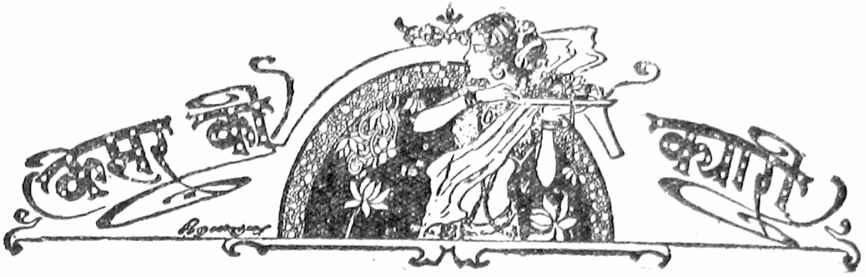
The fact that ‘classical’ Urdu verse also appeared in several Hindi journals of the period is all the more striking, given the apparent strengthening of distinctions between the two print worlds. The column titled ‘Kesar kī kyārī’ (literally flowerbed, and quite apparently a Hindi rendering of the common Urdu poetic image gulśan) in the Hindi monthly Cāṁd featured Urdu couplets selected by Sukhdeo Prasad ‘Bismil’ Ilahabadi and, while ranging widely, also regularly included compositions by him, his ustād Nur Narvi, and the latter's own ustād Dagh Dehlavi.Footnote 42 This selection is further noteworthy as it constituted an artistic and aesthetic statement in favour of a certain formalism in Urdu poetry, standing against reformist ideas. In addition, almost every aspect of its presentation of Urdu poetry points towards an aesthetic experience that was emphatically meant to be luxurious and indulgent, quite contrary to the norms of progressive literary values.
The graphic headline for the poetry selections of Bismil Ilahabadi that appeared in Cāṁd.

The process of canon formation was, as Orsini has demonstrated with regard to Hindi, directly dependent on the formal and institutional arrangements of education, in university syllabuses, and textbook production. It was in such contexts as these that literary canons were established and reproduced. In contrast, journals such as those discussed here provided a space to imagine an alternative canon, intimately bound up with issues of the creation of tastes and literary habitus, which transcended the divides of script and the increasing congruence between identifiers based on language and religious affiliation.
In this partly overlapping world of Hindi and Urdu poetics, two figures from this period stand out for their forthright advocacy of looking beyond the simplistic taxonomies of script and for practising what they preached. The first of these, Miraji (1912–49), would commonly be described as an Urdu poet, but one who ‘brought Braj, Awadhi, Hindi, Maithili back to Urdu’ through his poetry, particularly his gīt.Footnote 43 The second is Upendranath Ashk, who wrote two articles in 1938 for the Hindustani Academy Hindi journal, which also appeared in book form as Urdū Kāvya kī ek Naī Dhārā.Footnote 44 He discussed what he considered to be a significant positive shift in the oeuvre and outlook of some Urdu poets: a simultaneous move away from the traditional concerns and structures of classical Urdu poetics and an increasing acceptance of, and openness to, the influence of Hindi and other poetic traditions, exemplified in the pioneering works of ‘Hafiz’ Jalandhari, ‘Josh’ Malihabadi, and Miraji. As a writer and future publisher whose linguistic and literary habitus included Urdu, Punjabi, and Hindi, Ashk was involved in anthologizing and representing Urdu literature in Hindi throughout his life. He edited and published not only Saṅket, but also several other volumes of poetry in the 1960s.Footnote 45
The majority of Ashk's two articles is taken up with poetic quotations—comprising samplings of verse that Ashk had gleaned from a variety of Urdu journals and used to illustrate aesthetic and formal developments in Urdu poetry across an impressively wide range of themes. The first of these were ‘Kr̥ṣṇa ke gīt’. These are, unsurprisingly, songs on the life, beauty, and themes from the mythology of Krishna. Ashk cites an example by Maulvi Maqbul Ahmad Husenpuri, originally published in the Urdu journal Humāyūṅ, over whose poetry ‘the colour of Braj Bhasha prevails’, but which, had it not been published in an Urdu journal by a Muslim Urdu author, would be unlikely to be recognized as ‘Urdu’ at all:
Rādhā-svāmī / Antaryāmī / Paramānand kī rāh sujhāo / Baṃsīdhar maharāj hamāre / Hr̥day meṁ baṃsī bajāo. Footnote 46
Lord of Radha / supreme being / show the path to ultimate bliss / Our flute-playing king / play the flute in [my] heart.
Other selections in this section are in a similar linguistic vein, as is the original gīt by Hafiz Jalandhari, which Ashk considers to have been at the forefront of this literary revolution, and which he included in his later Urdū Kāvya—‘Banasrī bajāe jā!’:Footnote 47

Urdu gīt, then, as presented by Ashk, were almost thematically indistinguishable from the bhakti devotional lyrics of Braj.
In the case of other themes, too, Ashk interspersed poetic quotations with brief commentary or analysis, reinforcing at every opportunity the universal appeal, in his view, of these songs, and in particular their non-communal aspects. This is evidenced not only by his balanced selection of Hindu and Muslim writers throughout, but most especially in his section on “Ektā ke gīt” (Songs of Unity). Here, having quoted part of another song by Hafiz (“Apne man meṁ prīt”), Ashk commented:
Pañjāb sāmpradāyiktā ke lie badnām hai aur pañjāb ke musalmān sāmpradāyiktā ke kaṭṭar anuyāyī kahe jāte haiṁ. Usī pañjāb ke musalmān kavi ke muṁh se sāmpradayiktā ke viruddh aisī bāt nikalnā kyā gaurav kā viṣay nahīṁ hai, aur kyā yah navyug kī pratinidhi hindī bhāṣā ke prabhāv kā spaṣṭ pramāṇ nahīṁ haiṁ?
The Punjab is infamous for communalism, and Punjabi Muslims are said to be fierce adherents of communalism. Isn't it a great thing for such anti-communal sentiments to come from the mouth of a Muslim poet from that same Punjab, and isn't this clear evidence of the influence of the representative Hindi language of this new age?Footnote 48
This passage (which, for some reason, is absent from the later book that in many parts is otherwise a verbatim copy of the original articles) sheds further light on Ashk's understanding of modern Hindi and its relationship with Urdu. Ashk saw this process of influence as unproblematic, and ‘prabhāv’ is the word he employed most often to characterize the relationship between Hindi and Urdu poetry as regards this new trend. However, it is not clear that such a term carried particular connotations of subordination or submission on the part of the Urdu authors; rather, it would seem that Ashk was praising these various poets for looking beyond the narrow confines of ‘traditional’ Urdu, in terms of both register and form, and creating a form of Urdu poetry and song that was accessible to all.Footnote 49 It was for this reason that he reserved special praise for Miraji who, according to Ashk, had fulfilled the potential of this type of writing by expanding its horizons to include free verse, with great success.Footnote 50 Fundamentally, Ashk's understanding of Hindi and Urdu was a syncretic one: he saw these new forms of poetry as existing not so much at a point on a linear Hindi-Urdu spectrum, but in a broad and (probably intentionally) ill-defined arena that encompassed a broad range of registers, a malleability of form, and in which cultural influences from a variety of traditions—including Punjabi and, thanks to the efforts of Miraji among others, foreign poetry—were welcome. As an illustrative example, he quotes a poem by Maulana ‘Vaqar’:

The attractions this piece must have had for Ashk and his project are obvious. Vaqar created a nominally Urdu poem with a complete lack of what might be considered ‘excessively’ Persian- or Arabic-derived vocabulary. Moreover, in his warning against the debilitating effects of disunity he highlighted the dangers of rifts or schisms not merely in contemporary society, but by drawing on two foundational tales from Hindu and (at least Shi'a) Muslim community narratives. The point seems to be that a poetry of unity has the space for both. In Ashk's presentation of the poem, more emphatically, this was a form of poetry that defied easy or exclusive linguistic classification. This is not to say that all such practices that pointed towards a transcending of the linguistic or literary divide necessarily implied a desire to cross religious or communal divides—not even all of the examples included here. Nevertheless, in the face of powerful drives to create ‘pure’ Hindi and Urdu, and to separate out distinct literary canons and traditions and tastes, moments of non-conformity retain a special significance.
Such contrariness represented, in some cases, the endurance of a rich and diverse literary habitus, which persisted against the ultimately limited normative potential of the rupturing influences of these same nationalisms. In other cases, journals and publications acted as the means by which poets and poetry from the ‘other’ tradition were (re-)introduced to readers, and the consumption of śers became a part of Hindi reading practices, for example. In yet others, it took the form of creative experiments with language. By these efforts a new habitus was formed that itself laid the groundwork for an enduring set of tastes that would withstand the ravages of independence and partition. As Krishnadevprasad Gaur observed approvingly, it was indeed possible to create poetry of depth and meaning in a register that was accessible and free of the artificial, imported ‘excesses’ of Persian, Arabic, or Sanskrit vocabulary or conventions: a poetry which, even on close inspection, was almost impossible to classify as either ‘Hindi’ or ‘Urdu’.Footnote 52 A focus on these crossover figures, who themselves both searched for and helped to create the ‘common ground’ that is the focus of this article, in no way denies the reality of the quite frankly undeniable effect that linguistic and literary divisions ultimately had. It aims instead to broaden our understanding of the Hindi-Urdu field of cultural production, and to bring us a step closer to appreciating the nuances and slippages between these apparently separate fields that existed in the early decades of the twentieth century.
Some conclusions
I prefer never to ask, or answer, the question ‘What is Hindustani?’—it can be as cyclical today as it was in the decades leading up to Independence. Thankfully, that is not the question here: rather, I have been far more interested in what Hindustani meant to the writers and institutional actors of the period, and what some of the practical—literary, imaginative, associational—outworkings of these meanings were. The modern history of Hindi and Urdu as literatures and languages, and their association with discrete religious communities, has of course not been as straightforward or linear as studies might have suggested, and the spaces that existed, were (re-)created, and endured between the poles deserve our attention. Hindustani as a concept may—then as now—remain a fuzzy one, though that in itself does not denude it of utility. Moreover, in adopting what I have described as a policy of ‘strategic ambiguity’, it seems clear that at least one group of writers was endeavouring to fashion Hindustani as a progressive space of potential, in opposition to less flattering, and divisive, understandings of the term. In the projects of the Hindustani Academy, in the writings of Ashk, and in many other attempts to bridge the divide, it stood for a cultural and linguistic space of commonality and tolerance, wherein language might be delinked from the pernicious aspects of nationalism and religious communalism, and function instead as a site of communication, mutuality, and creativity—or, as a common ground.