Introduction
Kawasaki disease is an acute, febrile, exanthematous, self-limiting immune vasculitis that primarily affects small and medium-sized arteries. Reference Fukazawa, Kobayashi and Ayusawa1 The most serious complication is the involvement of the cardiovascular system with the occurrence of coronary artery lesions, including coronary artery dilatation and coronary artery aneurysms, which can progress to severe coronary artery stenosis and ischaemic cardiomyopathy, and it has become the leading cause of acquired cardiomyopathy in developed countries. Reference McCrindle, Rowley and Newburger2 The persistence of inflammatory damage to the vessel wall caused by Kawasaki disease makes it challenging to know when the affected coronary arteries have dilated to their maximum and when they begin to fade. Dynamic monitoring of the diameter size of the coronary arteries is required during the acute and recovery phases of Kawasaki disease. Coronary artery aneurysms can be classified into small, medium, and giant based on the size of the inner diameters and a standardised Z-score measured by echocardiography. Reference McCrindle, Rowley and Newburger2 Based on long-term follow-up data, most coronary artery aneurysms with a diameter of fewer than 6 millimetres can return to normal after 6 months. Reference Tsuda and Hashimoto3 In contrast, the diameter of giant coronary artery aneurysms remains relatively unchanged. Reference Liu, Luo and Hua4 In particular, coronary artery aneurysms with larger diameters are more likely to lead to severe cardiovascular events such as myocardial infarction, tumoral rupture, or even sudden death at a later stage if intervention is not provided promptly. Reference Ten, Chang, Hung and Chen5,Reference Miura, Kobayashi and Kaneko6,Reference Elias, Brothers and Hogarty7 The occurrence of giant coronary artery aneurysms negatively impacts the long-term prognosis and increases the mortality rate; therefore, it is crucial to promptly identify patients who may develop medium or giant coronary artery aneurysms and to treat and manage them effectively.
Risk factors for mild coronary artery dilatation and larger coronary artery aneurysms may be different. Previous studies have focused more on identifying risk factors for coronary artery lesions, Reference Suzuki, Kakimoto and Tsuchihashi8,Reference Kobayashi, Fuse and Sakamoto9,Reference Schwartzenburg, Strelow and Chowdhury10 with fewer models predicting medium–giant coronary artery aneurysms and presenting relatively insufficient sample sizes. Further distinction between medium–giant coronary artery aneurysms and other coronary artery lesions is necessary. The lack of specific laboratory tests delays the diagnosis of Kawasaki disease, resulting in atypical clinical symptoms being delayed, and may result in some coronary artery damage not being discovered in time. Echocardiography, as a non-invasive test, can only be positively detected in children who have already suffered from coronary artery lesions, which is not indicative in the early stages of the disease. Additionally, echocardiography for children is not yet a fully mature technology in some areas and hospitals, resulting in limitations in its application. In contrast, blood indices may better reflect the changes in coronary artery lesions in children with Kawasaki disease at an early stage, and we expect to identify some meaningful indices that predict medium–giant coronary artery aneurysms in children with Kawasaki disease in a timely and efficient manner. On the one hand, we can identify the potential high-risk population and provide meaningful guidance for their further examination and treatment plan. On the other hand, we can predict the type of coronary artery injury initially and assess their prognosis to a certain extent. This study aims to enhance the diagnostic accuracy of medium- to giant-sized coronary artery aneurysms by examining specific related blood indicators, thereby providing a crucial scientific basis for timely clinical intervention and ultimately reducing the incidence of coronary artery aneurysms.
Methods
Research population
In this study, the medical records of 6,540 children with Kawasaki disease hospitalised at Wuhan Children’s Hospital from January 2011 to December 2023 were enrolled for a retrospective case–control study. The data collected included demographic variables (sex, age, height, and weight), clinical characteristics (whether it was intravenous immunoglobulin resistance or not, whether it was complete Kawasaki disease or not), laboratory test variables (coagulation function, blood routine, biochemical indicators, erythrocyte sedimentation rate, C-reactive protein, procalcitonin, etc.), and the occurrence of coronary artery lesions (specific involved coronary artery, internal diameter size, and Z-score). The children were divided into the medium–giant coronary artery aneurysms group and the non–medium–giant coronary artery aneurysms group based on their diagnosis at the time of discharge and the results of colour Doppler echocardiography, to analyse the differences in the above indices between the two groups.
Research methods
-
1. Diagnostic criteria for Kawasaki disease: Complete Kawasaki disease consists of a fever (> 38°C) in the absence of any other cause and meets at least four of the following criteria: polymorphic rash (any type of rash), non-exudative conjunctival congestion, oral mucosal erythema (including lips, pharynx, or tongue), peripheral changes of the extremities (including erythema and/or swelling of the hands or feet), and unilateral enlarged neck lymph nodes (diameter greater than 1.5 cm). Patients with only 2 or 3 major clinical features except fever were considered to have incomplete Kawasaki disease after other possible causes of fever had been excluded. Reference McCrindle, Rowley and Newburger2
-
2. Definition and types of coronary artery lesions: Classification according to the latest American Heart Association statement: coronary artery dilatation only: Z-score 2 ∼ < 2.5; small coronary artery aneurysms: Z-score 2.5 ∼ < 5; medium coronary artery aneurysms: Z-score 5 ∼ < 10, or absolute diameter<8 mm; giant coronary artery aneurysms: Z-score ≥ 10, or absolute diameter ≥ 8 mm. Reference McCrindle, Rowley and Newburger2
-
3. Inclusion criteria: (1) Age < 18 years; (2) consistent with the diagnosis of Kawasaki disease; (3) children with a first-time diagnosis of Kawasaki disease, including complete Kawasaki disease and incomplete Kawasaki disease; (4) laboratory examinations before intravenous immunoglobulin treatment; and (5) complete clinical data.
-
4. Exclusion criteria: (1) Combination of CHD, cardiomyopathy, inherited metabolic disease or chromosomal abnormality, and haematologic neoplastic disease; (2) children with recurrence of Kawasaki disease or children recovering from the disease; (3) children who had already received relevant treatments such as intravenous immunoglobulin or glucocorticoids in the outside hospitals; (4) cardiac ultrasound at the time of admission had already suggested coronary artery dilatation or coronary artery aneurysms formation; (5) combination of serious complications, including shock and haemophagocytic syndrome, etc.; and (6) missing data.
-
5. Therapeutic regimen: All children diagnosed with Kawasaki disease were treated with intravenous immunoglobulin 2 g/kg and aspirin 30–50 mg/kg/day; the aspirin dosage was reduced to 3–5 mg/kg/day after normalisation of C-reactive protein. Children resistant to intravenous immunoglobulin were treated with a second dose of intravenous immunoglobulin or intravenous methylprednisolone, or a combination of both.
-
6. Cardiac ultrasound: We recorded cardiac ultrasound data of the children within 2 weeks from the onset of the disease and before intravenous immunoglobulin injection, including the maximal diameters of the left coronary artery, the left anterior descending, the left circumflex coronary artery, and the right coronary artery. The Z-score was calculated and normalised by body surface area and then classified according to maximum diameter and Z-score. The cardiac ultrasound was reviewed every 2–3 days during hospitalisation as needed. If the coronary artery had changed in size, the larger value was taken as its outcome. The cardiac ultrasound was performed independently by two paediatric cardiac ultrasound specialists, and another, more senior physician made the final decision when measurements did not agree.
Observation indicators
Demographic data, clinical characteristics, and laboratory test results were recorded. On the first day after admission, before intravenous immunoglobulin injection, venous blood specimens from all children with Kawasaki disease in the acute phase were collected for testing. The key indices included coagulation function, blood routine, electrolytes, liver function, kidney function, erythrocyte sedimentation rate, C-reactive protein, and procalcitonin. The type of Kawasaki disease (intravenous immunoglobulin resistance or not, complete/incomplete, and the occurrence of medium–giant coronary artery aneurysms) was also recorded. The age, sex, height, and weight of the children were also recorded at the time of admission to the hospital.
Methods of statistical analysis
SPSS 27.0 system software was used to analyse the clinical data. For the measurement data, the Kolmogorov–Smirnov test was used to examine whether they conformed to a normal distribution. Those that conformed to a normal distribution were expressed as mean ± SD. The comparison between groups was made using the independent samples t-test, and those that did not conform to a normal distribution were expressed as median and quartiles. The comparison between groups was made using the non-parametric test. Count data were expressed as the number of cases and the percentage, and the chi-square test was used for comparison between groups. P< 0.05 suggested that there was a statistically significant difference.
The variables preliminarily screened out through univariate analysis may still be quite numerous. Each variable has a different degree of influence on the outcome, and multicollinearity exists among some variables. Directly constructing a model using these indicators may result in a relatively complex model. Therefore, we need to further filter the variables. Least absolute shrinkage and selection operator regression analysis can help us achieve this process. Its advantage lies in its ability to select representative variables from the correlated set. After modelling, it can output a simplified, interpretable model containing only key variables, thereby enhancing the model’s generalisation capability.
We screened the predictors for the above statistically significant variables using the least absolute shrinkage and selection operator regression in R 4.2 software with the “glmnet” function package. The optimal penalty coefficients (lambda) were determined based on 10-fold cross-validation, and non-zero coefficient variables were selected for inclusion in the binary logistic regression model, and the backward stepwise regression method was used to obtain the final model. To comprehensively evaluate the performance of the model, we plotted the receiver operating characteristic curve and calculated the area under the curve to assess the model’s discriminatory ability. The optimal cut-off value was determined by the Youden index derived from the calculated sensitivity and specificity.
Results
Comparison of general information
A total of 6,540 children with Kawasaki disease were enrolled in this study, of which 4,236 were male and 2,304 were female, with a male-to-female ratio of 1.83:1.00, and a median age of 2.24 (1.19, 4.18) years; complete Kawasaki disease was 6,102 (93.3%) and incomplete Kawasaki disease was 438 (6.7%); intravenous immunoglobulin resistant Kawasaki disease was 357 (5.5%) and reactive type was 6,183 (94.5%). There were 162 (2.5%) medium–giant coronary artery aneurysms, including 56 (0.9%) large coronary artery aneurysms. The children were categorised into the medium–giant coronary artery aneurysms group and the non–medium–giant coronary artery aneurysms group. The results of univariate analysis showed that the percentage of male (74.7% versus 64.5%, P< 0.001) and intravenous immunoglobulin resistant (25.3% versus 5.0%, P< 0.001) in the medium–giant coronary artery aneurysms group were considerably higher than in the non–medium–giant coronary artery aneurysms group. There was no statistically significant difference between the two groups in terms of age, height, weight, and whether the children had complete Kawasaki disease (P> 0.05) (Table 1).
Comparison of demographic and clinical characteristics between the medium–giant CAA group and the non–medium–giant CAA group

CAA = coronary artery aneurysms; IVIG = intravenous immunoglobulin; KD = Kawasaki disease; IKD = incomplete Kawasaki disease; CKD = complete Kawasaki disease.
Comparison of clinical data between the medium–giant coronary artery aneurysms group and the non–medium–giant coronary artery aneurysms group
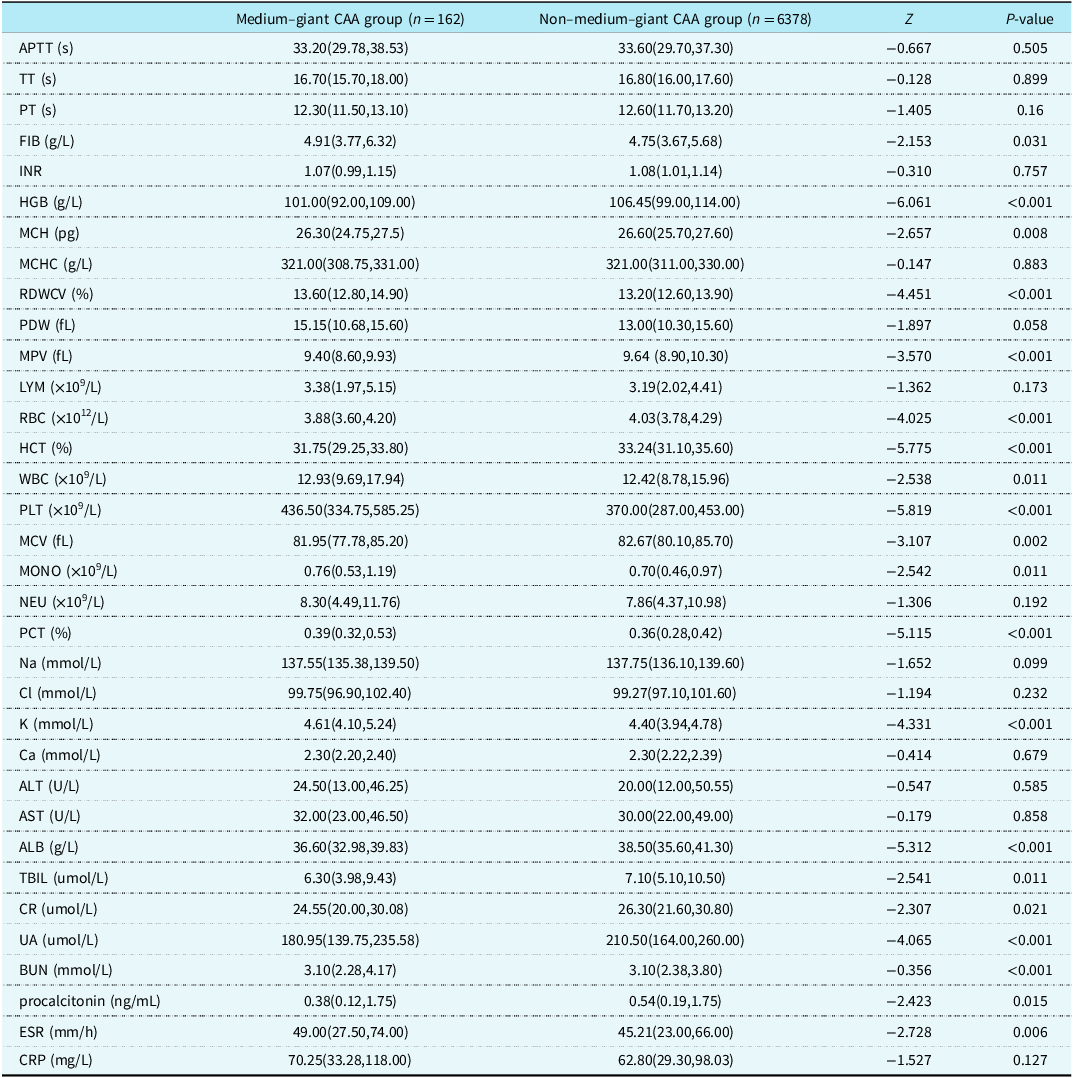
Laboratory indices of the two groups of children before treatment with intravenous immunoglobulin were analysed, including several indices related to coagulation function, blood routine, electrolytes, liver function, kidney function, as well as three infection indices: erythrocyte sedimentation rate, C-reactive protein, and procalcitonin. The results showed that the fibrinogen, red cell distribution width coefficient of variation, leukocyte counts, platelet counts, monocyte counts, platelettcrit, potassium ion levels, and erythrocyte sedimentation rate were significantly higher in the medium–giant coronary artery aneurysms group compared to the non–medium–giant coronary artery aneurysms group, and the difference between the two groups was statistically significant (P< 0.05). In contrast, haemoglobin, mean content haemoglobin, mean platelet volumes, erythrocytes, haematocrit, mean corpuscular volume, albumin, total bilirubin, creatinine, uric acid, urea nitrogen, and procalcitonin were lower than those in the non–medium–giant coronary artery aneurysms group (P< 0.05). There was no statistically significant difference in activated partial thromboplastin time, thrombin time, prothrombin time, international normalised ratio, mean corpuscular haemoglobin concentration, platelet distribution width, lymphocyte, neutrophil, sodium, chloride, calcium, alanine aminotransferase, aspartate aminotransferase, and C-reactive protein (P> 0.05) (Table 2).
Comparison of laboratory indices between the medium–giant CAA group and the non–medium–giant CAA group

CAA = coronary artery aneurysms; APTT = activated partial thromboplastin time; TT = thrombin time; PT = prothrombin time; FIB = fibrinogen; INR = international normalised ratio; HGB = haemoglobin; MCH = mean content haemoglobin; MCHC = mean corpuscular haemoglobin concentration; RDWCV = red cell distribution width coefficient of variation; PDW = platelet distribution width; MPV = mean platelet volumes; LYM = lymphocyte; RBC = erythrocytes; HCT = haematocrit; WBC = leukocyte counts; PLT = platelet counts; MCV = mean corpuscular volume; MONO = monocyte counts; NEU = neutrophil; PCT = plateletcrit; Na = sodium; Cl = chloride; K = potassium ion levels; Ca = calcium; ALT = alanine aminotransferase; AST = aspartate aminotransferase; ALB = albumin; TBIL = total bilirubin; CR = creatinine; UA = uric acid; BUN = urea nitrogen; ESR = erythrocyte sedimentation rate; CRP = C-reactive protein.
Independent risk factors for the occurrence of medium–giant coronary artery aneurysms
Multiple statistically significant variables identified through univariate analysis were included in the least absolute shrinkage and selection operator regression, ultimately yielding four meaningful correlation variables: intravenous immunoglobulin resistance, haemoglobin, platelet count, and albumin (Figures 1 and 2). Using the occurrence of medium–giant coronary artery aneurysms as the dependent variable and the above four indicators as independent variables, using binary logistic regression to construct the model, the results showed that intravenous immunoglobulin resistance (OR = 6.474, 95%CI = 4.399 ∼ 9.528, P< 0.001), platelet count elevation (OR = 1.003, 95%CI = 1.002 ∼ 1.004, P< 0.001), and albumin reduction (OR = 0.912, 95%CI = 0.879 ∼ 0.946, P< 0.001) were independent risk factors affecting the occurrence of medium–giant coronary artery aneurysms. The probability of occurrence of medium–giant coronary artery aneurysms in a child with Kawasaki disease was P = 1/1 + e-z, of which Z = –3.49 + 1.868* intravenous immunoglobulin resistance +0.003* platelet count −0.092 * albumin (Table 3). Using the Hosmer–Lemeshow test to assess the model’s calibration, we obtained a P-value of 0.702 (P> 0.05), indicating that the model’s predicted probability was not significantly different from the actual probability. The receiver operating characteristic curve was plotted according to the model, and the area under the curve was 0.75 (95%CI = 0.711–0.793), indicating a predictive value. According to the principle of the maximum Youden index, when the cut-off value was 0.408, the sensitivity of the prediction was 62.3% and the specificity was 79.2% (Figure 3).
LASSO regression coefficient path. X-axis: Log Lambda values, ranging from −11 to −4. The Log Lambda value is the regularisation parameter in LASSO regression that controls the strength of the penalty applied to the coefficients. Y-axis: The magnitude of the coefficients, indicating the strength of the association between the predictor variables and the response variable. Plot elements: This plot illustrates how the coefficients of various predictor variables change with different Log Lambda values. Non-zero coefficients at a given Lambda level indicate that the variable is selected as a predictor in the model at that level of regularisation. Computational method: We employed cross-validation to determine the optimal Lambda value. Specifically, we calculated the cross-validated error for each Lambda value and selected the one that minimised the error (lambda. min = 0.00052382). Additionally, we chose a more conservative Lambda value within one standard error of lambda. min (lambda.1se = 0.00936923) to balance model complexity and predictive accuracy. The final model was constructed based on lambda.1se, selecting the following four predictor variables: IVIG, PLT, HGB, and ALB. LASSO = least absolute shrinkage and selection operator; IVIG = intravenous immunoglobulin; PLT = platelet counts; HGB = haemoglobin; ALB = albumin.

LASSO regression cross-validation curve. X-axis: Log Lambda values, ranging from −11 to −4. Y-axis: Binomial deviance, a measure of how well the model fits the data. Plot elements: This plot displays the model’s binomial deviance across various Lambda values. A smaller Lambda indicates a more complex model, while a larger Lambda suggests a simpler model. Computational method: We assessed model performance by comparing binomial deviance at different Lambda values. The selection of lambda. min or lambda. 1se was based on cross-validation error. At lambda. 1se, the model maintains a good fit while selecting the minimal number of predictor variables, thus avoiding overfitting. This approach ensures the model’s generalisability, allowing us to identify the four most influential predictor variables from a pool of candidates. LASSO, least absolute shrinkage and selection operator.

ROC curve analysis of the risk prediction model for medium–giant coronary artery aneurysms. The ROC curve for the predictive model was plotted, with an AUC was calculated to be 0.75, suggesting that the model has certain predictive value for medium–giant coronary artery aneurysms. ROC = receiver operating characteristic; AUC = area under the curve.

Binary logistic regression analysis of medium–giant CAA in children with KD

After performing least absolute shrinkage and selection operator regression analysis, we identified four significant variables: IVIG-resistant, platelet counts, haemoglobin, and albumin. However, subsequent logistic regression analysis showed that the P-value of haemoglobin was greater than 0.05, so this variable was excluded. Eventually, we obtained three variables with predictive value: IVIG-resistant, platelet counts, and albumin.
CAA = coronary artery aneurysms; KD = Kawasaki disease; IVIG = intravenous immunoglobulin; SE = standard error; OR = odds ratio; CI = confidence interval.
Discussion
The presence and severity of coronary artery lesions are the key to influencing the course and prognosis of children with Kawasaki disease, so it is crucial to explore the risk factors for medium–giant coronary artery aneurysms. The incidence of medium–giant coronary artery aneurysms in this study was 2.48%, which is 0.92% lower than that reported in epidemiological studies of Kawasaki disease in China. Reference Xie, Yan and Huang11 Several studies worldwide have demonstrated that the neutrophil difference before and after initial intravenous immunoglobulin injection, age, male sex, duration of fever, intravenous immunoglobulin resistance, platelet count, haemoglobin, erythrocyte sedimentation rate, and delay in treatment can be used to predict medium–giant coronary artery aneurysms in children with Kawasaki disease. Reference Zhao, Wu and Liu12,Reference Jiang, Li and Xu13,Reference van Stijn, Korbee and Netea14 However, the characteristics of Kawasaki disease vary across different regions, and foreign standards of evaluation cannot be applied entirely to domestic children. Additionally, the existing models cannot accurately predict all occurrences of coronary artery aneurysms in children with Kawasaki disease. Reference Huang, Dong and Wang15 In this study, we compared clinical data of children with Kawasaki disease and incorporated statistically significant variables from Tables 1 and 2 into least absolute shrinkage and selection operator regression analysis. We observed that the regression coefficients gradually decreased to zero as the log(λ) value increased (Figure 1). When lambda.1se was taken, the model demonstrated excellent performance and was more streamlined (Figure 2). A risk prediction model was established through logistic regression analysis, ultimately 40 clinical indicators were reduced to 3 key indicators. The results indicated that intravenous immunoglobulin resistance, high platelet counts, and low albumin levels could be good predictors. Among these, intravenous immunoglobulin resistance and platelet count were risk factors, while albumin was a protective factor (Table 3).
Several domestic and international studies have considered platelet count as a correlative factor for the development of coronary artery lesions in children with Kawasaki disease; however, inconsistencies exist in the current reports. Some studies have reported that the development of coronary artery lesions is associated with higher platelet counts, Reference Kawamura, Takeshita, Kanai, Yoshida and Nonoyama16,Reference Kuwabara, Yashiro and Kotani17,Reference Maric, Knezovic and Papic18 whereas others have obtained the opposite result. Reference Kobayashi, Inoue and Takeuchi19,Reference Li, Chen and Tang20 In our research, platelet counts were significantly higher in the medium–giant coronary artery aneurysms group, and the difference was statistically significant (P< 0.05). Logistic regression analysis further identified the elevated platelet count as an independent risk factor for medium–giant coronary artery aneurysms. Platelet is an anucleate blood cell originating from bone marrow megakaryocytes, which not only plays a crucial role in haemostasis and thrombosis but is also closely related to the development of inflammatory reaction. Reference Scherlinger, Richez, Tsokos, Boilard and Blanco21 It has already been shown that platelets can exacerbate cardiovascular inflammation in the mouse vasculitis model of Kawasaki disease, confirming the correlation between platelet counts and the severity of cardiovascular lesions. Reference Kocatürk, Lee and Nosaka22 Although the pathogenesis of Kawasaki disease has not yet been fully clarified, existing studies suggest that it is essentially a generalised immune vasculitis accompaniedby platelet activation, and associated with various factors, including immunity and genetics. Reference Burns23,Reference Shulman and Rowley24 During the inflammatory response, there is an increase in oxidative stress and the production of reactive oxygen species, coupled with platelet interactions with endothelial cells, which leads to platelet activation. Reference Khodadi25,Reference Neubauer and Zieger26 Activated platelets can interact with various leukocytes, Reference van Gils, Zwaginga and Hordijk27 triggering intercellular signal transduction and forming platelet leukocyte aggregates. Reference Schrottmaier, Mussbacher, Salzmann and Assinger28 These substances increase the expression of many inflammatory factors, including tumour necrosis factor α, interleukin, interferon α, and monocyte chemotactic protein. Reference Chao, Rebetz and Bläckberg29,Reference Ludwig, Hilger, Zarbock and Rossaint30 Leukocytes can regulate platelet production, leading to an increase in platelet count. Reference Petzold, Zhang and Ballesteros31,Reference Hall, Lennon, Hall, Urbaniak, Vickers and Barker32 This positive feedback between them further leads to the formation of thrombi and the production of a large number of inflammatory mediators. Reference Hottz, Quirino-Teixeira and Merij33 Children who have a higher platelet count are more likely to develop into medium–giant coronary artery aneurysms, possibly related to their more intense inflammatory response.
Other indicators in the complete blood count are also worthy of attention. Some scholars have reported that red cell distribution width coefficient of variation and plateletcrit may be involved in the pathogenesis of coronary artery lesions and can serve as predictive factors to help identify its occurrence, Reference Hanawa, Murasaki, Namba and Oishi34,Reference Yu, Ming, Cao and Li35,Reference Chen, Liu, Liu and Wu36 while a lower mean platelet volume can be used as an early diagnostic marker for Kawasaki disease. Reference Liu, Gao, Huo and Yi37,Reference Zheng, Wu, Zhang and Wu38 These indicators have been confirmed to be associated with the occurrence of Kawasaki disease or coronary artery lesions in previous studies, so we included them in the initial univariate analysis to further clarify whether they are related to medium–giant coronary artery aneurysms. The results showed that there were indeed significant statistical differences in these indicators between the two groups. However, they were excluded in the subsequent least absolute shrinkage and selection operator regression and logistic regression analyses and were not included in the predictive model. We believe that these indicators may have limited predictive contribution in the model and are not major determinants. Meanwhile, these parameters may have a certain degree of collinearity with the core indicators. Least absolute shrinkage and selection operator regression tends to select representative variables while discarding others to ensure the stability and interpretability of the model. Although these indicators did not become independent predictors, they still have potential clinical significance and could serve as exploration directions for future research. However, more multicenter or prospective studies may be needed to further clarify their importance in predicting coronary artery aneurysms.
Additionally, Table 2 shows that total bilirubin and procalcitonin are significantly lower in the medium–giant coronary artery aneurysms group, which appears to contradict our conclusion that “medium–giant coronary artery aneurysms may be associated with severe inflammatory responses.” Since these two parameters are not specific markers for diagnosing Kawasaki disease, we believe that such results may occur under certain circumstances. First, from the perspective of research design, retrospective studies are difficult to obtain complete original data of all paediatric patients and can only exclude the paediatric patients who lack these two parameters. Second, despite we have strictly stipulated the timepoints of blood collection, the duration of illness prior to admission varied among patients. Finally, these parameters themselves are dynamic and changing, and all of these can affect the measurement results and lead to a certain degree of deviation from the ideal result. Although we considered these two parameters were statistically significant by the results in Table 2, they were excluded during the subsequent further screening of variables. This indicates that these two parameters have no predictive value in this study and may have little relation to the occurrence of medium–giant coronary artery aneurysms.
Serum albumin concentration is relatively stable and changes slightly and is often used in clinical studies. Our study found that albumin levels in children with Kawasaki disease combined with medium–giant coronary artery aneurysms were significantly lower than those in children without medium–giant coronary artery aneurysms, which is consistent with previous study findings. Reference McCrindle, Li and Minich39,Reference Xie, Wang and Fu40 We believe that its reduction is owing, on the one hand, to insufficient synthesis and, on the other hand, to excessive loss in the vasculature. Albumin is an acute-phase response protein synthesised primarily in the liver (hepatocytes) to maintain plasma colloid osmolality. The inflammatory response resulting from Kawasaki disease can damage the function of hepatocytes and inhibit the synthesis of albumin, thereby decreasing serum albumin levels. Reference Tsai, Yu, Tang, Huang and Kuo41 In addition, migrating leukocytes and activated platelets accumulate in the vascular endothelium cells, while producing large amounts of vascular endothelial growth factor and various growth factors, which act on the damaged parts of the blood vessels, causing endothelial cell activation and microvascular injury, promoting microvascular leakage, and resulting in albumin infiltration into the outside of the blood vessel. Reference Ueno, Nomura and Hashiguchi42,Reference Leung, Cotran, Kurt-Jones, Burns, Newburger and Pober43 Albumin is also an effective marker for assessing the activity of inflammatory diseases; Reference Vlasakova, Bourque and Bailey44,Reference Soeters, Wolfe and Shenkin45 its level is closely influenced by the degree of systemic inflammatory response in the acute phase of the disease. Reference Eckart, Struja and Kutz46 A study by Yuhan Xia et al. found that patients with lower albumin levels had a higher risk of coronary artery lesion progression in the acute stage. Reference Xia, Qiu and Wen47 Low albumin levels may reflect the inflammatory response and the severity of coronary artery lesions in children with Kawasaki disease, thereby predicting the occurrence of medium–giant coronary artery aneurysms.
Our study also found a higher proportion of intravenous immunoglobulin resistance in children with medium–giant coronary artery aneurysms, and many studies have shown that intravenous immunoglobulin resistance is more likely to occur in coronary artery lesions. Reference Zheng, Li and Yue48 In addition, previous studies have shown that platelet and albumin levels have some correlation with intravenous immunoglobulin resistance and have been included in different risk scoring systems for predicting intravenous immunoglobulin-resistant Kawasaki disease. Reference Chiang, Huang, Kuo, Huang and Chang49,Reference Yang, Song, Zhang, Li and Li50 Because children with intravenous immunoglobulin-resistant Kawasaki disease have a relatively longer duration of illness and a higher proportion of severe cases, likely, the inflammatory response has not been fully controlled after the initial treatment, making it difficult for elevated platelets to come down, and albumin also continues to leak. Elevated platelets and decreased albumin in the blood during the acute phase reflect the severity of the disease’s inflammation, in part, and interact with the child’s responsiveness to intravenous immunoglobulin, which together contribute to the progression of the pathologic process of Kawasaki disease and the formation of coronary artery aneurysms. Children with relevant risk factors should receive high attention, and measures should be taken accordingly. In children with elevated platelets, even if the cardiac ultrasound is normal, antiplatelet therapy should be initiated as early as possible to prevent thrombosis. It should be reviewed dynamically to monitor the platelet trend and guide the timing of aspirin discontinuation. Children with low albumin levels during hospitalisation should be monitored more frequently for coronary artery dimensions to discover medium–giant coronary artery aneurysms and intervene to minimise complications to some extent. Children who do not respond to intravenous immunoglobulin during treatment should receive a second intravenous immunoglobulin or related second-line treatment, such as glucocorticoids, to reduce the risk of medium–giant coronary artery aneurysms.
Our results mainly involve routine blood indicators, which do not require extra blood specimens or more advanced testing techniques, are more easily accessible, and the model based on this information can be more readily applied in the clinic. The limitation of this study is that it is a single-centre retrospective study, and some laboratory items, such as ferritin and N-terminal pro-brain natriuretic peptide, which may be associated with medium–giant coronary artery aneurysms, were not routinely performed in the past and could not be included in the analyses. Risk models for the early prediction of medium–giant coronary artery aneurysms in children with Kawasaki disease need to be continuously perfected and should be further supplemented and verified by multicenter studies. Furthermore, due to the differences in the course of the disease at the time of diagnosis of Kawasaki disease in each child and the uncertainty of the exact time of development of coronary artery aneurysms, it is not possible to standardise the timing of cardiac ultrasound, which may result in some cardiac ultrasound results that do not reflect the most realistic situation of the coronary arteries. Nevertheless, the sample size of this study was relatively large, and many children underwent more than one cardiac ultrasound during their hospitalisation, which could have mitigated this bias to some extent.
In conclusion, intravenous immunoglobulin resistance, platelet elevation, and albumin reduction are independent risk factors for the development of medium–giant coronary artery aneurysms in children with Kawasaki disease. For high-risk children, we should pay close attention to their changing conditions, dynamically monitor their blood indexes, formulate appropriate individualised diagnosis and treatment plans during hospitalisation, and review them promptly after discharge to minimise the adverse effects of medium–giant coronary artery aneurysms.
Acknowledgements
None.
Financial support
This research received no specific grant from any funding agency, commercial or not-for-profit sectors.
Competing interests
None.
Ethical standard
This retrospective study was conducted by the Declaration of Helsinki and approved by the Institutional Review Board (IRB) of Wuhan Children’s Hospital (approval number: 2022R103-E01). Because only de-identified data routinely collected during standard clinical care were analysed, the requirement for individual informed consent—including that from the parents/guardians of participants younger than 16 years—was waived by the IRB. All patient identifiers were removed before data extraction, ensuring the dataset cannot be linked back to any individual.