Introduction
Rice is a key food crop that feeds over half of the world’s people (Singh et al., Reference Singh, Harsh, Stuti, Amit, Sachin and Dinesh2024). It provides 21 % of calories globally and 76 % in Southeast Asia, making it especially important there (Zhao et al., Reference Zhao, Lin and Chen2020). However, conventional rice cultivation requires large amounts of water, which is becoming unsustainable, especially in arid and semi-arid regions. As a result, researchers in paddy fields are seeking solutions to enhance water productivity and promote sustainable production. Rice is one of the most water-intensive crops globally, accounting for 34–40 % of the world’s total irrigation water withdrawals (Surendran et al., Reference Surendran, Raja, Jayakumar and Subramoniam2021). The seasonal water requirement for transplanted rice cultivation with flood irrigation (TPR) is estimated to be around 1000 to 2000 mm (Tuong and Bouman, Reference Tuong, Bouman, Kijne, Barker and Molden2003), including 150–250 mm for puddling, 400–700 mm for evapotranspiration (ET), and 100–500 mm for deep percolation and seepage losses. Although TPR consumes large amounts of water, it remains economically viable, particularly in Asia, which produces over 90% of the world’s rice (Kumar and Ladha, Reference Kumar and Ladha2011). Direct seeding of rice (DSR) cultivation is being proposed as an alternative method to improve water resource productivity. Research indicates that shifting from TPR to DSR could help conserve limited water and energy resources, minimize soil degradation, and reduce greenhouse gas emissions. The high water consumption in TPR leads to increased labour, high energy costs, soil degradation, and lower profits in the short term, ultimately resulting in unstable production in the long term (Kumar et al., Reference Kumar, Mishra, Mali, Mondal, Meena, Lal, Jha, Naik, Biswas and Hans2021; Jat et al., Reference Jat, Dungrani, Arvadia and Sahrawat2012).
The shift from traditional rice cultivation methods to more water-efficient practices is becoming increasingly important due to water scarcity and other environmental and economic factors. There are several water-saving methods for growing rice more efficiently. These include aerobic rice, DSR, AWD, saturated soil culture, drip irrigation, the System of Rice Intensification (using less water and organic inputs), and smart irrigation with Internet Of Thing (IoT) sensors (Mallareddy et al., Reference Mallareddy, Thirumalaikumar, Balasubramanian, Naseeruddin, Nithya, Mariadoss, Eazhilkrishna, Choudhary, Deiveegan, Subramanian, Padmaja and Vijayakumar2023). These methods have shown potential to reduce water consumption, labour costs, and greenhouse gas emissions while maintaining or even improving rice yields. Mallareddy et al. (Reference Mallareddy, Thirumalaikumar, Balasubramanian, Naseeruddin, Nithya, Mariadoss, Eazhilkrishna, Choudhary, Deiveegan, Subramanian, Padmaja and Vijayakumar2023) reviewed several articles on alternative rice productivity practices that improve water productivity. Based on the literature, they reported that methods such as aerobic rice, DSR, AWD, saturated soil culture, drip-irrigated rice, and a system of rice intensification can enhance water productivity in rice fields compared to traditional methods. In general, climate change, water scarcity, reduced access to labour, declining groundwater levels, population growth, and rising greenhouse gas emissions are among the factors that persuade farmers to cultivate rice directly to achieve better water-labour-energy efficiency (Nie et al., Reference Nie, Peng, Chen, Shah, Huang and Cui2012; Rasul, Reference Rasul2016). Liu et al. (Reference Liu, Hussain, Ml, Peng, Huang, Cui and Nie2015) compared the direct and transplanting cultivation methods of three rice cultivars in China in 2012 and 2013. Their results showed that in direct rice cultivation, 15 % less water was used than in transplanting, while the rice yield in both cropping systems was the same in both years and for all three cultivars.
Studies have shown that DSR can reduce water consumption by 33–57 % (Kaur and Mahal, Reference Kaur and Mahal2015), 8–12 % (Ishfaq et al., Reference Ishfaq, Akbar, Anjum and Anvara-Ul-Haq2020) compared to TPR, and can improve water productivity by 20–30 % (Soriano et al., Reference Soriano, Wani, Rao, Sawargaonkar and Gowda2018). Additionally, aerobic rice cultivation has been found to reduce water consumption by 30–51 % during the preparation phase and increase water productivity by 32–88 % while also reducing labour by 50 % and greenhouse gas emissions by 20–50 % compared to conventional rice cultivation systems (Weller et al., Reference Weller, Janz, Jörg, Kraus, Racela and Wassmann2016). Recent studies on rice cultivation systems by Akbar et al. (Reference Akbar, Islam, Hameed and Ahmad2023) demonstrate that drip irrigation significantly enhances water productivity compared to TPR. Their data revealed that rice grown under drip irrigation achieved 249 % higher water productivity relative to traditional flooded systems, and 197 % greater water productivity than AWD systems. However, this water-saving advantage came at the cost of reduced grain yields, highlighting a critical trade-off between water conservation and productivity in rice cultivation. Drip-irrigated direct-seeded rice (DSR) shows higher water productivity than flooded TPR, mainly due to reduced water losses from evaporation, percolation, and runoff in drip systems (Mallareddy et al., Reference Mallareddy, Thirumalaikumar, Balasubramanian, Naseeruddin, Nithya, Mariadoss, Eazhilkrishna, Choudhary, Deiveegan, Subramanian, Padmaja and Vijayakumar2023). Still, its effects on the yield have been controversial as there are reports of increased (Kumar et al. Reference Kumar, Singh, Sagar and Maurya2018), steady (Liu et al., Reference Liu, Hussain, Ml, Peng, Huang, Cui and Nie2015), and reduced (Sandhu et al., Reference Sandhu, Yadaw, Chaudhary, Prasai, Iftekharuddaula, Venkateshwarlu, Annamalai, Xangsayasane, Battan, Ram, Cruz, Pablico, Maturan, Raman, Catolos and Kumar2019) production. Despite the lack of conclusive evidence on yield, some studies have emphasized the economic efficiency of the DSR method compared to TPR (Sing, Reference Singh2014). Çolak (Reference Çolak2021) reported that while there was a decrease in rice yield in drip irrigation compared to flood irrigation, the water productivity in drip irrigation (0.83 Kg/m3) was about twice that of flood irrigation. The reduction of rice yield in drip irrigation for the treatments of 100, 125, and 150 % pan Evaporation (Ep) replenishment was 29, 20, and 15 %, respectively, when compared with flood irrigation. In other words, the highest rice yield was related to the 150 % Ep replenishment. As a result, drip irrigation treatment with 150 % Ep was recommended for rice production because this treatment saved about 45 % of water by reducing the yield by 15 %. Ramalu et al. (Reference Ramalu, Rao, Devi, Kumar and Radhika2016) reported that irrigation equivalent to 150 % Ep replenishment produced significantly higher (23 %) rice grain yield over 100 % Ep replenishment.
The increasing rate of paddy cultivation in Iran, particularly through traditional methods, is concerning due to the high water consumption, shrinking groundwater aquifers, and long-term instability of water resources. The failure to effectively propagate water-saving cultivation methods among groundwater exploiters is evident from the annual increase in areas under traditional rice cultivation in the country, as depicted in the 13-year trend in Figure 1 for crucial provinces. The substantial increase in rice cultivation areas from 51,000 ha in 2010 to 270,000 ha in 2019 in Khuzestan province and from 55,000 ha in 2010 to approximately 118,000 ha in 2019 in Golestan province indicates the growing reliance on traditional methods despite the water scarcity issues. The slight modification of rice cultivation methods in Fars province due to insufficient water resources reflects the challenges faced in transitioning to more water-efficient practices. The continuation of this trend, with the expansion of rice cultivation through conventional methods, is likely to deplete water resources, particularly groundwater, in the near future. It is essential to address the immediate benefits and economic incentives for farmers to encourage the adoption of water-saving cultivation methods. The implementation of AWD, DSR, or other water-efficient techniques could help mitigate the strain on water resources while maintaining rice production levels.
The 13-year (2010–2022) trend of the area under rice cultivation in the rice-growing provinces of the country.

Direct seeding is a crop establishment system where rice seeds are sown directly into the field, as opposed to the traditional method of growing seedlings in a nursery and later transplanting them into flooded fields. Studies have shown that TPR leads to the creation of a compacted soil layer, resulting in reduced water penetration (Farooq et al., Reference Farooq, Wahid, Lee, Ito and Siddique2009). On the other hand, farmers have turned towards Conservation Agriculture (CA), including zero or minimum tillage, to maintain sustainability. It is clear that CA is not directly relevant to TPR, but it is easily applicable in DSR. Evidence has shown that DSR will become the predominant rice cultivation method in most countries worldwide (Kumar and Ladha, Reference Kumar and Ladha2011). This study aimed to conduct a comparative evaluation of TPR and DSR cultivation methods to determine their effects on grain yield, total water consumption, and water productivity under alternate wetting and drying (AWD) and continuous flooding (CF) irrigation regime. The primary goal of this study was to compare DSR and TPR methods, evaluating their impact on grain yield, water consumption, and water productivity under different irrigation regimes.
Materials and methods
Study area
This experiment was conducted at the Gorgan Agricultural Research Station in northern Iran over two rice cropping seasons (2019–2020). The site (36°54′N, 54°25′E, 5 m above sea level) has an average annual temperature of 17 °C and receives 450 mm of rainfall per year. Figures 2 and 3 provide insights into the climatic conditions influencing the study area. Figure 2 illustrates the rainfall distribution for the years 2019 and 2020, showing monthly precipitation. Notably, July 2019 features a significant peak in rainfall, while August experiences minimal precipitation. In contrast, September and October exhibit increased rainfall, emphasizing seasonal variability. Figure 3 depicts the daily distribution of long-term reference evapotranspiration (ETo), derived from the meteorological data collected at the Hashemabad meteorological station, located approximately 10 km from the study site. This long-term ETo data, calculated using the Penman-Monteith equation (Allen et al., Reference Allen, Pereira, Raes and Smith1998) based on factors such as air temperature, relative humidity, wind speed, and sunshine hours, demonstrates seasonal fluctuations, with higher ETo values occurring during mid-year.
Seasonal distribution of rainfall at the experiment site.

Long-term distribution of daily reference evapotranspiration (ETo) in the study area.

Field experiment
The experiment employed a strip design with irrigation as the main factor, performed at four levels (sprinkler, I1; permanent flooding, I2; alternate wet and dry, I3 and tape, I4), and cultivation at three levels (direct seed in a dry bed, C1; non-puddle transplanting, C2 and traditional transplanting, C3). The area of the plots was 48 m2 (6 × 8). The plots were arranged in a randomized complete block design with three replications. Figure 4 illustrates the experimental layout for the study, showing the arrangement of the main water tube, water inlet, valves, and tape configuration. Each row represents a irrigation treatment (I1 to I4), while the columns indicate the cultivation method (C1 to C3). Valves are shown in the layout to control the inlet water flow, with each treatment connected by a main water tube for efficient water distribution. This configuration facilitates a comprehensive assessment of how different irrigation methods and cultivation practices interact within the defined experimental framework. The rice used (Fajr, IR62781-175-1-10) was in the high-yielding medium-ripening category. The cultivation methods involved land preparation steps, including ploughing, puddling, and levelling in C3 treatment, while in C1 (seed) and C2 (seedlings of 3 to 4 leaves of rice) treatments did not involve puddling. In the I3 treatment, 90o part-circle sprinklers were used in the four corners of each plot with a flow rate of 0.15 l/s. Since the intake rate of sprinklers, in this case, is four times a full circle, sprinklers were used at a low flow. In I4, the lateral distance and row spacing were 0.50 m and 0.20 m, respectively, with a dripper flow rate of 1.0 l/hr and a working pressure of 0.8–1.0 atmosphere. The tape drip irrigation system has a central control station for filtration and inlet pressure control. Land preparation started in early June. Ploughing and plotting were performed on June 2-3. In C3 cultivation, puddling was done on July 8 and 6 in 2019 and 2020, respectively.
Schematic map of the experimental design, numbers on the map are in m (I1 = Sprinkler, I2 = Continues flooding, I3 = Alternate wet and dry and I4 = Drip, C1 = Direct seeding, C2 = Direct seedling and C3 = Traditional transplanting; the numbers represent the distance in m).

In the C1 cultivation, seeds were sown directly at a rate of 60 kg/ha on June 10 and 7, and harvested on October 7 and 2 in 2019 and 2020, respectively. For C2 and C3 treatments, the transplants were sown on June 9 and 10 and harvested on October 17 and 18, respectively. The seedlings and seeds were simultaneously planted manually and via drilling, respectively. In the first two weeks after planting, to ensure the proper establishment of rice in the direct cultivation treatments, the soil moisture was maintained at field capacity (i.e., saturated), while in the seedling treatments the fields were flooded. Fertilizer consumption was determined based on soil test and the leaf colour chart method. The required nitrogen was provided from urea sources during three growth stages: tillering, stem elongation, and panicle initiation. For seedlings (C1 and C2) and seeding (C1), 260 and 270 kg/ha of nitrogen fertilizer were used in the first year, and 230 and 260 kg/ha in the second year, respectively. Additionally, phosphorus and potassium in the forms of super phosphate and potassium sulphate, at 150 and 200 kg/ha, respectively, were used before planting. The experimental plots were protected from weeds, pests, and diseases in accordance with the recommendations of local researchers.
Irrigation scheduling
The irrigation scheduling in the experiment was conducted using different methods based on the specific irrigation treatments. For flood irrigation treatments (i.e., I2 and I3), water height control was the primary method. In I2, the water height was consistently maintained at 3 to 5 cm throughout the growing season, with the inletting water being stopped approximately ten days before harvesting. In the I3 treatment, irrigation was done intermittently with the first irrigation occurring at a height of 3–5 cm. The inletting water was then cut off for a few days until the water disappeared from the plots (zero height) at which point watering started again. This intermittent process continued up to 10 days before harvest. In the I1 and I4 treatments, irrigation was scheduled using the evaporation pan method to estimate gross irrigation depth (Ig). To ensure accuracy, daily pan evaporation (Ep) measurements were recorded at 7:00 AM local time using a Class A evaporation pan installed at the experimental site, following FAO-56 (Allen et al., Reference Allen, Pereira, Raes and Smith1998). Meteorological data (temperature, humidity, and wind speed) were also collected to validate kp (pan coefficient) adjustments. Subsequently, the irrigation run time (T) was adjusted based on the intake rate (I) of sprinklers or drippers (Equations 3-5), as described by Lage et al. (Reference Lage, Bamouh, Karrou and El Mourid2003) and Doorenbos and Pruitt (Reference Doorenbos and Pruitt1977).
Crop coefficients (Kc) were selected based on growth stage following FAO-56 (Allen et al., Reference Allen, Pereira, Raes and Smith1998), with adjustments for local crop conditions. Effective rainfall (Pe) Calculated using the Soil Conservation Service (SCS) method (Anonymous, 1972). Irrigation efficiency (E) varied by system: 75 % for sprinklers (I1) due to wind drift losses, and 90 % for drip irrigation (I4) owing to minimized evaporation and deep percolation. Intake rate calibration, sprinkler and drip flow rates (qs, qt) were measured to ensure system uniformity, and irrigation performance was monitored throughout the experiment.
 $$ETc = Ep \times Kp \times Kc$$


 $$T = {{{I_g}} \over I}$$
where ETc: Crop evapotranspiration (mm); Ep: Pan cumulative evaporation (mm); Kp: Pan coefficient (adjusted for microclimate conditions); Kc: Crop coefficient (stage-specific); Ig: gross irrigation depth (mm); Pe: Effective rainfall (mm); E: Irrigation efficiency; I: Intake rate (mm/hr); q s and q t: Flow rates of sprinkler (L/s) and drip tape (L/hr) respectively; S l and S m: Spacing of laterals and emitters (m)m respectively; T: Irrigation run time (hr).
In I 1 (sprinkler) and I 4 (drip), irrigation was applied every other day and daily, respectively, with Ig dynamically updated based on real-time Ep data. In I 2 (continuous flood) and I 3 (intermittent flood), scheduling relied on ponding height (3–5 cm), monitored daily using calibrated rulers. Puddling stage: A uniform 125 mm water depth was applied initially. Seasonal water application: Varied by treatment: I 1: 6–32 mm (adjusted for canopy cover and evaporation losses), I 2 and I3: 6–50 mm (flood-dependent), I 4: 3–18 mm (precision drip, reducing percolation losses).
Measurements
During the growth season, various measurements and calculations were conducted for all treatments, including applied water, grain yield, harvest index (HI), stem and leaf weights, the number of seeds in spikes, and physical and economical water productivity (PWP and EWP). To control the volume of water entering the plots, a valve and a volumetric contour were used at the entrance of each treatment. Grain yield was measured at the harvest time, with 1-metre-long sections removed from each side of the plots. Additionally, ten random rice plants were taken from each plot, and the stems, leaves, and spikes were separated and weighed. The average number of seeds in each spike was estimated, and the HI was calculated by dividing the grain yield by the biomass. The physical and economical water productivity was obtained by calculating the ratio of grain yield (or income) to the total irrigation water and effective rainfall. To assess soil penetration resistance (SPR) in different rice cultivation and irrigation methods, SPR was measured at a 20-cm soil depth using a penetrometer (Hand Penetrometer Eijkelkamp, 06.01 model) 10 and 40 days after planting, as well as at the time of harvest for all treatments.
Statistical analysis
The experimental data were analysed using SAS software (version 9.4). A two-way analysis of variance (ANOVA) was performed to evaluate the main effects of four irrigation treatments and three cultivation methods, as well as their interaction effects. When ANOVA indicated significant differences (p < 0.05), mean comparisons were conducted using Duncan’s multiple range test at a 5% significance level to identify specific treatment differences. All assumptions of ANOVA (normality, homogeneity of variance, and independence) were verified prior to analysis. Additionally, the combined analysis across two growing years was performed to evaluate year-to-year variation and treatment consistency.
Economic analysis
This study employed engineering economics principles with a discounting approach to evaluate different irrigation treatments economically. The required data were collected in four main categories: (1) Planting data including land preparation costs (ploughing, levelling), fertilization, seed treatment, seedling preparation and transplanting costs, (2) Maintenance data including irrigation costs (by system type), weeding, cultivation and spraying costs, (3) Harvest data including reaping, packing, transportation and milling costs, and (4) Equipment data including depreciation, maintenance and repair costs for pressurized irrigation systems with a 15-year lifespan and drip tape replacement costs. Economic calculations were performed using the Benefit-Cost Ratio (BCR) formula (equation 6):
 $$BCR = {{\sum\nolimits_{t = 1}^n {{{{B_t}} \over {{{\left( {1 + r} \right)}^t}}}} } \over {\sum\nolimits_{t = 1}^n {{{{C_t}} \over {{{\left( {1 + r} \right)}^t}}}} }}$$
Where: B t = Benefits in year t; C t = Costs in year t; r = Discount rate; n = Project lifespan
Results
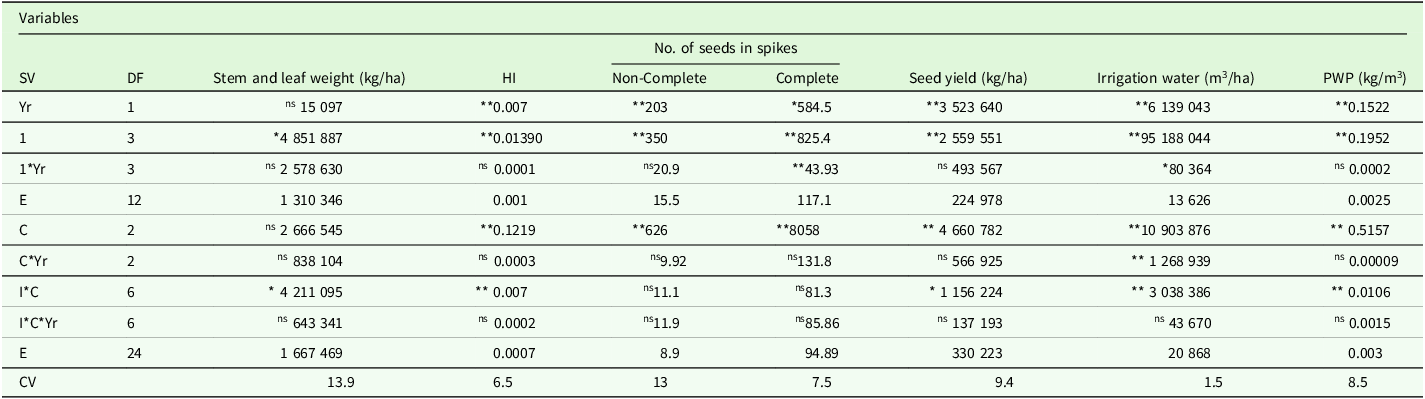
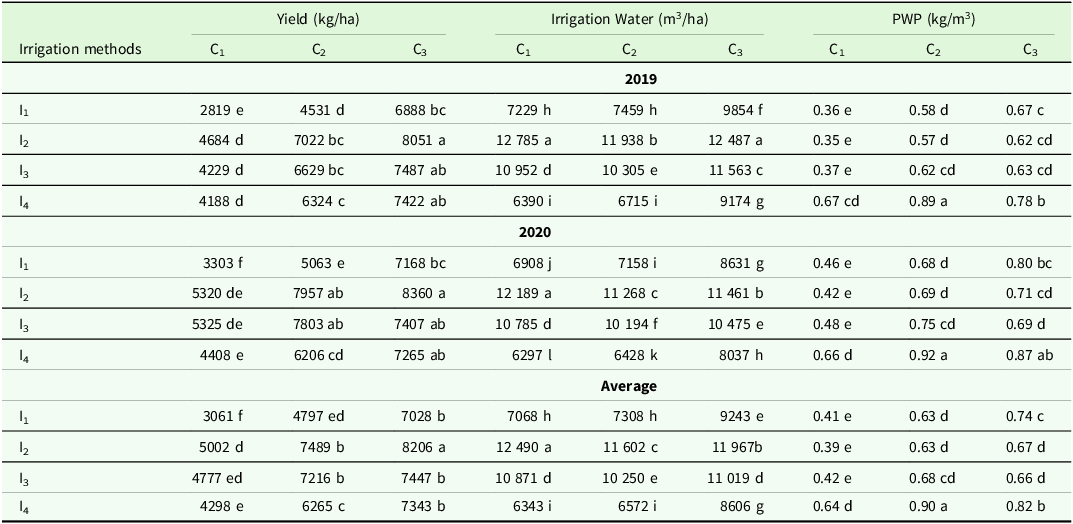
The statistical analysis of yield and related components, such as seed yield, stem and leaf weights, HI, number of complete and non-complete seeds in each spike, irrigation water, and PWP was conducted over two-year experiment, and the results are presented in Table 1. Additionally, Table 2 compares the mean values of seed yield, irrigation water and PWP separately for each year and over the two years. Overall, all the elements investigated exhibited statistically significant differences when comparing different irrigation methods. Furthermore, all factors showed statistically significant differences (P < 0.01) when comparing various cultivation methods except for the stem and leaf weights. However, the differences in the interaction between irrigation and cultivation methods were significant in all traits except for the number of seeds in spikes (Table 1).
Combined variance analysis for some of the rice characteristics based on mean squares

SV = Source of Variation, Yr =Year, I = Irrigation, C = Cultivation, E = Error, DF = Degree of Freedom, HI = Harvest Index, PWP = Physical Water Productivity, ns = non-significant; * P < 0.05, ** P < 0.01, *** P < 0.001, CV = Coefficient of Variation.
Interaction effects of cultivation method and irrigation method on yield, water consumption and PWP in rice

The same letters between numbers mean no significant.
I1 = Sprinkler, I2 = Continues flooding, I3 = Alternate wet and dry and I4 = Drip, C1= Direct seeding, C2 = Direct seedling and C3 = Traditional transplanting, PWP = Physical Water Productivity.
Comparisons of scenarios
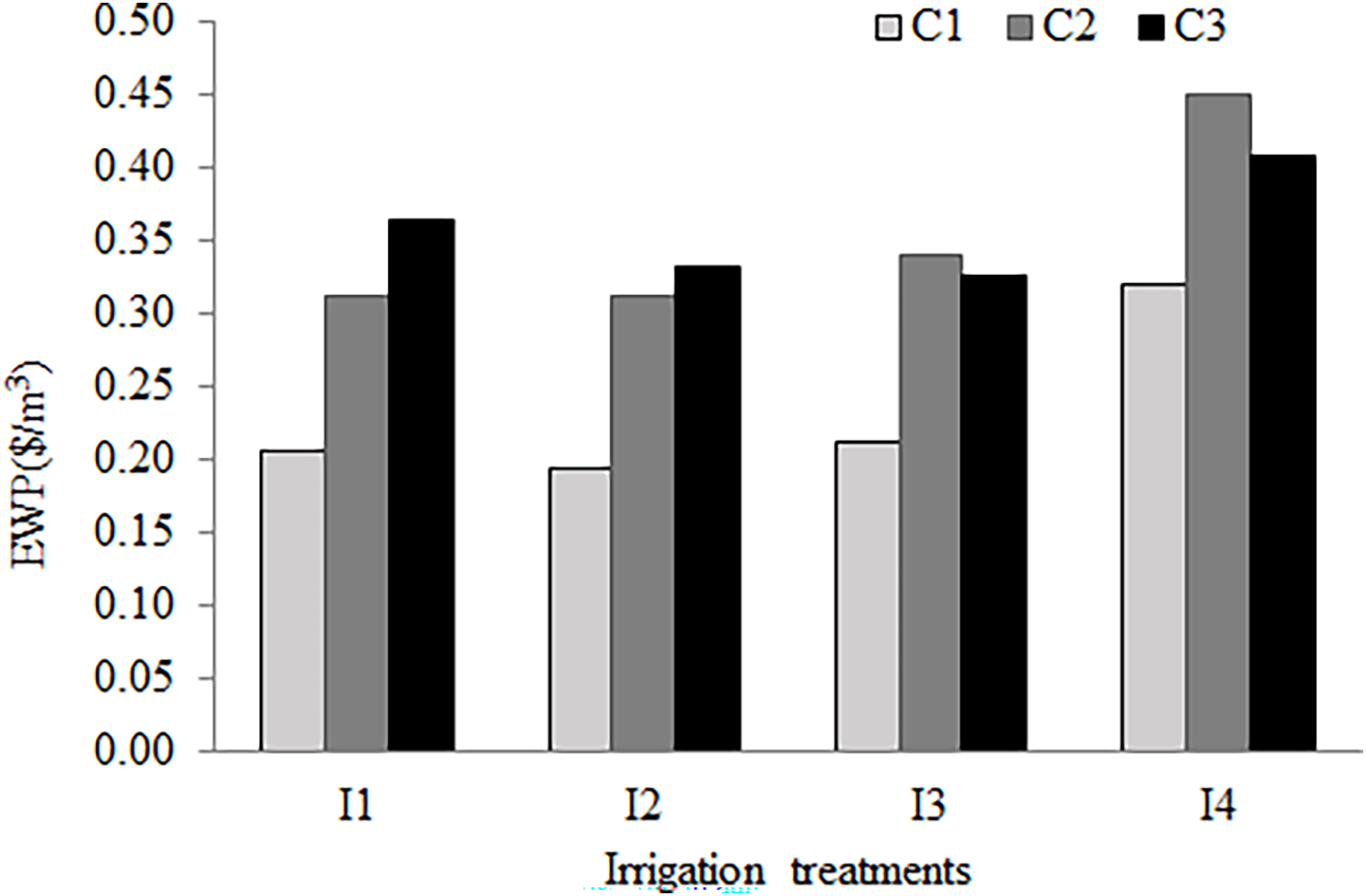
The two-year mean results showed that the highest yield (8206 kg/ha) was observed in the I2C3 treatment, and no significant difference was observed compared to the yields of other irrigation methods. However, in all irrigation methods, the yield was significantly reduced when changing from traditional seedling transplanting to the dry seed method (Table 2). Overall, rice yield in 2020 was approximately 7 % higher than in 2019. While seasonal rainfall variability can influence irrigation demand and yield, the exceptionally low total rainfall during the rice-growing seasons (2019: 73 mm; 2020: 43 mm) relative to crop water requirements (typically >1200 mm) significantly diminished its direct impact on yield and water savings. However, an analysis of temperature, particularly in August (the pollination stage), reveals that the average maximum temperature in 2019 was 31 °C, which is about 3 °C lower than in 2020. Specifically, during this month, there were 14 days in 2019 and only 2 days in 2020 when temperatures exceeded 35 °C. The two-year average number of incomplete rice grains in each spike in different cultivation methods (regardless of the irrigation strategy) was 29.8, 24.9, and 19.6 for the C1, C2, and C3 treatments, respectively, while the complete grains in the same treatments were equal to 108.5, 143.8, and 134.7, respectively (data not shown). The comparison of water usage in the sprinkler and drip irrigation methods with traditional seedlings revealed a significant reduction in water consumption compared to direct seeding. However, in flood irrigation methods (I2 and I3), dry seed cultivation consumed more water than traditional transplanting. The highest water use was observed in the I2C1 (12 490 m3/ha) and I2C3 (11 967 m3/ha) treatment (Table 2). Figure 5 presents the economic water productivity (EWP in USD/m3) of different irrigation treatments based on two-year averages. The economic water productivity analysis revealed that drip irrigation systems (I4) significantly outperformed other methods, with an average EWP of 0.4 $/m3 compared to 0.19 $/m3 for continuous flooding (I2). The optimal treatment (I4C2) achieved the highest EWP value of 0.5 $/m³, demonstrating 131 % improvement over conventional flood irrigation with direct seeding (I2C1). These results highlight the economic viability of water-saving irrigation technologies in rice production systems.
Economical water productivity (EWP) in different irrigation treatments (2 Year average). (I1 = Sprinkler, I2 = Continues flooding, I3 = Alternate wet and dry and I4 = Drip) and different cultivations (C1 = Direct seeding, C2= Direct seedling and C3 = Traditional transplanting).

Figure 6 illustrates the outcomes of yield and irrigation water usage across four irrigation treatments. The highest two-year average seed yields were observed in treatments I2 and I3, with averages of 6900 kg/ha and 6480 kg/ha, respectively; in contrast, treatment I1 recorded the lowest average yield of 4962 kg/ha. Furthermore, transitioning from treatment I2 to I4 resulted in significant decreases in yield and irrigation water applied, approximately 13 % and 40 %, respectively. The shift from I4C1 to I4C2 led to a 51 %, 41 %, and 46 % increase in rice yields for the years 2019, 2020, and over the two-year period, respectively, while the irrigation water usage increased by 5 %, 2.5 %, and 3.6 %. Additionally, converting from the traditional I2C3 to the direct seeding with drip method I4C1 reduced the volume of irrigation water by about 49 %, 45 %, and 47 %, while decreasing yield by approximately 48 % in the same years. Transitioning to I4C2 led to a notable increase in water productivity, with changes in values from 0.62, 0.71, and 0.67 kg/m³ to 0.89, 0.92, and 0.90 kg/m³ in 2019, 2020, and the two-year combined period.
The comparison of the average grain yield, and water consumption, under different irrigation methods (I1 = Sprinkler, I2 = Continues flooding, I3 = Alternate wet and dry and I4 = Drip).

The water-yield trade-offs revealed three distinct patterns: Flood Irrigation (I2/I3): Maximized yield (8206 kg/ha) but with high water use (11 967–12 490 m³/ha). Drip Irrigation (I4): I4C1 extreme water savings (47%) but severe yield penalty (48 %). I4C2 (Non-Puddled Transplant): Balanced scenario with 45% water savings and only 24 % yield loss. Sprinkler (I1): Lowest yield (4962 kg/ha) due to soil crusting in direct seeding.
Resistance to soil penetration
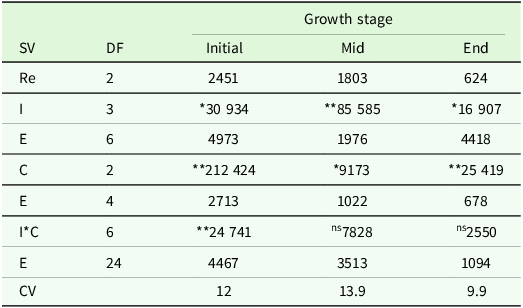
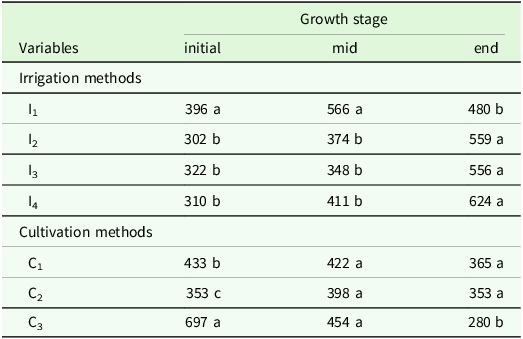
The results of variance analysis regarding the SPR index are presented in Tables 3 and 4, demonstrating a significant difference in soil penetration capacity between different irrigation and planting methods in the three stages of measurement. However, the interaction between irrigation methods in the context of the planting methods was significant only in the third stage, suggesting the gradual appearance of the outcome of this interaction at the end of the cultivation period (Table 3).
Variance analysis of penetration index (N/cm2) in three growth stages of rice in 2019

N = Newton.
SV = Source of Variation, Re = Repetition, I = Irrigation, E = Error, C = Cultivation, DF = Degree of Freedom, ns = non-significant; * P < 0.05, ** P < 0.01, *** P < 0.001, CV = Coefficient of Variation.
Separate effects of irrigation and planting method on soil penetration index (N/cm2)

The same letters in each column and at each stage mean no significant.
N = Newton, I1 = Sprinkler, I2 = Continues flooding, I3 = Alternate wet and dry and I4 = Drip, C1 = Direct seeding, C2 = Direct seedling and C3 = Traditional transplanting.
Cost-benefit performance
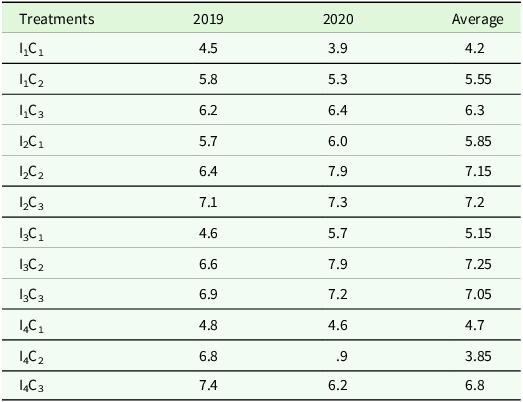
As presented in Table 5, a comprehensive economic comparison of irrigation methods was conducted, revealing that the highest short-term profitability (BCR = 7.2) was achieved by continuous flooding (I2C3) under Iran’s semi-arid conditions with subsidized water pricing. Significant water savings of 40–50 % were demonstrated by drip irrigation systems (I4 series, BCR = 4.7–6.8), while alternate wetting and drying (I3C2) was identified as an effective transitional technology, maintaining a BCR of 7.25 with 20 % reduced water use compared to flooding.
Results of economic evaluation and comparison of Benefit-Cost Ratios (BCR) for irrigation treatments in various rice cultivation methods

I1 = Sprinkler, I2 = Continues flooding, I3 = Alternate wet and dry and I4 = Drip, C1 = Direct seeding, C2 = Direct seedling and C3 = Traditional transplanting.
Discussion
Our results demonstrate a clear trade-off between irrigation efficiency and yield stability across systems, with the optimal balance achieved in drip irrigation using non-puddled transplanting (I4C2). This system reduced water use by 45 % while maintaining 76 % of conventional yield (I2C3), translating to a manageable 24 % yield gap primarily stemming from cold stress during grain filling in direct seeding (I4C1). Tashiro and Wardlaw (Reference Tashiro and Wardlaw1991) reported that the optimal temperature range during the grain-filling stage of rice is approximately 22 to 27 °C. It has been reported that whenever rice is exposed to temperatures above 35 °C for a brief period (approximately one hour) during the pollination phase, both the grain yield and quality are significantly reduced (Ye et al., Reference Ye, Tenorio, Argayoso, Laza, Koh, Redoña and Gregorio2015). The superior water productivity of I4C2 (0.90 kg/m³ vs 0.67 kg/m³ in flood irrigation) confirms global benchmarks while overcoming key limitations of dry seeding systems. These findings emphasize the significant impact of irrigation methods and cultivation practices on yield and water productivity in rice cultivation, indicating that careful selection of irrigation strategies and cultivation methods can yield substantial benefits.
Previous studies have consistently shown yield reductions in DSR (Sandhu et al., Reference Sandhu, Yadaw, Chaudhary, Prasai, Iftekharuddaula, Venkateshwarlu, Annamalai, Xangsayasane, Battan, Ram, Cruz, Pablico, Maturan, Raman, Catolos and Kumar2019; Cabngon et al., Reference Cabangon and Abdullah2002; Singh et al., Reference Singh, Singh, Johnson and Mortimer2005), attributing this to multiple factors: (1) reduced nutrient availability and soil carbon loss during drying-wetting cycles (Kumar and Ladha, Reference Kumar and Ladha2011), (2) suboptimal germination (Mallareddy et al., Reference Mallareddy, Thirumalaikumar, Balasubramanian, Naseeruddin, Nithya, Mariadoss, Eazhilkrishna, Choudhary, Deiveegan, Subramanian, Padmaja and Vijayakumar2023), (3) ineffective weed management (Rao et al., Reference Rao, Johnson, Sivaprasad, Ladha and Mortimer2007), (4) spikelet sterility under abiotic stresses (Bhushan et al., Reference Bhushan, Ladha, Gupta, Singh, Tirol-Padre, Saharawat and Gathalam Pathak2007), and (5) allelopathic residual effects from previous crops. These findings provide a scientifically validated pathway for sustainable rice cultivation in water-scarce regions, though farmer adoption will require targeted policy support and extension services to bridge the implementation gap.
When comparing the drip irrigation method to flood irrigation in the rice transplantation method (I2C3 to I4C3), the yield value decreased by 8 %, 13 %, and 14 % in 2018, 2019, and over the two years, respectively, while irrigation water was saved by approximately 27 %, 30 %, and 28 % for the same years, respectively. These findings are consistent with previous studies by Kumar and Ladha (Reference Kumar and Ladha2011), Kaur and Mahal (Reference Kaur and Mahal2015), and Liu et al. (Reference Liu, Hussain, Ml, Peng, Huang, Cui and Nie2015) that compared two cultivation methods in terms of water consumption. The decrease in yield in drip irrigation compared to flood irrigation is attributed to the possibility of the plant’s water needs not being fully met. It is suggested that the use of Kp and Kc based on FAO 56 (Allen et al., Reference Allen, Pereira, Raes and Smith1998) needs to be modified for drip irrigation of rice, as recommended by Çolak (Reference Çolak2021) and Ramulu et al. (Reference Ramalu, Rao, Devi, Kumar and Radhika2016). Direct seedling of rice in non-puddled soil with drip irrigation (I4C2) emerged as the most effective strategy compared to other scenarios, representing the primary outcome of this research. Sharda et al. (Reference Sharda, Mahajan, Siag, Singh and Chauhan2017) demonstrated that water productivity in rice with drip irrigation (0.81–0.88 Kg/m3) is higher than flood irrigation (0.42–0.52 Kg/m3), resulting in a 42 % reduction in total water inputs. Similar results have been reported indicating higher water productivity in DSR compared to TPR by Soriano et al. (Reference Soriano, Wani, Rao, Sawargaonkar and Gowda2018), Jabran et al. (Reference Jabran, Ullah, Hussain, Farooq, Haider and Chauhan2015), and Ishfaq et al. (Reference Ishfaq, Akbar, Anjum and Anvara-Ul-Haq2020). Therefore, to maintain stability, it is recommended to replace conventional methods with the drip irrigation system.
Farmers may hesitate to adopt direct seeding with drip irrigation due to reduced yield and limited economic benefits from water savings. Over two years, the I4C3 treatment produced 860 kg less rice per hectare than I2C3, equating to a $430 revenue loss (at $0.50/kg in 2020). Meanwhile, saving 3,300 m³ of water only translated to $56 in cost savings ($0.017/m³). These figures highlight the need for financial incentives or yield-enhancing strategies to encourage adoption. Mallareddy et al. (Reference Mallareddy, Thirumalaikumar, Balasubramanian, Naseeruddin, Nithya, Mariadoss, Eazhilkrishna, Choudhary, Deiveegan, Subramanian, Padmaja and Vijayakumar2023) also noted that farmers are unlikely to embrace a new technology if it only leads to reduced water usage without a corresponding increase in their income. However, the adoption of this method at the farm level depends on its acceptance by farmers, which is currently faces two main obstacles: the need to develop a device capable of planting one-month-old seedlings in non-paddle lands, and the necessity to prevent the reduction of rice yield in this system. To address these issues, two solutions have been proposed: 1 – A long-term solution, involving the use of a cultivar with a shorter growing season of approximately one month, and 2 – A short-term solution, to mitigate yield reduction by planting seedlings (3 to 4 leaves) in non-puddle soil. This would allow the filling grains of rice during the growth stage to be completed before facing autumn’s cold. Simultaneously, there is a need to implement incentive policies to encourage farmers to accept this system and send them a positive message regarding the preservation of sustainable water resources. As indicated, the use of I4C2 (DSR) method instead of I2C3 (TPR) led to a significant reduction in the amount of irrigation water (45 %), an increase in PWP (34 %) and EWP (36 %), and a slight decrease in yield (24 %). The most effective strategy to convince farmers is to compensate for their decreased income due to reduced production.
The results indicate that the initial stage in C3 cultivation, the drip method had the highest soil penetration resistance (SPR), whereas the sprinkler method exhibited the lowest, likely due to the highest intensity of sprinklers and associated soil compaction. This is likely due to the soil not being flooded and having less moisture in these treatments (I1 and I4), resulting in greater resistance compared to the two other treatments (I2 and I3). Traditional transplantation (C3) at this stage delivered the lowest SPR because the soil was saturated with water, causing the probe to penetrate more easily. In the mid-growing stage, the highest SPR was obtained in the I1C3 treatment, and the lowest value was related to the I2C2 treatment. At this stage, it is shown that except for the I1C3 treatment, almost all treatments delivered similar SPRs after about 50 days of planting. Since end-stage SPR values are essential for decision-making, it is notable that there was no significant difference (P < 0.01) between different irrigation methods in the context of conventional transplantation. Although the rate of SPR elevation was low in direct seed/seedling treatments, it was very high in traditional treatments, indicating the destruction of soil structure in this method at the end of the growing season. Similarly, TPR has been noted to create a hard pan in the subsoil layer, as reported in most areas where rice-wheat cultivation is common (Gathala et al., Reference Gathala, Ladha, Kumar, Saharawat, Kumar, Sharma, Sharma and Pathak2011, Singh et al., Reference Singh, Phogat, Dahiya and Batra2014).
Although flood irrigation showed superior economic returns under current subsidized water pricing, the 40–50 % water savings from drip systems present crucial sustainability advantages for Iran’s semi-arid conditions. The promising performance of AWD (I3C2) suggests its potential as a transitional technology. Three key policy interventions emerge from these findings: (1) targeted agronomic research to improve yields in water-efficient systems, particularly direct seeding under drip irrigation; (2) water pricing reforms to reflect true resource costs; and (3) subsidies for pressurized irrigation equipment. These measures would help align economic incentives with water conservation needs, especially considering the unaccounted environmental costs of groundwater depletion. While the two-year study period limits long-term conclusions, the results demonstrate that with proper support, water-saving technologies can achieve both economic and environmental objectives in Iran’s rice sector. Future research should incorporate the true cost of water resources and evaluate long-term system performance.
Conclusion
This study demonstrates that DSR can significantly reduce irrigation water use and improve water productivity (PWP and EWP) compared to traditional transplanting (TPR). Notably, our results demonstrate a measurable trade-off where the 45 % water savings in optimized drip systems (I4C2) came with a 24 % yield reduction relative to conventional flooding (I2C3), while maintaining superior water productivity (0.90 kg/m³). Traditional rice cultivation (i.e., soil puddling with continuous flooding irrigation) gradually deteriorates soil structure and increases soil resistance to water penetration, making land preparation for the next cultivation season challenging. While there are limitations to spreading DSR, such as the relative decrease in yield and the lack of suitable varieties and machinery for direct seedlings in non-puddled soil, and not having the appropriate coefficients to determine the rice water requirement in the DSR. Therefore, it is necessary to focus on overcoming these limitations in the future. This could involve research into subsurface drip irrigation, raised beds with furrow irrigation, using mulch to reduce evaporation, new cultivars with a shorter growing period, achieving a suitable nutritional formula, and considering incentive policies for water conservation.
Acknowledgements
The authors gratefully acknowledge the Rice Research Institute of Iran for all the support to implement this project. The authors express gratitude to Mr. Tabarsa R. and Mr. Haghtalab D. for their significant contributions to the project’s implementation. The authors acknowledge the use of an AI-powered tool for the purpose of improving the language and writing style in certain sections of this manuscript.
Author contributions
Kiani AR conceived and designed the study and wrote the manuscript, Yazdani MR collaborated on the proposal and conducted some data gathering.
Funding statement
This research received no specific grant from any funding agency, commercial or not-for-profit sectors.
Competing interests
The authors declare there are no conflicts of interest.
Ethical standards
Not applicable.