INTRODUCTION
Anaplasmosis is a tick-borne infectious disease of a variety of wild and domestic animals and human beings throughout the world. It is caused by a group of obligate intracellular bacteria in the genus Anaplasma (Rickettsiales: Anaplasmataceae), including Anaplasma phagocytophilum, Anaplasma marginale, Anaplasma ovis, Anaplasma bovis and Anaplasma platys (Dumler et al. Reference Dumler, Barbet, Bekker, Dasch, Palmer, Ray, Rikihisa and Rurangirwa2001). Among those, three Anaplasma species (A. phagocytophilum, A. marginale and A. bovis) have been detected in cattle and recognized as the agents of bovine anaplasmosis in China (Bai et al. Reference Bai, Chen, Ying, Liu and Zhou1987; Zhang et al. Reference Zhang, Wang, Cai, He, Cheng, Liu, Meng, Yang and Wang2013; Yang et al. Reference Yang, Li, Liu, Liu, Niu, Ren, Chen, Guan, Luo and Yin2015). Recently, an A. platys-like pathogen was also identified in cattle from Xinjiang, Northwest China (Yang et al. Reference Yang, Li, Liu, Liu, Niu, Ren, Chen, Guan, Luo and Yin2015).
The white yak (Bos grunniens) is a semi-wild and endemic species in Tianzhu Tibetan Autonomous County (TTAC) that relies heavily on white yaks farming for milk, meat and local economy. These animals inhabit in the alpine steppe ecoregion at altitude over 3000 m, with a population of ~49 400. Previous studies have reported that the Tianzhu white yaks are infected with Chlamydia abortus (Qin et al. Reference Qin, Huang, Yin, Tan, Liu, Zhou, Zhu, Zhou and Qian2015a ). Moreover, a high seroprevalence (17·76%) of tick-borne Babesia bigemina was also observed in them (Qin et al. Reference Qin, Wang, Ning, Tan, Yin, Zhang, Zhou and Zhu2015b ). Apart from the above reports, information on the Anaplasma infection is currently not available. The objective of this study was to determine whether and what species of Anaplasma agents infect white yaks in TTAC in Gansu Province, Northwest China. The molecular characterization of the identified Anaplasma strains was further analysed.
MATERIALS AND METHODS
Study sites
This study was carried out in TTAC in Gansu Province, Northwest China, with a total area of 7149 km2. Sampling sites were located between longitude 102°07′–103°46′ east and latitude 36°31′–37°55′ north in Gansu Province, Northwest China. The annual average temperature here is −8 to 4 °C, having an obvious vertical distribution of temperature.
Blood sampling and DNA preparation
The surveillance was performed from March to July in 2015 during the peak season of tick in rural areas in TTAC. EDTA whole-blood samples were taken from the jugular vein of 332 white yaks and collected in a sterile tube. Total DNA was extracted from 300 µL of blood using the Gentra Puregene DNA purification kit (Qiagen, Beijing, China) following the instructions of the manufacturer.
PCR and sequence analysis
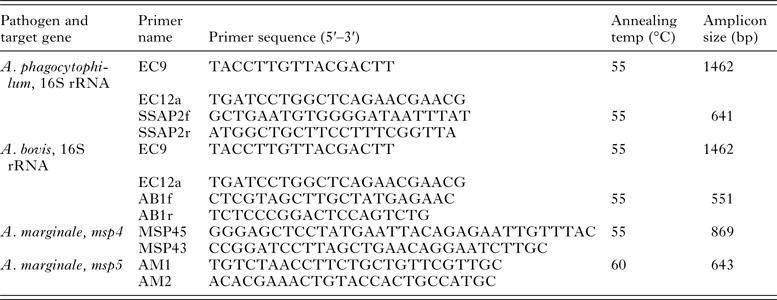
The total DNA was detected by nested PCR for the presence of A. phagocytophilum and A. bovis 16S rRNA gene and A. marginale major surface protein 4 (msp4) and major surface protein 5 (msp5) genes as previously described (de la Fuente et al. Reference de la Fuente, Van Den Bussche and Kocan2001; Kawahara et al. Reference Kawahara, Rikihisa, Lin, Isogai, Tahara, Itagaki, Hiramitsu and Tajima2006; Zhou et al. Reference Zhou, Hou and Piao2007; Zhang et al. Reference Zhang, Wang, Cai, He, Cheng, Liu, Meng, Yang and Wang2013). The PCR primers for 16S rRNA, msp4 and msp5 amplification were included in Table 1. The reaction was performed in an automatic thermocycler (Bio-Rad, Hercules, CA, USA) in a total volume of 25 µL containing 2·5 µL of 10 × PCR buffer (Mg2+ Plus), 2·0 µL of each dNTP at 2·5 mm, 1·25 U of Taq DNA polymerase (TaKaRa, Dalian, China), 2·0 µL of template DNA, 1·0 µL of each primer (20 pm) and 16·25 µL of distilled water. DNA extracted from whole blood of sheep infected with A. phagocytophilum and cattle infected with A. marginale and A. bovis was used as the positive control, and sterile water was used as the negative control for each run. Cycling conditions for PCR amplification were: 4 min of denaturation at 94 °C, 35 cycles at 94 °C for 30 s, annealing for 30 s (annealing temperatures of primers was listed in Table 1), and 72 °C for 1–1·5 min (dependent on the target gene), with a final extension step at 72 °C for 10 min. PCR products were determined by UV transillumination in a 1·0% agarose gel following electrophoresis and staining with ethidium bromide.
Primers and PCR amplification conditions

Positive PCR products were purified (TaKaRa Agarose Gel DNA purification Kit Ver.2·0, TaKaRa, China), cloned into pGEM-T Easy vector (Promega, USA) and transformed into Escherichia coli JM109 competent cells (TaKaRa, China). Two recombinant clones were selected for sequencing using BigDye Terminator Mix (Sangon, China). The obtained sequences were analysed by a BLASTn search in GenBank or by using the Clustal W method in the MegAlign software (DNAStar, Madison, WI). Phylogenetic trees were constructed based on the sequence distance method using the neighbour-joining (NJ) algorithm with the Kimura two-parameter model of the Mega 4·0 Software (Tamura et al. Reference Tamura, Dudley, Nei and Kumar2007).
Nucleotide sequence accession numbers
The GenBank accession numbers obtained in this study were as follows: KT824824–KT824833 (Ap20-a, Ap20-b, Ap31-a, Ap31-b, Ap54-a, Ap54-b, Ap5-a, Ap5-b, Ap12-a and Ap12-b) for A. phagocytophilum and KT824834–KT824851 (Ab20, Ab21-b, Ab21-c, Ab23-a, Ab23-b, Ab26-a, Ab26-b, Ab30-a, Ab30-b, Ab6-a, Ab6-b, Ab9-a, Ab9-b, Ab11-a, Ab11-b, Ab19-a, Ab19-b, Ab20-a) for A. bovis.
RESULTS
Out of 332 samples tested, 35 (10·9%) were positive for Anaplasma spp. The positive rates were 6·2% (20/322) and 5·3% (17/322) for A. bovis and A. phagocytophilum in white yaks, respectively. None of the sample was positive for A. marginale. Two (0·6%) samples were simultaneously positive to A. bovis and A. phagocytophilum.
To characterize the Anaplasma spp. detected in yaks, positive samples were sequenced. Twenty-eight sequences were obtained in this study: 10 for A. phagocytophilum and 18 for A. bovis. The partial 16S rRNA gene sequences of A. phagocytophilum (599 bp) and A. bovis (511 bp) were analysed. Alignment of these sequences revealed two genotypes of A. phagocytophilum in white yaks (ApG1 and ApG2). The similarity between ApG1 (Ap54-a, Ap54-b, Ap31-a and Ap 31-b) and ApG2 (Ap5-1, Ap5-b, Ap12-a, Ap12-b, Ap20-a and Ap20-b) was 98·5%. ApG1 were 98·8% identical to strains MR-23 (GenBank accession no. KP276588) isolated from Ixodes pacificus in the USA and Trbrt45 (GenBank accession no. KP745629) isolated from cow in Turkey. ApG2 were 100% identical to strain JC3-3 (GenBank accession no. KM186948) that was detected in the Mongolian gazelle from China. The 16S rRNA of A. bovis sequences identified in yaks were 99·6–100% identical to each other and to strain Ab4a (GenBank accession no. KJ639885) identified in red deer from Qilian-Mountain in Northwest China.
Phylogenetic analysis of 16S rRNA gene was conducted with A. phagocytophilum and A. bovis sequences in this study and selected sequences of Anaplasma spp. deposited in GenBank (Figs 1 and 2). The results revealed that ApG1 clustered independently from all known A. phagocytophilum sequences, ApG2 displayed a close relationship with the sequence amplified from Mongolian gazelle found in China (GenBank accession no. KM186948) (Fig. 1). All A. bovis strains from white yaks were classified into A. bovis cluster and contained two sequence types (ST1 and ST2) (Fig. 2).
Phylogenetic analysis of A. phagocytophilum (A. phago) based on 16S rRNA gene partial sequences. An alignment of 16S rRNA sequences from position 694 to 1334 of the sequence (based on strain ES34, GenBank accession no. AB196720) was used to construct this tree. Rickettsia rickettsii is used as an outgroup.

Phylogenetic analysis of A. bovis based on 16S rRNA gene partial sequences. An alignment of 16S rRNA sequences from position 60 to 610 of the sequence (based on strain ES1019, GenBank accession no. HQ913644) was used to construct this tree. Rickettsia rickettsii is used as an outgroup.

DISCUSSION
In the present study, molecular survey and characterization of Anaplasma pathogens was performed in white yaks. Our findings clearly demonstrated that the presence of A. phagocytophilum and A. bovis in white yaks from TTAC.
Anaplasma phagocytophilum has been recognized as an emerging pathogen of veterinary and human health significance (Chen et al. Reference Chen, Dumler, Bakken and Walker1994). In addition to humans, A. phagocytophilum infection has been reported in some domestic animals, such as sheep, goats and cattle (Aktas et al. Reference Aktas, Altay and Dumanli2011, Reference Aktas, Altay, Ozubek and Dumanli2012; Altay et al. Reference Altay, Dumanlı, Aktaş and Özübek2014). Anaplasma phagocytophilum is a wide spread tick-borne infection causing human granulocytic anaplasmosis and tick-borne fever in domestic ruminants, responsible for serious economic loss to sheep and cattle industry (Stuen, Reference Stuen2007). Several molecular surveys of A. phagocytophilum have been performed in ticks and domestic ruminants in China. In this study, A. phagocytophilum infection was reported in white yaks. The positive rate of A. phagocytophilum in white yaks (17/322, 5·3%) was much lower than in black yaks (51/158, 32·3%) and cattle-yaks (7/20, 35·0%) conducted in Gannan Tibetan Autonomous Prefecture in Gansu Province, and was slightly lower than that in cattle (8/125, 6·4%) in Xinjiang Province (Yang et al. Reference Yang, Liu, Guan, Liu, Li, Chen, Ma, Liu, Ren, Luo and Yin2013, Reference Yang, Li, Liu, Liu, Niu, Ren, Chen, Guan, Luo and Yin2015). In general, A. phagocytophilum is associated with Ixodes ticks, including I. pacificus, Ixodes dentatus and Ixodes scapularis in the USA (Goethert and Telford, Reference Goethert and Telford2003; Teglas and Foley, Reference Teglas and Foley2006); Ixodes ricinus and Ixodes trianguliceps in Europe (Bown et al. Reference Bown, Lambin, Telford, Ogden, Telfer, Woldehiwet and Birtles2008; Aktas et al. Reference Aktas, Vatansever, Altay, Aydin and Dumanli2010); Ixodes persulcatus in Asia (Cao et al. Reference Cao, Zhao, Zhang, Yang, Wu, Wen, Zhang and Habbema2003). However, the information on the epidemiology of the potential tick vectors is unclear in the study sites, therefore the investigation of tick species transmitting A. phagocytophilum in TTAC should be further carried out. To date, no transovarial transmission of A. phagocytophilum was described, except for Dermacentor albipictus ticks (abnormal feeding systems) (Baldridge et al. Reference Baldridge, Scoles, Burkhardt, Schloeder, Kurtti and Munderloh2009). Identification of reservoir hosts is important to prevent and control of A. phagocytophilum, that play a critical role in the maintenance of the agent in nature. Our results indicated that white yaks are part of the natural maintenance cycle of A. phagocytophilum. Anaplasma phagocytophilum can cause persistent infection in ruminants and other animals for several years (Brown and Barbet, Reference Brown and Barbet2016). The white yak serve as reservoir host may facilitate further spread of infection. In this study, sequence analysis showed two 16S rRNA genotypes of A. phagocytophilum (ApG1 and ApG2) existed in white yaks (Fig. 1). Considerable strain variation of A. phagocytophilum has been reported in different hosts or geographic locations, and four geographically dispersed ecotypes were identified based on groESL gene and showed significantly different host ranges in Europe (Jahfari et al. Reference Jahfari, Coipan, Fonville, van Leeuwen, Hengeveld, Heylen, Heyman, van Maanen, Butler, Foldvari, Szekeres, van Duijvendijk, Tack, Rijks, van der Giessen, Takken, van Wieren, Takumi and Sprong2014). It has been showed that the A. phagocytophilum ecotypes I in cattle were in the same group as those that infected human beings (Jahfari et al. Reference Jahfari, Coipan, Fonville, van Leeuwen, Hengeveld, Heylen, Heyman, van Maanen, Butler, Foldvari, Szekeres, van Duijvendijk, Tack, Rijks, van der Giessen, Takken, van Wieren, Takumi and Sprong2014). Although no human case was currently reported in TTAC, A. phagocytophilum infection in white yaks warrants further investigation.
Historically, A. bovis was usually reported in buffalo and cattle from South America and Africa (Ooshiro et al. Reference Ooshiro, Zakimi, Matsukawa, Katagiri and Inokuma2008). Recently, it has also been reported in cattle in continental Europe (Ceci et al. Reference Ceci, Iarussi, Greco, Lacinio, Fornelli and Carelli2014; Aktas and Ozubek, Reference Aktas and Ozubek2015). Aside from the aforementioned study, the agent was identified in other ruminant and non-ruminant animals such as sheep, goats, deer, cats, dogs and rabbits (Kawahara et al. Reference Kawahara, Rikihisa, Lin, Isogai, Tahara, Itagaki, Hiramitsu and Tajima2006; Ooshiro et al. Reference Ooshiro, Zakimi, Matsukawa, Katagiri and Inokuma2008; Sakamoto et al. Reference Sakamoto, Ichikawa, Sakata, Matsumoto and Inokuma2010; Liu et al. Reference Liu, Ma, Wang, Wang, Peng, Li, Guan, Luo and Yin2012; Tateno et al. Reference Tateno, Nishio, Sakuma, Nakanishi, Izawa, Asari, Okamura, Maruyama, Miyama, Setoguchi and Endo2013; Ben Said et al. Reference Ben Said, Belkahia, Karaoud, Bousrih, Yahiaoui, Daaloul-Jedidi and Messadi2015). In China, molecular evidence for the presence of A. bovis was reported in several wild and domestic animals including Reeves’ muntjac, Mongolian gazelle, red deer, sika deer, cattle and goats (Liu et al. Reference Liu, Ma, Wang, Wang, Peng, Li, Guan, Luo and Yin2012; Yang et al. Reference Yang, Li, Liu, Guan, Chen, Luo, Wang and Yin2014, Reference Yang, Li, Liu, Liu, Niu, Ren, Chen, Guan, Luo and Yin2015; Li et al. Reference Li, Chen, Liu, Liu, Yang, Li, Luo and Yin2015). In the present study, A. bovis infection was found in white yaks. The infection rate (6·2%, 20/322) was significantly lower than the 49·6% prevalence in goats in central and Southern China (Liu et al. Reference Liu, Ma, Wang, Wang, Peng, Li, Guan, Luo and Yin2012), and 42·7% in sheep and 23·8% in goats in Tunisia (Ben Said et al. Reference Ben Said, Belkahia, Karaoud, Bousrih, Yahiaoui, Daaloul-Jedidi and Messadi2015). However, it is almost comparable with 4·8% prevalence in cattle in Xinjiang, Northwest China (Yang et al. Reference Yang, Li, Liu, Liu, Niu, Ren, Chen, Guan, Luo and Yin2015). Sequences analysis revealed that A. bovis identified in this study were divided into two sequence types, indicating two different strains infected white yaks in TTAC. The ST1 has been identified in red deer in the Qilian-Mountain area that is near the study site, indicating A. bovis ST1 circulates in this region and has deer and white yaks as hosts. Previous report suggested that infection with A. phagocytophilum strain precludes infection with other strains; this could help to maintain the host tropism among strains (Rejmanek et al. Reference Rejmanek, Bradburd and Foley2012). Anaplasma bovis has a wide range of hosts, and the host tropism of A. bovis strains has not been demonstrated. However, both ST1 and ST2 of A. bovis were found in a white yak in this study (Ab9-a and Ab9-b) (Fig. 2).
Furthermore, A. marginale was known to cause severe disease in Northern China (Bai et al. Reference Bai, Chen, Ying, Liu and Zhou1987). However, none of the white yaks in TTAC were positive for A. marginale using two PCR assays based on msp4 and msp5 genes. More samples should be investigated to determine the ability of white yak as the host for A. marginale in the future study. In addition, coinfection of A. phagocytophilum and A. bovis occurred in two (0·6%) of the sampled animals. Although Anaplasma species infect different cell types (Dumler et al. Reference Dumler, Barbet, Bekker, Dasch, Palmer, Ray, Rikihisa and Rurangirwa2001; Rar and Golovljova, Reference Rar and Golovljova2011), coinfection increases the difficulties in diagnosis and treatment of bovine anaplasmosis.
In summary, this study is the first report to document the presence of Anaplasma in white yaks. Our findings extend the host range for A. phagocytophilum and A. bovis and demonstrate that white yaks play an important part in the natural life cycles of Anaplasma spp. Further studies are needed to investigate the potential tick vectors of these pathogens in this alpine steppe ecoregion.
FINANCIAL SUPPORT
This study was financially supported by the NSFC [grant no. 31502091 (JF Yang), no. 31372432 (JX Luo) and no. 31402189 (JL Liu)]; National Basic Science Research Programme (973 programme) of China (grant no. 2015CB150300) (JX Luo); ASTIP, FRIP (2014ZL010), CAAS (HY); NBCIS CARS-38 (HY); Jiangsu Co-innovation Center Programme for Prevention and Control of Important Animal Infectious Diseases and Zoonoses (HY), State Key Laboratory of Veterinary Etiological Biology Project (HY).