Introduction
Aluminotaipingite-(CeCa), (Ce6Ca3)Al(SiO4)3[SiO3(OH)]4F3, is a new mineral of the cerite supergroup, which was found in cavities of a leucogranitic orthogneiss at the Casette quarry, Montoso, Bagnolo Piemonte, Cuneo Province, Piedmont, Italy. The cerite-supergroup minerals nomenclature, which includes the cerite and merrillite groups, was established by Atencio and Azzi (Reference Atencio and Azzi2020). The general chemical formula of cerite-supergroup minerals is A 9XM[TO3Ø]7Z 3, where A = REE, Ca, Sr, Na, and □; X = □, Ca, Na and Fe2+; M = Mg, Fe2+, Fe3+, Al and Mn; T = Si and P; Ø = O and OH; Z = □, OH and F (Atencio and Azzi, Reference Atencio and Azzi2020). The general structural formula of cerite-supergroup minerals is A13A23A33XM[(T1O3Ø1)3(T2O4)3(T3O3Ø10)]Z1Z2Z3, where the structural non-equivalence of the sites is emphasised. The letter Z represents the set of anions occurring at three non-equivalent Z1, Z2 and Z3 sites; the root name is cerite or taipingite, if the Z sites are dominated by (OH) or F, respectively. The recent discovery of new cerite-group species, in addition to those already described, has made it necessary to change the nomenclature of this group and divide the cerite group into two subgroups, cerite and taipingite. (Atencio et al., Reference Atencio, Azzi, Qu, Miyawaki, Bosi and Momma2023). According to the new nomenclature rules the following changes in the mineral name have been approved: cerite-(Ce) into cerite-(CeCa), aluminocerite-(Ce) into aluminocerite-(CeCa), ferricerite-(La) into ferricerite-(LaCa) and taipingite-(Ce) into taipingite-(CeCa).
The new mineral and the mineral name aluminotaipingite-(CeCa) were approved by the Commission on New Minerals, Nomenclature and Classification (CNMNC) of the International Mineralogical Association (IMA2022–126, Campostrini et al., Reference Campostrini, Demartin, Finello and Vignola2023) according to the new naming rules (with symbol Atpg-CeCa). Type material is deposited in the Reference Collection of the Museo di Storia Naturale, Milano, Italy, sample number M39041.
Aluminotaipingite-(CeCa) is therefore a member of the cerite group, classified as 9.AG in the classification of Strunz (9: SILICATES (Germanates), A: Nesosilicates, G: Nesosilicates with additional anions; cations in > [6] ± [6] coordination. Aluminotaipingite-(CeCa) does not correspond to any valid unnamed mineral (Smith and Nickel, Reference Smith and Nickel2007). This paper describes the complete characterisation of the new mineral.
Occurrence
Aluminotaipingite-(CeCa) occurs in cavities of a leucogranitic orthogneiss locally named ‘Pietra di Luserna’ at the Casette quarry, Montoso, Bagnolo Piemonte, Cuneo Province, Piedmont, Italy (latitude and longitude 44°44'56''N, 7°13'54''E). Associated minerals are allanite-(Ce), kainosite-(Y), laumontite, synchysite-(Ce), titanite, wulfenite and clinochlore. From the geological point of view, the gneiss of the Luserna–Infernotto mining district belongs to the Dora Maira crystalline massif and represents the product of alpine metamorphic transformation of an originally magmatic rock with leucogranitic composition of late Hercynian age (Sandrone et al., Reference Sandrone, Cadoppi, Sacchi, Vialon, Von Raumer and Neubauer1993 and Reference Sandrone, Colombo, Fiore, Fornaro, Lovera, Tunesi and Cavallo2004). Due to its strong resistance to weathering and abrasion ‘Pietra di Luserna’ is used primarily in north-western Italy as dimension stone for external floors and stairs.
Physical and optical properties
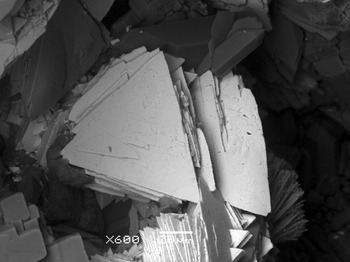
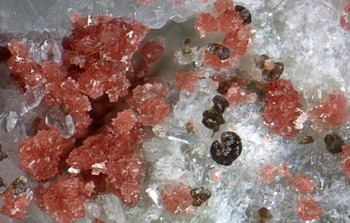
Aluminotaipingite-(CeCa) forms trigonal pyramidal crystals up to 0.07 mm in size (Figs 1 and 2). Crystals are light pink to pink or reddish and transparent or semi-transparent, with vitreous lustre. Observed forms are {0 0 1} and {1 0 $\bar{2}$ }. Tenacity is brittle, no distinct cleavage is observed and the fracture is uneven. The mineral does not fluoresce in long- or short-wave ultraviolet light. Observed twinning is by reflection on (001), two-fold rotation about [001] or inversion. Contact twins or complex lamellar forms are also observed. The streak is white. Hardness (Mohs) = 5. Density (meas.) was not determined because no suitable heavy liquids were available. Density (calc.) = 4.476 g cm–3 using the empirical formula and single-crystal cell data. The mineral is uniaxial (+) with ω = 1.750(3) and ɛ = 1.770(3) (white light).
Aggregate of aluminotaipingite-(CeCa) crystals. Back-scatter electron image ×600.

Aluminotaipingite-(CeCa) aggregates of pink pyramidal crystals on quartz matrix, with minor dark green clinochlore.

The Gladstone–Dale parameters are: K P = 0.1691 and K C = 0.1665; compatibility (–0.015) and is rated as superior, according to Mandarino (Reference Mandarino1981).
Infrared spectroscopy
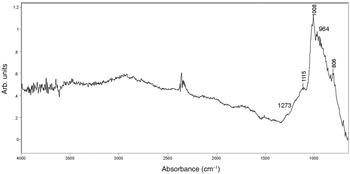
The FTIR (Fourier Transform Infrared Spectroscopy) spectrum obtained using a Jasco IRT-3000 shows relatively sharp bands at 806, 964, 1008 and 1115 cm–1 due to Si–O fundamental modes (Fig. 3). A band at 1273 cm–1 is also ascribable to Si–O fundamental modes and resembles that found in minerals having the [SiO3(OH)] tetrahedron (Chukanov, Reference Chukanov2013; Frost et al., Reference Frost, Scholz, Lopez, Xi, Granja, Gobac and Lima2013). According to the Libowitzky's equation (Libowitzky, Reference Libowitzky1999) and to the observed hydrogen-bonds, stretching frequencies related to the OH group, should occur at ~2800 cm–1. They appear as a very broad signal in this region of the infrared spectrum.
FTIR spectrum for aluminotaipingite-(CeCa).

Chemical analysis
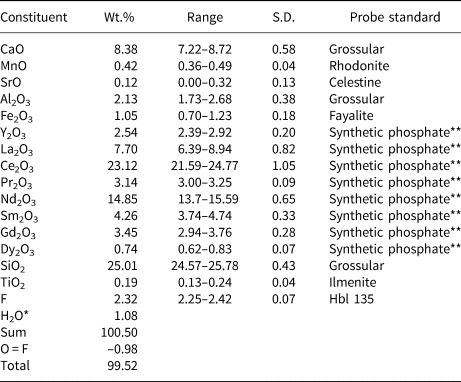
Quantitative chemical analyses (6 spots) were carried out in wavelength dispersive spectroscopy mode using a JEOL JXA-8200 WDS electron microprobe (15 kV excitation voltage, 5 nA beam current and 5 μm beam diameter). X-ray intensities were converted to wt.% by ZAF quantitative analysis software. Chemical data and the standards used in the analysis are reported in Table 1. The empirical formula, on the basis of 7 Si atoms per formula unit, is: A(Ca2.51Ce2.37Nd1.48La0.80Sm0.41Y0.38Pr0.32Gd0.32Mn0.10Dy0.07Sr0.02)Σ8.77M(Al0.70Fe3+0.22Ti0.04)Σ0.96T 2(SiO4)3T 1,T3[SiO3(OH)]4Z[F2.05(OH)1.02]Σ3.07. Atoms have been distributed according to the cerite general formula A 9XM[TO3(Ø)]7Z 3 (Atencio and Azzi, Reference Atencio and Azzi2020), in which the X position is vacant. The simplified formula is: (Ca,Ce,Nd,La,Sm,Y,Pr,Gd,Mn,Dy)9(Al,Fe3+,Ti)(SiO4)3[SiO3(OH)]4[F,(OH)]3. The ideal formula is: (Ce6Ca3)Al(SiO4)3[SiO3(OH)]4F3.
Analytical data (in wt.%) for aluminotaipingite-(CeCa) (average of 6 analyses).

* Calculated from the structure solution.
** Jarosewich and Boatner (Reference Jarosewich and Boatner1991)
X-ray crystallography and crystal structure determination
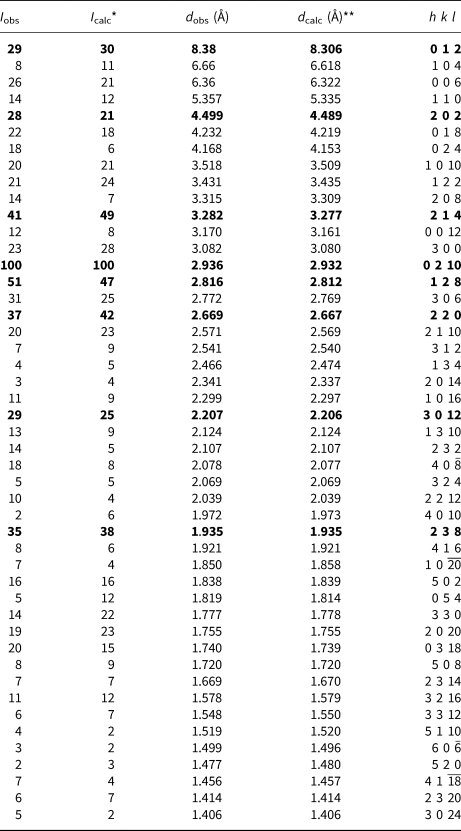
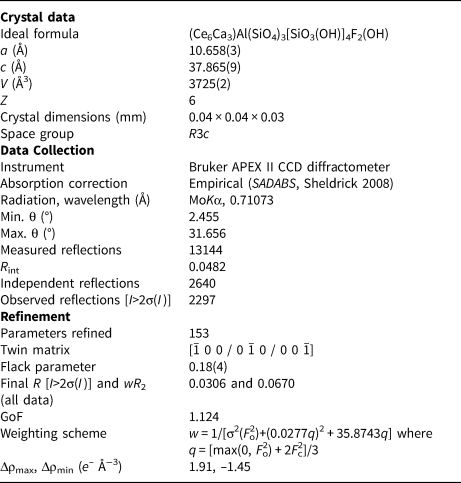
Powder X-ray diffraction data were collected using a Rigaku Miniflex powder diffractometer with graphite monochromated CuKα radiation. Data (in Å) are listed in Table 2 together with the pattern calculated from the crystal structure using VESTA (Momma and Izumi, Reference Momma and Izumi2011). Unit cell parameters refined from the powder data (Holland and Redfern, Reference Holland and Redfern1997) are a = 10.6695(5), c = 37.9364(30) Å and V = 3740.00 (37) Å3. Single-crystal diffraction data were collected on a crystal partly affected by merohedral twin using a Bruker Apex II diffractometer with MoKα radiation (λ = 0.71073 Å). A total of 13144 intensities were measured up to 2θ = 63.30°, of which 2640 were unique (R int 0.048). A SADABS absorption correction was applied (minimum transmission factor 0.766). The structure was refined with SHELXL-2017/1 (Sheldrick, Reference Sheldrick2017) in the space group R3c starting from the atomic coordinates of aluminocerite-(CeCa) (Nestola et al., Reference Nestola, Guastoni, Cámara, Secco, Dal Negro, Pedron and Beran2009). Crystal data and details of the structure refinement are reported in Table 3. Site scatterings for the A1, A2 and A3 sites were modelled using the scattering factors of Ce and for the M site using the scattering factors of Al and Fe. The location of the F atoms among the most probable sites was done after refinement of the occupancy of the F11, F12 and OH13 sites. In the final stages of the refinement each of these three sites were assigned full occupancies. Absolute configuration and twin refinement were carried out. The ratio of the two twin components related by inversion is 0.82/0.18. The formula of the mineral obtained from structure refinement, where only the contribution of Ce and Ca to the site scattering of the A sites was assumed is (Ce6.78Ca2.22)Σ9.00(Al0.56Fe3+0.44)Σ1.00(SiO4)3[SiO3(OH)]4F2(OH).
Powder X-ray diffraction data for aluminotaipingite-(CeCa).

Note: The strongest lines are given in bold.
* Calculated from the refined structure.
** Calculated from the unit cell a = 10.6695(5), c = 37.9364(30) Å and V = 3740.00(37) Å3, obtained from least-squares refinement of the above data using the program UNITCELL (Holland and Redfern, Reference Holland and Redfern1997).
Details about the data collection and structure refinement for aluminotaipingite-(CeCa).

Notes: R = Σ||F o|–|F c||/ Σ|F o|; wR 2 = { Σ[w(F o2–F c2)2] / Σ[w(F o2)2]}½; GoF ={Σ[w(F o2–F c2)]/(n–p)}½ where n is the number of reflections and p is the number of refined parameters.
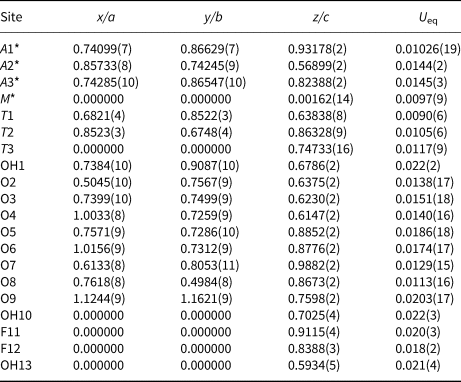
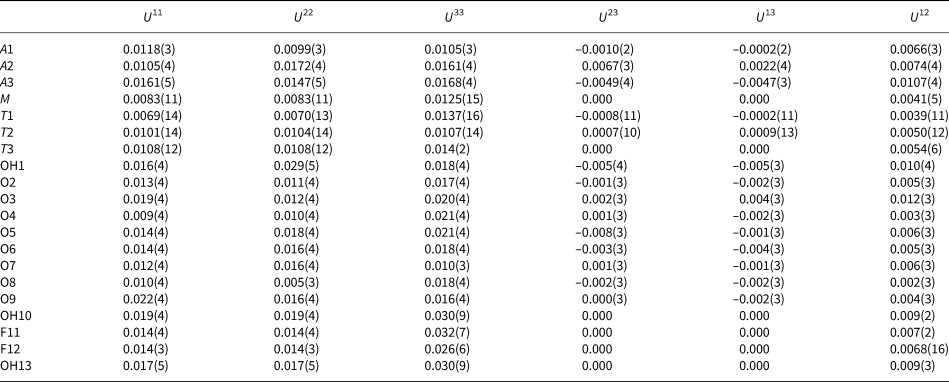
The c:a ratio calculated from the unit-cell parameters is 3.5527 (single-crystal data). Fractional atom coordinates and equivalent isotropic displacement parameters are given in Table 4. Anisotropic displacement parameters are given in Table 5. Refined selected bond distances are given in Table 6. Bond-valence analysis is reported in Table 7. The crystallographic information file has been deposited with the Principal Editor of Mineralogical Magazine and is available as Supplementary material (see below).
Sites, site occupancies*, fractional atom coordinates and equivalent-isotropic displacement parameters (Å2) for aluminotaipingite-(CeCa).

* Site occupancies for sites with <1.00 are: A1 = Ce0.947(7); A2 = Ce0.882(6); A3 = Ce0.683(5); M = Al0.56(2) Fe0.44(2).
Refined anisotropic displacement parameters (Å2) for aluminotaipingite-(CeCa).

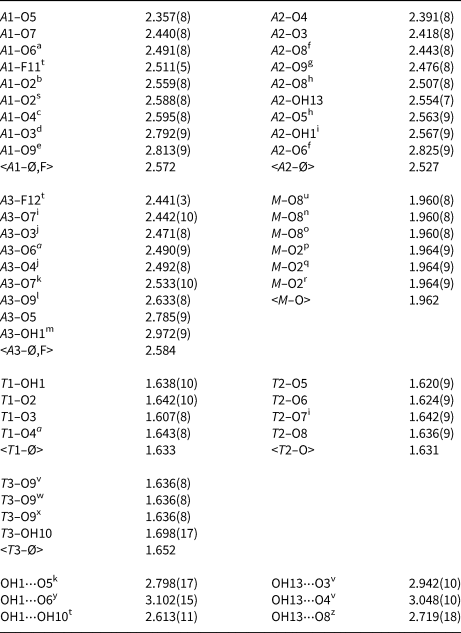
Selected bond distances (Å) and hydrogen bonds for aluminotaipingite-(CeCa).

Symmetry operations: a = 1–x+y, 2–x, +z; b = 5/3–y, 4/3+x–y, z+⅓; c = x–⅓, ⅓+y, ⅓+z; d = ⅔–x+y, 4/3–x, z+⅓; e = x–⅔, ⅔+x–y, ⅙+z; f = 4/3–x+y, 5/3–x, z–⅓; g = ⅔–x+y, y–⅔, z–⅙; h = 4/3–y, ⅔+x–y, z–⅓; i = 5/3–y, 4/3–x, z–⅙; j = 4/3–y, 5/3–x, ⅙+z; k = ⅔–x+y, ⅓+y, z–⅙; l = 2–y, 1+x–y, z; m = ⅓–x+y, y–⅓, ⅙+z; n = ⅓–x+y, y–⅓, z–5/6; o = x–⅔, x–y–⅓, z–5/6; p = x–⅓, y–⅔, z–⅔; q = ⅔–y,⅓+x–y, z–⅔; r = –x+y–⅓, ⅓–x, z–⅔; s = ⅔–x+y, 4/3–x, ⅓+z; t = 1+x, 1+y, z; u = ⅓–y, ⅔–x, z–5/6; v = x–1, y–1, z; w = 1–y, x–y, z; x = y–x, 1–x, z; y = x–⅓, ⅓+x–y, z–⅙; z = x–⅔, y–⅓, z–⅓.
Bond-valence (vu) analysis for aluminotaipingite-(CeCa)*.

* Parameters used from Brese and O'Keeffe (Reference Brese and O'Keeffe1991) and Brown (Reference Brown2009). Bond-valence sums were calculated with the site occupancies of A1 (Ca0.08Ce0.92), A2 (Ca0.18Ce0.82), A3 (Ca0.48Ce0.52) and M (Al0.56Fe0.44), obtained from structure refinement.
Description of the crystal structure and discussion
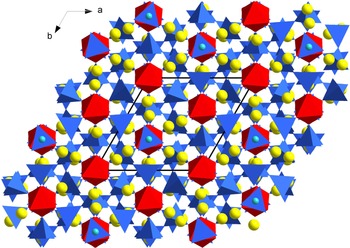
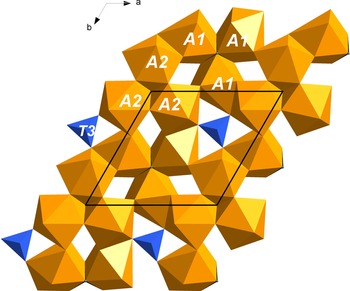
The crystal structure of the cerite-supergroup minerals A 9XM[TO3Ø]7Z 3 involves three eight-, nine- or ten-fold-coordinated A sites, one hexacoordinated X site, one octahedral M site and three [TO3Ø] tetrahedral sites. Aluminotaipingite-(CeCa) is isostructural to the other silicate minerals of the cerite supergroup: ferricerite-(LaCa), (La6Ca3)Fe3+(SiO4)3[SiO3(OH)]4(OH)3 (Pakhomovsky et al., Reference Pakhomovsky, Men'Shikov, Yakovenchuk, Ivanyuk, Krivovichev and Burns2002; Atencio and Azzi, Reference Atencio and Azzi2020) and aluminocerite-(CeCa), (Ce6Ca3)Al(SiO4)3[SiO3(OH)]4(OH)3 (Nestola et al., Reference Nestola, Guastoni, Cámara, Secco, Dal Negro, Pedron and Beran2009), where three nine-fold coordinated sites (A1 A2 and A3), with tricapped trigonal prism geometry are present (Fig. 4). In taipingite-(CeCa), (Ce7Ca2)Mg(SiO4)3[SiO3(OH)]4F3 (Qu et al., Reference Qu, Sima, Fan, Li, Shen, Chen, Liu, Yin, Li and Wang2020), these sites are instead ten-fold coordinated and in cerite-(CeCa), (Ce7Ca2)Mg(SiO4)3[SiO3(OH)]4(OH)3 (Moore and Shen, Reference Moore and Shen1983), they are eight-fold-coordinated. Fluorine is involved in coordination with the A1 and A3 sites. In aluminotaipingite-(CeCa) the two sites A1 and A2 are mainly occupied by lanthanides and display a scattering power of ~55 and 51 electrons respectively, similar to those observed in aluminocerite-(CeCa) (53 and 48 electrons) but slightly lower than those observed in taipingite-(CeCa) (57 and 56 electrons, respectively). From structure refinement the composition of the A1 and A2 sites is therefore Ca0.08Ce0.92 and Ca0.18Ce0.82, respectively. The average bond lengths A1–Ø,F = 2.572 Å and A2–Ø = 2.527 Å are statistically identical to those observed in aluminocerite-(CeCa) (2.573 and 2.542 Å) and taipingite-(CeCa) (2.576 and 2.546 Å). The third A3 site exhibits a relatively lower refined site scattering (40 electrons) corresponding to the composition Ca0.48Ce0.52, indicative that Ca is more abundant here than in A1 and A2. Considering that the average scattering value for the lanthanide cations is higher than 58 electrons, probably Ca is instead slightly dominant in this site. The average A3–Ø,F distance is 2.584 Å. The sum of the refined occupancies for the A sites is 437 electrons, to be compared to 418 electrons from the chemistry. These differences are due to the different crystal fragment used for the measurements.
The crystal structure of aluminotaipingite-(CeCa) viewed along [001]. M sites = red polyhedra, T sites = blue tetrahedra, A sites = yellow balls and F = small sky-blue balls. Drawn using Diamond (Crystal Impact GbR, Bonn, Germany). The unit cell is outlined.

In aluminotaipingite-(CeCa) the X site is vacant. In the octahedral M site aluminium prevails upon Fe3+ (Al0.56(2), Fe0.44(2) from structure refinement) and again here the refined occupancy of the M site gives 18.7 electrons in comparison to the 15.7 electrons from the chemistry for the same reason stated above. The average M–O distance (1.962 Å) is larger than the corresponding mean bond length for aluminocerite-(CeCa) (1.931 Å), because a larger Al/Fe3+ ratio is observed in aluminocerite-(CeCa), but less than that of taipingite-(CeCa) (2.050 Å), in line with the larger ionic radius of Mg with respect to that of Al3+. Considering the value of the ionic radii for VIFe3+ is 0.645 Å, VIAl is 0.535 Å and IIIO= is 1.36 Å, the calculated average bond length for the previous composition is 1.943 Å, a value close to the observed one, giving support for the oxidation state of Fe3+.
Among the three independent T sites, from bond-valence considerations and in accordance with the structure of the other members of the group, T2 belongs to a (SiO4)4– anion, whereas T1 and T3 belong to (SiO3OH)3– anions.
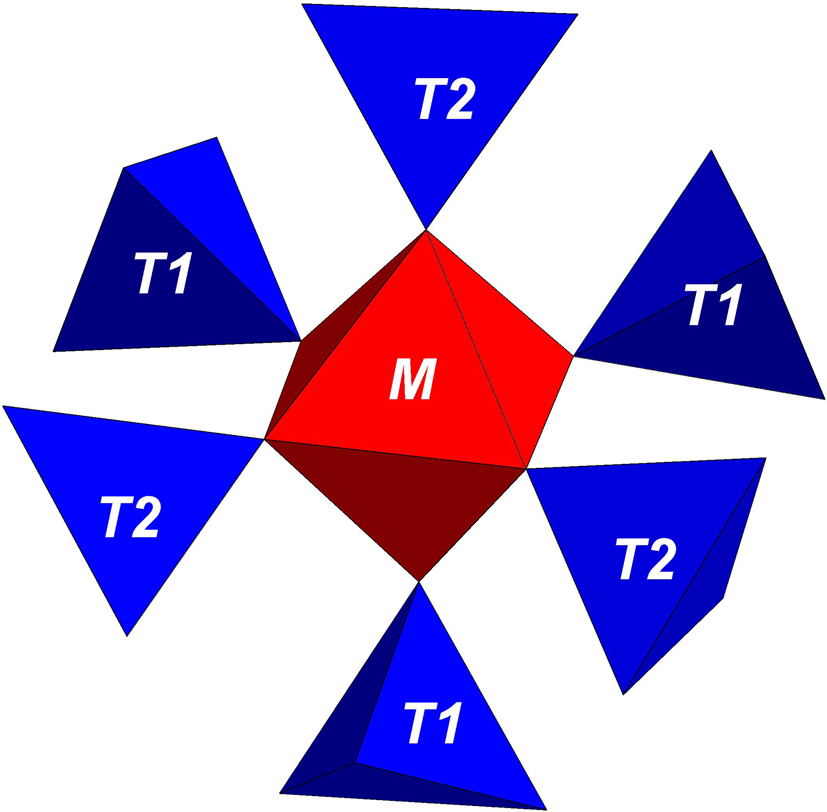
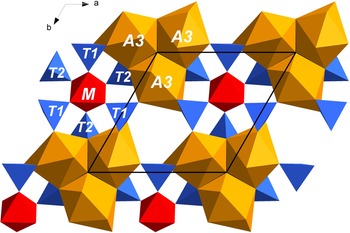
Moore and Shen (Reference Moore and Shen1983) described the structure of cerite-(CeCa) as based on rods of corner-, edge- and face-sharing TO4 tetrahedra, MO6 octahedra and AO8OH polyhedra. Another description of the cerite-group minerals has been suggested by Pakhomovsky et al. (Reference Pakhomovsky, Men'Shikov, Yakovenchuk, Ivanyuk, Krivovichev and Burns2002) for ferricerite-(LaCa) and is based on alternating sheets made by the above-mentioned coordination polyhedra. The M[T1O3ØT2O4]3 clusters (Fig. 5), together with A(3), form the A layers at z ≈ 0, ⅙, ⅓, ½… shown in Fig. 6, that should also include the X sites, whenever filled. The A1 and A2 polyhedra and the [T3O3Ø] tetrahedra form the B layers at z ≈ 1/12, ¼, 5/12, 7/12…(Fig. 7).The layers are parallel to (001) and alternate as ABABAB….
The M [T1O3ØT2O4]3 cluster.

The A layer made by M [T1O3ØT2O4]3 clusters and A3 polyhedra.

The B layer made by A1 and A2 polyhedra and [T3O3Ø] tetrahedra.

The positions of the hydrogen atoms bonded to OH1, OH10 and OH13 could not be detected in the structure determination. However, the short interatomic O⋅⋅⋅O distances reported in Table 6 and bond valence calculations may give some indication on the hydrogen bonds. For instance, OH1 and OH10 are at a distance of 2.613(11) Å, corresponding to a strong hydrogen bond where OH10 receives, as acceptor, bonding from three protons. This interaction contributes ~0.2 valence units (vu) to the low bond-valence value (0.820 vu) of OH10, (Hawthorne and Schindler, Reference Hawthorne and Schindler2008), thus giving a more reasonable bond valence for a hydroxyl group. Other significant interactions of the hydroxyls involve the oxygen atoms of the silicate anions.
Acknowledgements
This paper was improved by the valuable suggestions and very constructive comments of Fernando Camara, Peter Leverett and an anonymous reviewer. Special thanks are also due to the Principal Editor Stuart Mills and to the Associate Editor Antony R. Kampf.
Supplementary material
The supplementary material for this article can be found at https://doi.org/10.1180/mgm.2023.51.
Competing interests
The authors declare none