1. Introduction
The generation of intermediate rocks has been of great interest in modern geology because they are an essential component in the formation of the continental crust in Cordilleran-type arcs. Unlike felsic rocks that can be related to anatexis of supracrustal rocks or to fractional crystallization of mafic magma (e.g. Jagoutz & Klein, Reference Jagoutz and Klein2018), the formation of intermediate (mostly tonalitic) rocks in Cordilleran-type magmatic arcs is still under discussion. A large number of hypotheses have been proposed for their origin, including: (1) fractional crystallization of primary melts (e.g. Arth et al. Reference Arth, Barker, Peterman and Friedman1978; Gill, Reference Gill1981; Rogers & Hawkesworth, Reference Rogers and Hawkesworth1989; Müntener et al. Reference Müntener, Kelemen and Grove2001; Grove et al. Reference Grove, Elkins-Tanton, Parman, Chatterjee, Müntener and Gaetani2003); (2) partial melting of a variety of different sources, including mantle material (e.g. Moorbath, Reference Moorbath1975; Evans & Hanson, Reference Evans, Hanson, Ashwal and de Wit1996), amphibolite and eclogite (e.g. Rapp et al. Reference Rapp, Watson and Miller1991); (3) mixing of basaltic magmas with crustal melts in a deep crustal hot zone (e.g. De Paolo, Reference De Paolo1981; Annen et al. Reference Annen, Blundy and Sparks2006); and (4) processes within the mantle by partial melting and/or reaction with subducted materials (Castro, Reference Castro2014).
The recognition of different ‘types’ of tonalitic rocks implies more than one origin for the generation of tonalite magma. There is a consensus that the asthenospheric mantle is the source region for the most isotopically juvenile magmatism in Cordilleran arcs (Grove et al. Reference Grove, Till and Krawczynski2012), but less agreement exists about the origin of the isotopically evolved end-members. Most of the proposed petrogenetic processes require the involvement of the deep continental lithosphere, including subcontinental mantle and the lower crust. This lithosphere may act as a source region for processes such as partial melting of mafic-ultramafic rocks and subsequent differentiation (e.g. Jagoutz & Klein, Reference Jagoutz and Klein2018), or as a region where primary magmas induce local melting of crustal material followed by assimilation and extensive mixing, that is, the melting, assimilation, storage and homogenization (MASH) zone (Hildreth & Moorbath, Reference Hildreth and Moorbath1988).
Favourable conditions for magma storage in the deeper parts of the crust, as for example in a MASH zone (hypothesis 3), could result in homogenization of discrete magma batches, obscuring any variability inherited after extraction from mantle (e.g. Hildreth & Moorbath, Reference Hildreth and Moorbath1988). Furthermore, hybridization in the lower crust would not only mask the primary isotopic heterogeneity but would also contribute to crustal isotopic signature (e.g. Lackey et al. Reference Lackey, Valley, Chen and Stockli2008). However, if petrogenetic processes occur at still deeper levels where differentiation dominates over hybridization in the crust (hypotheses 1 and 2), the ‘crustal signature’ of the magmas might be derived from the subducted slab and/or through metasomatism of the lithospheric mantle (e.g. Jagoutz & Klein, Reference Jagoutz and Klein2018). In such a situation, the magmas might then experience a short residence time in the lower crust or pass directly through it to shallower levels without crustal-scale homogenization of their isotopic systems.
A magmatic arc where two contrasting hypotheses on the formation of large volumes of tonalitic rocks have been proposed is the Famatinian Cordilleran-type arc in the Sierras Pampeanas, NW Argentina (24–28° S). The generation of tonalites was related to either partial melting of a Proterozoic lithospheric crust–mantle section (e.g. Pankhurst et al. Reference Pankhurst, Rapela and Fanning2000; Dahlquist et al. Reference Dahlquist, Pankhurst, Rapela, Galindo, Alasino, Fanning, Saavedra and Baldo2008, Reference Dahlquist, Pankhurst, Gaschnig, Rapela, Casquet, Alasino, Galindo and Baldo2013; Grosse et al. Reference Grosse, Bellos, de los Hoyos, Larrovere, Rossi and Toselli2011; Castro et al. Reference Castro, Díaz-Alvarado and Fernández2012; Rapela et al. Reference Rapela, Pankhurst, Casquet, Dahlquist, Fanning, Baldo, Galindo, Alasino, Ramacciotti, Verdecchia, Murra and Basei2018) or interaction between mafic magmas and supracrustal sedimentary rocks in the crust (Otamendi et al. Reference Otamendi, Ducea and Bergantz2012; Ducea et al. Reference Ducea, Otamendi, Bergantz, Jianu, Petrescu, DeCelles, Ducea, Carrapa and Kapp2015). The aim of this paper is to review the magma source problem in this arc focusing mainly on O and H isotopes combined with radiogenic isotope data (Sr and Nd) in the same rock set, which can provide valuable insights into this issue. Additionally, the O-isotope composition of zircons of the Famatinian arc from the same study area reported by Rapela et al. (Reference Rapela, Pankhurst, Casquet, Dahlquist, Fanning, Baldo, Galindo, Alasino, Ramacciotti, Verdecchia, Murra and Basei2018), which give information about the deeper source region, is compared with our O analyses of whole rocks that record the last stages of the magmatic system. We focus on tonalite–granodiorite genesis but also consider the mafic units, and explore the possibility of a genetic link between intermediate rocks and those of felsic composition (mostly monzogranite). Source region(s), melting depth(s) and the architecture of the Famatinian continental arc are also discussed, integrating field relationships, petrology, whole-rock geochemistry and whole-rock O, H, Sr and Nd isotope data.
2. Famatinian Orogeny
The Famatinian orogeny was a subduction–related accretionary orogeny that occurred during the Ordovician Period along the proto-Andean margin of Gondwana from Patagonia to Venezuela (Cawood et al. Reference Cawood, Kröner, Collins, Kusky, Mooney and Windley2009). In the Sierras Pampeanas, it started with extension and marine sedimentation of the margin, followed by tectonic inversion and the setting up of a Cordilleran-type magmatic (I-type) arc that was coeval with shortening over a very short period of time of c. 5 Ma (e.g. Dahlquist et al. Reference Dahlquist, Pankhurst, Rapela, Galindo, Alasino, Fanning, Saavedra and Baldo2008; Cristofolini et al. Reference Cristofolini, Otamendi, Ducea, Pearson, Tibaldi and Baliani2012; Ducea et al. Reference Ducea, Bergantz, Crowley and Otamendi2017; Rapela et al. Reference Rapela, Pankhurst, Casquet, Dahlquist, Fanning, Baldo, Galindo, Alasino, Ramacciotti, Verdecchia, Murra and Basei2018; Weinberg et al. Reference Weinberg, Becchio, Farias, Suzaño and Sola2018). Arc magmatism was largely coeval with the development of crustal thickening and high-temperature–low-pressure metamorphism resulting from advective heat at c. 800°C and 7 kbar (Dahlquist et al. Reference Dahlquist, Rapela and Baldo2005; Murra & Baldo, Reference Murra and Baldo2006; Gallien et al. Reference Gallien, Mogessie, Bjerg, Delpino, Castro de Machuca, Thöni and Klötzli2010, Reference Gallien, Mogessie, Hauzenberger, Bjerg, Delpino and Castro de Machuca2012; Tibaldi et al. Reference Tibaldi, Otamendi, Cristofolini, Baliani, Walker and Bergantz2013; Larrovere et al. Reference Larrovere, de los Hoyos, Willner, Verdecchia, Baldo, Casquet, Basei, Hollanda, Rocher, Alasino and Moreno2019).
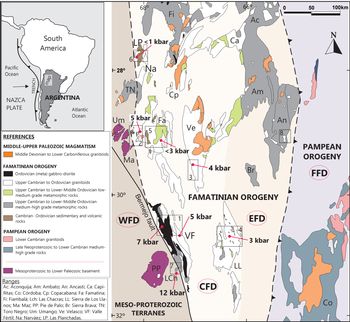
Ordovician magmatism has long been recognized in the Sierras Pampeanas of NW Argentina (e.g. Toselli, Reference Toselli1992; Rapela et al. Reference Rapela, Coira, Toselli and Saavedra1992; Bahlburg & Hervé, Reference Bahlburg and Hervé1997). Pankhurst et al. (Reference Pankhurst, Rapela and Fanning2000) distinguished three distinct plutonic associations between latitudes 27° 30′ and 31° 30′ S: (1) voluminous metaluminous intrusions of gabbro to monzogranite with largely dominant tonalite and granodiorite; this association is exposed at different crustal palaeodepths over a length of c. 750 km in the Sierras Pampeanas (Fig. 1); (2) more restricted but still voluminous peraluminous granites; and (3) minor tonalite–trondhjemite–granodiorite (TTG) -type rocks in the Eastern Sierras Pampeanas. More recently, Rapela et al. (Reference Rapela, Pankhurst, Casquet, Dahlquist, Fanning, Baldo, Galindo, Alasino, Ramacciotti, Verdecchia, Murra and Basei2018) divided the Famatinian orogenic belt into four domains (Western, Central, Eastern and Foreland) according to differences in the type of magmatism, metamorphism and geodynamic evolution; we focus here on the Central Domain, where a c. 470 Ma Cordilleran-type magmatic arc is exposed through an almost-continuous crustal section up to the Ordovician palaeosurface (Fig. 1).
Generalized sketch map of the Sierras Pampeanas and southern Puna showing the main lithologies and distribution of the Pampean and Famatinian orogenic belts. The study areas for this work are mostly included within the main region of the Famatinian arc. The pressure value for each crustal section is estimated from the emplacement of magma or the regional metamorphism (see text). Domains of the Famatinian orogen taken from Rapela et al. (Reference Rapela, Pankhurst, Casquet, Dahlquist, Fanning, Baldo, Galindo, Alasino, Ramacciotti, Verdecchia, Murra and Basei2018): FFD – Foreland Famatinian Domain; EFD – Eastern Famatinian Domain; CFD – Central Famatinian Domain; and WFD – Western Famatinian Domain.

3. Cordilleran-type magmatic arc of the Central Famatinian Domain
Ordovician magmatism took place between c. 490 and 460 Ma (Rapela et al. Reference Rapela, Pankhurst, Casquet, Dahlquist, Fanning, Baldo, Galindo, Alasino, Ramacciotti, Verdecchia, Murra and Basei2018). However, the Cordilleran-type magmatic arc long recognized in the Central Domain was emplaced within c. 10 Ma or less during c. 478–468 Ma, and is a case study of a magmatic flare-up (Ducea et al. Reference Ducea, Bergantz, Crowley and Otamendi2017; Rapela et al. Reference Rapela, Pankhurst, Casquet, Dahlquist, Fanning, Baldo, Galindo, Alasino, Ramacciotti, Verdecchia, Murra and Basei2018). A possible model for magma formation involves foundering of the subcontinental pyroxenite mantle and upwelling mantle wedge peridotite (Alasino et al. Reference Alasino, Casquet, Pankhurst, Rapela, Dahlquist, Galindo, Larrovere, Recio, Paterson, Colombo and Baldo2016). Because of almost vertical pre-Triassic tilting of crustal blocks, a continuous crustal section of the arc from a depth of c. 25 km to the palaeosurface is exposed (Fig. 1).
The deeper crustal level is exposed in the Sierra de Valle Fértil (area 1 in Fig. 1) corresponding to palaeodepths of 15–25 km (Otamendi et al. Reference Otamendi, Ducea and Bergantz2012) and is assumed to be the uppermost lower crust (Reference Otamendi, Vujovich, de la Rosa, Tibaldi, Castro, Martino and PinottiOtamendi et al. 2009b ; Tibaldi et al. Reference Tibaldi, Otamendi, Cristofolini, Baliani, Walker and Bergantz2013). Tonalite and diorite bodies dominate from c. 20 to 25 km with gabbro and gabbro cumulates increasing downwards. Host rocks attained medium-pressure upper amphibolite to granulite facies conditions (up to 7 kbar; Otamendi et al. Reference Otamendi, Ducea and Bergantz2012) and mainly consist of metapelites with minor marble and calc-silicate rocks of Cambrian protolith age (Collo et al. Reference Collo, Astini, Cawood, Buchan and Pimentel2009; Cristofolini et al. Reference Cristofolini, Otamendi, Ducea, Pearson, Tibaldi and Baliani2012; Rapela et al. Reference Rapela, Verdecchia, Casquet, Pankhurst, Baldo, Galindo, Murra, Dahlquist and Fanning2016). Migmatites are found as septa between igneous sheets and as partially assimilated blocks in tonalite (Otamendi et al. Reference Otamendi, Ducea and Bergantz2012).
At mid-crustal levels (c. 15 km depth) there is evidence of interaction between partially molten country rocks and tonalitic magmas. Good exposures of this are found in the westernmost Sierra de Famatina, NE Cerro Asperecito and Cerro Toro near Villa Unión, and in the SW Sierra de Velasco (areas 2 and 3 in Fig. 1; e.g. Saavedra et al. Reference Saavedra, Pellitero, Rossi and Toselli1992; Alasino et al. Reference Alasino, Casquet, Larrovere, Pankhurst, Galindo, Dahlquist, Baldo and Rapela2014; Bellos et al. Reference Bellos, Castro, Díaz-Alvarado and Toselli2015). At these localities, there are steeply dipping N–S-trending sheets of tonalite and less abundant granodiorite with scarce gabbro and mafic-ultramafic cumulates. Host rocks are high-grade metasedimentary rocks (c. 4–5 kbar; Rossi & Toselli, Reference Rossi and Toselli2005; Alasino et al. Reference Alasino, Casquet, Larrovere, Pankhurst, Galindo, Dahlquist, Baldo and Rapela2014). Water-fluxed melting was invoked by Alasino et al. (Reference Alasino, Casquet, Larrovere, Pankhurst, Galindo, Dahlquist, Baldo and Rapela2014) to explain the high degree of melting in the host rocks in the regional thermal aureoles. Hybrid granitoids were formed by variable mixing of anatectic leucogranite with tonalite at magma chamber margins (Alasino et al. Reference Alasino, Casquet, Larrovere, Pankhurst, Galindo, Dahlquist, Baldo and Rapela2014).
A still shallower section of depth 8–10 km (upper crust) is preserved in the Sierra de Los Llanos and the central part of the Sierra de Famatina (areas 4 and 5 in Fig. 1). Here there are large elongated subvertical bodies consisting of granodiorite to biotite monzogranite and local gabbro, tonalite and leucogranite. Host rocks are medium- to low-grade metasedimentary rocks of the same age as the deeper rocks (Pankhurst et al. Reference Pankhurst, Rapela and Fanning2000; Rapela et al. Reference Rapela, Verdecchia, Casquet, Pankhurst, Baldo, Galindo, Murra, Dahlquist and Fanning2016). Local autochthonous to parachthonous bodies of peraluminous two-mica cordierite monzogranites are formed by partial melting of metasedimentary rocks (Pankhurst et al. Reference Pankhurst, Rapela and Fanning2000; Dahlquist et al. Reference Dahlquist, Rapela and Baldo2005).
The uppermost magmatic arc, corresponding to the subvolcanic environment and the palaeosurface, is preserved in the central and eastern part of Sierra de Famatina and in its N-wards continuation into the Sierra de Narváez–Las Planchadas (areas 5 and 6, Fig. 1). This consists mainly of submarine volcaniclastic material and rhyolites, scarce basalts and a few granitoid plutons (for a review, see Rapela et al. Reference Rapela, Pankhurst, Casquet, Dahlquist, Fanning, Baldo, Galindo, Alasino, Ramacciotti, Verdecchia, Murra and Basei2018).
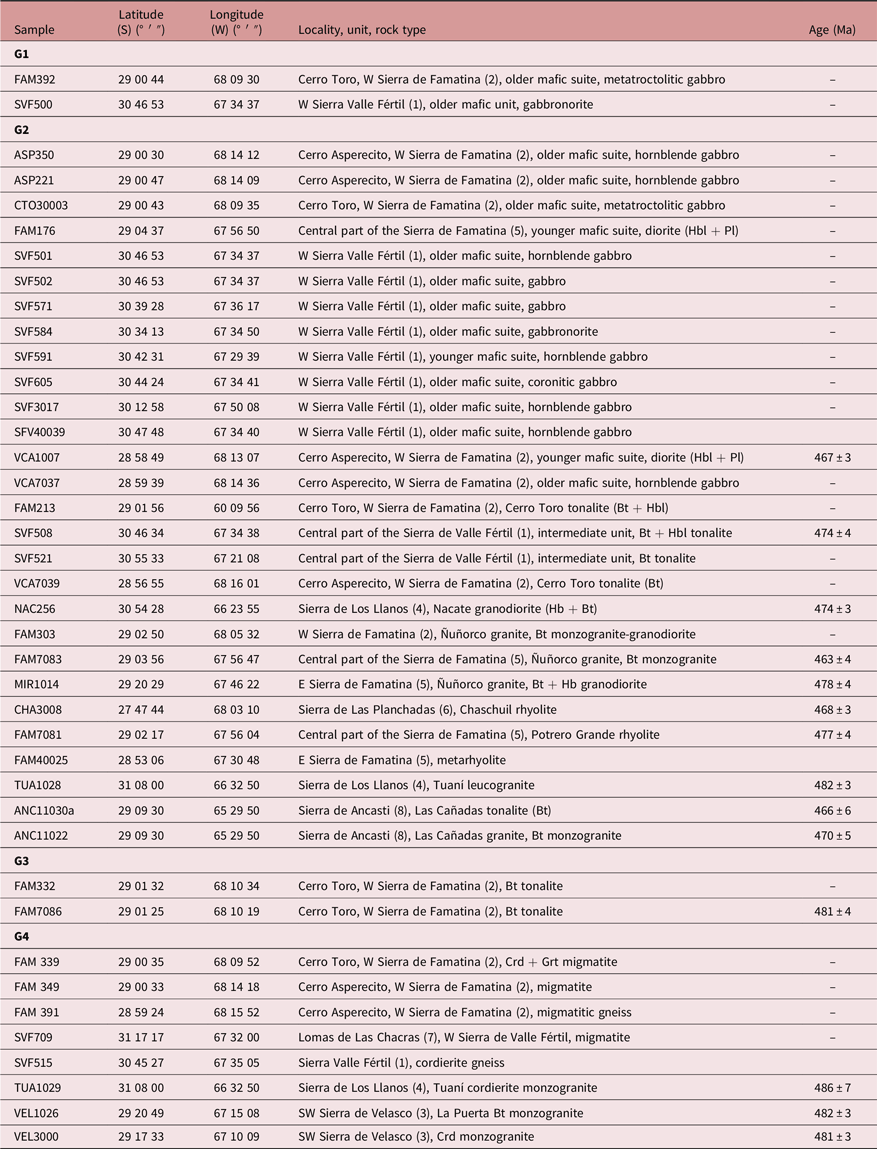
Crystallization ages (U–Pb zircon) of Famatinian igneous rocks range from c. 468 to c. 482 Ma (90% of the samples) (Table 1; Rapela et al. Reference Rapela, Pankhurst, Casquet, Dahlquist, Fanning, Baldo, Galindo, Alasino, Ramacciotti, Verdecchia, Murra and Basei2018) distributed in two peaks (c. 470 and c. 480 Ma). In fact, the Cordilleran-type magmatic arc (best dated in the Sierra de Valle Fértil) was emplaced in a short interval of c. 5 Ma during 472–467 Ma (U–Pb thermal ionization mass spectrometry; Ducea et al. Reference Ducea, Bergantz, Crowley and Otamendi2017). The older magmatism corresponding to the 480 Ma age peak is masked by the c. 470 Ma peak and is still poorly defined (e.g. Pankhurst et al. Reference Pankhurst, Rapela and Fanning2000; Dahlquist et al. Reference Dahlquist, Pankhurst, Gaschnig, Rapela, Casquet, Alasino, Galindo and Baldo2013). Additionally, on the basis of field relationships together with geochemical and isotopic data, Alasino et al. (Reference Alasino, Casquet, Pankhurst, Rapela, Dahlquist, Galindo, Larrovere, Recio, Paterson, Colombo and Baldo2016) recognized two temporal suites for the mafic rocks: an older intrusive suite at > 480 Ma and a younger suite, typically displaying subduction-related geochemical signatures, coeval with the magmatic flare-up at c. 470 Ma.
Location and rock type of the Famatinian samples from Sierras Pampeanas. All ages are SHRIMP zircon U–Pb ages from Pankhurst et al. (Reference Pankhurst, Rapela and Fanning2000), Dahlquist et al. (Reference Dahlquist, Rapela, Pankhurst, Fanning, Vervoort, Hart, Baldo, Murra, Alasino and Colombo2012) and Rapela et al. (Reference Rapela, Pankhurst, Casquet, Dahlquist, Fanning, Baldo, Galindo, Alasino, Ramacciotti, Verdecchia, Murra and Basei2018). Numbers in brackets correspond to the areas of study in Figure 1

Based on field evidence, chemistry and geochronology, five major igneous units form the c. 470 Ma Cordilleran-type magmatic arc: (i) an older gabbro suite (mostly coronitic metagabbros and gabbros); (ii) a subsequent suite of gabbros and diorites; (iii) voluminous tonalites to monzogranites coeval with the latter suite (or volcanic equivalents); (iv) granitoids with a crustal melt component, including (a) anatectic leucogranitoids (small bodies and veins) and (b) two-mica (±cordierite) granitic bodies; and (v) hybrid rocks resulting from local mixing of tonalite with crustal melts. An unexposed basement of Mesoproterozoic age (Casquet et al. Reference Casquet, Rapela, Pankhurst, Baldo, Galindo, Fanning and Dahlquist2012) probably underlies the magmatic arc (Rapela et al. Reference Rapela, Pankhurst, Casquet, Dahlquist, Fanning, Baldo, Galindo, Alasino, Ramacciotti, Verdecchia, Murra and Basei2018). The root of the magmatic arc attained a minimum pressure of 12 kbar at depths of c. 40–45 km (Casquet et al. Reference Casquet, Rapela, Pankhurst, Baldo, Galindo, Fanning and Dahlquist2012), but no xenoliths of mantle or lower crust have been recorded so far.
4. Sampling, description and analytical methods
A total of 31 petrographically fresh rocks were analysed for whole-rock O-isotope composition and 22 for whole-rock H-isotope composition (Table 2). Rocks analysed for whole-rock O-isotope composition were: one metagabbro, three gabbronorite and eight gabbros of the older suite (i); four Bt±Hbl tonalite-granodiorite samples, two Bt-rich granodiorite-monzogranite samples, three rhyolites and one leucogranite (suite iii); one hybrid rock of granitic appearance (sample FAM7086) (suite v) and two migmatites, one gneiss and three two-mica (±cordierite) monzogranites of suite (iv) (Tables 1 and 2). The samples were collected from bottom to top of the exposed crustal section of the Central Domain (see Table 1). We have also included for comparison two new samples from the Sierra de Ancasti in the Eastern Famatinian Domain (Rapela et al. Reference Rapela, Pankhurst, Casquet, Dahlquist, Fanning, Baldo, Galindo, Alasino, Ramacciotti, Verdecchia, Murra and Basei2018): one Pl-rich tonalite (ANC11030a) and one monzogranite (ANC11022) (Tables 1 and 2) (area 8 in Fig. 1). They were almost coeval with the Cordilleran-arc of the Central Domain, but emplaced away from the trench (at least 300 km) (Dahlquist et al. Reference Dahlquist, Rapela, Pankhurst, Fanning, Vervoort, Hart, Baldo, Murra, Alasino and Colombo2012). Additionally, the dataset includes O analyses of one metagabbro and one gabbro of the older suite (i); two diorites of the younger suite (ii); one Bt±Hbl tonalite of suite (iii); one hybrid with migmatitic texture collected near the migmatitic host rock (sample FAM332) (suite v) and one migmatite and one gneiss previously reported by Alasino et al. (Reference Alasino, Casquet, Pankhurst, Rapela, Dahlquist, Galindo, Larrovere, Recio, Paterson, Colombo and Baldo2016) (Tables 1 and 2).
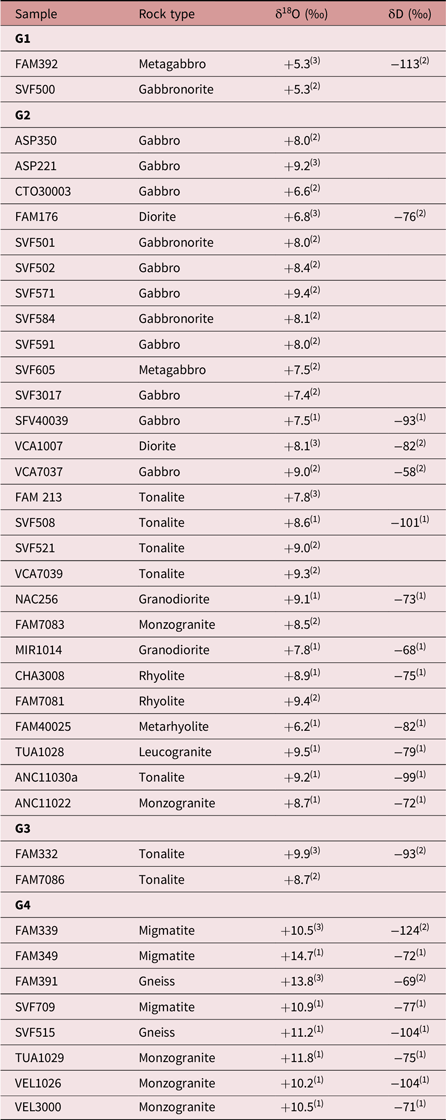
O–H isotopic compositions from studied samples. (1) Analysis performed at the Scottish Universities Environmental Research Centre (UK). (2) Analysis performed at the Servicio General de Análisis de Isótopos Estables (University of Salamanca, Spain). (3) Isotopic composition from Alasino et al. (Reference Alasino, Casquet, Pankhurst, Rapela, Dahlquist, Galindo, Larrovere, Recio, Paterson, Colombo and Baldo2016)

Oxygen and hydrogen isotope analyses of rocks with the superscript 1 in Table 2 were obtained at the Scottish Universities Environmental Research Centre. O analyses were performed by a laser fluorination procedure, involving total sample reaction with excess ClF3 using a CO2 laser at temperatures in excess of 1500°C (Sharp, Reference Sharp1990). Samples were evacuated overnight, and pre-fluorinated for 90 seconds prior to fluorination. All fluorinations resulted in 100% release of O2 from the silicate lattice. This O2 was converted to CO2 by reaction with hot graphite, and analysed by a VG SIRA II spectrometer. Results are reported in standard notation (δ18O) as per mil (‰) deviations from Vienna Standard Mean Ocean Water (V-SMOW). Two standards were run with each whole-rock analyses, giving an overall error of reproducibility of typically less than ±0.3‰, with international standard UWG-2 giving an average value of 5.7 ± 0.1‰ during these analyses. Hydrogen analysis was performed by in vacuo bulk heating of around 100 mg of whole rock analysed using the method of Donnelly et al. (Reference Donnelly, Waldron, Tait, Dougans and Bearhop2001) and a VG- Micromass Optima mass spectrometer. Samples were heated to > 1000°C by induction furnace to release included fluids. Results are reported in standard notation (δD) as per mil (‰) deviations from V-SMOW. The remaining samples (with superscript 2 in Table 2) were carried out at the Servicio General de Análisis de Isótopos Estables (University of Salamanca, Spain) on whole-rock powders by laser fluorination (Clayton & Mayeda, Reference Clayton and Mayeda1963), employing a Synrad 25 W CO2 laser (Sharp, Reference Sharp1990) and ClF3 as reagent (e.g. Borthwick & Harmon, Reference Borthwick and Harmon1982). Isotope ratios were measured on a VG-Isotech SIRA-II dual-inlet mass spectrometer. Both internal and international reference standards (NBS-28, NBS-30) were run to check accuracy and precision. Results are reported in δ18O notation relative to V-SMOW using a δ18O value of 9.6‰ for NBS-28 (quartz) for the mass spectrometer calibration (Table 2). Long-term reproducibility for repeated determination of reference samples was better than ± 0.2‰ (1σ). D/H ratios were measured on whole-rock powders using the technique of Godfrey (Reference Godfrey1962). Results are reported in standard notation (δD) (Table 2).
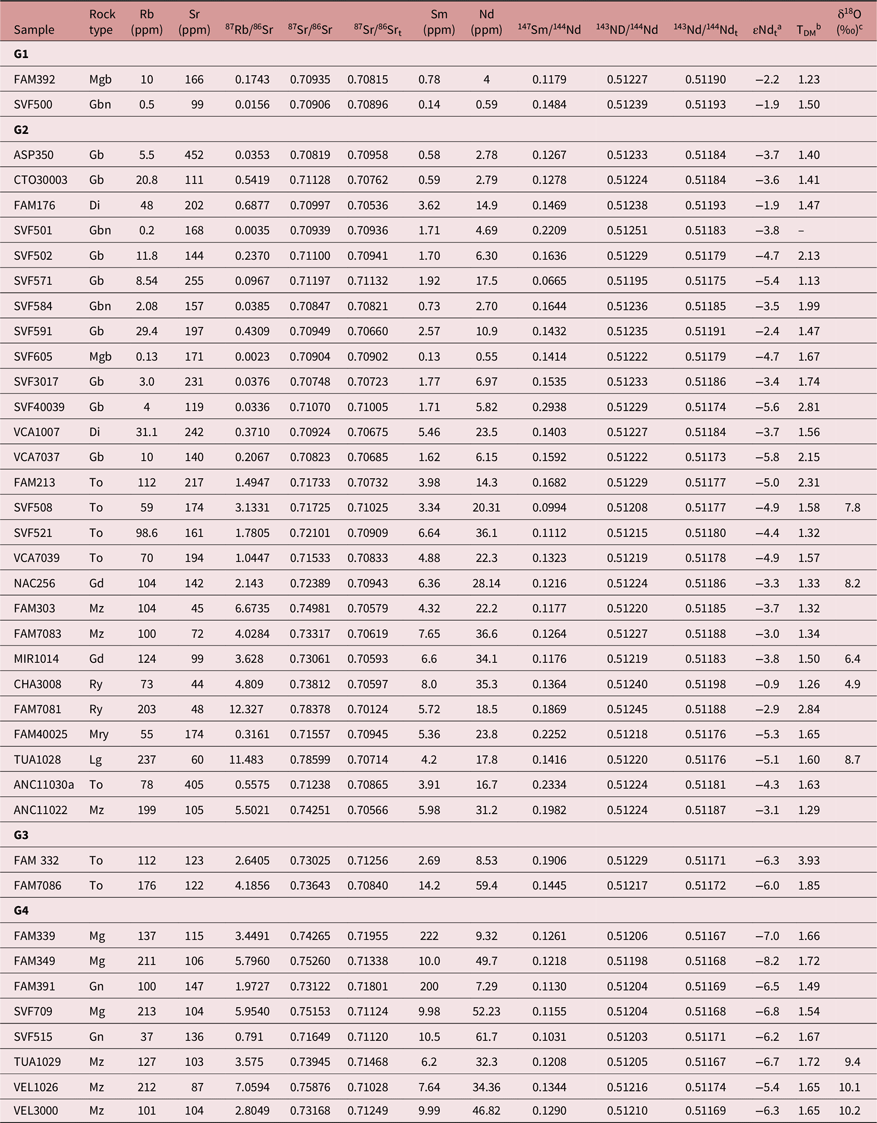
New Sr and/or Nd isotope analyses for six samples (CTO30003, SFV40039, FAM40025, FAM303, ANC11030a and ANC11022) were carried out at the Geochronology and Isotope Geochemistry Center, Complutense University (Madrid, Spain), using an automated multicollector VG® Sector 54 mass spectrometer (Table 3). Errors are quoted throughout as two standard deviations from measured or calculated values. Analytical uncertainties are estimated to be 0.006% for 143Nd/144Nd and 0.1% for 147Sm/144Nd, the latter parameter determined by isotope dilution. A total of 56 analyses of La Jolla Nd-standard over 1 year gave a mean 143Nd/144Nd ratio of 0.511846 ± 0.00003. These samples were analysed for whole-rock major oxides and trace elements using an inductively coupled plasma mass spectrometer (ICP-MS) at Activation Laboratories, Ancaster, Ontario, Canada, under the ‘4LithoResearch’ package, following the procedure described at http://www.actlabs.com (online Supplementary Table S1, available at http://journals.cambridge.org/geo). Additionally, we have taken into consideration the Sr and Nd isotope analyses reported by Dahlquist et al. (Reference Dahlquist, Rapela, Pankhurst, Fanning, Vervoort, Hart, Baldo, Murra, Alasino and Colombo2012), Alasino et al. (Reference Alasino, Casquet, Larrovere, Pankhurst, Galindo, Dahlquist, Baldo and Rapela2014, Reference Alasino, Casquet, Pankhurst, Rapela, Dahlquist, Galindo, Larrovere, Recio, Paterson, Colombo and Baldo2016) and Rapela et al. (Reference Rapela, Pankhurst, Casquet, Dahlquist, Fanning, Baldo, Galindo, Alasino, Ramacciotti, Verdecchia, Murra and Basei2018) and for the remaining samples in Table 2 (all recalculated to 470 Ma) (Table 3).
Zircon O and whole-rock Sr–Nd isotopic compositions from studied samples. The decay constants used in the calculations are the values λ87Rb = 1.42 × 10⁻¹¹ and λ147Sm = 6.54 × 10⁻¹² a−1 recommended by the International Union of Geological Sciences Subcommission for Geochronology. t = time used for the calculation of the isotopic initial ratios (t = 470 Ma). Whole-rock Sr and Nd isotopic compositions are from Alasino et al. (Reference Alasino, Casquet, Larrovere, Pankhurst, Galindo, Dahlquist, Baldo and Rapela2014, Reference Alasino, Casquet, Pankhurst, Rapela, Dahlquist, Galindo, Larrovere, Recio, Paterson, Colombo and Baldo2016) and Rapela et al. (Reference Rapela, Pankhurst, Casquet, Dahlquist, Fanning, Baldo, Galindo, Alasino, Ramacciotti, Verdecchia, Murra and Basei2018), except the samples CTO30003, SVF40039, FAM40025, FAM303, ANC11030a (for Sr) and ANC11022 (for Sr) belonging to this work. Mtgb – metagabbro; Gbn – gabbronorite; Gb – gabbro; Di – diorite; To – tonalite; Ry – rhyolite; Mz – monzogranite; Lg – leucogranite; Mry – metarhyolite; Mg – migmatite; Gn – gneiss

a εNd values were calculated relative to a chondrite present day (CHUR): (143Nd/144Nd) = 0.512638; (143Sm/144Nd) = 0.1967.
b TDM is depleted-mantle model age with average crustal Sm/Nd prior to emplacement at 470 Ma, following De Paolo et al. (Reference De Paolo, Linn and Schubert1991).
c Zircon O-isotope compositions are from Rapela et al. (Reference Rapela, Pankhurst, Casquet, Dahlquist, Fanning, Baldo, Galindo, Alasino, Ramacciotti, Verdecchia, Murra and Basei2018).
A database of c. 110 already reported geochemical analyses from the studied zone are included for the petrogenetic discussion (see online Supplementary Table S1). The geochemical data were taken from Reference Otamendi, Ducea, Tibaldi, Bergantz, de la Rosa and VujovichOtamendi et al. (2009a , 2012), Alasino et al. (Reference Alasino, Casquet, Larrovere, Pankhurst, Galindo, Dahlquist, Baldo and Rapela2014, Reference Alasino, Casquet, Pankhurst, Rapela, Dahlquist, Galindo, Larrovere, Recio, Paterson, Colombo and Baldo2016), Rapela et al. (Reference Rapela, Pankhurst, Casquet, Dahlquist, Fanning, Baldo, Galindo, Alasino, Ramacciotti, Verdecchia, Murra and Basei2018) and Ramacciotti et al. (Reference Ramacciotti, Casquet, Baldo, Alasino, Galindo and Dahlquist2020). Additionally, new whole-rock analyses for two samples (SFV40039 and FAM40025) using inductively coupled plasma mass spectrometry (ICP-MS) were carried at ACTLABS, Canada, following the procedures described as 4-Lithoresearch and 4E-research codes (methods in www.actlabs.com).
5. Isotopic analysis
5.a. O and H data
Four main groups of rocks from the Central Domain are considered here on the basis of the O-isotope composition (Table 2).
G1 consists of one gabbronorite from the deepest exposed crustal level and one granulite facies coronitic troctolitic gabbro from the intermediate level. They are the most juvenile rocks in terms of the O-isotope composition, with low δ18O values of around +5.3‰ (Table 2), that is, mantle-like values (c. +5.5‰; e.g. Hoefs, Reference Hoefs2009).
G2 comprises a variety of rocks with δ18O values ranging from +6.2 to +9.5‰. This group includes: 1 coronitic gabbro and 13 gabbro-diorite samples from the deepest and intermediate depths with δ18O values between +6.6 and +9.4‰; 5 Bt±Hbl tonalite-granodiorite samples from the three deeper levels with δ18O values from +7.8 to +9.3‰; and 2 Bt-rich granodiorite-monzogranite samples, 1 leucogranite and 3 rhyolites (1 with a superimposed low-grade metamorphism) from the uppermost crustal section with δ18O values from +6.2 to +9.5‰ (Table 2).
The G3 group consists of two hybrid granitoids formed by variable mixing of the tonalitic magma with partially molten metasedimentary rocks in the regional thermal aureole, with δ18O values of +8.7‰ for FAM7086 and +9.9‰ for FAM332 (Table 2).
The G4 group consists of five metasedimentary rocks (migmatite and gneiss) from the deepest and intermediate depth and three peraluminous granites from intermediate to shallow depth that show the highest δ18O values between +10.2 and +14.7‰ (Table 2).
Hydrogen isotope analysis of arc samples yielded: a δD value of −113‰ from one G1 gabbro; δD values between −58 and −101‰ from the G2 including two gabbros, two diorites, one tonalite, two granodiorites, one leucogranite and two rhyolites; one value of δD = −93 from a hybrid of the G3; and values between −69 and −124‰ from five metasedimentary rocks and three Crd-granites of the G4 (Table 2).
Rocks of the Eastern Famatinian Domain similar to the G2 group yielded δ18O values of +9.2‰ for the tonalite (ANC11030a) and +8.7‰ for the monzogranite (ANC11022). The δD values are −99 ‰ and −72 ‰, respectively (Table 2).
5.b. Sr and Nd data
In terms of the Sr and Nd isotope composition (calculated at 470 Ma; Table 3) the G1 gabbros yield εNdt values close to −2 and relatively radiogenic 87Sr/86Srt ratios of c. 0.7085. The largest G2 group yielded values of εNdt between −0.9 and −5.8 and 87Sr/86Srt values between 0.7053 and 0.7113, with most of the samples falling within the ranges −3 to −5 and 0.7070 to 0.7090, respectively. The G3 hybrid granitoids show values of εNdt (c. −6.1) intermediate between those of G2 and G4, with 87Sr/86Srt values of 0.7084 for FAM7086 and 0.7125 for FAM332. The G4 group yields εNdt values between −5.4 and −8.2 and 87Sr/86Srt ≥ 0.7102.
Tonalite and monzogranite of the Eastern Famatinian Domain yielded εNdt values of −4.3 and −3.1 and 87Sr/86Srt values of 0.7086 and 0.7056, respectively (Table 3).
6. Discussion
6.a. O–Sr–Nd isotopic composition of the Famatinian arc magmas
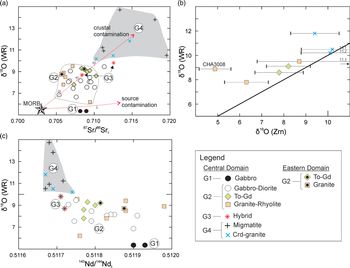
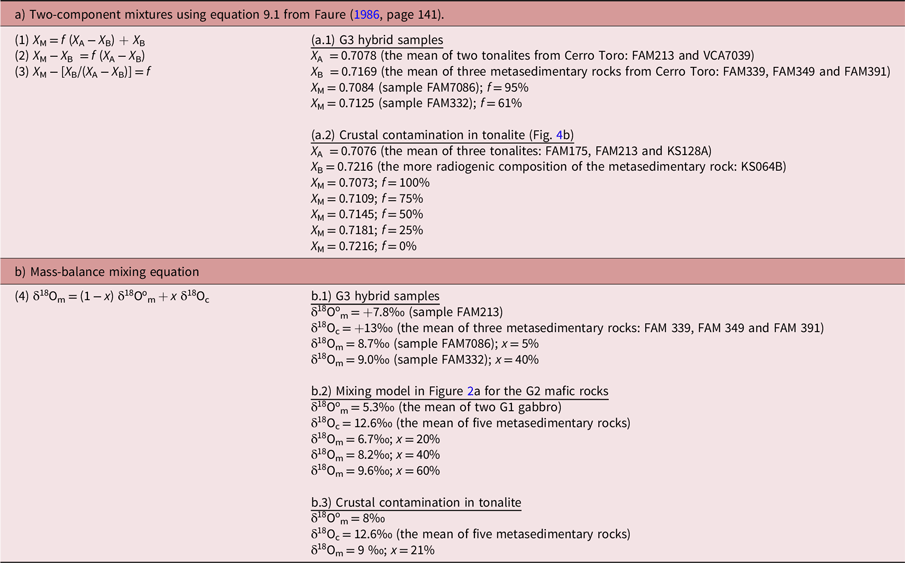
Oxygen isotope analyses were conducted on fresh rocks that do not exhibit significant post-magmatic alteration. There is no apparent correlation between the 87Sr/86Srt and δ18O values in the G2 group (Fig. 2a). The G1 gabbros have the lowest δ18O values but Sr isotope values similar to the G2 gabbros and tonalites-granodiorites, strengthening the apparent lack of correlation between the two isotope systems. Migmatites form a distinctive group with δ18O values typical of metasedimentary rocks (e.g. Hoefs, Reference Hoefs2009). A G2 gabbro that plots between the G2 rocks and the G4 host migmatites, but does not show significant bulk contamination with crustal material in its composition, suggests some fluid–rock interaction (see Section 6.d). The G3 hybrid granitoids show much scatter: FAM7086 overlaps the field defined by G2 samples, whereas FAM332 plots between the G2 rocks and the G4 host migmatites. A binary mixing model based on the 87Sr/86Srt ratios is consistent with variable crustal contribution (Table 4); the calculated percentages of assimilated metasedimentary rocks (and/or derived melts) are 5% and 39% for tonalites FAM7086 and FAM332, respectively. Mixing rates based on O-isotope data show similar values of 5% and 40%, respectively (Table 4).
(a) 87Sr/86Srt v. δ18O‰ (WR); (b) δ18O ‰ (Zrn) v. δ18O‰ (WR); and (c) 143Nd/144Ndt v. δ18O‰ for igneous and metamorphic rocks of the Famatinian orogen; (a) shows schematic lines of mixing between MORB and subducted sediment as source contamination (adapted from Davidson et al. Reference Davidson, Horab, Garrison and Dungan2005), and mixing between the MORB and metasedimentary rocks (G4 rocks) as crustal contamination (see Table 4). The latter is based on the O-isotope composition that can be considered as a simple mixture calculation (Kempton & Harmon, Reference Kempton and Harmon1992). δ18O‰ (WR): values for whole-rock sample and δ18O‰ (Zrn): values for zircon.

Two-component mixture equations, where X A is the initial Sr isotopic ratio (87Sr/86Srt) of the starting magma; X B is the initial Sr isotopic ratio of the contaminant; X M is the mixed isotopic composition represented by studied samples of the Famatinian arc; and f is the starting magma fraction in the mixture. Mass-balance mixing equation, where δ18Oo m is the oxygen isotope composition of the starting magma; δ18Oc is the oxygen isotope composition of the contaminant; δ18Om is the isotopic assumed mixed composition; and x is the mass fraction of component C. Data used in the calculation are from Tables 2, 3 and online Supplementary Table S1

Average δ18O values of G2 and G4 igneous zircon (Zrn) of Famatinian age (c. 470 Ma; Rapela et al. Reference Rapela, Pankhurst, Casquet, Dahlquist, Fanning, Baldo, Galindo, Alasino, Ramacciotti, Verdecchia, Murra and Basei2018) and the corresponding whole-rock (WR) values correlate well with Δδ18OWR–Zrn ≤ 2.4‰ (Fig. 2b). This suggests that the whole-rock oxygen isotope composition is the same as that of the magma and that a significant interaction with low δ18O meteoric waters after crystallization did not play a role (see Section 6.d). Some felsic rocks are exceptions, such as rhyolite CHA3008, which shows the largest Δδ18OWR–Zrn values (c. 4‰). The low 87Sr/86Srt ratio (0.7059), high εNdt (−0.9) and low δ18OZrn (+4.9) of this rock indicates some disequilibrium between zircon and the whole rock that did not affect the other isotope systematics. This implies that the rhyolite composition was not affected by bulk assimilation of supracrustal rocks, but reflects either original magmatic differences or the effect of metamorphic fluids (see Section 6.d).
Except for a potential negative correlation of the whole-rock O-isotope composition with the 143Nd/144Ndt ratio for G1 and G2 mafic rocks discussed in Section 6.b, the remaining rocks of the G2 group (tonalites and other granitoids and volcanics) show that the isotope systematics (O, Sr and Nd) are largely uncoupled as was noted by Rapela et al. (Reference Rapela, Pankhurst, Casquet, Dahlquist, Fanning, Baldo, Galindo, Alasino, Ramacciotti, Verdecchia, Murra and Basei2018) using O in zircon (Fig. 2a, c). Zircons analysed by Rapela et al. (Reference Rapela, Pankhurst, Casquet, Dahlquist, Fanning, Baldo, Galindo, Alasino, Ramacciotti, Verdecchia, Murra and Basei2018) exhibit O-isotope values within the same range as both the gabbros (δ18O = +6.5 to +8.1‰) and the tonalite-granodiorites (δ18O = +6.7 to +9.5‰). Moreover, the range of zircon O-isotope values overlaps with the whole-rock O-isotope values for the same rock types of the G2 group (δ18O = +6.6 to +9.4‰) (Table 2). This finding strengthens the idea that the oxygen isotopic composition did not change significantly after zircon crystallization (T c. 850°C) and that isotopic homogenization was not a major process operating on a regional scale.
6.b. Origin of the enriched sub-arc mantle in the Famatinian arc
Unlike mid-ocean-ridge basalts (MORBs) that derive from a fairly uniform melt-depleted upper mantle (87Sr/86Srt c. 0.703, εNdt c. +8 and δ18O c. +5.7‰; Harmon & Hoefs, Reference Harmon and Hoefs1995; Saunders et al. 1998), the Famatinian G1 and G2 gabbro-diorites are isotopically evolved in terms of Sr and Nd. They show average values of 87Sr/86Srt = 0.7085, εNdt = −2 and δ18O = +5.3‰ (G1; n = 2), and 87Sr/86Srt = 0.7082, εNdt = −4 and δ18O = +8‰ (G2; n = 14). The high initial 87Sr/86Sr ratios and low 143Nd/144Nd ratio of the two G1 meta-gabbros with typical δ18O mantle values suggest that these rocks acquired their isotope ‘crustal’ signature in the source (e.g. James, Reference James1981; Davidson et al. Reference Davidson, Horab, Garrison and Dungan2005). In the 87Sr/86Srt versus δ18O plot, the isotope compositions of the G1 mafic rocks could result from assimilation of less than 5% of a subduction-derived crustal component (Fig. 2a). For the G2 mafic rocks, however, the primary magma would require approximately 40% of crustal material with a δ18O value of +12.6‰ to reproduce the O-isotope data, which is inconsistent with the major-element compositions (Fig. 2a; Table 4). In this case, the contamination of mafic magmas by the host metasedimentary rocks played a minor role (e.g. Pankhurst et al. Reference Pankhurst, Rapela and Fanning2000; Walker et al. 2015; Alasino et al. Reference Alasino, Casquet, Pankhurst, Rapela, Dahlquist, Galindo, Larrovere, Recio, Paterson, Colombo and Baldo2016).
In continental arcs, the isotope signature of enriched-mantle-derived magmas is difficult to distinguish from that resulting from crustal assimilation of depleted-mantle magmas. The latter interpretation commonly prevails in relation to continental-arc magmatism (e.g. Bindeman, Reference Bindeman2008). However, the distinction remains controversial in that the root of the arcs is inaccessible and deep-seated igneous rocks with xenoliths are missing. This has been the case for the Famatinian arc, where assimilation of continental crust has been invoked (e.g. Otamendi et al. Reference Otamendi, Ducea and Bergantz2012; Walker et al. 2015). Walker et al. (2015) observed isotope decoupling as a product of prolonged but punctuated MASH processes in the lower crust of the arc. This view has been challenged by petrogenetic models involving enriched sub-arc mantle (Castro et al. Reference Castro, Díaz-Alvarado and Fernández2012; Dahlquist et al. Reference Dahlquist, Pankhurst, Gaschnig, Rapela, Casquet, Alasino, Galindo and Baldo2013; Alasino et al. Reference Alasino, Casquet, Pankhurst, Rapela, Dahlquist, Galindo, Larrovere, Recio, Paterson, Colombo and Baldo2016; Rapela et al. Reference Rapela, Pankhurst, Casquet, Dahlquist, Fanning, Baldo, Galindo, Alasino, Ramacciotti, Verdecchia, Murra and Basei2018). Evidence for high δ18O sources in the sub-arc mantle has been provided in some cases elsewhere. Eiler et al. (Reference Eiler, McInnes, Valley, Graham and Stolper1998) reported δ18O values of up to +12‰ in xenoliths from Papua-New Guinea, which they attributed to metasomatism of the sub-arc mantle by δ18O-enriched fluids. Dorendorf et al. (Reference Dorendorf, Wiechert and Worner2000) reported heavy O-isotope compositions in olivine and pyroxene from the Klyuchevskoy volcano, Kamchatka (Russia), implying magma with mean δ18O values between +6.2 and +7.5‰; again, slab-released hydrous melts with high δ18O values were invoked. Liu et al. (Reference Liu, Wu, Chung, Li, Sun and Ji2014) studied olivine from mantle xenoliths in basalts from South Tibet, and concluded that magmas were derived from a sub-arc metasomatized mantle source with δ18O values of +8.03 ± 0.28‰. Slab-derived fluid/melts with high δ18O values are to be expected in subduction zones, because weathered and hydrothermally altered upper oceanic crust has δ18O values between +7 and +15‰ (review in Bindeman, Reference Bindeman2005).
Based on chemical and isotopic compositions of the mafic rocks exposed in both the fore-arc region (in the westernmost Sierras Pampeanas, see Ramacciotti et al. Reference Ramacciotti, Casquet, Baldo, Alasino, Galindo and Dahlquist2020) and the arc region studied here, garnet-pyroxenite (sensu lato) and peridotite were proposed as the sources of the mafic magmas in the arc (Alasino et al. Reference Alasino, Casquet, Pankhurst, Rapela, Dahlquist, Galindo, Larrovere, Recio, Paterson, Colombo and Baldo2016). These authors suggested that mixing between a subordinate primitive magma and an ‘enriched’ lithospheric mantle could explain both the range of εNdt values (from +4.8 to −6.0‰) and the δ18O composition (from +5.3 to +9‰) in the mafic samples (see compilation data in Alasino et al. Reference Alasino, Casquet, Pankhurst, Rapela, Dahlquist, Galindo, Larrovere, Recio, Paterson, Colombo and Baldo2016). The good negative correlation between δ18O and 143Nd/144Ndt (r = 0.7; Fig. 3a) for our arc mafic rocks suggests that both were inherited from the source and could be acquired in a mixing process between the enriched lithospheric mantle and the depleted mantle. This interpretation is strengthened in a 143Nd/144Nd versus La/Sm plot (Fig. 3b), which shows the composition of melts from heterogeneous mantle sources (Stracke, Reference Stracke2012). The mafic samples of the orogen scatter between an isotopically enriched source (subcontinental lithospheric mantle?) with an estimated value of 143Nd/144Nd of c. 0.5122 and depleted peridotite, that is, the source of MORB-type magmas (Fig. 3b). This suggests that mafic melts can be extracted from a large range of depths with little melt mixing between these two protoliths, due to either the absence of a thick lithosphere or high excess mantle temperatures (e.g. Stracke, Reference Stracke2012) producing the heterogeneity and the enrichment in their isotopic compositions.
(a) δ18O ‰ v. 143Nd/144Ndt and (b) 143Nd/144Nd v. La/Sm for gabbros and diorites of the Famatinian orogen. Note that trace-element ratios involving a moderately incompatible element (e.g. La/Sm in (b)) are dominantly influenced by the melting process, whereas the isotope ratios only change in response to the relative contribution of the two source components. The La/Sm ratio is sensitive to the presence of residual garnet (and therefore the depth of melting and/or the role of pyroxenite) (e.g. Stracke, Reference Stracke2012). Data for (b) from Supplementary Table S1.

6.c. Origin of silicic magmas
There is no significant difference in isotope composition between G2 mafic rocks, interpreted here as derived mostly from an enriched lithospheric mantle (average δ18O = +8 ± 0.8‰, 87Sr/86Srt = 0.7082 ± 0.0016 and εNdt = −4 ± 1.1; n = 14) and tonalite-granodiorite rocks (average δ18O = +8.7 ± 0.5‰, 87Sr/86Srt = 0.7088 ± 0.0001 and εNdt = −4.5 ± 0.6; n = 5). This observation also applies to the Eastern Famatinian Domain, implying not only similar magmatic evolution in both regions at c. 470 Ma but also a ubiquitous occurrence of the source in the orogen (Fig. 2c). An old lithospheric (evolved) mantle source is therefore invoked rather than depleted mantle with assimilation of crustal material. The latter would require that each batch of mafic magma had assimilated just the right amount of extremely heterogeneous crustal material to generate the same range of isotope compositions over a wide area (see also Rapela et al. Reference Rapela, Pankhurst, Casquet, Dahlquist, Fanning, Baldo, Galindo, Alasino, Ramacciotti, Verdecchia, Murra and Basei2018).
However, there is field and geochemical evidence that G2 intermediate magmas were modified to some extent by contamination with supracrustal rocks (e.g. Otamendi et al. Reference Otamendi, Ducea and Bergantz2012; Alasino et al. Reference Alasino, Casquet, Larrovere, Pankhurst, Galindo, Dahlquist, Baldo and Rapela2014; Walker et al. 2015). Contamination with host rocks is recognized in the 87Sr/86Srt versus K2O plot as a significant increase of the 87Sr/86Srt (up to c. 0.720) along with increasing K2O content (Fig. 4a). This trend is shown by some tonalites (5 out of 32 samples) found in the Sierra de Valle Fértil and the western Sierra de Famatina. The hybrid FAM7086, with an assimilation of approximately 5% of wall rock, remains quite uniformly within the G2 tonalite group, whereas sample FAM332, with an assimilation rate near 40%, follows the trend of contaminated rocks. The remarkable increase in the 87Sr/86Srt ratio of some tonalites (up to c. 0.715), departing from the main differentiation trend in a plot against Sr concentration (Fig. 4b), strengthens this interpretation.
(a) 87Sr/86Srt v. K2O % and (b) Sr (ppm) v. 87Sr/86Srt for igneous and metamorphic rocks of the Famatinian orogen. In (b) a simple mixing equation based on the Sr isotope composition is used to estimate the crustal contamination in tonalite (see Table 4). Data from Supplementary Table S1. Legend as in Figure 2.

If an initial Sr-isotope value of 0.7073 (the mean for the three most primitive G2 tonalites in the dataset) is taken as the starting magma composition, and the more radiogenic composition of the metasedimentary rock (0.7216) is regarded as the contaminant, the rest of the G2 tonalites would be required to assimilate up to 40% (in most cases 10–20%) pre-existing crust to reproduce the Srt value (Fig. 4b; Table 4). Magma mixing ratios based on O-isotope data yield similar values (Table 4). If the lightest δ18O value of +8‰ from the G2 tonalites is taken as typical of the starting magma and the mean of the five G4 rocks as representative of the crustal contaminant (δ18O = +12.6‰), 21% contamination would be required to raise the δ18O of the magma by 1‰.
Crustal assimilation is only recorded in tonalite-granodiorite, not in granite-rhyolite samples. In fact, the latter show a decrease of the 87Sr/86Srt ratio down to c. 0.7059 with a simultaneous decrease of Sr content, suggesting that some of the felsic magmas evolved independently of the tonalite-granodiorite magmas, with a trend towards more juvenile isotopic composition (Fig. 4b). Likewise, in the 143Nd/144Ndt versus δ18O plot, the felsic rocks record values close to the most primitive mafic rocks (Fig. 2c).
6.d. Crustal fluids in the Famatinian arc
The δ18O versus δD plot (Fig. 5) shows that both igneous and sedimentary rocks display a wide range of δD values from −58 to −124‰, with a restricted range of δ18O values for the Central Domain. Part of the G4 rocks (two migmatites, one gneiss and two Crd-granites with δ18O ≥ +10.5‰ and δD c. −73‰) plot mostly outside of the metamorphic water box and to the right of the magmatic water box (Fig. 5). Moreover, some G4 samples yield low δD values (down to −124‰), likewise resulting from interaction with meteoric fluids. A group of samples of the G2 (mostly gabbro-diorite and monzogranite-rhyolite) with δ18O values of +6.2 to +8.1‰ and δD values of −68 to −79‰ are within the igneous box (Fig. 5). The rest of the G2 rocks and the G1 gabbro plot below the igneous box, suggesting some exchange with meteoric fluids small enough to affect the isotope composition of H but not that of O, implying low fluid/rock ratios. Moreover, the effect of metamorphic fluids on the isotope composition seems to be minor, as most samples plot outside the corresponding box and a clear trend is not visible. The G3 sample (a hybrid rock with approximately 40% contamination) falls consistently within the field of the metamorphic rock, but close to igneous rocks.
δ18O ‰ v. δD ‰ for igneous and metamorphic rocks of the Famatinian orogen. Legend as in Figure 2.

7. Conclusions
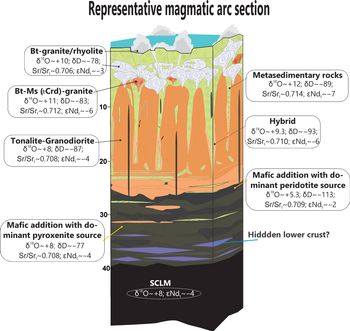
The stable (O and H) and radiogenic (Sr and Nd) isotope data for representative whole rocks from the main Famatinian arc in the Sierras Pampeanas preserve evidence that the sub-arc mantle was the main source region. The sub-arc mantle was isotopically heterogeneous, including an ‘enriched’ domain (δ18O c. +8‰) as well as a subordinate depleted member (δ18O c. +5‰). A sketch of the interpreted magmatic column of the Famatinian arc is shown in Figure 6.
Schematic cross-section through the Famatinian continental arc, representing a possible non-homogenized magmatic column with variable contamination in both mid-crustal regional contacts and in the deeper levels. SCLM – subcontinental lithospheric mantle. The depleted mantle (peridotite) is not represented.

The diversity of magmatic isotope compositions preserved in the tonalite-granodiorite rocks (average δ18O = +8.7 ± 0.5‰, δD = −73 ± 14‰, 87Sr/86Srt = 0.7088 ± 0.0001 and εNdt = −4.5 ± 0.6) shows no major difference from the isotopic composition of most of the contemporaneous mafic rocks (average δ18O = +8 ± 0.8‰, δD = −84 ± 18‰, 87Sr/86Srt = 0.7082 ± 0.0016 and εNdt = −4 ± 1.1), suggesting that arc magmas acquired their ‘crustal’ signature in the mantle source. The isotopic composition of the tonalite-granodiorite suite was then partially modified in the crust with the most samples explicable by 10–20% assimilation of crustal material (δ18O = +12.2 ± 1.7‰, δD = −89 ± 21‰, 87Sr/86Srt = 0.7146 ± 0.0034 and εNdt = −6.9 ± 0.7). The felsic magmas that reached upper crustal levels (δ18O = 9.9 ± 1.5‰, δD = −76 ± 5‰, 87Sr/86Srt = 0.7067 ± 0.0010, εNdt = −3.5 ± 1.4) were not derived by crustal assimilation and fractionation of the intermediate contaminated magmas, but evolved from different magma batches independently of the origin of the tonalite-granodiorite. Some rocks of the orogen, both igneous (mostly gabbro and tonalite) and metamorphic, underwent restricted interaction with meteoric fluids that did not significantly modify the O-isotope composition, but lowered whole-rock δD values.
Reported values of δ18O of zircon from the Famatinian arc rocks (+6 to +9‰) do not show differences from our whole-rock δ18O data, indicating that pervasive oxygen isotope exchange after zircon crystallization was not a major process in the lower crust during the magmatic flare-up at c. 470 Ma. The Famatinian arc was built from multiple magma batches that evolved independently at variable depths. Diversification processes, such as mixing and homogenization, in the continental crust played a secondary role in forming final compositional diversity in the studied arc.
Acknowledgements
Funds were provided by a Spanish CGL2016-76439-P grant from the MINECO (Ministry of Economy) and an Argentinean PICT 2017-0619 grant. The first author thanks S. Paterson for useful discussions on the geology of the Famatinian arc. We are grateful to two anonymous reviewers whose comments improved the final version of this manuscript, and to K. Goodenough for editorial handling.
Supplementary material
To view supplementary material for this article, please visit https://doi.org/10.1017/S0016756820000321