Introduction
Austen Henry Layard (1817–1894) was a typical Victorian polymath, whose personality scarcely fits within modern categorisations: he was a traveller, archaeologist, politician and diplomat, writer, art collector, and a learned scholar. During his life, Layard wrote books on his adventures and excavations in the Near East,Footnote 1 which enjoyed multiple editions and even two abridged editions;Footnote 2 he published drawings made by himself and his artists on the excavations;Footnote 3 he offered the material for the first Assyriological volume ever published under the auspices of the Trustees of the British Museum,Footnote 4 and he edited a booklet to present to the world the “Nineveh Court” at the Great Exhibition, held in London.Footnote 5 His manifold interests are also reflected by his publications on Italian Art,Footnote 6 as well as by the autobiography which he wrote in his old age, sitting in the studio of his Venetian residence.Footnote 7
Layard's list of publications is remarkable in itself, and all the more so when one considers that his private archives testify to him being even more prolific than what is generally acknowledged: there are, in fact, many more unpublished manuscripts on Italian Art and History, autobiographical accounts of the time he spent in Spain and Turkey as a diplomat, as well as other various pamphlets and speeches pronounced in the House of Lords that have never been published. Additionally, he wrote thousands of epistles to relatives, friends, politicians, and scholars all over the world.
According to the British National Archive database,Footnote 8 Layard's personal archives are scattered across eighteen repositories in the United Kingdom; more documents are held in other archives in Europe and the United States. The bulk of this material, the so-called “Layard Papers” kept at the British Library, consists of more than two hundred volumes donated by Lady Enid Layard (Henry's wife) and – at a later time – by Layard's biographer, Gordon Waterfield.Footnote 9 The total of manuscripts, thus, amounts to thousands of documents. The other British archives containing Layard's material reflect the personalities of their donors, the offices they held and the type of relationship that connected them to Layard (political, scholarly, economic, etc.).
Since October 2016, a new archive can be added to the list of previously known repositories, thus bringing the total to nineteen British archives containing papers written by or connected to Layard.
The newest collection, deposited in the Special Collections and Archives at Newcastle University, consists of about two hundred handwritten letters, a dozen books, about three hundred folios, photos, maps, and various other objects. Such an archive is different from the previously known ones in light of its history and nature: it was kept and bequeathed for generations as a family assemblage, and as such the heterogeneous materials which it contains were united by the special significance that they held for Henry and Enid Layard's descendants.Footnote 10 The archive in Newcastle once belonged to Charlotte Maria Guest, Enid Layard's oldest sister, and to her husband Richard Du Cane. Enid and Maria were daughters of Lady Charlotte Elizabeth Guest (later Lady Charlotte Schreiber), who was one of the main sponsors of Henry, her cousin,Footnote 11 whom she called “Henry Layard, the Eastern explorer” or “Henry Layard, the Ninevite” – particularly during the years that immediately followed his first campaign in the East and in its aftermath.Footnote 12
Maria, Enid and their siblings grew up listening to Henry's magnificent adventures in Mesopotamia, recounted by their mother and also by himself, on the occasion of his frequent visits; Charlotte even had a “Nineveh Porch” designed and built in her family property at Canford Manor. This consisted of a large room attached to the main building, which hosted original marbles from Nineveh sent by Henry to Charlotte directly from the excavations – including a couple of lion and bull similar to the ones that today stand at the British Museum.Footnote 13 The documents from the Newcastle Layard Archive prove that the interest in archaeology was handed down, likely through Maria, also to the later members of the Du Cane family. Indeed, Near Eastern archaeology and Assyriology are represented in this collection, in several ways.
The Letters
The handwritten letters kept in the archive are for the vast majority written by Enid Layard to her sister, and they are dated from the day after her engagement to Henry (January 10th, 1869) to January 23rd, 1884. These are indeed numerous, and address all sorts of topics: frivolous and daily ones, such as fashion, gardening, high society and family gossips, as well as house management, are intertwined with descriptions of Layard's activities as ambassador in Madrid (1869–1877) and Constantinople (1877–1880), even with some dramatic descriptions of scenes witnessed by Enid during the Third Carlist War (1872–1876) and the Russo-Turkish War (1877–1878).
Inside this large corpus there are also a couple of letters in which Enid gives to her sister some information with regards to a relief from Nineveh which belonged to the family (almost certainly from the very original corpus of reliefs owned by Charlotte) and that Maria apparently decided to donate:
Madrid
(18th Oct. 1876)
Dearest Maria,
(…) Henry tells me to tell you that you are quite right in y.r explanation of the piece of Nineveh marble – as to the tunic & greaves. I can imagine that both Dacre & his master will be delighted at this addition to the Museum. (…)Footnote 14
Madrid
Nov. 18th 1876
Dearest Maria
I was just getting out my pen to write in answer to your long letter of the other day when yours of 6th marched in so at once I proceed to answer your question ab.t the marbles. Henry says some of the marbles at Canford were found at Kouyounjik & some at Nimroud but he thinks the piece you have chosen must be from the former place & as such you may safely describe it (…)Footnote 15
The dispersal of the family collection of antiquities continued in the following generations. One later letter from the Newcastle Layard Archive may be added to the already known dossier related to the Assyrian reliefs originally displayed in the Nineveh Porch at Canford Manor (later “Canford School”), which were sold to several Museums and collectors across the world in different purchases from 1930 to 1992.Footnote 16
As a consequence of the clamour that arose after a Sotheby's auction held on November 16th, 1959, whose gross proceeds for the sale of six fragments of marbles reached the remarkable amount of £14,250,Footnote 17 Julia Du Cane (one of Layard's nieces) decided to sell one small fragment in her possession. She therefore addressed a letter to Mr Hughes, Senior History Master at Canford School, immediately after the sale (precisely, on November 19th); Mr Hughes’ reply, dated to November 25th, is preserved at Newcastle:
25th Nov. 1959.
Dear Miss Du Cane,
In order to get the best advice available to me in the matter of your Assyrian relief, I wrote to Mr. Kenneth Adams, one of our Governors upon whemsic fell the main responsibility for dealing with our “finds”. With his recent experience of this sort of thing I felt that his advice would be most valuable for you, and he strongly recommends you to place the matter in the hands of Sotheby's who acted for us. (…)Footnote 18
And so she did: Sotheby's handled this auction too, and on April 11th, 1960 the piece was sold for £2,700.Footnote 19
Julia also took care of other pieces from her uncle's original collections of antiquities still in the hands of the Du Cane family. One final interesting piece of evidence from the Newcastle Layard Archive proves how she donated one drawing to the British Museum that must have held a special significance for Henry Layard, and was therefore kept for many years within his family:Footnote 20
19th January, 1960
Dear Madam,
I beg to acknowledge with thanks your letter of the 17th enclosing the pencil sketch of the moving of the Assyrian bulls at Nimrud.
It is, I think, quite clearly the original of the frontispiece of your uncle, Sir Henry Layard's, famous book, Nineveh and its Remains, Vol. 1 (London 1848), and I take it itsic is by his own hand, although he himself is depicted in the picture giving directions from the top of the ruins! The figure below wearing a tarboosh and holding a sword I take to be Sir Henry Rawlinson, then Colonel Rawlinson.
It is a most interesting document and we are delighted to have it. I shall report it to the Trustees at their next meeting in February for their formal acceptance.
I am, and always have been, a great admirer of Sir Henry Layard, whose work was, I think, never been sufficiently appreciated, and I should be very happy to meet you and show you around if you should come to London at any time.
I understand that a Mr. Waterfield of the B.B.C., a descendant of Mr. Lynch, Layard's friend, is at present writing a biography of Layard which will, I am sure, fill a great want.
Yours very truly,
R.D. Barnett.
Keeper.Footnote 21
More documents kept in the Archives at the Department of the Middle East, British Museum, prove how Julia had begun to entrust items to that institution ever since the beginning of the Fifties. Indeed, in 1951–1952 she donated a dozen Mesopotamian and Egyptian items which were part of her uncle's private collection.Footnote 22
The Printed Material
The Newcastle Layard Archive also includes a large red folder, consisting in the front page of the first series of the volume Monuments of Nineveh originally published in 1849. One label, likely attached on the cover by one member of the Du Cane family, describes its contents as “Monuments of Nineveh, AH Layard, proofs and drawings”, but the folder includes many more scattered folios and later additions, as well.
Indeed, the binder contains sixteen pages consisting of the printed proofs, corrected by Layard himself, of both Monuments of Nineveh and the later volume A Second Series of the Monuments of Nineveh (published in 1853). These are not the only corrected proofs known from Layard's private archives: for example, in the National Library of Scotland are kept the galley proofs of his Early Adventures in Persia, Susiana, and Babylonia (1887),Footnote 23 and the marked first printed versions of his Autobiography (posthumously published in 1903).Footnote 24
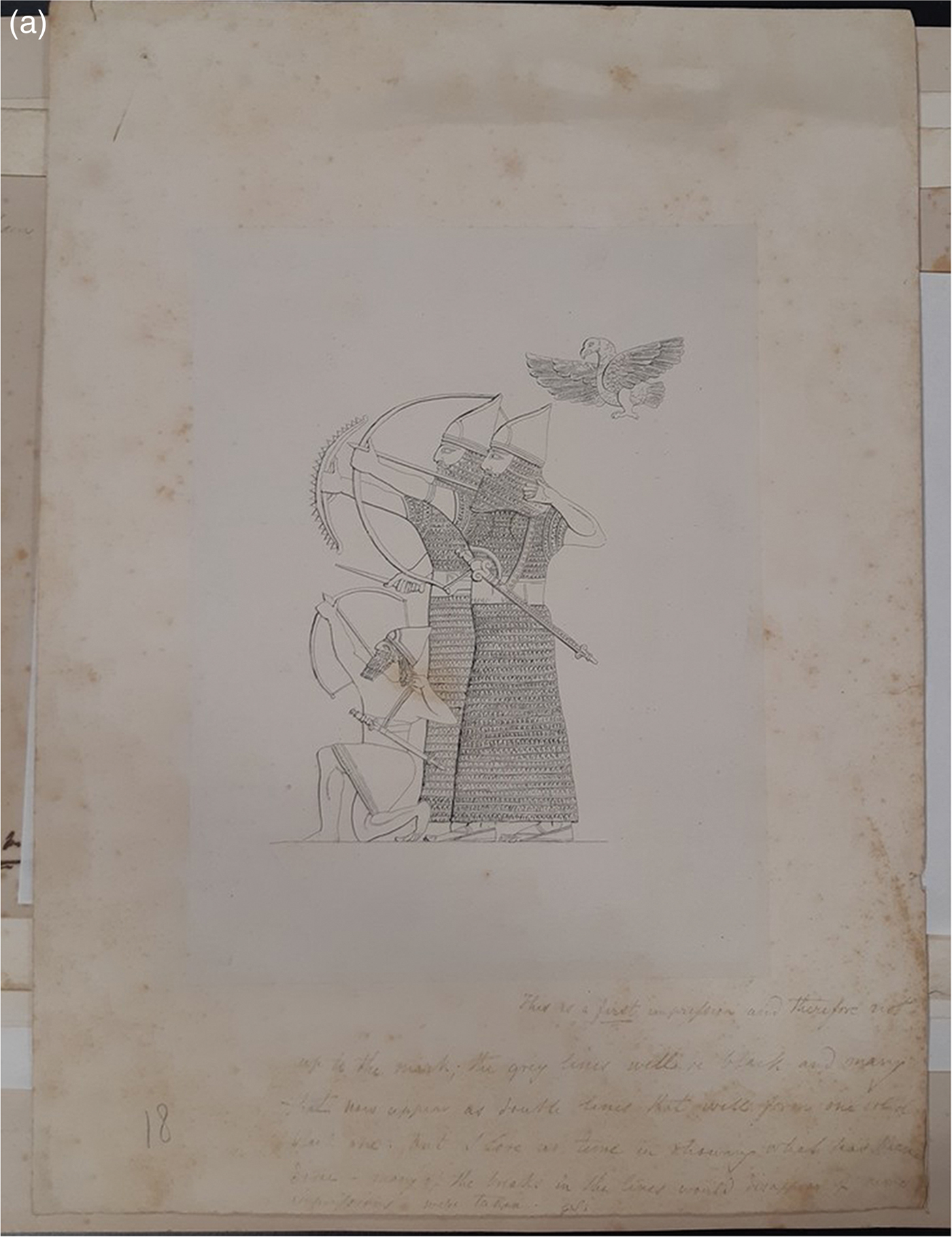
The folder also contains some engravings for the plates of both volumes, with annotations written by Layard and the engravers. Many plates present more than one duplicate; the paper upon which they are reproduced is often quite fragile, presenting stains, folding and holes. Notes are mostly limited to very simple ones, such as “not finished”/“unfinished”, digits of the plate written in pencil, and in one case the indication “for approval & writing”. Layard added one caption for the first edition's plate 32: “Warrior hunting the wild Bull”, which then became “Warrior pursuing a wild bull” in the final printed version. Finally, a longer note is written at the bottom of a plate labelled with the number 18, which depicts three archers surmounted by one eagle (Fig. 1a). The engraver, who signed the page with his initials and is to be identified with George Scharf junior,Footnote 25 wrote to Layard:
This is a first impression and therefore not up to the mark; the grey lines will be black and many that now appear as double lines that will form one solid black one: but I lose no time in showing what has been done – many of the breaks in the lines would disappear if more impressions were taken. GS
Monuments of Nineveh’s plate 18 in the Layard Archive, Newcastle University Library. G. Scharf's note is written in pencil, in the bottom-right corner.

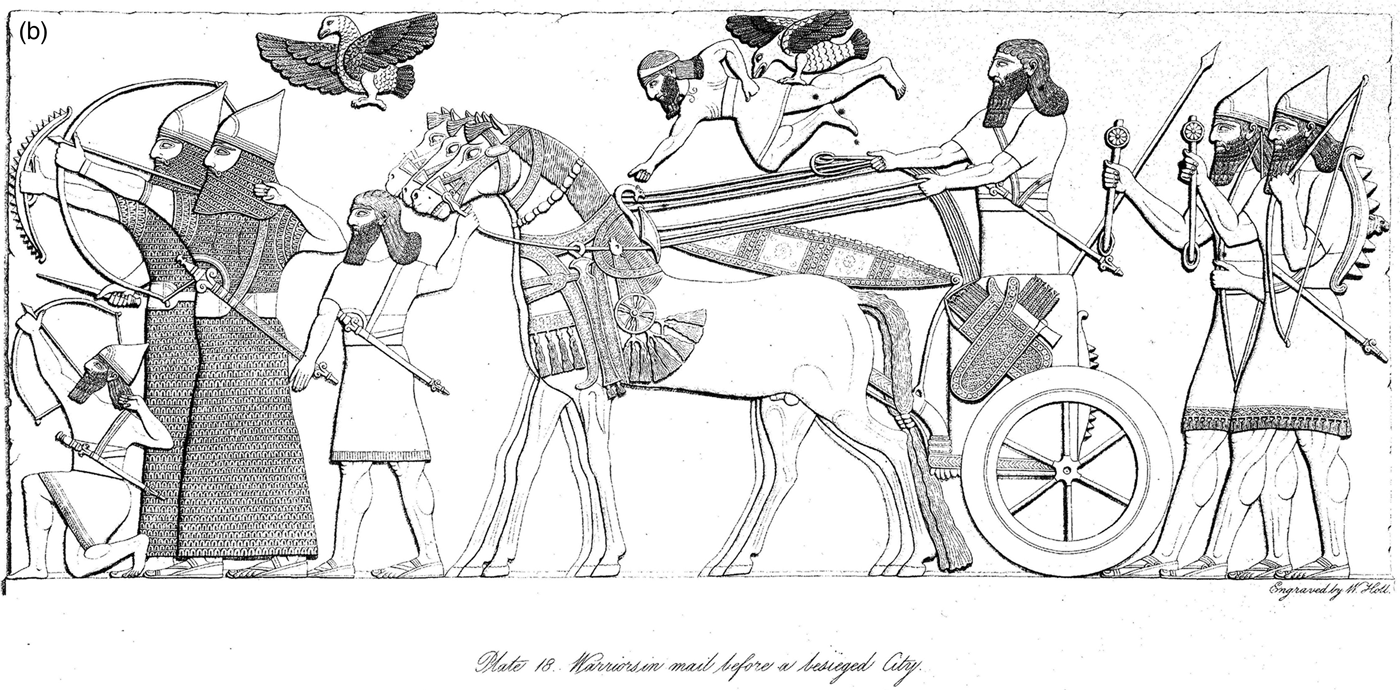
Monuments of Nineveh Plate 18 in the final publication.

Interestingly, in the final publication, plate 18 depicts a larger and more complex scene, encompassing many different warriors and one chariot behind the three archers, who appear at its left edge (Fig. 1b). Also, the plate bears the indication “engraved by W. Holl”: Scharf's contribution to it was thus obliterated in the final edition.
One brown envelope included in the red folder contains more various material: unfortunately, the absence of any handwritten note or comment prevents us from knowing which material was kept by Layard himself and what was instead added to the collection by later members of the family. The content of this envelope consists of:
1. one copy of the Report of the Assyrian Excavation Fund, February 20, 1855, which offers transcriptions of detailed letters sent by William Kennett Loftus (Layard's successor on the excavations at Nineveh and Nimrud) to the Committee of the Assyrian Excavation Fund while he was in the field (letters dated 28th August, 25th September, 9th October, and 4th December 1854) accompanied by printed copies of the drawings made by Loftus’ artist, William Boutcher;
2. nineteen plates from Layard's publications;
3. one newspaper cutting from The Illustrated People's Paper: this journal was published for only three months (April to June) in 1854, the paper included in the folder being the introductory page of the first issue, with the description of the editors’ intentions. Since it mentions neither Layard nor his excavation in any way, it is not clear why it has been kept in the Archive;Footnote 26
4. one image of the Nineveh Court at the Crystal Palace;
5. two printed images of an unknown chapel of an unidentified European church;
6. two sketches of unknown architectural elements, likely drawn in pencil by Layard himself.
The red folder also contains two more “envelopes” created by large sheets of folded papers: in the first one there are two engravings of winged bulls, from Felix Lajard's Introduction à l'étude du culte public et des mystères de Mithra (Reference Lajard1847).Footnote 27 As explained by Lajard in the introduction to his volume, the 110 plates which completed his work were engraved by M. Reveil, M. Meucci and M. Bigant, the images of the Assyrian and Persian colossi and reliefs having been taken from previous works by R. Ker Porter, M. J. Alexander, and M. M. Flandin, X. P. Coste and P.-É. Botta.Footnote 28
The second envelope was sent to Layard by Loftus, and contains copies of some of the plates of his Lithographic Facsimiles of Inscriptions in the Cuneiform Character from the Ruins of Susa.Footnote 29 To these, someone added six hand-made copies of cuneiform inscriptions made by Layard himself: these show Layard's remarkable attention to detail and to possible alternative readings for those signs that offered no certain interpretation.Footnote 30 The very presence of this envelope in the archive is meaningful, because it represents the only proof known so far among all the British archives of a direct contact between Layard and Loftus.
Drawings, Sketches, Maps and Watercolours
Besides the assorted printed material described above, the red folder in the Newcastle Layard Archive encompasses a remarkable collection of drawings, sketches, maps and watercolours. Some of them are certainly ascribable to Layard, while others are from the artists who worked with him, or in a few cases of uncertain attribution.
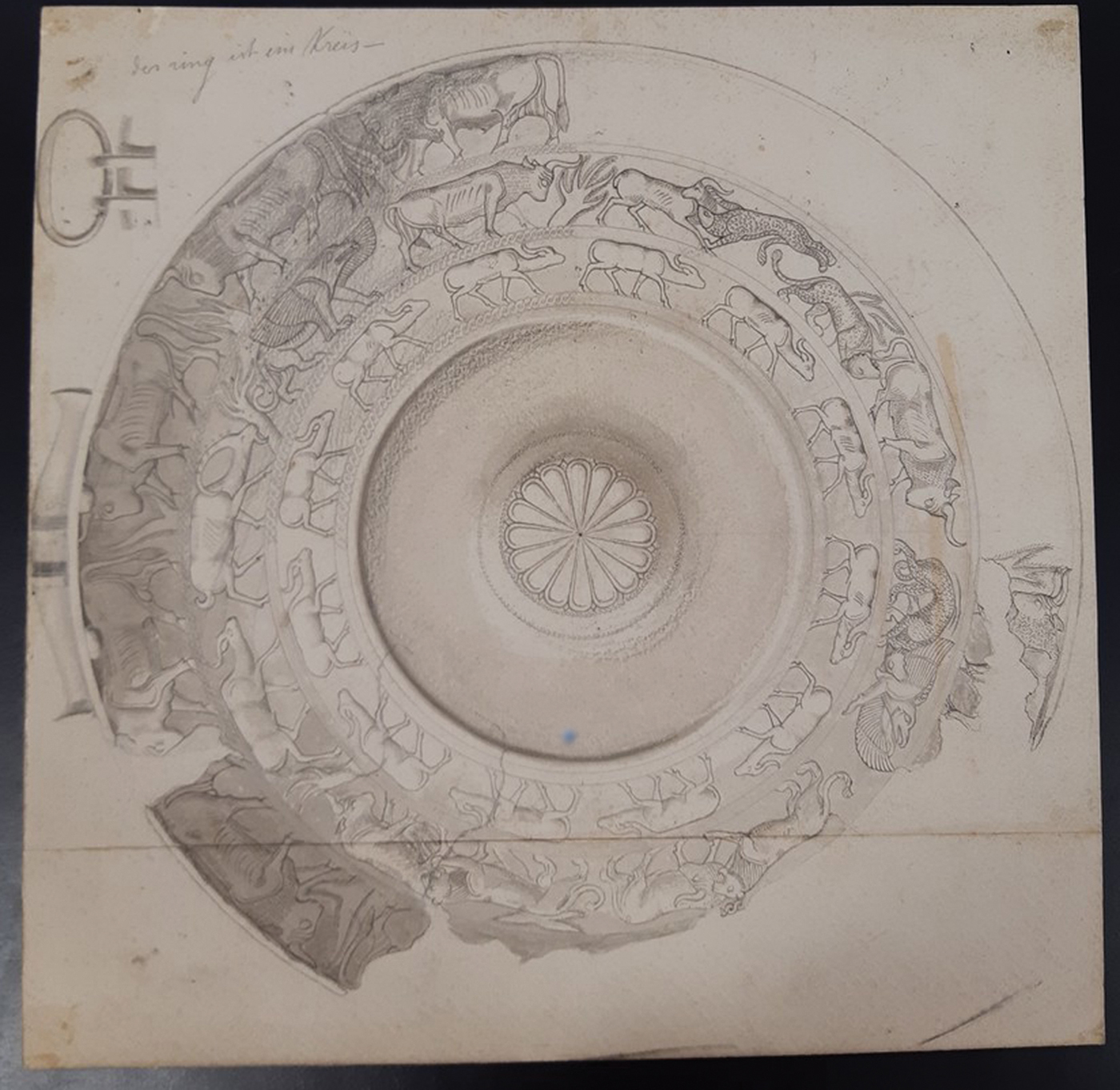
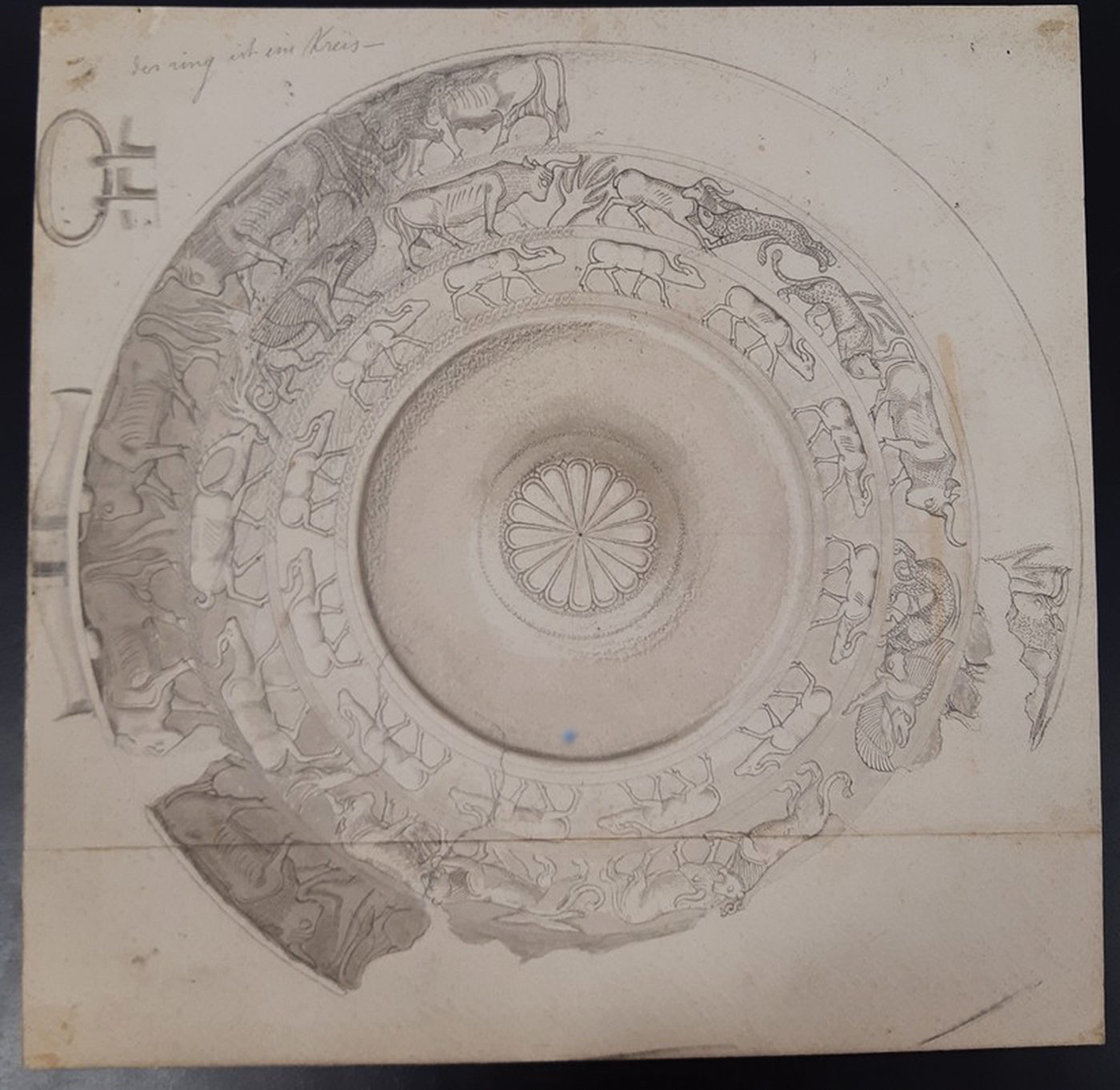
Pencil drawings are often – though not always – accompanied by handwritten notes. Some of them, especially those that are found mixed among the proofs for the plates of the two editions of Monuments of Nineveh, consist of the original ones from which the engravings were made. A few of these very accurate drawings show notes with practical details written in English: for example, at the bottom of one of them Layard wrote “This one is at Mr Prentices”, thus misspelling the name of the painter, E. Prentis – that he also misspelled in Nineveh and Babylon.Footnote 31 Others, instead, present words and sentences written in German likely by the engraver himself, W. H. Ludwig Gruner,Footnote 32 and they aim to explain (to Layard?) how the final result was intended to be. To mention a few examples: “der ringsic ist im Kreis” (Fig. 2) – to explain that a small ring drawn at one side on the page would have been represented at the top of the circle in the final plate;Footnote 33 “in der mitte etwas erhobene” – to indicate that the bottom of the plate should have been drawn slightly raised; or also “nur die grosse gaiersic sind im Relief, jedoch nicht viel” – to describe a peculiar decoration on one of these plates.Footnote 34
One of the drawings with L. Gruner's notes, Layard Archive, Newcastle University Library.
Other pencil sketches must be dated prior to the creation of the proofs for Monuments of Nineveh, and they bear witness to both Layard's travels through the East, before the beginning of the excavations, and to the excavations themselves. The paper on which these are drawn is often stained with ink or dirt and folded at the edges: these are probably the original papers brought back by Layard from Mesopotamia.
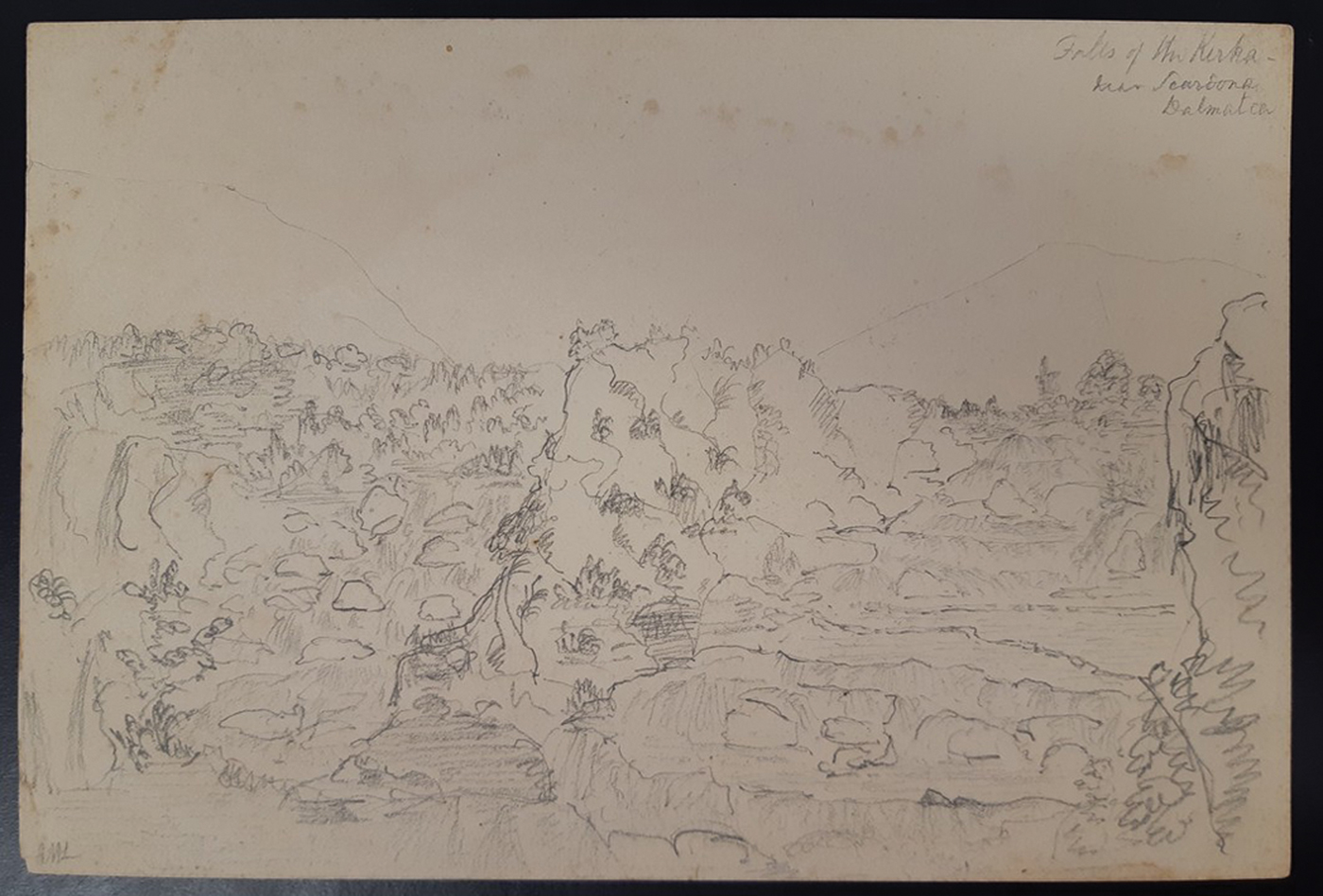
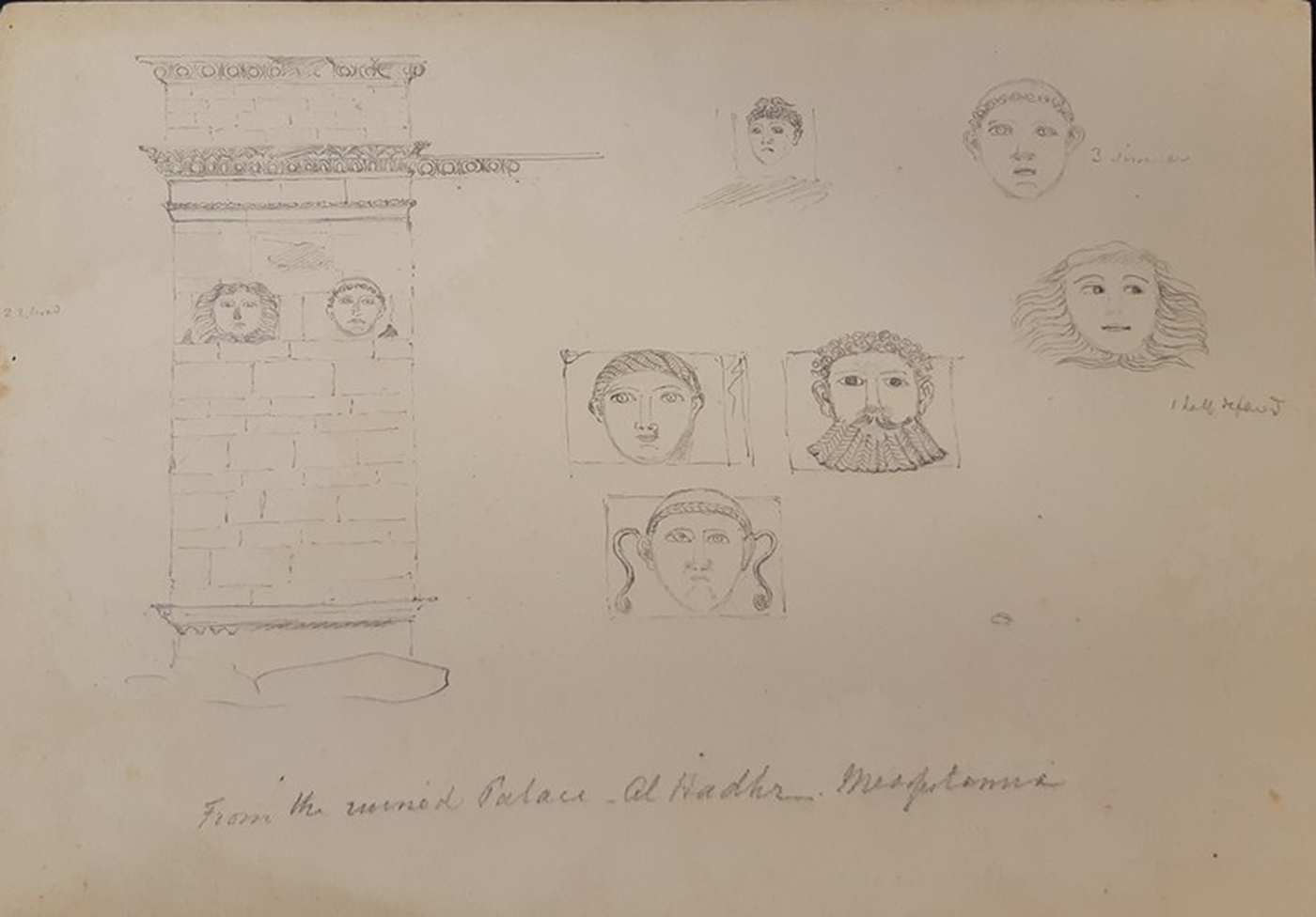
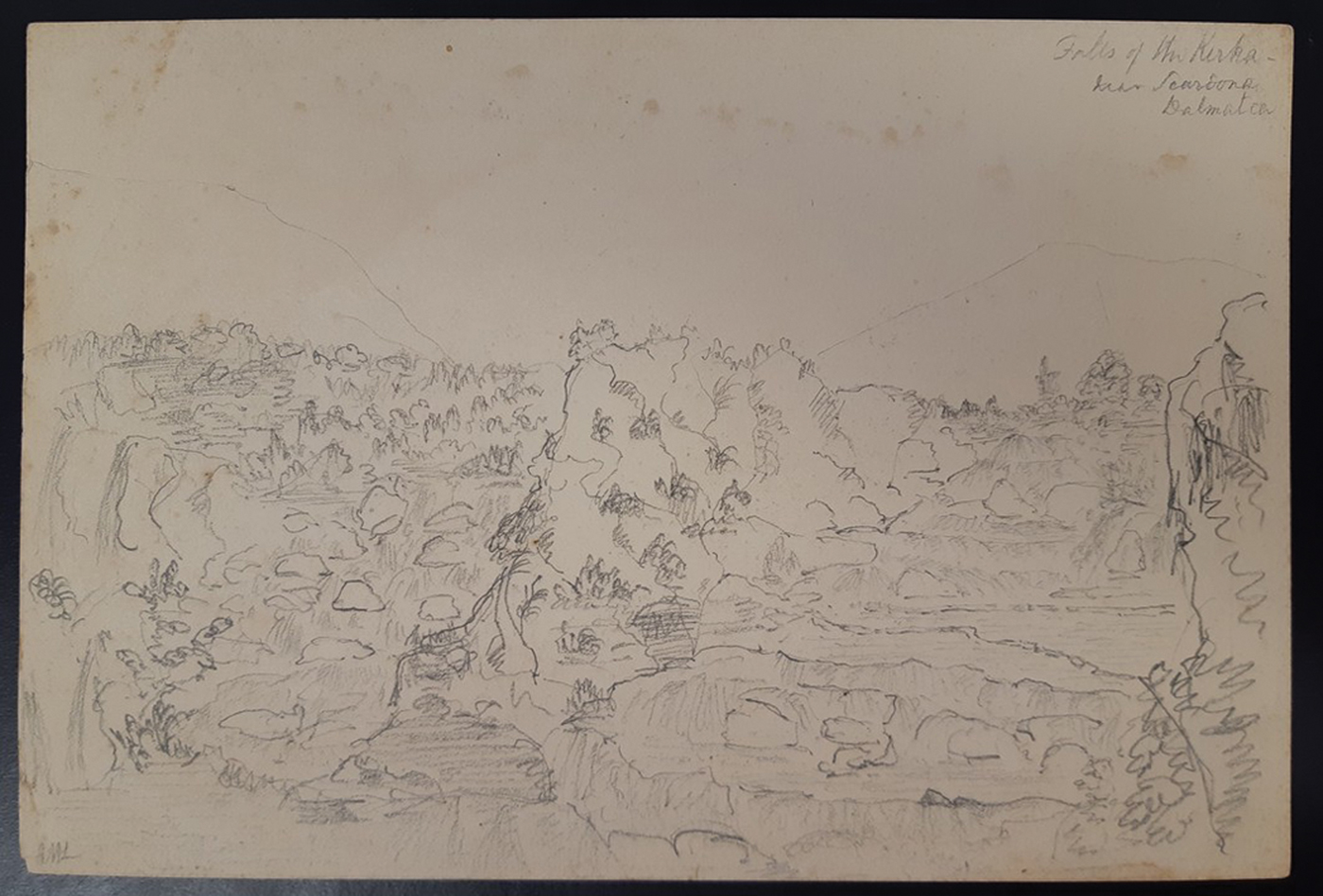
There are, thus, drawings of monuments, architectural details and small maps with measurements from still unidentified locations; one also finds sketches of men from the nomadic tribes likely encountered during his travels. A few images have captions and descriptions that provide a clearer context. For example, one of them, certainly made by Layard since his initials are written at the bottom left corner, depicts the Krka Waterfalls in Dalmatia – as the caption at the top-right side of the page indicates (Fig. 3).Footnote 35 Another page has annotated drawings of architectural and iconographic details “from the ruined Palace - Al Hadr Mesopotamia” (Fig. 4). Layard visited Hatra for the first time in 1840 with his travel fellow Mitford (Edward), the Chaldean Christian Rassam and the British traveller and writer William Ainsworth.Footnote 36 Indeed, these very drawings were published by Ainsworth in an article which appeared in The Journal of the Royal Geographical Society of London in 1841.Footnote 37
Layard's drawing of the Krka Waterfalls, Layard Archive, Newcastle University Library.
Layard's drawing of architectural and iconographic details from Hatra, Layard Archive, Newcastle University Library.
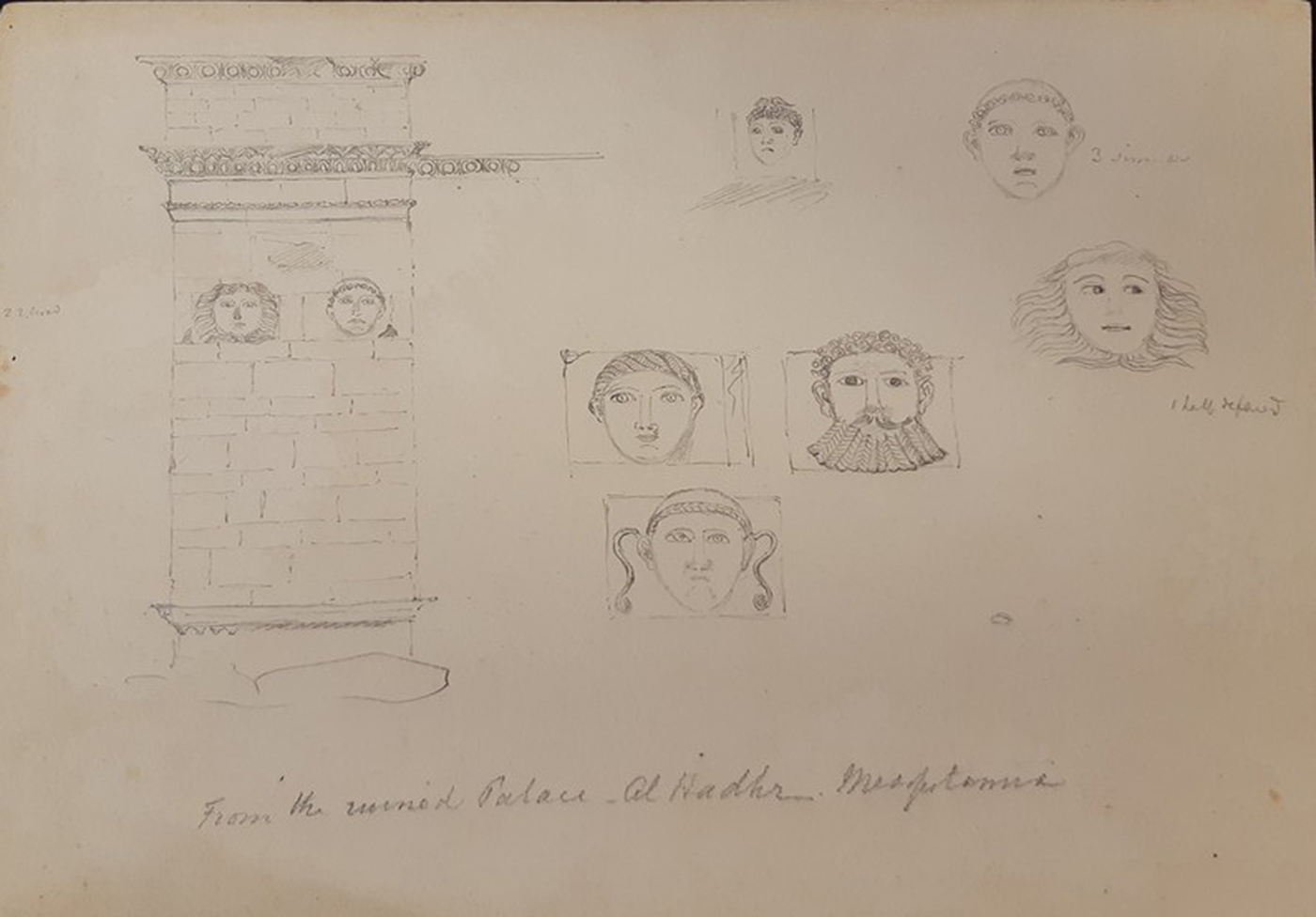
The papers kept in the red folder at Newcastle may also document his second visit to this site, dated 1846, when he remained for three days among the ruins and therefore “had ample time to take accurate measurements, and to make plans of the various buildings still partly standing within the walls”.Footnote 38 There is, in fact, one extremely detailed map created by Layard, that records the remains of the Great Temple; exact measurements are documented for each single wall, and dense, accurate notes describe the specifics of each room of the building.
One pencil sketch represents the plain of Kouyunjik and closely resembles the more elaborated drawings of this same landscape that appeared in Layard's later publications. This simple drawing was made by Layard himself, as is inferable from the handwriting of the “captions” for Nebbi Yunus, Mosul and Kouyunjik written at the bottom of the page.
A second map from this archive consists in the original scale drawing made by Layard in 1850, for his plan of the ziggurat and temple complex at Nimrud;Footnote 39 in the bottom-left corner, Layard described it as “Plan of high mound & chambers to East of it”. This map provides interesting new information on an area whose archaeological remains are difficult to interpret even today.Footnote 40 In his careful study on the ziggurat at Nimrud, Julian Reade justified the presence of several inaccuracies and inconsistencies in Layard's plan and description by the fact that these published versions were presumably made once he was in London, back from the excavations.Footnote 41 The new document from Newcastle, however, proves that Layard created a first version of the map already while in Nimrud. It must be noted that in this first drawing, that gives exact measurement for each single wall, letters assigned to the rooms do not correspond to those that appear in the printed version dated 1853 – they correspond, instead, to those used by Layard also in his excavation notes.Footnote 42 What is particularly relevant is that until today the correspondence between the original and the final letters assigned to the chambers could only be inferred by comparing the available reference to what was found inside them: now for the first time the correlation can be made with certainty.
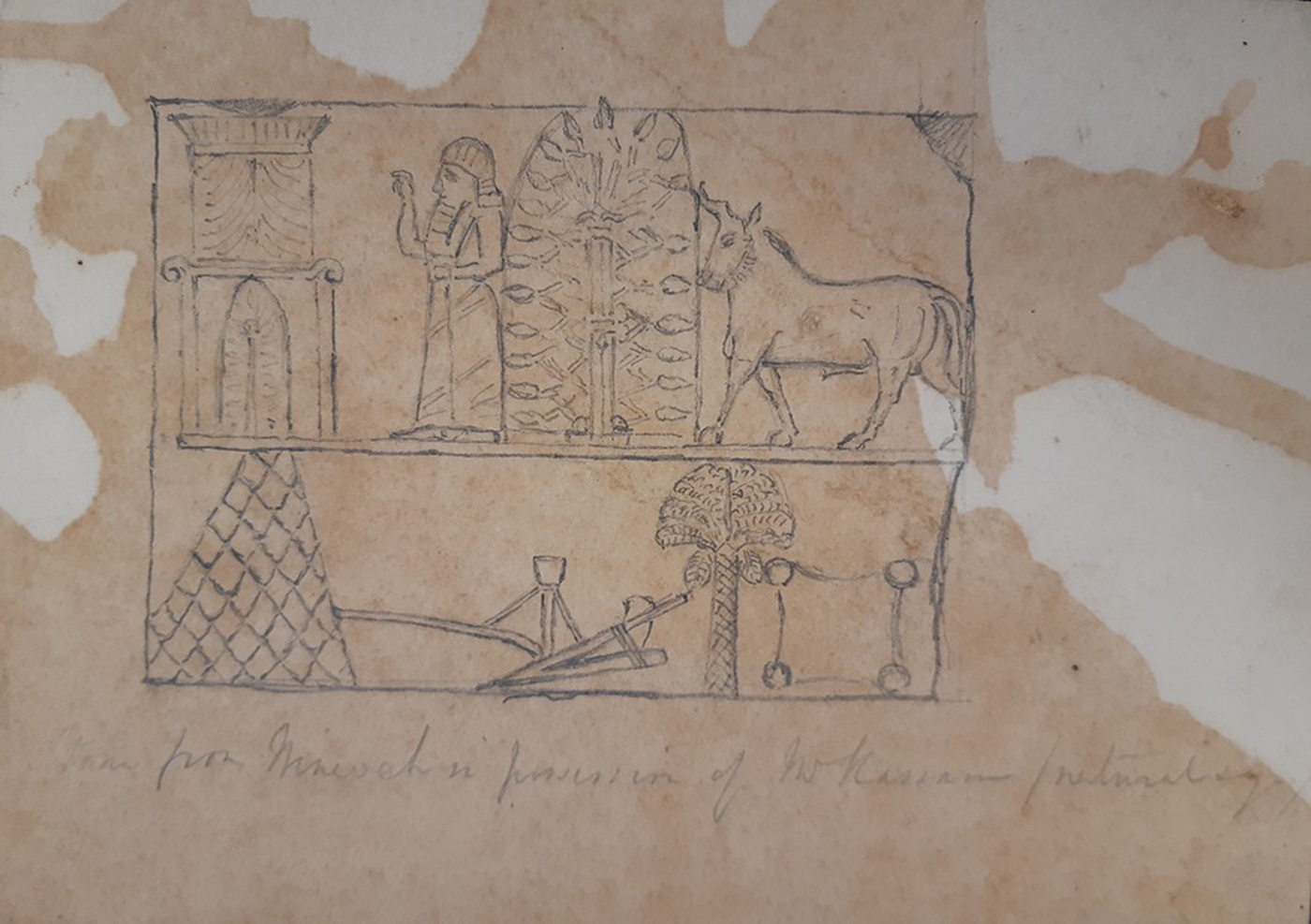
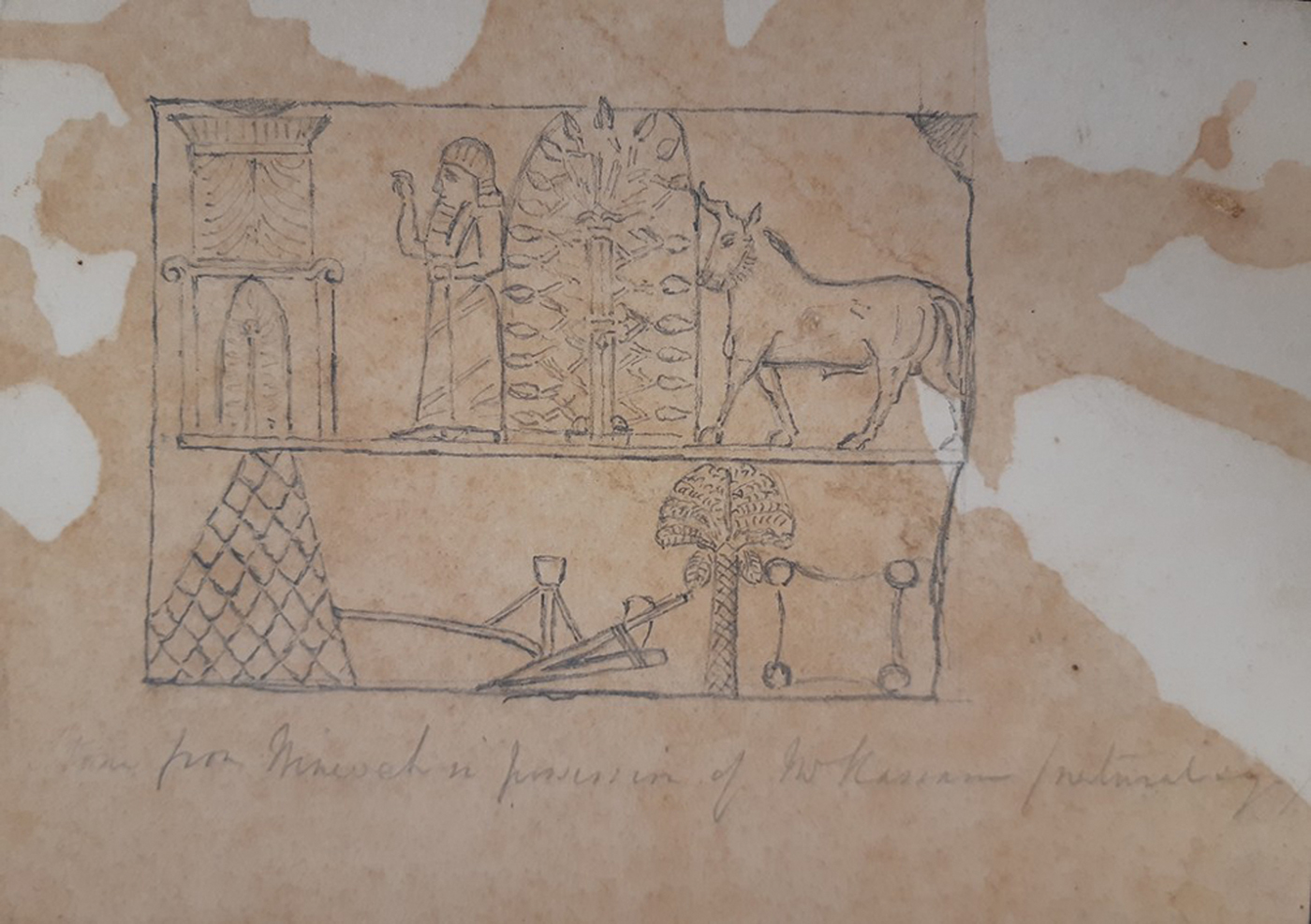
Beside monuments and architectural remains, smaller items discovered during the excavations in the ancient Assyrian capital cities are also represented in this collection of drawings. For example, one sketch whose caption reads “Stone from Nineveh in possession of Mr. Rassam” is highly interesting because it adds an important piece of information on the provenance of the object that it represents, i.e. the so-called “Lord Aberdeen's Black Stone” (Fig. 5).Footnote 43 While publishing a copy of it, Rawlinson indeed described it as a “black Stone found at Nineveh”,Footnote 44 but this assertion has been considered dubious by modern scholars, in light of the fact that he did not provide any evidence for his statement. According to recent reconstructions, the stone was thought to come from Babylon instead – since that site was the normal source for antiquities at the time Lord Aberdeen received it from Christian Rassam.Footnote 45 A first confirmation of its Ninevite provenance has been found in a dossier currently kept in the archives of the Bibliothèque de l'Institut de France (Paris), which collects the correspondence between Layard's French forerunner in Assyria, Paul Émile Botta, and his main contact in Paris, Jules Mohl.Footnote 46 The new drawing from Newcastle provides a further confirmation, corroborated by more archival materials which pertain to Layard.Footnote 47
Drawing of “Lord Aberdeen's Black Stone,” Layard Archive, Newcastle University Library.
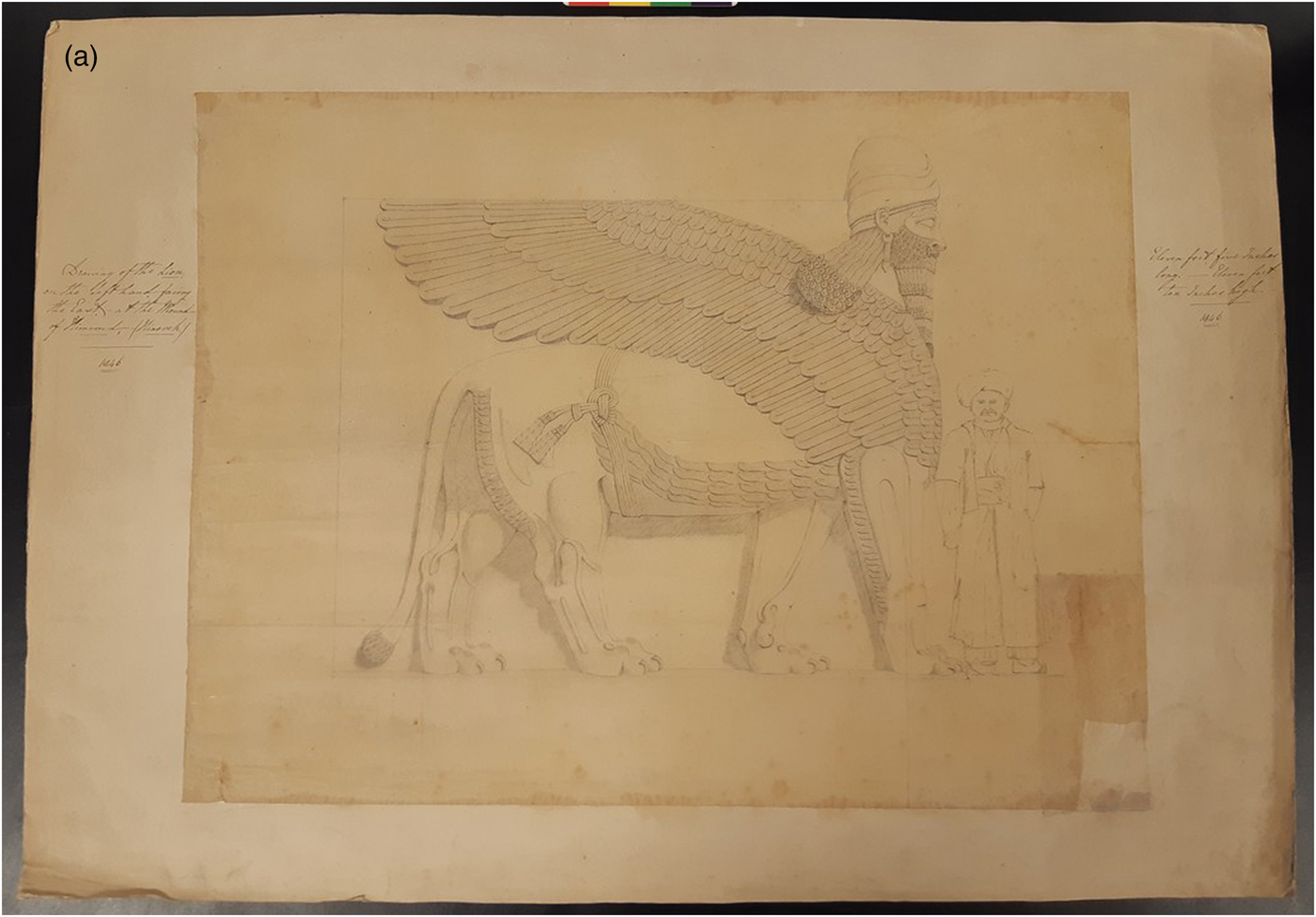
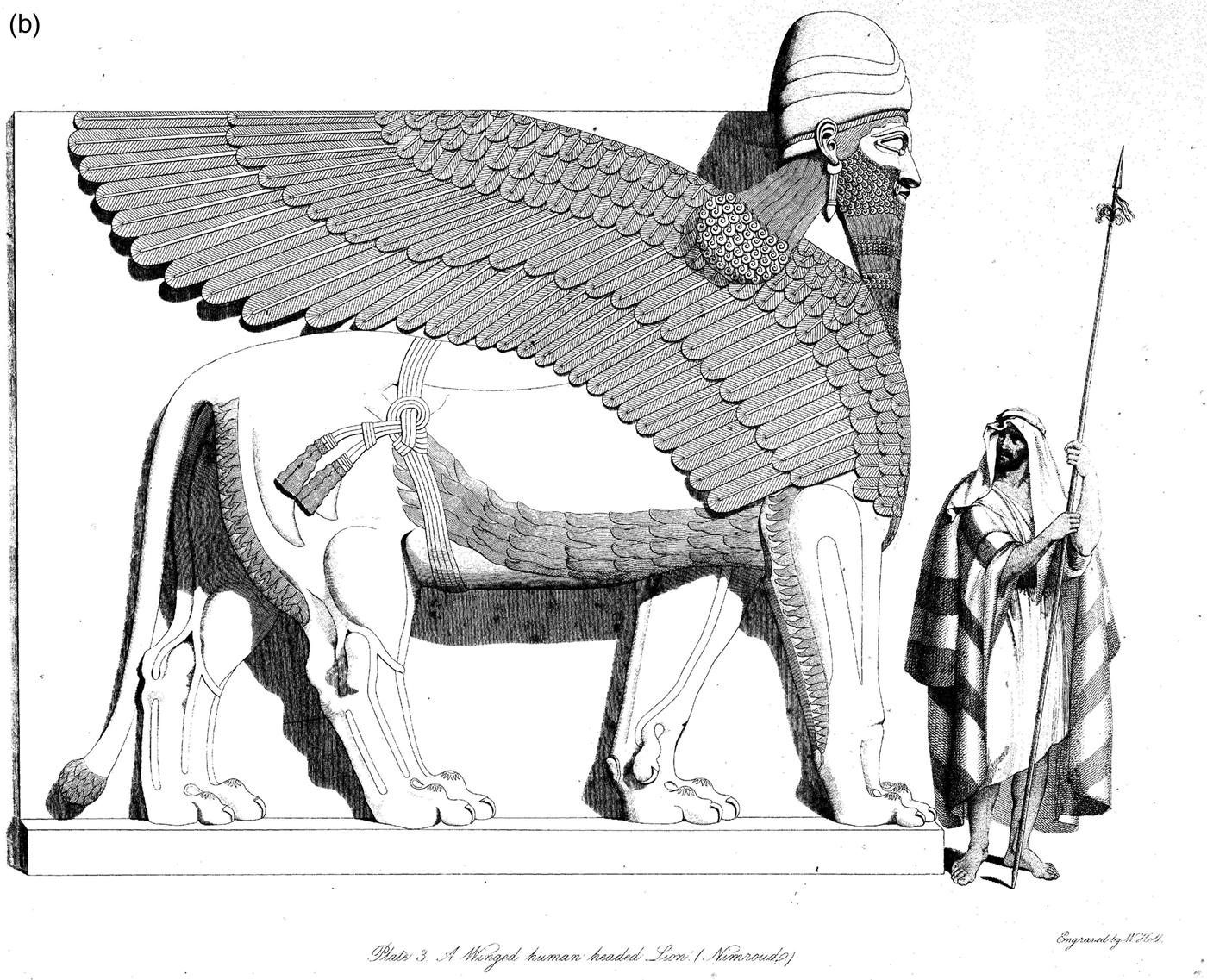
Concluding the review of pencil sketches, one last remarkable item must be mentioned. As described above, one letter from this archive contains proof of the fact that the Du Canes possessed the original drawing of the famous scene of the moving of the bull at Nimrud; the family also kept, still preserved in the red folder, another original drawing of one of the most famous drawings from Layard's publications. This is described by a sort of caption written on the left side as “Drawing of the Lion, on the left hand facing the East – at the Mound of Nimroud (Nineveh). 1846.” On the right hand side there are more details on the colossus: “Eleven feet five inches long. _ Eleven feet ten inches high. 1846” (Fig. 6a). This renowned drawing appeared in the first series of Monuments of Nineveh as plate 3 (with the caption “A winged human headed lion (Nimroud)”), but in the final edition the man depicted in this original image standing on the right of the creature, possibly to be identified with Thoma Shishman (one of the workers who assisted Layard on the site),Footnote 48 has been replaced by a Bedouin holding a long spear, pointing his gaze towards the lion (Fig. 6b).
Original drawing of the lion from Nimrud, Layard Archive, Newcastle University Library.

Monuments of Nineveh’s plate 3 in the final publication.

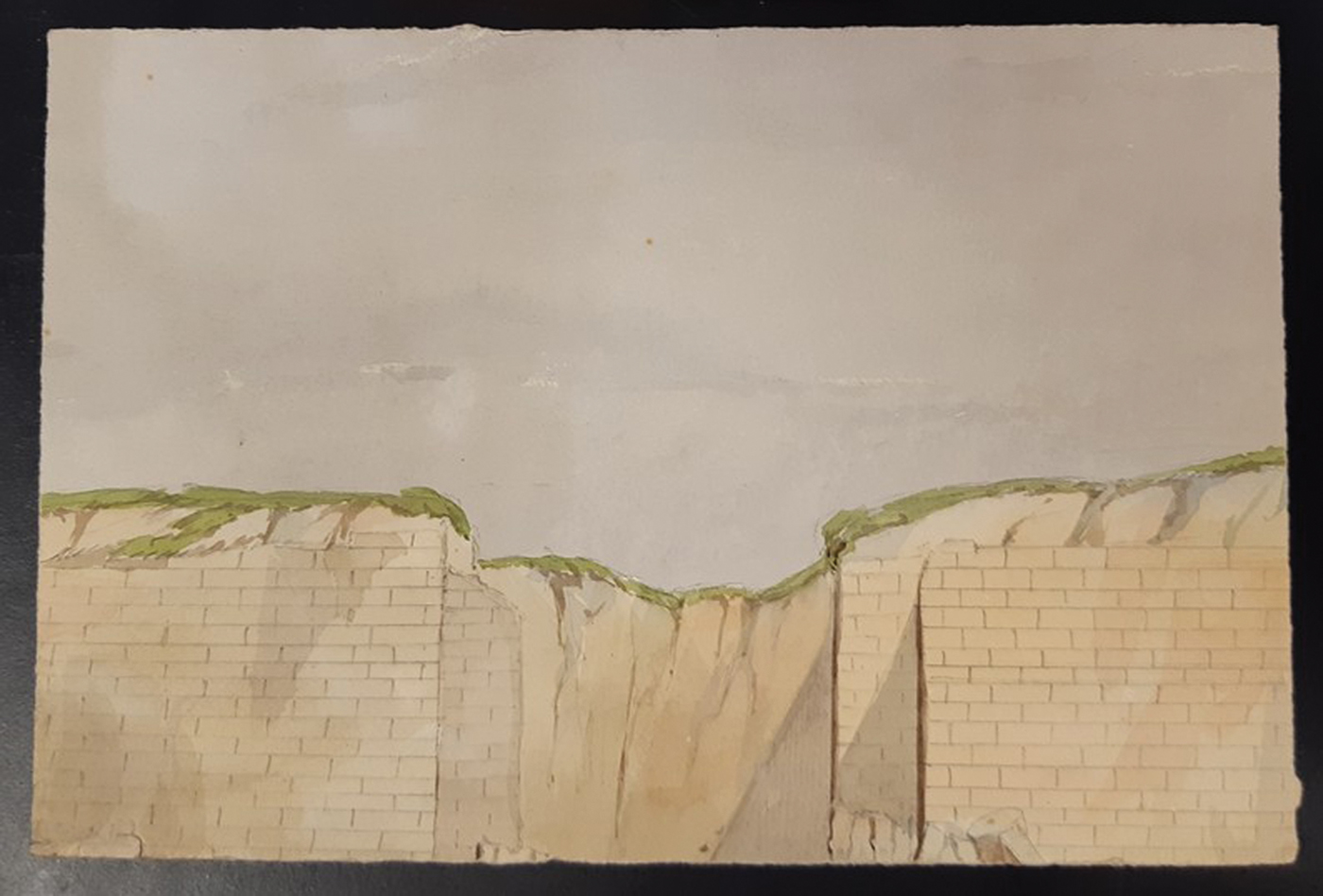
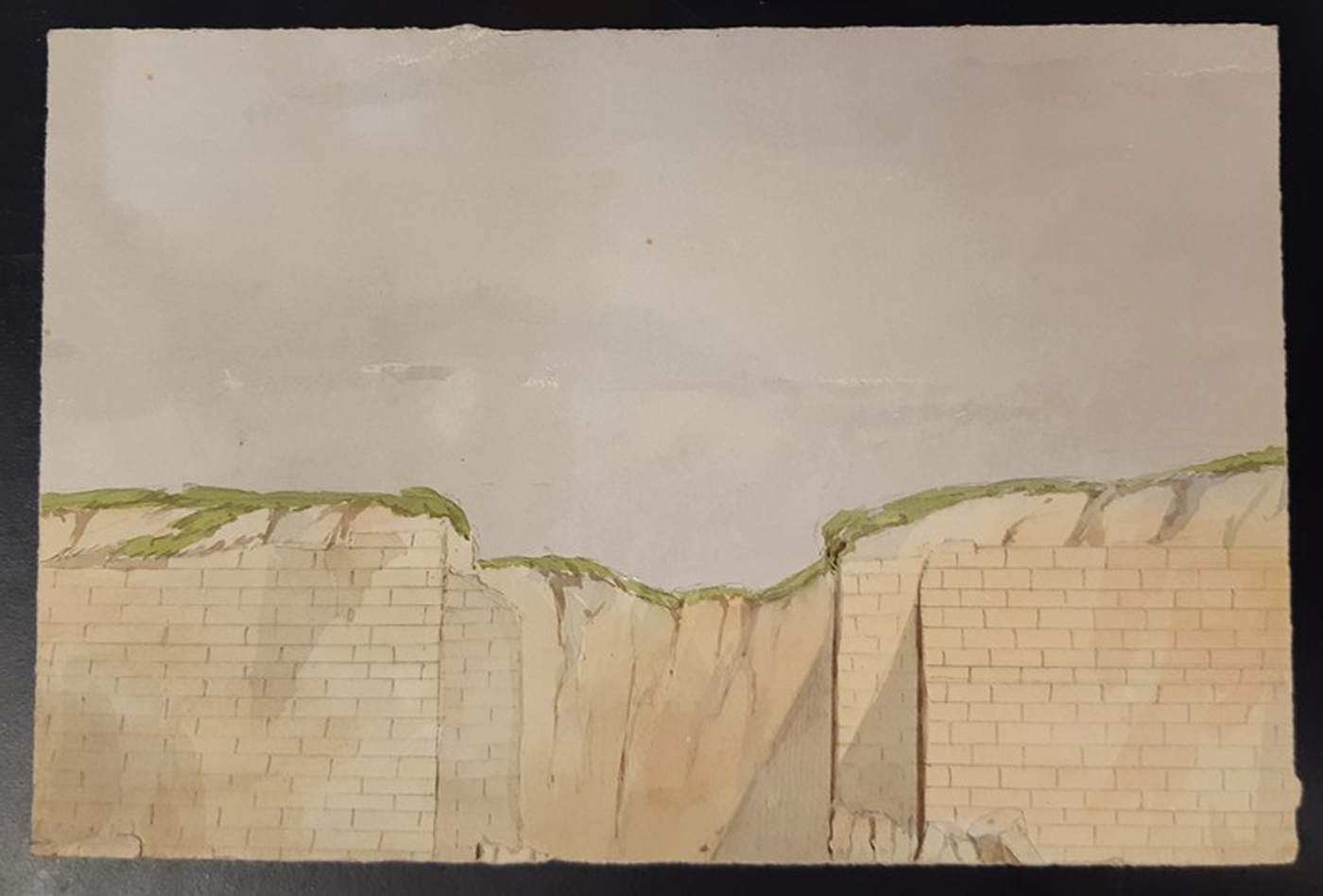
Watercolours, always not signed, are also part of this collection: they depict wall reliefs and in one case also one massive wall with an undecorated entrance, unfortunately from a building that cannot be identified with certainty (Fig. 7). Watercolours may not have been created by Layard himself, as he does not mention such activity in his publications – apparently, he was more keen on pencil sketches. His artists, instead, and especially F. C. Cooper, have left us several specimens.Footnote 49
Watercolour of an unidentified wall, Layard Archive, Newcastle University Library.
Among the scattered pages included in the red folders there are also two so far unknown colour reproductions of the so-called “Sargon vase”, discovered by Layard in the North-West Palace at Nimrud.Footnote 50 The first, signed with the initials “SdA” and dated July 1849, consists in a beautiful watercolour of the object, at the bottom of which there is also a copy of the cuneiform inscription and the caption “Glass Vase from Nineveh. Inscription enlarged f.m Reverse Side”. The characters of this caption resemble those of Monuments of Nineveh, yet this image is not included among those published in neither volume of the two series. The second image of the Sargon vase was created in 1850 by James Duffield Harding, as mentioned in a hand-written note at the bottom of the page. In this case, only the vessel is depicted – interestingly, the technique used consists in the opaque body colour instead of the usual watercolour.
Three more specimens (two in colour, one in pencil) conclude this survey of drawings of materials from Nimrud and Nineveh from the Newcastle Layard Archive: these are drawn on rolled papers that are kept in Richard Du Cane's blue writing box (see below). These images did not find their way into Layard's publications, and they are unfortunately without captions or notes.
Layard's Library
The Du Canes inherited part of Henry Layard's personal library, and they kept these volumes together with others that were published and collected in later years by members of the family, now preserved in the Robinson Library at Newcastle University.
Layard's books mirror his multifarious interests and vast knowledge. In fact, from his personal library there are: one volume on Italian art written by Layard's friend, Gustavo Frizzoni;Footnote 51 three volumes of Italian short stories,Footnote 52 some antique volumes on the history of FranceFootnote 53 and on the Papacy,Footnote 54 and another book on the St. Bartholomew's Day massacre, written in Italian and based on documents kept in the Archives of Venice,Footnote 55 the English translation of Gottfried A. Bürger's Lenore, by Julia M. Cameron.Footnote 56 There are also more utilitarian books, namely a French-English dictionary,Footnote 57 and even the manual that he used to study ancient Greek at a young age.Footnote 58 Layard also kept his own publications. In his library, there was one anthology entitled Articles from Quarterly Review &c., which included some of his articles written both for the Quarterly Review and the Royal Geographical Society: these show annotations and corrections in Layard's own handwriting. Another volume is entitled Speeches Delivered in the House of Commons by Austen Henry Layard, Esq. M.P. for Aylesbury and was published in London in 1854; also in this case, the author added notes, remarks and corrections to his own speeches.
Among these books, the most interesting from an archaeological perspective are all the first editions of Layard's publications, which he donated to members of the Du Cane family. Layard was very keen on delivering to relatives and friends one copy each of his book. This even caused some incomprehension with his publisher. In December 1887, Alexander Henry Hallam MurrayFootnote 59 wrote the following letter to Layard, with regard to his latest work Early Adventures in Persia, Susiana, and Babylonia:
December 15. 1887
My dear Sir Henry,
I hope 6 copies of your book will have reached you before this gets to Venice.
They were dispatched yesterday. I shall be glad to know what you think of the outward appearance of the “Early Adventures” in its complete state.
It is now in the hands of the Reviewers & we hope to see what they think of it in tomorrow papers. Tomorrow it will be published.
I have sent off all your presentation copies; but it is most difficult for me to know what to do about “the relations” you say “do as you think best” so at present I have done nothing for if I begin to give to one of your brothers or sisters in law I should not know where to stop, there are so many of them.
My fatherFootnote 60 has given a copy from himself to M.rs Du Cane and another to Mr Malcom. (…)Footnote 61
Indeed, the collection at Newcastle counts Julia Du Cane's Nineveh and Its remains, one copy of Nineveh and Babylon dedicated to a “Miss Guest” and Louis Du Cane's abridged version of the same work, one copy of Early Adventures which belonged to Nela (aka Enid Cornelia Du Cane, one of Maria's daughters), and Julia (possibly) Du Cane's new edition of the same book. Finally, there is one copy of the Autobiography and Letters which also once belonged to Nela, dated September 1909.
The copy of Layard's Early Adventures that belonged to Nela was donated by the author to her, who was one of his favourite nieces, as a Christmas gift in 1893.Footnote 62 A very personal letter was also kept inside the book: this was written by one of her cousins only two days after Layard's death and it mentions family arrangements for the funerals:
July 7th 1894
Dearest Nela,
Are any Ladies going to the funeral because if there are I should like to be present too I should come with Papa.
Please let me know if you get this tonight you had better wire to me in the morning.
Also Mama wants to know if any one is sending wreaths. If they are will you get one for Mama & send it in with her love.
How terrible it all is. Poor Aunt Enid one can think of no one but her now. God give her strength to bear it all. I must write to her though I daresay letters are horrid to her. How we shall miss Uncle Henry. He was so kind & dear to us.
Ever Y.r loving
E. Alderson
Finally, in the Newcastle Layard Archive is kept the Bible given to Layard by his mother, which he “used … in his travels in the East” – according to a note that had been later inserted inside it, likely by one Du Cane. The Bible presents a dedication: “A.H. Layard. With a Mother's love. June 30th 1839”, and it has some notes and underlinings made by Henry in different pages – the most interesting one being that at the book of Ezekiel, chapter 23, in light of the connections detected by Layard between this specific Biblical episode and the reliefs that he excavated at Nineveh.Footnote 63
One Archaeological Item
One final Mesopotamia-related item kept in the Newcastle Layard Archive needs to be mentioned. The repository includes a peculiar object: a blue writing box, which once belonged to Richard Du Cane – as a metal plaque set at its top indicates. This box contains a variety of unusual and quite unique materials, such as one of Layard's passports,Footnote 64 Enid's calling cards, some family information and genealogical trees, Enid Layard's funeral service programme, a letter opener donated by the German Princess Royal Victoria, a medal of the society of the Huguenots (of which Layard was president), a few photos of Enid and more.
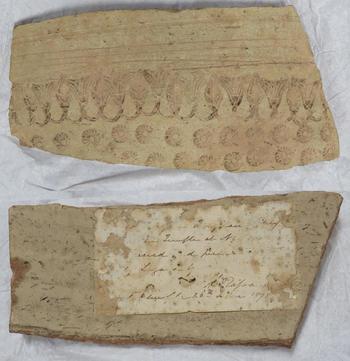
Among these items, there is also one sherd, which must have been part of Layard's private collection of archaeological materials (Fig. 8). Indeed, he sent back from his excavations in Mesopotamia hundreds of archaeological items, which form the core of today's Assyrian collections at the British Museum. However, as it is well known he also kept a few objects for himself, and donated others to friends and relatives.Footnote 65 After the end of his expeditions in Mesopotamia, Layard's collection kept on expanding thanks to gifts made by his successors in the East, notably by his friend and colleague Hormuzd Rassam.
Sherd from Nimrud donated by H. Rassam to Layard. Layard Archive, Newcastle University Library. Measurements: 16.4 cm in length, 8.3 cm in height.
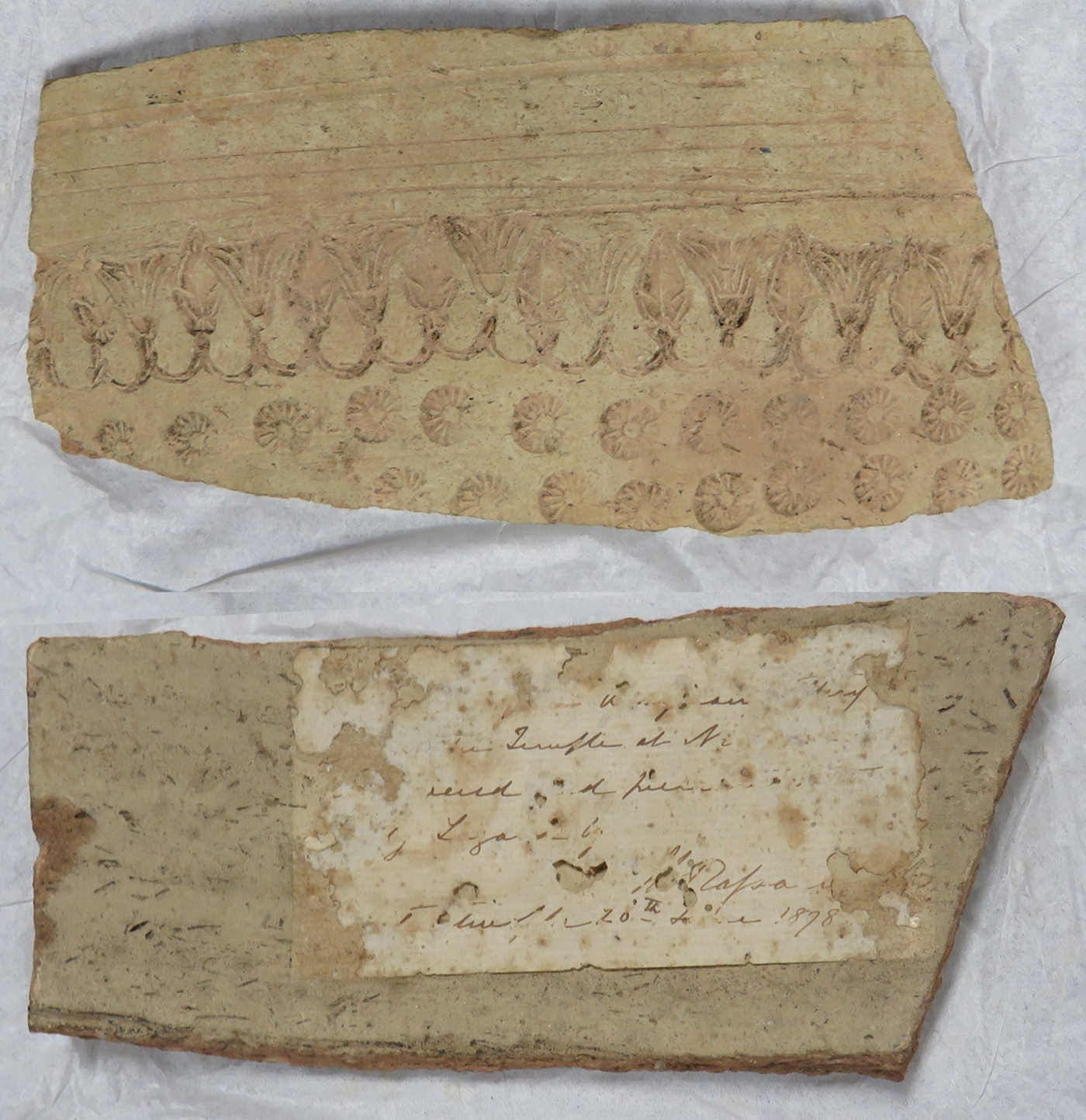
The sherd kept in Newcastle testifies precisely to this exchange, as inferred by a label that was glued onto it. Unfortunately, the paper is too damaged to be read in its entirety, but from the few words that are still preserved, it is clear that this was a gift from Rassam to Layard, coming from a Temple at Nimrud, and that the gift is dated 1878.
This item complements the relatively small group of known Assyrian sherds with a characteristic decoration made of a combination of lotus-and-bud frieze with stamped rosettes. It may even join one of the pieces already identified by John Curtis and Georgina Herrmann in Reference Curtis and Herrmann1998,Footnote 66 pertaining to a larger vessel excavated by Rassam at Nimrud: the time of excavations (first months of the year 1878) and find spot (the Temple of Kidmuru) of those sherds, as they are recorded in the British Museum archives, would in fact perfectly fit the content of the label attached to the sherd at Newcastle.
Conclusion
The Layard Archive kept at the Robinson Library, Newcastle University, is a small yet unique collection. Its peculiar nature, i.e. the fact that it was a family assemblage of items that held an emotive significance for Henry and Enid Layard's successors, has determined its content and fortune.
The archive conveys an image of Layard, which is overall more genuine and less contrived than the usual image known for the British archaeologist and diplomat, who, during his entire life, had been very careful in selecting the information that he wanted to convey about himself through his writings. Even after his death, Layard's family paid much attention in the kind of reports and facts that could be disseminated, both so as to protect Henry's achievements and work as politician and diplomat – and in order to maintain the admiration and deference that Layard had acquired during his life.Footnote 67
Instead, the letters between the two sisters in the Newcastle Layard Archive open a perspective on Henry's everyday life and feelings. The simple, sometimes even imprecise but spontaneous pencil drawings provide evidence of what struck Henry during his travels in the East; the accurate maps and annotated proofs, instead, not only show with how much attention he worked but also complement data found in the published works with information that were never recorded elsewhere. Finally, Layard's personal books and the assorted printed materials, often characterised by annotations and corrections, reflect his own interests and thoughts.
The Newcastle Layard Archive is also interesting for documenting Layard's legacy among members of his own family: overall, one feels a sense of profound esteem and pride for the celebrated predecessor, and it is remarkable how the interest in archaeology also remained in later members of the Du Cane family.Footnote 68
These pages present only the archaeological and Near Eastern material kept in the collection, yet it is already evident how this new repository sheds new lights on objects and data that have been known for years, such as Lord Aberdeen's Black Stone or the plans published by Layard of the Ziggurat at Nimrud. This information also contributes to a better comprehension of the scholarly community of Layard's time, as well as his personal relationship with colleagues and successors.
Acknowledgements
This article stems from a project entitled Unfolding a Victorian Archive. The Layard Collection at Newcastle University, which has been funded by a British Academy Visiting Fellowship and carried out at Newcastle University, UK, during 2018. I would like to thank Mark Jackson and Ian Johnson for their invaluable support throughout the fellowship. Thanks are due also to Geraldine Hunwick and the staff of Special Collections and Archives for the help provided at the Robinson Library, and to Federico Santangelo for his aid and suggestions. This research also falls within the activities fostered by the Gruppo di Ricerca Interdisciplinare di Storia degli Studi Orientali (GRISSO), directed by Silvia Alaura at the CNR in Rome.