INTRODUCTION
Language disturbance is common in Alzheimer's disease (AD) and frontotemporal dementia (FTD) regardless of the stage examined (Appell et al., 1982; Cummings et al., 1985; Gustafson, 1987). Both Alzheimer's and Pick's original patients were aphasic (Alzheimer, 1907; Pick, 1892). Despite extensive research that has characterized the basic language impairment in AD and FTD (Appell et al., 1982; Cummings et al., 1985; Hodges et al., 1992; Kertesz et al., 1986; Mesulam, 1982; Snowden et al., 1989), there is a paucity of longitudinal studies of language decline in these dementias. A longitudinal study that fully portrays language decline in these dementias would be helpful in better understanding the similarities and differences in these syndromes and would provide clinicians with better information about prognosis of language abilities to convey to their patients and families. Because AD is the leading cause of dementia, its high prevalence may give the mistaken impression that initial memory deficits are almost always the presenting symptoms of dementia (Mesulam, 2003). In 1982, Mesulam reported on 5 patients who presented with “slowly progressive aphasia without generalized dementia,” that he termed primary progressive aphasia (PPA) (Mesulam, 1982, 1987; Weintraub et al., 1990). In this syndrome, language decline is usually the fastest and predominant change and can be isolated for years before other areas of cognition, including behavior, memory, visuospatial skills, sensory-motor ability, and independence in activities of daily living are compromised (Mesulam, 2001; Weintraub et al., 1990). The diagnostic criteria for PPA suggest a minimum cutoff of 2 years of isolated language impairment (Mesulam, 2001; Weintraub et al., 1990). Agrammatism, which is similar to Broca's aphasia, along with telegraphic speech, syntactical difficulty, and paraphasic errors (especially of the phonemic type) are observed in the early stages; at this point, these patients are still independent in activities of daily living (Kertesz et al., 2003; Mesulam, 2001).
Intact recall for daily activities in PPA may contrast with poor performance on memory testing, however, when memory assessment is fractionated, nonverbal and visual memory are normal suggesting that language may interfere with testing in this group (Zakzanis, 1999). In AD, memory and other cognitive deficits are usually associated with the presence of word finding difficulty (Appell et al., 1982; Cummings et al., 1985). AD patients are typically fluent until the middle to late stages of the disease when difficulty with naming (anomia) is present along with comprehension deficits, paraphasic errors, and semantic jargon, similar to transcortical sensory aphasia or Wernicke's aphasia (when repetition deteriorates) (Appell et al., 1982; Cummings et al., 1985; Murdoch et al., 1987). Global aphasia and mutism are generally present in advanced stages of AD (Appell et al., 1982; Cummings et al., 1985).
Initially PPA was considered a distinct entity, but its relationship to the behavioral and extrapyramidal presentation of FTD was suggested by Kertesz et al. (1994). Recent consensus criteria (McKhann et al., 2001; Neary et al., 1998) have included PPA (referred to as progressive nonfluent aphasia) as an alternate presentation of FTD or frontotemporal lobar degeneration. These syndromes are generally seen in presenile populations and are typically diagnosed when either behavior and language or both are affected. The behavioral variant (FTD-bv) is recognized when behavior and personality changes occur in the early stages, such as disinhibition, impulsivity, indifferences, loss of insight, and stereotypic behaviors. In addition, semantic dementia (SD) has been recognized as another presentation of FTD because of clinical and pathological similarity (Kertesz et al., 2005; McKhann et al., 2001; Neary et al., 1998). Expressive and receptive language deficits characterize PPA and SD respectively. SD patients typically present with comprehension and naming deficits, semantic paraphasias, and circumlocutory responses in the context of normal fluency, syntax, and episodic memory (Hodges et al., 1992; Snowden et al., 1989; Warrington, 1975). FTD-bv patients eventually develop language deficits and alternately the language presentations of FTD usually develop behavioral change over time (Kertesz, 2003; Kertesz et al., 2005).
Decreased speech output or logopenia, reduced conversational initiation, stereotyped utterances, repetitive responses, unelaborated phrases, echolalia, and changes in pragmatic aspects of conversation, such as topic maintenance, interrupting others and redirecting conversations to one's own agenda, are seen in FTD-bv populations (Ash et al., 2006; Gustafson, 1993; Neary et al., 1998). As with AD, progressive aphasia to eventual mutism is seen in PPA (Kertesz et al., 2003; Mesulam, 1982) and also FTD-bv patients (Neary, 1990; Neary et al., 1998), however, the evolution and progression of language disturbance in FTD-bv patients is not often elaborated or assessed systematically with a standardized language battery. Clinical manifestations of the language disorder in FTD have overlapping features and are considered a spectrum (Kertesz, 2003; Mesulam, 2001). To date, longitudinal studies that quantitatively and also qualitatively address language changes are few or comprise a small sample of patients (Karbe et al., 1993; Kertesz et al., 2003; Mesulam, 1982).
The aim of this study therefore, was to longitudinally track and document the nature of language change and progression in FTD-bv, PPA, and AD using the Western Aphasia Battery (WAB) (Kertesz, 1982), which is a standardized measure of language functioning. Firstly, we aimed to explore the notion that language change and decline, typical of PPA, may develop later in FTD-bv patients. We expected that initially, language scores would be lower in PPA patients than FTD-bv patients. We hypothesized that over time, language scores of FTD-bv patients should also deteriorate and approach those of PPA patients as the dementia progressed and language difficulties become more observable. A different and less dramatic decline in language functioning should be observed in AD patients.
There is a tendency in the literature to report PPA patients as nonfluent whereas fluent progressive aphasia is almost synonymous with SD (Hodges, 2001; Neary et al., 1998). Previous research from our centre (Kertesz et al., 2003) found 57% of PPA patients were relatively fluent when first examined, but increasing anomia and word finding difficulty disrupted the fluency of their speech over time. The fluency dimension is only one of many distinctions in the initial presentation of language disorders in FTD and because it changes in the course of the illness, it should not be used as a static defining feature. As an important dimension nevertheless, it needs to be standardized and quantified further. Consequently, our secondary aim was to further explore the nature of the language deficit between the SD group and the fluent subgroup of PPA patients.
METHOD
Research Participants and Procedure
The Western Aphasia Battery (Kertesz, 1982) was administered to 105 AD, 20 FTD-bv, 54 PPA, and 10 SD patients on 2 occasions with approximately 1 year between each testing session (range: 8–18 months). A subgroup of patients (n = 99) were seen an additional year (AD: n = 53; FTD-bv: n = 10; PPA: n = 30; SD: n = 6). Study participants were prospectively followed at our clinic. They were annually assessed by psychometricians, psychologists, and neurologists trained in administering all testing instruments. Only patients diagnosed with AD, PPA, SD, and FTD-bv with a minimum of two years of language assessment were included in the study. All AD patients met the criteria for probable AD according to the National Institute of Neurological and Communicative Disorders and Stroke and the Alzheimer's Disease and Related Disorders Association (NINCDS-ADRDA) (McKhann et al., 1984).
The FTD-bv sample fulfilled the Neary et al. (1998) criteria. These patients had behavior and personality change reported at onset by history, which was prominent by the time of clinical consultation. In most cases the frontal behavioral inventory (Kertesz et al., 1997) was used to quantify the extent of change. Executive dysfunction, such as disorganization at home and work, indecision, and poor judgment, was frequently reported and occasionally the presenting symptom. At the time they were seen for testing, several FTD-bv patients had developed secondary syndromes of progressive aphasia (PA) (n = 12), and SD (n = 2) and tertiary syndromes of PA (n = 1), corticobasal degeneration syndrome (CBDS) (n = 3), and progressive supranuclear palsy (PSP) (n = 2).
The PPA group was noted to have word finding difficulty at the onset along with logopenia, aphemia or verbal apraxia, and nonfluent speech in some patients. PPA was diagnosed when aphasia was the first syndrome according to clinical history without other cognitive domains becoming involved for at least two years (Mesulam 1987; Mesulam, 2001; Weintraub et al., 1990). However, we included seven patients in the PPA group with secondary syndromes of FTD-bv (n = 4), CBDS (n = 2) and PSP (n = 1) occurring in the first year of illness. Although the 2-year criterion of isolated language impairment recommended by Weintraub et al. (1990) is a useful guideline to diagnose PPA patients, it is often difficult to operationalize. The early emergence of behavioral and extrapyramidal symptoms shortly after onset has been shown in some cases to be part of the PPA syndrome (Kertesz & Munoz, 2003). At the first time of assessment, 13 of the remaining 47 PPA patients with predominant language impairment in the first 2 years had secondary syndromes of FTD-bv (n = 8), CBDS (n = 4), and PSP (n = 1) and tertiary syndromes of FTD-bv (n = 3), CBDS (n = 1), and PSP (n = 1).
SD was diagnosed when a 2-way loss of naming and comprehension was evident with relatively intact fluency, phonology, syntax, verb use, and episodic memory (Hodges et al., 1992; Snowden et al., 1989). At the first time of assessment 6 of the 10 SD patients also had behavioral change compatible with FTD-bv. All FTD patients were placed in the FTD-bv, PPA, or SD groups based on the description of symptoms at onset and confirmed at the time of first neurological consultation.
Neuroimaging, usually MRI and SPECT or CT, was obtained on all patients. Although diffuse (global) atrophy and frontotemporal atrophy supported the diagnosis of AD or FTD respectively, clinical criteria was used as a basis for inclusion and classification in this study. Autopsy results were available for 23 of the 189 patients included in this study (AD, n = 10; FTD-bv, n = 5; PPA = 8). All clinically diagnosed AD patients were confirmed pathologically. FTD type pathology was found in PPA (CBD, n = 4; motor neuron disease type inclusion, MNDI, n = 2; pick body dementia, n = 2) and FTD-bv groups (MNDI, n = 5). Clinically diagnosed FTD-bv (n = 2) and PPA (n = 2) patients with AD pathology were excluded. The positive predictive value of McKhann et al. (1984) and Neary et al. (1998) criteria have been found to be greater than 80% on autopsy (Bowler et al., 1998; Kertesz et al., 2005).
The Dementia Rating Scale (DRS) was administered at the baseline visit to 121 of the 189 AD, FTD-bv, and PPA patients. We were able to obtain DRS data from an additional 20 patients within 6 months of the baseline visit. The DRS was missed in a few patients for a number of reasons including time pressure during visits and patient refusals. All data were obtained in compliance with regulations at our institution.
Test Instruments
Western Aphasia Battery (WAB)
The WAB (Kertesz, 1982) is a standardized and validated measure of language functioning. The aphasia quotient (AQ) of the WAB is a summary score that indicates overall severity of language impairment. It is composed of several subtests that assess different aspects of language functioning, including: (1) information content of spontaneous speech; (2) fluency of spontaneous speech; (3) comprehension (yes-no questions, pointing to objects named also called auditory word recognition, and sequential commands); (4) repetition; and (5) naming subtests (object naming, word fluency, sentence completion, and responsive speech). Spontaneous speech fluency (maximum score of 10) on the WAB is subdivided into nonfluent (0–4) and fluent speech (5–10) that includes logopenia (5–6), jargon (7), and word finding difficulty and circumlocutory speech (8–9). Based on a specific combination of fluency, comprehension, repetition, and naming subtests, the WAB allows for classification of aphasic subtypes namely global, Broca's, isolation, transcortical motor and transcortical sensory, Wernicke's, conduction, and anomic aphasia. The remaining supplementary subtests of the WAB are reading, writing, and nonverbal tests that include measures of praxis, drawing, block design, calculation, and Raven's Coloured Progressive Matrices (RCPM) (Raven, 1965). These supplementary subtests are not used in the scoring of the AQ.
Dementia Rating Scale
The DRS (Mattis, 1988) was utilized to assess severity of illness in all groups. It is composed of attention, initiation/perseveration, construction, conceptualization, and memory subscales.
Statistical Analyses
One-way analysis of variance (ANOVA) was conducted to analyze age of onset, duration of illness to baseline testing, education, and DRS scores among the groups. Post hoc analyses were done with Tukey tests. Gender difference among the groups was carried out using the χ2-test. WAB AQ scores were submitted to a 2 (Time) × 3 (Group) mixed design repeated measures ANOVA. Change in WAB subtests scores over time was performed with Kruskal-Wallis tests and pairwise comparisons were done with Mann-Whitney tests. The SD group was excluded from all preceding analyses because of their relatively small sample size. Mann-Whitney tests were utilized to compare SD patients with a fluent subgroup of PPA patients (spontaneous speech fluency of 5 or greater at baseline on the WAB) to explore variability in WAB subtests performance at baseline and a year later. All statistical analyses were performed using the Statistical Package for the Social Sciences (SPSS version 10.1 for Windows, Chicago, IL, USA) and all hypotheses were tested at alpha level of .05 (2-tailed).
RESULTS
Demographics and Cognitive Test Results of FTD-bv, PPA, and AD Groups
The ANOVA showed significant differences among the groups in age of onset, F(2,176) = 21.34, p < .001, ηp2 = .2 and duration of illness to test, F(2,176) = 7.23, p < .001, ηp2 = .08. Age of onset was significantly earlier in the FTD-bv group compared to all other groups, whereas PPA patients were significantly younger than AD patients at onset, p < .05 (Table 1). The time from the onset of the illness to first testing with the WAB (duration of illness in Table 1) was significantly longer in the FTD-bv group compared to the AD and PPA groups, p < .05. There were no differences among the groups in gender, education, and DRS scores, ps > .05. DRS scores were significantly associated with baseline AQ scores in FTD-bv (r = .93), PPA (r = .52), and AD patients (r = .83), p < .001. A weak negative correlation such that AQ scores were lower with longer duration of illness to test was found in AD (r = −.23, p = .02) and PPA (r = −.28, p = .04) patients but not the FTD-bv group (r = .17, p = .47). Age of onset and education were not associated with AQ scores in any of groups, p > .05. Mean baseline and subsequent AQ scores for all groups were below the 93.8 cut off for aphasia on the WAB (Kertesz & Poole, 1974). In addition, there were no differences among the groups in time from baseline to follow up approximately one, p = .16, and two years later, p = .32.
Means (standard deviations) of demographic characteristics and dementia rating scale (DRS) scores for AD (n = 105), FTD-bv (n = 20), and PPA (n = 54) patients at baseline

Longitudinal Language Assessment of FTD-bv, PPA, and AD groups
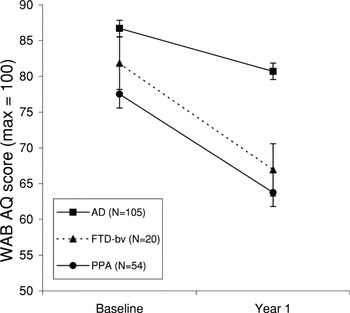
Results of the mixed design repeated measures ANOVA showed a significant time × group interaction, F(2,176) = 13.43, p < .001, ηp2 = .13 (Fig. 1). Initial AQ scores for the FTD-bv (M = 81.84, SD = 16.38), PPA (M = 77.53, SD = 14.38), and AD groups (M = 86.71, SD = 11.83) declined significantly on follow-up testing (FTD: M = 66.93, SD = 29.27; PPA: M = 63.76, SD = 21.53; AD: M = 80.71, SD = 17.62), p < .01. AQ scores declined in all groups by year 1 when compared to baseline (drop in AQ: AD = 6, t(104) = 7.23, p < .001; FTD-bv = 14.9, t(19) = 3.93, p < .001; PPA = 13.77, t(53) = 9.77, p < .001) using paired t-tests. When the drop in AQ scores was compared among the groups using independent t-tests, the AD group had a lesser decline compared to the FTD-bv, t(123) = 3.56, p < .001, and PPA groups, t(157) = 5.02, p < .001. FTD-bv and PPA patients had a similar decrease in AQ scores, t(72) = .37, p = .72.

Mean aphasia quotient (AQ) scores on the Western Aphasia Battery (WAB) for FTD-bv, PPA, and AD patients at baseline and year 1 with standard error bars.
Further analysis done with a subgroup of patients who came back for another year of testing had a similar result; compared to the AD group, the FTD-bv, t(61) = 2.15, p = .04, and PPA groups, t(81) = 4.19, p < .001, had a greater drop in AQ scores from baseline to year 2 testing (AQ change: FTD-bv = 20.72; PPA = 25.98; AD = 11.53) (Fig. 2). Once again, FTD-bv and PPA patients had a similar drop in AQ in this subanalysis, t(38) = .83, p = .41. The fifty percent of the FTD-bv patients who returned and were testable for this additional year of language assessment had significantly higher AQ scores than the remaining FTD-bv patients, p = .04.

Mean aphasia quotient (AQ) scores on the WAB for FTD-bv, PPA, and AD patients at baseline and years 1 and 2 with standard error bars.
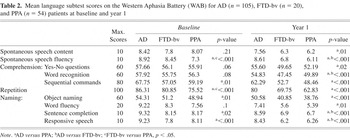
Tables 2 and 3 show differences among the groups on WAB subtests at baseline and follow-up testing. The AD group had consistently higher scores than the PPA group at baseline and 1-year follow-up on spontaneous speech fluency, sequential commands, repetition, object naming, sentence completion, responsive speech, and praxis. The PPA group outperformed the AD group at baseline on drawing subtests and the RCPM at both assessments. The FTD-bv and AD groups had similar scores on all measures at baseline. At follow-up testing, the FTD-bv group had significantly lower scores on spontaneous speech fluency, word recognition, sentence completion, responsive speech, and praxis. Despite similar scores at baseline between the AD and PPA groups on a number of subtests, the PPA group had a significantly impaired performance a year later on spontaneous speech content, yes/no questions, word recognition, word fluency, and writing. Overall, the AD group maintained higher scores than PPA and FTD-bv groups at follow-up on spontaneous speech fluency, word recognition, sentence completion, responsive speech, and praxis measures.
Mean language subtest scores on the Western Aphasia Battery (WAB) for AD (n = 105), FTD-bv (n = 20), and PPA (n = 54) patients at baseline and year 1

Mean scores and number of patient assessed on reading, writing, praxis, drawing, block design, calculation, and Raven's Coloured Progressive Matrices (RCPM) subtests of the WAB at baseline and year 1

Quality of Spontaneous Speech Fluency Among all Groups
All groups had word finding difficulty and circumlocution in conversation at baseline, but agrammatism, aphemia, paraphasia (especially of the phonemic type), and nonfluent speech was predominant in the PPA group. Using the WAB classification criterion that was previously standardized with 150 consecutively examined aphasic patients and 59 controls (Kertesz, 1982; Kertesz & Poole, 1974), our patient population was classified according to the various aphasia subtypes. As shown in Table 4, most patients were in the fluent-anomic stage at baseline. After a year of follow-up, more PPA patients (27.78%) were nonfluent followed by FTD-bv (25%), SD (10%), and AD groups (3.82%). Broca's aphasia like speech was overrepresented in the PPA group a year later. Many AD patients were in the unclassified group because they were too mildly affected to be classified at baseline and follow-up. Most of the AD patients were fluent at both assessments.
Percentage of AD (n = 105), FTD-bv (n = 20), PPA (n = 54), and SD (n = 10) patients according to aphasia subtype at baseline and year 1

WAB Subtests Comparison Between SD and Fluent PPA Patients
The fluent PPA subgroup, spontaneous fluency greater than or equal to 5 on the WAB (n = 48), had a later age of onset (M = 64.81, SD = 7.07), t(56) = 3.02, p < .01, and were assessed earlier in their illness (M = 2.63, SD = 1.82) than the SD group (n = 10; age of onset: M = 57.6, SD = 5.7; years of illness: M = 3.9, SD = 1.37), t(56) = 2.09, p = .04, using independent t-tests. Both groups had similar levels of education, p = .37, and gender ratios, p = .92. Nonparametric measures (Mann-Whitney tests) were done to compare the groups on all WAB subtests at baseline and year 1. No difference was found between the groups in measures of comprehension at both testing sessions, p > .05. Both groups were mildly affected on yes/no questions and auditory word recognition at both sessions but had moderately affected scores on the sequential commands component throughout (mean % correct at baseline: 77% for PPA, 71% for SD; mean % correct at year 1: 64% for PPA and 60% for SD). There was no difference between the groups on word (animal) fluency at both assessments, p > .05, however, a subanalysis of the frequency of animal names using published norms for the English language (Kucera & Francis, 1967) demonstrated a trend towards significance between the groups at baseline, p = .08, and follow-up, p = .06. There was a trend for the SD group to generate more high frequency animals than the PPA group who generally gave more low frequency exemplars. The SD group had a better performance than the PPA group on nonverbal tests such as the RCPM at both assessments, p < .05, and drawing and block design tasks at year 1, p < .05. PPA patients had higher scores on the object-naming task at baseline, p = .02.
DISCUSSION
Based on longitudinal follow-up, FTD-bv and PPA groups show a faster decline in language scores in contrast to the gradual decline found in AD patients. As predicted, language scores for FTD-bv patients approached those of PPA patients as the dementia progressed. A majority of patients in all groups were anomic initially and most AD patients were unchanged at follow-up. Most AD patients remained fluent at follow-up, whereas decreased speech fluency and errors pointing to objects named and deficits in sentence completion and responsive speech tasks dominated in both PPA and FTD-bv groups. Although decreased speech output and pragmatic aspects of conversation are noted to be compromised over time in FTD-bv patients (Neary et al., 1998), our results show quantitatively that language change in FTD-bv patients has a similar rate and pattern of decline on follow-up as seen in PPA patients. This decline was significant but less steep for a subgroup (50%) of FTD-bv patients who were assessed three times during the course of the study. At 1-yr follow-up these patients had significantly higher language functioning than the other fifty percent of patients who failed to return for a third year or were severely impaired for testing. This suggests that the language scores after one year of follow up may be underestimated in the FTD-bv group. As detailed in this study using a standardized measure of language functioning, FTD-bv patients go through a similar progressive aphasia in the early to mid stages with increasing severity as observed in PPA samples before eventual mutism.
The fluent PPA group performed better than SD patients on object naming at initial testing whereas the SD group had better scores on construction measures and the RCPM, a measure of nonverbal or fluid intelligence. Both groups had similar number of items generated on the category (animal) fluency measure. However, a qualitative analysis of the frequency of animal names given showed a trend towards higher frequency exemplars by the SD group. This is consistent with previous research showing a breakdown in conceptual knowledge in SD (Hodges et al., 1992, 1999; Marczinski & Kertesz, 2006). Progressive dissolution of semantic or declarative memory in SD results in the loss of lower frequency words including nouns and verbs (Bird et al., 2000; Marczinski & Kertesz, 2006). Both groups in the present study had similarly affected scores at baseline and at follow-up a year later on comprehension measures of the WAB, specifically when asked to execute sequential commands. This lack of difference on comprehension measures may be indicative of early grammatical impairment on sentence comprehension tasks found in PPA (Grossman & Moore, 2005; Grossman et al., 1996; Hodges & Patterson, 1996). Future testing with an extensive semantic battery examining conceptual representations and assessing reading and spelling or both of irregular words, which captures surface dyslexia found in SD patients (Hodges et al., 1992), may provide a more sensitive measure to compare semantic knowledge in these groups. SD patients show globally impaired performance on the Pyramids and Palm Trees test (Hodges et al., 1992), which measures access to semantic representation using verbal and nonverbal paradigms (Howard & Patterson, 1992).
The fluent versus non-fluent distinction in the PPA literature remains a controversial issue. The term PPA has become synonymous with progressive nonfluent aphasia (Hodges, 2001; Neary et al., 1998), but as shown in our study and previous research by Kertesz et al. (2003), the stage of the illness is likely a confounding factor when categorizing PPA patients along a fluent-nonfluent dimension. Over time, PPA patients frequently become nonfluent because of increasing word finding difficulty, labored speech, and to a lesser extent, dysarthria (Kertesz et al., 2003; Mesulam, 2001). Accordingly, the number of fluent PPA patients declined from 88.89% to 72.22% over a one-year period in the present cohort. For the subset of PPA patients with an additional year of follow-up (30/54), the fluent subgroup declined from 90% at baseline to 66.67% after 2 years.
All patient populations that followed up with language testing in this study were representative of our overall clinic cohort in terms of age of onset and duration to testing. FTD-bv patients were first assessed later in their illness than the AD and PPA groups. A possible explanation for this difference in time of initial diagnosis may be a heightened sense of awareness of memory and language deficits in the elderly, compared to behavioral changes. AD and PPA patients are readily diagnosed by their memory and language deficits respectively early in the course of the illness. However, in the case of FTD-bv patients, psychiatrists may be sought initially when an individual shows behavior and personality changes; because these symptoms may be regarded as depressive, obsessive compulsive, manic or anxiety related illnesses. Early loss of insight or denial by FTD-bv patients (Kertesz et al., 1997) combined with their younger age are also likely to add to their delayed clinical consultation with a dementia specialist. Based on our experience with these patients, family members sometimes overlook or make excuses for some inappropriate behaviors that may further delay time to consultation. However, future studies investigating the relationship of these various factors to the time of initial clinical consultation in FTD-bv populations are needed to clarify this issue.
Language impairment was found to be associated with severity of dementia as measured by the DRS in the FTD-bv, PPA, and AD groups. However, the score on the DRS is heavily dependent on language functioning and verbal reasoning. Impaired verbal skills may underestimate the cognitive ability of PPA patients on the DRS; therefore, using the DRS to assess dementia severity is a limitation of this study. Frattali et al. (2000) found that WAB scores were significantly associated with DRS performance in their study of aphasia, albeit in a CBDS population. Further limitations of this study include differences among the groups in duration of illness to the time of initial testing and age of onset. However, variability in age of onset may be representative of different underlying biological factors in the dementias examined.
In addition to the overlap in clinical features such as language functioning detailed here and behavioral changes that eventually develop in PPA populations described elsewhere (Marczinski et al., 2004), extensive biochemical and neuropathological overlap between FTD-bv and PPA patients (Hodges et al., 2004; Josephs et al., 2006; Kertesz et al., 2005) suggests that these syndromes belong to the same spectrum of disorders referred to as Pick complex (Kertesz et al., 1994) or within the spectrum of FTD. There is also evidence to suggest that CBDS, PSP, and FTD with motor neuron disease should be added to the complex because of clinical and pathological overlap with FTD-bv, PPA, and SD in terms of behavioral, motor, and language features (Hodges et al., 2004; Josephs et al., 2006; Kertesz et al., 1994, 2000, 2005; Kertesz & Munoz, 2004). None of the clinical variants of FTD exclusively predicts histopathological subtypes (Pick bodies, CBD, PSP, MNDI, dementia lacking distinctive histology) exclusively and the reverse is also true (Hodges et al., 2004; Josephs et al., 2006; Kertesz et al., 2005) further supporting the FTD/Pick complex concept. The eventual clinical and pathological similarity in these syndromes may outweigh initial differences.
ACKNOWLEDGMENTS
The authors acknowledge the funding support of the Pharmaceutical Manufacturers Association of Canada, MRC PMAC program grant No. PA14197 and Johnson & Johnson Pharmaceutical Research and Development, L.C.C., industry No. R113675. All information in this manuscript and the manuscript itself is new and original. It is not currently under review by any other publication. It has never been published either electronically or in print.