The prevalence of vitamin B12 deficient children and adolescents is increasing rapidly, both in high-income and in middle- and low-income countries. Vitamin B12 deficiency causes atherogenic plaque formation. This condition is the result of induced hyper-hyperhomocysteinemia.Reference Lorenz, Markus, Bots, Rosvall and Sitzer 1 Elevated red cell distribution width, mean corpuscular volume, and proliferation of smooth muscle cells due to hypomethylation are other risk factors for the development of cardiovascular disease in vitamin B12 deficiency.Reference Tonelli, Sacks, Arnold, Moye, Davis and Pfeffer 2
The methylation of homocysteine is catalysed by methionine synthetase and methionine is produced. This enzyme requires vitamin B12 as a co-factor.Reference Ng, Yong, Chan and Cheng 3 Vitamin B12 deficiency leads to decrease in methylenetetrahydrofolate reductase activity, which reduces synthesis of methionine and the accumulation of homocysteine occurs.Reference Lorenz, Markus, Bots, Rosvall and Sitzer 4 Elevated level of plasma homocysteine is an independent risk factor for atherosclerosis and coronary artery disease.Reference Virdis, Ghiadoni, Salvetti, Versari, Taddei and Salvett 5
The autoxidation of homocysteine results in components of superoxide, hydrogen peroxide, superoxide anions, and hydroxyl radicals, leading to the initiation of the atherogenic event.Reference Demir, Koc, Üstyol, Peker and Abuhandan 6 These compounds inhibit nitric oxide synthesis as oxides with low-density lipoproteins and cause arterial stiffness, endothelial inflammation, and foam cell formation.Reference Shargorodsky, Boaz and Pasternak 7 , Reference Dayal, Arning and Bottiglieri 8 Elevated homocysteine concentration causes suppression of endothelium-derived nitric oxide synthase.Reference Mahalle, Kulkarni, Garg and Naik 9 Homocysteine has primary atherogenic and prothrombotic properties.Reference Potter, Hankey, Green, Eikelboom, Jamrozik and Arnolda 10
Oxidative stress refers to the imbalance between oxidant products and antioxidant defence mechanisms. Reactive oxygen radicals stimulate proliferation in vascular smooth muscle cells and release proinflammatory cytokines by reducing nitric oxide levels.Reference Zoccali, Bode-Boger and Mallamaci 11 , Reference Schiro, Wilkinson, Weston, Smyth, Serracino-Inglott and Alexander 12 Endogenous competitive inhibitors of nitric oxide synthase, asymmetric dimethylarginine, may contribute to endothelial dysfunction.Reference Cooke 13 Nitric oxide is known as the major endothelium-derived anti-atherosclerotic molecule. Many studies have reported elevated asymmetric dimethylarginine levels in endothelial vasodilator dysfunction than do plasma low-density lipoprotein levels in patients with hypercholesterolemia. Asymmetric dimethylarginine may be an endogenous regulator of nitric oxide synthesis that becomes dysregulated in disease states.Reference Böger, Maas, Schulze and Schwedhelm 14 , Reference Tain and Huang 15 High asymmetric dimethylarginine levels have been shown to increase the incidence of cardiovascular events and strongly associated with increased concentric left ventricular hypertrophy and carotid artery intima media thickness.Reference Zoccali, Mallamaci and Tripepi 16 Many studies have reported elevated asymmetric dimethylarginine levels in various cardiac diseases such as acute coronary syndrome, atrial fibrillation, coronary artery disease, and congestive heart failure.Reference Visser, Paulus and Vermeulen 17 Plasma asymmetric dimethylarginine concentrations were found to be high in patients with obvious atherosclerosis in adult and child studies.Reference Ayer, Harmer and Nakhla 18
Endothelial dysfunction and atherosclerosis are thought to begin in childhood, and for the prevention of atherosclerosis, further studies are recommended.Reference Daniels, Meyer, Liang and Bove 19 Carotid intima media thickness is a non-invasive, simple method of predicting future vascular risk factors such as atherosclerosis, cardiovascular events. Carotid intima-media thickness in children and young people could be indicative of vascular re-modelling, and therefore used to investigate atherosclerosis at younger age.Reference Day, Park and Kinra 20 Left ventricular hypertrophy has prognostic significance in many cardiovascular diseases.Reference Day, Park and Kinra 21 Determination of the left ventricular mass index and carotid artery intima media thickness by echocardiography is a simple, inexpensive, non-invasive, and correlated technique.Reference McCully 22 To our knowledge, asymmetric dimethylarginine has not been studied in adolescents with vitamin B12 deficiency. Therefore, the aims of this study were to investigate the presence of endothelial dysfunction and atherosclerosis and to examine the relationship between asymmetric dimethylarginine and arterial stiffness and atherosclerosis in vitamin B12 deficient adolescents.
Materials and methods
This case–control study comprised 50 vitamin B12 deficient adolescents and 38 healthy subjects aged between 11 and 18 years. The diagnosis of severe vitamin B12 deficiency was based on serum vitamin B12 level of <130 pg/ml and a normal level of folic acid.Reference Dayal, Arning and Bottiglieri 8 , Reference Potter, Hankey, Green, Eikelboom, Jamrozik and Arnolda 23 The control group had vitamin B12 level >200 pg/ml. The local institutional ethics committee approved the study protocol. Informed consent was obtained from all the patients. Homocysteine levels were above 15 mmol/L in the entire patient group. The exclusion criteria were secondary obesity, chronic systemic diseases like kidney, cardiac, pulmonary, and hepatic, genetic disorders, hypertension, diabetes and low ferritin, iron, iron-binding capacity, and folate.
Blood samples were taken after 8 hours fasting from all cases. Hemogram, vitamin B12, folic acid, ferritin, homocysteine, triglyceride, total cholesterol, high-density lipoprotein, low-density lipoprotein, lactate dehydrogenase, iron, and iron-binding capacity were immediately studied in the blood samples. Serum samples taken for other parameters study were stored at −80°C until the day of start of the experiment.
A special software program, Vivid 7/Vivid i IMT Package, was used in the echocardiography device to measure the carotid artery intima media thickness. This measurement procedure is not operator-dependent and automatically measures the mean carotid artery intima media thickness after the device has detected the carotid artery. Left ventricular mass index was performed in accordance with the American Society of Echocardiography criteria using standard techniques in two-dimensional M-mode echocardiography.
Blood samples of patients and healthy controls taken for measurement of serum asymmetric dimethylarginine levels were dialyzed with ethylenediaminetetraacetic acid in Eppendorf tubes for 15 minutes at 3000 cycles. Samples were read at 450 nm densities on a Mindray MW-12A enzyme-linked immunosorbent assay instrument.
All tests were performed using SPSS for Windows 22.0 and Sigma Stat 3.1. First, the distributions of all parameters were determined by using the Shapiro–Wilk test. The parameters were expressed as mean±SD in normal distribution, and the parameters with abnormal distribution were expressed as median of 25th–75th percentile. Comparisons of means were performed with Student’s t-test, and comparisons of medians were performed with the Mann–Whitney U-test. Correlations were calculated with the Pearson product moment or Spearman rank order, as determined by the normalcy of data distribution. Multiple regression analyses were performed. A p-value of <0.05 was considered as statistically significant.
Results
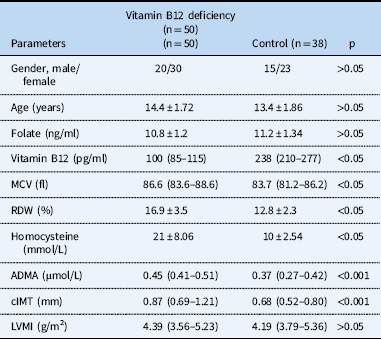
A total of 88 adolescents between the ages of 11–18 were included in the study, while 20 males (40%) and 30 females (60%) were in the vitamin B12 deficiency group and 15 males (39.5%) and 23 females (60.5%) were in the control group. The mean age of the patients with vitamin B12 deficiency was 14.4±1.72 years and the mean age of the control group was 13.4±1.86 years. There were no significant differences between groups in terms of gender, height, age, weight, body mass index, and folate (p>0.05). Vitamin B12 levels were 100 pg/ml (85–115) in the patient group and 238 pg/ml (210–277) in the control group. Homocysteine level was 21±8.06 mmol/L in the patient group and 10±2.54 mmol/L in the control group.
Asymmetric dimethylarginine, carotid artery intima media thickness, mean corpuscular volume, and red cell distribution width were found to be statistically significantly higher in patients with vitamin B12 deficiency group (p<0.001). There was no significant difference between the two groups in terms of left ventricular mass index (p>0.05, Table 1). Left ventricular mass index was 4.73 g/m2 (4.07–5.90) in males and 4.00 g/m2 (3.47–4.67) in females and a statistically significantly higher in males (p<0.05).
Demographic and biochemical characteristics, asymmetric dimethylarginine, and vascular measurements of study groups. Data are given as mean±SD and as median (Q1–Q3).

ADMA=asymmetric dimethylarginine; cIMT=carotid artery intima media thickness; LVMI=left ventricular mass index; MCV=mean corpuscular volume; RDW=red cell distribution width
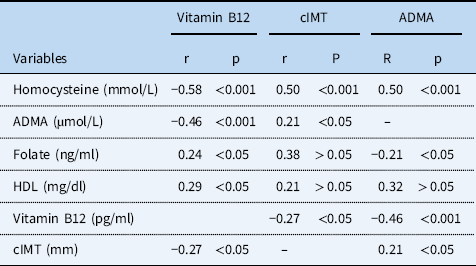
When a univariate analysis between vitamin B12, carotid intima media thickness, asymmetric dimethylarginine, and all study parameters in the vitamin B12 deficiency group was performed, vitamin B12 correlated negatively with homocysteine, carotid artery intima media thickness, and asymmetric dimethylarginine and positively with folate and high-density lipoprotein. Carotid artery intima media thickness correlated positively with asymmetric dimethylarginine, homocysteine, and vitamin B12 (p<0.05, Table 2). On the contrary, asymmetric dimethylarginine correlated positively with homocysteine and carotid artery intima media thickness and negatively with vitamin B12 and folate (Table 2, p<0.05).
Univariate correlations of vitamin B12, cIMT, and asymmetric dimethylarginine with other variables in adolescents with vitamin B12 deficiency.

ADMA=asymmetric dimethylarginine; cIMT=carotid artery intima media thickness; HDL=high-density lipoprotein
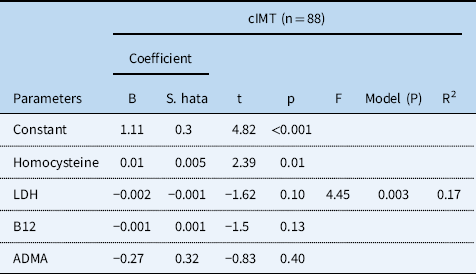
Carotid artery intima media thickness-dependent variable, age, weight, vitamin B12, ferritin, folate, haemoglobin, mean corpuscular volume, platelet, glucose, aspartate aminotransferase, alanine aminotransferase, lactate dehydrogenase, low-density lipoprotein, high-density lipoprotein, triglyceride, homocysteine, asymmetric dimethylarginine, left ventricular mass index, and independent variables were used in multiple linear regression analysis. The factors independently associated with carotid intima media thickness were examined by a multiple regression analysis backward method and the results are presented in Table 3. In the vitamin B12 deficiency group, homocysteine, vitamin B12, lactate dehydrogenase, and asymmetric dimethylarginine were found to be independent predictors for carotid intima media thickness.
Multiple regression analysis between cIMT and other parameters.

ADMA=asymmetric dimethylarginine; cIMT=carotid artery intima media thickness; LDH=lactate dehydrogenase
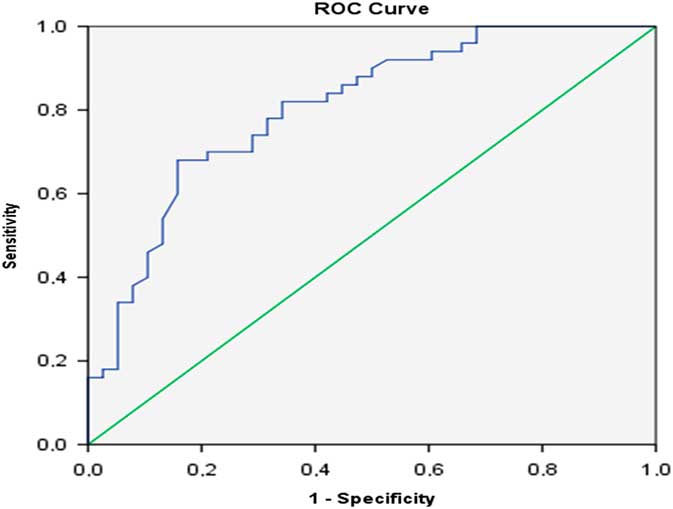
ROC analysis was performed to investigate the effect of asymmetric dimethylarginine value on vitamin B12 deficiency. The optimal cut-off value for serum asymmetric dimethylarginine level was 0.446 μmol/L, sensitivity 68%, specificity 84.2%, positive predictive value 85%, and negative predictive value 66%.
Discussion
The main findings of our preliminary study can be summarised as follows: increased asymmetric dimethylarginine and homocysteine levels were observed in adolescents with vitamin B12 deficiency. In addition, vitamin B12 deficient adolescents have increased carotid artery intima media thickness. The left ventricular mass index in patients with vitamin B12 deficiency and those without were similar.
Roman Pawlak et al reported the most important factor determining homocysteine as vitamin B12, indicating that vitamin B12 deficiency had adverse effects on cardiovascular disease and that vitamin B12 supplementation should be used to reduce the risk of cardiovascular disease. In addition, vitamin B12 deficiency may increase the risk of circulatory problems through its role in macrocytosis. Elevated mean corpuscular volume and red cell distribution width are symptoms of vitamin B12 deficiency.Reference Pawlak 24 Tonelli et al reported a significantly increased risk of fatal coronary disease for increase in red cell distribution width.Reference Tonelli, Sacks, Arnold, Moye, Davis and Pfeffer 2 Higher levels of red blood cell distribution width may be associated with endothelial impairment in patients with vitamin B12 deficient adolescents. Vitamin B12 deficiency may increase the endothelial dysfunction due to factors other than hyper-hyperhomocysteinemia, such as elevated mean corpuscular volume and red cell distribution width.
Harker, Wall, and Mudd reported that homocysteine is a reactive amino acid and that it initiates premature atherosclerosis and endothelial dysfunction as early as 4 years, damaging endothelial cells.Reference Harker, Ross, Slichter and Scott 25 , Reference Mudd, Levy and Skovby 26 In the present study, we observed increased homocysteine in children with vitamin B12 deficiency. Therefore, an increased homocysteine level may reflect endothelial dysfunction in vitamin B12 deficiency.
In many experimental and cross-sectional studies, carotid artery intima media thickness has been reported as an early indicator of atherosclerosis. Pignoli et alReference Pignoli, Tremoli, Poli, Oreste and Paoletti 27 reported that changes in the carotid artery intima media thickness may be helpful in predicting cardiovascular events. Libetta et alReference Libetta, Villa and Pirrelli 28 showed patients with high homocysteine levels undergoing renal transplantation and found that carotid artery intima media thickness was significantly higher than normal population. We found that vitamin B12 deficient adolescents have significantly higher carotid artery intima media thickness (Table 1). If the increase in carotid artery intima media thickness is considered as a marker of atherosclerosis, it can be assumed that atherosclerotic changes have begun with a decrease in vitamin B12.
Increased left ventricular mass index is an adaptive response to non-specific physiological stimuli and independent risk factor for cardiovascular morbidity and mortality.Reference Sabri and Kelishadi 29 Stephen et al found that left ventricular mass index was closely related to sex in children, adolescents, and young people and that there was a significant difference in terms of left ventricular mass index among genders.Reference Daniels, Meyer, Liang and Bove 30 Blacher et al showed a relationship between plasma homocysteine levels and left ventricular hypertrophy in end-stage renal patients.Reference Blacher, Demuth and Guerin 31 We found a higher index of left ventricular mass in the children of male patients with vitamin B12 deficiency than females. Although there was no significant difference in left ventricular mass index in adolescents with vitamin B12 deficiency, left ventricular mass index is not affected in the acute phase and it is believed that left ventricular mass index might be affected in the long term.
Asymmetric dimethylarginine is nitric oxide synthase inhibitor and has been previously found to be elevated in patients with cyanotic congenital heart disease, Eisenmenger syndrome.Reference Cordina, Nakhla and Meagher 32 Miyazaki et al detected in patients with atherosclerosis that there was a statistically significant relation between asymmetric dimethylarginine and carotid artery intima media thickness.Reference Miyazaki, Matsuoka and Cooke 33 Recently, Markus et al demonstrated homocysteine increase in the level of asymmetric dimethylarginine and posed a risk for cardiovascular disease. Our results demonstrated increased level of asymmetric dimethylarginine in adolescents with vitamin B12 deficiency compared with the controls that may reflect or contribute impaired endothelial function. Vitamin B12 deficiency increases homocysteine and elevated homocysteine promotes atherosclerosis through increased oxidant stress, impaired endothelial function, and induction of thrombosis. Homocysteine post-translationally inhibits dimethylaminohydrolase enzyme activity, causing asymmetric dimethylarginine accumulation.Reference Stühlinger, Tsao and Her 34 This may explain the known effect of homocysteine to endothelial dysfunction. In addition, we detected that an increased asymmetric dimethylarginine level has relationship with homocysteine and vitamin B12 (Table 2). Therefore, we think that high circulating asymmetric dimethylarginine levels may be correlated with atherosclerosis. For purposes of our study, in adolescents with vitamin B12 deficiency, asymmetric dimethylarginine and carotid artery intima media thickness may be markers that can be used in the follow-up of children at risk for atherosclerosis.
Our study has some limitations. First, it will be more useful to re-evaluate patients after vitamin B12 treatment. Second, methylmalonic acid is used as a sensitive test for vitamin B12 deficiency, and was not measured in this study. Finally, multi-centric studies should be performed to use asymmetric dimethylarginine as a determinant in clinical practice.
In conclusion, our results show that vitamin B12 deficient adolescents have increased circulating asymmetric dimethylarginine with endothelial dysfunction. In addition, carotid artery intima media thickness increases in adolescents with vitamin B12 deficiency. Asymmetric dimethylarginine may be used as markers for predicting atherosclerosis and endothelial dysfunction.
Plasma asymmetric dimethylarginine receiver operator characteristic (ROC) curve.

Peer-Review
Externally peer-reviewed.
Financial Support
The authors declared that this study has received no financial support.
Acknowledgements
The authors thank the members of the Pediatric Cardiology Interest Group for their assistance and support with this Project.
Conflicts of Interest
No conflict of interest was declared by the authors.
Ethical Standards
Ethics committee approval was received for this study from Erciyes University Ethics Committee on 19/02/2016 with the record number of 115.