Introduction
Lasioderma serricorne (F.) (Coleoptera: Anobiidae) is a cosmopolitan pest insect of economic importance worldwide. This specie is the major pest of stored tobacco, also recognized to attack a wide variety of foodstuffs such as stored grains and processed foods (Papadopoulou & Buchelos, Reference Papadopoulou and Buchelos2002; Arbogast et al., Reference Arbogast, Chini and Mcgovern2005).
In Brazil, these insects are controlled by chemical insecticides, mainly phosphine gas for purging and preventive spraying with insecticides, especially pyrethroids and organophosphates (Lorini, Reference Lorini2008). However, pesticide application has not been an effective measure due to the emergence of resistant insects in some parts of the world. Insects can develop resistance to insecticides via a number of esterase-based mechanisms. Many studies have related the role played by esterases in resistance mechanisms (Guedes et al., Reference Guedes, Kambhampati, Dover and Zhu1997; Conyers et al., Reference Conyers, Macnicoll and Price1998; Lee et al., Reference Lee, Choi, Kim, Je, Song, Chung, Boo and Koh2007; Silva & Lapenta, Reference Silva and Lapenta2011).
Knowledge of the genetic variability in natural populations of L. serricorne is an important aspect, and it may help in the development of new control methods. In recent years, molecular markers have been an efficient tool to determine the genetic structure of populations in this species (Frankel & Duffield, Reference Frankel and Duffield1984; Blanc et al., Reference Blanc, Lugon-Moulin, Panighini, Pijnenburg and Rossi2006).
Among the different molecular markers available, the random amplified polymorphic DNA (RAPD) markers are a simple and low-cost technique for assessing the genetic variability of the pest populations (Ross et al., Reference Ross, Shoemaker, Krieger, Deheer and Keller1999; Biron et al., Reference Biron, Landry, Nenon, Coderre and Boivin2000; Moya et al., Reference Moya, Guirao, Cifuentes, Beitia and Cenis2000; Naber et al., Reference Naber, El Boushssini, Labhilili, Udupa, Nachit, Baum, Lhaloui, Benslimane and El Abbouyi2000). Furthermore, RAPD analysis requires small amounts of DNA, and it does not require prior information of genome (Ayres et al., Reference Ayres, Melo-Santos, Solé-Cava and Furtado2003; Ocampo & Wesson, Reference Ocampo and Wesson2004).
The genetic variability can also be estimated by the use of isozyme markers. Unlike of RAPD markers, isozymes have a codominant nature, allowing for discrimination between heterozygotes and homozygotes (Lewis et al., Reference Lewis, El-Kassaby, Alfaro and Barnes2000). Many studies have used isozyme polymorphisms to analyze the genetic variability in insects (Martins & Contel, Reference Martins and Contel2001; Wool & Front, Reference Wool and Front2003; Martins et al., Reference Martins, Ayres and Lucena2007; Cantagalli et al., Reference Cantagalli, Mangolin and Ruvolo-Takasusuki2010).
Due to L. serricorne economic importance, and also considering the very little information available about its genetic variability, the aim of this study was to analyze this variability in natural populations of this pest using RAPD markers and the esterase isozymes.
Materials and methods
Insect collection
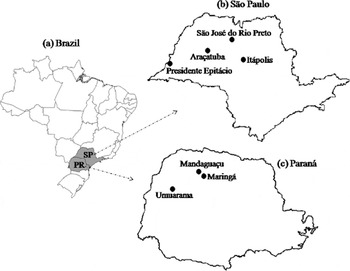
Eleven populations of L. serricorne were collected from seven different localities (table 1), in two states of Brazil, Paraná and São Paulo (fig. 1). They were obtained from processed products such as: wheat flour, soy flour, oatmeal and corn flour.
(a) Map of Brazil showing Paraná and São Paulo States; (b, c) locations of cities in the states of Paraná and São Paulo, respectively, where populations of L. serricorne were collected. Pop 1 (Mandaguaçu, PR); Pop 2, 3 and 4 (Maringá, PR); Pop 10 (Umuarama, PR); Pop 5 (Araçatuba, SP); Pop 6 (São José do Rio Preto, SP); Pop 7 (Presidente Epitácio, SP); Pop 8, 9 and 11 (Itápolis, SP).

Locations of cities where populations of L. serricorne were collected.

DNA extraction
The DNA of eight insects from each population was individually extracted using a modified protocol of Yu et al. (Reference Yu, Van Deynze, Paulus and Glick1993). Each beetle was homogenized in 200 µl of an extraction buffer (200 mM Tris–HCl, pH 8, 2 M NaCl, 50 mM EDTA, pH 8.0, 2% SDS, 20 mM sodium metabisulfite). The homogenate was incubated at 65°C for 30 min in the presence of proteinase K (100 µg ml−1). After incubation, 200 µl of chloroform: isoamyl alcohol (24:1) was added and the homogenate was centrifuged at 12,000 rpm for 10 min at room temperature. The aqueous phase was collected and the chloroform:isoamyl step was repeated. The DNA was precipitated by adding 50 µl isopropanol. After overnight incubation at −20°C, the precipitate was centrifuged at 12,000 rpm for 10 min at room temperature and the isopropanol was discarded. The DNA pellet was washed with 200 µl 70% etanol and centrifuged at 12,000 rpm for 10 min. After centrifugation, the air pellet dried was resuspended in 50 µl of TE buffer (10 mM Tris–HCl, 1 mM EDTA, pH 8.0). RNase (10 µg ml−1) was added and after 30 min, the isolated DNA was stored at −20°C. Samples were quantified using 0.8% agarose gel electrophoresis according to the protocol of Hoisington et al. (Reference Hoisington, Khairallah and González-Léon1994). UV quantification by visual comparison with known quantities of lambda DNA (Invitrogen) averaged about 50 ng µl−1–150 ng µl−1 for each sample.
PCR–RAPD
The amplification reactions were undertaken according to to the method of Williams et al. (Reference Williams, Kubelik, Livak, Rafalski and Tingey1990), with minor modifications; they were performed in aseptic chambers using volumes of 20 μl containing 10 ng of genomic DNA, 1× Tris–KCl buffer (20 mM Tris–HCl and 50 mM KCl, pH 8.0), 2.0 mM MgCl2, 0.3 µM of primer, 0.1 mM of each dNTP and 1 unit of Taq DNA polymerase Platinum (Invitrogen). Amplifications were performed, in duplicate, with Veriti Applied Biosystems. PCR conditions were: denaturation for 5 min at 96°C, followed by 45 cycles of 94°C for 45 s, 35°C for 1 min and 72°C for 1 min and 30 s, with a final 7 min extension of 72°C.
Amplification products were separated by electrophoresis in 1.7% agar (Invitrogen) 1× TBE buffer (90 mM Tris–borate and 2 mM EDTA) gels at 60 V for 4 h. Gels were stained with ethidium bromide (0.5 mg ml−1) and registered by image captured in a High-Performance Ultraviolet Transilluminator – Edas 290, using Kodak 1D 3.5 program. 1 Kb DNA Ladder (Invitrogen) was used as size marker.
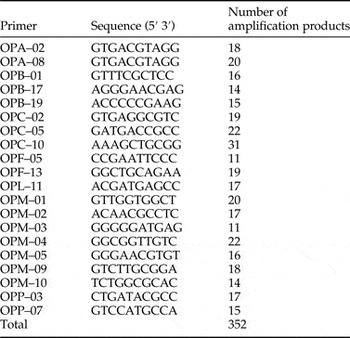
Among the 65 primers tested (Operon Technologies, Alameda, CA, USA) 20 (table 2) were used to amplify the DNA segments of eight insects from each population. Only one mix was prepared for each primer, which was used to compare simultaneously the 88 individual DNA samples for the same amplification reaction.
RAPD primers, sequence of the nucleotides and number of amplification products.

Esterases electrophoresis
Twenty individuals from each population were analyzed. Each beetle was homogenized at 0°C in 25 µl of an extraction buffer (1.5 M Tris–HCl, pH 8.8 and 10% glycerol). After centrifugation for 30 min at 4°C at 11,750 g, 10 µl supernatants were applied to a vertical polyacrylamide gel. It was prepared using 13% (acrylamide/bis-acrylamide solution) in resolution gel and 4% in stacking gel. Electrophoresis was run for 4 h at a voltage of 200 V. Running buffer consisted of 0.1 M Tris–glycine, pH 8.3 and staining for esterase activity was done according to Silva & Lapenta (Reference Silva and Lapenta2011).
Data analysis
DNA segments of RAPD were analyzed by comparing profiles of each insect in terms of presence or absence of each DNA fragment. RAPD products were scored as present (1) or absent (0) in the amplification profile of each sample. Based on such an analysis, a binary matrix was constructed to estimate percentage of polymorphic loci (P), and the degree of genetic differentiation among populations (G st). Analysis of esterases was used to estimate the average expected and observed heterozygosity (H e and H o), percentage of P and Wright (Reference Wright1978) fixation indices (F st and F is). Nei (Reference Nei1978) genetic distances obtained by RAPD markers were used to generate a dendogram using the UPGMA method (Unweighted Pair Group Method with Arithmetic Mean). All analyses were carried out using POPGENE software (Yeh et al., Reference Yeh, Boyle and Xiyan1999)
Results
RAPD analysis
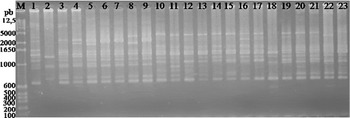
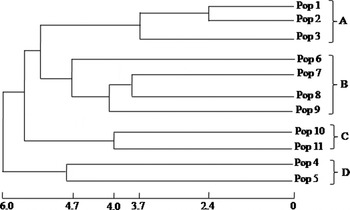
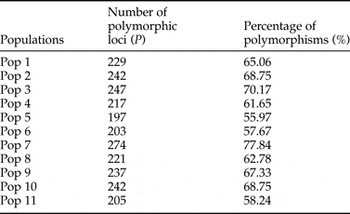
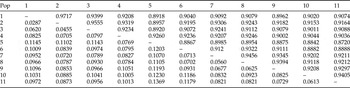
The 20 RAPD primers produced a total of 352 sharp and reproducible bands, all polymorphic (table 2). The average number of bands per primer was 17.6, with fragment sizes ranging from 200 to 5000 pb (fig. 2). The percentage of polymorphic bands ranged from 56% in population 5 (Araçatuba, SP, Brazil) to 78% in population 7 (Presidente Epitácio, SP, Brazil) (table 3). Population-specific bands were not detected. The degree of genetic differentiation (G st = 0.25) suggests that populations are highly differentiated and highly structured. The genetic identity among the populations varied from 0.87 to 0.97 (table 4). The dendrogram (fig. 3), based on Nei's genetic distance, shows four major groups: group A formed by three populations of Paraná; group B formed by four populations of São Paulo; and groups C and D each formed by one population of Paraná and another of São Paulo.
RAPD profiles of L. serricorne obtained with primer OPC–05. M: molecular weight marker (DNA Ladder Invitrogen). Sample 1: pop 3 (Maringá, PR). Samples 2–9: pop 4 (Maringá, PR). Samples 10–17: pop 5 (Araçatuba, SP). Samples 18–23: pop 6 (São José do Rio Preto, SP).

Dendogram based on the genetic distance of Nei (Reference Nei1978) constructed by UPGMA cluster analysis for 11 populations of L. serricorne analyzed using RAPD markers. Pop 1 (Mandaguaçu, PR); Pop 2, 3 and 4 (Maringá, PR); Pop 10 (Umuarama, PR) – populations from Paraná State. Pop 5 (Araçatuba, SP); Pop 6 (São José do Rio Preto, SP); Pop 7 (Presidente Epitácio, SP); Pop 8, 9 and 11 (Itápolis, SP) – populations from São Paulo State.

Number of polymorphic RAPD loci (P) and percentage of polymorphisms (%) for each population of L. serricorne.

Nei's (1978) genetic identities (above diagonal) and distances (below diagonal) obtained by RAPD between populations of L. serricorne.

Analysis of esterases
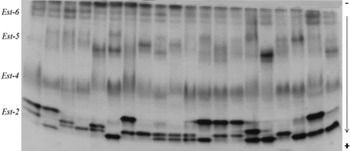
Although many loci were identified, only four (Est-2, Est-4, Est-5 and Est-6) showed a good resolution and could be analyzed safely (fig. 4). This analysis allowed identification of 18 alleles, 15 of which assigned to Est-2, Est-5 and Est-6 loci (five alleles in each locus) and three assigned to Est-4 locus.
Esterase patterns of L. serricorne in population 4 (Maringá, PR) as visualized by α- and β-naphthyl acetate staining.

The allele Est-6E was detected exclusively in population 10 (Umuarama, PR, Brazil). Interestingly, the only monomorphic locus, Est-2, was also observed in this population. Most enzymes were monomeric, except Est-6 that showed dimeric structure with three bands in homozygous individuals.
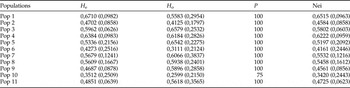
Mean expected and observed heterozygosity values are shown in table 5. The mean observed heterozygosity ranged from 0.259 in population 10 to 0.657 in population 3 (Maringá, PR, Brazil). Average fixation index (F is) was −0.035 indicating that there is an excess of heterozygous. The mean F st value was 0.26, suggesting that populations are genetically differentiated. Estimates of the genic flow number (0.7099) reveal low dispersion of genes from one population to another.
Mean expected and observed heterozygosity (H e and H o, respectively), percentage of polymorphic loci (P) and Nei's expected heterozygosity. Values in parentheses correspond to standard deviation.

Discussion
This is the first study performed in Brazil to investigate the genetic variability of L. serricorne using RAPD markers and esterases. Although it is an economically important species, very little is known about its genetic variability. Blanc et al. (Reference Blanc, Lugon-Moulin, Panighini, Pijnenburg and Rossi2006) studied the structure of worldwide populations of L. serricorne by amplified fragment length polymorphism (AFLP) markers. This study showed that populations were not clustered according to geographic origin of the sample, suggesting that transport of infested commodities worldwide may be contributing to its spreading among different geographic regions.
In the present study, both markers showed that there is a high degree of genetic variability in natural populations of L. serricorne. This result could be expected since natural populations often have high levels of genetic variability (Nevo, Reference Nevo1978; Solé-Cava & Thorpe, Reference Solé-Cava and Thorpe1991).
High degrees of polymorphisms detected in populations of L. serricorne might partly explain its great adaptive capacity that can be confirmed by its wide geographical distribution and its ability to attack different commodities. There are many studies reporting infestation of this pest in several stored products worldwide (Howe, Reference Howe1957; Papadopoulou & Buchelos, Reference Papadopoulou and Buchelos2002; Carvalho et al., Reference Carvalho, Santos, Mexia and Torres2006; Abdelghany, Reference Abdelghany, Awadalla, Abdel-Baky, El-Syraf and Fields2010).
In insects, the esterases isoenzymatic system shows frequently large polymorphism and it seems to be under strong selective pressure since it is of particular importance in insecticide resistance mechanisms in coleopteran such as Tribolium castaneum (Price, Reference Price1984) and Oryzaephilus surinamensis (Lee & Lees, Reference Lee and Lees2001; Silva & Lapenta, Reference Silva and Lapenta2011).
RAPD data indicated that there is a high genetic differentiation (G st = 0.25) among populations, which suggests that a considerable proportion of the total genetic variability (75%) is within populations. Studies performed with other coleopterans of economic interest report similar values. For instance, Martins et al. (Reference Martins, Ayres and Lucena2007) found the same degree of genetic differentiation (0.25) for populations of Anthonomus grandis Boheman. In another study, similar result (0.29) was found by Sosa-Gomez et al. (Reference Sosa-Gomez, Coronel, Binneck, Zucchi and Rosado-Nto2008) studying populations of Sternechus subsignatus.
Although the populations of L. serricorne are genetically structured, the genetic identity values (table 4) indicate that they belong to the same species since the values found are superior to 0.85. According to Thorpe & Solé-Cava (Reference Thorpe and Solé-Cava1994), when the values of the genetic identity are below 0.85, the populations should be considered to be of different species.
Similarly, esterase analysis also indicated a high degree of genetic differentiation among populations, with F st value (0.26) similar to G st value (0.25). In this study, even considering a small number of polymorphic esterase loci, it was possible to differentiate populations. However, this correlation is not always found. For example, in natural populations of A. grandis Boheman the F st value was two times greater than the G st value (Martins et al., Reference Martins, Ayres and Lucena2007).
Among 352 amplified fragments RAPD, no locus was exclusively of one single population. This result may indicate the occurrence of interbreeding, because when this event does not occur, or when its frequency is low, specific band might appear in any of the populations studied. This was demonstrated by Bas et al. (Reference Bas, Dalkilic, Peever, Nigg, Simpson, Gmitter and Adair2000) in a study to analyze the genetic structure of populations of the beetle Diaprepes abbreviatus. This study identified several RAPD loci fixed in one population, but completely absent in other.
The analysis of the esterases also suggested that interbreeding may be occurring, considering that among the 18 alleles identified only Est-6E appeared exclusively in one of the populations studied. The presence of this allele only in population 10 (Umuarama, PR) may indicate restricted gene flow. This hypothesis could also be raised because Est-2 was totally monomorphic in this population.
The heterozygote excess, reveled by the negative value of F is, can be related to high genetic variability associated with the population size. Data indicate that these populations were founded and maintained by a high number of insects; the founder effect that would have been expected due to the species's flight capacities does not seem to have been implemented by these populations.
The dispersion of L. serricorne can occur in two ways. The first, as suggest by Blanc et al. (Reference Blanc, Lugon-Moulin, Panighini, Pijnenburg and Rossi2006), involves the transportation of this insect to different regions by means of infested commodities. The second is due to its flight capacity which favors its dispersion from an infestation process (Ashworth, Reference Ashworth1993).
Given data indicate that the main dispersion form of the insects lies in the transport of infested commodities by maintaining high levels of genetic variability and avoiding endo-crossings. Such great variability maintained by the dispersion of the species is surely a protection against the great variety of insecticides employed for its control. Genetic variability may introduce different enzymes by determining more or less efficient organisms in the metabolism of the pesticides used to control the insects. Silva & Lapenta (Reference Silva and Lapenta2011) detected variations in the resistance to malathion in natural strains of the coleoptera species Orizaephilus surinamensis and Orizaephilus mercator and related their resistance to the variability in esterase patterns.
In regard to the clustering populations, RAPD markers formed a group (A) comprised by populations from the same region of Paraná State. This result can be explained due to the fact that these populations are close geographically, which may facilitate gene flow. However, such flow also appears to occur among geographically distant populations, because two groups (C and D) were formed by populations from both states, Paraná and São Paulo.
Results from this study indicate that the populations are genetically differentiated, and they show high level of genetic variability. The genetic differentiation does not appear to be directly correlated to the geographical distance; therefore, we suggest that it can be related to environmental factors. The high genetic variability may be a consequence of the large number of individuals in each population. In addition, our results also suggest that the transport of commodities attacked by L. serricorne between the states of Paraná and São Paulo is contributing to the maintenance of this wide genetic variability, given that it favors gene flow.
Acknowledgement
To National Council for Scientific and Technological Development (CNPq) for granting study scholarship.