Introduction
With 2010 bringing the end of the New Labour era, it is an apt time for researchers to think critically about the impact of the party's thirteen-year administration on social policy. This article looks specifically at the intention and effects of New Labour's welfare-to-work strategy, which was one of the party's most symbolic and important areas of reform. Further, despite New Labour's loss in the 2010 general election, the new Coalition government has continued along a similar, even more radical, path (DWP, 2010). As such, the analysis of welfare-to-work policy, and its social consequences, remains as important as ever.
With a central role for conditionality, a key task for New Labour was to distinguish its own form of ‘contractualism’ from similar reforms, most notably those associated with ‘workfare’ in the US. This article argues that New Labour attempted to do this by outlining an ethic of ‘reciprocal responsibility’, a quid pro quo which distributed rights and responsibilities equally to both government and claimant. By doing so, New Labour argued that its reform agenda would avoid the worst effects of a workfare strategy, where the unemployed were often blamed for their predicament. To test this claim, this article will present statistical evidence of longitudinal trends in British social attitudes. The objective is to see whether contractualism has indeed been compatible and associated with what might be termed fair or reciprocal attitudes towards the unemployed.
New Labour and welfare-to-work: ‘reciprocal responsibility’ as the driver of reform
The question of what New Labour's welfare reforms stood for was and will continue to be a major area of academic debate. The political theory of the Third Way − though dismissed by some as weak and incoherent (see Fitzpatrick, Reference Fitzpatrick2003; Bogdanor, Reference Bogdanor and Seldon2007) – seems to offer the most effective foundation for exploring this question, since it is arguable that its ideas had a major effect on many areas of social policy. In the case of welfare, social democratic modernisation had a particularly notable influence on policy reform, with Labour showing a demonstrable preoccupation with employment and the need to reform policy along more active, work-focused lines. Welfare-to-work came to symbolise Labour's ‘break with the past’ as the party embraced new ideas about globalisation, socio-economic change and the role of the private sector. It was only in 1988, by contrast, that Labour had endorsed the ‘Charter against Workfare’ in commitment to unconditional benefits (King and Wickham-Jones, Reference King, Wickham-Jones and Powell1999). Thus, welfare-to-work policy became symptomatic of the wider argument that Labour had changed because the world had. As Oppenheim (Reference Oppenheim and White2001: 77) rightly argues, it is in welfare-to-work that ‘the debates about how to rethink the traditional social democratic vision are at their sharpest’.
Beyond this ideological context, in practice the broader welfare-to-work strategy encompassed a wide range of reforms, such as the introduction of Jobcentre Plus, the childcare voucher scheme and tax credits. However, the New Deal programmes were the crux of Labour's back-to-work strategy, heralded by the party as the ‘largest assault on structural unemployment ever taken’ (Labour Party, 1998: 4) which would change ‘the whole culture of the benefits system’ (Labour Party, 1999: 3). For New Labour, the New Deals symbolised one of their most important claims: that its social policy agenda was distinct from both neo-liberalism and conventional social democracy. Driver and Martell (Reference Driver and Martell1997: 34) point to this, arguing that Labour showed a ‘third way’ through their dual concern with ‘unrestrained market egoism’ and ‘a rights-based culture which led to welfare dependency’. In their purportedly distinct strategy, Labour advocated an ‘integrative’ welfare-to-work model which went beyond blaming unemployment on the ‘moral fibre’ of the poor (Lødemel and Trickey, Reference Lødemel and Trickey2001: 21) by emphasising a ‘contract’ of equal responsibility between government and the unemployed.
What's wrong with contractualism?
The centrality of dual responsibility to Labour's welfare reforms was the most distinctive and controversial feature of the wider strategy. In considering the reforms, White (Reference White2000: 507–8) described the emerging landscape as a ‘new politics of welfare contractualism’. By this, White meant that the receipt of work-related benefits would be conditional upon the meeting of certain responsibilities and obligations. According to White (Reference White2000: 508), this was ‘deeply controversial’. The controversy of Labour's contractualism lay in its apparent break with the social rights view of benefits, often associated with T.H. Marshall (see King, Reference King1999; White, Reference White2000; Dwyer, Reference Dwyer2004). In short, this argument states that the shift from a rights-based foundation to a conditional one for benefit eligibility has profoundly adverse effects. Both Jayasuriya (Reference Jayasuriya2002) and Plant (Reference Plant2003), for example, argue that conditional welfare-to-work alters the way citizenship is construed and changes norms about the actors involved. Such ideas are grounded in parallel theories within social policy and political philosophy (see Titmuss, Reference Titmuss1970; Sandel, Reference Sandel1998), which argue that how social policies are delivered – e.g. through quasi-markets or under the presence of conditions – can have unintended and sometimes corrupting consequences. In the case of welfare-to-work, many critics have exerted this type of rebuke against Labour's contractualist reforms. Heron and Dwyer (Reference Heron and Dwyer1999: 101) for example argue that conditionality echoes ‘old individualistic ideas about the causes of and solutions to poverty’, with King (Reference King1999) describing welfare-to-work as symbolic of the re-emergence of an old ‘liberal contractarian framework’ underpinned by the belief that unemployment is a ‘consequence of individual indolence and choice’. In sum, such critics tend to see contractualism as not merely an ineffective employment strategy, but as a harmful discourse which renegotiates and undermines the status of unemployed people in society.
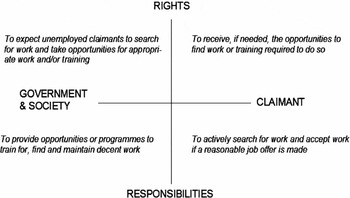
However, New Labour argued that its strategy was different to what its critics proposed in two ways. Firstly, although the reforms were heavily focused upon supply-side solutions of ‘reconnecting’ people with the labour market, Labour claimed it was not ascribing blame to the unemployed. Rather, the unemployed were seen as victims of what Piachaud (Reference Piachaud1993) called a ‘pathetic defeatism’ in terms of dealing with unemployment. Conditionality was seen as a means of dealing with the higher rates of unemployment and labour market ‘detachment’ resulting from two decades of economic restructuration. The second way in which Labour defended their reforms was by emphasising how responsibility would travel two ways: ‘we recognise that they (the unemployed) have a responsibility to seek work and training, but that these obligations must be matched by the government's responsibility to promote real opportunities’ (Labour Party, 1997). This was the quid pro quo of New Labour's plans, similar in essence to White's (2000) concept of ‘fair reciprocity’, which at a broad level involves the satisfaction of certain conditions and responsibilities before a government can fairly impose obligations upon the unemployed. While New Labour's conditions were not quite as ambitious as those proposed by White, the party looked to emphasise the role of government in helping people out of unemployment. This is what might be termed an ethic of ‘reciprocal responsibility’, that is to reciprocate certain goods in return for the fulfilment of specific responsibilities. This is demonstrated in Figure 1.
Rights and obligations for ‘reciprocal responsibility’

The above section has outlined a clear and fundamental tension between two theories of welfare contractualism. The first, drawing upon a long tradition within social policy, draws attention to the unfairness, ineffectiveness and corrupting effects of a welfare discourse which, through a process of attaching conditions to the receipt of unemployment benefits, allegedly relegates unemployed people to ‘second-class citizens’. The opposing theory – developed by New Labour – outlines a different argument, stating that conditionality can be fair and just as long as responsibility and reciprocity are shared equally, thus avoiding the worst by-products of more punitive approaches. The next section of this article will explore whether New Labour succeeded in this by analysing longitudinal trends in social attitudes towards the unemployed. It is the view of this article that the study of public norms and attitudes can provide a vital insight into whether welfare contractualism can indeed be fair and uncorrupting.
Fair responsibilities? What Britain expects from the unemployed
If contractualism can be fair and socially cohesive, then how wider society understands unemployment and the unemployed is an important question. In this light, social attitudes about the unemployed are valuable and the key question is how (if it all) attitudes have changed over time. If so, how and why have they changed and, further, do these changes coincide with the emergence of Labour's contractualist reforms? The next section presents evidence of changing British attitudes, with data drawn primarily from the British Social Attitudes (BSA) series.
Support for the unemployed
Before the election of Labour in 1997, BSA commentators consistently noted the weaker popularity of unemployment benefits relative to other components of the welfare state, particularly the NHS, pensions and education. In the mid-1980s, Bosanquet (Reference Bosanquet, Jowell and Airey1986: 130) stated that the ‘collectivist majority is much smaller on unemployment benefits than in other aspects of social welfare’. This was repeated by Lipsey eight years on (1994: 2–3), who drew a distinction between ‘working-class benefits’, that is unemployment support, and universal services buttressed by a ‘calculation of self-interest’.
Historically then, support for the unemployed seems to have stood at a lower ebb than other cash transfers and services. Whilst this was a noted concern by analysts, it was not considered vastly important, with a sense of what Taylor-Gooby (Reference Taylor-Gooby and Jowell1994: 17) called ‘sanguine optimism’ about the welfare state in general. This meant that despite lower relative popularity, there was a confidence throughout the preceding years to 1997 that the public, in general, retained a sympathetic comprehension of unemployment and subsequently supported the distribution of benefits to those in need of support. For example, 90 per cent saw the real living standards of the unemployed as being ‘extremely low’ in the mid-1980s (Taylor-Gooby, Reference Taylor-Gooby and Jowell1986), and, despite economic growth and a political agenda of ‘clamping down’ on benefit fraud, Bryson (Reference Bryson and Jowell1997: 78) noted that ‘the public are less inclined to blame the unemployed and more likely to feel some degree of sympathy’. Equally, there was a sense that government was the ‘appropriate agency’ to tackle unemployment and provide a decent standard of living to recipients (Mann, Reference Mann, Jowell, Witherspoon and Brook1986). This was true in an international perspective as well; Britons were amongst the most supportive of state-funded job creation schemes (Cairncross, Reference Cairncross and Jowell1992) and supported benefits to no less an extent than more typically ‘pro-welfare’ nations (Taylor-Gooby, Reference Taylor-Gooby and Jowell1998). As Lipsey (Reference Lipsey and Jowell1994) said: ‘if people were seething with resentment at those on the dole, one would expect to see it’. The reality seemed that people were not ‘seething’: less relative support for unemployment benefit should be expected, since not everyone gains. Overall, it can be said that attitudes to the unemployed remained ‘unscathed’ by Thatcherism (Cairncross, Reference Cairncross and Jowell1992: 46), to the extent that Taylor-Gooby (Reference Taylor-Gooby and Jowell1994: 17) could optimistically declare that the ‘foundations of public support for the welfare state had never been more solid’.
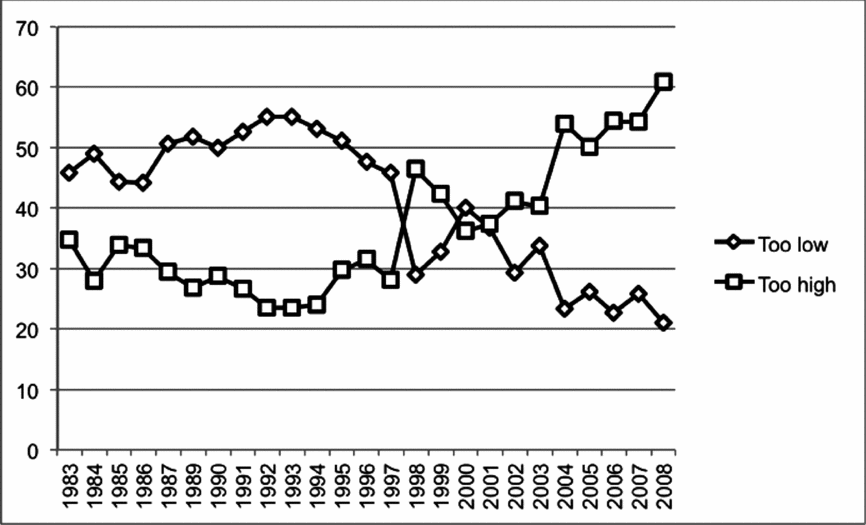
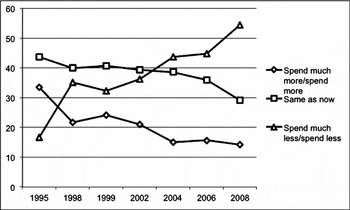
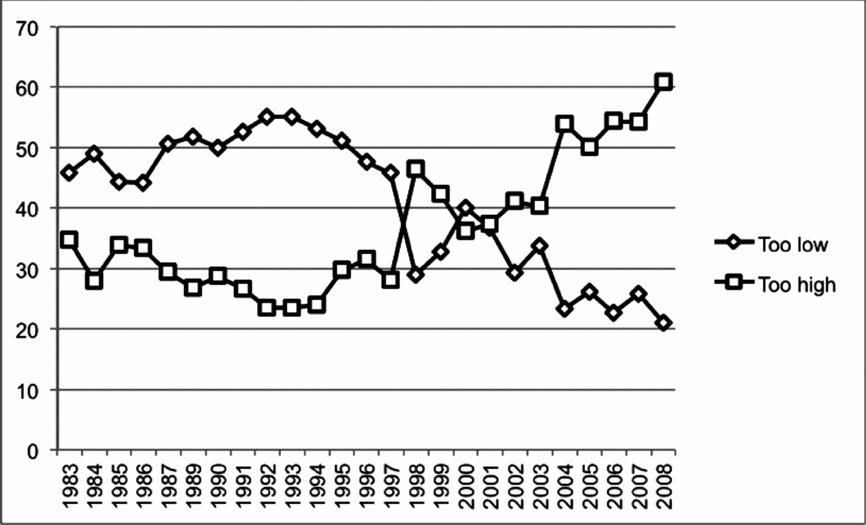
In 2011, it would be fair to hypothesise that such optimism might be depleted. Figure 2 shows an astounding shift against the belief that unemployment benefits are ‘too low’. When Tony Blair was elected leader of the Labour Party in 1994, 53.2 per cent of British Social Attitudes respondents for that year believed that benefits were too low and ‘cause hardship’; by the time he was due to leave, support for this proposition had dwindled to 25.9 per cent. Another BSA question, though newer and asked less frequently, requests respondents to consider whether they ‘would like to see more or less spending on the unemployed’ (Figure 3). In line with the belief that benefits are ‘too high’, respondents have increasingly held the belief that less should be spent on the unemployed: 38 per cent more respondents in 2008 agreed that the government should spend ‘less’ or ‘much less’ on the unemployed than in 1995.
Proportions of respondents who believe that benefits for the unemployed are either (a) too low or (b) too high, 1983–2008
Sources: Own analysis of British Social Attitudes series.
Respondents’ preferences for how much government should spend on the unemployed, 1995–2008
Sources: Own analysis of British Social Attitudes series.

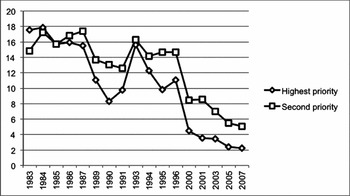
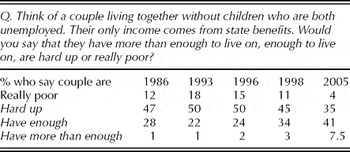
In addition, fewer respondents now prioritise social security expenditure in comparison to other areas of public spending. Although traditionally at a comparatively lower base, those who cited extra social security spending as their ‘first choice’, if government had to spend more money, dropped from an average of about 5 per cent to a low of 1.8 per cent in 2005. A more detailed question from the series asks respondents their views on the different components of social security spending (Figure 4). As the graph shows, the trend of reduced support for extra spending on unemployment benefits is striking, with an abrupt decline from 1996 onwards. We may relate these findings to an apparent lack of sympathy for the living standards of those dependent upon unemployment benefits. As Table 1 shows, there have been significant increases in the opinion that an unemployed couple has enough or more than enough to live on. The scale of sympathy towards the broader group of ‘the poor’ has been condensed into a ‘welfarism scale’ – which uses variables such as attitudes to poverty – to assess an overall ‘orientation towards the poor’ (Taylor-Gooby and Martin, Reference Taylor-Gooby, Martin and Park2008). In 2006, a 15 per cent increase in ‘slightly unsympathetic’ attitudes was found alongside a 13 per cent decrease in ‘very sympathetic attitude’.
Proportions of respondents who chose unemployment benefits as either (a) highest priority or (b) second priority when asked what social benefits government should spend more money on if it had to, 1983–2007
Sources: Own analysis of British Social Attitudes series.

Perceptions of the adequacy of unemployment benefits

Source: own analysis of British Social Attitudes series
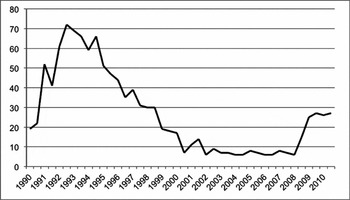
Commentators have noted the severity of these shifts in support: ‘any desire for extra spending on the unemployed has dwindled to an extremely low level, now standing at 1 in 14, down from 1 in 3 in 1986’ (Taylor-Gooby and Martin, Reference Taylor-Gooby, Martin and Park2008: 238). To stoke this concern, there has been strong support from respondents for benefit sanctions for unemployed lone parents (Hills, Reference Hills and Park2001), while only a tiny proportion of respondents (2 per cent) believe extra spending on unemployment benefits will actually improve services (Taylor-Gooby and Hastie, Reference Taylor-Gooby, Hastie and Park2002). Thus, what emerges is a shift of quite raw profundity against spending and support for the unemployed. All in all, the public refuse to conceptualise unemployment as a cause for concern, as they did in the past. This is similarly evident in MORI's long-standing Issues Index (see Figure 5). In mid-1996, a year before the election of New Labour, 44 per cent of people believed unemployment to be the most important issue in the UK. This contrasts significantly with the pre-recession 2000s average of around 6 per cent. Lower levels of concern about unemployment will inevitably be associated with the high levels of employment achieved in the early−mid 2000s, yet public concern during the recent economic downturn has stood between just 15 and 27 per cent. In the recession of 1993, opinion that unemployment was the UK's most important issue stood at a yearly average of 69 per cent.
Proportion of respondents who state ‘unemployment’ as the most important issue facing Britain, 1990–2010
Sources: Own analysis of MORI's Issue Index.

Explanations of unemployment
We now know that attitudes towards the unemployed have hardened and that benefit claimants can expect less support from the public for their predicament; a trend which has manifested itself in a growing and robust consensus that extra spending on the unemployed is undesirable. However, there are broadly two possible reasons why attitudes have changed in this way. Either (1): people are responding to changes in the economic cycle, with further support for the unemployed deemed unnecessary; or (2): attitudes are responding to a more discursive, ideological shift in how we think and conceptualise unemployment itself.
If the decline in support for the unemployed is associated with hypothesis (1) – the economic cycle – it is arguable we would see a degree of continuity in how unemployment is explained. In other words, if people support lower spending on the unemployed, it is because it is less necessary, rather than less morally desirable. Thus, we would expect little change in how people explain unemployment, despite change in the policies people support.
One way to test for explanatory change is to examine public perceptions of the ‘moral condition’ and the ‘personal responsibilities’ of the unemployed. When examining these themes, reports from the 1980s and early 1990s showed evidence of a bias against the unemployed when compared with other social groups. Recalling earlier surveys, Bosanquet (Reference Bosanquet, Jowell and Airey1986: 77) commented on a bias towards the ‘undeserving poor’ and beliefs in ‘self-reliance and self-help’. Equally, Taylor-Gooby (Reference Taylor-Gooby and Jowell1986: 43) talks of a ‘deep-rooted suspicion of the unemployed’, despite widespread gloom about the labour market.
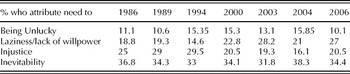
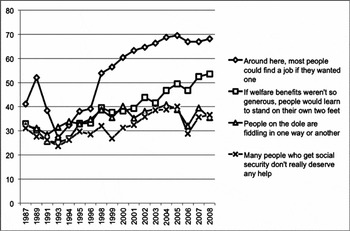
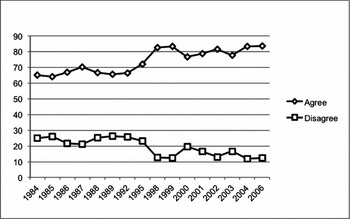
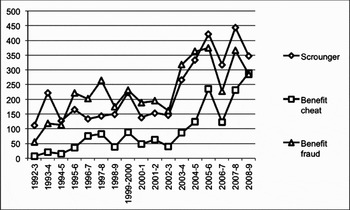
However, while concerns with the dependency and deservingness of the unemployed are not entirely new, there has been a shift in such concerns which Taylor-Gooby (Reference Taylor-Gooby and Park2004: 16) argues are ‘over and above what can be explained by the economic cycle’, a sentiment agreed with by Hills and Lelkes (Reference Hills, Lelkes and Jowell1999) and Sefton (Reference Sefton and Park2003). Figure 6, for example, shows an overwhelming increase in the agreement that most people could find a job ‘if they really wanted one’ since 1997, signifying an escalating concern with people ‘choosing’ to be on benefits. The same graph shows a 20 per cent increase between 1996 and 2008 in the belief that the generosity of benefits prevents claimants from ‘standing on their own two feet’, thus demonstrating a growing conviction in ‘welfare dependency’. While there is less of a swing in favour of the statement that claimants ‘don't really deserve any help’, Table 2 shows that people are increasingly likely to think that those in need are ‘lazy’, as opposed to being the victims of ‘injustice’. Similarly, while Figure 6 fails to show a huge change in the belief that people ‘fiddle’ benefit, Figure 7 shows a different story. Although the view that many people do falsely claim benefits has always been a majority view, 69 per cent more people agree with this than disagree, compared to a 40 per cent difference between the two positions in 1984. Indeed, the average proportion of respondents who disagreed that many people falsely claim benefits during the Labour era was 14 per cent, compared with an average of 24 per cent during the preceding Conservative years. Further, public conern with benefit fraud is seemingly matched by the national media. Figure 8 shows how press coverage of stereotypically negative phrases associated with claimants has increased substantially since the early 2000s.
Respondents’ views of why people live in need

Source: Own analysis of British Social Attitudes series.
Attitudes to social security claimants – proportions of respondents who agree with each statement
Sources: Own analysis of British Social Attitudes series.

Proportion of respondents who either agree or disagree with the statement ‘benefit fraud is widespread’, 1984–2006
Sources: Own analysis of British Social Attitudes series.

Press coverage of benefit claimants, 1992–2009 (number of articles with key terms in national newspapers)
Sources: Own analysis of Nexis UK system.

So, there is strong evidence that the hardening of sympathy towards the unemployed has been matched, and may be because of, a simultaneous increase in attitudes which explain unemployment by (a) a lack of responsibility, (b) the disincentive effects of the benefit system and (c) the motivations and character of its users. There does thus appear to be an enlarged sense that the unemployed have strong personal responsibility and are morally culpable for their position. That this is a shift beyond the structural explanation of economic growth is evident. The dominant trends up until the New Labour era – in times of economic growth as well as decline – offered different explanations of unemployment. For example, Ahrendt and Young (Reference Ahrendt, Young and Jowell1994) concluded that ‘authoritarian’ attitudes towards welfare claimants were far less widespread than equivalent attitudes towards sexuality and crime, whilst Taylor-Gooby (1995) argued that the ‘majority of people do not see the poor as responsible for their own plight’. In 1997, just as Labour came to power, Bryson (Reference Bryson and Jowell1997) argued that attitudes do not ‘sit easily with the notion of the job shy’. Political concerns that ‘scroungers (were) wilfully avoiding work’ had not ‘significantly increased public concern . . . reformers would be wise to bear this mind’ (emphasis added).
New Labour's focus on reciprocal responsibility has thus been associated with a profound shift in public attitudes, defined by a surge in support for the notion of claimant responsibility and a decline in support for governmental, collective support. The shifts cannot be explained wholly by economic growth, and as Sefton (Reference Sefton, Hills, Sefton and Stewart2009: 223) puts it: ‘consciously or not, the way government talks about social problems and presents its policies can over time shape the way people think’. In this instance, the bottom-right quadrant of Figure 1 – claimant responsibility – appears to have overwhelmed all other considerations for a public which has turned decisively against the unemployed.
Discussion
The evidence presented above shows that New Labour's principle of reciprocal responsibility, exemplified in the conditional nature of many welfare-to-work reforms, was strongly associated with a widespread societal revision of how both unemployment and the unemployed are viewed, with the majority of people now less supportive of measures to combat unemployment and more likely to blame benefit recipients for its persistence. As this article has argued, New Labour put forth a clear argument that a contractualist welfare policy could be just, as long as a ‘fair deal’ was offered to unemployed people, where claimant and government responsibilities were of equal weight. However, this article raises strong doubts that the strengthening of conditionality in the UK has produced the type of reciprocal and fair norms that New Labour stated it could. Evidence from the BSA series shows that there has been a huge shift in attitudes against the unemployed. The public are now more suspicious of the unemployed than at any time since the early 1980s and largely hold people as responsible for their own predicament. This finding is in line with other studies which have drawn attention to tough and uncompromising public attitudes towards benefit recipients (Orton and Rowlingson, Reference Orton and Rowlingson2007).
Precisely why this has occurred is something of an intellectual puzzle. As this article has argued, New Labour's welfare-to-work agenda was presented as more holistic than the punitive model associated with neo-liberalism and conservatism. If this is so, then making a causal link between New Labour's approach and hardened public attitudes is theoretically problematic and not immediately obvious. Intuitively, one might expect this approach – coupled with the election of a social democratic party – to produce more, not less, support for disadvantaged groups like the unemployed. To explain this puzzle, there appear to be five causes, all of varying plausibility.
(1) The economic cycle
The first explanation is that of the economic cycle: that is, as the economy grew and the number of jobs increased, support for those remaining unemployed inevitably decreased. However, as has been argued, this argument seems to have minimal explanatory power. While the level of unemployment has undoubtedly shaped public attitudes to an extent, it cannot alone account for the magnitude of the shift against the unemployed. To confirm this, there is little evidence that the financial crisis has shifted attitudes back in a more sympathetic orientation.
(2) The new, global welfare consensus
Secondly, just as policies and attitudes are symptoms of wider economic forces like unemployment levels, it is equally the case that shifts in both realms are the effects of wider, historical policy dynamics which shape social policy developments. In the case of welfare-to-work for example, Lødemel and Trickey (Reference Lødemel and Trickey2001) show that welfare conditionality is part of a new global consensus on the causes of unemployment and the remedies required to solve it. Thus, the trends outlined above can be seen as the effects of this broad and complex global shift.
(3) The increasing use of conditionality
However, for this particular article, it is necessary to look more specifically at the way policy has interacted with attitudes within the particular British context. Thus, a third explanation is how New Labour's agenda evolved between 1997 and 2010, away from reciprocal arrangements and towards a more typically US-style workfare approach with a clear individualised focus on unemployment. Daguerre and Etherington (Reference Daguerre and Etherington2009: 1) argue this is the case, stating that the UK is ‘clearly in the top league of countries to place increased pressure on benefit claimants’ after the welfare reforms of 2008 (DWP, 2008). However, the statistical evidence presented in this article demonstrates how attitudes hardened most clearly between 1997 and 1999, suggesting that the major swing in public opinion occurred with the election of the first Labour government and not during the later, tougher phase of welfare reform. This strongly suggests that we must turn to New Labour's original position to explain fully the attitudinal shifts demonstrated in this article.
(4) The failure to uphold government responsibility and support
Fourthly then, rather than transforming into a less supportive system focused more on claimant, rather than government, responsibility, the evidence suggests this was the reality from the start, with New Labour failing to match its reciprocal language in practice, resulting in a policy position that consisted of a quite limited undertaking of government responsibility. Support for this argument is evident throughout a range of policy evaluations, which show that New Labour's approach produced poor levels of job retention (Walker and Wiseman, Reference Walker and Wiseman2003), was inadequate in engaging with the more detached groups of the unemployed (Griggs et al., Reference Griggs, McLennan, Noble, Walker and Whitworth2008) and failed to address the profound geographical concentrations of unemployment (Green and White, Reference Green and White2007). This suggests that New Labour's welfare-to-work agenda was, from the start, minimalist and unambitious in practice, despite the support the party alleged would be on offer. Consequently, it is perhaps not surprising that, ultimately, an unsupportive system transpired to correlate with unsupportive attitudes.
(5) The consequences of contracts and conditions
Nevertheless, though this fourth point is important, an unsupportive system was not novel in itself. This leads to the fifth, final and perhaps most important cause, relating back to the arguments against contractualism, which were outlined at the start of this article. These arguments raised profound doubts about whether contractualism – of any form – is compatible with fair and respectful cultural norms about the unemployed. Theories like this are part of a wider intellectual framework in social policy which states that precisely how services and benefits are provided matters: a school of thought which has been most widely associated with the effects of replacing universal benefits with means-testing and of introducing markets in service provision. In such instances, a change in the way a policy is delivered is judged to have corrupting consequences. The most famous example of such corruption is Titmuss’ (1970) study of blood donation, where the establishment of a market reduced the quantity and quality of the service, as intrinsic values were ‘crowded out’ by financial incentives.
From the evidence presented in this article, welfare contractualism – akin to means-testing and to marketisation – appears capable of renegotiating and ultimately damaging social relations, with contracts possessing the capacity to fundamentally alter our norms and conceptions about the nature and purpose of welfare itself and the outcomes which policies produce. As Hills (Reference Hills and Park2001: 4) accurately predicted a decade ago: ‘the emphasis on the conditional nature of benefits may have reinforced their social unacceptability and rendered them less popular’. This conclusion suggests that welfare contractualism – no matter how purportedly integrative or balanced – is incompatible with strengthening public support for and inter-class solidarity with the unemployed.
Conclusion
New Labour aimed to fashion a distinctive form of welfare contractualism, in theory shunning the neo-liberal workfare model through a commitment to ‘reciprocal responsibility’; a quid pro quo where both government and claimant had clearly outlined rights and responsibilities. For New Labour, this model aimed to succeed in avoiding the outcomes which many critics associated with contractualism, such as the individualisation of unemployment and a rupturing of social cohesion. However, this article raises strong doubts that New Labour was able to achieve this. Evidence presented from the British Social Attitudes series shows that since 1997 attitudes have severely hardened against the unemployed, with a significant majority of the public now likely to support lower spending on unemployment, whilst attributing its persistence to moral failure. Thus, despite New Labour's attempt to style a ‘third way’ between the workfare and social rights models, social attitudes have evolved to reflect a preference for an unsympathetic, punitive system. Though a number of causes were outlined, such as the economic cycle, the evolution of the reform programme and a failure on New Labour's part to offer genuine support, it is argued that, above all, the centrality given to contracts and conditions is chiefly responsible for crowding out collective notions of fairness, social cohesion and reciprocity. For those who consider these to be some of the central goals of welfare, it seems necessary to revisit the language and practice of contractual social policy.