Introduction
‘Active ageing’, and its link to wellbeing, independence and health, are now regularly promoted through both policy and practice (Department of Health 2005; Department for Work and Pensions 2005; World Health Organisation (WHO) 2002) and through research funding initiatives such as the United Kingdom Research Councils' New Dynamics of Ageing programme (Clarke and Warren Reference Clarke and Warren2007; Hennessey and Walker Reference Hennessy and Walker2011). ‘Active ageing’ as a concept developed from established gerontological theories such as disengagement theory (Cumming and Henry Reference Cumming and Henry1961) and structured dependency theory (Townsend Reference Townsend1981), both of which focused on the social structures that constrain and isolate older people (Gilleard and Higgs Reference Gilleard and Higgs1998), and from activity theory (Havighurst Reference Havighurst, Williams, Tibbits and Donahue1963).
Activity theory, in contrast, emphasised the influence of constraining forces on later life by putting a greater emphasis on individual agency, continuing through retirement into a productive, active and healthy old age (Clarke and Warren Reference Clarke and Warren2007; Katz Reference Katz and Katz2005; Walker Reference Walker2002). It has been criticised, however, for placing unrealistic pressure on older people to continue the activity levels of middle age through to old age, without recognising the implications of bodily changes in later life, as well as failing to address potential barriers to active ageing, such as limited access to health care and appropriate housing (Estes Reference Estes1982; Katz Reference Katz and Katz2005; Walker Reference Walker2006). The emergence of the new concept of ‘active ageing’ in the 1990s, developed through the WHO and other governmental and non-governmental organisation initiatives, offered a policy framework which emphasised the link between activity, health, independence and successful ageing: ‘active ageing is the process of optimizing opportunities for health, participation and security in order to enhance quality of life as people age’ (WHO 2002: 12; see alsoWalker Reference Walker2002).
The goal of ‘active ageing’ is to empower older people to be active and independent in later life, and to avoid the morally negative implications of ageing and dependency in old age (Katz Reference Katz and Katz2005). To be successful in later life is seen as linking ageing with activity, productivity and health, so that to fail to be active and productive in retirement is to age unsuccessfully (Bowling Reference Bowling1993; Katz Reference Katz and Katz2005). Jolanki, whose respondents were all aged 90 or more years, found that their narratives of physical and social activity, or ‘activity talk’, were closely linked to perceptions of what constitutes good health, and that ‘being active in all imaginable ways was clearly the preferable option’ (2009: 263). Notwithstanding those older people who are frail or disabled and with limited capacity to undertake physical activities, the premise of ‘active ageing’ assumes that older people have the capacity to be active and productive in later life (Bowling Reference Bowling2008; Walker Reference Walker2002). Yet there is also a need to acknowledge that some bodily changes that accompany ageing, such as poor night-time sleep, impact on energy levels during the day and therefore constrain the number and duration of activities that older people can comfortably undertake. Moreover, the link between moderate physical activity and improved quality of sleep has been established (King et al. Reference King, Oman, Brassington, Bliwise and Haskell1997), as have the effects of maintaining leisure and domestic activities in later life in mediating against insomnia in older people (Morgan Reference Morgan2003).
If the goal in later life is to be ‘busy’ and active, how do older people with poor night-time sleep reconcile the desire to remain active with the (occasional) need to sleep during the day? It is well known that sleep in later life is often compromised as a result of a change in the architecture of sleep with increasing age (Feinsilver Reference Feinsilver2003; Morgan Reference Morgan, Tallis, Filit and Brocklehurst1998; Ohayon and Vecchierini Reference Ohayon and Vecchierini2005). For example, time spent in deep, slow-wave, sleep diminishes with age, and the time spent in lighter sleep increases, leaving older people finding that it takes longer to get to sleep, have more fragmented sleep episodes and wake up earlier (Ancoli-Israel, Ayalon and Salzman Reference Ancoli-Israel, Ayalon and Salzman2008). Total night-time sleep for older people is often reduced, therefore, which may ultimately lead to a propensity to nap and doze during the day and evening (McCrae et al. Reference McCrae, Rowe, Dautovich, Lichstein, Durrence, Riedel, Taylor and Bush2006; Youn et al. Reference Youn, Kripke, Youngstedt and Elliott2003). There has been research into whether day-time napping benefits older people by increasing their overall time spent asleep during 24 hours (Campbell, Murphy and Stauble Reference Campbell, Murphy and Stauble2005) or is detrimental in terms of reducing the quality and duration of night-time sleep (Boden-Albala et al. Reference Boden-Albala, Bazil, Moon, De Rosa, Elkind, Paik and Sacco2008).
Despite the known deterioration in night-time sleep with ageing, and the greater likelihood of day-time sleeping amongst older people, little attention has been paid to the meaning of day-time sleep in later life. For example, sleep researchers have largely conceptualised day-time sleep as ‘napping’ without recognising the potential inappropriateness of using the term ‘to nap’ as a representation of day-time sleep for older people. The implicit meaning of the word ‘nap’ is not only that it takes place during the day, but that it is sleep that is intentional, controlled, planned for, and clearly delineated with a beginning and an end, as in the expression ‘to take a nap’. ‘Power’ napping, for example, is recommended for office workers to improve productivity (Pilcher, Michalowski and Carrigan Reference Pilcher, Michalowski and Carrigan2001); a siesta is the (acceptable) cultural equivalent of a nap in Mediterranean countries, and inemuri or napping during work or school in Japan is acceptable because of its implication that an employee is working hard (Williams Reference Williams2005, Reference Williams2007). Napping, then, has different connotations for different groups of people. Most studies of napping among older people have asked only whether the older person said they did or did not nap, and few have recognised that day-time sleep may be unintentional (Ficca et al. Reference Ficca, Axelsson, Mollicone, Muto and Vitiello2009). In addition, older people tend to under-report day-time sleep, most particularly evening sleep or dozing (Dautovich, McCrae and Rowe Reference Dautovich, McCrae and Rowe2008).
Sociological investigations of the social context of sleep have shown that a range of social factors influence night-time sleep and sleep disturbances. These studies have focused variously on midlife women (Hislop and Arber Reference Hislop and Arber2003), on couples and sleep (Meadows Reference Meadows2005; Meadows et al. Reference Meadows, Arber, Venn and Hislop2008a, 2008 b; Venn Reference Venn2007; Venn et al. Reference Venn, Arber, Meadows and Hislop2008) and on children and sleep (Venn and Arber Reference Venn, Arber, Steger and Brunt2008). A recent study has examined older people's sleep (Venn and Arber Reference Venn and Arber2009), but no other sociological work has examined the significance of day-time sleep for older people, in spite of its acknowledged prevalence in later life (Martin and Ancoli-Israel Reference Martin and Ancoli-Israel2006). Because of its high prevalence, napping was included in a list of daily activities undertaken by older people in Arbuckle et al.'s (Reference Arbuckle, Gold, Chaikelson and Lapidus1994) study of predictors of cognitive functioning, but it was treated as a passive (non) activity without considering whether older people themselves regarded day-time sleep as an activity, or as a preventer of activity. The aims of this paper are: (a) to contribute to our understanding of the meanings and experiences of day-time sleep in the lives of older people, (b) to examine whether older people accept or resist sleeping during the day and the factors that underlie their orientations to day-time sleep, and (c) to examine how day-time sleep is linked to attitudes about and the practice of ‘active ageing’ among older people.
Methods
The data presented in this paper come from a large multi-disciplinary investigation of poor sleep in later life that was funded through the United Kingdom Research Councils' New Dynamics of Ageing programme. This part of the project aimed to understand the meanings and experiences of poor sleep for older people living in the community and the strategies they used to help with poor sleep. Data collection was undertaken in two phases. Phase 1 sent 2,400 self-completion questionnaires to a stratified sample of community-dwelling older people in the Thames Valley area of southern England. The sample was drawn from the registered patients of ten general medical practices, and equally divided by gender and into two age groups (65–74 and 75+ years). The questionnaire had two parts: (a) the modified Pittsburgh Sleep Quality Index (PSQI) (Buysse et al. Reference Buysse, Reynolds, Monk, Berman and Kupfer1998), which asks questions about sleep quality, duration and fragmentation during the previous month, and (b) questions about age, employment, health and marital status. Of the 1,158 respondents, over one-half were identified as having poor sleep, that is a PSQI score of at least ‘5’ (Venn and Arber Reference Venn and Arber2009).
A sub-sample of 62 of these ‘poor sleepers’, stratified by gender, age group and partnership status, were invited to take part in Phase 2, which comprised an in-depth semi-structured interview lasting between one and three hours in the respondent's own home. The sub-sample contained 31 men and 31 women, and their ages ranged from 65 to 95 years. The 39 who consented to have extracts of their interview appear on the Healthtalkonline website (www.healthtalkonline.org) were video and/or audio-recorded, and all the other interviews were audio-recorded. The website has ‘modules’ of people talking about their personal experiences of health and illness, and the interview extracts were used to create a module called ‘Sleep Problems in Later Life’ (see http://www.healthtalkonline.org/Later_life/Sleep_problems_in_later_life). All participants received an honorarium in compensation for their time, and confidentiality and anonymity were assured. Pseudonyms are used to protect their anonymity, and identifiers are kept to marital status and age. Ethical approval was granted by a National Health Service Multicentre Research Ethics Committee and the University of Surrey Research Ethics Committee.
Whilst an interview topic guide was used as a framework to ensure consistency across all interviews, respondents were encouraged to talk freely and openly (Patton Reference Patton2002). Questions during the interview focused on asking participants about perceptions of their sleep and sleep quality, sleep history, sleeping behaviours and environment, and attitudes to sleep and sleep disruption. During the pilots of the interview guide, it was realised that how older people talked about day-time sleep reflected the different connotations they placed on sleeping during the day. Further probing questions were devised to include discussion of all occurrences of day-time and evening sleep. All interviews were recorded and fully transcribed, and analysis was undertaken using NVivo8. Emerging themes were identified by reviewing respondents' answers to questions pertaining to day-time sleep and daily activities.
Accepting or resisting day-time sleep: implications for active ageing
All but five of the 62 participants indicated that sometimes they had some form of day-time sleep, which varied in frequency, duration and type (e.g. napping, dozing, nodding off, and cat-napping) from ‘very rarely’ to ‘routinely two to three times a day’. Rather than the frequency, the main focus of this paper is the participants' perceptions of the implications that day-time sleep had in terms of undertaking and achieving daily activities in later life.
Older peoples' attitudes to day-time sleep were divided, in that most either accepted or resisted it. Somewhat paradoxically, the reasons given for accepting or resisting day-time sleep were much the same, in that day-time sleep was regarded as closely linked to being active and therefore productive and as part of getting older. Those who accepted day-time sleep (26 of 62) did so in order that they had sufficient energy to be able to continue with their daily activities, as well as acknowledging that napping was an inevitable signifier of the ageing process. The implicit meaning of napping is a planned day-time sleep, sometimes taken in bed, sometimes by lying down on a sofa or sitting in a chair. When napping was accepted and planned for by the poor sleepers, it was most often described as ‘taking a nap’ or ‘nodding off’. As Ficca et al. (Reference Ficca, Axelsson, Mollicone, Muto and Vitiello2009) pointed out, however, day-time sleep may not only be planned napping, but can include unintentional napping or dozing and is often under-reported, particularly by older people. Many of those who accepted napping during the day also described circumstances, or specific times of the day, when they expected to fall asleep, such as in a warm room following morning exercise, or whilst watching the television news after lunch. In these circumstances, day-time sleep may be classed as a ‘nap’ but may also be acknowledged as a ‘doze’, as exemplified by the following exchange with 72-year-old Josephine (all names are pseudonyms):
Interviewer: If you had a day when you had nothing planned, would you say ‘I am tired and I am aware that I need to have a nap’?
Josephine: No, I might say ‘I will sit down and see what is on television’. Then I will have a nap … an involuntary one.
Those who resisted day-time sleep (31 out of 62) mainly did so because of the negative moral connotations of wasting potentially productive time during the day. Sleeping during the day was not seen as an activity, but rather as a way of preventing activity and was therefore to be avoided. As with those who accepted day-time sleep, napping was regarded as one of the signifiers of ageing and the ageing process, but they saw ageing itself as to be resisted, along with any markers of ageing, such as napping. Day-time sleep was therefore not spoken of as a ‘nap’ because of what was implied by napping, but may have been reluctantly acknowledged as a ‘doze’ or ‘dozing off’. The implication is that dozing is not really sleeping, and suggests that the dozer is not completely relinquishing control and attachment to the waking world. Dozing implies retaining some level of consciousness and allows for the possibility of quickly resuming activity.
Table 1 illustrates the characteristics of the older people who accepted or resisted napping by gender and whether they lived with a partner. There was no overall link between the age or health status of the respondent and their attitudes to napping. In terms of gender, slightly more women than men were likely to resist napping, perhaps as a result of the gendered expectations of women's domestic roles in the household and the need to be continuously productive, and slightly more of those living with a partner resisted day-time sleep. As Shirley (aged 72 years) commented, it is inappropriate when there is a couple for one person to nap whilst the other remains active:
Attitude to napping by gender and living status of older people
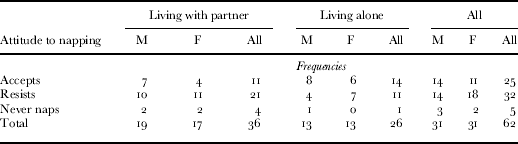
Notes: F: female. M: male.
Interviewer: So you won't have an afternoon nap for example?
Shirley: Never!
Interviewer: Okay, why do you say it so vehemently? I'm interested.
Shirley: I suppose if I think about it, it might be the reason I get narked with my husband if he does it. I just see it as unnecessary to have to sleep so much I think.
Maintaining an active lifestyle in later life was regarded as very important by all the participants. They placed great emphasis on the desirability of physical exercise, such as walking, swimming or cycling, of leisure activities, such as socialising and attending clubs or church; and of mental activities, such as learning how to use the computer and reading. Although the respondents acknowledged that activity levels had diminished to a degree in later life, and adjustments therefore had to be made to their type and amount, being active was universally regarded as desirable and even essential. Framed within the imperative to keep ‘busy’ and active in later life, the reasons for acceptance of day-time sleep will first be discussed, and then we will examine the views of those who resisted day-time sleep.
Acceptance of day-time sleep
The respondents who accepted day-time sleep reported that their ability to undertake daily routines and activities was adversely affected by poor night-time sleep, so that having a nap, or dozing off during the day-time or early evening, were seen as valuable in terms of being able to maintain their desired activity levels. Additionally, deteriorating night-time sleep, which led to day-time sleep, was seen as an inevitable and acceptable part of getting older.
Accepting day-time sleep: being active, being productive
For people in paid employment, the link between achieving a good night's sleep and being productive the next day at work is clear and unambiguous. Meadows et al.'s (Reference Meadows, Arber, Venn and Hislop2008a) study of couples' sleep found that men linked the need for a good night's sleep with their ability to function the following day, recognising that without a ‘good night's sleep’, work the next day was more difficult. Similarly among our respondents with poor sleep, those who accepted day-time sleep linked the need to nap, or justified unplanned napping, with the desire to have sufficient energy to undertake household jobs or tasks. For the few who were still working, and for those who had regularly taken a nap during the working day prior to retirement, napping was not only seen as acceptable, but also a justified necessity. Having a nap was seen as a way of continuing to be able to function properly at work, or to get on with household chores after work. This was expressed well by Jenny, who lived with a partner, was aged 69 years, and worked part-time as a care worker. She often took a nap after work and before her household tasks:
If I'm really tired, I'll just get into bed, otherwise I'll just sit here and nod off for sometimes an hour, and that's all I need, and I feel so much better and then I can carry on and cook dinner and all that sort of thing.
Among those who accepted day-time sleep, women particularly would schedule a nap to be able to cope better with daily household chores, such as gardening or cleaning, and were likely to plan to ‘take a nap’ or ‘nod off’ between household activities, to be able to continue with their chores. Such a case was that of Helen, who was married and aged 72 years:
Interviewer: And how do you approach the napping. Is it something you consciously do?
Helen: Yes, if we've spent a morning in the garden, which we do this sort of weather, come lunchtime we sit down and have our lunch and I could easily nod off, so I think right, if it's nod off time, it's nod off time, and I go off. But then sometimes, it's not like that at all, and it could be later in the afternoon, and I am thinking, before I cook supper I must have a nap, so then I will do that.
Being active and productive in later life was seen not only in terms of paid work and household chores, for leisure activities were also deemed important. Many of the older people's narratives contained references to being ‘busy’ with social events, albeit occasionally marked with regret when declining energy curtailed the number that could be undertaken in one day. Napping was therefore sometimes planned before a proposed leisure activity, such as playing bowls, or going out for an evening, in order to be refreshed and have enough energy to enjoy the activity. Yet even when a nap was seen as acceptable and desirable, it was not always possible to nap as planned. Norman, married and aged 68 years, explained:
Yesterday morning I did some work, quite a lot of work, putting that bathroom suite in, in the afternoon. Now this is interesting, I mean I wanted to go to sleep because I had a game of bowls in the evening but I couldn't get off.
Planned or unplanned napping was also seen as acceptable compensation for a poor night's sleep, or series of poor nights, so that productivity could be re-established. Another married man, Philip, aged 65 years, put it like this: ‘It might happen [unplanned day-time nap] if I have lost a couple of nights’ sleep, so then it is probably serving a purpose'. Especially for the oldest old, whose energy levels had diminished, napping was also seen as a way of using up time, or of passing the day, which for some retired people was made even longer by their short sleep at night. Under these circumstances, napping itself became an activity and was listed amongst their others, particularly when it was planned for a specific time. Margaret, a widow aged 86 years, explained, ‘I suppose really it [napping] is a way of using up time, because when you are older, time doesn't have the same meaning’. The deterioration of some respondents' night-time sleep led to decreasing energy levels and a tendency to nap or doze during the day. So by accepting napping as part of their everyday routines, they were able to continue to be active and productive and to maintain their ‘busy’ lives. Most of those who accepted napping also accepted the inevitability of growing older.
Accepting day-time sleep and the ageing process
Deteriorating night-time sleep was seen by many as one of the inevitable markers of chronological ageing, alongside an expected increase in the frequency of going to the toilet during the night. Just as there was an expectation of frequent awakenings in the night, and of waking early in the morning, the participants anticipated having less energy during the day and of experiencing day-time sleepiness. All were regarded as markers of growing older, and, for some, were reasons for accepting the benefits of napping and accommodating it into their daily lives. As ageing itself was seen by some as inevitable, the indicators of it were also accepted. Yet the changes that accompany ageing were not always initially accepted. Some initially resisted ageing and napping, but their desire to remain active for as long as possible led to a re-appraisal of their attitude to day-time sleep. As Helen reflected:
I have never been a person who sleeps in the day, but I just wonder. I suppose its old age coming on. It's needing more sleep, and I have a real belief and … you know, that sleep is extremely good for you. And I thought, ‘oh how awful, I mustn't do this [nap]. It [made me feel] guilty’. [But now] I think it's just an episode in the day when you're building up for the rest of the day … that … it's filled-in time, it's investment time, so that I can do something else.
For these respondents, napping was therefore acceptable because it was seen as an inevitable part of growing older, and part of growing older was recognising and acknowledging bodily changes that take place, such as decreasing energy levels, and accommodating these changes in order to continue being active and productive.
Accepting day-time sleep: acknowledging bodily needs
As with Meadows et al.'s (Reference Meadows, Arber, Venn and Hislop2008a) finding from sleep among couples, that men most often identified their sleep needs in terms of their bodily needs, older people who accepted day-time sleep in the current study most often recognised the primacy of their (ageing) bodies. Napping afforded them the opportunity to be more energetic and to cope with the day's activities. Following a broken night's sleep, as commonly reported, a nap was regarded as being refreshing and beneficial, with the interviewees emphasising the need to ‘listen to what their body was saying’ when there was an overwhelming desire to sleep during the day. The significance of relinquishing control to the ‘needs’ of the body was especially important in terms of justifying unplanned napping or dozing. ‘Giving in’ to the body and ‘relinquishing control’ were used to explain the power that the body exerts over the mind when they fall asleep unintentionally during the day. In the words of John, a married man aged 70 years, ‘I just think it is your body taking over and it is a natural thing’. Therefore learning to acknowledge the changing needs of the (ageing) body was offered as a further reason for accepting napping. Jenny articulated this view exceptionally well:
Do you know what, I'm learning as I'm getting older? I'm actually listening to my body and that's something I've never done in my life. I'm so stubborn and [used to say], ‘Oh no, I'm not going to give in’. I never wanted to give in [and would say] ‘No, I have got to keep going’. Now I'm listening. I'm saying, ‘okay, no, I'm not going to go on. I'm going to have a rest now’.
The ability to continue being active and busy in later life was of fundamental importance for the older people in this study, and those who accepted day-time sleep did so because they believed it would help them maintain their daily routines and activities. So a planned nap, or giving in to their body's need for a doze, were all deemed acceptable, and ultimately seen as an inevitable part of growing older.
Resisting day-time sleep
In contrast to accepting a planned, or even unplanned but acknowledged nap, day-time sleep was resisted by over half the sample. The key to some older people's denial of ‘napping’ was its perceived link to two supposedly negative connotations: firstly, that napping was identified with laziness, and secondly, because it signified ageing and a marker of an inevitably greater age to come.
Failing to be active
Retirement from paid work was not seen as an excuse for being inactive, and sleeping during the day was regarded as: (a) an indication of idleness, (b) a waste of valuable and limited time, and (c) counter to the inherently strong moral work ethic of their upbringing. Therefore any napping, or even unintentional dozing, held negative moral connotations and was accompanied by feelings of guilt. Two divorced respondents put such views well, Debora aged 70 years, and Arthur aged 95 years:
Debora: No, I don't believe I would ever [nap] because I think that it is the work and play ethic again, isn't it? That I was brought up with. You know, night-time's for sleep, eight hours for this, eight hours for that and eight hours for the other.
Interviewer: And that doesn't include napping?
Debora: No, not in my Mum's book anyway, it never did.
Arthur: Well I suppose [instead of napping], I would be doing something more constructive like doing research or something or reading or doing some gardening perhaps. Or seeing somebody. I do sketching as well, painting. … As I say, it is my puritanical background, you feel that you have to be useful. You have to do something useful with your time.
The times of day-time sleep influenced both its definition and whether it was acknowledged as taking place. For example, responding to the question, ‘Do you ever fall asleep during the day? Mary, a widow aged 80 years, denied that she napped but acknowledged that she fell asleep. She said, ‘I never nap (during the day). … Oh, I do go off … do you know when I can have my half-an-hour's sleep? [It is] between half-past eleven and twelve’. Another interviewee, Veronica, married and aged 68 years, initially replied, ‘No, I don't think so’, but when asked by the interviewer, ‘What about when watching television, would you fall asleep then?’ she answered, ‘Oh yes, I do!’ Clearly for Mary and Veronica, the ‘half-an-hour's sleep’ in the morning, or in front of the television, is not actually seen as a nap, it is quite different. By denying that she ‘naps’, which is counter to her belief about the need to be continuously active and productive, Mary was free to discuss her day-time sleep. For those who resisted day-time sleep, any form of ‘napping’ during the day was strongly denied, but other types of day-time sleep might be acknowledged if they could be justified. In the following extracts, Mary felt she needed to justify her half-hour's sleep by explaining she had been for a swim at eight o'clock in the morning, but when prompted she did acknowledge other episodes of day-time sleep or dozing later in the day:
Mary: Half-an-hour, that's it, usually half-past-eleven till twelve. Why I pick that time of day, I don't know, but I suppose I have been swimming for half-an-hour and I don't stop, I just spin and turn, spin and turn, spin and turn. I don't ever stop, I keep on all the while.
Interviewer: Is that the only nap you have during the day?
Mary: Yes, it has been known when I am watching television during the afternoon to sort of doze off for five minutes, if that, nothing to get excited about.
Interviewer: And in the evening you don't doze off?
Mary: Yes! About five minutes before the play ends! And you wake up and the news is on and you don't know who done it. That's when I sleep.
Whereas day-time sleep, for those who resisted it, was regarded as a waste of time, dozing in the chair in the evening was not resisted to the same extent. As previously suggested, ‘dozing’ implies the maintenance of some level of consciousness and was therefore not regarded as proper ‘sleeping’. Additionally, dozing would be more likely to take place at the end of the day when all tasks had been undertaken, so that a doze in front of the television was potentially acceptable, and even seen as inevitable in later life. Ray, aged 67 years, had no problem countering the interviewer's hint of an inconsistency:
Interviewer: Okay, you've talked a bit about falling asleep in front of the telly in the evening, and you said that is absolutely fine. You don't think there is an issue with that?
Ray: Oh no, no, I just take it as a natural thing as you get older.
Interviewer: Would you feel the same if you actually fell asleep during the day. Would you feel the same way about …
Ray: Probably not … probably not.
Interviewer: Why is that, do you know?
Ray: Well, because I like to do things during the day time.
Just as some of those who now accepted napping had resisted it initially, others who resisted napping had realised that a time may come when their attitude changes. Rather than accept the change compliantly, however, they still resisted the idea of napping and would consider it only if it allowed them to continue their active lifestyle. Some adjustments were envisaged, such as a nap to stave off what was perceived as an inevitable decline into old age – which they also felt should be resisted. As John reasoned:
John: [If my sleep worsens] I might need a rest in the afternoon to catch up, sort of thing.
Interviewer: You are not too keen on that idea?
John: Well no, not really, because I mean, I like to, we like to go out as a partnership. We feel that we are not that old, you know, we are sort of fairly mobile.
Maintaining mental acuity in later life was also seen as very important by the respondents in this study, perhaps because of a (largely unspoken) fear of declining cognitive ability or dementia, but had greater significance for some of those who resisted day-time sleep. Some of the participants who resisted day-time sleep, because it was seen as a waste of time, linked the need to be physically active with their mental health, and falling asleep during the day was resisted because they saw it as a potential risk to their mental health, as expressed by Jeremy, who was 69 years old and divorced:
It is necessary to my mental health [activity]. You know, I just don't feel – I feel – it is like every day if I haven't done something, if I haven't cleaned something, or painted something or made something I feel I have wasted the day.
Those older people who resisted day-time sleep largely did so because of the perception that napping is lazy and a waste of time, time which they felt would be better spent undertaking household chores or leisure activities. Continuing to be active in later life was also seen as important in contributing to mental health. There was some expectation that the need to nap may increase with age, but napping was still resisted. The language used to describe day-time sleep very much reflected older people's attitudes towards it, with dozing, to some extent, being acceptable under some circumstances, such as in the evening after a full day's activities, but napping was always strongly denied.
Resisting day-time sleep and the ageing process
Those who resisted the idea of getting older resisted the physical signifiers of ageing, which alongside going to the toilet frequently in the night included dozing off in the chair and napping at set times during the day. Napping, as part of the routine of daily life, was regarded as, in the words of Jeremy, ‘an old person's syndrome’, and therefore to be avoided. Whilst there was some recognition that overall sleep had changed with age, and to some extent these changes were expected, some older people resisted the idea of day-time sleep because of its indication of ageing. When Matthew, aged 67 years and married, was asked, ‘Do you think there'll ever come a time when you might [nap]?’ he replied, ‘Well, I hope not. I hope not, because I think it would reflect on the fact that I was really getting past it’. Veronica was also negative about sleeping during the day for the two reasons that she elided: ‘For me, it [day-time sleep] is a waste of time, it might be an admission that you are getting older’. Whereas those who accepted napping talked of ‘relinquishing control’ and giving in to their body and their body's needs, those who resisted day-time sleep saw napping as losing power over their potentially failing bodies. However, being ill, or taking prescribed medications for illness, were legitimate reasons for sleeping during the day. Jane, who was married and aged 78 years, explained:
But I don't [nap], only if I am not well, which is rare for me. Then I go sometimes to bed in the afternoon. But if I have ‘flu or something then I might, but otherwise I don't. No.
Finally, some respondents who resisted day-time sleep not only did so because of the negative moral connotations that surround it, but also for pragmatic reasons. Some who did not sleep well during the night recognised that day-time dozing or napping may reduce the quality and quantity of their night-time sleep, and for that reason was resisted. In the words of Alex, divorced and aged 67 years, ‘I think if I sleep or nap during the day is that going to make me sleep even worse at night’. Reginald, a widow aged 92 years, confided that, ‘The specialist said to me, “try and avoid sleeping during the day because it affects you at night”, but it is hard, that is’. As mentioned previously, to be active in later life was seen as fundamentally important, and those who resisted napping did so because of the perception that time spent sleeping during the day was wasted time. If day-time sleep did take place, it was rarely openly acknowledged, and was regarded as a ‘doze’, usually in the evening, and only after a full day's activities. However, those who resisted day-time sleep foresaw a time as they got older when a nap might be inevitable or unavoidable during the day, but only in order to continue an active and productive life, and any napping would still be undertaken reluctantly.
Discussion and conclusions
In line with policy frameworks that promote the link between ‘active ageing’, health and independent living, the older people in this study agreed that it was imperative to remain active, productive, healthy and independent past retirement and into old age. Retirement from full-time paid employment was not seen as a justification or excuse for reducing pre-retirement activity levels, even amongst those who continued to work part-time. In common with over 60 per cent of older people in the UK (Almeida and Pfaff Reference Almeida and Pfaff2005), however, all the study respondents experienced poor night-time sleep, which led to an increase in day-time sleepiness and influenced their ability to maintain their daily routines and activities. The key to achieving ‘active ageing’ for these older people, therefore, was to compensate for the decreased energy levels that resulted from losses of night-time sleep by the strategic use of day-time sleep.
In total, 57 of the 62 people in this study reported that they slept during the day, albeit with highly variable frequencies, timing and durations. However, their attitudes to day-time sleep tended to be polarised, in that napping was either conceptualised as facilitating an active life, or seen as a barrier to remaining active. Older people who accepted and acknowledged napping were likely to do so because of their desire to remain physically and mentally active, and indicated that a nap helps to sustain energy, and to enable household chores and leisure pursuits to be undertaken. Dozing too was accepted and readily acknowledged, especially in certain circumstances, such as after morning exercise or whilst watching the television. Ageing, for those who accepted day-time sleep, was seen as an inevitable process which was linked to a greater propensity to fall asleep during the day, and adjustments to the day were made to accommodate napping. Napping and dozing were seen as an inevitable accompaniment of ageing, along with bodily decline. Therefore those who accepted day-time sleep were learning to listen to their bodily needs and were comfortable with relinquishing control to their (tired) bodies.
Around one-half of the sample resisted napping. They focused on avoiding day-time sleep because of the perception that sleeping during the day was: (a) lazy, (b) a waste of time and (c) counter to the strong moral work ethic that they had grown up with and practised throughout their working lives. Any day-time sleep that did take place was accompanied by a sense of guilt unless a full day's activity had been undertaken. Falling asleep in front of the television in the evening, after a long, active and productive day, was termed ‘dozing’ and not napping but was also resisted. Whereas napping was regarded as a planned sleep and could be (reluctantly) admitted to, dozing was not regarded as sleep by those who resisted it. Ageing and the signifiers of ageing, such as napping and frequent visits to the toilet at night, were also resisted. Unintentional day-time sleep was seen as akin to losing power over their (potentially) failing body, and thus, combined with the perception that day-time sleep is somehow ‘immoral’ and time-wasting, served to reinforce the negativity that may surround ageing and the ageing process.
Poor night-time sleep and napping have implications for health and wellbeing in later life (Xu et al. Reference Xu, Song, Hollenbeck, Blair, Schatzken and Chen2010), therefore including advice about the impact of day-time sleep in debates on ‘active ageing’ is essential. For example, some research findings have suggested that napping is detrimental in later life as it is related to an increased rate of mortality (Newman et al. Reference Newman, Spiekerman, Enright, Lefkowitz, Manolio, Reynolds and Robbins2000; Steenhuysen Reference Steenhuysen2008), or that napping can lead to an increased risk of falls (Brassington, King and Bliwise Reference Brassington, King and Bliwise2000; Stone et al. Reference Stone, Ewing, Lui, Ensrud, Ancoli-Israel, Bauer, Cauley, Hillier and Cummings2006). In contrast, other findings suggest that napping in later life is beneficial in terms of improving cognitive functioning and that brief planned naps may benefit both healthy older adults and those in poor health (Ficca et al. Reference Ficca, Axelsson, Mollicone, Muto and Vitiello2009; Ohayon et al. Reference Ohayon, Carskadon, Guilleminault and Vitiello2004).
Such research does not, however, take into account the meaning of day-time sleep for older people. For example, Frisoni et al.'s (Reference Frisoni, De Leo, Rozzini and Trabucchi1996) study of older people and sleep used only a dichotomy (napping or not napping) to describe day-time sleep, and did not take into account unplanned or unintentional napping or dozing. Although some people may be willing to discuss frequency and duration of day-time naps, others who resist taking a nap may deny any day-time sleep or dozing because of the implication that they are ‘whiling away’ their days in non-productive activities. If researchers ask older people to list only the number and duration of naps taken over 24 hours, they are unlikely to capture all episodes of sleep. The picture would be quite different if older people were asked to recall any time they involuntarily ‘dozed off’ or ‘nodded off’ in front of the television. Additionally, evening dozing or unplanned napping may be considered part of night-time sleep because of its proximity to bed-time, which has significance for the subjective assessment of overall sleep duration and quality of sleep.
This paper has demonstrated that older people with poor night-time sleep clearly link day-time sleep with perceptions of ageing, and with the desire to continue to engage in ‘active ageing’. Older people who acknowledged napping in later life as an acceptable strategy for maintaining day-time activity levels, and as an inevitable signifier of ageing, allowed for the possibility of what it may be like to break away from the negative discourses surrounding inactive ageing. The links between activity, health, wellbeing and quality of life in older people were originally identified in activity theory (Havighurst Reference Havighurst, Williams, Tibbits and Donahue1963) and later translated into numerous ‘active ageing’ policy frameworks. All of the older people in this study expressed both the desire to be active and a fear of being inactive, and acknowledged that continuing to be active had at least some benefits for their health and mental wellbeing. Jolanki's study in Finland also showed that older people associated being active with being healthy, and presented themselves as productive ‘worthy members of society’, but also adopted an ‘old’ or aged identity as an explanation for ill health and a justification for inactivity (2009: 263). Just as Ekerdt (Reference Ekerdt1986) and Katz (Reference Katz and Katz2005) have suggested, however, a strong moral work ethic also reinforces the imperative to remain active, so that activity itself and the benefits derived from it are not always of great significance, just that some or any activity is undertaken. Regardless of the type or level of activity undertaken, the importance of continuing to be active was paramount for these older people, and for this to be sustained they saw the management of day-time sleep as fundamental.
Acknowledgements
The SomnIA (Sleep in Ageing) research was funded by the New Dynamics of Ageing initiative, a multidisciplinary research programme supported by the Economic and Social Research Council, the Engineering and Physical Sciences Research Council, the Biotechnology and Biological Sciences Research Council, the Medical Research Council, and the Arts and Humanities Research Council (RES-339-25-0009). The authors gratefully acknowledge this funding, the respondents for taking part in the research, and the support of colleagues in the SomnIA project.