Introduction
Sleep-disordered breathing is common in children: the prevalence has been estimated at 4–11 per cent, depending on the questionnaires and definitions used.Reference Lumeng and Chervin1
Sleep-disordered breathing includes a wide range of symptoms, from primary snoring to severe obstructive sleep apnoea (OSA) syndrome. If untreated, OSA syndrome may cause neuropsychological and cognitive problems, cardiovascular disease, and failure to thrive.Reference Marcus, Brooks, Draper, Gozal, Halbower and Jones2 Both OSA syndrome and primary snoring have been shown to cause cognitive and behavioural problems and reduce the quality of life (QoL).Reference Jackman, Biggs, Walter, Embuldeniya, Davey and Nixon3 Sleep-disordered breathing is usually caused by adenotonsillar hypertrophy in children; in most of these cases, adenotonsillectomy is an effective form of treatment.Reference Marcus, Moore, Rosen, Giordani, Garetz and Taylor4
Owing to the potentially serious nature of the condition, it is important that children with sleep-disordered breathing symptoms (such as frequent snoring and/or apnoea and choking during sleep) are examined by a physician and receive the necessary treatment. The extent to which symptomatic children in the population are being assessed by the healthcare system has not, however, been studied before. Previous studies have assessed how general paediatric clinicians and general practitioners (i.e. not sleep-disordered breathing specialists) question patients and caregivers about sleep-disordered breathing symptoms and adherence to screening protocols during visits. All studies have shown that sleep-disordered breathing symptoms, while prevalent among these children, are not sufficiently addressed during these visits.Reference Chervin, Archbold, Panahi and Pituch5–Reference Erichsen, Godoy, Gränse, Axelsson, Rubin and Gozal7
The present study attempted to estimate in a normal population whether children with frequent snoring and nocturnal breathing difficulties had been in contact with a healthcare provider about their symptoms using self-reported data. In Sweden, all children have access to free healthcare until their 18th birthday, and all children below school age regularly attend a primary care provider for growth and development evaluation and medical assessment. A wide range of national primary care services are available, including health information call centres. This study used a postal questionnaire to ask about specific symptoms including snoring, choking and apnoea. There are, however, limitations regarding the use of questionnaire data because no single validated questionnaire can diagnose sleep-disordered breathing in children. In fact, according to the clinical practice guidelines on polysomnography in children with OSA, taking a medical history, with or without physical examination, consistently fails to predict the presence or severity of sleep-disordered breathing or OSA in children.Reference Carroll, McColley, Marcus, Curtis and Loughlin8 A review of several studies showed that only 55 per cent of children with suspected OSA (based on a clinical evaluation) actually had OSA confirmed by polysomnography.Reference Brietzke, Katz and Roberson9 The present study, however, did not aim to diagnose sleep-disordered breathing but instead aimed to assess the extent to which children at risk of sleep-disordered breathing are brought to the attention of healthcare providers. For this, caregivers were asked about the presence of specific sleep-disordered breathing symptoms such as snoring, apnoea and choking in the children, in accordance with previous questionnaire-based epidemiological studies of sleep-disordered breathing.Reference Lumeng and Chervin1 A specific aim was to identify children with frequent symptoms. In addition, caregivers were asked whether they had been in contact with healthcare providers about these symptoms to estimate the general awareness of caregivers about the symptoms of sleep-disordered breathing.
Materials and methods
Study population
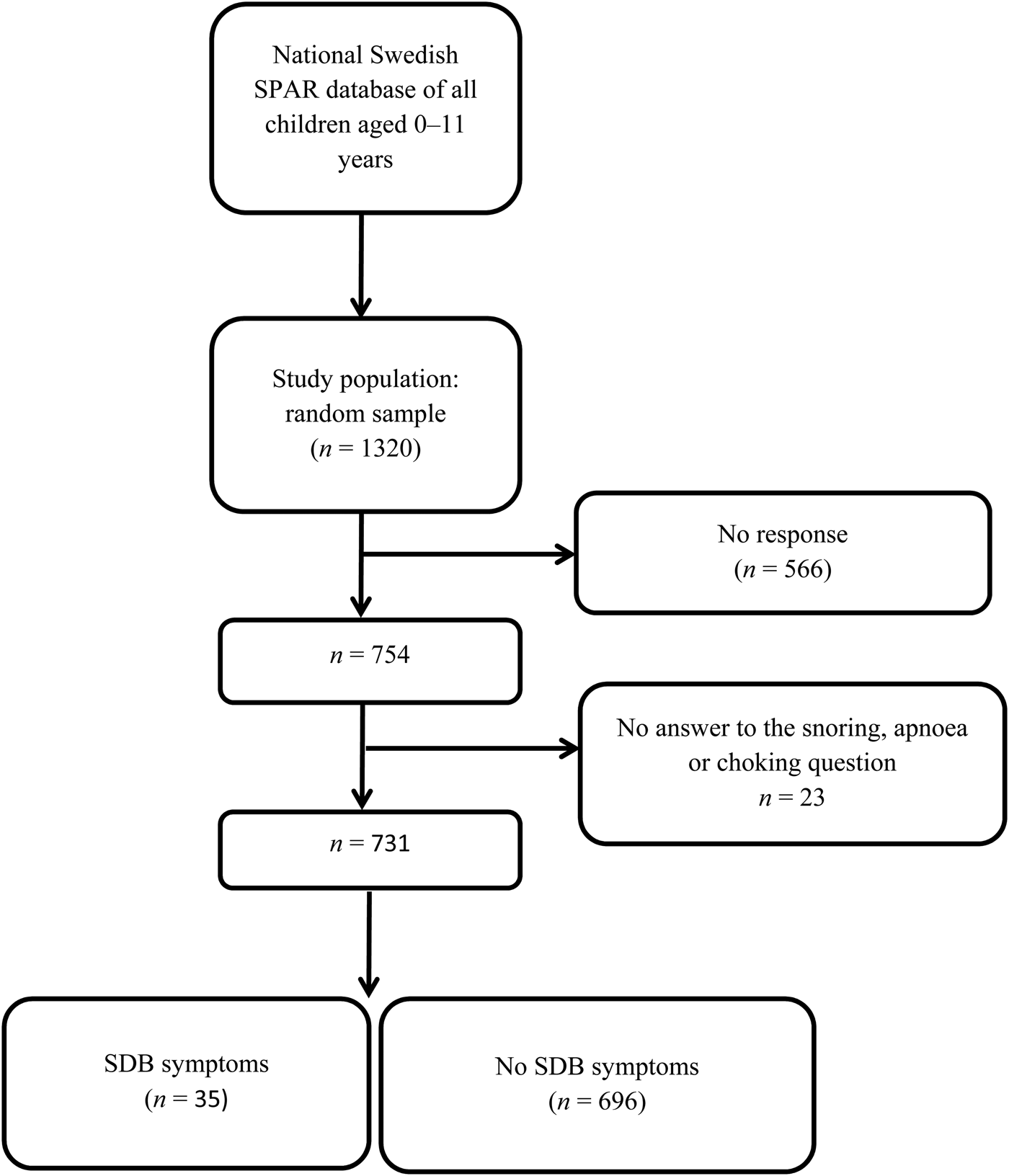
This cross-sectional study included 1320 Swedish children aged 0–11 years randomly selected from the national Statens Personadressregister (‘SPAR’) database, which contains the names and addresses of all Swedish residents at any given time (Figure 1). Children were selected to represent the demographic distribution of Sweden, and stratified according to sex and into four age groups: 0–2, 3–5, 6–8 and 9–11 years.
Flow chart showing selection of the study population. Sleep-disordered breathing symptoms were defined as loud snoring and/or apnoea and/or choking during sleep either all or most of the time during the previous month. SPAR = Statens Personadressregister; SDB = sleep-disordered breathing

The study was approved by the Regional Ethics Committee of Gothenburg (Dnr 594-10).
Questionnaires
An invitation letter and two questionnaires were posted to caregivers, along with a pre-paid envelope for their return. A second set of questionnaires was sent out to those who had not responded within two weeks.
Symptoms of sleep-disordered breathing were defined as frequent snoring, apnoea or choking during sleep. The items snoring, apnoea and choking from the OSA-18 QoL questionnaire relating to symptoms present during the last month were used.Reference Franco, Rosenfeld and Rao10 Questions were worded as follows: ‘During the past four weeks, how often has your child had loud snoring, breath-holding spells or pauses at night, or choked or made gasping sounds while asleep?’
Each item was scored in relation to its frequency from never to all the time on a 1–7 scale. All caregivers were instructed to fill out the questionnaire regardless of whether or not their child had symptoms. If no symptoms were present, the response ‘never’ (1 point) was chosen. Children scored as having symptoms most (6 points) or all (7 points) of the time on at least one of the three questions on snoring, apnoea or choking during sleep were considered to have sleep-disordered breathing symptoms.
The OSA-18 questionnaire includes 15 additional survey items related to physical symptoms, emotional symptoms, daytime functioning and caregiver's concerns during the last four weeks. The scores from each item were added to produce a total OSA-18 score (of 18–126). The OSA-18 questionnaire also contains a 10-grade visual analogue scale (VAS). This was used to assess the child's overall (global) QoL, ranging from the worst (0) to the best possible (10).
Healthcare provider contact and associated health conditions
Caregivers answered a second questionnaire containing questions about healthcare provider contact. The question about contact with healthcare services related to the child's sleep-disordered breathing symptoms was ‘Have you been in contact with a healthcare provider due to your child's sleep-related breathing problems and/or snoring?’, with two possible response options of ‘yes’ or ‘no’. The caregiver was also asked whether the child suffered from allergic rhinitis, asthma, pseudocroup, respiratory syncytial virus infections, enuresis or night sweats, or if daytime sleepiness had been reported to the daycare centre. Finally, they were asked about previous tonsillectomy or adenoidectomy, otitis media or tympanostomy tube insertion, with the response options ‘yes’, ‘no’ and ‘don't know’.
Statistical analysis
Of the 754 questionnaires returned, a total of 23 respondents did not score the items ‘loud snoring’, ‘apnoea’ or ‘choking’; these questionnaires were therefore discarded from the analysis of prevalence and associated factors. Thus, a total of 731 responses were analysed (Figure 1). Missing data for other items of the OSA-18 questionnaire were scored 1 (never). Fisher's permutation test was used to analyse between-group differences. Results are presented as odds ratios with 95 per cent confidence intervals. A p value of less than 0.05 was considered statistically significant. Correlations were evaluated using Pitman's test.Reference Good11
Results
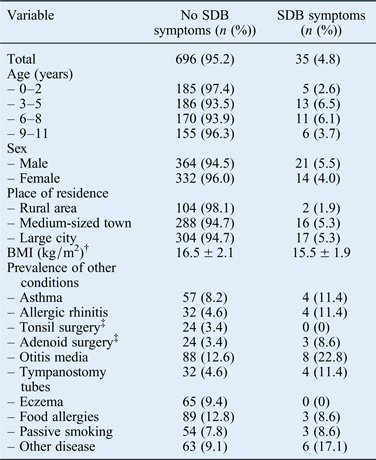
In all, 754 out of 1320 caregivers returned the questionnaires after a single reminder, giving a response rate of 57 per cent. Respondents were evenly distributed across the country and there were no significant differences between responders and non-responders regarding age (p > 0.3), sex (p < 0.3) or place of residence (city vs rural; p > 0.06). The study population included more boys (52.7 per cent) than girls, consistent with the sex distribution in the Swedish population; there was a similar sex distribution in non-responders. Baseline data for the 731 participants included in the analysis are shown in Table I.
Demographics of study groups with and without SDB symptoms*
Total number who underwent surgery = 34.
* Frequent loud snoring, and/or apnoea and/or choking sounds during sleep most or all of the time. †Mean ± standard deviation. ‡Combinations possible. SDB = sleep-disordered breathing; BMI = body mass index
Sleep-disordered breathing symptoms
In 4.8 per cent of children, loud snoring, apnoea or choking sounds during sleep were reported ‘most of the time’ or ‘all of the time’ during the previous month. Loud snoring was by far the most common symptom of the three: 4.7 per cent of children were frequent loud snorers, while 0.5 per cent had frequent apnoea and 0.4 per cent frequently made choking sounds. When children who snored ‘a good bit of the time’ (5 points) were included, the prevalence of loud snoring was 8.3 per cent. The prevalence of sleep-disordered breathing symptoms was higher in the three- to eight-year age group, but the difference was not statistically significant (Table I). Night sweats were significantly more common in children with sleep-disordered breathing symptoms (54 per cent) than in the rest of the population (p < 0.001).
Quality of life
The total QoL VAS was 7.4 (95 per cent confidence interval (CI), 6.8 to 8.1) in children with sleep-disordered breathing symptoms. This was significantly lower than in the rest of the population (VAS, 9.0 (95 per cent CI, 8.9 to 9.1; p < 0.001).
In a sub-analysis, total OSA-18 scores were calculated for all children in the study. In all, 3.6 per cent of children had an OSA-18 score of at least 60. In a previous study, this score combined with a physical examination showing signs of upper airway obstruction was taken to indicate a more severe impact on health-related QoL.Reference Franco, Rosenfeld and Rao10 The overall QoL, as measured by VAS (0, lowest possible QoL; 10, highest possible QoL), was significantly lower in the group with an OSA-18 score of at least 60 (6.08) than in the group with OSA-18 scores below 60 (9.05; p < 0.001).
Healthcare provider contact
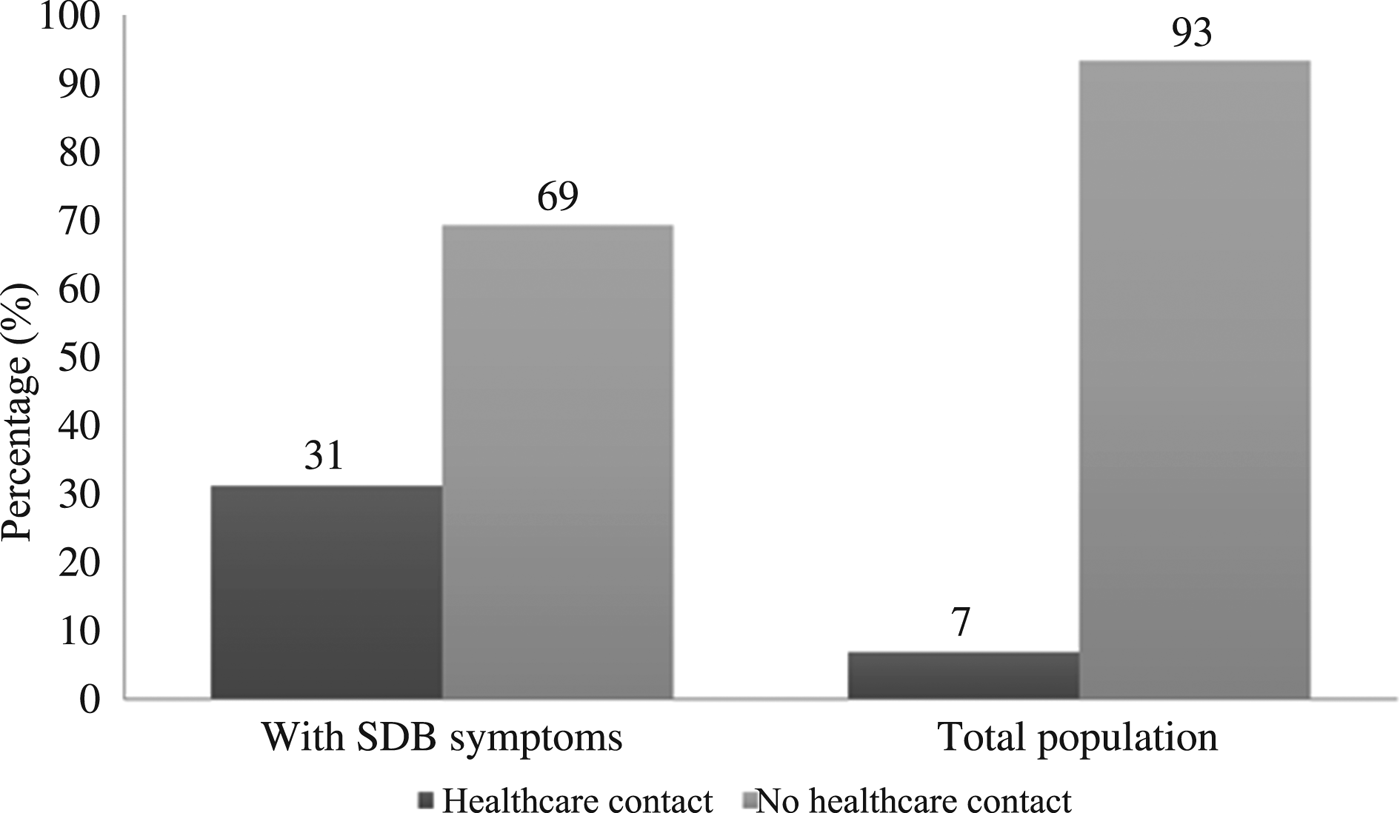
In all, 31 per cent of children with sleep-disordered breathing symptoms had been in contact with a healthcare provider about these problems (Figure 2). Asthma, allergic rhinitis, otitis media and tympanostomy tube insertion are known to be linked to the symptoms of sleep-disordered breathing. This finding was confirmed in the present study: children with these conditions were considerably more likely to have been in contact with a healthcare provider about sleep-disordered breathing symptoms, whereas those with food allergies and eczema were not (Table II).
Healthcare provider contact for children with sleep-disordered breathing symptoms and in the total study population initiated in response to sleep-disordered breathing and/or snoring.
Healthcare contacts in children with SDB symptoms* concomitant with other disease
n = 35.
* Frequent loud snoring, and/or apnoea and/or choking sounds during sleep most or all of the time. SDB = sleep-disordered breathing; CI = confidence interval
Previous surgery
A total of 34 children (4.7 per cent) were reported to have undergone previous adenoid and/or tonsil surgery. Of the 24 who had undergone tonsil surgery (3.3 per cent), none reported sleep-disordered breathing symptoms (as expected), whereas 11 per cent of those who had undergone adenoid surgery (3.7 per cent of the total) still had sleep-disordered breathing symptoms.
Discussion
This survey of Swedish children aged 0–11 years confirmed that frequent loud snoring, apnoea and choking events at night are common symptoms in the general paediatric population: 4.8 per cent had been affected most nights during the previous month. However, only 31 per cent of these children had been assessed by a healthcare provider. This is the first population survey to report the finding that frequent upper airway symptoms during sleep do not necessarily prompt caregivers to seek healthcare advice, which is readily available in Sweden. Since all children in Sweden attend primary care clinics, it cannot be ruled out that in some children sleep-disordered breathing symptoms had been assessed by their general practitioner. However, other studies have reported that sleep-disordered breathing symptoms are commonly missed at regular primary care visits.Reference Chervin, Archbold, Panahi and Pituch5–Reference Erichsen, Godoy, Gränse, Axelsson, Rubin and Gozal7 In most children with frequent sleep-disordered breathing symptoms, a further ENT examination is needed to specifically investigate a possible upper airway obstruction.
The prevalence of sleep-disordered breathing symptoms found in this study (4.8 per cent) is similar to that of previous epidemiological studies in which parents reported children to be ‘always’ or ‘frequently’ snoring (1.5–6.2 per cent).Reference Lumeng and Chervin1 As defined in this study, sleep-disordered breathing symptoms does not include children with a low frequency of loud snoring, apnoea and choking who may also have sleep-disordered breathing. However, the definition was used to prevent symptoms being missed by the caregiver. Loud snoring was by far the most common symptom reported in our study, whereas apnoea and choking sounds were reported in only 0.5 per cent and 0.4 per cent of children, respectively. This result must, however, be interpreted with caution: a caregiver's report is a proxy for the child's symptoms and questionnaire data alone cannot accurately diagnose sleep-disordered breathing in children. Other valid symptoms of sleep-disordered breathing are sweating and mouth breathing during sleep. In fact, night sweats were significantly more common in children with sleep-disordered breathing symptoms. These results indicate that a substantial number of children are at risk of having sleep-disordered breathing and should therefore be assessed by a healthcare provider. Polysomnography combined with a full clinical examination is the ‘gold standard’ for diagnosing sleep-disordered breathing and its most severe form, OSA, according to current guidelines from the American Academy of Pediatrics.Reference Marcus, Brooks, Draper, Gozal, Halbower and Jones2 In clinical practice, however, polysomnography is rarely used because of a lack of availability. A diagnosis of sleep-disordered breathing in children without complicating factors is therefore often made by otolaryngologists based on a medical history and clinical examination.Reference Pringle, Natesh and Buchanan12 It is important to recognise increasing evidence showing that snoring alone causes morbidity and a reduced QoL in children, even when polysomnography is normal.Reference Jackman, Biggs, Walter, Embuldeniya, Davey and Nixon3
This study's finding that 69 per cent of symptomatic children had not been in contact with healthcare services for symptom evaluation highlights an important problem in childhood sleep-disordered breathing. Paediatric patients rely on their caregivers’ concern, as well as the attention of healthcare services, for their well-being. Strocker and Shapiro found that most parents do not understand the symptoms, consequences and treatment of paediatric OSA secondary to adenotonsillar hypertrophy.Reference Strocker and Shapiro13 The present study found that children with conditions such as asthma, allergic rhinitis and otitis media were more likely to have been evaluated for sleep-disordered breathing symptoms. This difference is probably at least partly explained by medical professionals being aware of the link between these conditions and an increased risk of sleep-disordered breathing, and thus the importance of giving more information to parents. Other studies have shown that enquiries about sleep-disordered breathing symptoms are unlikely to be made in primary care settings when caregivers seek help for other paediatric problems.Reference Chervin, Archbold, Panahi and Pituch5–Reference Erichsen, Godoy, Gränse, Axelsson, Rubin and Gozal7
Since most children in developed countries such as Sweden are in regular contact with healthcare providers, there is significant potential for improving parental awareness of sleep-disordered breathing during scheduled appointments. Taking a short history of sleep-disordered breathing symptoms could easily be added to the assessment of hearing, speech and general development. Physicians in primary care should be educated about how to actively look for signs of sleep-disordered breathing and encouraged to refer at-risk children for further assessment by an ENT doctor or paediatrician. Only then can such children be properly assessed and their treatment options considered.
To our knowledge, there are no generally accepted and validated screening questionnaires for sleep-disordered breathing in children. The OSA-18 questionnaire used in this study is an instrument for measuring QoL in children with sleep-disordered breathing and was not originally intended as a screening tool. The items used in this study (i.e. loud snoring, apnoea and choking) are, however, symptom specific and had identical wording to the questions previously used in questionnaire-based studies of snoring in children.Reference Lumeng and Chervin1
• Sleep-disordered breathing is common in Swedish children but under-reported at primary care visits
• Frequent loud snoring should alert the caregiver to the possibility of sleep-disordered breathing
• This population-based survey assessed health-care provider contact in children with sleep-disordered breathing symptoms
• Only 31 per cent of children with frequent symptoms had been in contact with health-care services about sleep-disordered breathing
This study had several limitations. Firstly, the modest response rate may have resulted in selection bias. Further, the use of both caregiver-reported symptoms and a non-validated questionnaire may have resulted in misclassification of the children. As already discussed, no validated questionnaires are available to accurately diagnose sleep-disordered breathing in children. However, this study used the questions most frequently used to identify suspected sleep-disordered breathing in children in both epidemiological questionnaire studies and clinical practice.
Snoring is a common symptom in children and may therefore be perceived as normal or as something that the child will outgrow. This survey indicates that sleep-disordered breathing symptoms may go unrecognised and untreated in many children even when regular healthcare visits are mandatory. This issue needs further investigation.
Conclusion
This study shows that sleep-disordered breathing in children is underestimated and that the level of caregiver and healthcare provider awareness of sleep-disordered breathing in children should be increased.
Acknowledgements
The authors acknowledge the contributions of the Swedish Rhinological Research Alliance, E Ericsson (Department of Medical and Health Sciences, Linköping University), the research nurses C Cervin (in Lund) and C Larsson (Skövde) and the statistician H Johansson to this study. Financial support was provided by government funding of clinical research within the Swedish National Health Service, the ACTA Otolaryngological Foundation (Stockholm, Sweden) and Merck Sharp & Dohme (Stockholm, Sweden).