1. Introduction
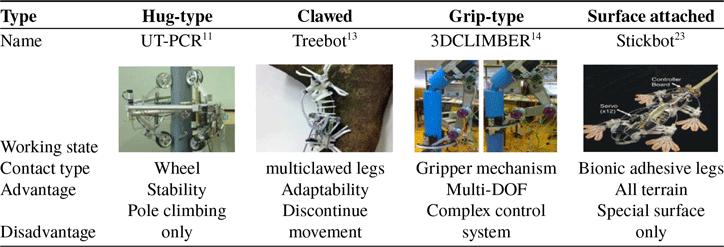
As complex automation systems in a specialized field, climbing robots have a short research history. Several studies have been carried out on climbing robots with different types [Reference Schmidt and Berns1–Reference Boumans and Heemskerk6] of application scenarios, which mainly can be categorized into hug-type climbing robots, clawed climbing robots, grip-type climbing robots, [Reference Guan, Jiang, Zhu, Zhou and Zhang7] and surface-attached climbing robots, as shown in Table I.
-
(1) Hug-type climbing robots: Typical examples of hug-type climbing robots are the WOODY robot [Reference Ueki, Kawasaki, Ishigure, Koganemaru and Mori8] for cylindrical trunk and SnakeRobot, [Reference Yaqub, Ali, Usman and Han9] the ring type climbing robot [Reference Jang, An, Kim and Cho10] and UT-PCR [Reference Baghani, Ahmadabadi and Harati11] for pole climbing. Hug-type climbing robots have uniform and fairly firm clamping forces; however, due to hug-type design they normally have poor climbing transition ability and adaptability, and their applications are limited within nonbranching trees and cylindrical objects.
-
(2) Clawed climbing robots: Clawed climbing robots are like the RiSE robot [Reference Spenko12] and Treebot robot. [Reference Lam and Xu13] RiSE is a multilegged robot, which achieves climbing by the coordinating movement of multilegs. Treebot is a biped climbing system, which climbs by alternating its biped legs. Although clawed climbing robots have the advantage of transition between different pole and climbing over obstacles, they can only climb trees with soft textures and their motions are discontinue due to the characteristics of claw structures.
-
(3) Grip-type climbing robots: Grip-type robots have higher degrees of freedom (DOF) and special clamping mechanisms. Grip-type climbing robots include 3DCLIMBER, [Reference Tavakoli, Marques and de Almeida14] Shady3D, [Reference Yun and Rus15] and other climbing robots. [Reference Boomeri, Pourebrahim and Tourajizadeh16–Reference Kim, Sitti and Seo21] Because gripper mechanisms can be separated from objects and robot bodies have multi-DOF movements, grip-type climbing robots have strong mobility. However, the multi-DOF characteristic of grip-type climbing robots requires a large number of motors and drives, which enlarge its own weight, reduce the load, and increase the complexity of the controller.
-
(4) Surface-attached climbing robots: The representatives of surface-attached climbing robots are the DynaClimber, [Reference Lynch, Clark and Lin22] Stickybot, [Reference Kim, Spenko, Trujillo, Heyneman and Cutkosky23] Gecko-inspired climbing robot. [Reference Schiller, Seibel and Schlattmann24–Reference Jiang, Wang, Zhou, Chen and Dai26] DIGbot, and DynaClimber are multifoot robots whose barbs are fixed on the end limbs, and they can climb on mesh and fence. Stickybot is a gecko-bionic robot, which uses villus material on feet with highly efficient symmetrical gait movement mechanism. Magnetic climbing robot could be attached to the metal surface, with a high climbing speed and stability. But application area of these robots is limited, since their movement depends on the characteristics of the climbed surface, and they only climb well on particular surfaces.
Typical climbing robot.

The conflicts of current climbing robots mainly include
-
(a) The conflict between the demand for multiaction functions and as few drive sources as possible. A large number of drive sources will cause the climbing robot system heavy. However, actual climbing requires the gripper mechanism to have more functions, such as self-adaptability and stability. The requirements of self-adaptability and stability need more drive sources.
-
(b) The conflict between the stability, adaptability, and fast movement. An ideal climbing system simultaneously requires the high stability, relatively high adaptability, and high movement efficiency. Existing climbing robots only have one or two of the above characteristics.
The proposed climbing robot is to realize pole climbing and ground crawling with fewer driving sources while ensuring the stability and adaptability of the climbing robot. In this work, a self-adaptive underactuated climbing robot is developed, where an underactuated holding mechanism is designed for stable and self-adaptive holding, and a wheel system is design for climbing and crawling. The underactuated holding mechanism combines the stability of the hug-type climbing robot and the self-adaptive characteristics of the clawed climbing robot. And the underactuated mechanism uses one motor for driving three holding mechanisms, where each of the holding mechanism has three limbs inspired by human-like grasping [Reference Wu, Carbone and Ceccarelli27–Reference Mohammed, Chua and Kwek28]. And an MRAC is designed for stable control of the holding process. Furthermore, integrating the wheel system into the underactuated holding mechanism realizes climbing on the pole and crawling on the ground. Section 2 determines the model design. Section 3 proposes the parameter design. In Section 4, the control design is proposed. The experiments are carried out in Section 5. Finally, conclusions are given in Section 6.
2. Model Design
2.1. Overview
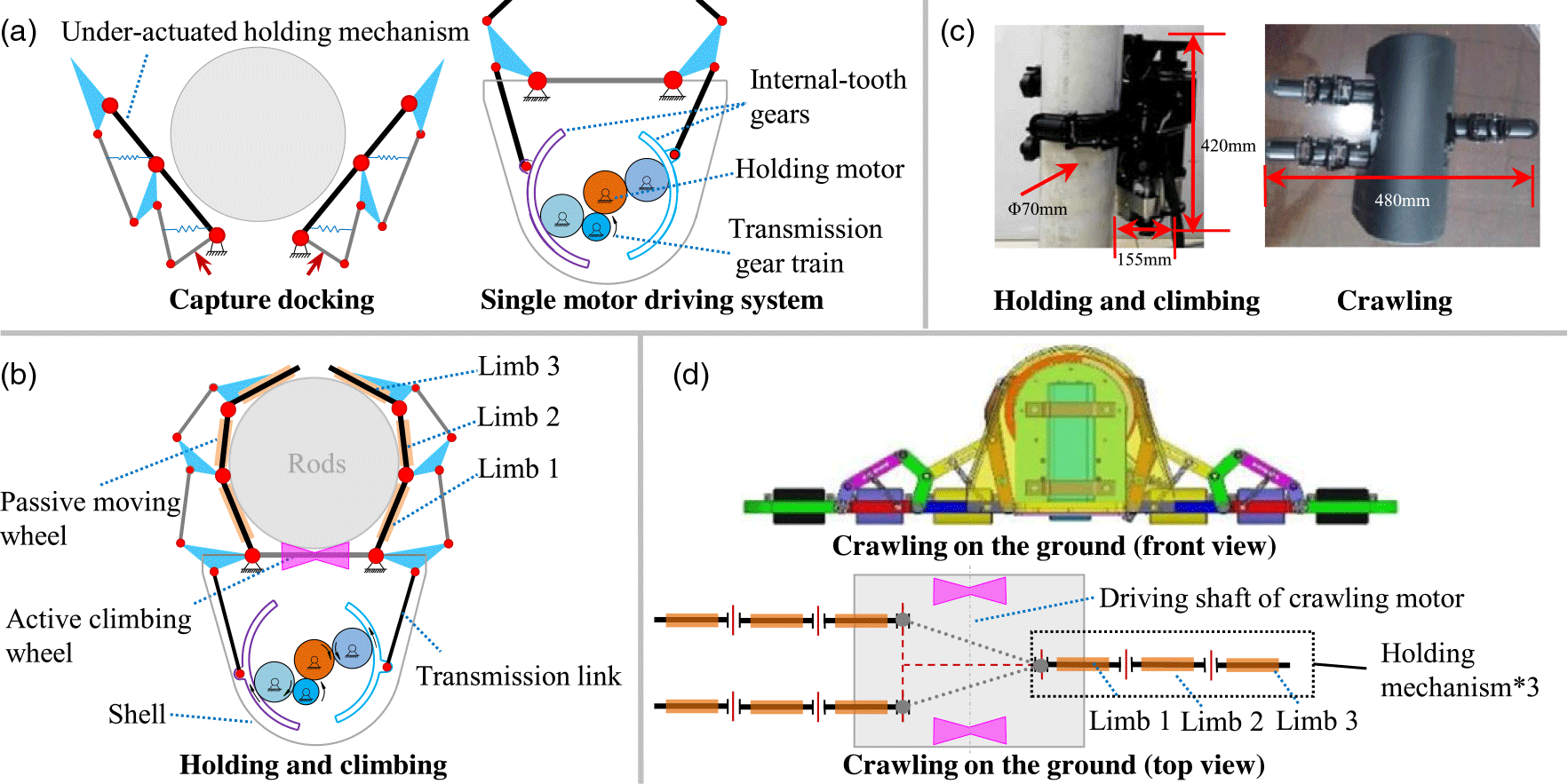
As shown in Fig. 1, a new type of climbing robot is designed that can realize adaptive grasping, closed envelope clamping, wheel-type locomotion, and crawling on the ground with two drive sources. Based on clamping stability and movement efficiency, as well as the combination of the advantages of high self-adaptability, self-balancing, and high wheeled movement efficiency, a new type of underactuated holding mechanism is developed as shown in Fig. 1(a) and (b). The structure of three limbs simulates human fingers, where one finger has three knuckles. The underactuated holding mechanism compared with two limbs and four limbs is optimal in strength and adaptability. The three holding mechanisms are staggered on the left and right to ensure a wide range of pole holding, and they do not interfere with each other. Moreover, there are two motion modes, which are stably climbing on the pole and crawling on the ground as shown in Fig. 1(c) and (d).
Overall schematic design. (a) Underactuated holding mechanism and its driving system. (b) Holding and climbing state diagram. (c) Holding, climbing, and crawling function. (d) Crawling state diagram.

2.2. Underactuated holding mechanism
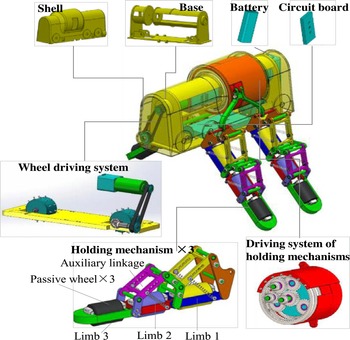
The robot mainly consists of a shell, a base, three underactuated holding mechanisms, a driving system of the holding mechanism, and a wheel driving system, along with the power supply and circuit boards and other related components as shown in Fig. 2. And a total of two motors is applied, where one motor drives the wheel driving system and the other motor drives three holding mechanisms.
Overall robot model design.

The proposed underactuated holding mechanisms drive by one motor, and the three holding mechanisms on both sides of the robot squeeze toward the holding center to realize the circumferential holding of cylindrical objects. Three holding mechanisms synchronously close or open to achieve the adhesion and separation from the climbing object.
The underactuated holding mechanism consists of linkage mechanisms, passive wheels, auxiliary springs, mechanical limits, and related sensors, as shown in Fig. 2. The linkage mechanisms mainly consist of limb 1, limb 2, limb 3, the auxiliary linkage, and three passive wheels arrange on limbs. The springs are located between the limbs and the auxiliary linkages providing auxiliary power for stable opening and closing.
2.3. Driving system of holding mechanisms
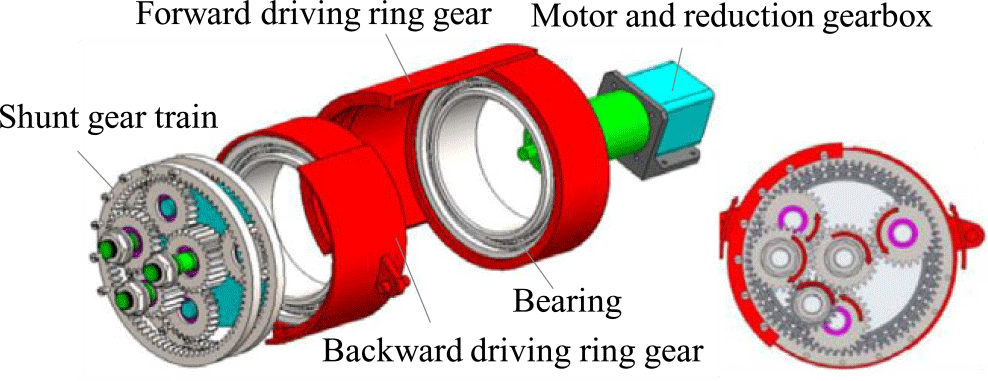
Three underactuated holding mechanisms share one drive system. As shown in Fig. 3, the system is mainly composed of a drive motor and a reduction gearbox, a shunt gear train, a forward driver ring gear, a backward driver ring gear, and a bearing. The motor power transfers to the holding mechanisms through a shunt gear train, where two holding mechanisms of right side driven by the forward driving ring gear, one holding mechanism of left side driven by backward driving ring gear. The motor drives the holding mechanisms on both sides of the robot, where each side moves in the opposite direction achieving the holding and releasing functions.
Model of driving system of holding mechanism.

2.4. Wheel driving system
Compared with the climbing robot of clawed, grip-type, and surface-attached type, the wheel driving system is obviously efficient from speed and stability. As shown in Fig. 2, the wheel driving system includes a motor, a belt-driving system, a driving shaft, a gear reversing system, and climbing wheel. Two driving wheels are placed at the front and back of the center line of the base driven by one motor. The design can be integrated effectively with multiple holding mechanisms in a limited space. To ensure the effectiveness and stability, the climbing wheel is equipped with a large number of external round thorns.
3. Parameter Design
The parameter design mainly contains two parts: linkage parameters and driving parameters. The underactuated holding mechanism is the key part of the proposed climbing robot, and its linkage parameters are determined by the size of the holding target. The length of the linkage is optimized by minimizing the difference of contact force of the three limbs. The holding mechanisms realize stable attachment and holding via the motor driving, so the driving force is an important parameter for motor selection.
3.1. Link parameter determination of the holding mechanism
The holding mechanism is an underactuated multilink mechanism, including two parts, three limbs and auxiliary links. The length parameters of the three limbs are set relative to the forces condition of the holding mechanism. In addition to being associated with the force condition, the length parameters of the auxiliary links are associated with the link kinematics.
3.1.1. Force and transmission ratio analysis of limbs
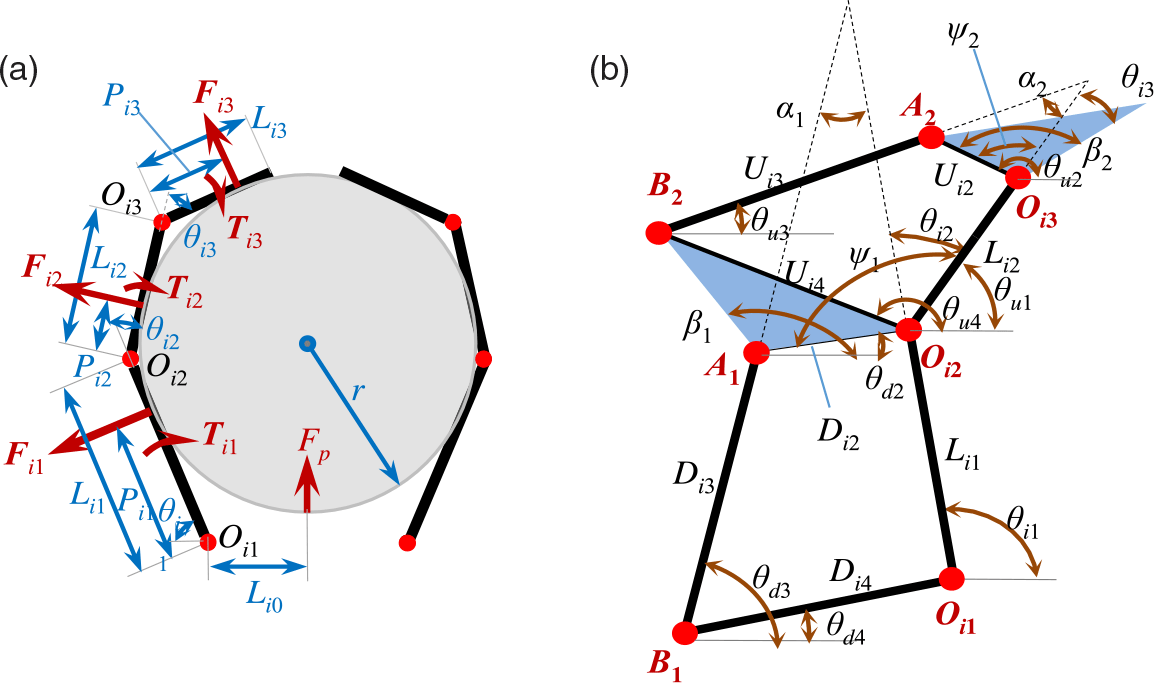
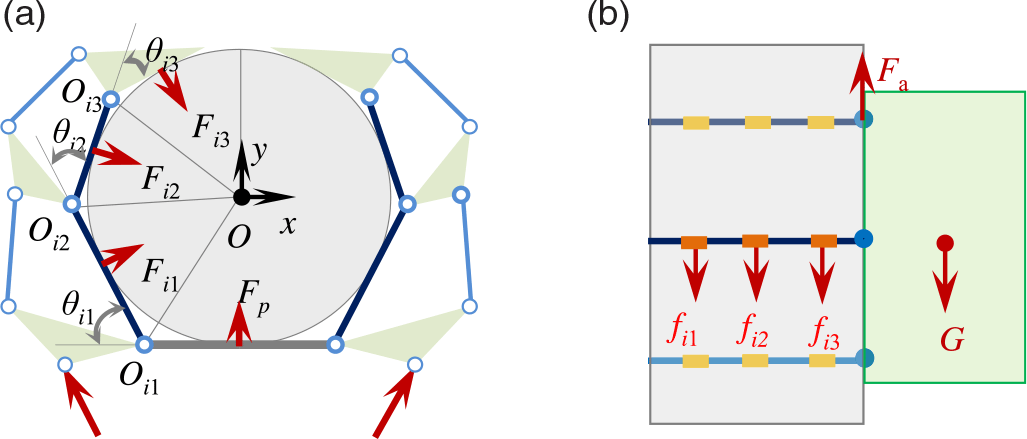
The contact force of each limb at the contact point directly affects climbing stability and reliability and is an important constraint in parameter optimization design [Reference Birglen and Gosselin29]. The overall force is shown in Fig. 4(a), when all limbs of three holding mechanisms on both sides of the robot are contacted with the pole. The weight of all joints and the friction between kinematic pairs are neglected in force analysis.
Mechanical analysis of holding mechanism. (a) Force diagram. (b) Principle of holding mechanism.

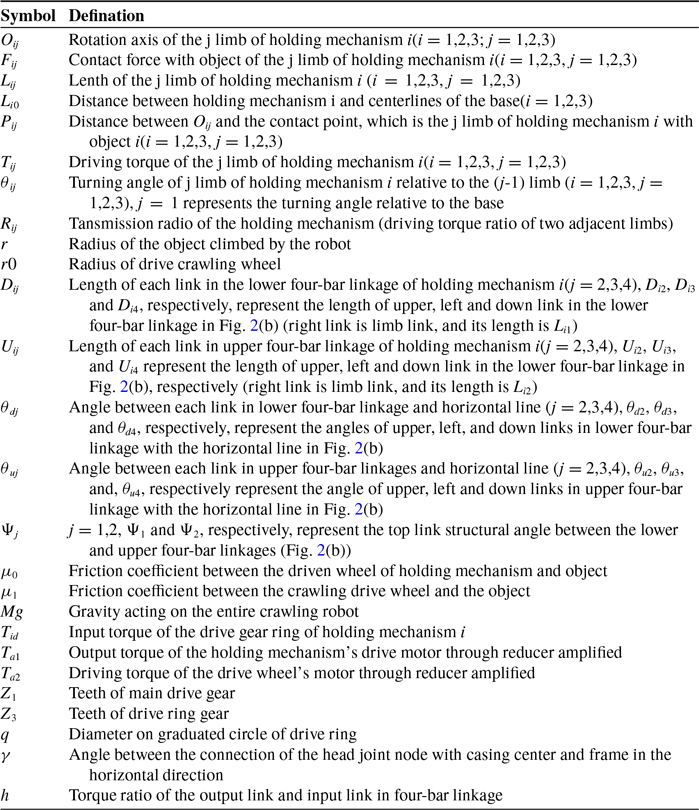
Nomenclature.

The transmission ratio Rij of ith holding mechanism is defined as the ratio of adjacent driving torque of the limbs; thus,
 \begin{align}{R_{ij}} = \frac{{{T_{i\left( {j + 1} \right)}}}}{{{T_{ij}}}}\begin{array}{*{20}{c}}{}{\left( {i = 1,2,3;\,\ j = 1,2} \right)}\end{array}\end{align}
In Eq. (1), there are two ratios
 $R_{i1}$
and
 $R_{i2}$
between three limbs of ith holding mechanism, and the ratios vary with the rotation of the limb. By the geometric relationship in Fig. 4(a), it can be obtained
 \begin{align}{R_{i2}} = \frac{{\left( {{L_{i2}} + {P_{i1}} - {L_{i1}}} \right)\left( {{r^2} + {{\left( {{L_{i2}} + {P_{i1}} - {L_{i1}}} \right)}^2}} \right)}}{{\left( {2{L_{i2}} + {P_{i1}} - {L_{i1}}} \right){r^2} + {{\left( {{L_{i2}} + {P_{i1}} - {L_{i1}}} \right)}^2}\left( {{P_{i1}} - {L_{i1}}} \right)}}\end{align}
 \begin{align}{R_{i1}} = \frac{{\left( {{L_{i1}} - {P_{i1}}} \right)\left( {{L_{i2}} + {P_{i1}} - {L_{i1}}} \right)\left( {{r^2} + {{{(}{L_{i1}} - {P_{i1}}{)}}^2}} \right)\left( {{r^2} + {{{(}{L_{i2}} + {P_{i1}} - {L_{i1}}{)}}^2}} \right)}}{{{\rm{M}} + {\rm{N}} - {\rm{K}} + {\rm{J}} - {\rm{Q}}}}\end{align}
where
 \begin{align}\left\{ \begin{array}{l}{\rm{M }}=\left( {1 - {R_{i2}}} \right)\left( {{L_{i1}} - {P_{i1}}} \right)\left( {{L_{i2}} + {P_{i1}} - {L_{i1}}} \right)\left( {{r^2} + {{{(}{L_{i1}} - {P_{i1}}{)}}^2}} \right)\left( {{r^2} + {{{(}{L_{i2}} + {P_{i1}} - {L_{i1}}{)}}^2}} \right)\\ \\[-7pt] {\rm{N }}={L_{i1}}\left( {{L_{i2}} + {P_{i1}} - {L_{i1}}} \right)\left( {{r^2} - {{{(}{L_{i1}} - {P_{i1}}{)}}^2}} \right)\left( {{r^2} + {{{(}{L_{i2}} + {P_{i1}} - {L_{i1}}{)}}^2}} \right)\\ \\[-7pt] {\rm{K }}={R_{i2}}{L_{i1}}\left( {{L_{i1}} - {P_{i1}}} \right)\left( {{r^2} - {{{(}{L_{i1}} - {P_{i1}}{)}}^2}} \right)\left( {{r^2} - {{{(}{L_{i2}} + {P_{i1}} - {L_{i1}}{)}}^2}} \right)\\ \\[-7pt] J = 4{R_{i2}}{L_{i1}}{r^2}\left( {{L_{i1}} - {P_{i1}}} \right)\left( {{L_{i2}} + {P_{i1}} - {L_{i1}}} \right)\\ \\[-7pt]{\rm{Q }}={R_{i2}}{L_{i2}}\left( {{L_{i1}} - {P_{i1}}} \right)\left( {{r^2} + {{{(}{L_{i1}} - {P_{i1}}{)}}^2}} \right)\left( {{r^2} - {{{(}{L_{i2}} + {P_{i1}} - {L_{i1}}{)}}^2}} \right)\end{array} \right.\end{align}
By Eq. (2), the transmission ratio
 $R_{i2}$
between limb 3 and limb 2 of the i holding mechanism is related to parameters
 $L_{i0}$
,
 $L_{i1}$
,
 $L_{i2}$
,
 $P_{i1}$
, and r.
 $R_{i2}$
variation with changes of
 $L_{i1}$
,
 $L_{i2}$
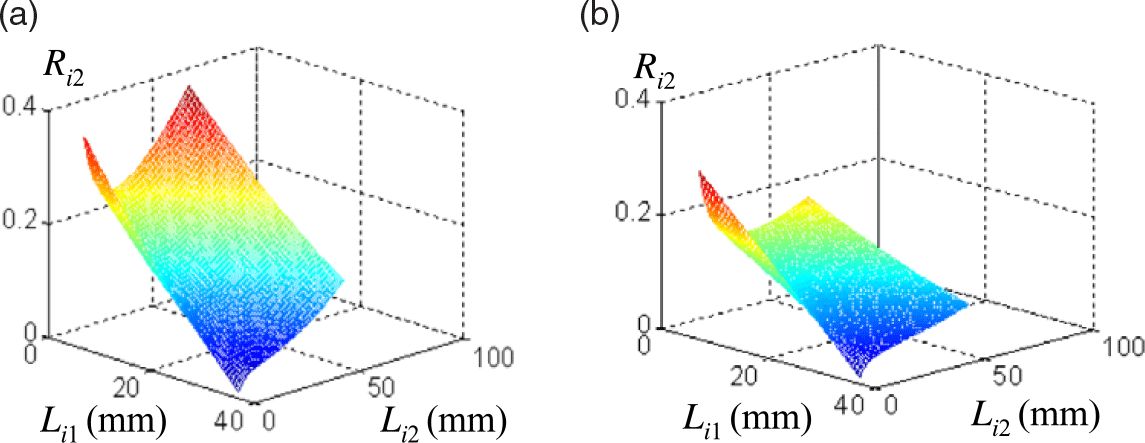
, r is shown in Fig. 4(a). In order to achieve 40–100 mm pole climbing, the middle value of the target range for calculation is selected. When given r = 70 mm, it means
 $L_{i0}$
= 20 mm and
 $P_{i1}$
= 30 mm, as shown in Fig. 5. So
 $R_{i2}$
decreases when r increases, the maximum value of
 $R_{i2}$
is no more than 0.5, that is, R
2max
≤0.5. By Eq. (3), the transmission ratio
 $R_{i1}$
between limb 2 and limb 1 of ith holding mechanism is related to
 $L_{i0}$
,
 $L_{i1}$
,
 $L_{i2}$
,
 $P_{11}$
, r, and
 $R_{i2}$
.
Transmission ratio
 $R_{i2}$
changing with
 $L_{i1}$
and
 $L_{i2}$
. (a) r = 35 mm. (b) r = 60 mm.

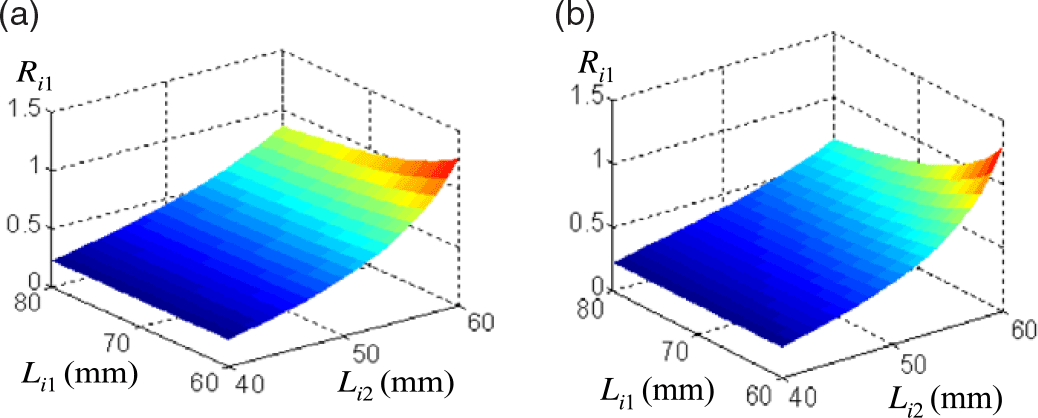
When given
 $L_{i0}$
= 20 mm and
 $P_{i1}$
= 30 mm, the variation of
 $R_{i1}$
with changes of
 $L_{i1}$
,
 $L_{i2}$
, r, and
 $R_{i2}$
is shown in Fig. 6. As it can be seen, R
1 decreases with the increase of r, but the maximum value of R
1 is no more than 1, that is, R
1max
≤1.
Transmission ratio
 $R_{i1}$
changing with
 $L_{i1}$
and
 $L_{i2}$
. (a) r = 35 mm,
 $R_{i2}$
= 0.4. (b) r = 55 mm,
 $R_{i2}$
= 0.5.

3.1.2 Kinematic analysis of holding mechanism
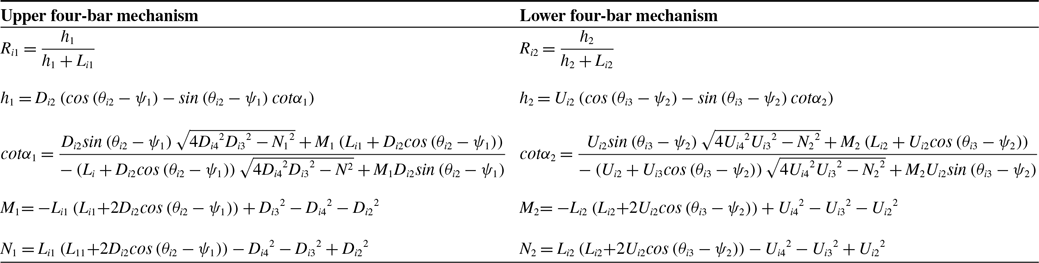
The holding mechanism can be seen as consisting of two four-link subsystems in series, and its geometric model diagram is shown in Fig. 4(b). In Eq. (1), the transmission ratio R of the limbs of the holding mechanism can be rederived from the linkage mechanism, as shown in Table III. The transmission ratios
 $R_{i1}$
and
 $R_{i2}$
are related to the four-link design parameters, where
 $R_{i1}$
is the function of the lower part of the four-link mechanism parameters
 $L_{i1}$
,
 $D_{i2}$
,
 $D_{i3}$
,
 $D_{i4}$
, β
1 and rotation angle
 $\theta_{i2}$
;
 $R_{i2}$
is a function of the upper part of the four-link mechanism parameters
 $L_{i1}$
,
 $U_{i2}$
,
 $U_{i3}$
,
 $U_{i4}$
, β
2 and rotation angle
 $\theta_{i3}$
.
3.1.3 Parameter optimization of the holding mechanism:
As all limbs of the holding mechanism contact with the pole and the contact forces of each holding mechanism are assumed to be equal, the robot can stably hold the object. However, in fact the contact forces of the three limbs of each holding mechanism will have differences. As the minimum differences of contact force among three limbs is the optimization target, the optimization function for ith holding mechanism is established:
 \begin{align} \textrm{min}\ \textrm{f}(\textbf{X})&=\textrm{min}\left(\sum_{n=1}^{3}\left(F_{in}-F_{i3}\right)^{2}+\sum_{n=1}^{2}\left(F_{in}-F_{i2}\right)^{2}\right)\nonumber\\[3pt] \textbf{x}&=\left[L_{i1}\ D_{i2}\ D_{i3}\ D_{i4}\ \beta_{1}\ L_{i2}\ U_{i2}\ U_{i3}\ U_{i4}\ \beta_{2}\ \right]^{\textrm{T}}\end{align}
where
 \begin{align}\left\{ {\begin{array}{*{20}{l}}{{F_{i1}} = \dfrac{{{T_{i1}}}}{{{P_{i1}}}}\left( {1 - {R_{i1}}\left( {\dfrac{{{P_{i2}} + {L_{i1}}{cos}{\theta _{i2}}}}{{{P_{i2}}}} - \dfrac{{{R_{i2}}}}{{{P_{i3}}}}\left( {{P_{i3}} + {L_{i2}}{cos}{\theta _{i3}} + {L_{i1}}{cos}\left( {{\theta _{i2}} + {\theta _{i3}}} \right)} \right)} \right)} \right)}\\ \\ {{F_{i2}} = \dfrac{{{T_{i1}}{R_{i1}}}}{{{P_{i2}}}}\left( {1 - \dfrac{{{R_{i2}}}}{{{P_{i3}}}}\left( {{P_{i3}} + {L_{i2}}{sin}{\theta _{i3}}} \right)} \right)\!{;}\,\ {F_{i3}} = \dfrac{{{T_{i1}}{R_{i1}}{R_{i2}}}}{{{P_{i3}}}}}\end{array}} \right.\end{align}
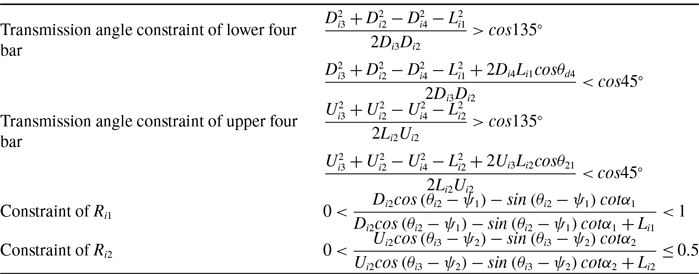
Above constraints mainly include the transmission ratio constraint and the link transmission angle constraint. The constraint functions of transmission ratios are derived in Figs. 3, 4 and Table III, and the constraint functions of the transmission angle are derived by the link transmission principle and Fig. 4(b). The results are shown in Table IV.
Transmission ratios of the multilinkage holding mechanism.

Constraints of optimization functions.

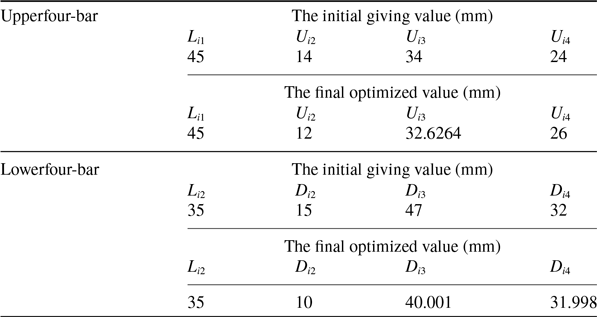
According to the actual situation, the initial values are given, the link parameters of the ultimate holding mechanism are determined finally based on the established optimization function and constraints, as shown in Table V.
Parameter optimization results of holding links.

3.2. Parameter calculation of the drive system
The whole robot has two motors, that is, the holding motor for three holding mechanisms and the driving motor for the wheel system, respectively. The required values of driving forces and critical parameters of the transmission system for two motors are computed below.
3.2.1. Driving torque calculation of the holding mechanism
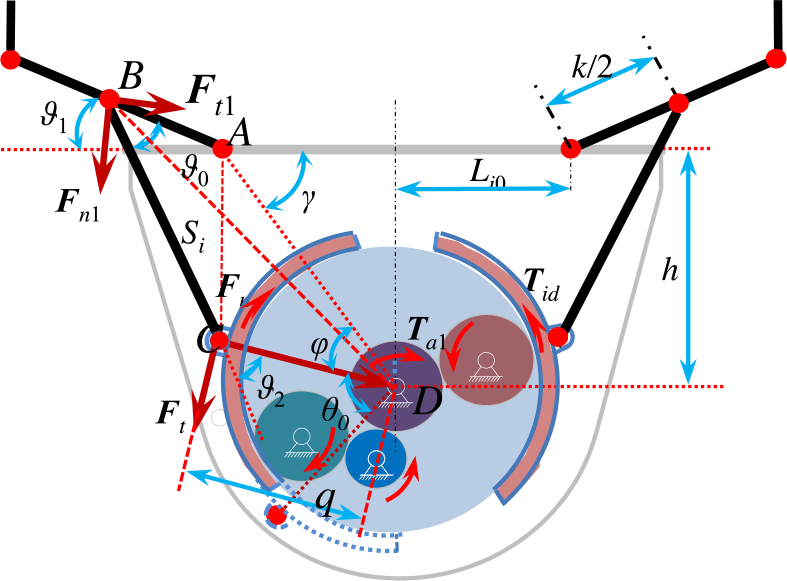
The drive system schematic of the holding mechanisms is shown in Fig. 7.
Transmission system sketch.

By the vector equation and the horizontal axis projection, we have
 \begin{align}0.5k{\rm{cos}}{\vartheta _1} - {S_i}{\rm{cos(}}{\vartheta _0} + {\vartheta _1}{\rm{)}}{\kern 1pt} ={\kern 1pt} {\kern 1pt} q{\rm{cos(}}{\vartheta _0} + {\vartheta _1} - {\vartheta _2}{\rm{)}} - \sqrt {L_{i0}^2 + {h^2}} {\rm{cos}}\gamma \end{align}
In Eq. (7), the parameter k can be obtained by parameters of Fin (n = 1, 2, 3) in Tables III and V.
 $L_{i0}$
,
 $S_{i}$
,
 $\gamma$
, and h are the structural parameters, which can be determined from Fig. 7 and Table V. q, Z
1, k, and Z
3 are design parameters, and the given values are shown in Table VI.
 ${\vartheta _0}$
,
 ${\vartheta _1}$
,
 ${\vartheta _2}$
, and
 $\varphi$
are design variables.
Given parameter values.

In the critical state of climbing on vertical cylindrical objects, the sum of friction between the robotic limbs and the climbed object equals the gravity of the robot. Assuming that each limb is in contact with the object, and the contact forces are equal (three unequal contact forces Fij are regard as three equal contact forces f), it can be inferred that
 \begin{align}\sum\limits_{i = 1}^3 {({F_{i1}} + {F_{i2}} + {F_{i3}})} = 9f\end{align}
And the relationship between friction and gravity can be described as follow:
 \begin{align}9\mu f = Mg\end{align}
When the diameter of holding pole is 70 mm, and the robotic mass is 3.5 kg, and the coefficient of friction
 $\mu $
between the limbs and the object is 0.3, it can be inferred that
 $f = Mg/\left( {9\mu } \right) = 12.96{\rm{N}}$
. Under the assumption of neglecting friction and spring forces, the contact force of the contact points is[Reference Lynch, Clark and Lin22]
 \begin{align}{\bf{f}} = \left[ {\begin{array}{*{20}{c}}{\dfrac{{{P_{i2}}\left( {1+{R_1}} \right)+{R_1}{L_{i1}}{\rm{cos}}{\theta _{i2}}}}{{{P_{i1}}{P_{i2}}}}{T_{i1}}}\\ \\[-7pt] { - \dfrac{{{R_1}}}{{{P_{i2}}}}{T_{i1}}}\end{array}} \right] = \left[ {\begin{array}{*{20}{c}}{12.96}\\ \\[-7pt] {12.96}\end{array}} \right]\end{align}
where R
1 = 0.19 and cos
 $\theta_{i2}$
= 0.6. By Eq. (10), it can be found that
 ${T_{i1}} = f \cdot {P_i}_2/{R_1} = 1.36{\rm{N}}\cdot{\rm{m}}$
, and it can be obtained,
 \begin{align}{T_{a1}} = \frac{{q{Z_1}\sin {\vartheta _2}{T_{i1}}}}{{k{Z_3}\sin {\vartheta _0}}} = \frac{{0.592\sin {\vartheta _2}}}{{\sin {\vartheta _0}}}\end{align}
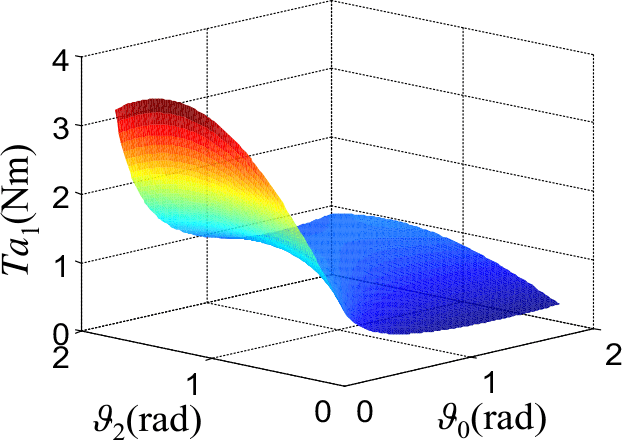
By Eq. (11), the driving torque varies with the changes of attitude angle
 ${\vartheta _0}$
and
 ${\vartheta _2}$
of driving push shaft, and the trend is shown in Fig. 8. From Fig. 8, when limb 3 is in contact with the pole, the drive torque reaches the maximum value to 3.2 N·m, where
 ${\vartheta _0}$
= 16°,
 ${\vartheta _2}$
= 80°. When all the holding mechanisms are in contact with the pole, the driving torque of the robot will maintain a fixed value.
Change condition for the driving torque of the holding mechanism, varying with push shaft posture.

3.2.2 Climbing driving torque calculation
The overall stress schematic for climbing process is shown in Fig. 9.
Force diagrams in the climbing process. (a) Plan view. (b) Front view.

By Newton’s second law and force equilibrium conditions, the minimum output torque of climbing wheels is obtained
 \begin{align}{T_{a2}}_{\min } = 3{F_{i1}}{\mu _0}{r_0}\left( \begin{array}{l}3 + \cos {\theta _{i1}} - \cos \left( {{\theta _{i1}} + {\theta _{i2}}} \right)\\ \\[-7pt] - \cos \left( {{\theta _{i1}} + {\theta _{i2}} + {\theta _{i3}}} \right)\end{array} \right)\end{align}
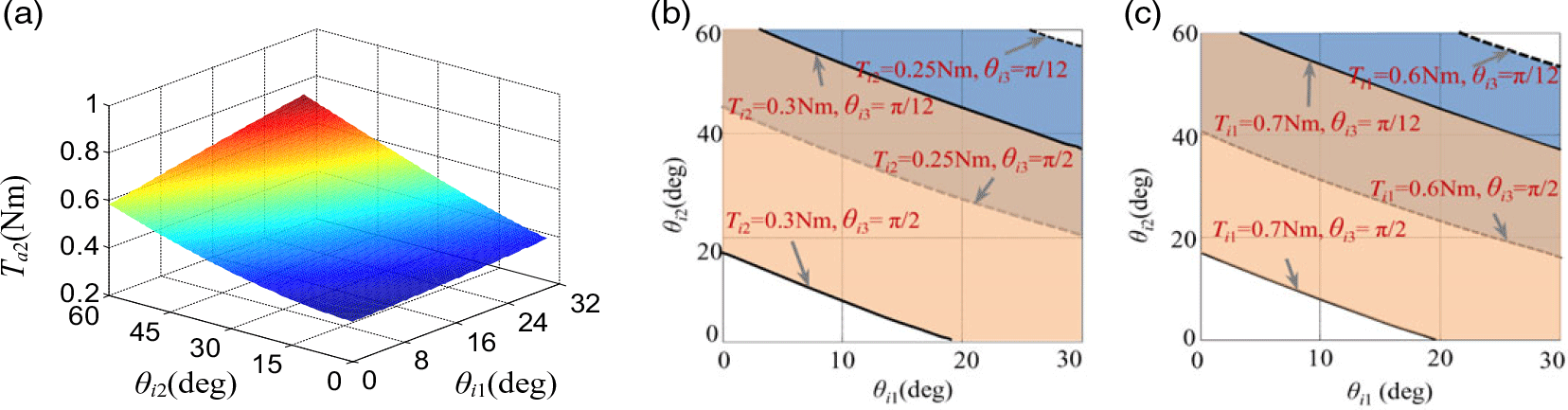
When the parameter values shown in Table VII are given, the relation for torque variation with the parameters is shown in Fig. 10, respectively.
Given parameter values.

Ta
2 changes with variable
 $\theta_{i1}$
,
 $\theta_{i2}$
,
 $F_{i1}$
,
 $\theta_{i3}$
. (a) When
 $F_{i1}$
= 120 N,
 $T_{a2}$
changes with
 $\theta_{i1}$
,
 $\theta_{i2}$
. (b) When
 $F_{i1}$
= 5 N,
 $T_{i2}$
changes with
 $\theta_{i1}$
,
 $\theta_{i2}$
. (c) When
 $F_{i1}$
= 120 N,
 $T_{i1}$
changes with
 $\theta_{i1}$
,
 $\theta_{i2}$
.

4. Control Design
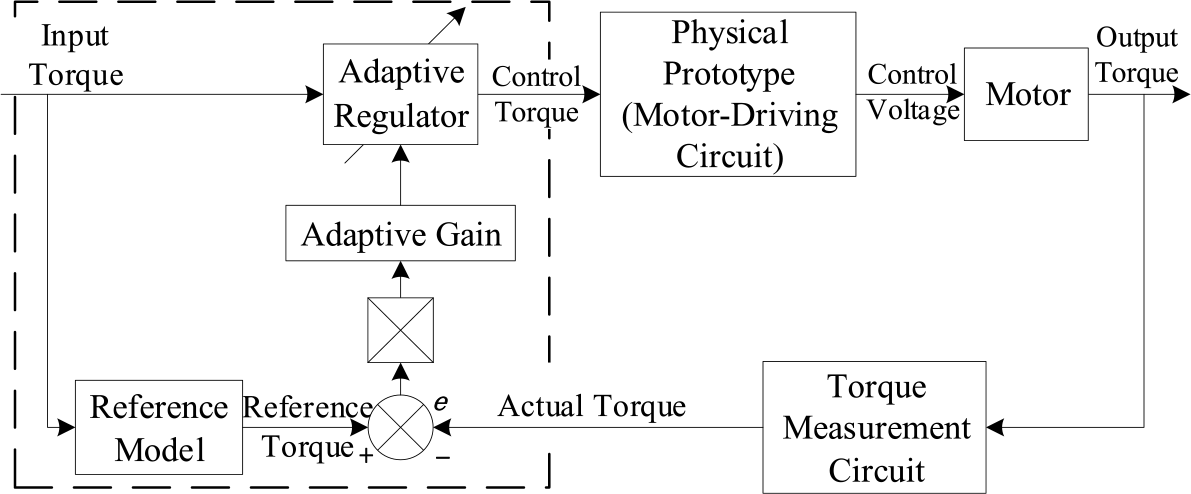
The control system model of the climbing robot is shown in Fig. 11. The hardware of the system is composed by a control circuit, a motor-driving circuit, and a torque measurement circuit. MRAC controller is within the dashed box. The system configuration uses STM32F405RGT6. The chip is a powerful member of the STM32 family with enhanced DSP processing instructions, clocked at 168 MHz (210DMIPS), with powerful hardware floating-point computing power, up to 1M bytes of on-chip memory, and 196K bytes of embedded SRAM. The chip uses Thumb-2 instruction system with a single-cycle 32-bit hardware multiply unit and a 16-bit SIMD calculation unit. The algorithm relies on the embedded real-time operating system μC/OSII.
Control system model.

First, error between reference torque and actual torque transfers from adaptive gain to adaptive regulator. Second, adaptive regulator integrates input torque and adaptive gain to calculate the control torque. Finally, holding mechanism is driven to action response.
The multilink mechanisms and the springs have the characteristic of rigid-flexible coupling, which provide a certain degree of adaptability itself. In order to better exert the adaptive advantages of holding mechanism, MRAC with adjustable gain is designed. Therefore, the robot moves along the desired trajectory ud
(t) and tends to asymptotic stability. The system structure of proposed Lyapunov-MRAC controller is shown in Fig. 12, where the physical quantities are given in Table VIII. Am
and Ap
are system matrixes, and Bm
and Bp
are input matrixes. Cm
and Cp
are matrixes combining centrifugal force. xm
and xp
are vectors obtained by
 $\theta_{ij}$
. The error between the object model and the reference model adjusts the controller gain ka
(t) via the coefficient kg
as shown in Fig. 12. Then, the object model is compensated by ka
(t).
 \begin{align}u\left( t \right) = {k_a}\left( t \right){u_d}\left( t \right)\end{align}
Parameters of input and output.

Block diagram of Lyapunov-MRAC controller system.

The design task of the controller is to seek the regulation law of the adjustable controller gain ka (t) according to the Lyapunov stability theory, so that e tends to zero. The gain difference k and the error e(t) are expressed as
 \begin{align}\left\{ \begin{array}{l}e\left( t \right) = {y_m}\left( t \right) - {k_a}\left( t \right){y_p}\left( t \right) = k\dfrac{{Y\left( p \right)}}{{U\left( p \right)}}{u_d}\left( t \right)\\ \\[-7pt] k = {k_m} - {k_a}\left( t \right){k_p}\end{array} \right.\end{align}
Equation (14) converts into an observable canonical form of the state space,
 \begin{align}\left\{ \begin{array}{l}\dot x = Ax + kB{u_d}\\e = Cx\end{array} \right.\end{align}
The Lyapunov function is defined as
 $V = {k_v}{x^T}Px + {k^2}$
, where kv
> 0, then,
 \begin{align}\dot V = - {k_v}{x^T}Qx + 2k\left( {\dot k + {k_v}{u_d}{B^T}Px} \right)\end{align}
kp
slowly changes with time and can be approximated as a constant. km
is a constant. In order to make
 $\dot V \lt 0$
, by Eq. (16), the parameter adaptive regulation law is
 \begin{align}\left\{ \begin{array}{l}\dot k = - {k_v}{u_d}{B^T}Px\\ \\[-7pt] {{\dot k}_a} \approx - \frac{{\dot k}}{{{k_p}}} = \frac{{{k_v}}}{{{k_p}}}{u_d}{B^T}Px\end{array} \right.\end{align}
By Eqs. (15) and (17), the model of the adjustable gain refers to the adaptive control law which is as follows:
 \begin{align}{\dot k_a}\left( t \right) = {k_g}{u_d}\left( t \right)e\left( t \right)\end{align}
where kg is the adaptive gain, and kg >0.
The above proposed model is simulated in MATLAB, taking an adaptive gain kg = 1.1, and Coriolis forces are as shown in Eq. (19).
 \begin{align}A = \left[ {\begin{array}{c@{\quad}c@{\quad}c@{\quad}c@{\quad}c@{\quad}c}0&0&0&1&0&0\\ \\[-7pt]0&0&0&0&1&0\\ \\[-7pt]0&0&0&0&0&1\\ \\[-7pt]0&{5.4}&{3.7}&0&0&0\\ \\[-7pt]0&{ - 19.1}&{19.2}&0&0&0\\ \\[-7pt]0&{19.2}&{ - 60.6}&0&0&0\end{array}} \right]\!,\;\;B = \left[ {\begin{array}{*{20}{c}}0\\ \\[-7pt]0\\ \\[-7pt]0\\ \\[-7pt]1\\ \\[-7pt]{ - 1.1}\\ \\[-7pt]{ - 0.8}\end{array}} \right]\!,\quad C = \left[ {\begin{array}{*{20}{c}}{1.3}\\ \\[-7pt]{2.7}\\ \\[-7pt]{1.1}\\ \\[-7pt]{2.1}\\ \\[-7pt]{1.9}\\ \\[-7pt]{1.3}\end{array}} \right]\end{align}
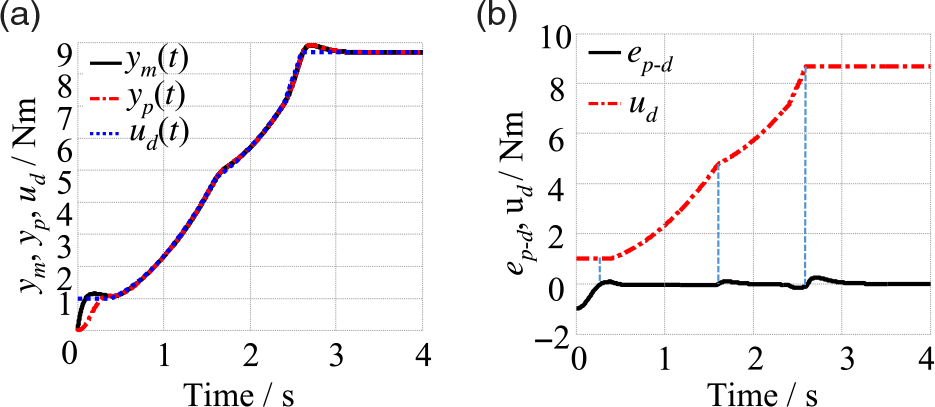
The simulation results are shown in Fig. 13(a). Contrasting ud (t) and ym (t), there are hysteresis at initial interval and overshoot at the end interval due to the inertia unit in holding mechanism. Contrasting ud (t) and yp (t), the control system can drive the robot well and complete the holding task. As shown in Fig. 13(b) is the error curve(ep-d ) between actual output yp (t) and given input ud (t). Large change rate of the drive torque results in large errors at the beginning of each stage when three limbs of each holding mechanism contact with target object in turn. But the errors tend to 0 by the controller adjusting.
Control performance and fluctuation curve of error.

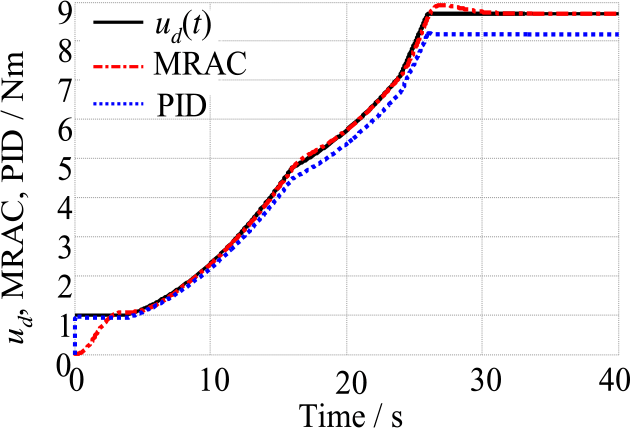
The response curves of the designed MRAC controller and the traditional PID controller are compared as shown in Fig. 15. After many rounds of debugging, the optimal PID parameters Kp = 25, Ki = 1.1, and Kd = 1.7 are obtained. The output response of the PID controller is well preformed at 0∼9 s in Fig. 14, but the steady-state error is getting larger and larger at later stage. The designed Lyapunov-MRAC controller achieves a good follow-up to the desired curve after 3 s with a small steady-state error, which means that the controller realizes the stability of the underactuated holding mechanisms.
Response curve of MRAC algorithm and traditional PID.

5. Experiment of the Prototype
5.1. Prototype establishment
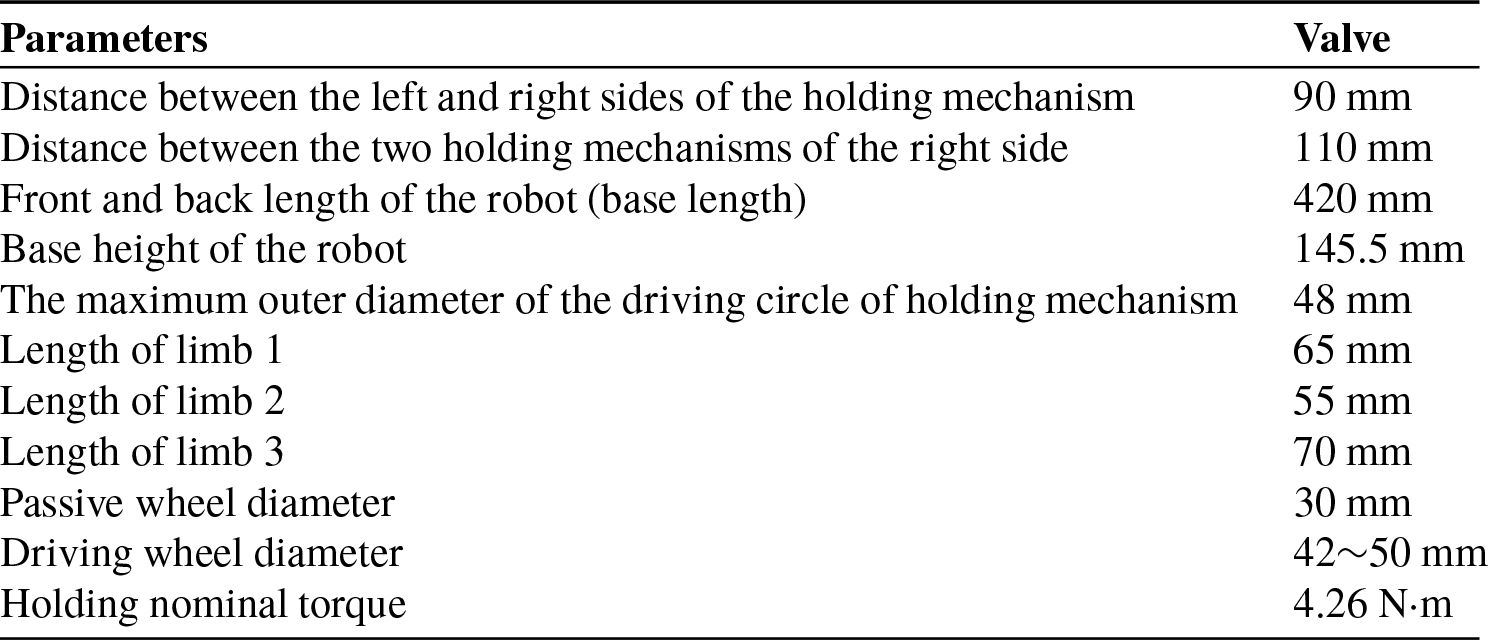
According to the parameter design, the key given parameters are shown in Table IX. A physical prototype of the underactuated climbing robot with the length of 420 mm, width of 480 mm, and height of about 155 mm is built. The drive shaft is made of No. 45 steel, the supporting parts are made of aluminum alloy, and the nonsupporting parts are made of polyester plastic and processed by 3D printing to reduce the weight of the climbing robot. Total weight of the climbing robot is 5.9 kg.
Key parameters of climbing robot.

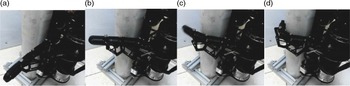
Whole process of holding movement. (a) Target object. (b) First limb contacting with target object. (c) Second limb contacting with target object. (d) Third limb contacting with target object.

Experimental measurement platform of the pole-climbing robot. (a) Measuring device of joint angle. (b) Measuring device of contact force.

5.2. Underactuated holding experiment
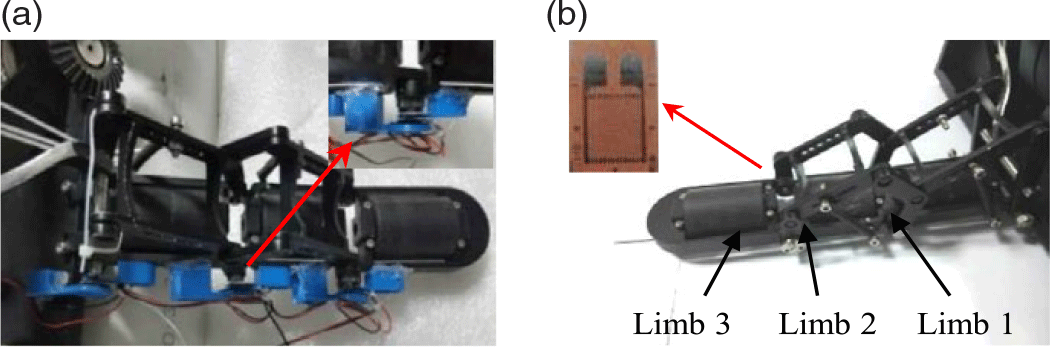
The holding process of the climbing robot is implemented and shown in Fig. 15. The experiment results are carried out for physical prototype verification. The 50 kΩ potentiometers with 1% precision are used to measure the angle changes of each joint, as shown in Fig. 16(a). The potentiometers are placed on the outside of the limb, collinear with the joint axis. The contact forces of each limb are measured by the metal strain gauges, with values of 350 Ω and sensitivity of 2.0, as shown in Fig. 16(b).
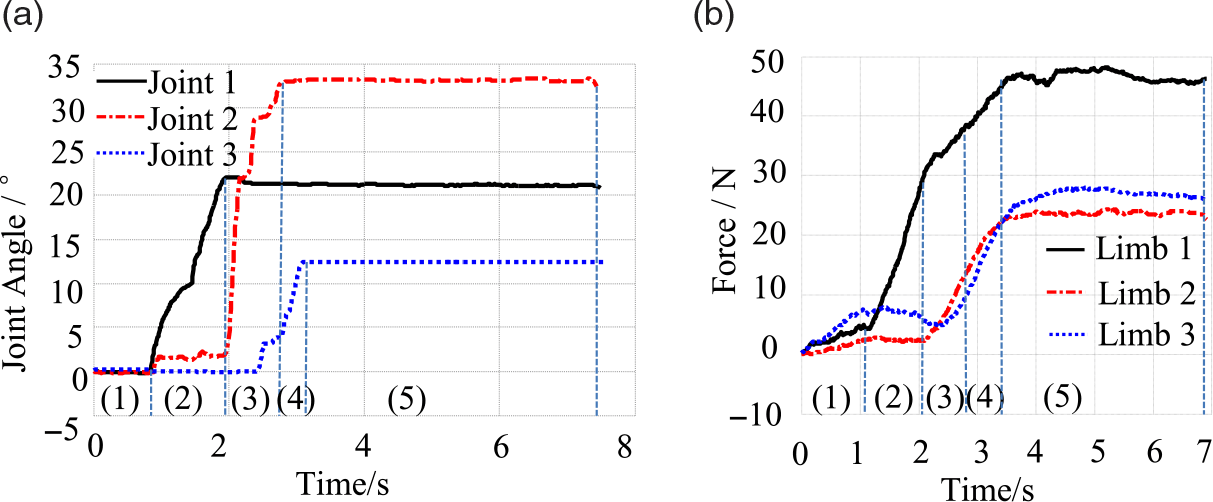
Multiple repeated experiments are made on the constructed platform. The experimental data are transmitted to PC through a serial communication device. The response curves of the joint angles and the contact forces are shown in Fig. 17. As it can be seen from Fig. 17, the joint angles are 12.2°, 33.8°, and 21.5°, followed by the contact force are 48, 20, and 28 N. From the change curve of the joint angles and the contact forces, the holding process of the robot can be subdivided into five stages, namely (1) not contact with target object, (2) the first limb contacting target object, (3) the second limb contacting target object, (4) the third limb contacting target object, and (5) motor continuing working to reach the required climbing friction. Design decision optimizes structure of robot, so that robot can hold and climb more steadily. The final contact forces of limbs are mostly smooth, and holding process is stable and reliable. This proves that the robot with the underactuated mechanism has good holding stability.
Response curve of joint angle and contact force. (a) Response curve of joint angular. (b) Response curve of contact force.

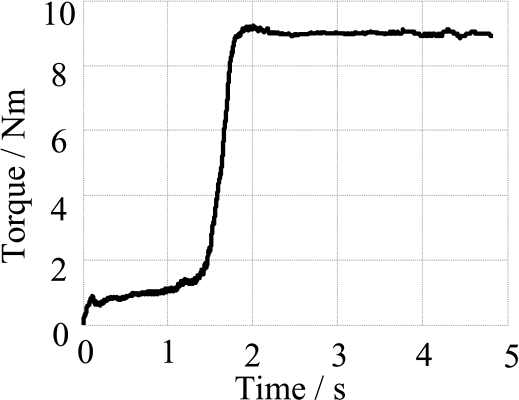
In Fig. 18, the output torque of the holding motor is obtained by measuring the motor output in real-time. The total holding time is 4.7 s, the holding torque is 9.1 N
 $\cdot$
m, the overshoot is 0.5 N
 $\cdot$
m, and the steady state error is 0.13 N
 $\cdot$
m. The designed adjustable gain Lyapunov-MRAC controller is stable with a low steady-state error.
Output torque response curve of holding motor.

5.3. Self-adaptive experiment
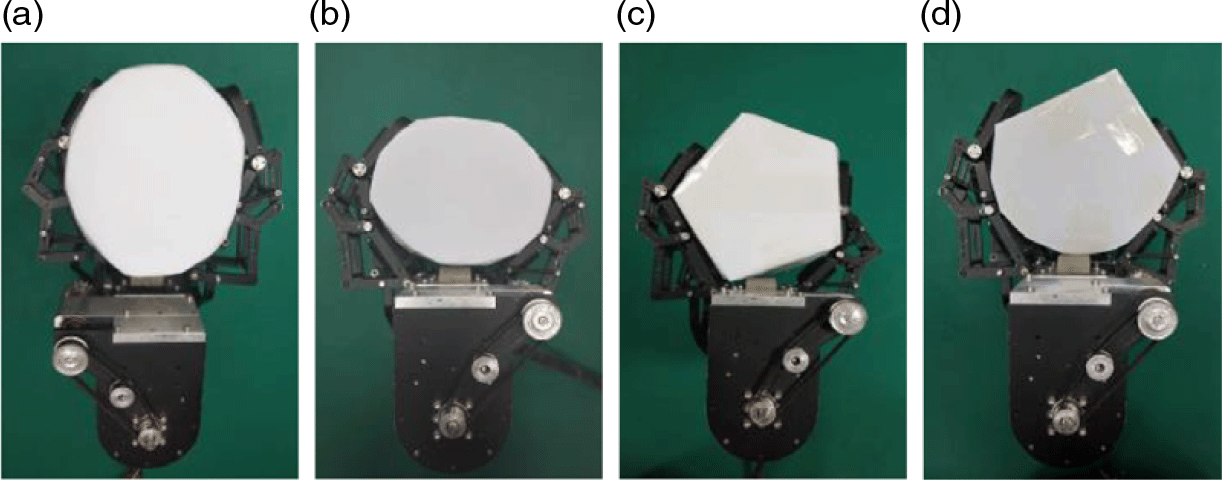
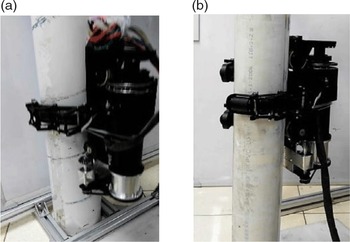
Since the holding mechanism has a high adaptability and self-balancing capability of internal forces for holding objects, the designed climbing robot can hold and climb on objects with a wide range size (radius continuously varying from 40 to 100 mm). When holding objects with radius less than 40 mm, the robotic holding mechanism on both sides eventually interferes with the base. When holding objects with radius larger than 100 mm, the robot cannot form a closed grasp, so the stability is greatly reduced. In addition, the designed climbing robot can climb on elliptic(a,b), polygon(c), irregular objects(d) as shown in Fig. 19 and some other irregularly shaped objects with the external diameter between 40 and 100 mm.
Robotic climbing adaptability in top view. (a) Elliptic (horizontal). (b) Elliptic (vertical). (c) Polygon. (d) Irregular.

5.4. Climbing experiment
Based on the contact force analysis and the designed MRAC controller, Fig. 20 shows the climbing process of the underactuated climbing robot on different diameter cylinders (
 $\varphi$
90 mm,
 $\varphi$
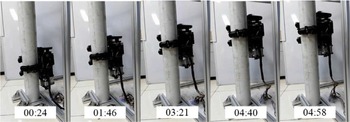
70 mm). The climbing process is stable and firm. Meanwhile, in order to demonstrate high efficiency of the climbing movement, the response time of holding mechanism and the climbing speed of robot have been measured. After repeated experiments, the response time of the holding mechanism is 2.3 s, the climbing speed is 0.194 m/s as shown in Fig. 21, and the maximum moving velocity on the flat surface is 0.407 m/s.
Robot on different objects climbing process. (a) Target object of
 $\varphi$
90 mm. (b) Target object of
 $\varphi$
70 mm.

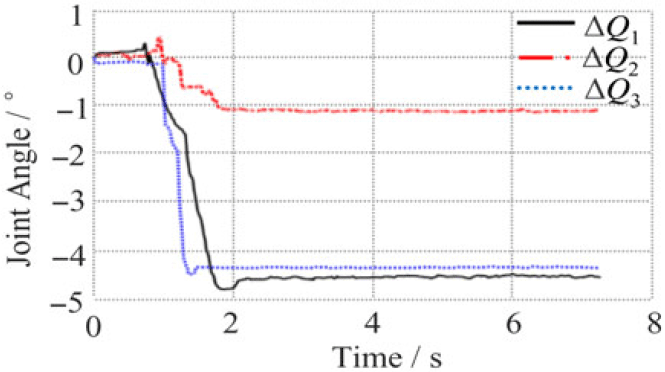
ΔQi is defined as the deviation of rotation angle of each joint when climbing the pole of 90 and 70 mm. As an example, when robot climbs the pole of 90 mm, the joint 1 rotates in an angle of Q90, and when robot climbs the pole of 70 mm, the joint 1 rotates in an angle of Q70. ΔQ 1 is the deviation angle of joint 1 from the situation of climbing the pole of 90 to 70 mm, which is ΔQ = Q 90 mm – Q 70 mm.
When climbing the pole of 90 and 70 mm, the results of ΔQi are shown in Fig. 22. Joint 1 (ΔQ 1) is close to both sides of the robot base. It is obvious that the corresponding deviation of rotation angle is –4.5° when holding the two poles. Joint 2 (ΔQ 2) transmits torque as intermediate to joint 3, and the deviation of rotation angle is –1.2°, which means that joint 2 changes slightly under different climbing situation. The deviation of rotation angle of joint 3 (ΔQ 3) is –4.3°, as shown in Fig. 22. The required positive pressure of climbing is provided by joint 3.
Climbing speed experiment. Intercept climbing process from 0.24 to 4.58 s, the climbing height is 0.84 m, and the climbing speed is 0.194 m/s.

Deviation of rotation angle of each joint when climbing objects of 90 and 70 mm.

5.5 Ground crawling experiment
Ground crawling state is the other way of movement of the climbing robot. When crawling on the ground, the holding mechanism is fully unfolded, and the two active wheels of the wheel driving system located under the base provide power, which can make the robot move forward or backward quickly. Due to the deviation of the gravity center caused by the difference in the number of holding mechanisms on both sides, the internal gear and motor system of the drive system are arranged to one side of the single holding mechanism, ensuring that the robot will not roll over.
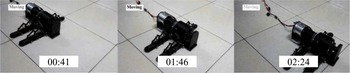
The crawling speed experiment is designed as shown in Fig. 23. The robot moves on the smooth floor tiles of 800 mm × 800 mm. A video segment of the robot passing by a floor tile is intercepted. After measurement, the robot moves 0.74 m in total, which takes 1.83 s, and the average crawling speed is 0.404 m/s.
Crawling speed experiment. Intercept crawling process from 0.41 to 2.24 s, the climbing length is 0.74 m, and the climbing speed is 0.404 m/s.

6. Conclusion
This work proposes an underactuated self-adaptive climbing robot that can hold and climb a variety of poles and move on the ground. The underactuated holding mechanism is designed to realize stable and self-adaptive holding for the target, and three underactuated holding mechanisms are driven by one motor to open and close. The wheel drive system is designed to achieve climbing and ground movement through one motor. Through the parameter design, the dimensions and driving force parameters of the climbing robot are analyzed, which provide a basis for the prototype machining and the motor selection. The MRAC controller is proposed, and the adjustable gain parameters are modified according to the Lyapunov stability theory, which improves the stability and rapid response of the climbing system. Through the model design and the parameter design, the structure and size of the climbing robot are determined, and the prototype is manufactured. The holding and self-adaptability experiments are carried out to verify the stability and self-adaptability of the holding mechanisms. The climbing experiment and the ground crawling experiment are carried out to verify the robot’s movement ability and travel speed.
Acknowledgements
This study is supported by National Key R&D Program of China (2018YFB1304600), National Natural Science Foundation of China (51975566, U1908214), CAS Interdisciplinary Innovation Team (JCTD-2018-11), and Liaoning Revitalization Talents Program (XLYC1807090).
Supplementary Material
To view supplementary material for this article, please visit https://doi.org/10.1017/ S0263574721001636.