Introduction
Living organisms are sensitive to temperature changes which lead to unfolding and aggregation of protein, loss of protein homeostasis and consequently expression of heat shock proteins (Hsps). Schistosoma worms as digenetic parasites are frequently exposed to different kinds of stress specially heat stress during their life cycles. The role of Hsps is not restricted to heat stress management but is also extended to other stresses including exposure to ultraviolet light, starvation, hypoxia, oxidative species and toxins where cellular homeostasis is affected (Swindell et al., Reference Swindell, Huebner and Weber2007). Cellular response responsiveness to stress is orchestrated mainly by the chaperone function of the Hsps which is involved in the stabilization of the basic cellular processes to preserve cell viability, restore cellular homeostasis and protect cells from subsequent insults (De Maio, Reference De Maio1999).
Several families of Hsps are induced as a response to the various challenges and are divided according to their molecular weight and wide function mainly: Hsp100, Hsp90, Hsp70, Hsp60/Hsp10 and sHsp. Hsp70 family is the most conserved and studied and is considered the most responsible Hsp family most responsible for intracellular chaperone and extracellular immunoregulatory functions (Kimura et al., Reference Kimura, Tanaka, Nakamura, Takano and Ohkuma2007).
Families of Hsps are represented by several homologs localized in subcellular compartments including the cytoplasm, endoplasmic reticulum (ER) and mitochondria, where they exhibit their chaperone function. Moreover, Hsps have been found extracellularly where they act as signalling molecules that activate the immune system in response to stress (De Maio, Reference De Maio2011).
Different stress conditions in Schistosoma mansoni life cycle
Schistosomiasis is a major devastating tropical disease affecting hundreds of millions of people worldwide. Left untreated, schistosomiasis poses a significant health burden on human health and economic development. The causative agent of the disease is the parasitic flatworms of the genus Schistosoma. Among Schistosoma species, Schistosoma mansoni (S. mansoni) is the most common species that infects humans mainly in Africa and South America. Different Schistosoma species can infect human being such as S. haematobium, S. intercalatum, S. japonicum, S. mansoni or S. mekongi with S. mansoni, S. haematobium and S. japonicum being responsible for the largest public health burden (Gryseels, Reference Gryseels2012). Its widespread distribution is permitted by the broad geographic range of susceptible species of the freshwater snail genus Biomphalaria which serves as obligatory hosts for its larval stages (Morgan et al., Reference Morgan, Dejong, Snyder, Mkoji, Loker and Andrews2001).
Schistosoma mansoni has a complex life cycle involving a vertebrate definitive host and a snail intermediate host. Infected snails shed cercariae which loss their tail during penetration of skin of the definitive host and initiate the infection. Inside the definitive host, the cercariae transform into schistosomula and enter the blood vessels of the host. Maturation and pairing of male and female worms occur while migrating into the portal blood system. Mature female worms start producing hundreds of eggs during their long-life span. While the eggs cross the intestinal wall, the miracidia develop inside the maturing eggs over a period of several days. Mature eggs are excreted with faeces and hatching occurs upon reaching fresh water. Free miracidia search for their intermediate snail host where asexual replication takes place. Miracidia are transformed to sporocysts, followed by shedding of new cercariae. Many eggs are trapped in organs, mainly the liver and the intestine, where they induce a granulomatous reaction leading to organ damage; the main cause of morbidity (Gryseels et al., Reference Gryseels, Polman, Clerinx and Kestens2006).
Throughout this complex life cycle, schistosomes undergo remarkable changes in their morphology and biology. Different life cycle stages encounter a plethora of environmental signals and display adaptations to the movement between definitive and intermediate snail hosts and also between parasitic and free-living environments (Walker, Reference Walker2011).
Each stage of the parasite must survive diverse stress conditions. The free-living stages (miracidia and cercariae) are exposed to stress conditions associated with the freshwater environment of their snail vectors (Grabe and Haas, Reference Grabe and Haas2004). The stages inside the snail (sporocysts and cercariae) are exposed to host internal defence systems (Abou-El-Naga and Radwan, Reference Abou-El-Naga and Radwan2012). Cercariae are highly adapted for swimming and invading their mammalian hosts through attraction by gradients of body heat and skin lipids (Hammouda et al., Reference Hammouda, Abou El Naga, El-Temsahi and Sharaf1994; Ishida and Jolly, Reference Ishida and Jolly2016). During penetration of the human host, they must transit from a cooler, low-saline freshwater environment to the warmer, saline environment to develop to the adult form. They transform to schistosomula which are adapted for survival in the host blood environment, elongate and migrate are transported through multiple organs, including lungs, heart and liver which have their own defence mechanisms (Loverde, Reference Loverde1998). Despite the different numbers of hostiles, harsh environments and the transitioning between intra-mammalian, aquatic and snail stages to development into full maturity, schistosomes have the ability to withstand all these conditions and adult flukes live for 3–10 years in their definitive human hosts (Kusel et al., Reference Kusel, Al-Adhami and Doenhoff2007).
Besides the environmental stresses, repeated exposure of the parasite to praziquantel (PZQ) constitutes another sort of stress. In the absence of a vaccine, treatment control of the disease relies almost entirely on this drug. Schistosomiasis control programs depend mainly on PZQ as a corner stone through mass drug administration. Although this strategy has had a great impact on curtailing transmission in different countries, the reliance on a single drug for any disease of this magnitude may lead to the development of drug resistant parasites (Abou-El-Naga, Reference Abou-El-Naga2018). A recent proteomic study revealed that Hsp70 is associated with decreased sensitivity of adult S. mansoni to PZQ (Abou-El-Naga et al., Reference Abou-El-Naga, Amer, Boulos, El-Faham, Abou Seada and Younis2019). The presence of genes encoding the universal stress protein domain in the genomes of S. mansoni suggests that this parasite is capable of responding to unfavourable conditions (Berriman et al., Reference Berriman, Haas, LoVerde, Wilson, Dillon, Cerqueira, Mashiyama, Al-Lazikani, Andrade, Ashton, Aslett, Bartholomeu, Blandin, Caffrey, Coghlan, Coulson, Day, Delcher, DeMarco, Djikeng, Eyre, Gamble, Ghedin, Gu, Hertz-Fowler, Hirai, Hirai, Houston, Ivens, Johnston, Lacerda, Macedo, McVeigh, Ning, Oliveira, Overington, Parkhill, Pertea, Pierce, Protasio, Quail, Rajandream, Rogers, Sajid, Salzberg, Stanke, Tivey, White, Williams, Wortman, Wu, Zamanian, Zerlotini, Fraser-Liggett, Barrell and El-Sayed2009).
Effect of temperature changes on S. mansoni life cycle
Climate change is affecting many infectious disease agents, mainly those transmitted via a poikilotherm intermediate host, whose geographical limits and survival are intimately linked with climate (Campbell-Lendrum et al., Reference Campbell-Lendrum, Manga, Bagayoko and Sommerfeld2015). There is increasing a raising concern that climate change and global warming will inevitably influence schistosome transmission potential and will have an impact on the feasibility of goals for schistosomiasis control and elimination goals (Abou-El-Naga, Reference Abou-El-Naga2015). Schistosomiasis (haematobium) has recently been spread from Africa and emerged in France (Calavas and Martin, Reference Calavas and Martin2014). In Uganda, the infections are being transmitted in higher altitudes areas above sea level than the previously defined limit (Kabatereine et al., Reference Kabatereine, Brooker, Tukahebwa, Kazibwe and Onapa2004). Stensgaard et al. (Reference Stensgaard, Vounatsou, Sengupta and Utzinger2019) suggested that climate change is more likely to shift than to expand the geographic ranges of the diseases caused by different Schistosoma species as any differences in thermo-tolerances may indicate clue which parasite-snail species that may stand to ‘lose or gain’ in a warming world.
Temperature can influence the performance of all developmental stages of the Schistosoma life cycle. It is suggested that Hsps have possible roles in Schistosoma ecology (Masamba et al., Reference Masamba, Adenowo, Oyinloye and Kappo2016). However, there are certain stages that are more sensitive to environmental temperatures particularly the free-living and intra-molluscan stages where temperature affects their physiological processes and determines their ability to remain active, infective and alive under extreme climatic conditions. The free-living stages, the miracidia and cercariae are exposed directly to ambient temperature changes hence, temperature affects their survival and infectivity. Temperature is also found to be an important determinant of the snail intermediate host distribution limits and population size and can also influence the interaction between the snail and the parasite and is thus hence are likely to affecting the disease dynamics. The growth, fecundity and survival of the snail intermediate host are influenced by temperature (Kalinda et al., Reference Kalinda, Chimbari and Mukaratirwa2017).
As the snail intermediate hosts are poikilotherms and their internal temperature follows the environmental temperatures therefore, all intra-molluscan stages are exposed to environmental temperature change. Stirewalt (Reference Stirewalt1954) demonstrated an effect of the apparent association of an early stress induction by showing that raising water temperature used for maintenance of the snail and shortening the length of the pre-patent period in S. mansoni infected snails. Likewise, a decrease in water temperature is negatively influencing the development of S. mansoni in the snail host (Coelho and Bezerra, Reference Coelho and Bezerra2006). Moreover, enhancing the stress by a non-lethal temperature increase prior to infection of a resistant snail reverses the resistance phenotype (Ittiprasert and Knight, Reference Ittiprasert and Knight2012).
Heat shock protein in different developmental stages of S. mansoni and their hosts
Transcriptomic analysis of S. mansoni worms in response to heat stress revealed the induction of transcripts encoding three homologs of Hsp40, Hsp70 and Hsp86 (Aragon et al., Reference Aragon, Imani, Blackburn and Cunningham2008). It was found that Hsp70 is present in different developmental stages of S. mansoni (Hedstrom et al., Reference Hedstrom, Culpepper, Schinski, Agabian and Newport1988). Besides its chaperone function, Hsp70 is likely to regulates cercarial invasion in humans and has been correlated with cercarial transformation (Neumann et al., Reference Neumann, Zin, Lantner and Schechter1993; Ishida and Jolly, Reference Ishida and Jolly2016). Hsp60, 70 and 86 were found to be present in the secretory products of the cercariae of S. mansoni (Knudsen et al., Reference Knudsen, Medzihradszky, Lim, Hansell and McKerrow2005). Heat shock factor 1 (the major transcriptional activator responsible for transcribing heat shock genes) is localized to the acetabular glands of cercariae (Ishida et al., Reference Ishida, Varrecchia, Knudsen and Jolly2014).
The Hsp70 gene of S. mansoni is regulated by two mechanisms. Stress induction, specific to Hsp70, refers to transient and high levels of Hsp70 mRNA observed during cercariae-schistosomulum transformation as well as in the heat shocked adult worms. The developmental programme, common to Hsp70 and other genes, refers to constitutive expression of Hsp70 mRNA in miracidia, sporocyst and adult worms, but not in cercariae. It is possible that the cercarial tail may exert a long-range inhibitory effect that suppresses Hsp70 gene expression in the body of the cercaria (Neumann et al., Reference Neumann, Zin, Lantner and Schechter1993).
In 2012, Protasio and his colleagues profiled gene expression at different S. mansoni life cycle stages (cercariae, 3 h schistosomula, 24 h schistosomula, adult stage). Genes involved in the protein re-folding and the chaperone function with expression above the 95 percentile were found to be highly expressed in schistosomula, namely five Hsps (Smp_008545, Smp_035200, Smp_062420, Smp_072330 and Smp_106930) were among the top 50 most expressed genes at this stage. Two Hsp70 genes (Smp_072330 and Smp_106930) were significantly differentially expressed (P value < 0.01) at different schistosome life cycle stages, where a 3.5–3.7 log 2 fold increase was detected in 3 h schistosomula, compared to the cercariae and 24 h schistosomula, while the adult stage had log 2 fold increase of 2 relative to the 24 h schistosomula (Protasio et al., Reference Protasio, Tsai, Babbage, Nichol, Hunt, Aslett, De Silva, Velarde, Anderson, Clark, Davidson, Dillon, Holroyd, LoVerde, Lloyd, McQuillan, Oliveira, Otto, Parker-Manuel, Quail, Wilson, Zerlotini, Dunne and Berriman2012). SmHsp70 clustered with human Hsp70, which is constitutively expressed and recognized as the Hsp70 cognate protein. The second SmHsp70 protein represents a non-constitutive heat inducible form of Hsp70, and it clustered with HsHsp70, also called Hsp70 family A member 5, which is localized to the lumen of the endoplasmic reticulum (Ishida and Jolly, Reference Ishida and Jolly2016). Moreover, Pereira et al. (Reference Pereira, Cavalcanti, Zingali, Lima-Filho and Chaves2015) identified two isoforms of Hsp70 as human plasma low-density lipoprotein binding proteins. Lipoproteins in the human blood circulation help to conceal the worm from the attack by host antibodies and also act as a source of lipids for the parasite (Tempone et al., Reference Tempone, Bianconi and Rumjanek1997).
Different studies revealed the importance of controlled protein turnover in the ubiquitin-proteasome system during development of Schistosoma worms (Mathieson et al., Reference Mathieson, Castro-Borges and Wilson2011; Pereira-Júnior et al., Reference Pereira-Júnior, Pereira, Silva, Castro-Borges, Sá, Cabral, Silva, Soares, Morais, Moreira, Magalhães, de Paula and Rodrigues2013). Proteasomes are found to be an important system involved in the stress response in S. mansoni adult worms (de Paula et al., Reference de Paula, de Magalhães Ornelas, Morais, de Souza Gomes, de Paula Aguiar, Magalhães and Rodrigues2015). Interestingly, it was found that the schistosomicidal activity of curcumin against S. mansoni adult worms is due to its potential inhibition of proteasome activity of the parasite (Morais et al., Reference Morais, Oliveira, Magalhães, Moreira, Verjovski Almeida and Rodrigues2013).
Schistosoma mansoni completes its life cycle in two hosts, the Biomphalaria snail as an intermediate host and man as a definitive one that have their own distinct immune systems. In infected B. glabrata, S. mansoni transforms over several hours to the mother sporocyst stage in susceptible snails, but is usually killed relatively quickly in resistant snails. The development and reproduction of the parasite are accompanied by downregulation of haemocyte Hsp70 (Zahoor et al., Reference Zahoor, Davies, Kirk, Rollinson and Walker2010). A recent proteomic study comparing the excretory secretory products of susceptible and resistant B. glabrata snails detected the presence of Hsp70 cognate 4 in resistant snails only that is involved in the parasite defence or immune protection (Fogarty et al., Reference Fogarty, Zhao, McManus, Duke, Cummins and Wang2019). On the other hand, in the human portal blood system, where the parasite experiences an extraordinary increase in biomass and significant morphological alterations, it was found that one constituent of the Hsp complex, Smp_097380.1-heat shock 10 kDa protein 1 was up-regulated. Active Hsp helps repairing the unfolded proteins (UFPs) generated in response to oxidative stress caused by contact with the constituents of the host portal serum thus helps the development inside the vertebrate host and the disease transmission (Jeremias et al., Reference Jeremias, Araújo, Queiroz, Pais, Mattos, Salim, Coelho, Oliveira, Kusel, Guerra-Sá, Coimbra and Babá2017).
Hsp70 also acts as a triage for quality control. This protein has been referred to as the triage chaperone as it determines the fate of client proteins. A quality control system must be able to efficiently recognize the properly folded proteins and also other forms, including partially unfolded, misfolded and incorrectly modified. After identification of damaged proteins, chaperones have to correct the misfolded proteins and those which cannot be repaired must be degraded. When chaperones fail and correct folding is not possible, aggregation of the protein is the outcome. Therefore, the protein quality control system dictates the fate of the chaperone–substrate complex, tilting it towards substrate folding or degradation through the general protein degradation pathways, the ubiquitin-proteasome system or autophagy (Tiroli-Cepeda and Ramos, Reference Tiroli-Cepeda and Ramos2011).
Main functions of Hsp70
Role of Hsp70 in protein folding
Hsp70 has a dual function depending on its location whether intracellularly or extracellularly. Intracellular Hsp has well established chaperone function during normal physiological conditions. Its cytoprotective and homeostatic functions facilitate the correct folding and assembly of other proteins as well as degradation of proteins misfolded beyond repair; thus they have inspired their designation as ‘molecular chaperones’ (Mayer and Bukau, Reference Mayer and Bukau2005). Disaggregation of proteins is a vital process in protein homeostasis. Protein degradation is essential for the clearance of misfolded proteins through the ubiquitin-proteasome system and also via other autophagy pathways (Fernández-Fernández et al., Reference Fernández-Fernández, Gragera, Ochoa-Ibarrola, Quintana-Gallardo and Valpuesta2017).
Immunological function of Hsp70
Extracellular Hsp70 has also an immunological function. It can trigger innate and adaptive immune responses and can also hold signalling proteins in a primed state that is readily activated according to a particular signal. Hsp70 together with various co-chaperones can direct the pathways of signals that control various cellular functions (Liu et al., Reference Liu, Daniels and Cao2012). This role in signal transduction is known as a ‘chaperokine’ function which is capable of modulating immune cells by binding to their cell surfaces (Shonhai et al., Reference Shonhai, Maier, Przyborski and Blatch2011). Therefore, Hsps are considered to be moonlighting molecules as they have secondary functions besides their main functions as molecular chaperones (Joly et al., Reference Joly, Wettstein, Mignot, Ghiringhelli and Garrido2010).
Hsp70 is released from cells by two possible mechanisms either a passive mechanism that results from necrosis, trauma or surgery, and/or an active mechanism by which they are released from exosomes (Mambula and Calderwood, Reference Mambula and Calderwood2006). Sotillo et al. (Reference Sotillo, Pearson, Potriquet, Becker, Pickering, Mulvenna and Loukas2016) revealed the presence of Hsp70 in extracellular vesicles and exosomal contents of S. mansoni proteins. The immunological function of the extracellular Hsp70 is related to its capacity to chaperone antigenic peptides and to elicit adaptive cytotoxic T-lymphocyte responses and is also a result of its peptide-independent immunomodulatory capacity (Bolhassani and Rafati, Reference Bolhassani and Rafati2008).
Antigen presenting cells incorporate the uptake of the peptides chaperoned by Hsps and stimulate the major histocompatibility complex (MHC) class I presentation pathway. Thus, showing cross presentation, where exogenous antigens enter the cells and stimulate MHC class I to produce CD8+ T cells (Bolhassani and Rafati, Reference Bolhassani and Rafati2013). Furthermore, Hsp70 also activates the innate immune system independently without binding to the antigenic peptides and induces the release of pro-inflammatory cytokines from the innate immune cells (Yokota and Fujii, Reference Yokota and Fujii2010). Stress increases the cell surface density of Hsp70 on stressed cells (Gehrmann et al., Reference Gehrmann, Radons, Molls and Multhoff2008). The enhanced secretion of Hsp70 facilitates targeting of these cells by natural killer cells (Specht et al., Reference Specht, Ahrens, Blankenstein, Duell, Fietkau, Gaipl, Günther, Gunther, Habl, Hautmann, Hautmann, Huber, Molls, Offner, Rödel, Rödel, Schütz, Combs and Multhoff2015). Furthermore, Hsp70 also activates the innate immune system independently of their bound peptides and induces the release of pro-inflammatory cytokines from the innate immune cells and also activates the natural killer cells. Therefore, Hsp was found to have dual immunoregulatory effects as it exerts both immunostimulatory and immunosuppressive roles. This balance might be achieved by the involvement of complex crosstalk between different cell signalling pathways and also by interacting with different populations of T cells (Pockley et al., Reference Pockley, Muthana and Calderwood2008). Furthermore, microbial Hsp70 exhibits a high degree of similarity with mammalian Hsp70 and is considered a harmful antigen capable of linking infection and autoimmunity (Hedstrom et al., Reference Hedstrom, Culpepper, Harrison, Agabian and Newport1987) (Routsias and Tzioufas, Reference Routsias and Tzioufas2006).
In this way, a Hsp70 peptide complex can be used as a vaccine as well as an adjuvant. Its function as a chaperone stabilizing and delivering the peptides makes it an efficient adjuvant (Bolhassani and Rafati, Reference Bolhassani and Rafati2013). It is considered as an immunogen in S. mansoni and S. japonicum. It is considered as one of the most immunogens in many parasites including S. mansoni (Hedstrom et al., Reference Hedstrom, Culpepper, Schinski, Agabian and Newport1988). A DNA vaccine developed from S. japonicum Hsp70 elicits partial protection against experimental challenge infection (He et al., Reference He, Yang, Lv, Hu, Cao, Wei, Sun, Yang, Zheng and Wu2010). Schistosoma japonicum Hsp70 induced by radiation-attenuation has been demonstrated to have immunostimulatory functions and to induce a variety of cytokines and protective immunity against S. japonicum cercarial challenge (Duan et al., Reference Duan, Xu, Yuan, Li, Liu, Cheng, Lin and Feng2015).
Diagnostic value of Hsp70
With regard to the diagnostic value of Hsp70, Kanamura et al. (Reference Kanamura, Hancock, Rodrigues and Damian2002) revealed that S. mansoni Hsp70 elicits an early and strong antibody response. By immunohistochemistry, Hsp70 is found to be expressed in tissue sections of bladder carcinoma caused by S. haematobium with a significant correlation between protein expression and tumour grade, stage and recurrence (El-Kenawy et al., Reference El-Kenawy, El-Kott and Hasan2008). Several proteins including Hsp70 were detected by proteomic analysis of the urine of patients with S. haematobium infection and with schistosomiasis-associated bladder carcinoma (Onile et al., Reference Onile, Calder, Soares, Anumudu and Blackburn2017). Therefore, Hsp could be used as a predictive biomarker for schistosomiasis and bladder pathology progression (El-Kenawy et al., Reference El-Kenawy, El-Kott and Hasan2008; Onile et al., Reference Onile, Calder, Soares, Anumudu and Blackburn2017).
Hsp70 and Biomphalaria/S. mansoni interaction
Biomphalaria snails showed a compatibility polymorphism during the interaction with S. mansoni such that some snails displayed resistance to infection while others are susceptible (Richards, Reference Richards1970). Ittiprasert et al. (Reference Ittiprasert, Nene, Miller, Raghavan, Lewis, Hodgson and Knight2009) revealed that the stress response gene Hsp70 shapes the outcomes of the susceptibility pattern to S. mansoni. The infection evokes Hsp70 in juvenile susceptible snails early and which permits the development of the parasites.
Zahoor et al. (Reference Zahoor, Davies, Kirk, Rollinson and Walker2010) found that the excretory secretory products of S. mansoni larvae lead to a greater decline in intracellular Hsp70 of haemocytes from susceptible than resistant snails suggesting a strategy employed by the parasite to manipulate the immune response of the intermediate snail host.
Following the rationale concerned with the effect of changes in global climate on the biology of disease-transmitting snails, several research studies have been concerned with modulation of stress genes and susceptibility of the Biomphalaria snail to S. mansoni during snail/parasite interaction. It was found that snail susceptibility to infection is temperature-sensitive. Knight et al. (Reference Knight, Elhelu, Smith, Haugen, Miller, Raghavan, Wellman, Cousin, Dixon, Mann, Rinaldi, Ittiprasert and Brindley2015) concluded that since elevated temperature affects snail susceptibility to S. mansoni therefore, in the face of global warming, the ability to control schistosomiasis by using refractory snails as a strategy to block transmission of the disease might prove challenging. In contrary, Nelson et al. (Reference Nelson, Cruz, Buena, Nguyen and Sullivan2016) did not demonstrate any change in the resistance phenotype of adult B. glabrata exposed to 33°C indicating that some degree of adaptation to abnormal temperatures may occur.
In Biomphalaria/S. mansoni interaction, epigenetics factors provide a selective pressure that shapes parasite survival vs destruction in the host (Knight et al., Reference Knight, Ittiprasert, Arican-Goktas and Bridger2016). Shortly after the interaction between the snail tissues and S. mansoni, the Hsp70 gene is up-regulated (Arican-Goktas et al., Reference Arican-Goktas, Ittiprasert, Bridger and Knight2014). Schistosoma mansoni orchestrates the stress response and the behaviour of Hsp70 of the snail host for its own advantage to ensure productive parasitism (Knight et al., Reference Knight, Ittiprasert, Arican-Goktas and Bridger2016). It was found that epigenetic modulations of the Hsp70 gene underscore a phenotype that either leads to resistance or susceptibility to infection (Knight et al., Reference Knight, Arican-Goktas, Ittiprasert, Odoemelam, Miller and Bridger2014).
Decreased sensitivity of adult S. mansoni to PZQ
PZQ is the current drug of choice and the only drug that is approved by the World Health Organization for the treatment of all species of Schistosoma (WHO, 1993; Cioli and Pica-Mattoccia, Reference Cioli and Pica-Mattoccia2003). It has been used successfully in large-scale schistosomiasis control programs in many multiplicity of countries (Abou-El-Naga, Reference Abou-El-Naga2018), therefore, the possible emergence of resistance might therefore is considered likely. There are several parasite isolates in the field and lab have shown reduced susceptibility to PZQ (Ismail et al., Reference Ismail, Taha, Farghaly and el-Azony1994; Couto et al., Reference Couto, Coelho, Araujo, Kusel, Katz, Jannotti-Passos and Mattos2011; Abou-El-Naga et al., Reference Abou-El-Naga, Amer, Boulos, El-Faham, Abou Seada and Younis2019), these possibly being an indication for the emergence of more widespread drug resistance. In spite of the extensive use of the drug for a long time, its mode of action remains unresolved and its molecular targets have yet to be defined rigorously (Greenberg, Reference Greenberg2005; Greenberg and Doenhoff, Reference Greenberg, Doenhoff, Mayers, Sobel, Ouellette, Kaye and Marchaim2017). The principle mode of action of PZQ is an increase of Ca2+ influx, however, it is obvious that other downstream factors contribute to its susceptibility. Juvenile worms which are refractory to PZQ become susceptible to the drug when they become mature (Aragon et al., Reference Aragon, Imani, Blackburn, Cupit, Melman, Goronga, Webb, Loker and Cunningham2009; Xiao et al., Reference Xiao, Mei and Jiao2009). In juvenile worms, although PZQ leads to Ca2+ influx and induces Ca2+ dependent contraction and paralysis similar to that observed in adults, yet but nevertheless juvenile worms recover. Although the drug acts on the same initial receptor at both stages, adaptive responses that allow worm survival come into play in the juvenile, but not adult, worms (Pica-Mattoccia et al., Reference Pica-Mattoccia, Orsini, Basso, Festucci, Liberti, Guidi, Marcatto-Maggi, Nobre-Santana, Troiani, Cioli and Valle2008). In this context, Aragon et al. (Reference Aragon, Imani, Blackburn, Cupit, Melman, Goronga, Webb, Loker and Cunningham2009) and Hines-Kay et al. (Reference Hines-Kay, Cupit, Sanchez, Rosenberg, Hanelt and Cunningham2012) demonstrated that juvenile worms exhibited an increase in heat shock-related transcripts following exposure to PZQ while adult worms could not, indicating the onset of PZQ susceptibility in mature worms.
Mechanisms of up-regulation of HSP70 in adult S. mansoni with decreased sensitivity to PZQ
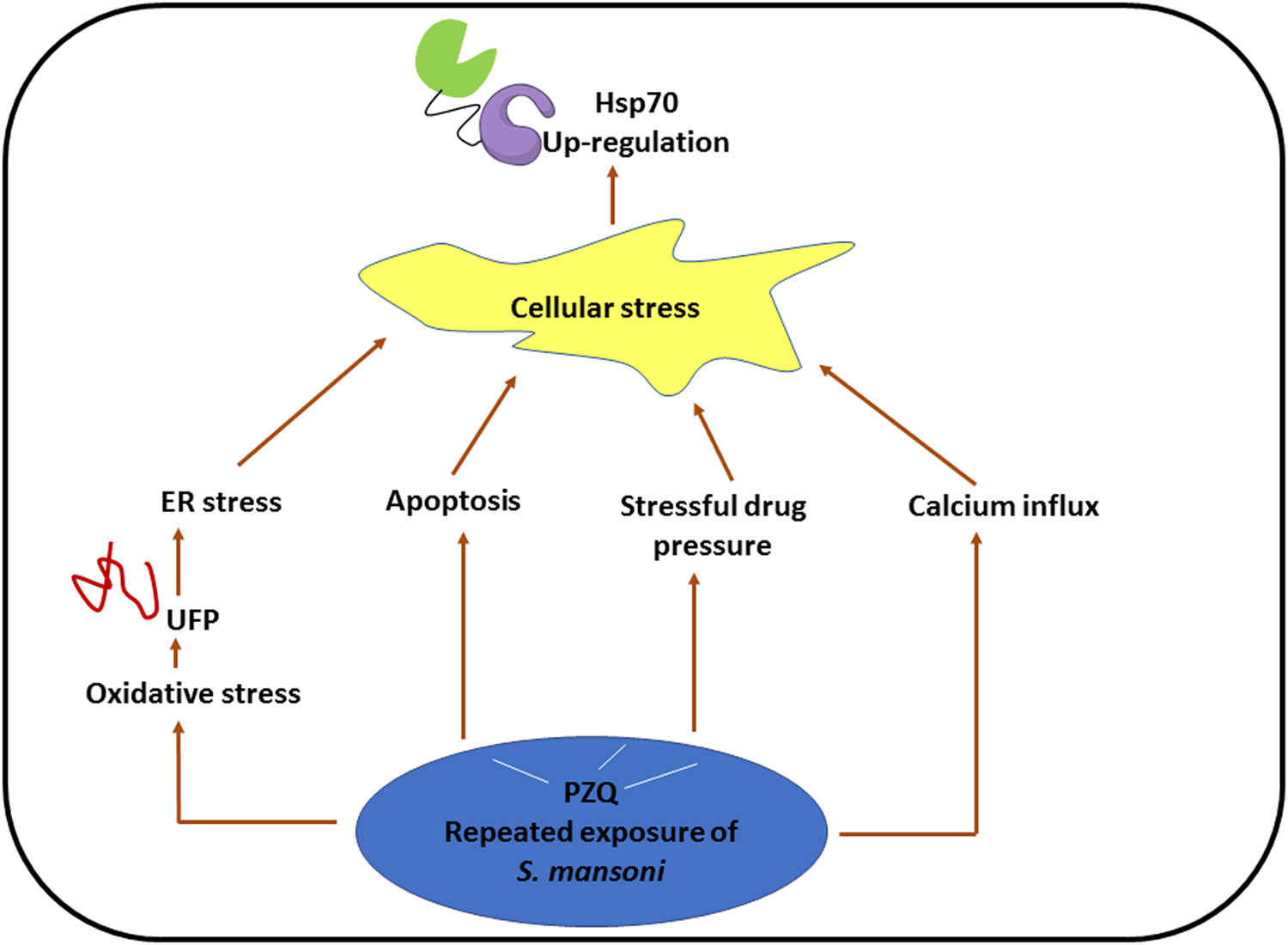
In a recent work done by Abou-El-Naga et al. (Reference Abou-El-Naga, Amer, Boulos, El-Faham, Abou Seada and Younis2019), the proteomic comparative study between susceptible and adult schistosomes with reduced sensitivity to PZQ (obtained after repeated intramolluscan exposure of the parasite to sublethal dose of PZQ) revealed the up-regulation of Hsp70 in the later isolates, pointing to a role of the Hsp70 stress response in resistant resistance mechanisms (Fig. 1).
Mechanism of up-regulation of Hsp70 in adult S. mansoni with reduced sensitivity to PZQ. Repeated exposure of S. mansoni to PZQ leads to the induction of oxidative stress, UFP and ERS. PZQ also leads to the induction of apoptosis. These factors together with the stressful drug pressure and the increase influx of calcium lead to up-regulated Hsp70.

Sanchez et al. (Reference Sanchez, Cupit, Bu and Cunningham2019) charted the change in the transcriptome of a lab PZQ-selected line of S. mansoni Puerto Rican strain over three passages (P) 6, 7 and 8 in comparison with the drug sensitive controls to identify genes associated with reduced sensitivity. Expression profiling was performed by high throughput sequencing using Illumina NextSeq 500. Both the numbers of up- and down-differentially regulated genes were found to increase with each successive generation. Hsps that can be responsive to stress, including Hsp70 (Smp 106930, Smp 072330 and Smp_049600) were reported to be significantly up-regulated at P7 or P8. This transcriptomic analysis comparing genes that are differentially regulated between PZQ-selected and sensitive lines does not suggest any single candidate gene or pathway as being responsible for the reduced susceptibility. Therefore, the authors suggested that the reduced susceptibility could be an epistatic interaction of multiple gene products. Up-regulation of stress-related proteins was also demonstrated in the resistant Leishmania donovani parasites resistant to pentavalent antimonials (Biyani et al., Reference Biyani, Singh, Mandal, Chawla and Madhubala2011).
The mechanism of up-regulation of the Hsp70 in adult S. mansoni with reduced sensitivity to PZQ could be due to several aspects related to the mechanisms of the drug's activity effect.
PZQ increases influx of calcium ions
Metal ions and a calcium ionophore can affect the transcription of Hsps and are important for their activity (Moseley, Reference Moseley2000). Given that the initial effect of PZQ on schistosomes is an increase in the influx of calcium ions, therefore, this could up-regulate Hsp70 (Hsu and Yoshioka, Reference Hsu and Yoshioka2015).
PZQ induces an oxidative stress
Induction of oxidative stress as it was found that incubation of Schistosoma worms with sub-lethal doses of PZQ led to an increase in oxidative stress, demonstrated by the enzymatic study and transcriptomic analysis (El-Bassiouni et al., Reference El-Bassiouni, Helmy, Saad, El-NabiKamel, Abdel-Meguid and Hussein2007; Aragon et al., Reference Aragon, Imani, Blackburn, Cupit, Melman, Goronga, Webb, Loker and Cunningham2009). The oxidative damage leads to cellular protein unfolding and aggregation in the ER and thus, generates endoplasmic reticulum stress (ERS) (Gorman et al., Reference Gorman, Healy, Jäger and Samali2012). Similarly, treatment of Raillietina echinobothrida tapeworm with PZQ leads to an oxidative stress response (Giri and Roy, Reference Giri and Roy2016). Cellular stress including oxidative stress and exposure to toxins can induce Hsp70 up-regulation. An increase in heat shock-related transcript was demonstrated following exposure of Schistosoma worms to PZQ (Aragon et al., Reference Aragon, Imani, Blackburn, Cupit, Melman, Goronga, Webb, Loker and Cunningham2009).
Exposure to the stressful drug pressure
The stressful drug pressure opposed exerted on the parasite in the intra-molluscan phase could lead to an up-regulation of this chaperone protein (Abou-El-Naga et al., Reference Abou-El-Naga, Amer, Boulos, El-Faham, Abou Seada and Younis2019).
PZQ induces apoptosis
Induction of apoptosis which is found to be associated with the schistosomicidal action of PZQ (Xiao et al., Reference Xiao, Mei and Jiao2009). Raillietina echinobothrida exposed to PZQ showed mitochondria-mediated, caspases-dependent apoptosis-like cell death in the worm (Giri and Roy, Reference Giri and Roy2016).
Hines-Kay et al. (Reference Hines-Kay, Cupit, Sanchez, Rosenberg, Hanelt and Cunningham2012) and You et al. (Reference You, McManus, Hu, Smout, Brindley and Gobert2013) have shown the up-regulation of several genes concerned with apoptosis after exposure to PZQ in S. mansoni and S. japonicum. Hines-Kay et al. (Reference Hines-Kay, Cupit, Sanchez, Rosenberg, Hanelt and Cunningham2012) suggested that the juvenile worms can survive under PZQ exposure due to the differential expression of genes that regulate apoptosis between them and the mature worms. Apoptosis can induce ERS due to interference with protein folding and accumulation of UFPs (Ushioda et al., Reference Ushioda, Miyamoto, Inoue, Watanabe, Okumura, Maegawa, Uegaki, Fujii, Fukuda, Umitsu, Takagi, Inaba, Mikoshiba and Nagata2016). In juvenile schistosomes, an increase in the transcription of stress response genes protects against apoptotic machinery at the pre- and post-mitochondrial level (Hines-Kay et al., Reference Hines-Kay, Cupit, Sanchez, Rosenberg, Hanelt and Cunningham2012).
Transient receptor potential channels and their role in HSP induction in S. mansoni
The transient receptor potential (TRP) channels are non-selective cation channels that display roles in sensory transduction and extraordinary diversity of functions in a large part due to their role in modulating intracellular Ca+2 concentrations (Gees et al., Reference Gees, Colsoul and Nilius2010). TRP channels fall into several subfamilies that are potential as therapeutic targets. Schistosomes contain genes predicted to encode representatives of most of the TRP channel subfamilies, yet appear to lack any sequences encoding TRPV homologs (Prole and Taylor, Reference Prole and Taylor2011). Recently, it was demonstrated that PZQ activates a Ca2+-permeable schistosome TRP channel, a member of the TRP melastatin (TRPM) subfamily, launched Sm.TRPMPZQ, expressed in PZQ-sensitive schistosomes (Park et al., Reference Park, Gunaratne, Chulkov, Moehring, McCusker, Dosa, Chan, Stucky and Marchant2019). Sm.TRPMPZQ has several similarities consistent with the properties of human TRPM2 channels. Both support substantial Ca2+ influx. The human TRPM2 channel induces apoptosis in response to reactive oxygen species (ROS) (Hara et al., Reference Hara, Wakamori, Ishii, Maeno, Nishida, Yoshida, Yamada, Shimizu, Mori, Kudoh, Shimizu, Kurose, Okada, Imoto and Mori2002). Such regulation could support the harmful actions of PZQ on worm tegument crucial for the efficacy of PZQ. Activation of the TRP channels induces sustained intracellular calcium elevation and subsequent oxidative stress leading to the induction of several types of Hsps (Hsu and Yoshioka, Reference Hsu and Yoshioka2015). Mutagenesis demonstrates that Sm.TRPMPZQ sensitivity to PZQ can be altered by point mutation (Park et al., Reference Park, Gunaratne, Chulkov, Moehring, McCusker, Dosa, Chan, Stucky and Marchant2019). However, the implications for drug resistance prioritize further analyses of TRPMPZQ homologs in other flatworms as well as all other schistosome TRPM channels (Park and Marchant, Reference Park and Marchant2020).
In this rational, it is worth mentioning that other TRP channels, the TRPA1 channel was demonstrated in S. mansoni. This channel apparently differs from that of host mammalian channels, as they exhibit atypical mixed TRPA1/TRPV1-like pharmacology. Despite the absence of TRPV-like channel genes in schistosomes, S. mansoni adults respond to selective TRPV1 activators with dramatic hyperactivity and rapid separation of the coupled worms. The TRPA1 channel transduces endogenous host signals that are required or exploited by the parasite thereby disrupting schistosome development, reproduction or survival within the host and therefore could be a drug target (Bais et al., Reference Bais, Berry, Liu, Ruthel, Freedman and Greenberg2018). However, the sensitivity of these channels to PZQ has not been demonstrated yet.
Role of Hsp70 in decreased sensitivity to PZQ in adult S. mansoni
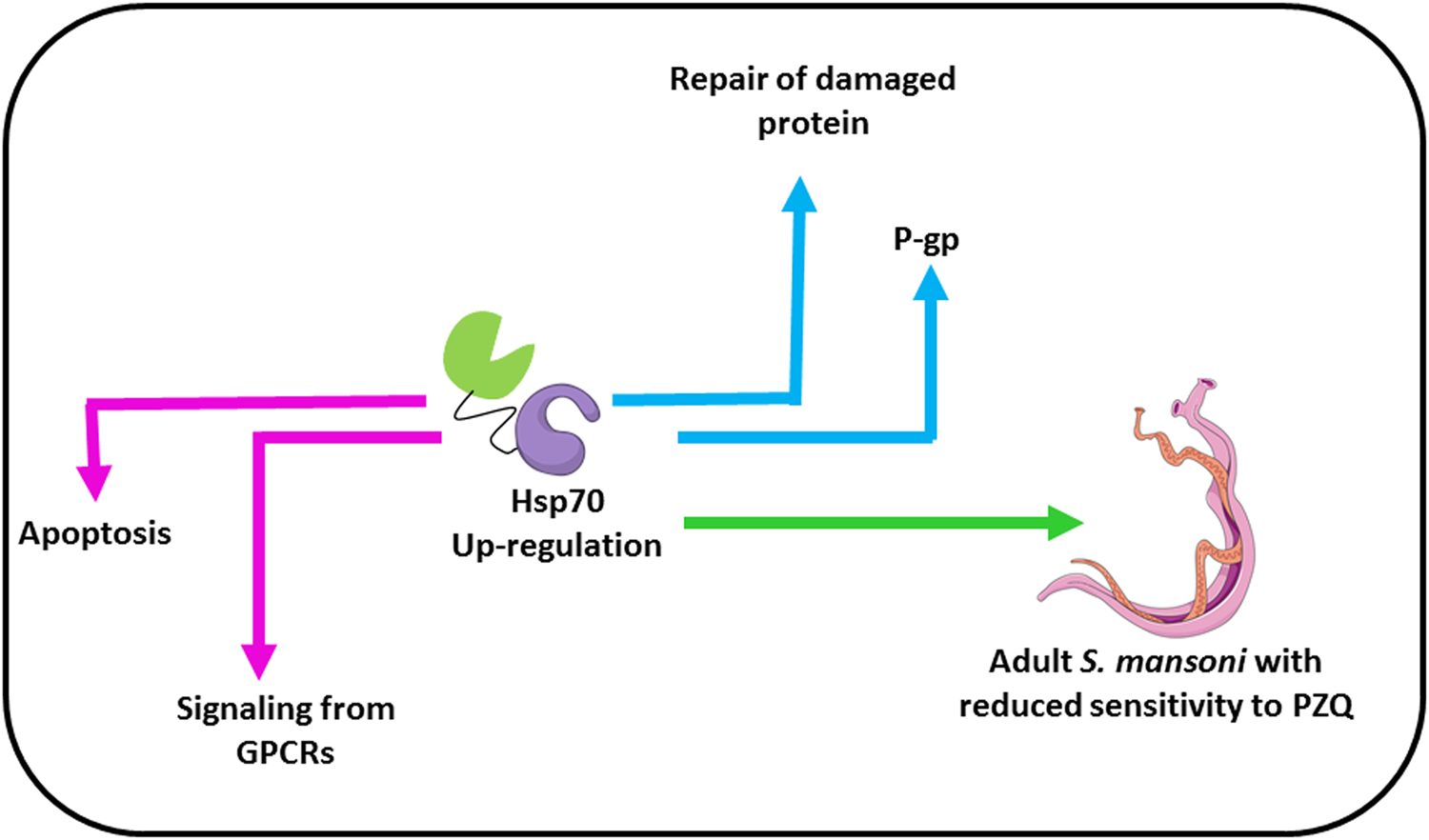
Hsp70 can influence PZQ resistance in a number of different multiple ways (Fig. 2).
Role of Hsp70 up-regulation in adult S. mansoni with reduced sensitivity to PZQ. Hsp70 up-regulation in adult S. mansoni with reduced sensitivity to PZQ can attenuate the schistosomicidal effect of the drug due to its cytoprotective effect as it repairs the damaged proteins and induces an anti-apoptotic effect. In addition, up-regulation of Hsp70 leads to the up-regulation of P-gp expression and attenuation of signalling from GPCRs.

Hsp70 repairs the damaged protein
It can interact with and repair misfolded proteins that resulted from ROS and thus allow cell survival.
Hsp70 has an antiapoptotic function
The cytoprotective effect of Hsps is, however, not only due to their role in repairing the damaged proteins, but also due to their anti-apoptotic function (Kumar et al., Reference Kumar, Stokes, Singh, Scissum Gunn, Acharya, Manne and Mishra2016). Hsps are powerful anti-apoptotic proteins and they have the capacity to block the cell death process at three levels: up-stream to mitochondria, at mitochondria and post-mitochondria. Hsp70 inhibits caspase activity directly or indirectly, thereby blocking the intrinsic and extrinsic apoptotic pathways through interaction with key apoptotic proteins at different levels. Interestingly cytochrome-c enzyme was found to be four times lower in PZQ resistant S. mansoni than susceptible worms (Pereira et al., Reference Pereira, Fallon, Cornette, Capron, Doenhoff and Pierce1998). Thus, increased Hsp70 by interacting at several points on apoptotic signalling pathways, increased Hsp70 leads to the attenuation of apoptosis (Kumar et al., Reference Kumar, Stokes, Singh, Scissum Gunn, Acharya, Manne and Mishra2016). Hsp70 can also induce autophagy under stress circumstances which can enhance cell survival by inhibiting apoptosis (Ishida and Nagata, Reference Ishida and Nagata2009).
Hsp70 up-regulate P-glycoprotein
In addition, the role of Hsp70 in reduced sensitivity of adult S. mansoni to PZQ could also be due to its role in the regulation of P-glycoprotein (P-gp); one of the multidrug-resistant transporters. Multidrug resistance transporters are members of the ATP-binding cassette superfamily of proteins. They are ATP-dependent efflux pumps concerned with the removal of toxins and xenobiotics from cells. They mediate multidrug resistance which is a cross-resistance toward different chemotherapeutic drugs. Up-regulation of Hsp70 leads to up-regulated P-gp expression mainly at the transcription level (Xin et al., Reference Xin, Yin, Qi, Shen, Xu, Luo, Lan and Yin2013). Multidrug resistance transporters have been considered as one of the main reasons for resistance of schistosomes (Kasinathan et al., Reference Kasinathan, Sharma, Cunningham, Webb and Greenberg2014).
Hsp70 attenuates signals from guanine nucleotide binding proteins
Guanine nucleotide binding proteins are glycoproteins attached to the cytoplasmic cell membrane and are involved in signal transduction controlled by G protein-coupled receptors (GPCRs) (Hurowitz et al., Reference Hurowitz, Melnyk, Chen, Kouros-Mehr, Simon and Shizuya2000). PZQ is a GPCR ligand and the efficacy of the drug is based on beneficial engagement with GPCR (Chan et al., Reference Chan, Cupit, Gunaratne, Mc Corvy, Yang and Stoltz2017). This modulates signalling events in both host and parasite and links a harmful paralytic effect on the parasite with beneficial host effects that help worm clearance. PZQ causes contraction of the parasite leading to its paralysis and also leads to contraction of the host mesenteric vessels to increase its perfusion pressure and consequently flush paralysed worms to the liver (Chan et al., Reference Chan, Cupit, Gunaratne, Mc Corvy, Yang and Stoltz2017). It was found that up-regulation of Hsp70 could attenuate signalling from specific GPCRs as a part of the stress response to help survival (Lim et al., Reference Lim, Kanelakis and Neubig2013). All these effects of Hsp70 up-regulation can attenuate the schistosomicidal effect of the drug and result in reduced sensitivity to the drug in the adult worms.
Underlying the mechanism of up-regulation of Hsp70 in adult S. mansoni with reduced sensitivity to PZQ and its possible role in attenuating the schistosomicidal effect of the drug could lead to possible strategies to reverse drug resistance or the development of alternative therapies.
Financial support
None.
Conflict of interest
None.
Ethical standards
Not applicable.