1. Introduction
Over the last two decades social investment strategies have emerged across European welfare states. Skills, education and the re-employability of the unemployed are central to welfare state politics. A growing literature exists on the politics of social investment on the national (Hemerijck, Reference Hemerijck2017; Morel et al., Reference Morel, Palier and Palme2012) and the regional level (Scalise and Hemerijck, Reference Scalise and Hemerijck2022); however, the positions of trade unions and employer associations towards social investment reforms are less well understood. The underlying question of this research is how the attitudes of unions and employer associations help to explain the success of social investment politics. More specifically in this study, I investigate one specific form of each type of social investment and social compensation policy. Active labour market policy (ALMP) is a key example of social investment policy whilst the level of unemployment benefit is an example for social compensation. Of course, there are many other policies in each category, which can be investigated in future research. However, ALMP and the level of unemployment benefits are one of the prominent policy areas and are in line with the policies discussed in recent literature (Palier et al., Reference Palier, Garritzmann, Häusermann, Garritzmann, Häusermann and Palier2022; Busemeyer and Neimanns, Reference Busemeyer and Neimanns2017).
In the theory section it will be argued that unions and employer associations will both tend to be supporters of ALMP (social investments) whilst having contrasting attitudes towards the level of unemployment benefits (social compensation). There is already empirical evidence regarding different positions on attitudes to the level of unemployment benefits (Nijhuis, Reference Nijhuis and Nijhuis2020; Bender, Reference Bender2020). However, the attitudes towards ALMP have been less well understood. With respect to the position of the employer associations, Korpi (Reference Korpi2006) highlights that they will not necessarily always be opponents of welfare state expansion; rather, they might be supporters if the policy reform brings business benefits. I argue that, in particular, ALMP as an example of social investment is expected to be perceived by employer associations as having the potential to bring the most business benefits. In addition, we can also expect that trade unions, though, are ALMP supporters, because they tend to promote training measures for their members. In the end, this would lead to an overall positive stance by social partners on ALMP, albeit for different reasons.
For employer association positions towards ALMP, indeed, as Swenson (Reference Swenson2002) and others show for Sweden and the US, there is empirical evidence that specific organisations can be supporters if they expect a positive impact on labour supply (Gordon, Reference Gordon and Nijhuis2020; Nijhuis, Reference Nijhuis and Nijhuis2020; Farnsworth, Reference Farnsworth2012). However, with the exception of the work by Tepe and Vanhuysse (Reference Tepe and Vanhuysse2013), we do not know much about the understanding of ALMP support by different unions, and in particular not in comparison with sectoral employer association positions. We only know that union members are lukewarm supporters of social investment strategies (Bledow and Busemeyer, Reference Bledow and Busemeyer2021), but the position of a variety of organisations across different sectors is not yet clear. To my knowledge, there does not seem to be any systematic study in which the interests of unions and employer associations are compared across different sectors, types of organisations, and social policy reforms. Palier et al. (Reference Palier, Garritzmann, Häusermann, Garritzmann, Häusermann and Palier2022) also focus either on unions or employer associations separately, rarely on both at the same time, but each of the studies point out the importance of an analysis including both.
The analysis presented in this paper thus fills this research gap and is the first of its kind, building on a new comprehensive dataset, which includes data from press releases and expert-interviews, covering fourteen years, three employer associations, and three unions. This new dataset called the ‘Reform Monitor on Political Conflict’ (ReMoPo) was developed for this research. It is based firstly on a systematic text analysis of all press releases on unemployment benefits and ALMP, and secondly it is enriched by expert interviews to understand the reasons behind positions displayed in the data. The combination of expert interviews and systematic content analysis of press releases has rarely been used in the field of labour relations and social policy preferences. I directly compare the positions expressed by social partners in different sectors towards social policy reforms from 2000 to 2014. The analysis presented in this paper is a significant contribution to the theories and methodology of political economy and welfare state research.
The main results are on the one hand in line with the theoretical assumptions, and on the other hand it is possible to update the understanding of welfare state support. As expected, after coding more than 400 press releases and four expert interviews, conflict is empirically confirmed between the social partners regarding unemployment benefits. Going beyond previous studies, the ReMoPo dataset provides new insights into the reason for consensus on ALMP. All in all, a more complex set of partially overlapping motivations drives a common positive stance towards ALMP by the social partners. This is not visible for their stance on the level of unemployment benefit. I argue that the complexity governing attitudes towards ALMP is specific to social investment policies in general and I expect that for other social investment issues (such as child-care services), complex and partially overlapping motivations will also lead to a positive stance by all social partners.
The paper is structured as follows: in section 2 I introduce the theoretical framework and the literature on unions and employers’ positions on unemployment benefits and ALMP reforms. Subsequently, in section 3 I explain the case selection and briefly review the main social policy reforms in Germany from 2000 to 2014. Afterwards, in section 4, I explain the relevant organisations and go on to introduce the new dataset, coding and methodology in section 5. The results follow in section 6, and section 7 presents the theoretical implications. Finally, section 8 provides the conclusion and outlook for further research.
2. Conflict Lines and Actor Configurations on Compensation and Social Investment Policies
In the industrial period, the conflict between labour and capital was one of the dominant factors used to explain welfare state development. According to Power Resource Theory, social policy can be understood as protection against the negative effects of free market processes (Esping-Andersen and Korpi, Reference Esping-Andersen, Korpi and Goldthorpe1984). Unions (and left-wing parties) are therefore expected to be in favour of social policy reforms, since they want to protect the workforce (particularly union members) against unemployment, illness and age-related disadvantages (Esping-Andersen, Reference Esping-Andersen1990). Later developments of Power Resource Theory paid more attention to the position of employer associations (Korpi, Reference Korpi2006). According to them, employer associations would not always oppose social policies if they were beneficial to business. Specifically, employer associations are expected to support social policy reforms if the social policy reform contributes to factors that guarantee business success during critical periods (Pavolini and Seeleib-Kaiser, Reference Pavolini, Seeleib-Kaiser, Garritzmann, Häusermann and Palier2022) – for example, social policy measures to increase the (skilled) workforce when (specialised) workers are currently hard to find. Secondly, employer associations are expected to support alternative social policy reforms if they mean lower costs for businesses.
Clearly, not all social policy reforms will be in the interests of employer associations because they may well increase costs and/or decrease profits. In particular, increases in unemployment benefit payments are often only perceived in terms of extra costs. However, the literature on varieties of capitalism has found that employer associations do in fact support reforms of unemployment insurance if they provide social security for skilled workers (Mares, Reference Mares, Hall and Soskice2001). Notably, these findings have in turn been challenged by other more recent studies, which found that employer associations are generally opposed to increases in unemployment benefits whilst unions generally support them. For example, it has been shown that peak employer associations are skeptical about a high level of unemployment benefits (Brosig, Reference Brosig2011). They mainly fear negative effects on the profitability and competitiveness of their member companies and argue that the unemployed will be less motivated to find a new job if social compensation is too high (Kinderman, Reference Kinderman2016). Furthermore, most of the employer associations do not have a vested interest in expanding unemployment benefits because they have to co-finance compensation reforms through higher taxes and levies. By contrast, trade unions favour a relatively high level of benefits for the unemployed, since a high monetary standard of living for their members should be guaranteed through passive transfers in times of unemployment (Gordon, Reference Gordon2015).
With respect to social investment policies the picture is more complex, because actor configurations and conflict lines are two- or multi-dimensional (Häusermann, Reference Häusermann2018). As has been documented by a growing literature, ALMP as taking a specific form of social investment strategies can be supported by employer associations (Swenson, Reference Swenson2002; Martin and Swank, Reference Martin and Swank2004; Gordon, Reference Gordon and Nijhuis2020). There are several studies showing that employer associations have an interest in high labour market participation because this guarantees a plentiful supply of labour and wage competition between workers (Martin, Reference Martin, Hassel and Palier2021). In this situation, companies can rely on a large potential workforce, and their ability to tackle new business tasks is ensured (Pavolini and Seeleib-Kaiser, Reference Pavolini, Seeleib-Kaiser, Garritzmann, Häusermann and Palier2022). The employer association support on ALMP is, then, because of the interest of a high level of labour market participation via employment assistance and re-training measures for the unemployed to re-enter the labour market (Huo et al., Reference Huo, Nelson and Stephens2008; Kluve, Reference Kluve2010; Farnsworth, Reference Farnsworth2012). Furthermore, a high level of labour market participation, in particular on the part of young employees, might constitute an investment in the new generation of taxpayers, thus relieving the financial burden on existing member companies of employer associations (Nijhuis, Reference Nijhuis and Nijhuis2020). Therefore, we can expect that employer associations are in favour of ALMP.
Unions’ positions towards ALMP are more critical (Durazzi and Geyer, Reference Durazzi, Geyer, Garritzmann, Häusermann and Palier2022), and not yet clear in existing research. Rueda (Reference Rueda2006) argues that there is a dilemma: on the one hand, peak union organisations might have an interest in ALMP because the unemployed (outsiders) receive help in various ways in order to re-enter the labour market. On the other hand, unions in the industrial sector want to protect the interests of existing employees (insiders). These labour market insiders might fear potential downward wage pressure and competition caused by ALMP. In dealing with this dilemma, Rueda (Reference Rueda2006) argues that unions first seek to protect their core insider members and are therefore against ALMP.
In this paper however, the contrary argument – namely, union support for ALMP – is expected for the following reasons: first, Tepe and Vanhuysse (Reference Tepe and Vanhuysse2013) show a generally positive union attitude towards ALMP before the financial crisis in 2008/2009. Following them, unions are in favour of ALMP since they tend to promote training measures to address their members’ re-employability worries, both insider and outsider members (see for the same argument Oliver and Morelock, Reference Oliver and Morelock2021). Second, Kenworthy (Reference Kenworthy and Hemerijck2017) argues that ALMP – or social investment strategies in general – are particularly useful for stimulating employment participation and thus increasing union membership and mobilisation. This logic applies particularly to groups that are underrepresented within trade unions, such as young employees, migrants and women. Unions may try to mobilise these groups via support for ALMP, such as training measures that equip workers with technological or general skills. Therefore, and contrary to unemployment benefits, consensus is expected towards ALMP between unions and employer organisations, albeit for different reasons.
3. Case Selection: Unemployment Benefits and Active Labour Market Policies in Germany between 2000 and 2014
Germany was chosen as a case study for two reasons. Firstly, the results can be transferred to similar contexts – for example, other corporatist countries. Germany has institutional structures, such as social partnership, round tables, working councils, and union and employer density that are similar to those of other corporatist countries (Jahn, Reference Jahn2016; Visser, Reference Visser2019). Therefore, I assume that the results of how conflict lines develop in response to different social policy reforms can be applied to other corporatist countries. Secondly, welfare state reforms made in Germany closely reflect those made in other European welfare states, embodied by significant cuts in unemployment benefits on the one hand, and the extension or consolidation of ALMP on the other hand (Cantillon et al., Reference Cantillon, Seeleib-Kaiser and van der Veen2021).
This welfare state change was furthermore the reason for the time period selected. The Agenda 2010 reforms began in 2003, and I have included analysis of a two year period prior to these reforms so as to pick up on topics debated in this context. Most significantly of the Agenda 2010 was the introduction of the ALG II. The ALG II provided a minimum standard of living for the long-term unemployed, and benefits were no longer calculated according to the most recently obtained earnings; instead, lump sums were paid out irrespective of prior income (Hassel and Schiller, Reference Hassel and Schiller2010). In addition to the new ALG II, the Job-AQTIV Act was introduced in 2003 entailing: firstly, employment assistance designed to match the unemployed with jobs; secondly, training measures and direct job creation programs which help the unemployed to gain work experience and reintegrate themselves in the labour market (Fleckenstein et al., Reference Fleckenstein, Saunders and Seeleib-Kaiser2011).
In the time period between 2005 and 2009 a few corrections to Agenda 2010 and Job-AQTIV Act were made. Most significant among these was the reduction of ALMP measures, such as 1-Euro-Jobs and Ich-AG in 2008 and 2011, both types of temporary job creation programs (Thelen, Reference Thelen2014). They were reduced because evaluation studies documented that these forms of ALMP did not result in longer term employment, but, rather, created market competition for private firms and were therefore politically unpopular (Kluve, Reference Kluve2010). ALMP measures moved away from long-term training measures and a high level of financial investment in ALMP towards shorter programs education and job search services (Eichhorst and Marx, Reference Eichhorst and Marx2011).
After this Instrumentenreform in 2011/2012, I considered ending the analysis in 2013, after the general election. However, I decided to include one additional year because of two reasons: firstly, new governments tend to present major new projects during their first year and therefore I expected unions and employer associations to reflect on recent developments in welfare state policy; secondly, the newly elected government quickly introduced new ALMP measures in the year 2014 which would clearly stimulate debate and would be reflected in press releases.
4. Relevant Social Partners in Germany
The most relevant and powerful social partners in Germany were selected for my study. The literature suggests that the selection can be based on a variety of different sectors, large membership size, neo-corporatist involvement and strong political influence (Streeck, Reference Streeck2016).
The following paragraph shows how the chosen organisations satisfy these requirements. Firstly, various sectors are represented by Ver.di (union) and the ZDH (employer association) represent the service sector whilst Gesamtmetall (employer association) and IG Metall (union) represent the metal and electronic industry and the BAVC (employer association) as well as IG BCE (union) since they draw their membership from the chemical industry. Secondly, the membership size requirement is satisfied by all of these organisations as they represent a large group of employers and employees with different skill levels in their respective fields (Schroeder, Reference Schroeder2014; Schroeder and Weßels, Reference Schroeder and Weßels2017). Of the unions, the IG Metall is the largest, as of 2014, with 2,269,281 members, followed by Ver.di with 2,039,931 and IG BCE with 657,752. ZDH is the largest employer association with 1,007,016 companies and 5,379,000 employees, followed by Gesamtmetall with 6,903 member companies and 2,254,665 employees, and the BAVC with 548,800 employees (Oeckl, 2021). Notably, Gesamtmetall is in fact the most influential organisation despite being smaller in membership (Weckwerth and Weishaupt, Reference Weckwerth and Weishaupt2019), because the companies affiliated to Gesamtmetall make a particularly large contribution to the German Gross Domestic Product. Thirdly, and despite differences in sectors and membership size, all of the chosen organisations demonstrated significant involvement in collective bargaining processes, works councils and company co-determination and therefore satisfy the neo-corporatist requirements for this sample (Schroeder, Reference Schroeder2014). Furthermore, all organisations are politically highly relevant, as shown by the number of times they were each invited as experts to governmental committees (Deutscher-Bundestag, 2014).
5. Reform Monitor on Political Conflict: Data, Coding and Method
The new ‘Reform Monitor on Political Conflict’ (ReMoPo), developed for this research, is based on a systematic text analysis of all press releases on social policy reforms between 2000 and 2014, as well as expert interviews to understand reasons behind positions displayed in the data. ReMoPo has been developed because a systematic analysis of press releases in addition with expert interviews has rarely been used in the field of labour relations. This is surprising, as these methods/technics have been used in analysing political parties (Lehmann et al., Reference Lehmann, Matthieß and Merz2018; Picot and Menéndez, Reference Picot and Menéndez2019). However, most of these studies do not include unions or employer associations across different sectors – which is all the more striking, as social partners use press releases to communicate their views to members and the public. As such, they should seem to lend themselves well to such an analysis of the structure of political conflict towards welfare state reforms. Moreover, by using the text-as-data aspect of such a perspective, we can make use of the large amount of potential data that is available today.
However, there are limitations to using press releases, not all of which are relevant to my research question. Firstly, press releases are often formulated only for the public or the media and do not necessarily reflect the heterogeneous interests within the organisations (Behrens, Reference Behrens2018). In other words, different positions within the organisation may exist, but this does not mean that this difference will be articulated in public through press releases. This argument also holds for other publicly available text-based material, such as web pages, Twitter data, or annual reports. The second potential limitation of press release data is that the organisations are often strategic actors, where employer associations or unions support or reject welfare state reforms in order to gain access to the political process (Broockman, Reference Broockman2012). This makes it difficult to identify their real preferences because they may strategically choose not to represent their true positions in press release publications (Grumbach, Reference Grumbach2015).
On the one hand, I dealt with this problem since I conducted expert interviews and was able to cross-check whether the positions analysed through press releases were strategic or not. On the other hand, had my research focused on conflicts within organisations then exclusive use of press releases would have been a more problematic choice as they do not reflect conflicts within organisations. However, I am interested in finding out how social partners represent themselves publicaly and politically. Since press releases are used to go beyond internal conflicts and to present an agreed organisational position (on unemployment benefits and ALMP) this actually makes them ideal for the current research question.
The press releases were selected on the basis of a semi-automatic keyword search on the websites of the organisations. For the IG BCE, Ver.di, and ZDH, the online versions of their press releases were used for the entire time period of the study, while for Gesamtmetall online versions were available from 2008 onwards, and for IG Metall from 2007, while scanned versions of the physical press releases were collected from the organisation archive for the time period before. This led to the collection of a total of 419 press releases for the years from 2000 to 2014, selected on the basis of references to the research objective on unemployment benefits and ALMP.
In addition, expert interviews were used to understand reasons behind union positions displayed in my data. Interviews with employer association representatives were not necessary since their positions had already been sufficiently explained through content analysis of the press releases. However, and with respect to the union position, the press releases lacked explanations of why the unions were in favour of ALMP. Therefore, four semi-structured expert interviews were conducted with representatives from the following organisations and sectors: IG Metall for the metal and electronic industry (Interviewee 1), IG BCE for the chemical industry (Interviewee 2), Ver.di for the service sector (Interviewee 3) and an expert from a large consulting group which focuses on trade unions in Germany (Interviewee 4).Footnote 1
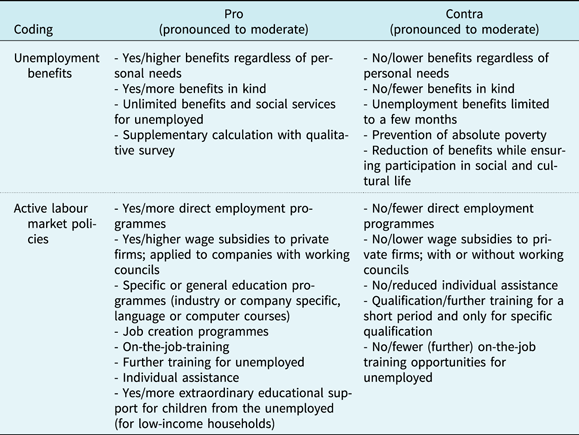
The text documents were coded on a 4-point scale (pronounced pro, moderate pro, moderate contra, and pronounced contra). Quantitative text analysis generally uses a two-category system of pro and contra (Slapin and Proksch, Reference Slapin and Proksch2008). However, I differentiate more finely between “moderate” and “pronounced”. Approximately 25% of all coded press releases were cross-checked by additional researchers. The coding scheme in the appendix (Table 1A) gives a simplified overview of how the various statements were coded.
After coding all relevant documents, the codes were converted into numerical values. These were first calculated for individual press releases and then converted into a yearly average (Bender, Reference Bender2020, Kim and Fording, Reference Kim and Fording2002). Formula 1 describes the calculation of the position of the organisation (i) in the policy field (j) in a certain year (x):
Formula 1:
 $$Position\;ijx = \;{{{\bf{\Sigma }}\;pro\;ijx + {\bf{\Sigma }}\;contra\;ijx} \over {{\bf{\Sigma }}\;codes\;ijx}}$$
Each year’s coding is the sum of pro and contra codes divided by the number of all codes for the organisation in one year. A position of plus two (+2) indicates a pronounced positive position on unemployment benefits or ALMP, a position of plus one or minus one demonstrate a moderate pro (+1) or contra (-1) stance on this topic, and a position of minus two (-2) indicates a pronounced negative position. A potential fifth neutral coding category was excluded after the pre-test, because no organisation published a neutral position via press release, leaving the four coding categories as described above.
6. Empirical Results
6.1. Social partners’ positions towards unemployment benefits
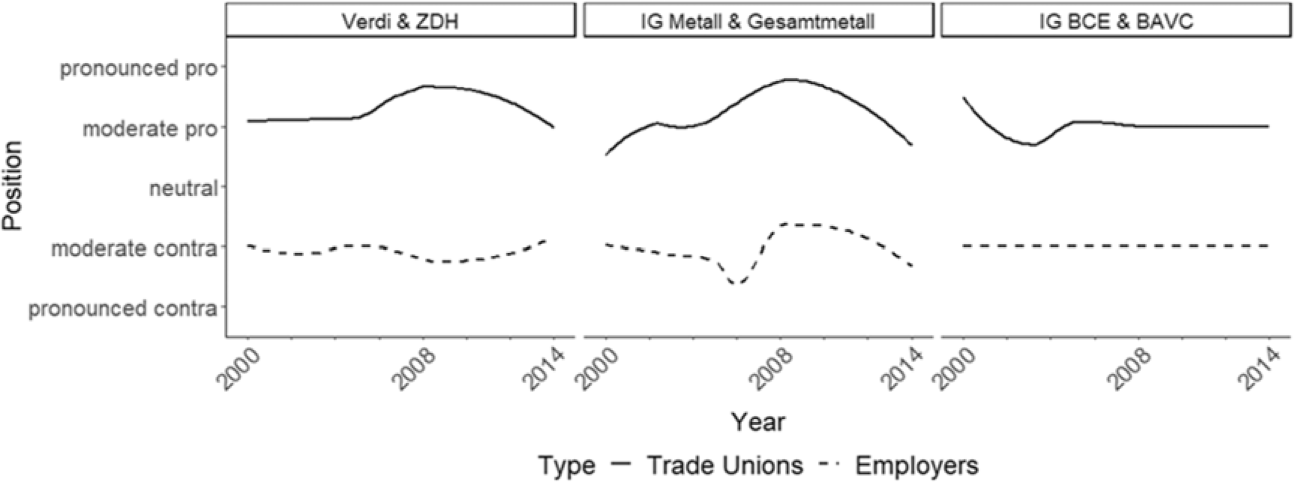
The empirical results show a conflict between the social partners towards the level of unemployment benefits. As expected, unions and employers clearly hold different positions, where the union stands for, and the employer associations against, a higher level of unemployment benefits from 2000 to 2014. The first area on the left side of Figure 1 combines the conflict lines for the service sector (Ver.di and ZDH), the area in the middle for the metal and electronic industries (IG Metall and Gesamtmetall), and the third area for the chemical industry (IG BCE and BAVC). Regarding unemployment benefits, the class-based conflict between different social partners clearly exists, regardless of the sector they represent.
Positioning of unions (solid line) and employers’ associations (dotted line) on unemployment benefits from 2000 to 2014.

The press releases show that all employer associations supported the introduction of ALG II with reduced benefits and a shorter period of duration (e.g.: ZDH, 2003). Although Gesamtmetall’s position was contra on average, a detailed analysis of the individual press releases shows that, during the economic and financial market crisis in 2008/2009, they temporarily took a moderately positive position, favouring benefits in particular areas of the metal and electronics industries (Gesamtmetall, 2009). However, as predicted, the overall position and the key concerns of employer associations were that higher unemployment benefits would lead to negative economic consequences for their member companies due to higher costs (Gesamtmetall, 2013).
This contrasts with the union position, since all unions rejected the cuts made in ALG II during the Agenda 2010 reform processes (e.g. IG-Metall, 2002). The main concerns of unions were that generous unemployment benefits would lead to more income security for individuals during their unemployment, and that individuals should be able to manage hard-times without any risk of poverty. Therefore, the unions campaigned for additional benefits for unemployed parents (Kinderzuschlag) and supported increased unemployment benefits in general (became clear in all four expert interviews). The conflict between the different social partners becomes a bit more pronounced before the financial market crash in the year 2008 in the service sector and in the metal- and electronics industry, and the reaction of the sectors employer associations seems to be related to the reaction of sector unions, each moving in opposite directions. However, the one-dimension actor configuration and antagonistic structure of political conflict is evident and in keeping with clear differences between the social partners on the level of unemployment benefits.
6.2 Social partners’ position towards active labour market policy
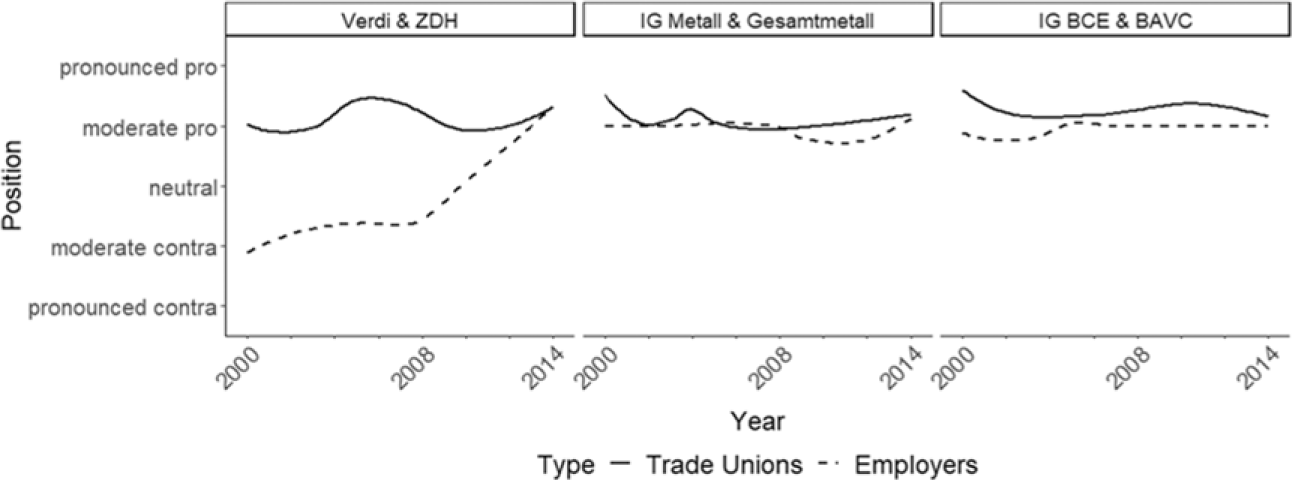
In contrast to the level of unemployment benefits, the unions and two of the three sector employer associations (Gesamtmetall and BAVC) had the same common positive stance towards ALMP. Figure 2 shows the unions’ positions as a solid line in each of the areas and the employer associations’ positions as a dotted line. The ZDH (representing skilled craftsmen) on the left side of Figure 2 is the only organisation opposing ALMP until 2008/2009, but shifted its stance to support ALMP after the government cut back temporary job creation programs.
Positioning of unions (solid line) and employers’ associations (dotted line) on active labour market policies from 2000 to 2014.

There were two underlying reasons for the ZDH contra position on ALMP until 2008/2009. Firstly, a higher number of ALMP programs were accompanied by increased taxes and financial contributions for member firms. The ZDH press releases described greater financial burdens due to ALMP, which made it particularly hard for small firms in the craftsmanship sector. This was due to the limited financial resources in the smaller craft firms compared to those of large companies in the industrial sector. Secondly, the data analysis reveals ZDH’s concern that publicly-funded job creation (e.g. Ich-AG and 1-Euro-Jobs) would essentially compete with their own business (e.g. ZDH, 2004). The medium and large companies in the chemical, electronics and metal industries were simply not affected by this extra competition because most job creation occurred in the craftsmanship sector, which is particularly suited to providing temporary additional services, such as carpentry or gardening, with very little prior training.
As seen in Figure 2, the ZDH took a positive stance towards ALMP following the elimination of state-funded job creation programs. The public/private market competition stemming from temporary job creation provided political motivation to reduce this form of ALMP in 2008, and it was eliminated in 2011 (see section 3). After that, ALMP programs were exclusively concerned with qualification, training measures and job search service, and all sector employer associations were in favour of ALMP. Since then, all employer associations argue that ALMP constitute an investment in education and consequently skilled workers would lead to the company economic success and prevent business closure due to gaps in their (skilled) workforce.
Theoretically, these ALMP-specific findings demonstrate that the position of employer associations is based on pragmatic reasons. How these organisations position themselves towards social policy reforms is not determined by purely ideology considerations: which would predict the same interest between employer associations. Rather, the pragmatic concerns of single organisations and their members provide a better explanation of organisational positions towards welfare state politics. When analysing organisational positions, the question needs to be asked: do the members of the organisation benefit or not? In the case of the employer association ZDH, the results clearly show that positions can change over time if the context changes. In other words, the type of organisation does not predict positioning on welfare state issues. Pragmatic considerations do.
Regarding union positions, as seen in Figure 2, the positive stance of all sector unions contradicts the original arguments by insider-outsider theories because it reflects strong support for the insider and outsider groups. In fact, all unions publish in their press releases that ALMP is a useful tool for qualification and re-integration into the labour market, especially for migrants and unemployed people with low skill levels or without any education certificate (e.g. Verdi, 2011). This support for ALMP did not change during or after the economic crisis, but was rather maintained until 2014 by all three unions, regardless of the sector they mainly represented (e.g. IG-BCE, 2001; IG-Metall, 2012).
On the basis of my interviews, I gained more insight into the factors which lead to union support for ALMP. It has been argued by Kenworthy (Reference Kenworthy and Hemerijck2017) that social investment strategies (ALMP) are particularly useful for stimulating employment participation, thus increasing union membership. However, interviewees suggested that other strategies are used to increase union membership per se.
The first motivation given for union support was that ALMP represents an investment in skills which is in turn an investment in human capital and is therefore itself an interest of trade unions. Interviewee 1 (IG Metall representative) argued that the unions have an interest in more qualification and education for workers and particularly for the unemployed because this benefits the individual. Interviewee 2 (IG BCE representative) also pointed out that the unions are interested in giving the workforce the opportunity to gain further qualifications. This enables them to upgrade their educational level and to tackle transformation processes such as digitalization and globalization. Interviewee 3 (Ver.di representative) and Interviewee 4 (consulting group representative) argued similarly that education and training measures via ALMP before and during unemployment are always a good thing, especially in times of transformation due to globalisation, digitalisation, industry 4.0, etc.
The first results of the four interviews showed that the motivation for a positive stance towards ALMP differed between unions and employer associations. Unions were in favour of improving the capabilities of the unemployed and the existing workforce, thereby benefitting individuals. Employer associations, on the other hand, were in favour of increasing labour supply to bring benefits at the company level. However, and as I have argued in the theory section, these different motivations lead to the same common positive stance towards ALMP.
The second motivation I analysed for unions ALMP support were more affected by pragmatic considerations. Two interviewees (IG Metall and consulting group representative) mentioned longer-term strategies to avoid a lack of (skilled) workers to save companies from failure due to gaps in their skilled workforce. Interviewee 1 highlighted the fact that recruitment is quite difficult in many sectors, thus making education and training very important to ensure the economic success of each company and to avoid the exodus of business to locations abroad. Interviewee 4 pointed out that, because of high level of demand for skilled workers in various sectors (nurses, caterers, physicians, engineers, IT specialists or craftspeople), the economic success of many companies has been under threat for many years. Therefore, workers and especially the unemployed should be provided with relevant training and qualification opportunities to avoid company shutdowns that are neither in the interests of the firms or the unions. In fact, this motivation was the same motivation as I analysed already for ALMP support by employer associations.
To summarise the results: there were different factors considered by the social partners with regards to ALMP reforms. These were in line with my theoretical predictions with two exceptions. Firstly, the mobilisation of new union members was less important to unions than I had expected. They were more broadly concerned with development opportunities for the whole workforce. Secondly, for some of the unions studied, there was more overlap with employer association motivations than I had expected. Specifically, a successful business was of direct benefit to its employees. However, the social partners’ different motivations, and to some degree overlap, lead to a common positive stance towards ALMP.
In the next section I argue that the support for social investment policies is in general more likely to have a variety of different motivations and leads in the end to the same support for the policy instrument.
7. Theoretical Implications for Social Policy Research
The main theoretical implication of these findings concerns ALMP as an example of a social investment policy that generates a homogeneous positive stance amongst social partners. The data demonstrates that for one specific form of social investment policy (namely, ALMP), all social partners are in favour. As I predicted, all organisations support ALMP but largely – but not exclusively – for different reasons. In line with Garritzmann et al. (Reference Garritzmann, Häusermann and Palier2017: 26), I argue that (in contrast to social compensation), social investment policies are particularly able to address a wide variety of important labour market and business issues. Hence different motivations and interpretations will lead to uniform support for particular measures (in this case qualification and training measures via ALMP).
I argue that more social investment policies have a lot of potential for finding further examples of consensus between the social partners. As mentioned earlier in the paper, the concept of social investments is much broader than ALMP. For example, child-care service is another prominent example for social investment strategy (Palier et al., Reference Palier, Garritzmann, Häusermann, Garritzmann, Häusermann and Palier2022; Busemeyer and Neimanns, Reference Busemeyer and Neimanns2017). Therefore, it could follow that the findings elaborated here for ALMP may also hold true for the social partner positions towards child-care service. On the one hand, employer associations might be in favour of increasing labour market participation by women in order to make a positive impact on labour supply – essentially a business-level motivation. Whilst some unions also share these business motivations, others focus on benefits at the individual level. Both employees and the currently unemployed should have the opportunity for labour market participation. For different motivational reasons, both social partners will be in favour of child-care service. As for ALMP, motivations for a positive stance on child-care service policy are multi-faceted. Investment in human capital (in this case by providing childcare) has far-reaching and long-lasting positive effects on both individuals and companies, thus leading to a common stance.
Indeed, an additional analysis of a small sample of press releases from 2020 and 2021 shows homogeneous support for child-care services (see supplementary material online for details). Whilst these results are preliminary findings based on a small data sample, they do indicate that different supports for social investment policies will correlate positively with one another. Clearly, further research is needed before substantial theoretical claims can be made. If there is more empirical evidence, then the homogenous positions between social partners might be one additional explanatory factor for the success of social investment strategies.
8. Conclusion
In this article, I investigated the question of political conflict or consensus between unions and employer associations on unemployment benefits as a form of social compensation, compared to their stances on active labour market policies (ALMP), as a form of social investment strategy. The novel empirical results elaborated here in the new ‘Reform Monitor on Political Conflict’ (ReMoPo) are on the one hand in line with the theoretical expectations, and, on the other hand, I am able to contribute new insights to the theoretical debate.
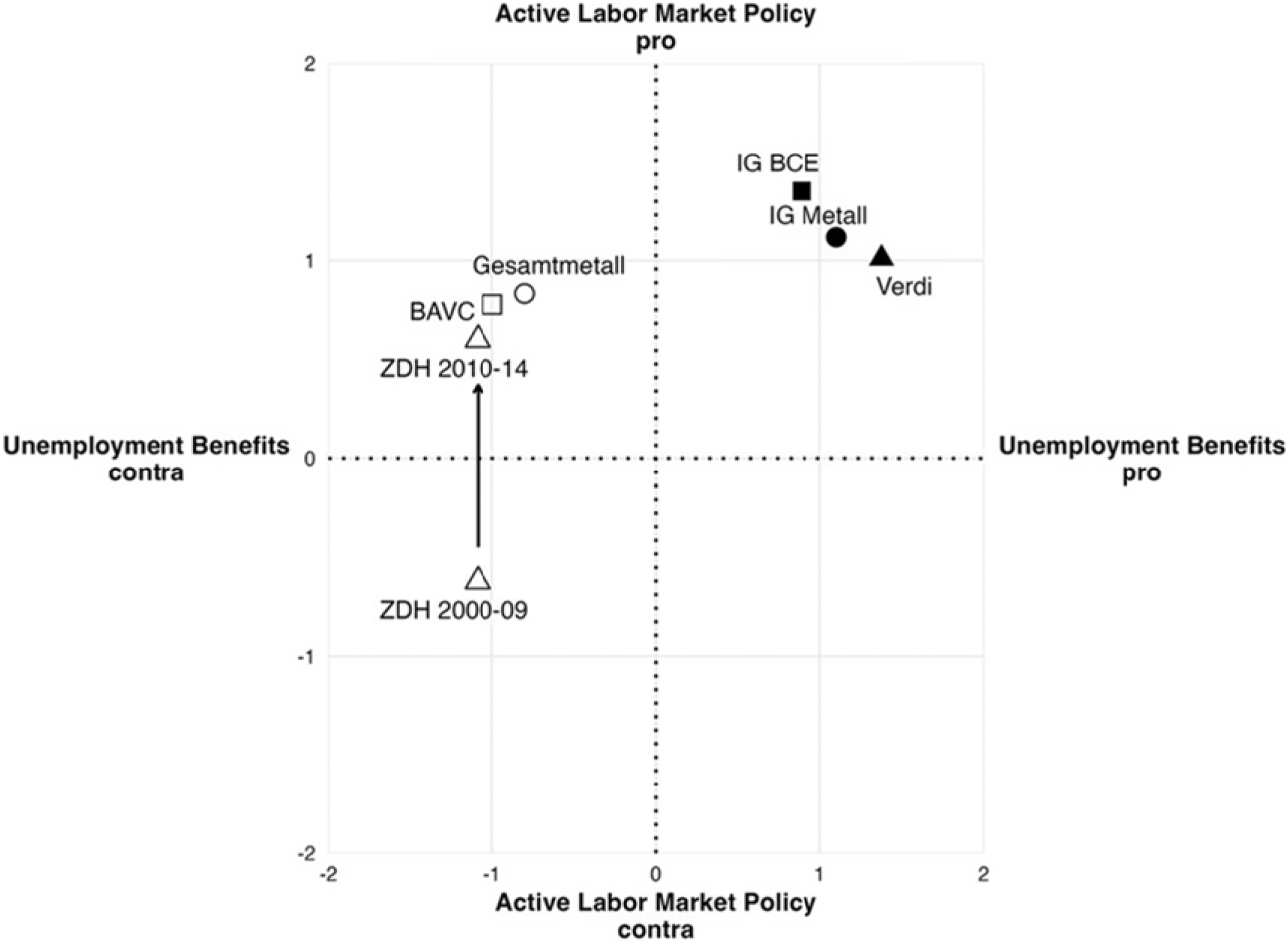
Figure 3 plots the stance of unions and employer associations on unemployment benefits on the x-axis, and their position on ALMP is plotted on the y-axis. The x-axis shows clearly a different position for the level of unemployment benefits. The unions support higher benefits for the unemployed because individuals should be able to manage hard-times without any risk of poverty, while the employer associations do not have an interest in expanding social benefits because such policies were too costly and would lead to negative economic consequences for their member companies.
Positioning of unions (IG BCE, IG Metall, Verdi) and employers’ organisations (Gesamtmetall, BAVC, ZDH) on unemployment benefits as a form of social compensation and active labour market policies as a form of social investment; cumulative period, 2000–2014 except for ZDH.

Regarding ALMP the picture is very different. The y-axis in Figure 3 shows that two out of three sector employer associations supported welfare state expansion from 2000 onwards and were therefore in line with the unions. After 2009, the third employer association, the skilled craft organisation (ZDH), also came to favour ALMP policies after the government coalition eliminated the temporary job creation programs. Of course, the interviews and press releases show minor differences in opinion regarding the financing of specific ALMP programs. However, and as Figure 3 shows, compared to the very clearly distinct positions with respect to compensation reforms (unemployment benefits), there is a comparatively minimal level of conflict between the social partners towards social investment strategy (ALMP).
On the one hand unions and employer associations support ALMP due to different motivations. The data show that the employer associations are interested in increasing labour market participation, thereby showing a positive stance towards ALMP measures. The lack of employees in many sectors was one of the main problems for employers in this time span and was perceived to be addressed by ALMP programs. Union motivations, on the other hand, were more complex. Some unions were equally concerned to maintain labour market participation and ensure the economic success of companies. This adds to the general trade union motivation to provide an opportunity for life-long learning across the whole workforce. All in all, a more complex set of partially overlapping motivations drives a common positive stance towards ALMP.
In section 7 I described the main theoretical implication of these findings. I suspect that a divergence of motivational factors combined with a consensus towards particular measures is specific to the concept of social investment (see for the same argument Garritzmann et al., Reference Garritzmann, Häusermann and Palier2017: 26). In other words, social investments serves multiple purposes for multiple groups, is therefore more likely to include a variety of different motivations and end up with the common support by the social partners for the same social policy instrument.
Another theoretical implication of these findings is they help us to understand how organisations position themselves on welfare state issues. On the one hand, the results on unemployment benefits show that the attitude towards welfare state politics can be explained by ideological difference, since both types of organisation are in conflict with each other. On the other hand, the results on ALMP show that some unions overlap more with employer association motivations and therefore the positions are better explained by pragmatic reasons and the organisation’s concern for its members’ interests. The existence of conflict or consensus between the social partners changes, depending on the topic and the extent to which an organisation’s members are affected. It is not mainly a question of ideology (labour vs. capital). When comparing data for two key topics (unemployment benefits and ALMP) clearly demonstrated this effect. Furthermore, I demonstrated that different employer associations had contrasting views on ALMP, which strengthens my argument that the type of organisation is not the main predictor of organisational position. In fact, we need to pay attention to pragmatic considerations and careful examination of how each welfare state reform affects individual organisations.
Further research is needed because we need to find out whether such a consensus and pragmatic considerations can be more widely seen in positions towards other social compensation and social investment policies, and across countries with different welfare state regimes or growth models; since institutional factors may well produce contrasting effects. In addition, the COVID-19 pandemic may also influence attitudes of social partners. More fundamentally, the extent of this crisis is actually likely to affect conflictual or homogeneous positioning by social partners in general.
Supplementary material
To view supplementary material for this article, please visit https://doi.org/10.1017/S0047279422000873
Acknowledgements
*I wish to thank Julian Garritzmann, Claudius Wagemann, Bernhard Ebbinghaus, Daniel Kinderman and Alexander Horn for their valuable comments on an earlier version of this paper. Furthermore, Thomas Paster and Dennie Oude Nijhuis as well as all other panel participants of the CES Conference 2022 in Lisbon for there comments. Last but not least, two anonymous reviewers for their helpful suggestions. **Until the end of 2019 the paper was prepared in the context of the Collaborative Research Centre (884) “Political Economy of Reforms” (139943784-SFB884), funded by the German Research Foundation (DFG) and conducted at the University of Mannheim. Other than this, the author received no financial support for the research of this article.
Declaration of Conflicting Interests
Competing interests: The author declares none.
Appendix
Simplified coding scheme