INTRODUCTION
Species interactions in ecological communities are one of the most intriguing and complex research endeavours. Traditionally, most emphasis has been placed on trophic interactions such as competition or seed dispersal, but other types of interaction exist (Krebs Reference KREBS2008, Smith & Smith Reference SMITH and SMITH2002). One interesting proposed type of non-trophic species interaction is ecosystem engineering (Jones et al. Reference JONES, LAWTON and SHACHAKM1994). Ecosystem engineers are species that modify the conditions or the availability of resources for other species by causing or maintaining physical changes in the abiotic or biotic environment (Jones & Gutiérrez Reference JONES, GUTIÉRREZ, Cuddington, Byers, Wilson and Hastings2007, Jones et al. Reference JONES, LAWTON and SHACHAKM1994, Reference JONES, LAWTON and SHACHAKM1997). These physical state changes can have both positive and negative ecological consequences. Studies have shown that at the local scale (the scale of the engineered patch, sensu Wright & Jones Reference WRIGHT and JONES2004) the creation, modification, maintenance or destruction of habitats or resources can have either positive (Cuddington et al. Reference CUDDINGTON, WILSON and HASTINGS2009, Jones et al. Reference JONES, LAWTON and SHACHAKM1997, Pringle Reference PRINGLE2008) or negative (Byers et al. Reference BYERS, CUDDINGTON, JONES, TALLEY, HASTINGS, LAMBRINOS, CROOKS and WILSON2006, Jones et al. Reference JONES, LAWTON and SHACHAKM1997) effects on the abundance or diversity of sympatric species (Hastings et al. Reference HASTINGS, BYERS, CROOKS, CUDDINGTON, JONES, LAMBRINOS, TALLEY and WILSON2007). On the other hand, most studies found positive effects on a landscape level (Crooks Reference CROOKS2002, Cuddington et al. Reference CUDDINGTON, BYERS, WILSON and HASTINGS2007, Jones et al. Reference JONES, LAWTON and SHACHAKM1994, Reference JONES, LAWTON and SHACHAKM1997).
The beaver (Castor canadensis) is the classic example of an ecosystem engineer in North America (Jones et al. Reference JONES, LAWTON and SHACHAKM1997, Stevens et al. Reference STEVENS, PASZKOWSKI and FOOTE2007, Wright et al. Reference WRIGHT, JONES and FLECKER2000). By damming streams, beavers physically modulate water flow and cause formation of lentic ponds and wetlands. Felling of trees and creating wetlands has negative effects for antecedent inhabitants (Jones et al. Reference JONES, LAWTON and SHACHAKM1997), while a new suite of plant and animal species subsequently colonizes the new habitats (Byers et al. Reference BYERS, CUDDINGTON, JONES, TALLEY, HASTINGS, LAMBRINOS, CROOKS and WILSON2006, Naiman et al. Reference NAIMAN, JOHNSTON and KELLY1988, Wright et al. Reference WRIGHT, JONES and FLECKER2000).
Another ecosystem engineer is the bison (Bison bison), which creates dust wallows in grassland ecosystems (Bragg Reference BRAGG1940, Gerlanc & Kaufman Reference GERLANC and KAUFMAN2003). High soil compaction and bulk density in such wallows cause greater retention of rainwater and formation of aquatic habitats (Coppedge et al. Reference COPPEDGE, FUHLENDORF, ENGLE and CARTER1999, Uno Reference UNO, Bock and Linhart1989). These modifications not only influence terrestrial plant distribution and richness (Polly & Collins Reference POLLY and COLLINS1984) but also create critical breeding habitats for numerous animal species including insects, fishes, salamanders and anurans (Bragg Reference BRAGG1940, Busby & Brecheisen Reference BUSBY and BRECHEISEN1997, Gerlanc & Kaufman Reference GERLANC and KAUFMAN2003, McHugh Reference McHUGH1972). Such non-trophic interactions are not captured with theoretical food web approaches or energy flow models (Buchman et al. Reference BUCHMAN, CUDDINGTON, LAMBRINOS, Cuddington, Byers, Wilson and Hastings2007, Cuddington et al. Reference CUDDINGTON, BYERS, WILSON and HASTINGS2007, Jones & Gutiérrez Reference JONES, GUTIÉRREZ, Cuddington, Byers, Wilson and Hastings2007).
In the Neotropics, Chacoan peccary (Catagonus wagneri, Rusconi), collared peccary (Pecari tajacu, Linnaeus) and white-lipped peccary (Tayassu pecari, Link) create and maintain wallows (Beck Reference BECK, Jorgensen and Fath2008, Gascon & Zimmerman Reference GASCON and ZIMMERMAN1998, Sowls Reference SOWLS1997). In arid habitats dust wallows dominate, whereas in more humid environments wallows are muddy and can form lentic bodies of water. Wallowing behaviour may be a form of grooming (Sowls Reference SOWLS1997), or a function of thermoregulation (Carrilla et al. Reference CARRILLA, SANZ and FULLER2002). Chapman (Reference CHAPMAN1936) provided one of the earliest accounts of a critical feature of peccary wallows when he noted: ‘Here, even in the heart of the dry season, there were evidences of water’ (see also Gascon Reference GASCON1995, Simberloff Reference SIMBERLOFF, Whitmore and Sayer1992, Zimmerman & Simberloff Reference ZIMMERMAN and SIMBERLOFF1996).
In tropical rain forests the only other terrestrial and lentic water bodies are naturally formed ponds, which occur primarily in soil depressions, old riverbeds, or pits left by uprooted trees. Ponds fill quickly after heavy rainfall or when the groundwater table rises during the rainy season (Murphy Reference MURPHY2003). Numerous studies document that, during the rainy season, a variety of anuran species uses both peccary wallows and ponds as foraging and breeding habitats (Duellman Reference DUELLMAN2005, Gascon Reference GASCON1991, Zimmerman & Simberloff Reference ZIMMERMAN and SIMBERLOFF1996). Habitat for anurans may become limited when the groundwater table drops and rainfall is less frequent during the dry season (Duellman Reference DUELLMAN2005). If the utilization of wallows by peccaries positively influences hydroperiod but does not affect the water quality (Cameron Reference CAMERON2008), wallows could be favourable foraging and breeding habitats for anurans.
In this study, we assessed if peccaries can be classified as ecosystem engineers by investigating whether wallows created and maintained by peccaries are habitats exploited by anuran species. We focused on how wallows affect anurans during the dry season. Specifically we hypothesized that, compared to naturally occurring ponds; peccary wallows will have (1) a longer hydroperiod; (2) similar water quality; (3) greater density of tadpoles, metamorphs and adult anurans; and (4) greater species richness and β-diversity.
METHODS
Study site
We conducted this study at Cocha Cashu Biological Station (11°54′S, 71°22′W), located in the south-eastern Amazonas within Manu National Park, Peru. With over 2 million hectares, Manu National Park represents one of the largest continuous and protected tropical forests in the world (Beck Reference BECK, Jorgensen and Fath2008, Terborgh Reference TERBORGH and Gentry1990). Because of Manu's pristine setting (i.e. no roads, and only accessible by a 3-day expedition in a boat), and exceptionally large diversity of habitats and species, UNESCO declared Manu as a World Heritage Site in 1987. Cocha Cashu Biological Station is one of the few research sites with both an undisturbed ecosystem and natural populations of both top predators and prey species including collared and white-lipped peccaries (Beck Reference BECK, Jorgensen and Fath2008, Terborgh Reference TERBORGH and Gentry1990). The station encompasses over 15 km2 of forest with more than 60 km of marked trails arranged in a grid system. Yearly rainfall averages 2000 mm with most precipitation occurring from November to May (Terborgh Reference TERBORGH and Gentry1990). An average of 100 mm of rain falls during the dry season, from June to October (Terborgh Reference TERBORGH and Gentry1990).
Survey of peccary wallows and ponds
Wallows could be distinguished from natural ponds by signs of peccary wallowing activities such as footprints, hair impressions in the mud, or mud spray on the surrounding vegetation. Peccaries visit wallows frequently and the oldest wallows have been used for at least 17 y. As herds of peccaries repeatedly utilize wallows, their activities, primarily trampling, digging and resting, maintain distinct microhabitats within the forest (i.e. no leaf litter and understorey vegetation; Beck Reference BECK, Jorgensen and Fath2008, Gascon & Zimmerman Reference GASCON and ZIMMERMAN1998). In contrast to wallows, vegetation occurred throughout pond areas and the soil is covered with leaf litter. We chose trails in a manner that allowed us to encounter a variety of soil types and microhabitats. We surveyed a total of 13.7 km of trails from April to November 2004. We extended this surveying to 25 km of trails from June to September 2007, which were re-surveyed between June and July in 2008. To determine the number of peccary wallows and ponds available during the dry seasons, we walked trails monthly and sampled all water bodies within 10 m on either side of the trails.
Hydroperiod of peccary wallows and ponds
At monthly intervals (April–November) in 2004, we estimated surface area by measuring the maximum length and the perpendicular width of standing water in each wallow (n = 21) and pond (n = 13). Because most water bodies were oval, we calculated surface areas using the formula for an ellipse.
We examined how strongly rainfall affected the hydroperiod of wallows and ponds by applying a linear regression with monthly rainfall as a predictor of mean monthly surface area. In order to test whether hydroperiod differed between wallows and ponds, we compared monthly mean surface area using a one-way repeated-measures ANOVA. Data were log-transformed to meet the underlying assumption of normality. Finally, we explored if there was a relationship between water area and the total number of anuran species encountered. For each wallow and pond we calculated the mean surface area across the dry season (April–November in 2004) and performed linear regressions using number of species (all three life stages combined) as a dependent variable.
Water quality parameters of peccary wallows and ponds
Physical and chemical water parameters such as pH, dissolved oxygen and temperature can affect the growth and survival of many anuran species (Duellman & Trueb Reference DUELLMAN and TRUEB1994). To explore if wallowing activity affects water parameters, in 2007 (June–September), we measured pH, dissolved oxygen and water temperature in wallows and ponds on a monthly basis using a handheld Oakton pH/DO 300 Meter. To minimize potential bias we randomized the time of data collection for the water bodies. Because the data did not meet the assumptions of normality, we used separate Mann–Whitney U-tests and compared the pooled data across the 3-mo period between water bodies.
Density of anuran species in peccary wallows and ponds
We sampled wallows and ponds for tadpoles, metamorphs and adult anurans monthly during a total of 14 mo across 3 years (2004, 2007 and 2008). Upon arriving at a water body, we searched and captured metamorphs and adults for at least 5 min across the total water surface and 1 m away from the water's edge until no further captures were made. We photographed captured individuals and, when necessary, took voucher specimens for identification and later verification by experts. To sample tadpoles, we dip-netted each water body using a metal strainer and aquarium fish net for at least 5 min or until no further captures occurred. We collected up to four voucher samples of each tadpole morphotype and reared them in the laboratory to facilitate species identification. We calculated monthly mean density of tadpoles, metamorphs and adult anurans in wallows and ponds by estimating monthly mean number of individuals for each water body per unit area of water surface and compared those using a one-way MANOVA. Because the data did not meet the statistical assumptions, we compared monthly numbers of tadpole, metamorph and adult anuran species between wallows and ponds using separate Mann–Whitney U-tests.
Adult species richness and β-diversity in peccary wallows and ponds
Because sample sizes for tadpoles and metamorphs were too small, we focused on adult anurans only. We first measured similarity of adult anuran β-diversity between water bodies by calculating a Morisita–Horn index with the program EstimateS ver. 8.0 (http://viceroy.eeb.uconn.edu/estimates). We chose the Morisita–Horn index because it is unbiased with respect to sample size and richness, and therefore is one of the most robust β-similarity indices (Cramer & Willig Reference CRAMER and WILLIG2004, Magurran Reference MAGURRAN2003).
Secondly, we estimated expected adult species richness by pooling the data within each water body and employing sample-based rarefaction statistics using EstimateS. The rarefaction statistics provide an unbiased estimate of expected species richness when sample effort is unequal or when an unequal number of individuals are observed across samples (Colwell & Coddington Reference COLWELL and CODDINGTON1994, Gotelli & Colwell Reference GOTELLI and COLWELL2001). We randomized the sample order 1000 times without replacement (Gotelli & Colwell Reference GOTELLI and COLWELL2001) and used the Chao 2 statistic (Chao Reference CHAO1987) to determine expected species richness. Statistical analyses were performed with PASW (2009, Version 17, Chicago, Illinois).
RESULTS
Hydroperiod of peccary wallows and ponds
We located 21 wallows and 13 ponds in 2004 and, after extending our survey area in 2007 and 2008, located a total of 61 wallows and 36 ponds. We found no evidence that peccaries used any pond for wallowing. On only three occasions did we find tapir (Tapirus terrestris, Linnaeus) footprints in wallows. We did not encounter faecal matter in wallows or ponds.
During the dry season of 2004, there was a strong positive relationship between monthly rainfall and mean surface area both for peccary wallows (F = 62.5, df = 1, 6, r2 = 0.912, P < 0.001) and ponds (F = 48.4, df = 1, 6, r2 = 0.890, P < 0.001).
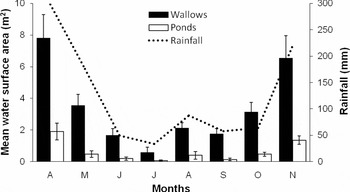
Comparison of the hydrology of both water bodies over the course of the dry season in 2004 revealed some striking differences. Over the course of 8 mo peccary wallows had consistently and significantly larger mean water surface areas than did ponds (F = 158, df = 1, 32, P < 0.001, Figure 1). During April and November, the two wettest months sampled with highest rainfall, wallows constituted 80% and 83%, respectively, of the total water surface. During July and September, the two driest months, the surface areas of wallows increased to 89% and 92%, respectively, of the total water surface. On average, wallows were dry for 1.5 mo whereas ponds were dry for 3 mo. Only one wallow was dry for 3 consecutive months, whereas three ponds dried up for 6 mo. There was a strong positive relationship between wallow water surface areas and the total number of anuran species (F = 32.7, df = 1, 20, r2 = 0.634, P < 0.001), but a weaker relationship for ponds (F = 8.9, df = 1, 12, r2 = 0.446, P = 0.013).
Mean (± 1 SE) water surface area of peccary wallows (n = 21) and ponds (n = 13) over 8 consecutive months across the entire dry season in 2004, at Cocha Cashu Biological Station, Peru.

Water quality parameters of peccary wallows and ponds
There were no monthly differences in pH (U = 97.5, P = 0.085), wallows: mean ± SE = 7.03 ± 0.0, ponds: 6.76 ± 0.1; dissolved oxygen (U = 88.0, P = 0.144), wallows: 23.5% ± 2.4%, ponds: 13.2% ± 5.5%; or water temperature (U = 112, P = 0.117), wallows: 23.6 °C ± 0.1 °C, ponds: 22.5 °C ± 0.6 °C between water bodies.
Density of anuran species in peccary wallows and ponds
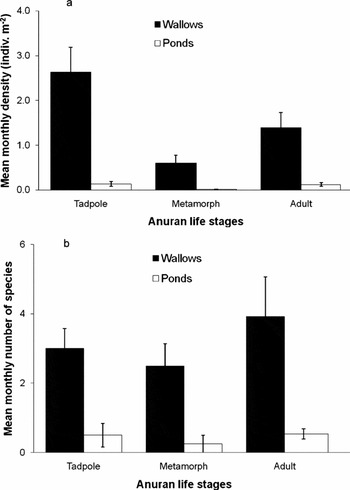
Across the dry seasons of three years, the mean monthly density of tadpoles was significantly greater (F = 45.6, df = 2, 26, P < 0.001) in wallows (2.6 ± 0.5 m−2) compared with ponds (0.1 ± 0.05 m−2, Figure 2a). Similarly, metamorph density was higher (F = 20.5, df = 2, 26, P < 0.001) in wallows (0.6 ± 0.1 m−2) than ponds (0.01 ± 0.009 m−2). The same was true for per month mean adult anuran density (F = 36.1, df = 2, 26, P < 0.001) when comparing wallows (1.3 ± 0.3 m−2) and ponds (0.1 ± 0.04 m−2, Figure 2a).
Comparisons of mean (± 1 SE) monthly densities (a) and mean (± 1 SE) monthly number of species (b) for all three anuran life stages in peccary wallows and naturally occurring ponds over the course of 14 mo during three dry seasons at Cocha Cashu Biological Station, Peru.

Adult species richness and β-diversity in peccary wallows and ponds
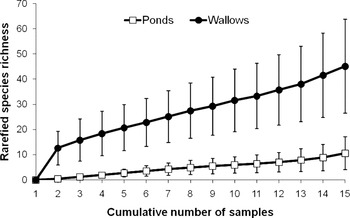
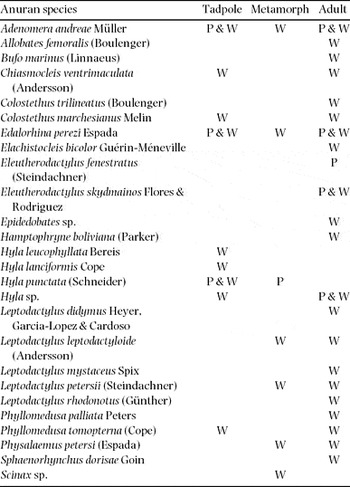
Along transects surveyed over the course of three dry seasons we found tadpoles of a total of nine species in wallows and three species in ponds. Metamorphs of six species occurred in wallows and only one in ponds. While adult anurans of 21 species occurred in wallows, only five species occurred in ponds (Figure 2b, Appendix 1). Overall, we found significantly higher mean monthly numbers of species for tadpoles (U = 2.00, P = 0.009), wallows: 3.0 ± 0.5, ponds: 0.5 ± 0.3; metamorphs (U = 0.50, P = 0.029), wallows: 2.5 ± 0.5, ponds: 0.2 ± 0.2; and adult anurans (U = 17.5, P < 0.001), wallows: 3.9 ± 1.1, ponds: 0.5 ± 0.1 in wallows compared with ponds (Figure 2b). Beta diversity of adult anurans (Morisita–Horn index) between the water bodies was 0.34. The rarefaction statistic indicated a difference in the estimated total expected species richness of adult anurans between peccary wallows: 45.1 (95% CI = 6.67–18.7) and ponds: 10.6 (95% CI = 0.0–6.53, Figure 3).
Rarefied species richness (± 95% CI) of adult anurans in peccary wallows and ponds over the course of 14 mo during three dry seasons at Cocha Cashu Biological Station, Peru.

DISCUSSION
The strong significant positive relationships between rainfall and the hydroperiods of both types of water body highlight their dependence on precipitation as the main water source during dry seasons. However, the hydroperiod expressed in mean monthly water surface area of wallows was consistently higher than for ponds. During the 7 mo in 2004, wallows represented between 80% and 92% of the total available water surface area along the 13.7 km transect. As demonstrated in previous studies, peccary activity enlarged and deepened wallows through time and thereby kept them from filling with debris (Cramer & Willig Reference CRAMER and WILLIG2004, Gascon & Zimmerman Reference GASCON and ZIMMERMAN1998, Simberloff Reference SIMBERLOFF, Whitmore and Sayer1992, Zimmerman & Bierregaard Reference ZIMMERMAN and BIERREGAARD1986). Several wallows at Cocha Cashu have been used for at least 17 y and may be much older. On numerous occasions, we encountered over 31 white-lipped peccaries rolling and resting in wallows. Repeated animal trampling can have major impacts on physical soil parameters, primarily resulting in higher soil compaction, reduced water penetration and lower soil water infiltration (Hamza & Anderson Reference HAMZA and ANDERSON2005, Kozlowski Reference KOZLOWSKI1999, Silvia et al. Reference SILVIA, REINERT and REICHERT2000, Terashima et al. Reference TERASHIMA, FUJII and MISHIMA1999). Furthermore, the impacts of trampling are higher at elevated soil moisture (Imhoff et al. Reference IMHOFF, SILVIA and TORMENA2000, Scholz & Hennings Reference SCHOLZ and HENNINGS1995), a condition found at wallows. One might argue that peccaries removed some water from wallows by splashing, or simply by soaking up water in their pelage and discarding it elsewhere by shaking or evaporation. Nevertheless, the amount of water removal might not be significant because our results confirmed that peccary wallows maintained longer hydroperiods than ponds. Water surface area was also a stronger predictor for the number of anuran species found in wallows than in ponds.
Our findings indicated that peccary activity did not significantly affect pH, dissolved oxygen and temperature in wallows; but all variables were higher in wallows than ponds. Preliminary chemical water analyses of nitrate, phosphate, ammonia and conductivity revealed no differences between water bodies (Cameron Reference CAMERON2008). We did not encounter faecal matter in any water body, suggesting that no additional organic matter was added that might have changed its chemical and microbial composition. Compared with ponds, the trampling and soil disturbance clearly reduced leaf litter and understorey vegetation in wallows. Differences in leaf litter decomposition might affect dissolved organic carbon and the microbial communities, but apparently did not affect water quality in wallows.
Over three dry seasons we found higher densities of all three anuran life stages in peccary wallows than in naturally formed ponds. Greater mean densities of tadpoles and metamorphs may indicate that anurans have higher reproductive activities in the more hydrologically stable wallows compared with the ephemeral ponds.
Monthly number of species of all three anuran life stages was also higher in wallows than ponds. We found tadpoles of six out of nine anuran species, six metamorphs out of seven anuran species, and adults of 17 out of 22 anuran species occurred only in peccary wallows. A small overlap of anuran species found as adults between water bodies was also evident by the low Morisita–Horn index (0.34). The number of adult anurans and estimated species richness were both higher for wallows. The non-asymptotic nature of the rarefaction curves suggests that continuing sampling would further increase the number of species, especially for wallows. However, the non-overlapping 95% CI indicates a difference in species richness. The fact that ponds dried up faster than wallows may explain why we found higher anuran density and species richness in peccary wallows (Cameron Reference CAMERON2008, Gascon Reference GASCON1991, Reference GASCON1995; Zimmerman & Bierregaard Reference ZIMMERMAN and BIERREGAARD1986, Zimmerman & Simberloff Reference ZIMMERMAN and SIMBERLOFF1996).
A few previous studies investigated anuran communities in peccary wallows; however, all were conducted during rainy seasons when other water bodies were also available (Gascon Reference GASCON1991, Reference GASCON1992, Reference GASCON1995; Zimmerman & Simberloff Reference ZIMMERMAN and SIMBERLOFF1996). Nevertheless, their findings parallel ours. For instance, in Brazil, Gascon (Reference GASCON1991) found a significantly higher mean number of anuran species in peccary wallows (5.5) compared with ponds (4.8). Furthermore, tadpole density of the four most common anuran species was significantly higher in peccary wallows than ponds (Gascon Reference GASCON1995). Other studies encountered up to seven anuran species breeding exclusively in wallows during the rainy season (Zimmerman & Bierregaard Reference ZIMMERMAN and BIERREGAARD1986, Zimmerman & Simberloff Reference ZIMMERMAN and SIMBERLOFF1996). The last two studies were carried out in experimentally fragmented forests, ranging in size from 10 to 500 ha, and contained only the collared peccary at the beginning of the experiment. The more gregarious white-lipped peccary was already locally extinct. Once the collared peccary vanished from these fragments, several anuran species had reduced abundance and some went locally extinct (Zimmerman & Bierregaard Reference ZIMMERMAN and BIERREGAARD1986). A number of studies linked the local decline or extinction of numerous anuran species with the disappearance of peccaries and their wallows as breeding habitats (Laurance et al. Reference LAURANCE, LOVEJOY, VASCONCELOS, BRUNA, DIDHAM, STOUFFER, GASCON, BIERREGAARD, LAURANCE and SAMPAIO2002, Simberloff Reference SIMBERLOFF, Whitmore and Sayer1992, Zimmerman & Bierregaard Reference ZIMMERMAN and BIERREGAARD1986). Consequently, we could infer that peccary wallows are crucial breeding habitats for several anuran species, even during the rainy season. Wallows may maintain anuran population densities and species richness, not only by providing critical water resources for rehydration and foraging habitat, but also by acting as stepping stones through the forest, thereby increasing dispersal distance and genetic diversity (Duellman Reference DUELLMAN2005, Marsh et al. Reference MARSH, FEGRAUS and HARRISON1999). We found that understorey vegetation, including seedlings and saplings, grows in and at the vicinity of ponds. Conversely, this is not the case at wallows. Trampling and wallowing activities destroy vegetation (see also Gascon & Zimmerman Reference GASCON and ZIMMERMAN1998) and thereby can have negative effects on plant recruitment and distributions.
In conclusion, this was the first study to systematically contrast the hydroperiods, water parameters, anuran density and species richness across dry seasons between peccary wallows and ponds within an intact ecosystem where both species of peccary occur at natural densities. The results indicate that peccaries maintain and alter the hydroperiods of wallows thus making a limited resource available to anurans. Wallows function as aquatic habitats that support increased anuran density, β-diversity and species richness. Therefore, by definition peccaries can be considered ecosystem engineers. These findings are also important for conservation and management. Habitat destruction and overhunting have increased local and regional extinctions of peccaries throughout their geographic range (Beck Reference BECK, Forget, Lambert, Hulme and Vander Wall2005, Reference BECK, Jorgensen and Fath2008; Taber et al. Reference TABER, CHALUKIAN, ALTRICHTER, MINKOWSKI, LIZÁRRAGA, SANDERSON, RUMIZ, VENTINCINQUE, MORAES, ANGELO, ANTÚNEZ, AYALA, BECK, BODMER, BOHER, CARTES, BUSTOS, EATON, EMMONS, ESTRADA, FLAMARION DE OLIVEIRA, FRAGOSO, GARCIA, GOMEZ, GÓMEZ, KEUROGHLIAN, LEDESMA, LIZCANO, LOZANO, MONTENEGRO, NERIS, NOSS, VIEIRA, PAVIOLO, PEROVIC, PORTILLO, RADACHOWSKY, REYNA-HURTADO, RODRIGUEZ ORTIZ, SALAS, DUENAS, SARRIA PEREA, SCHIAFFINO, THOISY, TOBLER, UTRERAS, VARELA, WALLACE and ZAPATA RÍOS2008). Studies demonstrated that their extinction resulted in the eliminations of critical non-redundant trophic interactions (e.g. seed predation and dispersal; Beck Reference BECK, Forget, Lambert, Hulme and Vander Wall2005, Reference BECK2006), and non-trophic species interactions (Beck Reference BECK, Jorgensen and Fath2008, Gascon & Zimmerman Reference GASCON and ZIMMERMAN1998, Zimmerman & Bierregaard Reference ZIMMERMAN and BIERREGAARD1986). Both trophic and non-trophic interactions of peccary with other species contribute and maintain Neotropical forest structure and species diversity (Beck Reference BECK, Forget, Lambert, Hulme and Vander Wall2005, Reference BECK2006; Gascon & Zimmerman Reference GASCON and ZIMMERMAN1998, Taber et al. Reference TABER, CHALUKIAN, ALTRICHTER, MINKOWSKI, LIZÁRRAGA, SANDERSON, RUMIZ, VENTINCINQUE, MORAES, ANGELO, ANTÚNEZ, AYALA, BECK, BODMER, BOHER, CARTES, BUSTOS, EATON, EMMONS, ESTRADA, FLAMARION DE OLIVEIRA, FRAGOSO, GARCIA, GOMEZ, GÓMEZ, KEUROGHLIAN, LEDESMA, LIZCANO, LOZANO, MONTENEGRO, NERIS, NOSS, VIEIRA, PAVIOLO, PEROVIC, PORTILLO, RADACHOWSKY, REYNA-HURTADO, RODRIGUEZ ORTIZ, SALAS, DUENAS, SARRIA PEREA, SCHIAFFINO, THOISY, TOBLER, UTRERAS, VARELA, WALLACE and ZAPATA RÍOS2008).
ACKNOWLEDGEMENTS
The Instituto Nacional de Recursos Naturales permitted access to Manu National Park. Funding was provided by a Sigma Xi, Grant-in-Aid of Research and the Towson University Graduate Student Association. Anuran identifications were verified by R. McDiarmid, R. Altig, L. Rodriguez and W. A. Arriaga. We thank K. Ledesma, F. Nisho, G. Lurdes, J. Li, K. Farris, C. Cosmopolis, C. Bravo and B. Johansson for tireless assistance and fun in the field. Statistical advice was provided by E. Scully and J. Snodgrass. This manuscript was improved by S. Johnson and J. Hull.
Life stages and anuran species found in 36 ponds (P) and 61 wallows (W) during dry seasons in 2004, 2007 and 2008 in Cocha Cashu Biological Station, Peru.