INTRODUCTION
Within the past several decades, there has been a dramatic increase in the prevalence of illicit drug use (Johnson & Gerstein, Reference Johnson and Gerstein1998; Degenhardt et al. Reference Degenhardt, Lynskey and Hall2000). While cannabis remains the most commonly used illicit drug, substantial minorities of people also report the use of other illicit drugs. For example, among people aged 12 years and older in the U.S., it has been estimated that 46·4% have ever used cannabis, 14·7% have ever used cocaine, 1·6 have used heroin, 14·5% have used hallucinogens, 9·7% have used inhalants and 20·1% have ever used prescribed pharmaceuticals non-medically (Substance Abuse and Mental Health Services Administration, 2004).
While many people who use illicit drugs may do so only infrequently, there are a substantial proportion of users who go on to develop a range of problems as a consequence of their illicit drug use. Within the DSM (APA, 1994) system of nomenclature, such problems are assessed using criteria for substance abuse and/or substance dependence, the criteria for which are largely based on those derived for alcohol (Edwards & Gross, Reference Edwards and Gross1976). Despite their widespread application, the appropriateness of these criteria for assessing abuse and dependence across a spectrum of illicit drugs with distinct pharmacological properties remains questionable, yet relatively under-researched (Budney, Reference Budney2006; Hughes, Reference Hughes2006).
In particular, within the alcohol and, to a lesser extent, cannabis literature there have been multiple studies that have examined issues relating to the dimensionality of alcohol use disorders using methods of factor analysis, item response modeling and more recently, taxometric techniques (e.g. mean above minus below a cut – MAMBAC). Factor analysis is the critical first step to addressing concerns surrounding dimensionality. This method is exploratory and can be used to test whether abuse and dependence form distinct abuse and dependence factors (which, may or may not be orthogonal) or whether all criteria load on a single (uni-dimensional) factor. Item response models are comparable to this latter, single confirmatory single-factor model, in that they assume that there is a uni-dimensional construct underlying abuse and dependence criteria and that given an individual's liability (or factor score), they are more or less likely to endorse certain criteria. Taxometric techniques, on the other hand, test the hypothesis of whether the covariation between abuse and dependence criteria is indicative of a latent structure that is dimensional or categorical/taxonic (Meehl, Reference Meehl1995). Other ‘aggregative’ techniques, such as latent class analysis (McCutcheon, Reference McCutcheon1987) and cluster analysis (Tyron, Reference Tyron1939) have also been applied.
There have been several studies testing the applicability of dependence criteria to illicit drug-related problems, although the bulk of these have been based on the analysis of data from clinical or other selected populations. Furthermore, they have produced inconsistent results, with some studies supporting the coherence of dependence (Hasin et al. Reference Hasin, Grant, Harford and Endicott1988; Morgenstern et al. Reference Morgenstern, Langenbucher and Labouvie1994; Feingold & Rounsaville, Reference Feingold and Rounsaville1995; Nelson et al. Reference Nelson, Rehm, Ustun, Grant and Chatterji1999; Swift et al. Reference Swift, Hall and Teesson2001; Langenbucher et al. Reference Langenbucher, Labouvie, Martin, Sanjuan, Bavly, Kirisci and Chung2004) while others have identified multiple factors underlying dependence criteria (e.g. Kosten et al. Reference Kosten, Rounsaville, Babor, Spitzer and Williams1987). Additionally, these studies have typically examined dependence criteria only and have not considered the psychometric properties of criteria for illicit drug abuse. One study did, however, report that there is a single dimension underlying cannabis abuse and dependence criteria (Teesson et al. Reference Teesson, Lynskey, Manor and Baillie2002), although examination of item characteristic curves [calculated using item response theory (IRT) criterion characteristic curves (Muthen & Lehman, Reference Muthen and Lehman1985)] suggested some discrepancies between item properties and the DSM conceptualization. Specifically, several of the dependence criteria discriminated between people with relatively low degrees of cannabis-related problems while conversely, several of the abuse items discriminated at a high level of cannabis-related problems. We have previously tested factor models for cannabis abuse and dependence criteria in NESARC (Agrawal & Lynskey, Reference Agrawal and Lynskeyin press) and reported similar results to those from the Australian study by Teesson et al. (Reference Teesson, Lynskey, Manor and Baillie2002). A shortcoming of this extant literature is that relatively little attention has been paid to similarities and differences in the factor structure and/or criterion responses across classes of drugs (Gillespie et al. Reference Gillespie, Neale, Prescott, Aggen and Kendlerin press). It is likely, that this limitation is in large part due to the low prevalence of abuse/dependence of some illicit drugs.
A further issue concerning the dimensionality of substance use disorders centers on ‘diagnostic orphans’ – individuals who do not meet criteria for abuse or for dependence but who do endorse one or two dependence criteria. Concerns have been raised that such individuals may experience significant substance-related problems but, because of the diagnostic conventions of the DSM system, do not meet criteria for a substance use disorder. To date, the majority of studies examining this aspect of nomenclature appear to have focused on alcohol (Hasin & Paykel, Reference Hasin and Paykin1998, Reference Hasin and Paykin1999; Pollock & Martin, Reference Pollock and Martin1999; Sarr et al. Reference Sarr, Bucholz and Phelps2000; Eng et al. Reference Eng, Schuckit and Smith2003) while only one study has examined this issue in relationship to cannabis use disorders (Degenhardt et al. Reference Degenhardt, Lynskey, Coffey and Patton2002). A consideration of this literature suggests several conclusions: first, the percentage of individuals who meet criteria for at least one dependence symptom but who are labeled as orphans appears quite high: between 13·7% and 41·1% for alcohol (Pollock & Martin, Reference Pollock and Martin1999; Sarr et al. Reference Sarr, Bucholz and Phelps2000; Eng et al. Reference Eng, Schuckit and Smith2003) and an estimated 21% for cannabis (Degenhardt et al. Reference Degenhardt, Lynskey, Coffey and Patton2002). While, to the best of our knowledge, no previous study has examined the prevalence and characteristics of ‘diagnostic orphans’ for other illicit substance use, the consistency of findings between alcohol and cannabis suggests that a substantial proportion of people meeting at least one criteria for an illicit drug problem may be labeled as ‘diagnostic orphans’ and that such individuals may be at heightened risks for drug-related and other mental health problems, relative to individuals experiencing no abuse or dependence criteria.
Closely related to the concept of ‘diagnostic orphans’ are issues relating more broadly to the dimensional or categorical nature of substance use disorders. Current conventions assign classifications of ‘dependent’ or ‘non-dependent’ yet there is likely to be a spectrum of symptom severity. For instance, Grant et al. (Reference Grant, Scherrer, Neuman, Todorov, Price and Bucholz2006) have shown that the latent classes identified for cannabis use disorders are representative of a spectrum of severity and that they do not distinguish classes of individuals with abuse or dependence. A recent taxometric study by Denson & Earleywine (Reference Denson and Earleywine2006) has also shown that a dimensional interpretation of cannabis dependence is favored over a taxonic one. While our discussion of diagnostic orphans addresses issues relating to individuals who have 1–2 dependence symptoms and therefore do not meet formal criteria for abuse or dependence, it is also the case that, among those meeting criteria for abuse (but not dependence), there may be gradations of severity with some individuals meeting criteria for abuse only while others meet criteria for abuse as well as 1–2 dependence symptoms. Similarly, among individuals meeting criteria for dependence, some may also exhibit symptoms of abuse while others do not.
Against this general background, we use data from a large and representative sample of the U.S. general population – the National Epidemiologic Survey on Alcohol and Related Conditions (NESARC; Grant et al. Reference Grant, Kaplan, Shepard and Moore2003b) to examine a number of issues related to the psychometric properties of DSM-IV assessments of illicit drug use symptomatology. First, we examine the factor structure of illicit drug use disorders (cannabis, cocaine, sedatives, tranquilizers, stimulants, hallucinogens, opiates and inhalants). Second, we report difficulty and discrimination parameters from an item response analysis of the individual abuse and dependence criteria for each illicit drug class. Third, we explore the spectrum of illicit drug symptomatology and the extent to which this spectrum of severity covaries with diagnoses of common mental health problems, including major depressive disorder, generalized anxiety disorder, panic disorder (with or without agoraphobia), specific phobias, social phobia, antisocial personality disorder, alcohol abuse/dependence and nicotine dependence.
METHOD
Sample
The NESARC is a nationally representative sample of 43 093 participants aged 18–99 years. Comprehensive details regarding the survey design and sample characteristics are available elsewhere (Grant et al. Reference Grant, Kaplan, Shepard and Moore2003b). Collected during 2001–2002 by the U.S. Bureau of Census on behalf of the National Institute on Alcohol Abuse and Alcoholism, the sample includes data from adult, non-institutionalized U.S. citizens and non-citizens (including Alaska and Hawaii). Approximately 57% of the sample is female and 19% of the sample is Hispanic (76% Caucasian), with an over-sampling for non-Hispanic Black households and for young adults aged 18–24 years. After complete description of the study to the subjects, informed consent was obtained. Statements regarding the strict confidentiality of respondent privacy are available at http://niaaa.census.gov/confidentiality.html.
Measures
The Alcohol Use Disorder and Associated Disabilities Schedule (AUDADIS-IV) module was used for interviews (Grant et al. Reference Grant, Dawson, Stinson, Chou, Kay and Pickering2003a). Individual DSM-IV criteria (APA, 1994) of illicit drug abuse and dependence were assessed for their occurrence in the last 12 months and in the period prior to those last 12 months only in those who reported lifetime illicit drug use. Illicit drug categories assessed in this interview were: cannabis, cocaine, stimulants, sedatives, tranquilizers, opiates, hallucinogens and inhalants.
A lifetime endorsement of each of the four abuse and seven dependence criteria was created by combining across the 12-month and prior to 12-month endorsements. Criteria for abuse included: (i) Legal (legal problems/getting arrested); (ii) Failure (failure to fulfill major role obligations); (iii) Hazard (use in hazardous situations); and (iv) Continue (continued use despite trouble with friends or family). Criteria for dependence included: (i) Tolerance; (ii) Withdrawal; (iii) Intend (using larger amounts/for longer than intended); (iv) Give up (give up or cut down on important activities); (v) Problems (use of drug despite health/psychological problems); (vi) Time (spent time getting or using drug); and (vii) Quit (more than once trying to stop or cut down use of drug). The assessment of alcohol and illicit drug use disorders using the AUDADIS has been detailed previously (Stinson et al. Reference Stinson, Grant, Dawson, Ruan, Huang and Saha2005; Dawson et al. Reference Dawson, Grant, Stinson and Zhou2005).
Statistical analyses
One- and two-factor (orthogonal and oblique) confirmatory models (CFA) were fitted to data for abuse and dependence criteria for each of the eight illicit drug classes. Model-fitting was performed in MPlus (v4; Muthen & Muthen, Reference Muthen and Muthen2006) using the robust maximum-likelihood ratio (MLR) estimator, which is suited to the analysis of data from complex survey designs and for missing data analyses, such as criterion data in those who had never used the substance. Criterion data for every individual who had responded to the lifetime use question for each drug was used and lifetime non-users were assigned a missing value. Data were weighted, clustered on primary sampling units (PSU) and appropriately stratified to allow generalizability to the U.S. population. NESARC weights are computed as a product of the base weight (product of conditional probabilities of selection of PSU within stratum and of housing unit within PSU) and of individual weighting factors (e.g. usual residence elsewhere adjustments). Details regarding weight estimates, selection of sampling units and stratification are available in Grant et al. (Reference Grant, Kaplan, Shepard and Moore2003b).
One advantage of using the MPlus (v4) software (Muthen & Muthen, Reference Muthen and Muthen2006) is that it allows the computation of item response parameters (Birnbaum, Reference Birnbaum, Lord and Norvick1968) by default for a one-factor CFA. Criterion difficulty and discrimination, which are key to the conceptualization of an item response model, were computed using a 2-parameter (2P) logistic model with logit function L=1·7∗a(θ−b), where a=discrimination, or the ability of a criterion to distinguish individuals with high liability from individuals with low liability; b=difficulty, or the location along the underlying distribution where the criterion functions; and θ=the liability distribution for each substance use disorder.
Parameters from the CFA can be easily converted to discrimination and difficulty parameters (Muthen, Reference Muthen1985; Takane & de Leeuw, Reference Takane and de Leeuw1987; MacIntosh & Hashim, Reference MacIntosh and Hashim2003). For instance ‘a’ or discrimination is representative of the factor loading, or whether a criterion is overall a good indicator of the underlying factor structure. The criterion discrimination parameter may be computed by multiplying the parameter estimate for that criterion with the square root of the factor variance and dividing the product by a constant 1·7 to approximate the probit scale. Likewise, ‘b’ or difficulty is a location index or representative of the threshold of an individual criterion along the liability distribution. It is computed by dividing the standardized threshold by the factor loading. In other words, criterion difficulty reflects the proportion of individuals endorsing the criterion. A difficult (or hard) criterion has a higher threshold (i.e. is endorsed by fewer people) and is less likely to be endorsed than an easy criterion.
Note that we opted to use the 2P model, where P(θ), the probability of endorsing a criterion at a given liability level, was computed as P(θ)=1/1+exp(−L), where L=1·7∗a(θ−b) (see also the technical appendix available at http://www.statmodel.com/download/MplusIRT1.pdf). An alternative, more parsimonious model, the 1-parameter (Rasch, Reference Rasch1960, Reference Rasch1966) model is also possible, where all criteria are assumed to discriminate equally. We tested this model across all substances by constraining the factor loadings (i.e. equal discriminations) across criteria for each substance. In all cases, this constraint led to a serious deterioration of model fit. For instance, for cannabis use disorders, the difference in log-likelihood fit for the Rasch model (with 12 parameters=11 thresholds and 1 loading) and the 2P model (with 22 parameters=11 thresholds+11 loadings) was 381·5 (for 10 df, p value <0·0001). Similarly, for cocaine use disorders, the deterioration in fit with the Rasch model was 217·7. Therefore, we pursued the 2P model for our analyses.
RESULTS
Confirmatory factor models of abuse and dependence criteria
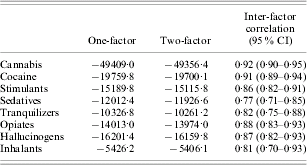
Table 1 summarizes the fit indices for one- and two-factor models and the estimated inter-factor correlation derived from the two-factor model for each of the eight illicit drug categories. While, across each of the eight drug classes, the two-factor model provided a better fit to the data, the estimated inter-factor correlations were exceptionally high, ranging from 0·77 for sedatives to 0·92 for cannabis. The improvement in model fit associated with the two-factor model may be partially a function of large sample size (Bentler, Reference Bentler1990). With larger samples, especially those as large as NESARC, trivial rejections of more parsimonious models (i.e. in favor of more saturated models) can occur. Given this, and the high inter-factor correlations, the observed pattern of results are consistent with the conclusion that there is a single continuum of severity underlying the abuse and dependence criteria for each of the eight drug classes, overlaid by correlated error structure.
Log likelihood model fit for one- and two-factor models, and estimated inter-factor correlations from the two-factor models

The two-factor model requires 2 degrees of freedom.
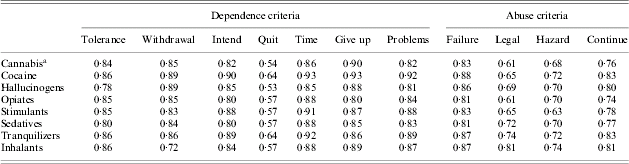
The factor loadings from one-factor models of abuse and dependence for each of the eight drug categories are summarized in Table 2. These analyses produced a consistent pattern of results: The factor loadings were uniformly high and there also appeared to be considerable consistency in the relative magnitude of the loadings for each item across substances.
Standardized factor loadings for illicit substance abuse and dependence criteria
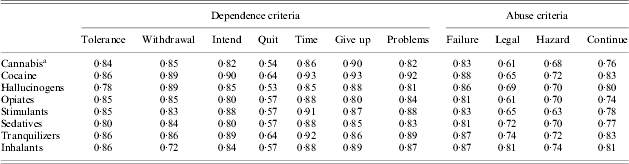
All factor loadings are statistically significant (p<0·0001).
a These estimates though similar to those previously reported in Agrawal & Lynskey (Reference Agrawal and Lynskeyin press) involve a different methodological strategy.
Item response models
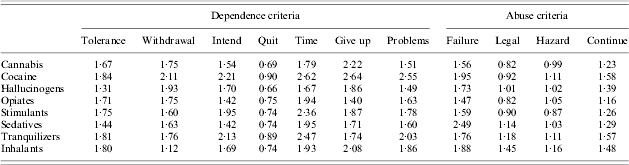
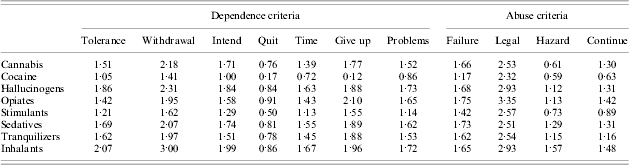
Assuming a one-factor model for substance use disorders, item response characteristics were also obtained to depict criterion function. Tables 3a and 3b summarize the discrimination and difficulty parameters for each criterion across each drug category derived from the results of a series of 2P item response models. Note that difficulty parameters are a function of both factor loadings (from Table 2) and thresholds, while the discrimination parameter is derived from unstandardized estimates of the factor loading and the variance of the underlying factor. There was broad consistency of parameter estimates across substance use categories and a number of interesting observations stem from Tables 3a and 3b. First, it appears that certain criteria have poor discriminative value, regardless of drug class. The most prominent examples of this are the abuse criteria of ‘legal difficulties’ and ‘hazardous use’, and the dependence criterion of ‘trying but being unable to quit’. Second, the results are particularly notable for the relative difficulties of abuse versus dependence criteria. Despite abuse theoretically representing a less severe manifestation of substance use disorders, the ‘legal difficulties’ criterion had the highest criterion difficulty across each of the eight drug categories studied. Conversely, despite its designation as an indicator of dependence, the symptom of ‘trying but being unable to quit’ consistently had the lowest criterion difficulty for each drug category. Thus, the overall pattern of criterion difficulty did not appear to support DSM specifications of the relative severity of abuse and dependence symptoms.
Item discrimination parameters for illicit substance abuse and dependence criteria

Item discrimination is calculated as the unstandardized parameter estimate for the factor loading multiplied by the square root of the total factor variance and the product divided by 1·7 to approximate the probit scale. For instance, for the hazard criterion for cocaine use disorders, the unstandardized parameter estimate for the factor loading was 0·60, the total variance in the factor representing cocaine use disorders was 9·70, and therefore item discrimination=(0·601∗√9·70)/1·7, which gives 1·11. The discrimination parameter reflects the extent to which the criterion distinguishes between individuals with relatively higher versus lower liability. In item characteristic curves, discrimination=slope.
Item difficulty parameters for illicit substance abuse and dependence criteria

Item difficulty was computed as the standardized threshold/factor loading from Table 2. Therefore, to obtain the difficulty for say, the Hazard criterion for cocaine use disorders, we would divide threshold/0·72=0·59; or standardized threshold=0·43.
Prevalence of illicit drug use disorders and symptomatology
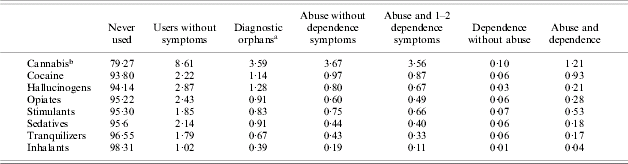
Table 4 shows the prevalence of illicit drug use and symptomatology for the eight drug classes. The most commonly used illicit drug was cannabis (20·7%) and the least commonly used was inhalants (1·7%) while other drug categories were used by between 3·4% and 6·2% of the sample. The information contained in this table can also be used to calculate the proportion of users, and of those meeting criteria for any abuse or dependence symptom, who were categorized as ‘diagnostic orphans’ or who met full criteria for abuse or dependence.
Weighted prevalence of categories of substance use disorders in 43 093 adult participants of NESARC

a Individuals meeting criteria for 1–2 dependence symptoms but not abuse.
b For these analyses, withdrawal was excluded from the dependence criteria for cannabis, consistent with the DSM-IV formulation.
A considerable proportion of lifetime users met criteria for at least one symptom of abuse or dependence: 40% of lifetime users of inhalants met criteria for at least one symptom of abuse/dependence while 69% of lifetime cocaine users met criteria for at least one symptom. The probabilities of experiencing any symptom of abuse/dependence for the other drug classes varied between these extremes.
Importantly, a relatively high proportion of those reporting at least one symptom did not meet formal diagnostic criteria for abuse or dependence, and were therefore labeled as ‘diagnostic orphans’: this varied from 29% for cocaine and stimulants to 51% for inhalants.
There was also further evidence of a spectrum of symptomatology with between 39% (for inhalants) and 49% (for cannabis) of those who received a formal diagnosis of abuse also meeting criteria for one or two dependence criteria. Finally, among those meeting criteria for dependence on any specific drug class, a very high proportion (between 74% and 94%) also met criteria for abuse.
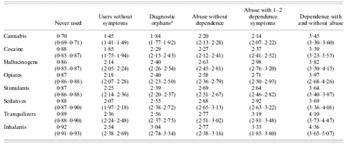
Table 5 shows the mean number of co-morbid DSM-IV psychiatric disorders [major depressive disorder, generalized anxiety disorder, panic disorder (with or without agoraphobia), specific phobias, social phobia, antisocial personality disorder, alcohol abuse/dependence and nicotine dependence] across the above categories of symptomatology. Due to the small number of individuals meeting criteria for dependence but not abuse, the final column of this table includes all individuals meeting criteria for dependence, regardless of whether or not they also met criteria for abuse. Rates of psychiatric disorders were substantially lower in those who had never used a specific drug than in users (regardless of whether they endorsed any symptoms). Additionally, lowest mean rates of disorder occurred in users who reported no abuse or dependence symptomatology. Diagnostic orphans had elevated rates of psychopathology although these were approximately equal to or less than rates among those meeting criteria for abuse. Interestingly, there appeared to be no consistent difference in rates of psychopathology in people meeting criteria for abuse, depending on whether they also reported one or two dependence symptoms. Finally, individuals meeting criteria for dependence had the highest mean rates of psychopathology.
Mean number (with 95% confidence limits) of co-morbid disorders according to substance use disorders classification

a Disorders include major depressive disorder, generalized anxiety disorder, panic disorder (with or without agoraphobia), specific phobias, social phobia, antisocial personality disorder, alcohol abuse/dependence and nicotine dependence.
DISCUSSION
In this paper we have explored a number of issues relating to the criterion performance of DSM-IV symptoms for illicit substance use disorders, as well as issues relating to the classification and dimensionality of these disorders. Despite the widespread application of these criteria to illicit substance use, these issues have been relatively unexplored (Budney, Reference Budney2006; Hughes, Reference Hughes2006), doubtless due to the large sample sizes needed to examine them. We have been able to capitalize on the extremely large sample size of NESARC, enabling us to examine these issues as they relate to even rarely used illicit drugs such as opiates and hallucinogens. Several features of these results are noteworthy:
First, across all drug categories, correlations between factors in two-factor solutions were uniformly high (0·77–0·92) suggesting that a one-factor model provided the most parsimonious representation of the inter-relationships between abuse and dependence criteria. There are clear parallels between this finding and the existing literature (Hasin et al. Reference Hasin, Grant, Harford and Endicott1988; Morgenstern et al. Reference Morgenstern, Langenbucher and Labouvie1994; Feingold & Rounsaville, Reference Feingold and Rounsaville1995; Nelson et al. Reference Nelson, Rehm, Ustun, Grant and Chatterji1999; Swift et al. Reference Swift, Hall and Teesson2001; Teesson et al. Reference Teesson, Lynskey, Manor and Baillie2002), yet this is one of the first studies both to include abuse symptomatology and to extend such findings to illicit drug categories other than cannabis.
Despite this, there were also clear departures between DSM characterizations of symptom severity and our empirical results. In particular, the item referring to legal difficulties appeared to represent an extreme form of problems (contrary to its designation as an abuse item in DSM) while conversely, the dependence symptom of wanting to cut down or quit appeared to represent a relatively minor form of problem. There are also several parallels between our results and those reported by Saha et al. (Reference Saha, Chou and Grant2006) in an IRT analysis of alcohol abuse and dependence criteria, based on the same sample (NESARC) as the current analyses. Specifically, Saha et al. (Reference Saha, Chou and Grant2006) concluded that the DSM abuse and dependence criteria formed a single continuum of severity with several of the abuse criteria tapping into the relatively more severe end of the continuum. They further questioned the utility of the ‘legal problems’ criterion and concluded that their results did not support the validity of the DSM distinction between abuse and dependence.
An additional issue examined in these analyses centered on the characteristics of ‘diagnostic orphans’ (Hasin & Paykel, Reference Hasin and Paykin1998, Reference Hasin and Paykin1999; Pollock & Martin, Reference Pollock and Martin1999; Sarr et al. Reference Sarr, Bucholz and Phelps2000; Degenhardt et al. Reference Degenhardt, Lynskey, Coffey and Patton2002; Eng et al. Reference Eng, Schuckit and Smith2003) and, more broadly, the extent to which current abuse and dependence conceptualizations are better represented by a spectrum of severity (Helzer et al. Reference Helzer, van den Brink and Guth2006; Muthen & Muthen, Reference Muthen and Muthen2006). Again, perhaps the most striking finding to emerge from these analyses was the consistency of findings across multiple drug classes. First, between 29% and 51% of all those who reported at least one symptom of abuse or dependence did not meet diagnostic criteria for abuse/dependence and were therefore labeled as ‘orphans’. Despite not receiving a diagnosis for a substance use disorder these individuals had elevated rates of psychiatric disorder and were more similar to individuals meeting criteria for abuse then they were to those who had used drugs but reported no symptoms of abuse or dependence.
Similarly, across drug classes, between 39% and 49% of those receiving a diagnosis of abuse also met criteria for 1–2 dependence symptoms and these individuals had rates of psychiatric disorder that were intermediate between those who met criteria for abuse (only) and those meeting criteria for dependence. Finally, it was very rare for individuals who met criteria for dependence not to also meet criteria for abuse: between 74% and 94% of individuals meeting criteria for dependence on any of the illicit drugs also met criteria for abuse (although DSM's exclusion criteria preclude them from receiving a formal diagnosis of abuse). Consistent with the existing literature (Regier et al. Reference Regier, Farmer, Rae, Locke, Keith, Judd and Goodwin1990; Merikangas et al. Reference Merikangas, Mehta, Molnar, Walters, Swendsen, Aguilar-Gaziola, Bijl, Borges, Caraveo-Anduaga, DeWit, Kolody, Vega, Wittchen and Kessler1998; Sakai et al. Reference Sakai, Hall, Mikulich-Gilbertson and Crowley2004; Conway et al. Reference Conway, Compton, Stinson and Grant2006; Rodriguez-Llhera et al. Reference Rodriguez-Llhera, Domingo-Salvany, Brugal, Silva, Sanchez-Niubo and Torrens2006), individuals meeting criteria for illicit drug dependence had the highest mean rates of psychiatric disorders.
Several limitations of our analyses are noteworthy: first, we relied on retrospective reports of lifetime symptomatology. However, Grant et al. (Reference Grant, Harford, Dawson, Chou and Pickering1995), have previously reported on the test–retest reliability of diagnostic criteria for substances included in the AUDADIS and found there to be good reliability for both abuse and dependence criteria. Second, we did not test for possible sex differences in item function across the eight drug classes. We have previously reported differential item function in women and men for cannabis use disorders (Agrawal & Lynskey, Reference Agrawal and Lynskeyin press) while Saha et al. (Reference Saha, Chou and Grant2006) have examined this issue with respect to alcohol use disorders. The effects of additional covariates, such as birth cohort or race/ethnicity were also not examined in the present study. Finally, data are also not available on the concurrent or simultaneous use of different drug categories, despite the fact that such use is common (Earleywine & Newcomb, Reference Earleywine and Newcomb1997; Collins et al. Reference Collins, Ellickson and Bell1998). Thus, we are uncertain about the extent to which the experience – and item function – of abuse and dependence criteria may be influenced by the concomitant use of multiple drug classes.
The results of our study, while generalizable to U.S. populations, are restricted only to samples of individuals who have used the respective psychoactive substance at least once in their lifetime. While this may introduce some statistical bias (i.e. due to the correlation between lifetime use and liability to endorse symptoms of abuse/dependence, with this correlation varying across samples), it does not affect the analyses from a psychometric perspective. The properties of abuse and dependence criteria cannot be assessed in samples of never users as they are, by contingency, missing at random in such individuals.
On the other hand, several elegant statistical methods currently exist for the investigation of such conditional multi-stage processes (Kendler et al. Reference Kendler, Neale, Sullivan, Corey, Gardner and Prescott1999; Heath et al. Reference Heath, Martin, Lynskey, Todorov and Madden2002; Neale et al. Reference Neale, Harvey, Maes, Sullivan and Kendler2006). While dependent on the availability of reasonable measures of substance use and, critically, on underlying distributional assumptions (e.g. multivariate normality), these methods can successfully estimate the correlated liability structure of substance use and substance use disorders. Although conceptually intriguing, such multi-stage analyses are not directly relevant to the psychometric properties of DSM criteria, which only relate to the latter stage of substance-related behavior.
One further issue requiring brief comment is our inclusion of withdrawal in the criteria set for the IRT analyses of cannabis use disorder symptomatology. Currently, DSM-IV excludes withdrawal from cannabis use disorders although recent evidence from both epidemiological and carefully controlled laboratory studies has confirmed that there is indeed a withdrawal syndrome associated with cessation of cannabis use (see review by Budney et al. Reference Budney, Hughes, Moore and Vandrey2004). Our own analyses indicated both that withdrawal loads highly on a factor representing liability to cannabis use disorders and that it has relatively high difficulty, consistent with evidence that, relative to some other drug categories, cannabis withdrawal is relatively mild and likely to occur only in those with a history of prolonged, heavy use. For consistency with the DSM system, we did, however, exclude withdrawal from the dependence set for cannabis in our consideration of diagnostic orphans.
In summary, our analyses have utilized the power of NESARC's exceptionally large sample to examine a number of issues relating to the assessment of illicit drug use disorders. While such issues have been relatively under-explored in research on illicit drugs (other than cannabis), our results generally confirmed previously reported patterns for alcohol and cannabis use and have broad implications for the nosology of substance use disorders. In particular, consideration of item difficulty suggested important departures between DSM conceptualizations and item performance. Specifically, several items hypothesized to indicate relatively minor forms of disorder (abuse) had high item difficulty, several dependence criteria had low item difficulty and may be better conceptualized as representing less severe forms of disorder. While these findings suggest the need for alterations in specific criteria, findings that a relatively high proportion of all individuals meeting criteria for one or two dependence criteria do not meet criteria for abuse – but nonetheless experience elevated rates of problems – also suggest that it may be important to revise either the item set or the diagnostic classification to more adequately represent the range of severity in symptomatology.
ACKNOWLEDGMENTS
Preparation of this manuscript was supported by NIH grants DA18267, DA18660. Arpana Agrawal also received research support from AA13321 (PI: Heath) and DA12854 (PI: Madden). We thank Dr Bridget Grant and colleagues, and the National Institute on Alcohol Abuse and Alcoholism and the National Institute on Drug Abuse for access to these data. We thank three anonymous reviewers and the editor for their valuable suggestions on this manuscript.
DECLARATION OF INTEREST
None.