Introduction
Farming elements other than the crop, when integrated in the system, are supplementary, providing weed and insect pest management, livelihood enhancement (Kathiresan Reference Kathiresan2007), improved soil health (Kathiresan Reference Kathiresan2009), and nutritional security (Kathiresan et al. Reference Kathiresan, Sangeeviraman, Chandrahasan, Chaudhary and Ramachandra2020). India is the world’s second-largest producer and consumer of rice (Oryza sativa L.) after China, with a rice-growing area of 43.7 million ha and rice production of about 112.9 billion kg. In the southern state of Tamilnadu, rice is cultivated in an area of 2.7 million ha with production of 7.98 billion kg (Department of Agriculture, Cooperation & Farmers Welfare 2019). The Cauvery delta region (popularly known as the “Granary of Tamilnadu”) contributes a major share of rice production, with a total rice-growing area of 0.74 million ha and rice production of 1.67 billion kg, contributing 47.02% of the rice production in the state of Tamilnadu, in India (Department of Economics and Statistics 2017). Traditionally, this rice-growing region was producing two crops per year during the monsoon seasons Kuruvai (June to August) and Thaladi (September to December) or Samba (July to December) and Navarai (January to April). These lands are called double-cropped wetlands. However, with delayed delivery of water from the Cauvery River in recent years, due to a dispute between adjoining Indian states of Karnataka and Tamilnadu, double cropping in Tamilnadu is now possible only with supplemental irrigation from underground water. Other social factors constraining farming, including scarcity of irrigation water and scarcity of agricultural labor, restrict the transplanting mode of rice cultivation, as this method requires a lot of water and farm labor. The low rice yield in India is attributed to insect pests and disease, weeds, poor water and soil fertility management, and low-yielding varieties.
The area under transplanted rice cultivation is shrinking due to scarcity of labor and water. As transplanted rice fields are prepared by puddling, a land preparation method that involve ploughing the fields with standing water followed by leveling, water scarcity also leads to improper leveling. Intermittent dry spells also promote weedy rice infestation. In the absence of an effective weed management strategy for weedy rice, farming elements integrated into the system, namely, fish culture and poultry rearing, could contribute significantly to weed management.
Up to 19 weed species within 13 families were reportedly controlled in rice fields by fish culture incorporating grass carp (Ctenopharyngodon idella val.), common carp (Cyprinus carpio L.), and tilapia (Tilapia nilotica L.) (Yu et al. Reference Yu, Wu, Wei, Ke, Xu and Wu1989). Ctenopharyngodon idella was used for the biological control of aquatic weeds, as carp can grow well on a diet of aquatic weeds and the fish is processed as animal feed in eastern countries (Ferreira Reference Ferreira1991). Grass weeds not only are strong competitors of rice, but also serve as alternate hosts for rice insect pests. Ctenopharyngodon idella feed on grass seedlings, providing effective grass weed control, thereby reducing labor costs for hand weeding and the need for herbicides. Therefore, biological control with C. idella provides economic, environmental, and public health benefits. Feces of C. idella serve as supplemental fertilizer (Nie et al. Reference Nie, Yinghong and Jianguo1992). Other fish species, silver barb (Puntius gonionotus Bleek) and C. carpio feed on aquatic weeds, increasing oxygenation of pond water (Rothuis et al. Reference Rothuis, Vromant, Xuan, Richter and Ollevier1991).
Poultry cum fish farming was assessed for gradual introduction in the rice-cropping region of Tanjavur delta (Govindan 1998). An integrated fish–poultry crop farming system was found to optimize net farm income, especially for small farms (Jayaraman and Varadarajan Reference Jayaraman and Varadarajan1996). Poultry manure is not only a good fertilizer, but it also improves the physical structure of the soil. Nitrogen from poultry manure is quickly available to the plant/crop (Sharma and Rao Reference Sharma and Rao1996). Poultry rearing integrated with wetland paddy supplemented weed control through poultry manure addition (Kathiresan Reference Kathiresan2007). Hence, a study was taken up with the objective of tracing the effect of integrated fish culture and poultry rearing on weed flora and weedy rice infestation in transplanted rice.
Materials and Methods
Pot Culture Experiments on Feeding Habits of Fish Species
Pot culture experiments were conducted to study the contribution of herbivorous fish species in rice weed management, including weedy rice (Oryza sativa L.) management, during 2017 and 2018. Glass pots (60 cm by 45 cm by 45 cm) fitted with drainage fixtures at the bottom were used for the study. The treatments were replicated three times in a completely randomized block design. These pots were kept outdoors and filled with water up to 45 cm, fingerlings of uniform size (10-cm length, six per pot) of C. idella (Ctenopharyngodon idella val.), mrigal (Cirrhinus mrigala Ham.), and silver carp (Hypophthalmichthys molitrix val.) were released into the pots. Every morning, 10 g of cut leaves and stems of Chinese sprangletop [Leptochloa chinensis (L.) Nees], weedy rice, and wedgewort (Sphenoclea zeylanica Gaertn.) were fed to the fingerlings. Then, the fish were temporarily transferred, the pots were drained, and the weed biomass left after 24 h was gathered and weighed. The weight reduction in weed biomass due to feeding by fish fingerlings was calculated relative to a control pot, where the same quantity of weed biomass was added in the absence of fish fingerlings.
Laboratory and Pot Culture Studies on the Effect of Poultry Manure on Weeds
The effect of poultry manure on weedy rice and other rice weeds was evaluated in the laboratory and in small-plot (1 m by 1 m) field experiments at Annamalai University during 2017 and 2018. In the laboratory experiments, rice ‘BPT (5204)’and weedy rice seeds were placed over moist filter paper spread in petri plates. The filter paper was kept wet through strips of filter papers with the opposite tip dipped in water. A poultry manure suspension was prepared by dispersing poultry manure at series of concentrations ranging from 10 to 50 g L−1 in 100 ml of water, and 10-ml aliquots of each concentration were added to the petri plates.
Another set of treatments compared 39, 78, 156, and 234 g L−1 of poultry manure mixed with 100 ml of water and added to 1 kg of clay loam field soil, with neutral pH. The treated soil was placed in clay pots (15-cm top diameter, 20-cm height) and 10 seeds of rice or weedy rice were planted per pot. The emerged seedlings were counted after 7 d. The poultry manure concentrations tested were equivalent to 0.5X (3.9 g d−1), 1X (7.8 g d−1), 2X (15.6 g d−1), and 3X (23.4 g d −1) the actual voiding rate of poultry birds per unit area of paddy.
Field Experiment for Tracing the Evaluation of Poultry Manure on Weeds
Microplots of 1 m2 were laid out in a field with clay loam soil, with the following treatments: (1) weedy check; (2) poultry droppings at 0.5X (3.9 g d−1) based on the previous season’s data from rice+fish+poultry integrated weed management treatment; (3) normal rate of poultry voiding (7.8 g d−1); and (4) 2X rate of poultry voiding (15.6 g d−1).
The poultry manure treatments were applied with or without supplemental herbicide (butachlor [Machete 50 EC, Monsanto India Limited, Banjara Hills, Hyderabad, Telangana, India] at 1.25 kg ha−1) and were compared with the weedy check and butachlor-alone treatment. Thus, the test had eight total treatments, replicated three times, with the experimental units arranged in a randomized block design. Data collected included dry biomass of weedy rice, weed control index (WCI; calculated using the following formula suggested by Misra and Tosh (Reference Misra and Tosh1979), and grain yield.
 $${\rm WCI} = a-b/a \times 100$$
where a is weedy rice biomass in the unweeded control plot and b is weedy rice biomass in the treatment plot.
Field Experiments for Integrated Farming for Weed Control
Field experiments were conducted during 2017 and 2018 to develop a holistic weed control program for a rice + fish + poultry farming system in 30 selected farmer holdings participating in the integrated farming system program under the National Agricultural Innovation Project implemented by Annamalai University in clusters of villages of Sathamangalam and Vellingudi in Tamilnadu. Each treatment was implemented in a 200-m2 area. The poultry cages were installed in the rice fields, supported by four 2.4-m-high concrete posts, 1.2 m buried in the soil and 1.2 m protruding above the soil, thus placing the cage above the crop canopy. The cages had wire mesh bottoms, allowing poultry litter to drop to the field to serve as food for fish and as a supplemental fertilizer. The dimensions of the cages were 1.8 m by 1.2 m by 0.9 m, accommodating 20 broiler birds in each cage at 1 bird 0.3 m-2 of cage floor space and 10 m2 of rice field area.
Trenches (1-m deep and 1-m wide) were dug along the perimeter of the rice field, occupying 7.5% of the field. The polyculture with 33 fingerlings each of C. idella, C. mrigala, and H. molitrix equated to a stocking density of 5,000 fingerlings ha−1 (considering the rice field dimensions) was established 15 d after transplanting (DATr) rice seedlings and basal fertilizer application.
The recommended fertilizer dose of 150 kg N, 50 kg P2O5, and 50 kg K2O was applied, following standard recommendations (TNAU 2012). Rice BPT (5204) seedlings (25-d old) were transplanted at 20 cm by 10 cm spacing. Missing hills were replanted at 7 DATr, using seedlings of the same age. The treatments were weedy check, two hand weedings, butachlor at 1.25 kg ha−1, anilophos (Anilores 30 EC, Krishi Rasayan Pvt Ltd, Kolkata, West Bengal, India) at 0.75 kg ha−1, and oxyfluorfen (Galigan, ADAMA India Pvt Ltd, Hyderabad, Telangana, India) at 0.25 kg ha−1. The herbicide treatments were sprayed at 500 L ha−1 using a knapsack sprayer fitted with a flood-jet deflector nozzle (American Spring & Pressing Works Pvt Ltd, Mumbai, Maharashtra, India) at 83 kPa of pressure at 3 DATr. Data collected were weed dry biomass, WCI, and grain yield. The data were analyzed following Panse and Sukhatme (Reference Panse and Sukhatme1978), using WASP v. 1.0 software (https://ccari.res.in/Oldwebsite/wasp/index.php). The data involving percentage values were transformed by arc-sine and LSD was estimated at 5% probability.
Results and Discussion
Weed Biocontrol Efficacy of Fish
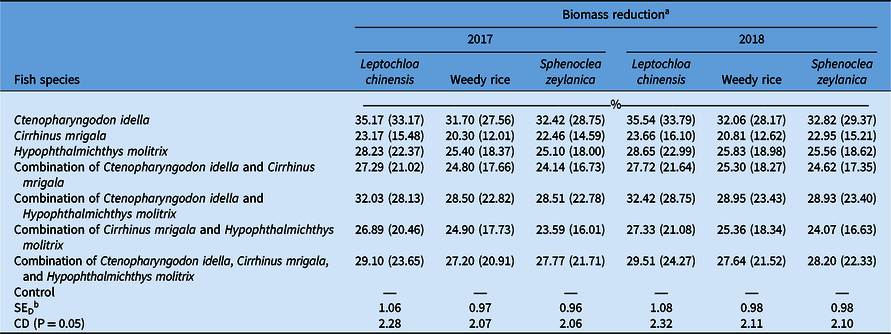
Among the three fish species, C. idella was the most voracious feeder, contributing significantly higher biomass reduction of the three weed species, viz., 33% of L. chinensis, 28% of weedy rice, and 29% of S. zeylanica (Table 1). A similar pattern of C. idella controlling rice weeds more effectively than C. carpio and T. nilotica was reported by Kathiresan (Reference Kathiresan2007).
Percentage reduction in biomass of weeds due to different fish species in pot culture studies at Annamalai University Agronomy Department Laboratory, Tamilnadu, India.

a Figures in parentheses are original values before arc-sine transformation.
b Abbreviations: CD, critical difference; SED, standard error deviation.
Stocking 30 g C. idella at 1 to 6 fish 10 m−2 had completely controlled weeds in a paddy field, floating weeds disappeared followed by submerged species, the C. idella had a preference for cereals, and so it was not stocked until rice seedlings were well established (Tsuchiya Reference Tsuchiya1979). Control of both floating weeds and submerged weeds in rice fields was observed earlier with a stocking density of 1 to 6 fish 10 m−2. Accordingly, a fish stocking density of 5 fish 10 m2 was adopted in the study.
The herbivorous C. idella (17-cm average total length) was released at 40 DAT at a stocking density of 1,064 fish ha−1 for biological control of weeds (Mitre et al. Reference Mitre, Ghosh, Jana and Mittra1992).
The adoption of fish polyculture in the present study is intended to enhance the livelihood of farmers and to supplement weed control. Hence, uniform-sized fingerling (30 g each) C. idella, C. mrigala, and H. molitrix were released. However, in a previous study, larger fish were better able to control weeds effectively in a short period with greater advantages to the rice crop; release of C. idella in rice plots for the control of aquatic weeds was a viable and feasible practice under lowland waterlogged conditions in rice fields (Rekha Ghosh et al. Reference Rekha Ghosh, Ghosh, Mitra and Jana1994). Based on the results, it is inferred that inclusion of C. idella in fish polyculture in rice fields, at a stocking density of 5,000 fingerlings ha−1 (including 1,666 C. idella) improves weed management in rice, including weedy rice, which coincides with the earlier report.
Studies on the Effect of Poultry Manure on Weeds
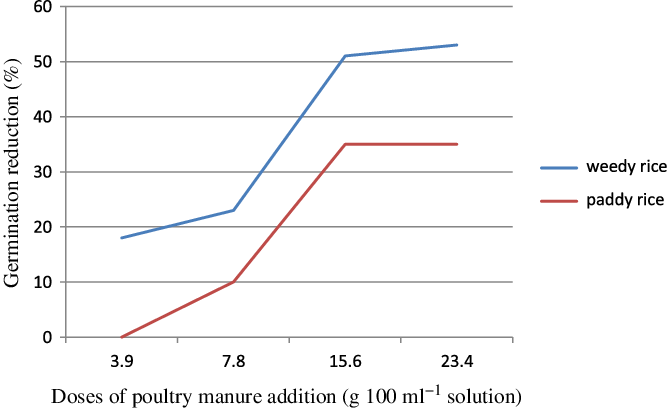
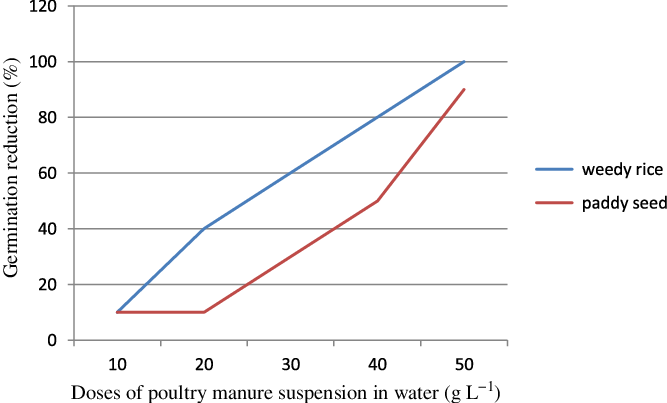
The inhibitory effect of poultry waste on weed and crop seed germination increased with the amount of poultry manure added from half the dose (3.9 g d−1) to the highest dose of 23.4 g d−1 (Figure 1). The effect of poultry waste on rice and weedy rice seed germination in the laboratory was significant at concentrations above 1% (Figure 2). Thus, in addition to its use as fertilizer, poultry manure can also provide supplemental weed control in transplanted rice.
Effect of poultry waste on weedy rice and rice germination (%) at Annamalai University Agronomy Department Laboratory, Tamilnadu, India.

Effect of poultry waste on weedy rice and cultivated rice germination (%) at Annamalai University Agronomy Department Laboratory, Tamilnadu, India.

The inhibitory response is not only due to the acidity of the fresh poultry manure, but could also be due to ammonia and ethylene oxide (Wong et al. Reference Wong, Cheung and Cheung1983). Inhibition of seed germination by poultry manure also differed across plant species. The inhibitory effect of poultry waste on rice seed germination is not a constraint, as rice is predominantly transplanted under lowland conditions and seedlings are not inhibited by poultry waste.
Evaluation of Poultry Manure Efficacy in Microplots
Among the doses of poultry manure compared in microplots, the 2X dose (15.6 g d−1) was significantly superior to the other doses, controlling the weeds with 17% WCI during both years (Table 2). When supplemented with herbicide, the 2X dose resulted in the highest WCIs of 46.32% and 44.83%, during 2017 and 2018, respectively, which were significantly the highest. Application of butachlor controlled the early emergence of weeds. Addition of poultry manure in a slower and phased manner contributed to suppression of weeds that emerged after the decline of herbicidal persistence, thereby reducing the weed dry matter production (DMP).
Effect of poultry manure on weedy rice dry matter production (DMP) and weedy rice control index (WCI) in microplots at Annamalai University Experimental Farm, Tamilnadu, India.

a Figures in parentheses are original values before arc-sine transformation.
b Abbreviations: CD, critical difference; SED, standard error deviation.
Field Experiments for Tracing Efficacy of Weedy Rice Biocontrol by Farming Components
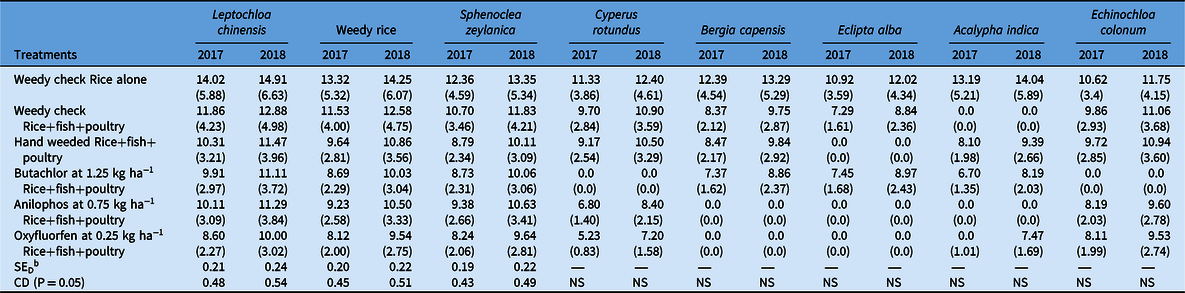
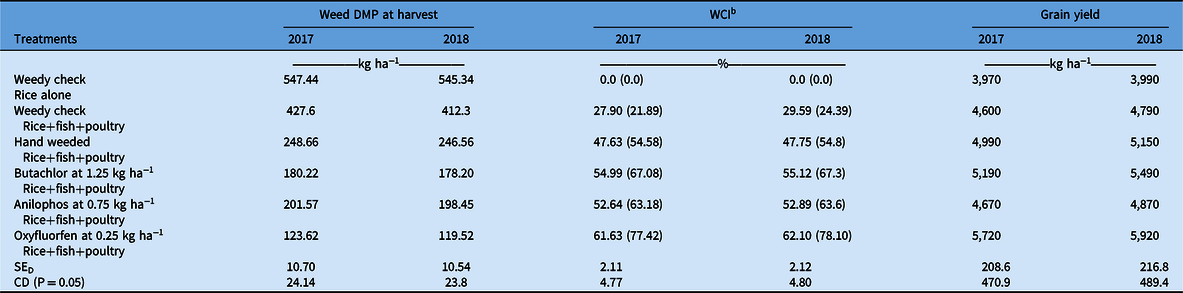
In all 30 participating farmers’ fields, the dominant weed species were L. chinensis, weedy rice, and S. zeylanica. Other weeds such as purple nutsedge (Cyperus rotundus L.), Bergia capensis L., eclipta [Eclipta alba (L.) Hassk.], Indian acalypha (Acalypha indica L.), and junglerice [Echinochloa colona (L.) Link] occurred sporadically (Table 3). The lowest weed DMP values of 123 and 119 kg ha−1 were recorded with oxyfluorfen at 0.25 kg ha−1 during both seasons (Table 4). Butachlor at 1.25 kg ha−1 and anilophos at 0.75 kg ha−1 had similar efficacy. The average weed biomass in the weedy check ranged from 545 to 547 kg ha−1 across both seasons. The highest WCIs of 77.42 and 78.10 were recorded in oxyfluorfen at 0.25 kg ha−1 during both seasons. This treatment also produced the highest grain yield of 5,720 and 5,920 kg ha−1 during both seasons.
Effect of different weed control treatments on individual weed count at 60 DATr (no. m−2) in field experiments at farmers’ holdings in Sathamangalam and Vellingudi villages, Tamilnadu, India. a

a Figures in parentheses are original values before arc-sine transformation.
b Abbreviations: CD, critical difference; SED, standard error deviation.
Effect of different weed control treatments on weed characters and grain yield of rice in rice + fish + poultry farming system in field experiments at farmers’ holdings in Sathamangalam and Vellingudi villages, Tamilnadu, India. a

a Abbreviations: CD, critical difference; DMP, dry matter production; SED, standard error deviation; WCI, weed control index.
b Figures in parentheses are original values before arc-sine transformation.
Overall, the integration of fish polyculture and poultry rearing in flooded transplanted rice could supplement weedy rice management by virtue of weed suppression by fish herbivory and reduction of weedy rice germination by poultry manure. The fish polyculture needs to include C. idella. The additive interaction of these two factors with herbicide application results in better weedy rice control and better overall weed control. This integrated system should reduce the manpower needed to remove remaining weeds late in the season and enable reduction of the weed seedbank in the long term.
Acknowledgments
This research received no specific grant from any funding agency or the commercial or not-for-profit sectors. The authors declare that they have no conflict of interest.