Introduction
Mooleptus rabuka (Machida, Ogawa & Okiyama, 1982) Özdikmen, 2010 is a rare and poorly studied nematode parasitizing the digestive tract of sharks living on the continental slope and seamounts of the Pacific Ocean (Machida et al., Reference Machida, Ogawa and Okiyama1982; Moravec & Nagasawa, Reference Moravec and Nagasawa2000; Ando et al., Reference Ando, Nagasawa and Nakaya2002; Rodríguez et al., Reference Rodríguez, D'Elía and George-Nascimento2012; Espínola-Novelo et al., Reference Espínola-Novelo, Escribano and Oliva2018; Gordeev et al., Reference Gordeev, Sokolov, Orlov and Orlova2019). This species was originally described, under the name of Metaleptus rabuka, as a member of the family Physalopteridae. Moravec & Nagasawa (Reference Moravec and Nagasawa2000) moved Metaleptus into the Gnathostomatidae and assigned this genus to a newly erected subfamily Metaleptinae. However, Metaleptus Machida, Ogawa & Okiyama, 1982 is a junior homonym of the genus name of the cerambycid beetle Metaleptus Bates, 1872. For this reason, Özdikmen (Reference Özdikmen2010) changed the name of the nematode in question from Metaleptus Machida, Ogawa & Okiyama, 1982 to Mooleptus Özdikmen, 2010.
The majority of the taxonomic hypotheses proposed in the last few decades consider the Gnathostomatidae as the type and only family of the Gnathostomatoidea (Chabaud, Reference Chabaud, Anderson, Chabaud and Willmott1975; Ivashkin & Khromova, Reference Ivashkin and Khromova1976; Bain et al., Reference Bain, Mutafchiev, Junker and Schmidt-Rhaesa2014). De Ley & Blaxter (Reference de Ley and Blaxter2004) put the Gnathostomatoidea into the infraorder Gnathostomatomorpha of the suborder Spirurina (order Rhabditida). According to Hodda (Reference Hodda2011), this superfamily belongs to the suborder Gnathostomatina of the order Spirurida. Besides Metaleptus, there are five genera in the Gnathostomatidae: Ancyracanthus Diesing, 1839, Echinocephalus Molin, 1858, Gnathostoma Owen, 1836, Spiroxys Schneider, 1866 and Tanqua Blanchard, 1904. Representatives of these genera at the adult stage parasitize elasmobranchs, amphibians, reptiles and mammals (Chabaud, Reference Chabaud, Anderson, Chabaud and Willmott1975; Ivashkin & Khromova, Reference Ivashkin and Khromova1976; Bain et al., Reference Bain, Mutafchiev, Junker and Schmidt-Rhaesa2014). The most prominent morphological features of the gnathostomatids are two large pseudolabia with a lobate internal border or large cuticular appendages, as well as non-embryonated eggs (Chabaud, Reference Chabaud, Anderson, Chabaud and Willmott1975; Ivashkin & Khromova, Reference Ivashkin and Khromova1976; Bain et al., Reference Bain, Mutafchiev, Junker and Schmidt-Rhaesa2014). Upadhyay (Reference Upadhyay2017) added the genus Sturdynema Upadhyay, 2017 to the Gnathostomatidae. However, even a cursory acquaintance with its morphology suggests that this genus corresponds to the concept of the genus Goezia Zeder, 1800 (Ascaridoidea).
Molecular data on the loci of nuclear and/or mitochondrial DNA are currently available for Echinocephalus, Gnathostoma, Spiroxys, Sturdynema and Tanqua (e.g. Laetsch et al., Reference Laetsch, Heitlinger, Taraschewski, Nadler and Blaxter2012; Sun et al., Reference Sun, Liu, Ando, Woo, Ma, Sohn, Sugiyama and Zhu2017; Chan et al., Reference Chan, Chaisiri, Morand, Saralamba and Thaenkham2020). However, only partial sequences of 18S ribosomal RNA (rRNA) gene are collected for all the five genera. Phylogenetic reconstructions of the Gnathostomatidae based on 18S rRNA gene sequence data do not support the monophyly of this family (Laetsch et al., Reference Laetsch, Heitlinger, Taraschewski, Nadler and Blaxter2012; Choudhury & Nadler, Reference Choudhury and Nadler2018).
We found M. rabuka in Fedorov's catshark Apristurus fedorovi Dolganov, 1983 (Carcharhiniformes, Pentanchidae). In this paper, we provide a detailed description of the parasite's morphology and reveal its phylogenetic connections using molecular genetic data.
Material and methods
Sample collection
A specimen of A. fedorovi was caught from the R/V Professor Kaganovsky on April 12, 2019, during a deep-water trawl survey (Somov et al., Reference Somov, Kanzeparova and Vazhova2019) in the area of the Imperial Ridge (Ojin Seamount, Pacific Ocean) at a depth of 1025 meters (37°57′06″N, 170°24′07″E). Four worms, one male and three females, were collected from the shark's stomach. Unfortunately, there are no exact data on the intensity of invasion and the size of the host.
The worms were fixed in 70% ethanol and subsequently transferred to 96% ethanol. For light microscopy studies, the male was transferred to anhydrous glycerine using a slow evaporation method (Seinhorst, Reference Seinhorst1959) and mounted in the same medium. Its morphology was studied with the aid of a light microscope Axio Imager A1 (Zeiss AG, Oberkochen, Germany). Two female specimens of M. rabuka were prepared for scanning electron microscopy (SEM) study by dehydration through a graded ethanol series and acetone followed by a critical-point drying. After coating with gold, they were examined with a Tescan Vega TS5130MM microscope (TESCAN, Brno, Czech Republic). One female specimen for genetic analysis was stored at −18°C prior to DNA extraction.
DNA extraction, sequencing and analysis
DNA was extracted from one female specimen fixed in 96% ethanol, with the addition of proteinase K and mercaptoethanol in the lysing solution (Holterman et al., Reference Holterman, van der Wurff, van den Elsen, van Megen, Bongers, Holovachov, Bakker and Helder2006). The sequences were amplified using an EncycloPlus polymerase chain reaction (PCR) Kit (Evrogen, Moscow, Russia). The design of the forward PCR primer (AGCGGAGGAAAAGAAACTAA) was described in Nadler & Hudspeth (Reference Nadler and Hudspeth1998). The reverse primer (TCGGAAGGAACCAGCTACTA) was designed by Thomas et al. (Reference Thomas, Vida, Frisse, Mundo and Baldwin1997). PCR products were visualized in gel, cut out and cleaned using the SV Gel and PCR CleanUp System kit (Evrogen, Russia). DNA sequencing was performed at the Genome Centre for Collective Use in the Severtsov Institute of Ecology and Evolution of Russian Academy of Sciences (Moscow, Russia).
Partial sequences of the 18S rRNA gene used in our study to evaluate the phylogenetic relationships were assembled using the Geneious ver. 10.0.5 software(Biomatters Ltd., Auckland, New Zealand) and aligned with sequences retrieved from the GenBank of the National Center for Biotechnology Information (Genbank NCBI) database using the ClustalW DNA weight matrix within the MEGA 10.0.5 software alignment explorer (Kumar et al., Reference Kumar, Stecher, Li, Knyaz and Tamura2018) selected using the BLAST search. Phylogenetic analysis of the nucleotide sequences was undertaken using the maximum likelihood (ML) and Bayesian inference (BI) methods. Phylogenetic trees using ML and BI methods were reconstructed using the MEGA 10.0.5 (Kumar et al., Reference Kumar, Stecher, Li, Knyaz and Tamura2018) and MrBayes v. 3.6.2 software (Ronquist & Huelsenbeck, Reference Ronquist and Huelsenbeck2003), respectively. The best nucleotide substitution model for the dataset was estimated using jModelTest version 0.1.1 software (Posada, Reference Posada2008). In both methods, the general time-reversible model GTR + G + I was used based on the Akaike Information Criteria. A Bayesian algorithm was performed using the Markov chain Monte Carlo option with ngen = 10,000,000, nruns = 4, nchains = 4 and samplefreq = 1000. The burn-in values were 2,500,000 for the ‘sump’ and ‘sumt’ options. The robustness of the phylogenetic relationship was estimated using bootstrap analysis with 1000 replications (Felsenstein, Reference Felsenstein1985) for ML and with posterior probabilities for BI (Ronquist & Huelsenbeck, Reference Ronquist and Huelsenbeck2003).
For comparative purposes and phylogeny construction, 18S rRNA gene sequences of nematodes of the suborder Spirurina from the GenBank NCBI database were also used (supplementary table SI). Sturdynema multiembryonata Upadhyay, 2017 (GQ265676–GQ265684) assigned to the Gnathostomatidae by Upadhyay (Reference Upadhyay2017) was not included in the main analysis. The phylogenetic assessment of S. multiembryonata is provided in supplementary fig. S1. The phylogenetic trees were rooted on non-spirurine rhabditids Teratocephalus lirellus Anderson, 1969 and Teratocephalus terrestris (Bütschli, 1873), based on the findings of Choudhury & Nadler (Reference Choudhury and Nadler2018).
Results
Mooleptus rabuka (Machida, Ogawa & Okiyama, 1982) Özdikmen, 2010
Description
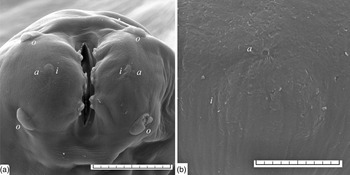
General morphology. Based on specimens examined by light microscopy (one male) and SEM (two females). Medium-sized nematodes, with transversely striated cuticle. Cephalic end rounded, with dorsoventrally elongate terminal oral aperture, two large lateral pseudolabia, four large submedian doublet papillae of external circle, two large simple lateral papillae of internal circle and two amphids situated at base of papillae of inner circle (figs 1a, b). Inner surface of pseudolabia trilobed; each lobe with one median tooth and two marginal small teeth. Cephalic bulb and cephalic collarette absent. Oesophagus muscular, connected posteriorly to ventriculus-like formation. Intestine dark brown. Somatic musculature platymyarian–meromyarian, with 4–5 muscle cells per quadrant.
Female of Mooleptus rabuka: (a) cephalic end, apical view; (b), amphid and lateral papilla of internal circle, apical view. Abbreviations: a, amphids; i, papillae of internal circle; o, papillae of external circle. Scale bars: (a) 0.05 mm; (b) 0.01 mm.

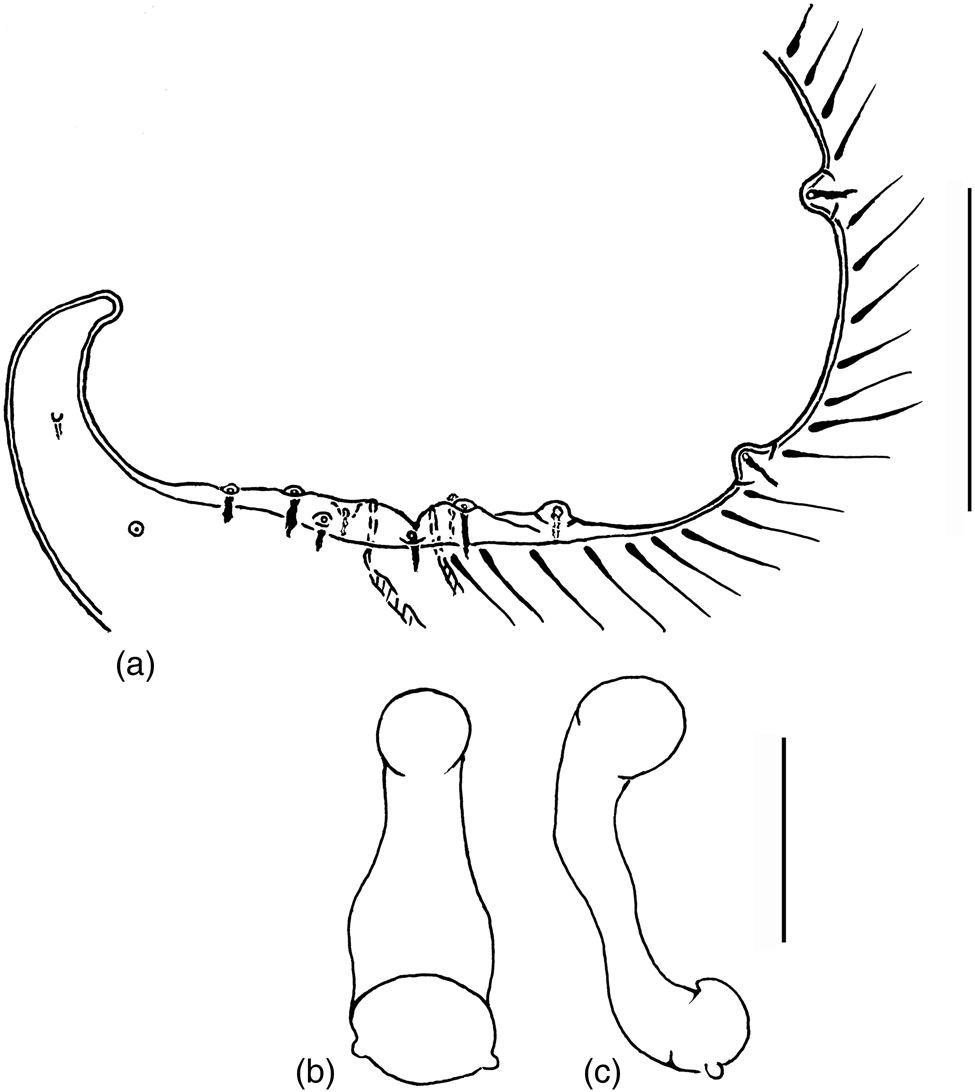
Male. One specimen. Body elongate, length 23.786 mm, maximum width 0.777 mm at border of middle and posterior third of body. Oesophagus length 1.597 mm. Nerve ring, deirids and excretory pore located at distance of 0.523 mm, 0.670 mm and 0.749 mm, respectively, from anterior end of body. Ventriculus-like formation 0.085 mm long. Anterior border of testis at 12.677 mm from anterior end of body. Precloacal area with numerous subventral oblique muscle bands (fig. 2a). Precloacal papillae: three pairs of subventral papillae, one pair of ventral papillae at level of last pair of subventral papillae and one unpaired median papilla somewhat anterior to level of last pair of subventral papillae (fig. 2a). Adcloacal papillae: one pair of subventral papillae (fig. 2a). Postcloacal papillae: three pairs of subventral papillae, one pair of ventral papillae somewhat anterior to level of first pair of subventral papillae, and one pair of lateral papillae located posteriorly to last pair of subventral papillae (fig. 2a). Lateral phasmids located posteriorly to lateral pair of postcloacal papillae (fig. 2a). Spicules equal, 1.514 mm long, with dorsal and ventral alae and pointed tip. Gubernaculum 0.198 mm long, represented by slightly curved, distally widening plate, with large ventrally directed protuberances at anterior and posterior ends; distal protuberance with two small lateral conical protrusions (fig. 2b, c). Tail conical, 0.359 mm long, with rounded distal tip.
Male of Mooleptus rabuka: (a) caudal end, lateral view; (b, c) gubernaculum, ventral and lateral views. Scale bars: (a) 0.25 mm; (b, c) 0.1 mm.

Taxonomic summary
Host. Apristurus fedorovi Dolganov, 1983.
Site in host. Stomach.
Locality. Ojin Seamount, Imperial Ridge, Pacific Ocean (37°57′06″N, 170°24′07″E).
Representative DNA sequences. Partial sequence of the 18S rRNA gene is deposited in GenBank NCBI; accession number MW980741.
Phylogeny
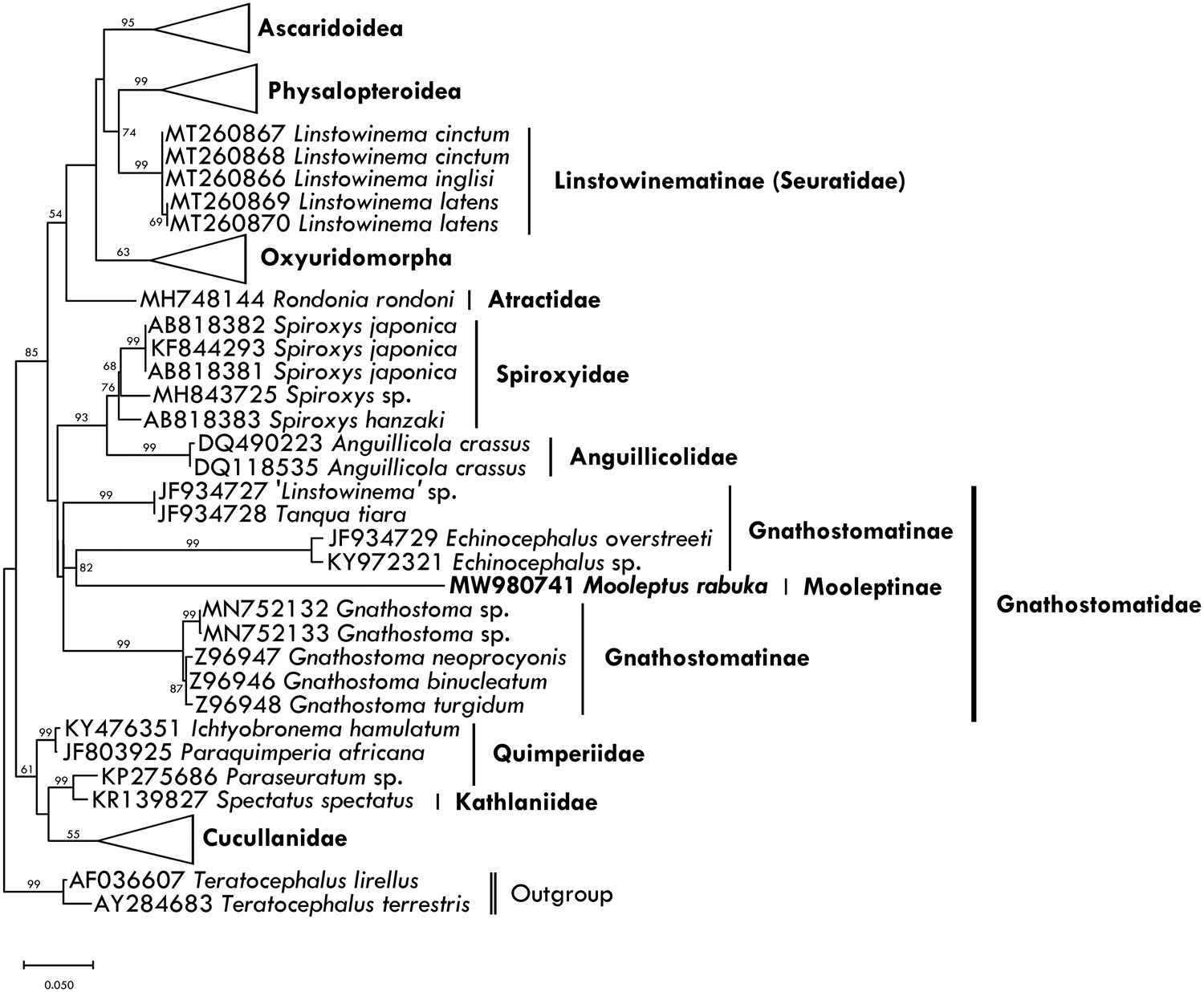
The ML-based analysis put Mooleptus into the poorly supported clade, which also includes Anguillicola, Echinocephalus, Gnathostoma, Spiroxys, Tanqua and ‘Linstowinema’ sp. (=Linstowinema sp. Laetsch, Heitlinger, Taraschewski, Nadler & Blaxter, 2012) (fig. 3). Spiroxys occupied a well-supported sister position to Anguillicola. This clade was sister to a poorly supported polytomic group formed by the well-supported clades of Gnathostoma and Tanqua + ‘Linstowinema’ sp. and the moderately supported Mooleptus + Echinocephalus clade. However, Mooleptus and Echinocephalus were separated by long branches. Other Linstowinema spp. with known 18S rRNA gene sequences formed a highly supported clade, which appeared as a sister to the well-supported Physalopteridae clade; however, this sister relationship has a moderate support. The Physalopteridae + Linstowinema spp. clade was nested in a large weakly supported clade, which also included ascaridoid, oxiuridomorh and atractid nematodes. This large clade occupied a well-supported sister position to the clade that united Mooleptus with the five genera mentioned above and ‘Linstowinema’ sp.
Phylogenetic position of Mooleptus rabuka, reconstructed by ML analysis of 18S rRNA gene sequences. References for data retrieved from GenBank are listed in supplementary table SI. The bootstrap values less than 50 are not indicated. Scale bar shows the number of substitutions per site.

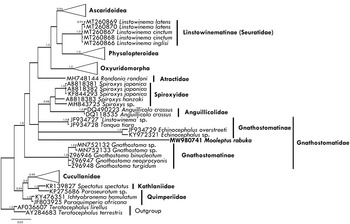
Results of BI-based analysis showed that Mooleptus occupied a separate branch within the poorly supported polytomic clade, which also contained the well-supported clades of the Echinocephalus, the Anguillicola + Spiroxys and the Tanqua + ‘Linstowinema’ sp. (fig. 4). The analysis united other Linstowinema spp. into a single large clade together with physalopterid, ascaridoid, oxiuridomorh and atractid nematodes. This clade was a poorly supported sister clade to the polytomic group containing Anguillicola, Echinocephalus, Mooleptus, Spiroxys, Tanqua and ‘Linstowinema’ sp. Gnathostoma occupied a basal position to all the listed nematodes.
Phylogenetic position of Mooleptus rabuka reconstructed by BI analysis of 18S rRNA gene sequences. References for data retrieved from GenBank are listed in supplementary table SI. Posterior probabilities less than 0.9 are not indicated. Scale bar shows the number of substitutions per site.

Discussion
The morphology of the nematodes examined in our study is consistent with that of the specimens of M. rabuka described by Machida, Ogawa & Okiyama (Reference Machida, Ogawa and Okiyama1982), Moravec & Nagasawa (Reference Moravec and Nagasawa2000) and Rodríguez et al. (Reference Rodríguez, D'Elía and George-Nascimento2012) in most features such as the structure of the pseudolabia, the presence of a ventriculus-like formation, the morphology of the precloacal area and the morphometry of males. However, we made several additions to the morphological data on this species and clarified some details. Firstly, we showed that M. rabuka has two lateral papillae of the internal circle as well as amphids. The papillae of the internal circle were mistaken for amphids in some previous studies (Moravec & Nagasawa, Reference Moravec and Nagasawa2000; Rodríguez et al., Reference Rodríguez, D'Elía and George-Nascimento2012), but the amphids, in fact, lie at the base of these papillae (fig. 1a, b).
We confirmed the observation of Rodríguez et al. (Reference Rodríguez, D'Elía and George-Nascimento2012) that the males of M. rabuka lack caudal alae (fig. 2a). The abdominal side and, partly, the lateral sides of the tail in the males of this species have a very thick cuticle, which, in the lateral view, was apparently mistaken for caudal alae by Moravec & Nagasawa (Reference Moravec and Nagasawa2000). We found a pair of lateral post-cloacal papillae that are not mentioned in the other descriptions of this species (Machida et al., Reference Machida, Ogawa and Okiyama1982; Moravec & Nagasawa, Reference Moravec and Nagasawa2000; Rodríguez et al., Reference Rodríguez, D'Elía and George-Nascimento2012). We also described the morphology of the gubernaculum and showed that this organ has a peculiar shape, resembling a telephone receiver in side view (fig. 2b, c). A simple sickle-shaped gubernaculum has been previously reported for this species (Moravec & Nagasawa, Reference Moravec and Nagasawa2000).
The discussion of the systematic position of Mooleptus is complicated by the non-monophyletic status of the Gnathostomatidae. ML- and BI-based phylogenetic analyses demonstrate that Spiroxys, traditionally affiliated to the Spiroxyinae of the Gnathostomatidae (Baylis & Lane, Reference Baylis and Lane1920; Chitwood & Wehr, Reference Chitwood and Wehr1934; Chabaud, Reference Chabaud, Anderson, Chabaud and Willmott1975; Ivashkin & Khromova, Reference Ivashkin and Khromova1976; Bain et al., Reference Bain, Mutafchiev, Junker and Schmidt-Rhaesa2014), clusters with Anguillicola (Anguillicolidae) (fig. 3). In addition, BI analysis does not support a direct phylogenetic relationship of Gnathostoma, with the group comprising the Anguillicola + Spiroxys clade and other gnathostomatids, and shows an unresolved topology for some gnathostomatid lineages, including the Mooleptus branch. In earlier phylogenetic reconstructions, carried out without the data on Spiroxys and Mooleptus, traditional gnathostomatids were also combined in the same clade with anguillicolids and appeared within it as a paraphyletic assemblage (Laetsch et al., Reference Laetsch, Heitlinger, Taraschewski, Nadler and Blaxter2012; Choudhury & Nadler, Reference Choudhury and Nadler2018). Our conclusion about the sister relationship between Spiroxys and Anguillicola is consistent with that of Rakhshandehroo et al. (Reference Rakhshandehroo, Gholamhosseini, Ahmadi, Rakhshaninejad and Heidari2020).
Adult anguillicolid nematodes have significant morpho-biological differences from Spiroxys and other traditional gnathostomatids – namely, they are ovoviviparous, have a buccal capsule and lack pseudolabia, spicules and gubernaculum (Moravec, Reference Moravec2006). Thus, we see no reason to unite anguillicolids and Spiroxys in a single taxon of a family rank. Taking into account the sister relationship of the spiroxyines and the anguillicolids and significant morphological differences between the adults of these nematodes, we exclude the Spiroxyinae Baylis & Lane, 1920 from the Gnathostomatidae and elevate it to a separate family, Spiroxyidae Baylis & Lane, 1920 stat. nov. Its diagnosis coincides with that of the subfamily Spiroxyinae (see Bain et al., Reference Bain, Mutafchiev, Junker and Schmidt-Rhaesa2014). We found morphological evidence of the phylogenetic affinity of the Spiroxyidae with the Anguillicolidae when comparing their third-stage juveniles. The juveniles of Spiroxys spp. have well-developed triangular pseudolabia (e.g. Hedrick, Reference Hedrick1935; Hasegawa & Otsuru, Reference Hasegawa and Otsuru1978; Sokolov, Reference Sokolov2013). The oral aperture of Anguillicola juveniles is surrounded by two lateral conical sclerotized protrusions, referred to as teeth (Moravec et al., Reference Moravec, Di Cave, Orecchia and Paggi1993, Reference Moravec, Di Cave, Orecchia and Paggi1994; Taraschewski et al., Reference Taraschewski, Boomker, Knopf and Moravec2005) or ornamentations (Blanc et al., Reference Blanc, Bonneau, Bagianti and Petter1992). The external morphology of these structures in SEM micrographs is similar to that of the pseudolabia in Spiroxys (Blanc et al., Reference Blanc, Bonneau, Bagianti and Petter1992, Fig. 3a; Sokolov, Reference Sokolov2013, Fig. 6). We hypothesize that the so-called teeth or ornamentations of Anguillicola juveniles are, in fact, heavily sclerotized pseudolabia. If so, the sister relationship of the spiroxyids and the anguillicolids is confirmed by the presence of conical pseudolabia in their third-stage juveniles. Noteworthy, the affinity between spiroxyids and anguillicolids is highlighted by the similarity of their development in early juvenile stages. Nematodes from both these groups hatch second-stage juveniles enclosed in the shed cuticle of the first-stage juvenile (e.g. Hedrick, Reference Hedrick1935; de Charleroy et al., Reference de Charleroy, Grisez, Thomas, Belpaire and Ollevier1990). The morphological similarity between adult spiroxyids and anguillicolids is largely confined to the general features characteristic of all spirurines. Perhaps only one of these similarity aspects, related to the type of organization of somatic musculature, can be accepted as an additional argument on the phylogenetic affinity between these two nematode groups. It is known that spirurine nematodes, including some gnathostomatids (Gnathostoma), tend to have polymyarian musculature (Chitwood & Chitwood, Reference Chitwood and Chitwood1934; Kim et al., Reference Kim, Lee, Joo, Chang, Chi and Chai2010). However, adult spiroxyids have meromyarian musculature (Ohmori et al., Reference Ohmori, Hasegawa and Otsuru1978), and musculature type of the anguillicolids is intermediate between meromyarian and holomyarian types (Lamah et al., Reference Lamah, Franz, Mehlhorn and Taraschewski1990).
Further reorganization of the Gnathostomatidae is premature. We provisionally consider that this family consists of the genera Ancyracanthus, Echinocephalus, Gnathostoma, Mooleptus and Tanqua, distributed into subfamilies according to the current taxonomic model (Moravec & Nagasawa, Reference Moravec and Nagasawa2000; Bain et al., Reference Bain, Mutafchiev, Junker and Schmidt-Rhaesa2014): Gnathostomatinae Railliet, 1895 sensu lato (Echinocephalus, Gnathostoma, Tanqua), Ancyracanthinae Yorke & Maplestone, 1926 (Ancyracanthus) and Mooleptinae nom. nov. (Mooleptus). We suggest the name Mooleptinae nom. nov. instead of the Metaleptinae Moravec & Nagasawa, 2000, which is based on the preoccupied generic name Metaleptus Machida, Ogawa & Okiyama, 1982 (International Code of Zoological Nomenclature, 1999, Article 39).
Upadhyay (Reference Upadhyay2017) placed Sturdynema in the Gnathostomatinae. However, in respect of the morphological characteristics such as the presence of transverse rows of posteriorly directed cuticular spines, three flattened lips with two distinct lobes in each directed towards the oral aperture and the number of caudal papillae in males, the type species of Sturdynema, S. multiembryonata, is similar to Goezia spp. (Ascaridoidea). On the phylogram S. multiembryonata clustered with Goezia pelagia Deardorff & Overstreet, 1980 and Goezia spinulosa (Diesing, 1839) (supplementary fig. S1). Thus, we believe that Sturdynema is a junior synonym of Goezia.
Note that ‘Linstowinema’ sp. studied by Laetsch et al. (Reference Laetsch, Heitlinger, Taraschewski, Nadler and Blaxter2012) and clustered with T. tiara (Linstow, 1879) is phylogenetically distant from the rest of Linstowinema spp. (fig. 3), and so its identification is undoubtedly erroneous. Linstowinema Smales, 1997 is type genus of the Echinonematinae of the Seuratidae (Smales, Reference Smales1997). The name Linstowinema was proposed by Smales (Reference Smales1997) as a substitute name for the preoccupied generic name Echinonema Linstow, 1898. In accordance with Article 39 of the International Code of Zoological Nomenclature (1999), we rename the Echinonematinae Inglis, 1967 to the Linstowinematinae nom. nov. Chabaud & Bain (Reference Chabaud and Bain1994) considered the Echinonematinae (=Linstowinematinae) as an ancestor group for the Gnathostomatidae, but our data do not support this hypothesis (figs 3 and 4).
The results of our phylogenetic study indicate a crisis of the concepts of the Anguillicoloidea sensu Moravec, 2006 and the Gnathosthomatoidea sensu Bain , Mutafchiev & Junker, 2014 proposed, respectively, for the Anguillicolidae and for the Gnathostomatidae (with Spiroxyinae). At present, however, we cannot tackle this taxonomic problem due to the lack of reliable support for a number of key nodes in our trees.
Supplementary material
To view supplementary material for this article, please visit https://doi.org/10.1017/S0022149X21000390
Acknowledgements
The authors are grateful to Dr Alexei Orlov (Shirshov Institute of Oceanology, Moscow) and Dr Svetlana Orlova (Russian Federal Research Institute of Fisheries and Oceanography, Moscow) for providing the specimens of Mooleptus rabuka, and to Boris Efeykin (A.N. Severtsov Institute of Ecology and Evolution, Moscow) for help with the sequencing.
Financial support
This work is a part of the state-supported studies in the Center of Parasitology, A.N. Severtsov Institute of Ecology and Evolution of RAS (project no. 0109–2018–0075).
Conflicts of interest
None.
Ethical standards
All applicable international, national and/or institutional guidelines for the care and use of animals were followed by the authors. All the necessary permits for sampling and observational field studies were obtained by the authors from the competent authorities.