




No CrossRef data available.
Article contents
The diffusion of subject you: A case study in historical sociolinguistics
Published online by Cambridge University Press: 16 February 2005
Abstract
Based on the Corpus of Early English Correspondence (CEEC) and the Helsinki Corpus of English Texts (HC), this study describes how the second-person object form you diffused among the population of England during the late middle and early modern period (1350–1710). After the take-off in c. 1480, you replaced the old subject form ye very rapidly, in about three generations of speakers. This article shows that this was a change from below in terms of social awareness, because you was preferred in oral genres and informal registers in the earliest stages of its use. The study suggests that the social origin of you was among the middle ranks, and women led the change in its critical period of diffusion. No specific region has been found as the origin of this change, but London and the Court adopted it before the North and East Anglia.The research reported here was supported in part by the Academy of Finland Centre of Excellence funding for the Research Unit for Variation and Change in English at the Department of English, University of Helsinki. I am grateful to an anonymous referee for helpful comments on an earlier version of this article.
Information
- Type
- Research Article
- Information
- Copyright
- © 2005 Cambridge University Press
The aim of this article is to describe how one particular change, the use of the object pronoun you as subject, diffused among the population of England in the late middle and early modern period (1350–1710). The sociolinguistic framework that is applied to this investigation was developed in the Sociolinguistics and Language History project, launched at the University of Helsinki on the initiative of Terttu Nevalainen and myself in 1993. This project has been continued in the Research Unit for Variation and Change in English, financed by the Academy of Finland and the University of Helsinki.
The second-person pronoun system underwent two major changes in Late Middle and Early Modern English. First, the original singular pronoun thou/thee was replaced by the plural pronoun ye/you. Second, the object form you came to be used in the subject function, gradually ousting the older alternative ye from the language. The second change is the topic of this article.
The change from subject ye to you is one of the morphosyntactic changes Terttu Nevalainen and I have discussed in Historical Sociolinguistics (2003).1
Although a number of my findings have been published in Nevalainen & Raumolin-Brunberg (2003), this article offers a more thorough analysis. The findings based on the Helsinki Corpus have not been discussed elsewhere.
What makes this study different from traditional accounts in historical linguistics is that my main questions are not why the change took place and what the instigating factors were, but rather how the change spread. This, of course, brings the external factors to the foreground. This article will offer a multifaceted picture of a very rapid change, in which linguistic factors seem to play a fairly insignificant role after the early stages. My methods are predominantly quantitative, and my primary data comprise structured electronic corpora, which offer a solid basis for chronological comparisons.
THE DATA
My primary data has been retrieved from two electronic corpora of historical English. The main source is the Corpus of Early English Correspondence (CEEC, the 1998 version; for details see Nevalainen & Raumolin-Brunberg, 1996, 2003:43–52). This corpus, compiled for use in historical sociolinguistics, covers the time span of c. 1410–1680. It contains 2.7 million running words, representing over 6,000 letters written by 780 informants, which have been selected from 96 edited collections. The second source is the multigenre Helsinki Corpus of English Texts (HC; Nevalainen & Raumolin-Brunberg, 1989, 1993; Kytö, 1996), whose 1.5 million running words cover about one thousand years of the history of English (c. 750–1710).
My CEEC data includes all letters from c. 1410–1619, comprising over 1.6 million running words. I have also examined approximately 35,000 words from the CEEC Supplement. These letters, mostly written by women, stem from collections with modernized spelling, which have not been included in the CEEC proper (Nevalainen & Raumolin-Brunberg, 2003:234). I have chosen sections ME 3-4 and E 1-3 (1350–1710) from the HC, which together cover approximately 900,000 running words.
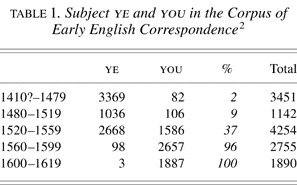
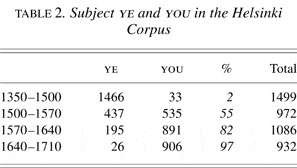
The two corpora yielded two large sets of occurrences of the variable: 13,493 from the CEEC and 4,489 from the HC (Tables 1 and 2).
Subject ye and you in the Corpus of Early English CorrespondenceFor different ways of sampling and counting occurrences, see Nevalainen & Raumolin-Brunberg (2003:214–217). Tables 1–4 and Figures 1 and 2 represent percentages counted from all occurrences, whereas Tables 5 and 6 and Figures 4 and 5 are based on quota samples.

Subject ye and you in the Helsinki Corpus

Personal letters offer interesting material for research in historical sociolinguistics, as they are known to share a number of linguistic features with the colloquial spoken idiom (e.g., Biber, 1988). The CEEC enables us to trace linguistic changes in this relatively informal written genre. Moreover, it has been possible to identify the social backgrounds of the corpus informants, and this information has been encoded in a separate database to facilitate sociolinguistic analyses (Nevalainen & Raumolin-Brunberg, 1996).
The HC offers an opportunity to research linguistic changes as they diffuse from one genre to another. Compared with recent special corpora, it is small at 1.5 million words, but its balanced division into some 15 genres redresses the disadvantage of its limited size, especially where the object of study is a frequent linguistic phenomenon, as is presently the case.
THE DIFFUSION OF SUBJECT you
Background
As mentioned earlier, the second-person pronoun system underwent two changes in Late Middle English, leading to the cross-linguistically rather unusual feature in present-day Standard English of just one second-person pronoun, you.3
Small capitals are used to cover all spelling variants, so that you represents you, yow,

, and so forth.
The first process, comprising a long period of variation between thou/thee and ye/you, has received a great deal of attention in the literature (for a good overview, see Busse, 2002). New studies continue to appear, and this is indeed a most intriguing case for historical pragmatics or pragmatically oriented sociolinguistics. The second change, the one now at issue, has not been discussed in the literature nearly as much as the first.
My concern is not the actuation of this change, but its diffusion. However, it is appropriate briefly to summarize the arguments on why and how this change came about. Most of what we know is based on traditional philological research, with literary texts as data. Good examples of this type of research are offered by Lutz (1998) and Busse (2002:249–281).
According to Mustanoja (1960:125), the first occurrences of subject you, dating back to the 14th century, often occurred in ambiguous linguistic contexts, for example, after the verb in questions and imperatives. As for what caused the change, several suggestions have been made. Phonological confusion is one, because both pronouns have apparently had a similar weak or fast-speech form pronounced

. Moreover, analogy with the singular pronouns has been suggested, you rhyming with thou, ye with thee. The use of both sets of pronouns in parallel in the same texts, especially in drama and poetry, lends credibility to this crossover pattern. This type of alternation of address pronouns may well have been part of the pragmatic pattern of actual conversations.
4Although the role of analogy and rhyming may seem puzzling, because thee continued to be an object form, several philologists have argued for their importance. A good overview is given by Lutz (1998:193–197), who considered analogy to be one of the factors leading to the exclusive use of you as subject.
My corpus data largely supports these arguments, although there are also early instances of you that do not occur in ambiguous contexts (1). These cases seem to concentrate on subordinate clauses following a main clause. On the other hand, it is easy to find evidence of occasional confusion in writing, ye appearing as object (2), and you as subject.5
Confusing subject and object forms seems to have a long history, and it is by no means unusual in present-day English. According to Quirk et al. (1985:337–338), the usage follows a positional distinction between subject and object “territories.” The objective has, in fact, become the unmarked case form in informal and nonstandard English, as shown by examples like, It's only me and Him and Mary are going abroad for a holiday. Similarly, dialect studies report a phenomenon called “pronoun exchange,” in which subject and object pronouns appear to change places (Trudgill, 1992:89–93).
The constructions with pray, which I analyze as accusative plus infinitive structures, have been excluded from the data, because the pronoun is not the subject of the sentence. There is an alternative analysis, in which the pronoun is understood to introduce a subordinate clause without a conjunction, but I prefer the first analysis.
The following impersonal verbs were checked in the pre-1500 CEEC data: think, seem, like, and please. Both ye and you were used with all of them, and consequently, they were included in the data when they occurred without subject it.

For the details on the Helsinki Corpus sources, see Kytö (1996). The sources of the CEEC examples contain the following information: name of writer, year of writing, coded name of collection, and page number. For the full titles of the collections, see Nevalainen & Raumolin-Brunberg (2003:223–234).
An interesting question is whether the reference of the pronoun has influenced the choice of form. No evidence has been found about the primacy of either the plural or the singular use. Busse (2002:41) showed that in drama the proportion of forms with plural reference is approximately 20%. In personal letters it is likely to be smaller, as the letters in the CEEC were both written by and addressed to individual people.
Timing
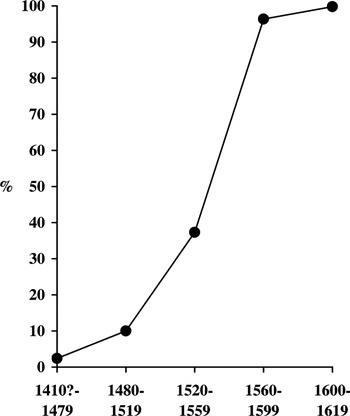
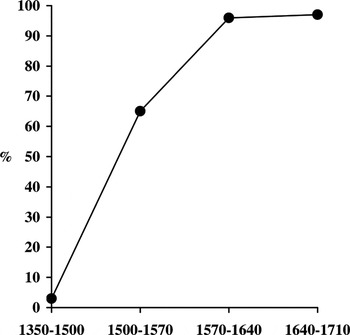
Figures 1 and 2 give the course of the change in both corpora as a graphic presentation. Figure 1, based on the Corpus of Early English Correspondence, depicts the adoption of subject you as an S-curve with a 40-year temporal division. Figure 2, based on the Helsinki Corpus data, has longer intervals.9
Identical periods would give a better picture, but the internal structure of the Helsinki Corpus unfortunately does not allow divisions into shorter periods. Shorter intervals would lead to generic imbalance and loss of comparability between the subperiods.

The replacement of subject ye by you in the CEEC. Percentages of you, impersonal structures included (Nevalainen & Raumolin-Brunberg, 2003:60).

The replacement of subject ye by you in the HC. Percentages of you, impersonal structures included. HC; Bible translations excluded.The Bible translations, in the Helsinki Corpus short extracts from John, Genesis, and Numbers, are not included in all its periods, so that the temporal continuity of this genre differs from the other genres. The inclusion of the Bible texts in this study would have skewed the statistics, as all the extracts contain a large number of second-person subjects but very few occurrences of you. Among the Helsinki Corpus material representing the Early Modern English translations, Tyndale's texts have none (Table 4) and the Authorized Version has only 3%. This is in harmony with Kenyon (1914:454), who has found only 7% you in the whole Authorized Version, published as late as 1611.
The completion of the change by the turn of the 17th century is corroborated by the Shakespeare Corpus, in which ye only occurs in about 2% of the cases (Busse, 2002:256).
The Helsinki Corpus does not quite encompass the exclusive use of you, as ye lived on in some fossilized expressions. Formulaic phrases like look ye, hark ye, and d'ye occurred in the early modern drama even after Shakespeare (Busse, 2002:261–270), and such occurrences can also be found in the Helsinki Corpus (6).

Individual variation
A change from the macro to the micro level offers a view of the behavior of individual informants under this ongoing linguistic change. It is obvious that when there is a linguistic change in progress, everyone has to make the choice, usually unconscious, between participating in the change or not.
If people do participate, they can adopt the innovation in different ways. There is always someone who is the innovator, the person who is the first to use the new form, but tracing innovators in historical texts is impossible. Instead, we can access early adopters, people who picked up the new form before most other people. They may have changed their language during their lifetimes or adopted the form during language acquisition. A further division can be made between people who have had variable grammars, that is, those who used both the incoming and old forms, and those who had only one alternative (for the role of children and adults in language change, see e.g., Croft, 2000:44–59; Matthews, 2002).
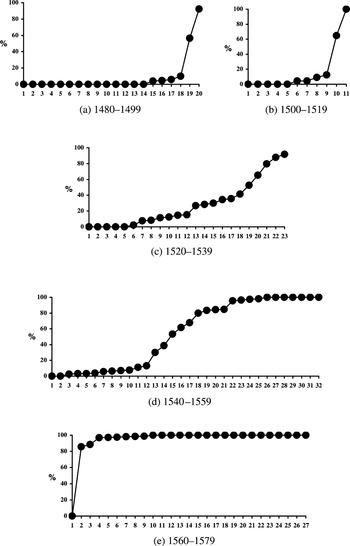
Figure 3 illustrates how CEEC informants used the new subject form in the course of the period 1480–1579. This 100-year period has been divided into five twenty-year subperiods. The black circles corresponding to the numbers on the horizontal axis represent people whose letters contain the ye/you variable at least ten times. (For their identities, see Nevalainen & Raumolin-Brunberg, 2003:101–104.)

The diffusion of you among individual informants in the CEEC 1480–1579 (Nevalainen & Raumolin-Brunberg, 2003:93).
Although the number of informants varies, the series neatly illustrates how the change advances. During the first two twenty-year periods, some early users stand out, but most people still have the old form. In period (c), 1520–1539, the majority have begun to use you, and in 1540–1559 the graph is quite symmetrical, the number of exclusive users of ye and you being approximately the same. In the last period, the change has practically been completed, with the exception of one conservative individual.
The data also indicate that during a period of rapid acceleration, 1520–1539, a very large proportion of the informants, about 60%, had a variable grammar, in other words, used both forms side by side (7–8).

In principle, an analysis of individual usage could help us narrow down the origin of a change, both temporally and socially, especially if the innovation was clearly anchored in a specific region, social order, or gender. In our case, the data does not suggest this. The two early adopters from the first two subperiods, four people altogether,11
These four people are the wool merchants John Dalton and Thomas Kesten, active in London and Calais, from period (a), and the Derbyshire gentleman Germain Pole and the Duke of Suffolk Edmund de la Pole, from period (b).
Moreover, while we could expect to find younger people among the early adopters, unfortunately, the dates of birth of only a small minority of the informants are known, and no apparent time patterns can be established.
Genre variation
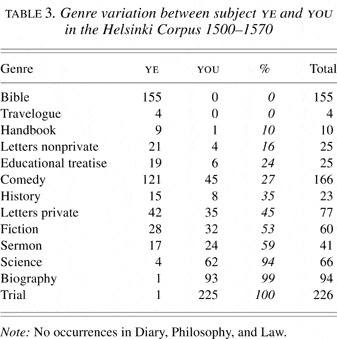
Table 3 is a presentation of the Helsinki Corpus genre variation from the critical period 1500–1570. Like the CEEC, this material indicates a great deal of variation, the proportion of you varying from zero to 100%. Example (9) from the genre History shows that this variation was no different from what we saw in the previous section, ye and you occurring side by side in the same texts.

Genre variation between subject ye and you in the Helsinki Corpus 1500–1570

Table 3 is not, however, as easy to interpret as Figure 3. The text excerpts in the HC stem from a period of 70 years, and this temporal divergence may disrupt comparison. For example, it is the case that some of the private letters date from the earliest years of the century, whereas Robert Record's book on geometry, included in the genre Science, was written in the 1550s, and Roger Ascham's educational treatise in the 1560s. As we saw in the previous section, the change from ye to you in letters seems to have taken place between these two periods and textual differences may consequently reflect the time of writing rather than genre-specific developments.
Despite these problems, I think we can draw some conclusions from the genres at the extreme ends of the Table 3. Tyndale's Bible translation does not participate in the change at all, but we must not forget that it was written in the 1520s and 1530s. It created a model, however, for future Bible translations and kept ye alive in religious language such as sermons, longer than in most other genres (see also, note 9). At the other end of the scale, the state trial of Sir Nicholas Throckmorton took place in 1554, and the exclusive use of you in its records may reflect its late date, but also the fact that it contains a large number of transcribed witness depositions, in other words, spoken language.
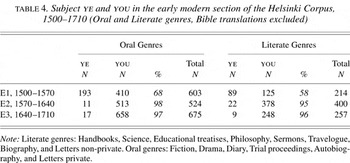
The comparability problems of the HC, caused either by temporal differences and/or the limited number of texts, may be remedied by dividing the data into two general types of writing, the oral and literate genres. This approach is based on the belief that some written texts resemble the typical oral mode of expression better than others (e.g., Biber, 1988; Biber & Finegan, 1997; for the division of the HC texts, see Raumolin-Brunberg & Kahlas-Tarkka, 1997). Table 4 suggests that you first spread to texts that were closer to the spoken idiom, because the difference in E1 between the two genre groups (68% vs. 58%) is statistically significant (chi square test, p < .01).
Subject ye and you in the early modern section of the Helsinki Corpus, 1500–1710 (Oral and Literate genres, Bible translations excluded)

Intertextual variability has also been attested in the CEEC. This variation, based on the relationship between the letter-writer and the recipient, will be discussed in the section on the interplay between the external factors. Unfortunately, the Helsinki Corpus is too small for similar multivariate analysis.
The direction of change
In this section my main question is whether you spread from above or below in sociolinguistic terms. My analysis is based on Labov's discussion of social awareness and his observations on the role of the socioeconomic hierarchy at the initial stages of language change. He wrote (1994:78):
Changes from below are systematic changes that appear first in the vernacular, and represent the operation of internal, linguistic factors. At the outset, and through most of their development, they are completely below the level of social awareness … Changes from below may be introduced by any social class, although no cases have been recorded in which the highest-status social group acts as the innovating group. Changes from above are introduced by the dominant social class, often with full public awareness. Normally, they represent borrowings from other speech communities that have higher prestige in the view of the dominant class.
Labov's findings suggest that we approach our change first as a look at textual variation, which can help us find the types of text in which you was first used, and second, as a study of social variation, which is needed to identify the social stratum in which you was introduced.
Drawing on the multigenre Helsinki Corpus, we have already suggested that you first found its way into the oral type of writing. Both the general behavior of the oral genres and the use of you in the trial records in particular corroborate this argument.
The CEEC, which, of course, generally represents the oral type of writing, also contains material with varying levels of formality. This variation has been tackled by looking at the relationship between the writer and the recipient, on the assumption that family letters are more informal than letters sent to other recipients. As regards the choice of you, quantitative differences emerge between the two types of letters, especially between 1500 and 1519. you occurs in 28% of the family letters, while the corresponding figure for nonfamily letters is less than 2%. This type of register analysis also reveals that the origin of you was in the most informal oral texts.
Similarly, a closer look at the individual variation of some CEEC informants' writing to different recipients shows that you was preferred in family letters, and ye elsewhere, as, for instance, was the case with the humanist scholar and Lord Chancellor Sir Thomas More and the poet Sir Thomas Wyatt (Raumolin-Brunberg & Nevalainen, 1997). King Henry VIII's letters form an excellent example of register variation between private and official writing. There are no occurrences of ye in his autograph love letters to Anne Boleyn, his second wife, although it occurs in his official letters written by secretaries. As far as the King's correspondence is concerned, it is quite fascinating to see the actual timing of the change from ye to you in the official letters: before 1535 you is rare (17% of the cases), whereas after 1535 it is the majority variant.
Finally, the linguistic side of the change, that is, the possible confusion between the weak and fast speech forms and the sound analogy with the second-person singular pronouns, also suggest an origin in the spoken language. On the whole, I think there is enough evidence to argue that the introduction of subject you was a change from below in terms of social awareness.
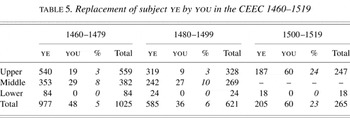
Let us move on to the second issue, the social order. Table 5 gives the figures for ye and you in three social ranks in the CEEC during early subperiods. The ranks are as follows: the upper, which covers the nobility and gentry; the middle, comprising professional people, such as lawyers, doctors, and wealthy merchants; and the lower, in this material mostly representing servants and petty tradesmen.12
The simple division of the social spectrum into three layers is a result of a great deal of reading, thought, and trial and error. The social order in Early Modern England has been reconstructed by historians in different ways (e.g., Barry, 1994; Wrightson, 1991, 1994), and finding out what groupings might be relevant for a linguistic analysis has taken time. In some previous studies on the CEEC, relatively fine-grained divisions were used, but it has become obvious that three or four layers are usually sufficient for temporal comparisons (see Nevalainen, 1996; Nevalainen & Raumolin-Brunberg, 2003:133–156).
Replacement of subject ye by you in the CEEC 1460–1519

Table 5 shows that the use of subject you originated among the middle ranks. The nonoccurrence of you in the language of the lower ranks shows the typical lag of a change from below in the lowest social order. This type of middle-rank origin of change is quite common among the shifts included in Nevalainen & Raumolin-Brunberg (2003), and is also in line with the findings of contemporary sociolinguistic research, which has argued that linguistic changes tend to originate in the interior social groups.
Table 5 also indicates that, rather than spreading to the lower ranks, you seems quite quickly to have found its way into the language of the upper ranks. As mentioned earlier, this change was readily adopted by influential high-ranking people such as Henry VIII and Sir Thomas More. It is possible that the endorsement of this change by the topmost social strata at an early stage ensured its rapid diffusion.
Gender difference
The next question concerns gender difference. Did women and men behave differently in their adoption of you? Gender differences present quite a challenge to historical research owing to the limited supply of authentic data (see e.g., Nevalainen, 2000, 2002a, 2002b).
Women's letters comprise about 20% of the CEEC. The lack of writing skills among women necessarily skews their social representativeness. Most of the letters that have come down to us stem from the upper ranks. The HC has some texts by women, but because only a couple of them are autographical before the second half of the 16th century, the corpus is not used in this part of the study.
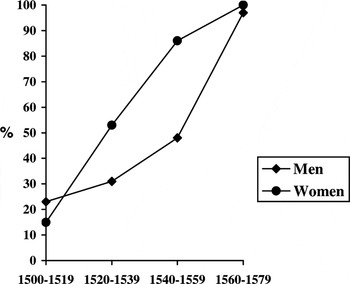
For this section I have chosen William Labov's Gender Paradox as a point of departure (Labov, 1990). Labov argued that, in linguistic change from below, women tend to use higher frequencies of innovative forms than men do. In linguistic change from above, women adopt prestige forms at a higher rate than men. Other researchers have stressed women's role in language change even more than Labov, arguing, for instance, for the vital role of women in the supralocalization of new forms (e.g., Milroy & Milroy, 1993).
Women's social roles form one of the areas in which Early Modern England diverged greatly from our present western societies. Late medieval and early modern women's economic and social dependence on men, fathers, and husbands, their exclusion from public life, their separate upbringing, and low level of education made women's social realities very different from those we live in today (e.g., Fletcher, 1995). Could there nevertheless be similarities in the linguistic behavior of women in relation to ongoing linguistic changes?
Figure 4 shows that there was a gender difference in the diffusion of you. The graph testifies to a systematic female advantage after the proportion of the you process has exceeded a frequency of 20%. This is consistent with Labov's first generalization that in a change from below, women tend to lead the changes. Other historical changes show similar patterning, so that there is no reason to believe that my result is coincidental (Nevalainen & Raumolin-Brunberg, 2003:110–132). However, we must not forget that the social distribution of men and women is not alike in the CEEC, and some of the gender difference may be explained by the lack of low-ranking women among its informants.13
Although Labov's second observation, women's preference for prestige forms, does not apply to the introduction of you, some comments may be appropriate. It seems that women's use of prestige variants depends on their access to these forms. In Early Modern England, women had no access to the overtly prestigious linguistic varieties, such as classical languages and administrative and legal texts (Fletcher, 1995). This becomes obvious in some changes, most notably in the loss of multiple negation, which was led by professional men after the model of administrative language and was clearly a change from above even in terms of the social order (Nevalainen, 1998; Nevalainen & Raumolin-Brunberg, 2003:128–129).

The replacement of subject ye by you in the CEEC: Gender difference (Nevalainen & Raumolin-Brunberg, 2003:119).
Regional variation
Our next issue is the possible dialectal background of you and its regional variation. Supralocalization, that is, spreading of a local linguistic item to larger areas, dialect hopping, and dialect contact involving accommodation are at issue here.
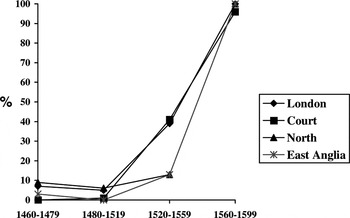
For the study of regional variation in the CEEC, the usage in four parts of England has been compared. These are: (1) the North, comprising counties to the north of Lincolnshire (the borderline can be drawn approximately from Liverpool to Hull), (2) East Anglia, covering Norfolk and Suffolk, (3) London, covering the City, suburbs and Southwark, and (4) the Court, a less geographical unit, which consists of the royal family, courtiers, and higher administrative officers, many of whom lived in Westminster. The City of London and the Court formed the capital area with a large number of in-migrants and weak-tie social networks, in other words, conditions that are likely to promote language change.
As Figure 5 indicates, no single area stands out as the origin of you. Before 1519 the percentage of the innovative form was below 10% in all areas. A difference emerges in the period of rapid growth from 1520 to 1559, with the leaders of the change being, as expected, London and the Court, while the North and East Anglia lag behind. But they catch up with the trend in the capital over the next forty-year period, with the completion of the change in all areas.

The replacement of subject ye by you in the CEEC: Regional differences (Edmund de la Pole excluded)Edmund de la Pole, Duke of Suffolk (1472–1513) has been excluded from this analysis, as his contribution is so considerable that it would skew the statistics. (Nevalainen & Raumolin-Brunberg, 2003:172).
The Middle English subsections M3 and M4 of the Helsinki Corpus (1350–1500), for which there is sufficient information of the dialectal provenance of the texts, further confirm that no specific area led this change in its early stages. In all the dialect areas used in the HC, the North, East and West Midlands, and the South, you remains below 4%.
This change is a good illustration of the type of development that has been reported by Ogura and Wang (1996). As Figure 5 shows, the curves for the localities that adopt the innovation later are steeper than those for localities that adopt innovation earlier. Accordingly, the rate of change is faster in the areas that originally lagged behind. As mentioned previously, the adoption of you follows the familiar pattern of the capital area leading the change (see also, Nevalainen & Raumolin-Brunberg, 2000).
Social networks
Despite being an interesting and important area in sociolinguistics, social networks need to be approached with caution in historical linguistics. The reliability of this approach increases when we come nearer to our own lifetimes, as our knowledge of the social relations and conditions allows more accurate reconstructions of networks. There are interesting studies of the 18th century and later (e.g., Tieken-Boon van Ostade, 2000). As regards times with less background information, we can approach the network issue in two ways: first, from the macro level, focusing on the general characteristics of the society in question and, second, by looking at particular individuals and their life stories.
The macro-level approach, in other words the general history of the first part of the 16th century, indicates that during this period the Reformation was a particular cause of instability. Although one might assume that only religious matters were at issue, the Reformation in fact had a broader effect on society. Among other things, the church lost its riches and its former lands were sold to lay people (Clay, Vol. I, 1984:144). This indeed increased internal migration, leading to a growth of weak-tie social networks, which are found to promote the diffusion of linguistic changes (e.g., Milroy & Milroy, 1985). The Reformation may in this way have played a role in the unusual rapidity of the diffusion of subject you, which was an ongoing change at the time of the onset of the Reformation process in the 1530s.
The second approach, examining the social networks of particular individuals, is more difficult, because we seldom know enough of a person's life to reconstruct his or her networks with sufficient accuracy. Some conclusions have been reached by comparing the leaders of linguistic changes at different stages of the diffusion process. In this type of study, the S-curves depicting the changes have been divided into five phases, after Labov (1994:79–82), and the proportion of the incoming form has been quantified. The following scale was introduced by Nevalainen and Raumolin-Brunberg (2003:55):

Those who had a personal score of more than 30% in the incipient phase and over 50% in the new and vigorous phase were singled out as leaders of the change. The CEEC suggests that the incipient and new and vigorous leaders were different kinds of people. The earliest leaders were mobile middle-ranking people, whereas the new and vigorous leaders appear to have been influential high-ranking individuals, such as Henry VIII, Sir Thomas More, and Henry Grey, Duke of Suffolk. Looked at in terms of social networks (Raumolin-Brunberg, 2003), this implies that the incipient leaders might have been members of loose-knit networks of the kind the Milroys argued for (Milroy & Milroy, 1985; L. Milroy, 1987), whereas the new and vigorous leaders seem to have been central people in the networks, resembling Labov's leaders of linguistic change in Philadelphia (Labov, 2001:325–365).
The interplay of external factors
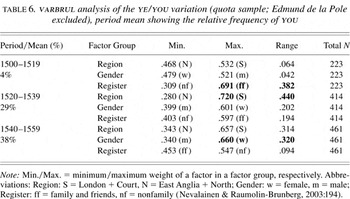
The CEEC offers sufficient data for investigating the interplay between three external factors: gender, region, and register. Gender and region have been introduced earlier. Register here refers to variation between family and nonfamily letters. A multivariate analysis was carried out to identify the role these three factors have in the diffusion of subject you. The computer program used was the varbrul application goldvarb 2 developed by Rand and Sankoff (1990), and special attention was paid to the relative weightings of the three factors in three phases of the linguistic changes. As Table 6 shows, attention was not only paid to the probability weighting, but also to the range of variation of the three factor groups to establish the relative impact of the external factors on the change in progress (Nevalainen & Raumolin-Brunberg, 2003:193–194).
varbrul analysis of the ye/you variation (quota sample; Edmund de la Pole excluded), period mean showing the relative frequency of you

The analysis of the variation between ye and you yields quite an interesting pattern. In the incipient phase, analyzed previously, informal register (family letters) is the most significant factor in the choice of you. In the new and vigorous phase, region, that is, London and the Court, becomes the most robust factor, while gender assumes the leading role with female leadership in the mid-range, in the steep upward slope in Figure 1. These results at least to some extent corroborate what we have seen in earlier sections dealing with the behavior of individual informants, gender difference, regional variation, and social networks, but their relative weights only come to light with this multivariate analysis.15
Four other changes were studied in the same way, and they show different patterns. In general, register, at least understood in our way, seems to be the weakest factor, as it only tops once, just in the case of you. Gender and region are more robust variables, and changes may be either gender-driven or region-driven throughout, or mixed, as is the case with you (Nevalainen & Raumolin-Brunberg, 2003:199).
CONCLUSION
We may conclude that you, introduced in the 14th century, began to spread after the 1480s, becoming the majority variant by the 1560s. The change was completed by the end of the century. During the rapid period of diffusion in 1520–1539, about 60% of the informants used both ye and you. This was a change from below in terms of social awareness, used in oral genres and informal registers during its earliest stage. The social origin of you was among the middle ranks, and women led the change during its critical period of diffusion. No specific region has been found as the origin of this change, but London and the Court adopted it before the North and East Anglia.
The diffusion of subject you is one of several parallel findings introduced in Nevalainen and Raumolin-Brunberg (2003). I have used it here to show what historical sociolinguistics can do. I believe it demonstrates that, with structured corpora and careful analysis, it is possible to capture the social embedding of linguistic changes in the diachronic continuum. I do not think there is any doubt that languages varied in similar patterned ways in the past as they do today.
References
REFERENCES
Barry, Jonathan.
(1994).
Introduction. In
Jonathan Barry &
Christopher Brooks (eds.),
The middling sort of people: Culture, society and politics in
England 1550–1800.
London:
Macmillan.
1–27.
Biber, Douglas.
(1988).
Variation across speech and writing.
Cambridge:
Cambridge University Press.
Biber, Douglas, &
Finegan, Edward.
(1997).
Diachronic relations among speech-based and written registers in
English. In
Terttu Nevalainen &
Leena Kahlas-Tarkka (eds.),
To explain the present: Studies in the changing English language in
honour of Matti Rissanen, Mémoires de la Société
Néophilologique de Helsinki 52.
Helsinki:
Société Néophilologique.
253–275.
Busse, Ulrich.
(2002).
Linguistic variation in the Shakespeare Corpus: Morpho-syntactic
variability of second person pronouns.
Amsterdam:
Benjamins.
Clay, C. G. A.
(1984).
Economic expansion and social change: England 1500–1700
(Vols. I–II).
Cambridge:
Cambridge University Press.
Corpus of Early English Correspondence (CEEC).
(1998).
Compiled by Terttu Nevalainen, Helena Raumolin-Brunberg, Jukka
Keränen, Minna Nevala, Arja Nurmi, & Minna Palander-Collin.
Helsinki:
Department of English, University of Helsinki.
Croft, William.
(2000).
Explaining language change: An evolutionary approach.
London:
Longman.
Fletcher, Anthony.
(1995).
Gender, sex & subordination in England 1500–1800.
New Haven, CT:
Yale University Press.
Helsinki Corpus of English Texts (HC).
(1991).
Compiled by the Helsinki Corpus project team.
Helsinki:
Department of English, University of Helsinki.
Kenyon, John S.
(1914).
Ye and you in the King James Version.
PMLA 24,
New Series
12:453–471.Google Scholar
Kytö, Merja.
(1996).
Manual to the diachronic part of the Helsinki Corpus of English
Texts: Coding conventions and lists of source texts
(3rd ed.).
Helsinki:
Department of English, University of Helsinki.
Labov, William.
(1990).
The intersection of sex and social class in the course of
linguistic change.
Language Variation and Change
2:205–254.Google Scholar
Labov, William.
(1994).
Principles of linguistic change. Volume 1: Internal factors.
Oxford:
Blackwell.
Labov, William.
(2001).
Principles of linguistic change. Volume 2: Social factors.
Oxford:
Blackwell.
Lutz, Angelica.
(1998).
The interplay of external and internal factors in morphological
restructuring: The case of you. In
Jacek Fisiak &
Marcin Krygier (eds.),
Advances in English historical linguistics (1996).
Berlin:
Mouton de Gruyter.
189–210.
Matthews, Peter.
(2002).
On change in ‘E-language’. In
Raymond Hickey (ed.),
Motives for language change.
Cambridge:
Cambridge University Press.
7–17.
Milroy, James, &
Milroy, Lesley.
(1985).
Linguistic change, social network and speaker innovation.
Journal of Linguistics
21:339–384.Google Scholar
Milroy, James, &
Milroy, Lesley.
(1993).
Mechanisms of change in urban dialects: The role of class, social
network and gender.
International Journal of Applied Linguistics
3(1):57–77.Google Scholar
Milroy, Lesley.
(1987).
Language and social networks
(2nd ed.).
Oxford:
Blackwell.
Mustanoja, Tauno F.
(1960).
A Middle English syntax. Part I.
Mémoires de la Société Néophilologique
de Helsinki 23. Helsinki:
Société Néophilologique.
Nevalainen, Terttu.
(1996).
Social stratification. In
Terttu Nevalainen &
Helena Raumolin-Brunberg (eds.),
Sociolinguistics and language history: Studies based on the Corpus
of Early English Correspondence.
Amsterdam:
Rodopi.
57–76.
Nevalainen, Terttu.
(1998).
Social mobility and the decline of multiple negation in Early
Modern English. In
Jacek Fisiak &
Marcin Krygier (eds.),
Advances in English historical linguistics (1996).
Berlin:
Mouton de Gruyter.
263–291.
Nevalainen, Terttu.
(2000).
Gender differences in the evolution of standard English: Evidence
from the Corpus of Early English Correspondence.
Journal of English Linguistics
28(1):38–59.Google Scholar
Nevalainen, Terttu.
(2002a).
Language and woman's place in earlier English.
Journal of English Linguistics
30(2):181–199.Google Scholar
Nevalainen, Terttu.
(2002b).
Women's writings as evidence for linguistic continuity and
change in Early Modern English. In
Richard Watts &
Peter Trudgill (eds.),
Alternative histories of English.
London:
Routledge.
191–209.
Nevalainen, Terttu, &
Raumolin-Brunberg, Helena.
(1989).
A corpus of Early Modern Standard English in a socio-historical
perspective.
Neuphilologische Mittelungen
90(1):61–104.Google Scholar
Nevalainen, Terttu, &
Raumolin-Brunberg, Helena.
(1993).
Early Modern British English. In
Matti Rissanen,
Merja Kytö, &
Minna Palander-Collin (eds.),
Early English in the computer age.
Berlin:
Mouton de Gruyter.
53–73.
Nevalainen, Terttu, &
Raumolin-Brunberg, Helena.
(1996).
The Corpus of Early English Correspondence. In
Terttu Nevalainen &
Helena Raumolin-Brunberg (eds.),
Sociolinguistics and language history: Studies based on the Corpus
of Early English Correspondence.
Amsterdam:
Rodopi.
39–54.
Nevalainen, Terttu, &
Raumolin-Brunberg, Helena.
(2000).
The changing role of London on the linguistic map of Tudor and
Stuart England. In
Dieter Kastovsky &
Arthur Mettinger (eds.),
The history of English in a social context: A contribution to
historical sociolinguistics.
Berlin:
Mouton de Gruyter.
279–337.
Nevalainen, Terttu, &
Raumolin-Brunberg, Helena.
(2003).
Historical sociolinguistics: Language change in Tudor and Stuart
England.
London:
Longman.
Ogura, Mieko, &
Wang, William S.-Y.
(1996).
Snowball effect in lexical diffusion: The development of
-s in the third person singular present indicative in
English. In
Derek Britton (ed.),
English historical linguistics 1994: Papers from the 8th
International Conference on English Historical Linguistics.
Amsterdam:
Benjamins.
119–141.
Quirk, Randolph,
Greenbaum, Sidney,
Leech, Geoffrey, &
Svartvik, Jan.
(1985).
A comprehensive grammar of the English language.
London:
Longman.
Rand, David, &
Sankoff, David.
(1990).
GoldVarb version 2: A variable rule application for the Macintosh.
Montréal:
Centre de Recherches Mathématiques, Université de
Montréal.
Raumolin-Brunberg, Helena.
(2003).
Leaders of linguistic change in Early Modern England.
Paper presented at NWAVE 32, Philadelphia, October 9–12,
2003.
Raumolin-Brunberg, Helena, &
Kahlas-Tarkka, Leena.
(1997).
Indefinite pronouns with singular human reference. In
Matti Rissanen,
Merja Kytö, &
Kirsi Heikkonen (eds.),
Grammaticalization at work: Studies of long-term developments in
English.
Berlin:
Mouton de Gruyter.
17–85.
Raumolin-Brunberg, Helena, &
Nevalainen, Terttu.
(1997).
Social embedding of linguistic changes in Tudor English. In
Raymond Hickey &
Stanislaw Puppel (eds.),
Language history and linguistic modelling: A Festschrift for Jacek
Fisiak on his 60th Birthday.
Berlin:
Mouton de Gruyter.
701–717.
Tieken-Boon van Ostade, Ingrid (ed.).
(2000).
European Journal of English Studies. Special issue on social
networks. 4(3).
Trudgill, Peter.
(1992).
The dialects of England.
Oxford:
Blackwell.
Wrightson, Keith.
(1991).
Estates, degrees, and sorts: Changing perceptions of society in
Tudor and Stuart England. In
Penelope J. Corfield (ed.),
Language, history and class.
Oxford:
Blackwell.
30–52.
Wrightson, Keith.
(1994).
‘Sorts of people’ in Tudor and Stuart England. In
Jonathan Barry &
Christopher Brooks (eds.),
The middling sort of people: Culture, society and politics in
England 1550–1800.
London:
Macmillan.
28–51.
Subject ye and you in the Corpus of Early English CorrespondenceFor different ways of sampling and counting occurrences, see Nevalainen & Raumolin-Brunberg (2003:214–217). Tables 1–4 and Figures 1 and 2 represent percentages counted from all occurrences, whereas Tables 5 and 6 and Figures 4 and 5 are based on quota samples.
Subject ye and you in the Helsinki Corpus
The replacement of subject ye by you in the CEEC. Percentages of you, impersonal structures included (Nevalainen & Raumolin-Brunberg, 2003:60).
The replacement of subject ye by you in the HC. Percentages of you, impersonal structures included. HC; Bible translations excluded.The Bible translations, in the Helsinki Corpus short extracts from John, Genesis, and Numbers, are not included in all its periods, so that the temporal continuity of this genre differs from the other genres. The inclusion of the Bible texts in this study would have skewed the statistics, as all the extracts contain a large number of second-person subjects but very few occurrences of you. Among the Helsinki Corpus material representing the Early Modern English translations, Tyndale's texts have none (Table 4) and the Authorized Version has only 3%. This is in harmony with Kenyon (1914:454), who has found only 7% you in the whole Authorized Version, published as late as 1611.
The diffusion of you among individual informants in the CEEC 1480–1579 (Nevalainen & Raumolin-Brunberg, 2003:93).
Genre variation between subject ye and you in the Helsinki Corpus 1500–1570
Subject ye and you in the early modern section of the Helsinki Corpus, 1500–1710 (Oral and Literate genres, Bible translations excluded)
Replacement of subject ye by you in the CEEC 1460–1519
The replacement of subject ye by you in the CEEC: Gender difference (Nevalainen & Raumolin-Brunberg, 2003:119).
The replacement of subject ye by you in the CEEC: Regional differences (Edmund de la Pole excluded)Edmund de la Pole, Duke of Suffolk (1472–1513) has been excluded from this analysis, as his contribution is so considerable that it would skew the statistics. (Nevalainen & Raumolin-Brunberg, 2003:172).
varbrul analysis of the ye/you variation (quota sample; Edmund de la Pole excluded), period mean showing the relative frequency of you
 You have
Access
- 19
- Cited by