INTRODUCTION
In immunocompetent people, exposure to the intraneuronal parasite Toxoplasma gondii (T. gondii), whose definitive host is any member of the cat family, can result in a chronic latent infection in the brain (Montoya and Liesenfeld, Reference Montoya and Liesenfeld2004; Carruthers and Suzuki, Reference Carruthers and Suzuki2007) indicated by IgG antibodies against T. gondii (Miman et al. Reference Miman, Mutlu, Ozcan, Atambay, Karlidag and Unal2010). As the prevalence of latent toxoplasmosis in the United States has been estimated to be approximately 22% (Montoya and Liesenfeld, Reference Montoya and Liesenfeld2004), it is possible that up to 69 million people in the United States alone could have latent toxoplasmosis. Furthermore, up to one-third of the world's population likely has latent toxoplasmosis (Montoya and Liesenfeld, Reference Montoya and Liesenfeld2004), suggesting that approximately 2·3 billion people worldwide could have latent toxoplasmosis.
In addition to being consistently linked to changes in behaviour in both animals and humans (McConkey et al. Reference McConkey, Martin, Bristow and Webster2013), latent toxoplasmosis has been associated with changes in cognitive function. In rodent models, latent toxoplasmosis has been related to decreased memory, hyperactivity, impaired learning, and deficits in spatial working and spatial recognition memory (Kannan and Pletnikov, Reference Kannan and Pletnikov2012; Xiao et al. Reference Xiao, Kannan, Jones-Brando, Brannock, Krasnova, Cadet, Pletnikov and Yolken2012). However, the relationship between latent toxoplasmosis and cognitive function in animal models is not conclusive as some studies have not found cognitive deficits in mice with latent toxoplasmosis (Gulinello et al. Reference Gulinello, Acquarone, Kim, Spray, Barbosa, Sellers, Tanowitz and Weiss2010).
In human studies, latent toxoplasmosis has been related to slower reaction times (Havlicek et al. Reference Havlicek, Gasova, Smith, Zvara and Flegr2001) and worsened immediate and delayed memory (Yolken et al. Reference Yolken, Dickerson and Fuller Torrey2009) compared to uninfected controls. One study found higher seroprevalence of T. gondii in patients with Alzheimer's disease than in healthy controls (Kusbeci et al. Reference Kusbeci, Miman, Yaman, Aktepe and Yazar2011), a preliminary finding suggesting that latent toxoplasmosis could be a risk factor for Alzheimer's disease. However, similar to results in animal models, some studies have failed to find evidence for a link between latent toxoplasmosis and cognitive function. For example, in a cross-sectional study using data from the United States’ Centers for Disease Control's National Health and Nutrition Examination Survey (NHANES), Pearce et al. (Reference Pearce, Kruszon-Moran and Jones2014) did not find main effects for an association between latent toxoplasmosis and cognition in their fully adjusted models. In a study consisting of 70 subjects, latent toxoplasmosis was not associated with cognitive deficits assessed by five standard neuropsychological tests (Guenter et al. Reference Guenter, Bielinski, Deptula, Zalas-Wiecek, Piskunowicz, Szwed, Bucinski, Gospodarek and Borkowska2012). However, in a reanalysis of these data done separately for men and women and controlling for age (Flegr et al. Reference Flegr, Guenter, Bielinski, Deptula, Zalas-Wiecek, Piskunowicz, Szwed, Bucinski, Gospodarek and Borkowska2012), women with latent toxoplasmosis had worse function on the Verbal Fluency test than uninfected women. In contrast, men with latent toxoplasmosis had better function on the forward portion of the Digit Span test and on the Stroop test than uninfected men. The authors hypothesized that the unexpected positive relationship between latent toxoplasmosis and cognitive function in men may have been due to increased motivation during testing due to increased testosterone concentrations rather than to improved cognitive function itself. This suggestion may be warranted in that another study that found men with latent toxoplasmosis had lowered estimated verbal intelligence compared to controls (Flegr et al. Reference Flegr, Preiss, Klose, Havlíček, Vitáková and Kodym2003).
In addition to possible sex differences in cognitive function associated with latent toxoplasmosis, there may be other variables that affect whether latent toxoplasmosis is associated with cognitive function. Although Pearce et al. (Reference Pearce, Kruszon-Moran and Jones2014) did not find main effects between latent toxoplasmosis and cognition, they did report interactions between low income and latent toxoplasmosis and between foreign birth and latent toxoplasmosis on cognitive deficits. These findings suggest that the relationship between latent toxoplasmosis and cognitive function may not be constant but may vary depending on personal characteristics including social and environmental variables. That is, certain groups may be more likely to have cognitive deficits associated with latent toxoplasmosis than other groups.
Using a sample of adults in the Center for Disease Control's National Health and NHANES, we examined the association between latent toxoplasmosis and cognitive function in specific groups testing two general hypotheses: first, that latent toxoplasmosis is associated with decreased cognitive function and, second, that the relationship between latent toxoplasmosis and cognitive function will differ depending on values of sociodemographic covariates.
MATERIALS AND METHODS
Study sample
Participants aged 20–59 years from the NHANES III (1988–1994), the latest available NHANES dataset containing all the relevant variables by which to test our hypotheses, were included. Respondents were selected using a complex sampling design. Data include a variety of health-related self-report, laboratory and examination data. NHANES III includes data from a nationally representative cross-section of the civilian, non-institutionalized US population (http://www.cdc.gov/nchs/tutorials/NHANES/SurveyDesign/SampleDesign/Info1_III.htm). Sampling weights were used in all analyses to account for the complex sampling design.
Latent toxoplasmosis
In the NHANES III, latent toxoplasmosis was determined by comparing the optical density readings of T. gondii IgG antibody levels for each sample to a standard curve constructed from positive control sera. The standard curve was calibrated to World Health Organization Toxo 60 serum. We interpreted the NHANES III laboratory documentation to indicate that antibody levels below 7 IU mL−1 were considered negative for latent toxoplasmosis, whereas levels above 7 IU mL−1 were considered positive for latent toxoplasmosis (ftp://ftp.cdc.gov/pub/Health_Statistics/NCHS/nhanes/nhanes3/1A/lab-acc.pdf pg 122). Subjects were coded 1 for latent toxoplasmosis positive if their antibody levels exceeded 7 IU mL−1 and subjects below that level were coded 0 for latent toxoplasmosis negative. Thus, we chose to analyse latent toxoplasmosis as a categorical rather than a continuous variable for three main reasons. First, this cutoff is the level specified in the NHANES documentation, which was based on the manufacturer's guidelines for the particular immunoassay kits the NHANES used. Second, seropositivity values in the NHANES dataset were reported as a maximum of 240 IU mL−1; values above 240 were reported as 240. Finally, given that we intended to expand on earlier work (Pearce et al. Reference Pearce, Kruszon-Moran and Jones2014) by specifically focusing on covariate interactions, we thought it important to use the same methodology used in previous studies.
Cognitive function
In the NHANES III, cognitive function was evaluated by three computerized tests, all components of the Neurobehavioral Evaluation System (NES). The NES was designed for use in environmental and occupational epidemiology studies and was patterned after widely used neuropsychological tests (Baker et al. Reference Baker, Letz, Fidler, Shalat, Plantamura and Lyndon1985). The NES was later modified with the subsequent version referred to as the NES2 (Letz and Baker, Reference Letz and Baker1988); the present study is based on the NES2. The subtests from the NES2 used in the NHANES III were the symbol-digit substitution (SDS), simple reaction-time (SRT) and the serial-digit learning (SDL) tests. The SDS is a measure of processing speed, the SRT is a measure of simple reaction time and the SDL is a measure of short-term memory or attention (Krieg et al. Reference Krieg, Chrislip, Letz, Otto, Crespo, Brightwell and Ehrenberg2001). Krieg et al. (Reference Krieg, Chrislip, Letz, Otto, Crespo, Brightwell and Ehrenberg2001) provide detailed descriptions of these cognitive tests and how they are scored. For all of the cognitive-function variables, higher scores represent worse functioning.
Demographic covariates
Age in years was included in the models as a continuous variable. Gender was coded 1 for female and 0 for male. Information on race-ethnicity was self-reported by the subject based on options provided by NHANES. Race categories were grouped into white, black and other (including Aleut, Eskimo, American Indian, Asian or Pacific Islander and other). Ethnicity categories included Hispanic (Mexican-American and other Hispanic) and non-Hispanic. We combined information from these two measures to form a race-ethnicity variable that included categories for non-Hispanic white, non-Hispanic black, Hispanic (regardless of racial categorization) and other. Education was a continuous variable operationalized as the years of education obtained. Poverty-to-income ratio (PIR) was a continuous variable defined as the total family income divided by the poverty threshold, as determined by the US Census Bureau for the year of the interview. PIR values less than 1 were below the official poverty threshold, whereas PIR values of 1 or greater indicated income at or above the poverty level. Based on preliminary analysis, the relationship between PIR and each outcome was modelled as a spline because it had two distinct linear components with the knot or deflection point at PIR of 3.
Statistical analyses
We used Stata 13.1 (StataCorp, College Station, Texas) for all statistical analyses. Analyses were performed using Stata's svy command prefix, which allows for the inclusion of sampling weights to adjust parameter estimates to be representative of the US civilian non-institutionalized population aged 20–59 years as well as adjustments to standard-error estimates to account for the complex-sampling design.
Because we used three different dependent variable measures of cognitive functioning as predicted by both categorical and continuous independent variables, the appropriate method for analysing the data is MANCOVA. MANCOVA enables the covariances of the dependent variables to be taken into account in a multivariate test of the relationship between latent toxoplasmosis (in combination with several control variables) and the three cognitive outcome variables. Unfortunately, traditional MANCOVA procedures available in Stata or other commonly available statistical packages cannot handle the complex-sampling nature of the NHANES data (i.e. non-random, stratified and clustered sampling). Consequently, it was necessary to resort to maximum likelihood estimation methods to calculate the multivariate hypothesis tests.
Typically, the output of MANOVA or MANCOVA will include both the holistic multivariate analysis results and also the corresponding univariate results for each dependent variable. We accomplished the univariate tests of the hypotheses for each of the dependent variables separately using ordinary least squares (OLS) models. The multivariate hypothesis tests of the holistic pattern of effects of the independent variables of all three dependent variables simultaneously were accomplished using Stata's maximum likelihood suest command. This command combines the estimation results, including parameter estimates for individual variables and also including covariance parameter estimates, into a single parameter vector. The results of this multivariate test are expressed in a single F value rather than the four usual multivariate statistics (Wilks’ lambda, Hotelling-Lawley trace, Pillai's trace and Roy's largest root).
We completed the analyses in two stages that coincided with the study's general hypotheses. First, we predicted cognitive functioning as measured by the SDS, SRT and SDL using latent toxoplasmosis as the main predictor and controlling for age, gender, race-ethnicity, education and PIR. Second, we estimated a series of interaction models, each including an interaction between latent toxoplasmosis and a single covariate and the controls. In other words, we estimated models for the interaction between latent toxoplasmosis and age, latent toxoplasmosis and gender, latent toxoplasmosis and race-ethnicity, and so on.
RESULTS
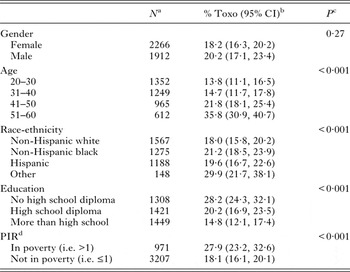
The overall prevalence of latent toxoplasmosis in the unweighted sample was 19·1%. The weighted seroprevalence of latent toxoplasmosis across values of the control variables is presented in Table 1. There was no significant difference in latent toxoplasmosis between sexes (P = 0·27). The prevalence of latent toxoplasmosis increased significantly with age (P<0·001) and decreased with educational attainment (P<0·001). Seroprevalence by race-ethnicity was statistically different between groups (P<0·001), with the highest seroprevalence in those categorized as “Other” (29·9%). Seroprevalence in the non-Hispanic black group was 21·2%, the Hispanic group had a seroprevalence of 19·6%, and the non-Hispanic white group had a seroprevalence of 18·0%. The seroprevalence difference was statistically significant (P<0·001) between the group with incomes below the poverty level (27·9%) and the group with incomes above the poverty level (18·1%).
Weighted prevalence of latent toxoplasmosis across demographic characteristics in US 21- to 59-year olds, NHANES III (1988–1994)

N = 4178.
Toxo, latent toxoplasmosis positive.
a Numbers are unweighted numbers of participants.
b Prevalence percentages are weighted to be representative of the US population.
c P based on Pearson's χ 2 test, which tests whether the prevalence of latent toxoplasmosis differs across the categories of each variable.
d Defined as total family income divided by poverty threshold, as determined by the US Census Bureau for the year of the interview.
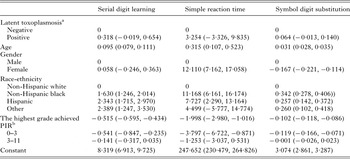
Table 2 reports the unstandardized coefficients and confidence intervals for the univariate tests of the first general hypothesis of the study, that latent toxoplasmosis would be associated with compromised cognitive function. Rencher and Scott (Reference Rencher and Scott1990) have demonstrated that alpha inflation in multiple dependent variables can be effectively controlled by only considering univariate effects to be significant when the corresponding multivariate test reaches significance. For these data, the maximum-likelihood multivariate test was not significant (F(3,47) = 1·81, P = 0·159) but neither were any of the three univariate tests. Controlling for age, gender, race-ethnicity, education and PIR, latent toxoplasmosis was not significantly related to SDL (b = 0·318; 95% CI, −0·019, 0·654), SRT (b = 3·254; 95% CI, −3·326, 9·835) or SDS (b = 0·064; 95% CI, −0·013, 0·140) in the univariate tests. Generally, the unstandardized coefficients represent the predicted average change in the dependent variable for a one-unit increase in the independent variable. In the case of SDL, this means that those with latent toxoplasmosis had an average SDL score 0·318 higher compared to those without latent toxoplasmosis. This difference, however, was not statistically different from 0.
Multiple regression analysis of cognitive functioning in US 21- to 59-year olds, NHANES III (1988–1994): unstandardized coefficients (95% CI) from weighted OLS regression

N = 4017.
CI, confidence interval.
a Positive defined as IgG antibody ⩾7 IU mL−1.
b Defined as total family income divided by poverty threshold, as determined by the US Census Bureau for the year of the interview.
The second general hypothesis was that the relationship between latent toxoplasmosis and cognitive function would differ at various levels of the control variables. Separate models were estimated for the interaction between latent toxoplasmosis and each control. The univariate models were estimated and then combined as described previously to create the maximum-likelihood multivariate tests of the interaction effects. With three measures of cognitive function and five controls, there were 15 univariate models combined into five multivariate models. The multivariate tests for the interaction between latent toxoplasmosis and age (F(3,47) = 1·00, P = 0·402) and gender (F(3,47) = 1·00, P = 0·401) were not statistically significant, indicating the absence of interaction effects. Multivariate tests were significant for the interaction between latent toxoplasmosis and race-ethnicity (non-Hispanic black compared to non-Hispanic white, F(3,47) = 3·30, P = 0·028; Hispanic compared to non-Hispanic white, F(3,47) = 1·24, P = 0·304; other compared to non-Hispanic white, F(3,47) = 1·99, P = 0·129), education (F(3,47) = 9·80, P<0·001) and PIR (F(6,44) = 5·73, P<0·001).
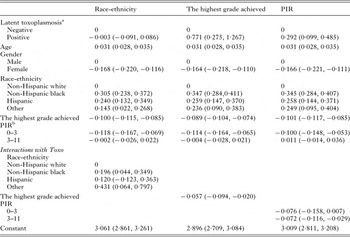
The univariate tests indicated that the significant multivariate tests were driven by SDS; there were no significant interactions for any of the controls for SDL and SRT. The significant interactions between latent toxoplasmosis and race-ethnicity, the highest grade achieved, and PIR for SDS are presented in Table 3. The interaction for race-ethnicity was significant for the non-Hispanic black (b = 0·196, 95% CI, 0·044, 0·349) and other (b = 0·431, 95% CI, 0·064, 0·797) categories. In other words, the presence of latent toxoplasmosis was associated with worse cognitive function among individuals identified as non-Hispanic blacks and other race-ethnicities compared to non-Hispanic whites. There were also significant interactions between latent toxoplasmosis and the highest educational grade achieved (b = −0·057, 95% CI, −0·094, −0·020) and the second part of the PIR spline (b 0–3 = −0·076, 95% CI, −0·158, 0·007; b 3–11 = −0·072, 95% CI, −0·116, −0·029).
Multiple regression analysis of cognitive functioning assessed with the SDS with interactions between latent toxoplasmosis and three of the control variables in US 21- to 59-year olds, NHANES III (1988–1994): unstandardized coefficients (95% CI) from weighted OLS regression

N = 4017.
CI, confidence intervals; Toxo, latent toxoplasmosis.
a Positive defined as IgG antibody ⩾7 IU mL−1.
b Defined as total family income divided by poverty threshold, as determined by the US Census Bureau for the year of the interview.
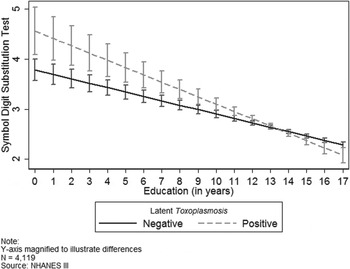
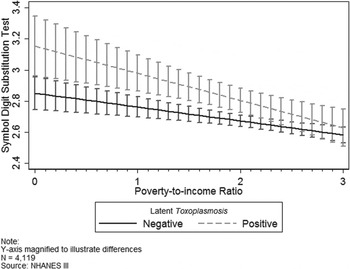
Model-based predictions of the interactions with 95% CIs are presented in Figs 1 and 2, respectively. Figure 1 shows that the presence of latent toxoplasmosis is associated with impaired cognitive function at low levels of education but that the cognitive-function penalty of latent toxoplasmosis decreases at higher levels of education until the CIs overlap at 12 years of education when most students in the US graduate high school. Figure 2 illustrates the interaction between latent toxoplasmosis and PIR. The 3–11 spline is not presented because, although the slope of PIR for latent toxoplasmosis positive and negative were different statistically, relatively few sample members had PIRs in this range resulting in large and overlapping confidence intervals for the predictions. The figure illustrates the significant effect for latent toxoplasmosis (b = 0·292, 95% CI, 0·099, 0·485) indicated by a significant difference in SDS between latent toxoplasmosis positive and negative when PIR is 0. This difference is maintained until the CIs overlap at PIR of 2·2.
Model-based prediction of the symbol digit substitution test illustrating the interaction between education and latent toxoplasmosis controlling for age, gender, race-ethnicity and PIR. Higher SDS values indicate poorer cognitive function. Error bars indicate 95% CIs.

Model-based prediction of the symbol digit substitution test illustrating the interaction between PIR and latent toxoplasmosis controlling for age, gender, race-ethnicity and education. Higher SDS values indicate poorer cognitive function. Error bars indicate 95% CIs.

DISCUSSION
From this large, community-based sample of adults, the primary finding was that there were significant interactions between latent toxoplasmosis and economic status, between latent toxoplasmosis and educational attainment, and between latent toxoplasmosis and race-ethnicity and performance on a measure of cognitive function (SDS) that measures processing speed, although more efficient performance on this task also requires intact short-term memory and attention. Furthermore, these significant interactions with latent toxoplasmosis indicate that the effects of latent toxoplasmosis on cognition may be apparent only in certain groups, in this case, people with low educational attainment, with low PIR, and in certain racial-ethnic groups. As a group, these findings are consistent with and extend those of Pearce et al. (Reference Pearce, Kruszon-Moran and Jones2014), who using the same publically available dataset also found interactions between income and latent toxoplasmosis that adversely affect cognition. Further, the finding of differences in vulnerability to the effects of latent toxoplasmosis on cognition between various groups, such as racial-ethnic groups, to adverse outcomes is consistent with previous work in other areas of medicine (Mody et al. Reference Mody, Gupta, Bikdeli, Lampropulos and Dharmarajan2012). Similarly, people with low educational attainment are more susceptible to Alzheimer's disease than are people with higher educational attainment (Roe et al. Reference Roe, Mintun, D'Angelo, Xiong, Grant and Morris2008) and socioeconomic status in childhood has been associated with cognitive function in adulthood (Kaplan et al. Reference Kaplan, Turrell, Lynch, Everson, Helkala and Salonen2001). In a study of workers exposed to water, sewage and soil in Durango, Mexico, Alvarado-Esquivel et al. (Reference Alvarado-Esquivel, Liesenfeld, Marquez-Conde, Estrada-Martinez and Dubey2010) found that lower education was associated with a higher prevalence of T. gondii infection consistent with our findings. In addition, Alvarado-Esquivel et al. (Reference Alvarado-Esquivel, Torres-Castorena, Liesenfeld, Estrada-Martinez and Urbina-Alvarez2012) demonstrated a significant association between T. gondii and low socioeconomic status in Mexican patients with work-related accidents. Alvarado-Esquivel et al. (Reference Alvarado-Esquivel, Pacheco-Vega, Hernandez-Tinoco, Sanchez-Anguiano, Berumen-Segovia, Rodriguez-Acevedo, Beristain-Garcia, Rabago-Sanchez, Liesenfeld, Campillo-Ruiz and Guereca-Garcia2014) also reported that T. gondii seroprevalence was associated with self-reported memory impairment. Taken together, our findings are consistent with these associations reported by Alvarado-Esquivel et al. in other studies suggesting an interaction between T. gondii and educational attainment and between T. gondii and socioeconomic status and cognition. While we cannot make causative statements, it is possible that these sociodemographic variables influence the risk of T. gondii infection through behaviour or other circumstances. For example, in the study of worker exposure Alvarado-Esquivel et al. (Reference Alvarado-Esquivel, Liesenfeld, Marquez-Conde, Estrada-Martinez and Dubey2010) also found a positive association between T. gondii infection with consuming unwashed fruit as well as with living in a suburban area. Prior work has also demonstrated that the poverty can negatively impact brain development in children (Luby et al. Reference Luby, Belden, Botteron, Marrus, Harms, Babb, Nishino and Barch2013), a deficit to which latent toxoplasmosis could further contribute. Moreover, it is possible that exposure to a parasitic infection at a young age could interfere with brain development (Eppig et al. Reference Eppig, Fincher and Thornhill2010; Mizgajska-Wiktor et al. Reference Mizgajska-Wiktor, Jarosz, Andrzejewska, Krzykala, Janowski and Kozlowska2013), which could potentially influence later cognition as well as educational attainment.
While other studies have reported associations between latent toxoplasmosis and impaired cognition (Havlicek et al. Reference Havlicek, Gasova, Smith, Zvara and Flegr2001; Flegr et al. Reference Flegr, Preiss, Klose, Havlíček, Vitáková and Kodym2003; Yolken et al. Reference Yolken, Dickerson and Fuller Torrey2009), we found no main effects of toxoplasmosis in our models similar to a study by Guenter et al. (Reference Guenter, Bielinski, Deptula, Zalas-Wiecek, Piskunowicz, Szwed, Bucinski, Gospodarek and Borkowska2012) that also did not show an association between latent toxoplasmosis and cognition and to the study by Pearce et al. (Reference Pearce, Kruszon-Moran and Jones2014), who did not find main effects between latent toxoplasmosis and cognition. We also did not find an interaction between latent toxoplasmosis and sex. While Guenter et al. (Reference Guenter, Bielinski, Deptula, Zalas-Wiecek, Piskunowicz, Szwed, Bucinski, Gospodarek and Borkowska2012) did not find a main effect between latent toxoplasmosis and cognition when adjusting for age and sex, when they re-analysed the data for men and women separately, they did find an effect (Flegr et al. Reference Flegr, Guenter, Bielinski, Deptula, Zalas-Wiecek, Piskunowicz, Szwed, Bucinski, Gospodarek and Borkowska2012). Specifically, women positive for Toxoplasma had lower verbal fluency scores than seronegative women. In contrast, seropositive men actually performed better than seronegative men on Digit Span forwards and on the first trial of the Stroop test though there were only 14 males in this study. Differences between the present study and prior studies may be related to sample size, dissimilarities between the cognitive tests used, or other factors.
Finally, although this study was unable to discern the potential underlying mechanisms related to impaired cognition in asymptomatic adults with latent toxoplasmosis, a few possibilities should be considered. First, T. gondii may affect the milieu of neurotransmitters in the central nervous system. For example, animal models have found associations between latent toxoplasmosis and alterations in dopamine levels and/or metabolism (Stibbs Reference Stibbs1985; Prandovszky et al. Reference Prandovszky, Gaskell, Martin, Dubey, Webster and McConkey2011), and human studies have suggested a potentially similar link (Hinze-Selch et al. Reference Hinze-Selch, Daubener, Eggert, Erdag, Stoltenberg and Wilms2007). One study found T. gondii increased extracellular GABA in dendrites from both mouse and human samples (Fuks et al. Reference Fuks, Arrighi, Weidner, Kumar Mendu, Jin, Wallin, Rethi, Birnir and Barragan2012). Second, the parasitic cysts associated with T. gondii infection may disrupt the central nervous system by altering its structure through either direct contact (Berenreiterova et al. Reference Berenreiterova, Flegr, Kubena and Nemec2011) or by influencing gene expression (Xiao et al. Reference Xiao, Kannan, Jones-Brando, Brannock, Krasnova, Cadet, Pletnikov and Yolken2012). Notably, behavioral changes in mice following acute T. gondii infection persist even after parasite levels were no longer apparent (Ingram et al. Reference Ingram, Goodrich, Robey and Eisen2013). Lastly, it has been suggested that the burden of parasitic infections, not limited to T. gondii, displaces the resources necessary for optimal brain development, which may affect intellectual ability/general cognition (Eppig et al. Reference Eppig, Fincher and Thornhill2010) or behaviour (Thornhill and Fincher, Reference Thornhill and Fincher2011).
While we did not find a difference in the prevalence of latent toxoplasmosis between men and women, we found that the prevalence of latent toxoplasmosis increased with age, decreased with increasing income, decreased with educational attainment and differed according to race-ethnicity.
Like others, we found that economic status was associated with cognition (Turrell et al. Reference Turrell, Lynch, Kaplan, Everson, Helkala, Kauhanen and Salonen2002). Similarly, our findings that cognitive function was associated with age, education, gender and race-ethnicity are consistent with previous findings examining the association between age, PIR, education, gender and race-ethnicity in the NHANES III (Krieg et al. Reference Krieg, Chrislip, Letz, Otto, Crespo, Brightwell and Ehrenberg2001).
Strengths of this study include the use of a large, community-based sample additionally weighted to be representative of the US population and the use of standardized methods of assessing cognitive function. The independent variable was laboratory based, and the outcome variables were obtained from actual testing, factors that eliminate the potential for recall bias about the exposure variable and the potential for error in the outcome variable based on subjects’ self-reported cognitive difficulties. We also included age, PIR, sex, education and race-ethnicity in the statistical models.
Several limitations may affect the interpretation of these findings. This study has all of the limitations associated with a cross-sectional design. As such, it is unclear whether latent toxoplasmosis in certain groups causes the cognitive deficits or whether cognitive deficits result in increased exposure to toxoplasmosis. It seems unlikely, however, that cognitive deficits would result in latent toxoplasmosis. As such, the limitations due to the cross-sectional design of this study may not be as important as they might otherwise have been. While we controlled for age, sex, PIR, education and race-ethnicity, there may be other factors that could affect the association between latent toxoplasmosis and cognition for which we did not adjust, resulting in the potential for residual confounding. In addition, the cognitive tests used in this study assessed processing speed, simple reaction time, short-term memory and attention. However, the available cognitive measures did not assess function in other cognitive domains such as executive function, long-term memory, language and overall intellectual function. It remains unknown how, if at all, latent toxoplasmosis might affect other cognitive domains. Our sample was restricted to subjects between ages 20 and 59 years since that was the age group in NHANES III that had received both cognitive testing and lab tests for T. gondii. This restricted age range precluded us from examining any associations between latent toxoplasmosis and cognition in older or younger age groups. In particular, it could be that length of infection is associated with cognitive deficits, a variable that we were unable to examine. While we did not find evidence for an interaction between age and latent toxoplasmosis in the sample we used, we were unable to evaluate this interaction in subjects older than age 59. Older people with cognitive deficits from additional sources may be vulnerable to the effects of latent toxoplasmosis, a hypothesis that we were unable to test because of the restricted age range of the sample. Recent work by others, however, has suggested an association between cognitive function and latent toxoplasmosis in healthy elderly (Beste et al. Reference Beste, Getzmann, Gajewski, Golka and Falkenstein2014; Gajewski et al. Reference Gajewski, Falkenstein, Hengstler and Golka2014).
In conclusion, we found in a large, community-based sample of adults significant interactions between latent toxoplasmosis and economic status, between latent toxoplasmosis and educational attainment, and between latent toxoplasmosis and race-ethnicity and performance on a measure of cognitive function assessing processing speed, short-term memory and attention. These interactions indicate a complex relationship between latent toxoplasmosis and cognition, with certain vulnerable groups being particularly susceptible to the adverse effects of latent toxoplasmosis on cognition.
FINANCIAL SUPPORT
This research received no specific grant from any funding agency, commercial or not-for-profit sectors.