Patients often require opioid medication post-operatively for management of pain, but these medications can have undesirable adverse effects, especially for the cardiac patient. Opioids readily cross the blood-brain barrier in neonates and young children, increasing the risk of depressing the central nervous system at concentrations in the blood that may be less than the minimally effective analgesic concentrations.Reference Forrest1–Reference Valley and Bailey5 Ketorolac has been used in place of opioids to treat post-operative pain, and provide a level of analgesia similar to that of opioids without the associated adverse effects such as respiratory depression, urinary retention, excessive sedation, postoperative ileus, or pruritis.Reference Forrest1, Reference Johnston, Abbott, Gray-Donald and Jeans6, Reference Cummings, Reid, Finley, McGrath and Ritchie7 Due to its improved profile of adverse effects compared to opioids, ketorolac is often considered for use in children following cardiothoracic surgery, but is currently not indicated for use in patients less than two years of age.8 Its use in infants less than six months of age following cardiothoracic surgery is increasing at our institution, albeit that there is a paucity of data related to such use. We designed this study, therefore, to compare the incidence of adverse effects associated with intravenous use of ketorolac in infants less than six months of age undergoing cardiothoracic surgery. We hypothesized that infants who received intravenous ketorolac following cardiothoracic surgery would not show an increased incidence of renal impairment or haematologic complications compared with patients who did not receive intravenous ketorolac post-operatively. We also compared whether ketorolac decreased analgesic use following cardiothoracic surgery.
Methods
Patients
The study received expedited approval by the Institutional Review Board of the participating medical centre. The primary outcome was the difference in incidence of renal impairment and haematologic complications in patients less than six months of age receiving ketorolac following cardiothoracic surgery compared to the incidence in infants not receiving post-operative ketorolac. A secondary outcome was whether the use of ketorolac decreased the use of analgesics in the post-operative period.
A retrospective, case-control review was conducted, which included patients less than six months of age who underwent cardiothoracic surgery from January 1, 2004, to April 15, 2007. Age-matched patients not receiving ketorolac were paired with identified patients receiving ketorolac. Criterions for exclusion included patients with functionally univentricular physiology, or those with an allergy to ketorolac, other nonsteroidal anti-inflammatory drugs, or aspirin. We also excluded any patient with preoperative renal impairment, defined by a serum creatinine of greater than 0.6 milligram/decilitre and/or a blood urea nitrogen greater than 15 milligram/decilitre, along with patients with preoperative anaemia defined by a haemoglobin less than 10 grams/decilitre and/or haematocrit less than 29 percent. All patients receiving ketorolac received a minimum of two doses.
Data analysis
Medical charts and medication administration records were reviewed to collect details of age, weight, and sex, the diagnosis, the dose, total number of doses, and length of therapy with ketorolac, any additional use of analgesics, and the number of blood transfusions and gastric acid suppressive medications as an indicator of gastrointestinal blood loss. Analgesic use was collected throughout the stay in hospital, and included the dose and total number of doses. We also collected details of the levels of blood urea nitrogen, serum creatinine, haematocrit, haemoglobin, and platelets within 24 hours prior to surgery, within 24 hours after surgery and prior to ketorolac therapy, and a minimum of 24 hours after initiation of treatment with ketorolac. Renal impairment was defined as a two-fold increase from baseline in blood urea nitrogen and serum creatinine. Haematologic complications were defined as a decrease in haemoglobin to less than 10 grams/decilitre and haematocrit to less than 29 percent, or the need for blood transfusion.
Statistical analysis
Student’s t-test was used to compare the mean differences in serum creatinine and blood urea nitrogen, and haematologic complications, between the groups. It was also used to compare the difference between use of analgesics. A statistically significant difference was defined as p value less than 0.05.
Results
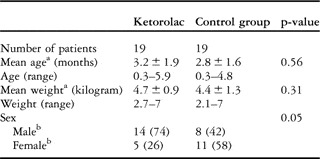
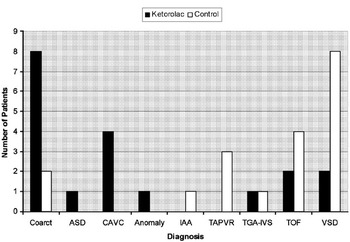
We evaluated the charts from 113 patients, but excluded 75 patients. After 19 patients were identified in the group receiving ketorolac, they were age-matched to 19 control patients who did not receive ketorolac postoperatively, giving a final group of 38 subjects (Table 1). No patient in either group was less than 1 week of age, and a broad range of diagnoses was found in both groups (Fig. 1).
Demographics.

aMean value is plus or minus the standard deviation.
bValue is total number (percentage).
Cardiac diagnosis. Legend: ▪ Ketorolac □ Control. Key: Coarct = Aortic coarctation; ASD = Atrial septal defect; CAVC = atrioventricular septal defect with common valvar orifice; Anomaly = Coronary anomaly; IAA = Interrupted aortic arch; TAPVR = Totally anomalous pulmonary vascular return; TGA-IVS = Transposition with intact ventricular septum; TOF = Tetralogy of Fallot; VSD = Ventricular septal defect.

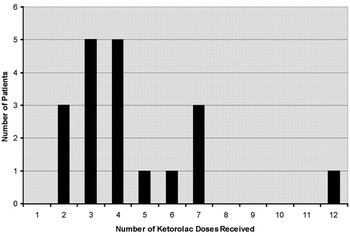
The mean dose of ketorolac received was 0.5 milligram per kilogram per dose given intravenously every 6 to 8 hours, with a range from 0.4 to 0.63. The mean total doses received was 4.5 with a standard deviation of 2.5, and a range from 2 to 12 (Fig. 2). The mean length of therapy was 3.1 days, with a standard deviation of 1.6, and a range from 1 to 6.
Number of doses of Ketorolac received.

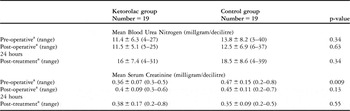
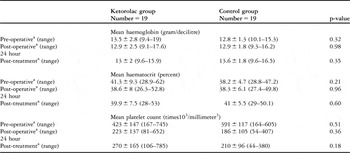
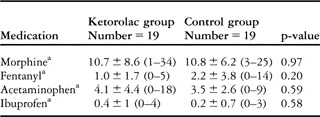
The mean values of blood urea nitrogen and serum creatinine are summarized in Table 2. No difference in the serum creatinine was detected between the two groups. No patient in either group met criterions for renal failure, or required renal replacement therapy. The values for haemoglobin and the haematocrit are summarized in Table 3. There was no statistically significant difference detected between the two groups for mean number of post-operative blood transfusions received or mean platelet counts (Table 3). Use of analgesics in the two groups is summarized in Table 4. Both groups received similar amounts of acid suppressive medications.
Renal function.

aMean value is plus or minus the standard deviation.
Haematologic values.

aMean value is plus or minus the standard deviation.
Mean number of analgesic doses (range).

aMean value is plus or minus the standard deviation.
Discussion
Ketorolac is a potent nonsteroidal anti-inflammatory drug indicated for short term management of moderate to severe postoperative pain.Reference Kokki9 It has no indication for minor or chronic painful conditions. Results from this study support the safety of ketorolac in infants following cardiothoracic surgery. We failed to detect any significant difference between the groups for renal or haematologic complications. In addition, we found no decrease in analgesic use in patients receiving ketorolac following surgery.
A previous retrospective study evaluated the safety of intravenous ketorolac in 53 patients less than six months of age undergoing cardiac surgery.Reference Moffett, Wann, Carberry and Mott10 The results showed ketorolac was not associated with adverse haematologic or renal effects, but these investigators did not compare ketorolac to a control group.Reference Moffett, Wann, Carberry and Mott10 Another study evaluated bleeding complications by measuring chest tube drainage, wound, and gastrointestinal bleeding on 70 infants and children one month to 14 years of age who underwent congenital cardiac surgery.Reference Gupta, Daggett, Drant, Rivero and Lewis11 Pain was managed with ketorolac and opioid analgesics in one study arm and opioid analgesics alone in the other arm. The results showed that the incidence of bleeding was not different between the groups.Reference Gupta, Daggett, Drant, Rivero and Lewis11 In contrast to these previous studies, our study compared the safety of intravenous use of ketorolac use in infants less than six months of age following cardiothoracic surgery to patients who did not receive ketorolac postoperatively. Comparison with a control group allowed a better evaluation of the safety of ketorolac in infants.
The study had several limitations. The possibility of bias exists because the study was retrospective, based on case-control chart review, and patients were not randomized to the treatment. A prospective, randomized, controlled study would minimize the possibility of bias from the study. Our sample was also small, and included only patients with biventricular circulations. Patients with functionally univentricular physiology often have some degree of renal insufficiency following surgical repair. These patients were excluded to allow for interpretation of renal effects based only on the medication and not the surgical procedure. The results did not show an occurrence of gastrointestinal bleeds in either group, but this was based on clinical documentations by the clinical staff. The reliability of this documentation could not be determined.
We have shown, nonetheless, that ketorolac intravenously can safely be used in infants less than six months of age with biventricular circulations following cardiothoracic surgery. Prospective studies are needed to evaluate its safety in larger populations of children, particularly in infants with functionally univentricular anatomy.