Introduction
Species of the genus Conyza are important weeds due to their high abundance, easy seed dispersion, and occurrence of hybridization. These species are cosmopolitan weeds that settle mainly in disturbed areas (Tremmel and Peterson Reference Tremmel and Peterson1983). Their germination and establishment in crop fields occur mainly during late fall to winter, during which time in Brazil fields are fallow or cultivated with pasture, cover crops, or winter grain cereals (Vidal et al. Reference Vidal, Kalsing, Goulart, Lamego and Christoffoleti2007). The seeds are positive photoblastic and do not germinate in soil depths greater than 0.5 cm (Nandula et al. Reference Nandula, Eubank, Poston, Koger and Reddy2006). Generally, hairy fleabane [Conyza bonariensis (L.) Cronquist] and horseweed [Conyza canadensis (L.) Cronquist] seeds germinate between 10 and 25 C, and 20 C is regarded as optimum for germination (Zinzolker et al. Reference Zinzolker, Kigel and Rubin1985). The wide genetic diversity of Conyza species also favors the emergence of herbicide-resistant biotypes (Bajwa et al. Reference Bajwa, Sadia, Ali, Jabran, Peerzada and Chauhan2016). Herbicide resistance is one of the largest agricultural problems. In Brazil, herbicide resistance is estimated to occur on 20.1 million ha, resulting in US$1.63 billion yearly losses (Adegas et al. Reference Adegas, Vargas, Gazziero and Karam2017). In that country, the most important herbicide-resistant weeds are hairy fleabane, Sumatran fleabane, sourgrass [Digitaria insularis (L.) Mez ex Ekman], italian ryegrass [Lolium perenne L. ssp. multiflorum (Lam.) Husnot], goosegrass [Eleusine indica (L.) Gaertn.], and Echinochloa sp. (Adegas et al. Reference Adegas, Correia, Silva, Concenço, Gazziero and Dalazen2022; Heap Reference Heap2022). Cross-resistance occurs in Sumatran fleabane, and cases of glyphosate (5-enolypyruvyl-shikimate-3-phosphate synthase; EPSPS inhibitor, HRAC Group 9) and chlorimuron (acetolactate synthase; ALS inhibitor, HRAC Group 2) double resistance have been found in Brazil since 2011, limiting the use of these two mechanisms of action (Santos et al. Reference Santos, Oliveira, Constantin, Francischini and Osipe2014). Following the appearance of resistance, herbicides with other mechanisms of action were used to control the resistant population, mainly 2,4-D, an auxinic herbicide (HRAC Group 4); the photosystem I (PSI, HRAC Group 22) inhibitors paraquat and diquat; ammonium glufosinate, an inhibitor of the enzyme glutamine synthetase (GS, HRAC Group 10); and saflufenacil, an inhibitor of the enzyme protoporphyrinogen oxidase (PPO, HRAC Group 14). However, the intensification of the use of these herbicides has contributed to the emergence of biotypes resistant to these mechanisms of action. In fact, in Brazil, cross-resistance was identified in Sumatran fleabane to paraquat, chlorimuron, and glyphosate in 2016 (Albrecht et al. Reference Albrecht, Pereira, Souza, Zobiole, Albrecht and Adegas2020) and to 2,4-D, paraquat, diuron, glyphosate, and saflufenacil in 2017 (Pinho et al. Reference Pinho, Leal, Souza, Oliveira, Oliveira, Langaro, Machado, Christoffoleti and Zobiole2019).
A unique case of resistance to the herbicide 2,4-D with an unusual resistance mechanism was identified in a biotype of Sumatran fleabane from the state of Paraná, Brazil, in 2015. Rapid necrosis (RN) symptoms begin approximately 2 h after herbicide spraying, and later the plants regrow from the axillary buds, resulting in a resistance factor (RF) of 18.6 compared with a susceptible biotype (Queiroz et al. Reference Queiroz, Delatorre, Lucio, Rossi, Zobiole and Merotto2020). Recently, a second study on this case of resistance identified that the RN mechanism may be related to changes in auxin transport or the transport inhibitor response 1 receptor and not related to 2,4-D detoxification by glutathione-S-transferase or cytochrome P450 monooxygenase enzymes (Queiroz et al. Reference Queiroz, Delatorre, Markus, Lucio, Angonese and Merotto2022). Furthermore, the oxidative stress related to RN was responsive to temperature and was not light-dependent in Sumatran fleabane resistant plants that also showed rapid photosynthetic damage (Leal et al. Reference Leal, Souza, Borella, Araujo, Langaro, Alves, Ferreira, Morran, Zobiole, Lucio, Machado, Gaines and Pinho2022). There is no report of other species showing similar resistance to auxinic herbicides in the literature (Figueiredo et al. Reference Figueiredo, Küpper, Malone, Petrovic, Figueiredo, Campagnola, Peersen, Prasad, Patterson, Reddy, Kubeš, Napier, Preston and Gaines2022; Peterson et al. Reference Peterson, McMaster, Riechers, Skelton and Stahlman2016). However, a similar phenotype has been reported in giant ragweed (Ambrosia trifida L.) resistant to glyphosate in the United States (Brabham et al. Reference Brabham, Gerber and Johnson2011). This mechanism has been proposed to increase the production of hydrogen peroxide, and it is influenced by temperature and light (Harre et al. Reference Harre, Young and Young2018a; Moretti et al. Reference Moretti, Van Horn, Robertson, Segobye, Weller, Young, Johnson, Douglas Sammons, Wang, Ge, d’Avignon, Gaines, Westra, Green, Jeffery, Lespérance, Tardif, Sikkema, Hall, McLean, Lawton and Schulz2017). In the resistant biotype of giant ragweed, the RN limited the action of other herbicides and caused antagonism between glyphosate and the herbicides atrazine, cloransulam, dicamba, lactofen, and topramezone (Harre et al. Reference Harre, Young and Young2018b). Despite their similarity, the 2,4-D RN-resistant biotype of Sumatran fleabane does not develop RN symptoms in response to glyphosate (Queiroz et al. Reference Queiroz, Delatorre, Lucio, Rossi, Zobiole and Merotto2020).
A previous study identified that the RN caused by 2,4-D in Sumatran fleabane was influenced by temperature, indicating the possible involvement of metabolic and/or transporter proteins (Leal et al. Reference Leal, Souza, Borella, Araujo, Langaro, Alves, Ferreira, Morran, Zobiole, Lucio, Machado, Gaines and Pinho2022). There are only a few studies about the influence of temperature on the 2,4-D efficacy in plants of the genus Conyza even in susceptible biotypes (Montgomery et al. Reference Montgomery, Treadway, Reeves and Steckel2017; Silva et al. Reference Silva, Aguiar, Basso and Muraro2021). A study with horseweed identified higher control efficiency of 2,4-D at noon (11:00 to 13:30, 16 to 26 C) than in the early morning (6:00 to 6:30, 6 to 13 C) (Montgomery et al. Reference Montgomery, Treadway, Reeves and Steckel2017). In general, low temperatures reduce the efficacy of auxinic herbicides due to a reduction in herbicide uptake and translocation (Richardson Reference Richardson1977).
The occurrence of RN has been reported as a variable in field conditions. Anecdotal evidence related to temperature and light has been associated with the low effect of the herbicide 2,4-D and with the intensity of RN. A previous study indicated that under low light (29 μmol m−2 s−1), H2O2 production was reduced in Sumatran fleabane and the onset of RN symptoms was delayed in comparison to high-light conditions (848 μmol m−2 s−1) (Queiroz et al. Reference Queiroz, Delatorre, Lucio, Rossi, Zobiole and Merotto2020). A similar response was observed in another 2,4-D-resistant biotype of Sumatran fleabane, which showed similar levels of H2O2 under dark and under light (520 μmol m−2 s−1) conditions, and it was higher in the resistant biotype than in the susceptible biotype (Leal et al. Reference Leal, Souza, Borella, Araujo, Langaro, Alves, Ferreira, Morran, Zobiole, Lucio, Machado, Gaines and Pinho2022). Another factor affecting the onset of RN is the plant growth stage in the timing of herbicide spraying, which is variable in field conditions. Owing to the increasing occurrence of plants with RN caused by 2,4-D, there is a necessity for more information on the effect of mixtures of 2,4-D and other auxinic herbicides to control resistant biotypes. In addition, alternative herbicides can also be applied after the visualization of the RN, and the efficacy of such applications is also unknown. The aim of this study was to investigate the effect of environmental conditions, plant growth stage, and simultaneous and sequential herbicide mixtures on the occurrence of RN caused by 2,4-D in Sumatran fleabane.
Material and Methods
Plant Material and Data Analysis
The resistant biotype MARPR9-RN (biotype RN) was collected in the city of Maripá, Paraná, Brazil (24.55°S, 53.72°W), and the susceptible biotype LONDS4-S (biotype S) was collected in Londrina, Paraná, Brazil (23.33°S, 51.21°W). Both biotypes were described in Queiroz et al. (Reference Queiroz, Delatorre, Lucio, Rossi, Zobiole and Merotto2020). Resistant plants were bagged and selfed for two generations after selection with 804 g ae ha−1 2,4-D (DMA® 806 BR SL, Corteva Agrisciences, São Paulo, Brazil; labeled use rate of 1,005 g ae ha−1 for Sumatran fleabane control) in a greenhouse to produce the seeds (Queiroz et al. Reference Queiroz, Delatorre, Lucio, Rossi, Zobiole and Merotto2020). Sowing was carried out in plastic trays measuring 15 × 10 cm, filled with substrate. The trays were maintained in a greenhouse at 28 ± 5 C and irrigated daily to promote seed germination. One seedling at the stage of 4 immature leaves was transplanted into individual 200-mL plastic pots previously filled with substrate, maintained in a greenhouse and irrigated daily. All the studies were conducted twice in a completely randomized design with four replicates. The statistical software R version 4.2.1 was used for data analysis (R Core Team 2020). Data were submitted to the nonparametric tests of Shapiro–Wilk and histogram to verify the normal distribution and were transformed as necessary. After that, data were submitted to analysis of variance (ANOVA), and when significant (P ≤ 0.05), the means were compared by Tukey’s honestly significant difference (HSD) test (P ≤ 0.05) using the Expdes.pt package (Ferreira et al. Reference Ferreira, Cavalcanti and Nogueira2021). Herbicide dose–response curves were adjusted using the three-parameter nonlinear log-logistic model using the drc package (Ritz et al. Reference Ritz, Baty, Streibig and Gerhard2015). Data from two replicates of each experiment were submitted to Bartlett’s test for homogeneity of variance using the car package, and when considered homogeneous, the data were analyzed together. All the repeated experiments were similar, and the replications of each experiment were analyzed together.
Dose–Response Evaluation of Seven Auxinic Herbicides
The study evaluated the occurrence of RN and plant injury in response to increasing doses of auxinic herbicides. Resistant and susceptible plants at 10 to 15 cm height (8 to 10 leaves) were sprayed with the herbicides dicamba (Clarity® SL, BASF, Durham, NC, USA) at 15, 30, 60, 120, 240, 480, 960, and 1,920 g ae ha−1; halauxifen-methyl (Arylex™ SC, Dow AgroSciences, Indianapolis, IN, USA) at 0.2, 0.4, 0.9, 1.8, 3.5, 7.0, 14.0, and 28.0 g ae ha−1; triclopyr (Garlon® 480 BR EC, Dow AgroSciences) at 23, 45, 90, 180, 360, 720, 1,440, and 2,880 g ae ha−1; fluroxypyr (Starane® EC, Dow AgroSciences) at 9, 19, 37, 75, 150, 300, 599, and 1,199 g ae ha−1; florpyrauxifen-benzyl (Loyant™ SL, Dow AgroSciences) at 0.2, 0.5, 0.9, 1.9, 3.8, 7.5, 15.0, and 30.0 g ae ha−1; and picloram (Padron® SL, Dow AgroSciences) at 8, 15, 30, 60, 120, 240, 480, and 960 g ae ha−1. For the herbicide 2,4-D, the rates for susceptible biotype were 25, 50, 101, 201, 402, 804, 1,608, and 3,216 g ae ha−1, and for the resistant biotype, they were 101, 201, 402, 804, 1,608, 3,216, 6,432, and 12,864 g ae ha−1. The considered labeled rate for Sumatran fleabane control was 560 g ae ha−1 of dicamba, 7 g ae ha−1 of halauxifen-methyl, and 1,005 g ae ha−1 of 2,4-D. Doses for the other herbicides were selected based on recommendations for similar species because there were no label recommendations for Conyza species. The label rates considered were 720 g ae ha−1 of triclopyr, 300 g ae ha−1 of fluroxypyr, 7.5 g ae ha−1 of florpyrauxifen-benzyl, and 360 g ae ha−1 of picloram. Plants were sprayed in a spray chamber (Generation III Research Sprayer, DeVries Manufacturing, Hollandale, MN, USA) calibrated at 262 kPa delivered by a TJ8002E nozzle, resulting in an output volume equivalent to 200 L ha−1. Plant injury was evaluated by a visual percentage scale rating the RN in the biotype RN and the occurrence of epinasty in the susceptible biotype at 35 d after treatment (DAT), where 0% corresponded to the absence of symptoms and 100% to total plant control.
Effect of Rapid Necrosis on the Effect of Other Auxinic Herbicides
Plants of the biotypes RN and S at 10 to 15 cm of height (8 to 10 leaves) were sprayed with the herbicides 2,4-D at 670 g ae ha−1 alone and in a simultaneous mixture with dicamba at 480 g ae ha−1, halauxifen-methyl at 7 g ae ha−1, or triclopyr at 720 g ae ha−1. These herbicides were also applied 4 and 24 h after 2,4-D spraying. The occurrence of RN was evaluated at 3 DAT and plant injury at 35 DAT, as described earlier. Data were submitted to ANOVA (P ≤ 0.05), and means were compared by Tukey’s HSD test (P ≤ 0.05). Analysis of the effect of interactions between herbicides was performed using the Colby (Reference Colby1967) method, which compares the effect of control of herbicides in mixture with the effect of the herbicides used alone and reveals additive, synergistic, or antagonistic responses. Synergism occurs when the observed effect is higher than the expected effect of the mixture, antagonism occurs when the observed effect is less than expected, and the additive response occurs when the observed effect is equal to the expected. Expected and observed values were compared using t-test (P < 0.05).
Effect of Temperature on the Occurrence of Rapid Necrosis
The first experiment evaluated the time course of RN symptoms at low temperature. Initially, plants of the resistant and the susceptible biotypes were grown in a greenhouse at a temperature of 25 ± 5 C. Four days before spraying, the plants were transferred to a growth chamber (Percival, Boone, IA, USA) at 12 C and 13-h photoperiod (300 μmol m−2 s−1). Plants at 10 to 15 cm of height (8 to 10 leaves) were sprayed with 804 g ae ha−1 of 2,4-D. Four 12-mm-diameter leaf disks were collected from the fifth leaf of four plants at different times after 2,4-D spraying and kept at 10 C. A hydrogen peroxide assay was performed using the 3,3′-diaminobenzidine (DAB) staining method (Thordal-Christensen et al. Reference Thordal-Christensen, Zhang, Wei and Collinge1997). The presence of H2O2 was visualized by color change (brown), where DAB polymerized with this compound. The staining associated with H2O2 was determined in the Image J program (National Institutes of Health, Bethesda, MD, USA).
The second experiment evaluated the effect of 2,4-D doses and temperatures on the occurrence of RN symptoms. Factor A was the biotypes S and RN. Factor B comprised the temperatures of 12 C and 30 C, and factor C was the 2,4-D doses of 50.25, 201, 402, 804, and 1,608 g ae ha−1. After spraying, half of the plants were kept in a growth chamber (Percival) at 12 C and 13-h photoperiod, and the other half of the plants were kept in a growth chamber (ATC40, Conviron, Winnipeg, Manitoba, Canada) at 30 C and 13-h photoperiod, both with light intensity of 300 μmol m−2 s−1. Plant visual injury on a percentage scale was evaluated for RN in the resistant biotype and epinasty in the susceptible biotype at 1 and 21 DAT.
Effect of Changes in Photosynthesis on the Occurrence of Rapid Necrosis
Plants of the biotype RN at 5 cm in height (4 to 5 leaves) were grown in nutrient solution. Treatments consisted of the herbicide 2,4-D singly or preceded by application of the photosystem II (PSII, HRAC Group 5) inhibitors herbicides atrazine (AclamadoBR® SC, Ouro Fino Química, Uberaba, Brazil) and diuron (Diox® SC, Ouro Fino Química) at 100, 500, 1,000, 2,500, 5,000, and 10,000 μM and maintained for 9 h. Then, the nutrient solution was renewed, and the herbicide 2,4-D was applied to the nutrient solution at the concentration of 2,000 μM and maintained for 6 h. After this period, the solution was renewed again. The evaluation of symptoms was performed at 1 DAT using a percentage visual scale on which 0% corresponded to the absence of injury and 100% to plant death. The resistant plants were evaluated for RN and the susceptible plants for epinasty symptoms. The time for onset of RN symptoms after herbicide application was also evaluated at intervals of 15 min until 5 h after herbicide spraying.
A second study evaluated the biotype RN submitted to different periods of light. Plants were initially grown in a greenhouse at 25 ± 5 C. When the plants were at 10 to 15 cm of height (8 to 10 leaves), they were transferred to a growth chamber with a temperature of 25 C and absence of light for 0, 1, 2, and 3 d before the herbicide treatment. After that, four drops of 2,4-D herbicide were applied with a micropipette at a concentration of 4.02 g ae L−1 per leaf sampled. Half of the plants remained in the absence of light, and the other half were transferred to a growing chamber with a temperature of 25 C and 400 μmol m−2 s−1 of light after herbicide application. The evaluation was performed on 11-mm-diameter leaf disks collected from the herbicide application site 90 min after application. For each treatment, four leaf disks were collected, and each disk consisted of a repetition. The leaf disk was incubated in a solution with DAB (1 mg mL−1, pH 3.8) at room temperature for 8 h. The staining associated with H2O2 was determined for each disk in the Image J program, as described earlier. In addition, the plants were photographed at the onset of the symptoms and at 5 h later. The necrotic area of four leaves per treatment was measured using the Image J program. Each experimental unit consisted of a leaf disk obtained from an individual leaf where the herbicide was applied. The time for onset of RN symptoms after herbicide application was also recorded for each leaf collected for the necrosis area measurement. An auxiliary green light was used to evaluate the onset of symptoms in plants kept in the dark.
Effect of Plant Growth Stage on the Occurrence of Rapid Necrosis
Factor A was the biotypes S and RN. Factor B was plant growth stage 1, corresponding to 5 to 8 cm of height and 10 to 12 leaves; stage 2, with 30 to 45 cm height and 22 to 25 leaves; and stage 3, with 45 to 60 cm height and 30 to 40 leaves. Factor C was herbicides doses of 2,4-D at 50.25, 201, 402, 804, 1,608, and 3,216 g ae ha−1; dicamba at 30, 120, 240, 480, 960, and 1,920 g ae ha−1; and triclopyr at 45, 180, 360, 720, 1,440, and 2,880 g ae ha−1. Visible plant injury on a percentage scale was evaluated at 49 DAT.
Results and Discussion
Dose–Response Evaluation of Auxinic Herbicides
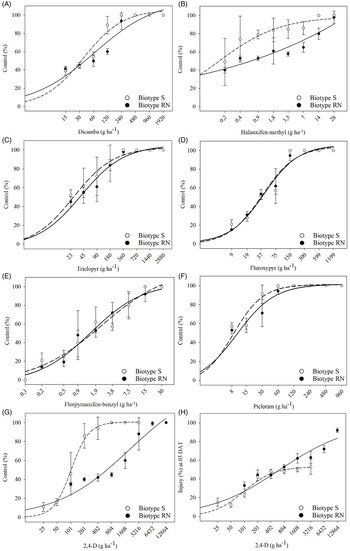
In a previous study, the resistant biotype showed RN symptoms to 2,4-D and MCPA herbicides, both classified as phenoxy herbicides, and only showed epinasty symptoms to other auxinic herbicides applied at labeled use rates (Queiroz et al. Reference Queiroz, Delatorre, Lucio, Rossi, Zobiole and Merotto2020). However, some field observations have identified the occurrence of RN in overlapping herbicide applications in some populations. In the present study, the effect of several auxinic herbicides was evaluated using dose–response curves. The symptoms of RN were observed only in the biotype RN in response to the 2,4-D herbicide. The other auxinic herbicides dicamba, halauxifen-methyl, triclopyr, fluroxypyr, florpyrauxifen-benzyl, and picloram, even applied at high rates in the dose–response assay, promoted only the typical symptom of epinasty and controlled both RN and susceptible biotypes (Figure 1 A to F). The 2,4-D herbicide controlled susceptible plants with the dose of 804 g ae ha−1, but the resistant biotype showed only 40% control at that dose (Figure 1 G). The RF for 2,4-D at 3 DAT was 0.66, because the susceptible plants were evaluated for epinasty and the resistant plants for RN symptoms, which were equivalent in some doses. At 35 DAT, the RF was 7.39 for 2,4-D (Table 1).
Dose–response curves for Sumatran fleabane biotypes RN (2,4-D RN resistant) and S (2,4-D susceptible) at 35 d DAT to dicamba (A), halauxifen-methyl (B), triclopyr (C), fluroxypyr (D), florpyrauxifen-benzyl (E), picloram (F), and 2,4-D (G) and at 3 DAT to 2,4-D (H). Vertical bars indicate the confidence interval (α = 0.05).

Log-logistic equation parameters and RFs for herbicide control at 35 DAT for Sumatran fleabane biotypes RN (2,4-D RN resistant) and S (2,4-D susceptible) for seven auxinic herbicides and at 3 DAT after application of 2,4-D. a,b

a Difference statistically significant (asterisk) or not statistically significant (ns) for parameter b (curve slope) with 0, parameter c (lower limit) with 0, parameter d (upper limit) with 100, parameter e (effective dose for 50% control) between S and RN biotypes, and RF with 1.
b Abbreviations: DAT, days after treatment; RF, resistance factor.
Auxinic herbicides are an important group of selective herbicides used to control dicot weeds (Peterson et al. Reference Peterson, McMaster, Riechers, Skelton and Stahlman2016). Resistance to these herbicides limits the options for controlling Conyza species, in which herbicide resistance has already been reported to other five mechanisms of action (inhibitors of PSIs and PSIIs and EPSPS, ALS, and PPO inhibitors) (Pinho et al. Reference Pinho, Leal, Souza, Oliveira, Oliveira, Langaro, Machado, Christoffoleti and Zobiole2019; Santos et al. Reference Santos, Oliveira, Constantin, Francischini and Osipe2014). The results obtained in this study are important to confirm the efficacy of six other auxinic herbicides in the control of the biotype RN.
Rapid Necrosis Caused by 2,4-D Results in Antagonism to Other Auxinic Herbicides
The herbicides dicamba, halauxifen-methyl, and triclopyr were applied singly, mixed with, or 4 and 24 h after the application of 2,4-D to evaluate the effect of RN on the efficacy of these alternative herbicides. The absence of antagonism was observed in the evaluation at 3 DAT of the simultaneous or sequential application of 2,4-D and either dicamba, halauxifen-methyl, or triclopyr in the biotype RN (Table 2). However, after plant regrowth, the herbicide injury at 35 DAT indicated an antagonism between 2,4-D and these three herbicides for controlling biotype RN when these herbicides were used either in association with or 4 h after 2,4-D (Table 2). After 2,4-D spraying, the R-RN plants developed the symptoms of RN, with partial leaf wilt and necrotic spots that expanded over time (Queiroz et al. Reference Queiroz, Delatorre, Lucio, Rossi, Zobiole and Merotto2020). It is possible that the leaf necrosis could have reduced the herbicide absorption and mobility from the leaf to the meristems when used in a simultaneous or sequential application. Similar antagonism was found in giant ragweed resistant to glyphosate by RN for five herbicides with different mechanisms of action (Harre et al. Reference Harre, Young and Young2018b). The prevention of herbicide resistance is dependent on rotation and mixtures of different herbicide mechanisms of action, especially for the increasing problem of resistance in Sumatran fleabane (Cantu et al. Reference Cantu, Albrecht, Albrecht, Silva, Danilussi and Lorenzetti2021), but the occurrence of antagonism in the RN plants jeopardizes this strategy and increases the herbicide resistance problem. In addition, herbicide resistance management also requires other nonchemical weed control and agronomic measures that contribute to resistance prevention.
RN at 3 DAT, injury at 35 DAT, expected effect of the association, and the result of the interaction of the 2,4-D herbicide mixed with dicamba, halauxifen-methyl, or triclopyr, according to the method proposed by Colby (Reference Colby1967) on the Sumatran fleabane biotype RN (2,4-D RN resistant). a,b,c

a Means followed by the same letter are not different according to Tukey’s HSD test (P < 0.05).
b An astersisk indicates significant difference between the observed and expected values by t-test (P < 0.05); an “ns” indicates nonsignificant difference between the observed and expected values by t-test (P < 0.05).
c Abbreviations: Exp., expected effect; Int., interaction; RN, rapid necrosis.
Low Temperature Delays the Occurrence of RN
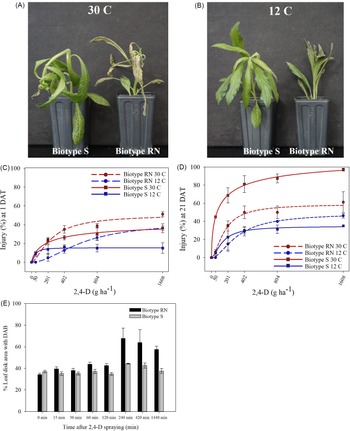
At a temperature of 25 C or higher, necrosis symptoms were detected in the biotype RN about 2 h after spraying and leaf desiccation after 1 DAT (Queiroz et al. Reference Queiroz, Delatorre, Lucio, Rossi, Zobiole and Merotto2020). Considering the field observation of variable occurrence of RN, we postulated that low temperature might modulate the effect of 2,4-D. Therefore we evaluated the effect of 2,4-D at the temperature of 12 C. In this situation, RN symptoms were detected only after 1 DAT and were less intense in comparison with the application at 30 C (Figure 2 A to C). The typical 2,4-D symptoms of epinasty were also less intense in the susceptible biotype at 12 C in comparison with 30 C (Figure 2 A and B). At 21 DAT, the injury caused by 2,4-D was higher in the susceptible biotype in comparison with biotype RN, characterizing the occurrence of resistance to 2,4-D (Figure 2 D). In this evaluation, the application of 2,4-D at the temperature of 12 C for biotype RN resulted in lower plant injury in comparison to 30 C (Figure 2 D). The obtained results agree with the standard Q10 (temperature quotient) principle in biology, which indicates that for most biochemical reactions, the rate of reaction changes by a factor of 2 for every 10 C change in temperature.
Effect of temperature on 2,4-D symptoms on Sumatran fleabane biotypes RN (2,4-D RN resistant) and S (2,4-D susceptible) at 1 DAT with 804 g ae ha−1 2,4-D at 30 C (A) and 12 C (B), plant injury (%) after 2,4-D application at 12 C and 30 C evaluated at 1 DAT (C) and 21 DAT (D), and ROS accumulation (%) at different times after 2,4-D spraying at 12 C (E). Vertical bars indicate the confidence interval (α = 0.05).

Not only was the necrosis delayed at low temperature but reactive oxygen species (ROS) accumulation was also delayed. Previous results indicated that the onset of ROS accumulation was about 15 min after 2,4-D spraying at the temperature of 25 C and high light (848 μmol m−2 s−1) and results in approximately 62% of the leaf area stained with DAB (Queiroz et al. Reference Queiroz, Delatorre, Lucio, Rossi, Zobiole and Merotto2020). In the present study carried out at 12 C, the onset was 60 to 120 min after spraying, and ROS formation was maximum at 240 min covering 63% of leaf area (Figure 2 E). A similar change has been reported in giant ragweed with the resistance to glyphosate by RN, in which the amount of H2O2 at 30 C was more than twice that obtained at 10 C, after 2.5 h of spraying (Harre et al. Reference Harre, Young and Young2018a). Also, in that study, the temperature affected the occurrence of antagonism with other systemic herbicides. The control of giant ragweed resistant to glyphosate with the association of the herbicides atrazine, cloransulam, dicamba, and topramazone was 12% to 21% less effective than expected at 30 C and 11% to 16% less effective at 10 C. Overall, the antagonism was up to 10% greater at 30 C than at 10 C (Harre et al. Reference Harre, Young and Young2018a).
Effect of Light and Photosynthesis Inhibitors on the Occurrence of Rapid Necrosis
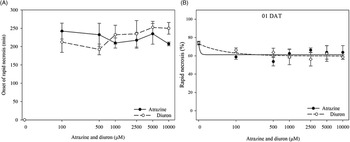
The effect of light and photosynthesis inhibitors could provide insights about the mechanisms behind the symptoms of RN caused by 2,4-D and regarding the variability of RN intensity under field conditions. The application of PSII inhibitors, atrazine, and diuron in nutrient solution did not delay the onset (Figure 3 A) or decrease the intensity (Figure 3 B) of RN at any of the concentrations evaluated in relation to the application of the herbicide 2,4-D alone. These results indicate that alterations in plant photosynthesis through PSII inhibition do not prevent the occurrence of symptoms related to resistance in the biotype RN.
Effect of photosystem II inhibitors atrazine and diuron before application of 2,4-D (2,000 μM) on the onset of symptoms (A) and injury (%) from rapid necrosis 1 DAT (B) on Sumatran fleabane biotype RN (2,4-D RN resistant). Vertical bars indicate the confidence interval (α = 0.05).

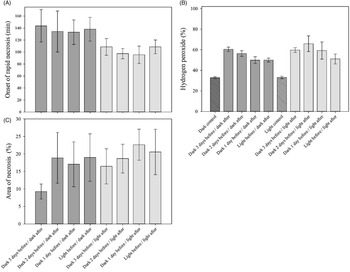
In the second study related to the effect on photosynthesis, treatments were evaluated in the presence and absence of light. Plants maintained in the absence of light after application of the 2,4-D herbicide started RN symptoms from 134 to 144 min after treatment, and in plants exposed to 400 μmol m−2 s−1 light after application, RN symptoms began earlier, at 95 to 109 min after treatment (Figure 4 A). The periods of 1 to 3 d of dark treatment before herbicide spraying resulted in similar results for RN.
Onset of symptoms in minutes (A), accumulation of hydrogen peroxide (%) at 90 min after treatment (B), and area of leaf necrosis (%) at 5 h after 2,4-D application (4.02 g ae L-1) (C) in plants kept under different light conditions on Sumatran fleabane biotype RN (2,4-D RN resistant). Dark control was untreated plants kept in the absence of light; light (intensity 400 μmol m−2 s−1). Vertical bars indicate the confidence interval (α = 0.05).

Regarding the effect on oxidative stress, no difference was observed in the production of H2O2 in leaf disks evaluated at 90 min after herbicide application, independent of the light regime (Figure 4 B). Similar results were observed for the area of RN at 5 h after treatment when the RN symptoms were consolidated (Figure 4 C). These results indicate that the absence of light after herbicide application causes a slight delay in RN symptoms, but the production of hydrogen peroxide and the sizes of necrosed areas were not affected by the light treatments either before or after 2,4-D application.
Similar results were observed in previous studies, in which low light (29 μmol m−2 s−1) delayed the onset of symptoms of RN compared with higher light (848 μmol m−2 s−1) (Queiroz et al. Reference Queiroz, Delatorre, Lucio, Rossi, Zobiole and Merotto2020). However, the production of H2O2 was not dependent on the presence of light in this species, and the symptoms also occurred in the dark condition. Another study evaluated the consequences on photosynthesis after 2,4-D application on an RN biotype of Sumatran fleabane (Leal et al. Reference Leal, Souza, Borella, Araujo, Langaro, Alves, Ferreira, Morran, Zobiole, Lucio, Machado, Gaines and Pinho2022). The photosynthetic performance was reduced by 20% 1 h after the application of the 2,4-D herbicide, showing lower performance of the electron transport chain. After 4 h of treatment, these metabolic alterations were also observed in the susceptible biotype. Photosynthetic damage was rapidly observed in the resistant compared with the susceptible biotype due to the differential physiological response to 2,4-D (Leal et al. Reference Leal, Souza, Borella, Araujo, Langaro, Alves, Ferreira, Morran, Zobiole, Lucio, Machado, Gaines and Pinho2022). These symptoms are probably related to the increase of ROS and the effect of the necrosis of the leaf tissue on photosynthesis.
The resistance mechanism of RN is affected by light intensity and temperature. In low light, there is a delay of 3 h for symptom onset, and the amount of H2O2 accumulated is also reduced in comparison to high light (Queiroz et al. Reference Queiroz, Delatorre, Lucio, Rossi, Zobiole and Merotto2020). Here we report that low temperature (12 C) causes a stronger effect; the symptoms were only manifested 1 DAT and were subtler, and H2O2 began to accumulate between 60 and 120 min. As discussed before, these interactions between environmental conditions and the RN mechanism have been reported also for the resistance to glyphosate found in giant ragweed (Harre et al. Reference Harre, Young and Young2018a; Moretti et al. Reference Moretti, Van Horn, Robertson, Segobye, Weller, Young, Johnson, Douglas Sammons, Wang, Ge, d’Avignon, Gaines, Westra, Green, Jeffery, Lespérance, Tardif, Sikkema, Hall, McLean, Lawton and Schulz2017). These findings are important because, in the field, where the environment is more variable than in greenhouse or growth chamber experiments, these interactions may confound the diagnostic of RN and influence the efficacy of other herbicides when applied in association with 2,4-D.
Effect of Plant Growth Stage
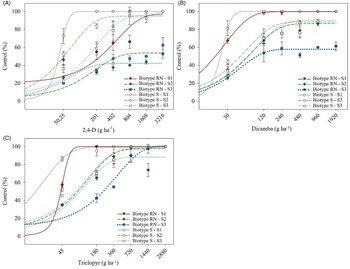
Plant regrowth at 49 DAT characterizes plant survival after the occurrence of RN in the biotype RN, as determined in previous studies (Queiroz et al. Reference Queiroz, Delatorre, Lucio, Rossi, Zobiole and Merotto2020). Resistant plants were effectively controlled only with 2,4-D doses higher than 1,340 g ae ha−1 applied in plants at stage 1 (5 to 8 cm and 10 to 12 leaves). At this stage, the susceptible plants were controlled with the dose of 50.25 g ae ha−1 (Figure 5 A). The RF for biotype RN in comparison with biotype S was 7.9, 82.5, and 24.8 for applications to stages 1, 2, and 3, respectively (Table 3). Despite the lower RF in stage 1 in comparison with stages 2 and 3, the occurrence of plant regrowth at 49 DAT was observed in treatments with the recommended dose of 804 g ae ha−1.
Efficacy of control (%) at 49 DAT of Sumatran fleabane biotypes RN (2,4-D RN resistant) and S (2,4-D susceptible) at three plant growth stages. Dose–response curves to 2,4-D (A), dicamba (B), and triclopyr (C) (S1, 5 to 8 cm and 10 to 12 leaves; S2, 30 to 45 cm and 22 to 25 leaves; S3, 45 to 60 cm and 30 to 40 leaves). Vertical bars indicate the confidence interval (α = 0.05).

Log-logistic equation parameters and RFs for herbicide control at 49 DAT for Sumatran fleabane biotypes RN (2,4-D RN resistant) and S (2,4-D susceptible), after application of 2,4-D, dicamba, and triclopyr in three plant growth stages in the application (S1, 5 to 8 cm and 10 to 12 leaves; S2, 30 to 45 cm and 22 to 25 leaves; S3, 45 to 60 cm and 30 to 40 leaves).a,b

a Difference statistically significant (asterisk) or not statistically significant (ns) for parameter b (curve slope) with 0, parameter c (lower limit) with 0, parameter d (upper limit) with 100, parameter e (effective dose for 50% control) between S and RN biotypes, and RF with 1.
b Abbreviation: RF, resistance factor.
The RN symptoms were not observed for dicamba and triclopyr treatments in resistant plants, regardless of the dose used and growth stage at application. These plants showed similar symptoms of epinasty to the biotype S for both herbicides after 1 d of application (data not shown). The efficacy of dicamba and triclopyr between the biotypes RN and S was similar for application at stages 1 and 2 (Figure 5 B and C). However, at stage 3, control of the biotype RN was inferior to the biotype S at doses higher than 120 g ae ha−1 of dicamba and for the doses of 45 to 360 g ae ha−1 of triclopyr (Figure 5 B and C). The recommended stage of application is stage 1 (5 to 8 cm and 10 to 12 leaves). The other two evaluated stages (30 to 45 cm and 22 to 25 leaves and 45 to 60 cm and 30 to 40 leaves) represent situations where late burndown applications are necessary, which frequently occurs in farm situations. Although the auxinic herbicides are not recommended for application on plant stages 2 and 3, this is evidence of decreased efficacy of dicamba and triclopyr for the 2,4-D-resistant plants caused by RN.
Several studies indicate satisfactory control of horseweed plants with the herbicide dicamba, even in advanced stages of growth (Kruger et al. Reference Kruger, Davis, Weller and Johnson2010). For 2,4-D, however, the plant stage is important for Conyza control (Oliveira Neto et al. Reference Guerra, Dan, Braz, Santos and Constantin2010; Walker et al. Reference Walker, Boucher, Cook, Davidson, McLean and Widderick2012). When evaluating hairy fleabane plants at rosettes of 5 cm and 10 to 15 cm in diameter to the effect of 2,4-D at 940 and 1,250 g ae ha−1, Walker et al. (Reference Walker, Boucher, Cook, Davidson, McLean and Widderick2012) found 36% lower control effectiveness for taller plants compared to the 5-cm-diameter stage, despite the dose increase in late application. However, in a study with glyphosate-resistant horseweed, there was no growth stage effect with 2,4-D when 560 g ae ha−1 of the herbicide was applied to plants with heights of 0 to 7, 7 to 15, 15 to 30, and 30 to 45 cm (Kruger et al. Reference Kruger, Davis, Weller and Johnson2010). The environmental conditions may complicate further the effect of the plant growth stage on the control of Conyza species by auxinic herbicides. The current study indicates that RN-resistant plants treated at early growth stage, such as stage 1 (5 to 8 cm and 10 to 12 leaves), are more affected by 2,4-D than those treated with later herbicide applications. The herbicides dicamba and triclopyr are less effective on plants of the biotype RN treated at growth stage 3 (45 to 60 cm and 30 to 40 leaves).
In conclusion, the auxinic herbicides dicamba, triclopyr, and halauxifen-methyl do not cause RN symptoms and are effective at controlling the RN 2,4-D-resistant biotype when applied without 2,4-D use. However, the effectiveness of these herbicides was reduced when sprayed on the resistant biotype either together, 4 h, or 24 h after 2,4-D herbicide. The temperature at spraying time modulates the occurrence of RN. Application at 12 C delays the symptoms and decreases their intensity but still results in plant survival after 2,4-D application. The absence of light after herbicide application causes a slight delay in RN symptoms, but the production of hydrogen peroxide and the size of necrotic areas are not affected by the light treatments either before or after 2,4-D application. The RN phenotypic expression does not occur for the herbicides dicamba and triclopyr, even in advanced plant growth stages of application and high doses. The RN-resistant plants treated at the early plant stages of 5 to 8 cm and 10 to 12 leaves are more affected by 2,4-D than at later herbicide applications. The herbicides dicamba and triclopyr are less effective on older plants of the biotype RN (45 to 60 cm and 30 to 40 leaves). This study identified that environmental effects, plant growth stage effects, and herbicide interactions can interfere with the occurrence of RN caused by 2,4-D in Sumatran fleabane and are important for identifying the causes of variability in herbicide symptomology and performance under experimental and field conditions. Future research through transcriptome and genetic mapping will be important to characterize the mechanism of resistance related to RN caused by 2,4-D in Sumatran fleabane.
Practical Implications
The results obtained in this study contribute to the understanding of the environmental conditions and plant growth stage effects in the observed variability of RN response in Sumatran fleabane resistant to 2,4-D. Several field observations found variability of the RN in closed fields where the 2,4-D was applied in different moments or herbicide combinations. This resulted in difficulties in the diagnostics of the resistance caused by 2,4-D by farmers and field technicians. The main contributions are that the application of 2,4-D in cold temperatures (12 C) delays symptom onset and decreases the intensity of RN and that application in low-light conditions also delays symptoms in resistant plants. We also confirm that the auxinic herbicides dicamba, triclopyr, and halauxifen-methyl do not cause RN symptoms and remain efficient tools in the control of 2,4-D-resistant plants of the evaluated biotype. But when these herbicides are sprayed either together, 4 h, or 24 h after 2,4-D, their effectiveness is reduced in the control of the resistant plants. This study contributes to understanding the variability of RN symptoms and to planning for the use of the other six auxinic herbicides, dicamba, halauxifen-methyl, triclopyr, fluroxypyr, florpyrauxifen-benzyl, and picloram, in managing Sumatran fleabane infestations.
Acknowledgments
The authors are grateful to the National Council for Scientific and Technological Development (CNPq) for a scholarship granted to PSA and ARSdQ and fellowships awarded to CAD and AMJ. Funding was provided by CNPq and Dow AgroSciences Industrial. The authors declare no conflicts of interest.