Introduction
Fasciolosis or liver fluke disease is caused by Fasciola hepatica, the common liver fluke, which is recognized as one of the most important parasitic helminths affecting a wide range of mammals. Fasciolosis causes annual losses worldwide of more than US$3 billion per year from the agricultural sector (Spithill et al., Reference Spithill, Smooker, Copeman and Dalton1999). Human infection is estimated to be between 2.4 and 17 million individuals and is an increasing global health problem (Keiser & Utzinger, Reference Keiser and Utzinger2009). Human and animal hosts become infected through drinking contaminated water or ingesting vegetation contaminated with metacercariae. These metacercariae then undergo excystation, releasing newly excysted juveniles that penetrate the intestinal wall to enter the peritoneal cavity, subsequently migrating through the liver capsule into the parenchyma. Within the major bile ducts the parasites mature and start to release embryonated eggs that are carried into the environment with the bile juices and faeces. Eggs reach a freshwater habitat and development is temperature dependent. When the eggs hatch on exposure to light, the ciliated miracidia swim actively to penetrate the snail host and asexual reproduction occurs prior to cercarial development. Cercariae penetrate out of the snail and then swim to nearby vegetation where they then encyst, transforming into metacercariae (Andrews, Reference Andrews and Dalton1999; Mas-Coma et al., Reference Mas-Coma, Bargues, Valero, Murrell and Fried2007; Young et al., Reference Young, Hall, Jex, Cantacessi and Gasser2010).
Computer-assisted sperm analysis (CASA) improves the objectivity, accuracy and efficiency of the evaluation of sperm motion. Using digital images of each sperm track, CASA machines are able to analyse, by processing algorithms, the motion properties of spermatozoa. The aim of the present study was to evaluate the motility parameters of miracidia at different temperatures and times post-hatching using CASA.
Materials and methods
In vitro cultures and hatching of eggs
Adult F. hepatica collected from the bile ducts of naturally infected cattle livers on the day of slaughter were washed six times in 0.01 m phosphate-buffered saline, at pH 7.2, and incubated overnight at 37°C. Eggs were incubated with tap water in complete darkness at 22°C or 25°C for 14 days (Alvarez et al., Reference Alvarez, Moreno, Moreno, Ceballos, Shaw, Fairweather and Lanusse2009; Villa-Mancera & Méndez-Mendoza, Reference Villa-Mancera and Méndez-Mendoza2012). They were examined microscopically for evidence of miracidium development. Eggs were exposed to the light of a 100 W lamp for 15 min to stimulate the hatching of miracidia (Andrews, Reference Andrews and Dalton1999; Fairweather et al., Reference Fairweather, McShane, Shaw, Ellison, O'Hagan, York, Trudgett and Brennan2012).
Evaluation of miracidial motility
Motion parameters were determined using a CASA system (Ultimate Sperm Analyzer, version 12.21; Hamilton Thorne Biosciences, Massachusetts, USA), consisting of an Olympus BX41 phase-contrast microscope with a 22–37°C heat plate equipped with UltimateTM software. Miracidia of F. hepatica were placed on a warmed slide and covered with a 22 × 22 mm cover slip. Using up to ten microscopic fields, a minimum of 100 miracidia were examined at 20 × magnification with an Olympus 20 × 0.40 PLAN objective using a negative phase-contrast field, and analysed hourly for up to 10 h. Software setting parameters included frames per second (Hz) 60, number of frames 45, minimum contrast 25, minimum cell size 10 pix, cell size 12 pix, cell intensity 50, slow-static cells with average path velocity (VAP) cut-off 20 μm/s and straight-line velocity (VSL) cut-off 5 μm/s. The studied CASA-derived motility characteristics were curvilinear velocity (VCL, μm/s, defined as the average velocity measured over the actual point-to-point track followed by the cell), VSL (μm/s, defined as the average velocity measured in a straight line from the beginning to the end of the track), VAP (μm/s, defined as the average velocity of the smoothed cell path), linearity of the curvilinear trajectory (ratio of VSL/VCL, %) and straightness (ratio of VSL/VAP, %).
Data analysis
Data were analysed using the software IBM SPSS 20 for Windows (SPSS Inc., Chicago, Illinois, USA). Analysis of variance for repeated measures followed by the Scheffé test was used to evaluate the effect of incubation temperature and time post-hatching on miracidium kinematics. Values are given as means and standard deviations, and are considered significant at P ≤ 0.05.
Results
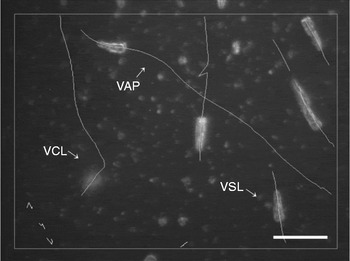
Trajectories of miracidia were observed using the CASA system (fig. 1). No significant differences were observed in the percentage of egg hatching after incubation, with 91.7% and 93.5% hatching at 22°C and 25°C, respectively.
Tracks of miracidia of Fasciola hepatica to show curvilinear velocity (VCL), straight-line velocity (VSL) and average path velocity (VAP) using the computer-assisted sperm analyser. Scale bar = 200μm.

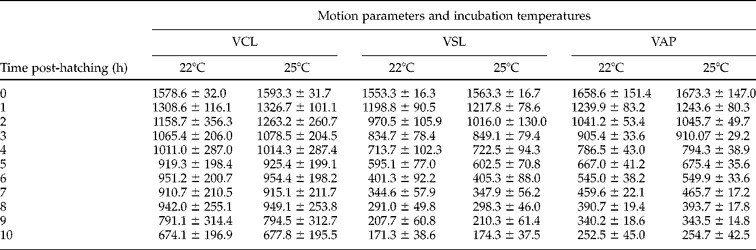
All motility parameters of miracidia showed an overall decrease after 10 h (table 1). A significant decrease in VSL was found following incubation at 22°C. At 0 h those miracidia hatching from eggs incubated at 25°C showed a higher VAP of 1673.3 μm/s, compared with a VSL of 1553.3 μm/s of miracidia that had hatched from eggs incubated at 22°C. No significant differences (P > 0.05) were found in VCL and VAP between 22°C and 25°C of incubation. A significant difference between the VSL of miracidia at different incubation temperatures was observed (P< 0.01) (table 1).
The effect of incubation at 22°C and 25°C on the curvilinear (VCL), straight line (VSL) and average path (VAP) velocities of miracidia of Fasciola hepatica for up to 10 h post-hatching; velocities given in μm/s and mean values as±SD; with *level of significance at P<0.01.
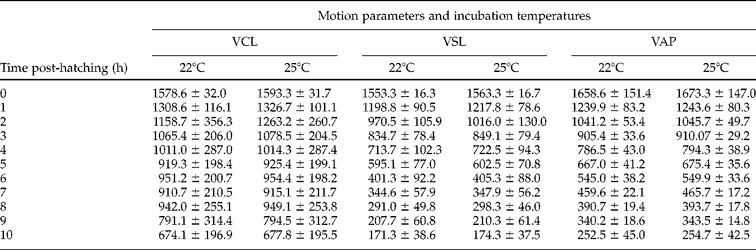
Analysing the effects of incubation of eggs at 22°C or 25°C for 14 days on miracidium motion parameters at different post-hatching temperatures, the velocity parameters VCL, VSL and VAP increased as the post-hatching temperature increased from 22°C to 37°C (table 2). At 22°C those miracidia hatching from eggs incubated at 25°C showed a higher VAP of 1673.3 μm/s compared with a VSL of 1553.3 μm/s that had hatched from those incubated at 22°C. At the post-hatching temperature of 28°C, VCL and VSL were significantly different (P< 0.01) between incubation temperatures of 22°C and 25°C (table 2).
The effect of post-hatching temperatures on the curvilinear (VCL), straight line (VSL) and average path (VAP) velocities of miracidia of Fasciola hepatica, together with percentage (%) differences in straightness (STR) and VCL linearity (LIN); velocities given in μm/s and mean values as±SD, with * significant at p<0.01.

Discussion
The miracidium is the first free-living larval stage of F. hepatica. Its life-span is associated with the depletion of finite energy reserves, thus providing the miracidium with a limited time-span for finding and infecting its molluscan intermediate host before death (Graczyk & Fried, Reference Graczyk, Fried and Dalton1999). Miracidia are propelled by cilia and swim in a spiralling movement in the direction of the apical papilla. Tracks of miracidia have been described as practically linear, some showing a tendency to regular undulations with a frequency of about 2 s, wavelength of about 600 μm and amplitude up to a maximum of 80 μm (Wilson & Denison, Reference Wilson and Denison1970). These observations are consistent with the parameters VCL, VSL and VAP measured by CASA in the present study. CASA is easy to perform, and provides an objective, rapid and multiple-parameter assessment of miracidial movement.
A miracidium is incapable of snail invasion during its first few minutes of life. However, optimal invasion capability of miracidia is achieved at 1.5–2.0 h after hatching, and then this capacity slowly declines (Graczyk & Fried, Reference Graczyk, Fried and Dalton1999). These results are in agreement with the higher miracidium velocity observed in the present study during the first 3 h post-hatching.
There appears to be no evidence that miracidial mortality varies with the pH of water between 6.0 and 8.0 (Smith & Grenfell, Reference Smith and Grenfell1984). However, miracidial mortality differs according to the temperature of aerated tap water and the age of miracidia. The mean expected life-span of miracidia decreases from about 35 h at 6°C to about 6 h at 25°C (Smith & Grenfell, Reference Smith and Grenfell1984). At 10°C the mean life-span is about 24 h (Andrews, Reference Andrews and Dalton1999).
The velocity of miracidia is related to infectivity. Miracidia swimming in circles or taking 30 s to move 1 cm do not infect snails, while those requiring 4–12 s to travel 1 cm are generally infective (Boray, Reference Boray1969). Although miracidia are capable of covering over 50 m at temperatures between 10 and 15°C (Andrews, Reference Andrews and Dalton1999), the results of the present study indicate that the potential travel distance in μm declines with time, so that 10-hour-old miracidia travel at approximately 57, 89 and 85% of the motion parameters VCL, VSL and VAP, respectively, compared with initial velocity. Wilson & Denison (Reference Wilson and Denison1970) reported a similar result at 7 h post-hatching miracidia, with a 60% reduction in velocity. However, they found that the decrease in speed over the first hours was only 4%, whereas in the present study, velocity decreased between 17% and 26%. If the motion path of a sperm is very regular and linear, VAP is almost identical to VSL (Lu et al., Reference Lu, Huang and Lü2013). This observation is in agreement with our study.
At or below 5°C, miracidia are not infective, with the optimum temperature for infection being between 15 and 26°C. A clear inverse relationship has been demonstrated between environmental temperature and the duration of the host-finding capacity of miracidia (Christensen et al., Reference Christensen, Nansen and Frandsen1976).
Once hatched from the egg the miracidium becomes active, immediately starting to swim at great speed, depending on temperature, ranging from 570 μm/s at 4.6°C to 1400 μm/s at 20°C (Wilson & Denison, Reference Wilson and Denison1970). Based on our study at higher temperatures of 22°C and 25°C post-hatching, velocity parameters using CASA ranged between 1553.3 μm/s and 1704.0 μm/s.
Fasciola hepatica eggs from different isolates, after incubation at 25°C, can vary in their duration of incubation period and hatching success (Walker et al., Reference Walker, Hoey, Fletcher, Brennan, Fairweather and Trudgett2006; Canevari et al., Reference Canevari, Ceballos, Sanabria, Romero, Olaechea, Ortiz, Cabrera, Gayo, Fairweather, Lanusse and Alvarez2013). The egg hatch percentage of the Rio Chico (94.8%) and Cajamarca (92.8%) isolates in the present study was similar to those incubated by Canevari et al. (Reference Canevari, Ceballos, Sanabria, Romero, Olaechea, Ortiz, Cabrera, Gayo, Fairweather, Lanusse and Alvarez2013).
The miracidium is the short-lived, non-feeding, free-living phase in a trematode's life cycle, survival of which is potentially influenced by temperature and intrinsically linked to climate change (Morley & Lewis, Reference Morley and Lewis2012). As miracidial energy generation is dependent on endogenous glycogen reserves, at higher temperatures glycogen utilization increases, due to more intense parasite movement, and thereby results in elevated mortality (Boyunaga et al., Reference Boyunaga, Schmitz, Brouwers, Van Hellemond and Tielens2001). Global warming can affect the geographical distribution of parasitic diseases, with potentially drastic consequences for their hosts. However, the role of temperature in influencing parasite transmission is still being evaluated, with differing interpretations of its effects (Poulin, Reference Poulin2006; Morley & Lewis, Reference Morley and Lewis2012).
CASA improves the objectivity, accuracy and efficiency of the evaluation of motion of miracidia at different temperatures. The effect of temperature on miracidium motility is an important factor influencing transmission viability, and its incorporation into future assessments of the effects of global climate change on the dynamics of host–trematode infections could be useful.
Financial support
This study was partially supported by the Mexican National Council of Science and Technology (CONACyT) and Meritorious Autonomous University of Puebla (VIEP-VIMA-NAT-14-I).
Conflict of interest
None.