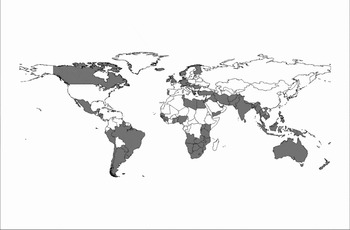
This article aims to clarify the scope of questions about religion in population censuses, and attempts to explain why such questions were included or left out of censuses taken in different nations and periods.Footnote 1 The quantitative aspect is a fundamental question for students of religion interested in knowing where it is possible to rely on statistics about the size of confessional groups and their basic characteristics. A common use of the census in connection with religion has been to create aggregates about the size of different congregations by nation, and to cross-tabulate this with other variables such as gender, occupations, ethnicity, or regions. Enumerations with questions about religion were performed in many countries from the mid-nineteenth century, but questions about religious affiliation never entered the US censuses, and were left out of most censuses in many other countries as is indicated in the map in figure 1. We shall try to clarify how pressure was put on statistical bureaus, parliaments, and governments to promote or hinder the inclusion of questions about religion.Footnote 2
Countries asking a question about religion in the censuses 1945 to 2001.

Unlike the central census variables—gender, age, marital status, household position, and occupations—religious affiliation belongs among the more marginal census variables that may or may not be included in any given census. The filling out can even be made optional. Before the mid-nineteenth century most censuses were statistical only, with questionnaires reporting only quantitative information and without names or other personal characteristics on the individual level. This made it difficult to fit marginal variables onto the census forms, and it has not been documented that a variable about religion was included until the censuses became nominative with information on the individual level. Most interestingly, the start of the twenty-first century has seen the inclusion of a census question about religion in countries that never asked such a question or had dropped it during many previous decades.
Apart from questions about religion in the census forms, there are two other links between religion and census taking. The second link is between the church and clergy working as census takers, when they sometimes used biblical citations in order to diminish their work load. The third link is the stories about censuses taken in Israel with dramatic consequences—in the Old Testament to conscript soldiers, in the New Testament the census in the Christmas story. The article will not deal with the two latter links in any detail.
The International Influence of Adolphe Quetelet
When questions about religions became usual in many censuses taken around the world from the mid-nineteenth century it was initially thanks to the influence of the Belgian statistician and scientist Adolphe Quetelet. Quetelet is famous for his work in such different fields as astronomy and demography, particularly for his work on “the average man.” As part of his work to explain population developments as fully as possible he considered both material and cultural factors, and one of the latter was religion. The first time this appeared as a field in a census was Quetelet's enumeration of Brussels in 1842 (Bulletin 1843: 79). When Quetelet introduced this specific question in the census, the reason was obviously not religious strife or heterogeneity. According to the census Brussels had a population consisting of 110,687 Catholics, 1,615 Protestants, 543 Jews, 9 others, and 355 undefined religions. The census may be looked at as an instrument for defining the emerging national states, the state religion being part of the basis for national identity (Desrosières Reference Desrosières1998; Lie and Roll-Hansen Reference Lie and Roll-Hansen2001). Religious homogeneity meant that data on religions could be asked for and presented without much opposition. Quetelet went on to organize a census for all of Belgium in 1846 with about the same format as the Brussels census and this became a basis for the attempts at standardization that was discussed, modified, and recommended by the international statistical conferences that met regularly from 1853 onward. Quetelet was a main organizer of eight of these conferences in major European cities until he died in 1874.
In spite of the attempts to standardize census contents the phrasing of the religion question in different censuses has not been consistent over time or from country to country. Indeed, there are indications that different persons conceived the question about religion in various ways when filling in the very same questionnaire. The question might be understood in at least three different manners. First as a question about faith (which God do you believe in?), second as a question about religious practice (what holy places do you visit?), and third as a question about affiliation (what religious community do you belong to?) (Sherif Reference Sherif2011: 4). The two first definitions are hardly used in any census, it is this third definition that the census questions are based on, for instance when Norwegian censuses have asked about “Trossamfund” (Faith Community). In a global perspective, however, this social definition may be criticized for its Westernized view of religion—especially some eastern religions stress the inner religious sentiments more than belonging to religious congregations (Masuzawa Reference Masuzawa2005).
Time and Place for the Faith Question
The first census to include a question about religion was the 1776 census for St. John and Nova Scotia. This was not repeated in the next censuses for Canadian territories, but from 1851 onward Canada has included religion among the census variables, thus having the world's longest statistical series with nominative and aggregated information on the population's religion (Goyer and Draijer Reference Goyer and Draijer1992: 361ff). Because including a question about religion was recommended by the international statistical conferences in the second half of the nineteenth century, they came to appear in a number of countries that did not ask such questions in more recent decades. This is the case with France (in 1866), Italy (in 1861, 1871, 1901, and 1911) and Spain (in 1877), which tabulated religious affiliation to start with, but dropped the variable when taking censuses later. It has not been documented that these three countries again introduced a question about religion in their national censuses, the only exception being that France from 1921 to 1936 used a bilingual questionnaire asking about religion and language in the religiously heterogeneous departments of Alsace and Lorraine, which had recently been returned from Germany (Goyer and Draijer Reference Goyer and Draijer1992: 177–78, 279–80, 430–31). In Spain the collection of information about religion in the census has been prohibited by law.Footnote 3
For the period until World War II there are no comprehensive overviews of which countries asked what census variables. Thus, the map in figure 1 shows which countries asked about religion at least once during the census rounds from 1945 to the 2000/2001 round of censuses covered by the three-volume Handbook of National Population Censuses, and the IPUMS's overview from the Minnesota Population Center.Footnote 4 Most American nations include a religion query in their censuses, the most obvious exception being the United States, for reasons discussed in the following text. But while areas dominated by Catholics in the Western Hemisphere tend to ask such a question, we saw that this is not the case in the Catholic countries in southwestern Europe. Here the only exception is Portugal where they asked a simple question distinguishing between Catholics, non-Catholic Christians, the nonreligious, and others in 1950 and 1960 (Goyer and Draijer Reference Goyer and Draijer1992: 392ff). Likewise, nearly the whole Communist Bloc was solidly against asking people to identify their religion in the censuses, for reasons that will become clearer by the example of the 1937 Soviet census related in the following text.
By contrast, Muslim countries tended to ask a faith query in their censuses, as did the members of the British Commonwealth. This may be due to both British and more general Western influence. The recommendations from the Registrar General in London about census taking in the empire from 1842 explicitly left out religion in order “not to crowd the Census with too many particulars.” The Census of the British Empire 1901, however, contained religion as a core variable (Christopher Reference Jones and Barrier2008: 274, 280). On the populous Indian subcontinent, a question about religion has been asked since the very start of census taking in 1872 (Domschke and Goyer Reference Domschke and Goyer1986). Allegedly, “[t]he census officials were fascinated by religion and everything related to it” (Jones Reference Jones and Barrier1981: 78). With hindsight after the secession of Moslem Pakistan in 1947 it is easy to understand that the British included the question about religion for political reasons. The initial 1921 census for Aden (Yemen) was directed from the government of Bombay census office. The first nominative census included religion and was taken as part of Ataturk's Westernizing reforms in 1927, only four years after British troops left Istanbul. A question about religion with broad categories was also included in the first census in the United Arab Emirates, which was conducted by the Middle East Development Division of the British Ministry of Overseas Development in 1968 (Domschke and Goyer Reference Domschke and Goyer1986: 863–64, 875–76, 885–86). Sir George Wood, who headed the Department of Statistics in New Zealand from 1946 to 1958 reflected extensively in his memoirs on a number of variables that were included in or omitted from the censuses, but did not mention religion (Wood Reference Wood1976). Statistics New Zealand still keeps asking this question with much detail in its censuses. This is a peculiar finding on the background of Britain not asking about religion in any census since 1851, and that was a census about capacity in the churches rather than a population census (Francis Reference Francis and Avis2003: 45–46). It is, however, not the only time more sensitive questions have been allowed in censuses in (previous) colonies than in the empirical hub. We shall come back to how a voluntary question was introduced in the 2001 and 2011 censuses in Britain.
Among the Nordic countries, the lack of information about religion in Swedish enumerations is explained by their special methodology, because from 1860 to 1945 the census was constructed by the vicars on the basis of their detailed and longitudinal church records and thus never belonged to the Quetelet tradition. When the need for numbers became urgent due to the influx of refugees from Germany and budding anti-Semitism, a special enumeration of foreigners including a question about Jewish ancestry was undertaken by the Social Authorities in January 1939, but this cannot be classified as a population census (Svenska Dagbladet 2008).
Due to the focus on protecting personal privacy and practical considerations, Norway dropped the question from 1990 after having asked about religious affiliation since 1866. Denmark similarly stopped asking in 1955, but the variable was not tabulated after World War II. The start of the new millennium saw the introduction of questions about religion in several national censuses. We shall return to how this item was lobbied into the 2001 censuses for Great Britain. Ireland asked the question off and on in their twentieth-century censuses, and now continues the practice. Next among European Union countries, the German census in 2011 asked about religious affiliation, even if the protection of privacy in West Germany used to be more topical than anywhere else.Footnote 5 There was less protest against introducing the question in Poland, but the lack of published results as late as March 2013 has led to speculations that the results are not as favorable for Catholic Church leaders as expected. The German and Polish developments can be interpreted on the background of recommendation from Eurostat, which did not require religion as a core variable, but still recommended that “Countries that are traditionally multi-denominational or have significant immigrant populations with different religions may wish to collect data on religion” (United Nations 2006: 97). Vietnam included questions about whether people were religious and in that case questioned to which religious community they belonged (IPUMS 2013). The attempt by Rosstat to tabulate religion in the census for the Russian Federation in 2002 provided rather imprecise results because religion was assigned on the basis of ethnicity, thus counting, for example, atheists as Orthodox if they were ethnically Russian (Filatov and Lunkin Reference Filatov and Lunkin2006).
Why Were Questions about Religion Included or Blocked from the Censuses?
Some reasons for including or blocking census data about religious adherence have been hinted at in the preceding text. A full answer to this question covering all periods and nations cannot be given here because the reasons obviously vary from place to place and would require extensive archival studies. There are, however, three cases in which the issue became contested in special ways that can help us illuminate potential reasons. One is Stalin's order to ask about religion in the 1937 all-Soviet census, a decision he came to regret once the results came in. The second is the US Census Bureau's proposal to include a question about religion for the first time in 1960; a reform stopped by efficient lobbying. The third is the previously mentioned inclusion of questions about religion in the two latest British censuses in spite of initial opposition from the Office for National Statistics in London.
The 1937 Soviet Union Census
In order to understand the dramatic events surrounding the 1937 census effort it is necessary to provide some background information about Russian census taking. The only real census taken in the Russian Empire was in 1897, when religion and mother tongue was asked for. Previously, only a survey like investigation of religious societies similar to the 1851 British “religious census” was also organized in the 1850s. Religion was removed by Lenin from the aborted 1920 census and dropped in the first full census organized by the USSR authorities in 1926 (Corley Reference Jones and Barrier1994: 404; Goyer and Draijer Reference Goyer and Draijer1992: 471–72). Some information about religion and religious practices can be found, however, in the 1926–27 Polar Census (Glavatskaya Reference Glavatskaya and Anderson2011: 98–99). This is of special value because the middle of the 1920s was a relatively liberal period between Orthodox domination and Bolshevik persecution when minority groups dared exhibit their special characteristics quite openly.
The next Soviet census was postponed repeatedly due to the economic and political turmoil of the early 1930s, but in 1937 the need for updated population numbers in the Gosplan forced the authorities to take a new census. On the year's second day, Pravda stressed the economic and political significance of the upcoming census, highlighting the love of statistics among Bolsheviks in general and Lenin and Stalin in particular. The propaganda expected the results to show faster population growth in the USSR than in the capitalist West, proving the superiority of the socialist planned economy. In order to secure the cooperation of the population to be enumerated, the census takers were described as semiheroes loyal to the party and penetrating every corner of the country in spite of potential hindrances such as the Siberian winter. People were assured that the information would be used to increase their living standards by building schools, hospitals, and so forth to meet the requirements that could be computed from the population's size and composition in the diverse districts of the Soviet Union. Still there was opposition. The religiously devout may still have seen census takers as the representatives of anti-Christ—the Old Believers would not even let them into their homes. There are indications that groups of people hid from the census takers because they were afraid of answering the question about religion, causing underenumeration (Corley Reference Corley1994: 404ff).
The timing of census day created special problems because the organizers had on short notice moved it one month forward to the start of Orthodox Christmas, in the middle of the winter, and more people may have been traveling (Merridale Reference Merridale1996: 228). Also, the census organizers were hardly prepared for the difficulties created by some of the information items in the census questionnaires. Especially the questions about nationality, religion, and literacy became topics for endless discussions between census takers and respondents. Question number five was addressed to persons over 16 and focused on contemporary religious faith. The instructions to census takers included the following: “If the person asked considers himself a nonbeliever, write ‘nonbeliever’. If the person asked considers himself a believer, write ‘believer’, and for believers holding a particular dogma, write the name of the religion (for example, Orthodox, Lutheran, Baptist, Molokan, Mohammedan, Jew, Buddhist etc.)” (Corley Reference Corley1994: 405). Husbands and wives disagreed about how risky it could be to state that they were still religious, some hoped high religiosity numbers would force the authorities to reopen the churches. Neighbors criticized each other for concealing their national or ethnic origin behind the label “Russian”; family members accused each other of exaggerating education or reading abilities. Indecent remarks in the census manuscript returns were not unheard of either (Merridale Reference Merridale1996: 234).
Some weeks or months passed before the authorities decided to suppress the publication of census results. In the meantime, already on January 6, the day after census night, Pravda asserted that education and literacy were flourishing while religion was almost eradicated, just like expected. The editors at best based such preliminary results on local and unrepresentative samples. Next, they tacitly dropped the publication of summary census results scheduled for February 10. Internally, census and statistics directors Kvitkin and Kraval had been cautious enough to demand census secrecy among their staff from the start of the aggregate work. Kraval sent his first preliminary assessment of census results to Stalin and Molotov on February 11 (Kraval: 1937). After stating that “The census was carried out in strict conformity with the directions of the VKP(b) CC and the USSR CPC . . .” he tried to stress the positive demographic developments, especially the urban population growth that was outstanding in an international perspective. He had to admit though, that a number of agricultural regions such as the Ukraine or Kursk had seen population decline, which he blamed on the high percentage of Kulaks who had resisted collectivization or fled from the regions. And most important, he could not hide that the total population of the USSR was only 162 million, some eight million inhabitants short of the projected estimates (Merridale Reference Merridale1996: 235). This was a completely unacceptable result for the Bolshevik leaders, because Stalin had cited optimistic figures based on theoretical population projections made in the Gosplan (Blum and Mespoulet Reference Blum and Mespoulet2003: 131).
The population projections on which Stalin based his speeches were misleading because of the poor organization of birth and death registration, Kraval asserted. It certainly did not help that the population decline among ethnic minorities was especially severe, an area for which Stalin had received special responsibility from Lenin. Also, even if they ought to have been warned by results from previous surveys, the figures reporting people's continued religious sentiments were depressingly high for the Bolsheviks because allegedly less than half the population 16 years and older identified themselves as atheists (Corley Reference Corley1994: 407). As indicated, it has been speculated that people feared religious persecutions, but even more wanted to grab this singular occasion to express indirectly a wish to have the churches reopened. The top administrators responsible for the census and statistics were arrested, including Kvitkin, his deputy Lazar Solomonovich Brandgendler (Brand), the director for population and health, Mikaïl Veniaminovich Kurman, and the leader of the Sector for Transportation and Communication, Ivan Maksimovich Oblomov. Both Kvitkin and Kraval as directors and being responsible for the census and statistics departments of Gosplan, respectively, were executed (Polyakov et al. Reference Polyakov, Zhiromskaya and Kiselev1990). It had not helped that Kraval met Stalin twice in April to defend the low population figures, also in writing—this must be understood on the background that the census became part of the Moscow processes.
In retrospect it has been shown that the census preparations, including the contents of the questionnaire were allegedly micromanaged by comrade Stalin personally! It may seem unbelievable that the leader of a large country found time to do this, but it is confirmed both in a contemporary Plan article on the 1937 census, in the statistical textbook by Starovski, and by eyewitnesses who saw the questionnaire with Stalin's handwriting in the 1960s (Volkov Reference Volkov1990: 31). It is less than likely that anyone at the time would dare to assert Stalin's interference unless it was true. He likely removed the de jure enumeration system from the census, added the question about religion, and simplified other items so that responses became more difficult to interpret. He deleted questions about secondary occupations and length of marriage and reverted to a question about nationality (Hациональность) instead of ethnicity (Hародность).
Because nearly the whole census including tabulations and handwritten manuscript lists were destroyed it is not possible to check what proportion of the population said they were still religious. How the Bolshevik leadership could have such unrealistic expectations about the success of the new Soviet state bears witness to their unfathomable belief in communism and the science of central planning, and to being surrounded by loyal party comrades who did not dare to protest. Asking about religion on Orthodox Christmas Eve two decades after the revolution was obviously asking for trouble. Also in the next census taken in the Soviet Union in 1939 there was underenumeration because religious people refused to participate even if the question about religion had been removed (Corley Reference Corley1994: 412–14). In later twentieth-century censuses organized in the Communist Bloc further attempts to include a question about religion have hardly been documented. The questions in the census of 1946 organized by German statisticians, covered also the eastern zone occupied by the Soviet Union, but must be seen as a continuation of previous practice (Goyer and Draijer Reference Goyer and Draijer1992: 195–96).
The Failure to Include a Question about Religion in the 1960 US Census
Because religion has never been an item in any US census, the student of this material easily gets the impression that asking about confessions is forbidden by the Constitution, which orders a census to be taken every decade. There is, however, no basic legal restrictions on what types of variables may be included, and the laws regulating the contents of each census have repeatedly been changed during its more than two centuries long history. It turns out that when preparing for the 1960 census administrators in the Census Bureau in Washington seriously intended to include a question about the respondents’ religion (Schultz Reference Schultz2006). The background was an opinion among census takers, social scientists, some politicians, and parts of the general public that religious faith was a crucial factor in US society well worth studying. President Eisenhower, who probably did not support the inclusion of a religion question, endorsed the importance of faith when he said that “our form of government makes no sense unless it is founded in a deeply felt religious faith—and I don't care what it is” (Reference Schultzibid.: 360).
The initiative came from the Census Bureau's assistant director for demographic fields for the 1960 census, Conrad Taeuber. Taeuber was the son of a clergyman, having a PhD from the University of Minnesota and a 20-year-long career as a civil servant. It seems his striving to include religion among the census questions came as a result of discussions with family, friends, and colleagues who pointed out the deficiency of US statistics about the population's religiosity. Likely, it was not difficult to persuade his boss, the statistician and economist Robert W. Burgess, who had been appointed director of the Census Bureau by Eisenhower in 1953. Burgess was a Baptist, but his interest in asking about religion may rather have been inspired by his belief in the usefulness of statistics to understand all aspects of human existence. Questions about birthplaces returned less and less data about ethnic origin as the large waves of immigration became a thing of the distant past—it is no coincidence that the parents’ birthplace questions gradually disappeared from the US censuses between 1940 and 1970. It mattered that the grant for the aggregate group-level Census of Religious Bodies, including forerunners taken each decade since 1850, was slashed by Congress after 1936. Simple, individual-level questions about religion were only asked in the Current Population Survey in 1957 (Pew Forum 2008: 108–9). Also, the advent of the computer convinced statisticians about the realism of expanding the scope of statistical work more generally. Thus, in 1956 when a list was published with potential new items to be included in the next census, religion was among them.
Opposition appeared immediately. The American Civil Liberties Union issued a press release stating that as defenders of individual privacy, they could not support any obligatory census question specifying individual beliefs, but could tolerate an optional question. The Catholic Church had long been in favor of including religion in the census, and in September 1956 the Jesuit weekly America attacked the Census Bureau for hesitating in this matter, finding the concerns about privacy groundless because all census results would be published anonymously. Burgess now defended the question internally, stating that statistics on confessions would be useful to churches, social scientists, and business interests. Taeuber on his side pressed on with testing alternative formulations of the question in the field, and eliciting the advice of colleagues in Statistics Canada. His provisional version was: “What is your religion? Baptist, Lutheran etc,” consciously not listing “Jewish” in the question—which they knew would be controversial. During a test run in Milwaukee in November only three out of 456 households refused to answer. A similar but expanded national survey of 35,000 households next year also went smoothly. With strong support from the National Catholic Welfare Conference, which made lobbying for this census question a top priority, Burgess and Taeuber may have felt reason for optimism. The official Catholic argument was the need for the data to plan schools and other services, but there is no doubt that they knew numbers about religious groups would bolster the position of the numerous Catholics in the United States.
Stronger opposition was about to appear, however, by early 1957. The executive director of the Jewish Statistical Bureau, Dr. H. S. Linfild started the counteroffensive. Together with other Jewish statisticians he lobbied their coethnic organizations, most notably the American Jewish Congress, which launched a press campaign. They argued that a question about religion in the census would violate the principle of a clear division between church and state, and could be the basis for attacks from anti-Semitic groups. Under this pressure the American Civil Liberties Union changed their stance, now also protesting against an optional question. The president of the American Jewish Congress, Israel Goldstein, published a letter in newspapers all over the country asserting that the Census Bureau jeopardized the freedom of religion by forcing people to answer questions about their faith in the census under threat of legal persecution if they denied. This was an exaggeration, to say the least, because the question could be made optional and few individuals had ever been punished for not answering. Burgess's attempts to answer could not stop the efficient campaign by Jewish organizations, however. They pointed to the recent persecutions of Jews in Europe and the many instances of anti-Semitism also in the United States in the 1930s and 1940s. More internally, they expressed worries about what might be the reactions when people found out what was the average income of Jews, what proportion of them held high-ranking positions, and how many lived in attractable areas. The Jews who looked more positively on religion as part of the census were efficiently silenced, while some Catholics voiced arguments against the question publically. Some liberal Protestant groups came out in favor of the issue, but generally the Lutherans took a more neutral position.
In October 1957 the American Jewish Congress launched a letter-writing campaign, resulting in a deluge of letters opposing the religion question to newspapers, congressmen, the clergy, and the Census Bureau. In November Director Burgess caved in, finding the matter too touchy. He feared that the question might endanger the whole 1960 census operation, and there was internal concern in the bureau that making census questions optional might spread to other sensitive issues such as race and income. Catholics, demographers, and social scientists were upset, but the campaign against the reform had resulted in so much opposition among central politicians that political considerations made further rational debate about the issue impossible. Reminders that Israel included a question about religion in its censuses were of no avail, and the final defeat of the Census Bureau came as an order from the Commerce Department to not publish the results about religion based on the 1957 survey (Schultz Reference Schultz2006).
In the 1960s and 1970s the Census Bureau repeatedly considered requests to include questions about religion in the upcoming censuses, but decided it might jeopardize the cooperation of the public when filling in the census forms, and violate the principle of the separation of church and state. Further attempts were blocked by Congress in 1976, when passing a census law including a paragraph prohibiting mandatory questions about religious belief or membership (Pew Forum 2008: 110). As we shall see, opposition against collecting and publishing statistical information about religion was not unknown in the British government bureaucracy either.
How a Question about Religion Was Lobbied into the 2001 Census in Britain
Like in the United States, there was much organized effort from religious communities to include a question about religion in the censuses of Great Britain. This was concentrated to the five last years before census day on April 30, 2001; however, in Britain there was relatively little organized opposition. The starting point was a meeting of the Inner Cities Religious Council (ICRC) in January 1996. This body had been established by the Department of the Environment in 1992 in order to promote dialogue between representatives for different religious communities. During this meeting the ICRC members expressed “general support for testing a question on religious affiliation, for possible inclusion in the 2001 census” (Sherif Reference Sherif2011: 2). One member, the Anglican Reverend David Randolph Horn, temporarily employed in the Department of the Environment, launched a Working Party headed by Reverend and professor of theology Leslie Francis to elucidate the issue. The Working Party stressed the importance of knowledge about religious affiliation in many social areas such as medicine, sociology, psychology, and gerontology and recommended the Office for National Statistics (ONS) to include a question on religion in 2001. The reply from the ONS in August 1996 was discouraging, stating that “this is not a priority need for Census users” (Reference Sherifibid.). They were, however, willing to participate in a consultative group. Also this committee was headed by Professor Francis and included Brian Pearce who had served in the Department of the Treasury, as well as prominent members from the Sikh and Jewish communities in Britain. It was obviously considered a crucial issue in many religious circles. While the Board of Deputies of British Jews had opposed the ethnicity question to be included in the 1991 census, in 1997 they decided not to protest against a new question about religion. This position made it possible to require that if the question should be included in the census—“Jewish” ought to be an explicit option (Schmool Reference Schmool1998: 70).
Lobbying started in earnest when Anglican and other religious leaders were inspired by group members to address the department directly about the importance of a census question about religion. This indirect pressure worked and in the spring of 1997 the ONS decided to test a potential question on a small but heterogeneous sample with the question: “Do you consider you belong to a religious group?” followed by tick boxes: “No, Christian, Buddhist, Hindu, Islam/Muslim, Jewish, Sikh, Any other religion, please write below”—thus with a write-in option. The ONS concluded that the question was well received, but that different respondents might have interpreted it in different ways (Sherif Reference Sherif2011: 3). This was confirmed in July with a bigger sample, some respondents having faith and some having religious practice in mind. Professor Francis commented to the ONS that the question ought clearly to be about religious affiliation. A symposium at the University of Southampton in the summer of 1997 confirmed scholarly interest in the new question, especially because it would complement the question about ethnicity, which had proven its usefulness because it was introduced in the 1991 census (Diamond Reference Diamond1998).
In parallel the consultative group held meetings with the relevant departments’ census users in order to establish whether or not different branches of the state bureaucracy would find the question useful enough that its inclusion could be defended in a cost-benefit analysis. The key meetings found place in the impressive oak-paneled Church House in Westminster, thus tacitly reminding the representatives of the smaller religious groups of the power of the Anglican Church. The Home Office was against including the question on religion while other departments such as education, environment, and health were supportive. When summarizing their arguments, however, it was found that religion ended up near the bottom of the list of questions that might potentially be included in 2001. Perhaps religion was a type of issue that easily lost in a cost-benefit type of analysis, statistics about religious affiliations were not considered useful enough compared with questions about ethnicity and language.
It added to the problem that the ONS may not quite have believed in its own findings that the public did not consider the question burdensome and internally found it burdensome that new legislation allowing the question had to be passed in Parliament. The reason for this was that the Census Act from 1920 ruled that only questions about social and civil issues could be included in census questionnaires, and the ONS legal expertise interpreted the concept of religion narrowly to be a private rather than a social matter. The Religious Affiliation Sub-group argued that the ONS had misinterpreted the Census Act and misunderstood the nature of religious affiliation. It is easy to support Professor Francis's explicit disagreement with the ONS on this point, but it was wisely decided to not contest the ONS's interpretation but rather make the government move to have the law modified (Francis Reference Francis and Avis2003: 48–49).
In the summer of 1998 the ONS withdrew from the consultative group, an act making the inclusion of a question about religion in the 2001 census unlikely. Political action was clearly needed, and the newly launched Muslim Council of Britain raised the issue in a meeting with Home Secretary Jack Straw. Faced with such pressure the ONS again changed its position and included the question in its white paper draft about the 2001 census to the government, although exempting Scotland and adding methodological reservations. The Muslim Council pressed the issue further in its reception organized for Prime Minister Tony Blair in May 1999. Blair responded with a promise to include a question on religion in the 2001 census. On this background it was disappointing that the Queen's Speech did not mention the necessary legislation. However, it was relatively easy to find a representative in the House of Lords to introduce a private bill about the matter, and it was here that Lord Weatherill included a clause making answering the question voluntary. Professor Francis and the reorganized consultative group knew it would be more difficult to find a time slot for the bill in the House of Commons with its busy agenda and two opposition members of Parliament speaking for hours in order to block legislation with filibustering tactics. In this precarious situation it was decisive that the prime minister kept his promise by allowing the religion in the census legislation to be passed in a time slot allocated to the government, something that rarely happens for private member bills. On June 20, 2000 it was carried, 194 voting in favor and 10 against (Sherif Reference Sherif2011: 10–11). Professor Francis distributes the honor for the lobbying more equally between different religious denominations than does Sherif who stresses Moslem influence (ibid.; Francis Reference Francis and Avis2003).
The Muslim Council of Britain published articles and posters in English, Urdu, Bengali, and Gujarati recommending people to answer the new question, in addition to the ordinary information dispatched by the ONS. Considering that answering was voluntary, the response rate was high: 93 percent although some wrote rather unexpected answers. The results, also cross-tabulating religion with other census variables, have proved useful in several reports and studies, for instance about the labor market and unemployment, social inequalities in London and nationwide, as well as health care. This paved the ground for the inclusion of the question also in the 2011 census (Geoghegan Reference Geoghegan2011). A positive side effect was that leaders of religious communities, most notably the Muslims, learned how to promote their interests in a democratic society through lobbying.
Formulating the Question on Religion
There is a whole methodological literature addressing the issue of how to formulate census questions and especially items that can be considered sensitive among groups of respondents—such as about religion. Census taking is usually regulated by law and neglecting to provide full answers to census questions can be punished by fines or even jail in severe cases. Punishment is seldom applied in actual practice, however, so census experts’ advice to make questions about sensitive issues voluntary so that their inclusion will not affect general response rates, causing underenumeration of the population with respect to the more central variables. Voluntariness was introduced for religion in the 2001 census for Britain as well as for Germany and Poland in 2011.
The next decision is whether to use an open-ended question or provide a list of religions and affiliations from which the respondents can choose. The former method may inspire some persons to respond with nonstandardized items that are not really religions. For instance a campaign on the Internet inspired some 390,000 persons in Britain to claim that “Jedi” was their religion in 2001. By contrast, any list of religions fitting on a census form will be far from complete, which may lead persons belonging to small congregations to provide too general replies or make it impossible to include new religions. The two methods combined in Britain in 2001 and 2011 when the page about ethnicity, language, and so forth also asked “What is your religion?” The following options were listed: “No religion; Christian (including Church of England, Catholic, Protestant and all other Christian denominations); Buddhist; Hindu; Jewish; Muslim; Sikh” and, finally, “Any other religion, write in. . . .” Professor Francis who had led the academic effort to include the religion question in 2001 was disappointed that the list of religions did not distinguish between different Christian congregations and called it “a flaw in the English census.” He sent accolades to the Scottish Parliament for ruling differently. There the forms differentiated between Church of Scotland, Roman Catholic, and Other Christian together with an open-ended write-in box (Francis Reference Francis and Avis2003). Also in Scotland, respondents could specify both the religious denomination they were brought up in and the one they presently belonged to.Footnote 6
Also, in today's secular society it may be advisable to first ask “Do you have a religion?” before specifying which one (Chryssides and Geaves Reference Chryssides and Geaves2007). A tendency to simplify the questions about sensitive issues over time may be found. A case in point is Israel where the new state in 1948 started out by distinguishing between Jews, Muslims with subdivisions, Christians with subdivisions, and the Druze. The 1961 census distinguished only between Jews and non-Jews. In the 1967 and 1972 aggregates Statistics Israel made a shortcut, considering that all household members belonged to the same faith as the head of household. We shall see that also Norway simplified and dropped the question about religion during this period.
Question about Religion in Norway's Censuses 1866 to 1980
As one of the longest series of censuses asking about religion, let us follow the development of this question in the Norwegian censuses. The Table Office had managed to squeeze in a question about ethnicity in the 1845 and 1855 statistical censuses. Columns for stating religion (and birthplace) came only with the extra space and methodological freedom provided by the nominative censuses. On the 1865 form the heading of column number nine read: “Troesbekjendelse, forsaavidt Nogen ikke bekjende sig til Statskirken” (Profession of faith, if someone does not confess to the State Church).Footnote 7 Thus a mixture of faith and religious society was asked for, and little was done on the form and nothing was written in the instructions in order that religious minorities should be adequately represented in the aggregates. This is hardly surprising since in the 1875 census only 7,180 in a population of 1.8 million belonged outside the State Church (Statistics Norway 1954). There the Bureau of Statistics added the following to the column heading: “. . . anføres her til hvilken særskilt Troesbekjendelse Enhver tilhøre” (note here to what specific profession of faith everybody belongs). The instruction to census takers laconically explains that the column should be filled following the same methodology as in the previous census. The 1891 census instructions for the first time assumed that the specification of faith was not self-explanatory: “Rubrik 9. Trossamfundets Art eller Navn må angives. Dersom nogen er udtrådt af Statskirken uden at have sluttet sig til noget bestemt Bekjendelses-Samfund, betegnes dette således: «Udtrådt, intet Samfund» eller på lignende Måde” (Field 9. The name or type of the religious community must be noted. If someone has left the State Church without joining a specific religious community this should be noted thus: “withdrawn, no community”). From this time on the census asked about religious community.
Starting in the twentieth century, the column heading for religion put different societies of faith more on a par, stating “Trossamfund. For dem der tilhører den norske Statskirke, skrives Bogstavet: S; for de øvrige anføres vedkommende Trossamfunds Navn, eller I Tilfælde: ‘Udtraadt, intet Samfund.’” (Religious community. For those belonging to the Norwegian State Church, write the letter S; for others note the relevant name of the religious community; or where relevant “withdrawn, no community”). An inconsistency between the form and the instruction may have caused problems, the latter specified religious confession rather than community. A sort of consistency was established in 1910 when the instructions left out any reference to the faith column. The 1920 census had much the same format as 1891 with one sheet per person. On the line for religious community the word Statskirken could be underlined, or alternatively a different community specified. The instructions were again simple: “De som er uttrådt av statskirken og ikke tilhører noget trossamfund anfører «Intet».” (Those who have left the State Church and do not belong to any religious community write: “None.”) The explanation was somewhat expanded in 1930: “De som. er meldt ut av statskirken og ikke tilhører noget trossamfund skriver ‘ikke noget samfund.’ Personer som er medlemmer av en ‘vennekrets’ innen statskirken og ikke er meldt ut av statskirken skriver ‘statskirken.’” (Those who have resigned from the State Church and do not belong to any religious community write “no community.” Persons who are members of a “circle of friends” within the State Church write “The State Church.”) The questionnaire in 1930 thus gave the options to write the State Church, another religious community, or no community. It was thus explicit that specifying a special religious community was only an option for those who had left the State Church.
After the war the first census was taken in 1946 and the next in 1950. Both aimed to establish a population register and statisticians were preoccupied with migration and family relations while treating religion as a marginal variable not even mentioned in the instructions. One column was simply headed “Trossamfunn” and in the printed example embedded in the 1950 instructions the first person was listed as belonging to the State Church with repletion signs for the rest, except the last person on the list who belonged to the Jehovah's Witnesses. The same heading was used in 1960, but with the explanation added that persons belonging to the State Church could simply write an “S,” people belonging to a different religious community should write the name of this community and those not belonging to any religious community should write “no community.” In 1970 this was simplified, people should tick one out of three boxes, either one for “the State Church,” one for “Religious community outside the State Church,” or one for “Not belonging to a Religious Community.” The same layout of the question about religion was used in 1980, and again explanations in the instructions were considered unnecessary. The 1990 census was the last to ask personal information with questionnaires, and it did so only for a representative sample of the population, complementary information being collected from diverse person registers. No question on religion was included in this census, one reason being that congregations outside the State Church were small in Norway and it could be hard to estimate their size and other characteristics from a sample. Other reasons were the heightened concern about disclosure of sensitive personal data and the possibility to obtain information about religious groups with surveys and from the religious communities. The last few decades have, therefore, seen a strong tendency to simplify and delete sensitive questions on such topics as religion and ethnicity in the Norwegian census. Because Norway became more culturally heterogeneous during the same decades, this may be perceived as a contraproductive paradox. Today's aggregates are based on the number of members the communities report in order to get public financial support, rather than on census figures.
Conclusion
Many countries followed the standard advice from Adolphe Quetelet and the International Statistical Congresses to include a question about religion when taking nominative censuses from the mid-nineteenth century. However, the US census never asked such a question due to opposition from some religious groups based on the ideological view that church and state issues should be kept separate. Jewish organizations have been skeptical about taking censuses in general and asking about religion in particular, except in Israel when the new government continued the British practice when they were in control of the census results from 1948. This general opposition may be linked to the Holocaust, but also to biblical census taking, which allegedly had negative consequences—in the Torah God punished those who in this way checked His creation.
Attitudes toward asking about religion in modern censuses range from New Zealand, where a detailed question still prevails, to the religiously heterogeneous United States, where including a faith-related variable remains virtually anathema. The Catholic countries in America, the members of the British Commonwealth, and several Muslim countries continue to ask about religion in their censuses, but in order to protect privacy and due to the introduction of registry-based censuses some European countries have until recently been removing the question. Until it was dissolved in the 1990s, the countries in the Communist Bloc only exceptionally included religion in their censuses, mainly because they did not want to reveal what proportion of people still considered themselves as religious. Both religiously homogeneous (e.g., Scandinavia) and heterogeneous (e.g., Germany) countries have included a question on religion in their censuses many times. With Catholics and Muslims in favor of including a question about religion and Jews opposed, the debate in the United States and Britain shows that the strength of pro and contra lobbying on behalf of religious minorities decided the outcome as long as the majority Protestant and Anglican Churches remained more or less neutral. The recent inclusion of questions about religion in such diverse countries as Britain, Germany, Poland, and Vietnam from the turn of the millennium may be the response to new social developments. Eurostat has successfully inspired the introduction of questions about religion in new countries without triggering much protest. A main confrontation today is between ethnic groups with different religions, making statistics about religious groups more relevant at the same time as it is difficult to define ethnicity among the descendents of immigrants. In addition, the rapid spread of social media instills more openness in people, making it less controversial to ask sensitive questions in the censuses.
The questions that have been asked about religion in the censuses are not as standardized as might be wanted from a social science point of view, but even unstandardized queries would be better than nothing. Most censuses with questions about religion aim to enumerate members of religious communities, the main exception being the Soviet 1937 census which asked about religious faith. As long as the censuses in more than half of the world do not ask about religion it will not be possible to tell even within the closest million the size of the different religious communities globally.