

Introduction
Decision-making is a hallmark impairment in traumatic brain injury (TBI) (Bonatti et al., Reference Bonatti, Zamarian, Wagner, Benke, Hollosi, Strubreither and Delazer2008; Cotrena et al., Reference Cotrena, Branco, Zimmermann, Cardoso, Grassi-Oliveira and Fonseca2014; Levine et al., Reference Levine, Black, Cheung, Campbell, O’Toole and Schwartz2005; Newcombe et al., Reference Newcombe, Outtrim, Chatfield, Manktelow, Hutchinson, Coles and Menon2011; Rabinowitz & Levin, Reference Rabinowitz and Levin2014). Some individuals with TBI have trouble making decisions under seemingly simple circumstances such as choosing which soap to buy. Others make hasty, impulsive decisions like saying hurtful things to loved ones or engaging in dangerous or costly activities. Despite well documented disruptions in decision-making following TBI, considerably less is known about moral decision-making in individuals with chronic moderate-severe TBI. Thus, we donʼt know which individuals with TBI are at risk for moral decision-making disruptions or the consequences of such impairments on long-term outcomes.
Moral decisions—defined as deciding if something is right or wrong—are motivated by social principles shared amongst individuals inhabiting the same social environment (Schwartz, Fitter & Jodis, Reference Schwartz, Fitter and Jodis2020). Moral decision-making can require a decision about how to act in a real or hypothetical dilemma (i.e., a scenario with moral rules or principles attached), or a judgment about the moral acceptability of the actions or moral character of individuals, groups, or institutions (Garrigan, Adlam & Langdon, Reference Garrigan, Adlam and Langdon2018).
A popular approach to the behavioral study of moral decision-making in individuals with and without neurologic abnormalities uses hypothetical dilemmas. Response options for these dilemmas juxtapose utilitarian decisions (i.e., decisions made based on the consequences of proposed actions) with deontological decisions (i.e., decisions made based on implications of moral norms and other emotionally weighted inputs). The most famous examples come from the original trolley and footbridge dilemmas. In the trolley dilemma, a trolley is coming down a track toward five workers, and the participant has the option to either allow the trolley to hit the five workers or to pull a switch that directs the trolley down a different track with just one worker (Foot, Reference Foot2002). In this example, the utilitarian choice (where the participant pulls the switch to save more lives, selecting an outcome that promotes the overall well-being of the larger group) is contrasted with the deontological choice (where the participant does not pull the switch, seemingly selecting an outcome based on the idea that deliberately harming others is wrong). When confronted with this dilemma, most neurotypical participants choose to pull the lever—diverting the trolley and sacrificing one individual to save five. However, when confronted with the footbridge dilemma, wherein the participant must push a large man off the footbridge and onto the tracks—sacrificing the large man’s life to save the five workers—most neurotypical participants choose not to sacrifice the man on the footbridge, allowing the trolley to hit the workers (Greene, Sommerville, Nystrom, Darley, & Cohen, Reference Greene, Sommerville, Nystrom, Darley and Cohen2001). Greene et al. (Reference Greene, Sommerville, Nystrom, Darley and Cohen2001) proposed that the difference between these dilemmas (i.e., why individuals find it acceptable to sacrifice a life to save five in the trolley dilemma but not in the footbridge dilemma) is that the footbridge dilemma engages more emotion given the “up close and personal” nature of pushing a person compared to pulling a lever.
In a seminal study of moral decision-making using the trolley dilemma task (after which many subsequent studies were modeled), Greene et al. (Reference Greene, Sommerville, Nystrom, Darley and Cohen2001) tested this proposal by asking neurotypical adults to respond to a battery of 60 dilemmas divided into non-moral dilemmas (n = 20), impersonal moral dilemmas (n = 18), and personal moral dilemmas (n = 22). Non-moral dilemmas have no moral or emotional value (e.g., whether to search for a name brand headache medication or buy the generic brand with the same ingredients). The critical condition type is the personal moral dilemmas, which involve directly harming another to achieve some goal (e.g., personally pushing a man off a footbridge onto the trolley tracks to stop the trolley from killing five workers). This condition is in contrast to the impersonal moral dilemmas, where the decision-maker would not need to directly inflict personal or physical harm to achieve the same outcome (e.g., switching the trolley to another track where one worker is present, killing one but saving five on another track). In both the personal (pushing a man off a footbridge) and the impersonal (pulling a lever) moral dilemmas, the participants must judge whether it is appropriate to incur the moral violation of sacrificing one human life in order to save a group. The researchers observed that a utilitarian response (e.g., pushing the man off the footbridge to save the five workers) elicited a significantly longer response time than a deontological response for personal dilemmas. This finding was in line with Greene and colleagues’ predictions that utilitarian responses to personal dilemmas are more emotionally engaging and require increased reaction time to override the increased emotional response (Greene et al., Reference Greene, Cushman, Stewart, Lowenberg, Nystrom and Cohen2009; Greene, Morelli, Lowenberg, Nystrom, & Cohen, Reference Greene, Morelli, Lowenberg, Nystrom and Cohen2008; Greene et al., Reference Greene, Sommerville, Nystrom, Darley and Cohen2001). This suggests that the time constraints of real-world decision-making may increase the likelihood of neurotypical individuals offering a response that adheres to moral norms in situations involving direct personal harms. Conversely, a speedy disregard of moral norms related to personal harms may be considered aberrant.
Attempts to understand the neural correlates of moral decision-making resulted in studies extending the trolley dilemma task to individuals with neurological lesions. A particular focus has been on the ventromedial prefrontal cortex (vmPFC) given its hypothesized role in supporting automatic processes that may guide moral decision-making (Damasio, Reference Damasio2005) and in opposing or overriding a response to a moral violation (Greene et al., Reference Greene, Sommerville, Nystrom, Darley and Cohen2001). While many of these studies considered reaction time, following Greene et al., Reference Greene, Sommerville, Nystrom, Darley and Cohen2001, the primary outcome of these studies has been the comparison of the proportion of utilitarian responses in the personal dilemma between individuals with and without neurological damage. For example, Koenigs et al. (Reference Koenigs, Young, Adolphs, Tranel, Cushman, Hauser and Damasio2007) studied a sample of 6 individuals with focal, bilateral, adult onset vmPFC damage from tumor resection or anterior communicating artery aneurysm, 12 comparison participants with brain damage (BDC) containing lesions that did not affect the structures important for emotion (no lesions to vmPFC, amygdala, insula, and right somatosensory cortices), and 12 neurotypical comparison (NC) participants. The participants answered a series of 50 trolley dilemma scenarios (taken from Greene). The patients with vmPFC damage had a significantly higher proportion of utilitarian responses to the personal dilemmas than either the BDC or neurotypical groups. That is, patients with vmPFC damage were more likely to endorse directly harming an individual in order to save more lives. No significant difference in response pattern was observed for either impersonal or non-moral dilemmas. This study was among the first to formally demonstrate the importance of the vmPFC for making moral decisions that follow behavioral patterns of neurotypical individuals (i.e., heavily weighing the emotional salience of moral norms, specifically in scenarios where direct personal harm is described).
Subsequent studies further corroborated the importance of the vmPFC in moral decision-making. Both Ciaramelli, Muccioli, Làdavas & di Pellegrino (Reference Ciaramelli, Muccioli, Làdavas and di Pellegrino2007) and Moretto et al., (2009) administered 15 non-moral, 15 impersonal, and 15 personal dilemmas (taken from Greene) to individuals with focal vmPFC damage (also see Thomas, Croft & Tranel, Reference Thomas, Croft and Tranel2011). Ciaramelli and colleagues’ sample included 7 adults with focal vmPFC damage secondary to anterior communicating artery aneurysm (2 bilateral) and 12 NC participants. Moretto and colleagues’ sample included 8 adults with focal, bilateral vmPFC damage secondary to anterior communicating artery aneurysm, 7 individuals with damage to the brain outside of the frontal cortex, and 18 NC participants. These studies reached similar conclusions: individuals with vmPFC damage demonstrated a significant utilitarian response bias (i.e., endorse directly harming an individual in order to save lives) compared to control groups in personal moral scenarios (Ciaramelli et al., Reference Ciaramelli, Muccioli, Làdavas and di Pellegrino2007; Moretto, Làdavas, Mattioli & di Pellegrino, Reference Moretto, Làdavas, Mattioli and di Pellegrino2010). Despite some variability in the specific number of scenarios administered, these findings in individuals with focal vmPFC damage, along with numerous neuroimaging studies in neurotypical participants (Harenski & Hamann, Reference Harenski and Hamann2006; Harenski, Kim & Hamann, Reference Harenski, Kim and Hamann2009; Heekeren, Wartenburger, Schmidt, Schwintowski, & Villringer, Reference Heekeren, Wartenburger, Schmidt, Schwintowski and Villringer2003; Luo et al., Reference Luo, Nakic, Wheatley, Richell, Martin and Blair2006; Moll, Eslinger & de Oliveira-Souza, Reference Moll, Eslinger and de Oliveira-Souza2001; Moll et al., Reference Moll, de Oliveira-Souza, Eslinger, Bramati, Mourão-Miranda, Andreiuolo and Pessoa2002; Prehn et al., Reference Prehn, Wartenburger, Mériau, Scheibe, Goodenough, Villringer and Heekeren2008; Shenhav & Greene, Reference Shenhav and Greene2010; Sommer et al., Reference Sommer, Rothmayr, Döhnel, Meinhardt, Schwerdtner, Sodian and Hajak2010; Young & Saxe, Reference Young and Saxe2009), point to the critical role of the vmPFC for moral decision-making ability and to disruptions in moral decision-making following vmPFC damage as measured by the hypothetical trolley dilemmas.
The current study examines moral decision-making in adults with chronic, moderate-severe TBI and is motivated by three key observations in the literature. First, although widespread neural damage and dysfunction are common in TBI due to diffuse axonal injury, the vmPFC is considered quite vulnerable to injury mechanisms (Adams et al., Reference Adams, Doyle, Graham, Lawrence, McLellan, Gennarelli and Sakamoto1985), and individuals with TBI are often described as having considerable overlap in deficit profile with individuals with focal vmPFC damage (Ylvisaker & Freeney, Reference Ylvisaker and Freeney1998). Given the literature linking vmPFC damage to moral decision-making deficits, the increased vulnerability of the frontal lobes broadly to damage in TBI places this population at increased risk for disruptions in moral decision-making. Second, there is a link between brain injury and incarceration. It has been suggested that individuals with brain injuries participate in more than half of the crimes that come to the attention of police and lead to incarceration (Sarapata, Herrmann, Johnson & Aycock, Reference Sarapata, Herrmann, Johnson and Aycock1998). Studies of prison populations in the United States, United Kingdom, and Australia suggest that anywhere from 25% to 87% of inmates report having experienced TBI as compared to 8.5% of the general population (Morrell, Merbitz, Jain & Jain, Reference Morrell, Merbitz, Jain and Jain1998; Schofield et al., Reference Schofield, Butler, Hollis, Smith, Lee and Kelso2006; Slaughter, Fann & Ehde, Reference Slaughter, Fann and Ehde2003; Williams et al., Reference Williams, Chitsabesan, Fazel, McMillan, Hughes, Parsonage and Tonks2018). While the cause of this link is unknown, gaining information about moral decision-making in individuals with TBI could provide insight into a range of cognitive deficits that may be associated with incarceration rates among individuals with TBI, in the presence of additional systemic challenges facing individuals with cognitive-communication disorders in the criminal justice system (J. Wszalek, Reference Wszalek2021).
Finally, very little is known about moral decision-making in individuals with a history of TBI. There is only one study to our knowledge in which moral decision-making is probed specifically in individuals with a history of TBI using materials similar to those described by Greene et al. (Reference Greene, Sommerville, Nystrom, Darley and Cohen2001). In that study, a set of dilemmas from the Greene study (6 non-moral, 6 impersonal, and 10 personal) were administered to a group of 29 individuals with TBI and 41 NCs matched by age and sex (Martins, Faísca, Esteves, Muresan, & Reis, Reference Martins, Faísca, Esteves, Muresan and Reis2012). The results mirrored the studies of patients with focal, vmPFC damage: participants with TBI had a significantly higher proportion of utilitarian responses to personal dilemmas than NC participants. Notably, this study recruited and studied only those participants with TBI who had a documented frontal lobe lesion (8 orbitofrontal, 3 medial, 18 dorsolateral), as confirmed by structural magnetic resonance imaging. While this provides converging evidence for the importance of vmPFC, and other frontal lobe structures, in moral decision-making, it does not offer representative data from individuals with TBI, where, despite increased vulnerability to frontal lobe structures, there is considerable variability in the loci and extent of neuroanatomical damage.
The current study sought to add to the literature by probing moral decision-making in a sample of individuals with TBI selected for injury severity, with well-described demographic and injury characteristics, rather than on presence of frontal lobe lesions alone. We hypothesized that individuals with TBI would make significantly more utilitarian decisions than demographically matched NC participants. Further, in line with previous studies (Koenigs et al., Reference Koenigs, Young, Adolphs, Tranel, Cushman, Hauser and Damasio2007), we only expected to see the increased utilitarian preference on personal moral dilemmas.
Methods
Participants
We recruited participants with TBI through the Vanderbilt Brain Injury Registry. These participants had a chronic (>6 months post-injury) history of moderate-severe TBI, as determined by the Mayo Classification Scale (Malec et al., Reference Malec, Brown, Leibson, Flaada, Mandrekar, Diehl and Perkins2007). TBI history was assessed via a combination of medical records and participant interview, and injuries were classified as moderate-severe if at least one of the following criteria were met: 1) Glasgow Coma Scale score < 13 within 24 h of acute care admission, 2) positive neuroimaging findings (acute CT findings or lesions visible on chronic MRI), 3) loss of consciousness > 30 min, and/or 4) post-traumatic amnesia > 24 h. All participants were 18–55 years old at the time of the study. All participants sustained their injuries at age 18 or older (i.e., no developmental injuries). 55 was chosen as the upper age limit in order to reduce the potential effects of age-related cognitive decline. All participants with TBI were screened to be free of aphasia by a certified speech-language pathologist. NC participants were recruited from the Nashville community, were also aged 18–55 years, and had no self-reported history of head injury or loss of consciousness and no history of neurological, psychiatric, or learning disorders. An initial sample of 46 individuals with TBI (26 females) and 51 NCs (27 females) completed the task. Following two phases of data quality checks (described below under Procedures), a final sample of 31 individuals with moderate-severe TBI and 31 demographically matched comparison participants remained for data analysis. We performed one-to-one matching of participants with TBI to comparison participants on demographic variables to remove the potentially confounding influence of factors such as age and education. In line with our previous work, we followed matching rules of ± 5 years for age and ± 2 years for education (Duff, Hengst, Tranel & Cohen, Reference Duff, Hengst, Tranel and Cohen2006; Morrow, Dulas, Cohen & Duff, Reference Morrow, Dulas, Cohen and Duff2020).
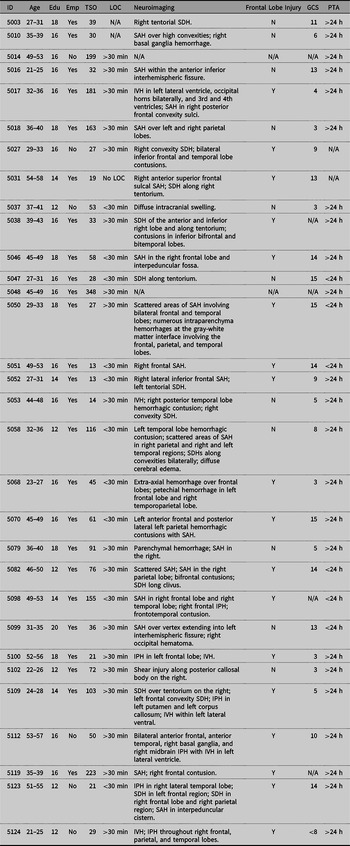
In the final sample, mean ages for participants with TBI and NC participants were 38.94 and 38.48, respectively, and did not differ statistically t(58.9) = −0.18, p = 0.86. Mean years of educational attainment were 15.48 for both groups and did not differ statistically t(59.5) = 0, p = 1.00. Glasgow Coma Scale score was available for 26 participants with TBI; loss of consciousness information was available for 28 participants; post-traumatic amnesia information was available for 29 participants; acute imaging information was available for 29 participants (all 29 with positive findings). Causes of injury were motor vehicle accidents (12), falls (6), motorcycle or snowmobile accidents (3), being hit by a car as a pedestrian (3), assault (3), being hit by a moving object (2), or non-motorized vehicle accidents (1), and other (1). See Table 1 for demographic and injury information for participants with TBI.
Demographic and injury information for final included sample of participants with traumatic brain injury

Note: ID = participant number. Age is represented in 5-year range to protect participant identity. Education (Edu) reflects years of highest degree obtained. For employment status (Emp), Yes = employed or full-time student, No = unemployed or self-employed. Time since onset (TSO) is presented in months. Loss of consciousness (LOC) is presented in minutes (min). Neuroimaging information obtained from acute CT radiology reports. SDH, subdural hematoma; SAH, subarachnoid hemorrhage; IPH, intraparenchymal hemorrhage; IVH, intraventricular hemorrhage; ICH, intracerebral hemorrhage. Glasgow coma scale (GCS) is total score within first 24 hours of acute care admission. PTA, post traumatic amnesia; h, hours. N/A = this information was not available for the given participant.
While not a criterion for inclusion in the study, per reviewer request, we obtained information about possible presence of frontal lobe pathology. We reviewed acute, clinical computed tomography (CT) scans in the medical records of the participants with TBI. Neuroimaging data were available for 29 of the 31 participants. Based on these reports, we coded an individual as having frontal lobe damage if the report specifically stated frontal lobe pathology (e.g., brain bleed or contusion; left, right, or bilateral). Descriptions of brain damage or pathology that may have impacted the frontal lobes (e.g., diffuse cerebral edema, SAH over high convexities) but for which there was no explicit reference to the frontal lobes were not coded as frontal lobe damage given lack of specificity in the medical record. Using these criteria, 18 (62%) of participants with TBI on whom neuroimaging data were available, had a confirmed frontal lobe bleed or contusion. We acknowledge this percentage is likely an underestimation of the number of participants with frontal lobe pathology, and the extent of that damage, given that CT scans have poor resolution compared to magnetic resonance imaging scans that can detect white matter damage. Furthermore, a single acute CT scan is incomplete, as it does not capture the dynamic neurological events that are common in the initial days following injury, so participants may have more neurological involvement than would be identified on these scans. Thus, this is a conservative estimation of frontal lobe pathology in this sample.
During a structured interview of their injury history, we asked individuals with TBI if they experienced changes in various domains as a result of their brain injury. Participants with TBI reported changes to their memory (n = 20; 64.5%), attention and concentration (n = 17; 54.8%), speech and language (n = 15; 48.4%), vision (n = 8; 25.8%), motor (n = 9; 29.0%), personality (n = 21; 67.7%), and executive functions (n = 10; 32.3%). Examples of reported changes in personality and executive functions, domains linked to frontal lobe function, included emotional lability, anger, flat affect, poor motivation, decreased initiation, difficulty completing tasks, lack of flexibility, and difficulty keep track of time and tasks.
Stimuli
Following (Koenigs et al., Reference Koenigs, Young, Adolphs, Tranel, Cushman, Hauser and Damasio2007) we administered 50 trolley dilemmas from Greene et al (Reference Greene, Sommerville, Nystrom, Darley and Cohen2001). Participants were presented with: personal moral dilemmas, which involve the up-close, direct harms to others (n = 21) (e.g., pushing a man off a footbridge to stop a trolley heading down a track toward a group of workers), impersonal moral dilemmas, which involve indirect harms to others (e.g., pulling a lever that will change the trajectory of a trolley such that it would kill one worker instead of five) (n = 11), and non-moral dilemmas, which hold no moral value (e.g., determining whether to buy a generic brand of medicine or continue to look for the name brand) (n = 18). Dilemmas were text-based, single-paragraph narratives and were, on average, 90.5 words long. The task instructions and dilemmas had good readability and a reading level of third grade reading according to The Hemingway Editor (Long & Long, Reference Long and Long2013).
Procedures
Due to the COVID-19 pandemic, this study was conducted online via REDCap (Harris et al., Reference Harris, Taylor, Thielke, Payne, Gonzalez and Conde2009, Reference Harris, Taylor, Minor, Elliott, Fernandez and O’Neal2019), rather than during an in-person session. Dilemmas appeared one at a time and were presented in a fixed random order. The left side of the screen presented the dilemma along with a question about hypothetical action (i.e., “Would you push the man off the footbridge in order to save five workers?”). The right side of the screen contained possible responses (yes/no). Participants read and clicked on their responses at their own pace. Participants were encouraged to complete this task in one sitting. We employed a one-item attention check at the end of the paradigm (Oppenheimer, Meyvis & Davidenko, Reference Oppenheimer, Meyvis and Davidenko2009). In this attention check, participants were asked to report their mood—ostensibly due to the effects that mood can have on decision-making. However, the last line of the instructions asked participants to select option 1 (very bad) as their response. Those who did not offer the correct response were excluded (see below).
An initial sample of 46 individuals with TBI (26 females) and 51 NC participants (27 females) completed the task. From this initial sample, a number of participants were excluded from the final sample prior to data analysis across two phases of data quality checks. In the first phase, two NCs were excluded, one due to technical failure during the study and one because it came to our attention that the participant had performed significantly different from all other NCs on a variety of tasks administered in our lab—raising concerns about effort or change in cognitive status. During this phase, we also excluded 10 individuals with TBI. One participant was outside of age range, six did not answer all of the questions, one participant did not meet the language requirements, and two had incorrect responses to the attention check item.
During the second phase of data quality checks, we were concerned about the possible effects of remote data collection during the COVID-19 pandemic. The studies that will be comparison points for our data were, to the best of our knowledge, all collected in-person in a laboratory setting in a single session with an experimenter present. We asked participants to complete our online task in one sitting, but we also conducted additional checks to ensure that we replicated this single-session lab environment as closely as possible. We piloted the study and determined a typical reading time of 17–22 min for the scenarios for neurotypical individuals. Based on this time range, we excluded participants who completed the full task in less than 15 min, as it suggested that the participants may not have completed the task at full effort (e.g., based on timestamp data, some participants completed the task in as little as 2–5 min, suggesting that they did not read the scenarios). It is also possible that the manipulation of moral dilemma types might depend on the participant reading and responding to all the scenarios in a single sitting, rather than intermittently over an extended period of time. Thus, considering that participants with TBI routinely take significantly longer to perform cognitive tasks, we set an upper time limit of 2.5 h to complete the survey. We excluded 14 NCs and 11 participants with TBI for taking too little time or too much time to complete the task. This left us below our target of 30 participants in each group, so we recruited an additional 6 NCs and 6 individuals with TBI using the methods described above.
Data analysis
In keeping with previous work (Greene et al., Reference Greene, Sommerville, Nystrom, Darley and Cohen2001; Koenigs et al., Reference Koenigs, Young, Adolphs, Tranel, Cushman, Hauser and Damasio2007), all yes responses were coded as utilitarian. As our primary form of analysis, we evaluated between-group response differences for each dilemma type (personal, impersonal, and non-moral) using mixed-effects logistic regression in the lme4 package in R (Bates, Mächler, Bolker & Walker, Reference Bates, Mächler, Bolker and Walker2015).
We modeled response type (utilitarian/yes or deontological/no) as a function of participant group and dilemma type, with consideration for variance nesting within individual scenarios and trials nested within individual participants. Participant group was dummy coded so that the NC group served as the reference. Dilemma type was Helmert contrast coded: we compared the likelihood of selecting a utilitarian response for personal dilemmas (−0.5) to the average of the impersonal (0.25) and nonmoral (0.25) dilemmas. Our planned model included random slopes, with fixed effects for participant group (NC or TBI), dilemma type (personal, impersonal, nonmoral), and the interaction between group and dilemma type. We also included random intercepts to account for variability nested within individual participants or scenarios. When the planned model did not converge with the available sample size, we removed the random slopes. Thus, the final model included fixed effects for participant group, dilemma type, and the interaction between group and dilemma type, with random intercepts to account for variability nested within individual participants and scenarios.
We conducted a primary post hoc analysis to assess group differences within each dilemma type. We ran three models, each with the data from a single dilemma type (personal, impersonal, nonmoral). Again, the outcome was response type, and we modeled the fixed effect of group with random intercepts to account for variability nested within individual participants and scenarios. These three post-hoc models did not include dilemma type, as each model was run within a single dilemma type.
In line with Martins et al. (Reference Martins, Faísca, Esteves, Muresan and Reis2012), we conducted an additional post hoc analysis in which we examined proportion of utilitarian responses by group for each scenario within the personal dilemmas to probe potential group differences in response patterns. Per reviewer request, we also compared proportion of utilitarian responses for personal dilemmas between those with confirmed frontal involvement and those without using Welch’s independent-samples t-tests.
Results
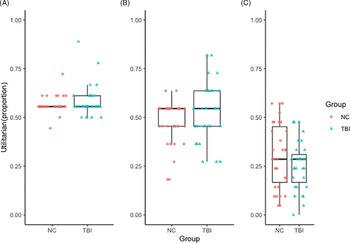
The data quality procedures described above resulted in a final sample of 31 individuals with TBI and 31 NCs (15 females in each group). Figure 1 presents group and individual data for the three dilemma types, disaggregated by group. Table 2 presents the group means for the three dilemma types.
Boxplot of group and individual performance for A) non-moral dilemmas, B) impersonal dilemmas, and C) personal dilemmas. Points represent individual participants. Central lines in boxplots reflect medians.

Proportion of utilitarian responses for each dilemma type disaggregate by group

Values = mean(standard deviation).
In our a priori model, there was no significant main effect of group (z = 0.61, p = 0.54). There was a significant effect of dilemma type, such that all participants were less likely to give a utilitarian response to personal dilemmas than other dilemma types (z = 2.71, p = 0.007). There was also a significant interaction effect between group and dilemma type (z = 3.68, p < 0.001), such that participants with TBI were less likely than NCs to give utilitarian responses to personal dilemmas relative to other dilemma types.
We next conducted a post-hoc analysis assessing whether group membership was predictive of response type within each dilemma category. There was no main effect of group for non-moral (z = 0.94, p = 0.35), impersonal (z = 1.66, p = 0.10), or personal dilemmas (z = −1.29, p = 0.20). This finding was contrary to our hypothesis that individuals with TBI would be more likely than NCs to give utilitarian responses on personal dilemmas.
Although we did not have a priori predictions about sex differences, following recommendations in the literature (Shansky & Murphy, Reference Shansky and Murphy2021; Turkstra et al., Reference Turkstra, Mutlu, Ryan, Despins Stafslien, Richmond, Hosokawa and Duff2020), we present data disaggregated by sex in the Supplemental Materials (Supplemental Table 1 and Supplemental Figure 1) to guide future hypotheses regarding the effect of sex on experimental outcomes in decision-making tasks.
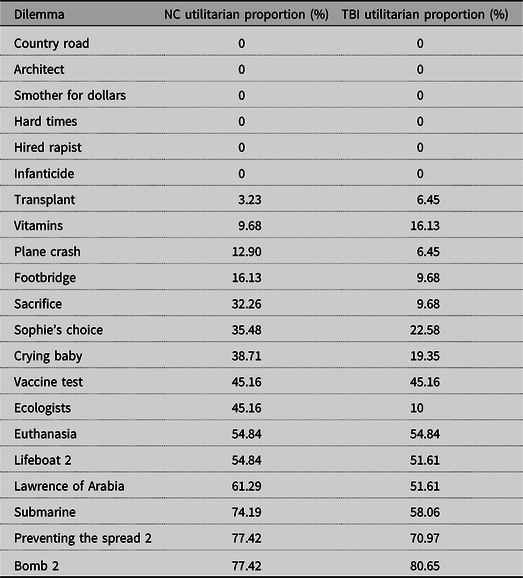
Following Martins et al. (Reference Martins, Faísca, Esteves, Muresan and Reis2012), we report the proportion of utilitarian responses by group for each personal dilemma (Table 3). In general, at the level of a specific dilemma, the NC and TBI groups were quite similar in the pattern of utilitarian responses. In fact, the groups had the same proportion of utilitarian responses on 8 of the 21 dilemmas. On 10 of the 21 dilemmas, the NC group had a higher proportion of utilitarian responses than the TBI group. This pattern of greater proportion of utilitarian responses by the NC participants at the level of the individual dilemmas explains the greater numerical mean proportion for the NC group (.30) relative to the TBI group (.25), although this difference was not statistically significant.
Proportion of utilitarian responses by group for each personal dilemma (n = 21)

We also observed disagreement between our sample and the sample from Martins et al. (Reference Martins, Faísca, Esteves, Muresan and Reis2012) in some personal dilemmas. For example, we observed a resounding refusal (that is, 0% utilitarian proportion within each group) to take the prescribed action in the architect dilemma (pushing one’s boss off a building considering that he is widely disliked, and no one would miss him) across groups. In Martins et al. (Reference Martins, Faísca, Esteves, Muresan and Reis2012) sample, individuals with TBI endorsed this action at a rate of 20.7%. Notably, NC participants in the Martins’ sample endorsed the action in the architect dilemma at 0%.
Per reviewer request, we compared performance on the personal dilemmas for those individuals with TBI with (18) and without (11) confirmed frontal lobe pathology documented in their acute CT report in the medical record. Mean proportion of utilitarian decisions for personal dilemmas was (M = 0.27, SD = 0.15) in those with confirmed frontal lobe pathology and (M = 0.22, SD = 0.07) for those individuals without confirmed frontal lobe pathology. This difference was not statistically significant t(27) = −1.04, p = 0.31, Cohen’s d = −0.40. Both individuals with and without confirmed frontal lobe pathology produced a numerically lower proportion of utilitarian decisions for personal dilemmas than the NC group (M = 0.30).
Interim discussion
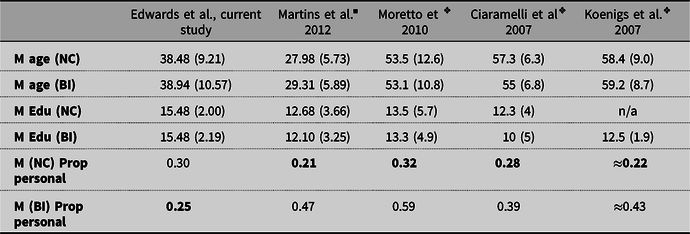
In contrast to our prediction, the TBI and NC groups did not differ in proportion of utilitarian responses for the personal dilemmas. This finding stands in contrast to previous studies using the same paradigm in individuals with documented frontal lobe lesions following TBI (Martins et al., Reference Martins, Faísca, Esteves, Muresan and Reis2012) or individuals with focal vmPFC lesions (Koenigs et al., Reference Koenigs, Young, Adolphs, Tranel, Cushman, Hauser and Damasio2007; Moretto et al., Reference Moretto, Làdavas, Mattioli and di Pellegrino2010; Thomas, et al., Reference Thomas, Croft and Tranel2011). Here, we look closer at these previous studies to see how our sample and their performance compared. First, we note that the mean proportion of utilitarian responses for the personal dilemmas of the TBI group (M = 0.25) in the current study falls squarely in the middle of the range of means of neurotypical participants (Ms = 0.21–0.32) from other studies. Thus, not only was there not a significant difference between the TBI and NC group here, but the performance of the TBI group is consistent with the performance of neurotypical participants across other studies. In our sample, the mean proportion of utilitarian responses for the personal dilemmas for the NC group also falls in the range of the means for neurotypical participants from previous studies (Ms = 0.21–0.32), even if at the higher end of the range. Finally, the mean proportion of utilitarian responses for the personal dilemmas of the TBI group (M = 0.25) in the current study is considerably lower than, and outside the range (0.40– 0.54) of, the participants with acquired brain injury from other studies in the literature. Thus, not only do the participants with TBI in the current study not differ statistically from their demographically matched NC participants, but the performance of the participants with TBI is remarkably similar to the NC participants, who varied in age and education level, using the same paradigm across other studies. It is important to note that these other studies of moral decision-making in acquired brain injury, including the single study in a sample of individuals with TBI, selected their participants based on presence of frontal lobe injury (e.g., vmPFC). We return to and expand on this point in the main discussion.
Discussion
Decision-making deficits following moderate-severe TBI are well documented in the literature, yet considerably less is known about moral decision-making. Thus, we do not know which individuals with TBI are at risk for moral decision-making disruption and what impact such impairments might have on long-term outcomes. To address this gap in the literature, we administered a set of 50 trolley dilemmas to a sample of 31 individuals with chronic, adult-onset TBI and 31 demographically matched NCs. Contrary to our prediction, results showed that individuals with TBI were not more likely than NCs to make utilitarian decisions for personal dilemmas. In fact, performance of individuals with TBI on the personal dilemmas, the critical condition, was within the range of performance of all NC groups in prior studies (Koenigs et al., Reference Koenigs, Young, Adolphs, Tranel, Cushman, Hauser and Damasio2007; Martins et al., Reference Martins, Faísca, Esteves, Muresan and Reis2012; Moretto et al., Reference Moretto, Làdavas, Mattioli and di Pellegrino2010; Thomas et al., Reference Thomas, Croft and Tranel2011), all of whom used the same, or a subset of the same, materials as used in the current study. These findings suggest that impairment in moral decision-making is not a ubiquitous deficit in moderate-severe TBI and that history of a such an injury alone may not predict moral decision-making deficits. In fact, presence of frontal lobe bleeds and contusions broadly was not associated with significantly different moral decision-making behavior relative to individuals with TBI without confirmed frontal lobe injuries or NC participants. Rather, moral decision-making impairments may be related to the specificity of neural damage in the frontal lobe.
Studies on the neurobiology of moral decision-making in individuals with acquired brain jury have focused on individuals with frontal lobe lesions, with a particular focus on the vmPFC. A consistent finding is that participants with lesions that damage the vmPFC, unilaterally or bilaterally, following an anterior communicating artery aneurysm (Ciaramelli et al., Reference Ciaramelli, Muccioli, Làdavas and di Pellegrino2007; Koenigs et al., Reference Koenigs, Young, Adolphs, Tranel, Cushman, Hauser and Damasio2007; Moretto et al., Reference Moretto, Làdavas, Mattioli and di Pellegrino2010) or tumor resection (Koenigs et al., Reference Koenigs, Young, Adolphs, Tranel, Cushman, Hauser and Damasio2007), produce a significantly higher proportion of utilitarian responses on personal dilemmas than demographically matched comparison participants. Martins et al. (Reference Martins, Faísca, Esteves, Muresan and Reis2012) reported that individuals with TBI and lesions to the orbitofrontal, medial, and dorsolateral aspects the frontal lobes confirmed by magnetic resonance imaging also produce a significantly higher proportion of utilitarian responses on personal dilemmas than demographically matched comparison participants. However, there is no information reported on the cause of TBI (e.g., fall, motor vehicle accident) that produced such seemingly circumscribed frontal lesions in their sample of individuals with TBI. Though presence of frontal lobe damage was not an inclusion criterion for the current study, 62% of participants had a confirmed frontal lobe bleed or contusion reported on their acute CT scan from medical records. We believe this is an underestimation of frontal lobe involvement given the limitations of acute CT scans and suspect that, given the diffuse nature of TBI together with the vulnerability of the frontal lobes to injury mechanisms, that all the participants in our sample may have had some degree of frontal lobe pathology. Such speculation is supported, in part, by the high endorsement rates of behavioral change in domains long linked to frontal lobe function, including personality and executive functions, but also attention and speech, among the participants with TBI. That said, it seems unlikely that the frontal involvement evident in the current sample (including documented contusions and subdural and subarachnoid hemorrhages, and probable diffuse axonal injury) would produce the same specificity or size of lesion to the vmPFC as an anterior communicating artery aneurysm—the most common etiology of vmPFC damage associated with deficits in moral decision-making in the literature (Ciaramelli et al., Reference Ciaramelli, Muccioli, Làdavas and di Pellegrino2007; Koenigs & Tranel, Reference Koenigs and Tranel2007; Moretto et al., Reference Moretto, Làdavas, Mattioli and di Pellegrino2010). Despite 62% of our sample having documented frontal lobe pathology, the moral decision-making disruption seen elsewhere in the literature (e.g., in Martins et al., Reference Martins, Faísca, Esteves, Muresan and Reis2012) was absent here. We acknowledge, however, that we cannot rule out vmPFC damage or dysfunction in the current sample given the neuroimaging data available. That said, it is worth speculating that sufficiently large lesions to the vmPFC, bilaterally or unilaterally, like those evident in other studies in the literature, are critical in the association between brain injury and a utilitarian bias in moral decision-making. In this sample, a history of a moderate-severe TBI in adulthood alone was not predictive of deficits in moral decision-making, even when some degree of frontal lobe pathology was evident, suggesting that a more specific lesion pattern may be required.
While the use of the trolley dilemmas has been a popular approach in the cognitive neuroscience of moral decision-making, the simple juxtaposition of utilitarian and deontological decisions has been criticized. Specifically, researchers have argued that the such juxtapositions lack sensitivity to the broader range of factors that can influence moral decision-making, including an individual’s sensitivity to consequences, moral norms, and a general preference for inaction, which are not experimentally manipulated in the trolley dilemmas (Gawronski, Armstrong, Conway, Friesdorf, & Hütter, Reference Gawronski, Armstrong, Conway, Friesdorf and Hütter2017; Gawronski & Beer, Reference Gawronski and Beer2017). For example, participants may pull the switch, saving the five workers while sacrificing one, to achieve the desired outcome of saving more individuals thus demonstrating sensitivity to the consequences. However, participants may not pull the switch, either because it violates their norms or because they prefer to take no action at all. Still others may pull the switch because they are willing to sacrifice the life of others regardless of the number of lives saved. In the latter case, it would be misguided to call the observed responses “utilitarian” in the moral sense. Indeed, individuals with sub-clinical levels of psychopathy have a greater willingness to accept harmful actions in the trolley paradigm compared to non-psychiatric participants (Bartels & Pizarro, Reference Bartels and Pizarro2011; Kahane, Everett, Earp, Farias, & Savulescu, Reference Kahane, Everett, Earp, Farias and Savulescu2015; Patil, Reference Patil2015). Thus, accepting harmful actions in the trolley dilemma paradigm may reflect either a genuine sensitivity to consequences or a more general willingness (or indifference) to accept harmful actions regardless of their consequences. Categorization of moral judgments as “utilitarian” presupposes that the observed decision is sensitive to consequences (the death of other individuals), which requires experimental manipulation of consequences. To address these limitations, Gawronski et al., (Reference Gawronski, Armstrong, Conway, Friesdorf and Hütter2017a) proposed the Consequences, Norms, Inaction (CNI) model, which seeks to quantify an individual’s sensitivity to consequences, moral norms, and for a general preference for inaction, and a task that experimentally manipulates the consequences and weightiness of moral norms presented across dilemma types. The CNI model and task warrant further consideration and study, as this approach may prove to be more sensitive to certain contextual dimensions of moral decision-making. This approach may also identify more nuanced moral decision-making disruptions in TBI that were not captured here using the traditional trolley dilemmas.
It is important to note that these are hypothetical dilemmas. While they may mirror real life decisions and judgments and have demonstrated sensitivity to specific neural correlates of interest in individuals with TBI, performance on this task may or may not relate to how individuals would make such decisions and judgments in the real world. In fact, the association between brain injury and increased risk of criminality appears to be strongest among individuals who sustained a TBI during early childhood (Timonen et al., Reference Timonen, Miettunen, Hakko, Zitting, Veijola, von Wendt and Räsänen2002). Such an association fits with evidence suggesting that early frontal lesions have been linked to atypical moral development (Taber-Thomas et al., Reference Taber-Thomas, Asp, Koenigs, Sutterer, Anderson and Tranel2014), and TBI sustained early in life is associated with abnormal moral decision-making and moral reasoning (Beauchamp, Dooley & Anderson, Reference Beauchamp, Dooley and Anderson2013; Beauchamp, Vera-Estay, Morasse, Anderson & Dooley, Reference Beauchamp, Vera-Estay, Morasse, Anderson and Dooley2019). This association between brain injury and increased risk of criminality is also consistent with data showing that early onset focal frontal lesions are more predictive of psychopathy and anti-social behavior (Anderson, Bechara, Damasio, Tranel & Damasio, Reference Anderson, Bechara, Damasio, Tranel and Damasio1999; Bellesi, Barker, Brown & Valmaggia, Reference Bellesi, Barker, Brown and Valmaggia2019; Taber-Thomas et al., Reference Taber-Thomas, Asp, Koenigs, Sutterer, Anderson and Tranel2014) than in those with adult-onset vmPFC lesions, including those individuals who are impaired on the trolley dilemma task. Thus, whereas adult-onset lesions of the vmPFC frontal lobes, focal or in the context of TBI, can impair moral decision-making ability, they do not appear to predict criminality. However, it is also important to note additional TBI-related impairments could drive criminal behavior and negative legal outcomes (i.e., incarceration) in some individuals with TBI such as impulsivity (Wood & Thomas, Reference Wood and Thomas2013) and poor cognitive communication skills that may make self-advocacy during criminal proceedings—from Mirandizing to sentencing—quite arduous (J. A. Wszalek, Reference Wszalek2021; J.A. Wszalek & Turkstra, Reference Wszalek and Turkstra2015, Reference Wszalek and Turkstra2019). Additionally, we note the potential impact of stress on decision-making (Porcelli & Delgado, Reference Porcelli and Delgado2017) as well as time constraints given the tradeoff between speed and accuracy that has been noted in individuals with TBI on timed tasks (Bigler, Reference Bigler2016). Considering these influences, future studies of adult onset TBI should continue to explore moral decision-making across tasks and settings that closely mimic decision-making scenarios in everyday contexts—where additional pressures of stress, cognitive communication, emotion regulation, and time constraints can influence adaptive decisions above and beyond the ability to know right from wrong.
Limitations and future directions
This study was conducted during the COVID-19 pandemic using remote data collection methods. It is possible that the circumstances of the pandemic may have caused changes in the mental states of participants (e.g., perceived scarcity of resources) that impacted how individuals respond to moral dilemmas. Data from our lab has revealed that individuals with TBI were less likely to change their behavior during the pandemic (Morrow, Patel & Duff, Reference Morrow, Patel and Duff2021), suggesting that if conducting this study during the pandemic were to affect the results, such concerns might be greater for the NC participants than those with TBI. For further context, there are data from a study which assesses moral decision-making in a sample of neurotypical adults before versus during the pandemic (McNabb & Francis, Reference McNabb and Francis2020). Notably, this group deployed remote data collection techniques similar to the ones described in this study. Analysis demonstrated no significant group differences in the proportion of utilitarian decisions on traditional trolley type dilemmas pre versus during pandemic, suggesting that completing this task during the pandemic would not affect participant performance. That said, there may be social pressures which are unique to a laboratory setting that cannot be replicated by administering this task in an online survey format (i.e., another person in the room). However, we do not believe the absence of such pressures significantly influence our results, as the NC participants’ utilitarian response proportions in the personal dilemmas (.30) falls in range of NC performance across similar studies conducted in a laboratory setting (range 0.21–0.32; see Table 4).
| Comparison to other studies of moral decision-making and acquired brain injury

NC = neurotypical comparison. BI = brain injured. Edu = reflects years of highest degree obtained. Prop = proportion of utilitarian responses. Values = mean(standard deviation). Means for Koenigs et al., were approximated from figures; the authors did not report means and were unable to locate them. Bolded values are intended to highlight the similarity in proportion of utilitarian responses in the current TBI sample with those of neurotypical comparison participants from other studies.
▪ = individuals with frontal lobe injury from TBI; non-frontal injuries excluded.
❖= individuals with ventromedial prefrontal cortex (vmPFC) damage.
Future studies should examine the impact of other contextual factors that can influence decision-making in everyday settings (e.g., stress, time-constraints), together with well-known TBI-related deficits such as impulsivity. Such studies would increase the ecological validity of moral decision-making research and may yield different results from controlled research studies where such factors are minimized or eliminated. Future studies that collect data on moral decision-making ability together with tasks of non-moral decision-making and social cognition are also warranted. Such studies could test for the presence and nature of associations between various types of decision-making and social cognition constructs, advancing our theoretical understandings of the unique and overlapping cognitive abilities that give rise to complex behavior. Such data would also facilitate clinical decision-making and education and counseling about predictive deficit profiles.
Conclusions
In this study, we observed that individuals with TBI are not more likely to make utilitarian moral decisions than their demographically matched, neurotypical counterparts. This was contrary to our initial hypothesis and suggests that moral decision-making may not be obligatorily impaired in TBI in the absence of significant damage to the vmPFC. These findings advance the neurobiology of moral decision-making and give some insight into which individuals with TBI might be at risk for moral decision-making disruption.
Supplementary materials
For supplementary material for this article, please visit http://doi.org/10.1017/BrImp.2022.11
Acknowledgements
We thank the participants from the Vanderbilt Brain Injury Registry for their participation and time. We also thank Nirav Patel and Kimberly Walsh in the Communication and Memory Lab, Vanderbilt University Medical Center for assistance with data collection and medical record review, and Dr Mary Dietrich in the Department of Biostatistics, Vanderbilt University Medical Center for consultation on the statistical analysis.
Financial support
This work was funded by the National Institute of Neurological Disorders and Stroke (MCD, grant number 110661). CTSA Award No. ULITR002649 from the National Center for Advancing Translational Sciences supports REDCap which we used for this study.
Conflicts of interest
None.
Ethical standards
The authors assert that all procedures contributing to this work comply with the ethical standards of the relevant national and institutional committees on human experimentation and with the Helsinki Declaration of 1975, as revised in 2008.