Introduction
In the Korean language, the equivalents of English words like “what” or “where” can have two lexical functions. These wh-words can be used interrogatively, as in English, to indicate a question that cannot be answered with “yes” or “no.” This type of question is known as a wh-question. However, Korean wh-words can also be used as an indefinite pronoun, similar to the usage of the English words “something” or “somewhere.” When a wh-word is used as an indefinite pronoun inside a question phrase, this can produce a question that may be answered with affirmation or negation, otherwise known as a yes-no question. It is thus ambiguous whether a given Korean question containing a wh-word, referred to in this article as a wh-indeterminates, may be simply answered with “yes” or “no” or if additional information is required. For instance, in the question “mwe mekko isseFootnote 1?”, the wh-word mwe ‘what’ may be translated into English as either “what” or “something.” Accordingly, the sentence as a whole could be interpreted as either “what are (you) eating?” or “are (you) eating something?”
Despite these ambiguities, very few studies have investigated the role of prosody on Korean children's disambiguation of wh-indeterminates (for an example see Y. Choi, Reference Cho, Inkelas and Zec2009). Prosodic characteristics in speech such as intonation, stress and rhythm are delivered by suprasegmental features (e.g., pitch, length, loudness) and provide vital cues in utterance interpretation (Hirschberg & Ward, Reference Hirschberg and Ward1992; Jun & Oh, Reference Jun and Oh1996). Previous studies on the ambiguity of Korean wh-indeterminates have shown that one or more prosodic features such as boundary tones, prominence of wh-words, and their phrasing relative to the following word help Korean adults in disambiguating wh-indeterminates (e.g., S.J. Chang, Reference Chang1973; Cho, Reference Cho, Inkelas and Zec1990; Choe, Reference Choe, Kuno, Whitman, Lee and Kang1985; Lee, Reference Lee1990).
The main goal of this study was to investigate whether three-year-old Korean children can disambiguate wh-indeterminates just as well as adults through the use of the prosodic cues in a perception task. Additionally, the influence of discrepancy between auditory and visual information on children's responses to wh-indeterminates was examined. To do this, we examined the responses of Korean children and adults to both ‘wh-questions’ (referred to as WHQs) and ‘yes-no questions’ (referred to as YNQs) by using a picture that either presents or does not present the specific entity indicated in the questions.
Adults’ use of prosodic cues in disambiguating wh-indeterminates
Adult speakers of Korean use prosodic cues to disambiguate wh-indeterminates both in perception and production. The most critical cue used for disambiguating wh-phrases in perception tests was the difference in the number of Accentual Phrases (APs) (Jun & Oh, Reference Jun and Oh1996; Yun, Reference Yun2012, Reference Yun2015). An AP is the smallest prosodic unit in the intonation system of Seoul Korean (Jun, Reference Jun1993; Reference Jun1998). It consists of one or more phonological words (e.g., a lexical item followed by a particle) and is marked by a tonal pattern. The underlying tonal pattern of an AP is THLH where T is realized as H (or else as L) when the phrase-initial segment is a tense or aspirated consonant. In addition, the Korean intonational structure is hierarchically organized such that an Intonational Phrase (IP) can have more than one AP consisting of one or more phonological words. Thus, the intonational contour of an IP contour comprises tonal patterns of one or more APs and an IP boundary tone on the last syllable of the IP.
As for wh- and yes-no questions, Jun and Oh (Reference Jun and Oh1996) found that the wh-phrase and the following word was produced with only one AP in a wh-question (WHQ), whereas they were produced with two separate APs in a yes-no question (YNQ). IP boundary tones also differed between the two readings. LH%, a sharper rising tone that starts to rise after the onset of the IP-final syllable, was more commonly used for a WHQ. In contrast, the most frequently used boundary tone for the YNQ was H%, a rising tone that starts to rise before the IP-final syllable (Jun & Oh, Reference Jun and Oh1996). Moreover, the pitch and the peak amplitude of the wh-word were found to be higher in wh-readings than in yes-no readings (Jun & Oh, Reference Jun and Oh1996), although it is not clear whether the prominence of the wh-word is a strong perceptual cue for wh-word disambiguation (Yun, Reference Yun2012).
For example, “eti kallayyo?” can be translated as “Where would you like to go?” or “Would you like to go somewhere?”. The differing prosodic cues indicating the phrase as either a WHQ or a YNQ are shown in Figure 1. According to the tone-syllable association explained in Jun's model, the 2nd (H) and 3rd (L) tones of the single AP (marked with the circle in Figure 1) fall on the second and penultimate syllable of the wh-phrase, respectively, in a WHQ (left). In contrast, because there is an AP boundary (marked with a dotted line) between the wh-word and the following verb in a YNQ (right), the first tone of the second AP (L1) falls on the first syllable of the verb. In this example, the tonal pattern of the first AP is simplified as LH as it consists of two syllables (Jun, Reference Jun1993, Reference Jun1998). The second AP likewise has L followed by the IP final tone H%. Different IP boundary tones (i.e., LH %, H%) are also expected to be used in the two readings.
Expected tonal patterns of APs for WHQs and YNQs.
The symbol ϭ represents each syllable.

It must be noted, however, that, while Jun and Oh's (Reference Jun and Oh1996) investigation on production suggested that Korean adults used distinct tonal patterns for wh- and yes-no questions, there was also a slight bias in response towards the WHQ in their perception experiment. They found that the percentage range of correctly identifying the meaning of the WHQ was 87.1% ~ 90.7%, whereas it was 67.3% ~ 82.9% for the YNQ. Similarly, in Y. Choi's (Reference Choi2009) experiment, 90~100% of adult answers to the WHQs were correct. For the YNQ, 40~80% of the responses were correct. While adults could distinguish YNQs from WHQs using prosodic cues, they performed better at correctly identifying the WHQ than the YNQ.
Children's use of prosodic cues and comprehension of wh- and yes-no questions
From a very young age, infants are exposed to various speech inputs and they become sensitive to the role of prosodic cues. For instance, infants aged under five months can use prosodic cues to distinguish different languages (Nazzi, Jusczyk & Johnson, Reference Nazzi, Jusczyk and Johnson2000; Ramus, Nespor & Mehler, Reference Ramus, Nespor and Mehler1999). When infants reach nine months of age, they become sensitive to acoustic markers that correspond to major phrasal units (Jusczyk, Hirsh-Pasek, Nelson, Kennedy, Woodward & Piwoz, Reference Jusczyk, Hirsh-Pasek, Nelson, Kennedy, Woodward and Piwoz1992). At the age of two years, children can use pause placement to comprehend sentences (Shady & Gerken, Reference Shady and Gerken1999).
When young children's use of prosodic cues in sentence comprehension has been compared to the ability of older children or adults, mixed findings have appeared. Some studies (Y. Choi, Reference Choi2009; Zhou, Su, Crain, Gao & Zhan, Reference Zhou, Su, Crain, Gao and Zhan2012) found no difference between young children and adults in the use of prosodic cues. Young Chinese children were not only as sensitive as adults to stress in resolving ambiguities related to the focus particle, but they also could use prosodic information as effectively as adults to resolve speech act ambiguities in Mandarin (Zhou et al., Reference Zhou, Su, Crain, Gao and Zhan2012). In Y. Choi's (Reference Choi2009) study, Korean children as young as three to four years of age did as well as adults in determining the target meaning of ambiguous wh-indeterminates based on prosody.
However, in another study, young children were less effective than adults in using prosodic cues to establish phrasal groupings (Choi & Mazuka, Reference Choi and Mazuka2003). They found that Korean children as young as three years could utilize prosodic cues like stress or intonation to comprehend the meaning of Korean sentences that contained word segmentation ambiguity (e.g., Kipper enters (a) room vs Kipper enters (a) bag), but not the sentences that contained phrasal grouping ambiguity (e.g., Giraffe eats cookie vs (somebody) eats giraffe-shaped cookie). Thus, the effectiveness of children's use of prosodic cues in sentence comprehension can vary according to the examined prosody and sentence type.
As mentioned previously, only a small number of studies have been carried out in regard to children's use of prosodic cues in the disambiguation of wh-indeterminates. Previous studies on the emergence of children's comprehension of WHQs and YNQs provided evidence that by the age of three years, children begin to comprehend WHQs and YNQs effectively. Children's understanding of WHQs occurred in a similar order to their acquisition in production: yes-no, what, and where questions were the first questions to be understood (Ervin-Tripp, Reference Ervin-Tripp1970). Furthermore, German and Chinese speaking children aged between 18 and 30 months understood a particular class of WHQs (for example, ‘what?’) earlier than the YNQs (Moradlous, Zheng, Tian & Ginzburg, Reference Moradlous, Zheng, Tian and Ginzburg2020). In the studies with Korean children, children as young as two years could produce and to some extent change the function (as interrogative, indefinite, and discourse) of certain wh-words (e.g., mwe ‘what’) depending on the context (Kang & Yi, Reference Kang and Yi2017). Nonetheless, Korean children preferred to produce and comprehend mwe ‘what’ or ‘something’ as an interrogative rather than an indefinite function (Kang & Yi, Reference Kang and Yi2017).
In summary, while children aged three years can comprehend both WHQs and YNQs, in some languages, children's understanding of WHQs emerged earlier than YNQs. In the case of the Korean language where wh-words can be used in both types of questions, children preferred to use the words as part of the WHQ rather than the YNQ. Such a preference may be because children, compared to adults, are not yet able to perceive mwe as ‘something.’ With only a limited number of studies, it is still debatable whether or not children as young as three years can stably and effectively use prosodic information to distinguish ambiguous phrases.
Effect of the visual cue on children's use of prosodic cues in disambiguating wh-indeterminates
Until now, to the best of our knowledge, no studies have considered the role of visual stimuli on Korean speakers’ responses to ambiguous wh-indeterminates. How do Korean speakers respond to ambiguous wh-indeterminates when presented with a visual cue that conflicts (i.e., is mismatched) to the question? What happens to their ability to use the prosodic cues to disambiguate wh-indeterminates in such a complicated situation? Do children show similar response patterns to adults?
There are at least three reasons why we should consider the role of visual stimuli in children's prosody research. Firstly, adding another stimulus in the task will increase a task complexity to test robustness of inferences drawn from the prosodic cues. Children's response to a conflicting (referred as mismatched in this paper) auditory-visual stimuli will provide an additional supporting evidence for children's ability in using the prosodic cue to distinguish WHQ and YNQ.
Secondly, mismatched situations exist in real life and we frequently face situations where what we see does not provide accurate information on the question being asked. For example, one can experience a mismatched situation when the listener and speaker pay attention to different things in the same setting. Consider the following situation: a boy enters the kitchen and sees the back of his mother cooking while his father is setting dishes on the table. However, the boy mistakenly thinks that his mother is washing something and asks his father, “dad, what is mom washing?”. At this moment, the father is experiencing an adverse situation where what he sees does not provide an accurate answer to the question being asked.
Secondly, in storybooks the words and illustrations are presented at the same time to express the content, meaning that children are generally forced to experience sound and picture information simultaneously (especially when they cannot read the text). While most picture books employ parallel storytelling in which text and illustrations tell the same stories, some storybooks use interdependent storytelling, requiring the reader to consider both text (auditory) and illustration (visual) information together in order to comprehend the book's story (Vandergrift, Reference Vandergrift1980). In some cases, the book also uses contradiction between the text and illustrations to create irony, humor, and disclosure in the story, so the words conflict with the information presented in the illustration (e.g., by presenting the text ‘sunny day’ with the illustration of a ‘rainstorm’). Without question, compared to parallel storytelling, the interdependent storytelling type involves more complex cognitive processing as it forces the readers to consider both stimuli simultaneously and more carefully (Agosto, Reference Agosto1999).
Considering the naturally occurring situations mentioned above and because responses to wh-indeterminates can involve multiple factors, we think that examining the similarities and differences in children's and adults’ responses to conflicting (i.e., mismatched) auditory-visual stimuli is worthy of attention. By doing so, we believe we can provide additional supporting evidence of children's ability to use the prosodic cues to distinguish WHQs and YNQs.
The mismatching stimuli have been used in children's studies to investigate their ability to process cross-modals. For instance, infants and very young children could differentiate matched and mismatched auditory-visual stimuli (e.g., Lyons-Ruth, Reference Lyons-Ruth1977; Volkmar & Siegel, Reference Volkmar and Siegel1979). In Hoffner, Cantor and Thorson's (Reference Hoffner, Cantor and Thorson1989) study, children aged five and six years, to some extent, were able to attend to the content of both modals (auditory and visual) and process them simultaneously, as well as older children. However, five- and six-year-olds’ tendency to compare or attempt to integrate the meaning of the two channels was less effective than older children, leading to an age difference in recognition of the mismatch task.
If children in our experiment are successful in processing both stimuli together, the pattern of children's responses to matched questions and mismatched questions will not differ significantly. However, if children are not yet able to integrate the meaning of the both channels together, their responses to the question may not be as effective as adults’.
In summary, our study aimed to empirically examine the following questions: (1) Can three-year-old children use the prosodic cues as effectively as adults to disambiguate wh-indeterminates? (2) Can three-year-old children use prosodic cues to disambiguate wh-indeterminates in a more complex situation in which visual stimuli do not match with auditory stimuli? and (3) Do the changes in response pattern for mismatched conditions significantly differ between children and adults?
Methodology
Participants
Initially, 46 three-year-old monolingual Korean speakers with Seoul dialect (M months = 43.45 months; age range = 37.25–48.08 months; SD = 3.38) agreed to participate in the study. The children were recruited from two daycare centres located in Gyeonggi-do and Seoul. Children who returned the completed parental consent form took part in the study. All children used Seoul dialects and had no reported history of speech, hearing, or language disorders. During the experiment, three children dropped out because they were uninterested in the study, refused to answer the questions, or did not understand the procedure of the study. Thus, 43 children formed the final sample, of whom 22 (51.2%) were girls and 21 (48.8%) were boys.
In addition, 20 Korean adults (50% male) who speak Seoul dialects (M age= 31.85; age range= 25–38; SD= 3.24) also participated in the study, as a comparison group. The same experimental procedure was applied to adult participants.
Materials
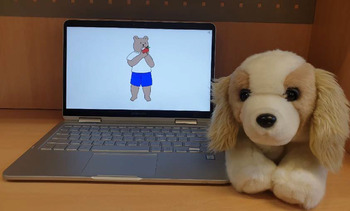
Eight ambiguous question sentences, which may lead the children to provide a specific answer or a yes-no answer, were constructed. The sentences were recorded using either wh- or yes-no prosodic cues, together with one practice and four filler questions. An experimental script employing a PowerPoint presentation was created to display a visual stimulus together with an auditory stimulus. In each slide, an utterance was played through a speaker that was placed behind a dog doll introduced to the children as Toto. Meanwhile, a picture that either matched or mismatched the content of the question was displayed on a laptop screen.
Prosodic cue
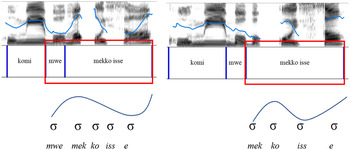
Together with one practice question and four filler questions, eight questionsFootnote 2 (Table.1) were recorded using both wh- and yes-no prosodic features, making the total number of recorded sentences 21. These sentences were recorded by a female native speaker of Korean who was also a trained phonetician. The audio recordings were made in a sound-proof booth with an RØDE NT1-A microphone. A sampling rate of 44100 Hz (quantisation: 16 bit) was used. She read the sentences at a slow speaking rate that was appropriate for children, with two different intonation patterns that are typically used for WHQs and YNQs, respectively (e.g., Jun & Oh, Reference Jun and Oh1996). As displayed in Figure 2, the wh-indeterminate (a wh-word followed by a verb) was produced with one Accentual Phrase (AP) in a WHQ, whereas it was produced with two APs in a YNQ, with the wh-word and the verb forming two separate APs. In addition, they differed in terms of their boundary tones; LH% was used for WHQs, and H% was used for YNQs.
Spectrograms (top panel) of the sentences with wh-indeterminates: ‘komi mwe mekko isse?’ ‘What is the bear eating?’ (left) and ‘Is the bear eating something?’ (right), and tonal patterns (bottom panel) of the final Accentual Phrase (AP) with ϭ representing each syllable. The final AP is marked with a red square.

Visual cue
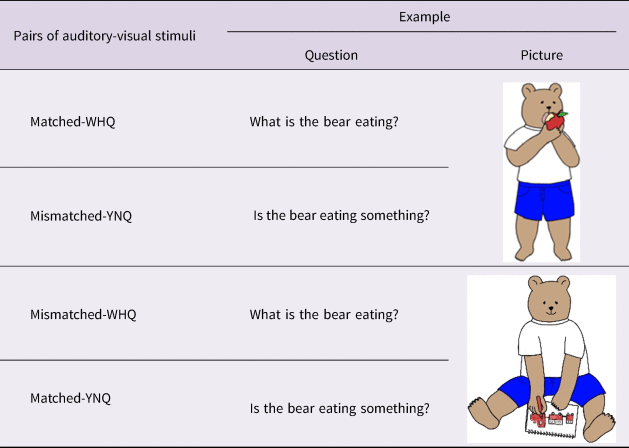
The visual stimuli were made by the experimenter. In each picture, a bear wearing blue trousers was involved in an action. When a matched visual cue was given, children were presented with a picture that contained the information of the question being asked (e.g., a picture of a bear eating an apple presented with the question “What is the bear eating?” or “Is the bear eating something?”). When the mismatched visual cue was given, a picture containing irrelevant information to the question (e.g., a picture of a bear riding a slide presented with the question “What is the bear eating?” or “Is the bear eating something?”) was shown to children. Table 1 contains a list of questions and pictures used in the study.
The list of questions and an example of a picture presented for matched question

*The combinations of questions and pictures were differently presented for mismatched questions
Vocabulary
The verbs and nouns used in the study were chosen from Chang, Jeon, Shin and Kim's (Reference Chang, Jeon, Shin and Kim2013) study. The study reviewed and selected 588 basic lexical items acquired by Korean infants and toddlers that are high in the frequency of use in the current period, used in a broad range of contexts, and appropriate for the stage of language development. From the study's pool of lexical items, we selected verbs (e.g., eat, look, ride, drink, wash, cut, draw, carry) and nouns (e.g., apple, flower, slide, milk, book, cup, paper, train) that are used daily by children and that could be clearly expressed in the drawing. For instance, verbs such as press, push, or put were avoided because such actions are hard to express in a drawing. The vocabulary comprehension and production of 180 Korean children aged 1;1 to 2;6 was reviewed (E. Choi, Reference Choi2000) to make sure that the selected words were well understood and used by three-year-olds. In her study, the verbs and nouns selected for our study were produced by at least 80% of the children aged 2;3 to 2;6.
Procedure
The experiment was conducted at the children's daycare centreFootnote 3. Before the experiment, teachers and parents were asked to notify the children several times about the research. Specifically, children were told that a researcher would be visiting their class to do fun activities with them so that they could feel ready to participate. On the day of the experiment, the researcher visited the classroom before conducting the study to briefly introduce herself and spend several minutes conversing with the participating children in the class. In this way, the methodology aimed to lessen the children's anxiety by meeting the researcher for the first time.
All children were individually tested in a quiet room in the daycare centre, separate from their classroom that was regularly used by the children. The location helped to ensure that the participating children felt comfortable in the environment. Although children were told that their teacher could stay with them in the room if they wanted them to, none of the children requested their teacher should stay with them. Therefore, only the researcher and participant were present in the room during the experiment. Sessions took approximately eight minutes per child and were audio-recorded.
The researcher sat beside the child facing the laptop screen and a puppy doll (Picture 1). The researcher introduced herself to the child and had a short conversation to develop rapport. After the self-introductions, the procedure of the study was explained to the child. The child was first introduced to the puppy doll, Toto. The researcher explained to the child that Toto accompanied her to the school to listen to the child's thoughts. Then, the researcher played the recorded audio files to simulate Toto talking.
Toto said:
“Hi! Nice to meet you! Please tell me what you think. First, look at the picture in front of you. I cannot see it, so you tell me.”
Afterward, the child was asked to greet Toto. Then, the researcher told the child to pay attention to the laptop screen and listen to what Toto says. Toto subsequently asked the practice question in the audio:
“The bear in the picture is my friend. Can you tell me what colour trousers the bear is wearing?”
The researcher waited and encouraged the child to provide the answer to the question. If the child provided the correct answer to the question, the experiment proceeded to the next step. If the child did not answer the question or gave the wrong answer, the researcher encouraged the child to listen to the question and provide the answer one more time. The researcher did not proceed to the next step unless the child provided the answer to the question. This process was necessary to make sure that the child understood the procedure of the activity, specifically that he/she would need to listen to the question and provide an answer referring to the picture on the screen. Although the child was highly encouraged to respond verbally, any responses made by action (e.g., shaking his/her head left and right for “no,” nodding for “yes,” or pointing to the object on the screen) were also counted. The researcher recorded the child's answer provided in verbal or gesture form (e.g., nodding). After the child had presented his/her ability to proceed to the next step, Toto reviewed the procedure of the experiment.
Toto said:
“The teacher will be showing 12 pictures of my friend Bear. I want you to answer my questions for each picture she shows like you just did. There are no wrong or correct answers to my questions. Just tell me what you think in a loud voice. Yes? Do you think you can do this?”
When the child was ready to proceed, the researcher showed the next slide to start the experiment. A total of 12 slides (eight questions, four fillers) were presented on the screen. The child was required to provide an answer to the question to move on to the next slide. This was done to make sure that the child understood what he/she was doing, to avoid any missing responses, and to distinguish the reasons behind their ‘no response’ behavior. When a child provided no response for the question both in verbal or gesture form, the experimenter immediately asked the child whether he/she did not know the answer, did not understand the question, wanted to hear the question again, or wanted to stop the activity (did not want to participate in the study). The attempt was to find out the problem that the child was facing in responding to the question.
For all questions, the child was allowed to hear the question as many times as he/she needed. Overall, eight children asked for the repetition of the 11 questions (M= 2.7; range=2-6 repetition per question). Eight questions were the mismatched-WHQs and three were mismatched-YNQs. Two adults asked for the repetition of the two questions (both twice). Both questions were mismatched-WHQs.
Material presentation
This study was a within-subjects design; all children experienced both wh- and yes-no questions. The eight test questions were arranged in different pairs of auditory-visual stimuli (table 2): two for each of these four questions types – matched-WHQs, mismatched-WHQs, matched YNQs, and mismatched-YNQs. The verbs of eight questions were counterbalanced in four different ways to ensure that each verb was used for each pair of the auditory-visual stimulus. The order of questions was randomized into four different ways to limit the carry-over effect.
An example of four different pairs of auditory-visual stimuli

A pilot test was conducted with nine children, aged 2;4 to 3;11, and five adults. The pilot test aimed to validate the materials and check the experimental procedure was age-appropriate. We judged that this method could be used with children as young as 2;8, but only when presented at home in a more comfortable environment. The majority of the children over three years old had no problem understanding the experimental procedure when it was presented in a daycare setting. Meanwhile, we found that the presentation order of questions could influence participants’ answers. The answers of adults and children were more likely to focus on object or action information presented in the picture; they tended to give more specific responses (rather than “yes” or “no”) in the following questions when the first question was in the form of a WHQ. This pattern no longer appeared when we set the first question to be in the form of a YNQFootnote 4. Therefore, we set a YNQ as the first question for all four conditions.
Coding
Children and adults’ responses to questions were transcribed based on recorded audio files. The transcribed responses and the researcher's notes taken on the day of the experiment were reviewed by the authors in the coding process. Any filler words such as “uh…” or “hmm” were not considered in the coding. If the respondent repetitively used ung ‘yes’ before he/she provided another answer, the ung ‘yes’ was not counted as an affirmative answer to the question. This is because ung ‘yes’ can also be used as a filler word, like “hmm” in Korean.
Based on a rigorous review of the collected responses and the previouse study (Y. Choi, Reference Choi2009), the authors judged that, for the descriptive analysis, children's responses can be categorized as a Yes-no Response (YNR), a Wh- Response (WHR), an Irrelevant Response (IR), and a Negation Form (NF). YNRs and WHRs can be subdivded as TRUE or FALSE answers (for more details, refer to Tables 3, 4 & 5).
Examples of each response types for matched- and mismatched-WHQ and YNQ

* WHR = Wh- Response; YNR = Yes-no Response; IR = Irrelevant Response; NF = Negative Form; Q = Question asked (WHQ or YNQ); V = Visual cue (matched or mismatched); R = Possible response
Number and percentage of responses in matched condition

* YNR = Yes-no Response; WHR = Wh- Response; IR = Irrelevant Response
Number and percentage of responses in mismatched condition

* YNR = Yes-no Response; WHR = Wh- Response; NF = Negative Form; IR = Irrelevant Response
For the multiple regression and mixed-model logistic analysis we performed in this study, all responses were re-coded as WHR (WHR TRUE & WHR FALSE) or NOT WHR (YNR TRUE, YNR FALSE, NF & IR). The responses, WHR FALSE and YNR FALSE, were grouped togeher with WHR TRUE and YNR TRUE, respectively, because our primary interest was to examine whether children provide a response that matches with the question type (e.g., WHR for WHQ).
The analysis was conducted based on WHRs because they also can be the responses for YNQs. For instance, it would be acceptable to state “apple” without yes for the question, “Is the bear eating something?”. However, it would be insufficient to answer a WHQ with a YNR (e.g., providing “yes” as a response for “What is the bear eating?”). Thus, our study investigated respondents’ probability of giving out a WHR for each question type that contained conflicting auditory and visual stimuli.
Results
For the descriptive analysis, the percentage of children and adults’ responses were computed for each response type and summarized in Figure 3-1, 3-2 and Tables 4 & 5.
Experimental Setting. The laptop and the doll were used in the experiment. The speaker (Sony SRS-X11) was placed under the puppy doll.

Children's response-frequency of each response category (WHR, NF, YNR, IR) for each prosodic-visual cue combination (matched-WHQ, mismatched-WHQ, Matched-YNQ, mismatched-YNQ)

Adults’ response-frequency of each response category (WHR, NF, YNR, IR) for each prosodic-visual cue combination (matched-WHQ, mismatched-WHQ, Matched-YNQ, mismatched-YNQ)

Matched question
Most of children's (98.84%) and adults’ responses (100%) to the question asked in WHQ prosody were WHRs (i.e., an apple, eating an apple). One response from a child was an IR (i.e., no response). None of the children and adults responded with “yes” or “no” for WHQs. When the question was asked in YNQ prosody 33.71% of children's responses and 42.5% of adults’ responses were YNRs (i.e., yes, no). Among the children's YNRs (33.71%), 4.65% was a FALSE answer (i.e., no). Compared to the children's and adults’ response for WHQs, the percentage of children and adults’ WHR decreased for the questions asked in YNQ prosody.
Mismatched question
For the mismatched-WHQ, the majority of children's responses (86.05%) were WHRs followed by NFs (5.81%), YNRs (3.49%), and IRs (4.65%). For example, when presented with the question “What is the bear eating?” with the picture depicting a bear drawing a train, an example of a WHR would be “The bear is drawing”, a NF would be “The bear is not eating, he is drawing”, a YNR would be “No”, an IR would be “I don't know” (for more details, refer to Table 5). Of children's WHRs, 44.19% were incoherent answers (FALSE) in the given conversational context. For example, children responded by saying “train”. In the case of adults, the majority of responses were NFs (72.50%), followed by WHRs (17.50%), IRs (7.50%), and YNRs (2.50%).
For the mismatched-YNQ, 51.16% of children's responses were YNRs, with 10.47% of their responses being false or incoherent answers. For example, children responded with “yes” (when the correct answer was “no”) or simply stated their thoughts (e.g., “looks like he is eating something” when it is not). 45.35% of children's responses were WHRs with 16.28% being incoherent responses; for the question “Is the bear eating something?” presented with the picture depicting a bear drawing a train, they responded by saying “train”. Although few in number, other types of responses were also provided; 2.33% were NFs and 1.16% were IRs. For adults, 62.50% of the responses were YNRs. It was followed by NFs (30%), WHRs (5%) and IRs (2.50%).
In sum, for matched questions, children and adults gave out either WHRs or YNRs (except for one IR). The percentage of giving WHRs was similar between adults and children for both WHQs and YNQs. For both groups, more WHRs appeared for WHQs than YNQs. It thus appears that children were as effective as adults in using prosodic cues to distinguish YNQs from WHQs when the information contained in the picture matched the content of the question.
For the mismatched condition, all response types appeared for both groups. NF responses (i.e., “the bear is not eating; it is drawing”) appeared for both groups. However, it was more commonly used by adults in their response to the mismatched-WHQ. For the same question type, children preferred to respond with a WHR (i.e., it is drawing, train). In other words, children were more likely to respond with a WHR for WHQs than YNQs even though they did not correct the mismatching information (i.e., NF) as adults often did. This suggests that children may have used prosodic cues to disambiguate wh-indeterminates in the mismatched condition, as well as in the matched condition. These results were tested in multiple regression and mixed-effect logistic regression analyses, which is described in the following section.
The main goal of the present study was to investigate whether three-year-old Korean children can correctly use prosodic cues to disambiguate wh-indeterminates. In addition, we aimed to examine how the presence of a visual cue influences their use of prosodic cues. Since matched and mismatched questions yielded different types of responses (e.g., NF only present in the mismatched condition), two separate statistical analyses were conducted.
Matched questions
In this condition, a multiple regression analysis was performed in R by computing the proportion of giving a WHR for each question type and each subject. Based on subjects’ responses coded as WHR or NOT WHR, we had initially planned to perform mixed-effects logistic regression analyses (Baayen, Davidson & Bates, Reference Baayen, Davidson and Bates2008). However, we failed to fit a mixed-effects logistic model for matched-question responses because 100% of adults’ responses for WHQs were WHRs, which led to the correlation of “1” between the prosody type and group (adult vs child) variable.
The assumptions of linearity, normally distributed errors, and uncorrelated errors were checked and met. The Durbin–Watson was 2.07. The variance inflation factors (VIFs) ranged from 2.00 to 4.15, indicating no multicollinearity issues (Hair, Anderson, Tatham & Black, Reference Hair, Anderson, Tatham and Black1998). The results of the regression analysis confirmed that prosody type (WHQ or YNQ) predicted 30% of the variance of the proportion of WHRs (F(3,122) = 19.19, p <.001). That is, children and adults responded with more WHRs for WHQs than YNQs (β= -.43, p <.001). However, the main effect of group (adults vs children) and the interaction effect of prosody and group were not significant (p > .05). In other words, the pattern of WHRs appearing significantly more for WHQs than for YNQs was not different for both groups.
Mismatched questions
To assess the effects of prosody and group on responses to mismatched questions, a logistic mixed-effects model was fitted using the lme4 package (Bates, Mächler, Bolker & Walker, Reference Bates, Mächler, Bolker and Walker2014) in R. The baseline model started with taking subject as a random intercept, with the binary responses (WHR or NOT WHR) as the dependent variable. Fixed effects (predictors) were then added step by step in the order of prosody type (WHQ or YNQ), group (adult or child), and the interaction between them (prosody type x group). Each time a fixed factor was added, the model fit was checked using Chi-square tests. Factors were retained in the model only when there was a significant change in devianceFootnote 5.
The model confirmed that there was a significant main effect of group, x 2(1) = 42.13, p < .001, suggesting that children were more likely to give out WHRs overall in the mismatched condition, compared to adults (β= -3.46, z= -4.96, p <.001; the group variable was effects-coded). It appears that this result was caused because adults gave out another form of answer, NF (i.e., “the bear is not eating”), which was not used frequently by children. There was also a significant main effect of prosody type, x 2(1) = 48.28, p < .001. This indicates that, even with mismatched visual stimuli, children and adults preferred specifying the entity they saw in the picture to responding with “no” when they heard a WHQ (β= 1.45, z= 5.32, p <.001; the prosody variable was effects-coded). However, the interaction term was not significant (x 2(1) = 1.29 p = .26), which suggests that children were as effective as adults in using prosodic cues in disambiguating wh-indeterminates.
Discussion
The current study was designed to test whether Korean three-year-olds can use prosodic cues as effectively as adults to disambiguate wh-indeterminates in a perception task and if the presence of conflicting auditory-visual information caused change in their response pattern. The general response pattern appeared to be similar between the adults and children: for children, the % of WHRs appeared in the order of matched-WHQ, mismatched-WHQ, matched-YNQ, mismatched-YNQ (most to least). Overall, our results demonstrate that children, at the age of three years, are able to use prosodic cues to disambiguate wh-indeterminates as effectively as adults. Also, visual cues had no significant effect on children's ability to disambiguate wh-indeterminate based on prosody. However, it had an effect on the quality of children's responses to questions. Below we discuss how these findings relate to previous findings and address the significance of each finding.
If three-year-old children were not yet able to disambiguate wh-indeterminates as well as adults based on prosodic cues, their response pattern for YNQs should have been similar to their response pattern for WHQs. However, our results showed that in both conditions, matched and mismatched, children's response pattern for YNQs and WHQs was similar to adults’ response pattern, demonstrating that they were as good as adults in using prosody to distinguish wh-indeterminates.
Our result provides additional evidence to the existing finding of Y. Choi's (Reference Choi2009) study in which a different methodology has been applied. Y. Choi's (Reference Choi2009) study was a between-subject designed study in which participants were grouped into either one of the WHQ or YNQ conditions. Children listened to three stories and were asked to answer three questions starting with where, what, or who. In her study, the effect of mismatched information on children's use of prosodic cues was not considered. However, our experiment was constructed following the question & answer format requiring participants to listen to the question and to provide answers immediately based on the information presented in the picture. Also, our study was a within-designed study, in which all participants were exposed to both WHQs and YNQs. Children were presented with four different forms of questions interchangeably in random order which caused more conflict demands (Diamond, Reference Diamond2013). Thus, our study's task, compared to Y. Choi's (Reference Choi2009) study, was more complex and intense. Despite this, children were able to complete the task as well as the adults. In addition, this was shown to be true even for the mismatched questions, which required more complex cognitive processing.
Another interesting finding of our research is that more children and adults’ responses for matched-YNQs were WHRs rather than YNRs. For the question, “Is the bear eating something?” many of the responses were “an apple” and “the bear is eating an apple”. This result is in line with Jun and Oh's (Reference Jun and Oh1996) and Y. Choi's (Reference Choi2009) study. In both studies, the percentage of Korean adults correctly identifying the meaning of WHQs was higher than that of YNQs.
One reason for this could be that the YNQs contained an indefinite word (e.g., anything/something), which may have provoked the respondents to feel the pressure to fill in the information gap. Another reason could be due to respondents’ general hesitation to answer just with “yes” or “no.” For instance, Korean adults, in natural conversation, occasionally repeated a part of the question when giving a “yes” response (Yoon, Reference Yoon2010).
However, it could also be possible that, for Koreans, the default response type of a given wh-indeterminate is as a WHQ rather than a YNQ. This may be because Koreans hear more wh-questions than polar-questions when the speaker is asking for specific information. The proportion of polar questions used for requesting specific information was much lower than that of wh-questions in corpus data of Korean adults’ naturally occurring conversation (Yoon, Reference Yoon2010). However, our study did not empirically investigate these possibilities. Thus, it would be interesting for future studies to be conducted in this area.
In addition, while children were able to use prosodic cues for disambiguating wh-indeterminates for a mismatched condition as well as the adults, our result from the descriptive analysis showed that children's responses for both mismatched-WHQs and mismatched-YNQs were less accurate than adults’ responses when interpreted in the conversational context; children, but not adults, gave out more false and irrelevant responses for both the mismatched-WHQ and mismatched-YNQ than the matched-WHQ and matched-YNQs. False answers were those that corresponded to the question type, but were not correct in terms of the context.
This result is somewhat in line with the results of previous studies which found that even very young children are able to process two stimuli with discrepancy (Lyons-Ruth, Reference Lyons-Ruth1977; Volkmar & Siegel, Reference Volkmar and Siegel1979, Hoffner et al., Reference Hoffner, Cantor and Thorson1989). Although children's responses were less accurate than adults’ responses, it seemed like the children in our study could comprehend both stimuli simultaneously. For instance, children showed unusual behaviors like looking at the experimenter, thinking longer, and pausing for mismatched questions. However, our study did not specifically investigate whether or not children could comprehend the meaning of mismatched-stimuli simultaneously so it would be interesting to address this issue in future works. Meanwhile, children's responses to mismatched questions revealed that they were not able to formulate an adult-like response. This finding can be possibly interpreted in two ways.
In one way, it is possible that children at age three years do not know yet which strategy to employ to accommodate presupposition failure immediately. While children's confusion and hesitation lead them to provide false information in their answer, adults gave out NF responses by correcting and revising the question based on the information provided in the picture. This result is somewhat intriguing as previous studies on Korean children's use of negation showed that Korean children at the age of two years could use a short-form of negation sentence (S. Choi, Reference Choi1988; Kim, Reference Kim2014). In Kim's (Reference Kim2014) study, the use of Anh ‘not’ started to appear in 2;1. Children in our study were all three years and above, and we expected that they had the ability to use the negation in their response if they felt the necessity of using it. However, it was also found in Kim's (Reference Kim2014) study that while children's use of ‘Anh’ appeared as young as two years, long-form negative sentences (e.g., ‘-ci a-ni-ha(anh)-‘, ‘-ci mos-ha-‘, ‘-ci mal-’) were rare even among older children's utterances. Thus, it is plausible that children in our study were not yet able to produce negation fluently in the experimental context, where children may have felt that they should respond as quickly as possible.
In another way, it may be due to the fact that children have difficulty in providing more extended responses (Casillas, Bobb & Clark, Reference Casillas, Bobb and Clark2016). For example, in Casillas et al.'s (2016) study, children took a long time to formulate and produce a longer type of answer (e.g., “yes, I want blue”) than a shorter type of answer (e.g., “yes”) for YNQ due to the demand for processing. Likewise, most children in our study preferred to respond in short answers (e.g., “yes,” “no,” & “apple”). The short answer forms such as “yes,” “no,” and “apple” in our study were counted as true answers for the matched-WHQ, matched-YNQ, and mismatched-YNQ. However, a short answer for mismatched-WHQ (e.g., “train” for “What is the bear eating?”) was counted as false. Thus, it is plausible that children's failure to provide an accurate answer for the mismatched-WHQ was due to their immaturity in producing an extended type of answer on the spot.
Lastly, children's and adults’ lesser use of WHRs for mismatched-YNQs than matched-YNQs is also worthy of attention. This result is in line with Agosto's (Reference Agosto1999) points that interdependent storytelling, which requires the readers to attend to consider both stimuli at the same time, forces young children to concentrate more on the words as well as the pictures. Considering the response pattern for YNQs, it seems like children and adults in our study were also more attentive to prosodic cues when the visual stimuli did not match the content of the question. This result may be suggesting that as children build the habit of examining the illustration and rethinking the verbal information more carefully when contradictory auditory-visual information appear simultaneously, such experience can, in fact, play a role in enhancing children's language comprehension skills and brain development (Agosto, Reference Agosto1999; Schwarcz, Reference Schwarcz1982).
As we highlight our conclusions, it should be noted that the number of adult participants was relatively fewer than children. However, the main interest of our study was children, not adults. The adult participants were only needed as the comparison group. Despite the drawback, the present research provides important implications for linguistic and developmental researchers helping them gain insight on children's ability to use prosodic and visual cues in their wh-indeterminate comprehension.
Combined together, the current results provide evidence that, to some extent, Korean children at the age of three years can disambiguate wh-indeterminates using prosodic cues as effectively as adults. Also, our result for the mismatched condition provides an additional finding that children's ability to pay attention to prosodic cues in disambiguating wh-indeterminates remained robust even with the presence of discrepancy between auditory-visual cues. In addition, this result adds to the finding from the previous studies that, to some extent, young children are capable of recognizing and processing contradictory auditory-visual information simultaneously.
Acknowledgements
This study was supported by the BK21 Plus program of National Research Foundation of Korea Grant funded by the Korean Governemnt (NRF-22V20152813529)