In 2008, California law required all general acute care hospitals to develop processes for evaluating the judicious use of antimicrobials and for monitoring results using quality improvement committees. 1 In 2015, California Senate Bill (SB) 1311 mandated hospitals to implement additional antimicrobial stewardship practices. 2 Hospitals were required to institute an antimicrobial stewardship policy in accordance with guidelines established by the federal government and professional organizations, to develop a physician-supervised multidisciplinary antimicrobial stewardship committee with at least 1 physician or pharmacist who received prior stewardship training, and to report antimicrobial stewardship activities to appropriate hospital committees. SB 1311 does not further specify antimicrobial stewardship program (ASP) activities or interventions. Compliance with SB 1311 requirements is enforced by the California Department of Public Health’s regulatory division during hospital relicensing surveys and investigations. 3 Relicensing surveys are performed every 3 years in acute care hospitals.
The Centers for Disease Control and Prevention (CDC) National Healthcare Safety Network (NHSN) Annual Survey has included questions about antimicrobial stewardship practices for acute care and long-term acute care (LTAC) hospitals since 2014. 4 , 5 These questions correspond with the CDC’s 7 Core Elements of Hospital Antibiotic Stewardship Programs, and they provide public health departments an opportunity to assess ASP implementation among hospitals reporting to NHSN in their jurisdictions. 6 We matched annual survey questions with core elements, using the same process as CDC’s analysis of national annual survey data, to assess ASP implementation progress among California hospitals before and after the 2015 legislative requirements were in effect.Reference Pollack, van Santen, Weiner, Dudeck, Edwards and Srinivasan 7
METHODS
All California hospitals were eligible for inclusion in the analysis if they submitted annual surveys in 2014 and 2015. We summarized answers to antimicrobial stewardship annual survey questions by reporting year. Bivariate analyses were used to evaluate associations among infrastructure core elements (ie, leadership commitment, accountability, drug expertise) and implementation core elements (ie, action, tracking, reporting, education). Hospitals with all 7 core elements in place in 2015 were compared with hospitals without all 7 core elements by hospital type and bed size. Fisher’s exact test was used for binary comparisons; McNemar’s test was used for paired, binary comparisons; and the Wilcoxon signed rank test was used to examine changes in the distribution of ASPs by the number of core elements in place (ie, zero to 7) between 2014 and 2015. The significance level for this analysis was ≤5%. All analyses were completed using SAS, version 9.4 (SAS Institute, Cary, NC).
RESULTS
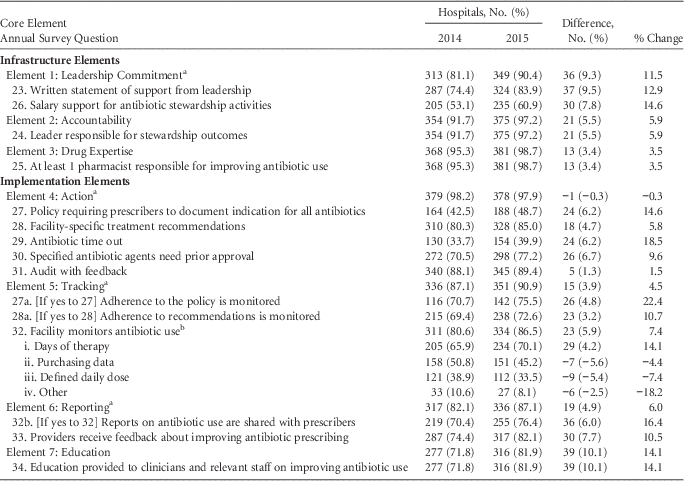
In total, 386 of 388 California hospitals (99.5%) submitted complete annual surveys in both 2014 and 2015 (Table 1). Among these were 284 community hospitals (73.6%), 36 major teaching hospitals (9.3%), 32 critical access hospitals (8.3%), 23 LTAC hospitals (6.0%), and 11 pediatric hospitals (2.9%).
Number and Percentage of California Hospitals (N=386) Reporting Implementation of Antimicrobial Stewardship Practices and Core Elements, 2014–2015

a Element achieved if hospitals answered “Yes” to at least 1 question.
b Met criteria if hospitals answered “Yes” to days of therapy, purchasing data, of defined daily dose, but not “other.”
In 2015, 343 hospitals (88.9%) implemented all infrastructure core elements, compared with 301 (78.0%) in 2014 (P<.001). Hospital ASPs with all infrastructure core elements in 2015 were more likely to have instituted all implementation core elements compared with ASPs without all infrastructure core elements in place (unadjusted risk ratio, 2.4; 95% confidence interval [CI], 1.5–3.7; P<.001).
The number of hospital ASPs with all 7 core elements increased by 38 (16.6%) from 2014 to 2015 (P<.001). In total, 267 ASPs (69.2%) had all 7 core elements in 2015, compared with 229 ASPs (59.3%) in 2014. All 386 hospitals reported implementation of 1 or more core elements in 2015.
DISCUSSION
We observed a significant increase in the number of California hospitals that reported implementation of all 7 CDC Core Elements of Hospital Antibiotic Stewardship Programs following enactment of Senate Bill 1311 in 2015. The proportion of hospitals with all 7 core elements rose from 59.3% in 2014 to 69.2% in 2015. Nationally, 48% of healthcare facilities that reported to NHSN in 2015 had stewardship programs with all 7 core elements. 8
The extent to which California’s legislative requirements have affected hospital ASPs is beyond the scope of this analysis. However, in combination with recommendations from professional and government organizations, it is likely that this legislation had a catalyzing effect on California’s ASP progress. SB 1311 requirements for California hospitals to have a physician-supervised ASP committee and a physician or pharmacist with expertise regarding antimicrobial stewardship are similar to the infrastructure core elements. The legislation might have been particularly influential among hospitals that would have been slower to develop antimicrobial stewardship programs due to barriers in leadership support or salary support.Reference Pollack, van Santen, Weiner, Dudeck, Edwards and Srinivasan 7 Most California hospitals (88.9%) reported implementation of all infrastructure core elements in 2015.
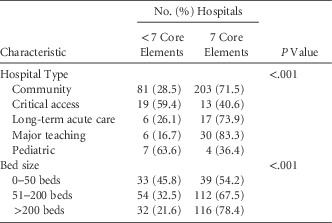
We identified hospitals to prioritize for public health outreach after completing this analysis. Hospitals with fewer than 51 beds, including all critical access hospitals, were significantly less likely to have all 7 core elements in place in 2015 (Table 2). We also prioritized community hospitals with less than 5 core elements to engage in public health initiatives that promote and support antimicrobial stewardship, including coordinated, regional efforts to prevent antimicrobial resistance.
Characteristics of California Hospitals (N=386) by Implementation of All 7 Core Elements, 2015

This analysis has limitations. We do not know the level of ASP committee participation when hospitals completed the annual surveys. NHSN annual survey data do not provide a direct measure for California hospitals’ implementation of SB 1311 because the core elements do not completely correspond with the requirements of the law. This analysis did not measure ASP effectiveness in achieving outcomes of antimicrobial stewardship (eg, reduction in inappropriate antimicrobial use). Annual survey data were self-reported by hospitals and were not externally validated; this may have biased the results by over- or underestimating ASP progress.
This analysis provides information on the progress of ASP in California hospitals following new legislative requirements. State and local health departments can perform similar analyses to inform outreach strategies that engage hospitals to sustain or improve their ASP. Public health efforts are needed to promote and advance antimicrobial stewardship practices in healthcare to address the urgent problem of antimicrobial resistance.
ACKNOWLEDGMENTS
The authors thank Jon Rosenberg, MD, for his expertise and guidance.
Financial support: Aspects of this work were supported by the Centers for Disease Control and Prevention Epidemiology and Laboratory Capacity grant funds.
Potential conflicts of interest: All authors report no conflicts of interest relevant to this article.