

Introduction
The functional difficulties, across a range of physical, cognitive, behavioural and emotional domains, experienced by individuals with an acquired brain injury (ABI) are complex and interrelated, and outcomes are difficult to predict (McMillan et al., Reference McMillan, Teasdale and Stewart2012; Ponsford, Reference Ponsford2013). The condition is complicated by the invisibility and sheer complexity of impairments in executive functioning in particular (including idea generation, decision making, concrete thinking and problem solving) and by impaired self-awareness of the impact of the injury (Gioia et al., Reference Gioia, Isquith, Kenealy, Anderson, Jacobs and Anderson2008; Prigatano, Reference Prigatano2005).
Although research into family support following ABI has been carried out for many years (Brooks, Reference Brooks1991; Lezak, Reference Lezak1986; Romano, Reference Romano1974), ‘there is a lack of knowledge and understanding of ABI among health and social care professionals in the UK, from those involved in acute care through to long-term community services’ (Norman et al., Reference Norman, Holloway, Odumuyiwa, Kennedy, Forrest, Suffield and Dicks2020: p2037). The impacts of ABI are keenly felt by family members (Anderson et al., Reference Anderson, Simpson and Morey2013; Knox et al., Reference Knox, Douglas and Bigby2016; Yeates, Reference Yeates, Wilson, Gracey, Evans and Bateman2009) and although some family approaches are developing (Karpa et al., Reference Karpa, Chernomas, Roger and Heinonen2020) and there is recognition of the need to focus on broad family contexts rather than on the injured individual in isolation (McIntyre et al., Reference McIntyre, Ehrlich and Kendall2020), service provision is still insufficient, variable and in need of development. Family members experience enduring distress and have many long-term unmet needs (Fisher et al., Reference Fisher, Bellon, Lawn and Lennon2020), some of which have been considered to be post-traumatic stress (Tsur & Haller, Reference Tsur and Haller2020). In order to support innovative service delivery, we reflected on the research carried out by the first author using a lifeworld humanising approach in order to (a) identify the dehumanising existential challenges facing family members of people living with severe ABI and (b) identify what family members most value in service delivery presented in humanising terms.
Process of reflection
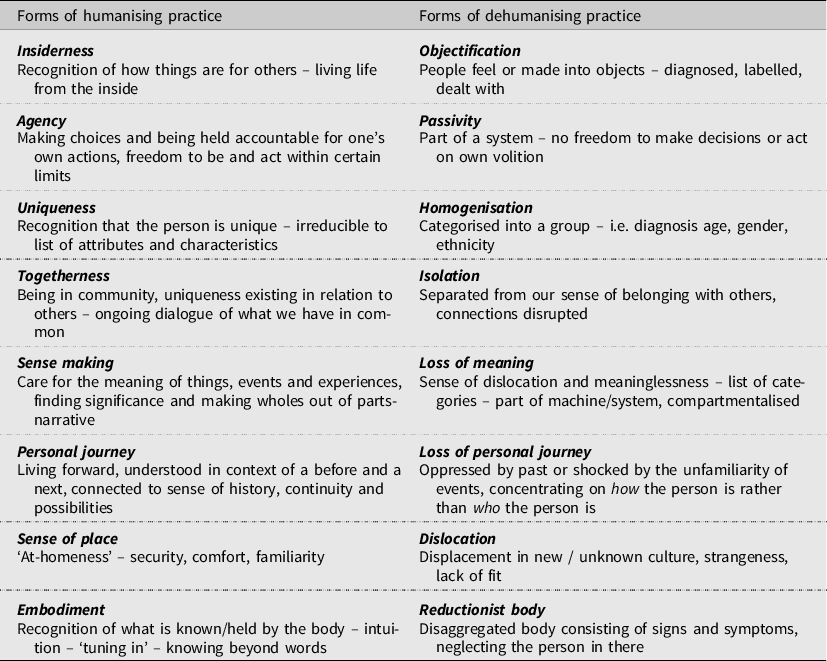
Severe ABI is a lifetime condition for which there is no cure. Much of the lead author’s years of work in the community as a brain injury case manager and social worker is an endeavour to facilitate family members’ struggles to assert a re-shaped life, enabling people to define and understand themselves anew in a world that rarely sees or comprehends the challenges of their situation (Muenchberger et al., Reference Muenchberger, Kendeall and Neal2008). A shared interest in lifeworld approaches and human responses finally brought the authors together in a reflective writing project to create new understandings to support innovative service delivery. Over several years the authors met at seminars and conferences leading to discussions of the relevance of the expert companion concept -led by MH, and a humanising lifeworld approach – led by CEH. As the discussions deepened the authors decided to write a manuscript. They worked on-line, discussing and reflecting on ideas in more detail and developing drafts of the submitted manuscript. The reflections were undertaken through sharing MH’s work which included his own practice and research leading to his doctoral thesis (Holloway, Reference Holloway2017) and his published papers (Holloway et al., Reference Holloway, Orr and Clark-Wilson2019; Holloway & Tasker, Reference Holloway and Tasker2019). The discussions were framed within a humanising lifeworld approach. This approach is based on the philosophical work of Husserl (1859–1938), the father of phenomenology, who first described the lifeworld. It is concerned with understandings at an existential level (Ellis-Hill et al., Reference Ellis-Hill, Pound and Galvin2021). A lifeworld approach privileges direct subjective experience, what life feels like from the inside out, rather than what it looks like to others (Galvin & Todres, Reference Galvin and Todres2013). Through philosophical analysis using a lifeworld approach, Todres et al. (Reference Todres, Galvin and Holloway2009) considered ways of human caring in order to find ways to act in response to human suffering at an existential level. They developed the humanisation framework which describes eight dimensions or ways in which service providers can help people feel more/less human. These humanising dimensions include: a sense of insiderness/objectivity, agency/passivity, uniqueness/homogenisation, togetherness/isolation, sense-making/loss of meaning, personal journey/loss of personal journey, sense of place/dislocation and embodiment/reductionist view of body. Details of these dimensions can be seen in Table 1.
Humanisation framework – details

Developed from Todres et al. (Reference Todres, Galvin and Holloway2009).
Humanising aspects create a sense of human connection, safety and trust, whereas these are lost when dehumanising actions occur.
In our discussion and reflections, it was suggested that the aspects of service delivery which were valued by family members were those which addressed their existential human concerns and these will be discussed later. In the research undertaken 6 years ago (Holloway, Reference Holloway2017), family members had been living in the UK with relatives with severe head injury affecting their behaviour and cognition (particularly, executive function) from 2 to over 28 years, with the participants’ experience evenly spread across this time range. All of the reflections below are based on discussions of MH’s doctoral research (Holloway, Reference Holloway2017). For ease of reading, family and friends will be referred to as family members; people who had acquired the brain injury will be referred to as relatives. Humanising and dehumanising aspects mentioned in the framework table are put in italics, linked to that experience, throughout the following section to aid understanding.
Existential dehumanising challenges faced by family members
Family members faced many dehumanising existential challenges which are interwoven and they build on each other. For ease of reading, these experiences have been described separately in this paper. Family members stepped out of the usual flow of life and entered a new world involving all encompassing, unsafe, ongoing, unfamiliar, complex work, which was not understood by others, and which dominated their own lives.
Family members entered a new world and took responsibility for their relatives’ lives
In hospital, family members entered unfamiliar territory (dislocation), they lost their sense of their place in the world, they were faced with strange cultures, with alien norms and routines. In the intensive care unit, they shared responsibility with staff who were perceived to be expert and they felt relatively safe. However, when their relative entered the general hospital ward, family members felt an overarching responsibility for their relative; as staff did not, appear to know what to do, or at times, did not seem to care (objectivity, loss of meaning). Either their relative was disruptive, affecting usual staff care, pulling out IV lines and nasal tubes, shouting or banging or their relative was ‘just different’ noticeable to family members but not considered as an issue by staff (objectivity). Some relatives sustained further injury through instances such as falling out of bed overnight when their family member was not present (passivity). The majority of family members, although spending many hours on the wards, felt isolated (isolation) and not involved (passivity), they did not know what was going on (lack of sense making) or what to expect in the future (loss of personal journey).
Building a new world
When relatives left hospital or moved to more specialist settings, most of which were unsuitable for their needs (loss of meaning, dislocation), family members felt alone with overwhelming responsibility (isolation). They still knew very little about brain injury (loss of meaning) and had to learn as they were going along, from the internet, and sometimes from Headway (UK ABI charity). They had to try and create a new life for their relative and faced many huge challenges alone (isolation).
Paradoxical living – dangerous and isolating
Family members and relatives entered a life that was paradoxical and sometimes dangerous to themselves and others. Relatives, because they often had no or few physical disabilities appeared to have recovered (objectivity). However, due to executive dysfunction they experienced, many significant functional changes and sometimes exhibited dangerous behaviours. Due to lack of initiation, some relatives could not look after themselves needing step by step support to do basic tasks such as eating or showering. Due to lack of inhibition, they had to be watched constantly due to inappropriate language or behaviour (loss of meaning). Due to their impulsive behaviour, relatives could leap out of moving cars, harm pets and even threaten to harm family members. Family members often felt out of control (passivity).
Often, because relatives were adults, it was not possible for family members to watch over them constantly. Poor or no judgement with money left relatives being very vulnerable. They would get into debt, people would steal from them, they would become homeless, they would mix with groups they would not usually connect with. They would get involved in drugs, criminal activity, gambling, fights and live with others who had their own problems but who were willing to tolerate their behaviour (dislocation, loss of personal journey, loss of meaning). Relatives felt powerless to intervene (passivity) and were left to try and pick up the pieces. They lived from one crisis to the next.
Paradoxical life – intelligence and dangerous mood
Family members also had to live with their relatives’ reaction to their injury. Their relative’s intelligence was usually not affected by their injury; some relatives knew they were changed and often became frustrated; leading to extreme anger, depression or anxiety. Relatives wanted to get back to their usual life but could not work out how to achieve this (lack of meaning, loss of personal journey). The mood of their relative impacted on family members most often when they lived in the same household, leaving them having to walk on eggshells, having constant vigilance, looking out for triggers or watching out to protect other family members.
For adult relatives, over time, lack of sleep, alcoholism, drug taking, overeating or not eating compounded the problems they were experiencing leaving some to consider suicide.
Paradoxical life – support from family and friends was not available
With the huge issues family members were facing, it may be expected that family and friends would rally round to support them. However, family members learnt over the years that this was not available to them (isolation). This was usually because they were not believed as their relatives appeared to have recovered or were considered in complete control of their behaviours (objectivity).
When family members tried to share with others, their relative’s behaviour was so bizarre it was difficult (and potentially socially embarrassing) to do so (loss of meaning; isolation). Trying to share with others was exhausting and painful; family members wanted to protect their relative, they did not want to expose their own or their relatives’ perceived vulnerabilities. When they tried, little came from it and often they were judged negatively themselves and so they just gave up (passivity, isolation).
Family members lose their own life
Family members ended up living in what could be considered a parallel universe with their relative who for the most part could give them no emotional support. This meant that their own life (loss of personal journey, isolation), and their own sense of self, disappeared (dislocation). The simple, usual day to day routines of life that they had taken for granted became distant memories. They felt they were watching in on the usual world as it went by. Over the years, their usual routines, friends and social events disappeared and even when they were given support, they found it was difficult to pick up the threads again (loss of personal journey).
Over the years family members were striving to find their relative a place in the world where they felt secure and ‘settled’ so that they could recover some comfort, familiarity, continuity, and ease themselves. They tried to work out how to return ‘home’ to their previous life, how to try and make a new home in this new world or a mixture of the two.
Relationship with services – dehumanising aspects
Over the years following their relative’s injury, family members reached out to statutory services for support to help them care for their relative. They learnt about brain injury and linked with many service providers trying to negotiate the best care and support for their relative. Although there were many, many services involved only one appeared to fully meet their needs. Services and institutions that family members had to manage included hospitals, neurologists, mental health services, counsellors, therapists, social services, local councils, housing associations, case managers, solicitors, live in carers, daily carers, commissioners, the police, courts (for compensation and offences) and prison staff.
Often, although reaching out for support, the specific needs of their relative could not be accommodated or taken into consideration as they did not fit the ‘system’ (homogenisation). Family members had to constantly chase things up and find things out for themselves as they were not included or involved (passivity). As relatives appeared so able, service providers would take them at face value when they said they could manage; or not allow family members to become involved in meetings due to confidentiality issues; meaning that services were either not provided or were withdrawn (objectivity, passivity). Service providers would expect relatives to make decisions for themselves or expect them to proactively contact services if they needed help, both of which were impossible (objectivity, reductionist view). This often led to breakdown and catastrophic results leaving family members lurching from one crisis to another.
Having highlighted the problems and lack of support experienced by family members, we now move on to what helped.
What was helpful
Within the services provided there were individuals who could reach across into the parallel universe inhabited by family members. Aspects that were helpful were interlinked and are separated out for ease of reading.
Relationship with services – Expertise entering the family member and relative’s lifeworld
Expertise was very important; however, it had to be related to the lifeworld of the family member to be useful (insiderness). Just being a specialist and having the knowledge, although contributing to support, was not enough. Family members valued service providers who could help them make sense of the information in their own terms (sense making). This was to help themselves and also for them to be able to explain things to others; including their relative.
They also valued experts who could influence the lifeworld of their relative. They valued experts who could recognise the problems their relative in particular, was experiencing, knew how to overcome them; and who were able to support them to regain a part of their life which was particularly important for them (uniqueness).
Family members also valued service providers who rather than expecting their relative to conform, would think ‘outside the box’ and adapt the environment to respond to their needs (uniqueness). One specialist service that family members reported had ‘got it right’ was a residential setting where rather than limiting activity, they built the environment to suit the relatives’ needs. An example was incorporating furniture which could not be smashed when a rage occurred. Family members also spoke of the service guiding rather than demanding things from relatives or making them feel like victims. They described how service providers mentored their relatives, putting things in place to allow a sense of freedom (insiderness, uniqueness, togetherness, agency, sense of place).
Relationship with services – enter lifeworld as a companion
With or without expertise a companion-like relationship with a service provider meant a great deal to family members (insiderness, togetherness). Family members really valued people who could enter and appreciate their lifeworld and accompany them as they travelled through life. This built a sense of safety and trust (sense of place).
Appreciating family members lifeworld even when service providers could do little about it was really important and validated family members experiences. Family members spoke of service providers such as GPs who did not have specialist knowledge of brain injury but who appreciated how difficult it was for them either by letting them know or by trying to make their own health care (appointments, etc.) as easy as possible for them. Being open to all aspects of the family member’s lifeworld; their needs as well as those of their relative made a great difference to them (insiderness, uniqueness, togetherness).
Being proactive meant a great deal to family members. It provided a sense that a service provider was thinking of them and recognised the difficulties they were facing (insiderness, uniqueness). Keeping abreast and checking things with family members through two-way communication was also important (uniqueness, togetherness). Building good working relationships and trust was important for family members as then they found that service providers would believe them when they called for support and recognise that they were not ‘just over-reacting’. A quick intervention from service providers in response not only prevented crisis situations and allowed family members to feel some sense of control over the situation (agency); it increased their sense of connection (togtherness).
Humour and a positive outlook were appreciated by many family members as a way of making deep connections and reducing tension. This in turn allowed a sense of playfulness, enabling family members to feel more positive and creative about their situation (togetherness, agency). Working with service providers who were relaxed, ‘clued in’ to their situation and happy to meet at a human level was really valued.
‘Natural’ peer support
Family members not only gained support from formal services but also from other family members living with severe ABI. It is interesting to note that considering meeting others was very scary. Family members felt so out of touch with mainstream life and vulnerable to painful experiences; and they had already been disbelieved by close family members. Family members had to develop the right sort of peer relationship; one that was ‘natural’ (unique, togetherness), and not formalised (homogenisation) or forced. There was a sense that peer relationships needed to develop ‘naturally’ through informal optional situations where a sense of companionship could develop at their own pace (togetherness, agency).
Speaking freely with others who completely understood and appreciated their lifeworld provided a few moments of normality in life, bringing the two parallel worlds together (togetherness, sense of place). Support groups often offered a lifeline and allowed family members to ‘come home’ if only for a short while.
Discussion
By exploring family members experiences of living with severe ABI at an existential level the usually ‘hidden’ aspects of life come into sharp focus. Family members enter a new world and they are alone. They have to liaise with many services; in the UK, the All Party Parliamentary Group on ABI (Barnes et al., Reference Barnes, Bennet and Etherington2018) has highlighted that because people are more likely to survive, ABI is a hidden epidemic affecting many different aspects of society due to secondary issues. Prevention is key and family members need support to care for their relatives.
The aspects which family members most valued in service providers was the ability to enter their world and appreciate what they were facing, reducing their sense of isolation. Service provision is usually considered in terms of activity and what can be ‘done’ to support family members. When seen in this light, it can be seen that either there does not appear to be much visibly ‘wrong’ or the situation is seen to be so complex that nothing can be ‘done’. Rather, relationships that enable service providers to enter the world of the client and family, creates new ways of understanding, revealing new opportunities. We would agree with Bowen et al. (Reference Bowen, Yeates and Palmer2018) that in developing services we should focus on the type of relationship and approach used by any service provider who is working with family members. This will form the basis for effective intervention and service provision as well as supporting the well-being of family members themselves.
Calhoun and Tedeschi (Reference Calhoun, Tedeschi, Calhoun and Tedeschi2006, Reference Calhoun and Tedeschi2012) described the concept of the Expert Companion, a practitioner working with humility in intractable situations where they may be no right answer and the journey is one of mutual learning. There will be few service providers who could embody all of the valued humanising aspects presented above, but all service providers could consider them and see which aspects they could address. In the first author’s research, the service most highly valued by family was independent Brain Injury Case Management (Holloway et al., Reference Holloway, Orr and Clark-Wilson2019).
This reflection addresses the experiences of family members who are living with or supporting a relative with a severe brain injury; we would not expect all family members living with brain injury to have experienced all of these aspects, but they may recognise them and we feel the general principles may be also relevant for them. We feel that the role of companionship is undervalued in current service provision; where the focus is on visible action. Services providers may not appreciate the powerful effect of how either humanising or dehumanising the type of relationships they form with family members may be, and we hope this paper will start to redress this imbalance.
Opportunities and barriers
Currently, the barriers to working in this way appear to be formed from three key aspects. First, splintering of services into separate organisations which categorises people into service users. Second, a short-term focus on immediate needs. Third, work practices and boundaries to services which are not co-terminous with the needs of the family, as they and their relative are expected to fit into what is provided within that service alone; if they don’t fit, then they do not receive any service.
Although there are structural issues as highlighted above, they are being addressed in current service provision in the UK. An example of the expert companion approach can be demonstrated by the work of Brain Injury Case Managers who work across settings and time, who see the family in its entirety as the client, and who work at the family’s pace. They are involved across the rehabilitation spectrum from inpatient to community and vocational practice. Practical examples are being a liaison between family member and services if needed, developing personalised bespoke training within services and proactive, ongoing practical involvement in the lives of families and their relatives. This was the service that family felt was most helpful and appropriate for their needs (Holloway & Tasker, Reference Holloway and Tasker2019). It is recognised that not all health and social care professionals can work in this overarching focused way. We feel we are at the forefront of developing an awareness of a humanising approach, which can impact every health and social care encounter with families. We invite interested readers to contact us to explore possible service development support based on a lived awareness of family members experiences.
Over time family members aim to get their relative ‘settled’ in some way. It is not until relatives are ‘settled’ that family members can relinquish the overwhelming responsibility they embraced on the day their relative was injured and start to step back into the usual flow of life again. These reflections support the work of Stenberg et al. (Reference Stenberg, Stålnacke and Saveman2020) who also report family members entering the ‘unknown’ with their relative and working through everyday life to create a future together. Companion-like relationships will not provide all the answers but provides the family member with recognition, acceptance, and most importantly, human connection and support in connecting between the parallel world and others in the usual world. This will enable family members to journey through the unknown, into more positive times when they can feel ‘at home’ and to experience moments of well-being.
Acknowledgements
The first author would like to thank the original research participants who provided the data for his doctoral research for their time and for generously providing their knowledge, experience and personal stories, and also his employer Head First for allowing him time to undertake the project.
Financial support
This research received no specific grant from any funding agency, commercial or not-for-profit sectors.
Conflicts of interest
None.
Ethical standards
The authors assert that all procedures contributing to this work comply with the ethical standards of the relevant national and institutional committees on human experimentation and with the Helsinki Declaration of 1975, as revised in 2008. Ethical approval was sought and granted by the University of Sussex for the original research.