Introduction
Socioeconomic status (SES) has significance for the health and mortality of individuals and groups. Morbidity and mortality, in general, increase with lower SES, whereas life expectancy and better health status are positively associated with higher SES (Adler et al., Reference Adler, Boyce, Chesney, Cohen, Folkman, Kahn and Syme1994; Rognerud & Zahl, Reference Rognerud and Zahl2006; Kołodziej et al., Reference Kołodziej, Lopuszańska, Bielicki and Jankowska2007). Explanations for the social inequalities in health, morbidity and mortality often focus on access to, and quality of, health care, environmental exposure (e.g. poor diet, poor hygiene, environmental pollution, among others) and differences in lifestyle, especially risk behaviours such as smoking, alcohol consumption, and low levels of habitual physical activity (Adler & Newman, Reference Adler and Newman2002; Stringhini et al., Reference Stringhini, Dugravot, Shipley, Goldberg, Zins and Kivimäki2011). Nevertheless, specific mechanisms underlying the association are not well understood.
A common theme is the influence of stressful life experiences beginning in childhood and/or chronic stress, which may lead to physiological dysregulation in the individual. The concept of allostasis, or the body's ability to adapt its internal physiologic milieu to match external demands, has been proposed to explain relationships between prolonged stress and health status (Sterling & Eyer, Reference Sterling, Eyer, Fisher and Reason1988). Accordingly, stress can influence the hypothalamic–pituitary–adrenal (HPA) axis and in turn glucocorticoid secretion, and also the sympathetic adrenomedullary (SAM) system and in turn secretion of two catecholamines (adrenaline and noradrenaline). Physiological mediators act on receptors in specific tissues and organs to produce effects that are adaptive over the short-term, but which can be damaging over the long-term. Chronically elevated stress hormones can impede insulin and promote obesity, immune dysfunction, hypertension, lipid imbalance, diabetes mellitus type 2, reduced bone mineral density and atherosclerosis (Brindley & Rolland, Reference Brindley and Rolland1989; McEwen & Stellar, Reference McEwen and Stellar1993; Lundberg, Reference Lundberg2005; Eskandari et al., Reference Eskandari, Martinez, Torvik, Phillips, Sternberg and Mistry2007). Based on the association between chronic stress and indicators of health status, the concept ‘allostatic load’ (AL) was introduced as a measure of cumulative biological wear and tear exacted on the body in the process of adapting to daily demands (McEwen & Stellar, Reference McEwen and Stellar1993; McEwen, Reference McEwen1998). Allostatic load is a means of quantifying prolonged or repeated stress. Variation in AL among individuals may reflect differential exposure to stressors and/or individual differences in the ability to adapt to environments and challenges.
Evidence indicates that AL is positively associated with cognitive and functional decline, psychological distress, hostility, low SES and negative social relationships (Kubzansky et al., Reference Kubzansky, Kawachi and Sparrow1999; Karlamangla et al., Reference Karlamangla, Singer, McEwen, Rowe and Seeman2002; Seeman et al., Reference Seeman, Singer, Ryff, Dienberg Love and Levy-Storms2002). A summary measure of physiological dysregulation has been found to be a better predictor of future health than individual physiological markers or risk factors, especially when dysregulation in individual systems is relatively small (Karlamangla et al., Reference Karlamangla, Singer, McEwen, Rowe and Seeman2002). In the MacArthur Studies of Successful Aging, AL accounted for 35% of socioeconomic variation in mortality, and the effect was independent of baseline morbidity (Seeman et al., Reference Seeman, Crimmins, Huang, Singer, Bucur and Gruenewald2004a).
The problem of physiological dysregulation has not been examined, to the authors' knowledge, in the Polish population. Polish society experienced deep political, economic and social changes in the late 1980s and early 1990s. Stress was seen as a major threat to health during this period (Watson, Reference Watson2006). Changing social relations while social inequalities were increasing provided an opportunity to investigate potential mechanisms playing a role in health inequalities. In this context, the aim of the present study was to examine the relationship between physiological dysregulation and several dimensions of SES and lifestyle in occupationally active adult Polish males. The extent to which lifestyle variables explained SES variation in the cumulative index of biological dysregulation (AL) was also evaluated.
Methods
The data are from the archives of the Lower Silesian Centre for Preventive Medicine (DOLMED) in Wrocław (south-western Poland). The data were collected during required health screening surveys of workers since the early 1980s. All workers were screened medically as required for continued work. Data for 3887 males, 25–60 years of age, examined between 1983 and 1993 were analysed. All men were free from overt disease (e.g. cancers, mental disorders, physical disabilities) at the time of examination and were occupationally active inhabitants of cities and villages in the region.
Each participant completed a questionnaire requesting information on SES and lifestyle. Indicators of SES included educational level (university, more than 12 years of education; secondary, 12 years of schooling; basic vocational, 9–11 years of schooling; and elementary, 8 years of schooling or less); marital status (currently married or unmarried [never, separated, divorced, or widowed]); and residence (cities with a population of more than 100,000, or villages [population <2000 and more than one-third of inhabitants employed in agriculture]). Health-related lifestyle behaviours included smoking, alcohol consumption and level of habitual physical activity. Each indicator was classified in one of three categories: smoking status (never smoker; ex-smoker; current smoker), alcohol consumption (none including former drinkers; rarely, 1 to 3 times a month; often, 1 to 3 times per week) and physical activity (regularly active, ≥4 h per week; not regularly active, 1 to 3 h per week; inactive). The subjects were divided into four age groups: 25–30, 31–40, 41–50 and 51–60 years.
The DOLMED screening protocol included anthropometry (height, weight, subscapular skinfold), systolic and diastolic blood pressures, lung function (forced vital capacity [FVC], forced expiratory volume after 1 second [FEV1]) and blood samples (taken in the morning with men in a fasting state). Samples were assayed for erythrocyte sedimentation rate (ESR), glucose, total cholesterol (TCH), total plasma protein, bilirubin, serum creatinine and alkaline phosphatase activity (ALP).
Height, weight and subscapular skinfold were used to estimate percentage body fat (Crook et al., Reference Crook, Bennett, Norwood and Mahaffey1966). Systolic (SBP) and diastolic (DBP) blood pressures were measured twice on the left arm with subjects in a sitting position and after at least 5 min rest period. Measurements were done by registered nurses using an ‘Avionics 1900’ apparatus. Two readings were taken in accordance with specified procedures of DOLMED and averaged. FVC and FEV1 were measured with a Collins apparatus. Blood samples were processed with standard laboratory procedures. The formula of Cockcroft & Gault (Reference Cockcroft and Gault1976), which includes serum creatinine, weight and age, was used to calculate the creatinine clearance rate.
No single set of biomarkers has been used to derive an index of AL (Dowd et al., Reference Dowd, Simanek and Aiello2009). Rather, AL has been derived differently in different studies. The original operationalization of AL used ten markers; the number of markers for which an individual fell into the highest-risk quartile was the AL score (Seeman et al., Reference Seeman, Singer, Rowe, Horwitz and McEwen1997). The original biomarkers of physiological dysregulation included 12-h urinary cortisol, adrenaline and noradrenaline; serum dehydroepiandrosterone sulphate; systolic and diastolic blood pressures; waist-to-hip ratio; high density lipoprotein cholesterol (HDL-C) and ratio of total to HDL-C; and plasma level of glycosylated haemoglobin. The first four markers were labelled primary mediators and the latter six as secondary outcomes. Subsequent studies, depending on data available, added to, or subtracted from, this set of markers under allostatic control (Crimmins et al., Reference Crimmins, Johnston, Hayward and Seeman2003; Schnorpfeil et al., Reference Schnorpfeil, Noll, Schulze, Ehlert, Frey and Fischer2003; Allsworth et al., Reference Allsworth, Weitzen and Boardman2005; Kinnunen et al., Reference Kinnunen, Kaprio and Pulkkinen2005).
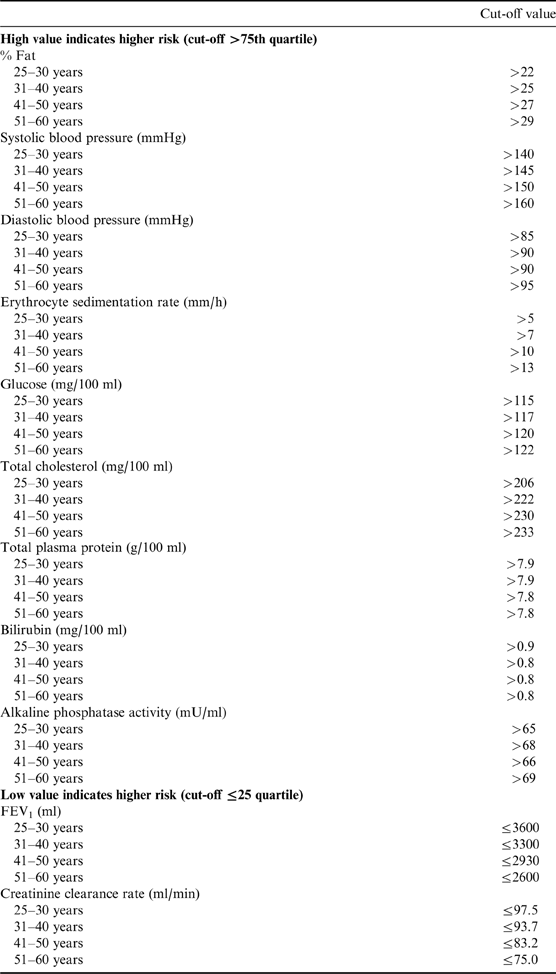
The indicator of AL in the present study included eleven markers: % fat (adverse nutritional intake), systolic and diastolic blood pressures (cardiovascular activity), FEV1 (lung function), erythrocyte sedimentation rate (inflammatory processes), glucose and total cholesterol (cardiovascular disease risk), total plasma protein (stress-haemoconcentration), bilirubin, creatinine clearance and alkaline phosphatase activity (hepatic and renal functions). The AL score was computed as the number of biomarkers for which the individuals was in the highest risk quartile (highest quartile for each parameter, except FEV1 and creatinine clearance, for which the lowest quartile indicates highest risk). Because the indicators change with age, cut-off scores for the 75th and 25th centiles were defined for each of four age groups (25–30, 31–40, 41–50, and 51–60 years), separately. Cut-off values for the eleven AL biomarkers by age group are summarized in Table 1.
Cut-off values for markers of allostasis by age group in Polish men aged 25–60 years

In scoring AL, individuals who were taking medications that might influence levels of one or more biomarkers (e.g. statins, anti-hypertensive or anti-diabetes drugs) were coded in terms of their actual, measured physiological values. Such a procedure is apparently built into the AL concept, i.e. a potential negative impact of a biomarker such as elevated cholesterol or blood pressure on physiological dysregulation that is favourably modified through medication translates into a lower degree of wear and tear on the organism (Seeman et al., Reference Seeman, Singer, Ryff, Dienberg Love and Levy-Storms2002, Reference Seeman, Glei, Goldman, Weinstein, Singer and Lin2004b).
Based on median values, AL scores were divided into two categories: low, AL scores 0 to 2; and high, AL scores ≥3. Differences in frequencies of low and high AL categories by age group, education level, marital status and place of residence were tested with chi-squared tests. Generalized linear models with a binomially distributed dependent variable were used to examine the relationship between AL and indicators of SES and lifestyle, adjusting for age. The dependent variable was AL, with low AL as the reference category. Model 1 was limited to age groups and variables describing SES or social position (education, marital status and place of residence). Reference categories were age group 25–30, completed university studies, married and urban residence. Model 2 included age groups, SES and lifestyle variables with the following reference categories: never smoked, non-drinker of alcohol and regularly active. Regression coefficients and standard errors for age groups, the SES and lifestyle variables were used to calculate odds ratios (ORs) and 95% confidence intervals (CI). Significance was assessed with the Wald chi-squared statistic. Fitting of the models were assessed by goodness-of-fit chi-squared test. STATISTICA 7.0 was used for all analyses.
Results
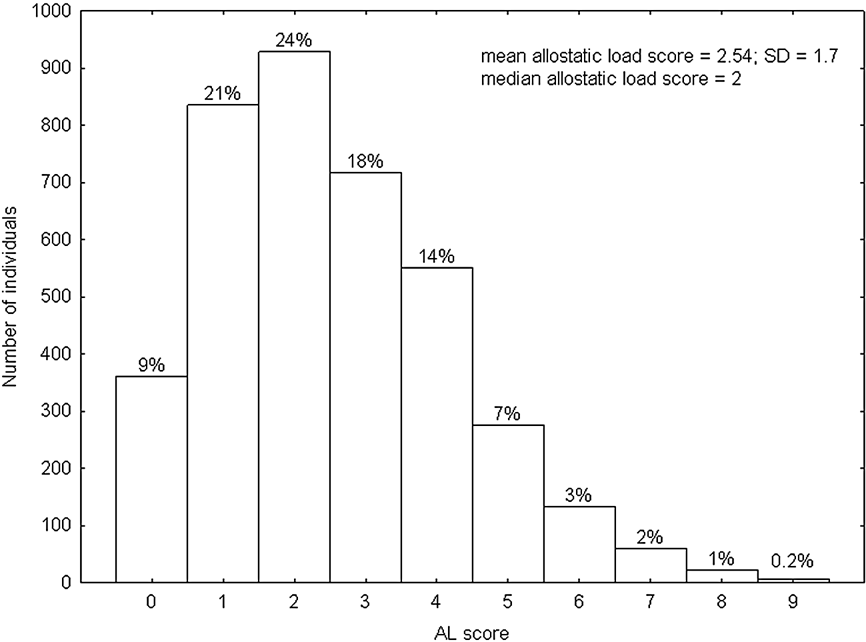
Figure 1 shows the distribution of AL scores as a sum of parameters for which the participant fell into the high-risk quartile. The mean AL score was 2.54 (SD=1.7); the most frequent AL score was 2. Only 9% of men did not exhibit physiological dysregulation.
Absolute and relative frequencies of AL scores in Polish men aged 25–60 years.
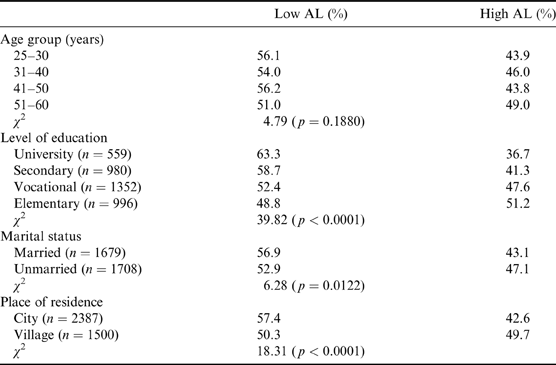
Prevalence of high and low AL by age group, level of education, marital status and place of residence is presented in Table 2. Because cut-off scores for the 75th and 25th centiles for biomarkers were defined for each of four age groups separately, the frequencies of men with high or low AL did not significantly differentiate. The percentage of men with high AL scores was lowest among those who had completed university education and increased significantly and monotonically from secondary to basic vocational to elementary education (χ 2=39.82, p<0.001). Conversely, the percentage of men with low AL scores decreased from highest to lowest educational categories. Among men with an elementary education, percentages with high and low AL scores were approximately equal. A greater percentage of non-married men had high AL scores compared with married men (χ 2=6.28, p=0.01), while a greater percentage of men residing in villages had high AL scores compared with those living in cities (χ 2=18.31, p=0.001).
Prevalence of high and low AL by age group, level of education, marital status and place of residence in Polish men aged 25–60 years
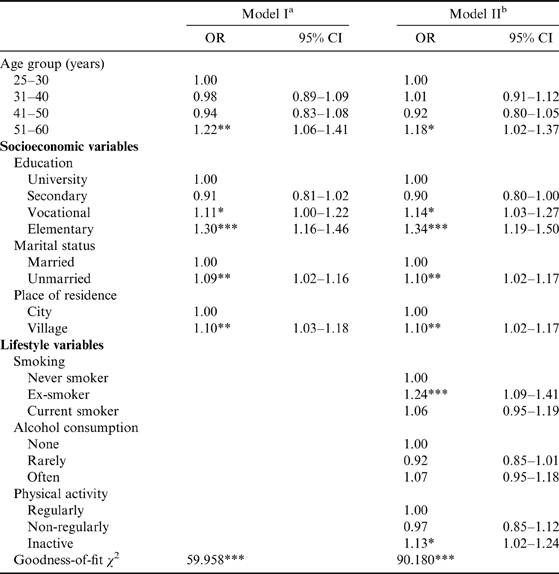
Results of the logistic regression analyses are summarized in Table 3 in the form of odds ratios (OR) and 95% CI for the risk of high AL. Both models showed significant effects of SES and lifestyle variables on the risk of high AL. With Model 1 limited to SES-related variables and age groups as a covariate, level of completed education significantly affected the risk of high AL by 11% in men with basic vocational education (OR=1.11, p<0.05) and by 30% in men with only elementary education (OR=1.30, p<0.001) compared with men who had completed university studies. Unmarried men had a significantly higher risk of AL compared with married men (OR=1.09, p<0.01), while residence in villages was associated with a significantly elevated risk of high AL compared with residence in cities (OR=1.10, p<0.01). Only the oldest age group had significantly higher risk of high AL as compared with men aged 25–30 years (OR=1.22, p<0.01). After adjustment for SES, lifestyle variables and age groups (Model 2), associations noted in Model 1 persisted, while being an ex-smoker (OR=1.24, p<0.001) and physically inactive (OR=1.13, p<0.05) increased the risk of a high AL.
Odds ratios (OR) and 95% confidence intervals (95% CI) of the risk of high AL among Polish males aged 25–60 years
a SES variables+age.
b SES variables+lifestyle variables.
*p<0.05; **p<0.01; ***p<0.001.
Discussion
This study of Polish men indicates a significant relationship between indicators of SES and physiological dysregulation. A higher level of completed education, the married state and residence in a city (presumably a more privileged environment compared with villages) were associated with lower AL (lower physiological stress). The results were generally consistent with those of previous studies from the United States and northern Europe (Gustafsson et al., Reference Gustafsson, Janlert, Theorell, Westerlund and Hammarström2010; Seeman et al., Reference Seeman, Crimmins, Huang, Singer, Bucur and Gruenewald2004a, Reference Seeman, Merkin, Crimmins, Koretz, Charette and Karlamangla2008).
Low social status is associated with a more stressful situation, negative emotions, social isolation, depression and low self-esteem among individuals (Turner & Marino, Reference Turner and Marino1994; Gallo & Matthews, Reference Gallo and Matthews1999). Adverse work environments such as low job control, shift work and job overload are also more prevalent among individuals in low-status jobs (Warren et al., Reference Warren, Hoonakker, Carayon and Brand2004). Negative emotions associated with low social position may influence health through alterations in neuroendocrine responses and immune functions, and in the cardiovascular system; high-risk behaviours may play a mediating role (Gallo & Matthews, Reference Gallo and Matthews1999).
The relationship between social position and health status has been confirmed in animal models. Competitive interactions between animals of the same species often lead to cognitive impairments in animals of lower social rank (McEwen & Seeman, Reference McEwen and Seeman1999). Elevated glucocorticoid steroid hormone levels have been linked to cardiovascular problems in subordinate baboons (Sapolsky & Share, Reference Sapolsky and Share1994). Similar patterns have been observed in other primate and some rodent species (Steptoe & Marmot, Reference Steptoe and Marmot2002; Romero, Reference Romero2004).
The results for Polish men linking the married state to lower AL are consistent with the role of social integration and positive social relationships in lower AL (Seeman et al., Reference Seeman, Singer, Ryff, Dienberg Love and Levy-Storms2002, Reference Seeman, Glei, Goldman, Weinstein, Singer and Lin2004b). Being married is generally associated with reduced levels of stress. Married individuals are also more likely to be happier compared with never-married men and women. Among 25- to 39-year-olds, 47% of married American men reported being very happy compared with only 21.0% among never-married men (Lee et al., Reference Lee, Seccombe and Shehan1991). The relationship between marital status and level of stress, however, is mediated by marital quality. Longitudinal observations have indicated more health problems among those in marriages of poor quality compared with satisfied couples (Baker et al., Reference Baker, Paquette, Szalai, Driver, Perger and Helmers2000; Robles & Kiecolt-Glaser, Reference Robles and Kiecolt-Glaser2003). Cortisol excretion was not found to differ, on average, between married and unmarried post-menopausal women, but overnight urinary cortisol level was significantly more variable among the unmarried (Englert et al., Reference Englert, Dauser, Gilchrist, Samociuk, Singh and Kesner2008). These authors suggested that the increased variability in urinary cortisol among unmarried women was due to elevated levels of acute and chronic stress, while greater access to different types of social support may serve as a buffer to the negative effects of stressful life events among the married (Englert et al., Reference Englert, Dauser, Gilchrist, Samociuk, Singh and Kesner2008).
Polish men living in villages had higher AL compared with inhabitants of cities, indicating place of residence as an important factor in physiological dysregulation. The influence of urban residence was independent of differences in educational level between urban and rural dwellers. Only 6% of males living in rural areas compared with 22% of males from cities had completed university studies (Statistical Yearbook of Poland, 2011). Rural environments in Poland are characterized by decidedly relatively poor living conditions and poor access to amenities compared with cities. More than one-half of Polish villages have a low level of infrastructure (power grid, heating, water system, sewage treatment, etc.), while underdeveloped public transport limits access to health and other services (Gorlach, Reference Gorlach2000). Differences between the two environments are perceived by Polish rural residents as unfair and are a source of dissatisfaction and of feelings of being worse-off compared with their urban peers. By inference, residents of villages are clearly disadvantaged, not only economically, but also socially compared with residents of cities. The deprivation experienced and/or perceived by rural dwellers, associated negative psychosocial factors, low self-esteem, and a sense of the poor coherence and helplessness apparently function to negatively impact the health status of residents of the rural environment (Jarco, Reference Jarco2004). Of relevance, higher AL is associated with the perception of neighbourhood conditions as being poor (Mair et al., Reference Mair, Cutchin and Peek2011).
The role of lifestyle variables in physiological dysregulation is somewhat ambiguous. Caloric intake, physical activity, alcohol use and smoking were not found to influence the association between SES and AL in American adults, whereas only hostility and sleep quality were found to exert a mediating role between SES and AL (Hawkley et al., Reference Hawkley, Lavelle, Berntson and Cacioppo2011). Lifestyle factors were found to contribute relatively little to the association between chronic stress and AL in middle-aged Mexican-American women, but higher alcohol consumption was found to be related to lower AL scores (Gallo et al., Reference Gallo, Jiménez, Shivpuri, Espinosa de los Monteros and Mills2011). Among middle-aged residents of Hawaii, less alcohol intake, more smoking and less physical activity significantly predicted physiological dysregulation in men but not women (Hampson et al., Reference Hampson, Goldberg, Vogt, Hillier and Dubanoski2009), while smoking and being physically inactive significantly elevated AL in Swedish men but not in women (Gustafsson et al., Reference Gustafsson, Janlert, Theorell, Westerlund and Hammarström2010). Among Polish men, only physical inactivity and cessation of smoking were found to be associated with higher AL.
Regular moderate physical activity is generally accepted as having a beneficial influence on health status in adults (Gill & Cooper, Reference Gill and Cooper2008; Kaczmarek & Skrzypczak, Reference Kaczmarek and Skrzypczak2008). Leisure physical activities are significantly associated with reduced risk of coronary heart disease, hypertension and obesity and with improvements in cognitive function (especially in the elderly), quality of life and mental health. The literature suggests that physical activity reduces depression and anxiety symptoms and improves ability to cope with stress. Potential physiological mechanisms for the latter include the effects of physical activity on dopamine, noradrenaline and serotonin (Chaouloff, Reference Chaouloff1989).
Cigarette smoking is associated with reduced physical and mental health. Symptoms of depression, worry, anxiety, fatigue, panic and irritability are elevated with increased dependence on smoking, and the effects generally do not differ in those who have never smoked and ex-smokers (Heatherton et al., Reference Heatherton, Kozlowski, Frecker, Rickert and Robinson1989). Among Polish men, ex-smokers had an elevated risk for high AL compared with men who never smoked and current smokers. A related factor contributing to this incongruous result may be stress related to giving up smoking by men who had higher cumulative physiological dysregulation and who felt unhealthy.
Potential limitations of the present study should be noted. The data used to compute AL were not originally collected with the goal of assessing cumulative physiological dysregulation. This is why the measure of AL did not include assessment of hormone levels or more extensive lipid profiles. Several other markers presumably under allostatic control were used to derive the index of AL. Nevertheless, the literature shows considerable variation in the number of markers used to quantify AL (Dowd et al., Reference Dowd, Simanek and Aiello2009). Studies have added or subtracted indicators of AL according to the data available or the question addressed. Men and women have also demonstrated somewhat different patterns of physiological dysregulation. Women are more likely to achieve dysregulation by high levels of neuroendocrine parameters, whereas men tend to exhibit dysregulation in cardiovascular parameters (Seeman et al., Reference Seeman, Singer, Ryff, Dienberg Love and Levy-Storms2002). It may reasonably be assumed that the lack of primary mediators does not reduce the potential value of the observations in Polish men, although comparisons with other studies should be made with caution.
In summary, the data indicate a significant association between lower social status and physiological dysregulation in Polish men. A higher level of completed education, being married and residing in an urban area in Poland were found to be associated with lower physiological dysregulation, as noted in several indicators for multiple body systems. The association between indicators of SES and AL was not eliminated or attenuated when unhealthy lifestyle variables were included in the model. Two of the lifestyle factors considered (smoking status and alcohol consumption) apparently played a minimal role in explaining the association between SES and AL; physical activity was the exception, which was consistent with a generally protective effect on AL noted in other studies (Hampson et al., Reference Hampson, Goldberg, Vogt, Hillier and Dubanoski2009, Gustafsson et al., Reference Gustafsson, Janlert, Theorell, Westerlund and Hammarström2010).
Allostasis and AL have been proposed as useful research tools for understanding how social inequalities can lead to pathophysiology, disease and death. Inclusion of other biomarkers in this cumulative measure of biological wear and tear might improve the ability to assess a state of ‘pre-disease’, which can be potentially useful in developing educational programmes to reduce social differences in health status.