Introduction
Hazardous materials (HazMat) events involve the release of substances that could affect public safety adversely. Little is known about the overall frequency of such events in the US and the nature of prehospital care for those exposed. The majority of studies on this topic involved small geographic convenience samples.Reference Martin, Lohse and Sztajnkrycer 1 - Reference Kales, Polyhronopoulos and Castro 3
Although the expanded National Toxic Substance Incidents Program (NTSIP; Agency for Toxic Substances and Disease Registry; Atlanta, Georgia USA) and its predecessor, the Hazardous Substances Emergency Events Surveillance (HSEES; Agency for Toxic Substances and Disease Registry; Atlanta, Georgia USA) program, collected data from seven state health departments, the data collected do not address prehospital emergency care and assessment specifically.Reference Burgess, Kovalchick and Harter 4 This lack of information results in a knowledge gap when planning appropriate prehospital responses to HazMat events. An analysis of the Emergency Medical Services (EMS) workforce found significant deficiencies in the ability of local EMS agencies to perform mass-patient decontamination.Reference Duncan and Orr 5
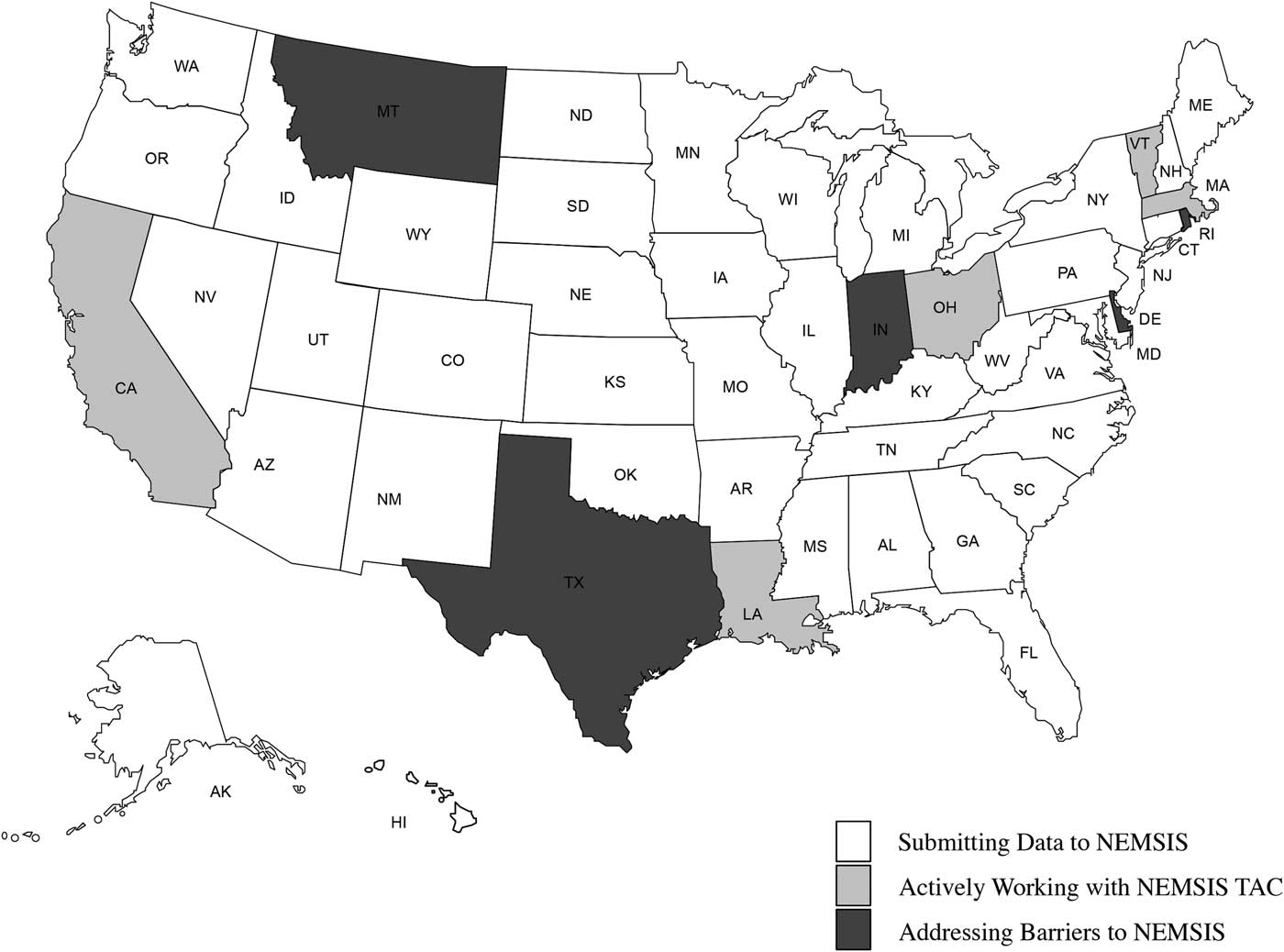
Recent efforts by EMS agencies have focused upon computerized data collection and standardization of data elements within these reports. In 1996, the National Highway Transportation Safety Administration (NHTSA; Washington, DC USA) identified five recommendations for EMS data information systems, including the adoption of uniform data elements and mechanisms to transmit data reliably and accurately. 6 By 2001, a collaborative effort by NHTSA and the Health Resource and Services Administration (HRSA; US Department of Health and Human Services; Washington, DC USA) developed the National EMS Information System (NEMSIS). State EMS agencies began signing a memorandum of understanding (MOU) recognizing the need for standardized data collection in 2003; by 2008, all states had signed this MOU. The first fully vetted dataset, based upon a consensus data dictionary, was released in 2005. The number of states contributing to the dataset continues to grow, with 41 states actively submitting data to NEMSIS; the remaining states are working with NEMSIS to address barriers to implementation.
The purpose of the current study was to provide a descriptive analysis of US EMS activations coded through NEMSIS as HazMat events, and to describe the prehospital care afforded victims of HazMat events.
Methods
Study Design
A descriptive analysis of the 2012 NEMSIS Public Release Research Data Set v.2.2.1, the most recent complete dataset as provided by the NEMSIS Project (NEMSIS Technical Assistance Center, University of Utah School of Medicine; Salt Lake City, Utah USA) and containing EMS emergency response data submitted by 41 states (Figure 1), was performed. The study was reviewed by the Mayo Foundation Institutional Review Board (Rochester, Minnesota USA) and deemed exempt.
States Submitting EMS Emergency Response Data to NEMSIS. Abbreviations: EMS, Emergency Medical Services; NEMSIS, National EMS Information System; TAC, Technical Assistance Center.

Study Setting
As part of the NEMSIS project, individual EMS agencies collect patient-care-specific data using a standardized data dictionary to guide data entry into computer software programs conforming to NEMSIS data element standards. All participating agencies must use NEMSIS-specific data element definitions contained in the data dictionary. These data are aggregated at the state level by the respective lead EMS regulatory body; statewide aggregate data subsequently are exported to the NEMSIS national data repository. Each state varies in regards to its inclusion criteria, data collection systems, and reporting requirements.Reference Bailey, Conn and Delbridge 7 , Reference Dawson 8 Although states may collect additional data, only 83 unique data elements are exported into the NEMSIS database, with some being mandatory and others optional. These data subsequently are de-identified to remove patient and agency-specific information prior to release as a public research database.
Data Set Validation
The NEMSIS Public Release Research Data Set v.2.2.1 receives information directly from participating states. As a consequence, the NEMSIS data set inherits deficiencies originating from contributing agencies. However, data files received from contributing agencies are checked by NEMSIS Technical Assistance Center (TAC) for completeness, logical consistency, and formatting. A data profile report is generated for each submitted file. Files not passing review either may be rejected or referred back to the contributing agency for review and revision. More than 300 data set edit checks are performed by NEMSIS TAC in order to ensure data set validation.Reference Dawson 8
Selection of Study Participants and Primary Data Extraction
Mandatory data elements E0207 (Type of Response Delay), E0208 (Type of Scene Delay), and E0209 (Type of Transport Delay) contained specific codes for HazMat events (145, 215, and 285, respectively), and they were used to identify specific EMS HazMat run records for subsequent analysis. Data set query, primary data extraction, and evaluation of overlapping data elements and invalid data codes were performed by a single biostatistician (CML). Additional NEMSIS data definitions can be accessed from the NEMSIS Research Data Set v.2.2.1 User Manual.Reference Dawson 8
Overlapping Data Elements
Overlapping data elements were identified and combined in order to prevent duplicate entries. The data element “EventID” is the unique key to match elements for each record contained in the Event Table and all other tables. This “Primary Key” (ie, EventID) is the unique ID for each record contained in each table and can be used to match elements across tables associated with the same EMS event.Reference Dawson 8
Invalid Data Codes
Observations with invalid codes were set to missing to report frequency counts and percentages more easily.
Primary Data Analysis
Descriptive analyses were generated from the NEMSIS Research Data Set using SAS version 9.3 (SAS Institute; Cary, North Carolina USA). Two-sided chi-square and two-sample t-tests were used to compare groups, with an alpha level of 0.05 considered statistically significant.
Results
A total of 17,479,328 EMS activations were reported during the study period. There were 531 records coded as HazMat Response Delay (E0207=145); 1,722 records coded as HazMat Scene Delay (E0208=215); and 449 records coded as HazMat Transport Delay (E0209=285). When these records were combined, a total of 2,702 records were available for analysis. Among the 2,702 records available for analysis, there were 2,527 unique EventIDs.
The most common level of prehospital care present on scene at HazMat events was Basic Life Support (BLS; 51.1%); 3.6% received more aggressive Advanced Life Support (ALS) response, defined as ALS Level 2, paramedic intercept, specialty care transport, or rotary wing transport. No difference in responder level was noted between HazMat response and total EMS response (P=.20). Helicopter EMS evacuation occurred in 0.7% of HazMat activations, compared with 1.0% of total EMS activations.
Mass-casualty incident was coded for 5.6% of HazMat events, compared with 0.2% of total EMS responses (P<.001). Hazardous materials events occurred most frequently in homes (36.2%), streets or highways (26.3%), and health care facilities (11.6%), with industrial locations accounting for 5.4% of events.
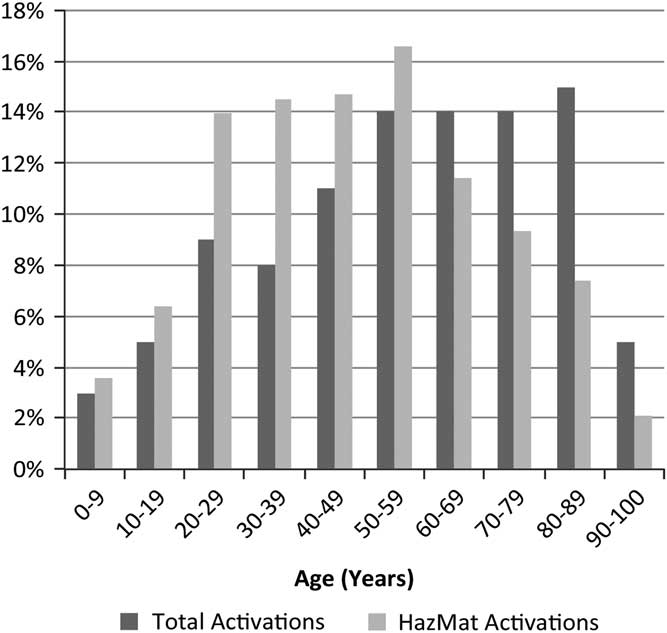
The age breakdown by decade for the HazMat and total EMS activation cohorts is shown in Figure 2. Of the 2,265 HazMat EMS activations with non-missing data for age, the mean age was 47.8 years (SD=22.3 years), as compared with 56.2 years (SD=24.1 years) for all activations. Hazardous material activations most often involved individuals aged 20-59 years. In contrast, EMS activations as a whole had a higher percentage of patients aged 50-89 years (P<.001).
Age Breakdown (by Decade) for HazMat and EMS Activations. Abbreviations: EMS, Emergency Medical Services; HazMat, hazardous materials.

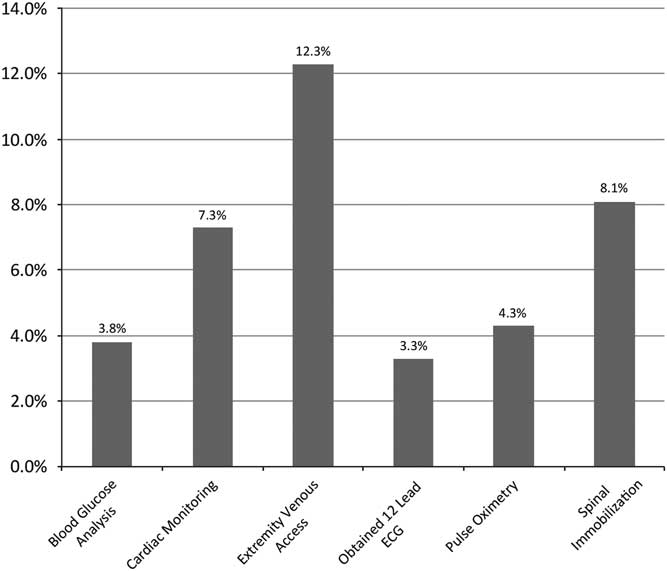
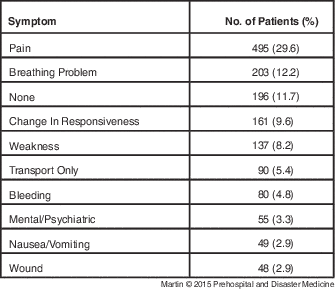
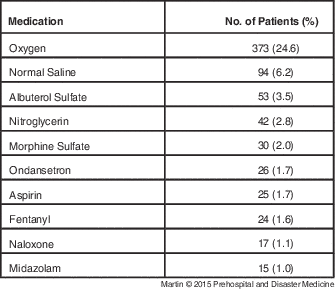
The primary symptoms observed by EMS personnel were pain (29.6%), breathing problems (12.2%), and change in responsiveness (9.6%; Table 1). The most common interventions were intravenous access (12.3%), spinal immobilization (8.1%), and cardiac monitoring (7.3%; Figure 3). The most common medications administered were oxygen (24.6%), normal saline (6.2%), and albuterol sulfate (3.5%; Table 2). Two percent of HazMat activations involved cardiac arrest; 21.7% of these occurred after EMS arrival. Cardiopulmonary resuscitation was initiated in 78.3% of cardiac arrest patients.
Most Common Interventions Performed by EMS Personnel. Abbreviations: ECG, electrocardiogram; EMS, Emergency Medical Services.

Top Ten Primary Signs and Symptoms Observed by EMS Personnel in HazMat Patients, as Reported in the 2012 National EMS Public Release Research Dataset

Abbreviations: EMS, Emergency Medical Services; HazMat, hazardous materials.
Top Ten Medications Most Frequently Administered to HazMat Patients, as Reported in the 2012 National EMS Public Release Research Dataset

Abbreviations: EMS, Emergency Medical Services; HazMat, hazardous materials.
A total of 1,812 (71.7%) HazMat activations involved patient transports by EMS, with 1,721 (95.0%) patients transported to hospitals by on-scene responding units. Ninety-one (5.0%) patients had care transferred to another EMS unit. Ten patients were transported by helicopter. These numbers were similar to those noted with total EMS responses, in which 75.5% of patients were transported by EMS, 95.4% by on-scene responding units, and 4.6% by other units after transfer of care. Mean scene time was 35.5 minutes, compared with a NEMSIS Data Set average of 18.7 minutes for all calls. Factors identified as impacting EMS response during the HazMat activation included response delay (21.0%), scene delay (68.1%), and transport delay (17.8%). Mean time from EMS arrival on scene to arrival at the patient was 8.2 minutes (SD=25.0 minutes) for HazMat activations, compared with 2.8 minutes (SD=11.7 minutes) for all NEMSIS activations (P<.001).
Discussion
Hazardous materials events result from the release of potentially toxic or otherwise dangerous materials that might cause harm to persons and/or property. The prehospital response to HazMat events is complicated by numerous factors, including operations in a potentially dangerous environment, the potential for rescue of one or more victims from the environment, the need to ensure adequate patient decontamination for both patient and responder safety, difficulty providing patient care while in personal protective equipment, and possible scene delays related to the HazMat event. 9
Despite this, little is known about the nature of prehospital response to HazMat incidents. In a study of regional HazMat teams in Massachusetts (USA), 47 of 162 events resulted in casualties; 194 patients were transported to the hospital.Reference Moles 10 A five-year study of HazMat events reported to the HSEES program in Washington State (USA) identified 457 events, resulting in 2,654 patients.Reference Kales, Polyhronopoulos and Castro 3 Seventy percent of patients were transported to a health care facility; 14 deaths were reported. Only 10 of 47 states in a 2012 study of the EMS workforce reported that more than 50% of EMS agencies had the capacity for the mass-decontamination of patients, equipment, and personnel beyond basic fire department resources.Reference Duncan and Orr 5
The current study examined HazMat events through EMS data submitted by 41 states to the NEMSIS program (Figure 1).Reference Dawson 8 Although the program does not cover all 50 states, it represents a significant portion of the United States, with 17,479,328 unique EMS activations reported in 2012, including both Washington State and Massachusetts. A total of 2,527 EMS activations were coded as HazMat events during the study period. Due to the limitations of the NEMSIS Public Research Database, a national incidence rate could not be determined.Reference Dawson 8 , Reference Kales, Polyhronopoulos and Castro 11 However, HazMat events appear to be a relatively uncommon cause for EMS activation within the NEMSIS Public Research Database, representing 14.5 activations per 100,000 activations. Hazardous materials events were identified by NEMSIS as the least common patient complaint category in 2012.Reference Schenk, Wijetunge and Mann 12 Even within the NEMSIS Public Research Database, rates may vary regionally and depend upon the community served, with agricultural and industrial communities potentially having higher risk. The de-identified NEMSIS Public Research Database does not allow for further geographic localization of events.
The majority of recorded HazMat activations in the current study occurred in homes, followed by streets and highways. Industrial locations were uncommon, accounting for only 5.4% of events. There are several possible explanations for this finding. The first is that agencies may define HazMat events differently. The nature of the event is not accessible through the de-identified database, so household chemical exposures to pesticides, hydrocarbons, or caustics may have been recorded as HazMat events. Streets and highways may represent locations of transportation accidents, or they may reflect the location where EMS staged and contacted patients during a HazMat event. In the Washington State study, only 14% of HazMat events occurred during transportation; the remaining 86% of HazMat events occurred in a fixed facility.Reference Kales, Polyhronopoulos and Castro 3 While industrial facilities might have more hazardous materials, the presence of in-house response teams and safety control measures might minimize injuries and diminish EMS response to these locations.
The age distribution of HazMat events patients differed from the overall EMS population within the NEMSIS database. The mean age for HazMat events patients was 47.8 years (SD=22.3 years) while that for all patients was 56.2 years (SD=24.1 years). This finding, consistent with age data previously reported in HSEES, may reflect the fact that individuals aged 20-59 years were more likely to come into contact with hazardous materials, either through occupational or household exposures. The most common symptoms noted in this study were pain, breathing problems, and change in responsiveness (Table 1). Data from the HSEES program identified the four most frequently reported health effects to be respiratory irritation, headaches, gastrointestinal symptoms, and dizziness or other central nervous system symptoms. 13
Slightly more than 50% of EMS providers in this study operated at the BLS level. The level of EMS response to HazMat events was not significantly different from response to other EMS events and likely reflects the level of available EMS providers. Although US national data are sparse and frequently combine Emergency Medical Technicians (EMTs) and paramedics, it has been reported that of the 826,111 EMS professionals currently working in the US, 547,693 are credentialed at the EMT-Basic Level, 54,855 at the EMT-Intermediate Level, and 203,807 at the EMT-Paramedic Level.Reference Duncan and Orr 5
In the current study, 3.6% of patients received aggressive ALS response, defined as ALS Level 2, paramedic intercept, specialty care transport, or rotary wing transport. Advanced Life Support Level 2 response is distinguished by NEMSIS from ALS Level 1, in part, based upon necessity for administration of at least three separate administrations of one or more medications.Reference Dawson 8 It remains unclear if patients required the more aggressive ALS response. Based upon the available data, the most common interventions were intravenous access, spinal immobilization, and cardiac monitoring, all of which can often be performed at the BLS level. The most common medications provided were oxygen, normal saline, and albuterol sulfate.
The mean scene time in the current study was 35.5 minutes, 16.8 minutes longer than the NEMSIS average. While the prolonged scene time may reflect the need to perform complex medical interventions, the commonly reported complaints and procedures performed appear to suggest otherwise. Rather, these delays may reflect the operational realities of HazMat response. This is further suggested by statistically significant delays in reaching the patient after EMS arrival on scene, as compared with total NEMSIS activations. Given that a major function of HazMat response is to preserve life, it is important that EMS understand the nature of delays and plan for this eventuality. One approach may be to partner with HazMat teams to perform life-saving interventions and administer essential antidotes in the warm zone during, or immediately after, the patient decontamination process.
Limitations
This study has limitations and biases inherent in any retrospective study, including the potential for miscoding or reporting biases. The latter is mitigated somewhat by the presence of mandatory fields, while the former is mitigated partially through on-going data edit checks. The NEMSIS Project identifies several specific limitations in its own documentation, including convenience sampling, use of event-based rather than patient-based coding, selection and information bias, and missing data.Reference Dawson 8 Of particular note, the NEMSIS data set is resource-based rather than patient-based. A single patient may be represented in more than one record for a variety of reasons. Several agencies may respond to the same event (ie, one patient) and each would submit a record to the National EMS Database.
Several other important limitations have been identified in regards to this study. In a study of HazMat response in Massachusetts, the majority of responses (71%) did not result in victims.Reference Moles 10 Similar findings were noted in HSEES data. 13 Events without patients would not be captured reliably within the NEMSIS Program, being an EMS activation dataset. The actual number of HazMat events during the study period was therefore likely much greater than reported in this study. However, the purpose of the current study was to evaluate EMS response.
There is no information in NEMSIS concerning the type or number of chemicals involved in reported HazMat events. Similarly, other than oxygen, no specific antidotal therapies are captured by the NEMSIS Program. As a consequence, it is impossible to make recommendations regarding antidote-stocking requirements for EMS agencies.
Lastly, although the NEMSIS Project is a large, multi-state dataset, it is not a comprehensive dataset, nor does it capture all 50 US states (Figure 1). Specifically, it does not capture data from several key US states, including California, Texas, and Louisiana. Data from HSEES indicate that from January 1, through June 30, 2009, Texas accounted for 23.3% of reported events, while Louisiana accounted for 12.2%, ranking them as the first and third highest in terms of reported HazMat events, respectively. 13
Conclusions
Hazardous materials events are rare causes of EMS activation in the United States. The majority of these events occur in non-industrial venues and involve two or fewer patients. Care is provided most frequently at the EMT level. Scene time frequently is delayed compared with other EMS responses, likely due to multiple barriers. Cardiac arrest is rare in this patient cohort, but occurred after EMS arrival in one-fifth of all such patients. Further study is needed to identify and to further delineate the medical interventions, training, and equipment needed by EMS personnel charged with responding to HazMat events.
Acknowledgments
The NEMSIS dataset is supported by the Office of Emergency Services, National Highway Traffic Safety Administration (Washington, DC USA). The authors acknowledge the participating EMS providers, EMS agencies, and state EMS offices who support and provided data for the NEMSIS Registry. Also, portions of this study were presented at the XXXIV International Congress of the European Association of Poison Centres and Clinical Toxicologists, Brussels, Belgium, May 27-30, 2014.