The purpose of this paper is to draw on recent studies of bilingualism and emotions to argue that future models of the bilingual lexicon need to acknowledge – where relevant – not only linguistic and cognitive but also affective aspects of the lexicon. I will begin with a discussion of definitions of emotion and emotion-laden words. Then, I will argue that the incorporation of the affective dimension in the mental lexicon needs to take place on three levels. On the lexical level, emotion and emotion-laden words need to be considered as a separate class of words in the mental lexicon, because recent research shows that these words are represented and processed differently from abstract and concrete words. On the conceptual level, models need to address cross-linguistic differences in emotion concepts and ways in which bilinguals' representations may differ from those of monolingual speakers. On the processing level, models need to incorporate the affective processing dimension, recognizing affective priming effects and differences in emotionality across bilinguals' languages and word types.
Unlike the study of visual or auditory processing, the study of emotion and emotion-laden words and of affective processing cannot be limited to the lab, because words do not have immutable meanings or stable affective dimensions – rather their meanings and affective connotations are internalized, constructed, and negotiated in context. Consequently, where possible, I will triangulate the findings of laboratory studies of bilingual affective processing and representation with findings of sociolinguistic, ethnographic, and clinical studies. In some cases I will also appeal to bi- and multilinguals' self-reports to complement the experimental data, to highlight the human dimension of this research, and to draw on people's insights about the interplay between their emotions and language choices in contexts we cannot easily observe.
Throughout, the discussion will focus on the bilingual lexicon, mainly because the research to date has been conducted with bilingual speakers, or at least with the focus on two languages of multilingual speakers. In the majority, albeit not all, of the cases these were adult or late bilinguals who learned their second language (L2) in teenage years or in adulthood. This choice of participants allows us to examine conceptual change in the mental lexicon and differential language emotionality; at the same time, it privileges one category of bilingual speakers. In future research, it would be critical to include other types of bi- and multilingual speakers, because different linguistic trajectories and proficiency levels affect the organization of the mental lexicon. I will try to incorporate information about these speakers where possible.
1. Emotion and emotion-laden words as a distinct class of words in the mental lexicon
1.1 Definitions of emotion and emotion-laden words
It is often stated that languages differ widely in the size of their emotion lexicons. Some languages, such as Chewong in Malaysia, have but seven emotion words (Howell, Reference Howell, Heelas and Lock1981), others, such as Malay, Indonesian, Filipino, and German, contain about 230–250 emotion words (Boucher, Reference Boucher, Marsella, Tharp and Ciborowski1979; Gehm and Scherer, Reference Gehm, Scherer and Scherer1988; Heider, Reference Heider1991; Church, Katigbak, Reyes and Jensen, Reference Church, Katigbak, Reyes and Jensen1998). Dutch emotion lexicon was shown to have 1,500 words (Heelas, Reference Heelas and Harré1986) and English more than 2,000, with 1,000–1,200 words regularly used by its speakers (Wallace and Carson, Reference Wallace and Carson1973). The key problem with these claims is the continuing lack of clarity as to what counted as emotion words in particular studies, how they were elicited or selected, and whether some numbers represent working emotion vocabularies of particular speakers and others emotion lexicons culled from a dictionary. These issues still plague the emotion lexicon research and scholars continue to differ in ways they define emotion, emotion-related, and emotion-laden words.
Some linguists and psychologists take what can be seen as a “common-sense” approach, offering examples for each category or referring to word lists used in earlier studies. This approach is clearly insufficient as it does not contain selection guidelines. Others apply some form of propositional analysis. Wallace and Carson (Reference Wallace and Carson1973), for instance, searched the dictionaries for adjectives and nouns that fit the syntactic contexts “He has a feeling of X” and “He feels X”. To justify their focus on nouns and adjectives, they stated that verbs and adverbs invariably have an alternate noun or adjective form. Clore, Ortony and Foss (Reference Clore, Ortony and Foss1987) argued that an emotion word has to express emotions in two contexts, “feeling X” and “being X”. Thus, “sad” and “sadness” are emotion words because “feeling sad” and “being sad” are both rated as expressions of emotion, as opposed to “feeling ignored” (emotion) and “being ignored” (state of events). Ortony, Clore and Foss (Reference Ortony, Clore and Foss1987) further argued that best examples of emotion words will refer to internal affective states. The approach advanced in their research was later adopted by other scholars, including Johnson-Laird and Oatley (Reference Johnson-Laird and Oatley1989) and Church et al. (Reference Church, Katigbak, Reyes and Jensen1998). Notably, however, these two propositional approaches are limited to languages, such as English or French, where emotions are most frequently expressed through adjectives that indeed refer to internal states. They are not applicable to languages like Russian or Polish, where emotions are more frequently expressed through verbs that refer to processes and relationships and do not always have adjectival counterparts (Pavlenko, Reference Pavlenko2002a; Wierzbicka, Reference Wierzbicka1992, Reference Wierzbicka2004).
An alternative to propositional analysis is found in componential approaches that draw on the early work of Osgood and associates (Osgood, Reference Osgood1969; Osgood, May and Miron, Reference Osgood, May and Miron1975) and examine emotion words in terms of several semantic dimensions deemed universal. Some draw directly on Osgood's work and examine the words in terms of evaluation (good to bad), activity (active to passive), and potency (strong to weak) (Wurm and Vakoch, Reference Wurm and Vakoch1996). Others use somewhat different terms and combinations: arousal, evaluation, and dominance (Fontaine, Poortinga, Setiadi and Markam, Reference Fontaine, Poortinga, Setiadi and Markam2002), arousal, pleasantness, and dominance (Church et al., Reference Church, Katigbak, Reyes and Jensen1998), arousal and pleasantness (Altarriba and Bauer, Reference Altarriba and Bauer2004), and valence, intensity, and duration (Zammuner, Reference Zammuner1998; Niedenthal et al., 2002). Componential approaches have an advantage over propositional analysis in being relatively language- and culture-neutral, they do not however offer principles for selection of emotion words, only for their evaluation on particular dimensions. As a result, they do not allow us to differentiate between emotion words per se and emotion-laden words.
The approach adopted here distinguishes between these two word types, based on their functions. Emotion words are seen as words that directly refer to particular affective states (“happy”, “angry”) or processes (“to worry”, “to rage”), and function to either describe (“she is sad”) or express them (“I feel sad”). In some contexts, these words may also elicit emotions and in others they may function just like abstract words. This definition does not include emotion-related words (“tears”, “tantrum”, “to scream”) that describe behaviors related to particular emotions without naming the actual emotions. Scholars differ with regard to these words: Some studies exclude them (e.g., Wallace and Carson, Reference Wallace and Carson1973), and others, such as studies of children's affective socialization (e.g., Eisenberg, Reference Eisenberg1999; Cervantes, Reference Cervantes2002), count these words together with emotion words proper.
Emotion-laden words are seen here as words that do not refer to emotions directly but instead express (“jerk”, “loser”) or elicit emotions from the interlocutors (“cancer”, “malignancy”). The following subcategories are commonly differentiated among emotion-laden words: (a) taboo and swearwords or expletives (“piss”, “shit”), (b) insults (“idiot”, “creep”), (c) (childhood) reprimands (“behave”, “stop”), (d) endearments (“darling”, “honey”), (e) aversive words (“spider”, “death”), and (f) interjections (“yuk”, “ouch”). The boundaries of these subcategories are somewhat fuzzy for two reasons. On the one hand, some words may cross categories. For instance, taboo and swearwords that commonly function as insults may in some contexts appear as friendly terms of affection. On the other hand, words that are not commonly viewed as emotion-laden may acquire emotional connotations in discourse. For instance, in some contexts, words like “liberal” or “elite” may appear as insults or as aversive words.
A useful corpus of 590 English emotion words can be found in Johnson-Laird and Oatley (Reference Johnson-Laird and Oatley1989) (selected through Clore et al.'s (Reference Clore, Ortony and Foss1987) propositional analysis). Italian emotion words and ratings are found in Zammuner (Reference Zammuner1998) and French words and ratings in Niedenthal et al. (2002).
1.2 Emotion and emotion-laden words in the bilingual lexicon
Traditional psycholinguistic approaches to the mental lexicon differentiate between two classes of words – concrete and abstract – on the grounds that concrete words are more easily recognized, better recalled, and easier to imagine and to contextualize than abstract words (Bleasdale, Reference Bleasdale1987; Schwanenflugel, Harnishfeger and Stowe, Reference Schwanenflugel, Harnishfeger and Stowe1988; De Groot, Reference De Groot, Schreuder and Weltens1993). Emotion words are commonly grouped together with abstract words in this research. However, a recent series of studies by Altarriba and associates (Altarriba, Bauer and Benvenuto, Reference Altarriba, Bauer and Benvenuto1999; Altarriba, Reference Altarriba2003, Reference Altarriba and Pavlenko2006; Altarriba and Bauer, Reference Altarriba and Bauer2004; Altarriba and Canary, Reference Altarriba and Canary2004) have demonstrated that emotion (“love”, “hate”, “despair”) and emotion-laden words (“cancer”, “rape”, “kill”) are represented, processed, and recalled differently from both concrete and abstract words.
Altarriba et al. (Reference Altarriba, Bauer and Benvenuto1999) showed that emotion words were rated by monolingual English-speakers as less concrete and lower in context availability than both abstract and concrete words. Context availability refers here to “the ease with which a context or circumstance can be recalled for a particular word” (p. 578). On the imagery scale, emotion words were rated lower than concrete but higher than abstract words. In all cases the differences between emotion words and the other two categories were significant. The authors also established that emotion words generated the highest number of different word associations, followed by abstract and then concrete words. Once again, there were significant differences between the three categories of words. These results were later replicated by Altarriba and Bauer (Reference Altarriba and Bauer2004).
Altarriba (Reference Altarriba2003) used the same approach as Altarriba et al. (Reference Altarriba, Bauer and Benvenuto1999) with Spanish–English bilinguals, finding that Spanish emotion words were also rated as less concrete than abstract words. Contrary to the findings of the previous study, however, bilinguals provided equal ratings for Spanish emotion and abstract words in terms of imagery and context availability. These ratings suggest that concrete, abstract, and emotion words are represented similarly in the English and Spanish lexicons in terms of concreteness, but that for Spanish–English bilinguals, Spanish emotion words are more readily visualized and contextualized than corresponding English words for English speakers. Without further research, however, it is hard to interpret the significance of the latter result. To disambiguate the contributing factors, comparisons need to be carried out between the ratings given by monolingual and bilingual speakers in each language. These comparisons will allow us to determine whether bilinguals pattern with monolinguals in both languages (and thus the difference in ratings should be attributed to language) or whether they perform differently from monolinguals in one or both languages (and thus the difference should be attributed to bilingualism).
Emotion and emotion-laden words also appear to be more memorable than neutral words. Several studies, including Rubin and Friendly (Reference Rubin and Friendly1986) and Altarriba and Bauer (Reference Altarriba and Bauer2004), show that emotion words are better recalled than neutral words by native speakers of English. Talmi and Moscovitch (Reference Talmi and Moscovitch2004) obtained the same result for emotion-laden words. Similar effects were observed in bilinguals' performance, with some differences across languages. Thus, Anooshian and Hertel (Reference Anooshian and Hertel1994) showed that both emotion and emotion-laden words are better recalled by speakers bilingual in Spanish and English but only in their L1, regardless of whether it was Spanish or English. In contrast, Ayçiçeği and Harris (Reference Ayçiçeği and Harris2004) identified emotion-memory effects in both languages of bilingual speakers, with stronger recall effects for L2 aversive words, and stronger recognition effects for both positive and aversive words in the L2.
Psycholinguistic studies also suggest that valence and arousal play a role in the organization of the mental lexicon. Altarriba and Bauer (Reference Altarriba and Bauer2004) showed that in the monolingual English lexicon emotion words function as primes for other emotion words (e.g., happy–sad) but not for semantically related abstract words (e.g., rage–violence). Altarriba and Canary (Reference Altarriba and Canary2004) extended this approach to emotion-laden words and examined affective priming in the lexicons of monolingual English-speakers and of Spanish–English bilinguals. They found that significant affective priming occurred in both high and moderate arousal conditions in monolingual English speakers. The effects were also significant in the L2 English of Spanish–English bilinguals but less pronounced. Several explanations are possible for this outcome – bilinguals' reaction times may be slower because they are accessing information in the other language, or they may be less susceptible to arousal dimensions in their L2. These factors can be disambiguated in future studies that examine priming effects in both languages of bilingual speakers.
To sum up, the studies discussed here suggest that emotion words differ from abstract and concrete words in terms of concreteness, imageability, and context-availability (at least in English) and that these words may be embedded in a richer semantic network. Emotion and emotion-laden words were also shown to have additional components that differentiate them from abstract and concrete words, namely valence and arousal. As a result of these differences, emotion and emotion-laden words are represented, processed, and recalled differently from abstract and concrete words in the mental lexicon. Studies of bilingual lexicons mirror these results, with additional differences between effects in the L1 and L2 (Anooshian and Hertel, Reference Anooshian and Hertel1994; Ayçiçeği and Harris, Reference Ayçiçeği and Harris2004). These findings suggest that future models of the bilingual lexicon should consider emotion and emotion-laden words as a distinct class of words.
2. Emotion concepts as variable across languages and lexicons
The studies of emotion words contribute significantly to our understanding of lexical processing, including the relative ease of imagining or recalling particular words. They say nothing, however, about the contents or the structure of particular conceptual representations. In what follows, I will discuss emotion concepts in the context of a larger argument about conceptual representation in the bilingual lexicon. Commonly, models of bilingual representation and processing link words of different languages to an undifferentiated – and presumably universal – conceptual store. Some scholars, however, have argued that conceptual representations of abstract (De Groot, Reference De Groot, Schreuder and Weltens1993) and concrete words (Paradis, Reference Paradis, Auger and Rose1997; Malt and Sloman, Reference Malt and Sloman2003; Ameel, Storms, Malt and Sloman, Reference Ameel, Storms, Malt and Sloman2005) may vary across languages and that this variability needs to be taken into consideration in modeling the bilingual lexicon (Pavlenko, Reference Pavlenko1999). Here, I extend this argument to emotion concepts, because these concepts too vary across languages and cultures. I will begin by discussing the structure of emotion concepts and cross-linguistic differences in this area. Then, I will examine two issues central for research in bilingualism: concept comparability and concept encoding in the bilingual mind.
2.1 Definition of emotion concepts
Studies in linguistics and linguistic anthropology show that languages differ in terms of whether they have a superordinate term for “emotion”. Some languages, such as Biminkuskusmin of Papua New Guinea (Poole, Reference Poole, White and Kirkpatrick1985), Ommura of Papua (Heelas, Reference Heelas and Harré1986), Chewong of Malaysia (Howell, Reference Howell, Heelas and Lock1981), Ifaluk of Micronesia (Lutz, Reference Lutz1988), Tahitian (Levy, Reference Levy1973), and Gidjinggali, an aboriginal language in Australia (Hiatt, Reference Hiatt1978), lack lexical equivalents of this term. This absence does not imply that speakers of these languages do not experience what we see as “emotions”, it does suggest however that it may be harder to discuss a unified and coherent category of emotions when using these languages as a medium of communication. Instead, the Ifaluk, for instance, talk about niferash (our insides) and, within this category, about nunuwan (thought/emotion) and tip- (will/emotion/desire), both of which are located within a complicated network of physical experiences, social relations, and moral obligations (Lutz, Reference Lutz1988).
Cross-linguistic differences have also been identified in grammatical categories favored in emotion encoding. Some languages, such as Polish, Russian, or Hindustani, favor emotion verbs that function as relationship-markers and encode emotions as personal and interpersonal processes. Others languages, such as English or Dutch, favor, respectively, adjectives and nouns that function as self-markers and encode emotions as inner states (Wierzbicka, Reference Wierzbicka1992, Reference Wierzbicka2004; Pavlenko, Reference Pavlenko2002a, Reference Pavlenkob; Semin, Görts, Nandram and Semin-Goossens, Reference Semin, Görts, Nandram and Semin-Goossens2002).
In addition to more general differences in emotion encoding, differences have also been identified in particular emotion concepts (as seen in the next section). To provide a useful framework within which these differences can be discussed, emotion concepts will be viewed here as prototypical scripts that are formed as a result of repeated experiences and involve causal antecedents, appraisals, physiological reactions, consequences, and means of regulation and display. These concepts are embedded within larger systems of beliefs about psychological and social processes, often viewed as cognitive models, folk theories of mind, or ethnopsychologies (Russell, Reference Russell1991a). This prototype and script-based approach has been advanced as an alternative to a componential or feature-based view of emotion concepts. It is based on experimental studies (Fehr and Russell, Reference Fehr and Russell1984; Shaver, Schwartz, Kirson and O'Connor, Reference Shaver, Schwartz, Kirson and O'Connor1987) and on semantic and pragmatic analyses (Kövecses, Reference Kövecses1986, Reference Kövecses1990, Reference Kövecses2000; Wierzbicka, Reference Wierzbicka, Kitayama and Markus1994) and is shared by a number of linguists (Kövecses, Reference Kövecses1986, Reference Kövecses1990, Reference Kövecses2000; Lakoff, Reference Lakoff1987; Wierzbicka, Reference Wierzbicka, Kitayama and Markus1994), psychologists (Fehr and Russell, Reference Fehr and Russell1984; Shaver et al., Reference Shaver, Schwartz, Kirson and O'Connor1987; Russell, Reference Russell1991a, Reference Russellb; Mesquita and Frijda, Reference Mesquita and Frijda1992) and linguistic anthropologists (Gerber, Reference Gerber, White and Kirkpatrick1985; Lutz and White, Reference Lutz and White1986).
The view of emotion concepts as scripts distinguishes between emotions, emotion concepts, and emotion words and allows me to avoid taking a stance in the universalist/relativist debate about basic emotions, because it says nothing about emotions per se, only about their conceptualizations. This approach is compatible with a universalist view of emotions, because it accommodates concepts that derive from shared human experiences and does not preclude the ability to experience emotions not encoded in single lexical items. It is also compatible with a relativist view because it recognizes experiential and script-like nature of emotion concepts and accommodates differences in emotion concepts across languages and cultures. To say that emotion concepts vary does not imply that speakers of different languages have distinct physiological experiences. Rather, it means that they may have somewhat different vantage points from which to evaluate and interpret their own and others' emotional experiences. Consequently, what is of interest here is linguistic, cognitive, and cultural categorization of emotion-related events, behaviors and phenomena, and not emotions per se.
2.2 Cross-linguistic differences in emotion concepts
Cross-linguistic studies of emotion lexicons mentioned earlier show that emotion concepts may vary across languages in terms of function, encoding, and salience. Some languages do not require their speakers to differentiate between thoughts and feelings, some privilege the view of emotions as processual and relational, and others view emotions as individual phenomena and as inner states rather than processes. But how do they vary specifically? Using the definition of concepts adopted here, we can examine cross-linguistic and cross-cultural differences across all constituents of emotion concepts (see also Scherer, Wallbott and Summerfield, Reference Scherer, Wallbott and Summerfield1988; Mesquita and Frijda, Reference Mesquita and Frijda1992).
The first locus of difference are causal antecedents of emotions. Here, differences are found in judgments made about what causes emotions in general or about the causes of particular emotions. For instance, in some cultures, emotions are seen as generated by external events and mental perceptions of these events, while in others they are believed to be generated by gods, other people, or internal organs (Heelas, Reference Heelas and Harré1986; Myhill, Reference Myhill1997). To give a more language-specific example, Russian revnost' “jealousy” may be caused by one's boyfriend or girlfriend flirting with someone, or by a preferential treatment of one sibling over the other. English “jealousy” may also be caused by these antecedents, and, additionally, by someone's good fortune, such as winning the lottery or taking a trip to Hawaii. In Russian, however, the latter antecedents cause exclusively zavist' “envy” and not revnost' (Stepanova Sachs and Coley, Reference Stepanova Sachs, Coley and Pavlenko2006).
Another locus of difference are appraisals, that is evaluations of emotion-causing events and of their consequences. For instance, exhibiting signs of one's dependence may be interpreted as a positive and desirable expression of amae (a feeling of dependence on someone) by the Japanese; the same behaviors may be perceived as shameful and childish among the Westerners or the Bedouins (Doi, Reference Doi1973; Abu-Lughod, Reference Abu-Lughod1986; Morsbach and Tyler, Reference Morsbach, Tyler and Harré1986). Among the Ifaluk, individuals who are submissive and passive in metagu “fear” are commended, and those who display an aggressive stance are condemned, while an opposite attitude is assumed in many Western cultures (Lutz, Reference Lutz1988). Even emotions themselves may be appraised differently: for instance, English–speakers commonly see “envy” as a negative emotion, while its Chinese translation equivalent, xian mu (a feeling of admiration for someone who has something you want) may be evaluated as much more pleasant and favorable (Moore, Romney, Hsia and Rusch, Reference Moore, Romney, Hsia and Rusch1999).
A few studies also point to differences in terms of physiological reactions, or somatic states associated with particular emotions. For instance, a Greek emotion stenahoria (discomfort/sadness/suffocation) is typically accompanied by a feeling of suffocation, not being able to breathe, and not having enough space; this feeling is not commonly experienced by those who feel “frustrated”, “sad” or “uncomfortable” (Panayiotou, Reference Panayiotou2004a).
Differences have also been found in consequences and means of emotion regulation and display. For instance, where anger is concerned, Utku Eskimo, Japanese, and Tahitians inhibit expressions of anger toward other people and emphasize emotional control (Briggs, Reference Briggs1970; Doi, Reference Doi1973; Levy, Reference Levy1973), while speakers of Israeli Hebrew emphasize self-assertion (Katriel, Reference Katriel1985), and the Ilongot and Samoans view anger as an important aspect of being a young male (Rosaldo, Reference Rosaldo1980; Gerber, Reference Gerber, White and Kirkpatrick1985). Consequently, what constitutes appropriate means of anger display (e.g., verbal dueling) and what constitutes a transgression will differ in these speech communities.
All in all, we can see that emotion concepts differ across languages in terms of causal antecedents of emotions, their appraisals, consequences, means of regulation and display and, in some cases, even physiological reactions associated with particular concepts. These differences suggest that to understand conceptual representations in the bilingual mind, we need to compare concepts in the respective languages of bi- and multilingual individuals.
2.3 Concept comparability
Analysis of concept comparability reveals three possible relationships between concepts encoded in languages A and B: (a) two concepts may be similar or identical; (b) one language may have a concept that has no counterpart in the other language; (c) two or more concepts may be in partial overlap. The first possibility, a complete or almost complete overlap between two concepts, is the most advantageous for L2 learners whose L1-based concepts may facilitate positive transfer in the L2 learning process.
The second possibility involves language- and culture-specific concepts such as the English “frustration” (Panayiotou, Reference Panayiotou2004a), Russian perezhivat' (to experience something keenly/to worry/to suffer things through; Pavlenko, Reference Pavlenko2002a, Reference Pavlenkob), Greek stenahoria (discomfort/sadness/suffocation) and ypohreosi (deep sense of cultural and social obligation) (Panayiotou, Reference Panayiotou2004a, Reference Panayiotoub; Reference Panayiotou and Pavlenko2006), Japanese akogare (Japanese women's desire for the Western lifestyle and Western men; Piller and Takahashi, Reference Piller, Takahashi and Pavlenko2006), or Samoan lotomamā? (socially approved feeling of happy passivity and willingness to agree with the desires of others; Gerber, Reference Gerber, White and Kirkpatrick1985).
The uniqueness of such concepts is often acknowledged by L2 learners who find no translation equivalents in their L1 conceptual and linguistic repertoires. For instance, in her Russian-language memoir, a well-known Russian actress, Elena Koreneva, who had lived for a while in the United States with her American husband, revealed that she came to rely on the Anglo concept of “frustration” in her thinking and behavior. In her defense, she argued that “frustration – чувство неудовлетворения, смешанное с досадой, которое возникает после больших ожиданий” [frustration – a feeling of dissatisfaction mixed with vexation/annoyance that appears after great expectations] (Koreneva, Reference Koreneva2003, p. 383) – is impossible to translate into Russian with one word. To internalize such concepts, L2 learners have to undergo the process of secondary affective socialization and to develop prototypical scripts for these emotions. In this process, they learn what events and phenomena commonly elicit such emotions, in what contexts and how these emotions are commonly displayed, and what consequences they might lead to.
The third relationship between the concepts of languages A and B is partial overlap. This overlap may take several different forms. In the nesting relationship one concept represents a subpart of another (see Figure 1). This relationship is found between the English notion of “jealousy” and its Russian translation equivalent revnost'. As already mentioned, revnost' refers only to jealousy in intimate relationships or to sibling rivalry but not to jealousy of someone's good fortune. The latter, in Russian, is the exclusive domain of zavist' “envy”, whereas in English “jealousy” and “envy” may at times be used interchangeably. Consequently, “jealousy” is a more inclusive conceptual category than revnost' (Stepanova Sachs and Coley, Reference Stepanova Sachs, Coley and Pavlenko2006).
Nesting.

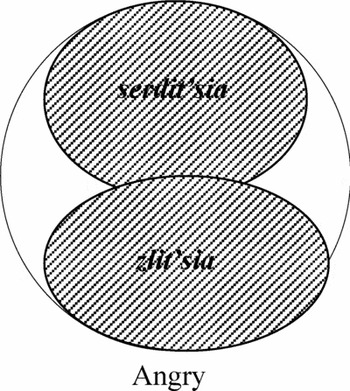
A relationship of split is found in cases where emotion categories referred to with a single term in one language are lexically and conceptually differentiated in other languages (see Figure 2). For instance, while English offers a single term for “anger”, Samoan has two terms that roughly connote “anger” (Gerber, Reference Gerber, White and Kirkpatrick1985), German and the Yankunytjatjara language of Central Australia three (Goddard, Reference Goddard1991; Durst, Reference Durst, Harkins and Wierzbicka2001), Mandarin Chinese five (Kornacki, Reference Kornacki, Harkins and Wierzbicka2001), and Biblical Hebrew seven such terms (Myhill, Reference Myhill1997). Furthermore, where English refers to the state of being “angry” as a result of particular experiences, Russian forces its speakers to differentiate between two processes, that of serdit'sia (to be actively cross at someone, to be upset with them and mad at them) and that of zlit'sia (to be actively angry, mad, but not necessarily at a particular person). Consequently, a speaker of English learning German or Mandarin Chinese will need to learn to differentiate systematically between different kinds of anger; when learning Russian, they will need to learn to speak of anger as an externally observable process, and not only an inner state.
Split.

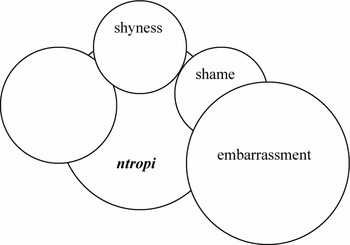
A more complicated case of split, seen here as differentiation, is found in cases where a concept in one language shares aspects (antecedents, consequences, etc.) with several concepts in the other language, while also retaining some language- and culture-specific properties (see Figure 3). The case for such concepts is made in Besemeres' (Reference Besemeres and Pavlenko2006) analysis of a Polish concept of żal that shares some but not all elements with the English “grief”, “sadness”, and “sorrow” and in Panayiotou's (Reference Panayiotou and Pavlenko2006) analysis of the Greek concept ntropi that shares some elements with the English “shyness”, “shame”, “embarassment”, and “discomfort”.
Differentiation.

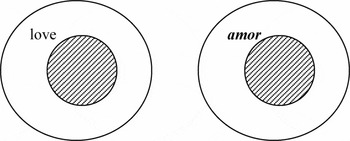
Another possible relationship is the overlap of core meanings or prototypes of the two concepts and differentiation at the periphery or in the links between the category in question and other categories (see Figure 4). An example of such difference is offered by Grabois (Reference Grabois, Palmer and Occhi1999) who examined word associations to three emotion words, “love”, “happiness”, and “fear”, in the lexicons of monolingual English and Spanish speakers. His results revealed cross-linguistic differences in semantic networks of these words. For instance, in the domain of “love” native speakers of English favored indirect, i.e. metaphoric and symbolic, associations (e.g., “heart”, “red”, “roses”), while native speakers of Spanish showed preference for sensory and referential associations.
Core overlap.

We see then that in any pair of languages, specific emotion concepts may overlap completely, partially, or not at all. In the case of partial overlap, we can differentiate between at least four configurations: nesting, split, differentiation, and core overlap. Let us now see how this variation plays out in the bilingual lexicon.
2.4 Emotion concepts in the bilingual lexicon
Evidence of cross-linguistic differences in conceptual categories linked to emotion words, or, for that matter, concrete words (e.g., Malt and Sloman, Reference Malt and Sloman2003; Ameel et al., Reference Ameel, Storms, Malt and Sloman2005), suggests that models that assume an undifferentiated conceptual store oversimplify the relationship between words and concepts. Undoubtedly, one cannot require that models and theories take into consideration all possible relationships between concepts, nor all possible permutations these concepts may undergo in the process of additional language learning. Rather, models of bilingual representation and processing need to acknowledge conceptual nonequivalence across languages and the possibility that L1 and L2 translation equivalents may be linked to distinct or only partially overlapping concepts. To illustrate the exact nature of these links, in what follows I outline a typology that distinguishes between seven conceptual processes in the bilingual lexicon: (1) co-existence; (2) L1 transfer; (3) internalization of new concepts; (4) restructuring; (5) convergence; (6) shift; and (7) attrition (see also Pavlenko, Reference Pavlenko1999, Reference Pavlenko and Fabbro2002c).
Co-existence of concepts of the two languages is common in the lexicons of bicultural bilinguals whose representations are similar to those of monolingual speakers of respective languages. This outcome may take place in all three cases – similar concepts, partially overlapping concepts, and language-specific concepts. Evidence of co-existence of emotion concepts comes from studies with Russian–English bilinguals conducted by Pavlenko (Reference Pavlenko2002b) and Stepanova Sachs and Coley (Reference Stepanova Sachs, Coley and Pavlenko2006) where bilinguals categorized emotion-eliciting situations in each language similarly to monolingual speakers of English and Russian.
L1 conceptual transfer, that is reliance on concepts encoded in L1 when using a later learned language, takes place in the lexicons of beginning and intermediate L2 learners and in particular of classroom learners who have not had an opportunity to be socialized into the target language community. In the case of identical concepts this reliance may represent positive transfer, and in the case of partially overlapping concepts or language-specific concepts it constitutes negative transfer. Evidence for such transfer in the domain of emotion concepts comes from a study conducted with advanced American learners of Russian by Pavlenko and Driagina (Reference Pavlenko and Driagina2007). The researchers found that across a variety of narrative tasks these learners use the copula verbs byt' “be” and stanovit'sia “become” with emotion adjectives in contexts where Russian monolinguals use emotion verbs. For instance, the learners stated that the main character stala serditoi “became angry” and stala eshche bolee rasstroennaia “became even more upset” in contexts where native speakers of Russian consistently used emotion verbs, saying ona rasserdilas' “she got angry” and ona eshche bol'she rasstroilas' “she got even more upset” (or literally: “she even more upset herself”). These instances suggest that in discussing emotions in Russian the learners draw on the dominant L1 concept of emotions as states and have not yet internalized the representation of emotions as processes. In addition, instances of lexical borrowing, such as “kak chto-to ee frastriruet/frastrirovalo” “as if something frustrates/frustrated her”, display reliance on the L1 concept of “frustration”, not encoded in Russian.
Internalization of new concepts takes place in cases where a new language has concepts not encoded in the other language or languages of the learner, and where L2 learners are socialized into the L2 community. Evidence of such internalization can be found in Panayiotou's (Reference Panayiotou2004a) study of Greek–English bilinguals who internalized the notion of “frustration” from English and code-switched to refer to it, even when speaking Greek, as in “Imoun polla frustrated me tin katastasi” (I was very frustrated with the situation) (Panayiotou, Reference Panayiotou2004a, p. 8). Metalinguistic comments made by the study participants suggest that this is a novel concept for them and not one that piggybacks on previous knowledge, e.g.:
“Frustration” is such an amazing word, the lack of it in a language is so amazing because it carries with it the word “frustrate” to stop to block . . . so the outside force is carried in that word, it's not just what you feel it's the way you feel because an outside force that is blocking you and you don't have that in Greek.
(Leonidas, a Greek–English bilingual, in Panayiotou, Reference Panayiotou2004a, p. 13)Notably, however, internalization does not always accompany L2 learning. Pavlenko and Driagina (Reference Pavlenko and Driagina2007) found that American learners of Russian are aware of the core meaning of the language-specific Russian emotion verb perezhivat' (to experience things keenly/to worry/to suffer things through) but do not appeal to this verb in the narrative tasks where Russian monolinguals do. This suggests that the learners have not yet formed a unified conceptual category that allows them to identify this emotion and to structure their narratives around it. Panayiotou's (Reference Panayiotou2004a) study shows that even L2 socialization may not guarantee internalization. Her interviews with English–Greek bilinguals, who reside in Cyprus and have Greek-speaking spouses, demonstrated that some of these bilinguals are still unsure about the precise meaning of the Greek emotion word stenahoria (discomfort/sadness/suffocation) and the range of contexts where this word is used.
In the presence of partially overlapping concepts, L2 users may exhibit evidence of conceptual restructuring, whereby the previously existing L1-based concept has been modified but does not fully approximate the target. Evidence of such restructuring is seen in the performance of Russian–English bilinguals who grouped situations eliciting jealousy and ones eliciting envy together as similar in the same sorting task, where Russian monolinguals separated the two types of situations (Stepanova Sachs and Coley, Reference Stepanova Sachs, Coley and Pavlenko2006). As mentioned earlier, Russian – unlike English – makes a categorical distinction between revnost' “jealousy” and zavist' envy. In most tasks Russian–English bilinguals in the study performed in language-appropriate ways; however, their performance on the sorting task suggests that some restructuring may have occurred in their L1 concepts under the influence of the English uses of the two terms. An interesting example of temporal restructuring comes from Panayiotou's (Reference Panayiotou and Pavlenko2006) interviews with Greek–English bilinguals. Some of her study participants commented that under the influence of the English uses of “guilt” they expanded the corresponding conceptual category of enohi “guilt” and made inappropriate references in Greek along the lines of “I feel guilty for eating too much cake”, which caused surprised stares from their interlocutors.
Conceptual convergence occurs in the lexicons of bilinguals who have partially overlapping concepts and may have created a unitary concept or category distinct from those encoded by monolingual speakers of their respective languages. This phenomenon commonly occurs in the lexicons of bicultural bilinguals who mostly communicate with other bicultural bilinguals. To date, however, I have seen no evidence of conceptual convergence in emotion concepts of bilingual speakers.
Conceptual shift takes place in the lexicons of L2 users residing in the L2 context, whose representations of partially overlapping concepts have shifted in the direction of L2-based concepts (as opposed to restructuring, where the shift has been initiated but not completed). Such shift has been observed in performance of Russian–English bilinguals who in their Russian narratives appealed to combinations of change-of-state verbs and adjectives to describe emotions as states, rather than as processes, thus displaying L2 influence on their L1 performance (Pavlenko, Reference Pavlenko2002b). An intriguing example of non-verbal evidence of such shift comes from a memoir of a Japanese-American writer Kyoko Mori who had lived in Japan for the first twenty years of her life and in the United States for the next twenty years. Upon returning to Japan for a visit, Mori realized that her emotion scripts, and more specifically her view of emotion regulation and display, differ from those around her:
Having adopted American ways, I can't always refrain from crying if I am with people I know well and trust. For a Japanese person to cry in a private situation, even in front of family, would indicate a suffering so great as to defy politeness, self-control, perseverance, and everything she has been taught. My relatives see my tears and conclude that I must be suffering from unspeakable hurt.
(Mori, Reference Mori1997, p. 195)Mori's experience also leads us to the next possible outcome of a prolonged contact with the L2, namely conceptual attrition. Such attrition takes place in the lexicons of L2 users, and in particular immigrants, who have resided in the target language context for a long time and have ceased relying on particular conceptual categories to interpret their experiences. It may be particularly visible in the case of language-specific concepts. While it does not imply that the speakers no longer recognize the categories, it means that the categories ceased to be central for their interpretation of the world around them. Evidence of such attrition in the emotion domain is seen in Pavlenko's (Reference Pavlenko2002b) study where monolinguals and bilinguals retold the same short film, portraying an emotionally charged situation. In their narratives, Russian monolinguals relied on two central emotion concepts, rasstraivat'sia (to be getting upset) and perezhivat' (to experience things keenly/to worry/to suffer things through). Russian–English bilinguals, however, relied only on the notion of “upset” that has a lexical and conceptual counterpart in English but did not invoke the language- and culture-specific notion of perezhivat'..
Conceptual attrition may be further accompanied by attrition of emotion vocabulary and difficulties in expressing one's emotions in the native language. Empirical evidence of such vocabulary attrition comes from a study of French-Hebrew bilinguals in Israel whose French linguistic repertoires contained but a few emotion words: triste “sad”, heureux “happy”, and content “glad, content” (Ben-Rafael, Reference Ben-Rafael and Schmid2004). Difficulties with self-expression were also commented on by several respondents to Dewaele and Pavlenko's (Reference Dewaele and Pavlenko2001–2003) webquestionnaire “Bilingualism and emotions”,Footnote 1 e.g.:
I cannot understand why I have lost the ability to express most of feelings in French but it has happened. Somehow it seems easier in L2 [English]; doing it in French requires more effort, concentration and involvement.
(Helene, 32; L1 French, L2 English, L3 German, dominant in L2 English)To sum up, I have argued that emotion words may be linked to distinct or at least partially distinct concepts in different languages. In cases where these concepts are fully or partially distinct, seven processes may be displayed in the bilingual lexicon: co-existence of L1 and L2 concepts, L1 conceptual transfer, internalization of new concepts, conceptual restructuring, conceptual convergence, conceptual shift, and conceptual attrition. Evidence of these processes may be found in verbal (e.g., code-switching, lexical borrowing, transfer) and non-verbal behaviors (e.g., sorting, categorization, failure to regulate one's emotion display). The precise configuration of conceptual representations in the bilingual lexicon will depend on the relationship between the concepts in the languages and cultures in question, on the speaker's individual linguistic trajectory, and on the task itself. The latter is seen in the study by Stepanova Sachs and Coley (Reference Stepanova Sachs, Coley and Pavlenko2006), where Russian–English bilinguals performed just like monolinguals on one set of tasks, and exhibited L2 influence on L1 in another set..
These conclusions require four caveats. To begin with, at present we only have data from studies with adult or late bilinguals. Undoubtedly, studies conducted with other types of bilinguals and with multilinguals will expand our understanding of conceptual representations in the mental lexicon, pointing, for instance, to L2 influence on L3. Secondly, as already mentioned earlier, none of the seven processes above account for the whole emotion domain in the bilingual lexicon – rather, depending on the speaker's personal history and on the relationship between the two concepts in question, some conceptual representations may display evidence of restructuring, others may be undergoing attrition, while in other areas there may be evidence of internalization of new concepts. Third, as already mentioned earlier, the bilingual lexicon is a dynamic phenomenon – its conceptual configurations are dynamic, rather than static, and may change with the change in the speaker's learning experiences and speaking contexts. Finally, while conceptual representations are viewed here as multi-modal, they are not independent of language. Rather, it is posited that they function in a context-dependent manner, where different aspects and dimensions are activated in different settings (Barsalou and Medin, Reference Barsalou and Medin1986; Damasio, Reference Damasio1989) and in different languages.
3. Emotionality in the mental lexicon
Neither the recognition of emotion words as a separate category in the mental lexicon nor acknowledgment of cross-linguistic differences in emotion concepts require major modifications of models of bilingual representation and processing. A more radical modification is the introduction of a new dimension, that of emotionality, and a new type of processing, affective processing. Emotionality refers here to autonomic arousal elicited by particular languages or words and examined directly, through changes in skin conductance response, and indirectly, through speakers' verbal and non-verbal behaviors and self-perceptions. So far, we have seen evidence of emotionality of emotion and emotion-laden words in two types of effects: affective priming and differential recall. In what follows, I will consider evidence for differential emotionality of bilinguals' languages and word types.
3.1 Differences between languages
Four types of studies contribute to our understanding of emotionality of bilinguals' languages: experimental studies of skin conductance response (SCR) in bilingual speakers, self-reports of bilinguals' perceptions of their respective languages, clinical case studies of bilinguals in therapy, and experimental studies of bilingual autobiographic memory.
Direct evidence of differences in language emotionality comes from experimental studies that use SCR as a measure of physiological response to emotion-laden and neutral words (Harris, Ayçiçeği and Gleason, Reference Harris, Ayçiçeği and Gleason2003; Harris, Reference Harris2004; Harris, Gleason and Ayçiçeği, Reference Harris, Gleason, Ayçiçeği and Pavlenko2006). Harris et al. (Reference Harris, Ayçiçeği and Gleason2003) demonstrated that in late Turkish–English bilinguals SCRs were stronger to L1 than to L2 in several categories of emotion-laden words. Harris (Reference Harris2004) and Harris et al. (Reference Harris, Gleason, Ayçiçeği and Pavlenko2006) compared SCRs in early and late Spanish–English bilinguals and showed that these responses are mediated by the age and context of L2 acquisition, so that early and relatively balanced bilinguals show similar SCRs in both languages. Studies of bi- and multilinguals' self-perceptions similarly show that L1 is commonly rated as a more emotional language, but the ratings are mediated by the age and context of acquisition, as well as by language dominance, so that perception of L1 emotionality is weaker in L1 attriters, i.e. speakers whose L1 is no longer dominant (Dewaele, Reference Dewaele2004a, Reference Dewaeleb, Reference Dewaele and Schmidc). I will return to both sets of studies in the next section, where I discuss them in detail focusing on word type effects.
Indirect evidence of differences in language emotionality comes from clinical case studies of bilinguals in therapy and psychoanalysis (Buxbaum, Reference Buxbaum1949; Greenson, Reference Greenson1950; Krapf, Reference Krapf1955; Rozensky and Gomez, Reference Rozensky and Gomez1983; Amati-Mehler, Argentieri and Canestri, Reference Amati-Mehler, Argentieri, Canestri and Whitelaw-Cucco1993; Javier, Reference Javier1995; Aragno and Schlachet, Reference Aragno and Schlachet1996; Movahedi, Reference Movahedi1996). In several of the studies, the patients began the therapy in their L2 English, refusing to use their native language even with bilingual therapists. A switch to L1 brought in either breakthroughs or emotional outbursts on the part of the patients, who felt safe and distant recounting their experiences in the L2. In some cases, a single L1 word was sufficient to bring back childhood memories, fears, and anxieties the patients were trying to suppress.
These studies provide us with several types of evidence of differential emotionality of late bilinguals' languages: (1) marked, i.e. unexpected, language choice, such as the decision to conduct analysis in the L2 while the patient and the analyst share the same L1; (2) topic-related code-switching during a therapy session, such as switching to L2 to discuss sex or to L1 to swear; (3) crying, or increase in pitch variation and range, exhibited only in one of the languages; (4) speaker's explicit acknowledgment that the language is linked to emotional and, in some cases, traumatic events; (5) triggering of emotional, and possibly painful, memories prompted by the switch to L1. Undoubtedly, individually, each of these behaviors may be influenced by factors other than emotionality. In combination, however, they function as contextualization cues to increased or decreased emotionality in the context where individuals reveal their most private thoughts, feelings, memories, and experiences. Together, these contextualization cues point to higher emotionality of L1 over languages learned later in life.
Evidence of links between languages and autobiographic memories also comes from studies of bilingual autobiographic memory (Javier, Barroso and Muñoz, Reference Javier, Barroso and Muñoz1993; Schrauf and Rubin, Reference Schrauf and Rubin1998, Reference Schrauf and Rubin2000, Reference Schrauf and Rubin2004; Marian and Neisser, Reference Marian and Neisser2000; Larsen, Schrauf, Fromholt and Rubin, Reference Larsen, Schrauf, Fromholt and Rubin2002; Marian and Kaushanskaya, Reference Marian and Kaushanskaya2004; Schrauf and Durazo-Arvizu, Reference Schrauf, Durazo-Arvizu and Pavlenko2006). These studies identify two key links between language and memory: language specificity and language congruity. Language specificity refers to the finding that memories are more likely to be elicited by the language in which the events in question took place (Schrauf and Rubin, Reference Schrauf and Rubin1998, Reference Schrauf and Rubin2000, Reference Schrauf and Rubin2004; Marian and Neisser, Reference Marian and Neisser2000; Larsen et al., Reference Larsen, Schrauf, Fromholt and Rubin2002). Language congruity refers to the finding that memories told in the language in which they were encoded are higher in detail and emotional intensity, while in translation they may lose some emotionality and detail (Javier et al., Reference Javier, Barroso and Muñoz1993; Marian and Kaushanskaya, Reference Marian and Kaushanskaya2004).
The triangulation of findings from the four research paradigms suggests that the first language or languages learned in early childhood are commonly perceived and experienced as more emotional than languages learned later in life. This difference is best explained through differences in the L1 and L2 learning contexts and processes (Pavlenko, Reference Pavlenko2005; Harris et al., Reference Harris, Gleason, Ayçiçeği and Pavlenko2006). At an early age, linguistic development coincides with conceptual development and the development of emotional regulation systems (e.g., Bloom and Beckwith, Reference Bloom and Beckwith1989). It is also inseparable from the process of affective socialization (e.g., Eisenberg, Reference Eisenberg1999; Cervantes, Reference Cervantes2002), which involves both emotional and autobiographic memories and all sensory modalities – visual, auditory, olfactory, tactile, kinesthetic, and visceral. Developing at the nexus of these processes, L1 vocabulary acquires affective and autobiographic dimensions, with some words becoming stimuli for positive or negative arousal. For instance, words, such as “clown”, “spider”, or “death”, become aversive words through links to personal fears, while words, such as “piss” or “shit”, become both aversive and taboo words through links to social experiences of prohibition, punishment, and stigmatization.
As established empirically by Javier and Marcos (Reference Javier and Marcos1989), linguistic conditioning spreads to phonologically and semantically related words of the same language, but not to translation equivalents of another language. Rather, one needs to develop such responses anew in the new language. Yet the process of L2 learning in teenage years or in adulthood does not necessarily offer the same opportunities for affective linguistic conditioning as L1 learning in childhood. To begin with, the speaker's conceptual system and emotion regulation system have already reached a more or less stable state. This is not to say that they cannot be modified – in the process of secondary affective socialization, both the conceptual space and emotion regulation and display may undergo some change. Foreign language (FL) classrooms, however, do not offer many opportunities for affective socialization. Rather, lexical development in FL classrooms commonly takes place through the processes of definition, translation, and memorization, subserved by declarative or explicit memory (Paradis, Reference Paradis and Ellis1994), rather than through consolidation of personal experiences channeled through multiple sensory modalities. Consequently, FL words are rarely integrated with emotional and autobiographic memory and may trigger translation equivalents but not personal and affective associations or sensory representations. As seen in the comments made by some webquestionnaire respondents, these words may be perceived as disembodied or even “fake”:
I do not feel the emotional load of words in foreign lnaguages. I've only learned them in an “instructed” environment.
(Pierre, 52; L1 French, L2 Dutch, L3 English, L4 German)Welsh is the language which is the one that feels natural for expressing feelings. Expressing endearment in English has a false “acting” ring to it. I would inevitably talk to babies and animals in Welsh.
(Maureen, 47; L1 Welsh, L2 English)Expressing strong emotions in a language other than my mother tongue French seems artificial.
(Stephanie, 50; L1 French, L2 Dutch, L3 English, L4 German)Even FL taboo words and endearments are perceived as relatively neutral, which is why it is so much easier to swear in a foreign language, to the detriment of one's interlocutors.
There is however a middle ground between languages learned in a naturalistic context in early childhood and languages learned in a FL classroom in adulthood. This middle ground is occupied by languages learned in adulthood but in a naturalistic or a mixed context, oftentimes through intimate relationships with speakers of another language. The process of secondary affective socialization that takes place during naturalistic L2 learning may lead to increased emotionality of the L2. This outcome is beautifully described by a Polish–English bilingual Eva Hoffman whose English acquired an affective dimension through an intimate relationship with a native English speaker:
But now the language has entered my body, has incorporated itself in the softest tissue of my being. “Darling”, I say to my lover, “my dear”, and the words are filled and brimming with the motions of my desire; they curve themselves within my mouth to the complex music of tenderness.
(Hoffman, Reference Hoffman1989, p. 245)To sum up, triangulation of studies in different paradigms suggests that L1 is commonly a more emotional language of bi- and multilingual speakers. Age and context of language acquisition, together with language dominance, mediate language emotionality, so that L2 users who underwent secondary affective socialization may perceive an increase in the emotionality of the L2 (Harris, Reference Harris2004; Pavlenko, Reference Pavlenko2004; Dewaele, Reference Dewaele and Pavlenko2006; Harris et al., Reference Harris, Gleason, Ayçiçeği and Pavlenko2006).
3.2 Differences among word types
Levels of emotionality vary not only between languages of a bilingual speaker but also across word types. As already mentioned earlier, six word types are commonly differentiated in studies of language emotionality, neutral words and five types of emotion-laden words: (a) taboo and swearwords, (b) insults, (c) (childhood) reprimands, (d) endearments, and (e) aversive words.
Taboo and swearwords occupy a central place in this line of inquiry. Several scholars have argued that taboo words constitute the nexus where language and emotions come together in an unprecedented manner (Lamendella, Reference Lamendella1977a, Reference Lamendella, Whitaker and Whitakerb; Jay, Reference Jay2000, Reference Jay2003). When processed, these words activate not only the semantic network but also the amygdala, eliciting autonomic arousal, detected through SCR. In monolingual speakers, reading or hearing taboo words and aversive words elicits a stronger SCR than reading or hearing neutral words (e.g., Manning and Melchiori, Reference Manning and Melchiori1974). The question then becomes whether these words function similarly or differently in the languages of bi- and multilingual speakers.
Studies of bilinguals' language use in the context of intimate relationships (Piller, Reference Piller2002; Koven, Reference Koven and Pavlenko2006) and in therapy (Buxbaum, Reference Buxbaum1949; Greenson, Reference Greenson1950; Krapf, Reference Krapf1955; Movahedi, Reference Movahedi1996) have long suggested that bilinguals commonly perceive L1 taboo and swearwords as more emotional than L2 swearwords. In fact, some bilinguals acknowledged that they avoid L1 taboo and swearwords because these words elicit high levels of anxiety. Direct evidence of these effects – with an interesting twist – comes from the studies by Harris and associates (Harris et al., Reference Harris, Ayçiçeği and Gleason2003, Reference Harris, Gleason, Ayçiçeği and Pavlenko2006; Harris, Reference Harris2004) that examined early and late bilinguals' SCRs in response to different word types. The results reveal that overall taboo and swearwords elicit the greatest SCRs in both languages of bilingual participants. In late Turkish–English bilinguals, as expected, L1 taboo and swearwords elicited stronger SCRs than L2 taboo words; L2 taboo words, however, also elicited relatively large SCRs. In early Spanish–English bilinguals who either grew up in the US or arrived there by the age of seven no differences obtained between L1 and L2 taboo words, and in late Spanish–English bilinguals L2 taboo words elicited stronger SCRs. These results point to the mediating effects of secondary language socialization that may make L2 taboo and swearwords more emotional then neutral words (as in the case of late Turkish–English bilinguals), as emotional as L1 taboo and swearwords (in the case of early Spanish–English bilinguals) and even more emotional than L1 words (as in the case of late Spanish–English bilinguals).
Indirect evidence of differential emotionality of L1 and L2 taboo and swearwords comes from Dewaele's (Reference Dewaele2004a, Reference Dewaeleb, Reference Dewaele and Schmidc) studies of bi- and multilinguals' responses to the webquestionnaire. In these studies, the researcher focused on respondents' ratings of the emotional force and frequency of use of swearwords in the speakers' respective languages. His findings revealed that L1 taboo and swearwords were rated as most emotional and forceful, with perceived emotionality of later learned languages declining gradually with age and order of acquisition (Dewaele, Reference Dewaele2004a). Some participants stated that they cannot use the L1 swearwords because of their emotional intensity:
I never swear in Spanish. I simply cannot. The words are too heavy and are truly a taboo for me.
(Maria, 40; L1 Spanish, L2 English)I find it more difficult to swear in Cantonese than in English. Swearing in Cantonese is a big taboo for people of my educational level however swearing in English doesn't sound vulgar. . . When the subject involves cultural taboos such as sex or swear words I prefer to use English because I feel less inhibited using L2 about cultural taboos probably because I don't feel the emotional intensity so strongly in L2.
(Li, 53; L1 Cantonese, L2 English, L3 French, L4 Putonghua, L5 Japanese)For the majority of the webquestionnaire respondents, however, the higher emotionality of L1 taboo and swearwords had an opposite effect, leading them to use these words more frequently, with the use of other languages declining in chronological order (Dewaele, Reference Dewaele2004b). Once again, these perceptions and preferences were mediated by language dominance and the context of acquisition. Participants who learned their subsequent languages in a naturalistic or mixed context rated the emotional force of L2 swearwords higher than those who learned the language in an instructed context; they were also more likely to use the L2 swearwords. The perceived emotional force of L1 swearwords was lower in self-reported L1 attriters (Dewaele, Reference Dewaele and Schmid2004c).
Differential emotionality is also characteristic of another word type, childhood reprimands. Harris et al. (Reference Harris, Ayçiçeği and Gleason2003) found that in Turkish–English bilinguals, the largest difference in SCRs occurred between L1 and L2 reprimands. Harris et al. (Reference Harris, Gleason, Ayçiçeği and Pavlenko2006) replicated these results with late Spanish–English bilinguals. These results are explained through the fact that members of both groups underwent childhood socialization exclusively in the L1. In fact, during the debriefing session several Turkish–English bilinguals mentioned that they could hear, in their mind, family members addressing Turkish reprimands to them (Harris et al., Reference Harris, Ayçiçeği and Gleason2003). In the future, it would be interesting to consider an additional group of late bilinguals whose members raised children in the L2 and to see whether the use of L2 reprimands with one's children may change one's perception of the language.
Evidence of the rise of emotionality of L2 words in the process of secondary affective socialization also comes from studies of L2 endearments. They show that speakers socialized into the L2 and those in a relationship with L2 speakers may, in fact, favor L2 terms of endearment for their sparkle, novelty, and significance (Pavlenko, Reference Pavlenko2004), e.g.:
Whilst I use the English terms with my own children they are also very “worn out”. I have had my children in Norway and the “new terms” I have learnt and heard my husband use have a “novelty” which is special and has emotional connections.
(Sophia, 32; L1 English, L2 Norwegian, uses both languages with her children)Even though we speak mostly English at home, [I prefer] the words (terms of endearment) for which my husband only uses Farsi and he uses them a lot with me and our 4−year old son. So those are the words I use and prefer as well. He also says them with such emotion and we have been living together for ten years so I got very use to the words they are my words too.
(Aida, 33; L1 Spanish, L2 English, L3 French, L4 Farsi, uses predominantly L2 English with her children)To sum up, different types of emotion words in the bilingual lexicon display differences in perceived and experienced arousal. Taboo and swearwords systematically appear as most emotional in the two languages, with more emotionality attributed to L1 taboo and swearwords. Childhood reprimands were shown to be emotional only in the L1 of late bilinguals. In contrast, endearments may be perceived as emotional in both languages and may, in fact, appear more emotional in the L2.
3.3 Emotionality in code-switching and language choice
Undoubtedly, there are many contexts where addition of the affective dimension of language processing will unduly burden models of the bilingual lexicon and will not contribute much to the findings of particular research. Yet there are several lines of inquiry, outside of the study of emotion words per se, where language emotionality should be considered among the explanatory factors. The key examples are code-switching and language choice.
To begin with, the superior emotionality of the L1 is often brought up as an explanatory factor by bi- and multilingual writers who, like Isaac Bashevits Singer or Czeslaw Milosz, cannot imagine writing in another language. And even when they do, some – like Iossif Brodsky or Felipe Alfau – reserve the mother tongue for that most emotional of the literary genres, poetry (Kellman, Reference Kellman2000; Pavlenko, Reference Pavlenko2005).
Not all bilingual writers, however, prefer writing in their most emotional language. Some favor their L2, precisely for its distancing effect, dubbed by a literary scholar Kellman (Reference Kellman2000) “emancipatory detachment”. For many of these writers, from the Israeli Arab Anton Shammas who writes in Hebrew, to Josip Novakovich, Jerzy Kosinski, and Andrei Codrescu who write in their L2 English, rather than in their native Croatian, Polish, and Romanian, the first language invokes childhood traumas, memories of war, and experiences of political oppression, while the “other” language is experienced as relatively neutral, because its words are not imbued with painful memories, anxieties, and taboos (Pavlenko, Reference Pavlenko2005).
Writing, however, is not the only area influenced by language emotionality, it may also affect language choice in everyday conversation. This influence is particularly visible in language choice for expression of positive and negative affect (Piller, Reference Piller2002; Dewaele, Reference Dewaele2004a, Reference Dewaeleb, Reference Dewaele and Schmidc, Reference Dewaele and Pavlenko2006; Pavlenko, Reference Pavlenko2005; Koven, Reference Koven and Pavlenko2006). In terms of negative affect, it was found that the L1 is the most frequent choice as the language of anger (Dewaele, Reference Dewaele and Pavlenko2006), sometimes regardless of the context and the interlocutor. For instance, in heated arguments partners and spouses with different L1s often revert spontaneously to their respective L1s because this language choice feels most satisfying and “natural” (Piller, Reference Piller2002; Pavlenko, Reference Pavlenko2005; Dewaele, Reference Dewaele and Pavlenko2006). This may happen even if the partner has a weak knowledge of the speaker's L1, or no understanding of it at all:
We argue in both languages but of course we tend to use each our mother tongue when we are VERY angry and too angry to think about the appropriateness of expressions.
(Maria, 33; L1 German, L2 Czech, partner is L1 speaker of Czech)We speak in english but when i am sick or angry I have to say some words in spanish. Of course he doesn't understand.
(Adela, 23; L1 Spanish, L2 English, L3 Swedish, partner is L1 speaker of English)We speak English and we argue in English because he doesn't speak Spanish. However, many times I find myself swearing at him in Spanish.
(Erica, 30; L1 Spanish, L2 English, L3 Italian, L4 Portuguese)L1 swearwords and interjections may also “pop out” uncontrollably in moments of pain or frustration:
If I would happen to hit myself with a hammer the words coming out of my mouth would definitely be in Finnish.
(Kari, 38; L1 Finnish, L2 English, L3 Swedish, L4 German)L1, however, is not the only possible choice for expression of negative affect. Language emotionality may also tip the scales in the other direction. Just like bilingual writers discussed earlier, some speakers prefer to use the L2 to gain distance, exercise self-control, wield power, and even practice the language itself:
Arguing with one's partner has the one advantage of being an excellent linguistic exercise in terms of logic quick response, etc.
(Ray, 24; L1 English, L2 French, partner is L1 speaker of French)We usually argue in a English/Spanish mish mash. When either of us are boiling it is each her/his own L1. When I am arguing yet am feeling clever and wittty and relaxed I will often use my L2 (Spanish) to deliver some really poisonous barbs.
(Kurt, 40; L1 English, L2 Spanish, partner is L1 speaker of Spanish)The language learned later in life also allows speakers to use taboo and swearwords, avoiding the feelings of guilt and discomfort internalized in childhood with regard to L1 expletives:
I have noticed . . . that I can swear much more easily in English than in Greek. In fact, I sometimes use quite strong swear words in English but . . . I can't really “hear” or “sense” how strong they are.
(Melissa, 25; L1 Greek, L2 English)My parents were quite strict and I still have the phrase “I'll wash your mouth out with soap and water” in my head! I'd never swear in English (or only mildly) and so German offers me the chance of getting annoyed easier!
(Nicola, 35; L1 English, L2 German, L3 French, L4 Italian, L5 Spanish)Unfortunately, the speakers' perceptions of emotional strength of L2 swearwords are not necessarily in line with those of their interlocutors who may be extremely offended by taboo and swearwords uttered in their native language (see also Piller, Reference Piller2002; Dewaele, Reference Dewaele2004a, Reference Dewaeleb, Reference Dewaele and Pavlenko2006):
I prefer to express anger in my L2 Italian. Probably because I do not hear the weight of my words so everything comes out quite easily. Which unfortunately means that I probably hurt people more than I intend to!
(Maureen, 41; L1 English, L2 Italian)Emotionality is also central in language choice for positive affect, such as endearments or praise for one's partner or children. L1 is, once again, the preferred option for many speakers, including in cases where L2 is otherwise the language of communication (Pavlenko, Reference Pavlenko2004). For instance, some bi- and multilinguals who are raising their children in the L2 setting find themselves unable to use the L2 in affective communication with the children:
I guess my preference is L1 again – in English it just doesn't feel right somehow. When my daughter was born I was planning to start talking English to her as soon as possible (to comfort her when she cried etc) but found out I couldn't – I either didn't know the words or they didn't feel good enough to express what I felt.
(Ioanna, 37; L1 Polish, L2 English, L3 Russian, uses L1 Polish with the child in the L2 environment)I have a preference for French. When my children were born I wanted to use English just so that they would be accustomed to it from an early age but I just couldn't. It sounded untrue.
(Anne Marie, 36; L1 French, L2 Dutch, L3 English, uses L1 French with the children in the L1 environment)Others favor the L2, precisely because it gives them an opportunity to express positive feelings without experiencing the undue emotionality elicited by the L1:
“I love you” in Chinese is a very strong phrase and we Chinese don't say it often. We use it only when we really mean it. But even when we mean it we (most of us) are still reluctant to say it. It is a very strong phrase. Many of my students say that this is a Chinese phrase we feel but not speak. Personally I feel much easy to say it in English (my L2).
(Jiang, 47; L1 Chinese, L2 English)In Russian it has more weight, it is not used as frequently and hence not as devalued. Saying “I love you” in English is somewhat easier.
(Natasha, 33; L1 Russian, L2 English)What we see then is that in some cases, in particular in expression of positive and negative affect, language choice may be influenced by language emotionality. This may happen even in an interaction with an interlocutor who has no competence in the chosen language. The choice of the L1 is commonly justified by the speaker's desire for internal satisfaction derived from the use of a language that feels most emotional and ‘natural’. The choice of the L2 is explained through emotional distance afforded by the language, and, in some cases, by the emotionality the language acquired in intimate relationships with its speakers. Undoubtedly, at all times language choice is also shaped by the context, by the language dominance of the speaker, and by linguistic proficiency of the interlocutors, yet the discussion above aims to highlight emotionality as an additional factor influencing code-switching and language choice.
4. Conclusions
To sum up, I have argued that emotion words, emotion concepts, and emotionality need to find their rightful place in future models of bilingual representation and processing and in theories of code-switching and language choice. This inclusion will enable researchers to compare words in the bi- and multilingual lexicon not only on their semantic, conceptual, and processing dimensions, but also on their affective characteristics, and to consider contributions of language emotionality to code-switching and language choice in bilingual conversations.
It is all too common to see models of bilingual processing and representation developed through modifications of models created to explain monolingual functioning, Levelt's (Reference Levelt1989) model being one such example. What is unusual about the developments outlined here is that some of these lines of inquiry and resulting findings are unique to the study of bilingualism. Language emotionality is undoubtedly present in monolingual speakers and can be studied with regard to word type effects, but differential language emotionality and its impact on language choice are best studied with bidialectal, bilingual, and multilingual speakers. Similarly, language specificity and language congruity are undoubtedly a property of monolingual autobiographic memory but are best seen through the lens of bilingual memory. Consequently, the purpose of this paper is not only to argue for inclusion of emotion words, concepts, and emotionality into current models and theories of bilingual representation and processing, but to highlight effects and phenomena, such as differential language emotionality, that are uniquely visible in bi- and multilingual speakers.