Introduction
Most historiography on the subject of France's recognition of the People's Republic of China (PRC) deals with two main periods: the years of neglect (1949–1954), when the new-born Socialist China was not only a Cold War enemy but also a major antagonist towards France in Indochina,Footnote 1 and the years of General Charles de Gaulle's spectacular move to establish official relations (1962–1964). The latter has received the lion's share of historians’ attention, with several works focusing primarily on de Gaulle's strategic vision and interpretation of international relations and the Cold War, and on the role he claimed for France in the world. Occasionally, authors go back to de Gaulle's coming to power in 1958 to detect the beginnings of his attitude to the Chinese question and find hints of his future action.Footnote 2
By contrast, the period 1954–1962 is largely untreated.Footnote 3 Moreover, most scholars have focused on the political and strategic aspects of France's China policy, overlooking the economic and trade components, the role of French industrialists, and their relationship with diplomacy in the development of relations with the PRC. In his article on the reasons, timing, and tactics of de Gaulle's opening up to China, Garret Martin concedes that de Gaulle was not alone in the matter: ‘[a]lthough the President was the driving force behind France's policy toward China, the influence of other actors in fostering the Sino-French rapprochement is also crucial to understand’.Footnote 4 Martin claims that his article ‘demonstrates that economic contacts between Chinese officials and French businessmen proved a useful forum for contacts between the two states’.Footnote 5 Yet he devotes only one page to economic relations, limits his focus to the period 1962–1963, and reports just a few initiatives from the Chinese side.Footnote 6 We learn nothing about the role of French businessmen or the influence that these contacts had, either on the development of relations between the two countries or on the formulation of French foreign policy.
This question is partially treated by historian Laurence Badel in her book Diplomatie et Grands Contrats. The book deals mostly with France's relations with the Soviet bloc, but devotes about 20 pages (4.4 per cent of the book) to Sino-French trade relations before France's recognition of the PRC.Footnote 7 Badel's analysis, though incidental and brief, is rich in detail and offers a precise argument. French diplomacy, she claims, operated behind the scenes until the establishment of official diplomatic relations, and limited its task to monitoring entrepreneurs’ activities in the commercial field. In this case as well, however, the author focuses just on the early 1960s.
To date, Thierry Robin's Le Coq face au Dragon represents the historiographical exception on the subject, both in terms of timeframe and approach.Footnote 8 Using a variety of sources from public and private archives, Robin draws a thorough picture of Sino-French trade and economic cooperation from 1944 to 1964. He also scrutinizes the French government's behaviour towards national entrepreneurs engaged in business with China. He claims that successive French governments did encourage and promote initiatives of individuals in the commercial sector, but, more often than not, prohibited and prevented their actions in order to closely contain Sino-French trade within the limits set by the American-led policy of embargo and hostility towards Socialist China.Footnote 9 Robin argues that there was great continuity in France's China policy, which, although not devoid of a certain amount of economic and commercial opportunism, was basically characterized by a 'strong degree of alignment [. . .] on the policy of the United States’Footnote 10 and guided primarily by concern to ‘not upset the American ally’.Footnote 11 Robin considers French opposition to the maintenance of a strict embargo as the mere display of France's vain ambition to dispute American intransigence and assert its political autonomy. Any change of policy, he concludes, would have depended on external political factors, and it would be hard to claim that the political decision to recognize the PRC was a consequence of progress in economic relations. Robin admits that in promoting economic relations with mainland China, the French leaders hoped that such contact would allow the achievement of the dual objectives of serving the economic and commercial interest of the country and creating the conditions that would, at the right time, lead to political recognition and diplomatic relations. However, he does not believe that this convergence did take place.Footnote 12
Although agreeing that the concern to maintain Atlantic solidarity was a constant feature of French policy for a long time, this article will demonstrate that the French government increasingly showed more than a mere desire for autonomy in the face of American guidelines. While postponing political and diplomatic recognition, the French administration took concrete steps that clearly show a new and more forthcoming approach to Communist authorities in Beijing, acting at both the bilateral and international level. Relying mostly on French archival documents, this article argues that de Gaulle's spectacular decision to recognize the PRC was preceded by a decade-long process of rapprochement with Socialist China, in which the French government, and particularly the French Foreign Ministry, played the role of director behind the scenes.
The argument unfolds in four steps. First, the article shows that in the mid-1950s the French government understood that economic exchanges (as well as cultural ones, which are not discussed here) had the potential to facilitate a gradual normalization of relations with Socialist China. At first, the key players were French businessmen and members of parliament who were proactive in pursuing contacts with the PRC and stimulating a gradual change in France's China policy. The government also grew concerned about emerging European competition to reach out to Beijing, and moved from a mere policy of control of private activities to discreet support of entrepreneurs’ contacts with the Chinese. In other words, the Quai d'Orsay took up commercial diplomacy, which was born in the private sector milieu, as a means to prepare the ground for the political recognition of Mao's regime in the long run. The second section of the article focuses on the 1956 French economic mission to China led by Senator Emile Rochereau in order to analyse the relationship between the actions of private economic actors and French diplomacy, and show the latter's high degree of commitment and involvement. The preparation and unfolding of the Rochereau Mission also allows us to delve into the development of contacts between French and Chinese diplomats through unofficial channels. In the third section, the focus shifts to the international level, and specifically to transatlantic discussions about Western embargo of the PRC. This section demonstrates France's determination—and the action it took—to bring the embargo to an end, as well as a quite significant change of mind that occurred in French political and diplomatic milieus in the reading of the international and Asian situations. Although still keen to maintain Western solidarity, the French government did not hesitate to take a proactive stance to demolish the discriminatory trade rules specifically designed for Socialist China—which the American administration vehemently insisted on maintaining—and proved indifferent to American pressure and veiled threats. The last section follows the development of Sino-French contacts up to the early 1960s, starting with the organization and unfolding of the second Rochereau Mission, in the light of the increasing competition among European allies and amid international crises such as Berlin, Cuba, and Algeria. It shows a more conspicuous engagement by the French government behind the scenes and a growing determination to normalize relations with the PRC. An analysis of the French government's considerations about the international scenario at the turn of the decade allows an assessment of the weight of economic interests and reveals powerful political rationales for recognizing Socialist China before the actual and spectacular move by President de Gaulle.
From control to discreet support: the French government and early private initiatives
In the early 1950s France was entangled in both decolonization conflicts and Cold War tensions. It was engaged in Indochina, was a loyal Western ally in the Korean War, and a founding member of Cocom, the committee that decided on the embargo of strategic products to the Soviet bloc. On 28 July 1952, France agreed with the United States, Canada, Japan, and Britain to establish a China Committee (Chincom) in Paris, which would adopt even more stringent special procedures for trade with the PRC.Footnote 13 In this context, the French government did not envisage taking any diplomatic initiative towards Socialist China, although the recognition of Mao's regime had been admitted in principle in 1949.
Nonetheless, private business initiatives were neither banned nor impossible. In particular, French industrialists who were close to Communist milieus were particularly active, and could count on international channels to get in touch with the Chinese. One such channel was the Moscow Economic Conference of April 1952, an allegedly non-governmental convention that aimed to foster East-West trade and led to the formation of national committees for the promotion of international trade in several countries. The Moscow Conference allowed French entrepreneurs to make contact with the Chinese government's delegates and then do business with them; the most famous and conspicuous case was that of a billion-franc contract for the supply of goods, signed by Jean-Baptiste Doumeng, president of Interagra,Footnote 14 and a representative of the China National Import–Export Corporation.Footnote 15
Yet private initiatives could not completely escape the control of the government, which held the keys to export licences. Before accepting large orders, French entrepreneurs were supposed to check in with the Directorate of External Economic Relations at the Ministry of Finance and Economic Affairs to obtain the necessary export licences.Footnote 16 Doumeng, who wisely followed the procedures, had no problems in bringing his business to a successful conclusion. This was not the case for the first trade mission to China organized by French entrepreneurs in 1953. At the beginning of the year, Nan Hanchen, chairman of the Chinese Committee for the Promotion of International Trade (and also president of the People's Bank of China), invited his French counterpart, Bernard de Plas, to visit China with a delegation of French entrepreneurs. As the international situation was still very tense, the National Council of French Employers (Conseil National du Patronat Français) prohibited employers’ representatives from participating in the mission. In any case, several industrialists spontaneously preferred not to engage with the mission for fear of commercial reprisals on the part of the United States. In the end, unsurprisingly, the delegation visiting China only included the usual suspects: those entrepreneurs who had participated in the Moscow Conference and were well known for their ties and business links with the Soviet bloc (Interagra, Berim,Footnote 17 the marketing company Sorice, and Comptoir européen).Footnote 18 The commercial mission took place between May and June 1953 and its success was only on paper. Although many contracts were signed, they related only to products on Chincom lists and, as the entrepreneurs had failed to secure preliminary governmental authorization, the orders had to be cancelled.Footnote 19 Evidently, French entrepreneurs would have been better off with the assistance of and/or coordination with the administration. As will be shown, the French government's China policy would benefit from cooperating with French business as well.
The Geneva Conference in 1954 and the subsequent release of tension on the Indochina issue certainly opened up opportunities to review France's policy towards the PRC. Economic competition at the European level provided an incentive in this direction: already in January 1954 the Quai d'Orsay's Asian Department had signalled that the British Board of Trade was actively encouraging the development of trade with Socialist China.Footnote 20 The impulse to start changing French diplomacy's attitude towards the PRC came particularly from the business community and from some members of parliament.
During 1955, the French business community manifested a clear interest in the Chinese market. First, a Chinese delegation was invited to Lyon's fair, then a Chinese technical mission visited the premises of the Schneider GroupFootnote 21 and the Société française radio-électrique (Radiolectric French Company). Keen not to lose these contacts, French industrialists proposed an economic mission to China.Footnote 22 Although recognizing the value of such a project, the government deemed that it was impossible for it to assume the patronage or even take care of the organization of the mission. Yet the government acknowledged that leaving it entirely to private initiative could lead to the formation of a quite partial representation of French interests or, even worse, to a politically marked mission.Footnote 23 Some sort of governmental involvement was thought necessary. Badel is right to note that the French government's concern was to avoid the French Communists’ monopoly on informal relations with the new regime in Beijing.Footnote 24 Yet the French government's engagement in the organization of the mission went well beyond the need to keep a close eye on the activities of the French Communists. As will be demonstrated, the French administration undertook to facilitate and promote economic contacts with the Chinese in order to start preparing the way for future official relations, which would occur when the international situation would allow for it. The Quai d'Orsay, in particular, engaged directly, with the intention of checking and guiding contacts with the Chinese.
The first step was taken in the summer of 1955, when the French Foreign Ministry established an unofficial channel with Chinese diplomats in Geneva. On 22 August, and then again on 28 August, the director of the Asian Department met with the Chinese ambassador to Poland, Wang Bingnan. Wang had been the secretary-general of the Chinese delegation to the Geneva Conference on Indochina the previous year, and was therefore the PRC diplomat entrusted with (continuing) contacts with Western governments.Footnote 25 He was in Geneva during the summer of 1955 for a series of bilateral talks with the US ambassador to Czechoslovakia on the question of the repatriation of nationals in either country, and to address any ‘other practical matters of concern to both sides’.Footnote 26 These conversations led to an understanding of how to handle various current affairs of common interest. It was agreed that the work would be entrusted to the respective embassies in London or Berne as appropriate; it was also implicitly assumed that issues of a more political nature, should they arise, would be addressed again with Wang in Geneva. The French suggested that the PRC government could restore the French consular office in Beijing, though they did not mention reciprocity. The Chinese government refused the request on the grounds that it would imply an unacceptable ‘two Chinas’ solution, as the French Republic still maintained diplomatic relations with Taiwan.Footnote 27
Having established a promising contact, the French government took a second step in its evolving China policy, this time at the transatlantic level, where it started to work for a change of Chincom rules. Since the suspension of hostilities in Korea and the Geneva Conference on Indochina, France, Britain, and other Western countries considered that the embargo against China was no longer justified. In September 1955, the French government informed its American ally of its desire to see the embargo removed; in December Britain did likewise.Footnote 28 The British, who were keen to see the Chincom problem solved quickly, also intended to address the issue during the imminent round of top-level Anglo-American talks in Washington.Footnote 29 The French government, through its ambassador in London, insisted that no decision be taken bilaterally between Britain and the United States, the appropriate forum being the Chincom, and the praxis that of trilateral consultations in preparation for the Committee's meetings.Footnote 30 Confronted with categorical American opposition to the idea of withdrawing the embargo, the French and British governments undertook to seek the agreement of the other Chincom members on, at least, the relaxation of the rules; in particular, they would push for alignment of Chincom prescripts to the rules applicable to exports of strategic goods to the Soviet Union and Eastern European countries.Footnote 31
In the meantime, the French continued to forge contacts with the Chinese government. Having excluded (for the time being) the possibility of holding political talks with the Chinese, the Quay d'Orsay did not ignore the benefits of using unofficial political contacts as well as those of business and trade. It thus interested itself in the French parliament's initiatives. Between September and October 1955, a delegation of the French Senate led by Senator Léo Hamon went to Beijing. The trip, quite improvised and not orchestrated with the Foreign Ministry, was ephemeral and devoid of results. On the contrary, the trip to China of a delegation of the National Assembly's Committee on Foreign Affairs, which took place in October–November of the same year, was prepared over a long time in conjunction with the Quai d'Orsay, and proved fruitful. Premier and Foreign Minister Zhou En Lai received French members of parliament in person for quite detailed conversations. On occasion, Zhou reiterated his government's opposition to the ‘two Chinas’ policy: ‘France must recognize one China, as China recognizes only one France.’ However, he acknowledged that a change of policy would create difficulties for the French government, and proposed to develop commercial and cultural relations between the two countries in the meantime; he mentioned the possibility of organizing visits to France by Chinese members of parliament, establishing cultural relations, and even starting semi-official trade relations for economic cooperation. ‘We can have relationships in all areas and it is the interest of our two countries to. What we do not want is that you recognize at the same time the Government of the PRC and the government of Chiang Kai-shek,’ said the Chinese leader.Footnote 32
From the Quai d'Orsay's point of view, the choice to supervise the members of parliament's mission to China was wise in terms of communicating with the Chinese authorities in Beijing. This made the French government aware of the Chinese government's position as expressed by its second-in-command. Having been appraised of the Chinese consensus to the use of trade contacts to develop relations between the two countries, there could only be benefits to getting involved in the organization of the French economic mission to China. Although the French Foreign Ministry would neither officially sponsor the mission nor endorse it with any direct diplomatic action, it is nevertheless difficult to argue that French diplomacy remained passive. The following section will show that it actually played the role of a patient director behind the scenes.
Launching economic contacts as parallel diplomacy: the first Rochereau Mission
Having decided against official patronage of the mission, the French government entrusted the National Council of French Employers with selecting the delegation to go to China. Nevertheless, the French administration actually guided and supported the Council in its endeavour, directing that particular care should be taken to assure a balanced and fair representation of French interests.Footnote 33 The Office of the Secretary of State for Economic Affairs and the Ministry of Industry and Commerce provided technical assistance and government backing to National Council of French Employers’ decisions. The mission eventually comprised 23 delegates chosen by the unions of the involved economic sectors.Footnote 34 The president of the mission, however, was nominated by the government, and it chose Senator Emile Rochereau, president of the Committee for Economic Affairs of the Council of the Republic. In addition, the government assigned a civil servant from the Office of the Secretary of State for Economic Affairs, Louis Bacquier, to the mission, with the task of coordinating its work and providing objective information to the government.Footnote 35 The presence of Rochereau and Bacquier did not change the private nature of the trade mission, yet it signals a significant involvement of the French government under the surface.
The government did not limit itself to participating in the setting up of the delegation. On the contrary, it is in its facilitation of the activity of the trade mission that its engagement is most visible. The French Foreign Ministry stepped in to smooth the Rochereau Mission's way to China. As a first step, the French ambassador in London organized a dinner so that Rochereau could meet with the Chinese chargé d'affaires, Huang Hsiang. Apart from introducing the senator to the Chinese beforehand, the dinner allowed an appraisal of the Chinese authorities’ positive reaction to the announcement of a French economic mission to Beijing.Footnote 36 Second, the Quai d'Orsay took responsibility for obtaining, through the Chinese representation in London, the Chinese authorities’ approval of the composition of the mission and the granting of visas for the delegates.Footnote 37 Finally, in order to remedy the absence of French diplomatic posts in China, the Quai d'Orsay secured the logistical and diplomatic support of the British government, which put its chargé d'affaires in Beijing at the French trade mission's disposal.Footnote 38 The French government also acted to ensure the success of the Rochereau Mission. Although complying with Chincom rules, the government made extensive use of the procedure of exemption. It granted the delegation exemptions of up to $3 million to facilitate the conclusion of contracts for industrial plants. By the same mechanism, it allowed the mission to sign contracts for steel products up to $1 million, should the success of the negotiations depend on such a concession.Footnote 39 Provided they remained within the limits of these exemptions, the trade mission delegates would have no difficulty in honouring and fulfilling the commitments signed in Beijing. Furthermore, the government gave the mission delegates assurances against reprisals from any third governments, namely the Americans.Footnote 40
A look at the Quai d'Orsay's considerations about the Rochereau Mission helps highlight the French government's interest in establishing economic contact with the Chinese. French diplomacy considered the trade mission to be an important event for its overall strategy. Politically, it was the most visible manifestation of a new, more conciliatory policy towards the PRC. Economically, it could give a significant boost to trade and would, in any case, allow French interested parties to get a more accurate idea of the possibilities offered by the Chinese market. Last but not least, it would enter France into the ‘competition between the countries of Western Europe’, which the Quai d'Orsay expected to become harsher as soon as the Chincom barriers fell.Footnote 41 Indeed, the Asian Department repeatedly lobbied for an early date for the departure of the Rochereau Mission, as the existing European competition suggested that others would fill in any space left by France, especially at the time when the Chinese government was discussing projects for its second Five-Year Plan.Footnote 42 The Directorate-General of Political Affairs substantially shared this impression: ‘if the question of establishing relations with Beijing does not amount yet to a race among several countries, we have nonetheless interest in not missing an opportunity when it is before us’.Footnote 43
It was therefore important to act timeously and respond positively to Chinese overtures. The Quai d'Orsay considered that the contacts made with the Chinese in Geneva, Bern, and London, together with the members of parliament's mission to China, had helped to create a new atmosphere between France and the PRC. The Chinese had shown an open and forthcoming attitude, expressed with ‘kind words about France and its democratic traditions and culture’ and via some conciliatory gestures, such as the release of three French soldiers imprisoned in China since 1951.Footnote 44 Especially important had been Zhou Enlai's statement that there was considerable room for improving and developing relations between the two countries before recognition, which indicated a desire for rapprochement and reaching an understanding with France. It did not pass unnoticed that the Chinese had adopted a softer and more forthcoming attitude towards France than, say, Italy, whose government was also keen to develop cultural and economic exchanges with the PRC. Indeed, in talks with the Italians, the Chinese linked the expansion of bilateral trade to the establishment of diplomatic relations; although they agreed to discuss trade, they would not drop their political demands, which weighted upon all negotiations with the Italians. By contrast, the political and diplomatic question was postponed in the case of talks with the French.Footnote 45 The Chinese authorities’ eagerness to receive the Rochereau Mission was evident also in their promptness in resolving issues relating to travel. Visas were granted exceptionally quickly, especially if one considers that several names had been communicated to the Chinese at the last minute.Footnote 46 The Quai d'Orsay therefore believed that the framework was set for the development of a pragmatic and effective policy towards the PRC. This would consist of leaving aside political problems for the time being and focusing instead on tightening cultural and, above all, trade contacts, working for the withdrawal or softening of the embargo, and moving towards the normalization of relations.Footnote 47 On this last point, the Quai considered that establishing a French presence in Beijing would be undeniably beneficial, with a view to future recognition.Footnote 48 Two solutions were a priori considered: either sending a middle-ranking consular officer to the Chinese capital, without reciprocity, or establishing a permanent trade delegation with unofficial status. For the moment, though, the Quai awaited the outcome of the Rochereau Mission to bring useful guidance in this regard.Footnote 49
The Rochereau Mission to China took place from 23 January to 20 February 1956.Footnote 50 At the end of it, a joint statement was signed by Rochereau and Lu Hsu-Chang, the representative of the Chinese Committee for the Promotion of International Trade, expressing the satisfaction of both sides. The latter pointed to the existence of a ‘great potential for the development of trade between the two countries’, and pledged to ‘continue their efforts for growth and standardization of these exchanges’. The joint statement also declared satisfaction at the conclusion of a number of contracts.Footnote 51 These were numerous indeed, and included both non-strategic and strategic products, for which the use of the exemption procedure to the Chincom embargo had proved highly useful. In addition, a protocol was signed on payments and financial regulations, a system that would contribute to a significant increase of bilateral trade during 1956. On the way back to France, Rochereau released a very positive statement to a Hong Kong newspaper, ‘Our desire is to restore a sound basis for commercial contacts between France and China so that trade between the two parties continues to increase [. . .] we can state that the visit was successful.’Footnote 52
The positive results of the Rochereau Mission pushed the French government to resume talks with the Chinese in London on the question of establishing a French post in Beijing. In March 1956 the French ambassador to the United Kingdom met with the Chinese chargé d'affairs to convey the French government's desire to officially station a commercial attaché in Beijing. The proposal fell on deaf ears, and two months went by without reply. The Chinese contact in London proved evasive any time the French ambassador called on him to discuss the issue. Given the circumstances, the Quai d'Orsay started to consider whether it should pursue the opportunity to resume contact with the Chinese ambassador to Warsaw in Geneva, Wang Bingnan, with whom it had been implicitly agreed to discuss matters of a more political nature should they arise. In the meantime, the French government considered whether to give the Chinese government some satisfaction, specifically on the question of reciprocity of commercial representation and of the accreditation of a correspondent of the official news agency Xin Hua (New China) in Paris.Footnote 53 Before moving in this direction, however, a new attempt was made in London. In June, the French ambassador presented a proposal that envisaged an official, yet temporary, commercial post in Beijing to be entrusted with the task of assisting with the fulfilment of Sino-French trade contracts.Footnote 54 Thought to be more palatable to the Chinese, this arrangement would achieve two fundamental goals. First, it would secure the smooth execution of the contracts signed during the Rochereau Mission while preparing for a new French mission to China. Second, it would constitute a step towards establishing more official (yet still not diplomatic) relations between the two countries. The so-called ‘temporary solution’ would have the advantage that it would ‘materialise, even provisionally, the French presence in Beijing’.Footnote 55 It would take a few years for the temporary solution to transpire; in the meanwhile, the bureau of the French commercial attaché in Berne became the locus of information on China for the French economic system, in conjunction with that which existed in Hong Kong.
Although the Chinese proved lukewarm on the question of establishing a French post in Beijing, they were otherwise highly interested in a second Rochereau Mission, about which talks were resumed with the Chinese representative in Berne during the summer.Footnote 56 Then the autumn brought the Suez crisis. The PRC stood firmly behind Nasser and pledged full support to Egypt.Footnote 57 In addition, it appears that some orders were cancelled by the Chinese in reprisal for French ‘imperialist activities’ in Egypt. Rochereau did not consider the moment appropriate to proceed with the organization of a new mission to China.Footnote 58 A close scrutiny of the facts, however, calls into question the senator's concerns. The French Foreign Ministry believed that the Chinese government's propaganda campaign about Suez was a tactical move aimed at regaining some leadership of the Bandung group, rather than an action resulting from true hostility towards France or Britain. Moreover, the campaign had no significant repercussions for Sino-French cultural relations. For example, the French Film Festival and the exhibition of reproductions of modern French paintings (Picasso, Matisse, Lurcat), both of which took place in Beijing during the height of the Suez crisis, had met with great public success and had been highly praised by the Chinese authorities. Nor had the Chinese actually boycotted French products. The slowdown in Sino-French trade following the Suez crisis was very limited: of contracts worth a total of $12.5 billion, cancelled contracts amounted to only $2 billion; in addition, for the most part, these contracts had had to be revised in light of increased transportation costs, and Chinese buyers had probably preferred to just give them up rather than taking on additional costs.Footnote 59 Overall, the French Foreign Ministry expected a continuation of the development of Sino-French economic (and cultural) contacts.
The French quickly put the Suez crisis behind them in developing their relations with the PRC, and the French government began again to consider the idea of a second Rochereau Mission. As the Chinese proved deaf to the request to establish either a permanent or temporary French commercial post in Beijing, a new trade mission would allow the maintenance of contacts with the PRC. This would be all the more so since sending an envoy in the person of a prominent French senator, who would also be allowed to meet with political personalities, would manifest the continuity of the French government's interest in normalizing relations between the two countries. The Quai d'Orsay was confident that a second Rochereau Mission would ‘have a favourable influence on the continuation of these relations’.Footnote 60 In January 1957, Rochereau took up his contacts in Berne, where the Chinese proved friendly again. However, a temporary halt was called by president of the Council of Ministers, Guy Mollet, who asked the senator to hold off until the end of the UN debate on Algeria.Footnote 61
If the question of France's international image was evidently at stake, so were France's economic and strategic interests in China. The European competition to reach out to Beijing was becoming fierce, and put pressure on the French. Senator Rochereau wanted to visit China in mid-March in order to get there before the West German trade mission, whose date of departure seemed imminent.Footnote 62 Then the Chinese pulled the brakes. They first insisted on April, but this move proved to be only a dilatory tactic. In early April the Chinese affirmed that, during the conversation with Rochereau in Berne, they had ‘negatively commented on the opportunity of a new mission’, which was not true.Footnote 63 Faced with the Chinese volte-face and the total lack of a serious explanation on their part, Rochereau put a hold on the mission (though only for the time being).Footnote 64 The French government's reading of the situation was that the Chinese were employing tactics to push French authorities to give the second Rochereau Mission a more political nature.Footnote 65 On the French side there was no will to take a step in this direction. Nonetheless, the year 1957 witnessed a quite significant change of mind on the part of French political and diplomatic milieus, which permeated the French analysis of the international situation and was visible in transatlantic quarrels over Chincom rules.
Transatlantic quarrels
The success of the mission guided by Rochereau in 1956 prompted the French government to take action to modify Chincom rules. It coordinated efforts with the British government to rally support from other Chincom members on the proposal to align Chincom rules to Cocom prescripts and overcome the American administration's obstinate opposition.Footnote 66 Gathering support proved quite easy, for a large gulf existed between the United States on the one side and Canada and the European allies on the other, the latter being willing to adopt a softer attitude towards China on both the economic and political level.Footnote 67 Among the countries that had recognized the PRC in 1950, Denmark and Norway went as far as to support the latter on the issue of a permanent seat at the UN Council, which was still held by Taiwan; the UK and the Netherlands had contested the questioning of Taipei's rights to the seat, but had qualified this by describing their stance on the issue as temporary. Following the Geneva conference of 1955, and under the influence of the so-called ‘spirit of Geneva’ promoting détente, the governments of Canada, Belgium, Italy, and France planned to recognize the PRC. Belgian Foreign Minister Paul-Henry Spaak, for example, was particularly vocal on the issue, and explicitly mentioned the impossibility of withholding the PRC's admission to the United Nations any longer. Belgium's preference was for a consistent Western policy on the matter, with Spaak insisting that the United States had to be shown that an important trend existed in most European countries and that a common stance had to be elaborated.Footnote 68 Belgium and the other countries refrained from taking any official step towards the PRC before the American presidential elections of November 1956, as the timing would have been highly inappropriate.Footnote 69 Indeed, it was impossible to imagine that the American government would change its policy in an election year.Footnote 70
After his re-election for a second term, President Eisenhower did not change his attitude to China. On the contrary, the White House outlined its views on the importance of maintaining the existing special controls and even tightening the overall Cocom and Chincom controls in light of the past events in Hungary and the Middle East.Footnote 71 In addition, the American administration lamented the lack of compliance with Chincom rules on the part of its European allies, among which France featured prominently. A year after the Rochereau Mission, French sales of embargoed goods far exceeded those of all other categories of products (12 billion francs versus 3.5 billion francs).Footnote 72 The American government sought to limit, both quantitatively and qualitatively, European countries’ use of the derogation procedure. In the case of France, the memorandum submitted on 4 January by the American embassy in Paris described the use of derogation as ‘beyond any reasonable expectation’.Footnote 73 This approach did not yield any results, though, as it came at a time when all other Chincom members also wished for a relaxation of the embargo.
Although the French government did not withdraw from transatlantic solidarity, it was becoming evident that its reading and stance on Asian issues was quite different from those held by the American administration. To start with, France did not have the same reasons to be as hostile to the regime in Beijing as the United States, which strenuously supported Chang Kai-shek. It was true that the PRC had been guilty of aggression in Korea and of providing military support to the Viet Minh in Vietnam, but the situation had changed with the armistice of Panmunjom and the Geneva Accords, and the French government now maintained relations with North Vietnam. Moreover, argued the French Foreign Ministry, the West recognized the Soviet Union, which was far from having ‘clean hands’. France's reasons to stay loyal to Taipei were also quite weak, and everybody in the country remembered the treatment meted out to France by the Chinese Nationalist government during the Tonkin events after the Second World War.Footnote 74 The Quai d'Orsay was aware that recognizing the PRC would have negative repercussions on France's relations with those Asian countries that were ‘subservient to the United States’: explicit reference was made to South Vietnam, where French economic and cultural interests were particularly important.Footnote 75 Yet—and this is the strongest signal that a change of mind was taking place at the Quai d'Orsay—if France's Asian policy ‘has in the past been based on our Indochina policy, we can rightly claim that now it is our policy in Indochina that must descend from our policy in Asia’.Footnote 76 The role of the PRC in international affairs had become important enough to justify diplomatic recognition of the Maoist regime. A diplomatic representation in Beijing would allow the French government to gather more useful intelligence to appraise the Chinese government's intentions, both domestically and internationally. The French Foreign Ministry deemed the chance to be better informed as ‘extremely desirable to the highest point [. . .] especially in light of the interests we still hold in Indochina, as well as with regard to the growing influence of Socialist China in the affairs of Eastern Europe, which hit us close’.Footnote 77
At the same time, a more vigorous push for recognizing the PRC came from the French parliament. On 6 March 1957, a draft resolution was presented at the National Assembly which ‘urge[d] the Government to take the lead in talks to recognize the People's Republic of China and to establish formal diplomatic relations with it’.Footnote 78 On 19 December an identical resolution was tabled in the Council of the Republic.Footnote 79 For the time being, the French government abstained from taking any official political initiative towards mainland China and maintained its relations with Taiwan: Western solidarity ‘require[d] that close cooperation be maintained with allies, particularly with the Government of the United States’.Footnote 80 Yet, the French ambassador to the United States, Hervé Alphand, was also instructed to remind the Americans every now and then that the French government was in favour of recognizing Socialist China, while assuring them of French loyalty.Footnote 81
To be sure, alignment with American policy did not relate to cultural and commercial contacts with the PRC, and the French were transparent on the subject. They informed the American administration, via embassy channels, about the first Rochereau Mission,Footnote 82 its results,Footnote 83 and the plans for a forthcoming ‘Rochereau 2’.Footnote 84 More importantly, the French government took the initiative on the issue of embargo. At the Cocom meeting of 12 April 1957, the French delegate tabled and presented a proposal for changing the policy of discrimination against Socialist China. The French envisaged a three-phase, one-year process that would lead to the abrogation of the so-called ‘China differential’ and the application of Cocom rules to trade with the PRC.Footnote 85 The British delegate was unequivocal about the impossibility of his government continuing to justify and endorse the existing system, and pushed for a fast discussion of the French proposal and for resolution of the problem.Footnote 86 Indeed, at the Anglo-American talks held in Bermuda in late March 1957, British Foreign Secretary Selwyn Lloyd had already firmly expressed his government's intention to align Chincom lists and procedures with those of the Cocom.Footnote 87 Delegates of Belgium, Denmark, Italy, Japan, Luxembourg, Norway, Portugal, Turkey, and the Netherlands gave their approval in principle to the French proposal. The Canadian lacked instructions from Ottawa, while the West German delegate accepted the opening of discussions on the subject, as did the American delegate, who announced he would table a counter-proposal by mid-May.Footnote 88 In fact, the American aide-memoire and draft proposal were circulated to allied ambassadors in Washington within a week.Footnote 89 Before the actual discussion of the American draft in the Cocom, the British government felt compelled to make sure that the White House would clearly acknowledge its position. The British ambassador to Washington, Harold Caccia, informed the American deputy under-secretary of state for economic affairs, Douglas Dillon, that the British government could not accept the American proposal, which it deemed insufficient, and that the only sensible proposal for Britain was alignment of the two lists. Dillon, however, replied that ‘never, or at least not for a long time, would the American government accept equality of Cocom and Chincom lists’.Footnote 90 The next day, at the NATO meeting in Bonn, Foreign Secretary Lloyd reiterated the same position to American Secretary of State John Foster Dulles, and complained that ‘the items that really counted were still on the embargoed list’.Footnote 91
Cain has thoroughly analysed the transatlantic quarrels that took place during Chincom negotiations.Footnote 92 Here it is sufficient to say that the United States made several efforts to preserve the China differential but was not successful. The first American counter-proposal did not receive a positive response. The British delegate regretted that it did not meet any of the criteria on which the French proposal was based and which the United Kingdom had fully supported. The majority of the other delegates also favoured the French proposal and either supported it completely or stated that ‘a solution must be found close to that proposal’.Footnote 93 In a quandary over rallying its allies in favour of maintaining a China differential (for at least some items), the American administration tried to elaborate a compromise proposal. Tabled at the Chincom meeting of 21 May 1957, this did not have a better reception. A last attempt was made to find a compromise that might be acceptable to all: a group of delegates, acting personally, put together two proposals, which were circulated the following day.Footnote 94 The American State Department instructed its diplomatic missions abroad to approach the respective governments ‘at [the] highest level’, inform them of the importance that the United States attached to the multilateral trade control issue, and urge them to support a compromise proposal that would effectively preserve continued Chincom controls.Footnote 95 According to American sources, the Americans ‘were pushing the French very hard’.Footnote 96 The hope was that if the latter reversed their position at the next meeting the British might feel isolated and eventually reconsider their stance.Footnote 97
French support never materialized, and the Americans decided that ‘there must have been a prior binding commitment to support the British position to the end’.Footnote 98 Indeed, as has been reported above, the French and the British governments kept in close contact and had been coordinating their stance since late 1955, with the aim of eliminating the China differential altogether. Far from just expressing vague ambitions, the French had worked to rally the support of the other Chincom members, and had eventually tabled the proposal for realizing the transition to the Cocom regime. Despite American pressure exerted on the French ambassador and on Foreign Minister Christian Pineau and Prime Minister Guy Mollet, via the American ambassador in Paris, the French government had proved deaf to American hard lobbying and even to more-or-less veiled threats that ‘[m]aintenance of [the] French position w[ould] inevitably affect Franco-American relations in other fields during coming months’.Footnote 99 Commercial diplomacy was, more than ever, the path chosen for the French rapprochement with the People's Republic of China, and the China differential stood in the way of that. On 27 May 1957, the British withdrew unilaterally from Chincom.Footnote 100 On 20 June, the French government informed national exporters that it had followed the British example,Footnote 101 and France began preparing for the second Rochereau Mission.
The rationales for recognition increase
Only access to relevant Chinese documents would reveal whether the PRC authorities’ dilatory tactics in the spring of 1957 was actually aimed at extorting a politically significant gesture from the French government or rather whether it was the consequence of domestic issues. It should be noted that it was precisely at this time that the effects of the Hundred Flowers Movement, which had been launched the previous year, became worrisome for Chinese authorities: eloquent members of Chinese society began to openly criticize government policies, and within a few weeks an increasing amount of criticism targeted the ruling Communist Party. It was probably not in the latter's best interest to allow Western foreigners to visit the capital at the time. Yet it must also have been important not to lose the good contacts that had been made with the French. As a matter of fact, the Chinese government itself unblocked the situation in May, when it invited former French prime minister, Edgar Faure, to Beijing.Footnote 102 The visit was evidently meant to convey to the French authorities the Chinese government's clear interest in the continuation and development of economic relations. Faure was received by Zhou Enlai in person, who confirmed what he had said to Rochereau the previous year: the Chinese authorities understood that recognizing only one China—the PRC—was problematic for the French government and they were in no hurry to see it happen. In addition, Zhou expressed the Chinese government's desire to receive the second Rochereau Mission in September, which he hoped would include major French businessmen.Footnote 103
As a direct consequence of Faure's visit to Beijing, friendly contacts were resumed in Berne, where on 22 June 1957 Rochereau met with Feng Hsuan, the Chinese ambassador to Switzerland. Their conversations went into the detail about the mission—for example, the composition of the delegation and the list of desirable economic sectors—and the French felt confident that the Chinese were now serious about receiving the economic mission.Footnote 104 Indeed, within a week Rochereau had received a formal invitation from the Chinese government to undertake an economic mission to China in September of that year.Footnote 105
Although still private in nature, the second Rochereau Mission revealed a more conspicuous engagement of the French government behind the scenes. The Directorate General of Economic, Financial and Technical Affairs of the Foreign Ministry closely followed the preparation of the mission, which took place at the Syndicat d’études pour l'Extrême-Orient. Created in 1946, this was an association of the main French enterprises interested in trade with Asia. The eventual delegation listed delegates from big French companies such as Schneider, Alstom, Neyrpic,Footnote 106 Saint-Gobain,Footnote 107 and Pechiney.Footnote 108 More importantly, it also featured representatives of public institutions: the director of the French Bank for Foreign Trade (Banque Française du Commerce Extérieur),Footnote 109 a representative of the French Company of Insurance for Foreign Trade (Compagnie Française d'Assurance pour le Commerce Extérieur), and two Chincom and Cocom specialists from the Ministry of Economic Affairs and the Ministry of Industry respectively. In contrast, the Quai d'Orsay vetoed the participation of Jacques Hirsch-Girin and Raymond Grimaud, respectively financial attaché and commercial adviser in Hong Kong, as their presence would have given the mission a too openly diplomatic character.
The second Rochereau Mission took place in September as scheduled, in a very friendly and constructive atmosphere. The French were particularly satisfied with the list of exports, especially as it was ‘more detailed than that gained by the West German mission staying in Beijing at the same time’.Footnote 110 The Chinese also expressed their strong interest in starting technical cooperation on chemical plants as well as electrification of railways; more specifically, they wanted to send a group of technicians to France to better understand the possibilities offered by French industry in these areas.Footnote 111 Although obviously interesting from an economic point of view, a Chinese technical mission of this kind also brought up issues of security, as the same technology could be used by the Chinese for military purposes. Once again, competition at the European level tilted the balance in favour of accepting the Chinese request. The Foreign Ministry's Asian Department highlighted,
when the Germans and Italians are concerned to establish technical ties with China (an Italian trip to China is planned for January, and the Germans must send in April experts in the field of mechanical equipment and oil industries) . . . it seems essential that we do not lose the lead that we gained via the Rochereau Mission.Footnote 112
Moreover, the same two countries called for a meeting in Paris on 17 January 1958 to create a more or less permanent organization entrusted with coordinating European Economic Community members on Chinese issues. This was an additional incentive for the French to move ahead with national initiatives before coordinated action narrowed their room for manoeuvre.
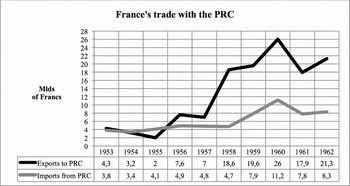
Chinese technicians were thus welcomed in France in February 1958 for a five-week mission, after which French company Sofrerail secured a contract to supply equipment for Chinese railways.Footnote 113 The year 1958 was a milestone in Sino-French economic relations: French exports increased from 7 to 18.6 billion francs, of which 66 per cent consisted of steel products. Although the second Rochereau Mission certainly contributed to cementing Sino-French exchanges, the freezing of commercial relations between China and Japan, which forced the PRC government to turn to Western Europe for massive purchases, certainly played its part.Footnote 114 Not only could Western European countries offer China high-quality technology, they also proved very eager to do so, engaged as they clearly were in a contest for rapprochement with the PRC.
As Figure 1 shows, from 1958 onwards French trade with Socialist China continued to grow. By 1960 the PRC had become France's primary customer in Asia, with imports of 26 billion francs, surpassing South Vietnam and India (at 22 and 20 billion francs respectively).Footnote 115 By 1960 many French businessmen were travelling to China and conducting successful business affairs.Footnote 116
France's trade with the PRC, 1953–1962.

France, as well as other Western European countries, would also benefit significantly from the Sino-Soviet split, which became evident in 1960 when the Soviets recalled their technicians involved in cooperation and aid programmes from China. Deprived of Soviet assistance, China turned to Western countries. Imports grew and also changed qualitatively, as the Chinese sought the technology and equipment from the West that Moscow would no longer supply. As a matter of fact, French and British enterprises competed strenuously in the fields of the aerospace, naval, and chemical industries, irrespective of the American administration's harsh reactions to the sale of such strategic goods to a Socialist regime.Footnote 117
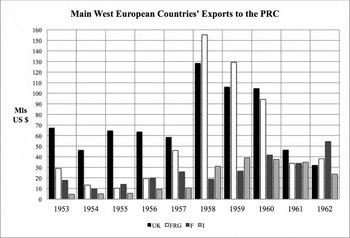
Yet economic and commercial interests did not represent a sufficient motivation for France to recognize Socialist China. Although acknowledging that diplomatic representation in Beijing would certainly assist French business better than the system of relying on accredited embassies in neighbouring countries, the French government estimated that recognition would not make a substantial difference in its trade with the PRC. States that already had diplomatic relations with China, such as Britain, the Netherlands, and the Scandinavian countries, did not gain business advantages unquestionably superior to those enjoyed by West Germany, Belgium, or France, which had excellent business relations with the PRC. It was West Germany, not Britain, that held the highest ranking among Western European countries in terms of exchanges with both Socialist China (see Figure 2) as well as with Nationalist Taiwan.Footnote 118 Although the PRC could well be accused of being politically driven in its dealings with underdeveloped countries, it was clearly driven by considerations of price, payment conditions, and quality when trading with Western Europe.Footnote 119
Main West European countries’ exports to the PRC, 1953–1962.

The rationale behind recognizing China, therefore, could have been politically motivated. The mainstream historiographical interpretation argues that General de Gaulle's return to power changed everything. The General believed that France should recognize the PRC, but for some years a series of obstacles prevented him from going ahead. Heightened Cold War tensions between 1958 and 1962, including the crises in Berlin and Cuba, made it harder to break ranks with Western allies, especially with the United States.Footnote 120 In addition, the ongoing war in Algeria made it impossible to conceive of political normalization with China: not only did PRC propaganda vociferously condemn French imperialism, it also actively supported the Algerian National Liberation Front by supplying international legitimacy, military advice, and weapons.Footnote 121 Yet, as Martin put it, ‘several factors helped to bridge the gap between France and China, especially from 1962 on’, for example, blossoming economic ties, the ending of the Algerian War with the signing of the Evian Accords, and the lessons learned from the Cuban crisis.Footnote 122
Although it is possible to share this interpretation at a general level, there is latitude to qualify it by bringing into the picture the underlying evolution of French policy towards the PRC. This article has already reported that a revision of France's China policy was already underway before de Gaulle's return to power, and that several steps had been taken to promote a certain degree of reconciliation with Beijing via cultural and economic relations. This evolution continued throughout the two crises in Berlin and Cuba, nor did the Algerian situation prevent the continuation of the gradual rapprochement between France and China. In fact, it is possible to argue that another international crisis influenced Sino-French relations for the better—that is, the Sino-Soviet split.
Already by February 1957, the French prime minister had received a note from the Quai d'Orsay's Directorate General of Political Affairs highlighting that ‘differences of interest are inevitable and already existing between Beijing and Moscow’.Footnote 123 In the same note, the Foreign Ministry lamented the American government's ‘complete disregard for the potential use of existing and potential divergent interests between Beijing and Moscow’.Footnote 124 American obduracy was indeed growing. In September 1958, a memorandum by the State Department refuted the assumption that it would be possible to loosen the Sino-Soviet alliance by forging diplomatic relations with Socialist China. French diplomacy could not have taken a more different view. It held that it was impossible to exclude a priori that the Soviets would try, sooner or later, to curb Chinese ambitions to play a more decisive international role. Neither did the Quai d'Orsay deem it possible to ignore that the Chinese, for their part, had an interest in seeking a conciliatory attitude towards the West as a counterweight to their dependence on the Soviet Union. In fact, the analysts of the French Foreign Ministry's Political Affairs Department believed that this interest would increase along with the Chinese economy's growing needs. If Sino-Soviet relations deteriorated, ‘the French Government would definitely consider it useful to the free world to exchange representatives with Beijing’.Footnote 125
After the Sino-Soviet split of 1960, other rationales for and incentives to recognizing the PRC accumulated, in spite of the fact that both the Algerian war and the Berlin crisis were still ongoing. First, the newly independent African nations, including those that were formerly French colonies, had no reason to remain loyal to Taiwan and sooner or later would establish relations with Socialist China. Beijing's prestige had increased decisively in the Afro-Asian world and it was in France's interest not to let the new African nations step away from the French Republic. It would therefore be wiser for France to be represented in Beijing before African countries opened their embassies there. Second, an embassy in Beijing would be able to collect useful intelligence and inform the French government in detail about a country ‘whose initiatives certainly weigh heavily on the world's destiny’ and whose population amounted to a quarter of humankind.Footnote 126
France's change of heart was particularly relevant in terms of its loyalty to the United States on this issue. A deviation from the American line was no longer conceived of as unthinkable. In fact, there was a genuine view at the Quai d'Orsay that France's recognition of the PRC ‘would not raise more objections than did some NATO and SEATO allies in the past (Britain, the Netherlands, Norway, and Pakistan)’.Footnote 127 Moreover, a clear element of competition with the Unites States emerged regarding normalization of relations with the PRC:
On the occasion of the beginning of détente between the Soviet Union and the United States—or should the latter's strategic stance in the Pacific soften—the [American] Democratic administration could be tempted to conclude an agreement on the question of Formosa. If such an agreement in turn helped the establishment of official relations between Washington and Beijing, it is indisputable that we would lose a lot of prestige if we were to wait until that moment to connect with the communist capital.Footnote 128
The elements of de Gaulle's grandeur were by then established. It only took the president finding the right moment to implement fully France's new China policy.
Conclusions
While agreeing with Robin that trade was not the driving force behind France's recognition of the PRC, it is possible to argue that economic relations played an important role in bridging the gap between the two countries’ political authorities and diplomatic officials. This rapprochement, though, did not occur in 1962, as Martin points out, but was rather a process that had been under development for almost ten years.
From the mid-1950s, commercial diplomacy was chosen as the means to establish an atmosphere conducive to the normalization of Sino-French relations. By carefully preparing, assisting, and monitoring the private channels of commercial and technical missions, the French government set in motion a gradual opening up of unofficial diplomatic contacts between France and the PRC at a time when the international situation discouraged steps towards official recognition. Trade and cooperation missions not only aimed to relaunch French economic interests in the area, they were also increasingly conceived of by the Quai d'Orsay as a political means by which to prepare the ground for future official relations. In other words, commercial missions were political trial balloons, meant to allow remote, and once hostile, interlocutors to better know each other's intentions, find common interests, and assess the possibility of developing substantial (though unofficial) contacts. The choice to nominate as the head of the first commercial mission an eminent senator of the Republic, and his confirmation to lead the successive mission—where he was also given the green light to discuss some political issues—was made with the intent of showing the Chinese the continuity and seriousness of the French government's interest in normalizing relations between the two countries. It is interesting to note that the French were also willing to step up to a more official level, provided the latter was confined to the realm of commercial relations and did not involve the official political sphere. Indeed, via the Berne channel, the French government asked if Chinese authorities would allow the opening up of a permanent French commercial representation in the Chinese capital. The post would not only take care of the business aspect of relations, but also establish more official contacts and materialize the French presence in Beijing.Footnote 129
To a certain extent, the question of normalizing relations with Socialist China acquired more and more importance in light of the evident, growing contest between European countries to reach out to the PRC. Besides actual competition in the realm of business and trade, it was important for France not to lose political status vis-à-vis other European countries and the world—the French grandeur that at its highest point de Gaulle would later incarnate and promote. Even more important, perhaps, was the necessity of not entirely losing a grip on former French colonies that were now newly independent states of Africa. French concerns about the PRC's appeal to these developing countries, and the fear that the latter might open official relations with and diplomatic posts in Beijing before France could step in, is quite revealing of the urgency felt in the Quai d'Orsay to rapprochement with Mao's regime. Nor was French reasoning deprived of Cold War-related considerations. French analysts in the Foreign Ministry had already detected both seeds for and evidence of a forthcoming Sino-Soviet split, and envisaged the possibility of weakening the Socialist camp by promoting China's relations with the West. In a sense, the French were 25 years ahead of the Americans, which eventually would undertake to play the China card during the Nixon administration. In the mid- to late 1950s, evidence of disagreement with the United States over treatment of the PRC, and annoyance at the White House's unwillingness to revise its reading of Cold War and international dynamics, progressively weakened France's disposition to comply with American demands to maintain a harsh stance towards Socialist China. Eventually, it took de Gaulle to break ranks and decide that France would officially recognize the PRC. Nevertheless, the General's move was preceded by a duly orchestrated, gradual ten-year rapprochement with Beijing that testifies to the evolution of French diplomacy's thinking and its assessment of China's and France's place in international relations. Although it is not the aim of this article to establish a direct link between these contacts and the way in which official relations between France and Socialist China were eventually established, some points can nonetheless be made for the benefit of further research and discussion.
First, upon assuming power in 1958, de Gaulle drew information from contacts that had been established in the 1950s: as Martin reports, Étienne Manac'h, head of the Asia department of the Quai d'Orsay, described de Gaulle as ‘passionately interested in all things Chinese and . . . always questioning visitors from Asia . . . about the evolution of Chinese affairs’.Footnote 130 Second, when launching his move towards the Chinese, de Gaulle decided to make use of previous paths and men: he sent Edgar Faure‘—because of the latter's experience with China—(. . .) on a secret mission to find out what the Chinese leaders thought about the prospect of establishing diplomatic relations’.Footnote 131 Finally, and perhaps most relevant, the Chinese did build on previous contacts with France: as clearly shown by Martin in his article, they continued to cultivate economic contacts with businessmen and establish unofficial channels with diplomats to ensure that de Gaulle knew of ‘their desire to establish diplomatic relations with France’.Footnote 132