INTRODUCTION
Prosodic prominence is a highly informative communicative device, allowing speakers to express meaning beyond the semantic content of the combined individual words in a sentence. Both children and adults often express joy, discomfort, and emphasis by changing the intonation or tunes of their utterances. One prosodic component that contributes to dynamic shifts in intonation is ‘pitch accent’ – an utterance-internal pitch excursion that leads to the perception of tonal prominence, which is typically aligned to a lexically stressed syllable (Beckman, Reference Beckman1986; Ladd, Reference Ladd1996; Pierrehumbert, Reference Pierrehumbert1980). An important function of pitch accent is to highlight the uniqueness of a particular discourse entity among a set of alternatives, and to indicate its contrastive relationship with alternatives: e.g., ‘I ordered fifty, not fifteen packages!’ (cf. Bolinger, Reference Bolinger1961; Chafe,Reference Chafe and Li1976; Gundel, Reference Gundel, Bosch and van der Sandt1999; Jackendoff, Reference Jackendoff1972; Pierrehumbert, Reference Pierrehumbert1980; Pierrehumbert & Hirschberg Reference Pierrehumbert, Hirschberg, Cohen, Morgan and Pollack1990; Watson, Tanenhaus & Gunlogson, Reference Watson, Tanenhaus and Gunlogson2008).
Experimental studies with adults have shown that contextually appropriate use of a prominent pitch accent can facilitate discourse comprehension (Birch & Clifton, Reference Birch and Clifton1995, Reference Birch and Clifton2002; Bock & Mazella, Reference Bock and Mazzella1983) and speed the detection of a contrastive referent targets (Eberhard, Spivey-Knowlton, Sedivy & Tanenhaus, Reference Eberhard, Spivey-Knowlton, Sedivy and Tanenhaus1995; Ito & Speer, Reference Ito and Speer2008, Reference Ito, Speer, Frota, Elordieta and Prieto2011; Weber, Braun & Crocker, Reference Weber, Braun and Crocker2006), whereas contextually inappropriate use of pitch accent may delay or mislead referential resolution (Dahan, Tanenhaus & Chambers, Reference Dahan, Tanenhaus and Chambers2002; Ito, Jincho, Minai, Yamane & Mazuka, Reference Ito, Jincho, Minai, Yamane and Mazuka2012; Ito & Speer, Reference Ito and Speer2008, Reference Ito, Speer, Frota, Elordieta and Prieto2011; Weber et al., Reference Weber, Braun and Crocker2006). For example, a series of eye-tracking experiments with English-speaking adults by Ito and Speer (Reference Ito and Speer2008, Reference Ito, Speer, Frota, Elordieta and Prieto2011) demonstrated that prominent pitch accent on a prenominal modifier facilitated visual search for the referent of the noun phrase. Participants performed a holiday tree decoration task with instructions such as ‘Hang the blue ball. Now, hang the green ball’. In this case, the pitch accent on green sped looks to the target referent ball, which had been primed by the immediately preceding instruction. Moreover, when the pitch accent was used inappropriately, it led participants astray. For example, in the instructions ‘Hang the blue ball. Now hang the green drum’, the prominent pitch accent on green signals that color is the relevant contrastive dimension. Such trials led to initial fixations to the green ball; that is, participants were garden-pathed to the wrong set of objects. Weber et al. (Reference Weber, Braun and Crocker2006) reported similar results in German.
Investigations with preschool-aged children suggest that it takes many years for children to acquire the pragmatic meaning of pitch accent. Afshordi, Weisleder, and Fernald (Reference Afshordi, Weisleder and Fernald2011) reported that three-year-old children were sensitive to how informative an adjective was (when faced with a red and a blue house, children look to the correct house upon hearing the adjective blue), but were not influenced by the contrastive function of pitch accent (accenting the adjective did not further facilitate children's ability to use adjectival information). Similarly, Arnold (Reference Arnold2008) found that four- to five-year-old children failed to use a pitch accent to detect an unmentioned contrastive object. Participants saw pictures of objects beginning with the same phoneme sequence (e.g., a bagel and some bacon), and heard sequences such as ‘Put the bacon on the star. Now, put the bacon on the square’. In adults (cf. Dahan et al., Reference Dahan, Tanenhaus and Chambers2002), the pitch accent on the target object in the second sentence led their initial fixations to the unmentioned competitor (e.g., after detecting the candy according to the first sentence, ‘Put the CAN …’ led fixations to candle). Children tested in Arnold (Reference Arnold2008) did not show such non-anaphoric interpretation of accent. Finally, Sekerina and Trueswell (Reference Sekerina and Trueswell2012) found that Russian speaking five- to six-year-old children could understand contrastive pitch accent in only a very limited manner. In Russian, information under emphasis is often fronted to the beginning of a sentence (which forms a so-called ‘split constituent’ construction) and this marked construction must be accompanied by a pitch accent. Sekerina and Trueswell (Reference Sekerina and Trueswell2012) found that children were able to use pitch accent to facilitate the detection of a target only when it was presented in an unmarked canonical word order.
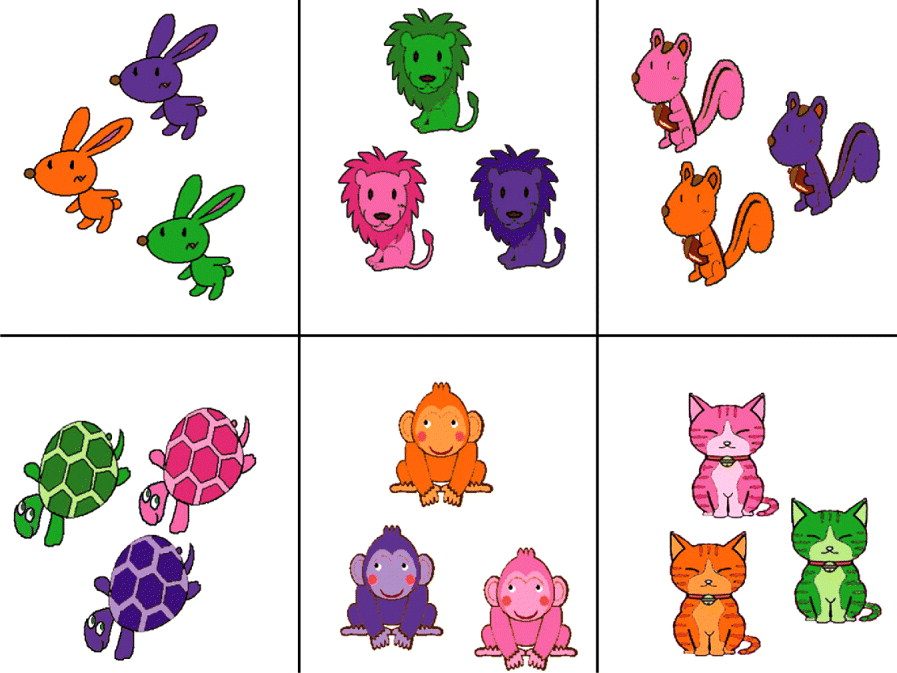
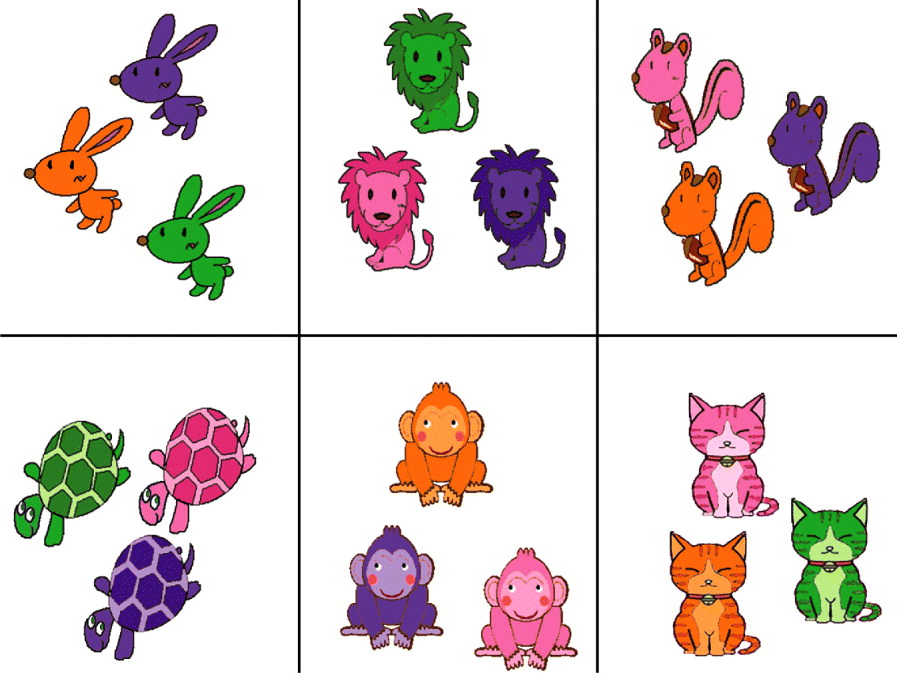
Unlike these studies, Ito et al. (Reference Ito, Jincho, Minai, Yamane and Mazuka2012) found that six-year-old Japanese-speaking children can make use of contrast-marking pitch prominence when they have sufficient time to update discourse statuses of referents. Since their task forms the basis of the current experiment, it is worth considering in detail. Participants were shown a display of animals (see Figure 1) and asked to find the location of two animals in a sequence (pinku-no neko-wa doko? ‘Where is the pink cat?’→jaa, midori-no neko-wa doko? ‘Then, where is the green cat?’). Adults demonstrated both facilitation and garden-path effects with pitch prominence on the adjectives (note that Japanese has lexical pitch accents and their tonal range is expanded when words are emphasized, leading to perception of prominence), depending on whether they were used felicitously or not. The six-year-old children also showed a facilitation effect, although it was largely delayed compared to the adult effect.
(Colour online available at journals.cambridge.org/jcl ) Example display.
Importantly, the children showed a strong tendency to keep fixating on the animal mentioned in the first sentence, which made it difficult to observe a garden-path effect in the non-contrastive sequences. That is, given the instruction sequence pinku-no usagi-wa doko? ‘Where is the pink rabbit?’→jaa, orenji-no saru-wa doko? ‘Then, where is the orange monkey?’, children's frequent looks to the rabbits (mentioned in the first instruction) were maintained during the second question regardless of the prosodic manipulation on the adjective. Young children's perseverative fixations to the first referent reflect a general tendency to maintain their initial interpretation of linguistic input, and to fail to update in response to incoming evidence (Choi & Trueswell, Reference Choi and Trueswell2006; Mazuka, Jincho & Oishi, Reference Mazuka, Jincho and Oishi2009; Minai, Jincho, Yamane & Mazuka, Reference Minai, Jincho, Yamane and Mazuka2012; Snedeker & Yuan, Reference Snedeker and Yuan2008; Trueswell, Sekerina, Hill & Logrip, Reference Trueswell, Sekerina, Hill and Logrip1999).
Noticing the strong perseveration tendency in children in the first experiment, Ito et al. (Reference Ito, Jincho, Minai, Yamane and Mazuka2012) hypothesized that the garden-path effect would surface if children had sufficient time to shift attention during discourse progression, and elongated the discourse marker and pause (jaa … →sorejaa …, ‘then …,’) intervening between the two instructions by 625 ms. With this manipulation of utterance timing, a long-lasting garden-path effect was detected in six-year-olds. This finding reinforces the idea that children possess the relevant pragmatic knowledge about the use of prosodic prominence, but are much slower than adults in processing it. Interestingly, extended timing led to the garden-path effects only for the older six-year-olds (6;6–6;11), suggesting children of this age are just beginning to shift their capabilities.
Despite this finding that six-year-old children can correctly interpret pitch accent, there are a number of past behavioral studies showing that children have difficulties in comprehending it until they are well into their school years. For example, in Cruttenden (Reference Cruttenden1985) (and see also Wells, Peppé & Goulandris, Reference Wells, Peppé and Goulandris2004), children listened to a sentence such as John's got four oranges and were asked to select a picture that matched the description from three choices: (1) a boy with four oranges and a girl with two oranges; (2) a boy with four oranges and a girl with four bananas; and (3) a boy with three oranges and a girl with four oranges. The correct choice is the first option, which portrays not only a boy with the right number of oranges, but contrasts his oranges along the correct dimension, namely number. More than a quarter of ten-year-old children did not reliably succeed at this task.
The studies showing later acquisition of pitch accent all involve off-line tasks, and as can be seen in the previous example, tend to involve sentences uttered out of the blue, which require a fair amount of pragmatic contextualization on the part of the child. By contrast, the six-year-olds who succeeded in Ito et al. (Reference Ito, Jincho, Minai, Yamane and Mazuka2012) were tested with an on-line measure and were provided with a sufficient discourse context that supported the contrastive interpretation of prosodic prominence. Therefore, it is highly likely that these task differences are an important factor for children as they acquire the use of pitch prominence over time. Here, we consider this issue of task differences from a slightly different perspective, focusing on changes in the ability to process the meaning of pitch accent information as they occur over time. The important assumption here is that the ability to correctly comprehend the accentual cue and use it swiftly for effective referential resolution is tightly related to the child's general processing capacity. In particular, the processing of a contrast-marking pitch accent seems to require a range of executive function skills that are known to develop in late childhood, including planning, goal setting, reasoning, decision-making, selective attention, and response inhibition (Anderson, Reference Anderson2002; Conboy, Sommerville & Kuhl, Reference Conboy, Sommerville and Kuhl2008; Davidson, Amso, Anderson & Diamond, Reference Davidson, Amso, Anderson and Diamond2006; Miller & Cohen, Reference Miller and Cohen2001, inter alia).
First, in order to form a contrastive link between one entity in the discourse background and another in the discourse foreground on the basis of pitch accent, the previously activated referents must be accurately represented (including what features of those referents are most salient for the current discourse). Second, while the discourse representation is being maintained in memory, cognitive resources must be allocated to process incoming referential expressions and attention needs to be shifted from the most recently activated referent to an incoming referent; this shifting process requires the listener to inhibit their representation of the initial referent. Third, because a prominent pitch accent evokes a contrast with a previous referent, listeners must re-activate the representation of the previously mentioned referent to guide their expectations about the incoming referent. Finally, in cases when the pitch accent leads to a garden path, listeners must revise the prosodically driven referential interpretation by re-directing their attention to the segmental information that labels the correct referent. That is, the recovery from a garden path requires the ability to accommodate a change in rules (from prosody to segmental information). Thus, processing pitch accent taps a variety of executive function and related cognitive skills, including delayed memory retrieval, attention shifting, inhibition, and flexible rule shifting.
Previous work in the domain of executive function development has found that there are ongoing improvements to children's skills in this area into adolescence. For example, Davidson et al. (Reference Davidson, Amso, Anderson and Diamond2006) tested children with a classic go/no-go task in which participants pressed buttons according to a dual association rule (e.g., butterfly → left; frog → right). They found that the ability to correctly refrain from pressing a button when the target appears in the location incongruent with the learned association (e.g., butterfly on the right side) improved gradually from the age of six years. They further showed that children's performances in the go/no-go tasks where the association rules switched did not reach adult levels even by age thirteen, demonstrating the protracted developmental trajectory in this domain. These findings, and others like them, support the claims about gradual development of executive function throughout childhood and adolescence (Bialystok & Craik, Reference Bialystok and Craik2010; Zelazo, Craik & Booth, Reference Zelazo, Craik and Booth2004; Zelazo & Müller, Reference Zelazo, Müller and Goswami2011).
The current experiment examines the on-line understanding of pitch accent in children acquiring English between the ages of six and eleven years. The focus of this work is on the processing changes that happen in this age range that influence children's ability to make use of pitch accent information. Because our primary interest is in the development of children's processing abilities, we restricted ourselves on the lower end of the age range to children we believe to have clearly mastered the semantics in question. Based on Ito et al. (Reference Ito, Jincho, Minai, Yamane and Mazuka2012), six years appears to be the youngest age at which children would show the effect of pitch accent in their on-line responses (although it is possible that the acquisition of contrastive pitch accent in English occurs at a much different time than it does in Japanese). The upper end of our age range was chosen to conform to the age at which previous behavioral work (cf. Cruttenden, Reference Cruttenden1985) has shown that the majority of children can succeed at using pitch accent even in a comparatively difficult off-line task. Thus our age range focuses on children who in principle should know how to interpret pitch accent information but who would likely have trouble deploying that knowledge in a flexible manner.
Based on the executive function literature and the ways in which those skills are necessary for processing pitch accent, we expected to find gradual improvement within our age range. Critically, our on-line measure allows us to see changes in specific areas of processing that are plausibly connected to specific executive function skills. We are not restricted to asking simply whether children succeed or fail to understand pitch accent (indeed, we expect all the children to succeed); instead we can see changes in specific processing skills over the course of development. Note that we do not have an independent measure of children's executive function skills; at this stage of this research program, we are simply seeking to establish that there are specific relevant changes in the processing of pitch accent in this age range. Below is a series of specific hypotheses about what changes were likely to occur in the present referential detection task.
First, we hypothesized that there would be early advances in the ability to inhibit attention to the previously mentioned referent. This skill is critical for continually updating the referents in ongoing discourse. Recall that Ito et al. (Reference Ito, Jincho, Minai, Yamane and Mazuka2012) had found that younger six-year-olds perseverated their attention on the initial referent even as they were being directed to shift away from it; older six-year-olds could shift attention when given extra processing time. We predicted that our English-speaking children would likewise show improvement in their ability to shift attention with age. Second, we hypothesized that there would be gradual improvements in the speed of children's processing with age. This increased speed should lead to faster shifts in attention to incoming discourse referents and quicker use of pitch accent information to guide anticipatory fixations. We therefore predicted that, over development, children would more quickly find the target object when pitch accent was used felicitously, but in addition they would also more quickly look towards the incorrect target when the pitch accent led them down the garden path. Third, we hypothesized that children would show improved speed in recovering from garden paths with age. Garden-path recovery is one of the most difficult elements of this task and, as noted above, taps several different aspects of executive function ability at once. Because of its difficulty, we predicted that improvements in this area of processing would be among the later developments in children's processing skills.
EXPERIMENT
Participants
Fifty-five six- and seven-year-olds (6;0–7;11, mean 6;5), 41 eight- and nine-year-olds (8;0–9;9, mean 8;6), and 25 ten- and eleven-year-olds (10;0–11;10, mean 10;5) were recruited, either through a local science museum, or through previous participation in a university laboratory. The data from 5 six- and seven-year-olds and 2 eight- and nine-year-olds were eliminated (color blindness (2); failure to complete the task (4); system error (1)). Data from five adults were eliminated for being non-native speakers of English.
All child participants were monolingual speakers of Midwestern American English and none had a history of language impairment or hearing difficulty. To collect adult data, 38 Ohio State University undergraduates were recruited in introductory-level psychology courses. None of the adult participants reported a history of language impairment or hearing difficulty. Children received a toy or a T-shirt, while the university students earned partial course credit for their participation.
Materials
A set of 48 slides was prepared by combining the eight animals (cat, monkey, rabbit, lion, fish, squirrel, frog, and turtle) in four colors (pink, green, orange, purple). On each slide, a total of 18 animals were sorted by animal type into six cells, and the three animals in each cell were differentiated by color (see Figure 1 for an example). All the animal and color labels were recognizable and familiar to young children, as determined by a naming task conducted with 12 children (4;1–11;0: mean 6;1), none of whom took part in the eye-tracking experiment. The combinations of animal and color were cycled such that each animal and color respectively appeared an equal number of times in each cell across the entire set of slides.
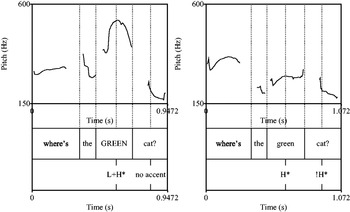
The auditory stimuli consisted of 48 pair of instructions – the context question and the target question. No particular accentual emphasis was placed in the context questions, while the target questions were recorded with two prosodic patterns – an emphatic contrastive pitch accent and a non-emphatic accent. These two accentual patterns were confirmed using the ToBI annotation conventions (Tone and Break Indices; Beckman, Hirschberg, Shattuck-Hufnagel, Reference Beckman, Hirschberg, Shattuck-Hufnagel and Jun2005). The contrastive emphatic pitch accent corresponded to an L + H* annotation and the non-emphatic accent corresponded to an H* on the adjective followed by a downstepped !H* on the noun (see Figure 2 for an example). All questions were digitally recorded by a female native speaker of American English at 44·1 KHz using Praat (Boersma & Weenink, Reference Boersma and Weenink1992–2010).
Example F0 traces: 2a. Adjective with emphatic L + H* followed by unaccented noun; 2b. Adjective with non-emphatic H* followed by noun with !H* (downstepped H*).

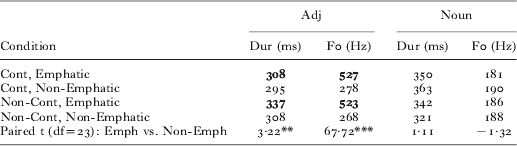
The acoustic analyses confirmed reliably longer duration and higher F0 peak for the contrastive pitch accented adjective than for the non-prominently accented adjectives in target questions, while there were no reliable differences in duration and F0 peak for the nouns across the two prosodic renditions (see Table 1).
Mean duration and F0 values of the Q2 adjective and noun
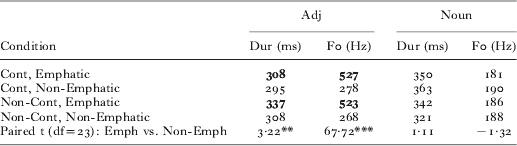
notes: ***p < .001, **p < .01
Cont = Contrastive sequences mentioning the same animal noun.
Non-Cont = Non-contrastive sequences mentioning different animal nouns.
Procedure
Participants were seated in front of a Tobii 1750 eye-tracker monitor and a set of speakers. Their eyes were calibrated using the Tobii ClearView 5-point calibration program. After a successful calibration, they were told to listen to questions that would inquire about the location of an animal on the display, and to answer those questions one by one. Adult participants were asked to press one of the six keys (numbered 1 through 6) on the computer keyboard, which corresponded to the layout of the six cells on the monitor. Children were asked to point to the animal on the screen. In each trial, the target question was played 1 s after the participant responded to the context question. Participants' eye locations during the target questions were sampled at 50 Hz.
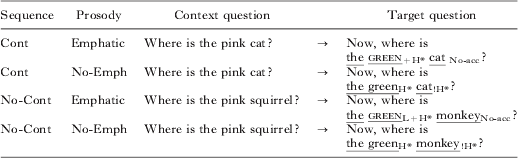
All participants saw a total of 50 trials consisting of two practice trials, 24 test trials (as just described) and 24 filler trials. Half of the test trials mentioned the same animal noun in both questions (creating a felicitous context for the contrastive pitch accent) while the other half mentioned different nouns across the questions (creating an infelicitous context for pitch accent). The color term was switched across the two questions in all test trials. Within each of the two context-target sequence types, half of the trials contained an emphatic pitch accent (L + H*) on the adjective of the target question, while the other half had a non-emphatic accent (H*) (see Table 2). As for the filler trials, half repeated the color across the two questions, while the other half mentioned different colors. The animal term was switched across the questions in all filler trials. Within each sequence type, half of the trials had an emphatic pitch accent (L + H*) on the noun, while the other half had a non-emphatic accent (!H*).
Experiment conditions: discourse sequence and intonation patterns
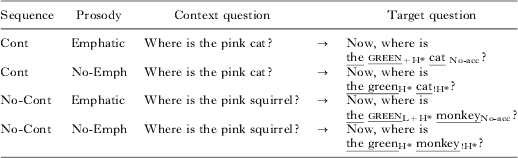
notes: Cont = locally contrastive (i.e., noun repeated), No-Cont = locally non-contrastive (i.e., noun altered).
Emphatic = Emphatic prosody with L + H* on the adjective, no accent on the noun.
No-Emph = Non-emphatic prosody with H* on the adjective, !H* (downstepped H*) on the noun.
RESULTS
There were six target areas of interest (AOIs) in each display, corresponding to the cells in the presentation grid. The fixation data were coded as either 1 (on) or 0 (off) for the given area of interest for each sampling point to calculate fixation likelihood (the log ratio of how often the AOI was fixated across the given number of trials. For the binomial data coding and the calculation of logit, see Agresti, Reference Agresti2002, Baayen, Reference Baayen2008, Barr, Reference Barr2008, Jaeger, Reference Jaeger2008, and Johnson, Reference Johnson2008). In the following graphs, the fixation patterns during the target questions are shown in logistic terms (logit; i.e., log odds). The logits averaged across participants were plotted for each sampling point (i.e., every 20 ms) such that the changes in the fixation patterns could be observed with the original time resolution. The data were aligned from the boundary between the adjective and the noun in target questions, and the data sampled preceding this boundary were plotted backwards (i.e., to the left). This plotting scheme was adopted from Ito and Speer (Reference Ito and Speer2008, Reference Ito, Speer, Frota, Elordieta and Prieto2011), as it would allow the examination of the effect of prosodic manipulation toward the end of the adjective as well as from the onset of the noun across the items that varied in word duration.
For the statistical analysis, the binomial data were submitted to mixed effects logistic regressions, which tested the effects of Accent (emphatic as compared to non-emphatic) and Time (change in fixation likelihood across time bins) as the predictor variables while modeling the effect of subjects and items as simultaneous random variables. All models included both subject-based and item-based differences in the effect of accent and fixation timing as random variables. In order to reduce the chances for Type I error due to oversampling (Barr, Reference Barr2008), the data were re-coded as 1 or 0 according to the presence or absence of fixation on the given AOI across three consecutive samples into 60 ms time bins.
Demonstration of knowledge of pitch accent
Our first set of analyses was aimed towards confirming that the children in this task did indeed understand the contrastive meaning of pitch accent. With respect to the processing components, knowledge of the contrastive meaning of emphatic pitch accent is demonstrated by two effects: facilitation effects, when the pitch accent on the adjective speeds the detection of correct target in felicitous sequences, and garden-path effects, where the pitch accent momentarily increases looks to the incorrect target in infelicitous sequences. To analyze participants' facilitation effects, we examined the test trials that presented a felicitous discourse context for the use of emphatic pitch accent – that is, the trials that mentioned the same animal noun in both questions. Participants' looks to the target AOI during the target question were compared between the trials with emphatic pitch accents (e.g., pink cat→green cat) and the control trials with non-emphatic accents (e.g., pink cat → green cat).
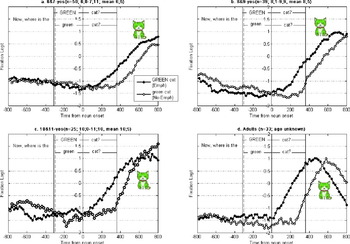
Figure 3 presents the fixation likelihood in the felicitous contrastive sequences. For each age group, the looks to the target cell increased earlier when the adjective had an emphatic pitch accent than when it did not. Importantly, the fixation rise in the trials with an emphatic accent was initiated shortly after the noun onset in all groups. According to past visual search studies such as Allopenna, Magnuson, and Tanenhaus (Reference Allopenna, Magnuson and Tanenhaus1988), Dahan et al. (Reference Dahan, Tanenhaus and Chambers2002), and Viviani (Reference Viviani and Kowler1990), adults' fixation rises toward the target referent are generally initiated 150–200 ms after the onset of relevant speech input, whereas preschoolers' fixation rises take place about 300 ms after speech onset (Arnold, Reference Arnold2008; Trueswell et al., Reference Trueswell, Sekerina, Hill and Logrip1999). Assuming that programming and execution of eye-movements also took 150–300 ms from the critical speech onset in the participants of the present experiment, the relatively early fixations to the target in the emphatic trials must have been driven largely by the adjective information. In contrast, a relatively late onset of fixation rise in the non-emphatic trials suggests that the eye-movements to the target were most likely guided by the noun's segmental information in the absence of the accentual cue to contrast.
(Colour online) Fixation likelihood for target referent during target questions in contrastive sequences (e.g., pink cat→GREEN/green cat). notes: The vertical lines indicate the average duration of the adjective and noun. Emph = trials with emphatic pitch accents. No-Emph = trials with non-emphatic pitch accents.

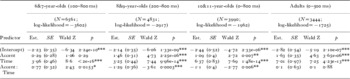
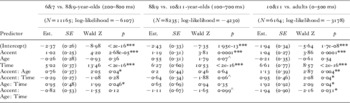
The results of logistic regressions confirmed the facilitating effect of emphatic pitch accent for all age groups (see Table 3). The analysis time window for each age group was determined by examining the beginning and ending of fixation rise in the grand mean function that collapsed the two prosody conditions (Barr, Reference Barr2008). The coefficient estimate for accent was positive for eight- and nine-year-olds, ten- and eleven-year-olds, and adults, indicating that their fixation likelihood for the emphatic trials was reliably greater than for the control non-emphatic trials at the beginning of each group's data analysis window. The six- and seven-year-olds did not show the effect of pitch accent but instead showed a reliable interaction between pitch accent and time, indicating that their fixation rises were steeper with the emphatic adjective than with the non-emphatic adjective. A robust effect of time in all groups confirmed the steady fixation increase toward the target within each group's time window. A reliable interaction between accent and time was found with a negative coefficient in eight- and nine-year-olds and ten- and eleven-year-olds, who showed a somewhat steeper rise for the non-emphatic trials within the respective time window (Figures 3b and 3c).
Summary of mixed effect logistic regressions for contrastive sequences: fixations to the target

notes: N = total number of observations. This indicates the total numbers of 0s and 1s coded for all 60 ms time bins across all the trials collected from all participants in each group. Reference condition = contrastive non-emphatic. ***p < .001, **p < .01, *p < .05.
Another measure of participants' contrastive interpretation of pitch accent was the presence of looks to the incorrect target (i.e., garden-pathed eye-movements) when the pitch accent was used infelicitously. To analyze participants' garden-path effects, we examined the test trials that contained an inappropriate discourse context for the use of contrastive pitch accent on the adjective – that is, the trials that mentioned the different animal nouns in the two questions. We compared participants' fixation patterns between the trials with emphatic pitch accents (e.g., pink squirrel→green monkey) and the control trials with non-emphatic accents (e.g., pink squirrel → green monkey).
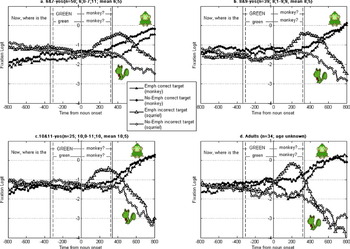
All age groups showed a robust garden-path effect. When the adjective in the second question had an emphatic accent, participants' eyes were initially drawn to the cell containing animals mentioned in the initial context question, and looks to that initial cell exceeded looks to the correct target cell until well past the noun offset (Figures 4a–d). Similar to the fixation patterns in the facilitative sequences, fixation rises to the context cell were initiated shortly after the noun onset in all three groups of children. In adults, the looks to the context cell started rising even earlier – during the latter half of the adjective. Such early fixations to the context animals indicate that participants immediately interpreted the pitch accent of the adjective contrastively, and anticipated being directed to the same type of animal before they processed the segmental information of the noun that specified the correct target. As a consequence of this accent-driven garden path, the detection of the correct second target was delayed in the trials with emphatic accents compared to the control trials with non-emphatic accent.
(Colour online) Fixation likelihood for incorrect (context) and correct target during the target questions in non-contrastive sequences (e.g., pink squirrel → GREEN/green monkey). notes: Emph = trials with emphatic pitch accents. No-Emph = trials with non-emphatic pitch accents.

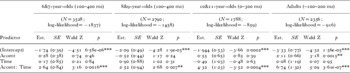
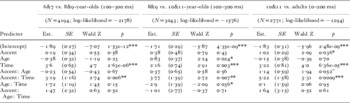
The time windows for the statistical analysis of the garden-path effect were again determined by examining the mean function across the two accent conditions for each age group. The results of logistic regressions confirmed a robust interaction between accent and time in all groups (Table 4). The robust interactions between accent and time and the non-significant time effects together confirmed the patterns of fixations to the initial context target seen in Figure 4: participants' fixations to the incorrect target increased within the respective time windows only when the adjective had an emphatic accent, and not when it did not. The adults showed a reliable pitch-accent effect as well, indicating that their fixations to the incorrect context target were higher for the trials with emphatic accents than for the control trials already at the beginning of the analysis window (i.e., the onset of the noun).
Summary of mixed effect logistic regressions for non-contrastive sequences: fixations to the context target

notes: N = total number of observations. This indicates the total numbers of 0s and 1s coded for all 60 ms time bins across all the trials collected from all participants in each group. Reference condition = non-contrastive non-emphatic. ***p < .001, **p < .01.
Overall, these data demonstrate that children of all ages understand the semantics of emphatic pitch accent: when it is present in a felicitous discourse context, all participants find the correct target animals faster; when it is present in an infelicitous context, all participants are garden-pathed and momentarily look to the previously mentioned target animals. With this basic knowledge in place, we turn next to examine developmental changes in processing ability based on our specific predictions.
Developmental improvement in perseveration
Based on Ito et al.'s results in Japanese, we predicted that the youngest children tested in the present experiment would show a tendency to perseverate, continuing to look to the animals mentioned in the context question even once they were asked to look at something new. This pattern was indeed found here. As can be seen in Figure 4a, during the initial part of the second target question (i.e., where is the), when participants have no information of any kind about what the target animal might be, the fixations of the six- and seven-year-olds were clearly higher to the initial context animals than to the correct target animals. None of the older age groups showed such a clear separation, suggesting that by eight years of age, children are no longer perseverating on the initial context animals once provided with new directions.
Developmental speeding of the use of pitch accent
We predicted that, as children developed, their processing would become more efficient, leading them to use pitch accent information more quickly, that is, they would show faster anticipatory responses based on the contrastive interpretation of emphatic pitch accent. With respect to facilitation, inspection of Figure 3 does suggest that there is a gradual speeding with age: the slopes for the trials with emphatic accents seem to be steeper in the older than in the younger groups, whereas the differences in slopes are less visible for control trials. It is particularly noteworthy that, relative to adults, even the oldest age group appeared to show a delay of approximately 400 ms (from 100 ms to 500 ms past the noun onset) in their facilitative use of pitch accent, suggesting that even though children of this age may perform in an adult-like way in off-line tasks, they still do not process pitch accent as efficiently as adults in an on-line task.
To verify that the facilitative use of emphatic pitch accent develops gradually with age, we submitted the data from adjacent age groups to logistic regressions that modeled accent, age, and time as predictor variables for fixations to the correct targetFootnote 1 in contrastive sequences (see Table 5). Reliable interactions between age and time and between age and accent were found for the six- and seven-year-olds vs. the eight- and nine-year-olds comparison and for the ten- and eleven-year-olds vs. adult comparison. Thus, older participants were not only faster to fixate the target in general, but they were also faster to fixate the target in response to accentual information than the younger participants. The analyses for the eight- and nine-year-olds and the ten- and eleven-year-olds showed a marginal age effect but not a reliable interaction between age and accent, implying large individual variability among children across this age range.
Summary of mixed effect logistic regressions for contrastive sequences: group comparisons of fixations to the target

notes: ***p < .001, **p < .01, * p < .05, ∧p < .1.
With respect to showing a garden-path effect, inspection of Figure 4 suggests that participants in the older age groups were again faster to fixate the incorrect context target cell given an infelicitous emphatic pitch accent than younger participants. Moreover, as was the case for the development of facilitative uses of pitch accent, the oldest group (ten- and eleven-year-olds), although faster than the younger children, nevertheless lagged behind the adults when going down the garden path. Again, it appears that even though children of this age group are qualitatively better than younger children in off-line assessments of pitch accent, they are still not quite adult-like in their abilities.
However, while statistical analyses to verify these impressions confirmed the difference between ten- and eleven-year-olds and adults, no significant differences were found among any of the child age groups. Logistic regression models tested both the initial incorrect fixations to the context target and the later fixations to the correct target (again by pooling the data from adjacent age groups). These models specified accent, age, and time as predictor variables and both subject-based and item-based differences in fixation timing and response to accent as random variables. For the fixations to incorrect context target, a reliable interaction between accent and time was found in each comparison (demonstrating the general presence of the garden-path effect). However, only a marginal interaction between accent and age was found in the comparison between the ten- and eleven-year-olds and the adults (see Table 6). No reliable interactions between accent and age were found among other age groups, nor were they found even in a comparison between the six- and seven-year-olds and the ten- and eleven-year-olds. Thus, the timing of incorrect garden-path fixations did not show age-related differences across childhood.
Summary of logistic regressions for non-contrastive sequences: group comparisons for fixations to context target

notes: ***p < .001, **p < .01, * p < .05, ∧p < .1.
Developmental speeding of garden-path recovery
The most difficult processing aspect of this task involved recovery from the garden path, and we predicted a protracted developmental trajectory for improvements in this area. Inspection of Figure 4 shows that the older participant groups were faster to re-direct their fixations from the incorrect target to the correct one in trials with infelicitous emphatic pitch accents. Across the four panels of Figure 4, the differences in the timing of recovery from the garden path can also be observed in the location of the point where the function for the fixations to the correct target cell (filled triangles) crosses the function for the fixations to the incorrect target cell (open triangles). This cross-over point, which roughly indicates the time beyond which the correct target was identified, appeared earliest in adults (at approximately 360 ms), then later for ten- and eleven-year-olds (at 440 ms), followed by eight- and nine-year-olds (at 520 ms), and finally six- and seven-year-olds (at 600 ms).
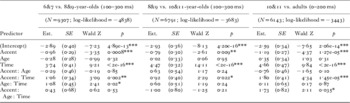
As was found for the analyses of developmental changes in the speed of incorrect fixations, the analyses of the speed of recovery from the garden path found that ten- and eleven-year-olds were different from adults, but there were no differences among the child age groups. Logistic regression models for fixations to the correct target specified accent, age, and time as predictor variables and both subject-based and item-based differences in fixation timing and response to accent as random variables (see Table 7). The results demonstrated significant effects of accent with negative coefficients indicating that the detection of the correct target was largely delayed due to the presence of the infelicitous pitch accent, regardless of age. Moreover, there was a reliable interaction between accent and time in all comparisons, showing that, across all ages, participants had faster fixations to the correct target when they were garden-pathed. However, while general age-related improvement in visual search was found in the comparison between six- and seven-year-olds and eight- and nine-year-olds (as indexed by an interaction between age and time), no interaction between accent, age, and time was found among these age groups to signal an age-related improvement in the recovery from the garden path. Similarly, we failed to find the relevant interaction among accent, age, and time among eight- and nine-year-olds and ten- and eleven-year-olds, or even between six- and seven-year-olds and ten- and eleven-year-olds. Only when comparing the ten- and eleven-year-olds to adults did a reliable interaction between accent, age, and time emerge. Thus, it appears that the timing of garden-path recoveries did not show age-related differences across childhood.
Summary of logistic regressions for non-contrastive sequences: group comparisons for fixations to correct target

notes: ***p < .001, **p < .01, *p < .05.
DISCUSSION
Contrastive pitch accent is a prosodic signal that can help guide a listener's expectations (when it is used felicitously) or mislead a listener (when it is used infelicitously). Past studies had suggested that although children understand the basic semantics of emphatic pitch accent by the age of six years, they continue to have difficulty using it in off-line tasks until they are as old as ten or eleven years. The current study used an on-line comprehension task to assess children's processing of pitch accent through this period where they possess this knowledge of intonational meaning, but cannot always deploy it efficiently and effectively.
The results of the present experiment confirmed that children acquiring English do indeed possess the semantics of contrastive pitch accent by around six years of age. The youngest children tested here demonstrated both facilitative as well as garden-path effects of pitch accent. To our knowledge, this is the first demonstration of on-line processing of contrastive accent in English-speaking children. The results indicated that the basic mechanism of pitch accent processing did not differ between adults and children: upon hearing a prenominal adjective with an emphatic pitch accent, listeners of all ages built a contrastive link between the most recently activated referent and the new referent. This immediate contrastive linking elicited anticipation for the incoming noun to be the same as that of the preceding referent, and therefore facilitated the target search when the pitch accent was used felicitously, but led to garden-path effects when the pitch accent was used infelicitously.
We predicted several developmental improvements in processing through this age range, but our predictions were only partially confirmed. As expected, older children became much more adept at shifting their attention after the first question and, indeed, only children in the youngest age group perseverated on the initial context target after that sentence was completed. Also as expected, there was a gradual improvement in the facilitation effect of pitch accent with age. Across each of the age groups tested, there were significant increases in how quickly children found the correct target cell after hearing the adjective with an emphatic pitch accent.
However, when considering the processes of accent-driven garden paths and recoveries from them, our results found no statistically significant development across childhood, but only a significant speeding between the oldest children and adults. Qualitatively, there do appear to be improvements in speed across ages for both aspects of the garden path, but perhaps because of large amounts of individual variability, age-related differences in fixation timings were not reliable in the mixed effects regression models. Importantly, however, reliable differences were found between the oldest ten- and eleven-year-old children and adults. Thus, although children do demonstrate an adult-like pattern of interpretation – they can be garden-pathed by an infelicitous pitch accent and can recover from it – nevertheless, their processing abilities in this area appear to be behind those of adults, even in very late childhood.
Why did children's behavior with respect to infelicitous use of pitch accent show little developmental change over this time period? One possibility is that children actually do not command the semantics of contrastive pitch accent, and that the presence of an accented adjective simply serves to focus children's attention in a general way to the speech signal. Such a focusing effect might make children find the associated noun faster – not because they were forming an appropriately contrastive expectation, but simply because they were paying more attention to the signal at that moment. This alternative is quite unlikely, however, as it cannot explain why children at all ages get garden-pathed in the first place. Lack of contrastive interpretation and ease of referential detection due to acoustic prominence would predict that children's fixations to the correct target would become speedier regardless of the discourse context. The present results instead demonstrated that children in the tested age range are processing the accentual information according to the preceding discourse context.
We suspect that the explanation for the lack of gradual improvement in the timings of garden paths and recoveries from them depends on two factors: children's slower processing overall, and their prolonged difficulties with the executive function task of rule-switching. Consider first the process of recovering from a garden path. The ability to switch from one analysis to another is a critical skill for such recovery: listeners have used the pitch accent information on the adjective to form an expectation about the target noun, but this expectation must be revised once the segmental information of the noun suggests it is incorrect. Previous research in the domain of executive function has shown that even children as old as eleven years continue to have trouble with tasks that require them to switch from one rule to another (Brown, Reference Brown and Reese1975; Dempster, Reference Dempster, Brainerd and Pressley1985; Diamond, Reference Diamond1995; Kovacs & Mehler, Reference Kovacs and Mehler2009; Lamm, Zelazo & Lewis, Reference Lamm, Zelazo and Lewis2006; Zelazo & Frye, Reference Zelazo and Frye1998). Although children may be improving their rule-switching abilities gradually between the ages of six and eleven years, they may not have reached the point where those incremental gains cash out in measurable improvements of timing in garden-path recovery. In essence, we may be dealing with a floor effect in this domain for this age range.
The fact that there is no development in the timing of the initial incorrect garden-path fixations, however, requires a little more explanation. A priori, we expected that the facilitative and garden-path effects of contrastive pitch accent would develop in tandem, as both cases seem to depend on the same process: the contrastive pitch accent provides an expectation which listeners act upon. However, it appears that children act on this expectation slightly differently depending on whether pitch accent is being used felicitously or not. When discussing how listeners recover from a garden path, we implied that there is strictly sequential process involved: first listeners use the pitch accent information on the adjective and then they revise their analysis on the basis of the segmental information in the noun. For very fast sentence processors (like adults) this incremental process may in fact be very close to accurate. However, for slower processors (perhaps like all the children in this experiment) it may be too much of an idealization. Children are building expectations on the basis of the pitch accent, but they are likely to implement those expectations more slowly than adults and thus hear segmental information of the target noun before they have fully established the opposing expectation driven by the pitch accent. That is, children may be coordinating the conflicting pieces of information simultaneously, rather than in sequence. The presence of this incongruent information may slow children down as they enter the garden path. Perhaps faster processing of garden-path cases is possible only after the facilitative effects of pitch accent have reached some higher threshold of speed.
Finally, we note that the youngest English-speaking children tested here appear to show qualitatively stronger effects of contrastive pitch accent than the comparably aged Japanese-speaking children in the original Ito et al. (Reference Ito, Jincho, Minai, Yamane and Mazuka2012) work. It is difficult to make direct comparisons across the two studies because of differences in the auditory stimuli, testing environment, and ages of the children involved. However, it does raise the possibility that there are language-specific properties in the form and use of pitch accent that interact with the acquisition process. For example, it seems possible that emphatic pitch accents in English generally involve more drastic pitch excursions than pitch expansion in Japanese, which must preserve the lexical pitch shape. In addition, durational cue may have different contribution to the perception of emphasis, as accentuation in English increases the duration of associated stressed syllables, whereas pitch expansion in Japanese does not change moraic duration much, presumably to maintain the durational contrast between short and long vowels (Ito, Reference Ito2002). Future work in this area will investigate how language-specific differences may contribute to children's acquisition and processing of pitch accent and other prosodic dimensions of language.
In summary, this present study has demonstrated that children as young as six years old not only understand the contrastive meaning of emphatic pitch accent, but also process it in qualitatively similar ways to adults. Nevertheless, the on-line method revealed that children as old as eleven years are not processing pitch accent at the same levels as adults. Prosody conveys rich information about referential status (in addition to other cues such as speaker's intention and syntactic structure), and on-line integration of such multi-layered prosodic cues is not trivial. The present data suggest that a child may take years to become efficient in updating referential representations according to the accentual cues, and its trajectory may be related to her general cognitive abilities. Further investigation is necessary to reveal the link between the individuals' general cognitive skills and their efficacies in processing prosodic information, and the on-line measure of speech processing would be essential for such avenues.