




No CrossRef data available.
Article contents
- Abstract
- SOURCE: RAMSEY ESTATEs' MANORIAL ACCOUNT ROLLS
- METHODOLOGY
- AGRARIAN LABOR PRODUCTIVITY IN THE TENANT FARMERS' SECTOR
- AVERAGE LABOR PRODUCTIVITY RATES BEFORE THE BLACK DEATH
- GAUGING THE REPRESENTATIVE NATURE OF RAMSEY ESTATEs' MANORS
- CONCLUSION
- THE STRUCTURE OF THE ACCOUNT ROLLS
- LABOR INPUTS OF WAGE WORKERS
- LABOR INPUTS OF TENANTS
- INTERPOLATING FOR MISSING OPERA
- SOME PLOWING AMBIGUITY
- OVERALL LABOR PRODUCTIVITY
- References
English Agrarian Labor Productivity Rates Before the Black Death: A Case Study
Published online by Cambridge University Press: 29 March 2004
Article contents
- Abstract
- SOURCE: RAMSEY ESTATEs' MANORIAL ACCOUNT ROLLS
- METHODOLOGY
- AGRARIAN LABOR PRODUCTIVITY IN THE TENANT FARMERS' SECTOR
- AVERAGE LABOR PRODUCTIVITY RATES BEFORE THE BLACK DEATH
- GAUGING THE REPRESENTATIVE NATURE OF RAMSEY ESTATEs' MANORS
- CONCLUSION
- THE STRUCTURE OF THE ACCOUNT ROLLS
- LABOR INPUTS OF WAGE WORKERS
- LABOR INPUTS OF TENANTS
- INTERPOLATING FOR MISSING OPERA
- SOME PLOWING AMBIGUITY
- OVERALL LABOR PRODUCTIVITY
- References
Abstract
It is often suggested that an agricultural revolution, currently defined as a rise in the output of arable workers, was a necessary precursor to industrialization and improved living standards. This article provides the first direct measurement of arable workers' average labor productivity for pre-industrial England. Rates are assessed for those production conditions that it is thought resulted in the lowest agrarian labor productivity rates in the pre-industrial period: c.1300–1348. The rates for English workers before the Black Death either surpassed or met the literature's best estimates for English workers until 1800, well after industrialization was underway.
Information
- Type
- ARTICLES
- Information
- Copyright
- © 2004 The Economic History Association
Development economists' debate over whether population growth hinders or promotes growth in poor countries is echoed among economic historians interested in pre-industrial Europe.1
For an introduction to the debate between economic historians over the relationship of population growth and development, see, for instance, Livi-Bacci's, Concise History, pp. 80–111.
Solving this debate and the related question of pre-industrial global divergence is complicated by the lack of good aggregate data, which becomes available only for the mid-nineteenth century or later. The debate on the state of the pre-industrial western European economy and living standards hinges upon agrarian labor productivity rates but direct measurement of such rates is not feasible. For most of the pre-industrial period, researchers lack data on population numbers, employment numbers in different sectors, and GNP. For example, estimates of England's population c.1300 vary by as much as 3.6 million, from a low of 3.4 million to a high of six or seven million.2
Russell, “The Pre-Plague Population,” pp. 1–21. See also, Hallam, “Population Movements,” pp. 508–93; and Smith, “Demographic Developments,” pp. 25–78.
Researchers therefore employ indirect clues, such as real wages and urbanization rates, to shed light on labor productivity levels. Researchers with opposing views, however, dispute such indirect evidence and find that alternative frameworks lead to divergent perspectives on development.3
For example, E. A. Wrigley and Phillip Schofield contend that the later sixteenth century experienced a decline in labor productivity. They argue that this decline is suggested by a fall in the real wages of construction workers; they correlate this change and its causation to a rise in population. Robert Allen has recently produced a new real wage series which often differs from that if Phelps-Brown and Hopkins, the real wage series employed by Wrigley and Schofield. Allen argues that labor productivity rose in the late sixteenth century, as illustrated by the slight improvement in the real wages. See, Wrigley and Schofield, Population History; and Allen, “Real Wages.” For criticisms of the statistical analyses of Wrigley and Schofield, see Lindert, “English Living Standards.”
Postan, “England,” pp. 549–632.
Hallam, “Population and Landholding,” pp. 966–1008. Persson, Pre-Industrial Economic Growth.
Britnell, “Commercialization.” He has recently qualified his optimistic view of the pre-1300 period based on the belief that agrarian labor productivity was low. See, “Surveys,” pp. 1–16. For a critique of all these perspectives, see Hatcher and Bailey, Modelling, pp. 21–65 and 121–74.
Adding fuel to this debate are the pioneering research findings of Bruce Campbell and Mark Overton on pre-industrial English land productivity. It was thought that medieval land productivity was significantly lower than that found in later centuries; in earlier research, the agricultural revolution was defined as a significant improvement in both land and labor productivity. Although yields fluctuated, Campbell and Overton find that the high yields per acre in English open fields before the Black Death, surprisingly, were not surpassed until around 1700.7
For example, Campbell and Overton, “New Perspective,” pp. 38–105.
Campbell, “Agricultural Progress in Medieval England,” pp. 26–46. Boserup, Conditions.
This article sheds light on this question by providing the first direct measurement of average agrarian labor productivity at the disaggregate level for medieval England—indeed, these are the first such rates produced for any pre-industrialized European country. Because of England's success story, her development path has served as a yardstick against which the experiences of other countries and periods are measured. Historians often argue that she experienced the first agricultural revolution in labor productivity sometime in the seventeenth or eighteenth century. Explanations for this revolution vary and include enclosures of open fields (efficiency gains garnered by a shift to private property or economies of scale with bigger farms), improvement in the quality of labor inputs (elimination of serf labor and an improvement in wage labor), changes in the agrarian social structure (the elimination of serfdom and the emergence of capitalist tenant–landlord relations), and technological improvements.
Labor productivity rates are therefore assessed here for the period between c.1300 and 1348 for which researchers predict that the output per arable worker was at its lowest level. Although there is some debate over a possible population decline during the half century before the Black Death reached England in 1348, it is still thought that the early fourteenth century population was not achieved again until the early modern period, perhaps as late as the eighteenth century.9
The exact century in which English population numbers for the first half of the fourteenth century were surpassed depends upon which estimate for this period is employed. See Wrigley and Schofield for estimates of English population numbers from the sixteenth to the eighteenth centuries, Population History, especially, pp. 563–87.
The analysis employs disaggregate data (aggregate data are not available for this period). In any case, aggregate sources, even centuries later, offer at best only rough approximations of output and inputs whereas medieval local farm records provide fairly precise information. The data here are drawn exclusively from records belonging to Ramsey Estates. The focus is on the arable sector because it is here that researchers predict a dramatic rise in the output of workers in the early modern period. Researchers agree that the labor productivity of pastoral workers was always high. Furthermore, grain and legumes were the major staples in the pre-industrial diet so the output of arable workers would profoundly affect living standards.
The volume and real value of the average labor productivity of workers in the open fields on the Ramsey manors before the Black Death (depending on how the comparison is made) either surpassed, met, or was not much below the literature's best estimates of productivity of free wage workers employed on enclosed farms in early-nineteenth-century England. These estimates indicate, at best, agrarian labor productivity in the arable sector rose above these pre–Black Death rates sometime after 1800, well after industrialization was under way.
Because these findings will surprise some researchers (initially, they surprised even me), this article focuses on a detailed outline of the source and methodology employed to calculate medieval average labor productivity. Rates are then presented and discussed in reference to comparable estimates made in the literature. Additional data on average medieval labor productivity and the implications of these findings for development will be presented elsewhere.
SOURCE: RAMSEY ESTATEs' MANORIAL ACCOUNT ROLLS
Manorial farm account rolls, employed in this study, supply more than enough information to measure agrarian labor productivity directly. The rolls document in great detail the inputs and outputs of land, labor, and capital for the landlord's share of the open fields on the manor, known as the demesne. They are truly, as noted by Postan, the best source on the English agricultural sector available to historians until nineteenth-century records.10
Stated by Postan in a conversation with J. Ambrose Raftis.
Harvey, “Introduction,” p. 14.
The account rolls offer an almost unique opportunity to study the labor inputs in arable and pastoral sectors separately. The managerial practice was to hire full- and part-time workers who were generally employed exclusively in one sector. Estimating inputs from an estate complex in which tenants' labor was widely employed on its demesnes offers another significant advantage: each arable job performed by a tenant on Ramsey Estates' manors could not exceed one day of labor but might well require less.12
At harvest time, certain tenancies in some locales owed multiple works or workers per day.
Thousands of manorial account rolls, dating mostly from the late thirteenth to early fifteenth centuries, survive. During the thirteenth and fourteenth centuries, many English landlords deviated from the normal practice of leasing their demesnes and instead directly cultivated some or all of their manors.13
For some views as to why direct cultivation of the demesne became widespread in these centuries, see Harvey, “English Inflation”; Miller, “Farming”; and Raftis, Ramsey Estates, especially pp. 76–91 and 96–128.
The manors analyzed in this article lay in three counties, which were employed by Koskminsky in his study: Bedford, Cambridge, and Huntingdon. He notes that this estimate is not necessarily representative for the rest of England. See his Studies, pp. 89–94.
On the development of manorial farm accounts, see Harvey, “Introduction.” On this matter and for a discussion of auditing procedures, also see Oschinsky, Walter of Henley, especially pp. 213–60.
The reeve received free rent and sometimes some perks for this job. The demesne might also be managed by a “baliff,” who worked for wages. As a rule, reeves managed the demesnes on Ramsey Estates before the Black Death.
Account rolls were drawn up at the end of the fiscal year. For example, a fiscal account roll year of 29 September,1323 to 28 September, 1324 was produced in September of 1324. A crop was harvested in the summer of 1324 but there was no possibility of processing the entire crop fast enough to record its output in the fiscal year of 1323/24. Instead, this crop was threshed and winnowed over the course of 1324/25 and appeared in the accounts for this fiscal year. On this medieval accounting practice, see Titow, p. 35. The labor inputs, therefore, expended on the harvest recorded in the fiscal year of 1323/24, with the exception of threshing and winnowing, appeared in the fiscal accounting year of 1322/23. Interpolation of labor inputs can be safely employed. Farmers did not change their labor inputs per acre in the arable sector significantly from one year to the next; nor did sown acreage vary much from one year to the next year. Changes were made gradually, over time, and farmers did not change their practices dramatically within two years. Changes in labor inputs found in consecutive years, extant for the post-1350 period, were usually an insignificant 10 percent a year. Even for fiscal years spaced widely apart in the pre-1350 period, labor inputs, as shown in Appendix Table 1, are still fairly consistent between years. Of the account rolls that differed in their labor inputs per acre significantly from other years, four were from the exceptionally poor harvest year of 1297/98. Unusually higher inputs per acre in this year resulted from many more tenants attending the reaping and plowing boonworks. This was likely a charitable gesture on the landlord's part, as large amounts of food were distributed to workers at these gatherings.
The date at which these individual demesnes were leased varied from the late fourteenth to the early fifteenth centuries.

Documenting all labor inputs on the demesne in the account rolls was a particular concern for the landlord, because he wanted to keep labor costs to a minimum. For example, a contemporary agricultural treatise on accounting methods for these rolls, the Husbandry, advised that when full-time wage workers were occupied with jobs that were also performed by others, such as threshing, the work of such full-time employees was to be carefully distinguished in the accounts from that of the others (usually part-time pieceworkers and tenants) “because the lord ought not to pay anything for their [the full-time employees] threshing.”19
Oschinsky, p. 421. On the possible dating of the Husbandry to c.1300, see ibid., p. 201. For instance, in Ramsey Estates' account rolls, the grange section, which recorded the output and the yearly expenditures of crops, very carefully distinguished the amount of each cereal or legume type threshed by pieceworkers and tenants. Full-time demesne employees rarely threshed until after the Black Death.
Ibid., p. 445.
The careful accounting of all jobs (labor rents and boonworks) performed by tenants was of special concern to the landlord.21
Loveboons or boonworks were works required in addition to the regular work week. They were usually performed at times of peak demand for labor, such as harvesting. Although strictly defined in number and type, they were theoretically performed only when requested by the landlord. That is, they were somewhat arbitrary in nature. On the Estates, such loveboons were standardized in number and type and incorporated into the regular labor rent system. On the standardization of loveboons, see also, Jones, “Harvest Customs … the Hay Harvest,” p. 106.
“Seneschaucy,” p. 269 in Walter of Henley. Oschinsky dates this treatise to c.1276. See, Oschinsky, “Introduction to the Seneschaucy,” p. 75.
Ibid., pp. 279. See also the “Husbandry,” p. 435 in Walter of Henley. “Customary tenancies” were those landholdings that owed a specified amount of labor on the demesne or the cash value of this work for their rent. Those leasing freehold property on the manor also often provided a slight amount of work on the demesne as part of their rent, usually in the form of boonwork(s).
Although it has been acknowledged that account rolls have the potential to supply accurate calculations of agrarian labor productivity, the complexity of this source has deterred their use. The rolls actually document a very flexible system of allocating inputs within a superficially rigid structure of accounting. In order to exploit the source fully, one must move beyond the surface to uncover the dynamic decision-making process in the day-to-day operations.24
On the impact of economic epistemologies on accounting practices, see Poovey and Miller, “Accounting”; and Hoskins and Maeve, “Writing.”
Ramsey Estates, held by the Benedictine order, was one of larger estates in medieval England. The abbey was founded around 970 and remained active until the dissolution of the monasteries in 1539. At the time of the Domesday survey in 1086, the agrarian holdings of these Black Monks included 23 complete villages, substantial amounts of land in 23 rural communities, and small amounts of land (under 120 acres or so) in more than 13 locales.25
For an outline of the Abbey's foundation, see Raftis, pp. 1–6, and for its agrarian holdings in 1086 and subsequent purchases of land in the thirteenth century, ibid, table 1, p. 20 and table 20, p. 110.
Because opera sections were often attached on a separate membrane to the end of the roll before the Black Death, they could be easily detached and lost. The number of such sections that survive for Ramsey Estates, based on my comparative reading of three other large estates' account rolls, again, seems to be exceptional. Without reading all extant account rolls in England, though, it is hard to say anything more definitive. See Appendix 2.
A deliberate decision was made to focus on a single estate complex in this study.27
By using manors located within one estate, it was also possible to distinguish between estate-wide managerial decisions and those carried out on a local level, on each manor, which seemed to reflect local farming practices. This issue is paramount in distinguishing which demesne productivity rates are applicable to the vast tenant farmers' sector. Kathleen Biddick's work (Biddick with Bijleveld, “Agrarian Productivity,” pp. 95–123.) has highlighted the import of approaching the question of land productivity within the framework of central estate management. The hypothesis that medieval English land productivity rates were low was predicated largely upon the evidence from Titow's Winchester Yields. Biddick attributes low yields per acre on many Winchester manors to an orientation to pastoralism on these manors. Equally as important were the extraordinary low capitalization rates on these demesnes, which were caused by the periodic stripping of Winchester Estates' working capital by the crown. J. Ambrose Raftis's The Estates of Ramsey Abbey, which examined Ramsey Estates' central management practices over the centuries in quantitative detail, has proven to be an invaluable aid in untangling the local and central decision-making process.
See, Raftis, Estates, throughout, on the nature of the farming system on Ramsey Estates' manors.
This practice is found for both wage and tenant labor. Tenants who worked on a manor other than their own had their works entered on the opera section of their home manor to which they owed the labor rents; no notation that such “foreign” tenant work was performed was made on the account roll of the nonhome manor. The reeve, the demesne manager, only needed to provide a report of those labor inputs for which he was financially responsible. So, the reeve on the home manor noted the payment of labor rents from customary tenants with holdings on his manor but the reeve on the manor where these “foreign” tenants paid their labor rent, did not need to report their inputs. As long as all account rolls and opera sections are extant for the same years for each manor in such an administrative unit, it is possible to accurately calculate labor inputs. Even when this is not the case, interpolation can still supply relatively precise estimates.
All extant account rolls for all manors in the estates were examined, and eight manors selected as the focus of this study. These manors each possessed a good series of account rolls from before and after the Black Death.30
Because in all these cases, each manor consisted of a single village, the terms manor and village are used interchangeably, whenever referring to characteristics or activities that were likely common to both the seigniorial and tenant sector.
The villages of Abbots Ripton, Elton, Upwood, Warboys, and Wistow were located in Huntingdonshire. Gravely and Knapwell lay in Cambridgeshire, and the village of Shillington was in Bedfordshire. For a map of these and the other manors of Ramsey Estates, see Raftis, Estates, p. 20. For a description of these manors, see ibid., throughout.
The negative qualities of clay soils have been a bit overstated in the literature. It should be borne in mind that although such soils required more work in some types of jobs, particularly to ensure adequate irrigation, they were far more fertile than the chalky and sandy soils found often in the eastern regions of England. The “bread basket” regions of both Canada and the United States are dominated by clay soils.
METHODOLOGY
The methodology employed to calculate labor productivity in the arable sector from account rolls is briefly outlined in Appendix 2. Given space restraints, the appendix is only a cursory summary of the approach and source, which occupies some 130 pages in the thesis; it focuses on the key points in the measurement of labor inputs and output.33
Necessary also to this analysis was the reconstruction of the labor rent system on the estates, as well as the socioeconomic, cultural, and environmental conditions of each village in this study. The latter permitted an understanding of the rationale for farmers' economic decisions. These findings will be explored elsewhere.
I have located only few early modern farm accounts that might permit a breakdown of days worked in the two sectors: arable and pastoral. Likely the most viable approach would be to estimate the output per worker for both sectors with these records. In using these accounts, some allowance must be made for labor inputs of the farmer and his family, because they are not recorded in the same fashion as that of wage labor. For a discussion of early modern farm accounts and their methodological issues, see Collins, E. J. T. “Historical Farm Records”; and also Turner, Beckett, and Afton, Farm Production.
AGRARIAN LABOR PRODUCTIVITY IN THE TENANT FARMERS' SECTOR
Evidence in the account rolls for the demesne suggests that they might also offer insight into agrarian labor productivity rates of tenants, who comprised some 75 to 90 percent of the population. Some specialists in estates studies have already suggested that account rolls might serve as an index to tenant practices, albeit in reference to seeding rates and crop mixes on demesnes. Mavis Mate and Bruce Campbell note the variation, often extreme, in seeding rates per acre and crop mixes from demesne to demesne (manor to manor), respectively, within one estate complex. They attribute this to a local decision making by the reeve, the local tenant who managed the landlord's portion of the demesne, who simply employed the same seeding and crop geography practices carried out by tenants on their own land. In other words, the landlords were following tenants' management practices.35
Mate, “Medieval Agrarian Practices,” pp. 22–31. Campbell, (“Arable Productivity”) like Mate, concludes that “the man who owned a demesne was probably less important that the man who ran it … [according to] … prevailing local husbandry practices,” pp. 387, 397–98.
Arable labor inputs per acre between manors in the Ramsey Estates show striking differences from demesne to demesne, similar to findings on seeding rates and crop mixes. This suggests the possibility that these labor inputs were devised in a similar fashion (see Table 1). That is, the reeve had the landlord's arable lands plowed, harrowed, weeded, and so forth in generally the same amounts and at the same times as did the tenants on their own holdings within each open field.

Table 1 presents the average days per acre of all arable work (preparation as well as harvesting and processing the crops) on these eight demesnes (see Appendix 2 for a list of typical jobs). Because work was expended upon both the sown and fallow land, the total acreage is taken into account. Elton's demesne had the highest arable inputs at around 13 days an acre. On three other demesnes, the workload was nine to almost 11 days an acre. Four locales tended to use about eight days an acre.
The literature's estimates for nonmechanized pre-industrial western arable agriculture range from three to 17 days per acre. Three estimates of arable inputs exist for manors in pre–Black Death England. Bruce Campbell's analysis of the Norfolk manor of Martham implies 10.3 days of pastoral and arable work per sown acre between 1300 and 1324. Deducting pastoral inputs (30 percent) and making a slight adjustment downwards of 10 percent to allow for a small fallow, places this manor below the lowest range of labor intensity found in Table 1.36
Campbell includes only the inputs of full-time workers and payments made to part-time work on weeding, and implies that other part-time work was slight. I assumed that each weeder was paid one penny a day. See, “Arable Productivity,” table 5, pp. 38–39. I reconfigured Martham's demesne acreage to statute acres. For the size of the customary acre at Martham, see Campbell, “Arable Productivity,” p. 385.
Fox, “Exploitation,” 544–45.
Thorton, “Determinants,” table 7.7, pp. 205. On fallow, see ibid., p. 186.
The number of days worked on these medieval manors in Table 1 tends to be higher than Parker and Klein's well-known estimates for total arable inputs per acre (sown acreage only) in the premechanized early-nineteenth-century United States. They found that for farmers in the northeastern United States, who employed the most number of days worked per acre, hours spent per acre on the most labor-intensive crop of wheat (with an estimated 14.5 bushels an acre, close to medieval yields) totaled 44.7 hours. Assuming either an eight- or ten-hour working day, days worked per sown acre were either 4.5 or 5.6. In the southern United States, days worked per sown acre were either three or 3.74. In comparing these estimates to my own, it should be borne in mind that Parker and Klein include fewer types of jobs than I consider here. They do not add days spent fertilizing the soil and carting or work on the fallow; their estimates of time spent threshing per bushel average out inputs for the two contemporary techniques of flailing by hand and the faster treading technique.39
Parker and Klein estimate about 30 hours of work per sown acre on wheat crops in the southern United States. See, “Productivity Growth,” p. 527, table 1 on p. 532, and p. 570.
Implied in Robert Allen's work are days worked per acre, circa 1800, for different sizes of enclosed arable-oriented farms in England. On his large farms of 400 to 450 acres, laborers input a total of 9.25 days per acre (sown and fallow). On smaller farms of 100 to 150 acres, typical of the average farm, about 16.6 days per acre were needed.40
Days per acre were calculated from Allen's estimates of work per acre required on different size farms. Allen assumes 250 days of work a year per full-time worker. See, “Growth,” table 11, p. 131, and table 13, p. 140.
See Timmer, “Turnip.”
Timmer argued that the greater labor inputs required in turnip production off-set any possible increase in land and thus labor productivity in c.1800 England. For this hypothesis, see “Turnip.”
George Grantham has calculated about 19 days of arable work per acre (sown) in early-nineteenth-century France before mechanization. With a fallow acreage of 25 percent, French farmers worked around 14 days per acre. Grantham assumes that each acre was plowed five or six times. Multiple plowings were employed on light soils in medieval and early modern England but on clay soils, such as those found in these villages, usually the fallow was plowed twice and the cropped acreage only once before sowing.
The divergence in arable inputs per acre from manor to manor shown in Table 1 could not have resulted from differences in the amount of tenant labor rents available to the reeve. The abbey had a surplus of tenant labor rents in all its manors and a number of tenants paid off some or all of their labor rents in cash each year. For example, in Upwood, where the number of days on arable jobs per acre were amongst the lowest of the villages, only 58 percent (3,379) of the labor rents were employed on the demesne and 42 percent (2,446.5) of the works were sold to tenants in 1323/24. Even Elton, which employed the most arable labor inputs per acre, did not use all its labor dues. For example, in 1313/14, 15 virgates were ad censum (at money rent) and 992.25 additional labor rents were sold.43
Tenants ad opera (at labor rent) could pay some off their rent in cash rather than labor. Such payments are recorded in the account rolls as “sales” of each labor rent back to the tenant.
BM 34885; PRO 882/13, 882/19; Elton Manorial Records, pp. 204–29.
Karakacili, “Peasants,” tables 3.1 and 3.2, pp. 87–190.
How closely did rates of land and labor productivity on the demesne accord with those found on tenants' farms? The strong contrast in arable labor inputs between manors suggests that labor inputs on the demesne reflected, at least fairly closely, those used by local farmers in these same regions.46
Campbell bases his recent estimates on levels of English medieval national grain production on the assumption that land productivity rates of the seigniorial and peasant sector were comparable. See his, English Seigniorial, p. 396.
On the role of furlongs in distinguishing arable qualities, see, for example, Hall, Open Fields; and Hogan, “Clays.” On post–Black Death demesne leasing rates that indicate divergence of soil quality, see Karakacili, “Peasants,” pp. 190–91.
It is also possible that the land and labor rates on tenants' own farms are somewhat higher than those found on the demesne. Labor inputs were potentially of better quality on farmers' own land, following the reasoning of those who argue that serf labor rents were performed inefficiently and thus lowered labor productivity on the demesne—an important consideration given that much of the arable work was performed by tenants. In addition to tenant labor, manors used wage labor. Again, tenant farms, run largely with family labor, could have a comparative advantage; it is frequently argued that family inputs tend to be more productive than those of wage workers, for incentive reasons.
Tenants also enjoyed an advantage over the demesne in the vast labor supplies at their disposal. Such labor inputs might be employed to increase yields. For example, tenants could spend more time weeding or obtaining and applying fertilizers to their lands. Information on fines in manorial court records suggest that villagers were well aware of the potential benefits of applying marl and manure to the soil and went to great lengths of obtain these for their holdings. Such work was not performed on every acre in every year—for example, the effects of one application of manure in temperate zones last three years and that of marl up to 30 years, depending on the amount applied. But at which point would increased labor inputs fail to be offset by rising land productivity? Given the level of labor inputs and output of demesne labor, arable labor inputs on tenant farms would need to dramatically higher before a great fall in output per worker might emerge. Post–Black Death evidence indicates that the point of diminishing returns to the average productivity of labor was not reached before 1348. Although this scenario of falling output might emerge should tenants switch their production focus to the relatively limited horticulture or industrial crop types available in this period, there is no evidence to date of widespread cultivation of such crops in the medieval open fields.48
On the differences in crop choices and labor inputs found between small and large farms in developing countries, see, Berry and Cline, Agrarian Structure.
Finally, tenants in these villages had a considerable advantage over the demesne in draft animals. Their draft animal capital per acre was two to three times that of the landlord.49
The estimates of tenants' plow numbers are taken from the number of tenants' plows recorded as present at the plowing boonworks in the account rolls. This number fluctuate widely from year to year or even in the same year. For example, in the village of Upwood in 1297/98, the first boonwork employed 26 plows and the second used only 18 tenant plows. See, PRO 885/11 and 885/14. As food was given to all workers at these loveboons, as a cost-saving measure, the reeve probably issued a request for the minimum number required to complete plowing needs. For this reason, the highest number of plows likely illustrates the minimum number of plow-teams held by tenants in each village; it is possible that tenants held an even greater number of plow-teams. So, tenants in Elton had one plow-team for every 43 or 52 acres but the landlord employed only one plow-team for every 105 acres. In Upwood, the demesne had one plow-team for every 110 acres but tenants could draw upon one for every 35 or 46 acres. The landlord was not undercapitalized in this area, though. A medieval agricultural treatise, the Seneschaucy, states that one plow-team should be able to plow about 180 acres in one year, p. 264. Two estimates were given for the ratio of tenants' plow-teams to tenants' acreage because of the occasional shift in the categorization of freehold and customary land. The first estimate deducts only freehold holdings of one hide, following the argument of Kosminsky that holdings of this size tended to operate as a sub-manor. On these issues, see Kosminsky, Studies, pp. 80–84, 78, 88.
Wrigley, “Energy,” pp. 325–26; see also his Continuity, pp. 38–39.
Langdon, Horses, pp. 254, 268, 253.
AVERAGE LABOR PRODUCTIVITY RATES BEFORE THE BLACK DEATH
Table 2 summarizes the average annual labor productivity rates for each of the eight villages in mixed bushels of grains and legumes (gross). A yearly breakdown of labor inputs and output is given in Appendix 1.52
It should be noted that output per worker in the village of Shillington was probably much higher than this amount would seem to indicate. The only usable account roll that survives from before the Black Death was for a year characterized by a relatively poor harvest (1323) and therefore this estimate represents the lower levels of labor productivity here.

Although there was generally a relative consistency in the output per worker, rather large differences in average labor productivity rates can be found not just between villages but also within the same place from year to year (see Table 2 and Appendix Table 1).53
The causes that underlie these differences offer insight into the elements shaping medieval labor rates and the potential for change in later centuries. A discussion of these matters will be presented elsewhere.
These estimates were usually produced in the context of studies of the British agricultural revolution and range between a 69- and 300-percent rise in the labor productivity of arable workers between c.1300 and c.1851. Table 3 indicates that agricultural workers in these medieval villages before the Black Death were more efficient by 115 percent than their 1600 counter-parts; again, medieval workers outstripped those labor rates found in 1700 by 44 percent to 149 percent. Arable labor productivity seems to become similar only by 1800, with medieval workers producing up to 16 percent more or 9 percent less than free wage workers on enclosed farms. And the difference between the output of arable workers before 1350 and those working in 1851, seems to be at most 37 percent. This increase in the volume and real value of output emerges sometime after 1800, becoming apparent only in those estimates made for the mid-nineteenth century. Taking place over the course of six centuries, this rise in labor productivity can scarcely be defined as an agricultural revolution, and it emerges only after industrialization is well under way, sometime after 1800.

It is possible, given the problematic and imprecise nature of early-modern and early-nineteenth-century data, that the productivity of early modern workers is either underestimated or overestimated in the literature.54
Based on my direct measurement of arable workers' output, using a few early modern farm accounts, it appears that output per worker likely rose, at least slightly, in later centuries.
Holderness, “Prices,” p. 174.
For a summary of some of these issues, see Afton and Turner, “Agrarian Occupations,” pp. 1956–63.
Do the medieval agrarian labor productivity rates in these villages support a Ricardian–Malthusian perspective? Theoretically, increasing population pressure on scarce land resources should find expression in an increasing number of labor inputs per acre and a movement to cultivate less fertile lands, resulting in declining productivity of land and labor. Campbell demonstrated that land productivity rates on medieval open fields do not decline in this period and are high in comparison to early-modern rates. Similarly, labor productivity rates in these open fields do not decline and are high by any equitable standard.57
It should be noted that because the bulk of data are post-1300, they cannot indicate whether labor rates rose or fell from thirteenth-century levels.
Is Ester Boserup's model applicable to medieval England? She herself argued that pre-industrial western Europe experienced problems similar to those faced in mid-twentieth-century developing countries. In both scenarios, population pressure induced the adoption of more labor-intensive techniques in the arable sector.58
For a summary of some criticisms and defenses of Boserup's work, see, for instance, Hunt, “Boserup Revisited”; and Eder, “Agricultural Intensification.”
For instance, by 1400 in Norfolk, wheat yields declined by a mean of 20 percent from average bushels an acre found between1275 to 1349. Barley yields fell in the 24 years after 1349 by 6.5 percent as compared to the mean from the previous 74 years and then rose again in the next quarter century to equal their highest pre–Black Death level. See Campbell's, English Seigniorial Agriculture, table 6.8, p. 180.
In post–Black Death villages where labor inputs decreased, they did so by a slight amount and not in proportion to the huge population decline. Karakacili, “Peasants,” pp. 176–241.
It seems unlikely that the agricultural sector in medieval England, in terms of labor inputs, labor productivity, and population pressures, is comparable to those found in developing countries in the mid-twentieth century, from whence Boserup drew the bulk of her evidence. The following estimates should be viewed as crude approximations, constructed by myself.61
Decent aggregate data emerge by the mid-twentieth century on the factors of production employed in developing countries' agricultural sectors. I also use these early data to avoid the later green revolution, which increased land productivity dramatically in some regions.
Constructed using information in Colin Clark and Haswell, table 17, p. 82. To compare these numbers with the output of medieval workers, hours worked per acre were converted to days per acre, assuming eight hours per work day and 300 days of work per full-time worker. If ten hours a day are used rather than eight, labor productivity rises by 20 percent. The conversion to wheat bushels made using weights given by Clark, which are based on Food and Agricultural Organization of the United Nations data from 1960. See, ibid., pp. 197–96.
Ibid., p. 90, with the assumption that the metric ton was employed. The long ton would mean that each worker produced 134 wheat equivalent bushels a year.
Tax's study of Guatemalan peasants cited in ibid, p. 118. Agricultural productivity made using procedure described in notes 62 and 63.
Made using information found in Buck, Land Utilization, table 14, p. 224, and table 15, p. 304, and his Statistical Supplement, table 9, p. 209. Buck gives man-days per acre but does not give the length of a working day. Conversion to wheat bushels was made as described previously.
Clark and Haswell, Economics, pp. 86 and 88. On the comparative advantages of farming in temperate versus tropical zones, see Gorou, Tropical World.
S. R. Sen argued against comparing the situation and problems found in less developed countries with the early stages of development in wealthier nations. He pointed out the density of population and their sheer numbers in less developed nations by the mid-twentieth century surpassed anything that was experienced in Europe's past.67
Sen, “Problems,” pp. 533–45. Kuznets argued that mid-twentieth-century agrarian labor productivity rates in less developed countries were only one-fourth to one-third the levels found in wealthier nations during their similar pre-industrialization stage. See his, “Underdeveloped Countries,” p. 179.
The estimates of population density requirements in early-fourteenth-century England were made with the assumption that arable land totaled 10 million acres in 1300. Campbell states that by 1315, English arable acreage was perhaps as high as 10.5 million acres. See, English Seigniorial Agriculture, pp. 386–90. Estimates of population numbers for 1950 and arable acreage for China (1947), India (1948), and Japan (1950) are in Food and Agricultural Organization of the United Nations, Yearbook table 1, p. 5 and table 2, p. 2.
GAUGING THE REPRESENTATIVE NATURE OF RAMSEY ESTATEs' MANORS
Because this is the first case study, it is not possible to quantify the representative nature of labor productivity rates found on these Ramsey Estates' manors. The typicality of these rates might be gauged to a degree, though, by assessing key areas that might lead rates to diverge significantly from those found on other estates and locales. Bruce Campbell has compared management strategies of ecclesiastical and lay-owned estates in Norfolk and Suffolk and found no difference. Land productivity did not vary between manors held by the laity as opposed to ecclesiastical organizations.69
Campbell, “Arable Productivity,” pp. 397–98.
E. A. Kosminsky argued that this was the norm as opposed to a village consisting of a single manor. Kosminsky, Studies, pp. 73–77.
Labor productivity is influenced by land productivity. To what degree are the land productivity rates of these Ramsey Estates' manors typical of those found elsewhere in England? Unfortunately, a comprehensive data set does not exist for average medieval yields per county in the same year for all of England. However, such information is available from the nineteenth century and should still be indicative of soil quality and type found in these same areas in the past. The weighted average of wheat yields for the counties where these Ramsey villages were found, using data from the c.1836 surveys and averages taken from the 1885 to 1894 studies, indicate that these lands were typical of the average output for England, being only 2 percent higher than the mean.71
Data employed in these calculations were taken from table 2A.5, found in Collins, “Rural and Agricultural Change,” pp.132–33.
A forthcoming study of medieval lay taxes and Post Mortem Inquisitions by Campbell and S. Bartley finds these eight Midland manors lie in a region of considerable individual wealth. They note that this wealth was not exclusive to landlords and was also clearly in the hands of the region's customary tenants.72
My thanks to Campbell for permitting me access to his forthcoming book, Lay Lordship.
It is difficult, however, to support a scenario in which these manors were substantially atypical. Specifically, it seems unlikely that farmers on these manors worked harder, or ran their open fields more efficiently, or employed a better technology than did farmers in neighboring manors and counties. To conclude, the average labor productivity rates on these Ramsey Estates' manors should provide some insight into medieval English rates in general—both for demesne and for the vast tenant farmer sector.
CONCLUSION
The volume and real value of the output per arable worker in these eight English open-field manors were surprisingly high. High output was achieved under conditions that were thought would result in the lowest levels of agrarian labor productivity rates: much of the work was performed by serfs, in open fields, using medieval technology, during a time in which population pressures on land resources reached their peak. In fact, it was the heavy reliance upon labor rents within the Ramsey Estates that made this study feasible. The need for medieval estates to account carefully for all tenants' jobs, and the widespread practice of hiring separate workers for the arable and pastoral sectors, provided the rare opportunity to accurately calculate the number of days worked in the arable sector and the output of these workers. A conservative approach to calculating labor inputs has produced a lower-bound estimate of medieval labor productivity. Even so, these rates are still comparable to the literature's best estimates of output per English worker, in nonmechanized agriculture, well into the nineteenth century.
Although the introduction acknowledged that many economic historians would find these results surprising, the relatively high levels of arable workers' output in the pre–Black Death period should not, after all, come as a complete surprise. Recent research has challenged many of the hypotheses in which low medieval agrarian labor productivity seems a logical conclusion to barriers of one sort or another. Work by Carl Dahlman, Deirdre McCloskey, and David Hall reject gross inefficiency in open fields, significantly lowering returns to land, labor, and capital. Instead, open fields are now viewed as an economically rationale response to environmental and commercial considerations.73
Dahlman, Open Fields; Hall, Open Fields; and, for example, McCloskey, “Prudent Peasant,” pp. 343–55. It is also possible that the open-field system enhanced land and labor productivity. See, Karakacili, “Peasants,” pp. 157–60, outlined also in the dissertation summary found in this JOURNAL, pp. 540–41.
Grantham, “Divisions of Labour,” pp. 478–502. Grantham notes out that a single constant technology is capable of generating quite different levels of productivity depending on how intensively it is exploited. There was considerable productivity elasticity in the old pre-industrial technology. My thanks to Grantham for this point. More recently, making a similar point, see Campbell's, “Uses.”
More studies that measure agrarian labor productivity directly, on a wider scale, are necessary to confirm the degree to which rates in these eight villages are representative of others elsewhere in England and on the continent. It is my hope that this article, and its detailed discussion of source and methodology, will stimulate such studies. Still, the simple presentation of the relatively high volume and real value output of bushels per arable worker from these eight manors, under those conditions thought to produce the lowest levels in the pre-industrial period, casts some doubt on the traditional perspective concerning England's path to economic greatness.
Historians had thought to explain the timing of industrialization by some sudden change in the output per worker, a later “agricultural revolution,” in England. It appears that any “agricultural revolution” that freed up product and producers from agriculture did not occur relative to the conditions on these fourteenth century farms, unless that later revolution was a recovery from some still-uncharted early modern slump. This is not to say that agrarian labor rates could not change–indeed they could as the post-1350 period indicates (more on this at a later date)–but that there was no barrier, institutional, tenurial, or technological in nature, that necessarily held rates in check until the seventeenth or eighteenth century.
Appendix 1
Appendix 2: Methodology: Calculating Arable Labor Productivity on the Demesne
This article examines the productivity of labor in arable crop production because the rise in agrarian labor productivity is usually attributed to a significant improvement in the output of workers in the arable sector. In fact, the pre-industrial arable and pastoral sectors were interdependent. For example, a shepherd folded his herd on the arable, supplying manure for crops, while an arable worker mowed stubble for straw and produced fodder crops—both raised the productivity of their companion sectors. Nonetheless, a distinction can usefully be made between the number of days worked in the pastoral and arable sectors and the respective labor productivity of such days of work.
Although not under discussion in this article, jobs were partitioned into three categories: crop preparation, harvesting, and processing the crop. This procedure permitted an understanding of where and why changes in agrarian labor productivity might emerge.75
In this I follow Parker and Klein, “Productivity Growth.”
I do not include the labor inputs implied in purchased inputs, such as fertilizers. In 1323/24, for example, the reeve on Elton's demesne bought five shillings and ten pence of manure. See Elton Manorial Records, p. 275. The inputs in carting and spreading this manure on the demesne are listed in the account roll but the labor of the individuals who gathered, or constructed dungheaps, and subsequently sold this manure to the demesne are obviously not recorded. Because such days would be relatively few in number, I elected not to add such work to the total number of days spent on arable jobs.
THE STRUCTURE OF THE ACCOUNT ROLLS
Restrictions of length preclude a detailed description of a pre–Black Death account roll, and the focus here is upon the core data required to measure labor productivity: labor inputs and crop output.77
Account rolls dating from after the Black Death on the Ramsey Estates differ from their earlier structure somewhat in the type of information which they contain and the manner of its presentation.
More rarely on the pre–Black Death Estates, the value of works might also be categorized by job type rather than by season.
The following section included the expenditures on all types of wage labor, including those employed in agriculture. Such wage labor is recorded according to job (for example, threshing), almost always with the terms of employment (by the year, month, week, day or piecework) and salary.79
Part-time workers made up a very small percentage of the workforce on Ramsey Estates. Usually information on such wage labor was quite detailed. Once in a rare while, the account roll simply gives the type of part-time worker and the sum total of his or her wages. This tends to occur in two instances: workers hired for a relatively short time (a few weeks or so) and workers hired to cart grain at harvest-time for one day or so. When the worker was employed for a week or more and food was given as part of the wage packet, quite often the number of weeks of their employment can be gleaned from one of the grain expenditure sections. Alternatively, because the type of workers and their employment patterns tended to stay pretty constant from year to year, often a look through the account rolls of years that proceed or follow will uncover an entry that offers the number of weeks or days of employment for such regular part-time workers. Finally, the wages of these workers can also be used to extrapolate the length of their employment.
Jones, “Harvest Customs … Hay Harvest,” p. 106.
The grange section presents the total number of threshed bushels received from each crop type and the details of crop disposal. This section is straightforward although the grange is net of tithe on those manors that paid the tithe in kind rather than cash. Care also need be taken to include only the output from one harvest year in the calculation as sometimes slight amounts of grain from the previous or the most recent harvest appear in the report, distinguished by reference to “old” or “new” grain. Similarly, purchased bushels or those sent from another manor should not be included in the output. Care also needs to be taken with the recorded bushel (is it the standard “Winchester” bushel?) and whether or not the bushel was razed or heaped. Finally, the grange section carefully lists the amount of each crop threshed by different categories of labor, which before the Black Death, included only tenants and pieceworkers on the manors in this study. The livestock section follows the grange and has not figured in the estimates here.
At times, an opera or works account survives and this provides critical information for this study. Its format follows the account's structure of receipts, expenditures and zero balance. For each fiscal season, the receipts portion presents the total number of customary tenancies in each category of rent (for example, works owed by individuals holding a larger holding as opposed to those who held an acre or two). For each category of tenancy, it lists the total number of works owed each week, as well as the days upon which they were to be performed. The number and type of loveboons owed by each such category of tenant are also provided. The account then gives the sum total of tenants' works theoretically available to the reeve for employment on the demesne. The expenditures section first deducts from this balance the works from those tenancies ad censum and from customary tenants performing important work on the demesne. Then follow the number of feast days which fell on the assigned workdays that were deducted from the total number of works which tenants owed. Quite often tenants paid a set amount of cash or grain for nonperformance of a loveboon and this was then recorded and deducted. Finally, the number of works that were expended in different types of jobs, by number and type is carefully recorded. Additional works deducted on account of the sickness of tenants are found at the end of each fiscal season, or sometimes following the deduction of the feast days. Then the number of works sold to tenants are given. Occasionally, works sold “on the account,” that is, for which cash payment had not yet been received, are found at the end of each season's expenditures.81
Such works sold on account were often likely “false sales” to the reeve, who had failed to use these works or to collect their monetary value from tenants.
LABOR INPUTS OF WAGE WORKERS
The account rolls clearly list full-time workers, giving both their numbers and job titles. On Ramsey Estates, usually only the plowmen can be categorized as full-time arable workers, and other full-time employees such as swineherders, shepherds, carters, and woodwards did not work in the arable sector.82
The “Seneschaucy,” p. 283 did indicate that carters might cart manure or marl or grain during the year. Usually only one carter was employed full-time on each Ramsey Estates manor and he was frequently away from the manor making deliveries; indeed, extra help for such deliveries was often hired throughout the year. Largely for this reason, labor inputs from the full-time carter were not included. Given the large numbers of days worked on the demesne, even adding 50 or 100 days from this worker on the arable, though, would not significantly change labor productivity rates. The pastoral workers could not abandon their animals for any length of time; this sector also needed to hire part-time workers for periods of peak activity, such as lambing. Medieval agricultural treatises suggest dairymaids could help with the winnowing of the crop. On Ramsey Estates, before the Black Death, the crop was usually winnowed by paid part-time workers and less commonly by tenants as part of their labor rents. As for the woodward, quite often during the harvest season he would leave his post to help with the harvest. Such practices are listed in the harvest expense section. During this time, a part-time worker was hired to work as the woodward. The woodward's inputs, in such an instance, are included in the category of harvest workers. For descriptions of the range of jobs possibly performed by full-time employees, see ibid, pp. 281–89.
For example, the 1344/45 works account for Elton states that tenants performed 137 plowing works (driving the plows) because the plowmen were occupied with other jobs on the manor. See Elton Manorial Records, p. 336.
Although the rolls indicate the numbers of workers employed full-time in each sector, they do not, unfortunately, state the number of days in a year in which plowmen worked on the demesne. Medieval historians debate the length of the agricultural work year without arriving at any definite conclusion due to the dearth of evidence. Although it is more likely that full-time arable workers were employed around 250 days a year, with some variation from year to year due to climatic factors, a work year of 300 days for each employee was the unit of calculation. This amount is acknowledged to be the maximum possible number of days worked for full-time agrarian workers. In general, calculating 300 days for full-time arable workers rather than 250 days potentially lowers medieval agrarian labor productivity by about 5 percent.84
On full-time wage workers, see Karakacili, “Peasants,” pp. 75–77.
Part-time workers were hired to perform a single job, such as harvesting or carting grain. Consistent with the general policy of making conservative estimates in regard to labor inputs, inputs from part-time wage arable workers were occasionally inflated. When workers were hired by the week or month rather than by the day, an input of six days per working week was made. In fact, they probably worked far fewer days in a week.85
Account roll entries usually just give the rate of pay and number of employment weeks for those workers hired by the week and do not indicate the number of days in a week that they worked. A receipt for Bigging, dating from 1378/79, indicates that almost all the harvesters, paid by the week, actually worked only 2.5 or three days in each week. Similarly, in the manor of Cuxhom, held by these estates of Merton College, an indenture for 1351 survives which indicates that the maximum of four days worked per week by each harvester. See, Manorial Records, pp. 155–56.
In Knapwell, part-time workers were not hired at all in 1323/24, and 1347/48; in 1325/26 and 1329/30, days worked by a part-time employee made up only 1 percent of the total inputs in the arable sector. PRO 768/30, 768/31, 768/32, and 768/35. On most demesnes, part-time arable workers usually supplied about 6 percent or less of the total inputs. For example, in 1323/24 in Elton, part-time arable wage workers contributed 6.6 percent of the total inputs in the arable sector.
Estimating labor inputs from workers hired at piecework terms (sometimes called “taskers” in early modern sources) requires a different approach. Pieceworkers were numerous on some other medieval estates and often appear in early modern farm accounts where either most or all of the labor was performed by wage labor. Employers in the middle ages and in later centuries preferred to hire part-time workers on this output system because it improved the productivity of labor (the incentive to finish work quickly was high) and it eliminated the need for constant supervision. For this reason, the bulk of agricultural wage data available to researchers are for such pieceworkers. Most commonly, they were hired on such terms to plow, harrow, harvest, and process the crops. One method used to calculate the daily productivity of such workers is to divide the piecework rate with a daily wage for the same work or for any work performed in the same season. Given that piecework rates were employed to drive the output per worker above that of a day worker, this approach would underestimate their productivity.87
For incentive reasons, a likely scenario would find a day worker who was paid four pence (d.) a day thresh four bushels of wheat in one day, should the piece rate pay 8d. for eight bushels. This situation is exemplified in the farm accounts of Robert Loder, a seventeenth-century English farmer. He notes in 1614 that “I payd 12 d. a quarter for pese threshing which was to much by 5 d. in a quarter at least, for they earned 13 d. a day when the dayes were shortest.” In other words, his “tasker” produced 8.5 bushels of peas in one day of threshing and he felt that he had overpaid him. Loder had expected only about 5 bushels to be produced, because the implied day wage was seven pence (d.), and the tasker received 1.5 d. for each threshed bushel. See, Robert Loder's Farm Accounts, p. 80. The output of his day workers in threshing, however, varied greatly. In 1613, they nearly doubled their output from the previous year to over 15 bushels of barley, even though the barley was the same size and dryness. Loder observed “thus men can work yf they list & soe they can loyter,” ibid., p. 25. Gregory Clark has also employed relative wage levels in threshing piecework rates to try to establish efficiency rates. An examination of the differences in relative medieval threshing wages within villages over time and between villages in different regions in the same year suggest that the value of the output rather than the efficiency of labor played the key role in setting relative wage levels. See, Karakacili, “Peasants,” pp. 44–45.
Ramsey Estates employed little arable part-time help on its demesnes before the Black Death, and generally only hired threshers and winnowers at piecework terms. Even these pieceworkers were only employed on some manors and on these threshers often processed only part of the crop. An alternative approach to piecework, employed here, calculates the number of days worked based on documented rates of efficiency by pieceworkers in such jobs. Medieval sources, such as agricultural treatises, extents, and account rolls, often supply information on the productivity of labor in many jobs. This information can be cross checked and supplemented using later records, because the efficiency of many nonmechanized jobs did not appear to change much across the centuries.88
Making this point, see Campbell, “Uses,” pp. 1–2; and Slicher Van Bath, Agrarian History, p. 299. Collins, though, argues that changes in the hand-tools in the pre-industrial period might increase efficiency for some jobs. See his “Sickle to Combine.”
The extents do not discuss winnowing works but the account rolls supply a bit of information on the efficiency of tenants in this work. At Wistow in 1350/51, tenants winnowed 24 bushels per work (each arable work could not exceed one day) but the next year, more than twice this amount (over 48 bushels) per work. BM 39897, 39898. The type of grain or legume possibly affected the output but this information is given only in the later year. The number of days worked by winnowers are relatively few and changes here would not have a significant effect on labor productivity. An English source, c.1800, states 30 bushels could be winnowed in one day: Volume 4: Midlands, General View of the Agriculture of the county of Warwick, p. 322. Leo Rogin cites two widely differing estimates for winnowing wheat with a sheet and sacking it: 12.5 to 15 bushels in 10 or 12 hours as opposed to 33 bushels in one day. See Rogin, Introduction, pp. 176–77. If any researcher has information on winnowing productivity, I would very much appreciate any such references.
LABOR INPUTS OF TENANTS
Certain tenants performed significant amount of work on the demesne and received free rent as a partial payment for such jobs. A conundrum was posed in the estimate of labor inputs from such tenants called akermen, who plowed on the demesne. The Ramsey account rolls suggest that akermen received wages, in addition to free rent.90
Postan notes that such tenants appear to, at times, receive wages of some sort (cash or food) from the landlord. This managerial practice of paying akermen both free rent and cash was also described in the surveys for Ramsey Estates' manors of Ringstead and Shillington. In the case of the latter manor, the landlord was trying to stop this practice. Cartularium Monasterii, vol. 1, pp. 408 and 474.
Land on the manor designated as akermanlands could also be subsumed into the regular labor rent system, leased, or held by another type of demesne official (non-akerman) or employee. The account rolls, on the Estates, always clearly indicate such situations and therefore there is little danger of adding too many akermen to the mix.
For a discussion of the Ramsey Estates' evidence concerning akermen, see Karakacili, “Peasants,” pp. 61–67.
Calculation of arable labor inputs on the demesne from the tenant sector was relatively straightforward given the quality of the information in the Ramsey Estates' records. Each tenant work was carefully noted in the opera section by type of job, number of such jobs (such as carting manure or harrowing), and the season in which they were performed. Although a work might take a half-day or less to complete, it could not exceed one day of labor. Loveboons were similarly documented. Tenants also performed nonarable jobs such as gathering fuel. The bulk of their labor, though, was in the arable sector and they performed virtually no work in the pastoral sector. In these calculations, only arable works and arable loveboons were included. Additional days of labor from the tenant sector were added for all plowing and reaping precaria, found elsewhere in the account.93
For those rare occasions when the clerk failed to record the number of individuals attending such precaria, interpolation using other such entries was employed.
About 60 percent of tenants' works, with a slight variation from manor to manor, were performed from 29 September to 1 August (the fiscal “winter” season). Arable works in this period were almost always defined as requiring up to a half-day of labor.94
Ramsey Estates was not unique in this regard. On the widespread practice of one labor rent requiring a maximum of a half-day of work, see, Bennett, Life, pp. 104–05.
For example, in Shillington, a ditching work could be defined by piecework or by a length of time. A full day of ditching was counted as two works. If the tenant was given a meal, then one day of work counted only for one work. Cartularium Monasterii, vol. 1, pp. 460–61.
The amount of food to be received for exceeding the norm of a half-day of work is often carefully described in the surveys, but the account rolls suggest that the practice before the Black Death—at least, if the amount of food distributed at the harvesting boonworks are any indication—was to give tenants far more than the minimum allowance of food. Thus, food expenditures on tenants cannot be employed to estimate the number of full-days they worked before 1348.
Threshing works were a very significant portion of tenant works, accounting for up to 50 percent of all tenant works, and their treatment required particular care.97
For example, threshing inputs constituted 56 percent of all tenants' arable works in Shillington in 1323–24 and 43 percent in Wistow in 1335/36. Threshing works were less significant in Warboys, tending to fall in the 30-percent range, consuming 32 percent of tenants' labor rents in 1342/43, 25 percent two years later, and 36 percent in 1347/48. The number of threshing works employed would shift according to the size of the demesne harvest: a very good harvest meant that more threshing works would be used and vice versa. PRO 741/20, BM 39895, 39803, 39805, 34900, 39809.
Cartularium Monasterii, vol. 2, pp. 38 and 44. See also, Cartularium Monasterii, vol. 1, pp. 460 and 408. The value of labor rents varied, according to the fiscal “season” in which they were performed. The value of a “winter” work, the season during which threshing was generally performed, was usually 0.5 pence. The evidence that these were half-days was often explicitly stated in the extents. Postan noted that the valuation of 0.5 pence for certain labor rents in the surveys indicated that they must have been one half day of work, given that the wage norm for one day of work in the winter was one penny in the thirteenth century. See, Postan, Famulus, p. 42, fn. 4. For a more lengthy discussion of threshing and the tenant labor rent system, see Karakacili, “Peasants,” pp. 42–54 and 270–76.
This approach results in the lowest estimate of labor productivity (Estimate 1 in Appendix Table 1).99
For years in which an opera section does not survive, an Estimate 1 can still be made for threshing works. Interpolation of the number of threshing works can be made by using the information found in the account rolls on the average number of bushels produced per threshing work. This should be considered in conjunction with the information contained in the grange on the types and totals of bushels threshed by tenants for their works. The inputs of paid piecework threshers are also treated differently in Estimate 1. Rather than estimating days worked based on the likely minimum efficiency of labor as in Estimate 2, a calculation of one day of work is entered for any output up to eight bushels of any crop type. Again, the purpose of this procedure was to achieve a lower-bound estimate of labor productivity.
However, this exaggerates threshing inputs; substantive evidence exists that one threshing work required only a couple of hours of work. One work was defined on most manors as threshing 24 sheaves of wheat or rye or 30 sheaves of other grain or legume types, which would produce about two bushels.100
The bushels obtained from the same number of sheaves could vary from year to year, depending on the quality of the harvest, but evidence suggests that sheaves were standardized to a certain size. The constancy in the number of sheaves to be threshed for one work on most Ramsey Estates manors implies standardization. On this point also, see Jones, “Harvest Customs … Corn Harvest,” especially pp. 15–16. He notes that some methods would be more precise than others.
Ramsey Estates' labor rent system was not unique in this respect. For example, such an output-based system for threshing was also found in Merton College. On the manor of Cuxham, held by Merton College, one threshing rent was defined as the production of four bushels of wheat/beans/peas or five of barley or six of dredge or eight of oats. See, Manorial Records, pp. 141–43.
Unfortunately, aside from labor rents, medieval evidence on the efficiency of labor in threshing by flail is scarce. Threshers were almost always paid by piecework, as they continued to be into the nineteenth century, and their output per day was not recorded. I have found only one instance in which a thresher was paid by the day and the output recorded in the Ramsey Estates account rolls. In 1350/51, in the village of Elton, each thresher produced 7.5 bushels of wheat in a day.102
Two threshers were hired for 4.5 days and they produced 68 bushels of wheat. See Elton Manorial Records, p. 375.
The technology of flailing (instrument or technique) did not change between the middle ages and the nineteenth century. A rich source of information on the threshing productivity is therefore supplied by later sources. Copious nineteenth-century evidence on flailing efficiency indicates that seven or eight bushels of wheat and up to 20 bushels of oats could be threshed and winnowed in one day of work. Generally, the estimates are that about double the amount of oats could be produced in the same amount of time as it took to thresh wheat. Farmers' diaries, for instance, indicate that in a partial working day, seven bushels of wheat were threshed as opposed to 14 bushels of oats.103
For a summary of the nineteenth-century evidence on flailing, see Rikoon, Threshing, p. 609; and Rogin, Introduction, pp. 178–80. See also, Bidwell and Falconer, p. 205. Collins (“Sickle,” p. 9) provides an estimate of threshing productivity of wheat in weight; assuming a statute bushel weight of 57 pounds, the output was about six bushels per day. Gregory Clark (“Labour Productivity,” p. 233) estimates 4.2 bushels of wheat threshed per day from 1561 to 1850, based on the ratio of daily wage to piece rates and the relative wages in threshing different grains. On this method see the text and note 87.
Given the piecework framework in which this labor rent was performed, the incentive was strong for tenants to finish this work as quickly as possible. They would receive no benefit from threshing slowly. The faster they completed this job, the sooner they or their servants could return to work on tenants' farms. In Estimate 2 in Appendix Table 1, I have employed what I think is the more accurate estimate of labor inputs in threshing based on one day's work producing eight bushels of wheat, rye, or legumes or 16 bushels of barley, dredge, or oats.104
The inputs of paid threshers are also treated in this fashion in Estimate 2. This methodology offers researchers who lack opera sections a manner in which to calculate the inputs of tenants in threshing. Days worked in threshing can be gauged from the amounts given in the grange as threshed by tenants.
The difference in aggregate output per worker under these two approaches to threshing is relatively minor, tending to be under 10 percent. I have employed Estimate 2 throughout this article because substantial evidence indicates that it captures the actual efficiency of labor in threshing more accurately. Estimate 2 rates are still likely to be low by as much as 20 percent, given my decision to calculate upper-bound total number of days worked in the arable sector on the demesne.
INTERPOLATING FOR MISSING OPERA
My ability to gauge days worked on the arable with some precision lies in the rich data on tenants' actual arable work supplied in the opera sections. The number of opera accounts extant for these Ramsey Estates' manors seems to be exceptional. Before the Black Death, 72 percent of the rolls contain opera sections and after the Black Death, they survive for almost every account roll. In other estates' accounts, researchers might find only one such work section extant in their pre–Black Death manorial account series. One possible approach, tested here, suggests a manner in which such account rolls can still be exploited for the measurement of labor productivity.
An upper-bound estimate of the total number of works owed by tenants can be readily performed for years in which opera sections did not survive.105
Three manors in this study had surviving opera sections for all their extant account rolls. At least two and often three opera sections survive for manors that had more than one complete account roll year available. See Appendix 1.
If it is feasible, for reasons of accuracy, it is best to reconstruct the entire labor-rent system on each estate before making estimates from each manor.
The extant opera section is necessary for interpolation, which provides an adjustment for the number of jobs expended in nonarable works, such as gathering fuel for the abbey. The percentage of such tenants' works employed in this category varied from manor to manor but on each Ramsey Estates manor, they remained constant before the Black Death. This constancy is the result of the relatively constant numbers of tenant labor rents available to the reeves in this period. After the Black Death, when many tenants opted out of the labor rent system (the timing varied from manor to manor), such nonessential “filler” jobs were largely discontinued and the reeve elected to focus available tenant inputs on arable related activities. Warboys' opera sections reveal that some 32 percent of tenants' works were spent on such nonarable jobs in 1297/98; 30 percent in 1342/43; 27 percent in 1344/45 and a similar amount in 1347/48. So an estimate and deduction of 30 percent for such nonarable works was made for 1318/19 and 1323/24, years for which opera sections do not survive in Warboys' account rolls.107
PRO 885/30; 885/18; BM 39798; 39803; 34803; 34804.
Appendix Table 1 indicates that total arable days worked per acre (sown and fallow) for the account roll years in which interpolation was employed do not vary much from those years for which opera sections survive. Inputs for 1297/98 were higher than those found in other years but this was the case on almost all manors for which the 1297/98 account roll survives.108
See note 17.
SOME PLOWING AMBIGUITY
A final possible source of labor rents from tenants should also be discussed. There is a discrepancy between the rents outlined in the twelfth- and thirteenth-century extents, and the rents found in the later account rolls. The extents outline the rents owed for customary holdings, stating the number of weekly works to be performed as well as the number of boonworks required, with variations according to the size of the holding. The plowing of a half-acre or quarter-acre of demesne land, which tenants were to perform once a week for part of the year, generally on a Friday, was usually part of the rent for some tenants (usually those holding a half or full virgate). The account rolls document the same number of works and boonworks per tenancy as those in the earlier surveys but no weekly plowing by tenants. The account rolls do record the plowing boonworks and the plowing on some manors performed by tenants.109
On those few manors, such as Lawshall, where a substantial amount of plowing was to be performed by tenants, the account rolls do carefully record the amount of plowing owed, sold, and performed by tenants. For example, in one year, Lawshall tenants owed a total of 168 plowings. They performed 32 at the fall sowing of the wheat, 42 at the seeding of the spring crops, 25 acres in the summer (probably on the fallow), and paid cash not to perform 69 plowings. They also record the plowings that tenants performed as boonworks. See, PRO 1001/09. Plowings are also found in the opera section of the account rolls, but these were a rare occurrence and few in number. Thus, in Elton in 1297/98, tenants ploughed for a total of 123 works. But these works were deducted from the regular number owed for the week and no mention is made of any Friday plowing works owed as part of the rent. See Elton Manorial Records, p. 79. On several manors, including Gravely and Knapwell, there was a special section in the account rolls that documented the sale of plowings to tenants. That is, tenants paid a money rent and did not perform this job. For a full discussion of the Ramsey Estates' evidence on tenants' plowing found in the surveys and account rolls, see, Karakacili, “Peasants,” pp. 277–95.
This discrepancy between information on tenants' plowing found in the surveys and in the account rolls does not seem to be unique to Ramsey Estates. Is it possible that tenants were plowing on Fridays and these labor inputs were not recorded in the account rolls? Researchers have always argued that all tenants' labor inputs were recorded in the account rolls. Support for the idea that tenants performed jobs on the demesne that were not recorded in the account rolls would not be readily found. After all, the reason that landlords maintained detailed records was to keep track of their tenants' jobs. David Farmer's study of the plowing on the demesne performed by tenants on 150 manors concluded that they actually ploughed little of the demesne arable.110
Farmer found for about 150 manors from different estates, tenants plowed only 8 percent of the demesne arable; see his “Famuli,” pp. 212.
Hypothetical plowing labor inputs were maximized by calculating them for all holdings on each manor that owed such plowing, both for tenancies paying their rent with labor as well as for those paying off their labor rents with cash (said to be ad censum in the account rolls). The surveys consistently state that tenants who do not own a plow were either not required to perform this task, or they were to help their neighbors plow, or they could join their animals together with those of a neighbor to plow the required one-half acre or one-quarter acre. I allowed for only 10 percent of tenancies (excluding smallholdings) not to own a full plow. I also assume that tenants owned small plow teams of four animals or less, and so employed only one man. There is some debate over the number of men used on tenant plow teams. A deep plowing on heavy soil or a first plowing, might also require more than one man per team. If two men were the norm, then the inputs should be doubled. Such plowing jobs were generally scheduled from 29 September to 1 August, with three weeks off for holidays. The surveys also make it clear that plowing could not be performed, sometimes, on Fridays, because of frost or poor weather conditions. I estimate 34 Fridays on which tenants might plow, deducting the three Fridays allowed for holidays and a possible seven Fridays on which work could not done because of unfavorable weather. Plowing a half-acre only required a maximum of a half-day, so that each holding then owed 17 full days of plowing work. These estimates can be found in Karakacili, “Peasants,” table C, pp. 296–97.
OVERALL LABOR PRODUCTIVITY
Historians who work on agrarian labor productivity almost always chose to produce estimates and hypotheses based on the amount of food produced in one year by a “full-time” worker. This practice is intended to gauge the potential for new sectors to emerge and to compare the productivity of workers across time and place in a consistent fashion. Because the common practice in the agricultural sector in the pre-industrial period was to employ full-time as well as part-time employees, researchers must construct hypothetical estimates of the potential output of one “full-time” worker. The issue, therefore, is defining how many days constituted one “full-time” work year. I have adopted 300 days of work per “full-time” worker.112
This follows Gregory Clark who calculated 300 days of work per “full-time” worker for the thirteenth to nineteenth centuries, based on the argument that this was a fairly typical work year in the 1800s.
Should another researcher wish to make a comparison with the rates in this article to those of workers who were employed 250 days a year, the output per medieval worker should be adjusted downwards about 17 percent. At 275 days a year, the difference would be 8 percent in the output.
Average labor productivity rates are calculated by dividing the total output of a single harvest, recorded in the grange section of the account, by the total number of full-time workers.114
Small numbers of sheaves from a previous or new harvest are occasionally recorded in the grange; these bushels were not included in the total output. I do include the labor inputs employed in processing such sheaves, because I was interested in tracking percentages of labor inputs in the three categories of jobs. As these labor inputs were relatively few, and so lowered labor productivity by a minute amount, I retained them in the final calculation of labor inputs. A few unthreshed sheaves for the harvest year are likewise found sometimes, usually for legumes. Unless an estimate of their output in bushels was given in the grange, one was not made and added to the total, since the output of sheaves might vary from year to year. I did not want to run the risk of overestimating the output and thus driving up labor productivity.
In the printed edition of Elton's account rolls, this account was misdated as 1324/25. The eighth year of the Abbot Simon Eye, who assumed office in 1316, was 1323/24 (the first year of office must be counted in dating the roll). See, Elton Manorial Records, p. 263.
It is unlikely that the reeve and akermen generally worked the entire day for each work owed. Such a number of work days would have posed some difficulties in the management of their own farms. The maximum number of days worked were added for these workers in order to promote the policy of achieving a lower-bound estimate of labor productivity.

This article is dedicated with much affection and respect to J. Ambrose Raftis. I thank him for his patience and encouragement during the writing of my dissertation and beyond. This work also has benefited greatly from suggestions made by R. Albert Berry, Bruce M. S. Campbell, George Grantham, C. Knick Harley, Peter H. Lindert, Joel Mokyr, as well as anonymous reviewers, and I thank them. All errors, of course, are my own. Funding for this research was made possible through a grant from the Social Sciences and Humanities Research Council of Canada.
References
Primary Sources
Account Rolls in the Public Records Office:741/20; 767/12; 767/13; 767/17; 767/19; 768/30; 768/31; 768/32; 768/35; 882/13; 882/18; 882/19; 885/11; 885/14; 885/18; 885/30.
Account Rolls in the British Museum: 34870; 34881; 34885; 39798; 39803; 39805; 39809; 39894; 39895; 39897; 39898.
1893
Cartularium Monasterii De Rameseia.
Vols. 1, 2, and 3.
London:
Her Majesty's Stationary House
1946
Elton Manorial Records, 1279–1351.
Edited by S. C. Ratcliff
and translated by D. M. Gregory.
Cambridge:
Roxburghe Club
1976
Manorial Records of Cuxham, Oxfordshire: Circa 1200–1349.
Edited and translated by P. D. A. Harvey.
London:
H. M. Stationary Office
1936
Robert Loder's Farm Accounts, 1610–1620.
Edited by G. E. Fussel.
Camden Third Series, Vol. 53.
London:
Offices of the Society
1971
Walter of Henley and Other Treatises on Estate Management and Accounting.
Edited and translated by Dorothea Oschinsky.
Oxford:
Clarendon Press
Secondary Sources
Afton Bethanie, and
Turner Michael.
2000
“Agrarian Occupations.”
In The Agrarian History of England and Wales,
Vol. 7, Part 2, 1850–1950,
edited by E. J. Collins,
Cambridge:
Cambridge University Press,
1955–92
Allen Robert C.
2001
“The Great Divergence in European Wages and Prices from the Middle Ages to the First World War.”
Explorations in Economic History
38,
no. 4:
411–47Google Scholar
Allen Robert C.
1994
“Agriculture During the Agricultural Revolution.”
In The Economic History of Britain Since 1700, Vol. 1, 1700–1860,
edited by R. Floud and
D. McCloskey.
Cambridge:
Cambridge University Press
Allen Robert C.
1991
“Labour Productivity and Farm Size in English Agriculture before Mechanization: Reply to Clark.”
Explorations in Economic History
28,
no. 4:
478–92Google Scholar
Allen Robert C.
1988
“The Growth of Labour Productivity in Early Modern English Agriculture.”
Explorations in Economic History
25,
no. 2:
117–46Google Scholar
Bennett H. S.
1960
Life on the English Manor: A Study of Peasant Conditions, 1150–1400.
Cambridge:
At the University Press
Berry R. Albert, and
William Cline R.
1979
Agrarian Structure and Productivity in Developing Countries.
Baltimore:
Johns Hopkins University Press
Biddick Kathleen, with
C. J. H. Bijleveld.
1991
“Agrarian Productivity on the Estates of the Bishopric of Winchester in the Early Thirteenth Century: A Managerial Perspective.”
In Land, Labour and Productivity: Historical Studies in European Agricultural Productivity,
edited by B. M. S. Campbell and Mark Overton,
Manchester:
Manchester University Press,
95–
123.
Bidwell Percy Wells, and
John I. Falconer.
1925
History of Agriculture in the United States, 1620–1860.
Washington:
Carnegie Institute of Washington
Boserup Ester.
1965
The Conditions of Agricultural Growth.
Chicago:
Aldine Publishing Co.
Britnell Richard H.
2001
“Specialization of Work in England, 1100–1300.”
Economic History Review
54,
no. 1:
1–
16Google Scholar
Britnell Richard H.
1995
“Commercialization and Economic Development in England, 1000–1300.”
In A Commercializing Economy: England 1086 to c.1300,
edited by R. Britnell
andB. M. S. Campbell,
Manchester:
Manchester University Press,
7–26
Buck John Lossing.
1937
Land Utilization in China.
Chicago:
University of Chicago Press
Buck John Lossing.
1937
Land Utilization in China: Statistical Supplement.
Chicago:
University of Chicago Press
Campbell Bruce M. S.
2000
English Seigniorial Agriculture, 1250–1450.
Cambridge:
Cambridge University Press
Campbell Bruce M. S.
1983
“Arable Productivity in Medieval England: Some Evidence from Eastern Norfolk.”
Economic History Review
36:
26–
46Google Scholar
Campbell Bruce M. S.
1983
“Agricultural Progress in Medieval England: Some Evidence from Norfolk”
This Journal
43,
no. 2:
379–
404Google Scholar
Campbell Bruce M. S.
2002
“The Uses and Exploitation of Human Power From the Thirteenth to the Eighteenth Century.”
Working Paper,
Queen's University Belfast
Campbell Bruce M. S., and
Bartley K.
Lay Lordship, Land and Wealth: A Socioeconomic Atlas of England, 1300–49.
Manchester:
Manchester University Press, forthcoming.
Campbell Bruce M. S., and
Overton Mark.
1991
“A New Perspective on Medieval and Early Modern Agriculture: Six Centuries of Norfolk Farming c.250–c.850.”
Past and Present
141:
38–105Google Scholar
Clark Colin, and
Haswell Margaret.
1964
The Economics of Subsistence Agriculture.
New York:
St. Martin's Press
Clark Gregory.
1991
“Labour Productivity in English Agriculture, 1300–1860.”
In Land, Labour and Livestock: Historical Studies in European Agricultural Development,
edited by B. M. S. Campbell, and
Mark Overton,
Manchester:
Manchester University Press,
211–35
Clark Gregory.
1991
“Labour Productivity and Farm Size in English Agriculture Before Mechanization: A Note.”
Explorations in Economic History
28,
no. 2:
248–57Google Scholar
Collins E. J. T.
2000
“Rural and Agricultural Change.”
In The Agrarian History of England and Wales, Vol. 7, Part 1, 1850–1914,
edited by E. J. T. Collins,
Cambridge:
Cambridge University Press,
72–
223.
Collins E. J. T.
1969
“Sickle to Combine: A Review of Harvest Techniques From 1800 to the Present Day.”
Reading:
Museum of English Rural Life
Dahlman Carl.
1980
The Open Fields and Beyond: A Property Rights Analysis of an Economic Institution.
Cambridge:
Cambridge University Press
Eder James F.
1977
“Agricultural Intensification and the Returns to Labour in the Philippine Swidden System.”
Pacific Viewpoint
18:
1–
21Google Scholar
Farmer David.
“The Famuli in the latter Middle Ages.”
In Progress and Problems in Medieval England: Essays in Honour of Edward Miller,
edited by R. Britnell
andJ. Hatcher,
1996
Cambridge:
Cambridge University Press,
207–36
Farmer David.
1988
“Statistical Appendix.”
In The Agrarian History of England and Wales, Vol. 2, 1042–1350.
edited by H. E. Hallam,
Cambridge:
Cambridge University Press,
779–91
Food and Agricultural Organization of the United Nations.
1951
Yearbook of Food and Agricultural Statistics: Production, Vol. 5., Part 1, 1951.
Economics Division:
FAO
Fox Harold.
1996
“Exploitation of the Landless by Lords and Tenants in Early Medieval England.”
In Medieval Society and the Manor Court,
edited by Z. Razi
and R. Smith,
Oxford:
Clarendon Press,
518–68
Gourou Pierre.
1980
The Tropical World. 5th ed.
Translated by S. H. Beaver.
Longman:
London and New York
Grantham George.
1993
“Divisions of Labour: Agricultural Productivity and Occupational Specialization in Pre-Industrial France.”
Economic History Review
46:
478–
502Google Scholar
Hall David.
1995
The Open Fields of Northamptonshire.
The Publications of Northamptonshire Record Society,
Vol. 38.
Northampton:
Northamptonshire Record Society
Hallam H. E.
1988
“Population Movements in England, 1086–1350.”
In Agrarian History of England and Wales, Vol. 2: 1042–1350.
edited by H. E. Hallam,
London:
Cambridge University Press,
508–93
Hallam H. E.
1988
“Population and Landholding.”
In Agrarian History of England and Wales, Vol. 2: 1042–1350.
edited by H. E. Hallam,
London:
Cambridge University Press,
966–
1006
Harvey P. D. A.
1976
“Introduction.”
In Manorial Records of Cuxham, Oxfordshire: Circa 1200–1349,
edited and translated by P. D. A. Harvey,
London:
H. M. Stationary Office,
1–
83
Hatcher John, and
Bailey Mark.
2001
Modelling the Middle Ages: The History and Theory of England's Economic Development.
Oxford:
Oxford University Press
Hogan Mary Patricia.
1988
“Clays, Culturae and the Cultivator's Wisdom: Management Efficiency at Fourteenth-Century Wistow.”
Agricultural History Review
36,
no. 2:
117–32Google Scholar
Holderness E. A.
1989
“Prices, Productivity and Output.”
In the Agrarian History of England and Wales, Vol. 6, 1750–1850,
edited by G. E. Mingay,
Cambridge:
Cambridge University Press,
84–
189
Hoskins K., and
Maeve Richard.
1994
“Writing, Examining, Disciplining: the Genesis of Accounting's Modern Power.”
In Accounting as Social and Institutional Practice.
Cambridge:
Cambridge University Press
Hunt Robert C.
2000
“Land Productivity and Agricultural Development: Boserup Revisited.”
Human Ecology
28:
251–77Google Scholar
Jones Andrew.
1978
“Harvest Customs and Labourers, Perquisites in Southern England, 1150– 1350: The Hay Harvest.”
Agricultural History Review
26,
2:
98–
107Google Scholar
Jones Andrew.
1977
“Harvest Customs and Labourers, Perquisites in Southern England, 1150–1350: The Corn Harvest.”
Agricultural History Review
25,
1:
12–
22Google Scholar
Karakacili Eona.
2001
“Peasants, Productivity and Profit in the Open Fields in England: A Study of Economic and Social Development.”
University of Toronto:
Ph.D. Thesis
Kosminsky E. A.
1956
Studies in the Agrarian History of England in the Thirteenth Century.
edited by R. H. Hilton and
translated by Ruth Kisch.
New York:
Kelly and Millman
Kuznets Simon.
1965
“Present Underdeveloped Countries and Past Growth Patterns.”
In Economic Growth and Structure: Selected Essays,
New York:
W. W. Norton & Co.,
176–93
Langdon John.
1986
Horses, Oxen, and Technological Innovation.
Cambridge:
Cambridge University Press
Lindert Peter H.
1983
“English Living Standards, Population Growth, and Wrigley-Schofield.”
Explorations in Economic History
20:
131–55Google Scholar
Livi-Bacci Massimo.
1997
A Concise History of World Population. 2nd ed.
Translated by Carl Ipsen.
Oxford:
Blackwell Publishers
Mate Mavis.
1985
“Medieval Agrarian Practices: The Determining Factors?”
Agricultural History Review
33:
22–
31Google Scholar
McCloskey D.
1991
“The Prudent Peasant: New Findings on the Open Fields.”
This Journal
51,
no. 2:
343–
55Google Scholar
Miller Edward.
1973
“Farming of Manors and Direct Management.”
Economic History Review
26,
no. 1:
138–40Google Scholar
Oschinsky Dorothea.
1971
Walter of Henley and Other Treatises on Estate Management and Accounting.
Edited and Translated by Dorothea Oschinsky.
Oxford:
Clarendon Press
Parker William N., and
Klein Judith L. V.
1966
“Productivity Growth in Grain Production in the United States, 1840–60 and 1900–10.”
In Output, Employment, and Productivity in the United States After 1800,
New York:
National Bureau of Economic Research,
523–80
Persson Karl Gunnar.
1988
Pre-Industrial Economic Growth: Social Organization and Technological Progress in England.
Oxford:
Basil Blackwell Ltd
Poovey Mary, and
Miller Peter.
1992
“Accounting and Objectivity: The Invention of Calculating Selves and Calculable Spaces.”
Annals of Scholarships
9:
61–
86Google Scholar
Postan M. M.
1966
“England.”
In The Cambridge Economic History.
Vol. 1. 2nd ed.,
edited by M. M. Postan,
Cambridge:
Cambridge University Press,
549–
632
Postan M. M.
1954
The Famulus: The Estate Labourer in the XIIth and XIIIth Centuries.
London:
Cambridge University Press
Raftis J. Ambrose.
1996
Peasant Economic Development Within the English Manorial System.
Montreal:
McGill-Queen's University Press
Raftis J. Ambrose.
1957
The Estates of Ramsey Abbey: A Study in Economic Growth and Organization.
Toronto:
Pontifical Institute of Mediaeval Studies
Rikoon J. Sanford.
1988
Threshing in the Midwest, 1820–1940: A Study of a Traditional Culture and Technological Change.
Bloomington and Indianapolis:
Indiana University Press
Rogers James E. Thorold.
1866
A History of Agriculture and Prices in England, Vol. 1, 1259–1400.
Oxford:
At the Clarendon Press
Rogin Leo.
1931
The Introduction of Farm Machinery in Its Relation to the Productivity of Labor in the Agriculture of the United States During the Nineteenth Century.
Berkeley:
University of California Press
Russell J. C.
1966
“The Pre-Plague Population of England.”
Journal of British Studies
5:
1–
21Google Scholar
Sen S. R.
1954
“The Problems of Population and Agricultural Productivity in India.”
In Proceedings of the World Population Conference, 1954.
New York:
United Nations
Slicher Van Bath B. H.
1963
The Agrarian History of Western Europe, AD 500–1850.
London:
Arnold
Smith Richard M.
1991
“Demographic Developments in Rural England, 1300–1348: A Survey.”
In Before the Black Death: Studies in the “Crisis” of the Early Fourteenth Century,
edited by B. M. S. Campbell,
Manchester:
Manchester University Press,
25–
77.
Thorton Christopher.
1991
“The Determinants of Land Productivity on the Bishop of Winchester's demesne of Rimpton, 1208 to 1403.”
In Land, Labour, and Livestock,
edited by B. M. S. Campbell
andM. Overton,
Manchester:
Manchester University Press,
183–
210
Timmer Peter C.
1969
“The Turnip, The New Husbandry, and the English Agricultural Revolution.”
Quarterly Journal of Economics
83:
375–95Google Scholar
Titow J. Z.
1972
Winchester Yields: A Study in Medieval Agricultural Productivity.
Cambridge:
At the University Press
Turner M. E.,
J. V. Beckett, and
B. Afton.
2001
Farm Production in England, 1700–1914.
Oxford:
Oxford University Press
United States Department of Labor, Commissioner of Labor.
1898
Thirteenth Annual Report: Hand and Machine Labor.
2 Vols.
Washington, DC:
GPO
Wrigley E. A.
1991
“Energy Availability and Agricultural Productivity.”
In Land, Labour and Livestock: Historical Studies in European Agricultural Development.
edited by B. M. S. Campbell,
and Mark Overton,
Manchester:
Manchester University Press,
323–39
Wrigley E. A.
1988
Continuity, Chance and Change.
Cambridge:
Cambridge University Press
Wrigley E. A., and
Schofield R. S.
1981
The Population History of England, 1541–1827.
London:
Edward Arnold
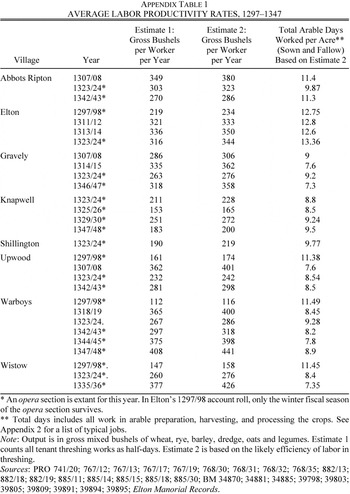
AVERAGE LABOR PRODUCTIVITY RATES, 1297–1347
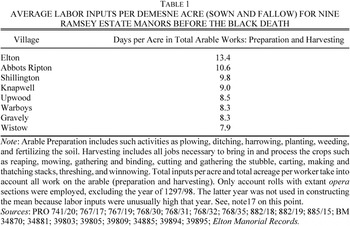
AVERAGE LABOR INPUTS PER DEMESNE ACRE (SOWN AND FALLOW) FOR NINE RAMSEY ESTATE MANORS BEFORE THE BLACK DEATH
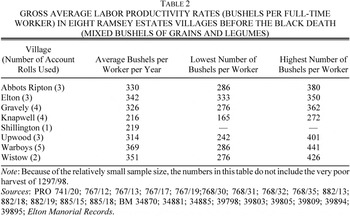
GROSS AVERAGE LABOR PRODUCTIVITY RATES (BUSHELS PER FULL-TIME WORKER) IN EIGHT RAMSEY ESTATES VILLAGES BEFORE THE BLACK DEATH (MIXED BUSHELS OF GRAINS AND LEGUMES)
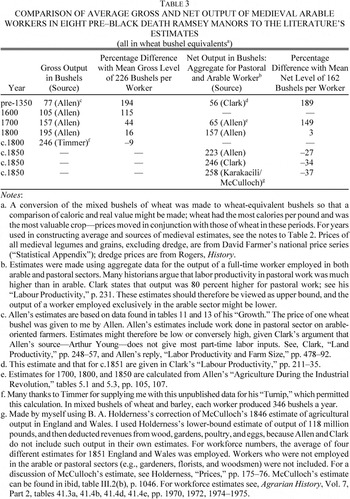
COMPARISON OF AVERAGE GROSS AND NET OUTPUT OF MEDIEVAL ARABLE WORKERS IN EIGHT PRE–BLACK DEATH RAMSEY MANORS TO THE LITERATURE'S ESTIMATES (all in wheat bushel equivalentsa)
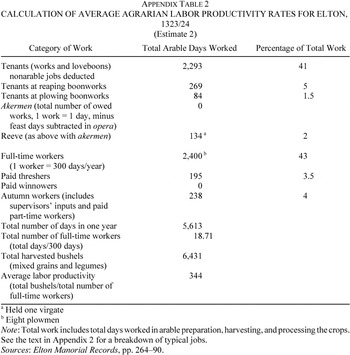
CALCULATION OF AVERAGE AGRARIAN LABOR PRODUCTIVITY RATES FOR ELTON, 1323/24 (Estimate 2)
 You have
Access
- 22
- Cited by