Implications
Formulation of cattle diets requires balancing the availability of carbohydrates and protein in order to maximize microbial growth in the rumen. Increasing the availability of rumen degradable protein (RDP) is useful to reduce the nutritional unbalance in cattle fed tropical grasses with a direct impact on meat and milk production. Protein is the most expensive component of cattle diets and the supplementation with nitrogenous compounds is a major factor limiting productivity of grazing cattle in the tropics. Manipulating the rumen microbiota to improve the efficiency of nitrogen utilization could improve animal performance and reduce nutritional losses due to nitrogen emissions.
Introduction
Brazil has the largest commercial cattle herd in the world (United States Department of Agriculture, 2011) ranking among the largest exporters of beef (Food and Agriculture Organization, 2011). However, the availability of foods for ruminants in the tropics varies depending on seasonality, with a distinct dry period and a rainy period (Figueiras et al., Reference Figueiras, Detmann, Paulino, Valente, Valadares Filho and Lazzarini2010; Costa et al., Reference Costa, Detmann, Paulino, Valadares Filho, Carvalho and Monteiro2011). In the dry period (April–September), the tropical forages available for animal feeding show a high fiber and lignin content and the levels of CP are often <7%, a value considered limiting for microbial protein synthesis by ruminal microorganisms (Lazzarini et al., Reference Lazzarini, Detmann, Sampaio, Paulino, Valadares Filho, Souza and Oliveira2009; Figueiras et al., Reference Figueiras, Detmann, Paulino, Valente, Valadares Filho and Lazzarini2010). In the rainy period (October–March), the forages have a more adequate CP content (16%), but the synthesis of microbial protein is still limited because of the high degradability of the CP in the forages (Costa et al., Reference Costa, Detmann, Paulino, Valadares Filho, Carvalho and Monteiro2011). Supplementation is the main strategy for avoiding these limitations and adjusting the nutritional imbalance in tropical pastures, being a common practice in dairy and beef farming (Lazzarini et al., Reference Lazzarini, Detmann, Sampaio, Paulino, Valadares Filho, Souza and Oliveira2009).
Although increasing dietary CP concentration in cattle fed silage-based rations has been related with small responses in BW gain and increased emissions of N and P (Huuskonen et al., Reference Huuskonen, Huhtanen and Joki-Tokola2014), feeding supplementary protein to cattle fed tropical forages can increase feed efficiency (Detmann et al., Reference Detmann, Valente, Batista and Huhtanen2014) reduces excessive nitrogen losses to the environment (Agle et al., Reference Agle, Hristov, Zaman, Schneider, Ndegwa and Vaddella2010; Calsamiglia et al., Reference Calsamiglia, Ferret, Reynolds, Kristensen and Van Vuuren2010) and increases overall animal performance (Detmann et al., Reference Detmann, Valente, Batista and Huhtanen2014). Detmann et al. (Reference Detmann, Valente, Batista and Huhtanen2014) showed positive response to rumen degradable protein (RDP) supplementation on forage intake and nitrogen use efficiency with concomitant positive response in animal performance. This positive response was attributed to improvements in the digestibility of tropical forages caused by supplementation with RDP.
Although previous work have demonstrated that protein supplementation improves animal performance and cause changes in rumen biochemistry (Agle et al., Reference Agle, Hristov, Zaman, Schneider, Ndegwa and Vaddella2010; Detmann et al., Reference Detmann, Valente, Batista and Huhtanen2014), there is a lack of studies about the impact of RDP on bacterial community composition and amino acid deamination in the rumen. Additionally, the direct infusion of RDP into the abomasum and the assessment of its effects on rumen fermentation in beef cattle have been little investigated. Therefore, we hypothesized that ruminal and/or postruminal RDP supplementation could select dominant species of ruminal bacteria affecting protein utilization, deamination activity and ammonia availability in the rumen. In addition, we asked if eventual changes in ruminal fermentation caused by protein supplementation could be associated with a change in the composition of the archaeal community. Exploring these relationships may provide a basis for designing strategies to balance ruminal ammonia concentration and control urea recycling in the rumen as well as improve body protein synthesis and animal growth.
It has been demonstrated that the infusion of RDP into the rumen or abomasum of steers consuming low-quality forage can improve the nitrogen status of the animal and increase urea recycling and total digestible organic matter (OM) intake. In addition, the provision of ruminal or postruminal protein tended to increase the passage rate of beef steers (Wickersham et al., Reference Wickersham, Cochran, Titgemeyer, Farmer, Klevesahl, Arroquy, Johnson and Gnad2004). In an earlier work, Bandyk et al. (Reference Bandyk, Cochran, Wickersham, Titgemeyer, Farmer and Higgins2001) also observed that beef steers fed Prairie hay containing 3.4% CP and supplemented with casein in the rumen and abomasum increased OM intake in 62% and 28%, respectively, when compared with the non-supplemented steers.
In this work, we aimed to investigate the impact of protein supplementation on ruminal fermentation, specific activity of deamination (SAD) and bacterial and archaeal community composition. In order to determine the impact of site of digestion on metabolizable protein supply without changes in protein composition and digestibility, Nellore steers were fed tropical forages and were infused with a source of RDP (casein) directly into the rumen and/or the abomasum.
Methods
Animals, diets and treatments
Four rumen fistulated crossbred Nellore steers with an average initial weight of 280±10 kg were used in this study, in accordance with a protocol approved by the Universidade Federal de Viçosa Ethics and Animal Care and Use Committee (nº 016/2012). The animals were housed in individual stalls with hay, water and minerals fed ad libitum. The experiment was conducted during four experimental periods, each with duration of 29 days and the animals were rotated in different treatments groups in each experimental period to avoid residual effects of treatments. The animals were allowed to adapt for 14 days to the experimental conditions and the basal forage before sampling. The diet comprised Tifton 85 (Cynodon sp.) hay with an average CP content of 9.8%, based on dry matter (DM). The composition of the hay and the source of RDP used in this work are presented in Table 1.
Chemical composition of the Tifton 85 hay fed to Nellore steers and the casein used for ruminal and abomasal supplementationFootnote 1

1 Chemical composition was determined from samples collected every day between the 20th and the 23th day of each trial period. Samples (10 g, DM basis) from each experimental period were pooled together for chemical composition analysis.
2 Tifton hay (Cynodon sp.) used in the experiment.
3 % fresh matter.
4 % dry matter (DM), organic matter (OM), CP, ether extract (EE), NDF, NDF corrected for ash and protein (NDFap), non-fiber carbohydrates (NFC), lignin and indigestible NDF (NDFi) in hay and casein.
Four treatments were evaluated in this study: (1) control (steers fed on basal forage only), (2) ruminal CP supplementation (steers receiving daily ruminal infusion of 230 g of pure casein (Labsynth, Diadema/SP, Brazil)), (3) abomasal CP supplementation (steers receiving daily abomasal infusion of 230 g of pure casein) and (4) ruminal and abomasal CP supplementation (steers receiving daily infusions of 115 g of casein in the rumen and 115 g of casein in the abomasum). Forage feeding and casein infusion were performed twice a day, at 0600 and 1800 h. Ruminal and/or abomasal CP supplementation was carried out fractioning the daily dosage of casein into two portions of equal weight, which was infused direct into the rumen and/or abomasum at the same time of feeding. Supplementation started on the 6th day of each experimental period. Ruminal infusions were carried out by introducing paper bags containing the proper amount of casein directly into the rumen through a cannula. Abomasal infusions were performed diluting the casein powder in 1000 ml of NaCl 9.0 g/l and transferring the solution to the abomasum through an abomasal cannula. The abomasal cannula was fitted with external polyethylene tubing (15 cm long) containing a custom made connecting valve in which the flask containing the diluted casein was connected at the defined infusion times.
The amount of supplemental protein (230 g casein per day) was ∼30% of the dietary CP requirements, 50% of the RDP requirements or 90% of the rumen undegradable protein requirements of uncastrated Nellore steers with 300 kg of BW and an expected weight gain of 0.5 kg/day (Marcondes et al., Reference Marcondes, Gionbelli, Valadares Filho, Chizzotti and Paulino2010).
Chemical composition of Tifton 85 hay and casein were determined from samples collected every day between the 20th and the 23th day of each trial period. Samples (10 g, DM basis) from each experimental period were pooled together for chemical composition analysis. Samples of the Tifton 85 hay were processed on a 1 mm sieve and evaluated for DM content, OM, CP and ether extract (EE) according to the methodologies of the Association of Official Analytical Chemistry (2004). Lignin (72% H2SO4) was estimated as described by Van Soest and Robertson (Reference Van Soest and Robertson1985). The contents of NDF were obtained using thermostable α-amylase and were corrected for the levels of protein and ash according to Licitra et al. (Reference Licitra, Hernandes and Van Soest1996) and Mertens (Reference Mertens2002), respectively. Casein was analyzed for DM, OM, CP and EE following the same procedures described for the analysis of Tifton 85 hay (Table 1).
The levels of non-fiber carbohydrates were calculated as described by Detmann and Valadares Filho (Reference Detmann and Valadares Filho2010):
 $${\rm NFC}={\rm OM}-({\rm CP}{\plus}{\rm EE}{\plus}{\rm NDFap})$$
where, NDFap is the content of NDF corrected for ash and protein levels (% DM; Table 1).
Rumen fluid
After the adaptation period (14 days), rumen fluid samples (500 ml) were collected from each animal immediately after the infusion of casein (time 0 hour) and every 6 h up to 24 h after the morning feeding. Ruminal contents were filtered through four layers of cheese cloth and transported immediately in insulated containers to the laboratory for further processing. Rumen pH was determined using a digital potentiometer (Tecnal, São Paulo, Brazil). Samples were harvested for analysis of volatile fatty acids (VFA), ammonia and microbial protein. All samples were stored at −20°C until use.
Determination of SAD, ammonia concentration and microbial protein
Ammonia was determined by the colorimetric method of Chaney and Marbach (Reference Chaney and Marbach1962). Absorbance was measured at 630 nm in a spectrophotometer Spectronic 20D (Thermo Fisher Scientific, Madison, WI, USA) and ammonium chloride (NH4Cl) was used as standard. Total ammonia (mmol/l) was expressed as the difference in ammonia concentration determined after 24 h of incubation and the initial concentration of ammonia (0 h). SAD was determined incubating ruminal fluid (9 ml) with 15 g/l trypticase at 39°C. Triplicate samples were analyzed for each time of rumen fluid sampling (0, 6, 12, 18 and 24 h). Aliquots (1 ml) were collected at 0 and 6 h for the analysis of ammonia and protein. SAD was calculated from the difference in ammonia concentration (mmol/l) between the times 0 and 6 h of incubation, divided by microbial protein concentration (mg/l) and the incubation time (min). Microbial protein was determined according to Bradford (Reference Bradford1976), using lysozyme as the standard.
Determination of organic acids
Organic acids were determined by HPLC in a Dionex Ultimate 3000 Dual detector HPLC (Dionex Corporation, Sunnyvale, CA, USA) coupled to a refractive index (RI) Shodex RI-101 maintained at 40°C using a ion exchange column Phenomenex Rezex ROA, 300×7.8 mm maintained at 45°C. Mobile phase was prepared with 5 mmol/l sulfuric acid (H2SO4) and the flow was 0.7 ml/min. Rumen fluid samples (2.0 ml) were centrifuged (12 000×g, 10 min) and the cell-free supernatants were treated as described by Siegfried et al. (Reference Siegfried, Ruckemann and Stumpf1984).
The following organic acids were used for the calibration of the standard curve: acetic, succinic, formic, propionic, valeric, isovaleric, isobutyric and butyric acid. All acids were prepared with a final concentration of 10 mmol/l, except isovaleric acid (5 mmol/l) and acetic acid (20 mmol/l).
Analysis of the bacterial and archaeal community of the rumen by denaturing gradient gel electrophoresis (PCR-DGGE)
To assess the genetic diversity of the ruminal microbial community, samples (50 ml) of rumen fluid were collected from steers fed with hay (controls) or infused with casein in the rumen 6 h after supplementation. These treatments were chosen due to the changes observed in the biochemical parameters analyzed in this study. The samples were stored at −80°C and processed separately by treatment (hay v. rumen infusion), time interval (6 h after morning feeding and 6 h after afternoon feeding) and steer. For DNA extraction, the samples were defrost at room temperature and processed according to the methodology described by Stevenson and Weimer (Reference Stevenson and Weimer2007). Genomic DNA extracted from the liquid phase was utilized in the amplification reactions using primers specific for the regions V3 to V5, V3 to V4 and of V4 to V5 the 16S rRNA of the γ-proteobacteria, firmicutes and bacteroidetes phyla, respectively (Muhling et al., Reference Muhling, Woolven-Allen, Murrell and Joint2008). The V3 region of the 16S rRNA of the archaea was also amplified to investigate changes in community composition within this phylogenetic group (Delong, Reference Delong1992).
PCR reactions were performed in a Biocycler MG96G (São Paulo, Brazil) and the amplification reaction contained GoTaq Reaction Buffer (0.5 X), MgCl2 (0.5 mmol/l), dNTPs (0.2 mmol/l), forward primer (0.12 mmol/l), reverse primer (0.12 mmol/l), Taq DNA polymerase (0.1 u/µl; Promega Corporation, Madison, WI, USA), BSA (0.08 mg/ml) and genomic DNA (0.8 ng/µl). The PCR was performed with an initial temperature of denaturation at 96°C for 4 min followed by 35 cycles of 96°C for 1 min for denaturation, 56°C for 1 min for annealing of the primers and an additional 2 min at 72°C for primer extension. The amplification cycle was followed by a final extension step at 72°C for 5 min (Muhling et al., Reference Muhling, Woolven-Allen, Murrell and Joint2008). For the amplifications carried out with the primer for the γ-proteobacteria, firmicutes and bacteroidetes, the annealing temperature was 54°C, 50°C and 56°C, respectively.
To increase the specificity of the analysis, a Nested-PCR was performed to amplify a shorter region of the γ-proteobacteria, firmicutes and bacteroidetes phyla and archaea domain (Raskin et al., Reference Raskin, Stromley, Rittmann and Stahl1994; Muhling et al., Reference Muhling, Woolven-Allen, Murrell and Joint2008). The amplification reaction contained GoTaq Reaction Buffer (0.5 X), MgCl2 (0.5 mmol/l), dNTPs (0.2 mmol/l), forward primer (0.12 mmol/l), reverse primer (0.12 mmol/l), Taq DNA polymerase (0.1 u/µl; Promega Corporation, Madison, WI, USA) and BSA (0.08 mg/ml). One microliter of the amplification product from the first reaction was used as the DNA template. The Nested-PCR was performed in thermocycler Biocycler MG96G with an initial denaturation temperature of 96°C for 4 min, followed by 35 cycles at 96°C for 1 min for denaturation, 56°C for 1 min for annealing of the primers and 72°C for 30 s for primer extension. The amplification cycle was followed by a final extension at 72°C for 5 min (Raskin et al., Reference Raskin, Stromley, Rittmann and Stahl1994; Muhling et al., Reference Muhling, Woolven-Allen, Murrell and Joint2008). For the amplifications carried out with the primer for the γ-proteobacteria, firmicutes, bacteroidetes and archaea domain, the annealing temperature was 56°C, 56°C, 52°C and 56°C, respectively.
DGGE was performed in a DGGE-2401 apparatus (CBS Scientific Company, San Diego, CA, USA) using 8 μl of the PCR products from the nested-PCR and 8 μl of sample buffer (0.05% bromophenol blue, 0.05% xylene cyanol, 70% glycerol and 1X TAE (40 mmol/l Tris, 20 mmol/l acetic acid and 1 mmol/l EDTA)). The PCR products were loaded into wells in a 8% (w/v) vertical polyacrylamide gel (acrylamide: N,N’-methylenebisacrylamide, 37.5 : 1) with a linear gradient of 40% to 60% urea/formamide.
The denaturing gradient was obtained by mixing two solutions (A and B) dispensed by an MPP-100-220 peristaltic mini-pump (CBS Scientific Company). Solution A contained 100% of the denaturing agents (7 mol/l urea and 40% deionized formamide (v/v)) in 8% acrylamide: N,N’-methylenebisacrylamide (37.5 : 1), and solution B was prepared as for solution A but without the denaturing agents. Solutions A and B also contained ammonium persulfate (3.1 mmol/l) of polymerizer and N,N,N’,N’-tetramethylethylenediamine (3.7 µmol/l) catalyst. The denaturing gradient was monitored using 20 µl of the visualization dye (bromophenol blue 0.5%, xylene cyanol 0.5% and 1X TAE). The gels were allowed to polymerize for 3 h before loading the DNA samples.
A mixture of 16S rRNA amplicons obtained from the genomic DNA of Escherichia coli ATCC 29214 (γ-proteobacteria), Salmonella enterica Typhimurium ATCC 14028 (γ-proteobacteria), Bacillus cereus ATCC 14579 (firmicutes) and Lactococcus lactis ATCC 19435 (firmicutes) were used as markers for bacterial species in wells located in the sides of the gel. Electrophoresis was performed at 60°C in 1X TAE at constant voltage of 150 V for 10 h. The gel was stained for 20 min with SYBR Gold (Invitrogen, Breda, The Netherlands) according to manufacturer’s recommendations. The gel was visualized and photo-documented using Eagle Eye (Stratagene, La Jolla, CA, USA). Gel bands were analyzed using Bionumerics 5.1 (Applied Maths). Dice’s similarity coefficient was used to compare the data sets with an optimization of 1% and a tolerance of 1.5%. Clustering was performed using the unweighted pair group method (UPGMA). In order to determine the optimal number of groups in each cluster, a binary matrix was generated from the scanned gels using BioNumerics 5.1 and the NbClust function of the psych package in the R software (R Development Core Team, 2011) was used to analyze the data.
Diversity (Shannon) indexes and species richness were calculated based on presence (1) or absence (0) of a particular band using a binary matrix generated from the gels with the Bionumerics 5.1 software. Shannon–Wiener index was calculated using the Past software (Hammer et al., Reference Hammer, Harper and Ryan2001), based on the following equation:
 $$H'={\minus}\!\mathop{\sum}\limits_{i=1}^s {(Pi)(\log \,Pi)} $$
where s is the number of bands i in a particular sample and Pi=ni/N (where ni=number of bands i; N=total number of bands).
The statistical analysis of species richness and Shannon–Wiener index was performed considering a completely randomized design with two treatments (hay feeding and casein infusion in the rumen) and four replicates (SAS, Statistical Analysis System, version 9.1). Venn diagrams were constructed using the Mothur software (Schloss et al., Reference Schloss, Westcott, Ryabin, Hall, Hartmann, Hollister, Lesniewski, Oakley, Parks, Robinson, Sahl, Stres, Thallinger, Van Horn and Weber2009) and a binary matrix of the presence or absence of band.
Experimental assay and statistical analysis
Steers were grouped according to their weight and age. The experiment design was a 4×4 Latin square balanced for residual effects (Cochran and Cox, Reference Cochran and Cox1957), with four animals and four experimental periods, each with duration of 29 days. The variables pH, microbial protein concentration, ammonia concentration and SAD were determined after the adaptation period (14 days), according to the model:
 $$Y_{{ijk}} =\mu {\plus}S_{i} {\plus}A_{j} {\plus}P_{k} {\plus}{\varepsilon}_{{ijk}} $$
where Y ijk is the response variable measured in the animal j, during period k, under the supplementation scheme i; µ the general constant; S i the effect of supplementation i (fixed); A j the effect of animal j (random); P k the effect of the experimental period k (fixed); and ε ijk the experimental error supposed to be normal and independently distributed. All statistical procedures were performed using SAS (SAS Institute, 2004) adopting 0.05 in the Tukey test as the critical limit for type I error.
To analyze the concentration of VFAs in the rumen we applied the methodology of repeated measures using the Proc Mixed of SAS to correct for treatment and animal effects within each experimental period. The Tukey test at 5% significance was used to compare the treatments (SAS Institute, 2004).
Principal component analysis was conducted using the R software (R Development Core Team, 2011) applying the main function of the psych package to determine the relationships between the biochemical and enzymatic parameters within different treatments.
Results
When Nellore steers were fed Tifton 85 hay containing 9.8% CP changes in ruminal pH and microbial protein concentration were not observed (P>0.05) between supplemented v. non-supplemented animals, regardless if casein was infused in the rumen or abomasum or if the dose was divided between the rumen and abomasum (Table 2). The average ruminal pH of the steers was 6.90±0.06 and the average microbial protein concentration was 1470.96±49.73 mg/ml. However, in steers receiving ruminal infusion of casein the SAD and ruminal ammonia concentration increased 33% and 76%, respectively, compared with the control (Table 2). If the infusion was performed in the abomasum or divided between the rumen and abomasum, no significant differences in ruminal parameters were observed between supplemented v. non-supplemented animals (Table 2).
Effect of casein supplementation on ruminal parameters of Nellore steers

C=control (non-supplemented); R=ruminal casein supplementation; A=abomasal casein supplementation; R+A (ruminal and abomasal casein supplementation); CV=coefficient of variation.
1 Ammonia concentration (NH3; mmol/l).
2 Microbial protein (mg/ml).
3 Specific activity of deamination (SAD; nmol of NH3/mg protein per min) according to different treatments.
Means followed by at least one letter in the line do not differ at 5% significance level by the Tukey test.
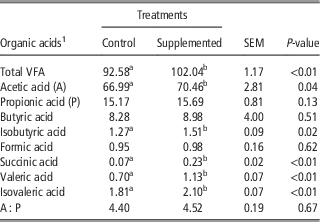
The total concentration of VFA increased (P<0.05) in steers receiving rumen infusion of casein and the proportion of some individual organic acids was also more likely to increase in these animals, especially the ones associated with the degradation of proteins and amino acids, such as valeric, isovaleric and isobutiric acids (Table 3). Nonetheless, the proportion of propionic, butyric and formic acids remained approximately the same and no significant changes in acetate to propionate ratio in steers with or without RDP supplementation.
Effect of casein supplementation on ruminal concentration of volatile fatty acids (VFA) of Nellore steers with and without ruminal supplementation with casein

1 Total VFA (mmol/l), acetic acid, propionic acid, butyric acid, isobutyric acid, formic acid, succinic acid, valeric acid and isovaleric acid (mol/100 mol) and acetate : propionate ratio (A : P) for different treatments.
Means followed by at least one letter in the line do not differ at 5% significance level by Tukey test.
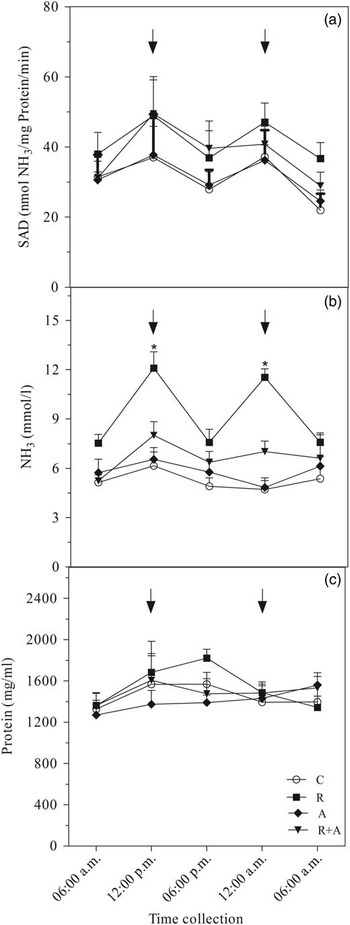
SAD and the microbial protein concentration (Figure 1a and c) did not vary significantly among treatments during the feeding cycle, but mean SAD values were 32% and 21% greater in steers supplemented in the rumen and rumen/abomasum, respectively, compared with the average SAD of non-supplemented and abomasum supplemented animals. However, the total ammonia concentration after 6 h of feeding was higher (P>0.05) in animals supplemented with casein in the rumen (Figure 1b). Non-supplemented animals (control) and steers infused with casein in the abomasum showed lower levels of ammonia during the feeding cycle compared with the animals infused with casein in the rumen. The treatments in which casein infusion was divided in the rumen/abomasum showed intermediate levels of ammonia (Figure 1b).
Dynamics of amino acid deamination and microbial protein during the feeding cycle. (a) Specific activity of deamination (SAD; nmol of NH3/mg protein per min), (b) ammonia concentration (mmol/l) and (c) microbial protein concentration (mg/ml) during the feeding cycle.

Ruminal ammonia concentration was positively correlated with SAD in animals receiving ruminal infusion of casein (Figure 2). The correlation coefficient was low (0.139) for the control treatment (non-supplemented steers), suggesting little or no correlation between SAD and ammonia concentration. However, steers that received casein infusion into the rumen showed a correlation coefficient of 0.994, indicating that an increase of 1 nmol of NH3/mg protein per min in SAD resulted in an increase of 0.388 mmol/l of ammonia in the rumen.
Correlation between the specific activity of deamination (SAD) (nmol NH3/mg protein per min) and ammonia concentration (mmol/l) in non-supplemented Nellore steers (control) the steers that received an infusion of casein (230 g) into the rumen. For the correlation calculations, the average ammonia concentration was correlated with the average SAD in each time sample collection. The correlation coefficient (r) was calculated by the square root of the coefficient of determination (R 2).

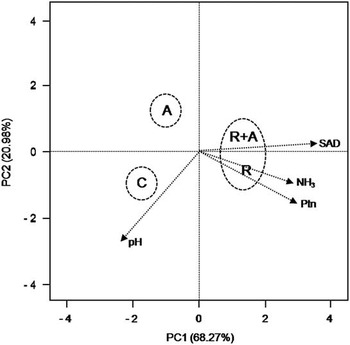
Principal component analysis was performed to represent the studied variables (pH, ammonia concentration, microbial protein and SAD) in relation to the treatments used in this work. Principal components analysis explained 89.25% of the cumulative variance in the first two principal components (Figure 3). The vectors indicate which parameters are influencing the treatments with greater intensity in each quadrant.
Analysis of principal components to evaluate the effect of casein supplementation on ruminal parameters. Ruminal parameters assessed by principal component analysis were: pH, microbial protein (Ptn; mg/ml), ammonia (NH3; mmol/l) and specific activity of deamination (SAD; nmol NH3/mg protein per min). Treatments correspond to C=control (non-supplemented steers), R=ruminal casein supplementation, A=abomasal casein supplementation, R+A (ruminal and abomasal casein supplementation).

The first component (PC1) explained 68.27% of the variance and the second component (PC2) explained 20.98% of data variance (Figure 3). Microbial protein, NH3 and SAD were positively correlated with PC1. The overlap between the spatial distribution of treatments with the variables of the two principal components separated the four treatments in three groups: the rumen/abomasum and rumen in the 1st and 4th quadrant (group 1); abomasum in the 2nd quadrant (group 2) and control in the 3rd quadrant (group 3) (Figure 3). No influence of the variables on group 2 was observed, however, there was influence of variables microbial protein, SAD and NH3 on group 1. The pH variable, although being influenced by two major components, has modest effect on group 3 (Figure 3).
Composition of bacteria and archaea in the rumen fluid was assessed by amplification of 16S rRNA gene and analysis of electrophoretic profiles obtained after analysis by denaturing gradient gel electrophoresis (DGGE). Diversity analysis of different bacterial phyla and archaea (Supplementary Figure S1 to S4) revealed low similarity between treatments, animals and time of sample collection. Analysis of the band profiling generated from this study revealed 43, 28, 23 and 26 bands for the γ-proteobacteria, firmicutes, bacteroidetes and archaea, respectively (Supplementary Figure S1 to S4).
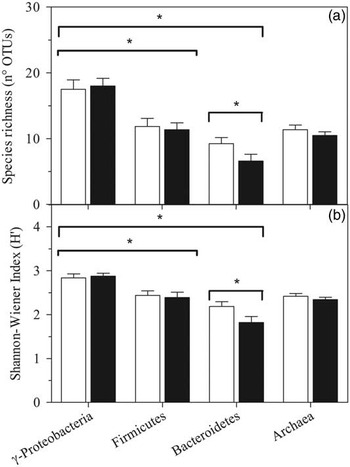
Richness analysis – assessed by the number of bands within each microbial group – and the determination of the Shannon–Wiener index were based on a binary matrix generated from the DGGE gels using the BioNumerics 5.1 software (Figure 4a and b). Results indicated no differences (P>0.05) in species richness and diversity of γ-proteobacteria, firmicutes and archaea between non-supplemented Nellore steers and steers receiving casein supplementation in the rumen. However, species richness and the Shannon–Wiener index were lower (P<0.05) for the phylum bacteroidetes in steers supplemented with casein in the rumen compared with non-supplemented animals (Figure 4a and b).
Richness and diversity of rumen microorganisms assessed by denaturing gradient gel electrophoresis (DGGE). The cattle were fed hay from Tifton and subjected or not to supplementation with casein in the rumen. (a) Species richness and (b) Shannon–Wiener index were calculated from the binary matrix of presence and absence of bands. Open bars (Control) and closed bars (supplemented). (*) Asterisk means average difference between treatments within the group assessed a 5% significance level by Tukey test.

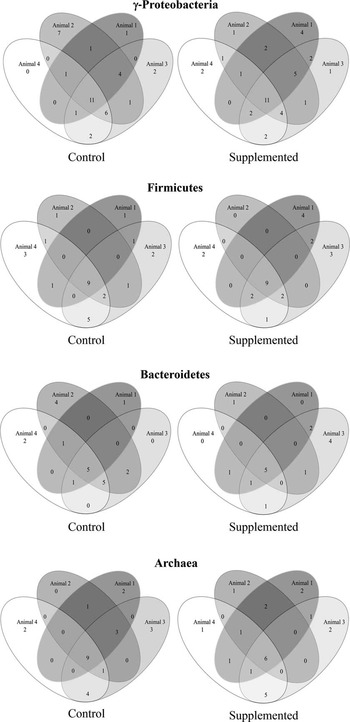
Venn diagrams indicated that the number of shared bands belonging to the γ-proteobacteria, firmicutes and bacteroidetes in non-supplemented steers were 11, 9 and 5, respectively, and did not change even after the infusion of casein in the rumen of the animals (Figure 5). In archaea the number of shared bands was nine in non-supplemented steers and decreased to six shared bands in steers infused with casein in the rumen.
Venn diagram showing the distribution of shared sequences among different animals used in this work. Venn diagrams were generated using the Mothur program and the binary matrix generated from the gel image analysis in the BioNumerics 5.1 software.

The number of unique bands varied considerably among individual animals and was usually higher in number for non-supplemented steers compared with supplemented animals (Figure 5). The only exception was the phylum firmicutes, where the number of unique bands was higher in supplemented steers (nine bands) in relation to the non-supplemented controls (seven bands).
Discussion
The impact of RDP supplementation on ruminal parameters has been evaluated for dairy and beef cattle (Agle et al., Reference Agle, Hristov, Zaman, Schneider, Ndegwa and Vaddella2010; Zhou et al., Reference Zhou, Hernandez-Sanabria and Guan2010). However, to our knowledge, previous studies have not investigated the relationship between the composition of ruminal microbial communities involved in the degradation of dietary protein and the biochemical parameters associated with nitrogen utilization in the rumen. In this study, casein supplementation in the rumen of Nellore steers were associated with increased ammonia concentration and increased activity of amino acid deamination.
It has been demonstrated that the rumen harbor a large group of proteolytic and amino acid fermenting bacteria and specialized populations of hyper-ammonia producing bacteria might have an impact on deamination activity and dietary protein utilization (Attwood et al., Reference Attwood, Klieve, Ouwerkerk and Patel1998; Bach et al., Reference Bach, Calsamiglia and Stern2005). Different bacterial species can break down dietary protein and ferment peptides and amino acids with the concomitant production of ammonia and VFAs, but the rate of ammonia and ATP production can vary considerably (Rychlik and Russell, Reference Rychlik and Russell2000). In our study, only modest changes in deamination activity were observed during the feeding cycle (P>0.05), but increased NH3 concentration were detected 6 h after the infusion of casein (P<0.05), returning to basal levels ∼12 h after feeding (Figure 1). Previous studies demonstrated that peaks of ruminal ammonia concentration often occur 4 to 6 h after feeding due to deamination activities (Agle et al., Reference Agle, Hristov, Zaman, Schneider, Ndegwa and Vaddella2010), but the free ammonia can be gradually consumed by rumen microorganisms, recycled through saliva or transported through the rumen wall and converted to urea in the liver (Bach et al., Reference Bach, Calsamiglia and Stern2005).
A positive correlation between deamination activity and ammonia concentration was also observed in steers that received ruminal casein supplementation. This result is consistent with the idea that greater availability of degradable protein will increase amino acid degradation by a more specialized population of ruminal bacteria. It has been estimated that hyper-ammonia producing bacteria have a lower substrate affinity (K m) than the mixed ruminal bacteria, but the V max of ammonia production is ∼12.5-fold greater than the mixed ruminal bacteria of forage fed animals (Rychlik and Russell, Reference Rychlik and Russell2000). Therefore, a higher RDP content in the diet could impact both SAD and the concentration of ruminal ammonia, demonstrating the influence of the diet in the activity of rumen microorganisms and nitrogen metabolism in the rumen (Bach et al., Reference Bach, Calsamiglia and Stern2005; Calsamiglia et al., Reference Calsamiglia, Ferret, Reynolds, Kristensen and Van Vuuren2010). Nonetheless, the RDP supplementation did not alter (P>0.05) the concentration of microbial protein among treatments. Although not statistically significant, our results indicated that microbial protein concentration in steers ruminally supplemented with casein was ∼6.1% greater than non-supplemented steers. It should be noted that the concentration of rumen microbial protein is usually more resilient to changes induced by feed ingredients and this parameter alone often does not reflect the changes in population size and species richness in the rumen.
However, ruminal supplementation resulted in changes in the conversion of ingested foods to VFA, the main energy source for the animal. Ruminal RDP supplementation increased both the total concentration of VFA and the proportion of organic acids resulting from amino acid deamination. Abomasal supplementation caused no effect on ruminal parameters, suggesting that the direct action of abomasal supplementation appears to be based on increasing the availability of amino acids absorbed in the small intestine, having no direct effect on ruminal fermentation and degradation of amino acids. Based on these results, it appears that the amount of nitrogen available to rumen microbes and to the animal host through postruminal supplementation is less efficient than the ruminal RDP supplementation, confirming previous observations (Wickersham et al., Reference Wickersham, Cochran, Titgemeyer, Farmer, Klevesahl, Arroquy, Johnson and Gnad2004).
In this study, the impact of RDP supplementation on ruminal microbial diversity was also determined to investigate changes in microbial community composition related to increased nitrogen availability. We used PCR-DGGE to evaluate and compare richness and diversity of the most predominant bacterial phyla and archaea in the rumen of Nellore steers that were supplemented or not with RDP. Previous studies have used only 16S rRNA universal primers to perform fingerprinting, but results could not discriminate changes in the ruminal community profiles. Genus-level analysis of the composition and abundance of the core bacterial community in the rumen of cattle demonstrated that the phyla bacteroidetes, firmicutes and proteobacteria comprises >95% of the abundance of bacterial taxa in the rumen (Jami and Mizrahi, Reference Jami and Mizrahi2012).
In this work, primers were used to target these abundant groups of rumen bacteria, but the band profiles revealed low levels of similarity between treatments and animals. Analysis of diversity indices showed that γ-proteobacteria had greater diversity (P<0.05) and species richness compared with other bacterial phyla. Differences in Shannon–Wiener index and species richness between supplemented and non-supplemented steers were only observed for the phylum bacteroidetes (P<0.05), which has been recognized as one of the most prevalent bacterial phyla in the rumen. The genus Prevotella is involved in the degradation of fiber and dietary protein and is described as the most abundant group of bacteroidetes in the rumen of cattle (Stevenson and Weimer, Reference Stevenson and Weimer2007). Nellore steers supplemented with RDP showed reduced diversity and species richness of bacteroidetes, which may be associated with increased populations containing fewer species of bacteria involved in protein metabolism. No differences were detected in ecological parameters within the phyla firmicutes, which contains the clostridia and most of the previously reported ruminal hyper-ammonia producing bacteria, but it should be noted that number of unique bands was greater in steers supplemented with casein.
Methanogenesis is the main mechanism for reducing equivalent disposal in the rumen, but the effect of protein supplementation on enteric methane production by beef cattle on tropical forages has not been investigated. Although methane production has not been determined in this study, the effect of RDP supplementation of ruminal archaea was assessed by PCR-DGGE. No differences in species richness or diversity were observed between supplemented and non-supplemented steers, but the number of bands resolved in the samples of individual animals reduced in supplemented steers compared with the non-supplemented ones. There is a lack in the literature of studies regarding the impact of protein supplementation on methane emissions in beef and dairy cattle. Aguerre et al. (Reference Aguerre, Wattiaux, Powell, Broderick and Arndt2011) observed that Holstein cows fed isonitrogenous diets (16% CP) with increasing forage-to-concentrate ratios (47 : 53 to 68 : 32) increased CH4 emission from 538 to 648 g/cow per day, although no effect was observed on manure ammonia nitrogen (14.1±3.9 g/cow per day) and CO2 emission (18.32±2.24 g/cow per day).
According to the DGGE analysis there was individual variation between animals subjected to the same treatment as revealed by the analysis of the operational taxonomic units shared by each animal subjected or not to ruminal RDP supplementation. These results agree with previous studies in which individual variation between animals possibly contributed to mask the effect of animal treatments (Petri et al., Reference Petri, Forster, Yang, McKinnonand and McAllister2012). Nonetheless, our results corroborate with the notion that protein supplementation has a positive impact on ruminal fermentation and nitrogen metabolism in the ruminant. As a result improvements in microbial protein synthesis and weight gain could be achieved in animals raised on low-quality forages by performing supplementation with protein sources that are highly degradable in the rumen or increasing the intake of CP in the diet.
Conclusions
This work demonstrate that feeding supplementary protein to cattle fed tropical forages stimulate metabolic activities (substrate fermentation) and increase deamination activity and ammonia availability in the rumen. Changes in ruminal fermentation caused by protein supplementation could not be associated with a change in the composition of the archaeal community or diversity of abundant groups of rumen bacteria by PCR-DGGE, but species richness within the phylum bacteroidetes was reduced in RDP supplemented steers. These changes in metabolic activity in the rumen might be related with variations in population sizes of different bacterial groups and were not determined by postruminal protein degradability. Results imply that increasing ruminal ammonia concentration in cattle fed tropical forages by RDP supplementation can spare amino acids required for hepatic output of urea and tissue formation, increasing the availability of precursors required for body protein synthesis and growth. Taken together, these findings emphasize the beneficial effects of nitrogen retention in the rumen to provide adequate conditions for microbial activity and growth and, ultimately, to improve animal performance.
Acknowledgments
This research was supported by the Conselho Nacional de Desenvolvimento Científico e Tecnológico (CNPq, Brasília, Brazil), the Coordenação de Aperfeiçoamento de Pessoal de Nível Superior (CAPES, Brasília, Brazil) and the Fundação de Amparo à Pesquisa do Estado de Minas Gerais (FAPEMIG, Belo Horizonte, Brazil). CBPB received a doctoral fellowship from FAPEMIG and a post-doctoral fellowship from CAPES (PNPD – 2439/11).
Conflicts of Interest
The authors declare that they have no conflicts of interest.
Supplementary Material
To view supplementary material for this article, please visit http://dx.doi.org/10.1017/S1751731115001512