


Introduction
Scholars of Muslim-majority countries (MMCs) have paid renewed attention to government efforts to exercise greater control over the religious sphere by co-opting religious institutions and demarcating acceptable beliefs and practices (Browers Reference Browers2011; Brown Reference Brown2017; Hamid and Mandaville Reference Hamid and Mandaville2018; Nasr Reference Nasr2001; Robbins and Rubin Reference Robbins and Rubin2013, Reference Robbins and Rubin2017; Sheline Reference Sheline2021; Wainscott Reference Wainscott2017; Wehrey Reference Wehrey and Wehrey2021; Zeghal, Reference Zeghal1999). These efforts are widely known as “official Islam” (OI). The existing literature focuses on either why states deploy OI—the function it serves for the government, such as countering the influence of Islamic political parties and deterring the threat of Islamic extremism, or how states deploy OI—the instruments that the government uses, such as establishing bureaucratic structures and co-opting religious institutions and actors. To date, it has not examined whether or when OI resonates with the public, which has important implications for state–societal relations. Furthermore, it has not explored OI in MMCs outside the Middle East and North Africa (MENA).
We advance our understanding of OI by bridging this growing literature with the broader scholarship on state narratives and expanding the study of OI to non-Arab MMCs. We define OI as a state narrative regarding Islamic beliefs and practices disseminated through official institutions and actors. We conceptualize OI’s resonance as close alignment between this narrative and the views held by most members of the dominant religion. Drawing on two literatures (Strategic Narratives and the Narrative Policy Framework [NPF]), we derive a set of hypotheses regarding the factors that influence alignment between the state’s OI narrative and popular views. We expect that there will be greater alignment with the state narrative among individuals who belong to the in-group versus the out-group (H1) and those who have higher levels of political trust (H2). We also expect that there will be greater alignment with the state narrative among individuals who are more religious when measured as religious belief (H3a). However, when religiosity is measured as religious practice, we expect those who are more religious (i.e., moderately and highly practicing) to be less aligned with the state narrative (H3b) because these individuals have a more pluralistic understanding of religiosity (Jones Reference Jones and Jones2017). Finally, we test these hypotheses using a novel mass survey with an embedded experiment in Kyrgyzstan—an MMC in Central Asia where the state has increasingly promoted an OI since the 2010s.
Kyrgyzstan provides an ideal setting for testing our hypotheses because it gained independence from the Soviet Union in 1991 but, unlike its Central Asian counterparts, only recently intensified its efforts to create and propagate an OI. The adoption of the “State Concept on Religion” (hereafter, Concept) in 2014 marks the formalization of this shift. Our analysis focuses on the Concept’s third main pillar, which promotes traditional Kyrgyz Islam as the only form of Muslim religious expression compatible with both national identity and personal piety, for three reasons. First, it represents a clear attempt to use OI to merge religious expression with national identity that has received insufficient attention to date. Second, when Kyrgyzstan adopted the Concept, it was at a pivotal moment in its state- and nation-building processes that mirrors this experience in the Muslim world. Many MMCs have grappled with how and whether to incorporate Islam into state structures and national identity in the aftermath of European colonialism (Cesari Reference Cesari2014). Finally, this pillar is the cornerstone of Kyrgyzstan’s OI narrative. Since 2008, in both legal documents and public discourse, the state has made a concerted effort to disseminate the message that preserving traditional Kyrgyz Islam is vital to national security and requires protecting it from foreign influence (Engvall Reference Engvall2020; Heathershaw and Montgomery Reference Montgomery and Heathershaw2016).Footnote 1
More specifically, the state has increasingly emphasized the importance of the Hanafi maktab, one of the four legal schools in Sunni Islam, as the foundation of traditional Kyrgyz Islam and promoted its main tenets as coterminous with the country’s national and cultural identity. It has also underscored that these tenets are what enable Kyrgyzstan to counter the influence of foreign Islam and the spread of religious radicalism within Kyrgyz society. Religious attire, moreover, has been central to this public discourse of securitization (Byerdimurat Reference Byerdimurat2024). In particular, the state has singled out the hijab as emblematic of the threat posed to traditional Islam from foreign (i.e., Arab) influence, preferring that women wear the Kyrgyz jooluk (Artman Reference Artman2019; Suyarkulova Reference Suyarkulova2016).
We perform two related tests of our hypotheses about how each factor (ethnicity, trust, and religiosity) influences the degree to which public opinion aligns with this third pillar. First, we examine the association between each of these factors and responses to a survey question about the importance of the Hanafi maktab to Kyrgyz national identity. Second, because promoting what it considers to be the traditional head covering is a core element of this third pillar, we designed a survey experiment to further assess the resonance of the state’s narrative concerning religious expression. We manipulate only the visual representation of the woman’s head covering in each treatment group and then ask a series of questions to elicit how well the woman conforms to respondents’ understandings of national identity and religious piety.
We find that Kyrgyzstan’s OI narrative only partially resonates with the population. With two key exceptions—members of the out-group (ethnic Uzbeks) and those who are more religious (measured as practice)—there is broad alignment with the state’s promotion of traditional Kyrgyz Islam as most compatible with national identity. When it comes to personal piety, however, no group seems to be aligning with the state’s narrative that the hijab is an illegitimate form of religious expression. This includes members of the in-group (ethnic Kyrgyz), those with high political trust, ethnic Uzbeks, and those who are more religious (measured as both belief and practice).
Our findings suggest that the Kyrgyzstani state’s attempt to make religion legible by promoting a singular interpretation of Islam as compatible with both national identity and religious expression is both limited and potentially counterproductive. That the state’s narrative regarding piety does not resonate with the groups that should be most likely to believe like the stateFootnote 2 —ethnic Kyrgyz and those with high political trust—confounds its attempt to portray Kyrgyz Islam as homogeneous. Meanwhile, the two groups that appear to reject the state’s OI narrative in its entirety—ethnic Uzbeks and those who are more religious—are the very groups that the state most needs to co-opt if it is to achieve its goal of homogenizing Islamic belief and practice. By pursuing this goal despite popular misalignment, moreover, the state may be creating the potential for backlash from those who oppose homogenization (Shields Reference Shields2004). More broadly, our findings suggest that the resonance of OI narratives may be reduced where there are significant in- and out-group differences and where popular attitudes toward religious expression are pluralistic. Under these conditions, OI may also generate unintended consequences.
Official Islam
Although it has long been a latent concept in studies of state–society relations in MMCs (Nasr Reference Nasr2001; Zeghal Reference Zeghal1999), OI has recently received overt attention (Brown Reference Brown2017; Robbins and Rubin Reference Robbins and Rubin2013; Sheline Reference Sheline2018, Reference Sheline2021; Wainscott Reference Wainscott2017), underscoring its importance both substantively and theoretically. Substantively, many governments in MMCs have employed it to shape religious discourse and co-opt religious institutions and actors. Scholars have documented a growing trend in MENA since the Arab Spring, for example, whereby states seek to augment their control of the religious sphere by promoting a singular interpretation of Islam (Robbins and Rubin Reference Robbins and Rubin2013, Reference Robbins and Rubin2017). This trend, moreover, is evident in countries across the region, including Oman, Saudi Arabia, Turkey, Iran, Tunisia, Morocco, Jordan, and Egypt (Brown Reference Brown2017; Hamid and Mandaville Reference Hamid and Mandaville2018; Robbins and Rubin Reference Robbins and Rubin2013, Reference Robbins and Rubin2017; Sheline Reference Sheline2018, Reference Sheline2021; Wainscott Reference Wainscott2017).
Theoretically, existing scholarship focuses on explaining the function that OI serves for the government and the instruments that the government uses to deploy it. Most scholars view OI as a regime strategy for countering Islamist mobilization and presenting an alternative discourse about religiosity and the relationship between religion and politics. The ruling elites in these countries want to reduce, if not eliminate, support for moderate Islamic parties as well as extremist and terrorist groups, such as the Islamic State of Iraq and Syria and Al-Qaeda. In other words, the rationale for deploying and sustaining OI is regime survival. More than a decade after the Arab Spring, the influence of many Islamists and extremist groups has waned. Yet, OI continues to be a potent weapon in the government’s arsenal for controlling the religious sphere and co-opting religious institutions and actors (Wehrey Reference Wehrey and Wehrey2021).
We expand the study of OI to include MMCs outside MENA and shift focus from OI’s function and instruments to its resonance. As several scholars acknowledge, a more complete understanding of OI requires determining how successful it is in shaping popular attitudes (Robbins and Rubin Reference Robbins and Rubin2013, 71–2, Reference Robbins and Rubin2017, 385; Sheline Reference Sheline2021, 17). Yet, the lack of panel data makes it difficult to measure OI’s effectiveness. Instead, we assess OI’s resonance—the extent to which the state’s narrative aligns with public opinion—because it is crucial for understanding whether the public will support or challenge it (Sheline Reference Sheline2021, 2–3). To date, there has been little attention to identifying the conditions under which OI is most likely to resonate with the Muslim population, especially when it might resonate more with certain groups than others.
There has also been little attention to evaluating OI as a strategy to synthesize the state’s singular version of Islam with popular views of national identity. Scholars have examined how the fusion of religious and national identities can impact policy outcomes (Grzymała-Busse Reference Grzymała-Busse2015; Zubrzycki Reference Zubrzycki2016), political mobilization against minorities (Anand Reference Anand2011), and negative sentiment toward minorities (Gravers Reference Gravers2015; Keyes Reference Keyes2016). However, with one exception (Gamza Reference Gamza2019), these studies focus on the role of religious institutions or religio-political movements in shaping the degree to which religious and national identities are fused rather than the role of the state in articulating this fusion. We depart from Gamza (Reference Gamza2019) by explicitly treating OI as a state narrative designed to influence popular attitudes, defining what it means for OI to be resonant, and developing and testing a set of unique hypotheses to assess OI resonance.
State Narratives
Under what conditions is OI most likely to resonate with the Muslim population? To answer this question, we bridge the growing literature on OI with the broader scholarship on state narratives—Strategic Narratives and the NPF. To our knowledge, neither has been applied to examine state narratives in comparative politics; these theories thus provide a novel and valuable perspective on OI. Specifically, they inform our approach in three ways: first, they enable us to define OI as a narrative; second, they provide a framework for conceptualizing OI’s resonance; and third, they identify the factors that affect the extent to which OI is resonant.
Existing literature
The Strategic Narratives and NPF literatures share many similarities but have different origins and emphases. Since Freedman (Reference Freedman2006) articulated the concept of Strategic Narratives to study war-related discourses, the literature on this topic has expanded within the subfield of international relations (De Graaf et al. Reference De, Beatrice, Ringsmose, De Graaf, Dimitriu and Ringsmose2015; Freedman Reference Freedman, De Graaf, Dimitriu and Ringsmose2015; Miskimmon et al. Reference Miskimmon, O’Loughlin and Roselle2013, Reference Miskimmon, O’Loughlin and Roselle2018; Schmitt Reference Schmitt2018). Strategic Narratives emerge after significant deliberation among the political elite aimed at shifting opinions, changing behavior, and evoking certain sentiments among the public in the context of war (De Graaf et al. Reference De, Beatrice, Ringsmose, De Graaf, Dimitriu and Ringsmose2015, 8; Miskimmon et al. Reference Miskimmon, O’Loughlin and Roselle2013, 3; Freedman Reference Freedman, De Graaf, Dimitriu and Ringsmose2015). Albeit intended to persuade domestic audiences, particularly when wars have significant human and financial costs (De Graaf et al. Reference De, Beatrice, Ringsmose, De Graaf, Dimitriu and Ringsmose2015, 7–8), they are not always effective. We argue that the elements that contribute to the effectiveness of Strategic Narratives can also be used to understand the resonance of OI, because in both cases political elites seek to counter what they regard as threats to regime survival. The NPF emerged in the field of public policy analysis to better understand how narratives influence policymaking. The scholarship it produced has evolved from an interpretivist to a more positivist approach (Jones et al. Reference Jones, Shanahan, McBeth, Jones, Shanahan and McBeth2014, 3). This approach provides a framework for understanding how narratives shape support for policies at multiple levels—individual, group, and national (Jones et al. Reference Jones, Shanahan, McBeth, Jones, Shanahan and McBeth2014, 10–11).
Together, these literatures identify three factors that affect the resonance of a state narrative: The first is narrative fidelity, which means that the narrative aligns closely “with the historical and cultural understandings of their intended audience” (Freedman Reference Freedman, De Graaf, Dimitriu and Ringsmose2015, 24). When there is close alignment, the narrative is more likely to reflect the population’s preexisting attitudes. The second is narrative trust. Whether the intended audience trusts the narrator matters because individuals will be “more receptive of policy stories that come from sources they trust” (Jones et al. Reference Jones, Shanahan, McBeth, Jones, Shanahan and McBeth2014, 10). The third is narrative probability—that is, whether the intended audience finds the internal logic to be consistent and coherent (Freedman Reference Freedman, De Graaf, Dimitriu and Ringsmose2015, 24). If there are contradictions within the narrative, then it will be less likely to resonate with the intended audience.
Importantly, these factors do not operate in a vacuum. As both literatures make clear, for a state narrative to resonate with its audience, it must require only a limited shift in perspective. The NPF defines this as “bounded relativity” or the extent to which the range of policies a state can promote on any given topic is restricted by existing norms, ideologies, and beliefs. The literature on Strategic Narratives reinforces this in more direct language. The narrative cannot “appear out of the blue” (De Graaf et al. Reference De, Beatrice, Ringsmose, De Graaf, Dimitriu and Ringsmose2015, 8) and seem “absurd to others” (Miskimmon et al. Reference Miskimmon, O’Loughlin and Roselle2018, 4). Freedman (Reference Freedman, De Graaf, Dimitriu and Ringsmose2015, 28) argues that state narratives “are most likely to work when their strategic purpose is immediate and clearly defined, and when the changes in perspective required are not too radical.” Ideally, the narrative will conform to and reinforce established views rather than attempt to reshape them in drastic ways or shift them in a markedly different direction.
Defining OI and conceptualizing OI resonance
Existing definitions of OI include common themes with varying levels of emphasis. Some emphasize the power of the state to define religion (Gunn Reference Gunn2003; Hurd Reference Hurd2015). Others emphasize institutions or doctrines and discourses as components of OI (Robbins and Rubin Reference Robbins and Rubin2013, Reference Robbins and Rubin2017; Sheline Reference Sheline2021). We synthesize these definitions to provide greater clarity. Our starting point is Cammett and Jones’ (Reference Cammett, Jones, Cammett and Jones2022, 2–3) conceptualization of religion as both doctrine (i.e., beliefs and practices) and infrastructure (i.e., social identity and social organization), where the former is critical to understanding religion’s potential force and the latter is the key to understanding why, when, and where religion has agency to enact that force. Within this framework, OI can be considered a state-sanctioned narrative on Islam that promotes a singular doctrine by emphasizing common bonds (social identity) and utilizing institutions and actors (social organization). In short, we define OI as a state narrative that demarcates which Islamic beliefs and practices are appropriate and is disseminated via authorized channels. OI resonance, then, is the degree to which the views espoused in the narrative align with public opinion. If the narrative closely reflects the views held by most of the population, then OI will be considered resonant.
Hypotheses
To derive relevant hypotheses, we apply the three factors identified in the existing literature—narrative fidelity, narrator trust, and narrative probability—to the specific case of OI’s resonance in MMCs. Based on our definition of OI as a state narrative that demarcates which Islamic beliefs and practices are appropriate and is disseminated via authorized channels, we argue that these three factors map onto group identity, political trust, and religiosity, respectively. Narrative fidelity corresponds to the public’s understanding of who counts as part of the religio-political community, which is shaped by the dominant social cleavage (ethnicity, sect, or ideology) rather than a universal Muslim identity. Narrative credibility stems from the public’s trust in state actors and institutions, especially the religious institutions and actors charged with disseminating the state’s message. Narrative probability depends on the public’s degree of religious commitment, which likely differs for those who express their faith primarily through belief versus practice.
We also incorporate the notion of bounded relativity, which in the context of MMCs concerns preexisting religious norms, ideologies, and beliefs. As scholars of MENA have argued, the resonance of OI with the population depends on the internality and consistency of the narrative (Sheline Reference Sheline2021, 4). While the internality concerns whether the narrative is directed toward co-religionists versus an external audience, consistency concerns ensuring that OI messaging does not contradict individuals’ understanding of their religious identity (Sheline Reference Sheline2021, 4–5). If the state tries to convert the population from Sunnism to Shiism, for example, the narrative is likely to be rejected and may incite backlash by garnering support for Islamic opposition groups that the regime wants to thwart; however, if the state tries to emphasize one Sunni school over another that is historically connected with their country, then the narrative is more likely to be resonant. In other words, an OI narrative must not only reflect “local heritage, history, and geography” but also be “framed as consistent with existing beliefs” (Sheline Reference Sheline2021, 4–5; see also Wainscott Reference Wainscott2017, 15–16). Thus, a baseline condition of OI resonance is the extent to which the narrative corresponds to the population’s preexisting religious identities and beliefs.
Group identity
Narrative fidelity operates through individual and group identity. Applying this first element to MMCs requires determining which identity is most salient for assigning Muslims into the in-group versus the out-group. For most MMCs, the colonial experience and post-colonial nation-building process will determine the dividing line between Muslims. In a country where Islamist movements have strong roots, for example, the line may be between those who sympathize with these movements (i.e., Islamists versus non-Islamists). In a country where sectarian differences are the basis for social or political cleavages, the line will be sect (e.g., Sunni versus Shia). Finally, in a country where the Muslim population consists of a dominant ethnic group and a large ethnic minority, the line will likely be ethnicity. The key mechanism at play is cognitive accessibility; individuals in the in-group are more likely than those in the out-group(s) to share the state’s reference points, stemming from shared culture, belief, and history. Thus, in-group members are more likely to hold attitudes that align with the state narrative on OI than out-group members.
-
• Group Identity (H1): The state’s OI narrative is more likely to resonate with individuals who are in-group members than those who are out-group members.
Political trust
Narrator trust corresponds to political trust—specifically, an individual’s level of trust in governmental institutions and actors. Individuals with higher degrees of political trust are more likely to align with the state’s narrative because their perception of the state as a credible source of information functions as a cognitive heuristic for OI. Although states develop and deploy OI narratives through government institutions as well as religious institutions and actors, we only include political trust for two key reasons. First, the narrator is clearly the government because OI is emanating directly from the state. Second, religious institutions and actors are not only commonly associated with the state in MMCs but also likely to be aligned with the state’s OI narrative. In other words, they are complicit in the state narrative. Trust in religious institutions and actors is thus likely to influence OI resonance in the same direction as political trust.Footnote 3 Although research shows that the politicization of religious authority in MENA can undermine the level of public trust in religious actors (Williamson et al. Reference Williamson, Yildirim, Grewal and Kuenkler2023), this dynamic does not change our expectations for the resonance of OI narratives because it would likely also weaken trust in political actors and institutions.
-
• Political Trust (H2): The state’s OI narrative is more likely to resonate with individuals who have high levels of political trust than with those who have low levels of political trust.
Religiosity
Narrative probability depends on the level of religiosity. OI is ultimately about demarcating the proper set of beliefs and practices for the Muslim population. Yet, as stated above, it cannot aim to achieve this in a way that departs markedly from local understandings of what it means to be Muslim. At the same time, this understanding may vary across the population depending on the degree of religiosity—specifically, whether they express their faith primarily in terms of beliefs or practices—because this affects the degree of cognitive pluralism. We expect that there will be closer alignment with the state narrative among those who are more religious in terms of belief because they are more willing to accept a uniform approach to religiosity. In contrast, those who express their faith primarily in terms of practices are more likely to have a pluralistic approach to religiosity and less willing to accept a singular version of Islam (Jones Reference Jones and Jones2017). Thus, we expect that when religiosity is measured as religious practice, those who are more practicing will be less aligned with the state’s OI narrative because it is more likely to circumscribe certain behaviors. Doing so would deviate from their lived experience and interfere with their ability to fully express their faith.
-
• Religious Belief (H3a): The state’s OI narrative is more likely to resonate with individuals who have high degrees of belief.
-
• Religious Practice (H3b): The state’s OI narrative is less likely to resonate with individuals who are moderately or highly practicing.
Empirical strategy
We test our hypotheses using data from an original mass survey with an embedded experiment conducted in Kyrgyzstan in 2019.Footnote 4 In this section, we explain our rationale for case selection, describe the survey design and sample, and detail our measurement strategy.
Case selection
Kyrgyzstan is one of the five Central Asian republics that gained independence after the Soviet Union collapsed in 1991. Under Soviet rule, all religious denominations, including Islam, were heavily restricted in the public sphere. In the post-independence era, however, Kyrgyzstan adopted a much more liberal approach toward religious freedom than its Central Asian counterparts, particularly Uzbekistan (Gamza and Jones Reference Gamza and Jones2021; Kortman and Nette Reference Kortmann and Nette2021). This approach spurred an Islamic revival, increasing the visibility and popularity of religious institutions, practices, and discourses (Jalil Reference Jalil and Jones2017, 10). Foreign influences, ideological and financial, also found their way into the country with minimal restrictions (Engvall Reference Engvall2020, 6). Eventually, the Islamic revival clashed with the secular nature of the state and raised questions about the appropriate balance between ensuring religious freedom and countering extremist groups and ideas (Engvall Reference Engvall2020, 38). As a result, like other MMCs both within and outside Central Asia, the state has attempted to gain leverage over religion in public discourse by fusing religion with national identity. Since the late 2000s, Kyrgyzstan has employed OI to achieve this fusion, articulating which forms of religious expression are consistent with its national identity. Kyrgyzstan’s use of OI enables us to evaluate the resonance of this strategy in an MMC that is both outside MENA and relatively young in terms of independent statehood. Moreover, because it is more democratic than most other MMCs both within and outside Central Asia (Anderson Reference Anderson1999), Kyrgyzstan also provides a context in which we would expect public opinion to have more influence on both the causes and consequences of government policies toward religion.
The government has adopted three official concepts outlining state policy toward religion, issued in 2006, 2014, and 2021. We consider the 2014 Concept as the embodiment of Kyrgyzstan’s OI for three main reasons. First, most scholars acknowledge that the 2006 Concept was weak and insufficient for confronting the religious developments that were taking place within the country and characterize the 2014 Concept as a turning point (Abdelkader et al. Reference Abdelkader, Chaplin, Mazario, Carulli and Robbers2014; Ashiraliev Reference Ashiraliev2019; Engvall Reference Engvall2020, 38–39; Esenamanova Reference Esenamanova2015; Gamza Reference Gamza2019, 96–7; Gamza and Jones Reference Gamza and Jones2021, 10–11). This is because, for the first time, the state made explicit its intention to wield official control over the religious sphere by constructing an official (Kyrgyz) Islam to demarcate which religious beliefs and practices are compatible with both the national ethos of the country and the expression of Muslim piety (Engvall Reference Engvall2020, 8; Gamza and Jones Reference Gamza and Jones2021, 10–11; Usenov Reference Usenov2022). Second, rather than departing from the 2014 Concept, the 2021 Concept echoed these goals and emphasized areas for improving their accomplishment, such as increasing compliance of religious institutions and clergy with the secular principles of the state (Usenov Reference Usenov2022). This suggests that neither the content of OI nor the state’s commitment to OI changed in any fundamental way. Finally, there is also broad agreement that underpinning the Concept is the government’s long-standing desire to reduce the perceived threat of religious extremism by sanctioning certain Islamic beliefs and practices as customary while discrediting others as foreign (Abdelkader et al. Reference Abdelkader, Chaplin, Mazario, Carulli and Robbers2014; Ashiraliev Reference Ashiraliev2019; Esenamanova Reference Esenamanova2015; Gamza and Jones Reference Gamza and Jones2021).
The Concept rests on three main pillars: (1) justifying state regulation of religion; (2) fighting radicalism through education; and (3) preserving traditional (Kyrgyz) Islam. The first two pillars concern the state’s effort to control and manage religion. The first justifies state regulation of the entire religious sphere. Asserting that extremist groups threaten to replace “the secular system with a theocratic one” (No. 203 2014, 2), the Concept explains that religious regulation is necessary to protect and uphold the democratic, secular, and sovereign nature of the state. Through effective regulation of the religious sphere, the state aims “to create an optimal model of state-confessional cooperation” that protects religious freedom, strengthens interfaith harmony, and counters extremist ideologies and groups (No. 203 2014, 4). The second justifies state regulation of domestic and foreign religious education to counter the spread of radical ideologies and protect “secularism” (No. 203 2014, 12). Domestically, it articulates the state’s concern that there is insufficient oversight over what is being taught in both religious and secular schools and its plan to rectify this by standardizing curricula, establishing a licensing process for schools and courses, and developing a pipeline of qualified teachers (No. 203 2014, 12–13). Concerning foreign education, the Concept argues that Kyrgyzstani citizens should be forbidden from attending institutions that are at odds with “the religious culture of the people of Kyrgyzstan” (No. 203 2014, 12).
We focus on the third pillar, which concerns the state’s desire to merge its favored religious expression with national identity. This pillar emphasizes the importance of preserving traditional Islam as part of Kyrgyz national identity, which the state equates with the Hanafi maktab. Specifically, the Concept argues that Hanafism “does not oppose Islamic values to national traditions and customs” and “has an ideological basis for development of partnership with the state” (No. 203 2014, 5). Although previous state leaders have stressed the centrality of Hanafism to the preservation of traditional Islam in Kyrgyzstan (Artman, Reference Artman2016, 6; McBrien and Pelkmans Reference McBrien and Pelkmans2008, 91; McGlinchey, Reference McGlinchey2009, 18), the Concept formalizes this sentiment, provides it as the rationale for the government’s entire policy on religion, and ties it directly to Kyrgyzstan’s nation-building project (No. 203 2014, 9; see also Artman Reference Artman2019, 1743).
The state’s efforts to promote Hanafism as the only Sunni school that is compatible with local ethnic customs and traditions, and hence, Kyrgyz Islam and national identity, are most evident in its position on religious clothing. The view espoused by multiple presidentsFootnote 5 is that deviating from local customs when it comes to “Islamic dress and practices” is a direct threat to “traditional ethnic values” (Toktogulova Reference Toktogulova2020, 53). Since the mid-2010s, as the government has become increasingly concerned about the influence of foreign Islam, the rise in women wearing the hijab in public has become a focal point of these concerns (Artman Reference Artman2019; Byerdimurat Reference Byerdimurat2024; Suyarkulova Reference Suyarkulova2016). The state prefers that women wear the traditional headscarf called the jooluk, which many argue has been common among Kyrgyz Muslims for centuries, rather than the hijab, which it views as infiltrating Kyrgyz society from the more religiously conservative Middle East (Toktogulova Reference Toktogulova2020, 54).
Against this backdrop, in the summer of 2016, then-president Almazbek Atambayev publicly endorsed billboards aimed at deterring women from wearing the hijab. These billboards depicted three contrasting images: women wearing what are considered traditional headscarves—the jooluk—versus women wearing what are considered foreign and more conservative head coverings—white hijabs—versus women wearing what are considered foreign and possibly extremist head coverings—black niqabs. The tagline read: “My poor people, where are we going?” (Nasritdinov and Esenamanova Reference Nasritdinov and Esenamanova2017, 218). Although the government did not initiate the billboards, it provided both rhetorical support and financial backing for them.Footnote 6 Even in the face of public controversy over the billboards, Atambayev not only made clear that he supported the message they conveyed about the dangers of foreign styles of Islamic dressFootnote 7 but also ordered his administration to provide funding to hang up similar billboards throughout the country (EurasiaNet 2016; see also Department of State 2017, Section III).Footnote 8 In sum, the billboards emphasized a central argument of the Concept: the Hanafi school allows Kyrgyz citizens to practice Islam without depriving them of their traditional practices.
Data and measurement
Our survey data is drawn from a nationally representative, probabilistic sample of 2,631 respondents in Kyrgyzstan, with an oversample of ethnic Uzbeks. The survey involved face-to-face interviews from January to March 2019 across all seven regions of the country and was conducted in all three primary local languages (Kyrgyz, Uzbek, and Russian). Although it varied by region, the overall response rate was 45 percent. Because our focus is on OI, we limit our analysis to those respondents who identified as Muslims, reducing our sample to 2,358.Footnote 9
The survey asked respondents a series of questions about national pride, political participation, and religion.Footnote 10 It also included standard demographic control variables—age, sex, region, income, education, and the frequency with which respondents get their information from official state television. To measure our dependent variable, we use a direct question about Hanafism: How important is the Hanafi maktab to being a true citizen of Kyrgyzstan? This captures the degree to which the state’s attempt to link Hanafism to Kyrgyz national identity is resonating.
We also use survey items to measure our explanatory variables. We operationalize in-group identity as ethnicity because this is the dividing line between Muslims in Kyrgyzstan (Hierman Reference Hierman2015). There are two main ethnic groups in the country: the Kyrgyz, who constitute the dominant majority (∼75 percent of the population), and the Uzbeks, who constitute the largest minority (∼21 percent of the population). We use respondents’ answers to a question asking whether their primary ethnic identity is Kyrgyz, Uzbek, Russian, or other. To construct our political trust variable, we asked each respondent to rate their trust in several different government institutions and leaders on a scale of 0–10 and then used exploratory factor analysis (EFA). Four items loaded highly on the first factor (0.6 or above): (1) President, (2) Prime Minister, (3) Government, and (4) Parliament. After adding the values for all four items, we calculated the average and categorized respondents into low (0–3), medium (4–7), and high (8–10) levels of trust.
To measure religiosity, we used a novel question about the degree of importance assigned to different religious beliefs and practices. We asked respondents to rate how important each belief or practice is to their own religiosity on a scale of 1–4 and then conducted EFA to verify the differentiation between the two categories. As expected, our items loaded highly on two different factors (0.6 or above) that corresponded to beliefs—(1) I am a good person and (2) I always try to do what is morally correct—and practices—(1) visiting holy places; (2) reading the Quran; (3) fasting during Ramadan; (4) going to the mosque; and (5) praying five times a day—respectively. The cumulative score after adding the values for the items concerning religious beliefs ranged from 1 to 8, which we categorized into low (1–4), moderate (5–7), and high (8). By contrast, the cumulative score after adding the values for the items concerning religious practices ranged from 1 to 20 for each respondent, which we categorized into low (1–14), moderate (15–18), and high (19–20).
The survey also included an embedded experiment that manipulated the visual representation of the woman’s head covering. To capture the different ways in which women in Kyrgyzstan dress empirically, we included three different treatments: one that is considered to be more secular or modern (no head covering), one that is endorsed by the state as traditional (jooluk), and one that is vilified by the state as foreign (hijab).Footnote 11 The control group was not shown a photo.
Respondents in the control and treatment groups were read the same short vignette about the woman. The content (in italics below) was chosen because it depicts the woman as having qualities that are generally viewed as positive in Kyrgyzstani society.
I will tell you about the girl whose name is [common Kyrgyz name]. She was born in a small village in Kyrgyzstan. She graduated from the Kyrgyz National University, where she studied economics. She recently married and is now waiting for her first child.
We then asked a series of questions to elicit how well the woman conforms to respondents’ understandings of national identity and religious piety. Each respondent was asked the extent to which they agreed with three statements: 1. She symbolizes the future of Kyrgyzstan; 2. She is a good citizen of Kyrgyzstan; 3. She is a good Muslim.Footnote 12
Results
Our findings suggest that Kyrgyzstan’s OI narrative only partially resonates with the population. Regarding the state’s promotion of traditional Kyrgyz Islam as most compatible with national identity, our observational data indicate that there is broad popular alignment with the view that Hanafism is an important part of Kyrgyz national identity, including both members of the in-group (Kyrgyz) and out-group (Uzbek), those with higher levels of political trust, and those with higher degrees of religiosity (measured as belief and practice). However, our experiment provides clear evidence that the state’s interpretation of Hanafism regarding religious clothing diverges from the views of key constituencies. While the average treatment effects indicate that the public broadly accepts the state’s narrative that wearing the hijab is incompatible with national identity, heterogeneous treatment effects show that Uzbeks and those who are more religious (measured as practice) reject this narrative. Furthermore, no group—Kyrgyz, Uzbeks, those with high political trust, and those who are more religious (measured as belief and practice)—aligns with the state narrative that the hijab is an illegitimate form of religious expression.
Observational data
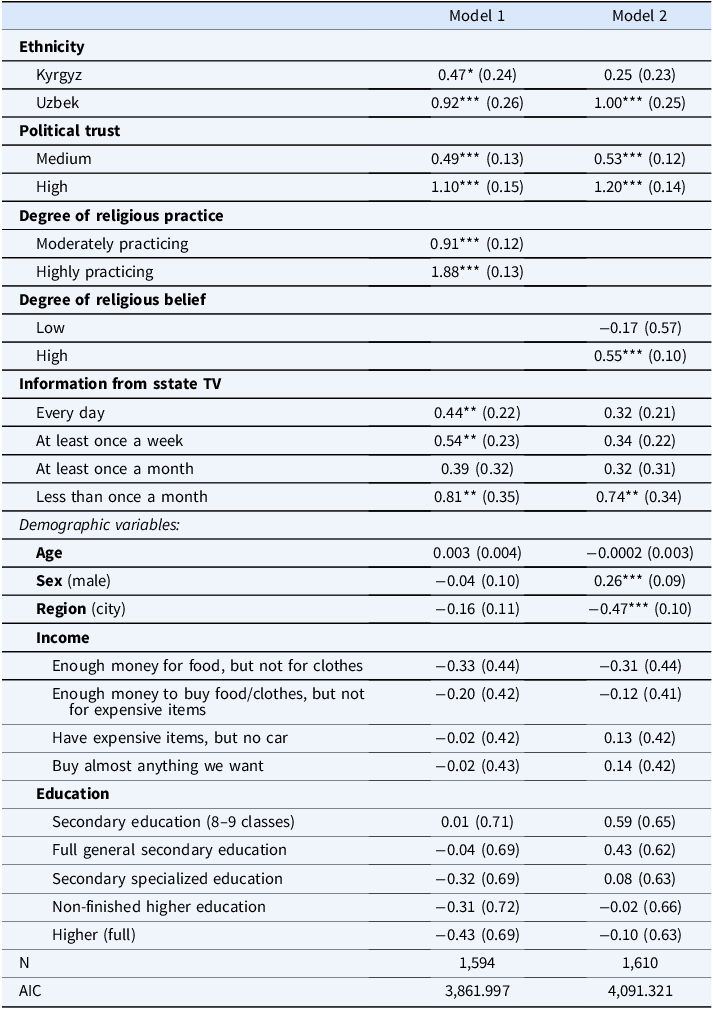
Our results are summarized in Table 1.Footnote 13 The variables in each model are the same except for religiosity. The first model includes religious practice, and the second one includes religious belief.
Importance of Hanafism to Kyrgyzstani national identity

Table 1. Long description
A table comparing the importance of Hanafism to Kyrgyzstani national identity across different models and variables. The table has 21 rows and 4 columns. Column headers are Model 1 and Model 2. Row labels include Ethnicity, Political trust, Degree of religious practice, Degree of religious belief, Information from state TV, Demographic variables, Age, Sex (male), Region (city), Income, Education, N, and AIC. Row 1: Ethnicity, Kyrgyz, 0.47 (0.24), 0.25 (0.23). Row 2: Ethnicity, Uzbek, 0.92*** (0.26), 1.00*** (0.25). Row 3: Political trust, Medium, 0.49* (0.13), 0.53*** (0.12). Row 4: Political trust, High, 1.10*** (0.15), 1.20*** (0.14). Row 5: Degree of religious practice, Moderately practicing, 0.91*** (0.12), . Row 6: Degree of religious practice, Highly practicing, 1.88*** (0.13), . Row 7: Degree of religious belief, Low,, -0.17 (0.57). Row 8: Degree of religious belief, High,, 0.55*** (0.10). Row 9: Information from state TV, Every day, 0.44** (0.22), 0.32 (0.21). Row 10: Information from state TV, At least once a week, 0.54** (0.23), 0.34 (0.22). Row 11: Information from state TV, At least once a month, 0.39 (0.32), 0.32 (0.31). Row 12: Information from state TV, Less than once a month, 0.81** (0.35), 0.74** (0.34). Row 13: Demographic variables, Age, 0.003 (0.004), -0.0002 (0.003). Row 14: Demographic variables, Sex (male), -0.04 (0.10), 0.26*** (0.09). Row 15: Demographic variables, Region (city), -0.16 (0.11), -0.47*** (0.10). Row 16: Income, Enough money for food, but not for clothes, -0.33 (0.44), -0.31 (0.44). Row 17: Income, Enough money to buy food/clothes, but not for expensive items, -0.20 (0.42), -0.12 (0.41). Row 18: Income, Have expensive items, but no car, -0.02 (0.42), 0.13 (0.42). Row 19: Income, Buy almost anything we want, -0.02 (0.43), 0.14 (0.42). Row 20: Education, Secondary education (8-9 classes), 0.01 (0.71), 0.59 (0.65). Row 21: Education, Full general secondary education, -0.04 (0.69), 0.43 (0.62). Row 22: Education, Secondary specialized education, -0.32 (0.69), 0.08 (0.63). Row 23: Education, Non-finished higher education, -0.31 (0.72), -0.02 (0.66). Row 24: Education, Higher (full), -0.43 (0.69), -0.10 (0.63). Row 25: N, 1,594, 1,610. Row 26: AIC, 3,861.997, 4,091.321.
Note: Estimation method is weighted ordinal logit. Dependent variable is response to the following question on a 4-point Likert scale of Not important at all to Very important: “In your opinion, how important is being a follower of the Hanafi maktab to be considered a genuine citizen of Kyrgyzstan?”. Unit of analysis is individual. Ethnicity, Political Trust, Degree of Religious Practice, Degree of Religious Belief, Information from State TV (frequency), Income, and Education are factor variables. Reference categories are Other, Low, Moderate (we only had 15 respondents in the low category, so we made moderate the reference category), Never, Not enough money for food, and 7 classes or lower, respectively. SEs (from ordinal logit) are in parentheses. Statistical significance is as follows: ***p < 0.01; **p < 0.05; *p < 0.1.
We find partial support for our Group Identity hypothesis (H1). Both Kyrgyz and Uzbek respondents consider being Hanafi important to being a true citizen of Kyrgyzstan; however, the coefficients for Kyrgyz are not statistically significant at the 0.05 levelFootnote 14 and the importance of Hanafism seems to resonate more with Uzbeks than Kyrgyz. While this seems to contradict our hypotheses because Uzbeks are the out-group, it is not surprising given their shared history with the in-group. This includes both the dominance of the Hanafi legal school and a Soviet legacy that deliberately conflated ethnic and religious identity (Akiner Reference Akiner1996; Radford Reference Radford2014). Rather than excluding the Uzbeks, the state’s emphasis on Hanafism as a marker of traditional and locally legitimate Islam incorporates them as an indigenous Muslim minority (Khalid Reference Khalid2007). Thus, it is in their collective interest to align with the state’s narrative concerning Hanafism. The greater resonance among Uzbeks compared to Kyrgyz may be related to the fact that the government in neighboring Uzbekistan actively promotes Hanafism as the legal school of Uzbek Islam, reinforcing the consistency with Uzbek identity (Schmitz Reference Schmitz2023, 29).
We find support for our Political Trust hypothesis (H2). As political trust increases, individuals are more likely to view being Hanafi as more important for being a true citizen of Kyrgyzstan. Thus, as expected, those with higher political trust are aligned with the state narrative regarding the importance of Hanafism for Kyrgyz national identity.
We find mixed support for our religiosity hypotheses. Respondents with higher degrees of religiosity measured as belief are more likely to align with the state’s narrative concerning Hanafism, as expected (H3a). However, contrary to our expectations, respondents with higher degrees of religiosity measured as practice are also more likely to view being Hanafi as important for being a true citizen of Kyrgyzstan (H3b). This alignment is likely due to the historical importance of Hanafism in Central Asia, where this legal school continues to have a dominant influence “on the religious orientations of Muslims” (Gunn Reference Gunn2003, 395). Moreover, because this school endorses a pluralistic understanding of the faith that includes customary law, it is also likely to be the least controversial aspect of the state’s OI narrative.
Experimental evidence
We conduct a two-step analysis of our embedded experiment. First, we use ordinary least squares (OLS) regressions to estimate the average effect of each treatment relative to the control group, enabling us to determine whether the state narrative concerning women’s head coverings resonates with the public. Second, we use one-way analysis of variance (ANOVA) tests and pairwise comparisons to see if differences between the treatment means are statistically significant. This enables us to assess the degree of resonance—specifically, whether respondents consider the jooluk to be more appropriate and compatible with national identity and personal piety than the hijab. Below, we report the ANOVA results for these two treatments only.Footnote 15
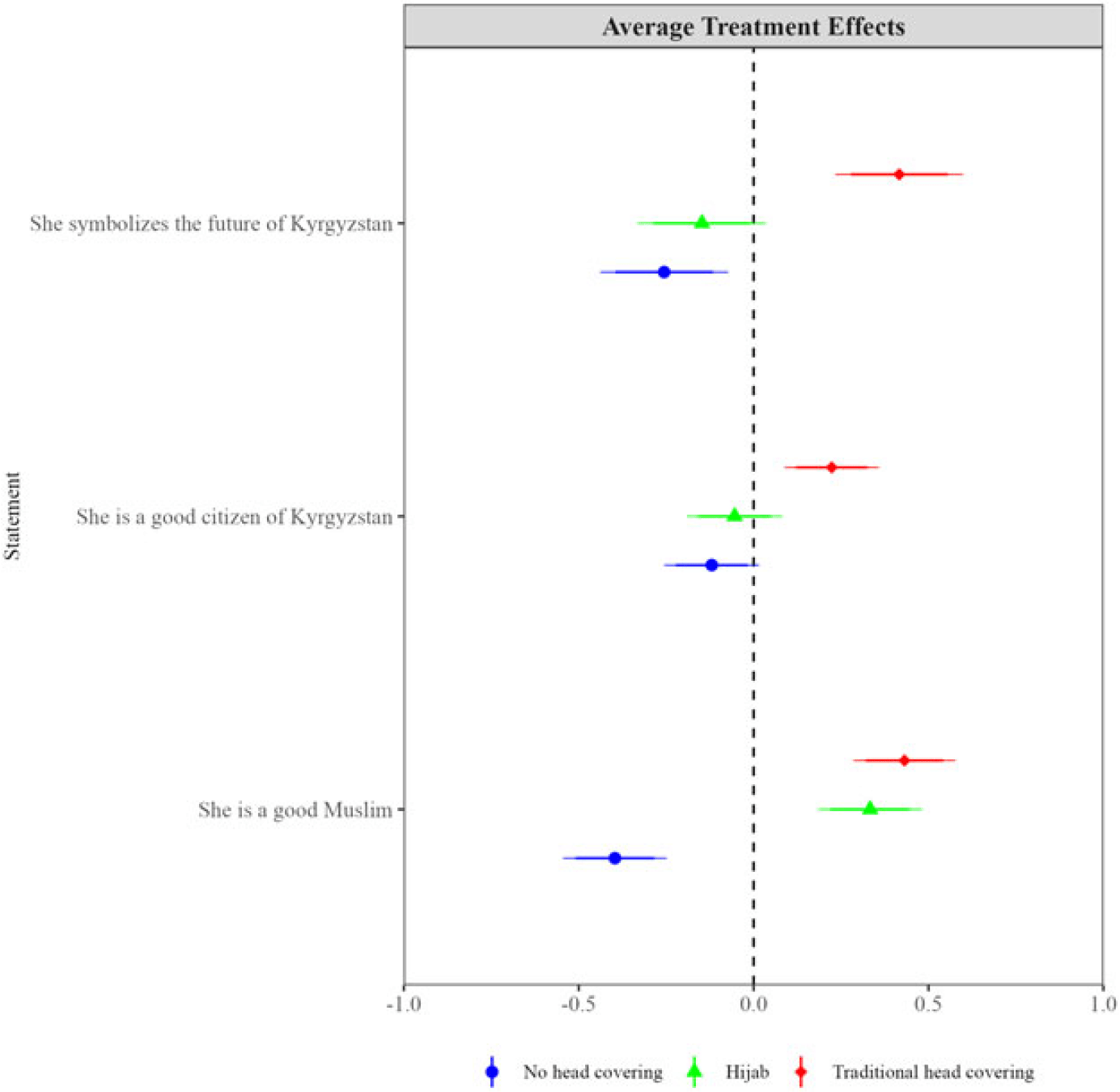
The average treatment effects, shown in Figure 1, indicate that the state’s narrative concerning religious expression and national identity is only partially resonant.Footnote 16 Consistent with this narrative, wearing the jooluk has a positive effect on respondents’ perceptions of the woman across all three statements relative to the control group. She is seen as symbolizing the future of Kyrgyzstan, being a good citizen of Kyrgyzstan, and being a good Muslim. Similarly, wearing no head covering has a negative effect on respondents’ perceptions of the woman across all three statements, albeit not significant for being a good citizen. However, the hijab treatment results are inconsistent with this narrative. Wearing the hijab has a negative effect on respondents’ perceptions of the woman’s national identity, but the differences are statistically insignificant, whereas it has a positive and significant effect on respondents’ perceptions of the woman’s religiosity. In other words, respondents do not view the woman as symbolizing the future or being a good citizen of Kyrgyzstan, but they do view her as a good Muslim. The difference between the means for these two treatments, moreover, is statistically insignificant, indicating that they do not view the traditional headscarf and the hijab differently when it comes to personal piety. This suggests that the state’s portrayal of the jooluk as more compatible with national identity than the hijab resonates with the public, but not its view of the hijab as an illegitimate form of religious expression.
Average treatment effects. Sample size: She symbolizes the future of Kyrgyzstan = 2,323; She is a good citizen of Kyrgyzstan = 2,270; She is a good Muslim = 2,205. Thick bars with size 0.5 indicate 95 percent confidence intervals while thin bars with size 0.25 indicate 99 percent confidence intervals. Results displayed are estimates from weighted OLS regressions with OLS standard errors.

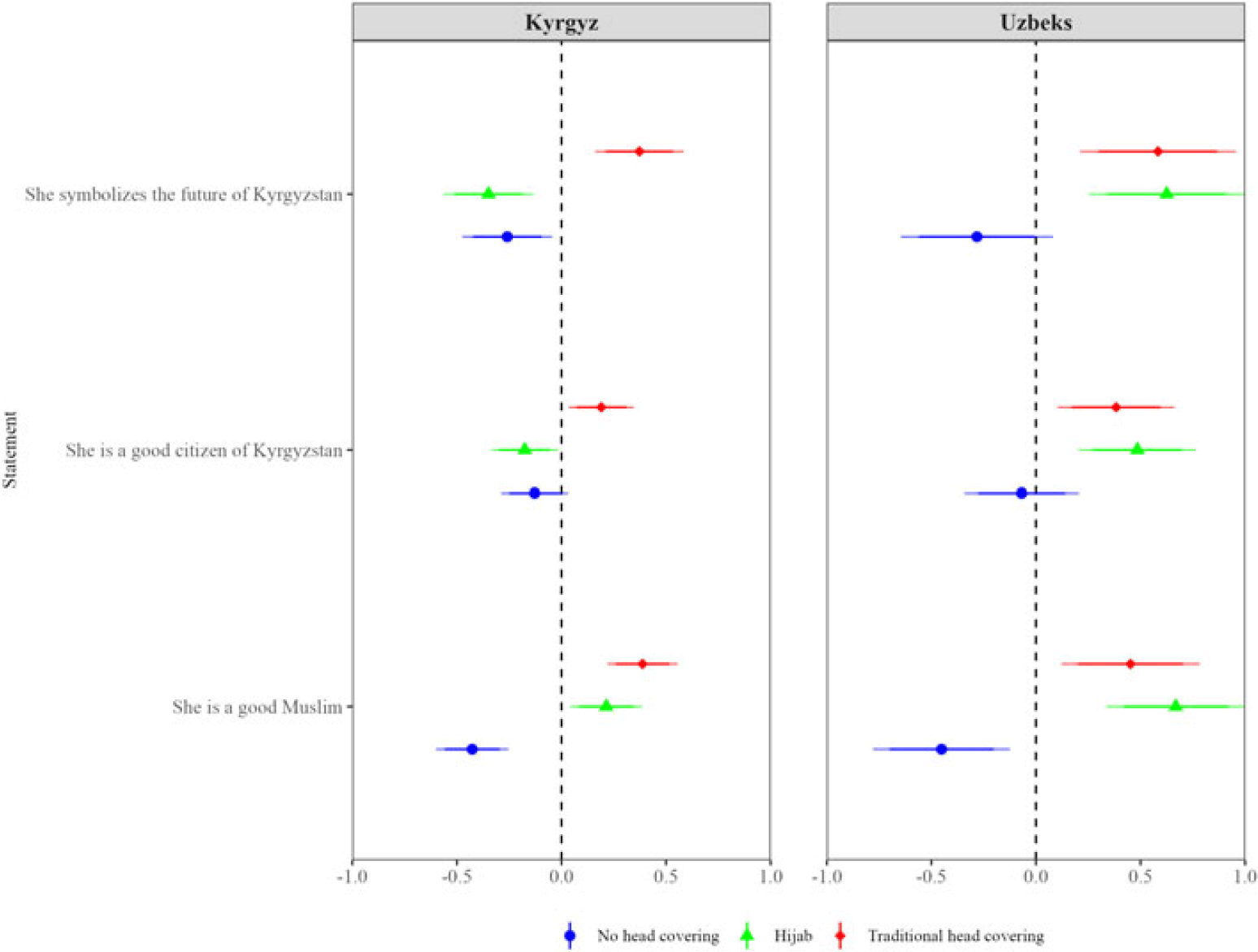
We now turn to the heterogeneous effects of ethnicity, trust, and religiosity to test our hypotheses. We find strong support for our Group Identity hypothesis (H1) that Kyrgyz will align more closely with the state narrative than Uzbeks (see Figure 2). For Kyrgyz, we find that wearing the jooluk has a positive effect on perceptions of the woman across all three statements, whereas the hijab has a negative effect on perceptions of the woman’s national identity but a positive effect on respondents’ perceptions of the woman’s religiosity. The difference between treatment means, moreover, is statistically significant at the 0.05 level, indicating that Kyrgyz respondents view the woman wearing the traditional headscarf as more compatible with national identity and a better Muslim than the woman wearing the hijab.
Heterogeneous effects (ethnicity). Sample size for Kyrgyz: She symbolizes the future of Kyrgyzstan = 1,743; She is a good citizen of Kyrgyzstan = 1,691; She is a good Muslim = 1,648. Sample size for Uzbeks: She symbolizes the future of Kyrgyzstan = 460; She is a good citizen of Kyrgyzstan = 459; She is a good Muslim = 439. Thick bars with size 0.5 indicate 95 percent confidence intervals. Thin bars with size 0.25 indicate 99 percent confidence intervals. Results displayed are estimates from weighted OLS regressions with OLS standard errors.

Conversely, we find that for Uzbeks, wearing either the jooluk or the hijab has a positive effect on perceptions of the woman across all three statements and that the differences between treatment means are not statistically significant. In other words, Uzbeks consider both forms of head coverings to be equally compatible with national identity and legitimate forms of religious expression. This finding underscores the positionality of Uzbeks as a Muslim minority ethnic group in a country that is promoting a version of Islam tied to the Muslim majority ethnic group. Whereas the Kyrgyzstan government’s promotion of Hanafism offers a shared umbrella under which Uzbeks can be recognized alongside Kyrgyz as part of Kyrgyzstan’s legitimate Muslim population, state restrictions on religious belief and practice pose a potential threat. Uzbeks, particularly in southern Kyrgyzstan, tend to be viewed as more conservative and ritualistic vis-à-vis Islamic expression than Kyrgyz and, largely for this reason, have also been viewed as being a greater risk for religious extremism (Kortmann and Nette Reference Kortmann and Nette2021).Footnote 17 Because religious restrictions are, at least nominally, aimed at countering extremism, they are often perceived as targeted at Uzbek communities (Liu Reference Liu2012).
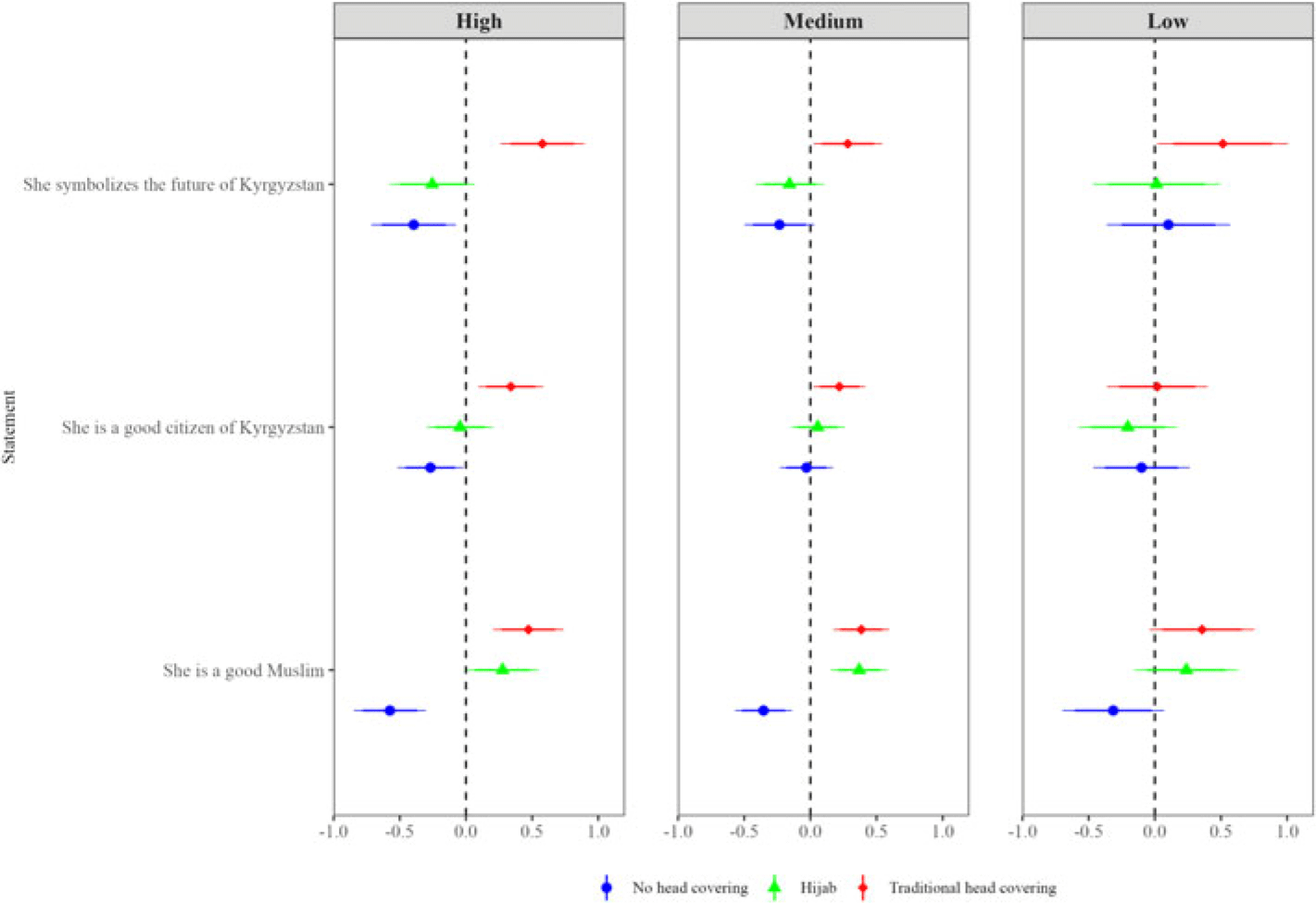
We find mixed support for our Political Trust hypothesis (H2). As political trust increases from low to high, the results mirror the average treatment effects (see Figure 3). Relative to the control group, wearing the jooluk has a positive and statistically significant effect on perceptions of the woman across all three statements. The hijab treatment, however, appears to have no significant effect on attitudes toward the woman’s compatibility with national identity, relative to the control group, and a positive and statistically significant effect on whether she is perceived as being a good Muslim. The pairwise comparisons reaffirm that this narrative does not resonate widely. Individuals with high and medium levels of political trust perceive the woman wearing the jooluk as more compatible with national identity but consider both women to be good Muslims. This suggests that those with higher political trust only align with part of the state’s narrative—that is, that one form of religious expression is more compatible with national identity.
Heterogeneous effects (political trust). Sample size for high: She symbolizes the future of Kyrgyzstan = 626; She is a good citizen of Kyrgyzstan = 616; She is a good Muslim = 598. Sample size for medium: She symbolizes the future of Kyrgyzstan = 1,061; She is a good citizen of Kyrgyzstan = 1,042; She is a good Muslim = 1,024. Sample size for low: She symbolizes the future of Kyrgyzstan = 383; She is a good citizen of Kyrgyzstan = 369; She is a good Muslim = 357. Thick bars with size 0.5 indicate 95 percent confidence intervals. Thin bars with size 0.25 indicate 99 percent confidence intervals. Results displayed are estimates from weighted OLS regressions with OLS standard errors.

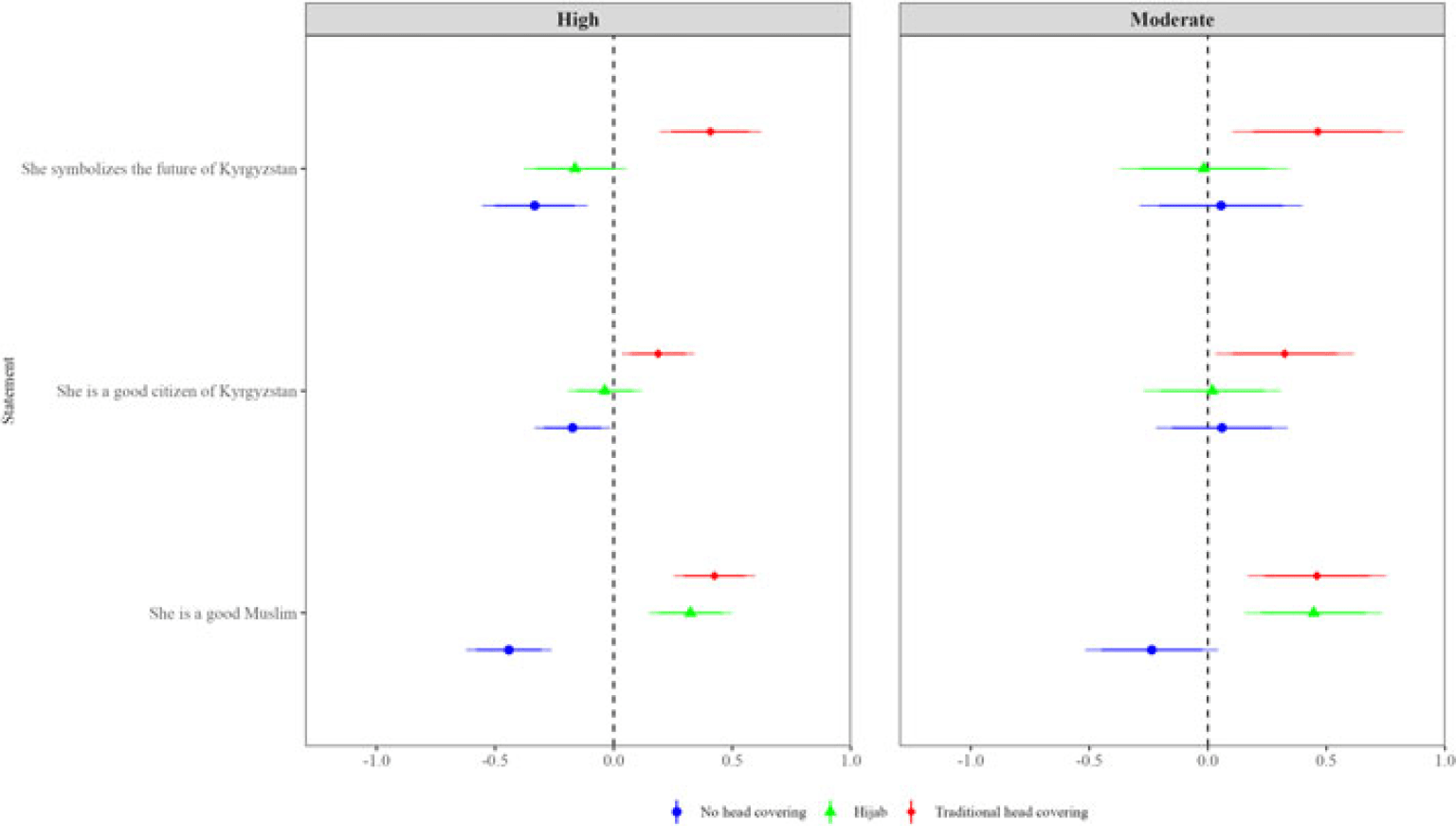
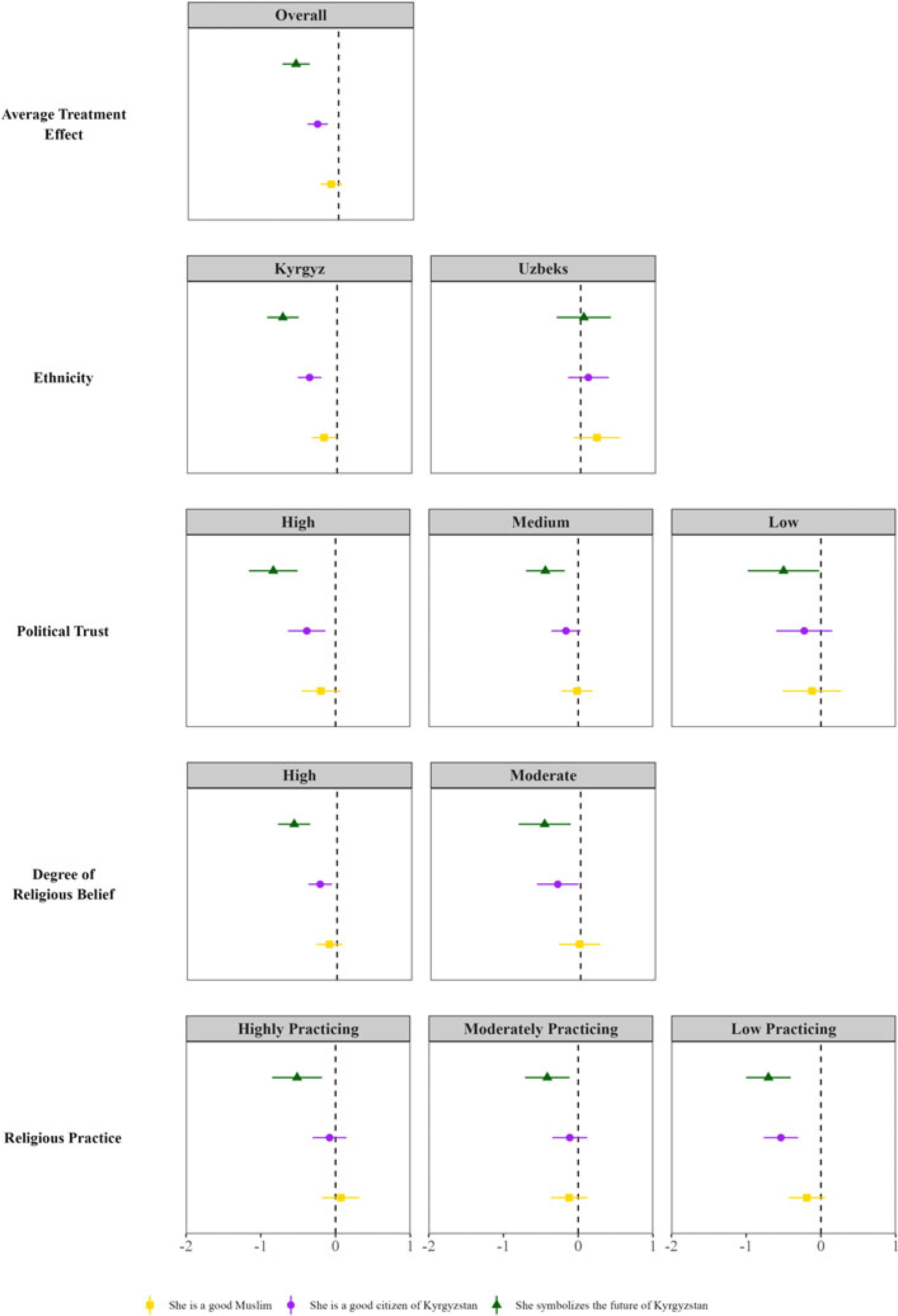
We also find mixed support for our Religious Belief hypothesis (H3a). Individuals with a high degree of belief align with the state’s narrative that the jooluk is most compatible with national identity, relative to the control group (Figure 4).Footnote 18 The pairwise comparisons show that they also share the view that the hijab is incompatible with national identity (Figure 6). However, when it comes to religious expression, this group considers both the hijab and jooluk to be legitimate, and the difference between the two is not statistically significant. In other words, the state’s narrative on religious clothing resonates with those who are more religious (measured as belief) regarding national identity but not personal piety.
Heterogeneous effects (religious belief). Sample size for high: she symbolizes the future of Kyrgyzstan = 1,560; She is a good citizen of Kyrgyzstan = 1,532; She is a good Muslim = 1,493. Sample size for moderate: She symbolizes the future of Kyrgyzstan = 667; She is a good citizen of Kyrgyzstan = 647; She is a good Muslim = 627. Thick bars with size 0.5 indicate 95 percent confidence intervals. Thin bars with size 0.25 indicate 99 percent confidence intervals. Results displayed are estimates from weighted OLS regressions with OLS standard errors.

Figure 4. Long description
Two side-by-side dot plots compare public perception of statements about a woman’s identity in Kyrgyzstan, categorized by head covering type and religiosity level. Panel A: High religiosity. Panel B: Moderate religiosity. Each panel features three statements: She symbolizes the future of Kyrgyzstan, She is a good citizen of Kyrgyzstan, and She is a good Muslim. The horizontal axis ranges from -1.0 to 1.0. The vertical axis lists the statements. Three data series are represented by different colors: blue for no head covering, green for hijab, and red for traditional head covering. Thick bars indicate 95 percent confidence intervals, and thin bars indicate 99 percent confidence intervals. The plots show varying levels of agreement with the statements based on head covering type and religiosity level.
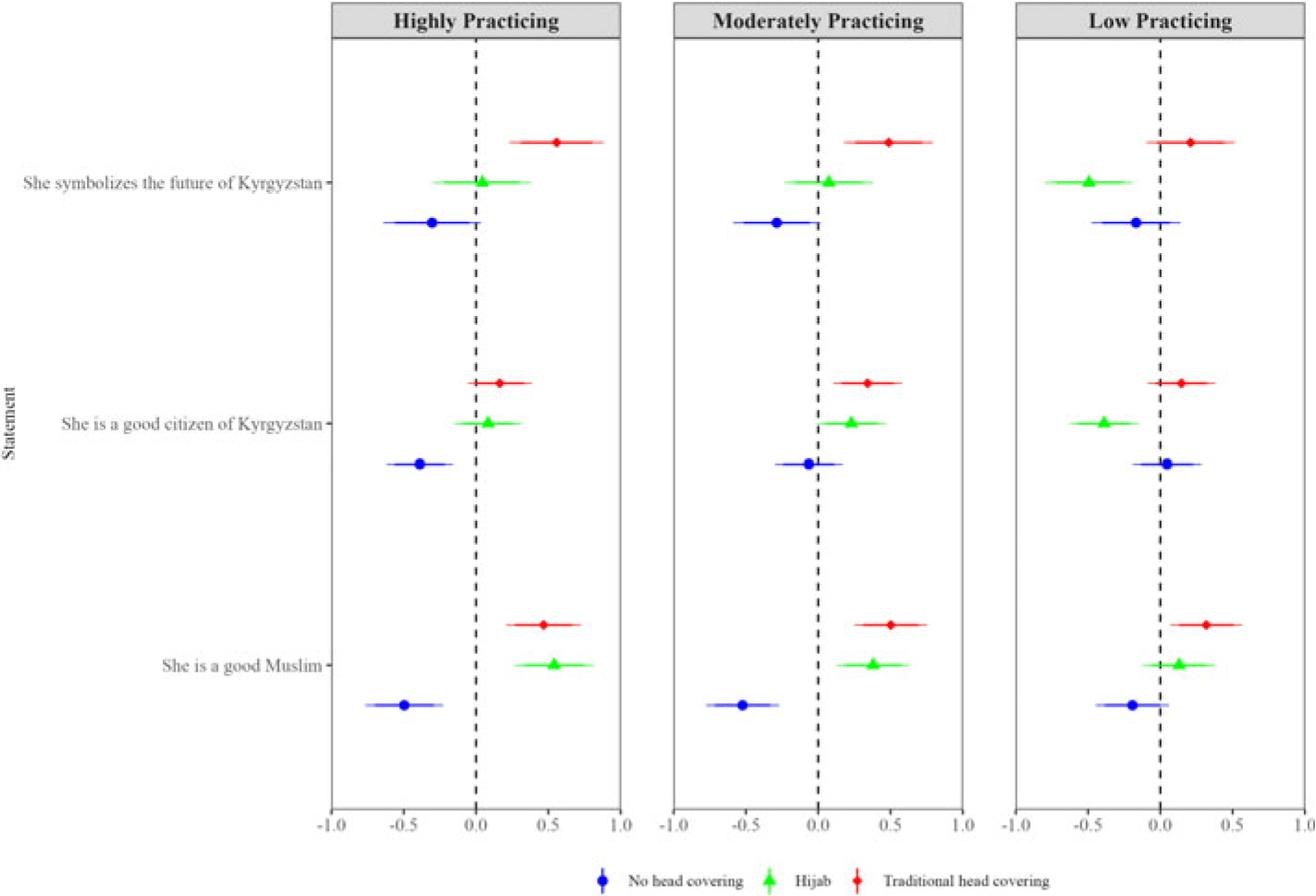
Heterogeneous effects (religious practice). Sample size for highly practicing: She symbolizes the future of Kyrgyzstan = 659; She is a good citizen of Kyrgyzstan = 645; She is a good Muslim = 629. Sample size for moderately practicing: She symbolizes the future of Kyrgyzstan = 754; She is a good citizen of Kyrgyzstan = 749; She is a good Muslim = 726. Sample size for low practicing: She symbolizes the future of Kyrgyzstan = 802; She is a good citizen of Kyrgyzstan = 778; She is a good Muslim = 759. Thick bars with size 0.5 indicate 95 percent confidence intervals, while thin bars with size 0.25 indicate 99 percent confidence intervals. Estimates are from weighted OLS regressions with standard errors.

ANOVA tests. The bars indicate 95 percent confidence intervals.

Figure 6. Long description
Panel A: description: The overall graph shows the average treatment effect of official Islam on public perception in Kyrgyzstan. The x-axis ranges from -2 to 2, and the y-axis represents different statements about being a good Muslim, a good citizen, and symbolizing the future of Kyrgyzstan. The graph includes three data points, each with a 95 percent confidence interval. Panel B: description: The ethnicity graphs show the average treatment effect for Kyrgyz and Uzbeks. Each graph has the same x-axis and y-axis labels as the overall graph. The data points for each statement are displayed with confidence intervals. Panel C: description: The political trust graphs are categorized into high, medium, and low trust levels. Each graph follows the same x-axis and y-axis structure as previous panels, with data points and confidence intervals for each statement. Panel D: description: The degree of religious belief graphs are divided into high and moderate belief levels. The structure and labels remain consistent with previous panels. Panel E: description: The religious practice graphs are categorized into highly practicing, moderately practicing, and low practicing. Each graph maintains the same x-axis and y-axis structure, with data points and confidence intervals for each statement.
We find some support for our Religious Practice hypothesis (H3b). As expected, individuals who are highly and moderately practicing do not align with the state narrative. They perceive both the woman wearing the jooluk and the hijab positively on all three statements, although not all the effects are statistically significant (Figure 5). Moreover, the pairwise comparisons show that they also do not view women wearing these two different head coverings as distinct when it comes to being either a good citizen or a good Muslim. At the same time, this group does partially align with the state’s narrative concerning the jooluk and national identity. The differences between the means for the jooluk and the hijab are statistically significant only for the “She symbolizes the future of Kyrgyzstan” statement. Thus, when religiosity is measured as practice, those who are more religious view the jooluk as the head covering that is likely to persist but do not consider it to be more compatible with either national identity or personal piety than the hijab. These findings are perhaps not surprising given that religiosity is measured in terms of behaviors; thus, to be highly religious is synonymous with embracing multiple ways of expressing one’s faith. Yet, they also suggest that, even among the most religious, there is a healthy skepticism that the country will continue to embrace a pluralistic understanding of Islamic practice. On the one hand, given the preexisting norms of religious pluralism in Kyrgyzstan, this alignment with the state narrative cuts against the expectation of bounded relativity. On the other hand, among those most beholden to these norms, it may reflect a sense of defeat rather than genuine acceptance.
Conclusion
In sum, we find that Kyrgyzstan’s OI narrative only partially resonates with the population. With two key exceptions—members of the out-group (ethnic Uzbeks) and those who are more religious (measured as practice)—there is broad alignment with the state’s promotion of traditional Kyrgyz Islam as most compatible with national identity. When it comes to personal piety, however, no group seems to be aligning with the state’s narrative that the hijab is an illegitimate form of religious expression, including members of the in-group (ethnic Kyrgyz), those with high political trust, ethnic Uzbeks, and those who are more religious (measured as both belief and practice).
Our findings suggest that the Kyrgyzstani state’s attempt to make religion legible by promoting a singular interpretation of Islam as compatible with both national identity and religious expression is limited and potentially counterproductive. That the state’s narrative regarding piety does not resonate with the groups that should be most likely to believe like the state—that is, ethnic Kyrgyz and those with high political trust—confounds its attempt to portray Kyrgyz Islam as homogeneous. Meanwhile, the two groups that appear to reject the state’s OI narrative in its entirety—that is, ethnic Uzbeks and those who are more religious—are the very groups that the state most needs to co-opt if it is to achieve its main goal of homogenizing Islamic belief and practice. By pursuing this goal in the face of popular misalignment, moreover, the state may be creating the potential for backlash from those who oppose homogenization (Shields Reference Shields2004). Moreover, our findings suggest that the resonance of OI narratives may be reduced where there are significant in- and out-group differences and where attitudes toward religious expression are pluralistic. Under these conditions, OI may also have unintended consequences.
Recent developments in Kyrgyzstan offer a glimpse into how popular backlash and unintended consequences may already be unfolding. The state appears to be resorting to ever more restrictive regulation to control religious expression. In the summer of 2023, for example, the government intensified its raids and closures of mosques and religious schools, shutting down 60 of them for violating religious regulations, allegedly because they “were operating beyond the confines of state-sanctioned Islam” (Eurasianet 2023). In February 2025, the state enacted two new laws that “widen the scope of restrictions on the freedom of religion or belief, freedom of expression, and freedom of association, such as by introducing fines for wearing certain religious attire in public places” (Linn Reference Linn2025). The laws impose requirements on religious practices aimed at abolishing or extending control “over autonomous communities seen as threats to ‘Kyrgyz Islam’ and at further centralizing Islamic religious life under the Muftiate” (Bühne Reference Bühne2025). Several months later, the state passed a law aimed at banning the niqab with hundreds of women receiving fines for being in violation (Najibullah and Asia Reference Najibullah and Asia2025).Footnote 19 Rather than conform to state regulations, women wearing the niqab have decided “to stay home,” feeling “alienated and socially isolated” (Noughani Reference Noughani2025). These restrictions suggest a desperation to enforce homogenization by other means. Yet, as the counterterrorism literature suggests, such measures are likely to produce a ratchet effect, in which increasing restrictions generate greater public backlash and heightened sympathy for extremist groups (Byman Reference Byman2013).
More broadly, our findings shed light on the factors that influence the viability of OI as a state- and nation-building strategy. It may be that where attitudes about religious expression and personal piety coincide with in- and out-group differences and prior beliefs about religious expression, individual attitudes are impervious to state narratives that counter those beliefs, especially for those with higher degrees of religiosity. Circling back to the scholarship on OI in the MENA region, it is worth considering that the resonance of OI may depend on the historical relationship between religious and national identities. These MMCs are characterized by what Cesari (Reference Cesari2014, 11) calls “hegemonic Islam,” wherein governments have been able to establish “a moral hierarchy” over their populations by incorporating Islam into state structures and standardizing Islamic belief and practice. There may therefore be more popular alignment with and less resistance to OI strategies in MENA countries than in non-MENA countries like Kyrgyzstan, where interpretations of Islam are less hegemonic at the state level and more pluralistic at the societal level. Future research should explore how the resonance of OI varies across MMCs with different historical relationships between national and religious identities.
Supplementary material
The supplementary material for this article can be found at https://doi.org/10.1017/S1755048326100479.
Data availability statement
The datasets generated and analyzed for this study will be made available on the project website.
Acknowledgements
The authors thank Justine Davis, Mostafa El Sharkawy, Dustin Gamza, R. Ward Holder, Anil Menon, Michael Robbins, and Mark Tessler for generous feedback on earlier drafts. The authors also gratefully acknowledge helpful comments from participants in the 2023–2024 Interdisciplinary Workshop on Religion at the University of Michigan, the 2023–2024 Interdisciplinary Workshop on Comparative Politics at the University of Michigan, the 2024 Midwest Political Science Association Conference in Chicago, and the 2025 Annual Meeting of the American Political Science Association in Philadelphia.
Financial support
Our research was supported by funding from the National Science Foundation (Grant no. SES-1658336) and the Department of Political Science, University of Michigan.
Competing interests
We have no competing interests to be declared.


 Open access

