Introduction
Sesame (Sesamum indicum L.) is an ancient oilseed crop that recently gained considerable importance as a genomic resource-rich oilseed crop (Wang et al., Reference Wang, Yu, Tong, Zhao, Liu, Song, Zhang, Zhang, Wang, Hua, Li, Li, Yu, Xu, Han, Huang, Tai, Wang, Xu, Li, Liu, Varshney R, Wang and Zhang2014; Dossa et al., Reference Dossa, Diouf, Wang, Wei, Zhang, Niang, Fonceka, Yu, Mmadi, Yehouessi, Liao, Zhang and Cisse2017; Mehmood et al., Reference Mehmood, Llorca, Casadesus, Farrakh and Bosch2021). Among all oilseed crops, sesame holds exceptional status for increasing oil demand in forthcoming years of India, as well as across the globe, as a result of its high oil content (OC) compared with other edible oilseed crops. The crop belongs to the family Pedaliaceae and diploid (2n = 26) in nature. It is a self-pollinated crop and believed to be a native of South Africa. Sesame is known as ‘queen of oilseeds’, as its seed oil has a high level of endogenous antioxidants, i.e. sesamol, sesamin and sesamolin, together with α-tocopherol, which exhibits resistance against auto-oxidation and rancidity (Dossa et al., Reference Dossa, Diouf, Wang, Wei, Zhang, Niang, Fonceka, Yu, Mmadi, Yehouessi, Liao, Zhang and Cisse2017). Sesame seeds possess both medicinal and nutritional value (44–55% oil, 18–25% protein, 13–14% carbohydrates), and oil is rich in unsaturated fatty acids (around 80%), which is ascribed to its effectiveness in reducing blood cholesterol level (Borchani et al., Reference Borchani, Besbes, Blecker and Attia2010). Sesame oil has anti-bacterial, anti-fungal, anti-viral and anti-oxidant properties; thus, it is very stable and holds long shelf life. Nearly 73% of the oil is used for edible purposes, whereas 8.3% for hydrogenization and 4.2% for industrial purposes in the manufacture of insecticides, paints and pharmaceuticals (Gharby et al., Reference Gharby, Harhar, Bouzoubaa, Asdadi, Yadini and Charrouf2017). Despite its high production demand, economic and nutritional importance, the crop yield is quite low when compared with other economically important oilseed crops such as rapeseed, peanut and soybean (Li et al., Reference Li, Dossa, Zhang, Wang, Zhu, Wang and Zhang2018; Mehmood et al., Reference Mehmood, Llorca, Casadesus, Farrakh and Bosch2021).
The sesame crop is mostly cultivated in tropics and subtropics regions. Globally, sesame covered an area of 14.15 million ha with the production of 6.83 million tones and productivity of 487.18 kg ha−1. In Asia, its coverage amounted to 3.91 million ha with the production of 2.17 million tones and productivity of 555.96 kg ha−1 (FAOSTAT, 2022). In India, the cultivated area under crop was 1.72 million ha with the production of 0.82 million tonnes and productivity of 474.16 kg ha−1 during the agricultural year 2021–22 (DES, 2021–22). The crop can be grown on various soil types and it is tolerant to higher temperatures. The cultivation is not labour intensive, requires a limited amount of irrigation and is suitable for crop rotations (Langham et al., Reference Langham, Janick and Whipkey2007; Dossa et al., Reference Dossa, Diouf, Wang, Wei, Zhang, Niang, Fonceka, Yu, Mmadi, Yehouessi, Liao, Zhang and Cisse2017). Lower yields in sesame were mainly due to its natural habitat, it is constantly exposed to very high temperatures, high solar radiation and high evaporation demand as it is mainly grown in marginal lands of tropical and subtropical regions, where it is frequently exposed to deficit soil moisture stress (Saljooghianpour and Javadzadeh, Reference Saljooghianpour and Javadzadeh2018; Baraki et al., Reference Baraki, Gebregergis, Belay, Berhe, Teame, Hassen, Gebremedhin, Abadi, Negash, Atsbeha and Araya2020; Pandey et al., Reference Pandey, Ratnakumar, Kiran, Dudhe, Lakshmi, Kulasekaran and Guhey2021). Though the crop is comparatively tolerant to moisture stress; however, extreme or long-lasting moisture stress has a tremendous impact on the plant growth, development and productivity of sesame (Ullah et al., Reference Ullah, Manghwar, Shaban, Khan, Akbar, Ali, Ali and Fahad2018; Dossa et al., Reference Dossa, Li, Zhou, Yu, Wang, Zhang and You2019; Pandey et al., Reference Pandey, Ratnakumar, Kiran, Dudhe, Lakshmi, Kulasekaran and Guhey2021; Ratnakumar et al., Reference Ratnakumar, Pandey, Gandi, Kulasekaran, Guhey and Reddy2021).
Deficit soil moisture stress is a major limiting issue to achieving the potential yield of present-day varieties of sesame (Ravitej et al., Reference Ravitej, Ratnakumar, Pandey, Reddy, Shanaker and Padmaja2019). Deficit soil moisture stress at critical growth stages in sesame affects the crop phenology and reduces the number of capsules per plant (NCP), seed yield and quality components (Dissanayake et al., Reference Dissanayake, Ranwala, Perera, Nijamudeen and Weerakoon2016; Sravanthi et al., Reference Sravanthi, Ratnakumar, Reddy, Eswari, Pandey, Manikanta, Ramya, Sonia, Mohapatra, Gopika, Anusha and Yadav2021; Gopika et al., Reference Gopika, Ratnakumar, Guhey, Manikanta, Pandey, Ramya and Rathnakumar2022, Reference Gopika, Ratnakumar, Brij, Manikanta, Ramya, Rathnakumar and Guhey2023). Identifying the various morpho-physiological, yield attributing and quality traits along with high seed yielding genotypes; particularly under deficit soil moisture stress is the need of the hour. So far, studies on moisture stress resistance in sesame are inadequate and the mechanism is barely reported.
Previous studies on sesame showed that the drought effects and drought responses of sesame are genotype-specific (Ratnakumar and Ramesh, Reference Ratnakumar and Ramesh2019). Therefore, it is needed to develop an elite line with soil moisture stress tolerance without compromising sesame seed quality and yield. Also, it is essential to find out the most promising genotypes with high seed yield, particularly under deficit soil moisture stress. In this connection, the present investigation ‘Phenotypic characterization of sesame (Sesamum indicum L.) revealed promising genotypes for moisture stress conditions’ was designed with the objectives of (i) to assess the diversity present in selected genotypes using multivariate analysis (ii) to select the best-performing genotypes based on their morpho-physiological, yield and quality traits under both WW and WS (iii) to assess phenotypic and genotypic trait association with seed yield.
Materials and methods
Experimental area
The present experiment was carried out at Narkhoda research farm, ICAR-Indian Institute of Oilseeds Research, Rajendranagar, Hyderabad (Latitude 17°15′16″ N; Longitude 78°18′30″ E), located at an altitude of 542 m above mean sea level. The experiment was conducted during the summer season of the year 2021 and 2022. The weather parameters like mean temperature (max and min) and rainfall were depicted in online Supplementary Fig. 1. Test location map was presented in online Supplementary Fig 2.
Plant materials
A subset of 35 sesame genotypes including two national checks (GT-10 and TKG-22) was selected for the study. The selected genotypes were mostly landraces, adapted to different agro-ecological zones in India and belong to the same gene pool species: Sesamum indicum L. The details of the genotypes were given in Supplementary Table S1. The selection of these 35 genotypes was made out from 313 sesame germplasms evaluated under well-watered and water-stressed conditions during the years 2018 and 2019 (Pandey et al., Reference Pandey, Ratnakumar, Kiran, Dudhe, Lakshmi, Kulasekaran and Guhey2021). The phenology and physiological maturity of these selected genotypes were similar and checks were better seed yielders under WW conditions.
Crop management
The seeds were sown in a plot of 12 m2 with a spacing of 45 (row) × 15 cm (plant to plant) by dibbling method, in three replications under each treatment using strip plot design. The recommended dose of fertilizer was applied (40 kg N + 20 kg P2O5 + 20 kg K2O/ha) in two split doses, and additional standard practices and required plant protection measures were followed to maintain a healthy crop. The experiment was carried out in sandy loam soil, which is deprived of organic content (OC: 0.4%; N: 235 kg/ha−1) with a water holding capacity of only 18%.
Stress imposition
The crop was irrigated at regular intervals in WW plots, and WS conditions were imposed from flowering (40–45 DAS) to the physiological maturity stage (90–95 DAS). Six solar-based real-time soil moisture sensors (Manufactures: Proximal; Brand: SoilSenS, Model: V1.0) were installed to record the soil moisture levels on hourly basis at a soil depth of 45 cm. Need-based irrigation was given to WW plots to maintain soil moisture up to 80% field capacity. In WS plots, stress was imposed up to 40% soil moisture of the field capacity by withholding the irrigation, equivalent to −4.5 to −5 bars of soil water potential.
Traits estimation
The various morphological, physiological, yield and quality traits were recorded during various crop growth stages and at maturity. The morphological traits, such as number of days to 50% flowering (NDF), number of branches (NBP), plant height (PH), total leaf area (LA) measured with LICOR bench-top LA meter, leaf dry weight (LDW) and total dry matter (TDM), were recorded from a total of 30 randomly selected plants in each replication under both WW and WS treatments. Physiological traits such as SCMR (SPAD chlorophyll meter readings) measured using SPAD-502 Plus (make: Konica Minolta, Inc.), relative water content {RWC = [(fresh weight – dry weight)/(turgid weight–dry weight)] × 100}, membrane stability index (MSI = [1−C1/C2] × 100), canopy temperature (CT) (using Everest 5100 IR gun), gas-exchange parameters (using Infra-Red Gas Analyser; LICOR-6400), viz. stomatal conductance (gs), photosynthetic rate (Pn) and transpiration rate (TR) were also recorded (at 70–75 DAS) after imposition of stress conditions. The physiological traits including gas-exchange parameters were measured mostly during sunny days at 10.00–13.00 h (IST) in five plants of each replication of each genotype. The yield attributing traits like the NCP, the number of seeds per capsule (NSC), capsule length (CL), capsule width (CW), test weight (TW) and seed weight per plant (SWP) were estimated at physiological maturity and harvest. The seed quality traits such as OC (Nuclear magnetic resonance spectrometer, MARS, UAS, Raichur), protein content (PC) (Kjeldahl method) and fatty acid profile (Gas chromatography, Agilent 7860A) were measured after crop harvest.
Statistical analysis
The analysis of variance (ANOVA) was performed to assess the effect of treatments, genotypes and interaction of treatments and genotypes for the different traits measured. The mean observations, after computing for each trait under WS and WW, were subjected to statistical analysis. The correlation coefficients were calculated using the formula proposed by Falconer (Reference Falconer1964), and path analysis by Dewey and Lu (Reference Dewey and Lu1959). Furthermore, the amount of divergence and clustering was done according to the procedure provided by Mahalanobis D2 (Reference Mahalanobis1936) statistics and Tocher's method (Rao, Reference Rao1952). Inter and intra-cluster distances were estimated using the formula given by Singh and Chaudhary (Reference Singh and Choudhary1977). The phenotypic and genotypic correlation coefficient, path analysis and D 2 statistics were assessed using INDOSTAT software. Principal component analysis (PCA) and principal component score were calculated using R software (V.4.1) (R Core Team, 2022).
Results
Analysis of variance
Results from ANOVA indicated significant variation (P ≤ 0.05) for all morpho-physiological, yield, yield components and quality traits due to the influence of varied water treatments, i.e. WW and WS; genotypes and interaction effect except for days to 50% flowering. The non-significant variation was observed for days to 50% flowering due to the influence of treatments, genotypes and interaction effects, which can be attributed to the fact that, deficit soil moisture stress was imposed at 50% flowering stage. The results of ANOVA are presented in the online Supplementary Table S2.
Mean performances
The mean performances of sesame genotypes revealed significant variation for almost all the observed traits and are presented in online Supplementary Tables S3 and S4. The results indicated that WS limits the performance of genotypes for all observed morpho-physiological and yield traits compared to WW. The mean performances revealed that PH ranged from 81.6 to 98.8 cm under WS conditions; whereas from 95.4 to 128.0 cm under WW. The NBP is an important yield-contributing trait and an indirect measure of final seed yield. The NBP significantly varied among the genotypes and decreased under WS (3.0–12.0) compared to WW conditions (2.0–11.0). The mean performance showed that WS limits the leaf growth and a drastic reduction (37.78%) in LA was noticed under WS compared to WW. Furthermore, morphological traits such as LDW (WW: 3.13–7.12 g and WS: 3.99–11.61 g) and TDM (WW: 7.75–20.92 g and WS: 10.60–27.40 g) were also significantly varied and exhibited a reduction under WS.
Among the physiological traits, the photosynthesis-related Pn, gs, and TR were significantly varied and showed a reduction of almost 20.15, 42.02 and 30.77%, respectively, under WS compared to WW. The RWC is an indicator of tissue water status and was reported to decline under WS (79.11%) conditions compared to WW (89.43%). Likewise, MSI varied from 85.1 to 94.1 under WW; whereas from 60.0 to 86.3 under WS and was found to be negatively affected when genotypes were exposed to WS. Unlike other physiological traits, SCMR values and CT were increased under WS (40.60–60.03°C and 33.67–40.0°C, respectively) compared to WW (35.87–58.50°C and 30.0–35.3°C, respectively).
The results revealed that WS had a detrimental effect on yield contributing traits and final seed yield in sesame. Mean performance showed that the yield contributing traits such as NCP (WW: 77.3–190.0; WS: 52.33–175.0), CW (WW: 7.53–16.16 g; WS: 4.22–15.23 g), NSC (WW: 66.40–89.60; WS: 64.40–87.20), and TW (WW; 2.68–3.89 g; WS; 2.40–3.42 g) were significantly varied among the genotypes and were reduced severely under WS conditions. The final SWP ranged from 6.55 to 12.62 g under WW and 3.83 to 10.33 g under WS. The percent reduction showed that the deficit soil moisture had a detrimental effect on seed yield as it reduced by almost 28.10% under WS.
Based on mean performance, best-performing genotypes for the different morpho- physiological traits, such as LA (JCS DT-26 and IC-205776), TDM (IC-132293 and IC- 205776), SCMR (JCS-1020 and DT-112), RWC (JCS DT-112 and IC-204622), NBP (YLM-66 and JCS DT 112), NCP (IC-204085 and IC-205776), NSC (IC-205804 and JCS DT-26) and SWP (IC-205776 and JCS DT-112) were identified.
Among the qualitative traits, OC, PC, and fatty acids (saturated and unsaturated) were recorded under both WW and WS. The mean performance revealed that all the qualitative traits were significantly varied among the sesame genotypes. Under WS, the OC ranged from 34.46 to 46.86% under WS; whereas from 42.90 to 50.59% under WW and reduced by almost 8.28% under WS. The PC varied from 13.61 to 26.16% under WW; whereas 16.41 to 29.96% under WS. Sesame oil is rich in both saturated (Palmitic and stearic acid) and unsaturated (oleic, linoleic, and linolenic acid) fatty acids. The results revealed that palmitic (WW; 7.28–13.21%: WS; 6.37–12.22%) and stearic acid (WW; 2.03–6.74%; WS; 1.95–5.57%) showed a small reduction, i.e. 5.48% and 5.38%, respectively, under WS conditions. On the other hand, WS enhances the oleic acid (WW; 36.7–51.50%; WS; 38.65–51.42%), linoleic acid (WW; 28.86–49.80%; WS; 34.06–49.69%), and linolenic acid (WW; 0.13–1.22%; WS; 0.28–1.24%) by almost 3.37, 1.7 and 9.52%, respectively. The mean performance revealed that the WS leads to an increase in unsaturated fats; while declining the saturated fatty acids content.
The per se performances indicated that the genotypes, viz. IC-205776, JCS DT-26, JCS DT-112, IC-204300 and IC-205610 were most promising for qualitative traits and had higher oleic, linoleic and linolenic acids, particularly under WS.
Phenotypic and genotypic traits association
Comprehension of the association between yield and morpho-physiological traits is useful to make the simultaneous selection for more than one trait (Disowja et al., Reference Disowja, Parameswari, Gnanamalar and Vellaikumar2021). The correlation analysis helps in determining the direction and number of traits to be scrutinized in improving the yield. The genotypic and phenotypic correlations were neighbouring together for morpho-physiological and yield traits under WS and WW (online Supplementary Tables S5 and S6). The correlation studies indicated that the SWP was reported to associate positively with LA, TDM and LDW; whereas negatively with CT under WW conditions at the significance level of P < 0.05 (online Supplementary Fig. 3). Likewise, under WS conditions, SWP was associated positively with LA, TDM, MSI and palmitic acid; while negatively with CT and oleic acid (P < 0.05) (online Supplementary Fig. 4).
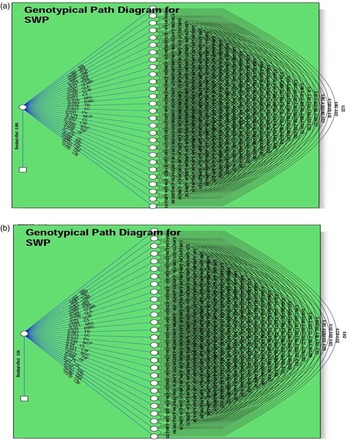
Correlation analysis provides one-way information regarding the effect of a particular trait on seed yield; therefore, path coefficient analysis was carried out to partition direct and indirect effects of each trait on seed yield. It indicated that the SWP had the highest positive direct effect with the traits, LA, TDM, LDW, NBP and NCP; whereas the negative direct effect with CT under both WW and WS. The highest positive indirect effect on seed yield was recorded with the traits TDM via LA, LDW, NBP and NCP under both WW and WS (Online Supplementary Table S7 and S8; Fig. 1) indicating the importance of these characters for consideration in the selection programme.
Genotypic path diagram for seed yield association with morpho-physiological, yield and quality traits under WW (a) and WS (b).

Considering both (WW and WS) conditions indicated that the traits LA and TDM were positively and CT was negatively associated with SWP. Therefore, these traits could be taken into consideration for future drought evaluation programmes.
Multivariate analysis
The multivariate analysis helps in determining the combination of traits that constitute an ideal plant. It also provides an opportunity for the utilization of appropriate germplasm in crop improvement for particular plant traits. The PCA may allow the plant physiologist and plant breeders more flexibility in finding the traits which could be used for selection.
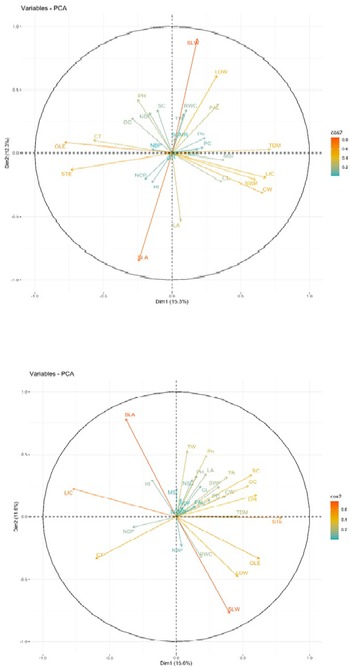
The PCA was carried out separately for both WW and WS and it revealed that the first eight PCs contributed for more than 70% variability existed among the evaluated sesame genotypes with eigen value >1. Under WW, PC1 and PC2 were responsible for 15.62 and 11.62% variation, respectively; whereas under WS, PC1 and PC2 account for 15.34 and 12.31% variability, respectively (Table 1). In the first PC, traits, viz. LA, NCP, SWP, OC and PC under WS condition; while LA, PH and PC under WW secured the highest positive factor loading values representing that these traits are the major contributors for variation in PC1 (Fig. 2). In addition, traits, viz. TR, and SC under WS; while TR and NBP under WW with positive factor loading values also account for variations in PC1. Similarly, in PC2, traits like NCP and NBP under WS; NCP, PC, and LA under WW with highest positive loading values; whereas TW and gs under WS and gs under WW exhibited with lowest negative loading values in PC2 contributing toward variability.
PCA showing the Eigen values and proportion of variance under WW and WS conditions

Biplot between PC1 and PC2 depicting the contribution of various traits under WW (top) and WS (bottom) conditions.

The traits with high coefficients in the PC1 and PC2 should be considered more significant because these explain more than 50% of the whole variation (online Supplementary Tables S9 and S10). In conclusion, PCA specified that the observed traits, i.e. LA, NBP, NCP, TDM, SWP, OC and PC were the most important, which reported greater than 50% of the total variation among the selected sesame genotypes.
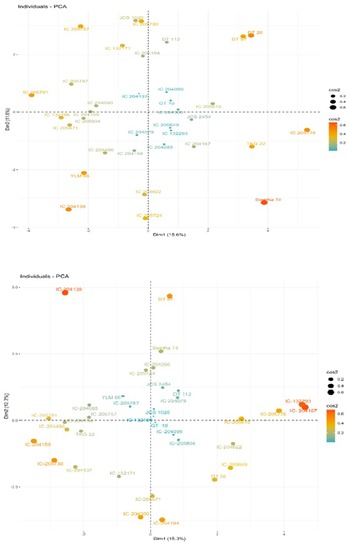
From the principal scatter plot, it inferred that the genotypes IC-204300, GT-10, JCS-2454, IC-205610 and IC-132293 under WW; and IC-132186, GT-10, JCS-1020, IC-205787 and JCS DT-112 under WS were located near the axis, representing that these genotypes performed similarly and showed the minimum quantum of variation tested. On the other hand, JCS DT-97, JCS DT-26, and IC-205776 can be denoted as tolerant cultivars as they are situated far away from the axis and could perform differently under varied moisture conditions (Fig. 3).
Principal scatter plot of the PC1 and PC2 of sesame genotypes under WW (top) and WS (bottom) conditions.

Distribution of genotypes
To analyse the diversity that exists among the sesame genotypes multivariate analysis like cluster and PCA was carried out. The critical assessment of clusters exposed that clusters were heterogeneous within themselves and between each other's based on major character relations. The genotypes were distributed into five and nine clusters under WW and WS, respectively, revealing the presence of a substantial amount of diversity in the material (Table 2). In WW among the five clusters, Cluster II was the largest cluster (15 genotypes) followed by cluster I (11 genotypes), and clusters IV and V were the solitary clusters containing only genotypes, indicating the distinct nature of genotypes belonging to these clusters. On the other hand, under WS among the nine clusters, cluster V was the largest cluster (nine genotypes) followed by cluster II (five genotypes), and clusters VI and IX were solitary clusters.
Sesame genotypes clusters under WW and WS conditions

The highest intra-cluster distance was observed for cluster II followed by cluster I under WW; whereas for cluster IV followed by cluster III under WS, indicating the presence of heterogeneity, genetic architecture, and also depends upon the history of the selections made during traits development among the population. In addition, the minimum inter-cluster distance was found between I and IV under WS; while between clusters II and III under WW, suggesting a close relationship among the genotypes present in these clusters (Table 3).
Intra and Inter-cluster distances of sesame genotypes under WW and WS conditions

Further, based on cluster mean values, a considerable amount of diversity was noticed among the genotypes under both WW and WS (online Supplementary Tables 11 and 12). Cluster mean values indicated that the genotypes of clusters I and V under WW; while clusters IV and VI under WS not only had the highest SWP but also superior in traits such as LA, LDW, TDM, PC and OC.
Based on cluster mean values, genotypes IC-132293, JCS DT-112 and JCS DT-26 were found most promising under both WW and WS and could be used in consideration for future drought evaluation programmes.
Discussion
Sesame is an oldest oilseed crop domesticated nearly 3000 years ago and it is believed as the first oil consumed by humans (Yadav et al., Reference Yadav, Kalia, Rangan, Pradheep, Rao, Kaur, Pandey, Rai, Vasimalla, Langyan, Sharma, Thangavel, Rana, Vishwakarma, Shah, Saxena, Kumar, Singh and Siddique2022). Sesame is also known as orphan crop because it gets little research attention. Genetic diversity of crops plays an important role in sustainable development and food security, as it allows adaption to various abiotic and biotic stresses (Dossa et al., Reference Dossa, Niang, Assogbadjo, Cissé and Diouf2016). Landraces are a valuable source of genetic diversity and possess important traits for pre-breeding and breeding programmes (Teklu et al., Reference Teklu, Shimelis, Tesfaye, Mashilo, Zhang, Zhang, Dossa and Shayanowako2021). In the present study, a subset of 35 genotypes was selected based on the previous study conducted by Pandey et al. (Reference Pandey, Ratnakumar, Kiran, Dudhe, Lakshmi, Kulasekaran and Guhey2021). The selected genotypes were mostly landraces and part of Indian sesame core set. Evaluation of diversity among sesame genotypes is important for the development of drought-tolerant cultivars. The results from the current study showed that high genetic diversity existed among the sesame genotypes for observed morpho-physiological, yield and yield components; and quality traits.
Understanding the moisture stress tolerance in sesame is of foremost importance as the crop is frequently exposed to severe water stress. Severe moisture stress affects plant growth, flowering, capsules and seed production, thus leading to declining of yields in sesame (Mehmood et al., Reference Mehmood, Llorca, Casadesus, Farrakh and Bosch2021; Pandey et al., Reference Pandey, Ratnakumar, Kiran, Dudhe, Lakshmi, Kulasekaran and Guhey2021; Gopika et al., Reference Gopika, Ratnakumar, Guhey, Manikanta, Pandey, Ramya and Rathnakumar2022, Reference Gopika, Ratnakumar, Brij, Manikanta, Ramya, Rathnakumar and Guhey2023). Furthermore, in sesame, the development of improved cultivars for deficit soil moisture stress tolerance particularly under moisture stress was hampered due to a lack of efficient selection criteria (Boureima et al., Reference Boureima, Diouf, Amoukou and Van-Damme2016, Dossa et al., Reference Dossa, Li, Zhou, Yu, Wang, Zhang and You2019).
The mean performance indicated that the most of the traits showed a limited expression when subjected to WS. The Physiological traits like Pn, gs, TR, and RWC were significantly reduced; whereas CT increased under WS. The CT is widely used as selection indices particularly under WS. Under limited water availability, the stomata tends to close (an adaptive mechanism under stress) and that leads to an increase in plant's CT (Mamnabi et al., Reference Mamnabi, Nasrollahzadeh, Golezani and Raei2019). Increased CT along with water shortage has a negative impact on transpiration and stomatal conductance and finally plant productivity (Sehgal et al., Reference Sehgal, Sita, Kumar, Kumar, Singh, Siddique and Nayyar2017; Sravanthi et al., Reference Sravanthi, Ratnakumar, Reddy, Eswari, Pandey, Manikanta, Ramya, Sonia, Mohapatra, Gopika, Anusha and Yadav2021). Hence, the genotypes with lower canopy temperatures with higher yield under moisture stress could be considered as tolerant (Ratnakumar et al., Reference Ratnakumar, Vadez, Nigam and Krishnamurthy2009; Beebe et al., Reference Beebe, Rao, Blair and Acosta-Gallegos J2013; Pandey et al., Reference Pandey, Ratnakumar, Kiran, Dudhe, Lakshmi, Kulasekaran and Guhey2021; Sravanthi et al., Reference Sravanthi, Ratnakumar, Reddy, Eswari, Pandey, Manikanta, Ramya, Sonia, Mohapatra, Gopika, Anusha and Yadav2021).
RWC reflects the tissue water content and is an indirect measure of assessing the sensitivity of crop plants to water stress (Lima et al., Reference Lima, Rocha, Melo and Dutra2018). The results showed that water stress conditions caused a reduction in RWC. These results are similar to the findings of Hassanzadeh et al. (Reference Hassanzadeh, Ebadi, Kivi, Eshghi, Somarin, Saeidi and Mahmoodabad2009), Kadkhodaie et al. (Reference Kadkhodaie, Razmjoo, Zahedi and Pessarakli2014), Pandey et al. (Reference Pandey, Ratnakumar, Kiran, Dudhe, Lakshmi, Kulasekaran and Guhey2021 and Reference Pandey, Ratnakumar, Ramesh, Qureshi, Sowjanya and Guhey2022) in sesame. The cell membrane is known as the principal site of damage when a plant is exposed to stressful environments. Water stress leads to changes in membrane integrity, increase the electrolytes leak out and together causes loss of cell permeability (Molaei et al., Reference Molaei, Ebadi, Namvar and Bejandi2012). Under WS, a notable decrease among sesame genotypes was recorded which might be due to the loss of membrane integrity (Najafabadi and Ehsanzadeh, Reference Najafabadi and Ehsanzadeh2017). On the other hand, results revealed an increase in SCMR values under WS which is probably due to reduced LA. Furthermore, previous findings suggested that the genotypes that accumulated a higher amount of chlorophyll predominantly under WS were considered tolerant (Alaei, Reference Alaei2011; Kadkhodaie et al., Reference Kadkhodaie, Razmjoo, Zahedi and Pessarakli2014; Pandey et al., Reference Pandey, Ratnakumar, Kiran, Dudhe, Lakshmi, Kulasekaran and Guhey2021).
The WS also caused decreased LA, LDW and TDM by almost 37.78, 26.31 and 27.9%, respectively, which is in accordance with the findings of Mensah et al. (Reference Mensah, Obadoni, Eruotor and Onome-Trieguna2006), Badiel et al. (Reference Badiel, Nana, Nanema, Konate and Ignassou2017), Najafabadi and Ehsanzadeh (Reference Najafabadi and Ehsanzadeh2017) and Zehra et al. (Reference Zehra, Koaser, Ahmad, Naz, Atta, Satti, Shahbaz and Sarwar2017). Decreasing LA and increased leaf thickness is one of the mechanisms of moderating water loss from crop canopy and averting excessive deficit soil moisture stress-induced injury to the plant (Vurayai et al., Reference Vurayai, Emongor and Moseki2011).
The mean performance showed that water stress conditions severely affect the yield contributing and final seed yield in sesame. The various yield traits such as NCP, NSC, CL, CW, TW, and SWP were reduced under WS by almost 29.09, 7.44, 7.68, 41.29, 10.63 and 28.10, respectively. These results are in agreement with the reports of Pandey et al. (Reference Pandey, Ratnakumar, Kiran, Dudhe, Lakshmi, Kulasekaran and Guhey2021), Sravanthi et al. (Reference Sravanthi, Ratnakumar, Reddy, Eswari, Pandey, Manikanta, Ramya, Sonia, Mohapatra, Gopika, Anusha and Yadav2021), and Pallavolu et al. (Reference Pallavolu, Pasala, Kulasekaran, Pandey, Virupaksham and Perika2023). In sesame, flowering is a sensitive stage to water stress, and even a mild reduction in soil moisture during this stage results in major yield losses (Golestani and Pakniyat, Reference Golestani and Pakniat2007; Badiel et al., Reference Badiel, Nana, Nanema, Konate and Ignassou2017; Ozkan, Reference Ozkan2018). A decrease in yield attributing traits was due to the fall of flower buds, blooms and even immature fruits during the period of water stress (Nana et al., Reference Nana, Ouédraogo, Sawadogo, Compaore, Ouédraogo, Badiel and Sawadogo2019).
Not only quantitative traits but qualitative traits were also influenced due to WS. The mean performance indicated that among the unsaturated fatty acids, an increased in oleic acid (3.37%), linoleic (1.7%) and linolenic acid contents (9.52%); whereas palmitic (5.48%) and stearic acid content (5.38%) was reduced. These findings are further confirmed with findings of Kadkhodaie et al. (Reference Kadkhodaie, Razmjoo, Zahedi and Pessarakli2014), Ali et al. (Reference Ali, Jan, Sohail, Habibullah, Zhikuan, Khan and Akhtar2015), Kurt (Reference Kurt2018) and Sravanthi et al. (Reference Sravanthi, Ratnakumar, Reddy, Eswari, Pandey, Manikanta, Ramya, Sonia, Mohapatra, Gopika, Anusha and Yadav2021). The expression of quality traits under WS depends upon stress duration, imposition and crop stage (Kurt, Reference Kurt2018; Sravanthi et al., Reference Sravanthi, Ratnakumar, Reddy, Eswari, Pandey, Manikanta, Ramya, Sonia, Mohapatra, Gopika, Anusha and Yadav2021). An increase in unsaturated fatty acid content revealed that under WS the degree of unsaturation is enhanced, which is essential for membrane fluidity regulation (Bettaieb et al., Reference Bettaieb, Zakhama, Wannes, Kchouk and Marzouk2009; Ozkan, Reference Ozkan2018). The mean performance indicated that the genotypes (IC-205776, JCS DT-26, JCS DT-112, IC-204300 and IC-205610) identified with superior yields also had highest oleic, linoleic and linolenic acid content under WS conditions.
Correlation studies are helpful in understanding the association between seed yield and different plant traits, aiding plant breeders to select accessions having desirable traits associated with seed yield (Disowja et al., Reference Disowja, Parameswari, Gnanamalar and Vellaikumar2021). Results indicated that the phenotypic and genotypic correlations were almost similar for most studied traits, indicating the minimum environmental influence on the genetic expression (Bedawy and Mohamed, Reference Bedawy and Mohamed2018). The correlation between seed yield with LA, TDM and CT under both WW and WS is in agreement with the findings of Saljooghianpour and Javadzadeh (Reference Saljooghianpour and Javadzadeh2018), Disowja et al. (Reference Disowja, Parameswari, Gnanamalar and Vellaikumar2021) and Pandey et al. (Reference Pandey, Ratnakumar, Kiran, Dudhe, Lakshmi, Kulasekaran and Guhey2021).
Further, the correlation was segregated into direct and indirect effects using path coefficient analysis for lucidity of cause and effect relationship among the traits. The results of path analysis revealed that the traits, such as TDM, LDW and NBP under WW; whereas TDM, NCP and LA under WS exercised the highest direct positive effect on seed yield, indicating that the selection based on these characters would be helpful for overall improvement in seed yield particularly under WS in sesame. Similar findings were also reported by Abate (Reference Abate2018) and Pandey et al. (Reference Pandey, Ratnakumar, Kiran, Dudhe, Lakshmi, Kulasekaran and Guhey2021) in sesame.
The cluster analysis indicated that the same accessions fall in different clusters under both WW and WS conditions. The unusual behaviour of these accessions under different water regimes might be due to the prevailing microclimatic conditions. In addition, the study material used in the present study consisted of genotypes, landraces, elites and accessions from various origins and agro-ecological conditions. It was noticed from the multivariate analysis that the clustering of these genotypes was not associated with the geographical distribution instead of this, mainly grouped due to their morphological differences and these results are in agreement with investigations of Dixit and Swain (Reference Dixit and Swain2000) and Gupta et al. (Reference Gupta, Parihar and Gupta2001). The presence of solitary clusters indicates a high degree of heterogeneity which may be directly used as parents in future hybridization programmes to combine desirable characters (Mohanty et al., Reference Mohanty, Singh, Singh, Singh and Kushwaha2020).
The cluster analysis further revealed that the genotypes, viz. IC-132293, JCS DT-112 and JCS DT-26 were not only superior in seed yield but also promising in other traits, such as LA, LDW, TDM, NBP and NSC, under different water regime conditions. These results are well following the reports of Srinivas et al. (Reference Srinivas, Dangi, Prayaga and Kumar2006) who identified the high-yielding breeding material based on cluster analysis. The findings are further supported by Pandey et al. (Reference Pandey, Ratnakumar, Kiran, Dudhe, Lakshmi, Kulasekaran and Guhey2021) who demonstrated the role of cluster analysis for effective selection criteria in sesame. Moreover, making groups or clusters of genotypes is an efficient tool to minimize the plant pool during the selection process (Crossa, Reference Crossa1990; Khorasani et al., Reference Khorasani, Mostafavi, Zandipour and Heidarian2011; Mostafavi et al., Reference Mostafavi, Shoahosseini and Geive2011).
The relationship among accessions for characterization and assessing the germplasm diversity was done using PCA analysis. The PCA results indicated that the traits, viz. LA, NBP, NCP, SCMR, TDM, SWP and PC exhibited the highest degree of variation among the selected sesame genotypes under both conditions of WW and WS. These results are well supported by the findings of Sravanthi et al. (Reference Sravanthi, Ratnakumar, Reddy, Eswari, Pandey, Manikanta, Ramya, Sonia, Mohapatra, Gopika, Anusha and Yadav2021) and Pandey et al. (Reference Pandey, Ratnakumar, Kiran, Dudhe, Lakshmi, Kulasekaran and Guhey2021). It is suggested that the research on these traits will save a lot of time in the identification of the best sesame germplasm in India. Therefore, the synchronic application of all these indices can provide a more reliable estimation than using each index independently for drought tolerance in sesame. Hence, performing multivariate analysis, such as cluster analysis and PCA will be more appropriate than other analysis methods for distinguishing drought-tolerant genotypes.
Conclusion
The presence of genetic diversity and variability between and within the species is the first criterion for any crop improvement. Sufficient amount of diversity was observed within the studied material as it comprises landraces belonging to different agro-ecological zones of India. In the current study, ANOVA revealed that almost all morpho-physiological, yield and quality exhibited statistically significant variations due to the influence of treatments (WW and WS), genotypes and interaction effects. Correlation analysis, Path analysis, Cluster analysis and PCA indicated that, among the various studied traits, the traits, viz. LA, TDM, NBP per plant, NSC and CT were found most promising traits under both WW and WS. Among the studied genotypes, IC-205776, JCS DT-26, JCS DT-112, IC-205610 and IC-204300 secured higher yields and also superior in above mentioned traits particularly under WS. Hence, these identified traits and genotypes may be used in breeding program to improve sesame crop yield under water-limited conditions.
Supplementary material
The supplementary material for this article can be found at https://doi.org/10.1017/S1479262123000667
Acknowledgment
The authors acknowledge Dr D.S. Chary, PJTSAU, Hyderabad, who conducted statistical analysis and Mr. Ranjith, skilled helper for his technical support during the experiment conductance.
Author contribution
P.L. worked on sesame deficit soil moisture stress, recorded and analysed the experimental data. P.R. designed and executed the experiment, and involved in manuscript preparation. B.P. and S.M. helped in PCA analysis. B.P., P.S., V.U., R.S., V.C., P.Y. and P.D. contributed to manuscript refinement. All others contributed to the article and approved the submitted version.
Conflict of interest
The authors declare no conflict of interest.
Data availability
All datasets, viz. information of sesame genotypes, phenotypic and genotypic correlation analysis, path analysis, cluster analysis, PCA, mean performances of genotypes under WW and WS were presented in the Supplementary material of the article.