1. Introduction
The Late Palaeozoic closure of the Rheic Ocean, followed by the continental collision of Gondwana with Laurussia and the Variscan–Alleghenian Orogeny, were among the major global events that created the Pangea supercontinent and shaped the fundamental basement structures across large areas of Europe and North America. Critical evidence for the large-scale geotectonic reconstructions, including the evolution of the orogenic Variscan Belt, comes from the study of ophiolites – slices of former oceanic lithosphere tectonically emplaced into the continental crust – that constrain the development of the Palaeozoic oceans and delineate the location of major orogenic sutures (e.g. Murphy et al. Reference Murphy, Gutiérrez-Alonso, Nance, Fernández-Suárez, Keppie, Quesada, Dostal and Braid2009; Nance et al. Reference Nance, Gutiérrez-Alonso, Keppie, Linnemann, Murphy, Quesada, Strachan and Woodcock2012; Dilek & Furnes, Reference Dilek and Furnes2014; Domeier & Torsvik, Reference Domeier and Torsvik2014; Franke et al. Reference Franke, Cocks and Torsvik2017). Among variably dismembered and sometimes controversial ophiolite suites in the European Variscan Belt, the Central Sudetic Ophiolite (CSO) represents the most complete and intensely studied. Since being recognized as a typical ophiolite sequence likely related to a normal mid-ocean ridge (MOR; Majerowicz, Reference Majerowicz and Gunia1979; Pin et al. Reference Pin, Majerowicz and Wojciechowska1988; Majerowicz & Pin, Reference Majerowicz and Pin1994), a number of studies addressed the questions of its age, magmatic evolution, metamorphism and mineralization. Among the important problems are the magmatic age of the CSO and its component massifs, as well as the geodynamic evolution of the CSO. Although the age of c. 400 Ma of the CSO suggested by Kryza & Pin (Reference Kryza and Pin2010) became widely accepted and cited (e.g. Furnes et al. Reference Furnes, de Wit and Dilek2014; Plissart et al. Reference Plissart, Monnier, Diot, Mărunţiu, Berger and Triantafyllou2017) the original dates were in fact published as ‘preliminary’ (Kryza, Reference Kryza2010; Kryza & Pin Reference Kryza and Pin2010). The dates show a relatively large spread of c. 10 Ma and, importantly, the more reliable results come from the biggest Ślęża Massif only; the age of the other component massifs of the CSO is less well constrained. Also, the well-defined mid-ocean-ridge-basalt (MORB) -like affinities of the mafic rocks in the CSO are in contrast with supra-subduction characteristics found in some rodingites, ore bodies and epidosites (Dubińska & Gunia, Reference Dubińska and Gunia1997; Wojtulek et al. Reference Wojtulek, Puziewicz and Ntaflos2016a, b, Reference Wojtulek, Puziewicz and Ntaflos2017, Reference Wojtulek, Schulz, Delura and Dajek2019; Klukowski, Reference Klukowski2017). This raises the question of geotectonic interpretation of the CSO. A part of the geological puzzle is also the unclear relation of the CSO relative to adjacent crystalline massifs in the Central Sudetes, especially the Góry Sowie Massif (cf. Mazur et al. Reference Mazur, Aleksandrowski, Kryza and Oberc-Dziedzic2006; Martínez Catalán et al. Reference Martínez Catalán, Collett, Schulmann, Aleksandrowski and Mazur2020).
This paper provides new, high-precision ages of meta-igneous rocks from CSO obtained using chemical abrasion – isotope dilution – thermal ionization mass spectrometry (CA-ID-TIMS) U–Pb zircon dating. Our results enable the verification of the magmatic age of the Central Sudetic Ophiolite and its component massifs, as well as comparison with other ophiolites of the Variscan Belt. The accurate ages, together with previously published geochronological data, highlight geodynamic links between the CSO and the Góry Sowie Massif separating dismembered parts of the ophiolite. These results constrain the timing of formation and obduction of Palaeozoic oceanic lithosphere in the Sudetes and provide insights into the geodynamic evolution of the Devonian Sudetic oceanic domain in the central part of the European Variscides.
2. Regional setting, previous work and open questions
The Sudetes, located in the Central European Variscides at the NE margin of the Bohemian Massif (Fig. 1), represent a mosaic of variably deformed and metamorphosed Neoproterozoic–Palaeozoic rock complexes. In recent decades the Sudetic mosaic has been interpreted as a collage of Gondwana-derived tectonostratigraphic terranes, accreted to the southern margin of Laurussia during a diachronous, multi-stage Late Devonian – Early Carboniferous collision, with significant influence of wrench tectonics along NW-trending faults (Mazur et al. Reference Mazur, Aleksandrowski, Kryza and Oberc-Dziedzic2006). Controversies regarding the location of major suture zones and terrane boundaries, as well as the age and correlation of several rock units, affect the various models of Palaeozoic evolution of the area (e.g. Cymerman et al. Reference Cymerman, Piasecki and Seston1997; Franke & Żelaźniewicz, Reference Franke and Żelaźniewicz2000; Aleksandrowski & Mazur, Reference Aleksandrowski, Mazur, Winchester, Pharaoh and Verniers2002; Mazur et al. Reference Mazur, Aleksandrowski, Kryza and Oberc-Dziedzic2006; Martínez Catalán et al. Reference Martínez Catalán, Collett, Schulmann, Aleksandrowski and Mazur2020).
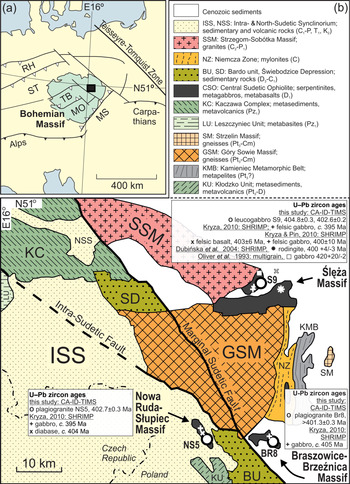
(a) Location of the study area (black square) in the Bohemian Massif in the Variscan Belt of Central Europe. MO – Moldanubian; MS – Moravo-Silesian; RH – Rhenohercynian; ST – Saxothuringian; TB – Tepla-Barrandian. (b) Simplified geological map of the central part of Sudetes (modified from Mazur et al. Reference Mazur, Aleksandrowski, Kryza and Oberc-Dziedzic2006, Reference Mazur, Aleksandrowski and Szczepański2010) showing the Central Sudetic Ophiolite around the Góry Sowie Massif in the Central Sudetes. Location of samples from the Ślęża, Braszowice–Brzeźnica and Nowa Ruda–Supiec massifs used in this study: S9 – rock crags on the eastern slopes of Mount Slęża (50.87609° N, 16.73616° E); NS5 – gabbro quarry at Nowa Ruda-Słupiec (50.55845° N, 16.56317° E); Br8 – gabbro quarry at Braszowice (50.54443° N, 16.7938° E). The general location of other sampling sites for U–Pb zircon dating is also indicated, and the frames show a summary of published ages, including this study.

The Central Sudetic Ophiolite (CSO) crops out in the middle of this complex segment of the Variscides (Fig. 1). It is represented by mafic and ultramafic rocks of the Ślęża, Nowa Ruda–Słupiec and Braszowice–Brzeźnica massifs, and other outcrops around the gneissic Góry Sowie Massif (Kryza & Pin, Reference Kryza and Pin2010). The Ślęża Massif preserves the most complete ophiolite pseudostratigraphy including, from base to top, serpentinites, ultramafic cumulates, metagabbros, diabases, metabasalts and cherts. A similar sequence in the Nowa Ruda Massif comprises small ultramafic bodies, gabbros, diabases and pillow lavas, whereas the Braszowice Massif is composed of serpentinites and metagabbros. Small bodies of plagiogranites and rodingites are fairly common. The ophiolitic rocks are non-penetratively deformed, with a low-grade regional metamorphic overprint (e.g. Majerowicz, Reference Majerowicz1994; Majerowicz et al. Reference Majerowicz, Kryza, Wróblewska and Mierzejewski2000).
According to Pin et al. (Reference Pin, Majerowicz and Wojciechowska1988) and Kryza & Pin (Reference Kryza and Pin2010), the mafic rocks of the Ślęża, Nowa Ruda and Braszowice Massifs display tholeiitic normal-MORB (N-MORB) geochemical and isotopic Nd–Sr characteristics, consistent with derivation from a depleted-mantle source at a normal MOR (or at an evolved back-arc basin, without distinct evidence of supra-subduction source contamination). Related geotectonic models link the formation of the CSO to a propagating tip of an oceanic spreading ridge (Floyd et al. Reference Floyd, Kryza, Crowley, Winchester, Abdel Wahed, Winchester, Pharaoh and Verniers2002), or to an oceanic rift in the upper plate of a steeply dipping oceanic subduction system fringing a continental mass (Kryza & Pin, Reference Kryza and Pin2010). In addition, minor lithologies in the CSO, such as rodingites, some amphibolites (Dubińska & Gunia, Reference Dubińska and Gunia1997), chromitites, Fe–Ti mineralization (Delura, Reference Delura2012; Wojtulek et al. Reference Wojtulek, Puziewicz and Ntaflos2016a, b, Reference Wojtulek, Puziewicz and Ntaflos2017, Reference Wojtulek, Schulz, Delura and Dajek2019) and epidosites (Klukowski, Reference Klukowski2017), bear mineralogical and petrological features indicative of late-stage emplacement and percolation of melts and fluids in a supra-subduction setting, raising questions regarding the geotectonic evolution of the CSO. In regional tectonic models, the origin of the CSO has until now been linked to the ‘Central Sudetic Oceanic Tract’, a rather narrow oceanic basin between terranes in the northern realm of the Rheic Ocean; that oceanic tract had already closed by the turn of the Middle and Late Devonian period (i.e. before c. 383 Ma; Cohen et al. Reference Cohen, Finney, Gibbard and Fan2013, updated) as constrained by the age of unconformity truncating the Nowa Ruda–Słupiec Massif and adjacent Kłodzko metamorphic unit (discussion in Mazur et al. Reference Mazur, Aleksandrowski, Kryza and Oberc-Dziedzic2006). A similar, tentative model, in which the CSO originated in a young, c. 400 Ma domain of the Rheic Ocean, is discussed by Kryza & Pin (Reference Kryza and Pin2010).
Since the late 1980s, geochronological data based on various isotopic methods have been reported for the CSO, that is: 353 ± 21 Ma for Ślęża and 351 ± 16 Ma for Nowa Ruda rocks (Sm–Nd isochron ages; Pin et al. Reference Pin, Majerowicz and Wojciechowska1988); 420 + 20/− 2 Ma for Ślęża gabbro (U–Pb multigrain zircon method; Oliver et al. Reference Oliver, Corfu and Krough1993); and 400 + 4/− 3 Ma for rodingites (SHRIMP on zircons; Żelaźniewicz et al. 1988; Dubińska et al. Reference Dubińska, Bylina, Kozłowski, Dőrr and Nejbert2004). Similar ages of c. 395–405 Ma were obtained using the SHRIMP method on zircons from mafic rocks from several localities in the ophiolite (Kryza, Reference Kryza2010; Kryza & Pin, Reference Kryza and Pin2010). Based on these results (the U–Pb SHRIMP ages are compiled in Fig. 1), some authors assume a late Silurian – Early Devonian age of 420–400 Ma for the CSO (e.g. Floyd et al. Reference Floyd, Kryza, Crowley, Winchester, Abdel Wahed, Winchester, Pharaoh and Verniers2002; Mazur et al. Reference Mazur, Aleksandrowski, Kryza and Oberc-Dziedzic2006), whereas Kryza & Pin (Reference Kryza and Pin2010) consider the age of c. 400 Ma more likely. Although the latter age has become widely accepted (e.g. Furnes et al. Reference Furnes, de Wit and Dilek2014; Plissart et al. Reference Plissart, Monnier, Diot, Mărunţiu, Berger and Triantafyllou2017), the age obtained by Dubińska et al. (Reference Dubińska, Bylina, Kozłowski, Dőrr and Nejbert2004) refers to serpentinization and rodingitization; all the c. 400 Ma SHRIMP dates of the mafic igneous rocks are in fact considered preliminary in the original publications (Kryza, Reference Kryza2010; Kryza & Pin, Reference Kryza and Pin2010). They also show considerable dispersion of 10 Ma, which is difficult to interpret either as a consequence of low analytical precision of the SHRIMP data or as real age differences; for example, in different fragments of the ophiolite, different ages may represent domains of oceanic crust formed at different times. Overall, the magmatic age of the CSO still remains imprecisely determined, age relationships between its component massifs are unclear, and the development of the CSO in the context of geodynamic evolution of the Central Sudetes and the Variscides are not well constrained.
3. Methods
3.a. Rock samples
Three rocks samples from the CSO were selected for precise age determination reported in this study (Fig. 1b). Sample S9 is a felsic metagabbro from the Ślęża Massif. Samples NS5 and Br8 are plagiogranites from veins in metagabbros of the Nowa Ruda–Słupiec and Braszowice–Brzeźnica massifs, respectively. The samples were studied in thin-sections and the identification and composition of minerals were confirmed using the electron microprobe (details will be provided in a future publication).
3.b. Zircon separation
Zircon separation was carried out at the University of Wrocław. The samples, about 5–10 kg in weight, were crushed and sieved. The 0.063–0.25 mm heavy fraction was separated using the conventional heavy liquid (sodium polytungstate). Zircon crystals were hand-picked and polished epoxy resin mounts were prepared from representative grains of various morphological types for optical and cathodoluminescene (CL) study using the LEO 440 scanning electron microscope (SEM) and CL detector GATAN MiniCL at the Universität Heidelberg, Germany. The morphology of separated zircon crystals was also studied using the Jeol JSM-IT500LA scanning electron microscope at the Institute of Geological Sciences, University of Wrocław, Poland. Representative, selected crystals were dated using the CA-ID-TIMS U–Pb method at Université de Genève, Switzerland.
3.c. Chemical abrasion and chemistry
In order to minimize the effects of secondary lead loss, each individual zircon grain was placed into a pre-cleaned Savillex capsule and chemically abraded in HF + trace HNO3 at 180 °C for 18 hours in Parr bombs (Mattinson, Reference Mattinson2005). After the partial dissolution step, each zircon, together with the leachate, was again transferred into a 3 mL screw-top Savillex vial. The leachate was completely pipetted out and the remaining zircons were rinsed in ultrapure water and then fluxed for several hours in 6 N HCl on a hotplate at a temperature of c. 80 °C. After removal of the acid, the zircons were again rinsed several times in ultra-pure water and 7 N HNO3 in an ultrasonic bath. Each single zircon grain was loaded for dissolution into pre-cleaned Savillex capsules, spiked with 6–15 mg of the EARTHTIME 205Pb–233U–235U tracer solution (ET 535, http://www.earthtime.org/; Condon et al. Reference Condon, Schoene, Mclean, Bowring and Parrish2015) and dissolved in 70 μL HF and traces of HNO3 at 210 °C for about 60 hours in Parr bombs. After evaporation, the residue was re-dissolved overnight in 25 μL 6 N HCl. Samples were then dried down again and re-dissolved in 80 μL 3 N HCl. Lead and uranium from zircons were separated by anion exchange chromatography (Krogh, Reference Krogh1973) in 40 μL columns using ultra-pure HCl and H2O, and finally dried down with 3 μL of 0.02 N H3PO4.
3.d. Mass spectrometry and blank
The isotopic analyses were performed at University of Geneva on a TRITON mass spectrometer equipped with a MasCom discrete dynode electron multiplier. The linearity of the multiplier was calibrated using U500, Sr SRM987, and Pb SRM982 and SRM983 solutions. The deadtime for the SEM was determined to be constant at 23 ns for up to 1.3 Mcps and at a Faraday/SEM yield of 93–94%. During analysis, potential isobaric interferences from BaPO2+ or Tl+ on masses 202 and 205 were evaluated by monitoring masses 201 and 203, and masses 202 and 205 in unspiked samples. Since no statistically significant signal was observed on the controlled masses, no correction was applied. Lead isotopic fractionation was corrected based on average Pb fractionation factors determined by EARTHTIME 202Pb–205Pb–233U–235U tracer and measurements of SRM 981 standard with −0.13 ± 0.02%/amu. The U mass fractionation for the same analyses was calculated using the 233U/235U ratio of the double spike solution (0.99506 ± 0.01%, 1σ). The average U fractionation factor was 0.08 ± 0.02%/amu (1σ). Both lead and uranium were loaded with 1 μL of silica gel–phosphoric acid mixture (modified after Gerstenberger & Haase, Reference Gerstenberger and Haase1997) on outgassed single Re-filaments. Pb isotope compositions were measured on the electron multiplier, while U (as UO2) isotopic measurements were made in static Faraday mode (using amplifiers equipped with 1012 Ω resistors) or on the electron multiplier in case of insufficient beam. Isobaric interference of 233U18O16O on 235U16O16O was corrected using a 18O/16O ratio of 0.00205. The measured uranium isotopic ratios were corrected assuming a sample 238U/235U ratio of 137.818 ± 0.045 (2σ, Hiess et al. Reference Hiess, Condon, McLean and Noble2012). All common Pb in the zircon analyses was attributed to the procedural blank with the following lead isotopic composition: 206Pb/204Pb = 17.10 ± 1.2, 207Pb/204Pb = 15.07 ± 0.7, 208Pb/204Pb = 36.17 ± 0.7 (1σ %). U blanks are < 0.1 pg and do not influence the degree of discordance at the age range of the studied samples; a value of 0.05 pg ± 50% was therefore used in all data reduction.
3.e. Data reduction, reporting ages and errors
The initial statistics, data reduction and age calculation were done using the TRIPOLI and Redux software (Bowring et al. Reference Bowring, Mclean and Bowring2011). All 206Pb/238U and 207Pb/206Pb ratios were corrected for initial disequilibrium in 230Th/238U using default Th/U (magma) = 3.5. The accuracy of the measured data was assessed by repeated analysis of the 100 Ma synthetic solution (Condon et al. Reference Condon, Mclean, Schoene, Bowring, Parrish and Noble2008) yielding an internal reproducibility in 206Pb/238U dates of better than 0.05%. The 100 Ma synthetic solution measured with EARTHTIME 205Pb–235U–238U tracer yielded mean 206Pb/238U =100.24 ± 0.02 Ma (mean square weighted deviation (MSWD) = 7.5; n = 7). All uncertainties reported are at the 2σ level, following the x–y–z systematic of Schoene et al. (Reference Schoene, Crowley, Condon, Schmitz and Bowring2006). All data are reported in the table with internal errors only, including counting statistics, uncertainties in correcting for mass discrimination and the uncertainty in the common (blank) Pb composition. The MSWD values from all samples are within the range of acceptable values at 95% confidence level and for n − 1 degrees of freedom, defined by Wendt & Carl (Reference Wendt and Carl1991).
4. Field and petrographic characteristics of samples
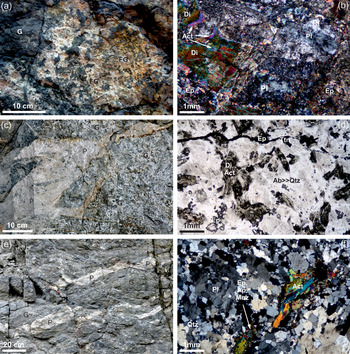
The geological setting of the studied samples is indicated in Figure 1b. Sample S9 from the Ślęża Massif is a felsic metagabbro that occurs within the common Ślęża metagabbro. Near the sampling site on the eastern slopes of Mount Ślęża, the metagabbros show features typical of the plutonic section of this massif (cf. Kryza & Pin, Reference Kryza and Pin2010), such as well-preserved, coarse-grained, subhedral-granular, massive igneous texture, and metamorphic foliation and lamination developed along thin, discontinuous zones only. The mafic metagabbros are strongly dominant, but locally contain segregations, or domains, of felsic metagabbros. The sampled felsic metagabbro domain is oval to irregular, several decimetres wide, with gradational boundaries against the surrounding mafic host (Fig. 2a). In thin-sections (Fig. 2b), sample S9 shows relicts of magmatic, tabular crystals of clinopyroxene (diopside) and plagioclase (andesine) variably replaced by metamorphic amphiboles (actinolite, magnesio-hornblende), Na-plagioclase (albite, oligoclase), clinozoisite-epidote, forming fine-grained intergrowths, clusters and streaks, with minor amounts of chlorite and titanite, and occasionally zircon (not easily visible in Fig. 2b).
Field structures and petrographic features of the samples studied; details in the text. (a) Segregation of the felsic metagabbro (sample S9) within the common Ślęża metagabbro. (b) Photomicropgraph of sample S9, crossed polarizers. (c) Plagiogranite veins (sample NS5) within gabbros of the Nowa Ruda-Słupiec Massif. (d) Photomicrograph of sample NS5, plane-polarized light. (e) Plagiogranite veins (sample Br8) in metagabbros the Braszowice-Brzeźnica Massif. (f) Photomicrograph of sample Br8, crossed polarizers. Rocks: G – gabbro, metagabbro; FG – felsic metagabbro; P – plagiogranite. Minerals: Act – actinolite, magnesiohornblende; Ap – apatite; Di – diopside; Ep – epidote-group minerals; Mnz – monazite; Pl – plagioclase; Qtz – quartz; Ttn – titanite.

Sample NS5 was collected in a gabbro quarry at Nowa Ruda–Słupiec (Fig. 1b). The gabbros are coarse-grained, massive rocks which are locally cut by leucocratic, fine-grained plagiogranite veins, several centimetres to 1–2 decimetres thick. The sampled plagiogranite vein (Fig. 2b) is 15 cm thick and shows sharp contacts with the gabbro; chilled margins are not observed. However, the vein is partly disrupted along small-scale faults and domains of gabbro are enclosed in the plagiogranite in places. Sample NS5 is, modally, a meta-leucodiorite, which shows a well-preserved, fine-grained, non-equigranular, subhedral granular, massive igneous texture, with a strong overprint of primary igneous minerals by low-grade metamorphic phases (Fig. 2d). The main components are: tabular albite pseudomorphs after, presumably, more calcic primary plagioclase, as well as relics of prismatic diopside intergrown by patches and veinlets of actinolite and calcite. Minor components found in various patches, aggregates and veinlets include epidote, quartz and titanite (Fig. 2d) as well as accessory apatite, zircon and Cu–Fe sulphides.
Plagiogranite sample Br8 was collected from a vein in a gabbro in the quarry at Braszowice (Fig. 2e). At the sampling site, the coarse-grained, massive gabbros are cut by locally abundant plagiogranite veins of up to 20 cm thick. The contacts of plagiogranite with the gabbro are sharp, but no chilled margins can be discerned and the veins are partly disrupted into segments offset by a system of gently inclined shear zones. Plagiogranite Br8 is modally a metatonalite; it is a leucocratic, non-equigranular-textured, foliated rock (Fig. 2f). The main components are anhedral to subhedral Na-plagioclase (oligoclase) crystals, prismatic actinolite and anhedral quartz. Actinolite, as well as varied aggregates of minor components (ilmenite, actinolite, chlorite, apatite, monazite, zircon, epidote-group minerals and Fe-sulpgides), form discontinuous bands and streaks.
Accessory zircon crystals are encountered in thin-sections of the studied samples as inclusions in amphiboles and in epidote aggregates (sample S9), as well as in plagioclase (albite, oligoclase; samples NS5 and Br8). However, these zircon grains are very small, from a micron to (occasionally) a few tens of microns. In contrast, the separated and dated zircon crystals represent a much coarser fraction, typically 100–200 microns in size (Figs 3, 4). Such large crystals were not observed in thin-sections, most probably due to their scarcity: the analysed zircon fractions were concentrated from much larger sample volumes (cf. Section 3 on methods) than can be screened in thin-sections.
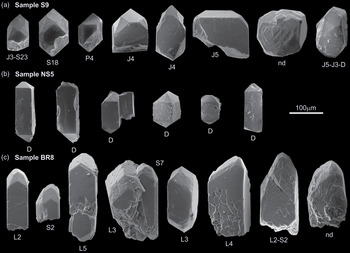
Representative zircon morphologies imaged using the scanning electron microscope: (a) S9, (b) NS5 and (c) Br8. Zircon type classified according to Pupin & Turco (Reference Pupin and Turco1972); nd – morphological type not determined.

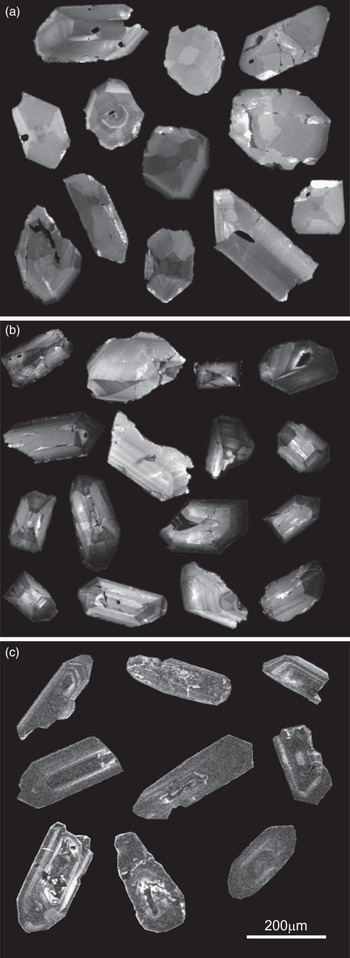
Scanning electron microscope cathodoluminescence (SEM-CL) images of representative zircon microtextures: (a) S9, (b) NS5 and (c) Br8.

5. Zircon characteristics and CA-ID-TIMS U–Pb dating
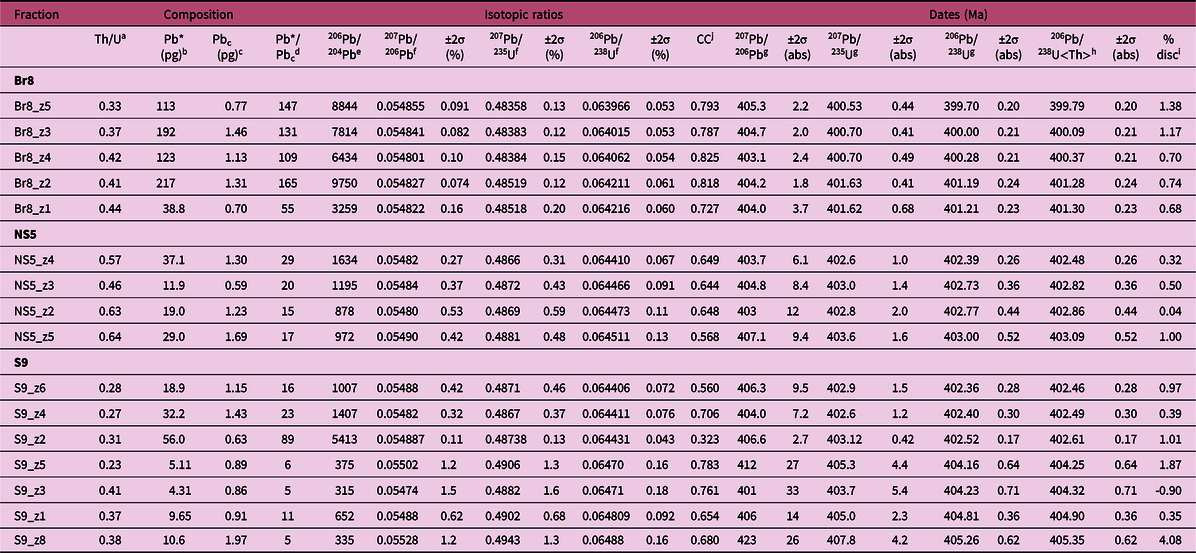
Representative scanning electron microscope secondary electron (SEM-SE) and SEM-CL images of the zircon crystals are shown in Figures 3 and 4, respectively. The results of dating (16 crystals in 3 samples) are reported in Table 1 and shown in Figure 5.
Results of the U-Pb zircon dating

a Th contents calculated from radiogenic 208Pb and 230Th-corrected 206Pb/238U date of the sample, assuming concordance between U–Pb Th–Pb systems.
b Total mass of radiogenic Pb.
c Total mass of common Pb.
d Ratio of radiogenic Pb (including 208Pb) to common Pb.
e Measured ratio corrected for fractionation and spike contribution only.
f Measured ratios corrected for fractionation, tracer and blank.
g Isotopic dates calculated using λ238 = 1.55125 × 10⁻¹⁰ and λ235 = 9.8485 × 10⁻¹⁰ (Jaffey et al. Reference Jaffey, Flynn, Glendenin, Bentley and Essling1971).
h Corrected for initial Th/U disequilibrium using radiogenic 208Pb and Th/U (magma) = 3.50000.
i Percentage discordance = 100–[100 × (206Pb/238U date)/(207Pb/206Pb date)].
j CC – correlation coefficient.
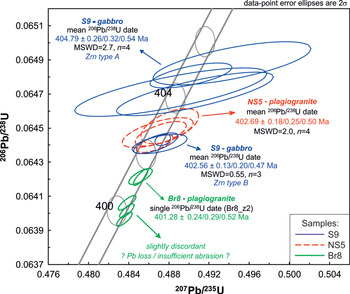
Results of the U–Pb CA-ID-TIMS zircon dating from samples S9, NS5 and Br8 in the Concordia plot. The uncertainties are reported at the 2σ-level following x–y–z systematic of Schoene et al. (Reference Schoene, Crowley, Condon, Schmitz and Bowring2006; internal uncertainties/with tracer calibration uncertainties/with decay constant uncertainties). Discussion in text.

The zircons separated from the felsic metagabbro S9 vary between two main morphological types: (A) relatively equant, multifaceted; and (B) short, prismatic and clear (Fig. 3a). In addition to dominant {100} and {101} forms, subordinate {110} prism and/or {211} dipyramid appear on many crystals. The crystals are morphologically fairly diverse and represent mostly J3–J5, P4–P5, D, S18 and S23–S24 types in the typological classification of Pupin & Turco (Reference Pupin and Turco1972). In SEM-CL images (Fig. 4a), the crystals are bright and reveal well-developed sector and/or oscillatory zoning consistent with zircon of magmatic origin. The A-type crystals look intact after the chemical abrasion, while those of the B-type are more strongly affected by the treatment. Four A-type grains were analysed. They are very poor in U with low radiogenic/common Pb (Pb*/Pbc) ratios; they are therefore analytically less precise than B-type zircons. They cluster on the concordia diagram, yielding a weighted mean 206Pb/238U age of 404.8 ± 0.3 Ma. Three analysed B-type grains yielded a weighted mean 206Pb/238U age of 402.6 ± 0.2 Ma.
In the plagiogranite NS5, the zircon crystals (Fig. 3b) show normal- to short-prismatic habit and are a combination of the {100} prism with the {101} dipyramid; they therefore represent the D-type according to the typological classification of Pupin & Turco (Reference Pupin and Turco1972). The crystals are clear and transparent and, in the SEM-CL images (Fig. 4b), are bright with well-developed sector and/or oscillatory zoning, indicative of a magmatic origin. The crystals show obvious strong resorption (but not complete disintegration) after chemical abrasion. Four single zircon crystals were analysed. All analytical ellipses are concordant within the decay constant uncertainty band, and yielded a weighted mean 206Pb/238U age of 402.7 ± 0.3 Ma, identical (within error) to the age of B-type crystals from sample S9 (Fig. 5).
The zircon grains from plagiogranite Br8 are mostly subhedral, translucent, often dark-coloured and normal- to long-prismatic. The crystals are mainly of S4, S2, S3, L4, S5 and S8 type according to the Pupin & Turco (Reference Pupin and Turco1972) classification. Their morphology is dominated by {110} prism with strongly reduced or absent {100}. Proportions of {211} and {101} pyramidal faces vary over a wide range (Fig. 3c). In contrast to S9 and NS5, zircons from Br8 are weakly luminescent (Fig. 4c). Perfect euhedral crystals show usually undisturbed magmatic oscillatory zonation. Many, mostly subhedral, grains show patterns with homogenous domains or geometrically disturbed and blurred primary igneous zonation (Fig. 4c). Weak luminescence and locally blurred zonation are suggestive of high uranium concentrations and a radiation-damaged crystalline structure. Consistently, after chemical abrasion the zircons were disintegrated into small fragments of c. 40 μm or smaller. Five single zircon fragments were analysed. Two of them are concordant within the decay constant uncertainty band and yielded overlapping 206Pb/238U dates; the slightly younger of these two dates is 401.3 ± 0.3 Ma (Fig. 5). The remaining three analyses yield 206Pb/238U ages of c. 400 Ma, slightly towards the right of the Concordia band, and may follow a Pb loss line, likely due to insufficient chemical abrasion. Overall, the result of Br8 cannot be considered as a reliable age and the 401.3 Ma date must be treated as a minimal age estimate.
6. Discussion
The felsic rock samples used for zircon separation and dating are considered here as formed during the magmatic stage of development of the CSO. The field and petrographic characteristics of the S9 leucogabbro, such as textural and mineralogical relicts of the protolith overprinted by low-grade metamorphic mineral assemblage as well as localized non-penetrative deformation, fully correspond to equivalent features recognized in the host metagabbros (cf. Kryza & Pin, Reference Kryza and Pin2010). These characteristics point to the formation of the felsic metagabbro protolith during the emplacement, cooling and crystallization of magma in the plutonic section of the Ślęża Massif, likely due to a local accumulation of residual, felsic melt. The plagiogranites NS5 and Br8 occur as dykes that cut and post-date gabbros in the Nowa Ruda–Słupiec and Braszowice massifs. Similar to Ślęża laucogabbro, the petrographic and structural features of the studied plagiogranites (i.e. low-grade metamorphic mineral assemblages replacing magmatic minerals; evidence of localized deformation) are consistent with the emplacement of the plagiogranites during the magmatic stage, before regional metamorphic and tectonic overprint of the ophiolite. The zircon ages obtained during this study therefore constrain the age of magmatic processes in the Central Sudetic Ophiolite.
The two zircon types A and B in sample S9, with ages of 404.8 and 402.6 Ma, are not much different in terms of their typological classification (Fig. 3; Pupin & Turco, Reference Pupin and Turco1972) and zoning patterns (Fig. 4), and can be related to crystallization of broadly similar, mafic melts. Rioux et al. (Reference Rioux, Bowring, Kelemen, Gordon, Miller and Dudás2013) found intra-sample variability of zircon ages of > 1 Ma in some gabbros of the Oman–UAE ophiolite, and linked this to the assimilation of older oceanic crust by younger magmas at a propagating rift segment. In fact, formation of the Ślęża mafic rocks at a propagating tip of a spreading ridge was suggested by Floyd et al. (Reference Floyd, Kryza, Crowley, Winchester, Abdel Wahed, Winchester, Pharaoh and Verniers2002) on geochemical grounds. We therefore interpret the older of the dated crystals in sample S9 as young xenocrysts, derived from slightly older (by c. 2.2 Ma) oceanic crust rocks by younger magmas in the Ślęża Massif magmatic system. However, the age of final crystallization of the leucogabbro S9 is constrained by the age of the younger zircon crystals in the studied sample. We therefore interpret the date of 402.6 ± 0.2 Ma as the best age estimate of the leucogabbro S9, and of the plutonic rocks of the Ślęża Massif in general.
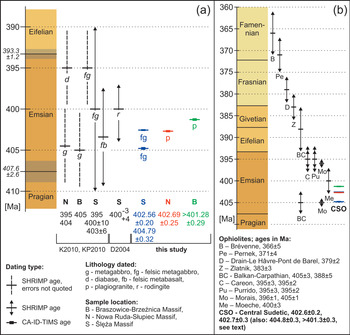
The date of 402.7 ± 0.3 Ma obtained for zircons from sample NS5 constrains the magmatic age of this sample, and of the plagiogranite magmatism in the Nowa Ruda–Słupiec Massif. This age overlaps (within error) with the age of the Ślęża gabbro S9. Although only minimal age information (> 401.3 Ma) was obtained for zircons from plagiogranite Br8, this date is consistent with the ages of 402.6–402.7 Ma discussed above. The convergence of the ages in the Ślęża gabbro and those of the plagiogranite NS9 (together with a similar minimal age estimate obtained for plagiogranite Br8) suggest almost contemporaneous magmatic crystallization in the three massifs. This supports the hypothesis that the different parts of the CSO, now tectonically separated and spread around the Góry Sowie Massif in the Central Sudetes, originated from a single domain of oceanic crust as previously suggested (e.g. Pin et al. Reference Pin, Majerowicz and Wojciechowska1988; Mazur et al. Reference Mazur, Aleksandrowski, Kryza and Oberc-Dziedzic2006). As shown in Figure 6, all our new precise zircon ages fall in a narrow range within the wide uncertainty band of previously published, largely preliminary and imprecise SHRIMP U–Pb age estimates of the various lithologies of the CSO. The new results positively verify the opinion of Kryza & Pin (Reference Kryza and Pin2010) on ‘c. 400 Ma age’ of the oceanic crust fragments in the CSO and, importantly, much more accurately determine the age of the CSO with an uncertainty of only a few hundred thousand years and not some ten million years. In summary, the age of 402.6–402.7 Ma can be considered at present the best estimate for the magmatic stage of the formation of the CSO at an oceanic spreading centre during Early Devonian – Emsian time (cf. Cohen et al. Reference Cohen, Finney, Gibbard and Fan2013, updated).
The CA-ID-TIMS U–Pb zircon ages obtained in this study compared with: (a) the published SHRIMP zircon ages from the Central Sudetic Ophiolite (D2004, Dubińska et al. Reference Dubińska, Bylina, Kozłowski, Dőrr and Nejbert2004; K2010, Kryza, Reference Kryza2010; KP2010, Kryza & Pin, Reference Kryza and Pin2010); and (b) the published U–Pb zircon ages of Devonian ophiolites in the Variscan Belt (SHRIMP and other methods; based on compilation of Plissart et al. Reference Plissart, Monnier, Diot, Mărunţiu, Berger and Triantafyllou2017). The Devonian chronostratigraphic scale after Cohen et al. (Reference Cohen, Finney, Gibbard and Fan2013, updated), all ages in Ma.

The new age determination of the CSO discussed above highlights possible geotectonic links between the CSO and the adjacent Góry Sowie Massif (GSM; cf. Mazur et al. Reference Mazur, Aleksandrowski, Kryza and Oberc-Dziedzic2006). In the latter, pre-Late Devonian high-pressure/high-temperature metamorphism is documented by the mean 207Pb/206Pb age of 401.5 ± 0.9 Ma for metamorphic zircons in granulites (O’Brien et al. Reference O’Brien, Corner, Jaeckel, Hegner, Żelaźniewicz and Kryza1997). An identical (within error) Sm–Nd–Grt–CPx–OPx–WR (whole-rock) isochrone age of 402 ± 3 Ma was obtained from a garnet peridotite body within granulites (Brueckner et al. Reference Brueckner, Blusztajn and Bakun-Czubarow1996). The CSO age determinations presented in this paper agree very well with these ages from the GSM. This shows that the magmatic formation of the CSO at a spreading centre and the high-grade metamorphism in the GSM, linked to the subduction of the continental crust (cf. Mazur et al. Reference Mazur, Aleksandrowski, Kryza and Oberc-Dziedzic2006), were contemporaneous. This further suggests a geodynamic coupling and a close geographic location of the divergent and convergent settings, in which the SCO and the GSM evolved during the Early Devonian Period.
The age of c. 402.6–402.7 Ma (Early Devonian – Emsian) confirms the affinity of the CSO to the group of younger, Devonian ophiolites of the Variscan Belt (cf. Sánchez-Martínez et al. Reference Sánchez-Martínez, Arenas, Díaz-García, Martínez Catalán, Gómez-Barreiro and Pearce2007; Murphy et al. Reference Murphy, Gutiérrez-Alonso, Nance, Fernández-Suárez, Keppie, Quesada, Dostal and Braid2009; Nance et al. Reference Nance, Gutiérrez-Alonso, Keppie, Linnemann, Murphy, Quesada, Strachan and Woodcock2012; Arenas et al. Reference Arenas, Sánchez Martínez, Gerdes, Albert, Díez Fernández and Andonaegui2014; Plissart et al. Reference Plissart, Monnier, Diot, Mărunţiu, Berger and Triantafyllou2017). Their ages range from 405 to 365 Ma and our results clearly locate the CSO among the oldest ophiolites in this group (Fig. 6b). The origin of these Devonian ophiolites is attributed to ephemeral marginal oceanic basins, such as back-arc basins, that developed before the final closure of the Rheic Ocean. Similarly, the origin of the CSO is linked with the ‘Central Sudetic Oceanic Tract’, a rather narrow seaway between terranes in the northern realm of the Rheic Ocean that closed during the border between the Middle and Late Devonian periods (i.e. before c. 383 Ma; Mazur et al. Reference Mazur, Aleksandrowski, Kryza and Oberc-Dziedzic2006, Reference Mazur, Aleksandrowski and Szczepański2010). Our dating and the regional tectono-stratigraphic constraints suggest a time span of less than c. 20 Ma between the magmatic formation and the obduction of the CSO. The available data show that the majority of the Devonian ophiolites were obducted after c. 380 Ma (cf. Plissart et al. Reference Plissart, Monnier, Diot, Mărunţiu, Berger and Triantafyllou2017), and therefore that the CSO was one of the first obducted. The relatively short time span between formation and obduction of the oceanic lithosphere of the CSO, together with inferred links between the CSO and the GSM, as well as the regional context of the Variscan ophiolites of age c. 400 Ma, are consistent with the origin of the CSO in an ephemeral, relatively narrow, subduction-related oceanic domain; an example of such a domain is an evolved back-arc basin, possibly associated with a steeply dipping subduction zone (cf. Pin et al Reference Pin, Majerowicz and Wojciechowska1988; Kryza & Pin, Reference Kryza and Pin2010). However, among the other Variscan ophiolites of age c. 400 Ma, many of which display well-defined supra-subduction zone geochemical characteristics (see Plissart et al. Reference Plissart, Monnier, Diot, Mărunţiu, Berger and Triantafyllou2017 for recent overview), the CSO is distinguished by MOR, and not supra-subduction, geochemical affinity of the mafic rocks (Pin et al. Reference Pin, Majerowicz and Wojciechowska1988; Floyd et al. Reference Floyd, Kryza, Crowley, Winchester, Abdel Wahed, Winchester, Pharaoh and Verniers2002; Kryza & Pin, Reference Kryza and Pin2010). On the other hand, some minor lithologies, such as rodingites, chromitites and epidosites, which can be linked to younger stages in the development of the CSO, reveal features related to the infiltration of supra-subduction fluids and/or melts (cf. Dubińska & Gunia, Reference Dubińska and Gunia1997; Wojtulek et al. Reference Wojtulek, Puziewicz and Ntaflos2016a, b, Reference Wojtulek, Puziewicz and Ntaflos2017, Reference Wojtulek, Schulz, Delura and Dajek2019; Klukowski, Reference Klukowski2017). From these constraints, we suggest that the influence of subduction-related fluids and melts increased with time during the evolution of the CSO. The main magmatic stage in the formation of the CSO at 402.7–402.6 Ma occurred at an oceanic spreading centre, most probably in an evolved back-arc basin, where magma sources were not significantly affected by subduction-related components (e.g. Floyd et al. Reference Floyd, Kryza, Crowley, Winchester, Abdel Wahed, Winchester, Pharaoh and Verniers2002); this resulted in the emplacement of the dominant igneous rocks with MOR-type geochemical characteristics. During the subsequent evolution, in the general context of plate convergence and closure of oceanic basins, the lithospheric domain of the CSO was, however, influenced by the infiltration of melts and fluids related to a subduction zone, with the formation of the abovementioned minor lithologies which bear supra-subduction-zone-type affinities. To some degree, the mixed geochemical and petrological characteristics of the CSO are similar to those recognized elsewhere (e.g. in the world’s largest Oman-UAE ophiolite that reveals evidence of two-stage magmatism; an earlier magmatism at an oceanic spreading centre and a younger magmatism above a subduction zone; Goodenough et al. Reference Goodenough, Thomas, Styles, Schofield and MacLeod2014). However, the limited distribution of rocks with subduction-related characteristics in the CSO, as recognized so far, suggest a more constrained evolution of the Sudetic ophiolite.
7. Conclusion
We summarize the main findings of this paper as follows.
1. The CA-ID-TIMS U–Pb dating of zircon crystals from felsic rocks precisely constrain the magmatic age of formation of the Central Sudetic Ophiolite and the genetic relations between its component massifs. A felsic gabbro from the Ślęża Massif contains an older population of zircon xenocrysts dated at 404.8 ± 0.3 Ma, and younger crystals dated at 402.6 ± 0.2 Ma that determine the final crystallization age of the gabbro. Two samples of plagiogranite from the Nowa Ruda–Słupiec and Braszowice massifs yielded coeval ages of 402.7 ± 0.3 Ma and > 401.3 ± 0.3 Ma. Contemporaneous magmatism in the three main component massifs of the Central Sudetic Ophiolite, now tectonically separated and spread around the Góry Sowie Massif, supports their interpretation as being derived from a single domain of Lower Devonian oceanic crust.
2. The magmatic stage of formation of the Central Sudetic Ophiolite and the early high-pressure/high-temperature metamorphism in the Góry Sowie Massif were contemporaneous, implying a close geographic location as well as geodynamic coupling of the divergent and convergent settings in which these units evolved. The obduction of the Central Sudetic Ophiolite occurred before c. 383 Ma, during less than 20 Ma after its formation at an oceanic spreading centre. These time constraints show the CSO to be among the oldest in the group of the Devonian ophiolites of the Variscan Belt, and one of the first obducted.
3. The new ages, the growing evidence of petrological diversity of rocks in the CSO and the overall geological framework of the Devonian ophiolites in the Variscan Belt favour the interpretation of the CSO as, broadly, subduction-related ophiolite. The CSO could have formed in an subduction-related spreading centre such as an evolved back-arc basin, where the influence of subduction-related fluids and melts increased with time from negligible, during the emplacement of the main magmatic units (metagabbros and metabasalts) showing MOR geochemical characteristics, to dominant, during subsequent stages of evolution when minor lithologies (rodingites, chromitites and epidosites) formed.
Acknowledgements
The study was initiated by the late Professor Ryszard Kryza. RK (and later MA and KT) received financial support from project 2013/11/B/ST10/00248. Zircons were separated by K. Dymna and the mounts were prepared by A. Zagórska. A. Willner and A. Varychev are acknowledged for their help in obtaining CL images of zircons. Insightful reviews by J. Berger and an anonymous reviewer helped to improve an earlier version of this paper. We thank K. Goodenough for editorial handling.
Conflict of interest
None.