Introduction
Mental health-related stigma has become a crucial issue for the public and for people with mental illness (Thornicroft, Reference Thornicroft2006; Corrigan & Shapiro, Reference Corrigan and Shapiro2010; Jorm, Reference Jorm2012; Ando et al. Reference Ando, Yamaguchi, Aoki and Thornicroft2013). Public stigma is defined as the public having negative beliefs, attitude and behaviour towards people with mental illness rather than their actual conditions (Corrigan & Shapiro, Reference Corrigan and Shapiro2010). Public stigma is a particular concern for young people, as in many cases, the onset of mental health problems is in adolescence and young adulthood (Kessler et al. Reference Kessler, Berglund, Demler, Jin, Merikangas and Walters2005; Patel et al. Reference Patel, Flisher, Hetrick and McGorry2007). Young people with greater public stigma could decide against accessing appropriate support and care when having mental health problems in the earlier stages of their illness (Jorm, Reference Jorm2012; Rusch & Thornicroft, Reference Rusch and Thornicroft2014). Therefore, reducing public stigma in young people is a major challenge to improve mental health outcomes in themselves and people with mental illness.
In-person social contact, meeting and talking with people with mental illness about their experiences of illness and recovery courses, is one of the most effective interventions for reducing stigma (Mehta et al. Reference Mehta, Clement, Marcus, Stona, Bezborodovs, Evans-Lacko, Palacios, Docherty, Barley, Rose, Koschorke, Shidhaye, Henderson and Thornicroft2015; Thornicroft et al. Reference Thornicroft, Mehta, Clement, Evans-Lacko, Doherty, Rose, Koschorke, Shidhaye, O'Reilly and Henderson2016). The effectiveness of in-person social contact for reducing mental health-related stigma has been shown in several randomised controlled trials (RCTs) (Corrigan et al. Reference Corrigan, River, Lundin, Penn, Uphoff-Wasowski, Campion, Mathisen, Gagnon, Bergman, Goldstein and Kubiak2001, Reference Corrigan, Rowan, Green, Lundin, River, Uphoff-Wasowski, White and Kubiak2002; Campbell et al. Reference Campbell, Shryane, Byrne and Morrison2011; Clement et al. Reference Clement, van Nieuwenhuizen, Kassam, Flach, Lazarus, de Castro, McCrone, Norman and Thornicroft2012; Papish et al. Reference Papish, Kassam, Modgill, Vaz, Zanussi and Patten2013), which found a stronger effect than for educational lectures (Corrigan et al. Reference Corrigan, Morris, Michaels, Rafacz and Rusch2012). Social contact decreases anxiety and increases empathy, which reduces stigma (Pettigrew et al. Reference Pettigrew, Tropp, Wagner and Christ2011; Al Ramiah & Hewstone, Reference Al Ramiah and Hewstone2013). However, the effect of one-time social contact over a 3-month follow-up was mixed (Campbell et al. Reference Campbell, Shryane, Byrne and Morrison2011; Clement et al. Reference Clement, van Nieuwenhuizen, Kassam, Flach, Lazarus, de Castro, McCrone, Norman and Thornicroft2012; Papish et al. Reference Papish, Kassam, Modgill, Vaz, Zanussi and Patten2013; Thornicroft et al. Reference Thornicroft, Mehta, Clement, Evans-Lacko, Doherty, Rose, Koschorke, Shidhaye, O'Reilly and Henderson2016). Campbell et al. and Papish et al. showed that one-time social contact improved stigma immediately after the intervention only, while Clement et al. suggested that one-time qualified social contact could sustain the effect for 4 months. Therefore, one-time non-qualified social contact is insufficient, and repeated and qualified social contact is needed to maintain a long-term effect in reducing stigma (Yamaguchi et al. Reference Yamaguchi, Wu, Biswas, Yate, Aoki, Barley and Thornicroft2013; Mehta et al. Reference Mehta, Clement, Marcus, Stona, Bezborodovs, Evans-Lacko, Palacios, Docherty, Barley, Rose, Koschorke, Shidhaye, Henderson and Thornicroft2015; Thornicroft et al. Reference Thornicroft, Mehta, Clement, Evans-Lacko, Doherty, Rose, Koschorke, Shidhaye, O'Reilly and Henderson2016).
Filmed social contact (FSC) using DVDs and/or websites may also be effective for reducing different aspects of stigma such as stereotyped knowledge (Clement et al. Reference Clement, van Nieuwenhuizen, Kassam, Flach, Lazarus, de Castro, McCrone, Norman and Thornicroft2012), attitudes (Woods, Reference Woods2002; Woods & Marcks, Reference Woods and Marcks2005; Kerby et al. Reference Kerby, Calton, Dimambro, Flood and Glazebrook2008; Clement et al. Reference Clement, van Nieuwenhuizen, Kassam, Flach, Lazarus, de Castro, McCrone, Norman and Thornicroft2012), social distance (Reinke et al. Reference Reinke, Corrigan, Leonhard, Lundin and Kubiak2004; Kerby et al. Reference Kerby, Calton, Dimambro, Flood and Glazebrook2008; Brown et al. Reference Brown, Evans, Espenschade and O'Connor2010) and behavioural intentions towards people with mental illness (Clement et al. Reference Clement, van Nieuwenhuizen, Kassam, Flach, Lazarus, de Castro, McCrone, Norman and Thornicroft2012). Although a meta-analysis showed that FSC might have a smaller effect size than in-person social contact (Corrigan et al. Reference Corrigan, Morris, Michaels, Rafacz and Rusch2012), well-conducted FSC was found to have an almost equal effect on reducing mental health-related stigma (Campbell et al. Reference Campbell, Shryane, Byrne and Morrison2011; Clement et al. Reference Clement, van Nieuwenhuizen, Kassam, Flach, Lazarus, de Castro, McCrone, Norman and Thornicroft2012). FSC is easier to implement and has better cost-effectiveness compared with in-person social contact (Clement et al. Reference Clement, van Nieuwenhuizen, Kassam, Flach, Lazarus, de Castro, McCrone, Norman and Thornicroft2012). However, to date, there have been no RCTs investigating the longer-term effects of repeated FSC (e.g. 12-month follow-up) (Clement et al. Reference Clement, Lassman, Barley, Evans-Lacko, Williams, Yamaguchi, Slade, Rusch and Thornicroft2013; Yamaguchi et al. Reference Yamaguchi, Wu, Biswas, Yate, Aoki, Barley and Thornicroft2013; Mehta et al. Reference Mehta, Clement, Marcus, Stona, Bezborodovs, Evans-Lacko, Palacios, Docherty, Barley, Rose, Koschorke, Shidhaye, Henderson and Thornicroft2015; Thornicroft et al. Reference Thornicroft, Mehta, Clement, Evans-Lacko, Doherty, Rose, Koschorke, Shidhaye, O'Reilly and Henderson2016).
Self-directed learning, or reviewing mental health-related information by oneself, is another strategy to reduce stigma. One RCT showed that a medical lecture with self-directed learning about major depression had a stronger effect on improving knowledge and attitudes than a medical lecture alone, and the effect was maintained for 6 months (Rong et al. Reference Rong, Glozier, Luscombe, Davenport, Huang and Hickie2011). Today, the Internet is commonly used for seeking medical information. Recent surveys indicated that approximately three quarters of young people had used the Internet and social media to access information about mental illness (Horgan & Sweeney, Reference Horgan and Sweeney2010; Birnbaum et al. Reference Birnbaum, Rizvi, Correll and Kane2015). Community-level and nation-wide anti-stigma campaigns have also been implemented using the Internet and social media (Henderson & Thornicroft, Reference Henderson and Thornicroft2009; Livingston et al. Reference Livingston, Cianfrone, Korf-Uzan and Coniglio2014). To the best of our knowledge, however, no RCT has investigated whether a self-directed Internet search would be effective for mental health-related stigma, whether there would be different effects for a self-instructional Internet search (INS) and FSC, and whether the effect would persist for long-term follow-up.
In the present study, we aimed to investigate whether 12-month repeated FSC interventions would reduce public stigma towards people with mental illness among general undergraduate and graduate students using an RCT. Our primary hypothesis was that a 30-min film including social contacts with follow-up web-based social contacts would be superior to INS or a control condition in reducing mental health-related stigma (behavioural intention) at a 12-month follow-up. As secondary hypotheses, we investigated the effect of these interventions using various aspects of stigma scales immediately after the intervention, at 1-month, and at 12-month follow-up surveys.
Methods
Study design
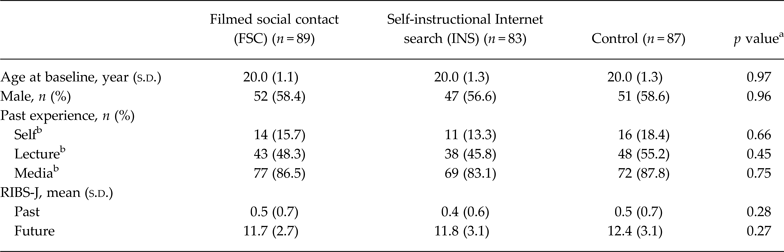
A parallel-group RCT was conducted for 259 participants from 20 universities and colleges in Tokyo (male, n = 150; mean age = 20.0 years, s.d. = 1.2) (Table 1). Participants were individually allocated to three groups (FSC/INS/control = 1/1/1) before a baseline survey was administered. The present study included four surveys during the12-month study period: baseline, immediately after intervention, and at 1-month, and 12-months after intervention. We chose 8 days in November 2013, and January and July 2014 for the baseline survey to minimise the effect of school curriculum on the results. Each participant was randomly assigned to one of the three intervention groups, completed the baseline survey (mean duration 30 min), received an initial 30-min intervention, and completed a survey immediately after the intervention (mean duration 15 min). The intervention and surveys were completed in a room in The University of Tokyo, and we informed each participant about the appointment time and location. To minimise attrition rates in the follow-up assessments, the survey administered 1 month after the intervention used a web-based questionnaire. The survey at 12 months after the intervention was administered by post or online for non-responders more than one month after sending the questionnaire.
Demographic characteristics and stigma scale scores at baseline for the study participants

RIBS-J, the Japanese version of Reported and Intended Behaviour Scale.
a Group differences were tested using ANOVA for continuous variables and using χ 2 test for categorical variables.
b Self, ‘Have you ever had any mental health problem yourself?’; Lecture: ‘Have you ever taken any lecture or course related to mental health?’; Media, ‘Have you ever watched a television program or read an article in the newspaper or on the internet about those who have mental health problems?’.
All surveys were conducted using anonymous, self-administered questionnaires. The allocation was masked to researchers involved in processing and analysing the data until all the participants completed their baseline survey. Researchers received the data of each assessment and allocation for each participant after the participant completed the survey immediately after the intervention. Therefore, this RCT was categorised as assessors-blinded in registration.
The present study was registered at the University Hospital Medical Information Network Clinical Trial Registration before the start of the initial survey (trial number: UMIN000012239), and had no further methodological changes after registration. We registered the future (intended behaviour) domain of the Japanese version of the Reported and Intended Behaviour Scale (RIBS-J) at the12-month survey as the primary outcome measure. Reducing behavioural consequence of stigma may have more effect on young people compared with the other types of public stigma, since public stigma is thought to develop negative beliefs, attitude, and behaviour (Corrigan & Shapiro, Reference Corrigan and Shapiro2010). Details of secondary outcome measures, sample size estimation, and randomisation and blinding are shown in online Supplementary Materials. Ethical approval was obtained from the Research Ethics Committee at the Office for Life Science Research Ethics and Safety, The University of Tokyo (approval no. 14-112 and 14-116). All participants provided written informed consent after receiving a full explanation of the study, including the detailed study settings and main purpose. However, the participants were still concealed about the interventions in details.
Participants
We used a website of a job recruitment board authorised by more than 200 colleges and universities in Japan (Nasic I support Co.Ltd., Kyoto, Japan). Undergraduate and graduate students from 20 colleges and universities, located within 60 min of the intervention site to avoid cohort effects of the intervention and to ensure generalisability of the findings, participated. No information about the mental health-related survey or trial was provided during recruitment to avoid influencing the results due to participants' interest in mental health. Instead, the job recruitment board provided the following explanation: ‘Exploring an effect of learning methods in university students with a 5000 Japanese Yen (JPY) incentive for three surveys and one 30-min task in one month.’ A 3000 JPY incentive was also paid when the participants completed the 12-month survey. Exclusion criteria were not having graduated from junior high school and high school in Japan and not planning to be a student in Japan 1 year later. To avoid the influence of psychiatry and psychology lectures on the survey, students in the third grade or higher in the departments of medicine or psychology, regularly receiving professional education in Japan, at the time of registration were also excluded from the study.
Interventions
Following completion of a baseline survey, participants received individual laptop computers containing one of three 30-min interventions assigned by intervention group (i.e. FSC, INS, control). The FSC group viewed a film including interviews with two men with schizophrenia, a portrayal of a woman with obsessive compulsive disorder, general mental illness-related knowledge consistent with the interviews and portrayal, and contact information for help-seeking. Thus, the film contained both social contact and general mental health education. This film was produced by the authors SK and SA (psychiatrists), SY (psychiatric social worker), and YO (psychiatric nurse), who all had sufficient experience in community mental health and school-based services. The film was made in accordance with the recommendations of a population-level campaign to reduce stigma (see the person, recovery-oriented messages, social inclusion/human rights and high prevalence of mental disorders; online Supplementary Table S1) (Clement et al. Reference Clement, Jarrett, Henderson and Thornicroft2010), and modified in consideration of the understanding and evaluation gained in a pilot test. The interviews were chosen from JPOP-VOICE (http://www.jpop-voice.jp), a website that contains personal interviews for people with schizophrenia aged in their 20s, who previously suffered from severe symptoms but personally recovered the ability to work or study as usual, to promote recovery-oriented and socially inclusive messages towards the public and patients. After the initial intervention, FSC participants received follow-up interventions every 2 months (2, 4, 6, 8 and 10 months after registration) in the form of e-mails that contained a link to a website with interviews for people with mental illnesses and medical information related to those illnesses. The topics included schizophrenia, major depression, panic disorder, and obsessive-compulsive disorder. The e-mail content was also aligned with the above-mentioned recommendations (Clement et al. Reference Clement, Jarrett, Henderson and Thornicroft2010).
The INS group was instructed to perform a 30-min INS for target terms without any control, using laptop computers connected to the Internet. The target terms were ‘schizophrenia’ and ‘mental illness’, in accordance with the initial FSC intervention. INS participants received follow-up e-mails at 2-month intervals after the initial intervention, which instructed them to search for a specific keyword on the Internet. Each disease name used as the topic for the follow-up FSC intervention was set according to the corresponding INS intervention as listed above.
The control group underwent a 30-min session involving playing games on laptop computers (e.g. minesweeper). Control group participants were not provided additional interventions after the initial intervention.
Primary outcome measure
The RIBS-J consists of four binary items for past experiences with people with mental health problems (RIBS past, range 0–4; ‘Yes’ = 1, ‘No’ = 0, ‘Don't know’ = 0; higher scores represent more social contact) and four items for future behavioural intentions on a five-point Likert scale (RIBS future, range 4–20; ‘Agree strongly’ = 5 to ‘Disagree strongly’ = 1; higher scores indicate a more positive intention, such as ‘In the future, I would be willing to live with someone with a mental health problem.’) (Evans-Lacko et al. Reference Evans-Lacko, Rose, Little, Flach, Rhydderch, Henderson and Thornicroft2011). Both the original and Japanese versions have good validity and reliability (Evans-Lacko et al. Reference Evans-Lacko, Rose, Little, Flach, Rhydderch, Henderson and Thornicroft2011; Yamaguchi et al. Reference Yamaguchi, Koike, Watanabe and Ando2014). Cronbach's alpha for the RIBS future scale was 0.78 in the present study.
Statistical analysis
All analyses were conducted under the intention-to-treat principle. As in the initial trial registration, for the primary outcome we employed a generalised linear mixed model (GLMM) using Group as a fixed effect (factor class: FSC/INS/Control) and Time as a random effect (factor class: baseline/12-month). Response variables were hypothesised to follow a binomial distribution. For the secondary outcomes, a GLMM was employed using Group and Time (baseline/immediately/1-month/12-month) for each scale. Statistical significance was set at 5% of variance. All analyses were carried out at September 2015 using glmmML package version 1.0 (Brostrom & Holmberg, Reference Brostrom and Holmberg2011) or R version 3.2.0 (R Core Team, 2014).
Results
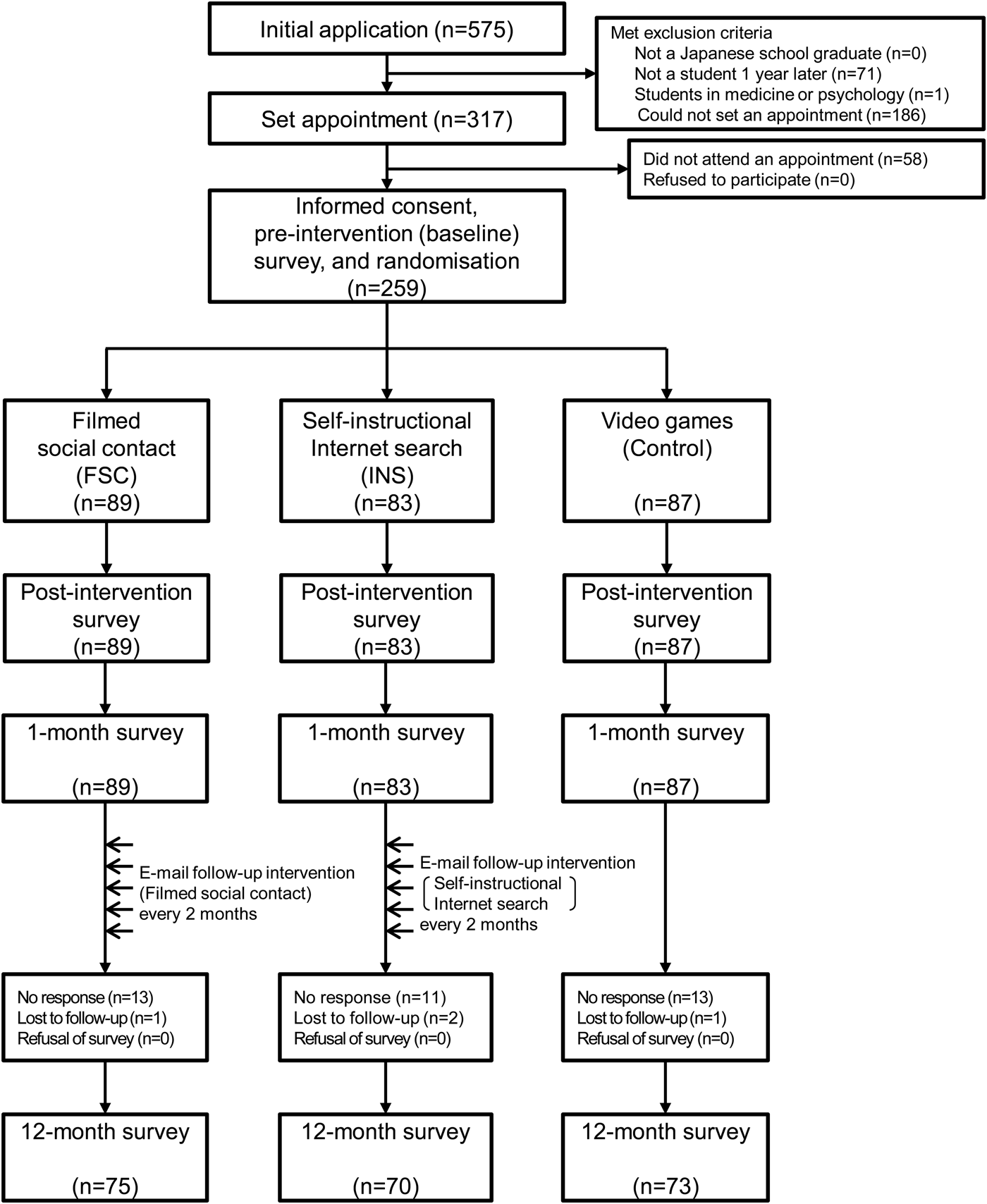
In total, 575 students initially applied to participate in the present study, and 503 students met the inclusion criteria (Fig. 1). Initial survey appointments were made with 317 students. Finally, 259 students participated in the study. There were no differences in sex and age between the participants and those who made appointments but did not come.
CONSORT flow diagram of the study.

Participants were randomly assigned to the FSC (n = 89), INS (n = 83), and control groups (n = 87). There were no differences in demographic characteristics at baseline between the groups (Table 1 and online Supplementary Table S2). The survey at 1-month after the intervention was administered online (n = 259, 100% response rate), whereas responses were obtained from 218 participants at the 12-month follow-up (84.1%, 75/70/73; returned by post n = 207, completed online n = 11; Fig. 1). There were no differences in the response rates between the three groups at the 12-month survey, in any stigma scale between postal and online responses at the 12-month survey, or in demographics at baseline between those who did and did not respond (p > 0.05). No adverse events were reported during the follow-up period.
The Pearson correlation coefficients of the stigma scale scores at baseline in order to check the degree of overlap are shown in online Supplementary Table S3.
Effect of filmed social contact on behavioural intention
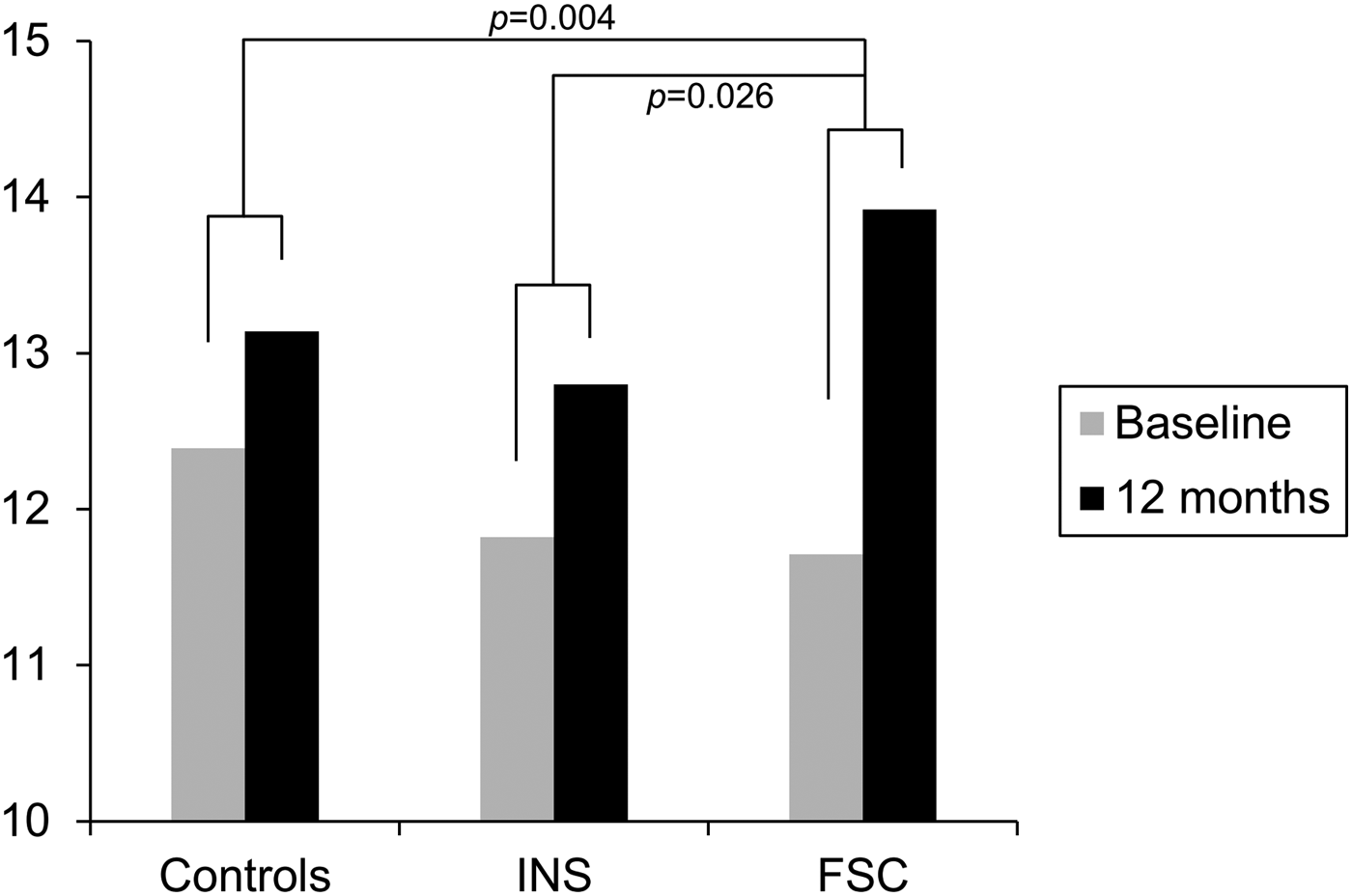
For the FSC group, the RIBS-J future score at baseline and 12 months after the intervention showed the greatest change (mean change = 2.11 [95% CI 1.49, 2.73]) followed by the INS and control groups (1.04 [0.29, 1.80]; 0.71 [0.09, 1.33], respectively; Fig. 2). A GLMM showed that the FSC group had the greatest effect on improved RIBS-J future scores at 12 months after intervention compared with the control group (Cohen's d = 0.52) and the INS group, and there was no difference between the INS and control groups (d = 0.11, Fig. 2).
Change in RIBS-J future scores (behavioural intention towards people with mental illness) for the primary outcome. Bars indicate statistical significance with the p values for Time by Group interactions. A GLMM showed a significant Time by Group interaction for the FSC group compared with the control group as a reference (FSC: B = 0.30 [0.10, 0.51], p = 0.004; INS: B = 0.07 [−0.15, 0.28], p = 0.54), as well as a significant main effect of Time (B = 0.16 [0.01, 0.31], p = 0.038) and a non-significant main effect of Group (FSC: B = −0.15 [−0.35, 0.06], p = 0.17; INS: B = −0.13 [−0.34, 0.09], p = 0.24). A comparison between the FSC and INS groups showed a significant main effect of Time (B = 0.22 [0.07, 0.37], p = 0.004) and a significant Time by Group interaction (B = 0.24 [0.03, 0.45], p = 0.026), but no significant main effect of Group (B = −0.02 [−0.23, 0.19], p = 0.85). INS, self-instructional Internet search; FSC, filmed social contact.

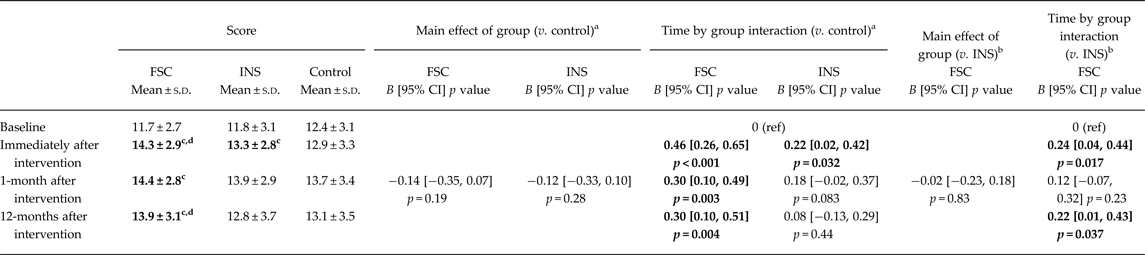
The RIBS-J future domain scores across four time points as one of secondary outcomes showed that the FSC group had the greatest improvement immediately after the intervention followed by the INS group compared with the control group (FSC: d = 1.14, INS: d = 0.54; Table 2). However, the significant difference between the INS and control groups disappeared in the survey at 1-month after intervention (FSC: d = 0.61, INS: d = 0.36).
Change of RIBS-J future scores during 12-month follow up

Bold indicates significant at 5% level.
RIBS-J, the Japanese version of the Reported and Intended Behaviour Scale; FSC, filmed social contact; INS, self-instructional Internet search.
a A generalised linear model was used for the control group as a reference (Residual deviance = 1274, df = 981, p < 0.001, AIC = 1300).
b A generalised linear model was used for the INS group as a reference to directly compare with the FSC group (Residual deviance = 847.8, df = 652, p < 0.001, AIC = 865.8).
c Greater difference from baseline compared with the control group.
d Greater difference from baseline compared with the INS group.
The results for other secondary outcome measures are shown in the online Supplementary Materials.
Discussion
Our RCT showed that an initial 30-min social contact and education video with follow-up web-based social contact had a 12-month sustained effect on reducing stigma, measured by a scale of intended behaviour towards people with mental illness. This effect was seen even when compared with a 30-min INS with follow-up e-mail interventions. We found that the social contact intervention in our study also improved a range of stigma-related responses, including feasible and stereotyped knowledge, and social distance. In contrast, the INS group showed an effect on behavioural intention immediately and at 1 month after intervention; however, the effect was smaller than that for the FSC group, and was not sustained for 12 months.
The long-term effect of repeated social contacts
Our findings showed that social contact had a sustained, long-term effect on reducing stigma, contrary to previous studies (Campbell et al. Reference Campbell, Shryane, Byrne and Morrison2011; Papish et al. Reference Papish, Kassam, Modgill, Vaz, Zanussi and Patten2013). Our intervention was different from these studies, as it consisted of repeated and qualified interventions, and participants in the FSC group were prompted to pay attention to mental health problems. As with our intervention, a well-designed FSC had a similar effect on reducing mental health-related stigma compared with in-person social contact (Clement et al. Reference Clement, van Nieuwenhuizen, Kassam, Flach, Lazarus, de Castro, McCrone, Norman and Thornicroft2012). Because filmed, web-based social contact can be implemented more easily and widely than in-person social contact, it is possible that educational lectures in schools and community-level and nation-wide anti-stigma campaigns may have more emphasis in their websites on social contacts with people who have mental illness (Kanehara et al. Reference Kanehara, Umeda and Kawakami2015). Second, similarly to a previous trial that showed a middle-term effect of a social contact intervention, the FSC group intervention was developed in line with the recommendations for population-level campaigns to reduce stigma (Clement et al. Reference Clement, Jarrett, Henderson and Thornicroft2010). The content in the FSC intervention contained more encouraging and familiar messages towards people with mental illness and less biomedical and psychosocial information compared with the previous interventions (Campbell et al. Reference Campbell, Shryane, Byrne and Morrison2011; Papish et al. Reference Papish, Kassam, Modgill, Vaz, Zanussi and Patten2013). Therefore, the participants may have felt a closer relationship to mental illness. In addition, secondary analyses showed that the difference of intervention intensity between schizophrenia and depressive disorders in the FSC group also reflected these findings. To develop more efficient and sustainable interventions, future studies are needed to explore what types of messages have a crucial effect on reducing stigma.
The results found using intergroup contacts (e.g. sexual orientation, physical disability, and race and ethnicity) could also explain why FSC is superior to INS (Pettigrew et al. Reference Pettigrew, Tropp, Wagner and Christ2011; Al Ramiah & Hewstone, Reference Al Ramiah and Hewstone2013). A meta-analysis showed that intergroup contacts increase knowledge and empathy, and reduce anxiety (Pettigrew & Tropp, Reference Pettigrew and Tropp2008). Of these, knowledge is a minor mediator and anxiety reduction is more crucial to reducing stigma. Contacts with people of equal status in ages and socio-economic and familial backgrounds maximise the effect on reducing anxiety and increasing empathy (Pettigrew et al. Reference Pettigrew, Tropp, Wagner and Christ2011; Al Ramiah & Hewstone, Reference Al Ramiah and Hewstone2013). The mixture of knowledge-based messages and social contacts suitable for young people in this study could lead to greater efficacy in the FSC group compared with the INS group (Chisholm et al. Reference Chisholm, Patterson, Torgerson, Turner, Jenkinson and Birchwood2016).
The long-term effect of repeated INS
Overall, the INS group intervention was shown to be less effective than the FSC group intervention. Although self-instructional searches in this study could not be controlled in terms of the websites and types of information accessed, one reason for this difference may be that most of the information accessed by the INS group may have been based on biomedical and psychosocial knowledge and scientific evidence (Nemoto et al. Reference Nemoto, Tachikawa, Sodeyama, Endo, Hashimoto, Mizukami and Asada2007; Reavley et al. Reference Reavley, Mackinnon, Morgan, Alvarez-Jimenez, Hetrick, Killackey, Nelson, Purcell, Yap and Jorm2012). Recent studies have shown that the quality of websites that receive the most page hits, such as Wikipedia, is similar or superior in some domains to other existing sources such as medical textbooks or encyclopaedias (Nemoto et al. Reference Nemoto, Tachikawa, Sodeyama, Endo, Hashimoto, Mizukami and Asada2007; Reavley et al. Reference Reavley, Mackinnon, Morgan, Alvarez-Jimenez, Hetrick, Killackey, Nelson, Purcell, Yap and Jorm2012); however, biomedical messages were not always recommended for anti-stigma interventions (Clement et al. Reference Clement, Jarrett, Henderson and Thornicroft2010). Social information may have a negative effect because of the possibility of stressing psychosocial weakness and personal responsibility (Schnittker, Reference Schnittker2008). There are relatively few social contacts with recovery-oriented and socially inclusive messages in website content, and most of the social contacts in the websites were based on supposed portrayals but not interviews with people who experienced mental illness. Therefore, the participants in the INS group may have received a less positive impression about people with mental illness than those in the FSC group.
This does not mean, however, that internet searches about mental health are ineffective in reducing stigma and could be harmful. Indeed, the INS intervention had a short-term effect on reducing stigma, and had similar long-term effects for the SDSJ compared with the FSC intervention with few adverse effects. SDSJ measures social distance (negative attitude) towards people with schizophrenia. Internet searches by themselves could have a domain-specific effect on reducing stigma, especially in negative emotional feelings towards people with mental illness. Internet searches are common among young people when seeking information and help (Horgan & Sweeney, Reference Horgan and Sweeney2010; Birnbaum et al. Reference Birnbaum, Rizvi, Correll and Kane2015). Therefore, the advantages offered by the Internet such as anonymity, confidentiality, and social networking could also become powerful tools for mental health lectures and anti-stigma campaigns.
Limitations
There are several limitations of our study that should be considered. First, compliance with the web-based follow-up interventions could not be tracked, although the initial session was well implemented as it was completed by participants in a room used for the purpose of the study. Therefore, the actual effect of follow-up interventions on maintaining the effect of the initial intervention and further reducing stigma was not identified. Additionally, the initial intervention for the INS group could not control what web pages were viewed and how the participants searched. A method of keeping participant's motivation and engagement towards the intervention would be needed such as web-based interactive education and social-networking-service-based discussion. Recording and analysing how participants use online content could utilise the improvement of the intervention. Second, because all measurements were carried out using self-reported questionnaires, two possible methodological limitations (social desirability bias and the effect of repeated measures) may have influenced the present findings. A previous report showed that a web-based survey was less likely to be influenced by social desirability than a face-to-face survey, possibly because of confirmation of confidentiality and anonymity (Henderson et al. Reference Henderson, Evans-Lacko, Flach and Thornicroft2012). In our study, the scores showed improvement at 1-month after the intervention, when all participants responded to the follow-up survey online. Additionally, mental health-related information from lectures and media, and the personal experiences of participants and people close to them during the follow up period could have improved the scores (Koike et al. Reference Koike, Yamaguchi, Ojio, Shimada, Watanabe and Ando2015, Reference Koike, Yamaguchi, Ohta, Ojio, Watanabe and Ando2016a , Reference Koike, Yamaguchi, Ojio, Ohta and Ando b ). However, the confidentiality and anonymity of the three self-report questionnaires was confirmed, and the effects of the interventions were compared with controls. Therefore, social desirability bias may have had less influence on the findings. Third, although all participants were recruited without any information related to mental health problems provided in advance, participants were undergraduate and graduate students in Tokyo, Japan. In addition to an age effect (Corrigan et al. Reference Corrigan, Morris, Michaels, Rafacz and Rusch2012), different cultural backgrounds including urbanisation of home and psychological conditions at the time of the interventions could have influenced the effect of the intervention (Griffiths et al. Reference Griffiths, Nakane, Christensen, Yoshioka, Jorm and Nakane2006; Eisenberg et al. Reference Eisenberg, Downs, Golberstein and Zivin2009). Therefore, the present findings may not be easily generalisable to the wider public, and the interventions may need to be modified if used for different demographic groups.
Conclusion
Reducing the public stigma of young people towards mental illness is essential to enable them to use appropriate support and care in the early stages of illness. Future educational lectures in schools, and community-level and nation-wide anti-stigma campaigns with well-qualified and repeated social contact with people who have mental illness could help to reduce stigma, and may support recovery from psychiatric conditions.
Supplementary material
The supplementary material for this article can be found at https://doi.org/10.1017/S2045796016001050.
Acknowledgements
We would like to thank Ryoko Anazawa, Sho Kanata, Mika Yamagishi and Eriko Ichikawa for substantial support during data collection. We also would like to thank JPOP-VOICE for the approval to use and edit the interview videos for this study. Please contact the authors if you would like to see the video films and e-mail letters used in this study. GT is supported by the National Institute for Health Research (NIHR) Collaboration for Leadership in Applied Health Research and Care South London at King's College London Foundation Trust. The views expressed are those of the author(s) and not necessarily those of the NHS, the NIHR or the Department of Health. GT acknowledges financial support from the Department of Health via the National Institute for Health Research (NIHR) Biomedical Research Centre and Dementia Unit awarded to South London and Maudsley NHS Foundation Trust in partnership with King's College London and King's College Hospital NHS Foundation Trust. GT is supported by the European Union Seventh Framework Programme (FP7/2007–2013) Emerald project.
Financial Support
The present study was supported by grants to SK from the JSPS/MEXT (grant numbers 25870143 and 26118703), the Uehiro Foundation on Ethics and Education, and Pfizer Health Research Foundation.
Conflict of Interest
All authors have no conflicts of interest relating to this study.
Contributors
SK and SY contributed to writing the draft manuscript and the statistical analysis. SK, SY, YO, GT and SA contributed to the conception and design of the study. KO contributed to data management. All authors contributed to the recruitment of participants, the assessment of data, and the critical revision, and have approved the final version of the manuscript.
Availability of Data and Materials
All data are not freely accessed because of no given informed consent from the participants to open data sharing, but we can provide the data used in this study to researchers who want to use after an approval by the ethical committee in the University of Tokyo.