Introduction
Within otolaryngology education, parotidectomy is a highly technical key-indicator case, and competence in parotidectomy is required for graduation from residency.Reference Franzen, Buchali and Lieder1–Reference Malata, Camilleri, McLean, Piggot, Chippindale, Kelly and Soames3 The procedure is considered technically challenging, often requiring identification and careful dissection of the facial nerve. Several studies have reported complication rates ranging from 7–22 per cent.Reference Sethi and Deschler4–Reference Kim, Lim, Wood, Samant, Ver Halen and Kim5 Despite the broad complication rate reported in the literature, there are limited data evaluating the implications of resident involvement on parotidectomy procedures.
The current model for surgical residency training involves a stepwise model of graduated surgical autonomy as residents progress through their training.Reference O'Brien, Kellermeyer, Chung and Carr6–Reference Cameron7 Across surgical specialties, varied results have been found when evaluating the impact of resident involvement, occasionally demonstrating worse patient outcomes.Reference Iannuzzi, Rickles, Deeb, Sharma, Fleming and Monson8–Reference Iannuzzi, Chandra, Rickles, Kumar, Kelly and Gillespie9 A recent study utilising the American College of Surgeons National Surgical Quality Improvement Program broadly examined all head and neck surgical procedures recorded in its database, and after adjusting for comorbidities found no association between resident participation and 30-day morbidity or mortality.Reference Abt, Reh, Eisele, Francis and Gourin10 Moreover, the yearly turnover in residents and role transitions for existing house staff, which has been referred to as the ‘July effect’, is another factor that may impact surgical outcomes.Reference Bohl, Fu, Golinvaux, Basques, Gruskay and Grauer11–Reference Young, Ranji, Wachter, Lee, Niehaus and Auerbach15
Within otolaryngology specifically, this phenomenon has been studied in microvascular surgery, pituitary skull base surgery and for procedures involving head and neck cancer. For the aforementioned procedures, there has been no evidence of an increase in morbidity and mortality during the resident transition period.Reference Hennessey, Francis and Gourin16–Reference Bashjawish, Patel, Kılıç, Hsueh, Liu and Baredes18 However, no studies have examined outcomes of patients undergoing parotidectomy during this transition period either. The purpose of this study was to investigate the morbidity of parotidectomy procedures with resident involvement compared with cases performed without residents. Our secondary aim was to investigate the impact of performing this procedure during the first academic quarter (July, August and September) relative to the months where residents would be expected to have more cumulative experience (all other quarters).
Materials and methods
This was a retrospective study utilising the American College of Surgeons National Surgical Quality Improvement Program database. The American College of Surgeons National Surgical Quality Improvement Program is a multicentre, nationally validated, risk-adjusted and outcomes-based database created for the purpose of measuring and improving surgical quality care.19 Each case contains up to 274 Health Insurance Portability and Accountability Act compliant variables regarding patient demographics, comorbidities, pre-operative laboratory values and operative variables, along with post-operative complications, mortality, readmission and reoperation within 30-days of the index procedure.19 Data are collected by centrally trained and certified clinical reviewers. Currently, this database contains information on more than 6.6 million cases, from over 700 hospitals across the USA and internationally in 9 different countries.19
The American College of Surgeons National Surgical Quality Improvement Program is a de-identified data set that meets exemption criteria established by The George Washington University School of Medicine and Health Sciences institutional review board. The American College of Surgeons National Surgical Quality Improvement Program database was queried for patients who had undergone parotidectomy procedures from 2005 to 2014.
Patients were isolated based on Current Procedural Terminology codes, selecting patients with Current Procedural Terminology codes corresponding to superficial parotidectomy with facial nerve dissection (Current Procedural Terminology code 42415), superficial parotid without facial nerve dissection (Current Procedural Terminology code 42410), total parotidectomy with facial nerve dissection (Current Procedural Terminology code 42420) and total parotidectomy with facial nerve sacrifice (Current Procedural Terminology code 42425).
In order to isolate solely parotidectomy cases, Current Procedural Terminology codes corresponding to neck dissections (Current Procedural Terminology codes: 38700, 38720 and 38724), as well as those associated with cancer resections (Current Procedural Terminology codes: 21016, 61605, 61590, 69120, 11644, 11646, 69970, 31225 and 69535) or reconstruction (Current Procedural Terminology codes: 14040, 14041, 14301 and 15120) as a separate or concurrent procedure were excluded. Additionally, patients with missing information with regards to demographic data or comorbidity information were excluded to ensure inclusion of patients with the most complete history as possible.
Within the American College of Surgeons National Surgical Quality Improvement Program database are two variables that allow for identification of resident involvement. The first variable is ‘attend’, which is coded as attending and resident when both are present in the operating room. The second variable is ‘postgraduate year (PGY)’ which refers to the highest-level training of the resident surgeon participating in the surgery. Resident involvement was therefore captured when both the ‘attend’ and ‘PGY’ variables were coded for a particular case. Cases that did not specify involvement by either an attending or resident were excluded.
Demographic data, pre-operative comorbidity information and 30-day patient morbidity and mortality outcomes were collected. Composite binary outcome variables were created to improve the ability to determine an association between resident participation and early patient morbidity and mortality after parotidectomy. These outcomes included cardiac events (myocardial infarction or cardiac arrest requiring cardiopulmonary resuscitation), pulmonary events (prolonged intubation, reintubation or pneumonia), septic events (sepsis or septic shock) and clotting events (deep venous thrombosis or pulmonary embolism). The association of resident involvement with organ-space infection, the occurrence of bleeding events requiring transfusion, prolonged length of hospital stay (defined as greater than 3 days), unplanned return to the operating room and 30-day mortality was also investigated. Next, the effect of resident transitions in July was examined by comparing parotidectomy procedures performed in the first academic quarter (quarter three) versus those in all other quarters (quarters one, two and four).
Statistical analysis
Demographics, pre-operative comorbidities and 30-day outcomes were compared separately between resident involvement cohorts (resident involvement vs attending only) and ‘July Effect’ cohorts (quarter three vs quarter one, quarter 2 and quarter 4) separately. Univariate comparisons were analysed using independent sample t-test and Mann–Whitney U test for parametric and non-parametric continuous variables, respectively, as well as the chi-square and Fisher's exact test for adequate and low cell-count (more than or equal to 25 per cent of expected cell counts less than or equal to 5) categorical variables, respectively. Continuous outcomes were analysed for normality by measuring the variable distribution's skew and kurtosis coupled with the Kolmogorov–Smirnov test for normality. Continuous outcome ‘total hospital length of stay’ was severely positively skewed and was therefore natural logarithm transformed to meet the assumptions of normality.
Demographic data and pre-operative comorbidities with resulting univariate-test of p-values less than 0.2 were considered potential confounding covariates and were entered into multivariable models following a backward stepwise selection procedure with stay criteria α = 0.1 in order to elucidate the independent effect between cohort of interest and outcome.
Multivariable logistic regression models were used for categorical outcomes, whereas general linear models were used for natural logarithm transformed continuous outcomes that were later reverse transformed for interpretation. No transform was performed for linear regression on outcomes that met the assumptions of normality, specifically for ‘total operative time’. Multicollinearity of covariates in all models was assessed by way of variance inflation factor analysis where variance inflation factor less than 2 was considered acceptable. Resulting adjusted odds ratios, 95 per cent confidence intervals (CIs) and p-values were reported from multivariable logistic regression models, whereas adjusted parameter estimates (β) with corresponding standard errors and p-values were reported for normally distributed or reverse transformed continuous outcomes.
All statistical analysis was performed using SAS statistical software (version 9.4; SAS Institute, Cary, USA), and a two-sided p-value less than 0.05 was considered statistically significant.
Results
Resident involvement
After applying inclusion and exclusion criteria for resident involvement cohort comparisons, 11 731 patients were included. Of the included cases, 932 (7.4 per cent) were resident involved. Resident involvement was significantly associated with a higher proportion of patients aged 41–60 years and more than 80 years, fewer white race patients and in turn more black and ‘other’ race patients, lower proportion of obese, diabetic and chronic obstructive pulmonary disease patients, as well as a higher proportion of anaemic patients and patients with more than 10 per cent weight loss 6 months prior to surgery (all respective p < 0.05). All other demographic data and comorbidities did not differ between resident involved and attending only cohorts (Table 1).
Patient demographics and pre-operative comorbidities

*n = 10 801 (92.1 per cent); †n = 932 (7.9 per cent); ‡two-sided p-value < 0.05 considered statistically significant. BMI = body mass index; COPD = chronic obstructive pulmonary disease; CHF = congestive heart failure
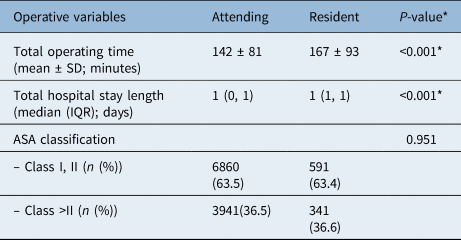
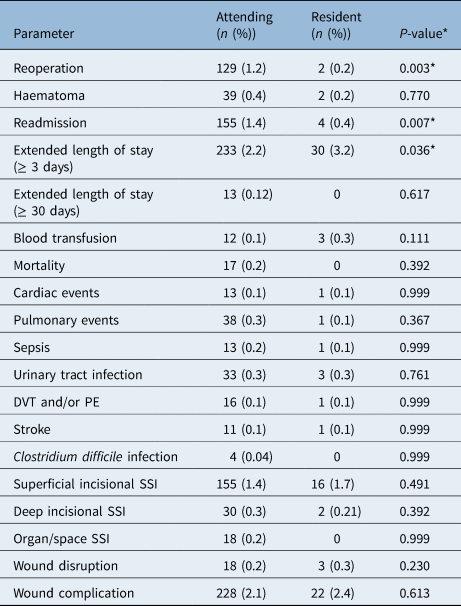
Univariate analysis also showed that resident involved cases were significantly associated with longer operative times, longer total hospital length of stay, a higher proportion of extended length of stay more than or equal to 3 days, and lower proportions of reoperations and readmissions (Tables 2 and 3).
Peri-operative variables categorised by resident involvement

*Two-sided p-value < 0.05 considered statistically significant. SD = standard deviation; IQR = interquartile range; ASA = American Society of Anesthesiology
Univariate analyses assessing post-operative parotidectomy complications categorised by resident involvement

*Two-sided p-value < 0.05 considered statistically significant. DVT = deep vein thrombosis; PE = pulmonary embolism; SSI = surgical site infection
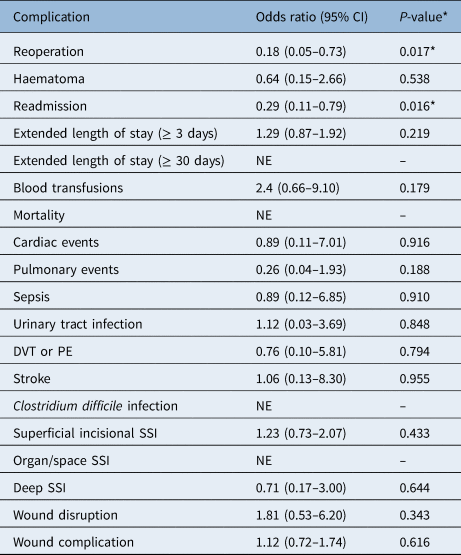
After adjusting for confounding covariates, multivariable analysis elucidated decreased odds of reoperation and readmission to be independently significant in association with resident involvement (Table 4). Relative to attending only cases, resident involved cases had 82 per cent lower adjusted odds of reoperation (95 per cent CI: 0.05–0.73; p = 0.017) and 71 per cent lower adjusted odds of readmission (95 per cent CI: 0.11–0.79; p = 0.016). Additionally, resident involvement was associated with 24 ± 3 minutes longer adjusted operative times and 23.5 ± 2.3 per cent longer adjusted total hospital length of stay when analysed continuously (mean ± standard error; respective p < 0.001).
Multivariate analyses assessing complications categorised by resident involvement

*Two-sided p-value < 0.05 considered statistically significant. CI = confidence interval; NE = not estimable due to too few events; DVT = deep vein thrombosis; PE = pulmonary embolism; SSI = surgical site infection
‘July effect’
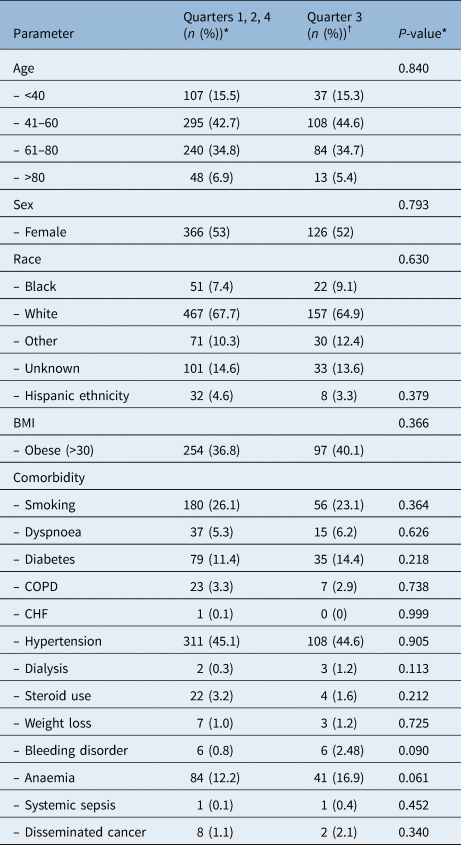
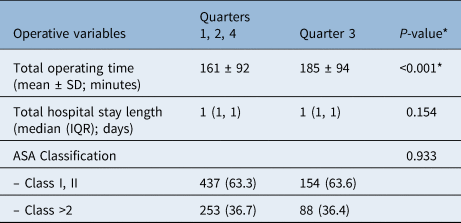
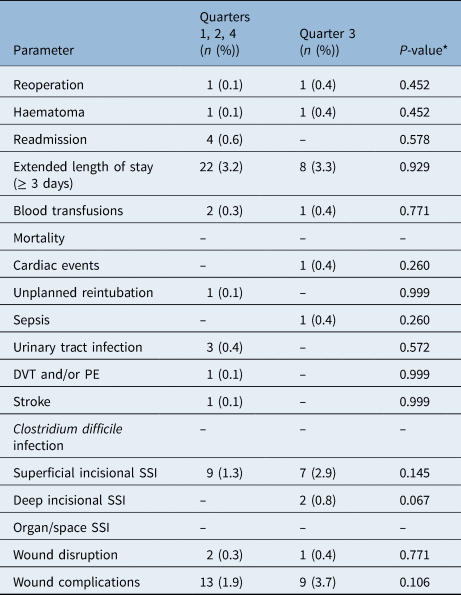
After applying inclusion and exclusion criteria for ‘July effect’ cohorts, 11 931 patients were included. Of the included cases, 2983 (25 per cent) took place in first academic quarter. Demographic and pre-operative comorbidities did not significantly differ by cohort, implying that the patient populations were similar in quarter three relative to all other yearly quarters (Table 5). Additionally, all operative variables and outcomes of interest were not detected to be significantly different between cohorts (Tables 6 and 7).
Patient demographics and pre-operative comorbidities categorised by academic quarter

*n = 690 (74 per cent); †n = 242 (726); ‡two-sided p-value < 0.05 considered statistically significant. BMI = body mass index; COPD = chronic obstructive pulmonary disease; CHF = congestive heart failure
Peri-operative variables categorised by academic quarter

*Two-sided p-value < 0.05 considered statistically significant. SD = standard deviation; ASA = American Society of Anesthesiology
Univariate analyses for post-operative complications categorised by academic quarter

*Two-sided p-value < 0.05 considered statistically significant. ELOS =; DVT = deep vein thrombosis; PE = pulmonary embolism; SSI = surgical site infection
Discussion
Parotidectomy is a relatively common procedure performed by otolaryngologists, and technical mastery of this procedure is required by residents prior to graduation. To our knowledge, this study represents the first analysis of both resident involvement and the ‘July effect’ on 30-day morbidity and mortality after parotidectomy.
Within otolaryngology, a handful of studies have described the relationship between resident involvement and patient outcome. Two large retrospective national database studies by Vieira et al. and Abt et al. showed no association between resident involvement and adverse outcomes in peri-operative patient care.Reference Abt, Reh, Eisele, Francis and Gourin10,Reference Vieira, Hernandez, Qin, Smith, Kim and Dutra20 Studies examining other key-indicator cases such as tympanoplasty, tympanomastoidectomy, transsphenoidal surgery and thyroid surgery have also failed to find an association between increased peri-operative complications and resident involvement.Reference Wong, Filimonov, Lee, Hsueh, Baredes and Liu21–Reference Kshirsagar, Chandy, Mahboubi and Verma23 However, similar to those studies examining otological surgery and thyroidectomy, we found significantly increased mean operative times in our resident cohort. This is not surprising considering the mission of academic programs is to graduate surgeons who can independently perform these technically demanding surgical procedures, a process that takes years of training to achieve.
When examining the effect of resident transitions in the first academic quarter on peri-operative care, we found no significant difference in peri-operative complication rates, readmissions or operative times. Other studies examining the ‘July effect’ across otolaryngology, as well as in other surgical disciplines have also found no evidence to support an increase in morbidity, mortality or length of stay during this time period.Reference Bresler, Bavier, Kalyoussef, Baredes and Park17, Reference Hennessey, Francis and Gourin24–Reference Lieber, Appelboom, Taylor, Malone, Agarwal and Connolly29 Past reports of increased morbidity and mortality in July have likely fuelled the emphasis and implementation of formal patient handoffs throughout medicine, with which modern trainees are well acquainted. While these protocols may not affect intra-operative outcomes, peri-operative patient care is almost certainly improved by them.Reference Gagnier, Derosier, Maratt, Hake and Bagian30,Reference Murray, Valdez, Hughes and Kavanagh31
We also found lower 30-day reoperation and readmission rates in resident-involved cases than those performed by the senior attending alone. No significant difference in readmission rate was associated with cases performed in the first academic quarter. Lower 30-day reoperation rates in resident-involved cases may reflect subtle differences in care not accounted for in the National Surgical Quality Improvement Program database. The American College of Surgeons National Surgical Quality Improvement Program database consists of multiple institutions throughout the country. Interestingly, the readmission rates gathered from National Surgical Quality Improvement Program appear to be lower than the 4 per cent readmission rate calculated from the nationwide readmission database.Reference Mukdad, Goel, Nasser and St John32 This discordance of values may be attributed to the fact that the National Surgical Quality Improvement Program only considers readmissions within 30 days post-operatively whereas the nationwide readmission database accounts for 30 days after discharge. Thus, if a patient had a prolonged hospital stay, American College of Surgeons National Surgical Quality Improvement Program may have underestimated the readmission rate. Moreover, parotidectomy procedures performed at academic centres may be more likely to be staffed by fellowship-trained head and neck attendings than those performed in community hospitals.
Within otolaryngology, surgical procedures performed at high-volume centres have been shown to be associated with decreased mortality and fewer post-operative complications.Reference Hatch, Bauschard, Nguyen, Lambert, Meyer and McRackan33, Reference Rubin, Wu, Kirke, Ezzat, Truong and Salama34 Although collinearity between high parotidectomy case volume and teaching hospital status has not been directly studied, nor is that data available in the National Surgical Quality Improvement Program database, collinearity between these variables has been demonstrated in head and neck cancer surgery.Reference Cheung, Koniaris, Perez, Molina, Goodwin and Salloum35 Further study is required to assess if parotidectomy case volume at institutions with resident involvement might explain the lower readmission, and reoperation rates associated with resident involvement.
• Resident involvement during parotidectomy is associated with significantly lower reoperation rates and readmission rates
• Resident involvement during parotidectomy is associated with significantly increased mean operative time and total length of stay
• No significant differences in medical or surgical complication rates were observed when comparing resident performed cases during the first academic quarter during new resident transitions compared to all other academic quarters
Although the National Surgical Quality Improvement Program database provides a wide range of variables and complications to address the impact of resident involvement, it has several limitations. Although certain surgical complications such as haematoma, surgical site infection and wound dehiscence are available, the lack of broader procedure-specific complications of interest is a limitation. Many of the potential surgical complications following a parotidectomy, such as incidence of seroma, sialocele formation or facial nerve paralysis are not recorded in the National Surgical Quality Improvement Program. Many pre-operative variables were controlled using multivariable analysis and while the National Surgical Quality Improvement Program database provides high-quality comorbidity data for risk-adjusted analyses of outcomes, there is a possibility of confounding by variables not captured in this database, such as socioeconomic status, histopathology, tumour size and drain placement. Underreporting of resident involvement is a possible source of bias that may influence complication rates. Although our study focused on parotid surgery, the proportion of resident involvement in all otolaryngology surgical cases has been cited as 38.4 per cent.Reference Vieira, Hernandez, Qin, Smith, Kim and Dutra36 The necessary exclusion of cases that do not specify resident-involved or attending-only cases could bias the results.
Conclusion
By utilising a multi-institutional database, we were able to use regression analysis to independently identify the impact of resident involvement on 30-day peri-operative complications, readmissions, reoperation and operative length. Resident participation is associated with significantly lower reoperation and readmission rates while demonstrating increased mean operative time and total hospital length of stay. Parotidectomy procedures performed in the first academic quarter during resident transitions had no significant impact on overall patient outcomes.
Competing interests
None declared