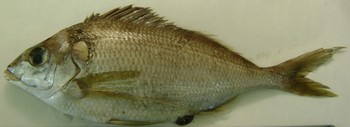
The morwong (Nemadactylus bergi, Norman 1937) is a sub-tropical demersal fish, belonging to the family Cheilodactylidae. This fish occurs from depths of 50 to 150 m in the south-east Pacific (along the Chilean coast) and in the south-west Atlantic as far south as 45°S in the Argentine Patagonia area (Froese & Pauly, Reference Froese and Pauly2006). They are occasionally caught in bottom trawls by the high-seas fleets of Argentina and Uruguay. The species is most abundant from 36 to 39°S, and its range was recently mapped as far south as to 47°S (Boltovskoy, Reference Boltovskoy2009).
On 12 May 2009, a mature N. bergi was caught by the commercial trawler MFV ‘Kalatxori’ to the north-west of West Falkland (50°05′ to 50°16′S 62°29′ to 62°34′W, mean towing depth of 147 m), on the outer edge of the Falkland Islands Conservation Zone (Figure 1). The animal measured 31 cm total length and weighed 319 g after freezing. Fin ray counts matched those described by Nakamura (Reference Nakamura and Nakamura1986); D XVI, 24; A III, 13; P1 15; P2 I, 6. The total number of gill-rakers was 23. The identification of this animal extends the range of this species by at least 330 km further south.
Morwong (Nemadactylus bergi) caught in Falkland Islands Conservation Zone.

The presence of a well developed commercial fishery in the Falkland Islands with extensive scientific observer coverage since 1988 makes it unlikely that N. bergi has always occurred at these higher latitudes; if this were the case it would have likely been encountered before. It was shown that an increasing number of species ranges in the south-west Atlantic have recently extended southward with no corresponding increase in distributional range in northern latitudes (Galvan et al., Reference Galvan, Venerus, Irigoyen, Parma and Gosztonyi2005; Hearne, Reference Hearne2009). Therefore, it is possible that ongoing climate warming could be the reason for the appearance of the sub-tropical N. bergi in Falkland waters.
ACKNOWLEDGEMENTS
I would like to thank Dr V. Laptikhovsky for his advice and support in the writing of this paper. Further thanks to two anonymous referees for their helpful comments.