Introduction
Fleas (Insecta, Siphonaptera) form a distinct group of wingless bloodsucking insects with complete metamorphosis. About 2574 species belonging to 16 families and 238 genera were described (Bitam et al., Reference Bitam, Dittmar, Parola, Whiting and Raoult2010). Lewis (Reference Lewis1998) recognized 15 families considering Ctenophthalmidae, while Medvedev (Reference Medvedev1998) treated Hystrichopsyllidae as a large family that includes Hystrichopsyllinae and the subfamilies that were traditionally placed within Ctenophthalmidae. This family (sensu Lewis, Reference Lewis1993a) consists of nine subfamilies and 17 described tribes, with 42 genera and 664 species. Roughly one quarter of flea species are placed within this group and Ctenophthalmidae has been traditionally the ‘catchall’ family for fleas that have been difficult to assign to other families (Whiting et al., Reference Whiting, Whiting, Hastriter and Dittmar2008). These authors reconstructed deep level evolutionary relationships for fleas (Insecta: Siphonaptera) based on 28S, 18S, COII and elongation factor 1-alpha (EFI-α) sequences and found, in their analysis, that this family was paraphyletic. The current arrangement of Ctenophthalmidae is clearly in a state of disarray; however, if one assesses the phylogeny based on the subfamily, five natural groupings may be observed: Ctenophthalminae, Doratopsyllinae, Neopsyllinae, Stenoponiinae and the Rhadinopsyllinae (Whiting et al., Reference Whiting, Whiting, Hastriter and Dittmar2008). These authors concluded that the catchall group Ctenophthalmidae is clearly an unnatural grouping of fleas, and elevating each of its constituent subfamilies to family level would be a closer reflection of their phylogeny. Furthermore, Ctenophthalmidae has been generally associated with insectivorous hosts (Soricidae) as the main hosts, but members of this family have been reported parasitizing rodents (Muridae) (Acosta, Reference Acosta2005).
The Holarctic subfamily Stenoponiinae are all very large and darkly pigmented fleas with a striking genal comb spanning most of the lateral portion of the head. Species from the Nearctic (Stenoponia americana), Palearctic (Stenoponia tripectinata medialis), and the Oriental (Stenoponia sidimi) regions parasitize murid rodents.
The genus Stenoponia (Ctenophthalmidae) Hopkins & Rothschild, Reference Hopkins and Rothschild1962, is a Holarctic genus of 16 species and 14 subspecies which includes Stenoponia tripectinata tripectinata, the vector of plague in Asia Minor and European Russia (Lewis, Reference Lewis, Lane and Crosskey1993b). To date, S. tripectinata has been documented in Turkey, Greece, Romania, Italy, France and the Iberian Peninsula (Sánchez & Gómez, Reference Sánchez and Gómez2012). Furthermore, Sánchez & Gómez (Reference Sánchez and Gómez2012) reported, for the first time the geographical and host distribution of S. t. tripectinata parasitizing Mus musculus on the Canary Islands, Spain.
The specific differentiation of fleas has been carried out according to morphological characteristics based on the shape and structure of their complex genitalia and the presence and the distribution of setae, spines and ctenidia on the body (Dunnet & Mardon, Reference Dunnet and Mardon1999; Whiting, Reference Whiting2002). Nevertheless, the phenotype is conditioned by different factors: host, ambient conditions, feeding, etc., and many species and subspecies of fleas were reported based on a new host or on the presence or absence of putative ‘specific’ morphological and biometrical characters. All these difficulties and this incertitude, in discriminating among flea species, claims for the need of adding molecular data to the observation of morphological characters to study the taxonomy of the group.
Among the different molecular markers used in systematics, the Internal Transcribed Spacer regions 1 and 2 (ITS1 and ITS2) ribosomal DNA (rDNA) remains a valuable marker, in particular arthropods to discriminate between species (Marrugal et al., Reference Marrugal, Callejón, de Rojas, Halajian and Cutillas2013; Monje et al., Reference Monje, Quiroga, Manzoli, Couri, Silvestri, Venzal, Cuervo and Beldomenico2013 ) or also within species (Essig et al., Reference Essig, Rinder, Gothe and Zahler1999; Marcilla et al., Reference Marcilla, Bargues, Abad-Franch, Panzera, Carcavallo, Noireau, Galvão, Jurberg, Miles, Dujardin and Mas-Coma2002) and it has been revealed to be informative to establish phylogenetic relationships at the genus level (Zagoskin et al., Reference Zagoskin, Lazareva, Grishanin and Mukha2014). Vobis et al. (Reference Vobis, D'Haese, Mehlhorn, Mencke, Blagburn, Bond, Denholm, Dryden, Payne, Rust, Schroeder, Vaughn and Bledsoe2004) carried out a molecular phylogeny of isolates of Ctenocephalides felis based on the analysis of the ITS1 and ITS2. These regions have also been used to differentiate populations within mite species (De Rojas et al., Reference De Rojas, Úbeda, Cutillas, Mora, Ariza and Guevara2007).
Furthermore, mitochondrial DNA (mtDNA) has remained as evaluable marker for population, biogeographic and phylogenetic studies. It is also used for taxonomic purposes, where determinate fragments are used as mtDNA sequence tags or bar-code for species diagnostics (Hebert et al., Reference Hebert, Cywinska, Ball and DeWaard2003). It remains, however, that while mtDNA sequences are very useful markers, their use is not without complication. Ballard & Whitlock (Reference Ballard and Whitlock2004) argued that mtDNA evolution is non-neutral with sufficient regularity to question its utility as a marker for genomic history. Direct selection (selection on mtDNA itself) and indirect selection (selection arising from disequilibrium with other maternally transmitted genes) is sufficiently common to impose caution when making phylogenetic inferences based on mtDNA data alone. Thus, Hurst & Jiggins (Reference Hurst and Jiggins2005) concluded that mtDNA is inappropriate as a sole marker in studies of the recent history of arthropods and, potentially, other invertebrates.
In the present work, we carried out a comparative molecular study of S. t. tripectinata isolated from M. musculus from different islands from the Canary Islands, Spain. To this end, the ITS1, ITS2 and 18S of the rDNA and a fragment of the cytochrome c-oxidase 1 (cox1) gene of the mitochondrial DNA of this subspecies were sequenced in order to clarify the taxonomic status of this subspecies and to assess inter-population variation and inter-specific sequence differences. Based on the sequences produced here, together with data of additional flea species retrieved from public databases, we also carried out a comparative phylogeographic analysis Bayesian, Maximum Parsimony (MP), Maximum Likelihood (ML) and Neighbor-Joining (NJ) inference.
Material and Methods
Collection of samples
Rodents were captured using live traps on all the islands. Fleas were collected from mice (M. musculus) from different islands of the Canary Islands (Gran Canaria, La Palma, El Hierro, La Gomera and Tenerife) (Spain) (table 1). Fleas were collected manually and kept in an Eppendorf tube with 70% ethanol until required for subsequent identification and sequencing. Specific identification was based on morphological characteristics (Jordan Reference Jordan1958; Hopkins & Rothschild, Reference Hopkins and Rothschild1962; Beaucournu & Launay, Reference Beaucournu and Launay1990). For details concerning host distribution on each island of the Canarian Archipelago and distribution of S. t. tripectinata in different biotopes (Laurisilva, Pine forest, etc) see Sánchez & Gómez (Reference Sánchez and Gómez2012).
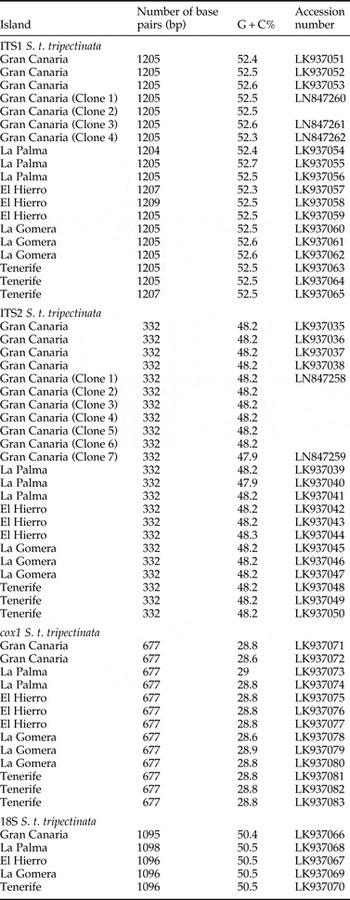
GenBank accession numbers of ITS1, ITS2, cox1 partial gene and 18S partial gene sequences of individuals of Stenoponia tripectinata tripectinata isolated of Mus musculus from the Canary Islands (Spain).

Molecular study
Single fleas were frozen in liquid nitrogen and pulverized in a mortar. Genomic DNA was isolated using the DNeasy Blood and Tissue Kit (Qiagen) according to the manufacturer's protocol. The ITS1 region was amplified by polymerase chain reaction (PCR) using a thermocycler (Perkin Elmer) and the PCR mix and PCR conditions were applied as previously described by Marrugal et al. (Reference Marrugal, Callejón, de Rojas, Halajian and Cutillas2013). Primers were NC5 (Gasser et al., Reference Gasser, Nansen and Guldberg1996) and ITS1rev (Marrugal et al., Reference Marrugal, Callejón, de Rojas, Halajian and Cutillas2013). For the ITS2 region the PCR mix used was the same as for the ITS1 region and the conditions were: 94°C at 5 min (denaturing), 35 cycles at 94°C at 60 s (denaturing), 55°C at 60 s (annealing), 72°C at 60 s (primer extension), followed by 10 min at 72°C. Forward and reverse primers for ITS2 region were senITS2 (Vobis et al., Reference Vobis, D'Haese, Mehlhorn, Mencke, Blagburn, Bond, Denholm, Dryden, Payne, Rust, Schroeder, Vaughn and Bledsoe2004) and ITS2R, respectively (Vobis et al., Reference Vobis, D'Haese, Mehlhorn, Mencke, Blagburn, Bond, Denholm, Dryden, Payne, Rust, Schroeder, Vaughn and Bledsoe2004). In the case of 18S partial gene region, the PCR mix was: 5 µl 10× PCR buffer, 1 µl 10 Mm dNTP mixture (0.2 mM each), 2 µl 50 mM MgCl2, 5 µl primer mix (1 mM each), 5 µl template DNA, 0.5 µl Taq DNA polymerase (2.5 units) and autoclaved distilled water to 50 µl. The PCR conditions and primers (18SF and 18SR) were defined by Kaewmongkol et al. (Reference Kaewmongkol, Kaewmongkol, Mclnnes, Burmej, Bennet, Adams, Ryan, Irwin and Fenwick2011). Cox1 mtDNA partial gene was amplified using PCR conditions designed for amplification of cox1 from fleas’ isolates by Kaewmongkol et al. (Reference Kaewmongkol, Kaewmongkol, Mclnnes, Burmej, Bennet, Adams, Ryan, Irwin and Fenwick2011). The cycling conditions consisted of a pre-PCR step of 96°C for 2 min, followed by 40 cycles of 94°C for 30 s, 50°C for 30 s and an extension of 72°C for 60 s with a final extension of 72°C for 7 min. Forward and reverse primers for the cox1 were: LCO1490 and HCO2198 (Folmer et al., Reference Folmer, Black, Hoeh, Lutz and Vrijenhoek1994), respectively.
The rDNA intra-individual variation was determined by sequencing four to seven clones of one individual per geographical population of S. t. tripectinata. The PCR products were eluted from the agarose by using the WIZARD® SV Gel and PCR Clean-Up System (Promega) and transformation was carried out as cited by Cutillas et al. (Reference Cutillas, Callejón, de Rojas, Tewes, Ubeda, Ariza and Guevara2009). Plasmids were purified using a Wizard Plus SV (Promega) and sequenced by Stab Vida (Portugal) with a universal primer (M13).
All the phylogenetic analyses were performed on the rDNA and mtDNA datasets, and sequences were aligned using the Clustal W program version 2.0 (Larkin et al., Reference Larkin, Blackshields and Brown2007). The intra-population variation was determined for the rDNA and mtDNA by sequencing three individuals from each island. Furthermore, all the sequences were aligned and compared with each other using the CLUSTAL W program. Alignments were manually adjusted.
Phylogenetic relationships were analyzed using four different methods: NJ and MP trees were generated from methods using the MEGA 5 program from Tamura et al. (Reference Tamura, Peterson, Peterson, Stecher, Nei and Kumar2011), ML using the phylogenetic estimation using maximum likelihood (PHYML) package from Guindon & Gascuel (Reference Guindon and Gascuel2003) and Bayesian inferences (B) were performing from Mr, Bayes-3.1.2. For the Bayesian analysis, we ran three independent runs of four Markov chains for 10 million generations, sampling every 500 generations. The Bayesian posterior probabilities are percentage converted. For ML inference, the JMODELTEST (Posada, Reference Posada2008) program was also used to determine the best fit substitution model for the parasite data (18S, ITS1, ITS2 and cox1). Models of evolution were chosen for subsequent analysis according to the Akaike Information Criterion (Huelsenbeck and Rannala, Reference Huelsenbeck and Rannala1997; Posada and Buckley, Reference Posada and Buckley2004). Best-fit nucleotide substitution models included general time-reversible (GTR) model with gamma-distributed rate variation and a proportion of invariable sites, GTR + I + G (18S), Hasegawa-Kishino-Yano, HKY85 + I + G (ITS1), GT + G (ITS2) and GTR + G (cox1). Support for the topology was examined using bootstrapping (heuristic option) (Felsenstein, Reference Felsenstein1985) over 1000 replications.
The phylogenetic and phylogeographic analysis, based on ITS1, ITS2, 18S and cox1 sequences was carried out using sequences obtained from GenBank (Appendix 1). Phylogenetic trees based on 18S rRNA and cox1 mtDNA were rooted including two outgroup species representing members of the Order Mecoptera: Microchorista philpotti and Boreus elegans (cox1) and Nannochorista dipteroides and Boreus coloradensis (18S) (Appendix 1), whereas phylogenetic trees based on ITS1 and ITS2 sequences were constructed using different outgroup species representing members of Order Diptera (Anopheles farauti, Anopheles lesteri, Anopheles anthropophagus, Muscina stabulans and Philornis seguyi). No ITS sequences of Order Mecoptera were found in public database.
Results
No morphological differences were observed between individuals of S. t. tripectinata isolated from Mus musculus from different islands. ITS1 sequences of the ribosomal DNA (rDNA) of different populations of S. t. tripectinata were 1204–1209 base pairs (bp) in length (table 1), while the ITS2 sequences of S. t. tripectinata were 332 bp in length (table 1). Furthermore, the cox1 and 18S partial gene sequences of S. t. tripectinata were 677 bp and 1095–1098 bp in length, respectively (table 1). All the sequences (ITS1, ITS2, 18S and cox1 partial gene) of S. t. tripectinata isolated from M. musculus from different islands were deposited in GenBank database (table 1).
ITS1 and ITS2
The intra-individual, intra-population and inter-population similarities of S. t. tripectinata isolated from M. musculus are shown in table 2 (ITS1) and table 3 (ITS2). No ITS1 sequences of others species of family Ctenophthalmidae were found in GenBank. Thus, no molecular comparative analysis between them could be performed.
Intra-individual, intra-population (*) and inter-population similarity observed in ITS1 sequences in Stenoponia tripectinata tripectinata populations isolated from different islands from the Canary Islands (Spain).

Intra-individual, intra-population (*) and inter-population similarity observed in ITS2 sequences in Stenoponia tripectinata tripectinata populations isolated from different islands from the Canary Islands (Spain).

The phylogenetic analysis based on ITS1 and ITS2 sequences showed a substantial length variation in the alignment which compromised inferences of positional homology. Furthermore, Anopheles spp. seemed to be a poor outgroup due to long-branch problems affecting root-placement.
18S rRNA partial gene
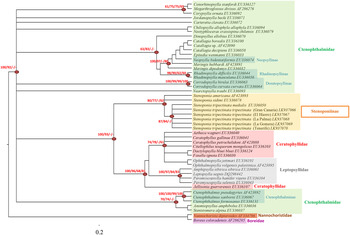
The intra-population and inter-population similarities were of 100%. Furthermore, the inter-specific similarity was of 99.6% (S. t. tripectinata-S. t. medialis), 99.8% (S. t. tripectinata-S. americana) and 99.9% (S. t. tripectinata-S. sidimi). The Bayesian, MP, NJ and ML analysis reconstructed a similar topology. The phylogenetic tree (fig. 1) constructed for the 18S rRNA partial gene sequences of S. t. tripectinata with those sequences from GenBank of species belonging to the family Ctenophthalmidae, Leptopsyllidae and Ceratophyllidae revealed the individuals of S. t. tripectinata clustering together with S. t. medialis, S. americana and S. sidimi (fig. 1). Subfamily Stenoponiinae appeared related with family Ceratophyllidae and Leptopsyllidae and separated, in polytomy, from Ctenophthalmidae (fig. 1).
Phylogenetic tree of Stenoponia tripectinata tripectinata from different geographical origins (see Table 1) based on 18S partial gene of ribosomal RNA inferred using the Bayesian (B), Maximum Likelihood (ML), Maximum Parsimony (MP) and Neighbor-Joining (NJ) methods and Bayesian topology. The percentage of replicate trees in which the associated taxa clustered together in the bootstrap test (1.000 replicates) is shown onto the branches (B/ML/MP/NJ). Bootstrap values lower than 60% are not shown. The Bayesian Posterior Probabilities (BPP) are percentage converted.

Cox1 mtDNA partial gene
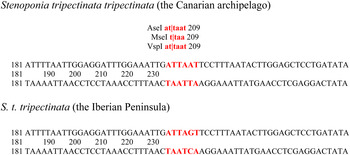
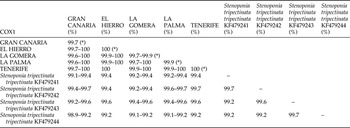
The intra-population and inter-population similarities are shown in table 4. When sequences of this cox1 mtDNA partial gene of S. t. tripectinata isolated from different islands were compared with those obtained in GenBank from the Iberian Peninsula (see Appendix 1) we noticed that both populations displayed slight differences (98.9–99.7%) (table 4). Based on the cox1 mtDNA partial gene sequences, a restriction map was constructed. Three endonucleases located at position 200 (Mse1, Ase1 and Vsp1) differentiated, clearly, both geographical regions (the Canary Islands and the Iberian Peninsula) (fig. 3).
Specific restriction endonucleases observed in the cox1 sequences of Stenoponia tripectinata tripectinata from the Canary Archipelago and the Iberian Peninsula.

Intra-population (*) and inter-population similarity observed in cox1 mtDNA partial gene sequences in Stenoponia tripectinata tripectinata populations isolated from different islands from the Canary Islands (Spain) and the Iberian Peninsula.

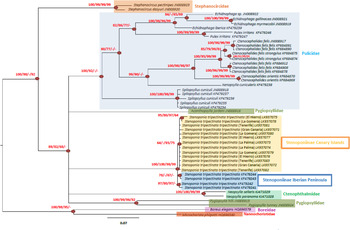
The phylogenetic tree topology of S. t. tripectinata from different geographical origins showed all the individuals from the Canary Islands clustered together, and separated from those individuals from the Iberian Peninsula (fig. 2). Furthermore, all the individuals of S. t. tripectinata appeared as a compact group and separated, in polytomy, with the remaining species belonging to different families of Siphonaptera: Ctenophthalmidae, Pygiopsillidae and Pulicidae (fig. 2).
Phylogenetic tree of Stenoponia tripectinata tripectinata from different geographical origins (see Table 1) based on cytochrome c-oxidase 1 (cox1) partial gene of mitochondrial DNA inferred using the Bayesian (B), Maximum Likelihood (ML), Maximum Parsimony (MP) and Neighbor-Joining (NJ) methods and Bayesian topology. The percentage of replicate trees in which the associated taxa clustered together in the bootstrap test (1.000 replicates) is shown onto the branches (B/ML/MP/NJ). Bootstrap values lower than 60% are not shown. The Bayesian Posterior Probabilities (BPP) are percentage converted.

Discussion
Fleas are holometabolous insects with an uncertain taxonomic classification. This is due to the extreme morphological specialization and the use of the quetotaxy, and the complex genitalia as the main differential diagnostic criteria. Nevertheless, phenotypic characters are influenced by different external factors and there might be synonymies among the described Siphonaptera species reflecting an accepted species being found in a different host and determined as a new species when host species and external factors influence results in a flea with different morphological characteristics. Thus, Marrugal et al. (Reference Marrugal, Callejón, de Rojas, Halajian and Cutillas2013) found in C. felis, collected from dogs from different geographical locations, four populations with different morphological characteristics which did not correspond with molecular differences. These authors concluded that ITS1 region is a useful tool to approach different taxonomic and phylogenetic questions in Ctenocephalides species and they found clear molecular differences between C. felis and C. canis. In addition, they detected some specific recognition sites for endonucleases in order to differentiate both species.
In the present work, S. t. tripectinata isolated from M. musculus from different islands from the Canary Islands was studied by amplification and sequencing of ribosomal (ITS1 and ITS2, and 18S rRNA partial gene) and mitochondrial (cox1 partial gene) DNA markers.
The differences in length in the ITS1 sequences of S. t. tripectinata were due to the presence or absence of nucleotides not only among different populations from different islands but also among different clones of the same individual (intra-individual variation). Nevertheless, the range of percentages of variation observed between different populations was higher than those observed intra-individually (tables 1 and 2).
The ITS2 sequences were markedly shorter than ITS1. This difference in the length of ITS1 and ITS2 sequences was also observed in triatomines by Bargues et al. (Reference Bargues, Klisiowicz, Panzera, Noireau, Marcilla, Perez, Rojas, O'Connor, Gonzalez-Candelas, Galvão, Jurberg, Carcavallo, Dujardin and Mas-Coma2006). The intra-population and inter-population similarity was nearly 100% and the highest differences were observed between individuals from La Palma (99.4%). At the inter-population level, it is to be noted that in all sequences analysis (ITS1, ITS2, 18S and cox1 partial gene), S. t. tripectinata populations from the Canary Islands appeared without any particular geographical pattern. ITS2 sequences evolve following the so-called concerted evolution (Smith, Reference Smith1976) through a process known as molecular drive (Dover, Reference Dover2002). Molecular drive, involving genomic turnover mechanisms and population dynamic processes, make it possible to homogenize and fix a particular repeat variant within each single reproductive unit. This leads to a lower degree of divergence within than between populations and/or species. This phenomenon clearly explains the lack of nucleotide variation within analyzed populations of S. t. tripectinata from different islands of the Canary Islands (see tables 2–4). This result seems to be consistent with other studies of Dipteran species that suggested that ITS2 cannot be utilized in differentiation of geographical populations of some blowfly species (Zaidi et al., Reference Zaidi, Wei, Shi and Chen2011).
ITS1 and ITS2 sequences of different species of genus Stenoponia were not available in GenBank, thus, we could not confirm that the approach employed here is useful to distinguish species within this genus as cited by other authors for the genus Ctenocephalides (Vobis et al., Reference Vobis, D'Haese, Mehlhorn, Mencke, Blagburn, Bond, Denholm, Dryden, Payne, Rust, Schroeder, Vaughn and Bledsoe2004; Marrugal et al., Reference Marrugal, Callejón, de Rojas, Halajian and Cutillas2013).
The phylogenetic analysis was carried out considering different outgroups (Diptera) but we had problems in performing a multiple alignment correctly. Thus, to address this problem and the absence of other ITS sequences that affects Stenoponia genus, 18S rRNA partial gene was sequenced and compared.
Whiting et al. (Reference Whiting, Whiting, Hastriter and Dittmar2008) based on 28S, 18S, COII and EF1-α markers reported the monophily of Stenoponiinae and Rhadinopsyllinae and placed both subfamilies as sister groups but with limited support. In our results, the 18S partial gene tree topology showed Rhadinopsyllinae clustered together with all the subfamilies and tribes included in family Ctenophthalmidae while Stenoponiinae clustered with Ceratophyllidae and Leptopsyllidae.
Furthermore, cox1 mtDNA partial gene sequences clustered all the populations from the Canary Islands and from the Iberian Peninsula with high support. Nevertheless, island populations showed a lower polymorphism than those from the Iberian Peninsula population. Island populations have shown to have lower levels of genetic variation than those populations from mainland (Dietzen et al., Reference Dietzen, Voigt, Wink, Gahr and Leitner2006). These two geographical lineages (Iberian Peninsula and Canary Islands) could have arisen due to the existence of geographical barriers.
The cox1 partial gene phylogenetic tree showed subfamily Stenoponiinae clustering all the species of Stenoponia from different geographical origins and in polytomy with Pygiopsyllidae, Ctenophthalmidae and Pulicidae.
This seems to suggest a new status for subfamily Stenoponiinae that was not related with family Ctenophthalmidae, and the suggestion of a new family: Stenoponiidae including species of the genus Stenoponia. Unfortunately, 18S partial gene and cox1 partial gene phylogenetic trees did not resolve at higher taxonomic levels. Furthermore, no other ITS1 sequences of Stenoponia, and related genera molecular data are available in GenBank for intra-generic comparisons.
In conclusion, ITS1 and ITS2 sequences were used as molecular markers to characterize S. t. tripectinata, while 18S rRNA partial gene and cox1 mtDNA partial gene assess the monophyletic origin of Stenoponiinae and a different genetic lineage from Ctenophthalmidae. Thus, the elevation of subfamily Stenoponiinae to family level (Stenoponiidae) would be considered. Nevertheless, we must be expecting since the molecular studies in Siphonaptera are scarce and the number of sequences of Siphonaptera in GenBank is low. Thus, the lack of knowledge of mitochondrial and ribosomal genomics for this group is a major limitation for phylogenetic studies. Furthermore, cox1 sequences revealed two different genetic lineages: the Canary Islands and the Iberian Peninsula, both being separated by specific restriction endonucleases.
Supplementary Material
The supplementary material for this article can be found at http://www.journals.cambridge.org/BER
Acknowledgements
The present work was supported by a grant of the V Plan Propio de Investigación of the University of Seville, Spain. We wish to thank Mrs, Anne Kendall for the critical reading of the manuscript.