Sare rind-o bash jahan ke tujh se sajud men rahte hain
Banke, terhe, tarchhe tikhe, sab ka tujh ko Imam kiya Footnote 1
Introduction
With the mild amusement of the schoolmaster, J. F. Stephen remarked that the Indian Penal Code and the Code of Criminal Procedure were grim presents to bequeath to a people.Footnote 2 This is a bequest that still inflects our everyday language. We describe a cheat as a char sau bees, invoking section 420 of the Indian Penal Code, and a ruffian as a das numbri badmaash, from the serial number ten of a police surveillance register.Footnote 3Badmaash—‘of bad-livelihood’—is a generic term for rascal, one flung at a bully, hooligan, or more menacing criminal, but also used to chide a naughty child or wayward lover. The badmaash can be conceptualized as a presumptuous plebeian, or as a debauched or déclassé element of the ‘respectable’ classes.Footnote 4 In both cases his dangerousness seems to give him a power he is not legitimately entitled to, in ways that threaten person, property, and respectability.Footnote 5 The word ‘he’ is used because the badmaash of popular conception is vested with a threatening masculinity, one distanced from ‘proper’ work and associated with inappropriate forms of consumption.Footnote 6
This dense cluster of normative judgements has encouraged an enthusiastic deconstruction of the discourses circulating around this figure. The badmaash emerges as ‘the necessary other’ of the loyal colonial subject, the respectable town-dweller, the docile labourer, and the ‘secular citizen subject’.Footnote 7 Historical work in this genre has located the anxieties and agendas emerging around the badmaash in the demographic and political changes overtaking large colonial cities from the end of the nineteenth century.Footnote 8 The badmaash of this article is located more prominently in the colonial rural imaginary, in perceptions that the forces of modernization were eroding village hierarchy so much that law, the police, and the magistracy would have to intervene to ensure its reproduction.
A list of badmaashes kept at every police station was a long-standing practice of colonial ‘preventive policing’, formalized in a 1793 regulation which required a money bond and sureties from those suspected of being vagrants, robbers, or ‘disorderly and ill-disposed’ persons.Footnote 9 Failure to provide ‘security for good behaviour’ resulted in terms of imprisonment which could range from six months to a year. The badmaash list could include released convicts, or simply suspected persons, with those characterized as ‘hereditary thieving castes’ often contributing a significant number. Those on the badmaash register might be checked at home by the night-watchman, summoned for roll-calls, paraded before visiting officials, rounded up during fairs, and interrogated for local robberies. Preventive policing was organized less to detect the unknown ‘habitual’ than to demonstrate that ‘known badmaashes’ had been tamed by making them over into dakhila walas—persons who had to present themselves when sent for.
There has been a rich body of work on the English Habitual Criminal Act, 1869, and the Prevention of Crime Act, 1871, formulated at a time when anxieties about crime in England were narrowing down to the figure of the recidivist.Footnote 10 Similar work on habitual offender legislation in India has tended to focus largely on the Criminal Tribes Act of 1871. However, its operation is sometimes examined too much in isolation from the general provisions of the law and in too static a frame. What emerged in fact from the hectic legislative activity of the 1860s and 1870s in India was a dual but intersecting pathway for dealing with habituality in crime: the Criminal Tribes Act (Act XXVII of 1871) which authorized provincial governments to set out rules for the collective registration and surveillance of ‘hereditary criminal castes and tribes’ and the ‘security for good behaviour’ sections of the Indian Code of Criminal Procedure (CrPC 1861) which allowed vagrancy and bad-livelihood to be assessed ‘by evidence of general repute or otherwise.’Footnote 11 Sections 109 and 110 of the 1882 CrPC will be used to refer to these provisions because this numbering was maintained in subsequent revisions of this code.
In England, habitual offender legislation focused largely on surveillance of the ex-convict.Footnote 12 In the colony, between the Criminal Tribes Act and the bad-livelihood sections of the CrPC, there was so much scope to deduce ‘habituality’ from social antecedents and repute alone, that the released convict was a very narrow category, whose surveillance was legalized very late in the day by section 565 of the 1898 CrPC. And, at the time, the North Western Provinces and Oudh government had expressed its fears that a measure which targeted only the ex-convict might compromise the surveillance of the much larger number who were merely suspected of habituality.Footnote 13 The ‘Habitual Offender in Hindustani is simply (the) “badmaash”’, insisted an official member of the Punjab Legislative Assembly, rejecting a proposal to restrict this categorization to offenders who had been convicted two or more times.Footnote 14
This article traces the career of the bad-livelihood sections across three revisions of the Code of Criminal Procedure—in 1872, 1882, and 1898—arguing that these and other provisions for ‘preventive policing’ allowed colonial law makers to soothe official fears about the project of codification.Footnote 15 The exercise, they insisted, was one that would legalize and systematize areas of executive and judicial discretion, not excise them.
However, with bureaucratic centralization and rationalization came a closer statistical monitoring of the workings of the police and the district criminal courts as well. This exposed the embarrassing variability with which district magistrates were continuing to interpret the law, even though this was now codified law and the higher courts were supposed to guide its uniform implementation. To what extent should this now rather-too-visible realm of executive autonomy be curbed by bringing it under the scrutiny of the sessions judge and the high courts? Interestingly, as this article shows, the debate on the judicial review of executive action began ‘internally’, in official circles, in the 1860s and 1870s, and left its mark on the 1882 CrPC. Thereafter it took on a life of its own in the public sphere as educated Indians struggled to create the conditions of citizenship for themselves in colony and empire. Their demand for a clearer separation of executive and judicial power has been a somewhat under-researched component of this endeavour.
Colonial officials began to affirm ever more insistently that oriental subjects needed to see in the district head not only an instrument of British sovereignty but also an embodiment of it. What seemed to erode this paternalist ideal was ‘legal-mindedness’, percolating into district criminal courts through the agency of ‘legal touts’, but also emerging insidiously from within the ranks of the ‘native judiciary’. Side by side, therefore, with the government's ideological investment in the figure of the paternalist district magistrate was its institutional effort in the late nineteenth century to modernize policing through the introduction of an educated Indian sub-inspector of police. Here was a figure that could be trained to construct a case on behalf of the prosecution, and to develop and manage a police archive which would assist him to do so. Legal-mindedness, like the pipal tree so beloved of colonial etchings, seemed to be sending stealthy roots into the edifice of rule.
The process described in this article was one which turned the badmaash of popular discourse into a ‘red-ink’ or ‘black-ink’ badmaash, according to the colour of the ink used to categorize him in a police surveillance register.Footnote 16 Simultaneously labels such as das numbri (history-sheeter) or kaydee (k.d., known depredator) began to be absorbed into a lush vernacular vocabulary for rascality. Such changes emerged both from a perceived need to record and circulate information about ‘known’ badmaashes in ways that would enable their recognition outside the frame of ‘the local’ as well as from the need to present a more convincing bad-livelihood case in court.
The elaboration of the paperwork and protocols of preventive policing added to the menace invoked by such figures instead of lessening it, for, pulled more tightly into police circles, the registered badmaash entered into another arena of ‘dangerousness’, that of executive illegality. It was not just the criminalized plebeian habitus of the badmaash that fuelled respectable fears, but the fact that he did not seem to be safely contained within this sphere.
‘Over-legislation’? Reconciling codification with executive discretion
The codification of criminal procedures in the 1860s took place against the backdrop of a kind of ‘constitutional’ debate about the balance between the judicial and executive arms of government. In the aftermath of the 1857 rebellion, enthusiasts in favour of overhauling the seemingly archaic and ad-hoc structure of Company rule had to contend with a strong current of opinion which was critical of ‘over-legislation, over-centralization, and over-departmentalization’.Footnote 17 Henry Maine, legal member of the Viceroy's Council (1862–1869), and his successor, James Fitzjames Stephen (1869–1872), had to persuade those officials who favoured a strong decentralized executive unhampered by ‘legal technicalities’ that codification would strengthen, not erode executive authority.Footnote 18 ‘The proper course,’ Maine insisted, was ‘not to indulge in vague condemnation of legislation, but to discover expedients by which its tendency to hamper discretion may be minimized.’Footnote 19 Both also stated that they understood the need, among an Asiatic people, to maintain some of the forms of visible, personalized, and discretionary authority.Footnote 20
The rationalizing and universalizing thrust of liberal and utilitarian ideology was tempered therefore by the need to win British ruling circles over to the more law-bound order of governance being worked out for the colony. J. F. Stephen displayed a special concern to uphold the prestige of the district magistrate who oversaw both revenue collection and ‘the executive administration of a District in criminal matters’. Officials would invoke section 37 of the 1872 CrPC (over which Stephen had presided) to contend that the sessions judge had only a limited authority to intervene in the lower criminal courts under the district magistrate's control.Footnote 21
The Police Act (Act V of 1861) had instituted the police as a separate department with its own hierarchy of command from the provincial level downwards. However, as the district magistrate had ultimate responsibility for maintaining order, the district superintendent of police was expected to defer to him. The modernizing ideal of specialist departments, with a separate chain of command, was disrupted therefore by the countervailing proposition that all district functionaries were subordinate to the district magistrate. Even as the actual ability to supervise the expanding work under his charge dwindled, the myths surrounding the district magistrate's office grew apace. The poet, Akbar Allahabadi (1846–1921), who spent his working life in the environs of the Allahabad courts, jested about the importance of staying on the right side of the mighty district magistrate-cum-collector:
Aas aisho umr ke liye kafi hai
Bibi razi ho aur collector sahib Footnote 22
The legal, the informal or ‘non-statutory’, and the illegal
Under the East India Company, it was the ‘native’ head of the police station, the daroga or thanedar, who largely determined the names on the badmaash register, despite criticism that this gave him too much scope for extortion.Footnote 23 Mid-century drives to standardize and legalize informal areas of police and magisterial authority brought badmaash registers and their stigmatizing routines under scrutiny again.Footnote 24 The question posed was this: did the public entry of a person's name on the badmaash list amount to an unsanctioned exercise of judicial and punitive authority? Such discussions exposed the degree to which the formal provisions of the law were just the tip of a much vaster domain of surveillance managed by the subordinate ‘native’ police and village functionaries. District magistrates and superintendents of police often insisted that this was not an ‘illegal’ domain but simply a non-statutory one.
In the 1860s the register for mere suspects was separated from the register for convicted persons. It was now supposed to be a confidential compilation requiring the superintendent of police's permission before adding a name to it.Footnote 25 The newly constituted Allahabad High Court had stated that magistrates who publicly ordered the entry of a name to the badmaash list were inflicting a punishment without legal sanction or judicial process.Footnote 26 What this meant was that it was now the superintendent of police who added and removed names from thana surveillance registers in a semi-judicial and public way.Footnote 27 Confidentiality remained a fiction for the entry of a name on the surveillance register was followed by an order requiring head-men and village-watchmen to report on the person's movements, his associates, and absences from home.Footnote 28 As Viceroy Elgin admitted some 30 years later, ‘under conditions of life in India, the fact of supervision cannot be concealed’.Footnote 29
In the 1850s and 1860s the high courts had questioned the legality of another surveillance practice as well—that of subjecting communities deemed to be ‘hereditary robbers’ to roll-calls and restrictions on their movement. The Criminal Tribes Act (Act XXVII of 1871) met this objection by authorizing provincial governments to notify selected communities of collective registration and restrictions, placing, at the same time, the entire exercise outside the scope of judicial review. Some Barwar women in the United Provinces chronicled the bitter dawn of this era of roll-calls and passes by giving their newborns names such as Dukhedi (annoyance), Bipatdie (calamity), and Jaizadie (roll-call).Footnote 30
The Criminal Tribes Act has attracted a great deal of scholarly attention because it so clearly violated the liberal principles of due process and equality before the law. However, the pulling together of families from scattered hamlets into one settlement, with an obligation to arrange for their livelihood, could be an arduous and expensive business. Superintendents of police often preferred to go on using illegal roll-calls and restrictions for ‘thieving tribes’, drawing upon sections 109–110 to intimidate particularly recalcitrant individuals, instead of invoking the Criminal Tribes Act.Footnote 31
Sections 109–110 outlined a procedure by which, drawing upon ‘evidence of general repute’, someone suspected of bad-livelihood or held to possess an even more nebulous attribute of ‘dangerousness’ could be asked to produce security for good behaviour.Footnote 32 Failure to provide security could result in jail terms ranging from six months to three years in some cases. As one High Court ruling admitted:
Though it is not very clear what the precise meaning of the words ‘by evidence of general repute or otherwise’. . .may be, it was the intention of the Legislature that the Magistrates should use a very large discretion as to the evidence which he may admit in proceedings under section 110. . ..Footnote 33
The point to stress is that the sanction given by the CrPC to a lower standard of evidence in bad-livelihood cases tended to legitimize the entire field of police surveillance, shading from the informal into the outright illegal.Footnote 34 This discretionary latitude was symptomatic of the oft-repeated mantra of colonial policing—that the habitual offender or ‘likely habitual’ could never be identified by offence alone, but by reference to local ‘character, history and antecedents’. The ‘local’ could stand in for the village, the police circle, or the district magistrate's jurisdiction. The common theme was the defence of executive discretion against the ‘threats’ assailing it, first in an era of self-conscious legal modernization and, later, in the context of political movements demanding the transformation of rule by law into rule of law.
Flexible as it was, the procedure of a bad-livelihood enquiry could erect quite a rigid frame of ‘habituality’. Someone ordered to furnish security under section 109 or 110 was no longer simply a ‘suspected person’. He acquired a record and, for purposes of police surveillance or jail discipline, was often categorized with convicted habituals.Footnote 35 For instance, the Indian Jail Committee of 1919–1920 stated that habituality should rest on one or more convictions, not on character alone. Nevertheless it held that an order to find security under section 110 would count as a previous conviction because ‘such an order is made only as a result of a regular judicial proceeding and is in fact as much a judicial finding on facts directly in issue as a regular conviction or acquittal’.Footnote 36
Prevention or punishment?
A procedure under section 109 or 110 was termed a judicial enquiry, not a trial. It began sometimes with a petition from an individual or a group, but more usually with a report from the thanedar (the head of the police station). If the magistrate decided to launch an enquiry he would issue a simple summons asking the person to ‘show cause’ why he should not be asked to provide security for his good behaviour, setting out the amount of the security bond, its term, and the ‘number, character and class of sureties’. The person summoned could, in theory, defend himself, by producing witnesses, or hiring legal counsel, and the magistrate was supposed to adjudicate on this evidence.Footnote 37 In practice, proceedings could be highly formulaic, with evidence from the police and watchmen to the fore.Footnote 38 The higher courts repeatedly pointed out that sections 109–110 were meant for the prevention, not the punishment, of crime, but magistrates often chose to be so exacting about the bond and sureties that a jail sentence was bound to follow.
After the codification of criminal procedure, the assessment of bad-livelihood was supposed to rest on the threat someone posed to property, not on immorality of lifestyle.Footnote 39 Inevitably, however, what attracted suspicion was that in environments where toil alone ought to define existence, someone had time and money to spare. The pressure to re-expand the scope of the bad-livelihood sections came as much from ‘respectable’ Indian society as from officialdom. Often the evidence, one magistrate complained, was not that someone was ‘by repute a robber, thief, or receiver of stolen property, but that he drinks toddy, gambles, has a kept woman, spends eight annas a day, is seldom seen to work’.Footnote 40
The target of section 109 was someone ‘taking precautions to conceal his presence. . .with a view to committing an offence’ or with ‘no ostensible means of subsistence, or who cannot give a satisfactory account of himself. . .’.Footnote 41 The suspicion sprang from someone found in the wrong place at the wrong time, or strangers unable to indicate acceptable forms of livelihood. Section 109, sometimes labelled the vagrancy section, was the milder enactment, with failure to provide security bringing a maximum of six months in prison, but its phraseology also made it easy to justify summary action. It could be deployed to eject wandering groups, or, conversely, to sweep up ‘unattached’ labour when needed for district road-building or other projects.Footnote 42 However magistrates were expected to exercise some restraint, especially during famines, lest the prisons filled up with paupers. The deputy commissioner of Gonda, who noted that the increase of badmaashi cases was ‘natural’ in a year of scarcity, was rebuked by the Oudh judicial commissioner, who pointed out that the security sections were for specific classes of vagrants and habitual law breakers, not for ‘ordinary beggars, houseless women, destitute labourers, and impoverished cultivators’.Footnote 43 In the case of section 110 it was not opacity of identity which attracted an enquiry but that someone was all too well known for criminal forms of livelihood, or used his reputation for dangerousness as leverage for extortion. The classic instance was of someone known to abet cattle-theft, who would negotiate a ransom for restoration. Failure to provide security under section 110 could mean a jail term of up to three years.
Police reports treated success in bad-livelihood cases as the index of a district kept in order. In 60–80 per cent of the cases the magistrate would pronounce that security was required, and the larger number of those asked to provide security would go to jail in default.Footnote 44 The use of sections 109–110 stepped up when cattle-stealing, cattle-poisoning, or the circulation of counterfeit coins seemed to display a dangerous level of organization, and the police had to demonstrate activity and allay panic.Footnote 45 District officials also used these provisions more freely when they had to mobilize recruits, labour or transport at short notice, as in Punjab during the Great War, when ‘security against breach of peace’ and ‘security for good behaviour’ sections were deployed to bully youths into enlisting.Footnote 46
Negotiations around the entry or removal of a name from the surveillance register, or petitions for early release from ‘preventive detention’, generated information and informers. Since ‘respectable people’ were often reluctant to denounce someone publicly as a badmaash, the police had to use the leverage of surveillance to generate prosecution witnesses.Footnote 47 A kind of police constituency could emerge at the interface of registers of ‘known depredators’, ‘suspected persons’, wandering gangs, receivers of stolen property, brothels, gambling dens, excise outlets, and municipal sweepers.Footnote 48 In 1916, when a crowd was needed to cheer Lord Chelmsford's progression through Bombay and ‘it was obviously impossible to impress respectable householders. . .the sectional officers were instructed to shepherd their bad characters of both sexes to the fixed point’, giving them clean clothes and two annas apiece.Footnote 49 In the context of nationalist movements the police were often accused of deliberately unleashing ‘their’ bad-characters onto respectable people.Footnote 50 Yet, the lower classes swept up in section 109–110 cases were often merely the medium by which colonial policing intercalated itself into networks of influence, forging connections with powerful figures. Landholders who made the right kind of overtures could be permitted a very wide margin of illegality. Those who tried to operate too independently of the police were treated as the detritus of a vanquished order, to be brought to heel by another preventive section, ‘security against breach of peace’.Footnote 51
Cold-weather badmaash hunting
The moral effect of the Hakim on tour. . .cannot be overrated.Footnote 52
Magistrates were advised to ensure that the summary authority vested in them by sections 109–110 was displayed publicly and ritualistically, to replenish their authority at outposts of rule. Around November, as the days became delightfully crisp, the district magistrate would go off on an inspection tour of police stations, ordering thanedars in advance to round up the bad characters. It was with the greatest approval that the Indian Police Commission (1902–1903) cited James Monroe's account of how, as magistrate of Jessore, he had conducted enquiries into bad-livelihood:
I rode out to the spot. . .. They (the villagers) all sat down and I commenced to record their depositions on oath. . .. I had no difficulty in getting respectable Brahmins, Purohits, traders, etc., to state what they knew. . .the man was undoubtedly tried by a jury of his countrymen, the Magistrate's order being merely the channel. . .. The accused could point out his field if he said he lived by cultivation; he could produce his employer if he said he was a daily labourer. . ..Footnote 53
Such occasions gave meaning to the distinctions which the colonial administration conferred on the loyal and respectable, among them the kursi nashin (those holding certificates), which entitled them ‘to the Courtesy of a seat when visiting officers and Gentlemen’. On-the-spot enquiry was supposed to act as a check on the thanedar’s account, but it also allowed him to dispose of all section 109–110 cases in one sweep, avoiding the expense and trouble of dragging suspects and witnesses to a distant court.Footnote 54
By the turn of the century, bad-livelihood cases had lengthened in duration, and backlogs could be cleared only by trying a substantial percentage in court.Footnote 55 But such was the investment in the idea of ‘justice under the banyan tree’, that the Police Commission (1902–1903) tried to turn the clock back, wanting bad-livelihood cases to be tried only by local enquiry.Footnote 56
The career of bad-livelihood in codified law: executive prestige versus judicial review
In the codifying swathe of the 1860s and 1870s one issue was this: should sovereignty be concentrated in the realm of law, with the colonial executive cast merely as its instrument, its actions always subject to judicial review? Or would this fetter the executive head of the district and strip him of prestige to a degree held to be particularly dangerous in an Asiatic colony? The revised CrPC of 1872, finalized during J. F. Stephen's tenure as law member, gathered together all the preventive powers of the magistrates in a segment entitled ‘Preventive Jurisdiction of Magistrates’.Footnote 57 Nelson's commentary praised this rearrangement for having clearly separated ‘the preventive from the judicial and other powers of the magistrate’.Footnote 58 The implication was that the district magistrate had been given a generous measure of discretion in provisions designed ‘for the protection of the community’, and that the sessions judge and the High Court should refrain from interfering too much in this domain.Footnote 59 This interpretation drew strength from another change as well. Under the earlier CrPC a person ordered to give security could appeal to the sessions judge or, in Presidency towns, to a high court.Footnote 60 Now, under CrPC 1872, a person ordered by a subordinate magistrate to give security could appeal to the district magistrate against the order. However if the magistrate himself had passed the order there could be no appeal.Footnote 61 J. F. Stephen's general principle was that since codification was removing areas of uncertainty in the law, the right of appeal could also be curtailed.Footnote 62 CrPC 1872 also widened the scope of the bad-livelihood sections, as picked out by the italicized phrase below:
section 504 ‘lurking. . .or. . .has no ostensible means of subsistence or. . .cannot give a satisfactory account of himself. . ..’
section 505 ‘by repute a robber, house-breaker, or thief, or a receiver of stolen property. . .. Or of notoriously bad-livelihood, or is a dangerous character.’Footnote 63
section 506 ‘by habit a robber, house-breaker or thief, or a receiver of stolen property. . .or a character so desperate and dangerous as to render his release without security, at the expiration of the limited period of one year, hazardous to the community.. . .’
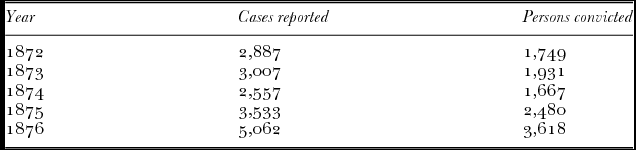
The number of those ordered to find security for good behaviour or sent to jail in default began to rise in certain provinces.Footnote 64 In 1877 the Bengal lieutenant governor, Ashley Eden, criticized the rise in figures for Bengal, arguing that the extensive locking up of those who were mere suspects exposed the lack of detective ability, spread alarm, and escalated jail expenses (Table 1). It ‘was a mode of dealing with crime which would not be tolerated in any country except India’.Footnote 65
Convictions for bad-livelihood, 1872–1876 (Bengal, Bihar, and Orissa)
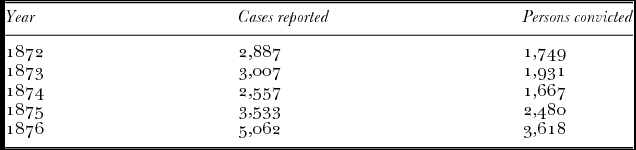
Source: Home, Judicial, A, January 1880, 136–166.
Eden recommended the restoration of the right to appeal from a district magistrate's order demanding security to the sessions judge or the High Court.Footnote 66 However, a circular asking provincial governments for their opinion exposed a groundswell of official opinion against this proposal. The district magistrate, so the argument went, had the benefit of local knowledge, which the sessions judge did not. If his orders were overruled, his prestige would suffer, especially if, horror of horrors, the sessions judge was also his junior in length of service.Footnote 67 As a result, when the CrPC was revised in 1882, the section allowing an appeal on the district magistrate's order was not reintroduced. However, the words ‘notoriously bad-livelihood’ and ‘is a dangerous character’ were deleted.Footnote 68 The objection, stated Whitley Stokes, law member, was that these phrases ‘were vague and that the powers which they placed in the hands of the police were liable to great abuse’.Footnote 69
CrPC 1882 (Act X of 1882)
section 109(a) `taking precautions to conceal his presence. . .with a view to committing any offence, or
section 109 (b) ‘. . .no ostensible means of subsistence, or who cannot give a satisfactory account of himself. . .’
section 110 ‘. . .is an habitual robber, house-breaker or thief, or an habitual receiver of stolen property. . .or. . .habitually commits extortion, or. . .to the committing of extortion habitually puts or attempts to put person in fear of injury. . .’.
However, Stokes added reassuringly that section 112 of the revised CrPC had authorized the magistrate to specify the ‘character and class’ of the sureties he required in enquiries into bad-livelihood, in order
to prevent certain persons making a trade of becoming sureties. The object of the law is not merely to provide a money security, but also to obtain respectable persons as guarantees for the good behavior of the criminal concerned.Footnote 70
The target here was the Indian lawyer at the lower end of the profession—the vakil or mukhtar—arranging a bond and sureties for those hauled up under sections 109–110. Imperial legislators had lauded rule by law as an instrument which would allow the steady and routine application of executive power, and educate native subjects to respect the obligations of contract, but now access to law seemed to be widening too much. Measures were taken to curb this burgeoning market in legal services, by encouraging ‘legal professionalization’ and passing laws against ‘legal touts and intermediaries’.Footnote 71 European magistrates and police officials who contended that legal ‘touts’ were assailing executive prestige from without, also excoriated ‘weak’ Indian magistrates and ‘technicality-loving’ Indian judges for undermining it from within. Indians in the judicial branch were characterized as indecisive, nervous about using sentences of whipping, far too ready to acquit, and susceptible to criticism from the vernacular press.Footnote 72 They were also suspected of encouraging a campaign, emerging in the vernacular press and Indian associational bodies, for a separation of the executive from the judicial arm of government. Proponents of this campaign argued that the district magistrate's responsibility for order compromised the judicial independence of the magistracy. To protect subordinate Indian magistrates from police bullying, the lower criminal courts should be placed directly under the sessions judge, not the district magistrate.Footnote 73
Yet ‘respectable’ Indians, demanding more of the law for themselves, were equally convinced that broad discretionary powers would always be needed for the lower classes. The vernacular press tended to critique only the ‘mis-use’ of the ‘security for good behaviour’ sections, deployed to intimidate respectable Indians seeking political and civil rights. Its more routine allegations were of laxity in enforcement, laced with suspicions of police complicity with badmaashes for profit or vendettas. It also pressed for the definition of bad-livelihood to include pimping, lecherous behaviour with ‘respectable’ women, and activities such as gambling and drinking, held to debauch ‘vulnerable’ groups like ‘coolies’, domestic servants, and schoolboys. In 1898 when the Calcutta Indian Association presented Romesh Chunder Dutt's scheme for the separation of executive and judicial power, an official observed sourly that, as magistrate-collector of Bakarganj, Dutt had made such substantial use of the preventive sections that he was hailed as a shining example of the vigour an Indian district magistrate could display.Footnote 74
Police reform and paperwork
‘with a civilised government, office work. . .cannot be dispensed with’Footnote 75
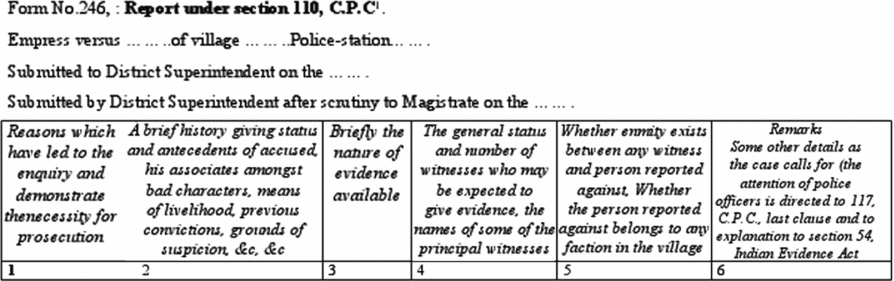
One way in which the police establishment sought to deal with this multi-sited and problematic emergence of ‘legal-mindedness’ was to develop a cadre of educated Indian sub-inspectors, instructed in criminal law, able to compile a database for the more systematic construction of cases.Footnote 76 ‘(T)o deal effectively with crime,’ noted the Indian Police Commission, 1902–1903, ‘it is necessary to have a continuous record of the criminal history of individuals and localities.’Footnote 77 It recommended a village crime notebook to give the newly appointed sub-inspector a bird’s-eye view of the population, revenue, principal castes, markets, fairs, and festivals in every village in his thana, as well as the headman, leading villagers, and watchmen, its ‘factions, land or water disputes, presence of criminal tribes or gangs, occurrence of obstructions on or damage to railway line. . .special outbreaks of crime’.Footnote 78 The notebook was to include a crime register (Part II), a conviction register (Part III), and history sheets (Part V).Footnote 79 The prescribed trajectory now for a bad-livelihood case was to begin by opening a history sheet for those ex-convicts or suspects who were ‘likely to become habitual criminals or aiders and abettors of such’, noting down suspicions arising from a house search, the evidence of cattle-trackers, or denunciation by a village assembly. Once complaints and suspicions had reached a satisfying density, the thanedar would obtain permission from the superintendent of police to enter the name on the surveillance register.Footnote 80 The final step was to submit this documented enquiry to the magistrate who would then decide whether to send a summons under section 110. The Bengal Police Code, Vol. II, 1897, had a standard form for this procedure (see Figure 1 above).
Police Code, Form No. 246 for Report under Section 110, Code of Criminal Procedure.
Source: The Bengal Police Code, Bengal Secretariat Press, Calcutta, 1897, Vol. II, p. 379.

The principle of careful paperwork, under the scrutiny of the superintendent of police and district magistrate, made it justifiable in 1905 to place suspects and ex-convicts once again on the same surveillance list.Footnote 81 This development may have also operated to link the magistracy even more closely to the police. The United Provinces Police report for 1904 commented, with approval, that prosecutions under section 110 were now ‘more or less generally conducted under the direct supervision of magistrates’.Footnote 82
Trans-local surveillance, or restriction to ‘original residence’?
But what if a suspect or ex-convict struck out, temporarily or permanently, for sites where he was not ‘known for what he was’? What if he refused to reveal his ‘true’ name and ‘original residence’? As it turned out, those on a surveillance register did not always have to move very far to place themselves ‘out of view’. In Allahabad town, a drive to locate ‘absentee convicts and surveilles’ found that hundreds absent from one city ward had simply shifted to the adjoining one, in another police jurisdiction.Footnote 83 It stated that the thanedar ‘of the original place of the surveille's residence’ was responsible for keeping track of him, but had to add that residence at the time of the first conviction was the original residence.Footnote 84 New forms of permanent residence had to be conceptualized, for instance the ‘artificial villages’ being set up for criminal tribes. Later the railway police would be instructed to open history sheets ‘for criminals living in railway premises. . .absent from their homes for so long that the railway premises may be regarded as their permanent residence. . .’.Footnote 85
The meshing of markets and spaces, accelerating by the 1890s, seemed to permit bad-characters to kick over their traces, and to rapidly shift illegal and stolen goods rapidly into commodity circuits. Officials argued that improved facilities for transport allowed bad-characters to throw off the control of village notables and seek work in new agricultural tracts, plantations, mines, and industrial sites. Police anxieties about ‘criminal’ migration generated an interest in descriptive protocols that would identify people and property outside ‘local’ frameworks.Footnote 86 It spurred the setting up from 1891 of provincial anthropometric bureaus, which gave way to the fingerprint bureaus taken, from 1906, under the wing of the provincial criminal intelligence departments.Footnote 87
Yet, the imperatives of archiving information could vary at various levels of policing, and new technologies of identification could be absorbed into these different circuits, without integrating them very effectively. In 1905 there was a prolonged wrangle when the Home Department wanted the Bombay police to dismantle its district fingerprint offices and the city fingerprint bureaus in Bombay and Karachi and concentrate records at the Provincial Fingerprint Bureau in Pune.Footnote 88 The provincial police were reluctant to give up the dense, if spatially bounded, information topographies, which served their interests, for the pared down fingerprint slips that the criminal intelligence departments advocated.Footnote 89 The controversy revealed that district and city fingerprint operators had been inducted into the routine business of keeping conviction records and supplying details of past convictions for nearly all prisoners under trial.Footnote 90 The Home Department protested that, ‘the object of a Fingerprint Bureau is not to provide a register of convictions, but to furnish facilities for discovering the criminal history of persons arrested by the police, whose antecedents are not known’.Footnote 91 Its other anxiety was that careless, untrained police officials at all these mini-bureaus, would compromise the aura of infallibility which had to be maintained for fingerprint identification.Footnote 92
Another persistent problem was that thanedars were notoriously reluctant to trim their surveillance lists in the interest of efficiency. Yet their opinion had to be given weight in order to prevent them from unloading their responsibility for surveillance onto specialist provincial units.Footnote 93 For the thanedar the length of his list represented the range of his power to make threats, and negotiate information and favours.Footnote 94 His decision to brand someone a badmaash was often made within such a local framework that he did not bother to keep track if that person shifted out of his jurisdiction.
The parallel strategy therefore for keeping ‘dangerous characters’ in view was to immobilize them in some ‘original residence’. It was in the village that the badmaash was ‘known for what he was’ and the law had to buttress the authority of village elites in order to keep him there. In 1893 the government of India drafted a Habitual Offender Bill which would have allowed restrictions on the movement permitted by the Criminal Tribes Act to be imposed on other kinds of habituals as well, including those ordered to give security under sections 109–110.Footnote 95 The Bill was dropped, but many of its provisions were scattered like buckshot over the revised CrPC of 1898. At this point, however, the political imperative of vesting the district administration with summary powers to proceed against sedition overtook some of the criminal imperatives.
The career of bad-livelihood in codified law: Act V of 1898, confronting the modern public sphere
The revised CrPC of 1898 increased the term for which security could be demanded under section 109 from six months to one year, and it dramatically widened the scope of section 110 by adding five new clauses:
Section 110 (b)‘by habit a receiver of stolen property’
Section 110 (c) ‘habitually protects or harbours thieves or aids in the concealment or disposal of stolen property’
Section 110(d) ‘habitually commits mischief, extortion or cheating or counterfeiting coin, currency notes or stamps or attempts so to do so’
Section 110(e) ‘habitually commits, or attempts to commit, or abets. . .offences involving a breach of the peace’
Section 110(f) ‘is so desperate and dangerous as to render his being at large without security hazardous to the community’
Clauses ‘b’, ‘c’, and ‘d’ reflected the sharpening concern that commodity flows were being pumped by illicit and stolen goods, and counterfeit coins.Footnote 96 Clauses ‘e’ and ‘f’ seemed to uncouple the quality of ‘dangerousness’ from the threat to property, leading some vernacular papers to conclude that section 110 could now be used politically as well.Footnote 97 However, the main blast of press criticism was directed at a new provision—section 108—which permitted security for good behaviour, for a term up to a year, to be demanded from:
any person who. . .orally or in writing, disseminates or attempts to disseminate. . .
(a) any seditious matter. . .
(b) any matter the publication of which is punishable under section 153-A of the Indian Penal Code
(c) any matter concerning a Judge which amounts to criminal intimidation or defamation. . ..
Section 108(c) illustrates the need that was felt to boost the morale of ‘nervous’ Indian judges held to be far too susceptible to the broadsides of the vernacular press. More significantly, it gave the district executive a highly flexible means by which it could keep disrupting the political platforms being put together, using modern media and communications. Indian legislators, the press, and public associations condemned section 108, not only for giving district magistrates too much discretion to determine what constituted ‘sedition’, thereby allowing them to intimidate speakers, writers, editors, and owners of presses, but also for clubbing such ‘respectable’ figures with vagrants and badmaashes.Footnote 98 Interestingly, section 108 breached not only the class barrier that set apart the bad-livelihood provisions, but also the race barrier, for certain English newspapers noted with displeasure that Europeans, exempted from sections 109–110, were not exempted from section 108.Footnote 99
There were magistrates and police officers who had hoped that the revised CrPC would also ‘legalize’ some of the ‘informal’ ways in which the local police compelled suspects to keep themselves in view. A draft provision was formulated that would have authorized magistrates to use section 110 to pass an order restricting someone to an area instead of demanding security for good behaviour. This, it was said, would prevent the suspect from finding security and then slipping away out of view. However, this harsher measure, which would have brought an aspect of the Criminal Tribes Act into the general provisions of the CrPC, was dropped from the final enactment.Footnote 100
From imperial codes to provincial enactments: the Punjab Habitual Offender Act (Act V of 1918)
During the following years the Punjab and United Provinces governments began to stretch the Criminal Tribes Act to bring ‘other kinds of habituals’, such as ‘cattle-thieving communities’ or mixed-caste bandit gangs, into its purview.Footnote 101 The Great War gave the Punjab government the opportunity to explore another option—that of using the provincial legislature to pass a local statute that would expand the ‘preventive powers’ of the magistrate.
In the nineteenth century, colonial officials often compared the ‘liberty of locomotion’ which Indians enjoyed under British rule with the internal passports imposed by Tsarist Russia.Footnote 102 However, in the course of the First World War, drawing upon Defence of India rules, the government of India expanded its powers to impose internal and external barriers to movement. Over 1915–1916 an Ingress into India ordinance was applied to forcibly restrict about 3,000 returning Punjabi emigrants, held to be contaminated by sedition, to their villages.Footnote 103 Against this backdrop the Punjab government asked for permission to push through a local enactment that would allow magistrates to pass an order under section 110 compelling someone to live and work in a particular area, instead of demanding security for his good behaviour.Footnote 104
Punjab officials cast the measure as a humane alternative to the possibility of going to jail in default of security and as a means of strengthening the organic cohesion of the village. It would not be an oppressive measure, they said, because restrictions would be enforced not through the problematic agency of the police, but by rural headmen—the lambardars and zaildars. They claimed that the internment of returning émigrés, implemented through these village functionaries, had proved to be a great ‘success’, one index of rehabilitation being that many had ‘volunteered’ for the army.Footnote 105
The government of India acknowledged that the Bill was a departure from the principle that major changes in codified law should be introduced only in the Central Legislature, but accepted that a provincial enactment could be pushed through more swiftly, and that the Punjab governor deserved support for his splendid war work.Footnote 106 In the Punjab Legislative Assembly and in public, the Bill had a rockier passage than Punjab officials had anticipated, with both the Muslim League and the Congress condemning it as a retrograde measure, designed to crush political life in rural areas.Footnote 107 But many Punjab legislators focused their critique more narrowly on the definition of the ‘habitual offender’, arguing that instead of being hitched to the loose terminology of section 110, it should rest on two or more convictions.Footnote 108 Punjab officials opposed this vigorously, for they wanted to build upon the definitional flexibility of the badmaashi sections, not to undermine them.
From London, Edwin Montagu, Liberal member of parliament and secretary of state for India, stressed that the Bill was not to be treated as a precedent: ‘It should not be assumed that the principle of restriction of movements of suspected persons commends itself to me as of general permanent application.’Footnote 109 And yet, the very next year, the government of India sanctioned another provincial statute, the Burma Habitual Officer Restriction Act (Act II of 1919). The Burma administration contended that it too wished to strengthen the authority of the village headman by using him as the primary agency for enforcement.Footnote 110 Both these enactments were structured discursively around the idea that dangerous figures could be disabled, even reformed, by rerooting them in agrarian hierarchy.
From the 1920s such statutes would be paralleled by the passing of other provincial enactments such as the Bengal Goonda Act (Act 1 of 1923) and the United Provinces Goonda Act (Act 1 of 1932) which were structured around a different spatial imaginary, that of the city as an unstable social conglomerate, where the labour force was cast as essentially ‘migrant’. In this milieu, the goonda, another word for ruffian and extortionist, was characterized as a low-level economic entrepreneur and political broker, offering loans and employment that could position the migrant either in honest work, or in criminal business. The premise of provincial Goonda acts was that the urban ruffian would have to be periodically expelled from the city to disrupt his hold over illegal markets and constituencies among the urban poor. He could not be incapacitated by interning him in the local social hierarchy.Footnote 111
Conclusion
I have argued elsewhere that both the CrPC bad-livelihood sections and the Criminal Tribes Act formed part of a complex arsenal deployed over the second half of the nineteenth century to recast ‘the village community’ as a more sedentary, stratified, and predominantly agricultural form.Footnote 112 As low-caste service communities began to be excluded from the territorial frame of ‘the village’ and its entitlements, they began to be described as shiftless and ‘unsettled’. A related imperative was that of defining property more sharply. Plebeian communities offering ‘services’ such as watching over cattle and fields, or boatmen contracted to carry goods over riverways, had to be discouraged from forms of ‘self-payment’, which challenged the sanctity of property and delayed the proper discipline of the wage-labour market.Footnote 113 The CrPC preventive sections were also used more freely when tenants challenged the rural hierarchy, or where the bargaining power of service and labouring strata increased because of opportunities for work outside clear networks of social dominance.Footnote 114
A more complex story remains to be told. The importance to imperial imperatives of labour and commodity flows within India and around her borders meant that the colonial administration had to generate legal forms and identity technologies, as for instance, sale-deeds or the branding of cattle, that would distinguish between the legal and illegal movement of people and goods. However, these flows were often intertwined. For example, section 109 proceedings were deemed legal for a gang which frequented fairs to conduct a game played with hoops, but held to be illegal when applied to some cattle-dealers camped out in Meerut, because they had produced bank deposits.Footnote 115 The possession of financial identity had to be accepted as proof of legitimate commercial activity, even though cattle-dealers were notoriously part of circuits of theft.
Along the legal and political track this article has pointed out that iconic figures such as Maine and Stephen made their case for codification by indicating how much scope was being given to executive discretion both within the general provisions of the law as well as in special enactments for ‘wild and frontier areas’ such as the Punjab Murderous Outrages Act (Act XXII of 1867), or for stigmatized communities such as the Criminal Tribes Act. It has shown how it was the very looseness of provisions such as CrPC sections 109–110 that blurred the line between the ‘legal’ and ‘non-legal’. High Court rulings, attempting to provide clearer guidelines, proliferated around the CrPC ‘preventive’ sections. However, these courts also accepted that the CrPC had vested the magistrate with considerable discretion.
Discrete institutional and conceptual topographies of order therefore re-formed under the surface of centralizing drives. The 1882 CrPC (Act X of 1882) had integrated the criminal procedure for the district courts, the courts of the Presidency magistrates, and the high courts. It did so in the face of strong protests that symmetry was overrated and that district courts functioned better with ‘rough and ready’ procedures.Footnote 116 Nevertheless, district magistrates were able to keep the bulk of the criminal work of the district courts under their direct control, discouraging too close a supervision by the sessions judge.
Faced by new political challenges in the 1890s, colonial officials began to allow ‘preventive’ strategies developed for ‘criminal tribes’ and stigmatized social strata to creep out towards ‘respectable’ subjects. The revised CrPC of 1898 would demonstrate that even as ‘legal-mindedness’ was emerging from the interstices of drives to modernize colonial rule, and from the efforts of Indians to promote judicial independence and the standing of the legal profession, the magistrate's ‘preventive powers’ were also expanding. Ideological and political imperatives, such as the agrarian paternalism embraced by the Punjab government to counter ‘disloyal urban lawyer elements’ ensured that decentralized rituals of sovereign power continued to be the valued method for identifying and punishing ‘habituality in crime’, even as modern technologies of identification gave colonial officials an amplified sense of their ability to force dangerous elements to keep in view.