Introduction
Over the last two decades, increasing attention has been given to activation policies and integrated services. Why do activation policies require integrated services? What do integrated services mean? Why have integrated services become part of the activation rhetoric? How have integrated polices been implemented in different welfare regimes? Why has a common welfare reform strategy brought about different policy outputs? This article suggests several answers to these questions, comparing two different welfare regimes: Italy and Finland,Footnote 1 on the basis of an empirical research project. These two countries differ in historical, socio-demographic and economic characteristics. Nonetheless, the comparison between such diverse welfare regimes highlights how a similar welfare reform process has led to different policy outputs in a path-dependent dynamic (Pierson, Reference Pierson2000). This article investigates the role of local institutional contexts (Scott, Reference Scott1995) in shaping integrated services in activation policies.
The empirical research was coordinated by the author as part of two larger research programmes, funded by the EU, within an RTN project (European Research Training Network) with regard to the Finnish case study, and by the Italian Ministry of Research with regard to the Italian one. The article is divided into three parts. The first part introduces the topic and describes the welfare context within which the rhetoric of activation policies and integrated services has been developed. The second part discusses two case studies, outlining the main features in welfare state reform and analysing the implementation of integrated services in activation policies in Finland and Italy. The final part draws some conclusions emerging from the comparison between Finland and Italy.
Integrated services in activation: the background of the rhetoric
Socio-demographic and economic changes in Western societies have brought about a reform process in most welfare systems over the past three decades (Jessop, Reference Jessop2002). Welfare policies have been redefined not only with regard to their aims and objectives, but also with regard to their services organisation structure. Welfare policies have been traditionally developed in four main areas: pensions, labour, health and social assistance. However, the breaking down of rigid barriers between different welfare policy areas (Mayer, Reference Mayer and Amin1994) has become one of the elements common to the welfare reform process in all the EU welfare systems. Greater emphasis has been placed on promoting integration between health and social policies, as well as labour and social policies. While the integration of health and social services has been widely implemented, analysed and discussed (Leichsenring and Alaszewski, Reference Leichsenring and Alaszewski2004), integration between labour market and social policies is a field that requires more in-depth investigation. This article investigates the integration of labour and social services in activation policies.
The rhetoric of integration between policies in the area of labour markets and social assistance has been largely framed by three different issues:
1 the focus on activation policies (Lødemel and Trickey, Reference Lødemel and Tricky2000) as part of the dominant neo-liberal political outlook (Brenner, Reference Brenner2004);
2 the role of activation policies in the EU welfare model (Hemerijck, Reference Hemerijck and Esping-Andersen2002);
3 the rescaling of regulative authorities in activation policies (Kazepov, Reference Kazepov2005).
These elements are closely interwoven in shaping the new integration of welfare and activation policies in EU countries, and thus need to be disentangled.
Firstly, all welfare reforms in Western countries have included neoliberal regulative principles since the beginning of the 1980s. Changes in society have led to changes in welfare policies, redefining the relationship between social and labour policies. Labour market policies and social policies have been bridged in the workfare approach (Lødemel and Trickey, Reference Lødemel and Tricky2000: 23) because activating people to achieve social and labour integration requires more than just labour policy measures. The USA, Sweden and Denmark were the first countries to show this trend (Barbier, Reference Barbier2001: 6–7).
In the labour market, strongly affected by the globalisation process and the decrease in the employment rate, the visible hand of the welfare state has been accused of interfering with market dynamics. The workfare approach and activation measures were thus introduced in order to avoid ‘dependence’ and ‘passive’ attitudes towards jobs among claimants, subordinating social to economic policy (Jessop, Reference Jessop and Amin1994). Despite the absence of sociological research providing evidence that social assistance creates dependence per se (Saraceno, Reference Saraceno2002: 235–58), the myth of welfare dependence is deeply rooted and still highly evident (Dean and Taylor-Gooby, Reference Dean and Taylor-Gooby1992). Activation policies are the symbolic and emblematic answer to this belief. Furthermore, within neo-liberal ideology, activation policies are meant to emphasise the rhetoric of the empowerment of citizenship, which must be created through new individualised services that define tailor-made programmes. These programmes have to be jointly outlined by social services, labour services and people in a state of need in order to promote labour and social integration within society. Shifting from a ‘passive’ attitude, largely represented by monetary subsidies, towards more active services, as in the case of activation policies, necessarily implies integration between social and labour services. Activation policies, therefore, refer to an increased and explicitly dynamic bond, introduced in public policy between social, welfare, employment and labour market programmes, which implies the critical redesign of previous income support, assistance and social protection policies in terms of efficiency and equity, as well as enhancing the various social functions of paid work and labour force participation (Barbier, Reference Barbier2001).
Secondly, in the EU context, activation has become a fashionable concept, despite its vagueness and weakness (Crespo Suarez and Serrano Pascual, Reference Crespo Suarez and Serrano Pascual2005: 19–44). Social inclusive activation policies are one of the key components in defining the EU social model, representing the attempt to consolidate a model capable of combining social justice and economic development in a positive virtuous circle (Rodrigues, Reference Rodrigues2006). The European social model (European Commission, 2007) is shaped by the diversity of national policies and practices, due to different political traditions and economic conditions. Despite the five main welfare models present in EU countries (Ferrera, Reference Ferrera2006), inclusive activation policies and the inherent integration of services have formed a common EU field of reform. Research into activation policies in EU countries has brought to light the ambivalence and ambiguity of these policies ( Hanesch et al., Reference Hanesch, Stelzer-Orthofer, Balzer, Heikkila and Keskitalo2001). Despite similar tools (e.g. subsidised jobs, training and requalification) EU welfare regimes differ with regard to degrees of conditionality, compulsion, generosity and the local fragmentation that these policies generate (Kazepov, Reference Kazepov2005). The greatest stress on compulsory activation and conditionality is to be found in the liberal regime, although it is also to be found in all others. The social-democratic regime fosters more empowering policies, while the conservative (corporative) regime balances obligation and empowerment. The familistic regime is the most problematic because, despite the path-breaking reforms in the second half of the 1990s, the reform process still reproduces past arrangements.
Thirdly, the rescaling of regulative authorities in activation policies in EU countries has been characterised by the two directions taken: one downwards, shifting the balance of power from the national state towards regions and local municipalities; and the other upwards, increasing the role of supranational organisations such as the EU, the World Bank or the World Health Organisation. There is enough evidence to claim that since the start of the globalisation process – and perhaps as a result of it – sub-national units have increased their demands for power. This process has numerous positive aspects but also raises important issues regarding national equity, public finance and territorial competition (Rodriguez-Pose and Gill, Reference Rodriguez-Pose and Gill2003). Devolution must be considered as a complex and heterogeneous process, which has taken on different forms in different EU countries. Nevertheless, it represents a common administrative reform path that has thrust regions and municipalities into the arena of competitiveness at a global level. Regions have gained new fiscal and legislative powers during the last decade, as in the case of Italy. While, in Finland, the district management of social services has been recently questioned in favour of more municipally centralised services as described below.
The next section considers the main elements involved in implementing integrated activation services in Finland and Italy. Moreover, in order to investigate policy integration, three different levels of integration have to be considered:
1 Institutional integration is required to promote a collaborative approach between different institutions such as the municipal, provincial, regional, health services and third sector in order to identify and achieve common objectives. This is implemented through institutionalised agreements brokered between different institutions.
2 Management integration takes place at the operative level and requires specific coordination actions and project approaches to address social needs.
3 Operative and functional integration require the ability to manage project work with a range of professional experts, respecting different competences.
Finland and Italy: opposite welfare regimes moving towards a common reform path
Finland and Italy represent two different welfare models: the social-democratic (Esping-Andersen, Reference Esping-Andersen1990) and the southern European regime (Flora, Reference Flora1986; Ferrera, Reference Ferrera1996, Reference Ferrera2000; Saraceno, Reference Saraceno2002). The main elements of the two welfare regimes are outlined in relation to the process of building integrated services.
The social-democratic regime is characterised by a wide range of universal and decommodifying benefits and services on the basis of a re-distributive regulative principle. The main actor involved in welfare polices is the state. Benefits and services are decommodifying because they are granted as a right and thus free people from the need to participate in the labour market by offering high levels of compensation in relation to market earnings (Esping-Andersen, Reference Esping-Andersen1990: 21–2). The aim of these extensive and generous social policies is to create a solid basis of support for the welfare state among all income groups and to achieve a high degree of equality of both incomes and opportunities (ibid.: 27). Welfare is ‘encompassing’ (Esping-Andersen and Korpi, Reference Esping-Andersen, Korpi and Erikson1987: 42–3) because of its comprehensiveness.
On the contrary, the Italian Southern European regime (Leibfried, Reference Leibfried, Ferge and Kolberg1992; Mingione, Reference Mingione1996) is characterised by the following features:
1 a strong relationship between labour market participation and social protection (except in the case of health);
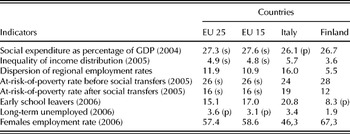
2 strong subsidiarity: the family is the main actor in responding to social needs, supported by third sector and voluntary organisations (see Table 1, ‘female employment rate’);
3 strong gender division of labour: women have comparatively low labour market participation rates and heavy care responsibilities;
4 high territorial heterogeneity of welfare policies;
5 high fragmentation in the sector of social policies relating to specific social needs (e.g. the disabled, families with three children).
Thus, the state plays a secondary role, intervening only when the family and third sector's responses to social needs are no longer sufficient. The family is the crucial actor and the interrelated reciprocity networks are the main regulative principle.
Table 1 reflects differences in cultural, economic and the social regulatory models. Expenses for social protection as a percentage of GDP are slightly below the EU 15 average. In 2003, however, Italy spent more than 63% of its social protection expenses on pensions; Finland only 35%. Moreover, in Finland the gap between rich and poor is very much less significant than in Italy (see Table 1, ‘inequality of income distribution’ and ‘dispersion of regional employment rates’). With regard to the Gini index, Finland is third after Denmark and Sweden in the EU classification, while Italy is at the bottom of European countries.
Comparative welfare data: Finland and Italy

Data on ‘income distribution’, such as those on ‘at risk of poverty after social transfers’, highlights the different role of welfare policies in the two countries. Data on early school-leavers and on long-term unemployment requires a more in-depth analysis of integrated services from an activation policy perspective (see below).
The differences in welfare polices in Finland and Italy have influenced the welfare reform process. In addition, both have experienced territorial reorganisation of their welfare services over the last 20 years. The main elements in the rescaling process in Finland and in Italy are discussed since rescaling dynamics are strongly affecting the process of building integrated services in activation policies.
The territorial reorganisation of welfare services in Italy and Finland
A widespread process is taking place across EU member states concerning employment and social policies, which might be defined as the unfolding of an implicit and explicit rescaling dynamic. Implicit rescaling refers to reforms in policy contents, aims and objectives. Increasing attention to activation policies, such as the focus on fostering job insertion instead of just supplying social assistance benefits, is a good example of implicit rescaling. On the other hand, the explicit rescaling process regards the change in institutional actors dealing with specific policies. Employment and social policies represent an emblematic example since both have been subjected to institutional reform processes in all EU member states aimed at improving the role of local authorities (Kazepov and Genova Reference Kazepov and Genova2006; Kazepov et al., Reference Kazepov, Carbone, Genova and Cimarelli2007).
In the EU, employment services used to be central state services not specifically related to local social institutions. The welfare reform process during the 1980s and 1990s promoted radical changes in institutional responsibility in dealing with unemployment problems. Public employment services were significantly restructured in favour of a more local organisation on the basis of the subsidiary principle, which implies that matters ought to be handled by the smallest or lowest competent authority (Kazepov, Reference Kazepov2008). Local authorities were, therefore, considered better suited to dealing with local unemployment and social problems despite the national or EU general unemployment trend. Social services have also been involved in the territorial reorganisation of services. This is a common EU reform path that has been shaped differently at national and regional levels, as may be seen when comparing the rescaling process in Italy and Finland.
In Finland, in 1985, social services were organised at the local level according to an explicit dynamic of localising social services. In Helsinki, for example, there were seven area-based organisation services, which offered social services through an integrated approach. The aim of the reform was to offer more personalised services, providing a single social service for all individual needs. Different social services were, therefore, unified into single local social service offices. The focus on local services improved the relationship between public services and the local community in terms of local associations and NGOs. In the Finnish welfare regime, social services are mainly managed by public authorities. The area-based organisation system, however, had the merit of improving reciprocal interaction between public and local community services. At that point the Finnish welfare system reached a significant level of integration between different social services areas and between public social services and local voluntary organisations. Analysing the welfare reform process through the lens of integrated services was thus a crucial point in the history of Finnish welfare systems. Despite the aim to improve service quality via an integrated approach, however, the decentralised area-based organisation was strongly criticised because of the territorial inequality of services and high administrative costs.
Citizens’ demand for equal services in all local districts had a strong political influence. Therefore, despite the fact that the system was still working well and only a few minor reforms were necessary to improve it, the local management of social services was put in question, and a new centralising process was put on the agenda at the end of the 1990s. In 2002, the critical Finnish economic situation drove the need for reforms in the social services. A large part of Helsinki's tax funds were used to overcome state financial problems and therefore it was necessary to review the costs of the social services organisation.
In 2005, the social services organisation was overturned, the area-based organisation being replaced with a ‘life course’ approach. The life course organisation of social services was planned and implemented across the entire city of Helsinki and, even though there were different service points, they were not area-based and there was a central bureaucratic structure. Social services were created according to four main social life conditions: childhood, youth, adulthood and old age. The child day-care service, because of its large-scale organisation, has not been significantly affected by social services reorganisation. At present welfare policies are managed by four different departments: child day-care, children and families, adulthood and the elderly. After 20 years (1985–2004), the social services organisation moved towards a more centralised system, challenging the relationships between public institutions and civil society organisations. The main actor in social services reform is the state, characterised by fairly consistent political coalitions, defining managerial modes of governance in which the main institutional levels have been national and municipalFootnote 2 (Genova, Reference Genova2006). The new social services organisation paved the way to new integrated services in activation policies (see below).
In Italy, the first national framework law on the ‘integrated system of social services and interventions’ (National Law No. 328) was passed by parliament in 2000, overcoming the legislative vacuum that had characterised the social services area. The impact of the reform was challenged and in part frustrated by the 2001 constitutional reform (Reform of Title V of the Constitution) that gave legislative power on social policies to the regions. According to the new institutional framework, the state is in charge of setting the minimum standard of services with regard to civil and social rights. The issue, however, is extremely controversial because of the high heterogeneity in social polices in the 20 Italian regions and in 2007 a national minimum standard is still lacking. Thus, most of the principles presented in the national framework law still have to be implemented and although it has been argued that the 2000 framework law represents a point of reference in social services at the local level, the new institutional set-up has increased responsibilities at local level and has opened the way to consolidating the fragmented and unequal Italian welfare system.
Regions and municipalities are mainly responsible for social services and are in charge of planning and managing services. Small municipalities have been unified in a new institutional framework, called Ambiti Territoriali, and a new role has been instituted: the area coordinator, responsible for managing the communication process between the different actors involved in the social services organisation. The main aim of territorial reorganisation was to promote a more efficient management of resources through the institution of a participatory decision-making process, involving not only different political governmental players from the different municipalities but also the other main actors in welfare services at a local level: third sectors, voluntary organisations representing different forms of social needs (such as Caritas, or the voluntary organisation of the family or of disabled people). Different working groups of civil society representatives at a local level and area consultants have been institutionalised in each area. In Italy, therefore, the modes of governance emerging in social policies are mainly characterised by participative dimensions that have, however, produced different results according to local institutional milieus. Managerial-participative modes of governance (DiGaetano and Strom, Reference DiGaetano and Strom2003) are taking place in some Northern regions, while there are more corporatist experiences in the centre and clientelistic in the South (Genova, Reference Genova2006).
Furthermore, the Italian administrative organisation has been characterised by four main different levels of institutional regulative powers: state, regions, provinces and municipalities. Regions and municipalities are the main actors in social policies, while provinces play a marginal role, although they play a crucial role in employment policies and services. Therefore, the fragmentation of the decision-making chain with regard to activation policies, such as joint social and labour services projects, is affecting the coordination of services, leading to a less readily integrated system.
Integrated services in activation policies: challenges and opportunities in Finland and Italy
The relationship between social and labour policies has been one of the main elements in the process of welfare policies reform with regard to activation policies in EU countries. This section discusses activation policies and the integration of services in Finland and Italy, highlighting the main challenges and opportunities in the implementation process.
In Finland, activation of the unemployed has been part of welfare policy since the 1980s, through a range of services such as employment, adult education, work experience, hands-on training or rehabilitative measures organised by unemployment offices, apprenticeship training or training for the long-term unemployed. Moreover, activation has been implicitly part of social assistance services. Day-care for all pre-school aged children is a good example of this, stressing the importance of promoting the labour participation of single parents and women.
However, because of the very low unemployment rate, there was not any specific need for activation until the 1990s, when activation came into fashion at a time of economic recession. The unemployment rate increased from 3% to 19% and the number of people receiving social assistance doubled, from 6% in 1990 to 12% in 1996. In 1996, people in a state of need who refused job offers or activation measures had their benefits cut by 20%. The Social Assistant Act of 1997 introduced activation plans for social welfare clients to be drawn up jointly by the social welfare and employment authorities. In 1998, unemployment offices were charged with drawing up a job-search plan for each of their clients, and following the implementation of the plan, meeting them periodically. Moreover, activation measures became a crucial aspect in social policies in the 2001 Act on Rehabilitative Work Experience, which again focused on the cooperation between labour and social affairs administrations (Keskitalo and Mannila, Reference Keskitalo, Mannila, Heikkila and Kautto2004).
However, the implementation of tailor-made plans was problematic because of the contrasting attitudes in the employment and social welfare services. Recent research stresses the contrasting behaviour of the two authorities. On the one hand, the social welfare officer aims to help people to regain and maintain control over their lives, while, on the other, labour authority services aim to employ people in a state of need on the open market (Heikkila and Keskitalo, Reference Heikkila and Keskitalo2001).
In the Finnish welfare system, work represents the primary instrument for overcoming economic and social disadvantages, and a new integrated service was organised in 2002 in order to help people in a state of severe need to enter the labour market. Eighteen joint pilot service projects were launched in the largest Finnish cities in order to promote integration between the labour administration, the social affairs administration and the Social Insurance Institutions. The joint service (Duuri)Footnote 3 is the local centre for rehabilitative work for people with a history of long-term unemployment, young people, or people with drug addiction or mental health problems. More than an organisation, Duuri is a network, characterised by multiple professional figures, and has to be considered one of the most advanced experiences of integrated services in the EU. It relies on institutional integration between the public employment office and the City of Helsinki, aiming to promote employment in the city and representing a good example of managerial integration. Duuri represents the local services, dealing with structural unemployment problems by strengthening the ability to work and the skills of the unemployed, facilitating job opportunities, preventing and diminishing social exclusion and reducing the need for long-term living allowances. In 2005, Duuri in Helsinki saw 3,000 clients and involved 100 professional figures from different sectors: social workers, employment officers, social pedagogues, nurses and psychologists. Psychologists are employed by the Employment Office and are in charge of sustaining the mental health of the client, assessing and planning vocational rehabilitation and providing vocational guidance. Nurses, employed by the Health Centre of the City of Helsinki are responsible for offering health services to the clients, such as an assessment of their ability to work, the early diagnosis of illnesses, sustaining self-help concerning health and promoting public health care. Social pedagogues, from the Social Services Department of the City of Helsinki, offer concrete help to clients and supervise them in their daily lives if necessary. In so doing, Duuri has reached high levels of professional integration that have been pursued by constant attention to training experiences, involving all the professions called upon to contribute to the service.
In Italy, the main reform promoting active labour policies was introduced in 1996 by Prime Minister Prodi, with the agreement of the five main trade unions. The reform opened the Italian labour market for the first time to atypical forms of work and, in order to increase the number of people benefiting from active measures, significantly reformed public employment service (PES) in line with the EES (European Employment Strategy) guidelines (Decree 469 of 1997).
Italian labour policies up to the end of the 1990s were characterised by the scant attention paid to the institution of a safety net. This was due to the fact that the great majority of the population were covered by contributory schemes, i.e. families were protected through the position on the labour market of the (male) breadwinner, while assistance to particular categories of need (e.g. homeless, the poor who accumulate several state of need) was still seen as charity and thus a prerogative of voluntary, mainly Catholic associations.
Labour policies and income support schemes have developed in an independent, irrational and uncoordinated way. Moreover, changes in labour market policies over the last 15 years have significantly affected the redistributive power within the family, and consequently social assistance reform has become a vital necessity.
Since 1977, policies targeted at people in a state of economic and social need had been the responsibility of the regional and local authorities. The lack of a framework law at a national level left regions and municipalities in a legislative vacuum for more than 20 years, the negative consequences of which have deeply embedded the consolidation of institutional inequality in Italy.
In Italy the increasing rhetoric on integration has become an explicit part of welfare discussion ever since the 328/2000 national framework law. However, the innovative aspects introduced by the law have yet to be institutionalised and implemented at regional and local levels. There has been greater attention given to the integration of services in Regional Social Plans, even though only modest operative guidelines have been provided. Some examples of integration between services have concerned disabled people, with agreements between health and labour services. The institutionalisation of integrated policies between social and labour services, however, merely remains part of the rhetoric at the national level, with sporadic examples at the regional or municipal levels.
In Rome, for example, local social services have been involved in some job insertion projects, promoted by Caritas and by other third sector actors, targeted at specific groups such as ex-prisoners or prostitutes. In some more consolidated local welfare systems, such as in Tuscany, there are interaction experiences but no integration of services with the coordination of actions and follow-ups. Despite the rhetoric on activation and integration policies in most of the regions, there is an evident divide between social and labour policies. Data on ‘long-term unemployed’ and on ‘early school-leavers’ (Table 1) in a comparative EU perspective confirm the absence of adequate integrated policies from an activation perspective. Integration between social and labour services is still too distant to promote efficient activation policies.
In recent years, the experimental phase of the Minimum Insertion Income (RMI) provided a positive first approach in the move towards process-building integration. However, the election of the Berlusconi government put an end to this process. The recent attention of the Prodi government towards such measures might represent new opportunities for promoting management and professional integration between social and labour sectors in Italy.
Moreover, the different types of actors involved in social policies are a structural obstacle towards the integration of services. Public social workers coordinated at a municipal level, labour services officers at a provincial level, third sector organisations, voluntary groups, regional social policy planners and private sector actors all contribute significantly to Italian welfare systems. Dealing with institutional, management and professional integration appears to be a very complex and challenging process.
The institutionalisation of a participatory mode of governance in social services planning has been promoted by the national framework law and might represent the main resource in integration process building. It might be assumed that different modes of governance at a local level imply different forms of integration between social and labour services. This is, however, just a hypothesis that calls for more in-depth analysis in years to come.
Comparing the implementation of integrated services in Finland and in Italy, the following remarks can be made in relation to the three integration levels.
Firstly, institutional integration has been successfully achieved in Finland thanks to two elements:
(a) constant dialogue, since the 1990s, between social and labour services and between different institutional levels (state and municipal) generated by the effort to update the universal welfare services in the face of new social needs (from area-based organisation to life course services);
(b) the types of actors involved in welfare policies are mainly public and operate at two main administrative levels – municipal and state – providing a multilevel governance that is less fragmented than the Italian one.
On the other hand, institutional integration in Italy has faced two main obstacles:
(a) the reform process (LN328/2000 and the Constitutional reform 2001) (Kazepov, Reference Kazepov2008), which outlined multilevel administrative management instead of the previous hierarchical structure, makes the process of institutional integration more complicated because of an insufficient national framework and the presences of local clientelistic political interests. Moreover, this has institutionalised the gap between social services planned at the regional level and managed at the municipal level, as well as labour services managed at the provincial level;
(b) territorial heterogeneity, such as the diverse actors involved (the family, third sector organisations, the state) has increased the complexity in integration process-building.
Secondly, management integration has been the evident outcome of the universalist logic in the Finnish welfare systems. In addition, it has been supported by a consolidated management culture in social services oriented towards coordination between different services. In the fragmented Italian welfare systems, this still constitutes an objective yet to be pursued. Italian social services are characterised by a structural weakness in management and coordination dimensions, due to the dominance of an ‘emergency logic’ in offering social services: the state is called to intervene only when family and third sector resources are insufficient to respond to social needs. Therefore, in Italy the state is considered as the last and the least structured resource.
Thirdly, professional integration has been at the heart of social service reform in Finland since 1985 and the reform process has always been fostered by central government. In Italy, recent reforms in labour and social services seem to have focused on radically restructuring the organisation of the two services, but less attention has been paid to establishing a dialogue between the professions involved in the services. Moreover, in Italy there is not adequate attention paid to training experiences to promote such a level of integration.
Conclusions: Building integration in different institutional contexts, the role of local institutions
How have integrated services in activation been implemented in Finland and Italy? Finland has organised its integrated services in order to implement activation policies with specific focus on the most vulnerable members of society (such as the long-term unemployed, people with drug addiction problems). In most Italian regions, although there have been sporadic and targeted experiences of integration between social and labour polices, a structural integration plan is still missing. Fragmentation of Italian welfare policies persists in contrast to the universal and ‘all-encompassing’ principle of the Finnish welfare system. Within the universalist logic, the shift towards new integrated services has been systematically pursued and achieved, because of the welfare logic common to different welfare policies. Integrated services objectives within the fragmented southern European welfare regime seem to be too distant because of the different logics adopted within each of the welfare policies areas.
Our study suggests the following final remarks. Despite the EU common reform path, in line with the neo-liberal trend towards activation policies, the implementation of services integration in activation policies has been very heterogeneous, depending largely on the local institutional context and the related modes of governance emerging in the course of the reform process over the last 20 years. Different contexts have filtered similar processes in different ways. In Finland there has been a radical ‘activation’ of services and reform processes that brought about the Duuri in order to offer more integrated and activating services. In Italy, there has been increasing attention to discourses about integrating services, but there has been an evident difficulty in defining its operative instruments.
A strong path-dependent dimension has emerged in the implementation of integrated services. For about 15 years, Finland has faced and dealt with the issues of improving the relationship between two different (social and labour) welfare organisation cultures in order to offer a joint service. The neo-liberalist rhetoric has promoted a more evident workfare approach and the related use of sanctions for clients who do not follow the rehabilitative plan offered (1998 Social Assistance Act). Despite the neo-liberalist attitude in recent Finnish welfare discourses, the restructuring process mainly meant preserving the system in order to overcome the period of financial crisis (Timonen, Reference Timonen2003: 7) without radically changing Finland's main social democratic features, confirming the ‘stickiness’ of its reputation in the welfare regime scenario (Cox, Reference Cox2004). Integrated services, therefore, constituted the logical answer of the universalistic welfare regime.
On the other hand, the fragmented Italian welfare services have been characterised by the structural weakness of public social services, predominantly substituted and supported by voluntary, third sector and private organisations. Social interventions have been very heterogeneous and, moreover, a dramatic lack of public coordination has occurred. The integration of services has recently become part of the rhetoric, but there is still a lack of institutional instruments making integration effective.
The path-dependency framework is a crucial starting point of analysis because the local institutional milieus are not easily and radically renewed even though new policy windows are periodically opened in order to develop the welfare reform process. Although the integration of services is part of the rhetoric of neo-liberal discourse in EU countries, and despite the fact that attention to the theme is on the rise in all national welfare discourses, organising efficient integrated welfare services requires many aspects that cannot be imposed or constructed quickly. In Finland the managerial mode of governance has brought about efficient integrated services for the most vulnerable; in Italy the participative mode of governance might provide the positive preconditions for fostering or promoting social and labour integration in the near future.
Acknowledgements
I would like to thank Yuri Kazepov for his comments and all the Finnish interviewees who contributed to the research, especially Aulikki Kananoja (former Director of social services in the City of Helsinki) and Sari Toiviainen (Manager of Duuri in Helsinki). The anonymous reviewers helped to focus the contribution, forcing me to clarify some key conceptual issues. The usual disclaimers apply.