






Introduction
Our aim in this introduction is twofold. Firstly, we recall a few facts surrounding the classical Ihara–Matsumoto–Oda Conjecture, which is now a theorem of Pop [Reference PopPop19]. These facts will be of no use in the main body of the paper, but help put our results into perspective. Secondly, we present a rough form of our main results.
Around the classical Ihara–Matsumoto–Oda conjecture
Let k be a field and fix a separable closure
$\overline {k}/k$
 of k. Given a geometrically connected k-variety X and a geometric point
$\overline {x} \to X$
 over
$\overline {k}$
 , one has the well-known short exact sequence of profinite groups

where
$\mathcal {G}(\overline {k}/k)$
 is the Galois group of k,
$\pi ^{\,\acute {\mathrm {e}}\mathrm {t}}_1(X,\overline {x})$
 is the étale fundamental group of X and
$\overline {\pi }{}^{\,\acute {\mathrm {e}}\mathrm {t}}_1(X,\overline {x})= \pi _1^{\,\acute {\mathrm {e}}\mathrm {t}}(X\otimes _k \overline {k},\overline {x})$
 is the étale fundamental group of
$X\otimes _k\overline {k}$
 ; see [SGA1, Exposé IX, Théorème 6.1]. This short exact sequence defines an action of
$\mathcal {G}(\overline {k}/k)$
 on
$\overline {\pi }{}_1^{\,\acute {\mathrm {e}}\mathrm {t}}(X,\overline {x})$
 by outer automorphisms, that is, a morphism of groups

In fact, the morphisms
$\widetilde {\rho }_X$
 are compatible with morphisms of k-varieties. To phrase this compatibility precisely, we introduce the category
$\widetilde {\mathrm {Grp}}_{\mathrm {pf}}$
 of profinite groups up to inner automorphisms. It is obtained from the category
$\mathrm {Grp}_{\mathrm {pf}}$
 of profinite groups by identifying the arrows that differ by inner automorphisms. Explicitly, if H and G are profinite groups, then

where G is acting by conjugation on the set of continuous morphisms from H to G. Using this category, the aforementioned compatibility can be summarised as follows.
-
(i) As an object of $\widetilde {\mathrm {Grp}}_{\mathrm {pf}}$
 , the profinite group
$\overline {\pi }{}^{\,\acute {\mathrm {e}}\mathrm {t}}_1(X,\overline {x})$
is independent of the choice of
$\overline {x}$
up to a canonical isomorphism, and we may denote it simply by
$\overline {\pi }{}^{\,\acute {\mathrm {e}}\mathrm {t}}_1(X)$
.
-
(ii) Let $\mathrm {Sch}^{\prime }_k \subset \mathrm {Sch}_k$
be the subcategory of geometrically connected k-varieties. The assignment
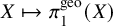
$X\mapsto \overline {\pi }{}_1^{\,\acute {\mathrm {e}}\mathrm {t}}(X)$
extends naturally to a functor(3) $$ \begin{align} \overline{\pi}{}^{\,\acute{\mathrm{e}}\mathrm{t}}_1: \mathrm{Sch}^{\prime}_k\to \widetilde{\mathrm{Grp}}_{\mathrm{pf}}. \end{align} $$
-
(iii) The group $\mathcal {G}(\overline {k}/k)$
acts on the functor
$\overline {\pi }{}^{\,\acute {\mathrm {e}}\mathrm {t}}_1$
by invertible natural transformations; this action is given on
$X\in \mathrm {Sch}^{\prime }_k$
by the morphism
$\widetilde {\rho }_X$
.


In particular, we obtain a morphism of groups

More generally, given any subcategory
$\mathcal {V}\subset \mathrm {Sch}^{\prime }_k$
 , we obtain a morphism of groups

We have the following remarkable theorem of Pop; see [Reference PopPop19, Theorem 2.7].
Theorem 1 (Pop)
Assume that k has characteristic zero and let
$\mathcal {V}={\mathrm {Sm}}^{\prime }_k$
 be the subcategory of smooth k-varieties in
$\mathrm {Sch}^{\prime }_k$
 . Then,
$\widetilde {\rho }_{\mathcal {V}}$
 is an isomorphism.
Remark 2. In the 80s, Ihara asked whether the morphism
$\widetilde {\rho }$
 , or some closely related variant, was an isomorphism for
$k=\mathbb {Q}$
 and, in the 90s, Matsumoto and Oda conjectured that this was indeed the case. In an unpublished manuscript, Pop gave a positive answer to Ihara’s question. Soon after, he developed a new approach for proving much finer versions of the Ihara–Matsumoto–Oda Conjecture; the new approach was finally published in [Reference PopPop19]. Further refinements were obtained later by Topaz [Reference TopazTop18] and Silberstein [Reference SilbersteinSil13]. In the present paper, we will not be concerned with these finer versions. However, for the interested reader, we mention a few milestones.
-
○ By [Reference PopPop19, Theorem 2.7], Theorem 1 holds true in positive characteristic if the étale fundamental groups $\overline {\pi }{}^{\,\acute {\mathrm {e}}\mathrm {t}}_1(X)$
are replaced by their tame quotients. -
○ A version of Theorem 1 holds true if the étale fundamental groups $\overline {\pi }{}^{\,\acute {\mathrm {e}}\mathrm {t}}_1(X)$
are replaced by their maximal pro-
$\ell $
abelian-by-central quotients and
${\mathrm {Sm}}^{\prime }_k$
by much smaller subcategories. See [Reference PopPop19, Theorem 2.6] for a precise statement. -
○ A version of [Reference PopPop19, Theorem 2.6] holds true for the maximal mod- $\ell $
abelian-by-central quotients of the
$\overline {\pi }{}^{\,\acute {\mathrm {e}}\mathrm {t}}_1(X)$
’s. See [Reference TopazTop18, Theorems A & B] for precise statements. -
○ According to [Reference SilbersteinSil13, Theorem 3], there are geometrically integral algebraic surfaces X defined over $\mathbb {Q}$
such that$$ \begin{align*}\widetilde{\rho}_{\eta_X}:\mathcal{G}(\overline{\mathbb{Q}}/\mathbb{Q})\to \mathrm{Out}(\overline{\pi}{}^{\,\acute{\mathrm{e}}\mathrm{t}}_1(\eta_X))\end{align*} $$is already an isomorphism. (Here, $\eta _X$
is the generic point of X.) A version for the maximal pro-
$\ell $
abelian-by-central quotient of
$\overline {\pi }{}^{\,\acute {\mathrm {e}}\mathrm {t}}_1(\eta _X)$
is obtained in [Reference PopPop18, Theorem 1.3].
-
○ Finally, a p-adic analytic version of Theorem 1 was proven by André based on Pop’s solution of the Ihara–Matsumoto–Oda Conjecture; see [Reference AndréAnd03, Theorem 9.2.2].


In this paper, we will prove a motivic analogue of a variant of Theorem 1. In order to explain what this variant is about, we need a digression.
Given a noetherian scheme X, we denote by
$\Pi ^{\acute {\mathrm {e}}\mathrm {t}}(X)$
 the étale fundamental groupoid of X. Recall that
$\Pi ^{\acute {\mathrm {e}}\mathrm {t}}(X)$
 is a groupoid enriched in profinite sets. The objects of
$\Pi ^{\acute {\mathrm {e}}\mathrm {t}}(X)$
 are the geometric points of X. The set of arrows between geometric points
$\overline {x}_0\to X$
 and
$\overline {x}_1\to X$
 is the profinite set
$\pi _1^{\,\acute {\mathrm {e}}\mathrm {t}}(X,\overline {x}_0,\overline {x}_1)$
 of paths from
$\overline {x}_0$
 to
$\overline {x}_1$
 , that is, of invertible natural transformations between the associated fibre functors on locally constant étale sheaves of finite sets on X. For more details, see [SGA1, Exposé V, §5 & §7]. The fundamental groupoid has better functorial properties than the fundamental group. Indeed, let
$\mathrm {Grpd}_{\mathrm {pf}}$
 be the strict
$2$
 -category of groupoids enriched in profinite sets. Then, there is a strict
$2$
 -functor

sending a k-variety X to the fundamental groupoid
$\overline {\Pi }{}^{\acute {\mathrm {e}}\mathrm {t}}(X)=\Pi ^{\acute {\mathrm {e}}\mathrm {t}}(X\otimes _k \overline {k})$
 of its base change to
$\overline {k}$
 . This
$2$
 -functor lifts and extends the functor
$\overline {\pi }{}^{\,\acute {\mathrm {e}}\mathrm {t}}_1$
 in (3). More precisely, the following holds.
-
(i) Let $\mathrm {Grpd}_{\mathrm {pf}}^0$
be the full sub-
$2$
-category of
$\mathrm {Grpd}_{\mathrm {pf}}$
whose objects are the connected groupoids. Then, there is an obvious functor$$ \begin{align*}\mathrm{Grpd}_{\mathrm{pf}}^0 \to \widetilde{\mathrm{Grp}}_{\mathrm{pf}}\end{align*} $$exhibiting $\widetilde {\mathrm {Grp}}_{\mathrm {pf}}$
as the
$1$
-categorical truncation of
$\mathrm {Grpd}_{\mathrm {pf}}^0$
.
-
(ii) There is a commutative triangle


There is also an action of the Galois group
$\mathcal {G}(\overline {k}/k)$
 on the
$2$
 -functor
$\overline {\Pi }{}^{\acute {\mathrm {e}}\mathrm {t}}$
 , lifting and extending the action
$\widetilde {\rho }$
 in (4). Before introducing this action, we explain what an automorphism of the
$2$
 -functor
$\overline {\Pi }{}^{\acute {\mathrm {e}}\mathrm {t}}$
 amounts to.
Description 3. We denote by
$\mathrm {Aut}(\overline {\Pi }{}^{\acute {\mathrm {e}}\mathrm {t}})$
 the monoidal category of automorphisms of the strict
$2$
 -functor
$\overline {\Pi }{}^{\acute {\mathrm {e}}\mathrm {t}}$
 . An object of this category consists of a pair of families
$((\xi _X)_{X}, (\alpha _f)_f)$
 , where:
-
○ for an object X in $\mathrm {Sch}_k$
,
$\xi _X$
is an equivalence of the groupoid
$\overline {\Pi }{}^{\acute {\mathrm {e}}\mathrm {t}}(X)$
acting continuously on the profinite sets of paths, -
○ for a morphism $f:Y \to X$
in
$\mathrm {Sch}_k$
,
$\alpha _f$
is a natural transformation$$ \begin{align*}\alpha_f:\xi_X\circ \overline{\Pi}{}^{\acute{\mathrm{e}}\mathrm{t}}(f) \to \overline{\Pi}{}^{\acute{\mathrm{e}}\mathrm{t}}(f) \circ \xi_Y\end{align*} $$which is necessarily invertible.


The
$\alpha _f$
 ’s are required to be compatible with composition in the obvious way: if
$f:Y\to X$
 and
$g:Z \to Y$
 are two composable morphisms in
$\mathrm {Sch}_k$
 , the following diagram commutes

An arrow
$\epsilon :((\xi _X)_{X}, (\alpha _f)_f) \to ((\xi ^{\prime }_X)_{X}, (\alpha ^{\prime }_f)_f)$
 in
$\mathrm {Aut}(\overline {\Pi }{}^{\acute {\mathrm {e}}\mathrm {t}})$
 is a family of natural transformations
$(\epsilon _X:\xi _X \to \xi ^{\prime }_X)_X$
 such that, for every
$f:Y\to X$
 , the following square commutes

The monoidal structure on
$\mathrm {Aut}(\overline {\Pi }{}^{\acute {\mathrm {e}}\mathrm {t}})$
 is given by composing functors and natural transformations:

Clearly, every object of
$\mathrm {Aut}(\overline {\Pi }{}^{\acute {\mathrm {e}}\mathrm {t}})$
 is left and right invertible for this tensor product. Thus,
$\mathrm {Aut}(\overline {\Pi }{}^{\acute {\mathrm {e}}\mathrm {t}})$
 is a (possibly noncommutative) Picard groupoid.
There is a morphism of Picard groupoids

defining an action of
$\mathcal {G}(\overline {k}/k)$
 on the
$2$
 -functor
$\overline {\Pi }{}^{\acute {\mathrm {e}}\mathrm {t}}$
 . It sends an element
$\sigma \in \mathcal {G}(\overline {k}/k)$
 to the pair
$((\xi _X)_X,(\alpha _f)_f)$
 such that:
-
○ for X in $\mathrm {Sch}_k$
,
$\xi _X$
is the autoequivalence of
$\Pi ^{\acute {\mathrm {e}}\mathrm {t}}(X\otimes _k\overline {k})$
induced by the automorphism
$\mathrm {id}_X\otimes \mathrm {Spec}(\sigma ^{-1})$
of the scheme
$X\otimes _k \overline {k}$
, -
○ for $f:Y\to X$
in
$\mathrm {Sch}_k$
,
$\alpha _f$
is the identity natural transformation obtained by applying the strict
$2$
-functor
$\Pi ^{\acute {\mathrm {e}}\mathrm {t}}$
to the equality$$ \begin{align*}(f\times \mathrm{id}_{\mathrm{Spec}(\overline{k})}) \circ (\mathrm{id}_Y\times \mathrm{Spec}(\sigma^{-1}))= (\mathrm{id}_X\times \mathrm{Spec}(\sigma^{-1}))\circ (f\times \mathrm{id}_{\mathrm{Spec}(\overline{k})}).\end{align*} $$


We have the following natural variant of the Ihara–Matsumoto–Oda question.
Question 4. Is the functor
$\rho $
 in (7), or some closely related variant, an equivalence?
Remark 5. The truncation functor
$\mathrm {Grpd}_{\mathrm {pf}}^{\circ } \to \widetilde {\mathrm {Grp}}_{\mathrm {pf}}$
 induces a morphism of Picard groupoids

for any subcategory
$\mathcal {V}\subset \mathrm {Sch}^{\prime }_k$
 , and it is easy to check that the triangle

is commutative. Unfortunately, this morphism of Picard groupoids is not a priori essentially surjective on objects: given a compatible family of outer automorphisms of the
$\overline {\pi }{}^{\,\acute {\mathrm {e}}\mathrm {t}}_1(X)$
 ’s, for
$X\in \mathcal {V}$
 , it is not at all clear how to lift this family to an object of the Picard groupoid
$\mathrm {Aut}(\overline {\Pi }{}^{\acute {\mathrm {e}}\mathrm {t}}|_{\mathcal {V}})$
 . Thus, a positive answer to Question 4 does not formally imply the original Ihara–Matsumoto–Oda Conjecture.
Before we start discussing our main results in the motivic setting, we need to move a small step further from the original Ihara–Matsumoto–Oda Conjecture. In fact, this extra step is merely cosmetic; it is based on the following observation.
Observation 6. The fundamental groupoid
$\Pi ^{\acute {\mathrm {e}}\mathrm {t}}(X)$
 of a noetherian scheme X carries exactly the same information as the multi-Galois category
$\mathcal {E}(X)$
 of locally constant étale sheaves of finite sets on X. Indeed,
$\mathcal {E}(X)$
 is equivalent to the category of covariant functors from
$\Pi ^{\acute {\mathrm {e}}\mathrm {t}}(X)$
 to the category
$\mathrm {Set}_{\mathrm {fin}}$
 of finite sets (respecting the enrichment in profinite sets on
$\Pi ^{\acute {\mathrm {e}}\mathrm {t}}(X)$
 ) and, conversely,
$\Pi ^{\acute {\mathrm {e}}\mathrm {t}}(X)$
 is equivalent to the groupoid of fibre functors on
$\mathcal {E}(X)$
 . In fact, there is a fully faithful
$2$
 -functor
$\mathrm {Fun}(-,\mathrm {Set}_{\mathrm {fin}})$
 from
$(\mathrm {Grpd}_{\mathrm {pf}})^{{\mathrm {op}}}$
 to the
$2$
 -category of categories and exact functors. (See [SGA1, Exposé V, §6, Proposition 6.1].)
Thus, instead of considering the
$2$
 -functor
$\overline {\Pi }{}^{\acute {\mathrm {e}}\mathrm {t}}$
 in (6), one could consider the
$2$
 -functor

sending a k-variety X to the category
$\overline {\mathcal {E}}(X)=\mathcal {E}(X\otimes _k \overline {k})$
 . It follows immediately from the above observation that we have a canonical equivalence of Picard groupoids

and hence also a morphism of Picard groupoids

The latter can be described as follows: it sends an element
$\sigma \in \mathcal {G}(\overline {k}/k)$
 to the family of pullback functors
$((\mathrm {id}_X \times \mathrm {Spec}(\sigma ))^*)_{X}$
 . Question 4 is equivalent to the following.
Question 7. Is the functor
$\rho $
 in (10), or some closely related variant, an equivalence?
It is precisely Question 7 that we will generalise and answer in this paper. In fact, this formulation of Question 4 immediately suggests many variants where the categories of locally constant étale sheaves of finite sets are replaced by similar ones such as:
-
○ the entire étale topoi;
-
○ categories of étale local systems with coefficients in a finite ring;
-
○ categories of étale sheaves with coefficients in a finite ring.
At this stage, we may state a precise theorem about the
$2$
 -functors

sending a k-variety X to the categories
$\overline {\mathcal {E}}(X;\Lambda )$
 and
$\overline {\mathcal {F}}(X;\Lambda )$
 of étale local systems and étale sheaves on
$X\otimes _k \overline {k}$
 with coefficients in a finite ring
$\Lambda $
 . Below, we write “
$\mathrm {Aut}^{\otimes }_{\Lambda }$
 ” for the Picard groupoid of symmetric monoidal
$\Lambda $
 -linear natural equivalences.
Theorem 8. Assume that k has characteristic zero and that
$\Lambda $
 is connected. Then, the natural functors of Picard groupoids

are equivalences.
Remark 9. Theorem 8 will be obtained as a consequence of our motivic Theorems 2.2.3 and 4.4.2 combined with rigidity for torsion étale motives. See Corollaries 2.2.8 and 4.4.16 (and Remark 4.4.17). We also expect that there is a direct proof which is entirely parallel to the proofs of our motivic theorems; see Remark 2.2.9. Such a direct proof should also work for the
$2$
 -functor
$\overline {\mathcal {F}}:(\mathrm {Sch}_k)^{\mathrm {op}}\to \mathrm {CAT}$
 sending a k-variety X to the étale topos of
$X\otimes _k \overline {k}$
 .
Description of the main results
We fix a field k endowed with a complex embedding
$\sigma :k\hookrightarrow \mathbb {C}$
 . In this paper, we are mainly concerned with variants of Questions 4 and 7 where the Galois group
$\mathcal {G}(\overline {k}/k)$
 is replaced by the motivic Galois group
$\mathcal {G}_{\mathrm {mot}}(k,\sigma )$
 .
In the remainder of the introduction, we treat
$\mathcal {G}_{\mathrm {mot}}(k,\sigma )$
 as an affine group scheme defined over
$\mathbb {Q}$
 for the sake of simplicity. (In the main body of the paper,
$\mathcal {G}_{\mathrm {mot}}(k,\sigma )$
 will be considered also over deeper bases, such as the sphere spectrum, and, more importantly, we shall keep track of its natural derived structure, although the said structure is conjectured to be trivial.) The short exact sequence (1) admits a motivic version, at least generically and up to a caveat. Indeed, let
$K/k$
 be a finitely generated extension in which k is algebraically closed, and let
$\Sigma :K\hookrightarrow \mathbb {C}$
 be a complex embedding extending
$\sigma $
 . Let U be the pro-k-variety of open neighbourhoods of the generic point of a smooth model of K, and let
$U^{\mathrm {an}}$
 be the associated analytic pro-variety. Note that
$\Sigma $
 determines a compatible system of base points in
$U^{\mathrm {an}}$
 . By [Reference AyoubAyo14c, Théorèmes 2.34 & 2.57], we have the following exact sequence of affine group schemes over
$\mathbb {Q}$
 :

where
$\pi ^{\mathrm {alg}}_1(U^{\mathrm {an}},\Sigma )$
 is the pro-algebraic completion of the pro-discrete topological fundamental group of the analytic pro-variety U. The caveat here is that this sequence is not exact on the left (unless the extension
$K/k$
 is trivial). Nevertheless, we obtain a short exact sequence

if we define
$\pi ^{\mathrm {geo}}_1(U,\Sigma )$
 to be the image of the morphism
$\pi ^{\mathrm {alg}}_1(U^{\mathrm {an}},\Sigma ) \to \mathcal {G}_{\mathrm {mot}}(K,\Sigma )$
 . This yields an action of
$\mathcal {G}_{\mathrm {mot}}(k,\sigma )$
 by outer automorphisms on the affine group scheme
$\pi _1^{\mathrm {geo}}(U,\Sigma )$
 . Letting K vary, it is possible to formulate a generic analogue of the original Ihara–Matsumoto–Oda Conjecture for
$\mathcal {G}_{\mathrm {mot}}(k,\sigma )$
 , but we will not do so here.
Instead, we move directly towards a motivic analogue of Question 7. For this, we need to understand precisely the Tannakian category that gives rise to
$\pi _1^{\mathrm {geo}}(U,\Sigma )$
 . By construction, we have a surjection of affine group schemes

Since
$\pi _1^{\mathrm {alg}}(U^{\mathrm {an}},\Sigma )$
 is the fundamental group of the Tannakian category
$\mathrm {LS}(U^{\mathrm {an}};\mathbb {Q})^{\omega ,\,\heartsuit }$
 of local systems of
$\mathbb {Q}$
 -vector spaces on
$U^{\mathrm {an}}$
 , we may think of
$\pi ^{\mathrm {geo}}_1(U,\Sigma )$
 as the fundamental group of a Tannakian subcategory
$\mathrm {LS}_{\mathrm {geo}}(U;\mathbb {Q})^{\omega ,\,\heartsuit } \subset \mathrm {LS}(U^{\mathrm {an}};\mathbb {Q})^{\omega ,\,\heartsuit }$
 whose objects we call local systems of geometric origin. It turns out that, more generally, there is a good notion of sheaves of geometric origin over any k-variety, which specialises to the aforesaid one for the pro-k-variety U. Given a k-variety X, a constructible sheaf on
$X^{\mathrm {an}}$
 is of geometric origin if it belongs to the smallest abelian subcategory
$\mathrm {Sh}_{\mathrm {geo}}(X;\mathbb {Q})^{\omega ,\,\heartsuit }$
 closed under extensions and containing the sheaves of the form
$\mathrm {R}^n f^{\mathrm {an}}_*\mathbb {Q}$
 , for
$n\in \mathbb {N}$
 and
$f:Y \to X$
 a proper morphism. Closing under colimits and deriving, one obtains the
$\infty $
 -category
$\mathrm {Sh}_{\mathrm {geo}}(X;\mathbb {Q})$
 .
Remark 10. In the main body of the paper, we adopt a different construction of the
$\infty $
 -category
$\mathrm {Sh}_{\mathrm {geo}}(X;\mathbb {Q})$
 which is better suited for dealing with more general coefficient rings; see Definition 1.6.1. However, for regular coefficient rings, one obtains precisely the
$\infty $
 -category we just described; see Remark 1.6.18 and Theorem 1.6.32.
By construction, these
$\infty $
 -categories are stable under pullback, which yields a functor

In fact, we prove in Subsection 1.6 that the
$\infty $
 -categories
$\mathrm {Sh}_{\mathrm {geo}}(X;\mathbb {Q})$
 , for
$X\in \mathrm {Sch}_k$
 , are actually stable under the six operations on constructible sheaves. This is a nontrivial fact and a key ingredient in the proof of the next statement, which is our first main result.
Theorem 11. There is a natural equivalence

from the discrete group of
$\mathbb {Q}$
 -rational points of
$\mathcal {G}_{\mathrm {mot}}(k,\sigma )$
 to the space of autoequivalences of the functor
$\mathrm {Sh}_{\mathrm {geo}}(-;\mathbb {Q})$
 considered as a presheaf on
$\mathrm {Sch}_k$
 valued in symmetric monoidal
$\infty $
 -categories.
Remark 12. Of course, we will also give a similar interpretation of the
$\Lambda $
 -points of
$\mathcal {G}_{\mathrm {mot}}(k,\sigma )$
 for any (classical)
$\mathbb {Q}$
 -algebra
$\Lambda $
 :
$\mathcal {G}_{\mathrm {mot}}(k,\sigma )(\Lambda )$
 is equivalent to the space of autoequivalences of the functor
$\mathrm {Sh}_{\mathrm {geo}}(-;\Lambda )$
 . However, it is worth mentioning that our main theorem is even more precise. Indeed, the motivic Galois group
$\mathcal {G}_{\mathrm {mot}}(k,\sigma )$
 carries a natural derived structure (expected to be trivial, but this expectation remains a conjecture at the time of writing). Similarly, the right-hand side of (15) is the global section of a derived group stack
$\underline {\mathrm {Aute}\,\,}\!\!\mathrm {q}(\mathrm {Sh}_{\mathrm {geo}}(-;\mathbb {Q}))$
 . Our main theorem matches
$\mathcal {G}_{\mathrm {mot}}(k,\sigma )$
 and
$\underline {\mathrm {Aute}\,\,}\!\!\mathrm {q}(\mathrm {Sh}_{\mathrm {geo}}(-;\mathbb {Q}))$
 with their derived structures; see Theorem 2.2.3.
Remark 13. An interesting byproduct of the proof of Theorem 11 is the following. The action of
$\mathcal {G}_{\mathrm {mot}}(k,\sigma )$
 on the functor
$\mathrm {Sh}_{\mathrm {geo}}(-;\mathbb {Q})$
 can be used to construct a new six-functor formalism whose underlying pullback formalism is given by the functor

sending a k-variety X to the
$\infty $
 -category
$\mathrm {Sh}_{\mathrm {geo}}^{\mathcal {G}_{\mathrm {mot}}}(X;\mathbb {Q})$
 of fixed objects in
$\mathrm {Sh}_{\mathrm {geo}}(X;\mathbb {Q})$
 for the action of
$\mathcal {G}_{\mathrm {mot}}(k,\sigma )$
 . The usual Betti realisation functor for motives factors through
$\mathrm {Sh}_{\mathrm {geo}}^{\mathcal {G}_{\mathrm {mot}}}(-;\mathbb {Q})$
 yielding a morphism of six-functor formalisms

(Here and below,
$\mathrm {MSh}(X;\mathbb {Q})$
 is the
$\infty $
 -category of motivic sheaves on X.) It is natural to expect that
$\mathcal {R}$
 yields an equivalence when restricted to the sub-
$\infty $
 -categories of constructible objects on both sides. In view of the main result of [Reference Choudhury and GallauerCG17], objects in
$\mathrm {Sh}^{\mathcal {G}_{\mathrm {mot}}}_{\mathrm {geo}}(X;\mathbb {Q})$
 are entitled to be called Nori motivic sheaves. This gives a new construction of an abelian category of Nori motivic sheaves with the expected relation to the triangulated categories of motivic sheaves à la Voevodsky. See [Reference ArapuraAra13], [Reference ArapuraAra23], [Reference IvorraIvo17] and [Reference Ivorra and MorelIM24] for other approaches.
The proof of Theorem 11 is extraordinarily simple! It relies on the following two ingredients.
-
1. A motivic description of the functor $\mathrm {Sh}_{\mathrm {geo}}(-;\mathbb {Q})$
. -
2. The universality of the functor $\mathrm {MSh}(-;\mathbb {Q})$
as an object in the
$\infty $
-category of Voevodsky pullback formalisms.


The second ingredient is a recent result of Drew–Gallauer [Reference Drew and GallauerDG22]. Roughly speaking, it is the property that the functor
$\mathrm {MSh}(-;\mathbb {Q})$
 is initial when viewed as an object of a certain
$\infty $
 -category of functors satisfying enough of the six-functor formalism; see also Theorem 2.1.5. To describe the first ingredient, we note that the Betti realisation yields a natural transformation

Let
$\mathcal {B}\in \mathrm {MSh}(k;\mathbb {Q})$
 be the commutative algebra representing singular cohomology of motives; this is the image of
$\mathbb {Q}$
 by the functor
$\mathrm {B}_*:\mathrm {Mod}_{\mathbb {Q}}\to \mathrm {MSh}(k;\mathbb {Q})$
 , right adjoint to
$\mathrm {B}^*$
 . Applying a general
$\infty $
 -categorical construction, we obtain a natural transformation

factoring
$\mathrm {B}^*$
 . Here, for
$X\in \mathrm {Sch}_k$
 , we denote by
$\mathrm {MSh}(X;\mathcal {B})$
 the
$\infty $
 -category of
$\mathcal {B}$
 -modules in
$\mathrm {MSh}(X;\mathbb {Q})$
 . The motivic description of
$\mathrm {Sh}_{\mathrm {geo}}(-;\mathbb {Q})$
 is the content of the following statement.
Theorem 14. The morphism
$\widetilde {\mathrm {B}}{}^*$
 in (19) is an equivalence.
The full faithfulness of
$\widetilde {\mathrm {B}}{}^*$
 is an old observation due to Cisinski–Déglise, which is a direct consequence of the compatibility of the Betti realisation with the six operations; see Proposition 1.6.6. The essential surjectivity, that is, the fact that every sheaf of geometric origin is in the image of
$\widetilde {\mathrm {B}}{}^*$
 , can be deduced from Deligne’s semi-simplicity theorem [Reference DeligneDel71, Théorème 4.2.6]. Nevertheless, we offer a second proof, avoiding Hodge theory and relying instead on results about the motivic Galois group, namely [Reference AyoubAyo14c, Théorèmes 2.34 & 2.57]. A closely related variant of Theorem 14 was announced by Drew in [Reference DrewDre18]; see the paragraph “Forthcoming and future work” in the introduction of loc. cit.
Remark 15. In the main body of the paper, the above results are presented differently. Indeed, as explained in Remark 10, we adopt another construction of the
$\infty $
 -category
$\mathrm {Sh}_{\mathrm {geo}}(X;\mathbb {Q})$
 , one for which the essential surjectivity of
$\widetilde {\mathrm {B}}{}^*$
 is automatic. The problem becomes then to concretely determine
$\mathrm {Sh}_{\mathrm {geo}}(X;\mathbb {Q})$
 as a sub-
$\infty $
 -category of ind-constructible sheaves. This can be achieved using Theorem 1.6.16 as explained in Remark 1.6.18.
Using the above two ingredients, we get the following chain of equivalences:

The subscripts “
$\mathrm {id}$
 ” and “
$f^*$
 ” refer to taking the fibres at the points

respectively. Also, the self-mapping spaces are taken in the
$\infty $
 -categories of
$\mathrm {CAlg}(\mathrm {Pr}^{\mathrm {L}})$
 -valued presheaves on
$\mathrm {Sch}_k$
 , for the first two, and on
$\Delta ^1\times \mathrm {Sch}_k$
 for the third one. Finally, the mapping spaces after the limit are taken in
$\mathrm {CAlg}(\mathrm {Pr}^{\mathrm {L}})^{\Delta ^1}$
 . We may use [Reference LurieLur17, Theorem 4.8.5.21] to continue the above chain of equivalences as follows

This finishes our sketch of proof of Theorem 11. For more details, we refer the reader to the proof of Theorem 2.2.3, where we actually use a slightly different argument.
In the remainder of the introduction, we briefly explain how to derive from Theorem 11 a similar statement about the action of the motivic Galois group on categories of local systems of geometric origin. For
$X\in \mathrm {Sch}_k$
 , we denote by
$\mathrm {LS}_{\mathrm {geo}}(X;\mathbb {Q})$
 the full sub-
$\infty $
 -category of
$\mathrm {Sh}_{\mathrm {geo}}(X;\mathbb {Q})$
 generated under colimits by the dualizable objects. Clearly, an autoequivalence of
$\mathrm {Sh}_{\mathrm {geo}}(X;\mathbb {Q})$
 restricts to an autoequivalence of
$\mathrm {LS}_{\mathrm {geo}}(X;\mathbb {Q})$
 , which gives a map

To construct a map in the opposite direction, it is enough to find a recipe for constructing the functor
$\mathrm {Sh}_{\mathrm {geo}}(-;\mathbb {Q})$
 from the functor
$\mathrm {LS}_{\mathrm {geo}}(-;\mathbb {Q})$
 . This is not unreasonable since a constructible sheaf of geometric origin on X can be obtained by gluing local systems of geometric origin on locally closed subvarieties of X. To produce such a recipe, we need to extend the functoriality of the categories
$\mathrm {LS}_{\mathrm {geo}}(-;\mathbb {Q})$
 in order to allow monodromic specialisation functors; see Section 3. Then, we need to show that these extra functorialities are automatically compatible with the autoequivalences of the functor
$\mathrm {LS}_{\mathrm {geo}}(-;\mathbb {Q})$
 . In the end, we are able to justify the following statement (see Theorem 4.4.2).
Theorem 16. There is a natural equivalence

from the discrete group of
$\mathbb {Q}$
 -rational points of
$\mathcal {G}_{\mathrm {mot}}(k,\sigma )$
 to the space of autoequivalences of the functor
$\mathrm {LS}_{\mathrm {geo}}(-;\mathbb {Q})$
 considered as a presheaf on
${\mathrm {Sm}}_k$
 valued in symmetric monoidal
$\infty $
 -categories.
Notation and conventions
$\infty $
 -categories. We freely use the language of
$\infty $
 -categories as developed in Lurie’s books [Reference LurieLur09], [Reference LurieLur17] and [Reference LurieLur18]. The reader familiar with the content of these books will have no problem understanding our notations pertaining to higher category theory, higher algebra and higher algebraic geometry, which are often very close to those in loc. cit. Nevertheless, we list below some of the notations and conventions we frequently use.
As usual, we employ the device of Grothendieck universes, and we denote by
$\mathrm {Cat}_{\infty }$
 the
$\infty $
 -category of small
$\infty $
 -categories, and by
$\mathrm {CAT}_{\infty }$
 the
$\infty $
 -category of possibly large
$\infty $
 -categories. We denote by
$\mathrm {CAT}_{\infty }^{\mathrm {L}}$
 (resp.
$\mathrm {CAT}_{\infty }^{\mathrm {R}}$
 ) the wide sub-
$\infty $
 -category of
$\mathrm {CAT}_{\infty }$
 spanned by functors that are left (resp. right) adjoints. Similarly, we denote by
$\mathrm {Pr}^{\mathrm {L}}$
 (resp.
$\mathrm {Pr}^{\mathrm {R}}$
 ) the
$\infty $
 -category of presentable
$\infty $
 -categories and left (resp. right) adjoint functors. We denote by
$\mathrm {Pr}^{\mathrm {L}}_{\omega }\subset \mathrm {Pr}^{\mathrm {L}}$
 (resp.
$\mathrm {Pr}^{\mathrm {R}}_{\omega }\subset \mathrm {Pr}^{\mathrm {R}}$
 ) the sub-
$\infty $
 -category of compactly generated
$\infty $
 -categories and compact-preserving functors (resp. functors commuting with filtered colimits). Given a compactly generated
$\infty $
 -category
$\mathcal {C}$
 , we denote by
$\mathcal {C}^{\omega }\subset \mathcal {C}$
 its full sub-
$\infty $
 -category of compact objects.
We denote by
$\mathcal {S}$
 the
$\infty $
 -category of spaces (aka., homotopy types) and by
$\mathcal {S\!p}$
 the
$\infty $
 -category of spectra. The latter admits a natural t-structure
$(\mathcal {S\!p}_{\geq 0},\mathcal {S\!p}_{\leq 0})$
 with
$\mathcal {S\!p}_{\geq 0}$
 the sub-
$\infty $
 -category of connective spectra.
Given an
$\infty $
 -category
$\mathcal {C}$
 , we denote by
$\mathrm {Map}_{\mathcal {C}}(x,y)$
 the mapping space between two objects x and y in
$\mathcal {C}$
 and, if
$\mathcal {C}$
 is stable, we denote by
$\mathrm {map}_{\mathcal {C}}(x,y)$
 the corresponding mapping spectrum. We denote by
$\mathrm {Eqv}_{\mathcal {C}}(x,y)\subset \mathrm {Map}_{\mathcal {C}}(x,y)$
 the subspace of equivalences between x and y. We also write
$\mathrm {EndMap}_{\mathcal {C}}(x)$
 , instead of
$\mathrm {Map}_{\mathcal {C}}(x,x)$
 , for the self-mapping space of an object x of
$\mathcal {C}$
 . Similarly, we write
$\mathrm {Auteq}_{\mathcal {C}}(x)$
 , instead of
$\mathrm {Eqv}_{\mathcal {C}}(x,x)$
 , for the space of autoequivalences of x.
Given two
$\infty $
 -categories
$\mathcal {C}$
 and
$\mathcal {D}$
 , we denote by
$\mathrm {Fun}(\mathcal {C},\mathcal {D})$
 the
$\infty $
 -category of functors from
$\mathcal {C}$
 to
$\mathcal {D}$
 . If
$\mathcal {C}$
 is small, we denote by
$\mathcal {P}(\mathcal {C})=\mathrm {Fun}(\mathcal {C}^{\mathrm {op}},\mathcal {S})$
 the
$\infty $
 -category of presheaves on
$\mathcal {C}$
 and by
$\mathrm {y}:\mathcal {C}\to \mathcal {P}(\mathcal {C})$
 the Yoneda embedding. More generally, we write
$\mathrm {Psh}(\mathcal {C},\mathcal {D})$
 , instead of
$\mathrm {Fun}(\mathcal {C}^{\mathrm {op}},\mathcal {D})$
 , for the
$\infty $
 -category of contravariant functors from
$\mathcal {C}$
 to
$\mathcal {D}$
 viewed as
$\mathcal {D}$
 -valued presheaves on
$\mathcal {C}$
 . If
$\mathcal {C}$
 is endowed with a Grothendieck topology
$\tau $
 , we denote by
$\mathcal {P}^{(\wedge )}_{\tau }(\mathcal {C})\subset \mathcal {P}(\mathcal {C})$
 the full sub-
$\infty $
 -category of
$\tau $
 -(hyper)sheaves and by
$\mathrm {L}_{\tau }:\mathcal {P}(\mathcal {C}) \to \mathcal {P}^{(\wedge )}_{\tau }(\mathcal {C})$
 the (hyper)sheafification functor. Similarly, we denote by
$\mathrm {Shv}^{(\wedge )}_{\tau }(\mathcal {C};\mathcal {D})$
 the full sub-
$\infty $
 -category of
$\mathrm {Psh}(\mathcal {C};\mathcal {D})$
 of
$\mathcal {D}$
 -valued
$\tau $
 -(hyper)sheaves.
A symmetric monoidal
$\infty $
 -category is a cocartesian fibration
$\mathcal {C}^{\otimes } \to {\mathrm {Fin}}_*$
 such that the induced functor
$(\rho ^i_!)_i: \mathcal {C}_{\langle n\rangle } \to \prod _{1\leq i \leq n} \mathcal {C}_{\langle 1\rangle }$
 is an equivalence for all
$n\geq 0$
 . (Recall that
${\mathrm {Fin}}_*$
 is the category of finite pointed sets,
$\langle n\rangle =\{1,\ldots , n\}\cup \{*\}$
 and
$\rho ^i:\langle n\rangle \to \langle 1 \rangle $
 is the unique map such that
$(\rho ^i)^{-1}(1)=\{i\}$
 .) The fibre
$\mathcal {C}^{\otimes }_{\langle 1\rangle }$
 over
$\langle 1\rangle $
 is called the underlying
$\infty $
 -category, and is simply denoted by
$\mathcal {C}$
 . The
$\infty $
 -category of commutative algebras in
$\mathcal {C}^{\otimes }$
 is denoted by
$\mathrm {CAlg}(\mathcal {C})$
 . If
$A\in \mathrm {CAlg}(\mathcal {C})$
 , we denote by
$\mathrm {Mod}_A(\mathcal {C})$
 the
$\infty $
 -category of A-modules. If
$\mathcal {C}^{\otimes }=\mathcal {S\!p}^{\otimes }$
 , we simply write
$\mathrm {CAlg}$
 and
$\mathrm {Mod}_A$
 . We also write
$\mathrm {CAlg}^{\mathrm {cn}}\subset \mathrm {CAlg}$
 for the full sub-
$\infty $
 -category of connective commutative ring spectra. If
$\Lambda $
 is a (connective) commutative ring spectrum, we write
$\mathrm {CAlg}^{(\mathrm {cn})}_{\Lambda }$
 , instead of
$\mathrm {CAlg}^{(\mathrm {cn})}_{\Lambda /}$
 , for the
$\infty $
 -category of (connective) commutative
$\Lambda $
 -algebras.
By Lurie’s straightening construction, a symmetric monoidal
$\infty $
 -category can be considered as a commutative algebra in
$\mathrm {CAT}^{\times }_{\infty }$
 . We use this to identify the
$\infty $
 -category of symmetric monoidal
$\infty $
 -categories with
$\mathrm {CAlg}(\mathrm {CAT}_{\infty })$
 . Similarly, the
$\infty $
 -categories
$\mathrm {Pr}^{\mathrm {L}}$
 and
$\mathrm {Pr}^{\mathrm {L}}_{\omega }$
 underlie symmetric monoidal
$\infty $
 -categories
$\mathrm {Pr}^{\mathrm {L},\,\otimes }$
 and
$\mathrm {Pr}^{\mathrm {L},\,\otimes }_{\omega }$
 . A symmetric monoidal
$\infty $
 -category is said to be presentable (resp. compactly generated) if it belongs to
$\mathrm {CAlg}(\mathrm {Pr}^{\mathrm {L}})$
 (resp.
$\mathrm {CAlg}(\mathrm {Pr}^{\mathrm {L}}_{\omega })$
 ).
Unless otherwise stated, lax symmetric monoidal functors and their underlying functors are denoted by the same symbol.
Algebraic geometry. If k is a field, we use “k-variety” as a shorthand for “k-scheme of finite type”. If
$\sigma :k\hookrightarrow \mathbb {C}$
 is a complex embedding, we denote by
$X^{\mathrm {an}}$
 the complex analytic variety associated to a k-variety X. If we need to specify the dependency on
$\sigma $
 , we write
$X^{\sigma \text {-}\mathrm {an}}$
 .
Unless otherwise stated, schemes will be assumed quasi-compact and quasi-separated. Given a scheme S, we denote by
$\mathrm {Sch}_S$
 the category of S-schemes of finite presentation. We denote by
${\mathrm {Sm}}_S\subset \mathrm {Sch}_S$
 and
$\acute {\mathrm {E}}\mathrm {t}_S \subset \mathrm {Sch}_S$
 the full subcategories of smooth and étale S-schemes respectively. When S is the spectrum of a commutative ring R, we write
$\mathrm {Sch}_R$
 instead of
$\mathrm {Sch}_{\mathrm {Spec}(R)}$
 , and similarly in the smooth and étale cases. These categories are usually endowed with the étale topology, which we abbreviate by “
$\acute {\mathrm {e}}\mathrm {t}$
 ”. We denote by
$-\times _S -$
 (resp.
$-\times _R -$
 ) the direct product on
$\mathrm {Sch}_S$
 (resp.
$\mathrm {Sch}_R$
 ). If a ground field k is fixed, we often write
$-\times -$
 instead of
$-\times _k-$
 .
Given a scheme S, we denote by
$\mathbb {A}^n_S$
 the n-dimensional relative affine space over S. If S is the spectrum of a commutative ring R, we write
$\mathbb {A}^n_R$
 instead of
$\mathbb {A}^n_{\mathrm {Spec}(R)}$
 . If a ground field k is fixed, we even write
$\mathbb {A}^n$
 instead of
$\mathbb {A}^n_k$
 . Similarly, we denote by
$\mathbb {P}^n_S$
 the n-dimensional relative projective space over S, and use similar shorthands when S is the spectrum of a commutative ring or the ground field.
Motivic and ordinary sheaves. In this paper, we depart from well-established notations in motivic homotopy theory: given a scheme X, we denote by
$\mathrm {MSh}(X)$
 the Morel–Voevodsky
$\infty $
 -category of motivic sheaves on X in the étale topology. This is traditionally denoted by
$\mathrm {SH}_{\acute {\mathrm {e}}\mathrm {t}}(X)$
 , or similarly. Given
$\Lambda \in \mathrm {CAlg}$
 , we denote by
$\mathrm {MSh}(X;\Lambda )$
 the
$\infty $
 -category of
$\Lambda $
 -modules in
$\mathrm {MSh}(X)$
 . Objects of
$\mathrm {MSh}(X;\Lambda )$
 will be called motivic sheaves with coefficients in
$\Lambda $
 . More generally, if A is a commutative algebra in
$\mathrm {MSh}(S)$
 and X is an S-scheme, we denote by
$\mathrm {MSh}(X;A)$
 the
$\infty $
 -category of A-modules in
$\mathrm {MSh}(X)$
 . (Here, we are implicitly using the symmetric monoidal functor given by pullback along the structural morphism
$X\to S$
 .)
Similarly, given a complex analytic variety (or, more generally, any topological space) W, we denote by
$\mathrm {Sh}(W)$
 the
$\infty $
 -category
$\mathrm {Shv}^{\wedge }(\mathrm {Op}(W);\mathcal {S\!p})$
 of
$\mathcal {S\!p}$
 -valued hypersheaves on the site of opens in W. Given
$\Lambda \in \mathrm {CAlg}$
 , we denote by
$\mathrm {Sh}(W;\Lambda )$
 the
$\infty $
 -category of
$\Lambda $
 -modules in
$\mathrm {Sh}(W)$
 which we call sheaves on W with coefficients in
$\Lambda $
 . The full sub-
$\infty $
 -category of
$\mathrm {Sh}(W;\Lambda )$
 of local systems is denoted by
$\mathrm {LS}(W;\Lambda )^{\omega }$
 , and its indization is denoted by
$\mathrm {LS}(W;\Lambda )$
 .
If X is a k-variety, with k a field endowed with a complex embedding
$\sigma :k\hookrightarrow \mathbb {C}$
 , we denote by
$\mathrm {Sh}_{\mathrm {ct}}(X;\Lambda )$
 the indization of the
$\infty $
 -category of sheaves on
$X^{\mathrm {an}}$
 that are constructible with respect to the analytification of a stratification of X. We denote by
$\mathrm {Sh}_{\mathrm {geo}}(X;\Lambda )$
 the full sub-
$\infty $
 -category of
$\mathrm {Sh}_{\mathrm {ct}}(X;\Lambda )$
 consisting of those sheaves that are of geometric origin. If we need to specify the dependency on
$\sigma $
 , we write
$\mathrm {Sh}_{\sigma \text {-}\mathrm {ct}}(X;\Lambda )$
 and
$\mathrm {Sh}_{\sigma \text {-}\mathrm {geo}}(X;\Lambda )$
 . If
$\Lambda $
 is the sphere spectrum, we omit it from the notation, and write simply
$\mathrm {Sh}_{\mathrm {ct}}(X)$
 and
$\mathrm {Sh}_{\mathrm {geo}}(X)$
 . Also, we denote by
$\mathrm {LS}_{\mathrm {geo}}(X;\Lambda )$
 the full sub-
$\infty $
 -category of
$\mathrm {Sh}_{\mathrm {geo}}(X;\Lambda )$
 generated under colimits by local systems of geometric origin.
Galois and fundamental groups. Let k be a field. Given a separable closure
$\overline {k}/k$
 of k, we denote by
$\mathcal {G}(\overline {k}/k)$
 the absolute Galois group of k; this is a profinite group. If
$\sigma :k\hookrightarrow \mathbb {C}$
 is a complex embedding, we denote by
$\mathcal {G}_{\mathrm {mot}}(k,\sigma )$
 the motivic Galois group of k. This is naturally an affine derived group scheme. More precisely, it is the spectrum of a derived Hopf algebra
$\mathcal {H}_{\mathrm {mot}}(k,\sigma )$
 which is connective. In fact, in this paper, we only consider commutative (but not necessarily cocommutative) Hopf algebras, and we use the expression “Hopf algebra” as a shorthand for “commutative Hopf algebra”.
If W is a connected complex analytic variety and
$w\in W$
 a point, we denote by
$\pi _1(W,w)$
 the fundamental group of W and by
$\pi _1^{\mathrm {alg}}(W,w)_{\mathbb {Q}}$
 its pro-algebraic completion over
$\mathbb {Q}$
 . In other words,
$\pi _1^{\mathrm {alg}}(W,w)_{\mathbb {Q}}$
 is the fundamental group of the Tannakian category
$\mathrm {LS}(W;\mathbb {Q})^{\omega ,\,\heartsuit }$
 neutralised by the fibre functor at w. If X is a connected k-variety and
$x \in X^{\mathrm {an}}$
 is a complex point of X, we denote by
$\pi _1^{\mathrm {geo}}(X,x)_{\mathbb {Q}}$
 the fundamental group of the Tannakian category
$\mathrm {LS}_{\mathrm {geo}}(X;\mathbb {Q})^{\omega ,\,\heartsuit }$
 neutralised by the fibre functor at x. If we need to specify the dependency on
$\sigma $
 , we write
$\pi _1^{\sigma \text {-}\mathrm {geo}}(X,x)_{\mathbb {Q}}$
 . In fact, similar groups
$\pi _1^{\mathrm {alg}}(W,w)_{\Lambda }$
 and
$\pi _1^{\mathrm {geo}}(X,x)_{\Lambda }$
 can be defined for any commutative ring spectrum
$\Lambda $
 .
1 Motives, realisation and the motivic Galois group
In this section, we review the construction of the motivic Galois group introduced in [Reference AyoubAyo14b] and revisited in [Reference AyoubAyo17a] and [Reference AyoubAyo26]. We also review some basic facts from [Reference AyoubAyo14b, Reference AyoubAyo14c] and relate them to the notion of local systems of geometric origin. All the results contained in this section are essentially known, but not always available in the generality we want to consider in this paper. The reader familiar with this material may skip this section and refer to it when needed.
1.1 Motivic sheaves
In order to streamline the notation in the paper, we will depart from well-established notations in motivic homotopy theory and write
$\mathrm {MSh}(X)$
 for the Morel–Voevodsky
$\infty $
 -category of étale motivic hypersheaves on X, simply called motivic sheaves herein. This
$\infty $
 -category is traditionally denoted by
$\mathrm {SH}_{\acute {\mathrm {e}}\mathrm {t}}(X)$
 , or similarly, in the literature. We will also write
$\mathrm {MSh}(X;\Lambda )$
 for the
$\infty $
 -category of motivic sheaves with coefficients in a commutative ring spectrum
$\Lambda \in \mathrm {CAlg}$
 . In this subsection, we recall the construction of these
$\infty $
 -categories and review their basic properties.
Notation 1.1.1. Given a small
$\infty $
 -category
$\mathcal {C}$
 , we denote by
$\mathcal {P}(\mathcal {C})$
 the
$\infty $
 -category of
$\mathcal {S}$
 -valued presheaves on
$\mathcal {C}$
 . (As usual,
$\mathcal {S}$
 is the
$\infty $
 -category of spaces, aka., homotopy types.) If
$\mathcal {C}$
 is endowed with a Grothendieck topology
$\tau $
 , we denote by
$\mathcal {P}^{(\wedge )}_{\tau }(\mathcal {C})$
 the full sub-
$\infty $
 -category of
$\mathcal {P}(\mathcal {C})$
 spanned by the
$\tau $
 -(hyper)sheaves. More generally, if
$\mathcal {D}$
 is another
$\infty $
 -category, we denote by
$\mathrm {Psh}(\mathcal {C};\mathcal {D})$
 the
$\infty $
 -category of
$\mathcal {D}$
 -valued presheaves on
$\mathcal {C}$
 and by
$\mathrm {Shv}_{\tau }^{(\wedge )}(\mathcal {C};\mathcal {D})$
 its full sub-
$\infty $
 -category spanned by
$\tau $
 -(hyper)sheaves. When
$\mathcal {D}=\mathrm {Mod}_{\Lambda }$
 is the
$\infty $
 -category of
$\Lambda $
 -modules for some commutative ring spectrum
$\Lambda \in \mathrm {CAlg}$
 , we write
$\mathrm {Psh}(\mathcal {C};\Lambda )$
 and
$\mathrm {Shv}_{\tau }^{(\wedge )}(\mathcal {C};\Lambda )$
 instead. If M is a
$\Lambda $
 -module, we denote by
$M_{\mathrm {cst}}$
 the associated constant presheaf and (hyper)sheaf on
$\mathcal {C}$
 . There are obvious functors

induced by the unique colimit-preserving functor
$\mathcal {S}\to \mathrm {Mod}_{\Lambda }$
 sending the one-point space to
$\Lambda $
 . We also denote by
$\Lambda (-)$
 and
$\Lambda _{\tau }(-)$
 the precompositions of the functors in (1.1) with the Yoneda embedding and its (hyper)sheafified version (which fails to be an embedding in general).
Remark 1.1.2. Let
$\mathcal {D}^{\otimes }$
 be a symmetric monoidal
$\infty $
 -category with underlying
$\infty $
 -category
$\mathcal {D}$
 . Applying [Reference LurieLur09, Proposition 3.1.2.1] to the cocartesian fibration
$\mathcal {D}^{\otimes } \to {\mathrm {Fin}}_*$
 , we deduce that

defines a symmetric monoidal
$\infty $
 -category
$\mathrm {Psh}(\mathcal {C};\mathcal {D})^{\otimes }$
 whose underlying
$\infty $
 -category is
$\mathrm {Psh}(\mathcal {C};\mathcal {D})$
 . By [Reference LurieLur17, Proposition 2.2.1.9], if the symmetric monoidal
$\infty $
 -category
$\mathcal {D}^{\otimes }$
 is presentable, then
$\mathrm {Shv}^{(\wedge )}_{\tau }(\mathcal {C};\mathcal {D})$
 underlies a unique symmetric monoidal
$\infty $
 -category
$\mathrm {Shv}^{(\wedge )}_{\tau }(\mathcal {C};\mathcal {D})^{\otimes }$
 such that the (hyper)sheafification functor

lifts to a symmetric monoidal functor. These considerations apply with
$\mathcal {D}^{\otimes }=\mathrm {Mod}^{\otimes }_{\Lambda }$
 the symmetric monoidal
$\infty $
 -category of
$\Lambda $
 -modules (with
$\Lambda \in \mathrm {CAlg}$
 as above). The resulting symmetric monoidal
$\infty $
 -categories are denoted by
$\mathrm {Psh}(\mathcal {C};\Lambda )^{\otimes }$
 and
$\mathrm {Shv}^{(\wedge )}_{\tau }(\mathcal {C};\Lambda )^{\otimes }$
 respectively. The functors
$\Lambda (-)$
 and
$\Lambda _{\tau }(-)$
 in (1.1) lift naturally to symmetric monoidal functors.
Remark 1.1.3. Let
$\Lambda \in \mathrm {CAlg}$
 be a commutative ring spectrum. By [Reference LurieLur09, Proposition 5.5.3.6 & Remark 5.5.1.6], the
$\infty $
 -categories
$\mathrm {Psh}(\mathcal {C};\Lambda )$
 and
$\mathrm {Shv}^{(\wedge )}_{\tau }(\mathcal {C};\Lambda )$
 are presentable. They are generated under colimits by their objects
$\Lambda (X)$
 and
$\Lambda _{\tau }(X)$
 , for
$X\in \mathcal {C}$
 . In fact, the objects
$\Lambda (X)$
 are compact, so that
$\mathrm {Psh}(\mathcal {C};\Lambda )$
 is compactly generated. More is true: the symmetric monoidal
$\infty $
 -categories
$\mathrm {Psh}(\mathcal {C};\Lambda )^{\otimes }$
 and
$\mathrm {Shv}^{(\wedge )}_{\tau }(\mathcal {C};\Lambda )^{\otimes }$
 are presentable and, if
$\mathcal {C}$
 has finite products,
$\mathrm {Psh}(\mathcal {C};\Lambda )^{\otimes }$
 is even compactly generated.
Remark 1.1.4. When
$\Lambda =\mathbb {S}$
 is the sphere spectrum, we write
$\mathrm {Psh}(\mathcal {C})$
 and
$\mathrm {Shv}_{\tau }^{(\wedge )}(\mathcal {C})$
 instead of
$\mathrm {Psh}(\mathcal {C};\mathbb {S})$
 and
$\mathrm {Shv}_{\tau }^{(\wedge )}(\mathcal {C};\mathbb {S})$
 . Said differently,
$\mathrm {Psh}(\mathcal {C})$
 and
$\mathrm {Shv}_{\tau }^{(\wedge )}(\mathcal {C})$
 are the
$\infty $
 -categories of
$\mathcal {S\!p}$
 -valued presheaves and
$\tau $
 -(hyper)sheaves respectively. In fact, this will be a general notational convention in the paper: given some
$\infty $
 -categories depending on a commutative ring spectrum
$\Lambda $
 , we simply remove “
$\Lambda $
 ” from the notation to indicate that
$\Lambda $
 is set to be the sphere spectrum
$\mathbb {S}$
 . It is worth recalling that
$\mathrm {Psh}(\mathcal {C})$
 is tensored over
$\mathcal {S\!p}^{\otimes }$
 and that, by [Reference LurieLur17, Proposition 4.8.1.17], the
$\infty $
 -category
$\mathrm {Psh}(\mathcal {C};\Lambda )$
 is equivalent to the
$\infty $
 -category of
$\Lambda $
 -modules in
$\mathrm {Psh}(\mathcal {C})$
 . Thus, we have an equivalence

where the tensor product is taken in
$\mathrm {Pr}^{\mathrm {L},\,\otimes }$
 . The same applies to the
$\infty $
 -category
$\mathrm {Shv}^{(\wedge )}_{\tau }(\mathcal {C};\Lambda )$
 .
We remind the reader that all schemes are assumed to be quasi-compact and quasi-separated, although this is often unnecessary. As usual, for a scheme S, we denote by
$\mathrm {Sch}_S$
 the category of S-schemes of finite presentation. We denote by
${\mathrm {Sm}}_S \subset \mathrm {Sch}_S$
 the subcategory of smooth S-schemes, which we view as a site endowed with the étale topology abbreviated by “
$\acute {\mathrm {e}}\mathrm {t}$
 ”.
Definition 1.1.5. Let S be a scheme and
$\Lambda \in \mathrm {CAlg}$
 a commutative ring spectrum. We denote by
$\mathrm {MSh}^{\mathrm {eff}}(S;\Lambda )$
 the full sub-
$\infty $
 -category of
$\mathrm {Shv}^{\wedge }_{\acute {\mathrm {e}}\mathrm {t}}({\mathrm {Sm}}_S;\Lambda )$
 spanned by the
$\mathbb {A}^1$
 -invariant étale hypersheaves. (Recall that a presheaf F is
$\mathbb {A}^1$
 -invariant if, for every
$X\in {\mathrm {Sm}}_S$
 , the projection map
$p:\mathbb {A}^1_X \to X$
 induces an equivalence
$p^*:F(X)\simeq F(\mathbb {A}^1_X)$
 .)
Remark 1.1.6. The sub-
$\infty $
 -category
$\mathrm {MSh}^{\mathrm {eff}}(S;\Lambda )$
 is the localisation of
$\mathrm {Shv}^{\wedge }_{\acute {\mathrm {e}}\mathrm {t}}({\mathrm {Sm}}_S;\Lambda )$
 with respect to the collection of maps of the form
$\Lambda _{\acute {\mathrm {e}}\mathrm {t}}(\mathbb {A}^1_X) \to \Lambda _{\acute {\mathrm {e}}\mathrm {t}}(X)$
 , for
$X\in {\mathrm {Sm}}_S$
 , and their desuspensions. In particular, the obvious inclusion admits a left adjoint

The
$\infty $
 -category
$\mathrm {MSh}^{\mathrm {eff}}(S;\Lambda )$
 is stable and, by [Reference LurieLur17, Proposition 2.2.1.9], it underlies a unique symmetric monoidal
$\infty $
 -category
$\mathrm {MSh}^{\mathrm {eff}}(S;\Lambda )^{\otimes }$
 such that
$\mathrm {L}_{\mathbb {A}^1}$
 lifts to a symmetric monoidal functor. Moreover, the symmetric monoidal
$\infty $
 -category
$\mathrm {MSh}^{\mathrm {eff}}(S;\Lambda )^{\otimes }$
 is presentable.
Definition 1.1.7. Let S be a scheme and
$\Lambda \in \mathrm {CAlg}$
 a commutative ring spectrum. We denote by
$\mathrm {T}_S$
 (or simply
$\mathrm {T}$
 if S is clear from the context) the image by the functor
$\mathrm {L}_{\mathbb {A}^1}$
 in (1.2) of the cofibre of the split inclusion
$\Lambda _{\acute {\mathrm {e}}\mathrm {t}}(S)\to \Lambda _{\acute {\mathrm {e}}\mathrm {t}}(\mathbb {A}^1_S\smallsetminus 0_S)$
 induced by the unit section. With the notation of [Reference RobaloRob15, Definition 2.6], we set

Thus, there is a morphism
$\Sigma _{\mathrm {T}}^{\infty }: \mathrm {MSh}^{\mathrm {eff}}(S;\Lambda )^{\otimes } \to \mathrm {MSh}(S;\Lambda )^{\otimes }$
 in
$\mathrm {CAlg}(\mathrm {Pr}^{\mathrm {L}})$
 , sending
$\mathrm {T}_S$
 to a
$\otimes $
 -invertible object, and which is initial for this property. We denote by
$\Omega ^{\infty }_{\mathrm {T}}$
 the right adjoint of
$\Sigma ^{\infty }_{\mathrm {T}}$
 . The objects of
$\mathrm {MSh}(S;\Lambda )$
 are called motivic sheaves on S.
Notation 1.1.8. Let X be a smooth S-scheme. We set

These are objects of
$\mathrm {MSh}^{\mathrm {eff}}(S;\Lambda )$
 and
$\mathrm {MSh}(S;\Lambda )$
 , respectively. The object
$\mathrm {M}(X)$
 is called the homological motivic sheaf associated to X.
Notation 1.1.9. We denote by
$\Lambda $
 (or
$\Lambda _S$
 ) the monoidal unit of
$\mathrm {MSh}(S;\Lambda )^{\otimes }$
 . For
$n\in \mathbb {N}$
 , we denote by
$\Lambda (n)$
 the image of
$\mathrm {T}^{\otimes n}_S[-n]$
 by
$\Sigma _{\mathrm {T}}^{\infty }$
 , and by
$\Lambda (-n)$
 the
$\otimes $
 -inverse of
$\Lambda (n)$
 . For
$n\in \mathbb {Z}$
 , we denote by
$M\mapsto M(n)$
 the Tate twist given by tensoring with
$\Lambda (n)$
 .
Lemma 1.1.10. Let S be a scheme and
$\Lambda \in \mathrm {CAlg}$
 a commutative ring spectrum. The symmetric monoidal
$\infty $
 -category
$\mathrm {MSh}^{(\mathrm {eff})}(S;\Lambda )^{\otimes }$
 is presentable and its underlying
$\infty $
 -category is generated under colimits, and up to desuspension and negative Tate twists when applicable, by the motivic sheaves
$\mathrm {M}^{(\mathrm {eff})}(X)$
 with
$X\in {\mathrm {Sm}}_S$
 .
Proof. See [Reference Ayoub, Gallauer and VezzaniAGV22, Lemma 3.1.6].
Notation 1.1.11. Let S be a scheme and
$\Lambda \in \mathrm {CAlg}$
 a commutative ring spectrum. We denote by
$\mathrm {MSh}^{(\mathrm {eff})}(S;\Lambda )^{\varpi }$
 the smallest full sub-
$\infty $
 -category of
$\mathrm {MSh}^{(\mathrm {eff})}(S;\Lambda )$
 containing the motivic sheaves
$\mathrm {M}^{(\mathrm {eff})}(X)$
 , with
$X\in {\mathrm {Sm}}_S$
 , and stable under finite limits, finite colimits, direct summands and negative Tate twists when applicable. In [Reference AyoubAyo07a, Definition 2.2.3], objects in
$\mathrm {MSh}(S;\Lambda )^{\varpi }$
 were called constructible, but we will avoid this terminology in this paper. Instead, we will call them motivic sheaves of finite generation.
Under some mild hypotheses, Lemma 1.1.10 can be strengthened as in the next proposition. We refer the reader to [Reference Ayoub, Gallauer and VezzaniAGV22, Definition 2.4.8] for the notion of (virtual)
$\Lambda $
 -cohomological dimension when
$\Lambda $
 is connective. Below, we extend this notion to nonconnective ring spectra by declaring that the (virtual)
$\Lambda $
 -cohomological dimension is equal to the (virtual)
$\tau _{\geq 0}\Lambda $
 -cohomological dimension. Also, we will say that a scheme is
$\Lambda $
 -good if it is
$(\tau _{\geq 0}\Lambda ,\acute {\mathrm {e}}\mathrm {t})$
 -good in the sense of [Reference Ayoub, Gallauer and VezzaniAGV22, Definition 2.4.14].
Proposition 1.1.12. Let S be a scheme and
$\Lambda \in \mathrm {CAlg}$
 a commutative ring spectrum. Assume that S has finite Krull dimension and that the virtual
$\Lambda $
 -cohomological dimensions of its residue fields are uniformly bounded. Then, the symmetric monoidal
$\infty $
 -category
$\mathrm {MSh}^{(\mathrm {eff})}(S;\Lambda )^{\otimes }$
 is compactly generated. A set of compact generators of its underlying
$\infty $
 -category is given, up to desuspension and negative twists when applicable, by the
$\mathrm {M}^{(\mathrm {eff})}(X)$
 ’s with
$X\in {\mathrm {Sm}}_S$
 a
$\Lambda $
 -good smooth S-scheme.
Proof. See [Reference Ayoub, Gallauer and VezzaniAGV22, Proposition 2.4.22 & Remark 2.4.23].
Over a field, we also have the following fact.
Proposition 1.1.13. Let k be a field and
$\Lambda \in \mathrm {CAlg}$
 a commutative ring spectrum. Then, the
$\infty $
 -category
$\mathrm {MSh}(k;\Lambda )$
 is generated under colimits by its dualizable objects.
Proof. By Lemma 2.1.16 below, the exponent characteristic of k is automatically inverted in
$\mathrm {MSh}(k;\Lambda )$
 . Thus, we may assume that the exponent characteristic of k is invertible in
$\pi _0\Lambda $
 . The result then follows from [Reference Elmanto and KhanEK20, Theorem 3.2.1], which is based on [Reference Bondarko and DégliseBD17]; see [Reference AyoubAyo26, Lemma 1.12]. If k has characteristic zero, one can use instead [Reference RiouRio05].
Proposition 1.1.14. Let S be a scheme and
$\Lambda \in \mathrm {CAlg}$
 a commutative ring spectrum. The assignment
$X\mapsto \mathrm {MSh}^{(\mathrm {eff})}(X;\Lambda )^{\otimes }$
 extends naturally to a functor

Proof. We refer to [Reference RobaloRob15] for the construction of such a functor.
Notation 1.1.15. Let
$f:Y\to X$
 be a morphism in
$\mathrm {Sch}_S$
 . The image of f by the functor (1.3) is the symmetric monoidal functor

whose underlying functor, also denoted by
$f^*$
 , is called the inverse image functor. The latter has a right adjoint
$f_*$
 , called the direct image functor.
The functor
$\mathrm {MSh}(-;\Lambda )^{\otimes }$
 in (1.3) is an example of what we shall call a Voevodsky pullback formalism. In [Reference AyoubAyo07a, §1.4.1 & §2.3.1], up to the
$\infty $
 -categorical enhancement, such a structure was called a monoidal stable homotopy
$2$
 -functor. An equivalent notion is that of a coefficient system; see [Reference DrewDre18, Definition 5.3] and [Reference Drew and GallauerDG22, Definition 7.5]. Below, we denote by
$\mathrm {CAT}_{\infty }^{\mathrm {st}}$
 the
$\infty $
 -category of stable
$\infty $
 -categories and exact functors;
$\mathrm {CAT}_{\infty }^{\mathrm {st}}$
 has a natural symmetric monoidal structure given by [Reference LurieLur17, Corollary 4.8.1.4] (with
$\mathcal {K}$
 the class of finite simplicial sets).
Definition 1.1.16. Let S be a scheme. A Voevodsky pullback formalism over S is a functor

sending
$X\in \mathrm {Sch}_S$
 to a stable symmetric monoidal
$\infty $
 -category
$\mathcal {H}(X)^{\otimes }$
 and a morphism
$f:Y\to X$
 in
$\mathrm {Sch}_S$
 to an exact symmetric monoidal functor
$f^*:\mathcal {H}(X)^{\otimes } \to \mathcal {H}(Y)^{\otimes }$
 , such that the following conditions are satisfied.
-
(1) $\mathcal {H}(\emptyset )$
is the final
$\infty $
-category with one object and one morphism. -
(2) For every morphism $f:Y\to X$
in
$\mathrm {Sch}_S$
, the functor
$f^*$
admits a right adjoint
$f_*$
. Moreover, given a cartesian square in
$\mathrm {Sch}_S$
with g smooth, the exchange morphism $g^*f_*\to f^{\prime }_*g^{\prime *}$
is an equivalence.
-
(3) If $f:Y \to X$
is a smooth morphism in
$\mathrm {Sch}_S$
, the functor
$f^*$
admits a left adjoint
$f_{\sharp }$
. Moreover, for
$A\in \mathcal {H}(X)$
and
$B\in \mathcal {H}(Y)$
, the obvious morphism
$f_{\sharp }(f^*(A)\otimes B) \to A \otimes f_{\sharp }(B)$
is an equivalence. -
(4) If $i:Z\hookrightarrow X$
is a closed immersion in
$\mathrm {Sch}_S$
, the functor
$i_*$
is fully faithful. Moreover, if
$j:U\hookrightarrow X$
is the complementary open immersion, then the pair
$(i^*,j^*)$
is conservative. -
(5) For $X\in \mathrm {Sch}_S$
and
$p:\mathbb {A}^1_X \to X$
the obvious projection, the functor
$p^*$
is fully faithful. -
(6) For $X\in \mathrm {Sch}_S$
, p as in (5) and
$s:X \hookrightarrow \mathbb {A}^1_X$
the zero section, the endofunctor
$p_{\sharp }\circ s_*$
is an equivalence.


We say that the Voevodsky pullback formalism
$\mathcal {H}^{\otimes }$
 is presentable if it factors through the
$\infty $
 -category
$\mathrm {CAlg}(\mathrm {Pr}^{\mathrm {L,\,st}})$
 of stable presentable symmetric monoidal
$\infty $
 -categories. We say it is compactly generated if it factors through the
$\infty $
 -category
$\mathrm {CAlg}(\mathrm {Pr}^{\mathrm {L,\,st}}_{\omega })$
 of stable compactly generated symmetric monoidal
$\infty $
 -categories.
Proposition 1.1.17. Let S be a scheme and
$\Lambda \in \mathrm {CAlg}$
 a commutative ring spectrum. The functor

is a presentable Voevodsky pullback formalism. It is compactly generated if S has finite Krull dimension and the
$\Lambda $
 -cohomological dimensions of its residue fields are uniformly bounded.
Proof. All the axioms in Definition 1.1.16 are direct consequences of the construction, except for axiom (4), which is a reformulation of the Morel–Voevodsky localisation theorem [Reference Morel and VoevodskyMV99, §3.2, Theorem 2.21]. For a fully detailed exposition, see [Reference AyoubAyo07b, §4.5.2 & 4.5.3]. For a modern treatment of the Morel–Voevodsky localisation theorem, see [Reference HoyoisHoy18, §1]. For the second assertion, we note that the assumptions on S ensure that every S-scheme of finite presentation is
$\Lambda $
 -good. Proposition 1.1.12 therefore implies that, for every
$X\in \mathrm {Sch}_S$
 , the
$\infty $
 -category
$\mathrm {MSh}(X;\Lambda )$
 is compactly generated by the motivic sheaves
$\mathrm {M}(Y)$
 , with
$Y\in {\mathrm {Sm}}_X$
 , together with their desuspensions and negative twists. As tensor products and inverse image functors preserve this class of generators, the result follows.
Remark 1.1.18. A Voevodsky pullback formalism gives rise to a full six-functor formalism, as explained in [Reference AyoubAyo07a, Reference AyoubAyo07b]. More precisely, the axioms of Definition 1.1.16 imply the proper base change theorem, which can be used to define the exceptional adjunction

for every morphism
$f:Y \to X$
 in
$\mathrm {Sch}_S$
 . In fact, it is even possible to prove an analogue of [Reference Ayoub, Gallauer and VezzaniAGV22, Theorem 4.6.1] for
$\mathcal {H}^{\otimes }$
 .
We record the following definition. (Compare with [Reference AyoubAyo10, Définition 3.1].)
Definition 1.1.19. Let S be a scheme, and let
$\mathcal {H}^{\otimes }$
 and
$\mathcal {H}^{\prime \otimes }$
 be two Voevodsky pullback formalisms over S. A morphism
$\phi :\mathcal {H}^{\otimes } \to \mathcal {H}^{\prime \otimes }$
 of Voevodsky pullback formalisms is a morphism of
$\mathrm {CAlg}(\mathrm {CAT}^{\mathrm {st}}_{\infty })$
 -valued presheaves such that the following condition is satisfied. For a smooth morphism
$f:Y \to X$
 in
$\mathrm {Sch}_S$
 , the induced natural transformation
$f_{\sharp }\circ \phi _Y \to \phi _X\circ f_{\sharp }$
 , between functors from
$\mathcal {H}(Y)$
 to
$\mathcal {H}'(X)$
 , is an equivalence. We say that
$\phi $
 is a morphism of presentable Voevodsky pullback formalisms over S if
$\phi $
 is a morphism of
$\mathrm {CAlg}(\mathrm {Pr}^{\mathrm {L,\,st}})$
 -valued presheaves. Finally, we say that
$\phi $
 is a morphism of (presentable) six-functor formalisms if it is a morphism of (presentable) Voevodsky pullback formalisms which is furthermore compatible with the ordinary direct image functors, that is, such that the natural transformation
$\phi _X\circ f_*\to f_*\circ \phi _Y$
 is an equivalence for every morphism
$f:Y \to X$
 in
$\mathrm {Sch}_S$
 . See Remark 1.1.20 below for a justification of this terminology.
Remark 1.1.20. By [Reference AyoubAyo10, Théorème 3.4], the commutation with the operations
$f_!$
 is automatic for any morphism of Voevodsky pullback formalisms. Moreover, the commutation with the operations
$f^!$
 can be reduced to the case of a closed immersion, which in turn follows from the commutation with the operations
$j_*$
 , for j an open immersion in
$\mathrm {Sch}_S$
 . Thus, a morphism of six-functor formalisms is also compatible with the operations
$f_!$
 and
$f^!$
 , for any morphism f in
$\mathrm {Sch}_S$
 . Furthermore, it is compatible with the internal Hom functor from any object of
$\mathcal {H}(X)$
 which belongs to the smallest sub-
$\infty $
 -category closed under retract, finite limits and finite colimits, and containing the objects of the form
$f_{\sharp }\mathbf {1}$
 , for
$f:Y \to X$
 smooth.
Remark 1.1.21. Let S be a scheme and
$\Lambda $
 a commutative ring spectrum. Let
$\mathcal {R}$
 be a commutative algebra in
$\mathrm {MSh}(S;\Lambda )$
 . Given an S-scheme X, we set

using the action of
$\mathrm {MSh}(S;\Lambda )^{\otimes }$
 on
$\mathrm {MSh}(X;\Lambda )$
 induced by the symmetric monoidal pullback functor along the structural morphism. In this way, we obtain a new presentable Voevodsky pullback formalism
$\mathrm {MSh}(-;\mathcal {R})^{\otimes }$
 together with a morphism
$\mathcal {R}\otimes _{\Lambda }-:\mathrm {MSh}(-;\Lambda )^{\otimes } \to \mathrm {MSh}(-;\mathcal {R})^{\otimes }$
 of presentable Voevodsky pullback formalisms. (The existence of the functor
$\mathrm {MSh}(-;\mathcal {R})^{\otimes }$
 follows, for example, from [Reference LurieLur17, Theorem 4.8.4.6] and the functoriality of the tensor product in
$\mathrm {Pr}^{\mathrm {L}}$
 ; the properties (1)–(6) in Definition 1.1.16 are easily verified.)
Remark 1.1.22. In this paper, we are mainly concerned with motivic étale hypersheaves (which we are simply calling motivic sheaves). However, we occasionally need to use the
$\infty $
 -category of motivic sheaves in the Nisnevich topology which, over a scheme S, will be denoted by
$\mathrm {MSh}^{(\mathrm {eff})}_{\mathrm {nis}}(S;\Lambda )$
 . This
$\infty $
 -category is obtained by using Nisnevich sheaves instead of étale hypersheaves in Definitions 1.1.5 and 1.1.7. Everything we said so far is equally valid for the Nisnevich version, and sometimes under weaker assumptions. In particular, we have a presentable Voevodsky pullback formalism
$\mathrm {MSh}_{\mathrm {nis}}(-;\Lambda )^{\otimes }$
 which is compactly generated (under the only assumption that S is quasi-compact and quasi-separated). We also have a morphism of presentable Voevodsky pullback formalisms
$\mathrm {a}_{\acute {\mathrm {e}}\mathrm {t}}:\mathrm {MSh}_{\mathrm {nis}}(-;\Lambda )^{\otimes } \to \mathrm {MSh}(-;\Lambda )^{\otimes }$
 given by localisation functors.
For later use, we introduce another class of presentable Voevodsky pullback formalisms which contains the compactly generated ones.
Definition 1.1.23. Let S be a scheme. A Voevodsky pullback formalism
$\mathcal {H}^{\otimes }$
 over S is said to be strongly presentable if it is presentable and if, for every morphism
$f:Y \to X$
 in
$\mathrm {Sch}_S$
 , the functor
$f_*:\mathcal {H}(Y)\to \mathcal {H}(X)$
 is colimit-preserving.
Remark 1.1.24. If
$\mathcal {H}^{\otimes }$
 is a strongly presentable Voevodsky pullback formalism over S, then the functors
$f^!$
 are also colimit-preserving for all morphisms f in
$\mathrm {Sch}_S$
 . Indeed, when f is smooth, this is automatic by the equivalence
$f^!\simeq \mathrm {Th}(\Omega _f) \circ f^*$
 (see [Reference AyoubAyo07a, Scholie 1.4.2]). Moreover, if i is a closed immersion in
$\mathrm {Sch}_S$
 with complementary open immersion j, the localisation triangle shows that
$i^!$
 is colimit-preserving if and only if
$j_*$
 is.
Remark 1.1.25. Let S be a scheme and
$\Lambda \in \mathrm {CAlg}$
 a commutative ring spectrum. The Voevodsky pullback formalism
$\mathrm {MSh}(-;\Lambda )^{\otimes }:(\mathrm {Sch}_S)^{\mathrm {op}}\to \mathrm {CAlg}(\mathrm {Pr}^{\mathrm {L,\,st}})$
 is strongly presentable if S has finite Krull dimension and the virtual
$\Lambda $
 -cohomological dimensions of its residue fields are uniformly bounded. This follows from Proposition 1.1.12. (Compare with Proposition 1.1.17.)
Proposition 1.1.26. Let S be a scheme and
$\Lambda \in \mathrm {CAlg}$
 a commutative ring spectrum. Assume that S is noetherian and that
$\Lambda $
 is eventually coconnective. Assume also that every prime number is invertible on S or in
$\pi _0\Lambda $
 . Then, the Voevodsky pullback formalism

is strongly presentable.
Proof. Let
$f:Y \to X$
 be a morphism in
$\mathrm {Sch}_S$
 . We need to show that
$f_*:\mathrm {MSh}(Y;\Lambda ) \to \mathrm {MSh}(X;\Lambda )$
 is colimit-preserving. By [Reference RobaloRob15, Corollary 2.22], it would be enough to show that the functors

with
$Z\in \{X,Y\}$
 , are colimit-preserving. The case of
$\Omega ^1_{\mathrm {T}}$
 follows from the case of the direct image functor along the projection
$\mathbb {A}^1_Z\smallsetminus 0_Z\to Z$
 . Thus, we only need to consider the case of
$f_*$
 . It is enough to show that the non-
$\mathbb {A}^1$
 -localised direct image functor

is colimit-preserving. (Indeed, this functor takes morphisms of the form
$\Lambda _{\acute {\mathrm {e}}\mathrm {t}}(\mathbb {A}^1_V) \to \Lambda _{\acute {\mathrm {e}}\mathrm {t}}(V)$
 , for
$V\in {\mathrm {Sm}}_Y$
 , to
$\mathbb {A}^1$
 -equivalences, as can be shown using the explicit
$\mathbb {A}^1$
 -homotopy

where
$m:\mathbb {A}^2\to \mathbb {A}^1$
 is the multiplication.)
To show that the functor (1.4) is colimit-preserving, we need to show that, for every
$U\in {\mathrm {Sm}}_X$
 , the direct image functor for the small étale sites, associated to the projection
$Y\times _X U \to U$
 , is colimit-preserving. Replacing X and Y by U and
$Y\times _X U$
 , we are led to show that

is colimit-preserving. Replacing
$\Lambda $
 with
$\tau _{\geq 0}\Lambda $
 , we may assume that
$\Lambda $
 is connective. Since
$\Lambda $
 is eventually coconnective, we can find an integer
$N\geq 0$
 such that
$\pi _i\Lambda =0$
 for
$i\geq N+1$
 . If
$N\geq 1$
 and the result holds for
$\tau _{\leq N-1}\Lambda $
 , we may use the exact triangle

and the fact that
$\tau _{\geq N}\Lambda $
 is a
$\tau _{\leq N-1}\Lambda $
 -module to conclude. Thus, by induction on N, we can reduce to the case where
$\Lambda $
 is an ordinary commutative ring. This case was treated in [Reference AyoubAyo14a, Lemme 4.2]. Note that the assumption in loc. cit. is indeed satisfied for any noetherian scheme S by [Reference Illusie, Laszlo and OrgogozoILO14, Exposé XVIII
${}_{\mathrm{A}}$
 , Corollary 1.2].
1.2 The Betti realisation
In this subsection, we recall the construction of the Betti realisation following [Reference AyoubAyo10]. Given a complex analytic variety V, we denote by
$\mathrm {AnSm}_V$
 the category of smooth complex analytic V-varieties which we endow with the classical topology, abbreviated by “
$\mathrm {cl}$
 ”. Unless otherwise stated, the notion of (hyper)sheaf on
$\mathrm {AnSm}_V$
 is always taken with respect to the classical topology. In fact, by [Reference LurieLur09, Corollary 7.2.1.12 & Theorem 7.2.3.6], every sheaf on
$\mathrm {AnSm}_V$
 is a hypersheaf. As usual, we denote by
$\mathbb {D}^n_V$
 the n-dimensional relative polydisc.
Definition 1.2.1. Let V be a complex analytic variety and
$\Lambda \in \mathrm {CAlg}$
 a commutative ring spectrum. We denote by
$\mathrm {AnSh}^{\mathrm {eff}}(V;\Lambda )$
 the full sub-
$\infty $
 -category of
$\mathrm {Shv}^{\wedge }_{\mathrm {cl}}(\mathrm {AnSm}_V;\Lambda )$
 spanned by the
$\mathbb {D}^1$
 -invariant hypersheaves. (Recall that a presheaf F is
$\mathbb {D}^1$
 -invariant if, for every
$W\in \mathrm {AnSm}_V$
 , the projection map
$p:\mathbb {D}^1_W \to W$
 induces an equivalence
$p^*:F(W)\simeq F(\mathbb {D}^1_W)$
 .)
As explained in Remark 1.1.6, the
$\infty $
 -category
$\mathrm {AnSh}^{\mathrm {eff}}(V;\Lambda )$
 underlies a presentable symmetric monoidal
$\infty $
 -category
$\mathrm {AnSh}^{\mathrm {eff}}(V;\Lambda )^{\otimes }$
 and we have a symmetric monoidal functor

whose underlying functor is left adjoint to the obvious inclusion.
Definition 1.2.2. Let V be a complex analytic variety and
$\Lambda \in \mathrm {CAlg}$
 a commutative ring spectrum. We denote by
$\mathrm {T}_V$
 (or simply
$\mathrm {T}$
 if V is clear from the context) the image under the functor
$\mathrm {L}_{\mathbb {D}^1}$
 in (1.5) of the cofibre of the split inclusion
$\Lambda _{\mathrm {cl}}(V)\to \Lambda _{\mathrm {cl}}(\mathbb {A}^{1,\,\mathrm {an}}_V\smallsetminus 0_V)$
 induced by the unit section. With the notation of [Reference RobaloRob15, Definition 2.6], we set

Thus, there is a morphism
$\Sigma _{\mathrm {T}}^{\infty }: \mathrm {AnSh}^{\mathrm {eff}}(V;\Lambda )^{\otimes } \to \mathrm {AnSh}(V;\Lambda )^{\otimes }$
 in
$\mathrm {CAlg}(\mathrm {Pr}^{\mathrm {L}})$
 , sending
$\mathrm {T}_V$
 to a
$\otimes $
 -invertible object, and which is initial for this property. We denote by
$\Omega ^{\infty }_{\mathrm {T}}$
 the right adjoint of
$\Sigma ^{\infty }_{\mathrm {T}}$
 .
The
$\infty $
 -categories introduced above are equivalent to much simpler ones. To state this, we introduce a notation.
Notation 1.2.3. Let W be a topological space and
$\Lambda \in \mathrm {CAlg}$
 a commutative ring spectrum. We denote by
$\mathrm {Sh}(W;\Lambda )^{\otimes }$
 the symmetric monoidal
$\infty $
 -category of sheaves on W with coefficients in
$\Lambda $
 . In other words, we set

with
$(\mathrm {Op}(W),\mathrm {cl})$
 the site of opens in W with the open cover topology.
Proposition 1.2.4. Let V be a complex analytic variety and
$\Lambda \in \mathrm {CAlg}$
 a commutative ring spectrum. Then, the obvious functors

are equivalences of
$\infty $
 -categories.
Proof. The first equivalence is the content of [Reference AyoubAyo10, Théorèmes 1.8]. The second equivalence follows from [Reference AyoubAyo10, Lemme 1.10] showing that
$\mathrm {T}_V$
 is already
$\otimes $
 -invertible in
$\mathrm {AnSh}^{\mathrm {eff}}(V;\Lambda )$
 .
We now fix a ground field k endowed with a complex embedding
$\sigma :k\hookrightarrow \mathbb {C}$
 . Given a k-variety X, we denote by
$X^{\mathrm {an}}$
 the associated complex analytic variety.
Definition 1.2.5. Let X be a k-variety and
$\Lambda \in \mathrm {CAlg}$
 a commutative ring spectrum. The Betti realisation for motivic sheaves on X is the symmetric monoidal functor

defined as the composition of

Here,
$\mathrm {An}^*$
 is obtained from the functor
${\mathrm {Sm}}_X \to \mathrm {AnSm}_{X^{\mathrm {an}}}$
 , given by
$Y\mapsto Y^{\mathrm {an}}$
 , by the functoriality of the constructions in Definitions 1.1.7 and 1.2.2. The functor
$\mathrm {B}_X^*$
 admits a right adjoint
$\mathrm {B}_{X,\,*}$
 . If no confusion can arise, we sometimes write
$\mathrm {B}^*$
 and
$\mathrm {B}_*$
 instead of
$\mathrm {B}_X^*$
 and
$\mathrm {B}_{X,\,*}$
 .
Proposition 1.2.6. The functors
$\mathrm {B}^*_X$
 in (1.6) are part of a morphism

of
$\mathrm {CAlg}(\mathrm {Pr}^{\mathrm {L}})$
 -valued presheaves on
$\mathrm {Sch}_k$
 . Moreover, if f is a smooth morphism in
$\mathrm {Sch}_k$
 , the obvious natural transformation

is an equivalence. Said differently,
$\mathrm {B}^*$
 is a morphism of presentable Voevodsky pullback formalisms in the sense of Definition 1.1.19.
Proof. One argues as in [Reference RobaloRob15, §9.1] for the first assertion. The second assertion is the content of [Reference AyoubAyo10, Proposition 2.5].
For later use, we need to adjust the Betti realisation, replacing its target by a smaller compactly generated
$\infty $
 -category. In particular, this will have the effect of rendering the Betti realisation into a morphism of six-functor formalisms in the sense of Definition 1.1.19.
Definition 1.2.7. Let
$\Lambda \in \mathrm {CAlg}$
 be a commutative ring spectrum.
-
(i) Let W be a complex analytic variety. We denote by $\mathrm {LS}(W;\Lambda )^{\omega }$
the full sub-
$\infty $
-category of
$\mathrm {Sh}(W;\Lambda )$
consisting of dualizable objects. Objects of
$\mathrm {LS}(W;\Lambda )^{\omega }$
will be called local systems on W; see Lemma 1.2.9 below. We then define
$\mathrm {LS}(W;\Lambda )$
to be the indization of
$\mathrm {LS}(W;\Lambda )^{\omega }$
. Objects of
$\mathrm {LS}(W;\Lambda )$
will be called lisse sheaves or ind-local systems on W. -
(ii) Let X be a k-variety. A sheaf $F \in \mathrm {Sh}(X^{\mathrm {an}};\Lambda )$
is called a constructible sheaf on X if, for every point
$x\in X$
, there is a locally closed subvariety
$Z\subset X$
containing x such that
$F|_{Z^{\mathrm {an}}}$
is dualizable, that is, belongs to
$\mathrm {LS}(Z^{\mathrm {an}};\Lambda )^{\omega }$
. We denote by
$\mathrm {Sh}_{\mathrm {ct}}(X;\Lambda )^{\omega }$
the full sub-
$\infty $
-category of
$\mathrm {Sh}(X^{\mathrm {an}};\Lambda )$
consisting of constructible sheaves on X. We then define
$\mathrm {Sh}_{\mathrm {ct}}(X;\Lambda )$
to be the indization of
$\mathrm {Sh}_{\mathrm {ct}}(X;\Lambda )^{\omega }$
. Objects of
$\mathrm {Sh}_{\mathrm {ct}}(X;\Lambda )$
will be called ind-constructible sheaves on X.


Remark 1.2.8. There is a unique colimit-preserving functor

which restricts to the obvious inclusion on
$\mathrm {Sh}_{\mathrm {ct}}(X;\Lambda )^{\omega }$
 , but which is not fully faithful unless X is zero-dimensional. Note also that
$\mathrm {LS}(X^{\mathrm {an}};\Lambda )$
 is a full sub-
$\infty $
 -category of
$\mathrm {Sh}_{\mathrm {ct}}(X;\Lambda )$
 . In the sequel, we will also write
$\mathrm {LS}(X;\Lambda )$
 instead of
$\mathrm {LS}(X^{\mathrm {an}};\Lambda )$
 . By construction,
$\mathrm {LS}(X;\Lambda )^{\omega }$
 is the full sub-
$\infty $
 -category of dualizable objects in
$\mathrm {Sh}_{\mathrm {ct}}(X;\Lambda )$
 .
Below, we prove a few facts concerning the
$\infty $
 -categories introduced in Definition 1.2.7. We start with the lemma that justifies our notion of local system.
Lemma 1.2.9. Let W be a complex analytic variety and
$F\in \mathrm {Sh}(W;\Lambda )$
 a sheaf on W. Then, the following conditions are equivalent.
-
(i) The sheaf F is dualizable.
-
(ii) There exists an open cover $(W_i)_{i\in I}$
of W such that the sheaves
$F|_{W_i}$
are constant with value a perfect
$\Lambda $
-module. -
(iii) For every contractible open subvariety $U\subset W$
, the sheaf
$F|_U$
is constant with value a perfect
$\Lambda $
-module.


Proof. The implication (ii)
$\Rightarrow $
 (i) is obvious and the implication (iii)
$\Rightarrow $
 (ii) follows from the classical fact that a complex analytic variety is locally contractible. (See [Reference HardtHar75, Corollary 3.4] for a much more general result.) The implication (ii)
$\Rightarrow $
 (iii) is standard, but we include an argument for the reader’s convenience. Assume that (ii) is satisfied. Replacing W by U, we may assume that W is contractible. In particular, it is connected and all the fibres of F are equivalent to a fixed object
$F_0\in \mathrm {Mod}_{\Lambda }$
 . Let
$Q=\mathrm {Eqv}_{\mathrm {Mod}_{\Lambda }}(F_0,F)$
 be the hypersheaf on W sending a connected open subset
$V\subset W$
 to the space of equivalences from
$F_0$
 to
$F(V)$
 . Then, Q admits an action of the group space
$G=\mathrm {Auteq}_{\mathrm {Mod}_{\Lambda }}(F_0)$
 . In fact, condition (ii) implies that Q is a G-torsor over W. By [Reference ŁojasiewiczŁoj64], W is a CW-complex, and this ensures that the G-torsor Q is classified by a map
$W\to \mathrm {B}(G)$
 , with
$\mathrm {B}(G)$
 the classifying space of G. Since W is contractible, every such map is null-homotopic, which implies that the G-torsor Q is necessarily trivial. A global section of Q yields an equivalence between F and the constant sheaf with value
$F_0$
 on W. This proves (iii).
It remains to show the implication (i)
$\Rightarrow $
 (ii). Assume that F is dualizable. We fix a point
$x\in W$
 , and we show that F is constant in the neighbourhood of x. The functor
$A\mapsto A_x$
 is symmetric monoidal. This implies that the
$\Lambda $
 -module
$F_x$
 is dualizable and hence perfect and compact. Writing
$F_x = \mathrm {colim}_{x\in U} F(U)$
 , where the colimit is over the open neighbourhoods of x, we deduce that the identity of
$F_x$
 lifts to a morphism of
$\Lambda $
 -modules
$F_x\to F(U)$
 , for U small enough. Replacing W by U, we obtain a morphism
$(F_x)_{\mathrm {cst}} \to F$
 from the constant sheaf
$(F_x)_{\mathrm {cst}}$
 with value
$F_x$
 , inducing the identity on the stalks at x. The cofibre G of this morphism is still dualizable, and it is enough to show that it is zero in the neighbourhood of x. Let
$G^{\vee }$
 be the dual of G, and consider the unit morphism
$\eta :\Lambda _W \to G\otimes _{\Lambda } G^{\vee }$
 . Restricting to an open neighbourhood U of x and passing to global sections, we obtain a morphism of
$\Lambda $
 -modules

Taking the colimit over U, we obtain the map
$\Lambda \to G_x\otimes _{\Lambda }G^{\vee }_x \simeq 0$
 . Since
$\Lambda $
 is compact, we deduce that the morphism (1.10) is zero for U small enough. Then, the unit map
$\Lambda _U\to G|_U\otimes _{\Lambda } G^{\vee }|_U$
 is zero, which implies that
$G|_U$
 is zero as needed.
Corollary 1.2.10. Assume that
$\Lambda $
 is an ordinary regular ring and let X be a k-variety. Then, the canonical t-structure on
$\mathrm {Sh}(X^{\mathrm {an}};\Lambda )$
 restricts to a t-structure on its sub-
$\infty $
 -categories
$\mathrm {LS}(X;\Lambda )^{\omega }$
 and
$\mathrm {Sh}_{\mathrm {ct}}(X;\Lambda )^{\omega }$
 . In particular, there is a unique compactly generated t-structure on
$\mathrm {Sh}_{\mathrm {ct}}(X;\Lambda )$
 making the functor (1.9) t-exact, and this t-structure restricts to a compactly generated t-structure on
$\mathrm {LS}(X;\Lambda )$
 .
Proof. To show that
$\mathrm {LS}(X;\Lambda )^{\omega }$
 is preserved by the canonical truncation functors, we use the second characterisation of local systems given in Lemma 1.2.9 and the fact that perfect
$\Lambda $
 -modules are preserved by the canonical truncation functors when
$\Lambda $
 is regular. To show the same property for
$\mathrm {Sh}_{\mathrm {ct}}(X;\Lambda )^{\omega }$
 , we use the fact that the pullback functors for
$\mathrm {Sh}((-)^{\mathrm {an}};\Lambda )$
 are t-exact. The remaining assertions are clear.
Remark 1.2.11. Keep the assumptions as in Corollary 1.2.10. Then,
$\mathrm {Sh}_{\mathrm {ct}}(X;\Lambda )^{\heartsuit }$
 is the indization of
$\mathrm {Sh}_{\mathrm {ct}}(X;\Lambda )^{\omega ,\,\heartsuit }$
 which is a full subcategory of
$\mathrm {Sh}(X^{\mathrm {an}};\Lambda )^{\heartsuit }$
 . Since every object of
$\mathrm {Sh}_{\mathrm {ct}}(X;\Lambda )^{\omega ,\,\heartsuit }$
 is noetherian, it follows that the family of fibre functors

for
$x\in X^{\mathrm {an}}$
 , is conservative. In fact, it is enough to consider those points x which are defined over a finite extension of k.
Lemma 1.2.12. Let X be a k-variety. Then, the functor

obtained from (1.9) by restriction, is fully faithful.
Proof. Let
$\mathcal {T}\subset \mathrm {Sh}(X^{\mathrm {an}};\Lambda )$
 be the full sub-
$\infty $
 -category generated under colimits by
$\mathrm {LS}(X^{\mathrm {an}};\Lambda )^{\omega }$
 . The functor (1.11) lands in
$\mathcal {T}$
 and restricts to the obvious inclusion on
$\mathrm {LS}(X;\Lambda )^{\omega }= \mathrm {LS}(X^{\mathrm {an}};\Lambda )^{\omega }$
 . Thus, it is enough to show that the objects of
$\mathrm {LS}(X^{\mathrm {an}};\Lambda )^{\omega }$
 are compact objects of
$\mathcal {T}$
 .
Since local systems are dualizable, we are reduced to showing that
$\Lambda _{\mathrm {cst}}$
 is a compact object of
$\mathcal {T}$
 or, equivalently, that the functor
$\Gamma (X^{\mathrm {an}};-):\mathcal {T} \to \mathrm {Mod}_{\Lambda }$
 commutes with direct sums. Let
$(M_{\alpha })_{\alpha }$
 be a family of objects in
$\mathcal {T}$
 and
$M=\bigoplus _{\alpha } M_{\alpha }$
 . We need to show that the natural map

is an equivalence. Both sides of the map (1.12) satisfy cdh excision on X. Using resolution of singularities in characteristic zero [Reference HironakaHir64a, Reference HironakaHir64b], we reduce to the case where X is smooth, admitting an open immersion
$j:X\hookrightarrow \overline {X}$
 with
$\overline {X}$
 smooth and proper, and
$\overline {X}\smallsetminus j(X)$
 a strict normal crossings divisor. By [Reference LurieLur09, Corollary 7.3.4.12], the functor
$\Gamma (\overline {X}{}^{\mathrm {an}};-)$
 commutes with direct sums. Thus, we are left to show that the morphism

is an equivalence in
$\mathrm {Sh}(\overline {X}{}^{\mathrm {an}};\Lambda )$
 . We check this on stalks, and fix a point
$x\in \overline {X}{}^{\mathrm {an}}$
 . For U in a cofinal system of neighbourhoods of x in
$\overline {X}{}^{\mathrm {an}}$
 , we can find isomorphisms

for some integers
$m,n\geq 0$
 . In particular,
$j^{-1}(U)$
 is then equivalent to the classifying space
$\mathrm {B}(\mathbb {Z}^n)$
 of
$\mathbb {Z}^n$
 . It is enough to show that

is an equivalence for such U’s. By Lemma 1.2.9, the sheaves
$M_{\alpha }|_{j^{-1}(U)}$
 and their direct sum
$M|_{j^{-1}(U)}$
 are constant over any contractible open subvariety of
$j^{-1}(U)$
 . The
$\infty $
 -category of such sheaves is equivalent to the
$\infty $
 -category of
$\Lambda $
 -modules endowed with an action of
$\mathbb {Z}^n$
 ; such an equivalence is given by taking the stalk at a base point
$o\in j^{-1}(U)$
 and endowing it with the natural action of
$\mathbb {Z}^n\simeq \pi _1(j^{-1}(U),o)$
 . Denote by
$N_{\alpha }$
 the stalk of
$M_{\alpha }|_{j^{-1}(U)}$
 and set
$N=\bigoplus _{\alpha } N_{\alpha }$
 . Then, the morphism (1.14) is equivalent to

where
$\Gamma (\mathbb {Z}^n;-)=(-)^{\mathbb {Z}^n}$
 is the derived functor of invariants under the action of
$\mathbb {Z}^n$
 . Thus, we are reduced to showing that
$\Gamma (\mathbb {Z}^n;-)$
 commutes with direct sums. By induction, we may assume that
$n=1$
 . The result follows then from the fact that
$\Gamma (\mathbb {Z};-)$
 can be computed as the equaliser of the identity map and the action of
$1\in \mathbb {Z}$
 .
Proposition 1.2.13. The six operations resulting from the Voevodsky pullback formalism

preserve the sub-
$\infty $
 -categories of constructible sheaves.
Proof. This is a well-known fact, at least when
$\Lambda $
 is an ordinary ring. For the reader’s convenience, we include a proof. To simplify notation, we shall write
$f^*$
 ,
$f_*$
 , etc., instead of
$f^{\mathrm {an},\,*}$
 ,
$f^{\mathrm {an}}_*$
 , etc. We split the proof into several steps.
Step 1. The result is obvious for the ordinary pullback and the tensor product. In this step, we assume that the result is also known for the ordinary direct image functors, and explain how to derive the result for the remaining operations.
Given a morphism f of k-varieties, to show that
$f_!$
 preserves constructible sheaves, we may assume that f is an open immersion or a proper morphism. The case of open immersions is clear and, in the case of proper morphisms, we use that
$f_! \simeq f_*$
 to conclude. Similarly, to prove that
$f^!$
 preserves constructible sheaves, we may assume that f is smooth or a closed immersion. If f is smooth, we conclude using that
$f^!$
 is equivalent to
$f^*$
 up to a twist and shift. If f is a closed immersion, we use the localisation triangle and the assumption that ordinary direct images along open immersions preserve constructible sheaves. Finally, to prove that
$\underline {\mathrm {Hom}}(F,G)$
 is constructible if
$F,G\in \mathrm {Sh}(X^{\mathrm {an}};\Lambda )$
 are constructible, we may assume that F is of the form
$u_!L$
 , where
$u:Z \to X$
 is a locally closed immersion and L is a local system on
$Z^{\mathrm {an}}$
 . In this case, we have equivalences

and the result follows from the previous considerations.
Step 2. It remains to prove that
$f_*$
 preserves constructible sheaves for every morphism
$f:Y \to X$
 of k-varieties.
We argue by induction on the dimension of Y. Let F be a constructible sheaf on Y. We may find a dense open subvariety
$V\subset Y$
 , which is smooth up to nil-immersion, and such that
$F|_V$
 is a local system on
$V^{\mathrm {an}}$
 . Let
$v:V\hookrightarrow Y$
 be the obvious inclusion and
$s:Z\to Y$
 the complementary closed immersion. We have an exact triangle

with
$C=\mathrm {cofib}(F \to v_*v^*F)$
 . Applying the induction hypothesis to
$f\circ s:Z \to X$
 , we see that
$f_*F$
 is constructible if
$(f\circ v)_*F|_V$
 and
$v_*F|_V$
 are constructible. This proves that it is enough to treat the case where Y is smooth and F is a local system on
$Y^{\mathrm {an}}$
 .
Step 3. Using resolution of singularities in characteristic zero [Reference HironakaHir64a, Reference HironakaHir64b], we may find an open immersion
$j:Y \to \overline {Y}$
 over X, with
$\overline {Y}$
 smooth and
$D=\overline {Y}\smallsetminus Y$
 a strict normal crossings divisor. In this step, we prove that
$j_*F$
 is constructible. (Recall that F is a local system on Y, by Step 2.)
Let
$D_1,\ldots , D_m$
 be the irreducible components of D and, for
$I\subset \{1,\ldots ,m\}$
 nonempty, let

We claim that the restriction of
$j_*F$
 to
$D^{\circ }_I$
 is a local system. Indeed, every point of
$(D^{\circ }_I)^{\mathrm {an}}$
 admits an open neighbourhood V in
$\overline {Y}{}^{\mathrm {an}}$
 such that

(Of course, n is the local dimension of Y and r is the cardinality of I.) We form the commutative diagram with cartesian squares

By homotopy invariance, the local system
$F|_{j^{-1}(V)}$
 is the pullback of a local system
$F_0$
 on
$(\mathbb {D}^1\smallsetminus \{0\})^r$
 . Using the (analytic) smooth base change theorem, it follows that the restriction of
$j_*F$
 to
$V\cap (D^{\circ }_I)^{\mathrm {an}}$
 is isomorphic to
$p^*i_0^*j_{0,\,*}F_0$
 . The
$\Lambda $
 -module
$i_0^*j_{0,\,*}F_0$
 is perfect since it is equivalent to
$\Gamma (\mathbb {Z}^r;(F_0)_x)$
 , where
$x\in (\mathbb {D}^1\smallsetminus \{0\})^r$
 is a base point. (See the proof of Lemma 1.2.12.) This proves our claim.
Step 4. Let
$g:\overline {Y} \to X$
 be the structural morphism of the X-scheme
$\overline {Y}$
 . Recall that our aim is to prove that
$f_*F\simeq g_*j_*F$
 is constructible.
Replacing
$\overline {Y}$
 with a connected component and X by the image of this component, we may assume that
$\overline {Y}$
 is integral and g dominant. Using the proper base change theorem, the constructibility of
$j_*F$
 and induction on the dimension, we can replace X with any dense open subvariety of X. Thus, we may assume that g is smooth and that
$D=\overline {Y}\smallsetminus Y$
 is a strict relative normal crossings divisor, that is, all the
$D_I$
 ’s from Step 3 are smooth over X. We claim that, in this situation,
$g_*j_*F$
 is a local system on X. This is typically proven using Ehresmann’s theorem. We will give below a different proof using the six-functor formalism.
Step 5. In this last step, we finish the proof of the proposition. We work in the situation we reached in Step 4. To show that
$f_*F$
 is a local system, it is enough to show that the obvious morphism

is an equivalence for every
$A\in \mathrm {Sh}(X^{\mathrm {an}};\Lambda )$
 . We have canonical equivalences

The third equivalence is obvious, while the first two rely on the fact that g is proper and smooth. Therefore, it is enough to show that the natural morphism

is an equivalence. This is a local question over
$\overline {Y}{}^{\mathrm {an}}$
 , and can be checked on stalks. We fix a point
$y\in \overline {Y}{}^{\mathrm {an}}$
 . For V varying in a fundamental system of neighbourhoods of y, and U the image of V in
$X^{\mathrm {an}}$
 , we have:
-
1. $U\simeq \mathbb {D}^m$
,
$V\simeq \mathbb {D}^n$
and, modulo these isomorphisms,
$V\to U$
is given by the projection to the first m coordinates. -
2. $j^{-1}(V)\simeq \mathbb {D}^{n-r}\times (\mathbb {D}^1\smallsetminus \{0\})^r$
with
$r\leq n-m$
.


It is enough to show that, for these V’s, the following morphism of
$\Lambda $
 -modules

is an equivalence. We have a commutative diagram with cartesian squares

and a local system
$F_0$
 on
$\mathbb {D}^{n-m-r}\times (\mathbb {D}^1\smallsetminus \{0\})^r$
 such that
$F|_{j^{-1}(V)}\simeq p^{\prime \prime *}F_0$
 . Up to canonical equivalences, the morphism (1.17) can be rewritten as

We have a chain of natural equivalences

where:
-
1. is induced by the adjunction $(g^{\prime *},g^{\prime }_*)$
; -
2. follows from the (analytic) smooth base change theorem applied to the second square in the above commutative diagram;
-
3, 4. follow from the fact that $p^*g_{0,\,*}j_{0,\,*}F_0$
is a (constant) local system with value
$\Gamma (\mathbb {D}^{n-m};j_{0,\,*}F_0)$
which is a perfect
$\Lambda $
-module.


This clearly proves that the morphism (1.18) is an equivalence, and finishes the proof of the proposition.
Corollary 1.2.14. There are two Voevodsky pullback formalisms

related by a morphism of six-functor formalisms
$\mathrm {Sh}_{\mathrm {ct}}(-;\Lambda )^{\omega ,\,\otimes } \to \mathrm {Sh}_{\mathrm {ct}}(-;\Lambda )^{\otimes }$
 which is compatible with internal Homs.
In the next statement, we introduce the refined Betti realisation.
Theorem 1.2.15. There is a commutative triangle of presentable Voevodsky pullback formalisms

where the vertical arrow is given by the functors (1.9). Moreover,
$\mathrm {B}^*_{\mathrm {ct}}$
 is a morphism of six-functor formalisms.
Proof. We may replace k with its algebraic closure in
$\mathbb {C}$
 in order to reduce to the case where k has finite
$\Lambda $
 -cohomological dimension. Indeed, by [Reference AyoubAyo15b, Corollaire 1.A.4], the inverse image functor along a field extension
$k'/k$
 defines a morphism of six-functor formalisms

Now that k is assumed to have finite
$\Lambda $
 -cohomological dimension, Proposition 1.1.12 implies that the
$\infty $
 -categories
$\mathrm {MSh}(X;\Lambda )$
 are compactly generated for all
$X\in \mathrm {Sch}_k$
 , that is, we have equivalences

By [Reference AyoubAyo07a, Théorème 2.2.37 & Corollaire 2.3.65], the six operations deduced from
$\mathrm {MSh}(-;\Lambda )^{\otimes }$
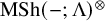 respect compact objects. It is worth noting here that compactness for motivic sheaves (under our hypothesis on k) coincides with the notion of constructibility introduced in [Reference AyoubAyo07a, Définition 2.2.3] relative to the set
$\{\Lambda (n); n\in \mathbb {Z}\}$
 . (This is just Proposition 1.1.12.) Proposition 1.2.13 then implies that the functors
$\mathrm {B}^*_X$
 in (1.6) take compact motivic sheaves to constructible sheaves, and thus induce a morphism of
$\mathrm {CAlg}(\mathrm {Cat}_{\infty })$
 -valued presheaves

By [Reference AyoubAyo10, Théorème 3.19],
$\mathrm {B}_{\mathrm {ct}}$
 is a morphism of six-functor formalisms. Applying indization, we obtain a morphism of presentable six-functor formalisms

All the remaining assertions are clear.
Remark 1.2.16. We refer to the morphism of six-functor formalisms
$\mathrm {B}^*_{\mathrm {ct}}$
 as the refined Betti realisation, or simply as the Betti realisation if no confusion can arise. Also, we will often write
$\mathrm {B}^*$
 and
$\mathrm {B}^*_X$
 instead of
$\mathrm {B}^*_{\mathrm {ct}}$
 and
$\mathrm {B}^*_{\mathrm {ct},\,X}$
 . To ease notation, we sometimes write
$\mathrm {B}^*$
 or
$\mathrm {B}^*_{\mathrm {ct}}$
 instead of
$\mathrm {B}^*_X$
 or
$\mathrm {B}^*_{\mathrm {ct},\,X}$
 .
For later use, we note the following fact.
Proposition 1.2.17. The functor

right adjoint to
$\mathrm {B}_{\mathrm {ct}}^*$
 , is colimit-preserving.
Proof. Since
$\mathrm {B}_{\mathrm {ct},\,*}$
 is an exact functor between stable
$\infty $
 -categories, it is enough to show that it preserves filtered colimits. If the ground field k has finite virtual
$\Lambda $
 -cohomological dimension, the functor
$\mathrm {B}_{\mathrm {ct}}^*$
 belongs to
$\mathrm {Pr}^{\mathrm {L}}_{\omega }$
 and the claim follows from [Reference LurieLur09, Proposition 5.5.7.2(2)]. In general, we argue as follows. Let
$\mathrm {MSh}_{\mathrm {nis}}(X;\Lambda )$
 be the
$\infty $
 -category of motivic sheaves on X in the Nisnevich topology. (See Remark 1.1.22.) There is an obvious functor

which is a localisation functor, that is, its right adjoint functor
$\mathrm {o}_{\acute {\mathrm {e}}\mathrm {t}}$
 is fully faithful. By [Reference Ayoub, Gallauer and VezzaniAGV22, Proposition 3.2.3 or Remark 2.4.23], the
$\infty $
 -category
$\mathrm {MSh}_{\mathrm {nis}}(X;\Lambda )$
 is compactly generated and the composite functor
$\mathrm {B}^*_{\mathrm {ct}}\circ \mathrm {a}_{\acute {\mathrm {e}}\mathrm {t}}$
 preserves compact objects. Using [Reference LurieLur09, Proposition 5.5.7.2(2)] as above, we conclude that
$\mathrm {o}_{\acute {\mathrm {e}}\mathrm {t}}\circ \mathrm {B}_{\mathrm {ct},\,*}$
 is colimit-preserving. The result follows since
$\mathrm {B}_{\mathrm {ct},\,*}\simeq \mathrm {a}_{\acute {\mathrm {e}}\mathrm {t}}\circ \mathrm {o}_{\acute {\mathrm {e}}\mathrm {t}}\circ \mathrm {B}_{\mathrm {ct},\,*}$
 and
$\mathrm {a}_{\acute {\mathrm {e}}\mathrm {t}}$
 is colimit-preserving.
Corollary 1.2.18. Let X be a k-variety. For
$M\in \mathrm {MSh}(X;\Lambda )$
 and
$N\in \mathrm {Sh}_{\mathrm {ct}}(X;\Lambda )$
 , the morphism

is an equivalence provided that M belongs to the full sub-
$\infty $
 -category of
$\mathrm {MSh}(X;\Lambda )$
 generated under colimits by dualizable objects. (In particular, if
$X=\mathrm {Spec}(k)$
 , then the morphism in (1.20) is always an equivalence.)
Proof. By Proposition 1.2.17, the domain and codomain of the morphism (1.20) are colimit-preserving in the variable M. Thus, we may assume M dualizable and use [Reference AyoubAyo14b, Lemme 2.8] to conclude. The last assertion follows from Proposition 1.1.13.
We end this subsection with an enhancement of Lemma 1.2.12. In the statement and the proof of this enhancement, we make use of some basic facts concerning stratifications, which are discussed at length at the beginning of Subsection 3.1.
Proposition 1.2.19. Let X be a k-variety endowed with a stratification
$\mathcal {P}$
 . Denote by
$\mathrm {Sh}_{\mathcal {P}}(X;\Lambda )^{\omega } \subset \mathrm {Sh}_{\mathrm {ct}}(X;\Lambda )^{\omega }$
 the full sub-
$\infty $
 -category whose objects are the constructible sheaves F such that
$F|_Z$
 is a local system on
$Z^{\mathrm {an}}$
 for every
$\mathcal {P}$
 -stratum Z. Let
$\mathrm {Sh}_{\mathcal {P}}(X;\Lambda )$
 be the indization of
$\mathrm {Sh}_{\mathcal {P}}(X;\Lambda )^{\omega }$
 . Then, the functor

obtained from (1.9) by restriction, is fully faithful.
Proof. We split the proof into two steps. In the first step, we gather some preliminary results which are used in the second step.
Step 1. Refining
$\mathcal {P}$
 if necessary, we may assume that there is a morphism of k-varieties
$f:X'\to X$
 and a stratification
$\mathcal {P}'$
 of
$X'$
 with the following properties:
-
○ $X'$
is smooth and
$\mathcal {P}'$
is regular in the sense of Definition 3.1.6(i); -
○ f is proper, surjective, and compatible with the stratifications $\mathcal {P}$
and
$\mathcal {P}'$
(as formulated in Remark 3.1.2(ii)); -
○ for every $\mathcal {P}$
-stratum Z, there is a unique open
$\mathcal {P}'$
-stratum
$Z'$
such that f induces an isomorphism
$Z'\simeq Z$
; -
○ for every $\mathcal {P}'$
-stratum
$Z'$
whose image in X is contained in the
$\mathcal {P}$
-stratum Z, the morphism$$ \begin{align*}f_{Z'}:\overline{Z}{}^{\prime}_Z=\overline{Z}{}'\times_XZ \to Z\end{align*} $$is smooth and the complement of $Z'$
in
$\overline {Z}{}^{\prime }_Z$
is a strict normal crossings divisor relative to Z.


The existence of f and
$\mathcal {P}'$
 as above can be obtained by noetherian induction using resolution of singularities in characteristic zero [Reference HironakaHir64a, Reference HironakaHir64b].
Given a locally closed subvariety
$Z\subset X$
 , we denote by
$j_Z:Z \hookrightarrow X$
 the obvious immersion. If Z is
$\mathcal {P}$
 -constructible (i.e., a union of
$\mathcal {P}$
 -strata), we write
$\mathcal {P}_Z$
 for the stratification of Z obtained by restricting
$\mathcal {P}$
 . In particular, we may consider the
$\infty $
 -category
$\mathrm {Sh}_{\mathcal {P}_Z}(Z;\Lambda )$
 defined as in the statement. Notice that, if Z is a
$\mathcal {P}$
 -stratum, then
$\mathrm {Sh}_{\mathcal {P}_Z}(Z;\Lambda )=\mathrm {LS}(Z;\Lambda )$
 . We use similar notations for locally closed subvarieties of
$X'$
 .
Let
$Z\subset X$
 be a
$\mathcal {P}$
 -constructible locally closed subvariety. We claim that
$j_{Z,\,*}$
 takes
$\mathrm {Sh}_{\mathcal {P}_Z}(Z;\Lambda )^{\omega }$
 to
$\mathrm {Sh}_{\mathcal {P}}(X;\Lambda )^{\omega }$
 . By induction on the dimension of Z and using localisation triangles, we easily reduce to the case where Z is a
$\mathcal {P}$
 -stratum. Let
$Z'$
 be the open
$\mathcal {P}'$
 -stratum mapping isomorphically to Z. By the third step of the proof of Proposition 1.2.13, we see that
$j_{Z',\,*}$
 takes
$\mathrm {LS}(Z';\Lambda )^{\omega }$
 to
$\mathrm {Sh}_{\mathcal {P}'}(X';\Lambda )^{\omega }$
 . (Indeed,
$Z'$
 is the complement of a strict normal crossings divisor in a connected component of
$X'$
 .) It remains to see that
$f_*$
 takes
$\mathrm {Sh}_{\mathcal {P}'}(X';\Lambda )^{\omega }$
 to
$\mathrm {Sh}_{\mathcal {P}}(X;\Lambda )^{\omega }$
 . We may check this on generators of the form
$j_{T',\,!}M$
 with
$T'\subset X'$
 a
$\mathcal {P}'$
 -stratum and
$M\in \mathrm {LS}(T';\Lambda )^{\omega }$
 . Letting
$u:T'\to \overline {T}{}^{\prime }_T$
 and
$g:\overline {T}{}^{\prime }_T\to T$
 be the obvious morphisms, it is sufficient to show that
$g_*u_!M$
 is a local system. By duality, we may as well prove that
$g_*u_*M^{\vee }$
 is a local system. This was proven in the fifth step of Proposition 1.2.13. (Recall that g is smooth and proper, and
$T'$
 is the complement of a strict relative normal crossings divisor in
$\overline {T}{}^{\prime }_T$
 .)
Similarly, under the assumption that
$Z\subset X$
 is
$\mathcal {P}$
 -constructible, the functor
$j_Z^!$
 takes
$\mathrm {Sh}_{\mathcal {P}'}(X';\Lambda )$
 to
$\mathrm {Sh}_{\mathcal {P}_Z}(Z;\Lambda )^{\omega }$
 . This can be deduced using a localisation triangle from the analogous property for
$j_{T,\,*}$
 , with
$T=X\smallsetminus \overline {Z}$
 .
Step 2. Let
$\mathcal {T}_X\subset \mathrm {Sh}(X^{\mathrm {an}};\Lambda )$
 be the full sub-
$\infty $
 -category generated under colimits by
$\mathrm {Sh}_{\mathcal {P}}(X;\Lambda )^{\omega }$
 . (We will use a similar notation when X is replaced by a locally closed
$\mathcal {P}$
 -constructible subvariety.) As in the proof of Lemma 1.2.12, we need to show that the objects of
$\mathrm {Sh}_{\mathcal {P}}(X;\Lambda )^{\omega }$
 are compact objects of
$\mathcal {T}_X$
 . It is enough to do so for objects of the form
$j_{Z,\,!}M$
 , where
$Z\subset X$
 is a
$\mathcal {P}$
 -stratum and M a local system on
$Z^{\mathrm {an}}$
 . Assume for a moment that
$j_Z^!$
 , restricted to
$\mathcal {T}_X$
 , is colimit-preserving. Then, by Step 1, it induces a functor

which is right adjoint to
$j_{Z,\,!}$
 . By adjunction, we have

By Lemma 1.2.12, we have an equivalence
$\mathrm {LS}(Z;\Lambda )\simeq \mathcal {T}_Z$
 showing that M is a compact object of
$\mathcal {T}_Z$
 . But we have also assumed that
$j_Z^!:\mathcal {T}_X \to \mathcal {T}_Z$
 was colimit-preserving. This shows that the right-hand side of the equivalence (1.22) preserves filtered colimits as needed.
To conclude, it remains to see that
$j_Z^!:\mathcal {T}_X \to \mathrm {Sh}(Z^{\mathrm {an}};\Lambda )$
 is colimit-preserving. We will show more generally that

is colimit-preserving for any
$\mathcal {P}$
 -constructible closed subvariety
$Y\subset X$
 containing Z. (Of course,
$j_{Y,\,Z}:Z\hookrightarrow Y$
 is the obvious inclusion.) We argue by induction on the codimension of Z in Y. If Z is open in Y, there is nothing to prove. Thus, we may assume that Z has codimension at least one in Y. Let
$Y^{\circ }\subset Y$
 be the union of the
$\mathcal {P}$
 -strata that are open in Y, and let
$u:Y^{\circ } \subset Y$
 be the obvious inclusion. We claim that

is colimit-preserving. Assuming this claim, we can conclude as follows. By Step 1, the functor
$u_*$
 induces a colimit-preserving functor
$u_*:\mathcal {T}_{Y^{\circ }}\to \mathcal {T}_Y$
 . Given an inductive system
$(M_{\alpha })_{\alpha }$
 in
$\mathcal {T}_Y$
 , consider the localisation triangles

where
$v:Y\smallsetminus Y^{\circ } \to Y$
 is the closed immersion complementary to u and
$N_{\alpha }=v^!M_{\alpha }$
 . Since v is a closed immersion, the functor
$v_*$
 is colimit-preserving. Thus, setting
$M=\mathrm {colim}_{\alpha }\, M_{\alpha }$
 and
$N=\mathrm {colim}_{\alpha }\, N_{\alpha }$
 , we have a localisation triangle

Now, recall that our goal is to show that

is an equivalence. Using the exact triangles (1.25) and (1.26), and the fact that
$j^!_{Y,\,Z}u_*=0$
 , we are reduced to showing that the morphism

is an equivalence. Since
$j^!_{Y,\,Z}v_*\simeq j^!_{Y\smallsetminus Y^{\circ },\,Z}$
 , this follows from the induction hypothesis on the codimension of Z in Y.
We now finish the proof by establishing the claim that the functor (1.24) is colimit-preserving. Without loss of generality, we may assume that
$Y=X$
 . Since
$X^{\circ }$
 is the disjoint union of the open
$\mathcal {P}$
 -strata, it is enough to show that
$j_{U,\,*}:\mathcal {T}_U \to \mathrm {Sh}(X^{\mathrm {an}};\Lambda )$
 is colimit-preserving, with
$U\subset X$
 an open
$\mathcal {P}$
 -stratum. We appeal to the morphism
$f:X'\to X$
 and the stratification
$\mathcal {P}'$
 from Step 1. Let
$U'\subset X'$
 be an open stratum of
$X'$
 mapping isomorphically to U. Since f is proper, the functor
$f_*$
 is colimit-preserving. (For instance, this follows from the proper base change theorem for the Voevodsky pullback formalism
$\mathrm {Sh}((-)^{\mathrm {an}};\Lambda )$
 and [Reference LurieLur09, Corollary 7.3.4.12].) Thus, it is enough to show that
$j_{U',\,*}:\mathrm {LS}(U';\Lambda ) \to \mathrm {Sh}(X^{\prime \mathrm {an}};\Lambda )$
 is colimit-preserving. This was done in the proof of Lemma 1.2.12. (Recall that
$U'$
 is the complement of a strict normal crossings divisor in a connected component of
$X'$
 .)
Remark 1.2.20. Let X be a k-variety. Since the functor (1.9) fails to be fully faithful, we cannot view the objects of
$\mathrm {Sh}_{\mathrm {ct}}(X;\Lambda )$
 as actual sheaves on
$X^{\mathrm {an}}$
 . However, the situation is not too bad. Indeed, we have an equivalence in
$\mathrm {Pr}^{\mathrm {L}}_{\omega }$
 :

where
$\mathcal {P}$
 varies in the filtered set of stratifications of X, and each
$\mathrm {Sh}_{\mathcal {P}}(X;\Lambda )$
 can be identified with a full sub-
$\infty $
 -category of
$\mathrm {Sh}(X^{\mathrm {an}};\Lambda )$
 by Proposition 1.2.19.
Corollary 1.2.21. Let X be a k-variety and
$\Lambda \to \Lambda '$
 a morphism of commutative ring spectra. Then, the induced functor

is fully faithful. Moreover, if
$\Lambda $
 and
$\Lambda '$
 are ordinary regular rings, then the functor (1.27) is t-exact and the image of the induced fully faithful exact embedding of abelian categories

is closed under subquotient.
Proof. Using Remark 1.2.20, it is enough to prove the corollary for
$\mathrm {Sh}_{\mathcal {P}}(X;-)$
 instead of
$\mathrm {Sh}_{\mathrm {ct}}(X;-)$
 , with
$\mathcal {P}$
 a stratification of X. (For the second assertion, we need that the t-structure on
$\mathrm {Sh}(X^{\mathrm {an}};-)$
 restricts to a t-structure on
$\mathrm {Sh}_{\mathcal {P}}(X;-)$
 , but this follows by arguing as in the proof of Corollary 1.2.10.)
By Proposition 1.2.19,
$\mathrm {Sh}_{\mathcal {P}}(X;-)$
 is a full sub-
$\infty $
 -category of
$\mathrm {Sh}(X^{\mathrm {an}};-)$
 . This already proves the first assertion since the functor

is an equivalence. To prove the second assertion, we notice that
$\mathrm {Sh}_{\mathcal {P}}(X;\Lambda )^{\heartsuit }$
 is the abelian subcategory of
$\mathrm {Sh}(X^{\mathrm {an}};\Lambda )^{\heartsuit }$
 whose objects are ordinary sheaves of
$\Lambda $
 -modules F such that, for every
$\mathcal {P}$
 -stratum Z,
$F|_{Z^{\mathrm {an}}}$
 is a filtered union of its subsheaves that are local systems of finitely generated
$\Lambda $
 -modules. An object of
$\mathrm {Mod}_{\Lambda '}(\mathrm {Sh}_{\mathcal {P}}(X;\Lambda ))^{\heartsuit }$
 is such an F together with a structure of
$\Lambda '$
 -module. Let
$G\subset F$
 be a subsheaf with
$G\in \mathrm {Sh}_{\mathcal {P}}(X;\Lambda ')^{\heartsuit }$
 . We need to show that
$G\in \mathrm {Sh}_{\mathcal {P}}(X;\Lambda )^{\heartsuit }$
 once the action of
$\Lambda '$
 is forgotten. This is clear. Indeed, given a
$\mathcal {P}$
 -stratum Z, the locally constant sheaf of
$\Lambda $
 -modules
$G|_{Z^{\mathrm {an}}}$
 is the filtered union of the intersections of
$G|_{Z^{\mathrm {an}}}$
 with the subsheaves of
$F|_{Z^{\mathrm {an}}}$
 that are local systems of finitely generated
$\Lambda $
 -modules. These intersections are clearly local systems of finitely generated
$\Lambda $
 -modules, as needed.
1.3 Motivic Galois group, I. The general case
We explain here the construction of the motivic Galois groupoid associated to a Weil spectrum following [Reference AyoubAyo26]. In Subsection 1.4, we specialise to the motivic Galois group associated to the Betti realisation, which was introduced and studied in [Reference AyoubAyo14b, Reference AyoubAyo14c]. The motivic Galois groupoid arises naturally as a nonconnective spectral affine groupoid in the sense of spectral algebraic geometry [Reference LurieLur18]. We start by recalling the notions of group and groupoid in an
$\infty $
 -category following [Reference LurieLur09, Definition 6.1.2.7].
Definition 1.3.1. Let
$\mathcal {C}$
 be an
$\infty $
 -category. A groupoid in
$\mathcal {C}$
 is a simplicial object
$X:\boldsymbol {\Delta }^{\mathrm {op}} \to \mathcal {C}$
 such that, for every integer
$n\geq 0$
 and every covering
$\{0,\ldots , n\}=I\cup J$
 with
$I\cap J=\{m\}$
 a singleton, the square

is cartesian. We say that X is a group if moreover
$X(\Delta ^0)$
 is a final object.
Next, we recall the
$\infty $
 -category of nonconnective affine spectral schemes following [Reference LurieLur18, Definition 1.1.2.8, Variant 1.1.2.9, Corollaries 1.1.6.2 & 1.1.6.3].
Definition 1.3.2. A nonconnective spectral scheme
$X=(|X|,\mathcal {O}_X)$
 is a pair consisting of a topological space
$|X|$
 and a
$\mathrm {CAlg}$
 -valued hypersheaf
$\mathcal {O}_X$
 , called the structural sheaf, such that the following properties are satisfied.
-
(i) The ringed space $X^{\mathrm {cl}}=(|X|,\pi _0\mathcal {O}_X)$
is a scheme in the classical sense. -
(ii) For every $i\in \mathbb {Z}$
, the
$\pi _0\mathcal {O}_X$
-module
$\pi _i\mathcal {O}_X$
is quasi-coherent.


The scheme
$X^{\mathrm {cl}}$
 is called the underlying scheme of X. A spectral scheme X is a nonconnective spectral scheme such that
$\mathcal {O}_X$
 is connective, that is, the sheaves
$\pi _i\mathcal {O}_X$
 are zero for
$i<0$
 . A (nonconnective) spectral scheme X is said to be affine if
$X^{\mathrm {cl}}$
 is affine.
Notation 1.3.3. We denote by
$\mathrm {SpSCH}^{\mathrm {nc}}$
 the
$\infty $
 -category of nonconnective spectral schemes and morphisms of locally spectrally ringed spaces in the sense of [Reference LurieLur18, Definition 1.1.5.3]. We denote by
$\mathrm {SpSCH}$
 the full sub-
$\infty $
 -category of
$\mathrm {SpSCH}^{\mathrm {nc}}$
 spanned by spectral schemes. We denote by
$\mathrm {SpAFF}^{(\mathrm {nc})}$
 the full sub-
$\infty $
 -category of
$\mathrm {SpSCH}^{(\mathrm {nc})}$
 spanned by affine (nonconnective) spectral schemes.
Remark 1.3.4. The point of view of spectrally ringed spaces will be of little use in this paper. Indeed, we will rather think about spectral schemes via their functors of points. More precisely, by [Reference LurieLur18, Proposition 1.1.4.3], a commutative ring spectrum A gives rise to an affine nonconnective spectral scheme
$\mathrm {Spec}(A)$
 , whose underlying scheme is
$\mathrm {Spec}(\pi _0A)$
 . By [Reference LurieLur18, Propositions 1.1.5.5 & 1.1.6.1], this yields equivalences of
$\infty $
 -categories

Using the Yoneda embedding and Zariski descent, one obtains fully faithful functors

This allows us to view a (nonconnective) spectral scheme X as a functor from (nonconnective) commutative ring spectra to spaces. More generally, we set

and call the objects of these
$\infty $
 -categories (nonconnective) spectral prestacks.
Notation 1.3.5. Given a (nonconnective) commutative ring spectrum
$\Lambda \in \mathrm {CAlg}$
 , we denote by
$\mathrm {SpAFF}^{(\mathrm {nc})}_{\Lambda }$
 ,
$\mathrm {SpSCH}^{(\mathrm {nc})}_{\Lambda }$
 and
$\mathrm {SpPSTK}^{(\mathrm {nc})}_{\Lambda }$
 the
$\infty $
 -categories of objects over
$\mathrm {Spec}(\Lambda )$
 in
$\mathrm {SpAFF}^{(\mathrm {nc})}$
 ,
$\mathrm {SpSCH}^{(\mathrm {nc})}$
 and
$\mathrm {SpPSTK}^{(\mathrm {nc})}$
 . In particular, we have equivalences of
$\infty $
 -categories
$\mathrm {SpAFF}_{\Lambda }\simeq (\mathrm {CAlg}_{\Lambda }^{\mathrm {cn}})^{\mathrm {op}}$
 and
$\mathrm {SpAFF}_{\Lambda }^{\mathrm {nc}}\simeq (\mathrm {CAlg}_{\Lambda })^{\mathrm {op}}$
 .
Definition 1.3.6. Let
$\Lambda $
 be a (nonconnective) commutative ring spectrum. A (nonconnective) spectral group(oid) prestack G over
$\Lambda $
 is a group(oid) in the
$\infty $
 -category
$\mathrm {SpPSTK}^{(\mathrm {nc})}_{\Lambda }$
 . We say that G is a (nonconnective) spectral affine group(oid) over
$\Lambda $
 if it belongs to the
$\infty $
 -category
$\mathrm {SpAFF}^{(\mathrm {nc})}_{\Lambda }$
 .
Remark 1.3.7. The
$\infty $
 -category of nonconnective spectral affine groups (resp. groupoids) over
$\Lambda $
 is equivalent to the
$\infty $
 -category of groups (resp. groupoids) in
$(\mathrm {CAlg}_{\Lambda })^{\mathrm {op}}$
 and hence to the opposite of the
$\infty $
 -category of Hopf algebras (resp. algebroids) in
$\mathrm {Mod}_{\Lambda }$
 . Said differently, every nonconnective spectral affine group (resp. groupoid) G arises in an essentially unique way as the spectrum of a Hopf algebra (resp. algebroid) in
$\mathrm {Mod}_{\Lambda }$
 . The same applies in the connective case. Given a symmetric monoidal
$\infty $
 -category
$\mathcal {C}^{\otimes }$
 , recall that a Hopf algebra (resp. algebroid) in
$\mathcal {C}$
 is a cosimplicial object
$H:\boldsymbol {\Delta } \to \mathrm {CAlg}(\mathcal {C})$
 satisfying the dual conditions for a group (resp. groupoid) in Definition 1.3.1. Below, we will also use the notion of comodules over Hopf algebroids; see [Reference AyoubAyo26, Definition 4.4] for a precise definition.
To go further, we need to recall the notion of a Weil spectrum following [Reference AyoubAyo26, Definition 1.14]. The following notation will be handy.
Notation 1.3.8. Let S be a scheme and
$\Lambda $
 a commutative ring spectrum. Given a motivic sheaf
${M\in \mathrm {MSh}(S;\Lambda )}$
 , we set
$\Gamma (S;M)=\mathrm {map}(\Lambda _S,M)$
 , the mapping spectrum in
$\mathrm {MSh}(S;\Lambda )$
 from the unit object to M. This yields a functor

right adjoint to the “constant Artin motive” functor. As usual, if
$S=\mathrm {Spec}(R)$
 , we write
$\Gamma (R;-)$
 instead. If S is clear from the context, we also write
$\Gamma (-)$
 instead of
$\Gamma (S;-)$
 .
We fix a ground field k and a commutative ring spectrum
$\Lambda $
 .
Definition 1.3.9. A Weil
$\Lambda $
 -spectrum over k is a commutative algebra
$\mathcal {A}$
 in
$\mathrm {MSh}(k;\Lambda )$
 such that, for every
$\mathcal {A}$
 -module
$M\in \mathrm {MSh}(k;\mathcal {A})$
 , the obvious morphism
$\mathcal {A}\otimes _{\Gamma (\mathcal {A})}\Gamma (M) \to M$
 is an equivalence. We say that
$\mathcal {A}$
 is neutral over
$\Lambda $
 if the map
$\Lambda \to \Gamma (\mathcal {A})$
 is an equivalence. If k and
$\Lambda $
 are understood, we simply say “Weil spectrum”.
Lemma 1.3.10. Let
$\mathcal {A}\in \mathrm {CAlg}(\mathrm {MSh}(k;\Lambda ))$
 be a Weil spectrum. Then, the functor

is an equivalence of
$\infty $
 -categories.
Proof. See [Reference AyoubAyo26, Propositions 1.11 & 1.13].
Notation 1.3.11. Let
$\mathcal {C}^{\otimes }$
 be a symmetric monoidal
$\infty $
 -category and let
$A\in \mathrm {CAlg}(\mathcal {C})$
 be a commutative algebra in
$\mathcal {C}$
 . We denote by
$\check {\mathrm {C}}^{\bullet }(A)$
 the Čech conerve of A. This is the cosimplicial commutative algebra

defined as the left Kan extension along the inclusion
$\boldsymbol {\Delta }^{\leq 0}\subset \boldsymbol {\Delta }$
 of the functor
$[0]\mapsto A$
 . Informally, for an integer
$n\geq 0$
 , we have
$\check {\mathrm {C}}^n(A)\simeq A^{\otimes n+1}$
 , and the face maps are induced by the unit morphism
$\mathbf {1} \to A$
 while the degeneracy maps are induced by the multiplication morphism
$A\otimes A \to A$
 . (See [Reference AyoubAyo26, Notation 4.6].) The Čech conerve of A has a natural coaugmentation given by
$\check {\mathrm {C}}^{-1}(A)=\mathbf {1}$
 .
Theorem 1.3.12. Let
$\mathcal {A}\in \mathrm {CAlg}(\mathrm {MSh}(k;\Lambda ))$
 be a Weil spectrum.
-
(i) The cosimplicial commutative algebra $\Gamma (\check {\mathrm {C}}^{\bullet }(\mathcal {A}))$
is a Hopf algebroid in
$\mathrm {Mod}_{\Lambda }$
. -
(ii) For $M\in \mathrm {MSh}(k;\Lambda )$
, the
$\Gamma (\check {\mathrm {C}}^{\bullet }(\mathcal {A}))$
-module
$\Gamma (\check {\mathrm {C}}^{\bullet }(\mathcal {A})\otimes _{\Lambda } M)$
is naturally a comodule over the Hopf algebroid
$\Gamma (\check {\mathrm {C}}^{\bullet }(\mathcal {A}))$
.


Thus, there is a symmetric monoidal functor

Proof. This is a particular case of [Reference AyoubAyo26, Theorem 1.3.12].
Definition 1.3.13. Keep the assumptions of Theorem 1.3.12. The Hopf algebroid
$\Gamma (\check {\mathrm {C}}^{\bullet }(\mathcal {A}))$
 is called the motivic Hopf algebroid associated to
$\mathcal {A}$
 and is denoted by
$\mathcal {H}_{\mathrm {mot}}(\mathcal {A})$
 . We set

this is a nonconnective spectral affine groupoid over
$\Lambda $
 , which we call the motivic Galois groupoid associated to
$\mathcal {A}$
 . When the Weil spectrum
$\mathcal {A}$
 is neutral over
$\Lambda $
 ,
$\mathcal {H}_{\mathrm {mot}}(\mathcal {A})$
 is a Hopf algebra and
$\mathcal {G}_{\mathrm {mot}}(\mathcal {A})$
 is a group.
In the remainder of this subsection, we give a description of the functor of points of
$\mathcal {G}_{\mathrm {mot}}(\mathcal {A})$
 .
Theorem 1.3.14. Let
$\mathcal {A}\in \mathrm {CAlg}(\mathrm {MSh}(k;\Lambda ))$
 be a Weil spectrum.
-
(i) The commutative algebra $\mathcal {A}$
admits a natural structure of a comodule over
$\mathcal {H}_{\mathrm {mot}}(\mathcal {A})$
, that is, there is a natural lift of
$\mathcal {A}$
to a commutative algebra in
$\mathrm {coMod}_{\mathcal {H}_{\mathrm {mot}}(\mathcal {A})}(\mathrm {MSh}(k;\Lambda ))$
. -
(ii) Let $s,t\in \mathcal {G}_{\mathrm {mot}}(\mathcal {A})_0(\Lambda )$
be two
$\Lambda $
-points corresponding to two
$\Lambda $
-algebra morphisms from
$\Gamma (\mathcal {A})$
to
$\Lambda $
. We set
$\mathcal {A}_s=\mathcal {A}\otimes _{\Gamma (\mathcal {A}),\,s} \Lambda $
and
$\mathcal {A}_t=\mathcal {A} \otimes _{\Gamma (\mathcal {A}),\,t}\Lambda $
. Then, the coaction in (i) induces an equivalence of spaces$$ \begin{align*}\mathcal{G}_{\mathrm{mot}}(\mathcal{A})_1(\Lambda) \times_{\mathcal{G}_{\mathrm{mot}}(\mathcal{A})_0(\Lambda)\times \mathcal{G}_{\mathrm{mot}}(\mathcal{A})_0(\Lambda)}\{(s,t)\} \simeq \mathrm{Map}_{\mathrm{CAlg}(\mathrm{MSh}(k;\Lambda))}(\mathcal{A}_s,\mathcal{A}_t).\end{align*} $$


Proof. The lift of
$\mathcal {A}$
 to a commutative algebra in
$\mathrm {coMod}_{\mathcal {H}_{\mathrm {mot}}(\mathcal {A})}(\mathrm {MSh}(k;\Lambda ))$
 is simply given by the cosimplicial commutative algebra
$\check {\mathrm {C}}^{\bullet }(\mathcal {A})$
 considered as a commutative algebra over the Hopf algebroid
$\Gamma (\check {\mathrm {C}}^{\bullet }(\mathcal {A}))$
 . The key property to be checked here is that the obvious morphism

is an equivalence for all integers
$0\leq m\leq n$
 , which follows from the defining property of a Weil spectrum. For (ii), we need to show that the coaction of
$\mathcal {H}_{\mathrm {mot}}(\mathcal {A})$
 on
$\mathcal {A}$
 induces an equivalence

The natural map between these two spaces takes a morphism
$\alpha :\Gamma (\mathcal {A}_s\otimes _{\Lambda }\mathcal {A}_t) \to \Lambda $
 to the composite morphism

where the middle equivalence is provided by the defining property of Weil spectra. (Indeed,
$\mathcal {A}_t$
 is a Weil spectrum by [Reference AyoubAyo26, Corollary 1.15].) To see that (1.32) is an equivalence, we use the following chain of equivalences

where the second equivalence follows from Lemma 1.3.10 applied to the Weil spectrum
$\mathcal {A}_t$
 .
In the case where the Weil spectrum is neutralised over
$\Lambda $
 , we can be more precise. To do so, we need a digression on groups of autoequivalences in the
$\infty $
 -categorical setting.
Notation 1.3.15. Let
$\mathcal {C}$
 be an
$\infty $
 -category admitting fibre products and let
$f:Y \to X$
 be a morphism in
$\mathcal {C}$
 . We denote by
$\check {\mathrm {C}}_{\bullet }(f)$
 , or
$\check {\mathrm {C}}_{\bullet }(Y/X)$
 , the Čech nerve of f. This is the simplicial object

defined as the right Kan extension along the inclusion
$(\boldsymbol {\Delta }^{\leq 0})^{\mathrm {op}} \subset \boldsymbol {\Delta }^{\mathrm {op}}$
 of the functor
$[0]\mapsto Y/X$
 . The Čech nerve of f can be also considered as an augmented simplicial object in
$\mathcal {C}$
 by setting
$\check {\mathrm {C}}_{-1}(f)=X$
 . (Compare with Notation 1.3.11.)
In the next construction, we use Notation 1.3.15 in the case where
$\mathcal {C}=\mathcal {S}$
 is the
$\infty $
 -category of spaces. As usual, given an
$\infty $
 -category
$\mathcal {C}$
 , we denote by
$\mathcal {C}^{\simeq }$
 the largest sub-
$\infty $
 -groupoid of
$\mathcal {C}$
 .
Construction 1.3.16. Let
$\mathcal {C}$
 be an
$\infty $
 -category. For
$X\in \mathcal {C}$
 , we define a (small) simplicial space
$\mathrm {Auteq}_{\mathcal {C}}(X):\boldsymbol {\Delta }^{\mathrm {op}} \to \mathcal {S}$
 by taking the Čech nerve of the morphism
$X:\mathrm {pt} \to \mathcal {C}^{\simeq }$
 from the point to the
$\infty $
 -groupoid
$\mathcal {C}^{\simeq }$
 viewed as a (possibly large) space. In formula, we have

By [Reference LurieLur09, Proposition 6.1.2.11], the simplicial object
$\mathrm {Auteq}_{\mathcal {C}}(X)$
 is a group in spaces.
Remark 1.3.17. Given a groupoid
$G:\boldsymbol {\Delta }^{\mathrm {op}}\to \mathcal {S}$
 in spaces, we set
$\mathrm {B}(G)=\mathrm {colim}_{\boldsymbol {\Delta }^{\mathrm {op}}}G$
 which we call the classifying space of G. By construction,
$\mathrm {B}(G)$
 is the value at
$\Delta ^{\emptyset }\in \boldsymbol {\Delta }_+$
 of the augmented simplicial object
$G^+$
 extending G to a colimit diagram. Moreover, the groupoid G is effective in the sense of [Reference LurieLur09, Definition 6.1.2.14], that is, G is the Čech nerve of the map
$G_0 \to \mathrm {B}(G)$
 ; see [Reference LurieLur09, Corollary 6.1.3.20] for a proof of this classical fact. In the situation of Construction 1.3.16, the natural augmentation of the simplicial space
$\mathrm {Auteq}_{\mathcal {C}}(X)$
 induces a map of spaces

which identifies
$\mathrm {B}(\mathrm {Auteq}_{\mathcal {C}}(X))$
 with the full sub-
$\infty $
 -groupoid of
$\mathcal {C}^{\simeq }$
 spanned by the object X.
We also need a parametrised version of Construction 1.3.16.
Construction 1.3.18. Let K be a small simplicial set and let
$\mathcal {C}:K\to \mathrm {CAT}_{\infty }$
 be a diagram of
$\infty $
 -categories. Let
$X:\mathrm {pt}_K \to \mathcal {C}$
 be a natural transformation from the constant functor
$\mathrm {pt}_K:K \to \mathrm {CAT}_{\infty }$
 pointing to the final
$\infty $
 -category
$\mathrm {pt}$
 . We define a diagram
$\mathrm {Auteq}_{\mathcal {C}}(X):\boldsymbol {\Delta }^{\mathrm {op}}\times K \to \mathcal {S}$
 by taking the Čech nerve of the morphism
$X:\mathrm {pt}_K \to \mathcal {C}^{\simeq }$
 in
$\mathrm {Fun}(K,\widehat {\mathcal {S}})$
 . (As in Construction 1.3.16, the diagram of
$\infty $
 -groupoids
$\mathcal {C}^{\simeq }$
 is viewed as a diagram in spaces.) We may view
$\mathrm {Auteq}_{\mathcal {C}}(X)$
 as a diagram of simplicial spaces

sending a vertex
$v\in K$
 to the group
$\mathrm {Auteq}_{\mathcal {C}(v)}(X(v))$
 .
We need to spell out in which sense the group
$\mathrm {Auteq}_{\mathcal {C}}(X)$
 acts on X. We do this directly in the parametrised case.
Lemma 1.3.19. Keep the notations as in Construction 1.3.18. Let
$p:\int _K\mathcal {C} \to K$
 be the cocartesian fibration classified by the functor
$\mathcal {C}$
 . There are a diagram

and a natural transformation
$\mathrm {Act}_{\mathcal {C}}(X) \to \mathrm {Auteq}_{\mathcal {C}}(X)\circ (\mathrm {id}_{\boldsymbol {\Delta }^{\mathrm {op}}}\times p)$
 such that the following conditions are satisfied. (Below, we represent vertices of
$\int _K\mathcal {C}$
 by pairs
$(v,A)$
 with
$v\in K$
 and
$A\in \mathcal {C}(v)$
 .)
-
(i) The diagram $\mathrm {Act}_{\mathcal {C}}(X)_0:\int _K\mathcal {C} \to \mathcal {S}$
is given informally by
$(v,A)\mapsto \mathrm {Map}_{\mathcal {C}(v)}(X(v),A)$
. -
(ii) For all integers $0\leq m\leq n$
, the square is cartesian. -
(iii) For every $(v,A)$
in
$\int _K\mathcal {C}$
, the induced action of
$\mathrm {Auteq}_{\mathcal {C}(v)}(X(v))$
on
$\mathrm {Map}_{\mathcal {C}(v)}(X(v),A)$
in
$\mathrm {h}\mathcal {S}$
is given by composition.


Proof. Consider the diagram
$\mathcal {F}:{\textstyle \int _K\mathcal {C}} \to \mathrm {CAT}_{\infty }$
 sending a vertex
$(v,A)$
 to the
$\infty $
 -category
$\mathcal {C}(v)_{/A}$
 . There is a natural transformation
$\mathcal {F}\to \mathcal {C} \circ p$
 given at
$(v,A)$
 by the forgetful functor
$\mathcal {C}(v)_{/A} \to \mathcal {C}(v)$
 . It induces a natural transformation
$\mathcal {F}^{\simeq } \to \mathcal {C}^{\simeq }\circ p$
 . We define
$\mathrm {Act}_{\mathcal {C}}(X)$
 by the cartesian square of simplicial objects in
$\mathrm {Fun}(\int _K\mathcal {C},\widehat {\mathcal {S}})$


The properties (i)–(iii) follow readily from the construction.
We now return to our discussion about motivic Galois groups. First, we introduce a special instance of Construction 1.3.18.
Notation 1.3.20. Let
$\mathcal {R}$
 be a commutative algebra in
$\mathrm {MSh}(k;\Lambda )$
 . (We are interested in the case of a Weil spectrum, but this is not relevant for now.) We apply Construction 1.3.18 to the functor

sending
$\Lambda '\in \mathrm {CAlg}_{\Lambda }$
 to
$\mathrm {CAlg}(\mathrm {MSh}(k;\Lambda '))$
 , and the natural transformation
$\mathrm {pt} \to \mathrm {CAlg}(\mathrm {MSh}(k;-))$
 , given at
$\Lambda '$
 by the functor pointing at
$\mathcal {R}\otimes _{\Lambda }\Lambda '$
 . This yields the nonconnective spectral group
$\Lambda $
 -prestack of autoequivalences of
$\mathcal {R}$
 , which we denote by
$\underline {\mathrm {Aute}\,\,}\!\!\mathrm {q}(\mathcal {R})$
 .
Theorem 1.3.21. Let
$\mathcal {A}\in \mathrm {CAlg}(\mathrm {MSh}(k;\Lambda ))$
 be a Weil spectrum neutral over
$\Lambda $
 . Then, there is a canonical equivalence of nonconnective spectral group prestacks

Proof. By Theorem 1.3.14, we know that
$\underline {\mathrm {Aute}\,\,}\!\!\mathrm {q}(\mathcal {A})$
 is affine and has the same underlying nonconnective spectral scheme as
$\mathcal {G}_{\mathrm {mot}}(\mathcal {A})$
 . We need to show that this identification of the underlying spectral prestacks extends to the group structures. To simplify notation, we write
$X_{\bullet }=\mathrm {Spec}(E^{\bullet })$
 for the simplicial object in
$\mathrm {SpAFF}^{\mathrm {nc}}_{\Lambda }$
 representing
$\underline {\mathrm {Aute}\,\,}\!\!\mathrm {q}(\mathcal {A})$
 . By Lemma 1.3.19, we have a functor

and, for every integer
$n\geq 0$
 , the functor

is corepresentable by the pair
$(E^n,\mathcal {A}\otimes _{\Lambda } E^n)$
 . (For the last assertion, we use properties (i) and (ii) in Lemma 1.3.19.) In particular, we may view
$\underline {\mathrm {Act}}(\mathcal {A})$
 as a cosimplicial object in the
$\infty $
 -category
$\int _{\mathrm {CAlg}_{\Lambda }}\mathrm {CAlg}(\mathrm {MSh}(k;-))$
 . Composing with the projection to
$\mathrm {CAlg}(\mathrm {MSh}(k;-))$
 , we obtain a cosimplicial commutative algebra
 in
$\mathrm {MSh}(k;\Lambda )$
 with the following properties:
-
(i)
and
; -
(ii)
defines a commutative algebra in
$\mathrm {coMod}_E(\mathrm {MSh}(k;\Lambda ))$
; -
(iii) the coaction maps $\mathcal {A}\to \mathcal {A}\otimes _{\Lambda }E^1$
and
$\mathcal {A}\to \mathcal {A}\otimes _{\Lambda }\mathcal {H}_{\mathrm {mot}}(\mathcal {A})^1$
are equivalent, and correspond to the tautological action of
$\underline {\mathrm {Aute}\,\,}\!\!\mathrm {q}(\mathcal {A})$
on
$\mathcal {A}$
. (For this claim, we use Theorem 1.3.14 and the third property in Lemma 1.3.19.)


It is now easy to conclude. Indeed,
$\check {\mathrm {C}}(\mathcal {A})$
 being a left Kan extension, there is a morphism of cosimplicial commutative algebras
 extending the identity in degree
$0$
 . The property (iii) above ensures that the morphism
 is an equivalence. This readily implies that the morphism
 is an equivalence in all degrees.
Remark 1.3.22. Given a Weil spectrum
$\mathcal {A}\in \mathrm {CAlg}(\mathrm {MSh}(k;\Lambda ))$
 neutral over
$\Lambda $
 , we have the associated realisation functor given by

where the last equivalence follows from Lemma 1.3.10. By [Reference AyoubAyo26, Theorem 1.21], we have an equivalence of groups

On the other hand, the obvious map

is an equivalence (where, by abuse of notation, we wrote “
$\mathrm {Fun}$
 ” for the
$\infty $
 -category of symmetric monoidal functors). Indeed, every autoequivalence of
$\mathfrak {R}_{\mathcal {A}}$
 which is the identity on
$\mathrm {MSh}(k;\Lambda )^{\otimes }$
 is also the identity on
$\mathrm {Mod}^{\otimes }_{\Lambda }$
 since
$\mathfrak {R}_{\mathcal {A}}$
 admits a section. Thus, we have an equivalence of groups

This holds equally with
$\Lambda $
 and
$\mathcal {A}$
 replaced by
$\Lambda '$
 and
$\mathcal {A}\otimes _{\Lambda }\Lambda '$
 for any
$\Lambda '\in \mathrm {CAlg}_{\Lambda }$
 . Using this and Theorem 1.3.21, it follows that the motivic Galois group
$\mathcal {G}_{\mathrm {mot}}(\mathcal {A})$
 is equivalent to the one defined by Iwanari [Reference IwanariIwa14, Definition 5.13].
1.4 Motivic Galois group, II. The Betti case
We fix a ground field k and a complex embedding
$\sigma :k\hookrightarrow \mathbb {C}$
 . In this subsection, we specialise the general constructions of Subsection 1.3 to the Betti spectrum representing Betti cohomology. Then, we recall a few known properties of the associated motivic Galois group. As usual,
$\Lambda \in \mathrm {CAlg}$
 will be a commutative ring spectrum.
Definition 1.4.1. Consider the Betti realisation functor
$\mathrm {B}^*:\mathrm {MSh}(k;\Lambda ) \to \mathrm {Mod}_{\Lambda }$
 associated to the complex embedding
$\sigma $
 , and let
$\mathrm {B}_*$
 be its right adjoint. (See Definition 1.2.5.) The Betti spectrum is the commutative algebra in
$\mathrm {MSh}(k;\Lambda )$
 given by

When
$\Lambda =\mathbb {S}$
 is the sphere spectrum, we simply write
$\mathcal {B}$
 . If we need to specify the dependency on
$\sigma $
 , we write
$\mathcal {B}_{\sigma }$
 and
$\mathcal {B}_{\sigma ,\,\Lambda }$
 .
Remark 1.4.2. By [Reference AyoubAyo26, Proposition 1.20], the Betti spectrum
$\mathcal {B}_{\Lambda }$
 is a Weil spectrum, which is neutral over
$\Lambda $
 . Moreover, by [Reference AyoubAyo26, Theorem 1.21], the Betti realisation functor
$\mathrm {B}^*$
 is equivalent to the composition of

Thus, for
$M\in \mathrm {MSh}(k;\Lambda )$
 , we have an equivalence
$\mathrm {B}^*(M)\simeq \Gamma (\mathcal {B}_{\Lambda }\otimes _{\Lambda }M)$
 .
Definition 1.4.3. The motivic Hopf algebra
$\mathcal {H}_{\mathrm {mot}}(k,\sigma )_{\Lambda }$
 associated to the complex embedding
$\sigma $
 is defined to be
$\mathcal {H}_{\mathrm {mot}}(\mathcal {B}_{\sigma ,\,\Lambda })$
 . Similarly, the motivic Galois group
$\mathcal {G}_{\mathrm {mot}}(k,\sigma )_{\Lambda }$
 is defined to be
$\mathcal {G}_{\mathrm {mot}}(\mathcal {B}_{\sigma ,\,\Lambda })$
 . When
$\Lambda $
 is the sphere spectrum, we simply write
$\mathcal {H}_{\mathrm {mot}}(k,\sigma )$
 and
$\mathcal {G}_{\mathrm {mot}}(k,\sigma )$
 .
Remark 1.4.4. By [Reference AyoubAyo26, Theorem 4.18 & Remark 4.19], the motivic Hopf algebra
$\mathcal {H}_{\mathrm {mot}}(k,\sigma )_{\Lambda }$
 coincides with the one introduced in [Reference AyoubAyo14b]. In particular, we have
$\mathcal {H}_{\mathrm {mot}}(k,\sigma )_{\Lambda }^1=\mathrm {B}^*\mathrm {B}_*\Lambda $
 . This fact will be used with no further mention in the sequel.
Lemma 1.4.5. There is an equivalence of commutative algebras
$\mathcal {B}_{\Lambda }\simeq \mathcal {B}\otimes \Lambda $
 in
$\mathrm {MSh}(k;\Lambda )$
 . We also have an equivalence of Hopf algebras
$\mathcal {H}_{\mathrm {mot}}(k,\sigma )_{\Lambda }\simeq \mathcal {H}_{\mathrm {mot}}(k,\sigma )\otimes \Lambda $
 and an equivalence of nonconnective spectral affine groups
$\mathcal {G}_{\mathrm {mot}}(k,\sigma )_{\Lambda }\simeq \mathcal {G}_{\mathrm {mot}}(k,\sigma )\times \mathrm {Spec}(\Lambda )$
 .
Proof. We only need to prove the first assertion. In fact, more generally, we have an equivalence
$\mathrm {B}_*(\mathbb {S})\otimes L \simeq \mathrm {B}_*(L)$
 for every spectrum
$L\in \mathcal {S\!p}$
 . This is easily proved by reduction to the case
$L=\mathbb {S}$
 using Proposition 1.2.17.
In the remainder of this subsection, we review some well-known properties of the motivic Galois group. We start with the following useful fact.
Proposition 1.4.6. Assume that k is a filtered union of a family of subfields
$(k_{\alpha })_{\alpha }$
 and let
$\sigma _{\alpha }=\sigma |_{k_{\alpha }}$
 be the complex embedding of
$k_{\alpha }$
 obtained by restricting
$\sigma $
 . Then, the morphism of Hopf algebras

is an equivalence.
Proof. The morphism
$e_{\alpha }:\mathrm {Spec}(k) \to \mathrm {Spec}(k_{\alpha })$
 induces a pair of adjoint functors

and, by [Reference Ayoub, Gallauer and VezzaniAGV22, Proposition 2.5.11], the obvious functor

is a localisation. (Here, the colimit is computed in
$\mathrm {Pr}^{\mathrm {L}}$
 and, under suitable finiteness assumptions, the above functor is actually an equivalence.) Thus, for
$M\in \mathrm {MSh}(k;\Lambda )$
 , we have an equivalence

Denote by
$\mathrm {B}_{\alpha }^*:\mathrm {MSh}(k_{\alpha };\Lambda ) \to \mathrm {Mod}_{\Lambda }$
 the Betti realisation functor associated to
$\sigma _{\alpha }$
 and let
$\mathrm {B}_{\alpha ,\,*}$
 be its right adjoint. We have an equivalence
$\mathrm {B}^*_{\alpha }\simeq \mathrm {B}^*\circ e_{\alpha }^*$
 inducing an equivalence of right-lax monoidal functors
$\mathrm {B}_{\alpha ,\,*}\simeq e_{\alpha ,\,*}\circ \mathrm {B}_*$
 . Applying the equivalence (1.34) to
$M=\mathrm {B}_*\Lambda $
 , we obtain an equivalence of commutative algebras

Applying the colimit-preserving functor
$\mathrm {B}^*$
 to (1.35) yields the equivalence

This shows that the morphism of Hopf algebras (1.33) is an equivalence in cosimplicial degree one, which is enough to conclude.
Notation 1.4.7. Let X be a profinite set. Given a
$\Lambda $
 -module M, we set

where the colimit is over the filtered set of surjections from X to finite sets and
$M^F=\prod _F M$
 is the finite direct product of copies of M indexed by F. When
$M=\Lambda $
 , the resulting
$\Lambda $
 -module
$\Lambda ^X$
 is naturally a commutative
$\Lambda $
 -algebra. In fact, we have equivalences
$M^X\simeq \Lambda ^X\otimes _{\Lambda }M$
 .
Construction 1.4.8. Let
$k'/k$
 be an algebraic extension of k and
$\sigma ':k'\hookrightarrow \mathbb {C}$
 a complex embedding extending
$\sigma $
 . We have a commutative diagram of
$\infty $
 -categories

where
$\mathrm {B}^*$
 and
$\mathrm {B}^{\prime *}$
 are the Betti realisations associated to
$\sigma $
 and
$\sigma '$
 , and
$e:\mathrm {Spec}(k') \to \mathrm {Spec}(k)$
 is the obvious morphism. From this diagram, we deduce a morphism

of commutative algebras in
$\mathrm {MSh}(k;\Lambda )$
 making the following diagram

commutative. Applying
$\mathrm {B}^*$
 to the morphism (1.37), we obtain a morphism of commutative algebras

where
$\mathrm {Hom}_{\sigma }(k',\mathbb {C})$
 is the profinite set of complex embeddings of
$k'$
 extending
$\sigma $
 . Moreover, the commutative diagram (1.38) implies that the following square

is commutative. Now, assume furthermore that
$k'/k$
 is a Galois extension with Galois group
$\mathcal {G}(k'/k)$
 . Then, the morphism (1.39) underlies a morphism of Hopf algebras

where
$\mathrm {B}_{\bullet }(\mathcal {G}(k'/k))$
 is the classifying simplicial profinite set associated to
$\mathcal {G}(k'/k)$
 . To see this, note that the morphism (1.37) extends to a morphism of cosimplicial algebras
$\iota ^*\check {\mathrm {C}}^{\bullet }(e_*\Lambda ) \to \check {\mathrm {C}}^{\bullet }(\mathrm {B}_*\Lambda )$
 . Taking global sections, we obtain a morphism of cosimplicial algebras
$\Gamma (\check {\mathrm {C}}^{\bullet }(e_*\Lambda )) \to \Gamma (\check {\mathrm {C}}^{\bullet }(\mathrm {B}_*\Lambda ))$
 which is precisely the morphism (1.41). It follows also from the construction that the morphism (1.41) is part of a commutative square of Hopf algebras

extending the square (1.40).
Lemma 1.4.9. Let
$k'/k$
 be an algebraic extension and
$\sigma ':k'\hookrightarrow \mathbb {C}$
 a complex embedding extending
$\sigma $
 . Then, the square of commutative algebras (1.40) is cocartesian. If moreover
$k'/k$
 is Galois, then the square of Hopf algebras (1.42) is also cocartesian.
Proof. We keep the notations as in Construction 1.4.8. For
$M'\in \mathrm {MSh}(k';\Lambda )$
 , the object
$e_*(M')$
 is an
$e_*(\Lambda )$
 -module and the morphism

is an equivalence by [Reference AyoubAyo26, Proposition 5.2]. Set
$\mathcal {B}_{\Lambda }=\mathrm {B}_*\Lambda $
 and
$\mathcal {B}^{\prime }_{\Lambda }=\mathrm {B}^{\prime }_*\Lambda $
 . Since
$\mathrm {B}^*\simeq \mathrm {B}^{\prime *}\circ e^*$
 , we have
$\mathcal {B}_{\Lambda }\simeq e_*(\mathcal {B}^{\prime }_{\Lambda })$
 . Using the equivalence (1.43), we deduce an equivalence of commutative algebras

Applying
$\mathrm {B}^{\prime *}$
 to this equivalence, the result follows.
Theorem 1.4.10. Let
$\overline {k}/k$
 be an algebraic closure of k and
$\overline {\sigma }:\overline {k}\hookrightarrow \mathbb {C}$
 a complex embedding extending
$\sigma $
 . Then, the morphism of Hopf algebras

becomes an equivalence after
$\ell $
 -adic completion, for every prime
$\ell $
 . Said differently, the cofibre of the morphism of
$\Lambda $
 -modules
$ \Lambda ^{\mathcal {G}(\overline {k}/k)} \to \mathcal {H}_{\mathrm {mot}}(k,\sigma )_{\Lambda }^1$
 belongs to
$\mathrm {Mod}_{\Lambda _{\mathbb {Q}}}$
 .
Proof. This follows from [Reference AyoubAyo26, Theorem 5.9].
The following is a particular case of [Reference AyoubAyo26, Theorem 7.1].
Theorem 1.4.11. Assume that
$\Lambda $
 is connective. Then, the Hopf algebra
$\mathcal {H}_{\mathrm {mot}}(k,\sigma )_{\Lambda }$
 is also connective. Equivalently,
$\mathcal {G}_{\mathrm {mot}}(k,\sigma )_{\Lambda }$
 is a spectral affine group over
$\Lambda $
 .
Proof. We only need to show that the underlying
$\Lambda $
 -module of
$\mathcal {H}_{\mathrm {mot}}(k,\sigma )_{\Lambda }$
 is connective. Since
$\mathcal {H}_{\mathrm {mot}}(k,\sigma )_{\Lambda }\simeq \mathcal {H}_{\mathrm {mot}}(k,\sigma )\otimes \Lambda $
 , we may assume that
$\Lambda =\mathbb {S}$
 is the sphere spectrum. Since
$\mathbb {S}^{\mathcal {G}(\overline {k}/k)}$
 is connective, it is enough to show that the cofibre of the morphism of spectra

is connective. By Theorem 1.4.10(ii), this cofibre belongs to
$\mathrm {Mod}_{\mathbb {Q}}$
 . Since tensoring with
$\mathbb {Q}$
 is exact, we are left to show that the cofibre of the morphism of
$\mathbb {Q}$
 -modules

is connective. This follows immediately from [Reference AyoubAyo14b, Corollaire 2.105].
Remark 1.4.12. Keep assuming that
$\Lambda $
 is connective. It follows from Theorem 1.4.11 that the ordinary
$\pi _0\Lambda $
 -algebra

is an ordinary Hopf algebra. Its spectrum, denoted
$\mathcal {G}_{\mathrm {mot}}^{\mathrm {cl}}(k,\sigma )_{\Lambda }$
 , is the classical affine group scheme underlying
$\mathcal {G}_{\mathrm {mot}}(k,\sigma )_{\Lambda }$
 . Taking
$\Lambda =\mathbb {Q}$
 , we obtain an affine pro-algebraic group
$\mathcal {G}_{\mathrm {mot}}^{\mathrm {cl}}(k,\sigma )_{\mathbb {Q}}$
 which is isomorphic to Nori’s motivic Galois group by [Reference Choudhury and GallauerCG17, Theorem 9.1].
1.5 The fundamental sequence
In this subsection, we discuss some of the results obtained in [Reference AyoubAyo14c, §2] relating motivic Galois groups to topological fundamental groups. The main facts are summarised in Theorem 1.5.18 below. As usual,
$\Lambda \in \mathrm {CAlg}$
 is a commutative ring spectrum.
Construction 1.5.1. Fix a ground field k and a complex embedding
$\sigma :k\hookrightarrow \mathbb {C}$
 . Let
$X=(X_{\alpha })_{\alpha }$
 be a pro-k-variety and
$x\in \lim _{\alpha } X_{\alpha }(\mathbb {C})$
 a compatible system of base points. Consider the symmetric monoidal functor

given by the fibre functor at x. (Here and below, we define
$\mathrm {LS}(X;\Lambda )^{\otimes }$
 to be the filtered colimit in
$\mathrm {CAlg}(\mathrm {Pr}^{\mathrm {L}}_{\omega })$
 of the symmetric monoidal
$\infty $
 -categories
$\mathrm {LS}(X_{\alpha };\Lambda )^{\otimes }$
 introduced in Definition 1.2.7; see also Remark 1.2.8.) The functor
$\phi _x^*$
 in (1.45), being a morphism in
$\mathrm {CAlg}(\mathrm {Pr}^{\mathrm {L}}_{\omega })$
 , admits a right adjoint
$\phi _{x,\,*}$
 which is right-lax symmetric monoidal and commutes with colimits. In particular, we have a commutative algebra
$\phi _{x,\,*}\Lambda $
 in
$\mathrm {LS}(X;\Lambda )$
 and a symmetric monoidal functor

sending a
$\phi _{x,\,*}\Lambda $
 -module M to
$\phi _x^*(M)\otimes _{\phi _x^*\phi _{x,\,*}\Lambda }\Lambda $
 . (For
$\mathcal {R}\in \mathrm {CAlg}(\mathrm {LS}(X;\Lambda ))$
 , we are denoting by
$\mathrm {LS}(X;\mathcal {R})$
 the
$\infty $
 -category of
$\mathcal {R}$
 -modules in
$\mathrm {LS}(X;\Lambda )$
 as in Remark 1.1.21.) By Lemma 1.5.2 below, the functor
$\widetilde {\phi }{}_x^*$
 is an equivalence. Thus, the conditions in [Reference AyoubAyo26, Situation 4.7] are fulfilled and we can apply [Reference AyoubAyo26, Theorem 4.9] to obtain a Hopf algebra
$\mathcal {F}(X,x)_{\Lambda }=\Gamma (X;\check {\mathrm {C}}(\phi _{x,\,*}\Lambda ))$
 .
Lemma 1.5.2. The functor (1.46) is an equivalence.
Proof. Since the functor
$\widetilde {\phi }{}_x^*$
 admits a section, it is enough to show that it is fully faithful. Using that the right adjoint
$\phi _{x,\,*}$
 is colimit-preserving and that
$\mathrm {LS}(X;\phi _{x,\,*}\Lambda )$
 is compactly generated by objects of the form
$M\otimes \phi _{x,\,*}\Lambda $
 with M dualizable, we are left to check that the morphism

is an equivalence. This follows from [Reference AyoubAyo14b, Lemme 2.8].
Notation 1.5.3. With the notations as in Construction 1.5.1, we set

This is a nonconnective spectral affine group over
$\Lambda $
 .
Remark 1.5.4. If
$\Lambda '$
 is a commutative
$\Lambda $
 -algebra, there is an obvious morphism of Hopf algebras

However, in contrast with Lemma 1.4.5, this morphism is not an equivalence in general.
Lemma 1.5.5. Keep the assumptions and notations as in Construction 1.5.1. Assume furthermore that
$\Lambda $
 is an ordinary regular ring. Then, the Hopf algebra
$\mathcal {F}(X,x)_{\Lambda }$
 is coconnective.
Proof. By Corollary 1.2.10, there is a t-structure on
$\mathrm {LS}(X;\Lambda )$
 , and the functor
$\phi _x^*$
 is t-exact. This implies that its right adjoint
$\phi _{x,\,*}$
 is left t-exact. The result follows since the
$\Lambda $
 -module underlying
$\mathcal {F}(X,x)_{\Lambda }$
 is given by
$\phi _x^*\phi _{x,\,*}\Lambda $
 .
Lemma 1.5.6. Let X be a pro-k-variety and let
$e:Y \to X$
 be a pro-finite étale morphism. Let
$y\in \lim Y(\mathbb {C})$
 be a point and
$x\in \lim X(\mathbb {C})$
 its image by e. Then, we have a cocartesian square of commutative algebras

If e is Galois with profinite Galois group
$G\simeq e^{-1}(x)$
 , then the above square underlies a commutative square of Hopf algebras.
Proof. The proof is identical to that of Lemma 1.4.9.
We recall the following classical definition.
Definition 1.5.7.
-
(i) An elementary fibration is an affine morphism of schemes $f:X \to S$
which is part of a commutative diagram where j is an open immersion with complementary closed immersion i, $\overline {f}$
is smooth, proper, geometrically connected and of relative dimension
$1$
, and e is étale.
-
(ii) Let k be a field. A k-variety X is said to be an Artin neighbourhood if its structural morphism $X \to \mathrm {Spec}(k)$
can be factored as$$ \begin{align*}X=X_d \xrightarrow{f_d} X_{d-1} \to \cdots \to X_1 \xrightarrow{f_1} X_0=\mathrm{Spec}(k),\end{align*} $$where, for $1\leq r\leq d$
, the morphism
$f_r:X_r \to X_{r-1}$
is an elementary fibration. (In particular, an Artin neighbourhood is smooth and geometrically connected over k.)


Lemma 1.5.8. Assume that the field k is infinite and perfect. Then, every smooth and geometrically connected k-variety admits an open covering by Artin neighbourhoods.
Proof. This is proven in [SGA43 , Exposé XI, Proposition 3.3] under the assumption that k is algebraically closed. The argument in loc. cit. has been extended to the case where k is infinite and perfect in [Reference Schmidt and StixSS16, Lemma 6.3]. (Note that perfectness is already necessary for a smooth affine curve over k to admit a smooth compactification.)
Fix a ground field k and a complex embedding
$\sigma :k\hookrightarrow \mathbb {C}$
 . The following theorem, which is essentially due to Beı̆linson, is a “pro-algebraic” version of the well-known property that Artin neighbourhoods are of type
$K(\pi ,1)$
 ; see [Reference Schmidt and StixSS16, §2.3 & Proposition 2.8] for a discussion in the context of pro-finite étale homotopy theory. (In the statement below, we implicitly use the fact that pushforwards along elementary fibrations preserve local systems, which follows from Ehresmann’s theorem; see also Step 5 of the proof of Proposition 1.2.13.)
Theorem 1.5.9 (Beı̆linson)
Assume that
$\Lambda $
 is a field or a Dedekind domain with finite residue fields at all maximal ideals. Let
$X\in {\mathrm {Sm}}_k$
 be an Artin neighbourhood. Then, there is an equivalence of
$\infty $
 -categories

More generally, assume that, for every k-variety S, we are given a full sub-
$\infty $
 -category
$\mathcal {L}(S)\subset \mathrm {LS}(S;\Lambda )$
 such that the following conditions are satisfied:
-
○ each $\mathcal {L}(S)$
is stable under colimits, desuspension, tensor product and truncations with respect to the natural t-structure; -
○ the $\mathcal {L}(S)$
’s are stable under pullback and pushforward along finite étale morphisms and elementary fibrations; -
○ each $\mathcal {L}(S)^{\omega }=\mathcal {L}(S) \cap \mathrm {LS}(S;\Lambda )^{\omega }$
is stable under duality and generates
$\mathcal {L}(S)$
by colimits.


With
$\mathcal {L}(X)^{\heartsuit }=\mathcal {L}(X) \cap \mathrm {LS}(X;\Lambda )^{\heartsuit }$
 , there is an equivalence of
$\infty $
 -categories
$\theta _X:\mathrm {D}(\mathcal {L}(X)^{\heartsuit }) \xrightarrow {\sim }\mathcal {L}(X)$
 .
Proof. The existence of a functor
$\theta _X$
 as in the statement follows from Lemma 1.2.12. Indeed,
$\mathrm {Sh}(X^{\mathrm {an}};\Lambda )$
 is the derived category of its heart and hence receives a t-exact functor from
$\mathrm {D}(\mathrm {LS}(X;\Lambda )^{\heartsuit })$
 whose image is obviously contained in
$\mathrm {LS}(X;\Lambda )$
 . Alternatively, the functor
$\theta _X$
 can be obtained from [Reference LurieLur18, Theorem C.5.4.9] using that the t-structure on
$\mathrm {LS}(X;\Lambda )$
 is left separated, as a consequence of Lemma 1.2.12. We need to show that the functor
$\theta _X$
 is an equivalence. This can be done by adapting Beı̆linson’s proof of [Reference BeĭlinsonBeĭ87, Lemma 2.1.1]. However, some extra work is needed for dealing with unbounded complexes. For the reader’s convenience, we give a complete proof which we split into three steps.
Step 1. We argue by induction on the dimension of X. When X is zero-dimensional, there is nothing to prove. Thus, we may assume that the dimension of X is
$\geq 1$
 , and we fix an elementary fibration
$f:X \to S$
 with S an Artin neighbourhood. By the induction hypothesis, the functor

is an equivalence of
$\infty $
 -categories. Consider the commutative square

where we denote by
$f^*$
 the two functors given by pullback along f. These two functors admit right adjoints that we denote by

In fact, under our assumptions on the sub-
$\infty $
 -categories
$\mathcal {L}(-)$
 , the second right adjoint is just the restriction to
$\mathcal {L}(X)$
 of the usual direct image functor along f. We will prove in Steps 2 and 3 below that the square (1.47) is right adjointable, that is, that the natural transformation

is an equivalence. This would suffice to conclude. Indeed,
$\theta _X$
 is colimit-preserving and its image generates
$\mathcal {L}(X)$
 under colimits. Thus, it is enough to show that
$\theta _X$
 is fully faithful. Let M and N be two objects of
$\mathrm {D}(\mathcal {L}(X)^{\heartsuit })$
 , and consider the map

(Since
$\theta _X$
 is the identity on objects, we simply write M and N for
$\theta _X(M)$
 and
$\theta _X(N)$
 .) The domain and codomain of the map (1.49) transform colimits in the variable M into limits in
$\mathcal {S}$
 . The
$\infty $
 -category
$\mathrm {D}(\mathcal {L}(X)^{\heartsuit })$
 is generated under colimits by the objects of
$\mathcal {L}(X)^{\omega ,\,\heartsuit }$
 , and these objects are clearly dualizable with respect to the symmetric monoidal structure on
$\mathrm {D}(\mathcal {L}(X)^{\heartsuit })$
 given by Lemma 1.5.10 below. Thus, we may assume that M is dualizable with dual
$M^{\vee }$
 . Replacing N by
$N\otimes _{\Lambda } M^{\vee }$
 , we may even assume that
$M=\Lambda _X$
 is the unit object. In this case, the map (1.49) can be identified with the map

induced by the equivalence
$\theta _S$
 and the natural transformation (1.48). This proves our claimed reduction.
Step 2. It remains to see that the natural transformation (1.48) is an equivalence. Note that the functor
$f_*$
 has cohomological amplitude in
$[0,1]$
 , that is, takes an object
$M\in \mathcal {L}(X)^{\heartsuit }$
 to an object
$f_*M\in \mathcal {L}(S)$
 concentrated in cohomological degrees zero and one.
We start by showing that (1.48) is an equivalence when evaluated at an injective object J of the Grothendieck abelian category
$\mathcal {L}(X)^{\heartsuit }$
 . The condition that J is injective ensures that the complex
$\mathrm {R} f_*J$
 is concentrated in degree zero. Since
$\mathrm {R} f_*J \to f_*J$
 induces an equivalence in degree zero, it remains to see that
$\mathrm {H}^1(f_*J)$
 vanishes. Since the functor
$f^*:\mathcal {L}(S)^{\heartsuit } \to \mathcal {L}(X)^{\heartsuit }$
 is exact, it follows that
$\mathrm {H}^0(f_*J)$
 is an injective object of
$\mathcal {L}(S)^{\heartsuit }$
 . Using that
$\theta _S$
 is an equivalence, we deduce that
$f_*J$
 splits as a direct sum
$\mathrm {H}^0(f_*J)\oplus \mathrm {H}^1(f_*J)[-1]$
 . To conclude, it is thus enough to show that the morphism
$f^*f_*J\to J$
 is zero on the factor
$f^*\mathrm {H}^1(f_*J)[-1]$
 . But
$\mathrm {cofib}(f^*\mathrm {H}^1(f_*J)[-1] \to J)$
 belongs to
$\mathcal {L}(X)^{\heartsuit }$
 and is an extension of
$f^*\mathrm {H}^1(f_*J)$
 by J. This extension must split because J is injective. Hence,
$f^*\mathrm {H}^1(f_*J)[-1] \to J$
 is zero as needed.
Next, we show that the natural transformation (1.48) is an equivalence when evaluated at any object M of
$\mathcal {L}(X)^{\heartsuit }$
 . Choose an exact sequence

where the
$I^i$
 ’s are injective objects of
$\mathcal {L}(X)^{\heartsuit }$
 . Letting
$I=[I^0\to \ldots \to I^m]$
 , with
$I^0$
 placed in degree zero, we obtain an exact triangle

in
$\mathrm {D}(\mathcal {L}(X)^{\heartsuit })$
 . The morphism
$\mathrm {R} f_*I\to f_*I$
 is an equivalence by the previous discussion. We deduce an equivalence

The right-hand side is concentrated in cohomological degrees
$\geq m$
 . This shows that the morphism
$\mathrm {H}^i(\mathrm {R} f_*M) \to \mathrm {H}^i(f_*M)$
 is an isomorphism for
$i\leq m-1$
 . Since m can be taken arbitrarily large, this proves that
$\mathrm {R} f_*M \to f_*M$
 is an equivalence.
For use in Step 3 below, we note the following consequence. We have two “global sections” functors

right adjoint to the obvious functors sending a
$\Lambda $
 -module to the associated constant sheaf. Using the induction hypothesis and the discussion above, we immediately see that the obvious natural transformation
$\mathrm {R}\Gamma (X;-)\to \Gamma (X,-)\circ \theta _X$
 is an equivalence when evaluated at any object of
$\mathrm {D}^{\mathrm {b}}(\mathcal {L}(X)^{\heartsuit })$
 . In particular, using Artin’s vanishing theorem for the cohomology of affine varieties in the Betti setting (see the beginning of [Reference NoriNor02, §1] for a proof), we deduce that the functor
$\mathrm {R}\Gamma (X;-)$
 has cohomological amplitude in
$[0,\mathrm {dim}(X)]$
 .
Step 3. At this stage, we know that the natural transformation (1.48) is an equivalence when evaluated at any object of
$\mathrm {D}^{\mathrm {b}}(\mathcal {L}(X)^{\heartsuit })$
 . This sub-
$\infty $
 -category generates
$\mathrm {D}(\mathcal {L}(X)^{\heartsuit })$
 under colimits. On the other hand, the functors
$f_*$
 and
$\theta _X$
 are colimit-preserving. (In the case of
$f_*$
 , we use that
$f^*:\mathcal {L}(S)\to \mathcal {L}(X)$
 belongs to
$\mathrm {Pr}^{\mathrm {L}}_{\omega }$
 by construction; see Definition 1.2.7.) Thus, to conclude, it remains to see that
$\mathrm {R} f_*$
 is also colimit-preserving. For this, we will show that
$f^*:\mathrm {D}(\mathcal {L}(S)^{\heartsuit }) \to \mathrm {D}(\mathcal {L}(X)^{\heartsuit })$
 belongs to
$\mathrm {Pr}^{\mathrm {L}}_{\omega }$
 . That
$\mathrm {D}(\mathcal {L}(S)^{\heartsuit })$
 is compactly generated follows from the induction hypothesis since
$\mathcal {L}(S)$
 has this property. Using the symmetric monoidal structures provided by Lemma 1.5.10 below, we see that
$f^*:\mathrm {D}(\mathcal {L}(S)^{\heartsuit }) \to \mathrm {D}(\mathcal {L}(X)^{\heartsuit })$
 preserves dualizable objects. Since dualizable objects generate
$\mathrm {D}(\mathcal {L}(X)^{\heartsuit })$
 under colimits, we can conclude if dualizability in
$\mathrm {D}(\mathcal {L}(X)^{\heartsuit })$
 implies compactness. This is the case if and only if
$\Lambda _X$
 is compact in
$\mathrm {D}(\mathcal {L}(X)^{\heartsuit })$
 . Said differently, we are left to show that the “global sections” functor
$\mathrm {R}\Gamma (X;-):\mathrm {D}(\mathcal {L}(X)^{\heartsuit }) \to \mathrm {Mod}_{\Lambda }$
 is colimit-preserving.
In order to do so, we first prove that every object of
$\mathrm {D}(\mathcal {L}(X)^{\heartsuit })$
 is Postnikov complete in the sense of [Reference Clausen and MathewCM21, Definition 2.4] (see also [Reference Clausen and MathewCM21, Example 2.6]). By [Reference Clausen and MathewCM21, Proposition 2.10], it is enough to show that every torsion-free object M of
$\mathcal {L}(X)^{\omega ,\,\heartsuit }=\mathcal {L}(X)^{\omega }\cap \mathcal {L}(X)^{\heartsuit }$
 has cohomological dimension
$\leq \mathrm {dim}(X)$
 . (Here, we use the fact that every object of
$\mathcal {L}(X)^{\omega ,\heartsuit }$
 is a quotient of a torsion-free object; see the proof of Lemma 1.5.10 below.) This follows immediately from the following properties: M is dualizable, the functor
$M^{\vee }\otimes -$
 is t-exact, and, for
$N\in \mathcal {L}(X)^{\heartsuit }$
 , the
$\Lambda $
 -module
$\mathrm {R}\Gamma (X;N)$
 has cohomological amplitude in
$[0,\mathrm {dim}(X)]$
 . (The last property was proven in Step 2.)
It is now easy to see that
$\mathrm {R}\Gamma (X;-)$
 is colimit-preserving. Indeed, let
$L:K^{\rhd } \to \mathrm {D}(\mathcal {L}(X))$
 be a colimit diagram with K filtered, and denote by
$\infty $
 the cone point of
$K^{\rhd }$
 . For every
$\alpha \in K^{\rhd }$
 , we have an equivalence in
$\mathrm {Mod}_{\Lambda }$
 :

just using that
$L(\alpha )$
 is Postnikov complete. Moreover, for a fixed cohomological index n, the tower of ordinary
$\Lambda $
 -modules
$\left (\mathrm {R}^n\Gamma (X;\tau _{\leq m}L(\alpha ))\right )_m$
 is constant starting from
$m\geq \mathrm {dim}(X)-n$
 . (This follows from the fact proven in Step 2 that
$\mathrm {R}\Gamma (X;-)$
 has cohomological amplitude in
$[0,\dim (X)]$
 .) Using the Milnor exact sequence for
$\lim ^1$
 (see for example [Reference WeibelWei94, Theorem 3.5.8]), we deduce that

is an isomorphism for
$m\geq \mathrm {dim}(X)-n$
 . Thus, we are reduced to showing that
$\mathrm {R}^n\Gamma (X;\tau _{\leq m}L(\infty ))$
 is the colimit of the
$\mathrm {R}^n\Gamma (X;\tau _{\leq m}L(\alpha ))$
 , for
$\alpha \in K$
 . Said differently, we may replace L with
$\tau _{\geq -n}\tau _{\leq m}L$
 and assume that the
$L(\alpha )$
 ’s, for
$\alpha \in K^{\rhd }$
 , are bounded. In this case, by Step 2, we may replace
$\mathrm {R}\Gamma (X;-)$
 with
$\Gamma (X;-)\circ \theta _X$
 and conclude using the fact that
$\Gamma (X;-)$
 is colimit-preserving.
Lemma 1.5.10. Assume that
$\Lambda $
 is a field or a Dedekind domain with finite residue fields at all maximal ideals, and assume we are given full sub-
$\infty $
 -categories
$\mathcal {L}(S)\subset \mathrm {LS}(S;\Lambda )$
 as in the statement of Theorem 1.5.9. Then, the
$\infty $
 -categories
$\mathrm {D}(\mathcal {L}(S)^{\heartsuit })$
 admit natural symmetric monoidal structures such that the pullback functors and the functors
$\theta _S$
 lift to symmetric monoidal functors.
Proof. The case where
$\Lambda $
 is a field is clear, so we assume that
$\Lambda $
 is a Dedekind domain. It is enough to show that every local system M in
$\mathcal {L}(S)^{\omega ,\,\heartsuit }$
 admits a resolution by a torsion-free local system in
$\mathcal {L}(S)^{\omega ,\,\heartsuit }$
 . Let
$M'\subset M$
 be a torsion-free subsheaf of M such that
$M"=M/M'$
 is torsion. (For example, take
$M'$
 to be the image of an endomorphism of M given by multiplying by a nonzero element of
$\Lambda $
 annihilating the torsion in M.) By our assumption on the residue fields of the Dedekind domain
$\Lambda $
 , the local system
$M"$
 has finite monodromy, that is, there exists a finite étale cover
$e:S'\to S$
 such that
$e^*M"$
 is constant. Since
$e_!e^*M"\to M"$
 is surjective, we may find a surjection
$N\to M"$
 with N torsion-free. (More precisely, we take for N the image by
$e_!$
 of a constant sheaf of free
$\Lambda $
 -modules surjecting onto
$e^*M"$
 .) We then obtain a surjection
$M\times _{M"}N\to M$
 from a torsion-free local system in
$\mathcal {L}(S)^{\omega ,\,\heartsuit }$
 , whose kernel is also torsion-free.
Remark 1.5.11. Theorem 1.5.9 admits a version at the generic point. More precisely, let
$K/k$
 be a finitely generated extension, and let
$\mathcal {L}(K)$
 be the colimit in
$\mathrm {Pr}^{\mathrm {L}}$
 of the
$\mathcal {L}(X)$
 ’s with X smooth affine models of K. (Note that the X’s can be assumed to be Artin neighbourhoods by Lemma 1.5.8.) Then, we also have an equivalence

Indeed, restricting to compact objects, we have
$\mathrm {D}^{\mathrm {b}}(\mathcal {L}(K)^{\omega ,\,\heartsuit })\simeq \mathcal {L}(K)^{\omega }$
 which is a direct consequence of Theorem 1.5.9. It remains to see that
$\mathrm {D}(\mathcal {L}(K)^{\heartsuit })$
 is compactly generated by the objects of
$\mathcal {L}(K)^{\omega ,\,\heartsuit }$
 and their desuspensions. Since these objects are dualizable, we reduce to showing that
$\mathrm {R}\Gamma (K;-): \mathrm {D}(\mathcal {L}(K)^{\heartsuit })\to \mathrm {Mod}_{\Lambda }$
 is colimit-preserving. The argument used in Step 3 can be adapted to cover this. (Note that
$\mathrm {R}\Gamma (K;-)$
 has cohomological amplitude bounded by the transcendence degree of
$K/k$
 as this follows from the analogous property for the
$\mathrm {R}\Gamma (X;-)$
 ’s.)
Proposition 1.5.12. Assume that
$\Lambda $
 is a field or a Dedekind domain with finite residue fields at all maximal ideals. Let X be an Artin neighbourhood and let
$x\in X(\mathbb {C})$
 . Denote by
$\overline {\pi }{}^{\,\acute {\mathrm {e}}\mathrm {t}}_1(X,x)$
 the profinite étale fundamental group of the pair
$(X^{\mathrm {an}},x)$
 . Then, the natural morphism of Hopf algebras

becomes an equivalence after
$\ell $
 -adic completion, for every prime
$\ell $
 . Said differently, the cofibre of the morphism of
$\Lambda $
 -modules
$\Lambda ^{\overline {\pi }{}^{\,\acute {\mathrm {e}}\mathrm {t}}_1(X,x)} \to \mathcal {F}(X,x)_{\Lambda }^1$
 belongs to
$\mathrm {Mod}_{\mathrm {Frac}(\Lambda )}$
 .
Proof. This is a variant of Theorem 1.4.10 and the proof given in [Reference AyoubAyo26, Theorem 5.9] can be adapted to the situation at hand. It is enough to prove that the morphism (1.51) becomes an equivalence after tensoring with
$\Lambda /\mathfrak {p}$
 , for every maximal ideal
$\mathfrak {p}\subset \Lambda $
 containing
$\ell $
 . Then, in place of the rigidity theorem for torsion motivic sheaves, one uses the equivalences

where the first one is provided by Theorem 1.5.9 and the second one follows from the fact that a local system of
$\Lambda /\mathfrak {p}$
 -modules on X has finite monodromy, and hence becomes constant over a finite étale cover of
$X^{\mathrm {an}}$
 .
Proposition 1.5.13. Assume that
$\Lambda $
 is a field or a Dedekind domain with finite residue fields at all maximal ideals. Let X be an Artin neighbourhood and let
$x\in X(\mathbb {C})$
 . Then,
$\mathcal {F}(X,x)_{\Lambda }$
 is concentrated in degree zero and
$\pi _1^{\mathrm {alg}}(X,x)_{\Lambda }$
 is a classical affine group scheme over
$\Lambda $
 .
Proof. By Lemma 1.5.5, we already know that
$\mathcal {F}(X,x)_{\Lambda }$
 is coconnective. Thus, it remains to see that it is connective. Using Proposition 1.5.12, it is enough to prove this after tensoring with
$\mathrm {Frac}(\Lambda )$
 . Since the functor
$\phi _{x,\,*}:\mathrm {Mod}_{\Lambda } \to \mathrm {LS}(X;\Lambda )$
 is colimit-preserving, we have

Now, by Theorem 1.5.9, the functor
$\phi _{x,\,*}$
 can be identified with the right derived functor
$\mathrm {R} \phi _{x,\,*}:\mathrm {D}(\mathrm {Mod}_{\Lambda }^{\heartsuit }) \to \mathrm {D}(\mathrm {LS}(X;\Lambda )^{\heartsuit })$
 of the right adjoint of
$\phi _x^*:\mathrm {LS}(X;\Lambda )^{\heartsuit } \to \mathrm {Mod}_{\Lambda }^{\heartsuit }$
 . Since
$\mathrm {Frac}(\Lambda )$
 is an injective object of
$\mathrm {Mod}_{\Lambda }^{\heartsuit }$
 , we deduce that
$\mathrm {R} \phi _{x,\,*}(\mathrm {Frac}(\Lambda ))$
 is concentrated in degree zero. The same is thus true for
$\phi _x^*\mathrm {R} \phi _{x,\,*}(\mathrm {Frac}(\Lambda ))$
 as needed.
Corollary 1.5.14. Assume that
$\Lambda $
 is a field or a Dedekind domain with finite residue fields at all maximal ideals. Let
$K/k$
 be a field extension and
$\Sigma :K\hookrightarrow \mathbb {C}$
 a complex embedding extending
$\sigma $
 . Consider
$\mathrm {Spec}(K)$
 as a pro-k-variety in the obvious way and
$\Sigma $
 as a point of the analytic pro-variety
$\mathrm {Spec}(K)^{\mathrm {an}}$
 . Then,
$\mathcal {F}(\mathrm {Spec}(K),\Sigma )_{\Lambda }$
 is concentrated in degree zero and
$\pi _1^{\mathrm {alg}}(\mathrm {Spec}(K),\Sigma )_{\Lambda }$
 is a classical affine group scheme over
$\Lambda $
 . (In the sequel, we will write
$\mathcal {F}(K,\Sigma )_{\Lambda }$
 and
$\pi _1^{\mathrm {alg}}(K,\Sigma )_{\Lambda }$
 instead.) Moreover, with
$\overline {K}/K$
 the algebraic closure of K in
$\mathbb {C}$
 , the natural morphism of Hopf algebras

becomes an isomorphism after
$\ell $
 -adic completion, for every prime
$\ell $
 . Said differently, the cofibre of the morphism of
$\Lambda $
 -modules
$\Lambda ^{\mathcal {G}(\overline {K}/K)} \to \mathcal {F}(K,\Sigma )^1_{\Lambda }$
 belongs to
$\mathrm {Mod}_{\mathrm {Frac}(\Lambda )}$
 .
Remark 1.5.15. When
$\Lambda $
 is a field, the affine group scheme
$\pi _1^{\mathrm {alg}}(X,x)_{\Lambda }$
 in Proposition 1.5.13 is the pro-algebraic completion of the topological fundamental group
$\pi _1(X^{\mathrm {an}},x)$
 . This can be easily obtained from the fact that
$\mathrm {LS}(X;\Lambda )^{\heartsuit }$
 is equivalent to the ordinary category of finite-dimensional representations of
$\pi _1(X^{\mathrm {an}},x)$
 with coefficients in
$\Lambda $
 .
Construction 1.5.16. Let
$K/k$
 be a field extension and
$\Sigma :K\hookrightarrow \mathbb {C}$
 be a complex embedding extending
$\sigma $
 . We have a commutative diagram of
$\infty $
 -categories

where we have written
$\mathrm {LS}(K;\Lambda )$
 , instead of
$\mathrm {LS}(\mathrm {Spec}(K);\Lambda )$
 , to denote the
$\infty $
 -category of ind-local systems on
$\mathrm {Spec}(K)^{\sigma \text {-}\mathrm {an}}$
 . This gives rise to a commutative diagram in
$\mathrm {CAlg}(\mathrm {LS}(K;\Lambda ))$
 as follows:

Applying [Reference AyoubAyo26, Theorem 4.9] to the commutative algebras
$\mathrm {B}_{\sigma ,\,*}\Lambda $
 ,
$\mathrm {B}_{\Sigma ,\,*}\Lambda $
 and
$\phi _{\Sigma ,\,*}\Lambda $
 , we deduce a commutative square of Hopf algebras

and hence a sequence

of nonconnective spectral affine groups over
$\Lambda $
 .
Notation 1.5.17. Let
$K/k$
 be a field extension and
$\Sigma :K\hookrightarrow \mathbb {C}$
 a complex embedding of K extending
$\sigma $
 . Consider the induced morphism of spectral affine groups

The kernel of the morphism
$\rho _{K/k}$
 will be denoted by
$\mathcal {G}_{\mathrm {rel}}(K/k,\Sigma )_{\Lambda }$
 , and its Hopf algebra will be denoted by
$\mathcal {H}_{\mathrm {rel}}(K/k,\Sigma )_{\Lambda }$
 . The sequence (1.52) induces a morphism of nonconnective spectral affine groups
$\pi _1^{\mathrm {alg}}(K/k,\Sigma )_{\Lambda } \to \mathcal {G}_{\mathrm {rel}}(K/k,\Sigma )_{\Lambda }$
 .
In the next statement, we summarise the relation between motivic Galois groups and algebraic completions of fundamental groups. The main part of the statement was essentially proven in [Reference AyoubAyo14c, §2]. (See also [Reference AyoubAyo14d] for corrections.)
Theorem 1.5.18. Let
$K/k$
 be a field extension and
$\Sigma :K\hookrightarrow \mathbb {C}$
 a complex embedding extending
$\sigma $
 . We have the following properties.
-
(i) The morphism (1.53) is flat. Moreover, it is faithfully flat if and only if k is algebraically closed in K.
-
(ii) If k is algebraically closed, the morphism (1.53) admits a splitting exhibiting $\mathcal {G}_{\mathrm {mot}}(K,\Sigma )_{\Lambda }$
as a semi-direct product of
$\mathcal {G}_{\mathrm {rel}}(K/k,\Sigma )_{\Lambda }$
by
$\mathcal {G}_{\mathrm {mot}}(k,\sigma )_{\Lambda }$
. -
(iii) The nonconnective spectral scheme $\mathcal {G}_{\mathrm {rel}}(K/k,\Sigma )_{\Lambda }$
is flat over
$\Lambda $
. In particular, if
$\Lambda $
is an ordinary ring, then
$\mathcal {G}_{\mathrm {rel}}(K/k,\Sigma )_{\Lambda }$
is classical. -
(iv) Assume that $\Lambda $
is a field or a Dedekind domain with finite residue fields at all maximal ideals. Then, the morphism of classical affine group schemes(1.54) $$ \begin{align} \pi^{\mathrm{alg}}_1(K/k,\Sigma)_{\Lambda} \to \mathcal{G}_{\mathrm{rel}}(K/k,\Sigma)_{\Lambda}, \end{align} $$induced from the sequence (1.52), is faithfully flat.


Thus, if
$\Lambda $
 is a field or a Dedekind domain with finite residue fields at all maximal ideals, and if k is algebraically closed in K, then we have an exact sequence of classical affine group schemes

Proof. Using Lemma 1.4.5, it is enough to prove (i)–(iii) when
$\Lambda $
 is the sphere spectrum. In particular, we may assume that
$\Lambda $
 is connective. By Theorem 1.4.11, it follows that the nonconnective spectral group schemes appearing in the statement are actually spectral group schemes.
Let
$k'\subset K$
 be the algebraic closure of k in K and
$\sigma '=\Sigma |_{k'}:k'\hookrightarrow \mathbb {C}$
 . We have a factorisation
$\rho _{K/k}=\rho _{k'/k}\circ \rho _{K/k'}$
 . By Lemma 1.4.9, the morphism
$\rho _{k'/k}:\mathcal {G}_{\mathrm {mot}}(k',\sigma ')_{\Lambda } \to \mathcal {G}_{\mathrm {mot}}(k,\sigma )_{\Lambda }$
 is a base change of
$\mathrm {Spec}(\sigma ^{\prime *}):\mathrm {Spec}(\Lambda ) \to \mathrm {Spec}(\Lambda ^{\mathrm {Hom}_{\sigma }(k',\mathbb {C})})$
 which is a pro-open immersion. Thus, to prove that the morphism (1.53) is flat, we may replace k by
$k'$
 , and it is enough to treat the second assertion in (i). Next, we want to reduce to the case where k is algebraically closed. Fix an algebraic closure
$\overline {k}/k$
 of k and a complex embedding
$\overline {\sigma }:\overline {k} \to \mathbb {C}$
 extending
$\sigma $
 . Set
$K'=K\otimes _k\overline {k}$
 and let
$\Sigma ':K'\to \mathbb {C}$
 be the complex embedding extending
$\overline {\sigma }$
 and
$\Sigma $
 . By Lemma 1.4.9, we have a commutative diagram of spectral affine groups with cartesian squares

where we wrote
$\mathcal {G}(\overline {k}/k)_{\Lambda }$
 for the Galois group of
$\overline {k}/k$
 considered as a constant spectral group scheme over
$\Lambda $
 . To show that
$\rho _{K/k}$
 is faithfully flat, we may argue locally around each point
$\gamma \in \mathcal {G}(\overline {k}/k)$
 . Since
$\mathcal {G}(\overline {k}/k)$
 is profinite, localising around the inverse image of
$\gamma $
 amounts to taking the fibre at
$\gamma $
 . Thus, we are left to prove that
$\mathcal {G}_{\mathrm {mot}}(K,\Sigma )_{\Lambda ,\,\gamma } \to \mathcal {G}_{\mathrm {mot}}(k,\sigma )_{\Lambda ,\,\gamma }$
 is faithfully flat (where “
$\gamma $
 ” in subscript refers to taking the fibre at
$\gamma $
 ). But
$\mathcal {G}_{\mathrm {mot}}(K,\Sigma )_{\Lambda ,\,\gamma }$
 and
$\mathcal {G}_{\mathrm {mot}}(k,\sigma )_{\Lambda ,\,\gamma }$
 are torsors under
$\mathcal {G}_{\mathrm {mot}}(K',\Sigma ')_{\Lambda }$
 and
$\mathcal {G}_{\mathrm {mot}}(\overline {k},\overline {\sigma })_{\Lambda }$
 . So, it is enough to treat the case of the extension
$K'/\overline {k}$
 as needed.
Now that we have reduced property (i) to the case where k is algebraically closed, we see that it follows from properties (ii) and (iii). We next prove (ii) and (iii), starting with (iii) which requires less work. By Lemma 1.4.5, it is enough to show that
$\mathcal {G}_{\mathrm {rel}}(K/k,\Sigma )$
 is flat over the sphere spectrum. Using Theorem 1.4.10(ii), we have equivalences of spectra

By [Reference AyoubAyo14c, Theorem 2.55],
$\mathcal {H}_{\mathrm {rel}}(K/k,\Sigma )_{\mathbb {Z}}$
 is concentrated in degree zero, which implies that the spectra in (1.57) belong to
$\mathrm {Mod}_{\mathbb {Q}}^{\heartsuit }$
 , and hence are flat over the sphere spectrum. Since
$\mathbb {S}^{\overline {\pi }_1^{\,\acute {\mathrm {e}}\mathrm {t}}(K/k,\Sigma )}$
 is also flat, the result follows from stability of flatness under extension.
We now prove (ii). Without loss of generality, we may assume that K is also algebraically closed. Applying Zorn’s lemma to the partially ordered set of pairs
$(L,s)$
 consisting of an algebraically closed subfield
$L\subset K$
 containing k and a section s of
$\rho _{L/k}$
 , we are reduced to showing (ii) in the case where
$K/k$
 has transcendence degree
$1$
 . Let t be an indeterminate and, for
$n\in \mathbb {N}^{\times }$
 , fix an n-th root
$t^{1/n}$
 of t. Let
$A_n$
 be the henselisation of
$k[t^{1/n}]$
 at the ideal generated by
$t^{1/n}$
 , and
$K_n=A_n[t^{-1}]$
 . Then,
$\bigcup _{n\in \mathbb {N}^{\times }}K_n$
 is an algebraically closed extension of k of transcendence degree
$1$
 . Thus, without loss of generality, we may assume that
$K=\bigcup _{n\in \mathbb {N}^{\times }}K_n$
 . For
$n\in \mathbb {N}^{\times }$
 , we denote by

the “nearby motive” functor associated to the uniformiser
$t^{1/n}\in A_n$
 . For the construction and the basic properties of this functor, we refer the reader to [Reference AyoubAyo07b, §3.5]; see also [Reference Ayoub, Ivorra and SebagAIS17, §4.3] for a shorter account of the construction. (The constructions of loc. cit. are done using the language of derivators but are easily translated into the language of
$\infty $
 -categories.) By [Reference AyoubAyo07b, Proposition 3.5.9], for
$m,n\in \mathbb {N}^{\times }$
 , we have an equivalence of symmetric monoidal functors
$\Psi _{mn}\circ (e_m)_{\eta }^*\simeq \Psi _n$
 , where
$e_m:\mathrm {Spec}(A_{mn}) \to \mathrm {Spec}(A_n)$
 is the obvious morphism. Passing to the colimit in
$\mathrm {CAlg}(\mathrm {Pr}^{\mathrm {L}})$
 , we obtain a symmetric monoidal functor

Composing with the Betti realisation functor associated to
$\sigma :k\hookrightarrow \mathbb {C}$
 , we obtain the tangential Betti realisation functor

considered in [Reference AyoubAyo15a, §2.5]. We claim that this functor is noncanonically equivalent to
$\mathrm {B}^*_{\Sigma }:\mathrm {MSh}(K;\Lambda )^{\otimes }\to \mathrm {Mod}_{\Lambda }^{\otimes }$
 . Before saying anything about this claim, we explain why it suffices for proving (ii). Using the claimed equivalence, we see that
$\mathcal {H}_{\mathrm {mot}}(K,\Sigma )_{\Lambda }$
 is equivalent to the Hopf algebra associated to the Weil spectrum
$\mathrm {TgB}_*(\Lambda )$
 , where
$\mathrm {TgB}_*$
 is the right adjoint of
$\mathrm {TgB}^*$
 . By the very construction of
$\mathrm {TgB}^*$
 , we have a morphism of commutative algebras
$\Psi _{\infty }(\mathrm {TgB}_*(\Lambda )) \to \mathrm {B}_*(\Lambda )$
 yielding a morphism of Hopf algebras

This gives the required splitting.
We now say a few words about why the functor
$\mathrm {TgB}^*$
 in (1.58) is equivalent to
$\mathrm {B}^*_{\Sigma }$
 . The proof is very similar to that of [Reference AyoubAyo14c, Proposition 2.20] and [Reference AyoubAyo15a, Théorème 2.18], and we will not repeat the details here. One needs a variant of [Reference AyoubAyo14c, Lemme 2.21] ensuring the existence of a family of paths
$(\gamma _n:[0,1]\to \mathbb {C})_{n\in \mathbb {N}^{\times }}$
 with the following properties:
-
○ $\gamma _n(0)=0$
,
$\gamma _n'(0)=1$
and
$\gamma _n(1)$
is the image of
$t^{1/n}$
by
$\Sigma :K\hookrightarrow \mathbb {C}$
, -
○ for $m,n\in \mathbb {N}^{\times }$
, we have
$(\gamma _{mn})^m=\gamma _n$
, -
○ $\gamma _n$
admits a lift to the analytic pro-variety
$\mathrm {Spec}(A_n)^{\mathrm {an}}$
sending
$0$
to the origin.


We leave the construction of such a family of paths to the reader.
To finish the proof, it remains to prove (iv). Using the first cartesian square in (1.56), we may assume that k is algebraically closed. The morphism (1.54) is over
$\mathcal {G}(\overline {K}/K)_{\Lambda }$
 , where
$\overline {K}$
 is the algebraic closure of K in
$\mathbb {C}$
 . Arguing as in the beginning of the proof, it is enough to show that the morphism (1.54) is faithfully flat after taking the fibre at
$1\in \mathcal {G}(\overline {K}/K)$
 . Using Lemmas 1.4.9 and 1.5.6, we find ourselves in the case where K is algebraically closed. In this case, using Theorem 1.4.10, we have a cartesian square of ordinary rings

where the horizontal arrows are the counit morphisms. (Notice that this is still true even when
$\Lambda $
 has positive characteristic.) Similarly, by Corollary 1.5.14, we have a cartesian square of ordinary rings

Applying Lemma 1.5.19 below, we are reduced to showing that the morphism of
$\mathrm {Frac}(\Lambda )$
 -algebras

is flat. If
$\Lambda $
 has positive characteristic, we have
$\mathcal {H}_{\mathrm {rel}}(K/k,\Sigma )_{\Lambda }^1 \otimes _{\Lambda }\mathrm {Frac}(\Lambda )\simeq \mathrm {Frac}(\Lambda )$
 by Theorem 1.4.10, and there is nothing to prove. So, we may assume that
$\mathrm {Frac}(\Lambda )$
 is a field of characteristic zero. In this case, a morphism of Hopf algebras over
$\mathrm {Frac}(\Lambda )$
 is flat if and only if the induced morphism of affine group schemes is surjective. Thus, it is enough to show that

is surjective. (Indeed, the above morphism factors through
$\pi ^{\mathrm {alg}}_1(K/k,\Sigma )_{\Lambda }\otimes _{\Lambda }\mathrm {Frac}(\Lambda )$
 .) The result follows now from [Reference AyoubAyo14c, Théorème 2.57].
Lemma 1.5.19. Let R be an integral domain, and consider a commutative triangle of ordinary rings

where a and b are surjective. Define subrings
$A\subset A'$
 and
$B\subset B'$
 by
$A=a^{-1}(R)$
 and
$B=b^{-1}(R)$
 , and let
$f:A \to B$
 be the induced morphism. Then, f is flat if and only if
$f'$
 is flat.
Proof. It is clear that
$A'$
 and
$B'$
 are localisations of A and B. Thus, if f is flat, then so is
$f'$
 . The converse follows from [Reference FerrandFer03, Théorème 2.2(iv)]. Indeed, assume that
$f'$
 is flat. Let
$C'=B'\otimes _{A'} \mathrm {Frac}(R)$
 and
$C=c^{-1}(R)$
 , where
$c:C' \to \mathrm {Frac}(R)$
 is the obvious morphism. Then, B is also the inverse image of
$C\subset C'$
 along the obvious map
$B' \to C'$
 . Said differently, the A-module B is the image by the functor

as in [Reference FerrandFer03, page 559], of the triple
$(C,s,B')$
 , where
$s:C\otimes _R\mathrm {Frac}(R)\simeq C'$
 is the obvious identification. Thus, it remains to see that
$C'$
 is flat over R, which is clear.
1.6 Constructible sheaves of geometric origin
In this subsection, we give a precise definition of what we mean by sheaves of geometric origin. (A similar notion was introduced in [Reference Beĭlinson, Bernstein and DeligneBBD81, §6.2.4]; see Remark 1.6.24 below for a comparison.) We then prove that this class of sheaves has good formal properties. Along the way, we prove a Betti version of [Reference DrewDre18, Desiderata 1.1(7)]. As usual, we fix a ground field k endowed with a complex embedding
$\sigma :k\hookrightarrow \mathbb {C}$
 , and we denote by
$\Lambda $
 a commutative ring spectrum.
Definition 1.6.1. Let
$\Lambda \in \mathrm {CAlg}$
 be a commutative ring spectrum and let X be a k-variety.
-
(i) We denote by $\mathrm {Sh}_{\mathrm {geo}}(X;\Lambda )$
the full sub-
$\infty $
-category of
$\mathrm {Sh}_{\mathrm {ct}}(X;\Lambda )$
generated under colimits and desuspension by objects of the form
$f_*\Lambda $
, with
$f:Y\to X$
a proper morphism of k-varieties. Ind-constructible sheaves in
$\mathrm {Sh}_{\mathrm {geo}}(X;\Lambda )$
are said to be of geometric origin. -
(ii) We define $\mathrm {LS}_{\mathrm {geo}}(X;\Lambda )$
to be the full sub-
$\infty $
-category of
$\mathrm {Sh}_{\mathrm {geo}}(X;\Lambda )$
generated under colimits by the dualizable objects of
$\mathrm {Sh}_{\mathrm {geo}}(X;\Lambda )$
.


Remark 1.6.2. By Proposition 1.2.13, the objects generating the sub-
$\infty $
 -category
$\mathrm {Sh}_{\mathrm {geo}}(X;\Lambda )$
 are compact in
$\mathrm {Sh}_{\mathrm {ct}}(X;\Lambda )$
 . Thus, the
$\infty $
 -category
$\mathrm {Sh}_{\mathrm {geo}}(X;\Lambda )$
 is compactly generated and
$\mathrm {Sh}_{\mathrm {geo}}(X;\Lambda )^{\omega }$
 is the smallest full sub-
$\infty $
 -category of
$\mathrm {Sh}_{\mathrm {ct}}(X;\Lambda )^{\omega }$
 closed under retract, finite limits and finite colimits, and containing the objects of the form
$f_*\Lambda $
 , with
$f:Y\to X$
 a proper morphism of k-varieties. Similarly, the
$\infty $
 -category
$\mathrm {LS}_{\mathrm {geo}}(X;\Lambda )$
 is compactly generated and

is precisely the
$\infty $
 -category of local systems that are of geometric origin. (This relies on the fact that a constructible sheaf of geometric origin is dualizable in
$\mathrm {Sh}_{\mathrm {geo}}(X;\Lambda )$
 if and only if it is dualizable in
$\mathrm {Sh}_{\mathrm {ct}}(X;\Lambda )$
 . Indeed, the contravariant endofunctor
$\underline {\mathrm {Hom}}(-,\Lambda )$
 of
$\mathrm {Sh}_{\mathrm {ct}}(X;\Lambda )$
 preserves the sub-
$\infty $
 -category
$\mathrm {Sh}_{\mathrm {geo}}(X;\Lambda )$
 by Corollary 1.6.9 below.)
Remark 1.6.3. Let
$\Lambda '$
 be a commutative
$\Lambda $
 -algebra. Then, the obvious functor

is an equivalence. Indeed, it is fully faithful by Corollary 1.2.21 and essentially surjective since its image contains a set of generators of
$\mathrm {Sh}_{\mathrm {geo}}(X;\Lambda ')$
 . We do not know if the analogous result for
$\mathrm {LS}_{\mathrm {geo}}(X;-)$
 holds true in full generality, but see Remark 1.6.27 and Proposition 1.6.30 below.
Remark 1.6.4. Using the proper base change theorem and the projection formula for proper pushforward in the Betti setting of ind-constructible sheaves, we see that sheaves of geometric origin are stable under pullbacks and tensor product. Thus, we have a
$\mathrm {CAlg}(\mathrm {Pr}^{\mathrm {L}})$
 -valued presheaf

By [Reference AyoubAyo07a, Lemme 2.2.23], given a k-variety X, the
$\infty $
 -category
$\mathrm {MSh}(X;\Lambda )$
 is generated under colimits, desuspension and positive Tate twists by motivic sheaves of the form
$f_*\Lambda $
 , with
$f:Y\to X$
 proper. This shows that the refined Betti realisation of Theorem 1.2.15 factors through a morphism

of
$\mathrm {CAlg}(\mathrm {Pr}^{\mathrm {L}})$
 -valued presheaves. If no confusion can arise, we simply write
$\mathrm {B}^*$
 for this morphism.
Construction 1.6.5. Recall that we denoted by
$\mathcal {B}_{\Lambda }$
 the commutative algebra in
$\mathrm {MSh}(k;\Lambda )$
 given by
$\mathrm {B}_*(\Lambda )$
 , where
$\mathrm {B}_*:\mathrm {Mod}_{\Lambda } \to \mathrm {MSh}(k;\Lambda )$
 is the right adjoint of the Betti realisation functor. By Remark 1.1.21, there is a Voevodsky pullback formalism

sending a k-variety X to the symmetric monoidal
$\infty $
 -category
$\mathrm {MSh}(X;\mathcal {B}_{\Lambda })^{\otimes }$
 of
$\mathcal {B}_{\Lambda }$
 -modules in
$\mathrm {MSh}(X;\Lambda )^{\otimes }$
 . Moreover, we have a factorisation of the refined Betti realisation

where
$\widetilde {\mathrm {B}}{}^*$
 is given by the formula
$\widetilde {\mathrm {B}}{}^*(-)= \mathrm {B}^*(-)\otimes _{\mathrm {B}^*\mathrm {B}_*(\Lambda )}\Lambda $
 . The existence of the functor (1.63) and the factorisation (1.64) can be deduced from [Reference LurieLur17, Theorem 4.8.4.6] and the functoriality of the tensor product in
$\mathrm {Pr}^{\mathrm {L}}$
 . (Alternatively, one can adapt the method used in [Reference Ayoub, Gallauer and VezzaniAGV22, §3.4].) Combining this with Remark 1.6.4, we obtain a morphism of
$\mathrm {CAlg}(\mathrm {Pr}^{\mathrm {L}})$
 -valued presheaves

If no confusion can arise, we simply write
$\widetilde {\mathrm {B}}{}^*$
 for this morphism too.
The following result is essentially due to Cisinski–Déglise; see [Reference Cisinski and DégliseCD19, Example 17.1.7].
Proposition 1.6.6 (Cisinski–Déglise)
Let X be a k-variety. Then, the functor

is fully faithful. In particular, the morphism (1.65) is an equivalence.
Proof. For the sake of clarity, we shall write
$\widetilde {\mathrm {B}}{}^*_X$
 for the functor (1.66) and denote by
$\widetilde {\mathrm {B}}_{X,\,*}$
 its right adjoint. Informally, the latter sends an object
$F\in \mathrm {Sh}_{\mathrm {ct}}(X;\Lambda )$
 to
$\mathrm {B}_{X,\,*}(F)$
 endowed with its natural structure of a
$\mathcal {B}_{\Lambda }$
 -module. Combining Proposition 1.2.17 with [Reference LurieLur17, Corollary 3.4.4.6], we deduce that
$\widetilde {\mathrm {B}}_{X,\,*}$
 is colimit-preserving. Thus, to show that the unit morphism
$\mathrm {id} \to \widetilde {\mathrm {B}}_{X,\,*}\widetilde {\mathrm {B}}{}_X^*$
 is an equivalence, it is enough to do so after evaluation on a set of objects generating
$\mathrm {MSh}(X;\mathcal {B}_{\Lambda })$
 under colimits. Using [Reference AyoubAyo07a, Proposition 2.2.27], we are reduced to showing that

is an equivalence when
$g:Y \to X$
 is a proper morphism from a smooth k-variety Y. By the projection formula (see, for example, [Reference Ayoub, Gallauer and VezzaniAGV22, Proposition 4.1.7]), we have
$g_*(\Lambda ) \otimes _{\Lambda } \mathcal {B}_{\Lambda }|_X \simeq g_*(\mathcal {B}_{\Lambda }|_Y)$
 . By Theorem 1.2.15, we have an equivalence
$\mathrm {B}_{X,\,*}\mathrm {B}_X^* (g_*(\Lambda ))\simeq g_*\mathrm {B}_{Y,\,*}(\Lambda )$
 . Thus, to conclude, we need to show that
$\mathcal {B}_{\Lambda }|_Y\to \mathrm {B}_{Y,\,*}(\Lambda )$
 is an equivalence. Using that the refined Betti realisation commutes with extension by zero, we deduce that the functors
$\mathrm {B}_{-,\,*}$
 commute with the inverse image along open immersions. Thus, we may replace Y by a smooth compactification and assume that Y is furthermore proper. Using [Reference AyoubAyo07a, Proposition 2.2.27] once again, we see it is enough to show that

is an equivalence for
$h:Z \to Y$
 a proper morphism from a smooth k-variety Z, and
$m,n\in \mathbb {Z}$
 . Using adjunction and Theorem 1.2.15, we reduce to showing that

is an equivalence, where
$E=h^!(\Lambda )$
 is the relative Thom space associated to the virtual normal bundle of h. Finally, by adjunction, we are left to show that

is an equivalence, where
$p:Z \to \mathrm {Spec}(k)$
 is the structural morphism which is smooth and proper. Using the projection formula [Reference Ayoub, Gallauer and VezzaniAGV22, Proposition 4.1.7] and Theorem 1.2.15 as we did previously, we can rewrite this morphism as
$p_*(E)\otimes _{\Lambda } \mathcal {B}_{\Lambda }\to \mathrm {B}_*\mathrm {B}^* p_*(E)$
 . That this is an equivalence is a particular case of Corollary 1.2.18.
Remark 1.6.7. The proof of Proposition 1.6.6 shows that the commutative algebra
$\mathcal {B}_{\Lambda }|_X$
 , obtained by pulling back
$\mathcal {B}_{\Lambda }$
 to X, coincides with
$\mathrm {B}_{X,\,*}(\Lambda )$
 . This is actually a formal consequence of the full faithfulness of the functor
$\widetilde {\mathrm {B}}{}^*$
 in (1.66), which implies, more generally, that

is an equivalence for every
$M\in \mathrm {MSh}(X;\Lambda )$
 .
Remark 1.6.8. One could give a shorter proof of Proposition 1.6.6 under the hypothesis that the field k has finite virtual
$\Lambda $
 -cohomological dimension. Indeed, in this case, we easily reduce to showing that

is an equivalence when M is compact. We then have an equivalence

since
$\mathcal {B}_{\Lambda }|_X$
 can be written as a filtered colimit of dualizable objects. By Theorem 1.2.15, we have an equivalence
$\mathrm {B}^*\circ \underline {\mathrm {Hom}}(M,-)\simeq \underline {\mathrm {Hom}}(\mathrm {B}^*(M),\mathrm {B}^*(-))$
 . Putting these facts together, we may rewrite the map (1.67) as follows:

Let
$p:X \to \mathrm {Spec}(k)$
 be the structural projection. For the same reasons as before, we have equivalences
$p_*(-\otimes _{\Lambda } \mathcal {B}_{\Lambda }|_X)\simeq p_*(-)\otimes _{\Lambda }\mathcal {B}_{\Lambda }$
 and
$\mathrm {B}^*\circ p_*\simeq p_*\circ \mathrm {B}^*$
 . Thus, it is enough to show that

is an equivalence, which is the case by Corollary 1.2.18.
Corollary 1.6.9. The sub-
$\infty $
 -categories
$\mathrm {Sh}_{\mathrm {geo}}(-;\Lambda )\subset \mathrm {Sh}_{\mathrm {ct}}(-;\Lambda )$
 are closed under the four operations
$f^*$
 ,
$f_*$
 ,
$f_!$
 and
$f^!$
 , associated to a morphism f of k-varieties, as well as tensor product and the internal Hom from a constructible sheaf of geometric origin.
Proof. Theorem 1.2.15 implies that

is a morphism of six-functor formalisms. By Remark 1.1.20, it is thus compatible with internal Homs from constructible objects. (Here, constructibility is relative to the set
$\{\mathcal {B}_{\Lambda }(n); n\in \mathbb {Z}\}$
 in the sense of [Reference AyoubAyo07a, Définition 2.2.3].) The result follows then from Proposition 1.6.6.
Corollary 1.6.10. Let
$\ell $
 be a prime number and let
$\overline {k}/k$
 be the algebraic closure of k in
$\mathbb {C}$
 . Let X be a k-variety and set
$X_{\overline {k}}=X\otimes _k \overline {k}$
 . Then, the obvious functor

is an equivalence of
$\infty $
 -categories.
Proof. If
$\overline {\sigma }$
 denotes the inclusion
$\overline {k}\subset \mathbb {C}$
 , we have
$\mathrm {Sh}_{\sigma \text {-}\mathrm {geo}}(X;\Lambda ) =\mathrm {Sh}_{\overline {\sigma }\text {-}\mathrm {geo}}(X_{\overline {k}};\Lambda )$
 . Thus, we may assume that
$k=\overline {k}$
 . By Proposition 1.6.6 and [Reference Ayoub, Gallauer and VezzaniAGV22, Theorem 2.10.4], it suffices to show that
$(\mathcal {B}_{\Lambda })^{\wedge }_{\ell }\simeq (\Lambda )^{\wedge }_{\ell }$
 . This follows from the fact that the Betti realisation induces an equivalence of
$\infty $
 -categories
$\mathrm {MSh}(k;\Lambda )_{\ell \text {-}\mathrm {cpl}}\simeq (\mathrm {Mod}_{\Lambda })_{\ell \text {-}\mathrm {cpl}}$
 , again by [Reference Ayoub, Gallauer and VezzaniAGV22, Theorem 2.10.4].
Proposition 1.6.11. Let
$\ell $
 be a prime number. Assume that
$\Lambda $
 is connective and that the homotopy groups of
$\Lambda /\ell $
 are all finite. Let X be a k-variety. Then, we have an equivalence of
$\infty $
 -categories

Proof. Arguing as in the proof of Corollary 1.6.10, we may assume that k is algebraically closed. We split the proof into three steps.
Step 1. Working with
$\ell $
 -nilpotent objects instead of
$\ell $
 -completed ones, we need to show that the inclusion
$\mathrm {Sh}_{\mathrm {geo}}(X;\Lambda )_{\ell \text {-}\mathrm {nil}}\subset \mathrm {Sh}_{\mathrm {ct}}(X;\Lambda )_{\ell \text {-}\mathrm {nil}}$
 is an equality. (See for example [Reference Ayoub, Gallauer and VezzaniAGV22, Notation 2.10.1 & Remark 2.10.2].) It is enough to show that
$\mathrm {Sh}_{\mathrm {geo}}(X;\Lambda )_{\ell \text {-}\mathrm {nil}}$
 contains a family of compact generators of
$\mathrm {Sh}_{\mathrm {ct}}(X;\Lambda )_{\ell \text {-}\mathrm {nil}}$
 . Such a family is given by objects of the form
$j_!(L/\ell )$
 , where
$j:Z \to X$
 is a locally closed immersion and L a local system on
$Z^{\mathrm {an}}$
 . Replacing X with Z, we are reduced to showing that
$L/\ell $
 belongs to
$\mathrm {Sh}_{\mathrm {geo}}(X;\Lambda )_{\ell \text {-}\mathrm {nil}}$
 for every local system L of
$\Lambda $
 -modules on
$X^{\mathrm {an}}$
 . We will show in Step 2 and Step 3 that
$L/\ell $
 is locally constant for the étale topology. In this step, we explain why this suffices.
Consider the full sub-
$\infty $
 -category
$\mathrm {Shv}_{\acute {\mathrm {e}}\mathrm {t}}^{\wedge }(\acute {\mathrm {E}}\mathrm {t}_X;\Lambda )^{\mathrm {lcp}}_{\ell \text {-}\mathrm {nil}} \subset \mathrm {Shv}_{\acute {\mathrm {e}}\mathrm {t}}^{\wedge }(\acute {\mathrm {E}}\mathrm {t}_X;\Lambda )_{\ell \text {-}\mathrm {nil}}$
 spanned by those
$\ell $
 -nilpotent étale hypersheaves on X that are locally constant for the étale topology and whose stalks at geometric points of X are perfect
$\Lambda $
 -modules. Using Corollary 1.6.10, we have fully faithful functors

Replacing X with objects in
$\acute {\mathrm {E}}\mathrm {t}_X$
 , we obtain morphisms of
$\mathrm {Cat}_{\infty }$
 -valued presheaves on
$\acute {\mathrm {E}}\mathrm {t}_X$


The first and the third of these presheaves are étale hypersheaves. This follows from [Reference Ayoub, Gallauer and VezzaniAGV22, Corollary 2.3.8] ensuring that
$\mathrm {Shv}_{\acute {\mathrm {e}}\mathrm {t}}(\acute {\mathrm {E}}\mathrm {t}_{(-)};\Lambda )$
 and
$\mathrm {Sh}((-)^{\mathrm {an}};\Lambda )$
 are étale hypersheaves, and the fact that the various conditions we imposed (
$\ell $
 -nilpotency, perfectness of the stalks, and local constancy for the étale topology or for the classical topology on the associated analytic space) can all be checked locally for the étale topology. If
$L/\ell $
 were étale locally constant, then it would lift étale locally to an
$\ell $
 -nilpotent étale hypersheaf of
$\Lambda $
 -modules on X with perfect stalks. Thus, by the above discussion, there would be an object of
$\mathrm {Shv}_{\acute {\mathrm {e}}\mathrm {t}}^{\wedge }(\acute {\mathrm {E}}\mathrm {t}_X;\Lambda )_{\ell \text {-}\mathrm {nil}}^{\mathrm {lcp}}$
 which maps to
$L/\ell \in \mathrm {LS}(X;\Lambda )^{\omega }$
 . This clearly shows that
$L/\ell $
 belongs to
$\mathrm {LS}_{\mathrm {geo}}(X;\Lambda )$
 as desired.
Step 2. It remains to see that
$L/\ell $
 is étale locally constant for every local system L of
$\Lambda $
 -modules on
$X^{\mathrm {an}}$
 . In this step, we treat the case where
$\Lambda $
 is eventually coconnective.
Since the stalks of L are perfect
$\Lambda $
 -modules, the Postnikov tower of
$L/\ell $
 yields a finite exhaustive filtration of
$L/\ell $
 in
$\mathrm {Sh}(X^{\mathrm {an}};\Lambda )$
 whose graded pieces are, up to shifts, ordinary local systems of finite abelian groups. Such local systems have finite monodromy and become constant over the analytification of a finite étale cover of X. In particular, they clearly belong to
$\mathrm {LS}_{\mathrm {geo}}(X;\Lambda )$
 , and the same is thus true for
$L/\ell $
 . (Here, we implicitly use Lemma 1.2.12 to identify
$\mathrm {LS}_{\mathrm {geo}}(X;\Lambda )$
 with a sub-
$\infty $
 -category of
$\mathrm {Sh}(X^{\mathrm {an}};\Lambda )$
 .) In fact, we even have
$L/\ell \in \mathrm {LS}_{\mathrm {geo}}(X;\Lambda )^{\omega }_{\ell \text {-}\mathrm {nil}}$
 since
$L/\ell $
 is dualizable in
$\mathrm {Sh}(X^{\mathrm {an}};\Lambda )$
 . By Corollary 1.6.10,
$L/\ell $
 is the image of an étale hypersheaf
$E\in \mathrm {Shv}^{\wedge }_{\acute {\mathrm {e}}\mathrm {t}}(\acute {\mathrm {E}}\mathrm {t}_X;\Lambda )_{\ell \text {-}\mathrm {nil}}$
 . Clearly, the Postnikov tower of E maps to the Postnikov tower of
$L/\ell $
 . This shows that E has a finite exhaustive filtration whose graded pieces are, up to shifts, ordinary locally constant étale sheaves of finite abelian groups. It follows that the restrictions of E to the strict henselisations of X are constant. (Indeed, over strictly henselian schemes, an extension of two constant étale sheaves of
$\Lambda $
 -modules is again constant.) This proves that E is étale locally constant as needed.
Step 3. We now treat the general case. Without loss of generality, we may assume that X is connected. Let
$L_0$
 be the fibre of L at some geometric point of X. We also denote by
$L_0$
 the associated constant sheaf on
$X^{\mathrm {an}}$
 , and consider
$G=(L/\ell )\otimes _{\Lambda } (L_0/\ell )^{\vee }$
 . We claim that, locally for the étale topology, there is a morphism
$\Lambda \to G$
 which corresponds, by duality, to an equivalence
$L_0/\ell \simeq L/\ell $
 . This will finish the proof. Since G is eventually connective, there exists an integer
$N\geq 0$
 such that

is a bijection for every étale X-scheme U. Indeed, the cohomological dimension of U is bounded by twice the dimension of X. By Step 2,
$(L\otimes _{\Lambda } \tau _{\leq N}\Lambda )/\ell $
 is étale locally equivalent to the constant local system
$(L_0\otimes _{\Lambda } \tau _{\leq N}\Lambda )/\ell $
 . Thus, there are an étale cover
$U\to X$
 and a morphism
$e:(L_0|_U)/\ell \to (L|_U)/\ell $
 which becomes an equivalence when tensored with
$\tau _{\leq N}\Lambda $
 . Since
$L_0$
 and L are eventually connective, this forces e to be an equivalence.
Construction 1.6.12. Let X be a pro-k-variety and
$x\in \lim X(\mathbb {C})$
 . Repeating Construction 1.5.1 with
$\mathrm {LS}_{\mathrm {geo}}(X;\Lambda )$
 instead of
$\mathrm {LS}(X;\Lambda )$
 , we obtain a Hopf algebra
$\mathcal {F}^{\mathrm {geo}}(X,x)_{\Lambda }$
 . Explicitly, we consider the symmetric monoidal functor

with right adjoint
$\phi _{x,\,*}$
 , and we set
$\mathcal {F}^{\mathrm {geo}}(X,x)_{\Lambda }= \Gamma (X;\check {\mathrm {C}}(\phi _{x,\,*}\Lambda ))$
 . We also set

This is a nonconnective spectral affine group over
$\Lambda $
 . When
$X=\mathrm {Spec}(K)$
 , with
$K/k$
 a field extension, and x is the point induced by a complex embedding
$\Sigma :K \hookrightarrow \mathbb {C}$
 extending
$\sigma $
 , we write
$\mathcal {F}^{\mathrm {geo}}(K,\Sigma )_{\Lambda }$
 and
$\pi _1^{\mathrm {geo}}(K,\Sigma )_{\Lambda }$
 instead.
Proposition 1.6.13. Assume that
$\Lambda $
 is a field or a Dedekind domain with finite residue fields at all maximal ideals. Let X be an Artin neighbourhood and let
$x\in X(\mathbb {C})$
 . Then,
$\mathcal {F}^{\mathrm {geo}}(X,x)_{\Lambda }$
 is concentrated in degree zero and
$\pi _1^{\mathrm {geo}}(X,x)_{\Lambda }$
 is a classical affine group scheme over
$\Lambda $
 .
Proof. The proof is identical to that of Proposition 1.5.13. The only difference is that one needs to apply Theorem 1.5.9 in the case
$\mathcal {L}(-)=\mathrm {LS}_{\mathrm {geo}}(-;\Lambda )$
 .
For the next statement, recall the Hopf algebras
$\mathcal {F}(K/k,\Sigma )_{\Lambda }$
 and
$\mathcal {H}_{\mathrm {rel}}(K/k,\Sigma )_{\Lambda }$
 that were introduced in Construction 1.5.1 and Notation 1.5.17. See also Remark 1.6.20 below.
Lemma 1.6.14. Let
$K/k$
 be a field extension and
$\Sigma :K\hookrightarrow \mathbb {C}$
 a complex embedding extending
$\sigma $
 . Let
$\mathrm {B}^*_{\Sigma }:\mathrm {MSh}(K;\Lambda )\to \mathrm {Mod}_{\Lambda }$
 be the associated Betti realisation functor and set
$\mathcal {B}_{\Sigma ,\,\Lambda }=\mathrm {B}_{\Sigma ,\,*}(\Lambda )$
 which we view as a commutative algebra in
$\mathrm {MSh}(K;\mathcal {B}_{\Lambda })$
 . Consider the fibre functor
$\phi _{\Sigma }^*:\mathrm {LS}(K;\Lambda ) \to \mathrm {Mod}_{\Lambda }$
 associated to the point
$\Sigma $
 of
$\mathrm {Spec}(K)^{\mathrm {an}}$
 . Then, the following conditions are satisfied.
-
(i) There is an equivalence of commutative algebras $\phi _{\Sigma }^*\widetilde {\mathrm {B}}{}^*\mathcal {B}_{\Sigma ,\,\Lambda } \simeq \mathcal {H}_{\mathrm {rel}}(K/k,\Sigma )^1_{\Lambda }$
which is compatible with the coaction of
$\mathcal {F}(K/k,\Sigma )_{\Lambda }$
. -
(ii) Assume that $\Lambda $
is an ordinary regular ring. Then,
$\widetilde {\mathrm {B}}{}^*\mathcal {B}_{\Sigma ,\,\Lambda }$
belongs to
$\mathrm {LS}(K;\Lambda )^{\heartsuit }$
.


Proof. By construction, we have equivalences

showing the first assertion. For the second assertion, we may assume that
$\Lambda $
 is
$\mathbb {Z}$
 or
$\mathbb {Z}/\ell $
 for a prime number
$\ell $
 . In particular,
$\Lambda $
 is a field or a Dedekind domain with finite residue fields at all maximal ideals. It follows from Theorem 1.5.9 and Remark 1.5.11 that
$\phi _{\Sigma }^*:\mathrm {LS}(K;\Lambda ) \to \mathrm {Mod}_{\Lambda }$
 is t-exact, and reflects t-connectivity and t-truncatedness. Thus, it suffices to show that
$\phi _{\Sigma }^*\widetilde {\mathrm {B}}{}^*\mathcal {B}_{\Sigma ,\,\Lambda }$
 belongs to
$\mathrm {Mod}_{\Lambda }^{\heartsuit }$
 , which is indeed the case by Theorem 1.5.18(iii).
Theorem 1.6.15. Let
$K/k$
 be a field extension and
$\Sigma :K\hookrightarrow \mathbb {C}$
 a complex embedding extending
$\sigma $
 . Then, there is an equivalence of spectral affine groups

In particular,
$\pi _1^{\mathrm {geo}}(K,\Sigma )_{\Lambda }$
 is flat over
$\Lambda $
 . Moreover, assuming that k is algebraically closed in K, we have a short exact sequence

Finally, when
$\Lambda $
 is a field or a Dedekind domain with finite residue fields at all maximal ideals, we have a faithfully flat morphism of classical affine group schemes

Proof. By Theorem 1.5.18, we only need to prove the equivalence in (1.71). Since
$\mathcal {F}^{\mathrm {geo}}(K,\Sigma )^1_{\Lambda }\simeq \phi _{\Sigma }^*\phi _{\Sigma ,\,*}\Lambda $
 , the result follows from Lemma 1.6.14(i) by noticing that
$\widetilde {\mathrm {B}}{}^*\mathcal {B}_{\Sigma ,\,\Lambda } =\phi _{\Sigma ,\,*}\Lambda $
 .
Theorem 1.6.16. Assume that
$\Lambda $
 is an ordinary regular ring and let X be a k-variety. Then, the natural t-structure on
$\mathrm {Sh}_{\mathrm {ct}}(X;\Lambda )$
 restricts to a t-structure on
$\mathrm {Sh}_{\mathrm {geo}}(X;\Lambda )$
 . Moreover, the abelian subcategory
$\mathrm {Sh}_{\mathrm {geo}}(X;\Lambda )^{\heartsuit }\subset \mathrm {Sh}_{\mathrm {ct}}(X;\Lambda )^{\heartsuit }$
 is stable under subquotient.
Remark 1.6.17. Keep the assumptions as in Theorem 1.6.16. By Corollary 1.2.10, the truncation functors for the natural t-structure on
$\mathrm {Sh}_{\mathrm {ct}}(X;\Lambda )$
 preserve compact objects. This implies the same for the natural t-structure on
$\mathrm {Sh}_{\mathrm {geo}}(X;\Lambda )$
 by virtue of the equality

Said differently, the natural t-structure on
$\mathrm {Sh}_{\mathrm {geo}}(X;\Lambda )$
 restricts to a t-structure on
$\mathrm {Sh}_{\mathrm {geo}}(X;\Lambda )^{\omega }$
 and can be recovered from this restriction by indization.
Remark 1.6.18. We keep assuming that
$\Lambda $
 is an ordinary regular ring. Theorem 1.6.16 allows for a very concrete description of the
$\infty $
 -category
$\mathrm {Sh}_{\mathrm {geo}}(X;\Lambda )^{\omega }$
 . First, we note that
$\mathrm {Sh}_{\mathrm {geo}}(X;\Lambda )^{\omega ,\,\heartsuit }\subset \mathrm {Sh}_{\mathrm {ct}}(X;\Lambda )^{\omega ,\,\heartsuit }$
 is the smallest abelian subcategory of constructible sheaves, closed under extension and containing the objects of the form
$\mathrm {H}^p(f_*\Lambda )$
 , where
$f:Y \to X$
 is a proper morphism and
$p\in \mathbb {N}$
 . We call the objects of
$\mathrm {Sh}_{\mathrm {geo}}(X;\Lambda )^{\omega ,\,\heartsuit }$
 ordinary constructible sheaves of geometric origin. Then,
$\mathrm {Sh}_{\mathrm {geo}}(X;\Lambda )^{\omega }\subset \mathrm {Sh}_{\mathrm {ct}}(X;\Lambda )^{\omega }$
 is the full sub-
$\infty $
 -category consisting of those constructible sheaves F such that
$\mathrm {H}^i(F)$
 is of geometric origin for every
$i\in \mathbb {Z}$
 , that is, belongs to
$\mathrm {Sh}_{\mathrm {geo}}(X;\Lambda )^{\omega ,\,\heartsuit }$
 . Finally, we note that
$\mathrm {Sh}_{\mathrm {geo}}(X;\Lambda )$
 is the indization of
$\mathrm {Sh}_{\mathrm {geo}}(X;\Lambda )^{\omega }$
 .
Lemma 1.6.19. To prove Theorem 1.6.16, it is enough to treat the case of
$\Lambda =\mathbb {Q}$
 .
Proof. We split the proof into two small steps.
Step 1. Let
$\Lambda \to \Lambda '$
 be a morphism of ordinary regular rings. In this step, we assume that Theorem 1.6.16 is known for
$\Lambda $
 , and we prove it for
$\Lambda '$
 . By Remark 1.6.3, we have an equivalence

By Corollary 1.2.21, it is thus enough to prove the conclusions of Theorem 1.6.16 for the inclusion

assuming them for the inclusion
$\mathrm {Sh}_{\mathrm {geo}}(X;\Lambda )\subset \mathrm {Sh}_{\mathrm {ct}}(X;\Lambda )$
 . This follows immediately from the fact that the forgetful functor

is t-exact, and reflects the property of being of geometric origin.
Step 2. It remains to prove Theorem 1.6.16 for
$\Lambda =\mathbb {Z}$
 assuming it holds true for
$\Lambda =\mathbb {Q}$
 . Let
$M\in \mathrm {Sh}_{\mathrm {geo}}(X;\mathbb {Z})^{\omega }$
 be a constructible sheaf of geometric origin, and form the ordinary constructible sheaf
$\mathrm {H}^0(M)\in \mathrm {Sh}_{\mathrm {ct}}(X;\mathbb {Z})^{\heartsuit }$
 . Let
$N\subset \mathrm {H}^0(M)$
 be a constructible subsheaf. We claim that N belongs to
$\mathrm {Sh}_{\mathrm {geo}}(X;\mathbb {Z})^{\omega }$
 . Since M and N are arbitrary, this will prove the result.
By Corollary 1.2.21 and our assumption, the conclusions of Theorem 1.6.16 are verified for the inclusion

It follows that
$\mathrm {H}^0(M_{\mathbb {Q}})$
 belongs to
$\mathrm {Sh}_{\mathrm {geo}}(X;\mathbb {Z})$
 , and the same is true for its subsheaf
$N_{\mathbb {Q}}$
 . On the other hand, there is an exact sequence of ind-constructible sheaves of
$\mathbb {Z}$
 -modules

where
$\ell $
 varies among prime numbers, and
$E_{\ell }$
 and
$F_{\ell }$
 are
$\ell $
 -nilpotent objects of
$\mathrm {Sh}_{\mathrm {ct}}(X;\mathbb {Z})$
 . Our claim follows now from Proposition 1.6.11.
Remark 1.6.20. Unless otherwise stated,
$\mathrm {Pr}^{\mathrm {L}}$
 -valued presheaves are left Kan extended to pro-k-varieties. This applies to
$\mathrm {Sh}_{\mathrm {ct}}(-;\Lambda )$
 and
$\mathrm {LS}(-;\Lambda )$
 , and their sub-
$\infty $
 -categories
$\mathrm {Sh}_{\mathrm {geo}}(-;\Lambda )$
 and
$\mathrm {LS}_{\mathrm {geo}}(-;\Lambda )$
 . If A is a k-algebra, we write
$\mathrm {Sh}_{\mathrm {ct}}(A;\Lambda )$
 , etc., instead of
$\mathrm {Sh}_{\mathrm {ct}}(\mathrm {Spec}(A);\Lambda )$
 , etc. If
$K/k$
 is a field extension, then we have equivalences

This follows immediately from the fact that every constructible sheaf on a k-variety becomes a local system when restricted to some open dense subvariety.
Next, we prove Theorem 1.6.16 at the generic point, assuming that
$\Lambda =\mathbb {Q}$
 . We will give two proofs, one relying on Deligne’s semi-simplicity theorem [Reference DeligneDel71, Théorème 4.2.6] and one avoiding Deligne’s semi-simplicity theorem, and relying instead on Theorem 1.5.18. We believe that the argument using Deligne’s semi-simplicity theorem was known to Drew.
Lemma 1.6.21. Let
$K/k$
 be a field extension. Then, the natural t-structure on
$\mathrm {LS}(K;\mathbb {Q})$
 restricts to a t-structure on
$\mathrm {LS}_{\mathrm {geo}}(K;\mathbb {Q})$
 . Moreover, the abelian subcategory
$\mathrm {LS}_{\mathrm {geo}}(K;\mathbb {Q})^{\heartsuit }\subset \mathrm {LS}(K;\mathbb {Q})^{\heartsuit }$
 is stable under subquotient.
First proof of Lemma 1.6.21.
By [Reference AyoubAyo07a, Proposition 2.2.27],
$\mathrm {Sh}_{\mathrm {geo}}(K;\mathbb {Q})$
 is generated under colimits and desuspension by objects of the form
$f_*\mathbb {Q}$
 , with
$f:Y \to \mathrm {Spec}(K)$
 proper and smooth. By Deligne’s semi-simplicity theorem [Reference DeligneDel71, Théorème 4.2.6] combined with [Reference DeligneDel68, Proposition 2.1],
$\mathrm {Sh}_{\mathrm {geo}}(K;\mathbb {Q})$
 contains the ordinary sheaves that are subquotients of some
$\mathrm {H}^p(f_*\mathbb {Q})$
 , for
$f:Y \to \mathrm {Spec}(K)$
 proper and smooth, and
$p\in \mathbb {N}$
 . Moreover,
$\mathrm {Sh}_{\mathrm {geo}}(K;\mathbb {Q})$
 is generated by these ordinary sheaves under colimits and desuspension. We conclude using Lemma 1.6.22 below.
Lemma 1.6.22. Let
$\mathcal {A}$
 be a stable
$\infty $
 -category endowed with a t-structure, and let S be a set of objects in
$\mathcal {A}^{\heartsuit }$
 which is closed under subquotient. Let
$\mathcal {B}\subset \mathcal {A}$
 be the smallest full sub-
$\infty $
 -category closed under finite colimits and desuspension, and containing S. Then, the t-structure of
$\mathcal {A}$
 restricts to
$\mathcal {B}$
 and
$\mathcal {B}^{\heartsuit }\subset \mathcal {A}^{\heartsuit }$
 is closed under subquotient. In fact, the latter is the smallest abelian subcategory of
$\mathcal {A}^{\heartsuit }$
 containing S and closed under extension.
Remark 1.6.23. Using the decomposition theorem [Reference Beĭlinson, Bernstein and DeligneBBD81, Théorème 6.2.5] and arguing as in the first proof of Lemma 1.6.21, one obtains more generally that, for every k-variety X, the perverse t-structure on
$\mathrm {Sh}_{\mathrm {ct}}(X;\mathbb {Q})$
 restricts to a t-structure on
$\mathrm {Sh}_{\mathrm {geo}}(X;\mathbb {Q})$
 whose heart is stable under subquotient. (In fact,
$\mathbb {Q}$
 could be replaced here with any field of characteristic zero.) A closely related result was announced by Drew in [Reference DrewDre18]. Most probably, this was based on the same argument.
Remark 1.6.24. The more general result alluded to in Remark 1.6.23 implies that every object in
$\mathrm {Sh}_{\mathrm {ct}}(X;\mathbb {C})^{\omega }$
 which is of geometric origin in the sense of [Reference Beĭlinson, Bernstein and DeligneBBD81, §6.2.4], belongs to
$\mathrm {Sh}_{\mathrm {geo}}(X;\mathbb {C})^{\omega }$
 . The converse being clear, this proves that Definition 1.6.1 is compatible with [Reference Beĭlinson, Bernstein and DeligneBBD81, §6.2.4].
We offer another proof of Lemma 1.6.21, avoiding Deligne’s semi-simplicity theorem.
Second proof of Lemma 1.6.21
As in the first proof, the essential point is to show that every subquotient Q of
$\mathrm {H}^p(f_*\mathbb {Q})$
 is of geometric origin, that is, belongs to the essential image of the fully faithful functor
$\widetilde {\mathrm {B}}^*:\mathrm {MSh}(K;\mathcal {B}_{\mathbb {Q}}) \to \mathrm {LS}(K;\mathbb {Q})$
 . Without loss of generality, we may assume that the extension
$K/k$
 is of finite type, and hence has finite transcendence degree. We use the notation in the statement of Lemma 1.6.14. By Theorem 1.5.18, the action of
$\pi _1^{\mathrm {alg}}(K/k,\Sigma )_{\mathbb {Q}}$
 on
$\phi _{\Sigma }^*\mathrm {H}^p(f_*\mathbb {Q})$
 factors uniquely through its quotient
$\mathcal {G}_{\mathrm {rel}}(K/k,\Sigma )_{\mathbb {Q}}$
 , and the same is true for
$\phi _{\Sigma }^*Q$
 . Thus, we may find a
$\pi _1^{\mathrm {alg}}(K/k,\Sigma )_{\mathbb {Q}}$
 -equivariant resolution

where the
$J^n$
 ’s are
$\mathbb {Q}$
 -vector spaces endowed with the trivial action of
$\pi _1^{\mathrm {alg}}(K/k,\Sigma )_{\mathbb {Q}}$
 . By Lemma 1.6.14, this yields a resolution in
$\mathrm {LS}(K;\mathbb {Q})^{\heartsuit }$
 of the form

Truncating stupidly, we obtain a tower

in
$\mathrm {LS}_{\mathrm {geo}}(K;\mathbb {Q})$
 . Clearly, for
$n\geq 1$
 , we have

Since the cohomological dimension of
$\mathrm {LS}(K;\mathbb {Q})^{\heartsuit }$
 is bounded by the transcendence degree of the extension
$K/k$
 , we have

for n big enough. Since
$P_n$
 belongs to
$\mathrm {LS}_{\mathrm {geo}}(K;\mathbb {Q})$
 , the result follows.
We are now ready to finish the proof of Theorem 1.6.16.
Proof of Theorem 1.6.16
By Lemma 1.6.19, we may assume that
$\Lambda =\mathbb {Q}$
 . By Lemma 1.6.21, the result is known at the generic points.
We fix a compact object
$F\in \mathrm {Sh}_{\mathrm {geo}}(X;\mathbb {Q})^{\omega }$
 and let
$G\subset \mathrm {H}^0(F)$
 be a constructible ordinary subsheaf of
$\mathrm {H}^0(F)$
 . We need to show that G also belongs to
$\mathrm {Sh}_{\mathrm {geo}}(X;\mathbb {Q})^{\omega }$
 . We argue by noetherian induction on X. Let
$\eta $
 be a generic point of X and
$K=\kappa (\eta )$
 its residue field. By Lemma 1.6.21,
$G_{\eta }=\eta ^*G$
 belongs to
$\mathrm {Sh}_{\mathrm {geo}}(K;\mathbb {Q})^{\omega }$
 . Thus, we can find an open neighbourhood
$U\subset X$
 of
$\eta $
 such that
$G|_U$
 belongs to
$\mathrm {Sh}_{\mathrm {geo}}(U;\mathbb {Q})^{\omega }$
 . Using the localisation triangle, we are thus reduced to showing that
$i^*G\in \mathrm {Sh}_{\mathrm {geo}}(Z;\mathbb {Q})^{\omega }$
 , with
$i:Z \hookrightarrow X$
 the inclusion of the complement of U in X. Since
$i^*$
 is t-exact,
$i^*G$
 is a subsheaf of
$\mathrm {H}^0(i^*F)$
 . Thus, it is of geometric origin by noetherian induction.
Theorem 1.6.16 admits the following complement.
Proposition 1.6.25. Assume that
$\Lambda $
 is an ordinary regular ring and let X be a k-variety. Then, the t-structure on
$\mathrm {Sh}_{\mathrm {geo}}(X;\Lambda )$
 , provided by Theorem 1.6.16, restricts to a t-structure on
$\mathrm {LS}_{\mathrm {geo}}(X;\Lambda )^{(\omega )}$
 .
Proof. Given a local system of geometric origin
$L\in \mathrm {LS}_{\mathrm {geo}}(X;\Lambda )^{\omega }$
 , we need to show that the
$\mathrm {H}^i(L)$
 ’s are also local systems of geometric origin. We know that they are constructible sheaves of geometric origin by Theorem 1.6.16. We also know that they are local systems by Corollary 1.2.10. We conclude using the equality in (1.60).
Next, we will discuss a variant of Theorem 1.6.16 which is valid for arbitrary connective commutative ring spectra
$\Lambda $
 . In general, we do not expect
$\mathrm {Sh}_{\mathrm {ct}}(X;\Lambda )$
 to have a natural t-structure, and thus the forthcoming t-structure on
$\mathrm {Sh}_{\mathrm {geo}}(X;\Lambda )$
 is not obtained by restricting an existing one on
$\mathrm {Sh}_{\mathrm {ct}}(X;\Lambda )$
 . Instead, we are going to restrict the natural t-structure on
$\mathrm {Sh}(X^{\mathrm {an}};\Lambda )$
 , but for this we need to overcome the issue that the functor
$\mathrm {Sh}_{\mathrm {geo}}(X;\Lambda ) \to \mathrm {Sh}(X^{\mathrm {an}};\Lambda )$
 is not fully faithful, and Lemma 1.2.12 will be our main tool for doing so. We will need the following auxiliary
$\infty $
 -categories.
Notation 1.6.26. Let X be a k-variety. We denote by
$\mathrm {LS}_{\mathrm {geo}}'(X;\Lambda )$
 the sub-
$\infty $
 -category of
$\mathrm {LS}_{\mathrm {geo}}(X;\Lambda )$
 generated under colimits and desuspension by objects of the form
$f_*\Lambda $
 , with
$f:Y \to X$
 a smooth and proper morphism of k-varieties.
Remark 1.6.27. As in Remark 1.6.3, the functor

is an equivalence since, by construction, its image contains a set of generators of
$\mathrm {LS}^{\prime }_{\mathrm {geo}}(X;\Lambda ')$
 . This is actually the main reason for using
$\mathrm {LS}^{\prime }_{\mathrm {geo}}(X;-)$
 instead of
$\mathrm {LS}_{\mathrm {geo}}(X,-)$
 in the statement below.
Lemma 1.6.28. Assume that
$\Lambda $
 is connective and let X be a smooth k-variety. Then, there is a unique t-structure on
$\mathrm {LS}^{\prime }_{\mathrm {geo}}(X;\Lambda )$
 such that the functor
$\mathrm {LS}^{\prime }_{\mathrm {geo}}(X;\Lambda )\to \mathrm {Sh}(X^{\mathrm {an}};\Lambda )$
 is t-exact.
Proof. Using Lemma 1.2.12, we identify
$\mathrm {LS}^{\prime }_{\mathrm {geo}}(X;\Lambda )$
 with a full sub-
$\infty $
 -category of
$\mathrm {Sh}(X^{\mathrm {an}};\Lambda )$
 . We need to show that the natural t-structure on
$\mathrm {Sh}(X^{\mathrm {an}};\Lambda )$
 restricts to a t-structure on
$\mathrm {LS}^{\prime }_{\mathrm {geo}}(X;\Lambda )$
 . We split the proof of this into two steps. In the first step, we reduce to the case where
$\Lambda =\mathbb {Q}$
 . This case is treated in the second step by repeating the first proof of Lemma 1.6.21.
Step 1. Given a morphism
$\Lambda \to \Lambda '$
 in
$\mathrm {CAlg}^{\mathrm {cn}}$
 , we have a commutative square of
$\infty $
 -categories

where the vertical arrows are equivalences and the horizontal ones are fully faithful embeddings. Thus, if the proposition holds true for
$\Lambda $
 , it does also for
$\Lambda '$
 . This shows that it is enough to treat the case where
$\Lambda =\mathbb {S}$
 is the sphere spectrum.
Next, we assume that the proposition holds true for
$\Lambda =\mathbb {Q}$
 and we prove it for
$\Lambda =\mathbb {S}$
 . Let
$F\in \mathrm {LS}^{\prime }_{\mathrm {geo}}(X;\Lambda )^{\omega }$
 be a compact object. We will show that
$\mathrm {H}^0(F)$
 belongs to
$\mathrm {LS}^{\prime }_{\mathrm {geo}}(X;\Lambda )$
 . By assumption, we know this for
$\mathrm {H}^0(F_{\mathbb {Q}})$
 . Consider the fibre sequence

where
$\ell $
 denotes a prime number and
$N_{\ell }=\mathrm {colim}_nF/\ell ^n$
 is an
$\ell $
 -nilpotent object. We deduce an exact sequence of ordinary sheaves on
$X^{\mathrm {an}}$
 :

It is thus enough to show that
$K=\ker \{\mathrm {H}^i(F/\ell ^n) \to \mathrm {H}^{i+1}(F)\}$
 and
$I=\mathrm {im}\{\mathrm {H}^i(F/\ell ^n) \to \mathrm {H}^{i+1}(F)\}$
 belong to
$\mathrm {LS}^{\prime }_{\mathrm {geo}}(X)$
 for all
$\ell $
 ,
$n\in \mathbb {N}$
 and
$i\in \mathbb {Z}$
 . By Lemma 1.2.9, F is a locally constant sheaf on
$X^{\mathrm {an}}$
 with stalks in
$\mathcal {S\!p}^{\omega }$
 . It follows that
$\mathrm {H}^{i+1}(F)$
 and
$\mathrm {H}^i(F/\ell ^n)$
 are locally constant ordinary sheaves of abelian groups on
$X^{\mathrm {an}}$
 , and that the stalks of
$\mathrm {H}^i(F/\ell ^n)$
 are finite. This implies that both K and I are locally constant ordinary sheaves with finite stalks. Thus, they become constant over a finite étale cover and this implies that they belong to
$\mathrm {LS}^{\prime }_{\mathrm {geo}}(X)$
 as needed.
Step 2. We now assume that
$\Lambda =\mathbb {Q}$
 . It is enough to show that the t-structure on
$\mathrm {Sh}_{\mathrm {ct}}(X;\mathbb {Q})$
 restricts to
$\mathrm {LS}^{\prime }_{\mathrm {geo}}(X;\mathbb {Q})$
 . The first proof of Lemma 1.6.21, based on Deligne’s semi-simplicity theorem [Reference DeligneDel71, Théorème 4.2.6] and [Reference DeligneDel68, Proposition 2.1], extends literally.
Theorem 1.6.29. Assume that
$\Lambda $
 is connective and let X be a k-variety. There is a unique t-structure on
$\mathrm {Sh}_{\mathrm {geo}}(X;\Lambda )$
 which is compatible with filtered colimits and such that the obvious functor
$\mathrm {Sh}_{\mathrm {geo}}(X;\Lambda )\to \mathrm {Sh}(X^{\mathrm {an}};\Lambda )$
 is t-exact. Moreover, we have an equivalence of abelian categories

Proof. Given a stratification
$\mathcal {P}$
 of X, we denote by
$\mathrm {Sh}^{\prime }_{\mathcal {P}\text {-}\mathrm {geo}}(X;\Lambda )^{\omega }\subset \mathrm {Sh}_{\mathrm {geo}}(X;\Lambda )^{\omega }$
 the sub-
$\infty $
 -category whose objects are the constructible sheaves F such that
$F|_Z\in \mathrm {LS}^{\prime }_{\mathrm {geo}}(Z;\Lambda )^{\omega }$
 for every
$\mathcal {P}$
 -stratum
$Z\subset X$
 . We then define
$\mathrm {Sh}^{\prime }_{\mathcal {P}\text {-}\mathrm {geo}}(X;\Lambda )$
 to be the indization of
$\mathrm {Sh}^{\prime }_{\mathcal {P}\text {-}\mathrm {geo}}(X;\Lambda )^{\omega }$
 . It is easy to see that
$\mathrm {Sh}_{\mathrm {geo}}(X;\Lambda )$
 is the colimit in
$\mathrm {Pr}^{\mathrm {L}}$
 of the
$\mathrm {Sh}^{\prime }_{\mathcal {P}\text {-}\mathrm {geo}}(X;\Lambda )$
 ’s when
$\mathcal {P}$
 varies among all the stratifications of X. To prove the existence and the uniqueness of the t-structure in the statement, it is enough to do so for
$\mathrm {Sh}^{\prime }_{\mathcal {P}\text {-}\mathrm {geo}}(X;\Lambda )$
 with the extra assumption that all the
$\mathcal {P}$
 -strata are smooth. By Proposition 1.2.19, the functor
$\mathrm {Sh}^{\prime }_{\mathcal {P}\text {-}\mathrm {geo}}(X;\Lambda ) \to \mathrm {Sh}(X^{\mathrm {an}};\Lambda )$
 is fully faithful, and it remains to see that the t-structure on
$\mathrm {Sh}(X^{\mathrm {an}};\Lambda )$
 restricts to
$\mathrm {Sh}^{\prime }_{\mathcal {P}\text {-}\mathrm {geo}}(X;\Lambda )$
 . The latter property follows from Lemma 1.6.28 and the t-exactness of the functors
$j^*$
 and
$j_!$
 , for
$j:Z \to X$
 the inclusion of a
$\mathcal {P}$
 -stratum in X.
It remains to prove the last statement. Using Remark 1.6.3, we reduce to the case where
$\Lambda =\mathbb {S}$
 is the sphere spectrum. We then use the fact that a
$0$
 -truncated object of
$\mathrm {Sh}^{\prime }_{\mathcal {P}\text {-}\mathrm {geo}}(X)_{\geq 0}$
 has a natural structure of a
$\mathbb {Z}$
 -module. This gives a fully faithful embedding
$\mathrm {Sh}_{\mathrm {geo}}(X)^{\heartsuit }\subset \mathrm {Sh}_{\mathrm {geo}}(X;\mathbb {Z})^{\heartsuit }$
 . For the converse inclusion, we use the t-exact forgetful functor
$\mathrm {Sh}_{\mathrm {geo}}(X;\mathbb {Z}) \to \mathrm {Sh}_{\mathrm {geo}}(X)$
 .
We can now prove the following result.
Proposition 1.6.30. Let
$\Lambda \to \Lambda '$
 be a morphism of commutative
$\mathbb {Z}$
 -algebras, and assume that
$\Lambda $
 and
$\Lambda '$
 are eventually connective and coconnective. Let X be a smooth k-variety. Then, the functor

is an equivalence.
Proof. It is enough to prove that the functor

is an equivalence for any
$\mathbb {Z}$
 -algebra
$\Lambda $
 which is eventually connective and coconnective. Using Remark 1.6.3, it is enough to prove that the forgetful functor
$\mathrm {LS}_{\mathrm {geo}}(X;\Lambda ) \to \mathrm {Sh}_{\mathrm {geo}}(X;\mathbb {Z})$
 lands inside
$\mathrm {LS}_{\mathrm {geo}}(X;\mathbb {Z})$
 . Let
$F\in \mathrm {LS}_{\mathrm {geo}}(X;\Lambda )^{\omega }$
 be a local system of
$\Lambda $
 -modules which is of geometric origin. We need to show that F, considered as a sheaf of
$\mathbb {Z}$
 -modules, is a filtered colimit of local systems of geometric origin. Under our assumption on
$\Lambda $
 , F has finite cohomological amplitude with respect to the natural t-structure on
$\mathrm {Sh}_{\mathrm {geo}}(X;\mathbb {Z})$
 . It is thus sufficient to show that
$\mathrm {H}^i(F)$
 belongs to
$\mathrm {LS}_{\mathrm {geo}}(X;\mathbb {Z})$
 for all
$i\in \mathbb {Z}$
 . Since F can be shifted, we may assume
$i=0$
 . We may also assume that X is connected.
Note that
$\mathrm {H}^0(F)$
 is locally constant for the analytic topology on
$X^{\mathrm {an}}$
 . By Remark 1.6.3, F can be written as a filtered colimit of constructible sheaves of
$\mathbb {Z}$
 -modules which are of geometric origin. It follows that
$\mathrm {H}^0(F)$
 is the filtered union of its subsheaves of
$\mathbb {Z}$
 -modules that are constructible and of geometric origin. If
$G\subset \mathrm {H}^0(F)$
 is such a subsheaf, we can find a dense open subvariety
$U\subset X$
 such that
$G|_U$
 is a local system of geometric origin. Choose a base point
$x\in U^{\mathrm {an}}$
 . Since X is smooth, the induced morphism of fundamental groups
$\pi _1(U^{\mathrm {an}},x) \to \pi _1(X^{\mathrm {an}},x)$
 is surjective. Since the action of
$\pi _1(U^{\mathrm {an}},x)$
 on
$\mathrm {H}^0(F)_x$
 factors through
$\pi _1(X^{\mathrm {an}},x)$
 , the same is true for the action of
$\pi _1(U^{\mathrm {an}},x)$
 on
$G_x$
 . It follows from this that
$G|_U$
 is the restriction to U of a unique local system
$G'$
 contained in
$\mathrm {H}^0(F)$
 . In fact, we have
$G'=\mathrm {R}^0j_*j^*G$
 , where
$j:U \to X$
 is the obvious inclusion. This proves that
$G'$
 is of geometric origin and that
$G\subset G'$
 . Thus, we have proven that
$\mathrm {H}^0(F)$
 is the filtered union of its local systems of
$\mathbb {Z}$
 -modules that are of geometric origin.
Corollary 1.6.31. Assume that
$\Lambda $
 is a commutative
$\mathbb {Z}$
 -algebra which is connective and eventually coconnective. Let X be a smooth k-variety. Then, there is a unique t-structure on
$\mathrm {LS}_{\mathrm {geo}}(X;\Lambda )$
 such that the functor
$\mathrm {LS}_{\mathrm {geo}}(X;\Lambda ) \to \mathrm {Sh}(X^{\mathrm {an}};\Lambda )$
 is t-exact. Moreover, we have an equivalence of abelian categories

Proof. Using Proposition 1.6.30, we reduce to the case where
$\Lambda =\mathbb {Z}$
 which is treated in Proposition 1.6.25.
The following result is essentially due to Nori.
Theorem 1.6.32 (Nori)
Assume that
$\Lambda $
 is an ordinary commutative ring, and let X be a k-variety. Then, the functor

is an equivalence of
$\infty $
 -categories. If
$\Lambda $
 is a field or a Dedekind domain with finite residue fields at all maximal ideals, then the same is true with “
$\mathrm {Sh}_{\mathrm {ct}}$
 ” instead of “
$\mathrm {Sh}_{\mathrm {geo}}$
 ”.
We will not give a self-contained proof of Theorem 1.6.32. Instead, we will explain how to deduce it from results in [Reference NoriNor02]. First, we establish some reductions.
Lemma 1.6.33. Assume that
$\Lambda $
 is an ordinary ring. We have an equivalence of
$\infty $
 -categories

Thus, to show that the functor (1.75) is an equivalence, it is enough to consider the case
$\Lambda =\mathbb {Z}$
 .
Proof. The functor
$-\otimes \Lambda :\mathrm {Sh}_{\mathrm {geo}}(X;\mathbb {Z})^{\heartsuit } \to \mathrm {Sh}_{\mathrm {geo}}(X;\Lambda )^{\heartsuit }$
 is right exact and, by Theorem 1.6.29, it admits an exact right adjoint given by the forgetful functor. Arguing as in the proof of Lemma 1.5.10, this adjunction can be lifted to the derived setting:

It is immediate to see that [Reference LurieLur17, Theorem 4.7.3.5] applies to the above adjunction yielding the equivalence in the statement. This proves the first statement. Combining this with Remark 1.6.3, we obtain also the second statement.
Lemma 1.6.34. Assume that
$\Lambda $
 is a field or a Dedekind domain with finite residue fields at all maximal ideals. To show that the functor (1.75) is an equivalence, it is enough to show that the functor

is an equivalence. The same is true for “
$\mathrm {Sh}_{\mathrm {ct}}$
 ” instead of “
$\mathrm {Sh}_{\mathrm {geo}}$
 ”.
Proof. Since
$\mathrm {Sh}_{\mathrm {geo}}(X;\Lambda )$
 is the indization of
$\mathrm {Sh}_{\mathrm {geo}}(X;\Lambda )^{\omega }$
 , it would be enough to show that
$\mathrm {D}(\mathrm {Sh}_{\mathrm {geo}}(X;\Lambda )^{\heartsuit })$
 is the indization of
$\mathrm {D}^{\mathrm {b}}(\mathrm {Sh}_{\mathrm {geo}}(X;\Lambda )^{\omega ,\,\heartsuit })$
 . The argument is very similar to the one used in Step 3 of the proof of Theorem 1.5.9. Indeed, using that the functor (1.76) is an equivalence, we deduce that every object of
$\mathrm {Sh}_{\mathrm {geo}}(X;\Lambda )^{\omega ,\,\heartsuit }$
 has cohomological dimension bounded by
$2\dim (X)$
 . Using [Reference Clausen and MathewCM21, Proposition 2.10], we deduce that every object of
$\mathrm {D}(\mathrm {Sh}_{\mathrm {geo}}(X;\Lambda )^{\heartsuit })$
 is Postnikov complete. From this, it follows easily that every object in
$\mathrm {D}^{\mathrm {b}}(\mathrm {Sh}_{\mathrm {geo}}(X;\Lambda )^{\omega ,\,\heartsuit })$
 determines a compact object of
$\mathrm {D}(\mathrm {Sh}_{\mathrm {geo}}(X;\Lambda )^{\heartsuit })$
 . The result follows since
$\mathrm {D}^{\mathrm {b}}(\mathrm {Sh}_{\mathrm {geo}}(X;\Lambda )^{\omega ,\,\heartsuit })$
 generates
$\mathrm {D}(\mathrm {Sh}_{\mathrm {geo}}(X;\Lambda )^{\heartsuit })$
 under filtered colimits. The case of “
$\mathrm {Sh}_{\mathrm {ct}}$
 ” is treated similarly.
Proof of Theorem 1.6.32
We only discuss the case of sheaves of geometric origin. By Lemmas 1.6.33 and 1.6.34, it is enough to show that the functor (1.76) is an equivalence. Only full faithfulness is needed. We will prove more generally that

is an equivalence for
$F\in \mathrm {D}^{\mathrm {b}}(\mathrm {Sh}_{\mathrm {geo}}(X;\Lambda )^{\omega ,\,\heartsuit })$
 and
$G\in \mathrm {D}^{\mathrm {b}}(\mathrm {Sh}_{\mathrm {geo}}(X;\Lambda )^{\heartsuit })$
 .
Step 1. We first assume that G is torsion. Since F is constructible, the domain and codomain of the map (1.77) commute with filtered colimits in the variable G provided that the inductive system is uniformly bounded below (using cohomological indexing). In particular, we may assume that G is a
$\mathbb {Z}/\ell ^{\nu }$
 -module. By adjunction, we may then replace
$\Lambda $
 with
$\Lambda /\ell ^{\nu }$
 and F with
$F/\ell ^{\nu }$
 . (Here, we are implicitly using Remark 1.6.3 and Lemma 1.6.33.) Then, the result follows from Corollary 1.6.10 and the fact that
$\mathrm {Shv}_{\acute {\mathrm {e}}\mathrm {t}}(\acute {\mathrm {E}}\mathrm {t}_{X_{\overline {k}}};\mathbb {Z}/\ell ^{\nu })$
 is equivalent to the derived
$\infty $
 -category of ordinary étale sheaves of
$\mathbb {Z}/\ell ^{\nu }$
 -modules on
$X_{\overline {k}}$
 . (This works similarly in the case of “
$\mathrm {Sh}_{\mathrm {ct}}$
 ”, but one needs to combine Corollary 1.6.10 with Proposition 1.6.11.)
Step 2. By Step 1, we may replace G with
$G\otimes _{\Lambda }\mathrm {Frac}(\Lambda )$
 since
$\mathrm {cofib}\{G \to G\otimes _{\Lambda }\mathrm {Frac}(\Lambda )\}$
 is torsion. By adjunction, we can further replace
$\Lambda $
 and F with
$\mathrm {Frac}(\Lambda )$
 and
$F\otimes _{\Lambda }\mathrm {Frac}(\Lambda )$
 . In this case, the result follows from [Reference NoriNor02, Theorem 3]. Strictly speaking, Nori’s theorem is stated for constructible sheaves, but a quick look at his proof shows that the result is also valid for constructible sheaves of geometric origin (and constructible sheaves of
$\mathrm {Frac}(\Lambda )$
 -modules definable over
$\Lambda $
 ).
Corollary 1.6.35. Assume that
$\Lambda $
 is an ordinary commutative ring and let X be a k-variety. Then, the family of fibre functors
$x^*:\mathrm {Sh}_{\mathrm {geo}}(X;\Lambda )\to \mathrm {Mod}_{\Lambda }$
 , for
$x\in X^{\mathrm {an}}$
 , is conservative and reflects t-connectedness and t-truncatedness. In fact, it is enough to consider those points x which are defined over a finite extension of k. If
$\Lambda $
 is a field or a Dedekind domain with finite residue fields at all maximal ideals, then the same is true with “
$\mathrm {Sh}_{\mathrm {ct}}$
 ” instead of “
$\mathrm {Sh}_{\mathrm {geo}}$
 ”.
In the same vein, we state the following version for local systems.
Theorem 1.6.36 (Beı̆linson)
Assume that
$\Lambda $
 is an ordinary commutative ring. Let X be a smooth k-variety, and assume that X is an Artin neighbourhood. Then, the functor

is an equivalence of
$\infty $
 -categories.
Proof. When
$\Lambda =\mathbb {Z}$
 , this is Theorem 1.5.9 where we take
$\mathcal {L}(-)=\mathrm {LS}_{\mathrm {geo}}(-;\Lambda )$
 . The general case would follow from Proposition 1.6.30 if we can show an equivalence

This is done using Corollary 1.6.31 and arguing as in Lemma 1.6.33.
Proposition 1.6.37. Assume that
$\Lambda $
 is an ordinary commutative ring. Let X be a smooth k-variety, and assume that X is an Artin neighbourhood. Then, an ind-constructible sheaf of geometric origin
$M\in \mathrm {Sh}_{\mathrm {geo}}(X;\Lambda )$
 belongs to
$\mathrm {LS}_{\mathrm {geo}}(X;\Lambda )$
 if and only if its cohomology sheaves
$\mathrm {H}^i(M)$
 belong to
$\mathrm {LS}_{\mathrm {geo}}(X;\Lambda )^{\heartsuit }$
 for all
$i\in \mathbb {Z}$
 .
Proof. By Proposition 1.6.30 and Corollary 1.6.31, it is enough to treat the case
$\Lambda =\mathbb {Z}$
 . By Proposition 1.6.25, the condition is necessary. Thus, we only need to show that M is an ind-local system of geometric origin provided that its homology sheaves
$\mathrm {H}^i(M)$
 are ind-local systems of geometric origin. Since
$M=\mathrm {colim}_{n\in \mathbb {N}}\,\tau _{\geq -n}M$
 , we may assume that M is connective. Clearly, for every
$n\in \mathbb {N}$
 ,
$\tau _{\leq n}M$
 belongs to
$\mathrm {LS}_{\mathrm {geo}}(X;\mathbb {Z})$
 . Thus, it is enough to show that the Grothendieck prestable
$\infty $
 -categories
$\mathrm {LS}_{\mathrm {geo}}(X;\mathbb {Z})_{\geq 0}$
 and
$\mathrm {Sh}_{\mathrm {geo}}(X;\mathbb {Z})_{\geq 0}$
 are Postnikov complete. (See [Reference LurieLur18, Definitions A.7.2.1, C.1.2.12 & C.1.4.2].) This follows from [Reference Clausen and MathewCM21, Example 2.21] combined with Theorems 1.6.32 and 1.6.36. Note that these two theorems imply that the Grothendieck abelian categories
$\mathrm {Sh}_{\mathrm {geo}}(X;\mathbb {Z})^{\heartsuit }$
 and
$\mathrm {LS}_{\mathrm {geo}}(X;\mathbb {Z})^{\heartsuit }$
 admit enough objects of cohomological dimension
$\leq 2\dim (X)$
 in the sense of [Reference Clausen and MathewCM21, Definition 2.8].
We can use Proposition 1.6.37 to get rid of the connectivity assumptions in Proposition 1.6.30 provided that X is an Artin neighbourhood.
Proposition 1.6.38. Let
$\Lambda \to \Lambda '$
 be a morphism of commutative
$\mathbb {Z}$
 -algebras. Let X be a smooth k-variety, and assume that X is an Artin neighbourhood. Then, the functor

is an equivalence.
Proof. It is enough to prove that the functor

is an equivalence for any
$\mathbb {Z}$
 -algebra
$\Lambda $
 . Using Remark 1.6.3, it is enough to prove that the forgetful functor
$\mathrm {LS}_{\mathrm {geo}}(X;\Lambda ) \to \mathrm {Sh}_{\mathrm {geo}}(X;\mathbb {Z})$
 lands inside
$\mathrm {LS}_{\mathrm {geo}}(X;\mathbb {Z})$
 . Let
$F\in \mathrm {LS}_{\mathrm {geo}}(X;\Lambda )$
 be an ind-local system of
$\Lambda $
 -modules which is of geometric origin. We need to show that F, considered as a sheaf of
$\mathbb {Z}$
 -modules, is a filtered colimit of local systems of geometric origin. Using Proposition 1.6.37, it is enough to show that
$\mathrm {H}^i(F)$
 belongs to
$\mathrm {LS}_{\mathrm {geo}}(X;\mathbb {Z})$
 for all
$i\in \mathbb {Z}$
 . The rest of the argument is identical to the one used for Proposition 1.6.30.
2 The main theorem for constructible sheaves
This section contains the first main result of this paper. We show here that the motivic Galois group
$\mathcal {G}_{\mathrm {mot}}(k,\sigma )$
 arises naturally as the full group of autoequivalences of the functor

This is Theorem 2.2.3 whose proof is given in Subsection 2.2. A key ingredient for the proof is the universality theorem of Drew–Gallauer [Reference Drew and GallauerDG22], which we review in Subsection 2.1.
2.1 Universal Voevodsky pullback formalisms
In this subsection, we review the main result of [Reference Drew and GallauerDG22], which, roughly speaking, asserts that
$\mathrm {MSh}_{\mathrm {nis}}(-)^{\otimes }$
 is initial among all Voevodsky pullback formalisms (see Remark 1.1.22). The following definition agrees with [Reference Drew and GallauerDG22, Definition 2.11] except for the condition that
$\mathcal {H}(\emptyset )$
 is final. (Recall that all schemes are assumed quasi-compact and quasi-separated; given a scheme S, we denote by
$\mathrm {Sch}_S$
 the category of S-schemes of finite presentation.)
Definition 2.1.1. Let S be a scheme. A pullback formalism over S is a functor

sending
$X\in \mathrm {Sch}_S$
 to a symmetric monoidal
$\infty $
 -category
$\mathcal {H}(X)^{\otimes }$
 and a morphism
$f:Y\to X$
 in
$\mathrm {Sch}_S$
 to a symmetric monoidal functor
$f^*:\mathcal {H}(X)^{\otimes } \to \mathcal {H}(Y)^{\otimes }$
 , such that the following conditions are satisfied.
-
(i) $\mathcal {H}(\emptyset )$
is the final
$\infty $
-category with one object and one morphism. -
(ii) (Projection formula.) If $f:Y \to X$
is a smooth morphism in
$\mathrm {Sch}_S$
, the functor
$f^*$
admits a left adjoint
$f_{\sharp }$
. Moreover, for
$A\in \mathcal {H}(X)$
and
$B\in \mathcal {H}(Y)$
, the natural morphism
$f_{\sharp }(f^*(A)\otimes B) \to A \otimes f_{\sharp }(B)$
is an equivalence. -
(iii) (Smooth base change.) Given a cartesian square in $\mathrm {Sch}_S$
with g smooth, the exchange morphism $g^{\prime }_{\sharp }f^{\prime *} \to f^*g_{\sharp }$
is an equivalence.


A morphism of pullback formalisms is a natural transformation
$\theta :\mathcal {H}^{\otimes }\to \mathcal {H}^{\prime \otimes }$
 such that the natural morphisms
$f_{\sharp }\circ \theta _Y \to \theta _X\circ f_{\sharp }$
 are equivalences for all smooth morphisms
$f:Y \to X$
 in
$\mathrm {Sch}_S$
 . We denote by
$\mathrm {PB}(S)$
 the sub-
$\infty $
 -category of
$\mathrm {Fun}((\mathrm {Sch}_S)^{\mathrm {op}},\mathrm {CAlg}(\mathrm {CAT}_{\infty }))$
 spanned by the pullback formalisms and their morphisms.
The following is a key technical result in [Reference Drew and GallauerDG22]. We give a sketch of proof for the reader’s convenience. For a much more systematic treatment, we refer the reader to [Reference Drew and GallauerDG22, Theorem 3.26].
Proposition 2.1.2. The
$\infty $
 -category
$\mathrm {PB}(S)$
 admits an initial object given by the functor

sending
$X\in \mathrm {Sch}_S$
 to the ordinary category
${\mathrm {Sm}}_X$
 endowed with its cartesian symmetric monoidal structure.
Proof. We will explain how to construct a morphism of pullback formalisms
$\theta :({\mathrm {Sm}}_{(-)})^{\times } \to \mathcal {H}^{\otimes }$
 for any
$\mathcal {H}^{\otimes }$
 in
$\mathrm {PB}(S)$
 . One can then conclude by arguing that our construction is functorial in
$\mathcal {H}^{\otimes }$
 and provides a section of the left fibration
$\mathrm {PB}(S)_{({\mathrm {Sm}}_{(-)})^{\times }/}\to \mathrm {PB}(S)$
 sending
$({\mathrm {Sm}}_{(-)})^{\times }$
 to the initial object of
$\mathrm {PB}(S)_{({\mathrm {Sm}}_{(-)})^{\times }/}$
 , which is given by the identity of
$({\mathrm {Sm}}_{(-)})^{\times }$
 . Informally, the functor
$\theta _X:{\mathrm {Sm}}_X \to \mathcal {H}(X)$
 sends a smooth X-scheme Y with structural morphism f to the object
$f_{\sharp }\mathbf {1}_Y$
 , where
$\mathbf {1}_Y$
 is the monoidal unit of
$\mathcal {H}(Y)^{\otimes }$
 .
The construction of the natural transformation
$\theta :{\mathrm {Sm}}_{(-)} \to \mathcal {H}$
 , without its compatibility with the symmetric monoidal structures, is quite straightforward. (For instance, one can adapt the proof of [Reference Ayoub, Gallauer and VezzaniAGV22, Lemma 2.6.12].) The question of how to incorporate the symmetric monoidal structures was resolved in [Reference Drew and GallauerDG22]. In retrospect, one needs to exploit the fact that the functors
$f_{\sharp }$
 are left-lax monoidal. The problem is that the theory of symmetric monoidal
$\infty $
 -categories is built in a way that allows to speak naturally about right-lax monoidal functors, but not about the left-lax monoidal ones. Thus, one is led to work with the induced symmetric monoidal structures on the
$\infty $
 -categories
$\mathcal {H}^{\mathrm {op}}(X)$
 ’s. (Here and below we write “
$\mathcal {H}^{\mathrm {op}}(X)$
 ” instead of “
$\mathcal {H}(X)^{\mathrm {op}}$
 ”.)
Let
$(\mathrm {Sch}_S)^{\mathrm {op},\,\amalg }$
 be the ordinary category whose objects are given by pairs
$(\langle n \rangle ,(X_i)_{1\leq i \leq n})$
 , where
$n\geq 0$
 is an integer and the
$X_i$
 ’s are S-schemes of finite presentation. An arrow

between two such pairs consists of a morphism
$r:\langle n \rangle \to \langle n'\rangle $
 in
${\mathrm {Fin}}_*$
 and, for every
$1\leq j\leq n'$
 , a morphism of S-schemes
$u_j:X^{\prime }_j \to \prod _{i\in r^{-1}(j)}(X_i/S)$
 . We have an obvious functor
$(\mathrm {Sch}_S)^{\mathrm {op},\,\amalg } \to {\mathrm {Fin}}_*$
 which defines the cocartesian monoidal structure on
$(\mathrm {Sch}_S)^{\mathrm {op}}$
 . We also have the diagonal functor

sending a pair
$(\langle n \rangle ,X)$
 to the pair
$(\langle n \rangle ,(X)_{1\leq i \leq n})$
 .
Similarly, we consider the ordinary category D whose objects are pairs
$(\langle n\rangle ,(f_i:Y_i \to X_i)_{1\leq i \leq n})$
 , where
$n\geq 0$
 is an integer and the
$f_i$
 ’s are smooth morphisms in
$\mathrm {Sch}_S$
 . An arrow

between two such pairs consists of a morphism
$r:\langle n\rangle \to \langle n'\rangle $
 in
${\mathrm {Fin}}_*$
 and, for every
$1\leq j \leq n'$
 , a commutative square of S-schemes

We have obvious functors

sending the object
$(\langle n\rangle ,(f_i:Y_i \to X_i)_{1\leq i \leq n})$
 to
$(\langle n\rangle ,(Y_i)_{1\leq i \leq n})$
 and
$(\langle n\rangle , (X_i)_{1\leq i \leq n})$
 respectively. We also have a natural transformation
$\phi :t \to s$
 given at the previously considered object by
$\mathrm {id}_{\langle n\rangle }$
 and the
$f_i$
 ’s.
Next, we consider the cocartesian fibration

classified by the functor sending an object
$(\langle n\rangle , (X_i)_{1\leq i \leq n})$
 to the
$\infty $
 -category
$\prod _{1\leq i \leq n}\mathcal {H}^{\mathrm {op}}(X_i)$
 and an arrow as in (2.2) to the functor
$(M_i)_{1\leq i \leq n}\mapsto (\otimes _{i\in r^{-1}(j)} u_{ji}^*M_i)_{1\leq j \leq n'}$
 , where
$u_{ji}:X^{\prime }_j \to X_i$
 is the i-component of
$u_j$
 . The existence of such a cocartesian fibration is established in [Reference Drew and GallauerDG22, Corollary A.12 & Remark A.13]. Notice that, for
$X\in \mathrm {Sch}_S$
 , the base change of p along
$d|_{{\mathrm {Fin}}_*\times \{X\}}$
 is precisely the cocartesian fibration
$\mathcal {H}^{\mathrm {op}}(X)^{\otimes }\to {\mathrm {Fin}}_*$
 defining the symmetric monoidal structure on the opposite of
$\mathcal {H}(X)$
 .
Base changing p along s and t, we obtain a commutative triangle

where
$p_s$
 and
$p_t$
 are cocartesian fibrations, and
$\phi ^*$
 preserves cocartesian edges. Over the previously considered object
$(\langle n\rangle ,(f_i:Y_i \to X_i)_{1\leq i \leq n})$
 ,
$\phi ^*$
 is given by the cartesian product of the inverse image functors
$f_i^*$
 , which admit right adjoints by assumption. By [Reference LurieLur17, Proposition 7.3.2.6], the functor
$\phi ^*$
 admits a right adjoint
$\phi _{\sharp }$
 relative to D in the sense of [Reference LurieLur17, Definition 7.3.2.2]. Writing
$\mathbf {1}$
 for the cocartesian section of
$p_s$
 given by the monoidal units, we obtain a section
$\phi _{\sharp }\mathbf {1}:D \to \Xi ^{\otimes }_t$
 of
$p_t$
 . Equivalently, we have constructed a commutative triangle

with the following properties. For
$X\in \mathrm {Sch}_S$
 , the base change of t along
$d|_{{\mathrm {Fin}}_*\times \{X\}}$
 is the cocartesian fibration

defining the cocartesian symmetric monoidal structure on
$({\mathrm {Sm}}_X)^{\mathrm {op}}$
 . Similarly, for
$X\in \mathrm {Sch}_S$
 , the base change of h along
$d|_{{\mathrm {Fin}}_*\times \{X\}}$
 is a symmetric right-lax monoidal functor

sending a smooth X-scheme Y with structural morphism f to
$f_{\sharp }\mathbf {1}_Y$
 . It follows from the projection formula for
$\mathcal {H}^{\otimes }$
 that
$h_X$
 is actually symmetric monoidal. Combining this with the smooth base change property for
$\mathcal {H}^{\otimes }$
 , we deduce that h preserves cocartesian edges, that is, that the diagram (2.6) is a morphism of cocartesian fibrations. Base changing this diagram along the functor d in (2.3), composing the slanted arrows with the projection to
$(\mathrm {Sch}_S)^{\mathrm {op}}$
 and then straightening, we obtain a morphism
$({\mathrm {Sm}}_{(-)})^{\mathrm {op},\,\amalg } \to \mathcal {H}^{\mathrm {op},\,\otimes }$
 in
$\mathrm {Fun}((\mathrm {Sch}_S)^{\mathrm {op}},\mathrm {CAlg}(\mathrm {CAT}_{\infty }))$
 . Applying the involution
$(-)^{\mathrm {op}}$
 of
$\mathrm {CAlg}(\mathrm {CAT}_{\infty })$
 , we obtain the desired morphism of pullback formalisms
$\theta :({\mathrm {Sm}}_{(-)})^{\times } \to \mathcal {H}^{\otimes }$
 .
Definition 2.1.3. Let S be a scheme.
-
(i) A pullback formalism $\mathcal {H}^{\otimes }$
is said to be presentable if it factors through
$\mathrm {CAlg}(\mathrm {Pr}^{\mathrm {L}})$
. A morphism of presentable pullback formalisms is a morphism of pullback formalisms that belongs to the
$\infty $
-category
$\mathrm {Fun}((\mathrm {Sch}_S)^{\mathrm {op}},\mathrm {CAlg}(\mathrm {Pr}^{\mathrm {L}}))$
. We denote by
$\mathrm {PrPB}(S)$
the sub-
$\infty $
-category of
$\mathrm {PB}(S)$
spanned by the presentable pullback formalisms and their morphisms. -
(ii) A pullback formalism $\mathcal {H}^{\otimes }$
is said to be stable if it factors through
$\mathrm {CAlg}(\mathrm {CAT}_{\infty }^{\mathrm {st}})$
. A morphism of stable pullback formalisms is a morphism of pullback formalisms that belongs to the
$\infty $
-category
$\mathrm {Fun}((\mathrm {Sch}_S)^{\mathrm {op}},\mathrm {CAlg}(\mathrm {CAT}_{\infty }^{\mathrm {st}}))$
. We denote by
$\mathrm {PB}^{\mathrm {st}}(S)$
the sub-
$\infty $
-category of
$\mathrm {PB}(S)$
spanned by the stable pullback formalisms and their morphisms. -
(iii) We denote by $\mathrm {PrPB}^{\mathrm {st}}(S)$
the intersection of
$\mathrm {PrPB}(S)$
with
$\mathrm {PB}^{\mathrm {st}}(S)$
. Thus,
$\mathrm {PrPB}^{\mathrm {st}}(S)$
is the full sub-
$\infty $
-category of
$\mathrm {PrPB}(S)$
spanned by stable presentable pullback formalisms.


Definition 2.1.4. We define
$\mathrm {VPB}(S)$
 to be the full sub-
$\infty $
 -category of
$\mathrm {PB}^{\mathrm {st}}(S)$
 consisting of Voevodsky pullback formalisms in the sense of Definition 1.1.16. Similarly, we define
$\mathrm {PrVPB}(S)$
 to be the full sub-
$\infty $
 -category of
$\mathrm {PrPB}^{\mathrm {st}}(S)$
 consisting of presentable Voevodsky pullback formalisms.
Recall from Remark 1.1.22 that we denote by
$\mathrm {MSh}_{\mathrm {nis}}(-)^{\otimes }$
 the presentable Voevodsky pullback formalism sending
$X\in \mathrm {Sch}_S$
 to the Morel–Voevodsky stable
$\infty $
 -category
$\mathrm {MSh}_{\mathrm {nis}}(S)$
 endowed with its natural symmetric monoidal structure. We stress here that this
$\infty $
 -category is constructed using nonhypercomplete Nisnevich sheaves. (This is only relevant when S has infinite Krull dimension since, otherwise, every Nisnevich sheaf is hypercomplete by [Reference Clausen and MathewCM21, Theorem 3.18] and [Reference LurieLur09, Corollary 7.2.1.12].) We can now state [Reference Drew and GallauerDG22, Theorem 7.14]. Since this result is crucial for us, we give a sketch of proof relying on Robalo’s universality theorem [Reference RobaloRob15, Corollary 2.39]. For a more detailed and self-contained proof, we refer the reader to [Reference Drew and GallauerDG22].
Theorem 2.1.5 (Drew–Gallauer)
Let S be a scheme. Then, the Voevodsky pullback formalism

is an initial object of
$\mathrm {PrVPB}(S)$
 .
We will need the following general lemma.
Lemma 2.1.6. Let
$\mathcal {C}$
 and
$\mathcal {D}$
 be
$\infty $
 -categories, and let
$F_0:\mathcal {C} \to \mathcal {D}$
 be a functor. Assume that, for every
$A \in \mathcal {C}$
 , we are given a replete sub-
$\infty $
 -category
$\mathcal {V}_A\subset \mathcal {D}_{F_0(A)/}$
 such that, for every arrow
$A \to B$
 in
$\mathcal {C}$
 , the induced functor
$\mathcal {D}_{F_0(B)/}\to \mathcal {D}_{F_0(A)/}$
 takes
$\mathcal {V}_B$
 inside
$\mathcal {V}_A$
 . Let
$\mathcal {W}\subset \mathrm {Fun}(\mathcal {C},\mathcal {D})_{F_0/}$
 be the largest replete sub-
$\infty $
 -category such that the evaluation functors
$\mathrm {Fun}(\mathcal {C},\mathcal {D})_{F_0/} \to \mathcal {D}_{F_0(A)}$
 take
$\mathcal {W}$
 inside
$\mathcal {V}_A$
 for all
$A\in \mathcal {C}$
 . If the
$\mathcal {V}_A$
 ’s admit initial objects, then so does
$\mathcal {W}$
 , and
$F_0 \to G_0$
 is an initial object of
$\mathcal {W}$
 if and only if
$F_0(A) \to G_0(A)$
 is an initial object of
$\mathcal {V}_A$
 for every
$A\in \mathcal {C}$
 .
Proof. Consider the functor
$\mathcal {D}_{F_0(-)/}:\mathcal {C}^{\mathrm {op}} \to \mathrm {CAT}_{\infty }$
 , sending an object A to the
$\infty $
 -category
$\mathcal {D}_{F_0(A)/}$
 , and form the associated cartesian fibration

Using the discussion preceding [Reference LurieLur09, Remark 4.2.2.2] and [Reference LurieLur09, Proposition 4.2.2.4], it is easy to see that the
$\infty $
 -category
$\mathrm {Sect}(p)$
 of sections of p is equivalent to
$\mathrm {Fun}(\mathcal {C},\mathcal {D})_{F_0/}$
 . Let

be the replete sub-
$\infty $
 -category containing all the p-cartesian edges and whose fibre at
$A \in \mathcal {C}$
 is the sub-
$\infty $
 -category
$\mathcal {V}_A \subset \mathcal {D}_{F_0(A)/}$
 given in the statement. Denoting by
$q:\mathcal {V} \to \mathcal {C}$
 the restriction of p, we see that the replete sub-
$\infty $
 -category
$\mathrm {Sect}(q)\subset \mathrm {Sect}(p)$
 corresponds to
$\mathcal {W}\subset \mathrm {Fun}(\mathcal {C},\mathcal {D})_{F_0/}$
 modulo the equivalence
$\mathrm {Sect}(p)\simeq \mathrm {Fun}(\mathcal {C},\mathcal {D})_{F_0/}$
 . Now, the result follows from [Reference LurieLur09, Proposition 2.4.4.9] applied to the cartesian fibration q.
Proof of Theorem 2.1.5
We apply Lemma 2.1.6 to the following situation. We take
$\mathcal {C}=(\mathrm {Sch}_S)^{\mathrm {op}}$
 ,
$\mathcal {D}=\mathrm {CAlg}(\mathrm {CAT}_{\infty })$
 and
$F_0$
 the functor
$({\mathrm {Sm}}_{(-)})^{\times }:(\mathrm {Sch}_S)^{\mathrm {op}} \to \mathrm {CAlg}(\mathrm {CAT}_{\infty })$
 . Given
$X\in \mathrm {Sch}_S$
 , we define
$\mathcal {V}_X\subset \mathrm {CAlg}(\mathrm {CAT}_{\infty })_{({\mathrm {Sm}}_X)^{\times }/}$
 to be the replete sub-
$\infty $
 -category whose objects are the symmetric monoidal functors
$\rho :({\mathrm {Sm}}_X)^{\times } \to \mathcal {K}^{\otimes }$
 satisfying the following conditions.
-
(1) The symmetric monoidal $\infty $
-category
$\mathcal {K}^{\otimes }$
is stable and presentable. -
(2) The functor $\rho $
takes a Nisnevich square of smooth X-schemes to a cocartesian square in
$\mathcal {K}$
. -
(3) For every $U\in {\mathrm {Sm}}_X$
, the functor
$\rho $
takes the projection
$\mathbb {A}^1_U \to U$
to an equivalence in
$\mathcal {K}$
. -
(4) The object $\mathrm {cofib}\{\rho (\infty _X)\to \rho (\mathbb {P}^1_X)\}$
is
$\otimes $
-invertible in
$\mathcal {K}^{\otimes }$
.


A commutative triangle of symmetric monoidal functors

with
$\rho $
 and
$\rho '$
 satisfying the conditions (1)–(4), belongs to
$\mathcal {V}_X$
 if
$\kappa $
 is colimit-preserving. Clearly, the natural transformation
$\mu :({\mathrm {Sm}}_{(-)})^{\times } \to \mathrm {MSh}(-)^{\otimes }$
 , provided by Proposition 2.1.2, defines an object in the sub-
$\infty $
 -category

By [Reference RobaloRob15, Corollary 2.39], for
$X\in \mathrm {Sch}_S$
 , the
$\infty $
 -category
$\mathcal {V}_X$
 admits an initial object given by the symmetric monoidal functor
$\mu _X:({\mathrm {Sm}}_X)^{\times } \to \mathrm {MSh}_{\mathrm {nis}}(X)^{\otimes }$
 . (Note that Robalo considers the
$\infty $
 -category of Nisnevich motivic hypersheaves, but his argument works as well in the nonhypercomplete case. Note also that the condition (2) is equivalent to demanding Nisnevich descent by [Reference HoyoisHoy14, Proposition C.5].) Thus, by Lemma 2.1.6, the natural transformation
$\mu $
 is an initial object of
$\mathcal {W}$
 . To conclude, we will show that the
$\infty $
 -category
$\mathrm {PrVPB}(S)$
 embeds naturally in
$\mathcal {W}$
 and that the morphism from the initial object of
$\mathcal {W}$
 to a presentable Voevodsky pullback formalism belongs to
$\mathrm {PrVPB}(S)$
 .
We use Proposition 2.1.2 to identify
$\mathrm {PrVPB}(S)$
 with the
$\infty $
 -category

whose objects are the morphisms of pullback formalisms
$\theta :({\mathrm {Sm}}_{(-)})^{\times }\to \mathcal {H}^{\otimes }$
 from
$({\mathrm {Sm}}_{(-)})^{\times }$
 to a Voevodsky pullback formalism
$\mathcal {H}^{\otimes }$
 . We clearly have a faithful functor

whose image lies inside
$\mathcal {W}$
 . Given a presentable Voevodsky pullback formalism
$\mathcal {H}^{\otimes }$
 and a triangle of natural transformations

defining a morphism in
$\mathcal {W}$
 , we claim that
$\phi $
 is a morphism of presentable Voevodsky pullback formalisms. To prove this, we need to check that, given a smooth morphism
$f:Y \to X$
 in
$\mathrm {Sch}_S$
 , the natural transformation
$f_{\sharp }\circ \phi _Y \to \phi _X \circ f_{\sharp }$
 is an equivalence. Using that
$\mathrm {MSh}_{\mathrm {nis}}(Y)$
 is generated under colimits, desuspension and Tate twists by the image of
$\mu _Y$
 , it is enough to check that the natural transformation

is an equivalence. Since
$\mu $
 and
$\theta =\phi \circ \mu $
 are morphisms of pullback formalisms, we have equivalences
$f_{\sharp }\circ \phi _Y \circ \mu _Y \simeq \phi _X\circ \mu _X \circ f_{\sharp }$
 and
$f_{\sharp } \circ \mu _Y\simeq \mu _X\circ f_{\sharp }$
 , which is enough to conclude.
There is an étale local version of Theorem 2.1.5. To state it, we make the following definition.
Definition 2.1.7. Let S be a scheme, and let
$\mathcal {H}^{\otimes }:(\mathrm {Sch}_S)^{\mathrm {op}} \to \mathrm {CAlg}(\mathrm {Pr}^{\mathrm {L,\,st}})$
 be a presentable Voevodsky pullback formalism. Denote by
$\theta :({\mathrm {Sm}}_{(-)})^{\times }\to \mathcal {H}(-)^{\otimes }$
 the natural transformation provided by Proposition 2.1.2. We say that
$\mathcal {H}^{\otimes }$
 is étale local if, for every
$X\in \mathrm {Sch}_S$
 and every étale hypercover
$Y_{\bullet }\to Y_{-1}$
 in
${\mathrm {Sm}}_X$
 , the augmented simplicial object
$\theta _X(Y_{\bullet }) \to \theta _X(Y_{-1})$
 is a colimit diagram in
$\mathcal {H}(X)$
 . We denote by
$\mathrm {PrVPB}_{\acute {\mathrm {e}}\mathrm {t}}(S)$
 the full sub-
$\infty $
 -category spanned by the étale local presentable Voevodsky pullback formalisms.
Lemma 2.1.8. Let S be a scheme, and let
$\mathcal {H}^{\otimes }:(\mathrm {Sch}_S)^{\mathrm {op}} \to \mathrm {CAlg}(\mathrm {Pr}^{\mathrm {L,\,st}})$
 be a presentable Voevodsky pullback formalism. Assume that
$\mathcal {H}^{\otimes }$
 is étale local. Let
$(e_i:X_i \to X)_i$
 be an étale cover in
$\mathrm {Sch}_S$
 . Then, the functors
$e_i^*:\mathcal {H}(X)\to \mathcal {H}(X_i)$
 are jointly conservative.
Proof. Set
$Y=\coprod _i X_i$
 and let
$f:Y \to X$
 be the obvious morphism, which is étale and surjective. It is enough to show that
$\mathcal {H}(X)$
 is generated under colimits by the image of the functor
$f_{\sharp }$
 . Denoting by
$f_{\bullet }:\check {\mathrm {C}}_{\bullet }(Y/X) \to X$
 the Čech nerve of f, we will show that the obvious morphism

is an equivalence for every
$M\in \mathcal {H}(X)$
 . But this morphism can be written as

where
$\theta :{\mathrm {Sm}}_X \to \mathcal {H}(X)$
 is the functor provided by Proposition 2.1.2. This finishes the proof.
Theorem 2.1.9. Let S be a scheme. Then, the Voevodsky pullback formalism

is an initial object of
$\mathrm {PrVPB}_{\acute {\mathrm {e}}\mathrm {t}}(S)$
 .
Proof. The proof of Theorem 2.1.5 can easily be adapted to the étale local context. Given
$X\in \mathrm {Sch}_S$
 , we define
$\mathcal {V}^{\prime }_X\subset \mathrm {CAlg}(\mathrm {CAT}_{\infty })_{({\mathrm {Sm}}_X)^{\times }/}$
 to be the replete sub-
$\infty $
 -category whose objects are the symmetric monoidal functors
$\rho :({\mathrm {Sm}}_X)^{\times } \to \mathcal {K}^{\otimes }$
 satisfying the conditions (1), (3) and (4) from the proof of Theorem 2.1.5 as well as the following strengthening of condition (2).
-
(2′) The functor $\rho $
preserves finite coproducts and takes étale hypercovers in
${\mathrm {Sm}}_X$
to colimit diagrams in
$\mathcal {K}$
.


We then obtain a replete sub-
$\infty $
 -category

with an initial object given by the natural transformation
$\mu :({\mathrm {Sm}}_{(-)})^{\times }\to \mathrm {MSh}(-)^{\otimes }$
 . (This relies on an étale version of Robalo’s universality theorem [Reference RobaloRob15, Corollary 2.39], which follows from the original one by the universal property of localisations.) The remainder of the argument can then be repeated with the obvious modifications.
We end this subsection with the
$\Lambda $
 -linear versions of Theorems 2.1.5 and 2.1.9.
Remark 2.1.10. We follow the convention in [Reference LurieLur18, Appendix D.1] of assuming
$\Lambda $
 -linear
$\infty $
 -categories to be presentable by design; see [Reference LurieLur18, Definitions D.1.2.1 & D.1.4.1]. In particular, if
$\Lambda $
 is connective, we define the
$\infty $
 -category
$\mathrm {LinPr}_{\Lambda }$
 of
$\Lambda $
 -linear
$\infty $
 -categories by

Without any condition on
$\Lambda $
 , we define the
$\infty $
 -category
$\mathrm {LinPr}^{\mathrm {st}}_{\Lambda }$
 of stable
$\Lambda $
 -linear
$\infty $
 -categories by

The
$\infty $
 -categories
$\mathrm {LinPr}_{\Lambda }$
 and
$\mathrm {LinPr}^{\mathrm {st}}_{\Lambda }$
 have natural symmetric monoidal structures, and we have natural equivalences

as a consequence of [Reference LurieLur17, Corollary 3.4.1.7].
Definition 2.1.11. Let
$\Lambda \in \mathrm {CAlg}$
 be a commutative ring spectrum. A
$\Lambda $
 -linear Voevodsky pullback formalism is a functor

whose composition with the forgetful functor
$\mathrm {CAlg}(\mathrm {LinPr}^{\mathrm {st}}_{\Lambda }) \to \mathrm {CAlg}(\mathrm {Pr}^{\mathrm {L,\,st}})$
 is a presentable Voevodsky pullback formalism. We define the
$\infty $
 -category
$\mathrm {PrVPB}(S;\Lambda )$
 of
$\Lambda $
 -linear Voevodsky pullback formalisms by the following cartesian square

We define in the same way the
$\infty $
 -category
$\mathrm {PrVPB}_{\acute {\mathrm {e}}\mathrm {t}}(S;\Lambda )$
 of étale local
$\Lambda $
 -linear Voevodsky pullback formalisms.
Lemma 2.1.12. The obvious forgetful functor
$\mathrm {PrVPB}(S;\Lambda )\to \mathrm {PrVPB}(S)$
 admits a left adjoint sending a presentable Voevodsky pullback formalism
$\mathcal {H}(-)^{\otimes }$
 to the
$\Lambda $
 -linear Voevodsky pullback formalism
$\mathrm {Mod}_{\Lambda }(\mathcal {H}(-))^{\otimes }$
 . The analogous statement holds also in the étale local case.
Proof. This follows immediately from the fact that the right vertical arrow in the square (2.7) admits a left adjoint, given by
$\mathcal {H}(-)^{\otimes } \mapsto \mathrm {Mod}_{\Lambda }(\mathcal {H}(-))^{\otimes }$
 , which moreover preserves presentable Voevodsky pullback formalisms and their morphisms.
Theorem 2.1.13. Let S be a scheme. Then, the Voevodsky pullback formalism

is an initial object of
$\mathrm {PrVPB}(S;\Lambda )$
 . Similarly, the Voevodsky pullback formalism

is an initial object of
$\mathrm {PrVPB}_{\acute {\mathrm {e}}\mathrm {t}}(S;\Lambda )$
 .
Corollary 2.1.14. Let S be a scheme. The obvious forgetful functor

is an equivalence of
$\infty $
 -categories. Similarly, the obvious forgetful functor

is an equivalence of
$\infty $
 -categories.
For later use, we record the following application of Theorem 2.1.13.
Corollary 2.1.15. Let S be a scheme, and let
$\mathcal {H}^{\otimes }:(\mathrm {Sch}_S)^{\mathrm {op}} \to \mathrm {CAlg}(\mathrm {LinPr}^{\mathrm {st}}_{\Lambda })$
 be a
$\Lambda $
 -linear Voevodsky pullback formalism. Assume one of the following conditions:
-
(i) every prime number is invertible on S or in $\pi _0\Lambda $
, -
(ii) $\mathcal {H}^{\otimes }$
is étale local.


Then,
$\mathcal {H}^{\otimes }$
 is semi-separated in the following sense. For every universal homeomorphism
$e:X'\to X$
 in
$\mathrm {Sch}_S$
 , the functor
$e^*:\mathcal {H}(X)\to \mathcal {H}(X')$
 is an equivalence.
Proof. Arguing as in the proof of [Reference Ayoub, Gallauer and VezzaniAGV22, Theorem 2.9.6], we only need to show that
$\mathrm {id} \to e_*e^*$
 is an equivalence. By the projection formula for proper direct image, we have an equivalence
$e_*e^*(-)\simeq e_*\mathbf {1}\otimes (-)$
 . It is thus enough to prove that
$\mathbf {1} \to e_*\mathbf {1}$
 is an equivalence in
$\mathcal {H}(X)$
 . We first prove this under the assumption (i). By [Reference AyoubAyo10, Théorème 3.4], the morphism of Voevodsky pullback formalisms
$\mathrm {MSh}_{\mathrm {nis}}(-;\Lambda )^{\otimes } \to \mathcal {H}^{\otimes }$
 provided by Theorem 2.1.13 is compatible with the operation
$e_*$
 . Thus, it is enough to show that
$\mathbf {1} \to e_*\mathbf {1}$
 is an equivalence in
$\mathrm {MSh}_{\mathrm {nis}}(X;\Lambda )$
 , which follows from [Reference Ayoub, Gallauer and VezzaniAGV22, Theorem 2.9.7]. Similarly, under the assumption (ii), we are reduced to showing that
$\mathbf {1} \to e_*\mathbf {1}$
 is an equivalence in
$\mathrm {MSh}(X)$
 . We may assume that X is affine. By [Reference GrothendieckGro66, Théorème 8.10.5], we may assume that
$e:X'\to X$
 is the base change of a finite type universal homeomorphism
$e_0:X^{\prime }_0\to X_0$
 , where
$X_0$
 is a finite type
$\mathbb {Z}$
 -scheme. We are then reduced to showing that
$\mathbf {1} \to e_{0,\,*}\mathbf {1}$
 is an equivalence. By [Reference Ayoub, Gallauer and VezzaniAGV22, Corollary 2.8.8 & Remark 2.8.9], we can check this after pulling back to the points of X. Thus, we are finally reduced to the case where
$X=\mathrm {Spec}(K)$
 is the spectrum of a field K. If K has characteristic zero, we can then use [Reference Ayoub, Gallauer and VezzaniAGV22, Theorem 2.9.7] to conclude. If K has characteristic
$p>0$
 , Lemma 2.1.16 below gives an equivalence
$\mathrm {MSh}(K)\simeq \mathrm {MSh}(K;\mathbb {S}[p^{-1}])$
 , and we can again conclude by [Reference Ayoub, Gallauer and VezzaniAGV22, Theorem 2.9.7].
Lemma 2.1.16. Let S be a scheme of characteristic
$p>0$
 , and let
$\mathcal {H}^{\otimes }:(\mathrm {Sch}_S)^{\mathrm {op}}\to \mathrm {CAlg}(\mathrm {Pr}^{\mathrm {L}})$
 be a presentable Voevodsky pullback formalism. If
$\mathcal {H}^{\otimes }$
 is étale local, then it is
$\mathbb {S}[p^{-1}]$
 -linear.
Proof. Using Theorem 2.1.13, we reduce to showing that
$\mathrm {MSh}^{\mathrm {eff}}(\mathbb {F}_p)$
 is
$\mathbb {S}[p^{-1}]$
 -linear. For this, it is enough to show that
$\mathbf {1}/p=\mathrm {cofib}(p:\mathbf {1} \to \mathbf {1})$
 is zero. It is enough to do so in
$\mathrm {MSh}^{\mathrm {eff}}(\mathbb {F}_p;\Lambda )$
 , where
$\Lambda $
 is the localisation of the sphere spectrum at all primes different from p.
By [SGA43
, Exposé X, Théorème 5.1], the étale
$\Lambda $
 -cohomological dimension of an
$\mathbb {F}_p$
 -scheme X is bounded by
$\dim (X)+2$
 . We claim that this implies that the
$\mathbb {A}^1$
 -localisation functor
$\mathrm {L}_{\mathbb {A}^1}$
 takes an n-connective étale hypersheaf of
$\Lambda $
 -modules on
${\mathrm {Sm}}_{\mathbb {F}_p}$
 to an
$n-2$
 -connective étale hypersheaf. This can be shown by adapting Morel’s proof in [Reference MorelMor05] of the stable
$\mathbb {A}^1$
 -connectivity theorem. First, note that for an étale hypersheaf F of
$\Lambda $
 -modules on
${\mathrm {Sm}}_{\mathbb {F}_p}$
 , the presheaf
$\mathrm {Sing}^{\mathbb {A}^1}(F)$
 , given by the Suslin–Voevodsky construction

is again an étale hypersheaf which is moreover
$\mathbb {A}^1$
 -invariant. (This relies on the fact that étale hypersheaves are stable under filtered colimits computed in presheaves, which itself relies on the finite
$\Lambda $
 -cohomological dimension of
$\mathbb {F}_p$
 -varieties; see [Reference AyoubAyo07b, Proposition 4.5.62].) This shows that
$\mathrm {L}_{\mathbb {A}^1}(F)=\mathrm {Sing}^{\mathbb {A}^1}(F)$
 . Then, arguing as in [Reference MorelMor05, Lemma 4.3.1], we deduce that
$\mathrm {L}_{\mathbb {A}^1}$
 takes an n-connective étale hypersheaf of
$\Lambda $
 -modules on
${\mathrm {Sm}}_{\mathbb {F}_p}$
 to an étale hypersheaf which is generically
$n-2$
 -connective, that is, whose values at function fields of smooth
$\mathbb {F}_p$
 -varieties are
$n-2$
 -connective. Finally, we conclude using [Reference MorelMor05, Lemma 6.1.6] asserting that generic
$n-2$
 -connectivity implies Nisnevich local
$n-2$
 -connectivity for
$\mathbb {A}^1$
 -invariant Nisnevich sheaves, which is even stronger than the asserted étale local
$n-2$
 -connectivity.
It is now easy to prove the vanishing of
$\mathbf {1}/p= \mathrm {L}_{\mathbb {A}^1}(\Lambda _{\acute {\mathrm {e}}\mathrm {t}}/p)$
 . (Here, we write
$\Lambda _{\acute {\mathrm {e}}\mathrm {t}}$
 instead of
$\Lambda _{\acute {\mathrm {e}}\mathrm {t}}(\mathrm {Spec}(\mathbb {F}_p))$
 ; see Notation 1.1.8.) By the previous discussion, the étale hypersheaves of
$\Lambda $
 -modules
$\mathrm {L}_{\mathbb {A}^1}(\tau _{\geq n}(\Lambda _{\acute {\mathrm {e}}\mathrm {t}}/p))$
 are
$n-2$
 -connective for
$n\in \mathbb {N}$
 . Thus, we have
$\lim _{n\in \mathbb {N}}\mathrm {L}_{\mathbb {A}^1}(\tau _{\geq n}(\Lambda _{\acute {\mathrm {e}}\mathrm {t}}/p))\simeq 0$
 yielding an equivalence in
$\mathrm {MSh}^{\mathrm {eff}}(\mathbb {F}_p;\Lambda )$
 :

Arguing by induction on the amplitude of
$\tau _{\leq n}(\Lambda _{\acute {\mathrm {e}}\mathrm {t}}/p)$
 , we are finally reduced to showing that
$\mathrm {L}_{\mathbb {A}^1}(\mathbb {Z}/p)_{\acute {\mathrm {e}}\mathrm {t}}$
 is zero or, equivalently, that the
$\infty $
 -category
$\mathrm {MSh}^{\mathrm {eff}}(\mathbb {F}_p;\mathbb {Z}/p)$
 is zero. This follows from the Artin–Schreier exact sequence, as in the proof of [Reference AyoubAyo14a, Lemme 3.10].
2.2 The main theorem
In this subsection, we prove our main theorem for constructible sheaves of geometric origin and derive a few complements. We start by introducing the prestack of autoequivalences of the
$\mathrm {CAlg}(\mathrm {CAT}_{\infty })$
 -valued presheaf
$\mathrm {Sh}^{\otimes }_{\mathrm {geo}}$
 .
Notation 2.2.1. We denote by
$\mathrm {LinPr}_{(-)}^{\mathrm {st},\,\otimes }:\mathrm {CAlg} \to \mathrm {CAlg}(\mathrm {CAT}_{\infty })$
 the functor sending a commutative ring spectrum
$\Lambda $
 to the symmetric monoidal
$\infty $
 -category
$\mathrm {LinPr}_{\Lambda }^{\mathrm {st},\,\otimes }= \mathrm {Mod}_{\mathrm {Mod}_{\Lambda }^{\otimes }}(\mathrm {Pr}^{\mathrm {L}})^{\otimes }$
 of stable
$\Lambda $
 -linear
$\infty $
 -categories. (See Remark 2.1.10.) We deduce from
$\mathrm {LinPr}_{(-)}^{\mathrm {st},\,\otimes }$
 another functor, namely
$\mathrm {CAlg}(\mathrm {LinPr}^{\mathrm {st}}_{(-)}):\mathrm {CAlg} \to \mathrm {CAT}_{\infty }$
 which we can identify with
$\mathrm {CAlg}(\mathrm {Pr}^{\mathrm {L}})_{\mathrm {Mod}_{(-)}^{\otimes }/}$
 . (This identification follows from [Reference LurieLur17, Corollary 3.4.1.7].)
Definition 2.2.2. Let k be a field and
$\sigma :k\hookrightarrow \mathbb {C}$
 a complex embedding. We define the nonconnective spectral group prestack
$\underline {\mathrm {Aute}\,\,}\!\!\mathrm {q}(\mathrm {Sh}^{\otimes }_{\mathrm {geo}})$
 by applying Construction 1.3.18 to
-
○ the functor $\mathcal {C}=\mathrm {Psh}(\mathrm {Sch}_k;\mathrm {CAlg}(\mathrm {LinPr}^{\mathrm {st}}_{(-)})): \mathrm {CAlg} \to \mathrm {CAT}_{\infty }$
sending
$\Lambda $
to the
$\infty $
-category$$ \begin{align*}\mathrm{Psh}(\mathrm{Sch}_k;\mathrm{CAlg}(\mathrm{LinPr}^{\mathrm{st}}_{\Lambda}))\end{align*} $$of $\mathrm {CAlg}(\mathrm {LinPr}^{\mathrm {st}}_{\Lambda })$
-valued presheaves on
$\mathrm {Sch}_k$
, and
-
○ the natural transformation $\mathrm {pt}\to \mathcal {C}$
pointing at the functor$$ \begin{align*}\mathrm{Sh}_{\mathrm{geo}}(-;\Lambda)^{\otimes}:(\mathrm{Sch}_k)^{\mathrm{op}} \to \mathrm{CAlg}(\mathrm{LinPr}^{\mathrm{st}}_{\Lambda}),\end{align*} $$viewed as a $\mathrm {CAlg}(\mathrm {LinPr}^{\mathrm {st}}_{\Lambda })$
-valued presheaf on
$\mathrm {Sch}_k$
, for every
$\Lambda \in \mathrm {CAlg}$
.


Thus, informally, the group of
$\Lambda $
 -points of
$\underline {\mathrm {Aute}\,\,}\!\!\mathrm {q}(\mathrm {Sh}^{\otimes }_{\mathrm {geo}})$
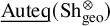 is the group of autoequivalences of the
$\mathrm {CAlg}(\mathrm {LinPr}^{\mathrm {st}}_{\Lambda })$
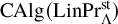 -valued presheaf
$\mathrm {Sh}_{\mathrm {geo}}(-;\Lambda )^{\otimes }$
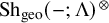 . If we want to stress that
$\underline {\mathrm {Aute}\,\,}\!\!\mathrm {q}(\mathrm {Sh}_{\mathrm {geo}}^{\otimes })$
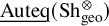 depends on the complex embedding
$\sigma $
 , we will write
$\underline {\mathrm {Aute}\,\,}\!\!\mathrm {q}(\mathrm {Sh}_{\sigma \text {-}\mathrm {geo}}^{\otimes })$
 .
The following is our main theorem for constructible sheaves.
Theorem 2.2.3 (Main theorem for constructible sheaves)
Let k be a field and
$\sigma :k\hookrightarrow \mathbb {C}$
 a complex embedding. There is an equivalence of nonconnective spectral group prestacks

In particular, the right-hand side is a spectral affine group.
Proof. We split the proof into three steps.
Step 1. Using Theorem 1.3.21, it is enough to construct an equivalence of nonconnective spectral group prestacks

where
$\mathcal {B}\in \mathrm {CAlg}(\mathrm {MSh}(k))$
 is the Betti spectrum introduced in Definition 1.4.1. By Proposition 1.6.6, we have an equivalence of
$\mathrm {CAlg}(\mathrm {LinPr}^{\mathrm {st}}_{\Lambda })$
 -valued presheaves

and this equivalence is natural in
$\Lambda $
 . Thus, in Definition 2.2.2, we may as well take the natural transformation
$\mathrm {pt}\to \mathcal {C}$
 sending
$\Lambda $
 to the functor

Now, recall that the nonconnective spectral group prestack
$\underline {\mathrm {Aute}\,\,}\!\!\mathrm {q}(\mathcal {B})$
 is obtained by applying Construction 1.3.18 to
-
○ the functor $\mathcal {D}:\mathrm {CAlg} \to \mathrm {CAT}_{\infty }$
sending
$\Lambda $
to the
$\infty $
-category
$\mathrm {CAlg}(\mathrm {MSh}(k;\Lambda ))$
of commutative algebras in
$\mathrm {MSh}(k;\Lambda )$
, and -
○ the natural transformation $\mathrm {pt}\to \mathcal {D}$
pointing at
$\mathcal {B}_{\Lambda }$
for every
$\Lambda \in \mathrm {CAlg}$
.


There is a natural transformation
$\mathcal {D} \to \mathcal {C}$
 sending
$\Lambda $
 to the functor

taking a commutative algebra
$\mathcal {A}$
 in
$\mathrm {MSh}(k;\Lambda )$
 to the
$\mathrm {CAlg}(\mathrm {LinPr}^{\mathrm {st}}_{\Lambda })$
 -valued presheaf

Moreover, the following triangle of natural transformations

is commutative. Applying Construction 1.3.18 with the functor
$\Delta ^1\times \mathrm {CAlg} \to \mathrm {CAT}_{\infty }$
 corresponding to the natural transformation
$\mathcal {D}\to \mathcal {C}$
 , we obtain a morphism

and it remains to see that this morphism is an equivalence. This will be proven in the next steps.
Step 2. Evaluating the morphism (2.9) at
$\Lambda $
 yields the morphism of groups:

We only need to show that (2.10) induces an equivalence on the underlying spaces.
First, we note that any autoequivalence of the
$\mathrm {CAlg}(\mathrm {LinPr}^{\mathrm {st}}_{\Lambda })$
 -valued presheaf
$\mathrm {MSh}(-;\mathcal {B}_{\Lambda })^{\otimes }$
 is automatically an autoequivalence of étale local
$\Lambda $
 -linear Voevodsky pullback formalisms. Thus, the codomain of the map (2.10) can be rewritten as

where
$\mathrm {PrVPB}_{\acute {\mathrm {e}}\mathrm {t}}(k;\Lambda )$
 is the
$\infty $
 -category introduced in Definition 2.1.11. Applying Corollary 2.1.14, we see that the space (2.11) is equivalent to

Using again that the autoequivalences of the
$\mathrm {CAlg}(\mathrm {Pr}^{\mathrm {L}})$
 -valued presheaf
$\mathrm {MSh}(-;\mathcal {B}_{\Lambda })^{\otimes }$
 belong to
$\mathrm {PrVPB}(k)$
 , we may rewrite the space (2.12) as

Now, remark that we have a commutative triangle

where
$(a)$
 is the map (2.10) modulo the above identifications, and
$(b)$
 is the map induced by evaluating at the final object of
$\mathrm {Sch}_k$
 . It is easy to see that the map
$(c)$
 is induced by the functor

sending a commutative algebra
$\mathcal {A}$
 in
$\mathrm {MSh}(k;\Lambda )$
 to the functor
$\mathrm {MSh}(k;\Lambda )^{\otimes } \to \mathrm {MSh}(k;\mathcal {A})^{\otimes }$
 . By [Reference LurieLur17, Corollary 4.8.5.21], the functor (2.14) is fully faithful, which implies that the map
$(c)$
 is an equivalence. To end the proof, it remains to see that the map
$(b)$
 is an equivalence.
Step 3. To prove that the map
$(b)$
 is an equivalence, we remark that, for every k-variety X, the following square

is cocartesian in
$\mathrm {CAlg}(\mathrm {Pr}^{\mathrm {L}})$
 . Indeed, by the usual formula for the pushout of commutative algebras (which follows from [Reference LurieLur17, Corollary 3.2.3.2 & Proposition 3.2.4.7]), it is enough to show that the base change functor

takes the
$\mathrm {MSh}(k;\Lambda )^{\otimes }$
 -module
$\mathrm {MSh}(k;\mathcal {B}_{\Lambda })$
 to the
$\mathrm {MSh}(X;\Lambda )^{\otimes }$
 -module
$\mathrm {MSh}(X;\mathcal {B}_{\Lambda })$
 . Thus, we are reduced to showing that the obvious functor

is an equivalence. (Note that here, we are free to forget the symmetric monoidal structure on
$\mathrm {MSh}(X;\Lambda )$
 , remembering only its left
$\mathrm {MSh}(k;\Lambda )^{\otimes }$
 -module structure.) The claimed result is then a particular case of [Reference Ben-Zvi, Francis and NadlerBFN10, Proposition 4.1].
It is now easy to prove that the map
$(b)$
 is an equivalence. Indeed, the object

of
$\mathrm {Psh}(\mathrm {Sch}_k;\mathrm {CAlg}(\mathrm {Pr}^{\mathrm {L}}))_{\mathrm {MSh}(-;\Lambda )^{\otimes }/}$
 appears now as the image of the object

by the cobase change functor

(As usual, the subscript “
$\mathrm {cst}$
 ” refers to “constant presheaf”.) The result follows now from Lemma 2.2.4 below.
Lemma 2.2.4. Let
$\mathcal {C}$
 be a small
$\infty $
 -category admitting a final object
$\mathrm {pt}$
 , and let
$\mathcal {D}$
 be an
$\infty $
 -category admitting pushouts. Let
$F\in \mathrm {Psh}(\mathcal {C};\mathcal {D})$
 be a
$\mathcal {D}$
 -valued presheaf on
$\mathcal {C}$
 . Let
$f:A \to B$
 be a map in
$\mathcal {D}$
 , and suppose we are given a pushout square in
$\mathrm {Psh}(\mathcal {C};\mathcal {D})$
 :

Then, the functor
$\mathrm {Psh}(\mathcal {C};\mathcal {D})\to \mathcal {D}$
 , given by evaluating at
$\mathrm {pt}$
 , induces an equivalence of groups:

Proof. Without loss of generality, we may assume that
$A=F(\mathrm {pt})$
 , which implies that
$B=G(\mathrm {pt})$
 . Evaluation at
$\mathrm {pt}$
 gives a map

and we want to show that this map is an equivalence. By construction, the object
$F \to G$
 is the image of the object
$A_{\mathrm {cst}}\to B_{\mathrm {cst}}$
 by the cobase change functor
$\mathrm {Psh}(\mathcal {C};\mathcal {D})_{A_{\mathrm {cst}}/}\to \mathrm {Psh}(\mathcal {C};\mathcal {D})_{F/}$
 which admits a right adjoint given by precomposition with the morphism
$A_{\mathrm {cst}} \to F$
 . Combining this with the fact that
$(-)_{\mathrm {cst}}$
 is left adjoint to evaluating at
$\mathrm {pt}$
 , we obtain the equivalences

It is easy to see that the composite equivalence sends the subspace
$\mathrm {Auteq}_{\mathrm {Psh}(\mathcal {C};\,\mathcal {D})_{F/}}(F \to G)$
 to the subspace
$\mathrm {Auteq}_{\mathcal {D}_{A/}}(A \to B)$
 yielding the map (2.16). It remains to see that this map is surjective on
$\pi _0$
 , which follows from the fact that it admits a section.
Our next task is to derive a version of Theorem 2.2.3 for the classical affine group scheme underlying
$\mathcal {G}_{\mathrm {mot}}(k,\sigma )$
 . For that, we need a “classical” version of Definition 2.2.2.
Definition 2.2.5. Let k be a field and
$\sigma :k\hookrightarrow \mathbb {C}$
 a complex embedding. The (noncommutative) Picard prestack
$\underline {\mathrm {Aute}\,\,}\!\!\mathrm {q}(\mathrm {Sh}_{\mathrm {geo}}^{\heartsuit ,\,\otimes })$
 is the functor sending an ordinary commutative ring
$\Lambda \in \mathrm {CAlg}^{\heartsuit }$
 to the Picard groupoid of autoequivalences of the functor
$\mathrm {Sh}_{\mathrm {geo}}(-;\Lambda )^{\heartsuit ,\,\otimes }$
 from
$(\mathrm {Sch}_k)^{\mathrm {op}}$
 to the
$2$
 -category
$\mathrm {CAlg}(\mathrm {LinPr}^{\mathrm {ord}}_{\Lambda })$
 of ordinary
$\Lambda $
 -linear symmetric monoidal categories. If we want to stress that this depends on the complex embedding
$\sigma $
 , we will write
$\underline {\mathrm {Aute}\,\,}\!\!\mathrm {q}(\mathrm {Sh}^{\heartsuit ,\,\otimes }_{\sigma \text {-}\mathrm {geo}})$
 instead.
Remark 2.2.6. As for
$\infty $
 -categories, we will assume that ordinary
$\Lambda $
 -linear categories are presentable. More precisely, if
$\mathrm {Pr}^{\mathrm {L,\,ord}} \subset \mathrm {Pr}^{\mathrm {L}}$
 denotes the full sub-
$\infty $
 -category of ordinary presentable
$\infty $
 -categories (see [Reference LurieLur09, Remark 5.5.6.21]), then
$\mathrm {LinPr}^{\mathrm {ord}}_{\Lambda }=\mathrm {Mod}_{\mathrm {Mod}^{\heartsuit }_{\Lambda }}(\mathrm {Pr}^{\mathrm {L,\,ord}})$
 . (Compare with Remark 2.1.10.)
Corollary 2.2.7. Let k be a field and
$\sigma :k\hookrightarrow \mathbb {C}$
 a complex embedding. There is an equivalence of classical Picard prestacks

In particular, the right-hand side is an affine group scheme.
Proof. Recall that, for an ordinary commutative ring
$\Lambda $
 , we have
$\mathcal {G}_{\mathrm {mot}}^{\mathrm {cl}}(k,\sigma )(\Lambda )= \mathcal {G}_{\mathrm {mot}}(k,\sigma )(\Lambda )$
 . Thus, by Theorem 2.2.3, it remains to construct equivalences of groups

which are natural in
$\Lambda $
 . We split the proof into three steps.
Step 1. Note that any autoequivalence
$\Theta $
 of the
$\mathrm {CAlg}(\mathrm {CAT}_{\infty })$
 -valued presheaf
$\mathrm {Sh}_{\mathrm {geo}}(-;\Lambda )^{\otimes }$
 has to be t-exact, that is, should respect the natural t-structures on the stable
$\infty $
 -categories
$\mathrm {Sh}_{\mathrm {geo}}(X;\Lambda )$
 , for
$X\in \mathrm {Sch}_k$
 . This follows from the following two observations:
-
○ for any finite extension $l/k$
,
$\Theta $
induces a t-exact autoequivalence of the stable
$\infty $
-category
$\mathrm {Sh}_{\mathrm {geo}}(l;\Lambda )\simeq (\mathrm {Mod}_{\Lambda })^{\hom _k(l,\mathbb {C})}$
since it preserves colimits and the
$\otimes $
-unit, -
○ $\Theta $
commutes with the t-exact functors
$x^*:\mathrm {Sh}_{\mathrm {geo}}(X;\Lambda )\to \mathrm {Sh}_{\mathrm {geo}}(x;\Lambda )$
, for all closed points
$x\in X$
, and these functors reflect t-connectedness and t-truncatedness by Corollary 1.6.35.


In particular, we deduce an equivalence of groups:

Moreover, for every
$X\in \mathrm {Sch}_k$
 , the ordinary category
$\mathrm {Sh}_{\mathrm {geo}}(X;\Lambda )^{\heartsuit }$
 can be identified with the full sub-
$\infty $
 -category of discrete objects in
$\mathrm {Sh}_{\mathrm {geo}}(X;\Lambda )_{\geq 0}$
 . Thus, there is a natural map of groups:

Clearly, the maps (2.18) and (2.19) can be made functorial in the ordinary ring
$\Lambda $
 . Thus, to finish the proof, it suffices to show that the map (2.19) is an equivalence.
Step 2. We first note that the map (2.19) admits a section. Indeed, a symmetric monoidal autoequivalence of the functor
$\mathrm {Sh}_{\mathrm {geo}}(-;\Lambda )^{\heartsuit ,\,\otimes }$
 induces a symmetric monoidal autoequivalence of the functor
$\mathrm {D}(\mathrm {Sh}_{\mathrm {geo}}(-;\Lambda )^{\heartsuit })_{\geq 0}^{\otimes }$
 which, by Theorem 1.6.32, is equivalent to
$\mathrm {Sh}_{\mathrm {geo}}(-;\Lambda )_{\geq 0}^{\otimes }$
 . This actually requires some explanations. First, we need to argue that the monoidal structure on
$\mathrm {Sh}_{\mathrm {geo}}(-;\Lambda )^{\heartsuit ,\,\otimes }$
 can be left derived, and for this we need the existence of flat resolutions. But using the equivalence (1.74), we can reduce to the case
$\Lambda =\mathbb {Z}$
 which can be treated as in the proof of Lemma 1.5.10. Second, we need to construct a natural transformation
$\mathrm {D}(\mathrm {Sh}_{\mathrm {geo}}(-;\Lambda )^{\heartsuit })^{\otimes } \to \mathrm {Sh}_{\mathrm {geo}}(-;\Lambda )^{\otimes }$
 extending the functors considered in Theorem 1.6.32. This can be done as follows. Clearly, we have a natural transformation
$\mathrm {D}(\mathrm {Sh}_{\mathrm {geo}}(-;\Lambda )^{\heartsuit })^{\otimes } \to \mathrm {Sh}((-)^{\mathrm {an}};\Lambda )^{\otimes }$
 . For
$X\in {\mathrm {Sm}}_k$
 , the
$\infty $
 -category
$\mathrm {D}(\mathrm {Sh}_{\mathrm {geo}}(X;\Lambda )^{\heartsuit })$
 is compactly generated (as it follows from Theorem 1.6.32) and the functor
$\mathrm {D}(\mathrm {Sh}_{\mathrm {geo}}(X;\Lambda )^{\heartsuit }) \to \mathrm {Sh}(X^{\mathrm {an}};\Lambda )$
 takes the compact objects to
$\mathrm {Sh}_{\mathrm {geo}}(X;\Lambda )^{\omega }$
 . In this way, we obtain an induced natural transformation
$\mathrm {D}(\mathrm {Sh}_{\mathrm {geo}}(-;\Lambda )^{\heartsuit })^{\omega ,\,\otimes } \to \mathrm {Sh}((-)^{\mathrm {an}};\Lambda )^{\omega ,\,\otimes }$
 and it remains to pass to indization to conclude.
The domain of the map (2.19) is discrete, being equivalent to the set of
$\Lambda $
 -points of the affine group scheme
$\mathcal {G}_{\mathrm {mot}}^{\mathrm {cl}}(k,\sigma )$
 by Theorem 2.2.3 combined with the equivalence (2.18). Since this map admits a section, it follows that its codomain is also discrete. Even more, we see that the functor sending
$\Lambda \in \mathrm {CAlg}^{\heartsuit }$
 to the group

is representable by an affine group scheme which is a split closed subgroup of
$\mathcal {G}_{\mathrm {mot}}^{\mathrm {cl}}(k,\sigma )$
 . To end the proof, we need to show that this closed subscheme is dense, and to do so it is enough to show that this closed subscheme and
$\mathcal {G}_{\mathrm {mot}}^{\mathrm {cl}}(k,\sigma )$
 have the same
$\Lambda $
 -points for every field
$\Lambda $
 of characteristic zero. In this way, we are reduced to showing that the map (2.19) is an equivalence when
$\Lambda $
 is a field of characteristic zero. Under this assumption, the tensor products on the abelian categories
$\mathrm {Sh}_{\mathrm {geo}}(X;\Lambda )^{\heartsuit }$
 , for
$X\in \mathrm {Sch}_k$
 , are exact in each variable.
Step 3. The remainder of the argument consists in quoting some results from [Reference LurieLur18, Appendix C]. Following loc. cit., we denote by
$\mathrm {Groth}_{\infty }$
 the
$\infty $
 -category of Grothendieck prestable
$\infty $
 -categories. This is the full sub-
$\infty $
 -category of
$\mathrm {Pr}^{\mathrm {L}}$
 whose objects are the prestable
$\infty $
 -categories in which filtered colimits are exact; see [Reference LurieLur18, Proposition C.1.4.1, Definitions C.1.4.2 & C.3.0.5]. We also need the wide sub-
$\infty $
 -category
$\mathrm {Groth}^{\mathrm {lex}}_{\infty }\subset \mathrm {Groth}_{\infty }$
 spanned by those functors that are left exact (in addition to being colimit-preserving); see [Reference LurieLur18, Notation C.3.2.3]. We need as well the full sub-
$\infty $
 -categories
$\mathrm {Groth}^{\mathrm {lex},\,\mathrm {sep}}_{\infty }\subset \mathrm {Groth}^{\mathrm {lex}}_{\infty }$
 and
$\mathrm {Groth}^{\mathrm {lex}}_{\mathrm {ab}}\subset \mathrm {Groth}^{\mathrm {lex}}_{\infty }$
 spanned by the separated Grothendieck prestable
$\infty $
 -categories and by the Grothendieck abelian categories respectively; see [Reference LurieLur18, Proposition C.3.6.1 & Definition C.5.4.1]. The
$\infty $
 -categories
$\mathrm {Groth}_{\infty }$
 ,
$\mathrm {Groth}^{\mathrm {lex}}_{\infty }$
 and
$\mathrm {Groth}^{\mathrm {lex}}_{\mathrm {ab}}$
 have natural symmetric monoidal structures, and the inclusion functors to
$\mathrm {Pr}^{\mathrm {L}}$
 are compatible with these structures; see [Reference LurieLur18, Theorem C.4.2.1, Corollary C.4.4.2 & Theorem C.5.4.16]. There is a functor
$(-)_{\mathrm {sep}}:\mathrm {Groth}^{\mathrm {lex}}_{\infty } \to \mathrm {Groth}^{\mathrm {lex},\,\mathrm {sep}}_{\infty }$
 which is left adjoint to the obvious inclusion. By [Reference LurieLur18, Corollary C.4.6.2], there is a unique symmetric monoidal structure on
$\mathrm {Groth}^{\mathrm {lex},\,\mathrm {sep}}_{\infty }$
 such that
$(-)_{\mathrm {sep}}$
 is symmetric monoidal. Now, by [Reference LurieLur18, Theorem C.5.4.9 & Remark C.5.4.10], the construction
$\mathcal {A}\to \mathrm {D}(\mathcal {A})_{\geq 0}$
 defines a fully faithful functor

from the
$2$
 -category
$\mathrm {Groth}_{\mathrm {ab}}^{\mathrm {lex}}$
 of Grothendieck abelian categories and colimit-preserving exact functors. The induced functor

is symmetric monoidal, that is, given two
$\mathbb {Q}$
 -linear Grothendieck abelian categories
$\mathcal {A}$
 and
$\mathcal {A}'$
 , the natural functor

is an equivalence. To see this, we use [Reference LurieLur18, Corollary C.2.1.8] to view
$\mathcal {A}$
 and
$\mathcal {A}'$
 as exact localisations of
$\mathrm {Mod}^{\heartsuit }_R$
 and
$\mathrm {Mod}^{\heartsuit }_{R'}$
 , where R and
$R'$
 are noncommutative ordinary
$\mathbb {Q}$
 -algebras. In this case,
$\mathrm {D}(\mathcal {A})_{\geq 0}$
 and
$\mathrm {D}(\mathcal {A}')_{\geq 0}$
 are exact localisations of
$\mathrm {Mod}^{\mathrm {cn}}_R$
 and
$\mathrm {Mod}^{\mathrm {cn}}_{R'}$
 . The result then follows from the equivalence
$\mathrm {Mod}^{\mathrm {cn}}_R\otimes \mathrm {Mod}^{\mathrm {cn}}_{R'}\simeq \mathrm {Mod}^{\mathrm {cn}}_{R\otimes R'}$
 , noting that
$R\otimes R'$
 is an ordinary
$\mathbb {Q}$
 -algebra (since R and
$R'$
 are flat over
$\mathbb {Q}$
 ). With these recollections, it is now easy to conclude.
From the fully faithful symmetric monoidal embedding (2.21), we obtain, for any ordinary
$\mathbb {Q}$
 -algebra
$\Lambda $
 , a fully faithful embedding

The functor
$\mathrm {Sh}_{\mathrm {geo}}(-;\Lambda )^{\heartsuit ,\,\otimes }$
 can be considered as a
$\mathrm {CAlg}(\mathrm {Groth}_{\mathrm {ab}}^{\mathrm {lex}})_{\mathrm {Mod}^{\heartsuit }_{\Lambda }/}$
 -valued presheaf. Similarly, the functor
$\mathrm {Sh}_{\mathrm {geo}}(-;\Lambda )_{\geq 0}^{\otimes }$
 can be considered as a
$\mathrm {CAlg}(\mathrm {Groth}_{\infty }^{\mathrm {lex},\,\mathrm {sep}})_{\mathrm {Mod}^{\mathrm {cn}}_{\Lambda }/}$
 -valued presheaf. Moreover, the latter is obtained from the former by composing with the fully faithful embedding (2.22). Thus, we obtain an equivalence of groups:

Since any autoequivalence of
$\mathrm {Sh}_{\mathrm {geo}}(X;\Lambda )_{\geq 0}$
 (resp.
$\mathrm {Sh}_{\mathrm {geo}}(X;\Lambda )^{\heartsuit }$
 ) is colimit-preserving and left exact, we see that the map (2.19) coincides with the map (2.23).
By base change to positive characteristic rings, one obtains the following particular case of Corollary 2.2.7.
Corollary 2.2.8. Let k be a field of characteristic zero,
$\overline {k}/k$
 an algebraic closure of k and
$\Lambda $
 a torsion ordinary connected ring. Consider the functor
$\overline {\mathcal {F}}(-;\Lambda ):(\mathrm {Sch}_k)^{\mathrm {op}}\to \mathrm {CAT}_{\mathrm {ord}}$
 sending a k-variety X to the ordinary category of étale sheaves of
$\Lambda $
 -modules on
$X\otimes _k\overline {k}$
 . Then, there is an equivalence of Picard groupoids

In particular, the right-hand side is discrete.
Proof. This follows readily from Corollary 2.2.7. Indeed, fix a complex embedding
$\overline {\sigma }:\overline {k}\to \mathbb {C}$
 and set
$\sigma =\overline {\sigma }|_k$
 . By Theorem 1.4.10,
$\mathcal {G}_{\mathrm {mot}}^{\mathrm {cl}}(k,\sigma )_{\Lambda }$
 is isomorphic to the constant affine group scheme associated to the profinite group
$\mathcal {G}(\overline {k}/k)$
 . On the other hand, for every
$X\in \mathrm {Sch}_k$
 , the category
$\overline {\mathcal {F}}(X;\Lambda )$
 is equivalent to
$\mathrm {Sh}_{\mathrm {geo}}(X;\Lambda )^{\heartsuit }$
 by Corollary 1.6.10.
Remark 2.2.9. The proof we gave of Corollary 2.2.8 is not satisfactory. Indeed, there is an elementary direct argument, valid for any ground field k and any ordinary commutative ring
$\Lambda $
 , which can be obtained by following the same strategy used for proving Theorem 2.2.3. Indeed, the Drew–Gallauer universality theorem for
$\mathrm {MSh}(-;\Lambda )^{\otimes }$
 admits a version for the functor
$\mathcal {F}(-;\Lambda )$
 sending a k-variety X to the category of étale sheaves of
$\Lambda $
 -modules on X. (In such a version, one asks that
$f^*$
 admits a left adjoint
$f_{\sharp }$
 just when f is étale.) Using that
$\overline {\mathcal {F}}(X;\Lambda )$
 is equivalent to the category of
$e_*\Lambda $
 -modules in
$\mathcal {F}(X;\Lambda )$
 , where
$e:\mathrm {Spec}(\overline {k})\to \mathrm {Spec}(k)$
 is the obvious morphism, we deduce that the autoequivalences of
$\overline {\mathcal {F}}(-;\Lambda )$
 correspond to the automorphisms of the commutative algebra
$e_*\Lambda \in \mathrm {CAlg}(\mathcal {F}(k;\Lambda ))$
 which can be identified with the elements of
$\mathcal {G}(\overline {k}/k)$
 . We leave the details to the interested reader.
2.3 A complement to the main theorem
In this subsection, we derive an interesting complement to our main theorem for constructible sheaves. Fix a ground field k and a complex embedding
$\sigma :k\hookrightarrow \mathbb {C}$
 .
Notation 2.3.1. We write
$\mathcal {G}_{\mathrm {mot}}(k,\sigma )_{\bullet }$
 for the simplicial object in
$\mathrm {SpAFF}$
 defining the spectral affine group
$\mathcal {G}_{\mathrm {mot}}(k,\sigma )$
 . Let
$\mathrm {B}\mathcal {G}_{\mathrm {mot}}(k,\sigma )$
 be the spectral prestack sending
$\Lambda \in \mathrm {CAlg}^{\mathrm {cn}}$
 to the space

Below, we will consider
$\mathrm {B}\mathcal {G}_{\mathrm {mot}}(k,\sigma )$
 as a functor from
$\mathrm {CAlg}^{\mathrm {cn}}$
 to
$\infty $
 -groupoids and, in particular, to
$\infty $
 -categories. Given a connective commutative ring spectrum
$\Lambda $
 , we denote by
$\mathrm {B}\mathcal {G}_{\mathrm {mot}}(k,\sigma )_{\Lambda }$
 the restriction of
$\mathrm {B}\mathcal {G}_{\mathrm {mot}}(k,\sigma )$
 to
$\mathrm {CAlg}^{\mathrm {cn}}_{\Lambda }$
 .
The following is a “connective” version of Notation 2.2.1.
Notation 2.3.2. We denote by
$\mathrm {LinPr}_{(-)}^{\otimes }:\mathrm {CAlg}^{\mathrm {cn}} \to \mathrm {CAlg}(\mathrm {CAT}_{\infty })$
 the functor sending a connective commutative ring spectrum
$\Lambda $
 to the symmetric monoidal
$\infty $
 -category
$\mathrm {LinPr}_{\Lambda }^{\otimes }= \mathrm {Mod}_{\mathrm {Mod}_{\Lambda }^{\mathrm {cn},\,\otimes }}(\mathrm {Pr}^{\mathrm {L}})^{\otimes }$
 of
$\Lambda $
 -linear
$\infty $
 -categories. (See Remark 2.1.10.) We deduce from
$\mathrm {LinPr}_{(-)}^{\otimes }$
 another functor, namely
$\mathrm {CAlg}(\mathrm {LinPr}_{(-)}):\mathrm {CAlg}^{\mathrm {cn}} \to \mathrm {CAT}_{\infty }$
 which we can identify with
$\mathrm {CAlg}(\mathrm {Pr}^{\mathrm {L}})_{\mathrm {Mod}_{(-)}^{\mathrm {cn},\,\otimes }/}$
 . (This identification follows from [Reference LurieLur17, Corollary 3.4.1.7].)
In the statement below, we consider the functor

sending
$\Lambda $
 to the
$\infty $
 -category
$\mathrm {Psh}(\mathrm {Sch}_k;\mathrm {CAlg}(\mathrm {LinPr}_{\Lambda }))$
 of
$\mathrm {CAlg}(\mathrm {LinPr}_{\Lambda })$
 -valued presheaves on
$\mathrm {Sch}_k$
 . Note that we have a natural transformation

pointing at
$\mathrm {Sh}_{\mathrm {geo}}(-;\Lambda )^{\otimes }$
 for every
$\Lambda \in \mathrm {CAlg}^{\mathrm {cn}}$
 .
Theorem 2.3.3. There is a natural transformation of functors from
$\mathrm {CAlg}^{\mathrm {cn}}$
 to
$\mathrm {CAT}_{\infty }$


extending the natural transformation (2.24). Moreover, for every
$\Lambda \in \mathrm {CAlg}^{\mathrm {cn}}$
 , the corresponding functor

induces an equivalence between its domain and the full sub-
$\infty $
 -groupoid of its codomain spanned by the object
$\mathrm {Sh}_{\mathrm {geo}}(-;\Lambda )^{\otimes }$
 .
Proof. It follows immediately from Construction 1.3.18 and Remark 1.3.17 that there is a natural transformation

with the required property. Thus, the result follows from Theorem 2.2.3.
Construction 2.3.4. The natural transformation (2.25) gives rise by adjunction to another natural transformation

of functors from
$\mathrm {CAlg}^{\mathrm {cn}}$
 to
$\mathrm {CAT}_{\infty }$
 . Applying Lurie’s unstraightening [Reference LurieLur09, §3.2] to the functor
$\mathrm {B}\mathcal {G}_{\mathrm {mot}}(k,\sigma )$
 , we obtain the cocartesian fibration

which is in fact a left fibration. Similarly, applying Lurie’s unstraightening [Reference LurieLur09, §3.2] to the functor
$\mathrm {CAlg}(\mathrm {LinPr}_{(-)})$
 , we obtain a cocartesian fibration

The morphism (2.26) induces a commutative triangle

where
$r:(\mathrm {Sch}_k)^{\mathrm {op}}\times \Phi \to \Phi $
 is the projection to the second factor and h is a functor preserving cocartesian edges. There is a functor
$l:\Psi \to \mathrm {CAlg}(\mathrm {Pr}^{\mathrm {L}})$
 whose restriction to the fibre at
$\Lambda \in \mathrm {CAlg}^{\mathrm {cn}}$
 is the obvious forgetful functor
$\mathrm {CAlg}(\mathrm {LinPr}_{\Lambda })\to \mathrm {CAlg}(\mathrm {Pr}^{\mathrm {L}})$
 . Consider the composite functor

Note that this functor sends a triple
$(X,\Lambda ,\star )$
 , with
$X\in \mathrm {Sch}_k$
 ,
$\Lambda \in \mathrm {CAlg}^{\mathrm {cn}}$
 and
$\star $
 the base point of
$\mathrm {B}\mathcal {G}_{\mathrm {mot}}(k,\sigma )(\Lambda )$
 , to the symmetric monoidal
$\infty $
 -category
$\mathrm {Sh}_{\mathrm {geo}}(X;\Lambda )^{\otimes }$
 . By adjunction, we deduce a functor

We denote by

the functor obtained from the functor (2.28) by composition with the limit functor

Informally, for
$X\in \mathrm {Sch}_k$
 , an object of the
$\infty $
 -category
$\mathrm {Sh}^{\mathcal {G}_{\mathrm {mot}}}_{\mathrm {geo}}(X)$
 is an object
$M\in \mathrm {Sh}_{\mathrm {geo}}(X)$
 endowed with compatible equivalences
$M\otimes \Lambda \simeq \gamma ^*(M\otimes \Lambda )$
 for every
$\Lambda \in \mathrm {CAlg}^{\mathrm {cn}}$
 and
$\gamma \in \mathcal {G}_{\mathrm {mot}}(k,\sigma )(\Lambda )$
 . Said differently,
$\mathrm {Sh}^{\mathcal {G}_{\mathrm {mot}}}_{\mathrm {geo}}(X)$
 is the
$\infty $
 -category of sheaves of geometric origin fixed by the action of the spectral affine group
$\mathcal {G}_{\mathrm {mot}}(k,\sigma )$
 on the
$\infty $
 -category
$\mathrm {Sh}_{\mathrm {geo}}(X)$
 .
Proposition 2.3.5. The functor
$\mathrm {Sh}_{\mathrm {geo}}^{\mathcal {G}_{\mathrm {mot}}}(-)^{\otimes }$
 in (2.29) is a presentable Voevodsky pullback formalism and the forgetful functors yield a morphism

of presentable six-functor formalisms over k in the sense of Definition 1.1.19.
Proof. This is a consequence of the fact that limits of
$\infty $
 -categories have good formal properties. Inspecting Definitions 1.1.16 and 1.1.19, we see that it suffices to show that the squares

are right adjointable for all morphisms
$f:Y \to X$
 in
$\mathrm {Sch}_k$
 and left adjointable for all smooth ones. This follows easily from [Reference LurieLur17, Corollary 4.7.4.18]. Indeed, the functor

deduced from the functor (2.27) by restricting along
$(f,\mathrm {id}):\Delta ^1\times \Phi \to (\mathrm {Sch}_k)^{\mathrm {op}}\times \Phi $
 and using adjunction, factors through
$\mathrm {Fun}^{\mathrm {RAd}} (\Delta ^1,\mathrm {CAT}_{\infty })$
 ; see [Reference LurieLur17, Definition 4.7.4.16]. (This follows from the fact that the
$\mathrm {B}\mathcal {G}_{\mathrm {mot}}(k,\sigma )(\Lambda )$
 ’s are
$\infty $
 -groupoids and that the operation
$f_*$
 on sheaves of geometric origin commutes with extension of scalars.) Consider a limit diagram

extending the diagram (2.32). By construction, the cone point of
$\Phi ^{\lhd }$
 is mapped to the functor
$f^*:\mathrm {Sh}_{\mathrm {geo}}^{\mathcal {G}_{\mathrm {mot}}}(X) \to \mathrm {Sh}_{\mathrm {geo}}^{\mathcal {G}_{\mathrm {mot}}}(Y)$
 . By [Reference LurieLur17, Corollary 4.7.4.18], the diagram (2.33) factors through
$\mathrm {Fun}^{\mathrm {RAd}}(\Delta ^1,\mathrm {CAT}_{\infty })$
 . Since the square (2.31) is the image of the edge relating the cone point of
$\Phi ^{\lhd }$
 to the object
$(\mathbb {S},\star )$
 of
$\Phi $
 , the result follows. When f is smooth, the functor (2.32) factors through
$\mathrm {Fun}^{\mathrm {LAd}}(\Delta ^1,\mathrm {CAT}_{\infty })$
 , and we may conclude similarly.
Corollary 2.3.6. There is a morphism

of presentable six-functor formalisms over k.
Proof. It follows from Theorem 2.1.9 and Proposition 2.3.5 that there is a morphism of presentable Voevodsky pullback formalisms
$\mathrm {B}^{\mathcal {G}_{\mathrm {mot}}}$
 as in the statement. It remains to prove its compatibility with ordinary direct images. This follows from Theorem 1.2.15 and the fact that the forgetful functors in (2.30) are conservative and commute with ordinary direct images.
Remark 2.3.7. For
$X\in \mathrm {Sch}_k$
 , it is expected that the functor
$\mathrm {B}^{\mathcal {G}_{\mathrm {mot}}}:\mathrm {MSh}(X)\to \mathrm {Sh}_{\mathrm {geo}}^{\mathcal {G}_{\mathrm {mot}}}(X)$
 induces an equivalence between the
$\infty $
 -category
$\mathrm {MSh}(X)^{\mathrm {cons}}$
 of constructible motivic sheaves and the
$\infty $
 -category
$\mathrm {Sh}_{\mathrm {geo}}^{\mathcal {G}_{\mathrm {mot}}}(X)^{\mathrm {cons}}$
 of constructible sheaves of geometric origin fixed by
$\mathcal {G}_{\mathrm {mot}}(k,\sigma )$
 . This property would imply the conservativity conjecture (see for example [Reference AyoubAyo17b, §2.1]).
Since
$\mathcal {G}_{\mathrm {mot}}(k,\sigma )$
 is affine, it is possible to describe the
$\infty $
 -categories
$\mathrm {Sh}_{\mathrm {geo}}^{\mathcal {G}_{\mathrm {mot}}}(-)^{\otimes }$
 more simply. This is explained in the following remark.
Remark 2.3.8. By construction,
$\mathrm {B}\mathcal {G}_{\mathrm {mot}}(k,\sigma )$
 is the colimit of
$\mathcal {G}_{\mathrm {mot}}(k,\sigma )_{\bullet }$
 taken in the
$\infty $
 -category of spectral prestacks. Thus, with the notation of Construction 2.3.4, the cosimplicial diagram
$\mathcal {H}_{\mathrm {mot}}(k,\sigma )^{\bullet }:\boldsymbol {\Delta } \to \mathrm {CAlg}^{\mathrm {cn}}$
 admits a canonical lift to
$\Phi $
 , that is, there is a commutative triangle

Moreover,
$\rho $
 induces an equivalence between the colimits of the diagrams
$p^{\mathrm {op}}:\Phi ^{\mathrm {op}}\to \mathrm {SpAFF}$
 and
$\mathcal {G}_{\mathrm {mot}}(k,\sigma )_{\bullet }$
 taken in the
$\infty $
 -category of spectral prestacks. Thus, composing
$\rho $
 with the functor (2.27), one obtains a functor

and an equivalence

of
$\mathrm {CAlg}(\mathrm {Pr}^{\mathrm {L}})$
 -valued presheaves on
$\mathrm {Sch}_k$
 . It is important to note here that the functor (2.34) is by no means the obvious one obtained by applying
$\mathrm {Sh}_{\mathrm {geo}}(-;-)^{\otimes }$
 to the cosimplicial ring spectrum
$\mathcal {H}_{\mathrm {mot}}(k,\sigma )^{\bullet }$
 . In fact, this functor encodes the action of
$\mathcal {G}_{\mathrm {mot}}(k,\sigma )$
 on
$\mathrm {Sh}_{\mathrm {geo}}(-)^{\otimes }$
 .
Remark 2.3.9. There is also an “ordinary” version of the previous results, where
$\mathcal {G}_{\mathrm {mot}}(k,\sigma )$
 is replaced with its underlying ordinary group scheme
$\mathcal {G}_{\mathrm {mot}}^{\mathrm {cl}}(k,\sigma )$
 . More precisely, replacing
$\mathrm {CAlg}^{\mathrm {cn}}$
 and
$\mathcal {G}_{\mathrm {mot}}(k,\sigma )$
 with
$\mathrm {CAlg}^{\heartsuit }$
 and
$\mathcal {G}_{\mathrm {mot}}^{\mathrm {cl}}(k,\sigma )$
 in Construction 2.3.4, we obtain a functor

Arguing as in Proposition 2.3.5, we see that this functor is a
$\mathbb {Z}$
 -linear Voevodsky pullback formalism, and the obvious natural transformation

is a morphism of presentable six-functor formalisms. Arguing as in Remark 2.3.8, we also obtain the following simpler description

Let
$\boldsymbol {\Delta }'\subset \boldsymbol {\Delta }$
 be the wide subcategory of strictly increasing maps. The obvious inclusion is coinitial by [Reference LurieLur09, Lemma 6.5.3.7], and thus we also have an equivalence

Since
$\mathcal {G}_{\mathrm {mot}}^{\mathrm {cl}}(k,\sigma )$
 is a flat affine group scheme over
$\mathbb {Z}$
 , we see that the semi-cosimplicial diagram

lifts to a diagram of stable
$\infty $
 -categories with t-structures and t-exact functors. Thus, for
$X\in \mathrm {Sch}_k$
 , the stable
$\infty $
 -category
$\mathrm {Sh}_{\mathrm {geo}}^{\mathcal {G}_{\mathrm {mot}}^{\mathrm {cl}}}(X;\mathbb {Z})$
 admits a t-structure such that

By [Reference Choudhury and GallauerCG17, Theorem 9.1], the abelian category
$\mathrm {Sh}_{\mathrm {geo}}^{\mathcal {G}_{\mathrm {mot}}^{\mathrm {cl}}}(k;\mathbb {Z})^{\heartsuit }$
 is equivalent to the abelian category of ind-Nori motives. Thus, an object of the
$\infty $
 -category (2.40) whose underlying sheaf is constructible is entitled to be called a Nori motivic sheaf on X. See [Reference ArapuraAra13], [Reference ArapuraAra23], [Reference IvorraIvo17] and [Reference Ivorra and MorelIM24] for other approaches to the notion of Nori motivic sheaves.
Remark 2.3.10. Given a commutative ring spectrum
$\Lambda $
 , one can also define a
$\Lambda $
 -linear Voevodsky pullback formalism

Indeed, we have a natural transformation

of functors from
$\mathrm {CAlg}_{\Lambda }$
 to
$\mathrm {CAT}_{\infty }$
 , and we can use it in place of the natural transformation (2.26) in Construction 2.3.4. Alternatively, we have an equivalence

as explained in Remark 2.3.8. The obvious
$\Lambda $
 -linear versions of Proposition 2.3.5 and Corollary 2.3.6 hold true. In fact, by Lemma 1.4.5 and Remark 1.6.3, there is an equivalence

of
$\mathrm {CAlg}(\mathrm {LinPr}^{\mathrm {st}}_{\Lambda })$
 -valued presheaves on
$\mathrm {Sch}_k$
 .
3 Monodromic specialisation, stratification and exit-path
In this section, we develop the machinery needed in Section 4 to prove that
$\mathcal {G}_{\mathrm {mot}}(k,\sigma )$
 is the group of autoequivalences of the functor
$\mathrm {LS}_{\mathrm {geo}}^{\otimes }$
 ; see Theorem 4.4.2. Given a smoothly stratified k-variety X (in the sense of Definition 3.1.6), this machinery provides a description of the
$\infty $
 -category
$\mathrm {Sh}_{\mathrm {ct}\text {-}\mathrm {geo}}(X)$
 of sheaves of geometric origin that are ind-dualizable on the strata of X. This description is expressed in terms of
$\infty $
 -categories
$\mathrm {LS}_{\mathrm {geo}}(\mathrm {N}^{\circ }_{\overline {C}_-}(C_0))$
 of ind-local systems of geometric origin on certain k-varieties
$\mathrm {N}^{\circ }_{\overline {C}_-}(C_0)$
 associated with pairs of strata
$C_-\succeq C_0$
 in X (see Notation 3.1.13). More precisely, in Subsection 3.6, we construct a functor
$(C_-,C_0) \to \mathrm {LS}_{\mathrm {geo}}(\mathrm {N}^{\circ }_{\overline {C}_-}(C_0))$
 , denoted by
$\mathrm {LS}^{\Psi }_{\mathrm {geo}}$
 , which encodes the functoriality of the nearby cycle functors. We then identify
$\mathrm {Sh}_{\mathrm {ct}\text {-}\mathrm {geo}}(X)$
 with an explicit sub-
$\infty $
 -category of the lax limit of
$\mathrm {LS}^{\Psi }_{\mathrm {geo}}$
 , viewed as a diagram indexed by pairs of strata of X. This is the content of Corollary 3.8.18, which may be viewed as an exit-path theorem. To make this identification functorial in X, we are led to introduce the category
${\mathrm {Sm}}\Sigma ^{\mathrm {dm}}_k$
 of demarcated smoothly stratified k-varieties; see Definition 3.6.1. The reader interested only in the proof of Theorem 4.4.2 may treat Corollary 3.8.18 as a black box, and move directly to Section 4, returning to the present section when needed. Since this section is rather long, we provide a brief overview of its contents. Subsection 3.1 studies regularly stratified schemes and their deformations to the normal cone associated with strata. In Subsection 3.2, we construct monodromic specialisation functors over regularly stratified schemes and establish their basic properties. More involved coherence results are deferred to Subsection 3.6. Our exit-path theorem is established in Subsection 3.7. As we expect the results of this section to be useful in other contexts, we made an effort to develop them for a general class of Voevodsky pullback formalisms. This led us to formulate a general notion of logarithmicity and tameness for local systems, which we study in Subsections 3.3 and 3.4. Finally, in Subsection 3.8, we specialise to the Betti setting, where we prove that tameness is automatic.
3.1 Regularly stratified varieties and deformations to normal cones
In this subsection, we gather some geometric constructions needed in the remainder of this section. We start by recalling the notion of a stratification.
Definition 3.1.1. Let X be a noetherian spectral space (see for example [Sta20, Tag 08YF]). A stratification
$\mathcal {P}$
 of X is a set of connected and locally closed subspaces of X, called
$\mathcal {P}$
 -strata, such that the following conditions are satisfied.
-
(i) The $\mathcal {P}$
-strata form a partition of X, that is, we have a set-theoretic decomposition
$X=\coprod _{S\in \mathcal {P}} S$
. -
(ii) The closure of a $\mathcal {P}$
-stratum is a union of
$\mathcal {P}$
-strata.


A subset
$C\subset X$
 is called
$\mathcal {P}$
 -constructible if it is a union of
$\mathcal {P}$
 -strata.
Remark 3.1.2. Let X be a noetherian spectral space.
-
(i) Let $\mathcal {P}$
be a stratification of X. The set
$\mathcal {P}$
of
$\mathcal {P}$
-strata is finite. We define a partial order
$\preceq $
on
$\mathcal {P}$
by setting
$T\preceq S$
if
$T\subset \overline {S}$
. A
$\mathcal {P}$
-stratum is maximal (resp. minimal) for this partial order if and only if it is open (resp. closed). Moreover, the union of open
$\mathcal {P}$
-strata is dense in X. -
(ii) Let $\mathcal {P}$
and
$\mathcal {Q}$
be two stratifications on X. We say that
$\mathcal {Q}$
is finer than
$\mathcal {P}$
if every
$\mathcal {P}$
-constructible subset is
$\mathcal {Q}$
-constructible. More generally, a continuous map
$f:Y \to X$
of noetherian spectral spaces is said to be compatible with stratifications
$\mathcal {P}$
and
$\mathcal {Q}$
on X and Y if the inverse image of a
$\mathcal {P}$
-constructible subset is
$\mathcal {Q}$
-constructible. In this case, there is an induced map
$f_*:\mathcal {Q}\to \mathcal {P}$
sending a
$\mathcal {Q}$
-stratum D to the unique
$\mathcal {P}$
-stratum C such that
$f(D)\subset C$
. -
(iii) Given a finite family $(Z_i)_{i\,\in \, I}$
of closed subsets of X, there is a coarsest stratification on X for which the
$Z_i$
’s are constructible. The strata of this stratification are the connected components of the subsets
$(\bigcap _{j\,\in \, J} Z_j)\smallsetminus (\bigcup _{i\,\in \, I\smallsetminus J} Z_i)$
for
$J\subset I$
.


Definition 3.1.3. A stratified scheme is a pair
$(X,\mathcal {P}_X)$
 consisting of a noetherian scheme X and a stratification
$\mathcal {P}_X$
 of the topological space underlying X, which we call the structural stratification. Unless stated otherwise, we view the strata as reduced locally closed subschemes of X in the obvious way. Whenever possible, we omit mentioning the structural stratifications. A morphism of stratified schemes
$f:Y \to X$
 is a morphism of schemes which is compatible with the structural stratifications (as in Remark 3.1.2(ii)).
Remark 3.1.4.
-
(i) If no confusion can arise, the $\mathcal {P}_X$
-strata of a stratified scheme X are simply called the strata of X. Similarly, the
$\mathcal {P}_X$
-constructible subsets of X are simply called the constructible subsets of X. -
(ii) Let S be a base scheme. By the expression “stratified S-scheme”, we mean a stratified scheme whose underlying scheme is endowed with a morphism to S. The same applies to the expression “morphism of stratified S-schemes”.


Notation 3.1.5. Let X be a stratified scheme. We denote by
$X^{\circ }$
 the union of the open strata of X. As said in Remark 3.1.2(i), this is a dense open subset of X which we view as an open subscheme.
Definition 3.1.6.
-
(i) Let X be a regular noetherian scheme. A stratification $\mathcal {P}$
on X is said to be regular if there exists a strict normal crossings divisor D on X whose irreducible components are
$\mathcal {P}$
-constructible and such that
$\mathcal {P}$
is the coarsest stratification on X with this property. (Said differently, if
$(D_i)_{\in I}$
are the irreducible components of D, then the
$\mathcal {P}$
-strata are the connected components of the subsets
$(\bigcap _{j\,\in \, J} D_j)\smallsetminus (\bigcup _{i\,\in \, I\smallsetminus J} D_i)$
, for
$J\subset I$
, as in Remark 3.1.2(iii).) -
(i′) A regularly stratified scheme X is a stratified scheme X whose underlying scheme is regular and whose structural stratification $\mathcal {P}_X$
is also regular. -
(ii) Let S be a noetherian scheme and X a smooth S-scheme. A stratification $\mathcal {P}$
on X is said to be smooth (over S) if there exists a relative normal crossings divisor D on X which is a union of
$\mathcal {P}$
-constructible smooth divisors and such that
$\mathcal {P}$
is the coarsest stratification on X with this property. -
(ii′) Let S be a noetherian scheme. A smoothly stratified S-scheme is a stratified S-scheme X whose underlying S-scheme is smooth and whose structural stratification $\mathcal {P}_X$
is also smooth.


Notation 3.1.7. We denote by
$\mathrm {SCH}\Sigma $
 the category of stratified schemes and by
$\mathrm {REG}\Sigma $
 its full subcategory of regularly stratified schemes. Let S be a noetherian scheme. We denote by
$\mathrm {Sch}\Sigma _S$
 the category of finite type stratified S-schemes. We denote by
$\mathrm {Reg}\Sigma _S$
 (resp.
${\mathrm {Sm}}\Sigma _S$
 ) the full subcategory of
$\mathrm {Sch}\Sigma _S$
 spanned by the regularly stratified S-schemes (resp. the smoothly stratified S-schemes). If A is a ring and
$S=\mathrm {Spec}(A)$
 , we write
$\mathrm {Sch}\Sigma _A$
 ,
$\mathrm {Reg}\Sigma _A$
 and
${\mathrm {Sm}}\Sigma _A$
 instead. Note that for a perfect field k, we have
${\mathrm {Sm}}\Sigma _k=\mathrm {Reg}\Sigma _k$
 .
Our next task is to introduce a version of the classical deformation to the normal cone which plays a key role in the whole section. This is the subject of Construction 3.1.10 below; the relation with the classical deformation to the normal cone is explained in Remark 3.1.12. We start by introducing some useful notations.
Notation 3.1.8. Let X be a regularly stratified scheme and let C be a stratum of X. We denote by
$\mathrm {R}_X^{\circ }(C)$
 the group of Cartier divisors of X freely generated by the irreducible constructible divisors of X containing C. (Said differently, a basis of this group consists of the
$\overline {D}$
 ’s, for the
$1$
 -codimensional strata D of X such that
$C\preceq D$
 .) We denote by
$\mathrm {R}_X(C)\subset \mathrm {R}_X^{\circ }(C)$
 the submonoid of effective Cartier divisors. We set

(Here, the
$\mathbf {t}^v$
 ’s are considered as monomials satisfying
$\mathbf {t}^v\cdot \mathbf {t}^{v'}=\mathbf {t}^{v+v'}$
 .) Thus,
$\mathrm {T}^{\circ }_X(C)$
 is the split torus dual to the lattice
$\mathrm {R}_X^{\circ }(C)$
 and we have an equivariant embedding
$\mathrm {T}^{\circ }_X(C) \hookrightarrow \mathrm {T}_X(C)$
 . Such an embedding will be called a split torus-embedding; see Definition 3.6.4 below. In fact,
$\mathrm {T}_X(C)$
 is isomorphic to
$\mathbb {A}^c$
 , with c the codimension of C in X, and
$\mathrm {T}^{\circ }_X(C)$
 corresponds to the complement of the union of the coordinate hyperplanes. We use this to consider
$\mathrm {T}_X(C)$
 as a regularly stratified scheme, with open stratum
$\mathrm {T}^{\circ }_X(C)$
 . We denote by
$\mathrm {o}_C$
 the unique closed stratum of
$\mathrm {T}_X(C)$
 ; it is isomorphic to
$\mathrm {Spec}(\mathbb {Z})$
 . Often, when working over a base scheme S, we continue to write
$\mathrm {T}^{\circ }_X(C)$
 ,
$\mathrm {T}_X(C)$
 and
$\mathrm {o}_C$
 for the base change of these schemes to S.
Notation 3.1.9. Let X be a regular scheme. As usual, given an irreducible divisor D on X, we denote by
$\mathcal {O}_X(D)$
 the fractional ideal associated to D, that is, the inverse of the ideal of
$\mathcal {O}_X$
 defining D. More generally, if
$v=e_1\cdot D_1+\ldots +e_n\cdot D_n$
 is a Cartier divisor on X, we set
$\mathcal {O}_X(v)=\mathcal {O}_X(D_1)^{e_1}\cdots \mathcal {O}_X(D_n)^{e_n}$
 . (Note that
$\mathcal {O}_X(v)$
 is an ideal of
$\mathcal {O}_X$
 if and only if
$-v$
 is effective.)
Construction 3.1.10. Let X be a regularly stratified scheme and let C be a stratum of X. We set

By construction, we have an evident morphism
$\mathrm {Df}_X(C)\to X\times \mathrm {T}_X(C)$
 , and cartesian squares

The scheme
$\mathrm {Df}_X(C)$
 is regular and the open subscheme
$\mathrm {Df}^{\circ }_X(C)\subset \mathrm {Df}_X(C)$
 is the complement of a strict normal crossings divisor. We use this to make
$\mathrm {Df}_X(C)$
 into a regularly stratified scheme so that
$\mathrm {Df}^{\circ }_X(C)$
 is its open stratum. Note also that the obvious action of
$\mathrm {T}^{\circ }_X(C)$
 on
$\mathrm {Df}^{\circ }_X(C)$
 extends to an action on
$\mathrm {Df}_X(C)$
 . (Indeed,
$\mathrm {Df}_X(C)$
 is the spectrum of an
$\mathrm {R}^{\circ }_X(C)$
 -graded
$\mathcal {O}_X$
 -algebra.)
Construction 3.1.11. Let X be a regularly stratified scheme and let C be a stratum of X. Let
$D\subset X$
 be an irreducible constructible divisor containing C, corresponding to an element
$v\in \mathrm {R}_X(C)$
 . The ideal of
$\mathcal {O}_{\mathrm {Df}_X(C)}$
 generated by the sections of
$\mathcal {O}_X(-v)\cdot \mathbf {t}^{-v}$
 is the ideal of an irreducible smooth divisor
$D^{\flat }\subset \mathrm {Df}_X(C)$
 , namely the closure of
$D\times \mathrm {T}^{\circ }_X(C)$
 in
$\mathrm {Df}_X(C)$
 . We define the constructible open subset
$\mathrm {Df}^{\flat }_X(C)\subset \mathrm {Df}_X(C)$
 as the complement of the union of the divisors
$D^{\flat }$
 , for
$D\subset X$
 irreducible constructible and containing C. Using the second equality in (3.1), we readily obtain the following description:

Thus, the X-scheme
$\mathrm {Df}^{\flat }_X(C)$
 is a torsor under
$\mathrm {T}^{\circ }_X(C)$
 . In particular, the morphism
$\mathrm {Df}^{\flat }_X(C) \to X$
 is smooth.
Remark 3.1.12. Keep the notation as above. Let
$D_1,\ldots , D_c$
 be the irreducible constructible divisors containing C. For
$1\leq i \leq c$
 , we have the classical deformation to the normal cone of
$D_i$
 , which we denote by
$W_i$
 . Recall that
$W_i$
 is the complement of the strict transform of
$\mathrm {o}\times X$
 in the blowup of
$\mathbb {A}^1\times X$
 along
$\mathrm {o}\times D_i$
 , that is,

It follows immediately that
$\mathrm {Df}_X(C)$
 is the fibre product of the
$W_i$
 ’s over X. Also, letting
$\widetilde {D}_i$
 be the strict transform of
$\mathbb {A}^1\times D_i$
 in
$W_i$
 , the open subscheme
$\mathrm {Df}^{\flat }_X(C)$
 corresponds to the fibre product of the
$W_i\smallsetminus \widetilde {D}_i$
 ’s. The main reason for introducing the scheme
$\mathrm {Df}_X(C)$
 the way we did in Construction 3.1.10 is to render its naturality in X and C more transparent; see Theorem 3.1.29 below.
Notation 3.1.13. Let X be a regularly stratified scheme and let C be a stratum of X. We set

where
$X'\subset X$
 is the smallest constructible open neighbourhood of
$\overline {C}$
 in X. This is a constructible closed subscheme of
$\mathrm {Df}_{X'}(C)$
 , and hence inherits a stratification. We write
$\mathrm {N}^{\circ }_X(C)$
 instead of
$\mathrm {N}_X(C)^{\circ }$
 and set
$\mathrm {N}^{\flat }_X(C)=\mathrm {Df}^{\flat }_X(C)\cap \mathrm {N}_X(C)$
 . Note that
$\mathrm {T}^{\circ }_X(C)=\mathrm {T}^{\circ }_{X'}(C)$
 acts naturally on
$\mathrm {N}_X(C)$
 .
Lemma 3.1.14. Let X be a regularly stratified scheme and let C be a stratum of X. Let
$D_1,\ldots , D_c$
 be the irreducible constructible divisors containing C. For
$1\leq i \leq c$
 , let
$N_i \to D_i$
 be the normal bundle of the closed immersion
$D_i\to X$
 . Then,
$\mathrm {N}_X(C)$
 is isomorphic to

endowed with the coarsest stratification
$\mathcal {P}$
 for which the inverse images of the zero sections of the
$N_i$
 ’s and the inverse images of the irreducible components of
$\overline {C}\smallsetminus C$
 are
$\mathcal {P}$
 -constructible. Moreover, we have the following properties.
-
(i) The locally closed subscheme $\mathrm {N}_X(C) \subset \mathrm {Df}_X(C)$
is actually closed, and is isomorphic to the normal cone of the closed immersion
$\overline {C}\to X$
. -
(ii) $\mathrm {N}_X(C)$
is regularly stratified and
$\mathrm {N}^{\flat }_X(C)$
is a torsor under
$\mathrm {T}^{\circ }_X(C)$
defined over
$\overline {C}$
.


Proof. If C is open, we have
$\mathrm {N}_X(C)=\overline {C}$
 , and there is nothing to prove. Thus, we may assume that C has codimension
$\geq 1$
 . A direct computation shows that
$\mathrm {N}_X(C)$
 (resp.
$\mathrm {N}^{\flat }_X(C)$
 ) is isomorphic to the spectrum of the
$\mathrm {R}^{\circ }_X(C)$
 -graded
$\mathcal {O}_{\overline {C}}$
 -algebra

where
$\overline {\mathcal {O}}_{X'}(v)$
 is the quotient of
$\mathcal {O}_{X'}(v)$
 by the sub-
$\mathcal {O}_{X'}$
 -module
$\sum _{v'<v}\mathcal {O}_{X'}(v')$
 . (Of course, the inequality sign “
$<$
 ” refers to the additive partial order on the group
$\mathrm {R}^{\circ }_X(C)$
 for which
$\mathrm {R}_X(C)$
 is the monoid of positive elements.) Since
$\overline {C}=X'\cap D_1\cap \cdots \cap D_c$
 , this shows that
$\mathrm {N}_X(C)$
 is indeed given by the scheme (3.3). The remaining claims follow easily from this.
Remark 3.1.15. Let X be a regularly stratified scheme and let C be a stratum of X. Then,
$\mathrm {R}^{\circ }_X(C)$
 can be identified with the group of Cartier divisors with constructible support on the smallest constructible open neighbourhood of C. Thus, given a second stratum
$D\succeq C$
 , there is a natural morphism
$\mathrm {R}^{\circ }_X(C)\to \mathrm {R}^{\circ }_X(D)$
 induced by restricting Cartier divisors to the smallest constructible open neighbourhood of D. (In terms of Cartier divisors on X, this morphism sends an irreducible constructible divisor to itself if it contains D and to zero if not.) We let
$\mathrm {R}^{\circ }_{X\mid D}(C)$
 be the kernel of this morphism and set
$\mathrm {R}_{X\mid D}(C)=\mathrm {R}_X(C)\cap \mathrm {R}^{\circ }_{X\mid D}(C)$
 . Clearly,
$\mathrm {R}^{\circ }_{X\mid D}(C)$
 is freely generated by those irreducible constructible divisors containing C but not D. By construction, we have an exact sequence of lattices

(The inclusion
$\mathrm {R}^{\circ }_X(D)\subset \mathrm {R}^{\circ }_X(C)$
 defines a splitting of the exact sequence (3.4), which gives rise to decompositions
$\mathrm {R}^{\circ }_X(C)=\mathrm {R}^{\circ }_X(D)\oplus \mathrm {R}^{\circ }_{X\mid D}(C)$
 and
$\mathrm {R}_X(C)=\mathrm {R}_X(D)\oplus \mathrm {R}_{X\mid D}(C)$
 . However, this splitting is not functorial for morphisms of stratified regular schemes and will be of little use to us.) Dually, we obtain the following exact sequence of tori

acting on the following sequence of morphisms

Taking the closure of the orbit of
$\mathrm {o}_D$
 by
$\mathrm {T}^{\circ }_X(C)$
 , one obtains a constructible closed subscheme of
$\mathrm {T}_X(C)$
 mapping isomorphically to
$\mathrm {T}_{X\mid D}(C)$
 . Said differently, the second morphism in (3.6) admits a
$\mathrm {T}^{\circ }_X(C)$
 -equivariant section

which we use to identify
$\mathrm {T}_{X\mid D}(C)$
 with a constructible closed subscheme of
$\mathrm {T}_X(C)$
 . (It is easy to see that the ideal defining
$\mathrm {T}_{X\mid D}(C)$
 is generated by the
$\mathbf {t}^v$
 ’s for
$v\in \mathrm {R}_X(D)$
 .) Moreover,
$\mathrm {T}^{\circ }_{X\mid D}(C)$
 is then a stratum of
$\mathrm {T}_X(C)$
 , and it is easy to check that the map
$D\succeq C \mapsto \mathrm {T}^{\circ }_{X\mid D}(C)$
 is a bijection between the strata of
$\mathrm {T}_X(C)$
 and those strata of X containing C in their closure.
Notation 3.1.16. Let X be a regularly stratified scheme and let
$C\preceq D$
 be strata of X. We set

where
$X'\subset X$
 is the smallest constructible open neighbourhood of
$\overline {D}$
 in X. This is a constructible closed subscheme of
$\mathrm {Df}_{X'}(C)$
 , and hence inherits a stratification. We write
$\mathrm {Df}^{\circ }_{X\mid D}(C)$
 instead of
$\mathrm {Df}_{X\mid D}(C)^{\circ }$
 and set
$\mathrm {Df}^{\flat }_{X\mid D}(C)=\mathrm {Df}^{\flat }_X(C)\cap \mathrm {Df}_{X\mid D}(C)$
 . Note that
$\mathrm {T}^{\circ }_X(C)$
 acts naturally on
$\mathrm {Df}_{X\mid D}(C)$
 .
Lemma 3.1.17. Let X be a regularly stratified scheme and let
$C\preceq D$
 be strata of X. Denote by E the largest stratum of
$\mathrm {N}_X(D)$
 lying over the stratum
$C\subset \overline {D}$
 . There is a commutative diagram of stratified schemes

where the horizontal arrows are isomorphisms. Moreover, we have the following properties.
-
(i) The locally closed subscheme $\mathrm {Df}_{X\mid D}(C) \subset \mathrm {Df}_X(C)$
is actually closed, and the projection
$\mathrm {Df}_{X\mid D}(C)\to \mathrm {Df}_{\overline {D}}(C)$
has the structure of a vector bundle and exhibits
$\mathrm {Df}_{\overline {D}}(C)$
as the quotient of
$\mathrm {Df}_{X\mid D}(C)$
by the action of
$\mathrm {T}^{\circ }_X(D)$
. -
(ii) $\mathrm {Df}_{X\mid D}(C)$
is regularly stratified, and the horizontal arrows in (3.8) induce isomorphisms-
○ $\mathrm {Df}^{\circ }_{X\mid D}(C)\simeq \mathrm {T}^{\circ }_{\overline {D}}(C)\times \mathrm {N}^{\circ }_X(D)\simeq \mathrm {T}^{\circ }_{\mathrm {N}_X(D)}(E)\times \mathrm {N}^{\circ }_X(D)$
, -
○ $\mathrm {Df}^{\flat }_{X\mid D}(C)\simeq \mathrm {Df}^{\flat }_{\overline {D}}(C)\times _{\overline {D}} \mathrm {N}^{\flat }_X(D)\simeq \mathrm {Df}^{\flat }_{\mathrm {N}_X^{\flat }(D)}(E)$
, -
○ $\mathrm {N}_X(C)\simeq \mathrm {N}_X(D) \times _{\overline {D}}\mathrm {N}_{\overline {D}}(C)\simeq \mathrm {N}_{\mathrm {N}_X(D)}(E)$
.
-


Proof. If D is open, we have
$\mathrm {Df}_{X\mid D}(C)=\mathrm {Df}_{\overline {D}}(C)$
 , and there is nothing to prove. Thus, we may assume that D has codimension
$\geq 1$
 . Using the decomposition
$\mathrm {R}^{\circ }_X(C)=\mathrm {R}^{\circ }_{X\mid D}(C)\oplus \mathrm {R}^{\circ }_X(D)$
 from Remark 3.1.15, we have an isomorphism of
$\mathcal {O}_X$
 -algebras

and similarly with X replaced with the smallest constructible open neighbourhood
$X'$
 of
$\overline {D}$
 . Using that
$\mathrm {N}_X(D)\to X$
 factors through
$X'$
 , it follows that

For the last isomorphism in the above chain, we use the fact that the lattice
$\mathrm {R}^{\circ }_{\overline {D}}(C)$
 can be identified with
$\mathrm {R}^{\circ }_{X\mid D}(C)$
 . All the assertions are now clear, except maybe the second chain of isomorphisms in (ii), which can be obtained via a similar computation.
Remark 3.1.18. Let X be a regularly stratified scheme and let
$C\preceq D$
 be strata of X. It follows from Lemma 3.1.17 that
$\mathrm {Df}^{\flat }_{X\mid D}(C)$
 is a torsor under
$\mathrm {T}^{\circ }_X(C)$
 defined over
$\overline {D}$
 . In particular, we have an isomorphism
$\mathrm {Df}^{\flat }_{X\mid D}(C)\simeq \mathrm {Df}^{\flat }_X(C)\times _X\overline {D}$
 showing that
$\mathrm {Df}_{X\mid D}(C)$
 is just the closure in
$\mathrm {Df}_X(C)$
 of the inverse image of D under the projection
$\mathrm {Df}^{\flat }_X(C) \to X$
 .
Remark 3.1.19. Let X be a regularly stratified scheme and let
$C\preceq D$
 be strata of X. There is a commutative diagram of regularly stratified schemes

The top horizontal arrow is obtained by composing the inclusion
$\mathrm {Df}_{X\mid D}(C) \to \mathrm {Df}_X(C)$
 with the zero section of the vector bundle
$\mathrm {Df}_{X\mid D}(C)\to \mathrm {Df}_{\overline {D}}(C)$
 . (Note that this zero section is also the fixed-point locus for the action of
$\mathrm {T}^{\circ }_X(D)$
 on
$\mathrm {Df}_{X\mid D}(C)$
 .) The bottom horizontal arrow coincides with the inclusion
$\mathrm {T}_{X\mid D}(C)\to \mathrm {T}_X(C)$
 modulo the identification
$\mathrm {T}_{X\mid D}(C)\simeq \mathrm {T}_{\overline {D}}(C)$
 . We can describe the induced morphism

as follows. If
$\nu \not \in \mathrm {R}^{\circ }_{X\mid D}(C)$
 , then the above morphism sends the
$\nu $
 -th factor to zero. If
$\nu \in \mathrm {R}^{\circ }_{X\mid D}(C)$
 with image
$\nu '\in \mathrm {R}^{\circ }_{\overline {D}}(C)$
 , then the above morphism sends the
$\nu $
 -th factor to the
$\nu '$
 -th factor via the obvious projection.
Lemma 3.1.20. Let X be a regularly stratified scheme and let
$C\preceq D$
 be strata of X. There is a natural morphism
$\mathrm {Df}_X(D) \to \mathrm {Df}_X(C)$
 which is part of a commutative cube

whose back, front, bottom and top faces are cartesian. In fact, if X coincides with the smallest constructible open neighbourhood of
$\overline {D}$
 , then all the faces of the cube (3.9) are cartesian.
Proof. The morphism
$\mathrm {Df}_X(D)\to \mathrm {Df}_X(C)$
 is dual to the morphism of
$\mathcal {O}_X$
 -algebras

given as follows. For
$\nu \in \mathrm {R}^{\circ }_X(C)$
 , let
$\nu '\in \mathrm {R}^{\circ }_X(D)$
 be the Cartier divisor obtained by removing the components corresponding to the irreducible constructible divisors containing C but not D. Then,
$\mathcal {O}_X(\nu )\cap \mathcal {O}_X\subset \mathcal {O}_X(\nu ')\cap \mathcal {O}_X$
 , and the morphism (3.10) sends the
$\nu $
 -th factor to the
$\nu '$
 -th factor via this inclusion. It is easy to see that the square

is cartesian, for example, using Remark 3.1.12. The cube (3.9) and its properties follow readily from the construction of
$\mathrm {Df}_{X\mid D}(C)$
 .
Remark 3.1.21. We warn the reader that the morphism
$\mathrm {Df}_X(D) \to \mathrm {Df}_X(C)$
 in Lemma 3.1.20 does not map the open
$\mathrm {Df}^{\flat }_X(D)$
 inside
$\mathrm {Df}^{\flat }_X(C)$
 unless
$C=D$
 .
Notation 3.1.22. Let X be a regularly stratified scheme and let
$C\preceq D$
 be strata of X. We set

where the closure is taken in
$\mathrm {Df}_X(C)$
 . (Said differently,
$\mathrm {Df}^D_X(C)$
 is the closure in
$\mathrm {Df}_X(C)$
 of the inverse image of D by the projection
$X\times \mathrm {T}^{\circ }_X(C) \to X$
 ; compare with Remark 3.1.18.) This is a constructible closed subscheme of
$\mathrm {Df}_X(C)$
 , and hence inherits a stratification. We write
$\mathrm {Df}^{D,\,\circ }_X(C)$
 instead of
$\mathrm {Df}^D_X(C)^{\circ }$
 . Note that
$\mathrm {T}^{\circ }_X(C)$
 acts naturally on
$\mathrm {Df}^D_X(C)$
 .
Lemma 3.1.23. Let X be a regularly stratified scheme and let
$C\preceq D$
 be strata of X. There is an isomorphism
$\mathrm {Df}^D_X(C)\simeq \mathrm {Df}_{\overline {D}}(C)\times \mathrm {T}_X(D)$
 . Moreover, we have the following properties.
-
(i) There is a natural projection $\mathrm {Df}^D_X(C) \to \mathrm {Df}_{\overline {D}}(C)$
admitting the structure of a free vector bundle and exhibiting
$\mathrm {Df}_{\overline {D}}(C)$
as the quotient of
$\mathrm {Df}^D_X(C)$
by the torus
$\mathrm {T}^{\circ }(D)$
. -
(ii) $\mathrm {Df}^D_X(C)$
is regularly stratified, and
$\mathrm {Df}^D_X(C)\cap \mathrm {Df}_{X\mid D}(C)=\mathrm {Df}_{\overline {D}}(C)$
, where
$\mathrm {Df}_{\overline {D}}(C)$
is identified with the fixed-point loci for the action of
$\mathrm {T}^{\circ }(D)$
on
$\mathrm {Df}^D_X(C)$
and
$\mathrm {Df}_{X\mid D}(C)$
.


Proof. By construction,
$\mathrm {Df}^D_X(C)$
 is the spectrum of the image of the graded homomorphism

If
$\nu $
 does not belong to
$\mathrm {R}^{\circ }_{X\mid D}(C)+\mathrm {R}_X(D)$
 , then the image of
$\mathcal {O}_X(\nu )\cap \mathcal {O}_X\to \mathcal {O}_{\overline {D}}$
 is zero. If
$\nu =\nu '+\nu "$
 with
$\nu '\in \mathrm {R}^{\circ }_{X\mid D}(C)$
 and
$\nu "\in \mathrm {R}_X(D) $
 , then the image of
$\mathcal {O}_X(\nu )\cap \mathcal {O}_X\to \mathcal {O}_{\overline {D}}$
 is
$\mathcal {O}_{\overline {D}}(\nu ')\cap \mathcal {O}_{\overline {D}}$
 . Thus, the image of the above graded homomorphism is given by

This proves all the assertions in the statement. (For (ii), recall that
$\mathrm {Df}_{X\mid D}(C)$
 is defined by the vanishing of the
$\mathbf {t}^{\nu "}$
 for
$\nu "\in \mathrm {R}_X(D)$
 .)
In the remainder of this subsection, we will describe the functoriality of the previous constructions in X and C. Given a stratified scheme Y and a sequence of strata
$(D_j)_{1\leq j \leq n}$
 in Y, we call an open stratum of Y relevant if it contains at least one of the
$D_j$
 ’s in its closure.
Lemma 3.1.24. Let
$f:Y\to X$
 be a morphism of regularly stratified schemes. We assume in each item below that f sends the relevant open stratum of Y into an open stratum of X.
-
(i) Let D be a stratum of Y and $C=f_*(D)$
. Pulling back Cartier divisors from the smallest constructible neighbourhood of C to the smallest constructible neighbourhood of D induces a homomorphism
$f^*:\mathrm {R}^{\circ }_X(C) \to \mathrm {R}^{\circ }_Y(D)$
respecting the submonoids of effective elements. -
(ii) Let $D_0\succeq D_1$
be strata of Y and
$C_0\succeq C_1$
their images by
$f_*$
. Then, we have a morphism of short exact sequences of lattices (3.11)Moreover, we have a commutative squarewhere the horizontal arrows are the obvious identifications given by pulling back Cartier divisors and $f_0:\overline {D}_0 \to \overline {C}_0$
is the morphism induced by f.


Proof. This follows from the associativity of pulling back Cartier divisors.
Remark 3.1.25. We warn the reader that, in general, the morphism of exact sequences (3.11) is not compatible with the splittings given by the inclusions
$\mathrm {R}^{\circ }_X(C_0)\subset \mathrm {R}^{\circ }_X(C_1)$
 and
$\mathrm {R}^{\circ }_Y(D_0)\subset \mathrm {R}^{\circ }_Y(D_1)$
 .
Proposition 3.1.26. Let
$f:Y\to X$
 be a morphism of regularly stratified schemes, and assume that Y is connected.
-
(i) Let D be a stratum of Y and $C=f_*(D)$
. There is an induced commutative diagram of regularly stratified schemes -
(ii) Let $D_0\succeq D_1$
be strata of Y and
$C_0\succeq C_1$
their images by
$f_*$
. There is an induced commutative diagram of regularly stratified schemes -
(iii) Keep the notations as in (ii). There is an induced commutative diagram of regularly stratified schemes


Proof. Let
$C_0$
 be the stratum of X containing the image of the open stratum of Y. Then, there is an obvious morphism
$f^*:\mathrm {R}^{\circ }_{X\mid C_0}(C) \to \mathrm {R}^{\circ }_Y(D)$
 given by the pullback of Cartier divisors. The morphism
$\mathrm {T}_Y(D) \to \mathrm {T}_X(C)$
 is dual to the morphism

sending
$\mathbf {t}^{\nu }$
 to
$\mathbf {t}^{f^*\nu }$
 , when
$\nu \in \mathrm {R}_{X\mid C_0}(C)$
 , and to zero otherwise. Similarly, the morphism
$\mathrm {Df}_Y(D)\to \mathrm {Df}_X(C)$
 is dual to the morphism of
$\mathcal {O}_X$
 -algebras

sending
$\mathbf {t}^{\nu }$
 to
$\mathbf {t}^{f^*\nu }$
 , when
$\nu \in \mathrm {R}^{\circ }_{X\mid C_0}(C)$
 , and to zero otherwise. The commutativity of the diagram in (i) is immediate from the construction.
We next check that the second and third cubes in (ii) are commutative. To do so, we may use Remark 3.1.27 below to reduce to the following two cases: f takes the open stratum of Y to an open stratum of X or f is the inclusion of the closure of a stratum D of X. The first case follows from Lemmas 3.1.20 and 3.1.24. The second case follows from Remark 3.1.19 using Notation 3.1.16, and the commutative squares

It remains to check that the first cube in (ii) is commutative. This follows from the fact that the morphisms

are equivariant retractions to fixed-point loci for the action of the tori
$\mathrm {T}^{\circ }_Y(D_0)$
 and
$\mathrm {T}^{\circ }_X(C_0)$
 as explained in Lemma 3.1.17(i). Part (iii) is proven similarly.
Remark 3.1.27. The morphisms
$\mathrm {T}_Y(D) \to \mathrm {T}_X(C)$
 and
$\mathrm {Df}_Y(D) \to \mathrm {Df}_X(C)$
 in Proposition 3.1.26(i) are compatible with composition in the obvious sense. Moreover, when f is the inclusion of the closure of a stratum
$C'\succeq C$
 , the induced morphisms
$\mathrm {T}_{\overline {C}{}'}(C) \to \mathrm {T}_X(C)$
 and
$\mathrm {Df}_{\overline {C}{}'}(C) \to \mathrm {Df}_X(C)$
 are the ones described in Remark 3.1.19.
We end the subsection with a statement encapsulating the functoriality of the deformation spaces introduced above. We start by introducing some posets associated to a stratified scheme. (The first of these posets will only be used later, starting from Subsection 3.6.)
Notation 3.1.28. Let X be a stratified scheme.
-
(i) We denote by $\mathcal {P}^{\prime }_X$
the subposet of
$(\mathcal {P}_X,\succeq )\times (\mathcal {P}_X,\preceq )$
whose elements are the pairs
$(C_-,C_0)$
of strata in X such that
$C_-\succeq C_0$
. Thus, an arrow$$ \begin{align*}(C_-',C_0') \to (C_-,C_0)\end{align*} $$witnesses a decreasing chain of strata $C_-'\succeq C_- \succeq C_0\succeq C_0'$
.
-
(ii) We denote by $\mathcal {P}^{\prime \prime }_X$
the subposet of
$(\mathcal {P}_X,\succeq )\times (\mathcal {P}_X,\preceq )\times (\mathcal {P}_X,\succeq )$
whose elements are the triples
$(C_-,C_0,C_+)$
of strata in X such that
$C_-\succeq C_0\succeq C_+$
. Thus, an arrow$$ \begin{align*}(C_-',C_0',C_+') \to (C_-,C_0,C_+)\end{align*} $$witnesses a decreasing chain of strata $C_-'\succeq C_- \succeq C_0\succeq C_0'\succeq C_+' \succeq C_+$
.


There is an obvious projection
$\mathcal {P}^{\prime \prime }_X\to \mathcal {P}^{\prime }_X$
 sending
$(C_-,C_0,C_+)$
 to
$(C_-,C_0)$
 .
Theorem 3.1.29. There are functors

sending a pair
$(X,(C_-,C_0,C_+))$
 , consisting of a regularly stratified scheme X and an object of
$\mathcal {P}^{\prime \prime }_X$
 , to the regularly stratified schemes
$\mathrm {Df}_{\overline {C}_-\mid C_0}(C_+)$
 and
$\mathrm {T}_{\overline {C}_-\mid C_0}(C_+)$
 respectively. These functors are characterised by the following properties.
-
(i) For a fixed X and an arrow in $\mathcal {P}^{\prime \prime }_X$
of the form
$(C_-,C_0,C_+)\to (C_-,C_-,C_+)$
, the associated morphisms
$\mathrm {Df}_{\overline {C}_-\mid C_0}(C_+) \to \mathrm {Df}_{\overline {C}_-}(C_+)$
and
$\mathrm {T}_{\overline {C}_-\mid C_0}(C_+) \to \mathrm {T}_{\overline {C}_-}(C_+)$
are the obvious inclusions. -
(ii) For a fixed X and an arrow in $\mathcal {P}^{\prime \prime }_X$
of the form
$(C_-,C_-,C^{\prime }_+)\to (C_-,C_-,C_+)$
, the associated morphisms
$\mathrm {Df}_{\overline {C}_-}(C^{\prime }_+) \to \mathrm {Df}_{\overline {C}_-}(C_+)$
and
$\mathrm {T}_{\overline {C}_-}(C^{\prime }_+) \to \mathrm {T}_{\overline {C}_-}(C_+)$
are the obvious ones. -
(iii) For a fixed X and an arrow in $\mathcal {P}^{\prime \prime }_X$
of the form
$(C_-,C_0,C_+)\to (C_0,C_0,C_+)$
, the associated morphism
$\mathrm {Df}_{\overline {C}_-\mid C_0}(C_+) \to \mathrm {Df}_{\overline {C}_0}(C_+)$
is the one described in Lemma 3.1.17(i), and the associated morphism
$\mathrm {T}_{\overline {C}_-\mid C_0}(C_+) \to \mathrm {T}_{\overline {C}_0}(C_+)$
is the obvious identification. -
(iv) A cocartesian morphism of the form $f:(Y,(D_-,D_-,D_+))\to (X,(C_-,C_-,C_+))$
is sent to the obvious morphisms
$\mathrm {Df}_{\overline {D}_-}(D_+)\to \mathrm {Df}_{\overline {C}_-}(C_+)$
and
$\mathrm {T}_{\overline {D}_-}(D_+)\to \mathrm {T}_{\overline {C}_-}(C_+)$
. (See Proposition 3.1.26(i).)


Furthermore, we have a natural transformation
$\mathrm {Df}\to \mathrm {T}$
 given by the obvious morphisms.
Proof. This follows from Proposition 3.1.26 by direct verification. The details are omitted.
3.2 Monodromic specialisation, I. Definition and basic properties
In this subsection, we construct monodromic specialisation functors. Classically, monodromic specialisation was introduced by Verdier in [Reference VerdierVer83, §8], and it is closely related to nearby cycle functors. Roughly speaking, the monodromic specialisation functor along a closed subvariety
$Z\subset X$
 is the nearby cycle functor associated to the deformation to the normal cone of Z. When Z is a principal divisor, this construction can be used to encode the monodromy action on the sheaf of nearby cycles via a monodromic sheaf on a relative
$1$
 -dimensional torus. In the motivic setting, a similar but more restrictive formalism was developed by Ivorra–Sebag in [Reference Ivorra and SebagIS21]. (Indeed, the map
$f^{\,\mathbf {G}_{\mathrm {m}}{}}$
 used in [Reference Ivorra and SebagIS21, §4.1] is the projection to
$\mathbb {A}^1$
 from an open subvariety of the deformation to the normal cone of the central fibre of f.) Our monodromic specialisation formalism is closely related to the aforementioned constructions, but differs in some aspects related to functoriality. We start by generalising some constructions from [Reference AyoubAyo07b, §3.4 & 3.5]. Throughout this subsection, we fix a base scheme S and a Voevodsky pullback formalism

which we assume to be strongly presentable in the sense of Definition 1.1.23. Recall that this means that
$\mathcal {H}^{\otimes }$
 factors through
$\mathrm {CAlg}(\mathrm {Pr}^{\mathrm {L,\,st}})$
 and that the two operations
$f_*$
 and
$f^!$
 , associated to a morphism f in
$\mathrm {Sch}_S$
 , are colimit-preserving as explained in Remark 1.1.24. (The same is true, of course, for the two operations
$f^*$
 and
$f_!$
 .)
Construction 3.2.1. Let T be a torus over S (or any other base scheme). We define a diagram of T-schemes
$\mathcal {Y}^T$
 as follows. The indexing category of
$\mathcal {Y}^T$
 is
$\boldsymbol {\Delta }\times \mathbb {N}^{\times }$
 , where
$\mathbb {N}^{\times }=\mathbb {N}\smallsetminus \{0\}$
 is partially ordered with the opposite of the divisibility relation. We set
$\mathcal {Y}^T([n],r)=T^{n+1}$
 , with structural morphism

For
$r,d\in \mathbb {N}^{\times }$
 , the morphism
$\mathcal {Y}^T([n],rd)\to \mathcal {Y}^T([n],r)$
 is given by raising all the coordinates to the power d. The cosimplicial scheme
$\mathcal {Y}^T(-,r)$
 is independent of r once we forget the structural morphism to T. Its coface morphism
$d^i:\mathcal {Y}^T([n],r) \to \mathcal {Y}^T([n+1],r)$
 is given by

Its codegeneracy morphism
$s^j:\mathcal {Y}^T([n],r) \to \mathcal {Y}^T([n-1],r)$
 is given by

Said differently,
$\mathcal {Y}^T(-,r)$
 is the cosimplicial torus
$T\,\widetilde {\times }_T\, 1$
 , obtained by applying [Reference AyoubAyo07b, Lemme 3.4.1], and considered as a cosimplicial T-scheme using the composition of

In fact, we even have
$\mathcal {Y}^T= \mathcal {E}^T\,\widetilde {\times }_{\mathcal {E}^T} \,1$
 , where we apply [Reference AyoubAyo07b, Lemme 3.4.1] in the category of
$\mathbb {N}^{\times }$
 -diagrams of tori with
$\mathcal {E}^T$
 the diagram sending
$r\in \mathbb {N}^{\times }$
 to T and an arrow
$rd \to r$
 in
$\mathbb {N}^{\times }$
 to the endomorphism of raising to the power d. (See also [Reference AyoubAyo07b, Définitions 3.5.1 & 3.5.3].)
Construction 3.2.2. Keep the notations as in Construction 3.2.1. Let
$\theta :\mathcal {Y}^T\to (T,\boldsymbol {\Delta }\times \mathbb {N}^{\times })$
 be the natural transformation from
$\mathcal {Y}^T$
 to the constant
$\boldsymbol {\Delta }\times \mathbb {N}^{\times }$
 -diagram given by the structural projections to T. We have a morphism of cocartesian fibrations

By [Reference LurieLur17, Proposition 7.3.2.6], the functor
$\theta ^*$
 admits a relative right adjoint
$\theta _*$
 . By applying
$\theta _*\theta ^*$
 to the section of p given by the
$\otimes $
 -unit object of
$\mathcal {H}(T)$
 , we obtain the section
$\theta _*\mathbf {1}$
 of p which we may view as a diagram
$\theta _*\mathbf {1}:(\boldsymbol {\Delta }\times \mathbb {N}^{\times })^{\mathrm {op}} \to \mathrm {CAlg}(\mathcal {H}(T))$
 . We set

Note that the above colimit is sifted, and thus can be computed on the underlying objects in
$\mathcal {H}(T)$
 by [Reference LurieLur17, Corollary 3.2.3.2]. We will also need a variant of the above construction where we use the subdiagram
$\mathcal {Y}^T_1=\mathcal {Y}^T(-,1)$
 instead of
$\mathcal {Y}^T$
 . This yields the commutative algebra
$\mathcal {L}_T$
 given by

By construction, we have a morphism of commutative algebras
$\mathcal {L}_T \to \mathcal {U}_T$
 . We refer to
$\mathcal {L}_T$
 and
$\mathcal {U}_T$
 as the logarithmic and the quasi-logarithmic algebras over T.
Definition 3.2.3. A smooth affine split torus-embedding, or simply a split torus-embedding, is a triple
$(T,T^{\circ },j_T)$
 , where T is a smooth affine
$\mathbb {Z}$
 -scheme,
$T^{\circ }$
 a split torus over
$\mathbb {Z}$
 acting on T and
$j_T:T^{\circ }\hookrightarrow T$
 an equivariant dense open immersion. Such a triple is isomorphic to

with
$m,n\in \mathbb {N}$
 and j the obvious inclusion. A split torus-embedding will be denoted by
$j:T^{\circ }\hookrightarrow T$
 or just T. If no confusion can arise, we also write T for its base change to S.
Remark 3.2.4. A split torus-embedding T is regularly stratified by the orbits of the action of
$T^{\circ }$
 . The kernel of the action of
$T^{\circ }$
 on an orbit
$E^{\circ }$
 of T can be identified with the split torus
$\mathrm {T}^{\circ }_T(E)$
 . (See Notation 3.1.8.) The closure of the
$\mathrm {T}^{\circ }_T(E^{\circ })$
 -orbit of the unit section of
$T^{\circ }$
 intersects
$E^{\circ }$
 in a single
$\mathbb {Z}$
 -point. This induces an equivariant isomorphism
$E^{\circ }\simeq T^{\circ }/\mathrm {T}^{\circ }_T(E^{\circ })$
 and, in particular, gives
$E^{\circ }$
 the structure of a split torus. The closure E of the stratum
$E^{\circ }$
 in T is again a split torus-embedding.
Notation 3.2.5. Let
$T^{\circ }$
 be a split torus and
$j:T^{\circ } \hookrightarrow T$
 a split torus-embedding. We set

Since
$j_*$
 is a right-lax symmetric monoidal functor, these are commutative algebras in
$\mathcal {H}(T)$
 . (As mentioned above, we are writing T and
$T^{\circ }$
 for the base change to S of the
$\mathbb {Z}$
 -schemes T and
$T^{\circ }$
 .)
We gather a few basic properties of the commutative algebras
$\mathcal {L}_T$
 and
$\mathcal {U}_T$
 in the next statement.
Lemma 3.2.6.
-
(i) Let $T'$
and
$T"$
be two split torus-embeddings, and let
$T=T'\times T"$
. There are canonical equivalences of commutative algebras
$\mathcal {L}_{T}\simeq \mathcal {L}_{T'}\boxtimes \mathcal {L}_{T"}$
and
$\mathcal {U}_{T}\simeq \mathcal {U}_{T'}\boxtimes \mathcal {U}_{T"}$
. -
(ii) Let T be a split torus-embedding, and let $p:T\to S$
be the structural projection of its base change to S. The unit morphisms
$\mathbf {1} \to p_*\mathcal {L}_T$
and
$\mathbf {1} \to p_*\mathcal {U}_T$
are equivalences. -
(iii) Let T be a split torus-embedding, and let $E^{\circ }\subset T$
be a stratum with closure E. There are equivalences of commutative algebras
$\mathcal {L}_T|_E\simeq \mathcal {L}_E$
and
$\mathcal {U}_T|_E\simeq \mathcal {U}_E$
.


Proof. In this proof, we use without further comment that the direct image functors for
$\mathcal {H}^{\otimes }$
 are colimit-preserving.
Let
$j:T^{\circ }\hookrightarrow T$
 ,
$j':T^{\prime \circ }\hookrightarrow T'$
 and
$j":T^{\prime \prime \circ }\hookrightarrow T"$
 be the split torus-embeddings considered in (i). Let
$e_r$
 ,
$e^{\prime }_r$
 and
$e^{\prime \prime }_r$
 be the endomorphisms of
$T^{\circ }$
 ,
$T^{\prime \circ }$
 and
$T^{\prime \prime \circ }$
 given by raising to the power
$r\in \mathbb {N}^{\times }$
 , and let
$\overline {e}_r$
 ,
$\overline {e}{}^{\prime }_r$
 and
$\overline {e}{}^{\prime \prime }_r$
 be their extensions to T,
$T'$
 and
$T"$
 . There is an isomorphism of
$\boldsymbol {\Delta }\times \mathbb {N}^{\times }$
 -diagrams of T-schemes
$\mathcal {Y}^{T^{\circ }}\simeq \mathcal {Y}^{T^{\prime \circ }}\times _S \mathcal {Y}^{T^{\prime \prime \circ }}$
 . Since the tensor product commutes with sifted colimits, we are reduced to showing that the obvious morphism

is an equivalence for
$r\in \mathbb {N}^{\times }$
 , and for
$A'$
 and
$A"$
 objects in
$\mathcal {H}(T^{\prime \circ })$
 and
$\mathcal {H}(T^{\prime \prime \circ })$
 obtained by pullback from
$\mathcal {H}(S)$
 . (In fact, the objects
$A'$
 and
$A"$
 that we need to consider are direct sums of desuspensions of Tate twists of
$\otimes $
 -units.) By [Reference AyoubAyo07a, Théorème 2.3.40], the above morphism can be identified with the image by
$\overline {e}_{r,\,*}$
 of the morphism
$j^{\prime }_*(A')\boxtimes j^{\prime \prime }_*(A") \to j_*(A'\boxtimes A")$
 . That the latter morphism is an equivalence is easy and standard.
To prove (ii), we may assume that
$T=T^{\circ }$
 is a split torus. Also, it suffices to treat the case of the logarithmic algebra. Using (i), we may reduce to the case
$T=\mathbf {G}_{\mathrm {m}}{}$
 , which is treated in [Reference AyoubAyo07b, page 78]. Alternatively, we may notice that the argument in loc. cit. is valid for a general T. Indeed,
$p_*\mathcal {L}_T$
 is the geometric realisation of the simplicial algebra
$(p\circ \theta _1)_*\mathbf {1}$
 and we can use [Reference AyoubAyo07b, Lemme 3.4.1(B) & Corollaire 3.4.12] to conclude.
For (iii), we may assume that
$T=E\times \mathbb {A}^c$
 so that E is identified with the subscheme
$E\times 0$
 . In this case, we may use (i) to reduce to the case where
$T=\mathbb {A}^c$
 and
$E=0_S$
 . Using (i) again, we may further reduce to the case where
$T=\mathbb {A}^1$
 . The result follows then from [Reference AyoubAyo07b, Proposition 3.4.9(1) & Lemme 3.5.10]. We may also deduce it from (ii), but we leave this to the reader.
Remark 3.2.7. The commutative algebras
$\mathcal {L}_T$
 and
$\mathcal {U}_T$
 are motivic in the following sense: the initial morphism of Voevodsky pullback formalisms

provided by Theorem 2.1.5, takes the commutative algebras
$\mathcal {L}_T$
 and
$\mathcal {U}_T$
 in
$\mathrm {MSh}_{\mathrm {nis}}(T)$
 to the commutative algebras
$\mathcal {L}_T$
 and
$\mathcal {U}_T$
 in
$\mathcal {H}(T)$
 . Indeed, by Lemma 3.2.6(iii) and induction, it is enough to prove this in the case of a split torus
$T^{\circ }$
 . Using that (3.15) is compatible with finite direct images (by [Reference AyoubAyo10, Théorème 3.4]), we reduce to the case of the logarithmic algebras. We are then left to check that (3.15) commutes with the composite operation
$q_*q^*$
 , for
$q:(T^{\circ })^{n+1} \to T^{\circ }$
 the projection to the first factor. This is clear since
$q_*q^*$
 is a direct sum of desuspended Tate twists.
Definition 3.2.8. Let T be a split torus. We denote by
$q:T \to S$
 the structural projection of its base change to S and by
$e_r:T \to T$
 , for
$r\in \mathbb {N}^{\times }$
 , the endomorphism of raising to the power r.
-
(i) We denote by $\mathcal {H}(T)_{\mathrm {un}/S}$
, or simply
$\mathcal {H}(T)_{\mathrm {un}}$
if S is understood, the full sub-
$\infty $
-category of
$\mathcal {H}(T)$
generated under colimits and desuspension by the image of
$q^*$
. We denote by
$\phi _{\mathrm {un}}^*:\mathcal {H}(T)_{\mathrm {un}} \to \mathcal {H}(S)$
the restriction to
$\mathcal {H}(T)_{\mathrm {un}}$
of the inverse image functor along the unit section of T, and by
$\phi _*^{\mathrm {un}}$
its right adjoint. -
(ii) Similarly, we denote by $\mathcal {H}(T)_{\mathrm {qun}/S}$
, or simply
$\mathcal {H}(T)_{\mathrm {qun}}$
if S is understood, the full sub-
$\infty $
-category of
$\mathcal {H}(T)$
generated under colimits and desuspension by the image of the functors
$e_{r,\,*}\circ q^*$
, for
$r\in \mathbb {N}^{\times }$
. We denote by
$\phi _{\mathrm {qun}}^*:\mathcal {H}(T)_{\mathrm {qun}} \to \mathcal {H}(S)$
the restriction to
$\mathcal {H}(T)_{\mathrm {qun}}$
of the inverse image functor along the unit section of T, and by
$\phi _*^{\mathrm {qun}}$
its right adjoint.


The objects of
$\mathcal {H}(T)_{\mathrm {un}}$
 are said to be unipotent, and those of
$\mathcal {H}(T)_{\mathrm {qun}}$
 are said to be quasi-unipotent. Of course, replacing S by an S-scheme
$X\in \mathrm {Sch}_S$
 , we also have the
$\infty $
 -categories
$\mathcal {H}(T)_{\mathrm {un}/X}$
 and
$\mathcal {H}(T)_{\mathrm {qun}/X}$
 of unipotent and quasi-unipotent objects relative to X.
Remark 3.2.9. The notion of quasi-unipotent objects in
$\mathcal {H}(T)$
 introduced above is only reasonable under the assumption that
$\mathcal {H}^{\otimes }$
 is étale local in the sense of Definition 2.1.7. When working with the Voevodsky pullback formalism
$\mathrm {MSh}_{\mathrm {nis}}(-)^{\otimes }$
 , a better notion of quasi-unipotency can be found in [Reference Ivorra and SebagIS21, §3.2]. Since we are mostly interested in the étale local case, we have adopted the more restrictive but simpler notion above.
Proposition 3.2.10. Let T be a split torus over S. There are equivalences of right-lax symmetric monoidal functors

In particular, we have
$\mathcal {L}_T\simeq \phi ^{\mathrm {un}}_*(\mathbf {1})$
 and
$\mathcal {U}_T\simeq \phi ^{\mathrm {qun}}_*(\mathbf {1})$
 .
Proof. This is a generalisation of [Reference AyoubAyo14c, Proposition 2.10] and the proof given in loc. cit. extends to the generality we are considering.
We only treat the quasi-unipotent case. Using the unit sections of the tori
$\mathcal {Y}^T([n],r)$
 , for
$[n]\in \boldsymbol {\Delta }$
 and
$r\in \mathbb {N}^{\times }$
 , we see that there is a morphism of commutative algebras
$\epsilon :\phi ^*_{\mathrm {qun}}(\mathcal {U}_T)\to \mathbf {1}$
 . We use this morphism to define a natural transformation
$\mathcal {U}_T\otimes q^*(-)\to \phi _*^{\mathrm {qun}}(-)$
 which, by adjunction, corresponds to the composition of

To conclude, we will show that for
$M\in \mathcal {H}(T)_{\mathrm {qun}}$
 and
$N\in \mathcal {H}(S)$
 , the induced map

is an equivalence. By the definition of
$\mathcal {H}(T)_{\mathrm {qun}}$
 , we may assume that M belongs to the image of
$e_{r,\,*}\circ q^*$
 , for some
$r\in \mathbb {N}^{\times }$
 . Note that we have equivalences
$e_{r,\,*}(\mathcal {U}_T)\simeq \mathcal {U}_T$
 and
$e_{r,\,*}\circ \phi ^{\mathrm {qun}}_*\simeq \phi ^{\mathrm {qun}}_*$
 fitting in a commutative diagram of natural transformations

Thus, the morphism
$\mathcal {U}_T\otimes q^*(N)\to \phi ^{\mathrm {qun}}_*(N)$
 , inducing the map (3.17), is equivalent to its image by
$e_{r,\,*}$
 . Using adjunction, we are reduced to showing that the map (3.17) is an equivalence for M belonging to the image of the functor
$e_r^*\circ e_{r,\,*}\circ q^*$
 . We claim that the image of
$e_r^*\circ e_{r,\,*}\circ q^*$
 is contained in the image of
$q^*$
 . Indeed, there is an isomorphism
$T\times _{e_r,\,T,\,e_r}T \simeq T\times _S S'$
 with

where m is the relative dimension of the split torus T. Moreover, we have a commutative diagram with cartesian squares

This allows us to write the following chain of natural equivalences

proving our claim. Thus, it is enough to show that the map (3.17) is an equivalence when
$M=q^*M_0$
 , with
$M_0\in \mathcal {H}(S)$
 . By adjunction, we are thus left to show that

is an equivalence. Since
$\phi _{\mathrm {qun}}^*\circ q^*\simeq \mathrm {id}$
 , we deduce that the codomain of this morphism is equivalent to N. On the other hand, the domain is easily seen to be equivalent to
$q_*(\mathcal {U}_T)\otimes N$
 . We conclude using Lemma 3.2.6(ii).
Corollary 3.2.11. Let
$T'\to T$
 be a morphism of split tori.
-
(i) The right adjoint to the inverse image functor $\mathcal {H}(T)_{\mathrm {un}}\to \mathcal {H}(T')_{\mathrm {un}}$
takes
$\mathcal {L}_{T'}$
to
$\mathcal {L}_T$
. -
(ii) The right adjoint to the inverse image functor $\mathcal {H}(T)_{\mathrm {qun}}\to \mathcal {H}(T')_{\mathrm {qun}}$
takes
$\mathcal {U}_{T'}$
to
$\mathcal {U}_T$
.


Proof. This follows immediately from Proposition 3.2.10.
Corollary 3.2.12. Let T be a split torus over S and denote by
$q:T \to S$
 the structural projection. There are equivalences of
$\infty $
 -categories

Proof. We only treat the quasi-unipotent case. By Proposition 3.2.10, the functor
$\mathcal {U}_T\otimes q^*(-)$
 in the statement is equivalent to the functor
$\widetilde {\phi }{}^{\mathrm {qun}}_*$
 taking
$M\in \mathcal {H}(S)$
 to
$\phi ^{\mathrm {qun}}_*(M)$
 viewed as a
$\phi ^{\mathrm {qun}}_*(\mathbf {1})$
 -module. The latter admits a left adjoint
$\widetilde {\phi }{}^*_{\mathrm {qun}}$
 sending a
$\mathcal {U}_T$
 -module N to
$\phi _{\mathrm {qun}}^*(N)\otimes _{\phi _{\mathrm {qun}}^*(\mathcal {U}_T)}\mathbf {1}$
 . Proposition 3.2.10 also implies that the counit morphism
$\widetilde {\phi }{}^*_{\mathrm {qun}}\circ \widetilde {\phi }{}^{\mathrm {qun}}_*\to \mathrm {id}$
 is an equivalence. Thus,
$\widetilde {\phi }{}_*^{\mathrm {qun}}$
 is fully faithful and it remains to see that its essential image generates the
$\infty $
 -category
$\mathrm {Mod}_{\mathcal {U}_T}(\mathcal {H}(T)_{\mathrm {qun}})$
 under colimits. Concretely, we need to show that every
$\mathcal {U}_T$
 -module N can be written as a colimit of
$\mathcal {U}_T$
 -modules of the form
$\mathcal {U}_T\otimes q^*(M)$
 , with
$M\in \mathcal {H}(S)$
 , and it is enough to do so for
$N=\mathcal {U}_T\otimes e_{r,\,*}q^*(L)$
 , with
$L\in \mathcal {H}(S)$
 and
$r\geq 1$
 . As explained in the proof of Proposition 3.2.10, we have
$\mathcal {U}_T\simeq e_{r,\,*}\mathcal {U}_T$
 . Moreover, using the projection formula, we obtain equivalences

Using the equivalences in (3.19), we have
$e_r^*e_{r,\,*}q^*(L)\simeq q^*(L')$
 for some
$L'\in \mathcal {H}(S)$
 . This allows us to continue the above chain of equivalences as follows

This finishes the proof of the corollary.
We now come to the definition of the nearby cycle functors.
Definition 3.2.13. Let T be a split torus-embedding admitting a stratum
$\sigma _T$
 of relative dimension zero. (This can happen only when T is maximal, i.e., isomorphic to
$\mathbb {A}^n$
 for some integer n, and
$\sigma _T$
 will be called the central stratum of T.) Let
$f:X \to T$
 be a morphism in
$\mathrm {Sch}_S$
 and consider the commutative diagram with cartesian squares

We define functors
$\Upsilon _f,\; \Psi _f:\mathcal {H}(X_{\eta }) \to \mathcal {H}(X_{\sigma })$
 by the formulae:

These functors are called the unipotent and the quasi-unipotent nearby cycle functors.
Remark 3.2.14. The functors
$\Upsilon _f$
 and
$\Psi _f$
 are right-lax symmetric monoidal. Moreover, when the T-scheme X varies, these functors form a specialisation system over
$(T,j,i)$
 in the sense of [Reference AyoubAyo07b, Définition 3.1.1]. The proof of this is a straightforward application of the six-functor formalism; see for instance the proof of [Reference AyoubAyo07b, Proposition 3.2.9]. Recall also the so-called canonical specialisation system given by the functors
$\chi _f=i^*j_*:\mathcal {H}(X_{\eta })\to \mathcal {H}(X_{\sigma })$
 . We have obvious natural transformations
$\chi _f \to \Upsilon _f \to \Psi _f$
 defining morphisms of specialisation systems.
Lemma 3.2.15. If f is smooth, we have equivalences
$\mathbf {1} \simeq \Upsilon _f(\mathbf {1})\simeq \Psi _f(\mathbf {1})$
 .
Proof. This follows from Lemma 3.2.6(iii) using the smooth base change theorem.
Definition 3.2.16. Assume that S is quasi-excellent. We say that a Voevodsky pullback formalism over S satisfies purity if for every cartesian square

of closed immersions in
$\mathrm {Sch}_S$
 , which is transversal in the sense of [Reference AyoubAyo14a, Définition 7.2], the induced morphism
$s^{\prime *}t^!\mathbf {1} \to t^{\prime !}s^*\mathbf {1}$
 is an equivalence. (Recall that transversality in the sense of loc. cit. requires that X,
$X'$
 , Y and
$Y'$
 are regular, and that the codimension in
$X'$
 of an irreducible component of
$Y'$
 is equal to the codimension in X of the irreducible component of Y containing it.)
Proposition 3.2.17. Assume that S is quasi-excellent and that
$\mathcal {H}^{\otimes }$
 satisfies purity. Let T be a maximal split torus-embedding with central stratum
$\sigma _T$
 , and let
$f:X \to T$
 be a morphism in
$\mathrm {Sch}_S$
 . We assume that X is regular and that
$X_{\sigma }=X\times _T \sigma _T$
 is a regular subscheme of X of codimension equal to the codimension of
$\sigma _T$
 in T. Then, we have equivalences
$\mathbf {1}\simeq \Upsilon _f(\mathbf {1})\simeq \Psi _f(\mathbf {1})$
 .
Proof. Without loss of generality, we may assume that S is regular and that X is smooth over S. (This can be achieved for instance by replacing S with X and restricting
$\mathcal {H}$
 to
$\mathrm {Sch}_X$
 .) Consider the closed immersion
$d:X \to W=X\times T$
 given by the graph of f, and let
$g:W \to T$
 be the projection to the second factor. Since g is smooth, we have equivalences
$\mathbf {1} \simeq \Upsilon _g(\mathbf {1})\simeq \Psi _g(\mathbf {1})$
 by Lemma 3.2.15. Thus, to conclude, it is enough to prove that d induces equivalences
$d_{\sigma }^*\Upsilon _g(\mathbf {1})\to \Upsilon _f(\mathbf {1})$
 and
$d_{\sigma }^*\Psi _g(\mathbf {1})\to \Psi _f(\mathbf {1})$
 . The first equivalence is easier and we focus on establishing the second one. With the notation as in Definition 3.2.13, we need to prove that the morphism

is an equivalence. Inspecting the construction of
$\mathcal {U}_{T^{\circ }}$
 , we reduce to showing that

is an equivalence for every
$r\in \mathbb {N}^{\times }$
 . (Indeed,
$\mathcal {U}_{T^{\circ }}$
 belongs to the sub-
$\infty $
 -category generated under colimits, Tate twists and desuspension by the
$e_{r,\,*}\mathbf {1}$
 ’s.) Let
$\overline {e}_r:T \to T$
 be the extension of
$e_r$
 to T, and set
$X_r=X\times _{T,\,\overline {e}_r}T$
 and
$W_r=W\times _{T,\,\overline {e}_r}T$
 . (Note that
$W_r=X\times T$
 , but the natural morphism
$W_r \to W$
 is given by
$\mathrm {id}_X\times \overline {e}_r$
 .) We have a commutative diagram of T-schemes

Moreover, using the proper base change theorem applied to the finite morphisms
$X_r\to X$
 and
$W_r \to W$
 , we are reduced to showing that

is an equivalence. Replacing X with an open neighbourhood of
$X_{\sigma }$
 , we may assume that
$X_r$
 is a regular scheme and that the obvious morphism
$X_{\sigma }=X_{r,\,\sigma } \to X_r$
 is a regular closed immersion. (Indeed, if R is a local regular ring and
$a_1,\ldots , a_n$
 a regular system of parameters, then
$R[a_1^{1/r},\ldots , a_m^{1/r}]$
 is again a local regular ring for any
$0\leq m\leq n$
 .) Shrinking X further around
$X_{\sigma }$
 if necessary, we may also assume that for every stratum
$E^{\circ }$
 of T with closure E,
$X_r\times _TE$
 is a regular closed subscheme of
$X_r$
 . Then, we have transversal squares of closed immersions

and it is easy to see that purity applied to these squares implies that the morphism (3.20) is an equivalence as needed.
We now come to the main players of this section, namely the monodromic nearby cycle functors. From now on, unless otherwise stated, we assume that S is noetherian.
Definition 3.2.18. Let X be a regularly stratified finite type S-scheme, and let C be a stratum of X. Let
$X'\subset X$
 be the smallest constructible open neighbourhood of
$\overline {C}$
 in X, and consider the commutative diagram with cartesian squares (see Construction 3.1.10 and Notation 3.1.13)

We define the functors
$\widetilde {\Upsilon }_C,\,\widetilde {\Psi }_C: \mathcal {H}(X) \to \mathcal {H}(\mathrm {N}_X(C))$
 by the formulae

The functors
$\widetilde {\Upsilon }_C$
 and
$\widetilde {\Psi }_C$
 are called the monodromic specialisation functors. The first one is said to be unipotent and the second one is said to be quasi-unipotent. If we need to stress the role of X, we write
$\widetilde {\Upsilon }_{X,\,C}$
 and
$\widetilde {\Psi }_{X,\,C}$
 instead.
Remark 3.2.19. We will also need a variant of Definition 3.2.18 where we employ the open deformation space
$\mathrm {Df}^{\flat }_X(C)$
 instead of
$\mathrm {Df}_X(C)$
 . (See Construction 3.1.11.) More precisely, let
$X"\subset X$
 be the smallest constructible open neighbourhood of C in X, and consider the commutative diagram with cartesian squares (see Construction 3.1.11)

We define the functors
$\widetilde {\Upsilon }^{\circ }_C,\, \widetilde {\Psi }^{\circ }_C: \mathcal {H}(X^{\circ }) \to \mathcal {H}(\mathrm {N}^{\circ }_X(C))$
 by the formulae

These functors will be also called monodromic specialisation functors. They are related to the previous ones by the following commutative squares

where the vertical arrows are the obvious restriction functors.
Remark 3.2.20. Let X be a regularly stratified finite type S-scheme, and let C be a stratum of X. Consider the commutative diagram

where the first square is cartesian and the second one is cartesian in the neighbourhood of
$\mathrm {N}_X(C)$
 . (Note that this diagram differs from the one in Definition 3.2.18 in the arrow between X and
$X\times \mathrm {T}^{\circ }_X(C)$
 : instead of projecting to X, we use the unit section of the torus
$\mathrm {T}^{\circ }_X(C)$
 .) By Proposition 3.2.10, we have equivalences
$\phi ^{\mathrm {un}}_*\simeq \mathcal {L}_{\mathrm {T}^{\circ }_X(C)}\otimes p^*(-)$
 and
$\phi ^{\mathrm {qun}}_*\simeq \mathcal {U}_{\mathrm {T}^{\circ }_X(C)}\otimes p^*(-)$
 . It follows that
$\widetilde {\Upsilon }_C$
 and
$\widetilde {\Psi }_C$
 are also given by the compositions of

This description of
$\widetilde {\Upsilon }_C$
 and
$\widetilde {\Psi }_C$
 is sometimes more convenient.
Proposition 3.2.21. Assume that S is quasi-excellent and that
$\mathcal {H}^{\otimes }$
 satisfies purity. Let X be a regularly stratified finite type S-scheme and C a stratum of X. There are equivalences
$\mathbf {1} \simeq \widetilde {\Upsilon }_C(\mathbf {1})\simeq \widetilde {\Psi }_C(\mathbf {1})$
 in
$\mathcal {H}(\mathrm {N}_X(C))$
 .
Proof. This is a particular case of Proposition 3.2.17.
We now give three results describing the rough functoriality of the monodromic specialisation functors. More structured results will be discussed in Subsection 3.6. As before, we call an open stratum relevant if its closure contains one of the strata at hand.
Proposition 3.2.22. Let
$f:Y \to X$
 be a morphism of regularly stratified finite type S-schemes. Let
$D\subset Y$
 be a stratum of Y and let
$C=f_*(D)$
 . Assume that f takes the relevant open stratum in Y to an open stratum in X, and let
$g:\mathrm {N}_Y(D) \to \mathrm {N}_X(C)$
 be the morphism induced by f. Then, there are natural transformations of right-lax symmetric monoidal functors

which are equivalences if f is smooth and D is open in
$f^{-1}(C)$
 .
Proof. The existence of the natural transformations follows readily from their constructions, the functoriality of the logarithmic and the quasi-logarithmic algebras (provided by Corollary 3.2.11), and the following commutative diagram

For the last assertion, we remark that the hypotheses on f and D imply that
$\mathrm {T}_Y(D)\to \mathrm {T}_X(C)$
 is an isomorphism and that
$\mathrm {Df}_Y(D) \to \mathrm {Df}_X(C)$
 is smooth. Thus, the result follows immediately from the smooth base change theorem.
Proposition 3.2.23. Keep the assumptions and notations as in Proposition 3.2.22. Then, there are natural transformations of right-lax symmetric monoidal functors

Moreover, if
$f:Y \to X$
 is a closed immersion, D is open and dense in
$f^{-1}(C)$
 , and
$\mathrm {T}_Y(D)\simeq \mathrm {T}_X(C)$
 , these natural transformations are equivalences.
Proof. The natural transformations in the statement are deduced from those in Proposition 3.2.22 by adjunction. Under the hypotheses of the last assertion, the induced morphism
$\mathrm {Df}_Y(D) \to \mathrm {Df}_X(C)$
 is a closed immersion and the claim follows from the proper base change theorem.
Remark 3.2.24. The natural transformations in (3.21) and (3.22) are compatible with the composition of morphisms of regularly stratified finite type S-schemes in the obvious way.
Proposition 3.2.25. Let X be a regularly stratified finite type S-scheme,
$Y\subset X$
 a regular constructible closed subscheme which we endow with the stratification induced from the one of X, and C a stratum of X contained in Y. Let
$v:Y\to X$
 and
$w:\mathrm {N}_Y(C)\subset \mathrm {N}_X(C)$
 be the obvious inclusions. Then, there are natural transformations of right-lax symmetric monoidal functors

Proof. We only treat the quasi-unipotent case. Replace X and Y with their smallest constructible open neighbourhoods of
$\overline {C}$
 . In particular, Y is connected and we have
$Y=\overline {D}$
 for a stratum
$D\succeq C$
 in X. By Lemma 3.1.23, there is a commutative diagram

This induces natural transformations as follows:

In the above discussion, s is the zero section of
$\mathrm {T}_X(D)$
 and we have used Lemma 3.2.6(iii) to obtain the equivalence
$(\mathrm {id} \times s)^* \mathcal {U}_{\mathrm {T}^{\circ }_{\overline {D}}(C)\times \mathrm {T}_X(D)}\simeq \mathcal {U}_{\mathrm {T}^{\circ }_{\overline {D}}(C)}$
 .
Remark 3.2.26. The natural transformations in (3.23) fail to be equivalences in general. However, it follows from Corollary 3.2.45 below that they induce equivalences after restriction to the zero section of
$\mathrm {N}_Y(C)$
 . Here, we just notice that the natural transformation between the third and fourth lines in (3.25) is invertible. Indeed, the exchange morphism
$t^*\circ j^{\prime }_* \to j^{\prime \prime }_*\circ (\mathrm {id} \times \mathrm {id} \times s)^*$
 , associated to the cartesian square

is an equivalence when evaluated at an object of the form
$M\boxtimes \mathcal {U}_{\mathrm {T}_X(D)}$
 , with
$M\in \mathcal {H}(\overline {D}\times \mathrm {T}^{\circ }_{\overline {D}}(C))$
 . This follows easily from the fact that
$\mathrm {Df}^D_X(C)$
 is isomorphic to
$\mathrm {Df}_{\overline {D}}(C)\times \mathrm {T}_X(D)$
 and that, modulo this isomorphism,
$j'$
 and t are given by
$j"\times \mathrm {id}$
 and
$\mathrm {id} \times s$
 .
Proposition 3.2.27. Keep the assumptions and notations as in Proposition 3.2.25. Then, there are natural equivalences of right-lax symmetric monoidal functors

Proof. We only treat the quasi-unipotent case. We may replace X and Y with their smallest constructible open neighbourhoods of
$\overline {C}$
 . Using the diagram (3.24), we have equivalences as follows:

Moreover, as explained in Remark 3.2.26, the natural transformation between the second and third lines is an equivalence. This finishes the proof.
Remark 3.2.28. The natural transformations in (3.23) and (3.26) are compatible with composition in the following sense. Keep the assumptions and notations as in Proposition 3.2.25. Let
$Z\subset Y$
 be a regular constructible closed subscheme containing C. Let
$v':Z \to Y$
 and
$w':\mathrm {N}_Z(C) \to \mathrm {N}_Y(C)$
 be the obvious inclusions. Then, we have a commutative diagram

and a similar one for the quasi-unipotent monodromic specialisation functors. There is also a compatibility between the natural transformations in (3.21) (resp. in (3.22)) and those in (3.23) (resp. in (3.26)) which we refrain from spelling out now. These compatibilities are tedious but follow directly from our constructions. Later, in Subsection 3.6, we will construct oplax
$2$
 -functors encoding all sorts of compatibilities between the monodromic specialisation functors and the six-functor formalism. (See Remark 3.6.14.)
We can combine the previous three propositions in a single statement as follows.
Theorem 3.2.29. Let X be a regularly stratified finite type S-scheme and C a stratum of X. Let
$Y\subset X$
 be a regular constructible closed subscheme, and denote by
$v:Y \to X$
 the inclusion.
-
(i) Let D be an open stratum of $\overline {C} \cap Y$
, and denote by
$w:\mathrm {N}_Y(D) \to \mathrm {N}_X(C)$
the induced morphism. Then, there are natural transformations of right-lax symmetric monoidal functors$$ \begin{align*}w^*\circ \widetilde{\Upsilon}_{X,\,C} \to \widetilde{\Upsilon}_{Y,\,D}\circ v^* \qquad \text{and} \qquad w^*\circ \widetilde{\Psi}_{X,\,C} \to \widetilde{\Psi}_{Y,\,D}\circ v^*.\end{align*} $$
-
(ii) Let $D_1,\ldots , D_m$
be the open strata of
$\overline {C}\cap Y$
, and let
$w_i:\mathrm {N}_Y(D_i) \to \mathrm {N}_X(C)$
be the induced morphisms. Then, the natural transformations in (i) induce, by adjunction, equivalences$$ \begin{align*}\widetilde{\Upsilon}_{X,\,C}\circ v_* \xrightarrow{\sim} \bigoplus_{i=1,\ldots, m} w_{i,\,*}\circ \widetilde{\Upsilon}_{Y,\,D_i} \qquad \text{and} \qquad \widetilde{\Psi}_{X,\,C}\circ v_* \xrightarrow{\sim} \bigoplus_{i=1,\ldots, m} w_{i,\,*} \circ \widetilde{\Psi}_{Y,\,D_i}.\end{align*} $$


Proof. Without loss of generality, we may replace X and Y with their smallest constructible open neighbourhoods of
$\overline {C}$
 . Let
$Z\subset X$
 be the smallest regular constructible closed subscheme containing Y and C. (Thus, Z is a connected component of the intersection of all the irreducible constructible divisors of X that contain Y and C.) It is enough to prove the theorem separately for the closed immersions
$Z\to X$
 and
$Y\to Z$
 . Said differently, it is enough to treat the following two cases:
-
1. C is contained in Y;
-
2. Y is not contained in any constructible irreducible divisor of X that contains C.
We split the proof accordingly.
Case 1. When C is contained in Y, the natural transformations in (i) are constructed in Proposition 3.2.25 and (ii) is the content of Proposition 3.2.27.
Case 2. Let
$X'$
 be the regularly stratified S-scheme having the same underlying S-scheme as X and whose irreducible constructible divisors are those of X containing C. Then,
$C'=\overline {C}$
 is the stratum of
$X'$
 containing C, and the morphism of regularly stratified S-schemes
$v:Y \to X'$
 takes the open stratum of Y to the open stratum of
$X'$
 . Notice that
$\widetilde {\Upsilon }_{X,\,C}=\widetilde {\Upsilon }_{X',\,C'}$
 and
$\widetilde {\Psi }_{X,\,C}=\widetilde {\Psi }_{X',\,C'}$
 . Then, the natural transformations in (i) are constructed in Proposition 3.2.22 and (ii) is the content of Proposition 3.2.23. More precisely, to prove (ii), we work locally on X in order to reduce to the case where
$\overline {C}\cap Y$
 is connected, and then apply Proposition 3.2.23.
Proposition 3.2.30. Let X be a regularly stratified finite type S-scheme, and let
$C_0\succeq C_1$
 be strata of X. Denote by
$E\subset \mathrm {N}_X(C_0)$
 the largest stratum of
$\mathrm {N}_X(C_0)$
 lying over
$C_1\subset \overline {C}_0$
 . Modulo the identification
$\mathrm {N}_X(C_1) \simeq \mathrm {N}_{\mathrm {N}_X(C_0)}(E)$
 provided by Lemma 3.1.17, there are natural transformations of right-lax symmetric monoidal functors

Proof. We only treat the quasi-unipotent case. Replacing X with the relevant connected component, we may assume that X is connected. We will use the description of the quasi-unipotent monodromic specialisation given in Remark 3.2.20. Consider the following commutative diagram

(See Lemma 3.1.17.) We denote by


the functors given by
$M\mapsto 1^*(M)$
 on relative quasi-unipotent objects, and then denote by
$\phi ^0_*$
 ,
$\phi ^1_*$
 and
$\phi _*$
 their respective right adjoints.
Now, recall that
$\widetilde {\Psi }_{C_1}$
 is given by the composite operation
$i_1^*\circ j_{1,\,*}\circ \phi ^1_* \simeq i^*\circ t^*\circ j_{1,\,*}\circ \phi ^1_*$
 . Inserting the unit morphism
$\mathrm {id} \to j_*\circ j^*$
 , we obtain the natural transformation

We make the following claim.
Claim
$(\star)$

The image of
$j^*\circ t^*\circ j_{1,\,*}\circ \phi ^1_*$
 is contained in
$\mathcal {H}(\mathrm {N}_X(C_0)\times \mathrm {T}^{\circ }_{\overline {C}_0}(C_1))_{\mathrm {qun}/\mathrm {N}_X(C_0)}.$

Assuming this claim, we can complete the proof as follows. Consider the natural transformations

By adjunction, we obtain a natural transformation

Combining this with the natural transformation (3.29) and using that
$\widetilde {\Psi }_E=i^*\circ j_*\circ \phi _*$
 , we obtain the desired natural transformation. To finish the proof, it remains to justify the claim
$(\star )$
 .
It will be convenient to use the splitting
$\mathrm {T}_X(C_1)\simeq \mathrm {T}_X(C_0)\times \mathrm {T}_{X\mid C_0}(C_1)$
 and the isomorphism

even though they are not functorial in morphisms of regularly stratified schemes. (One way to see the latter isomorphism is to use Remark 3.1.12.) We have a commutative diagram with cartesian squares

where the middle line is obtained from the bottom line by base change along the open immersion
$\mathrm {T}^{\circ }_{X\mid C_0}(C_1)\to \mathrm {T}_{X\mid C_0}(C_1)$
 . Noticing that
$\phi ^1_*(-)\simeq \phi ^0_*(-)\boxtimes \mathcal {U}_{\mathrm {T}^{\circ }_{X\mid C_0}(C_1)}$
 and
$\phi _*(-)\simeq (-)\boxtimes \mathcal {U}_{\mathrm {T}^{\circ }_{\overline {C}_0}(C_1)} \simeq (-)\boxtimes \mathcal {U}_{\mathrm {T}^{\circ }_{X\mid C_0}(C_1)}$
 , we obtain natural equivalences

This proves the claim
$(\star )$
 and more. Indeed, it proves that the natural transformation (3.30) was actually an equivalence.
Remark 3.2.31. The natural transformations in (3.27) fail to be equivalences in general. However, inspecting the proof of Proposition 3.2.30, we obtain the following criterion. Given an object
$M\in \mathcal {H}(X)$
 , the morphism

is an equivalence if the unit morphism
$\mathrm {id} \to j_*j^*$
 is invertible on the object
$t^*\circ j_{1,\,*}\circ \phi ^{\mathrm {qun}}_*(M)$
 (resp.
$t^*\circ j_{1,\,*}\circ \phi ^{\mathrm {un}}_*(M)$
 ). Indeed, as mentioned above, the natural transformation (3.30) is an equivalence.
Before going further, we prove two lemmas, which are actually valid for an arbitrary base scheme S (always quasi-compact and quasi-separated). The second one shows the existence of a good notion of relative quasi-unipotent objects over torsors under split tori.
Lemma 3.2.32. Assume that
$\mathcal {H}^{\otimes }$
 is étale local in the sense of Definition 2.1.7. Let
$f:Y \to X$
 be a finite surjective morphism in
$\mathrm {Sch}_S$
 . Then,
$\mathcal {H}(X)$
 is generated under colimits by the image of
$f_*$
 .
Proof. Denote by
$f_{\bullet }:\check {\mathrm {C}}_{\bullet }(Y/X) \to X$
 the Čech nerve of f. It is enough to show that for every
$M\in \mathcal {H}(X)$
 , the obvious morphism

is an equivalence. It is enough to check this after applying
$s^!_{\alpha }$
 for a family
$(s_{\alpha })_{\alpha }$
 of locally closed immersions
$s_{\alpha }:Z_{\alpha }\to X$
 whose images form a partition of X. We may find such a family with the property that the morphisms
$Y\times _XZ_{\alpha }\to Z_{\alpha }$
 are étale up to universal homeomorphisms. (This follows from [Sta20, Lemma 030K] by a standard argument.) Using the proper base change theorem applied to the
$f_n$
 ’s, semi-separatedness (Corollary 2.1.15) and the commutation of the functors
$s^!$
 with colimits, we can reduce to the case where f is finite étale. Then, the morphism (3.31) can be written as

where
$\theta :{\mathrm {Sm}}_X \to \mathcal {H}(X)$
 is the functor provided by Proposition 2.1.2. This finishes the proof.
Lemma 3.2.33. Assume that
$\mathcal {H}^{\otimes }$
 is étale local in the sense of Definition 2.1.7. Let T be a split torus and let
$E \to X$
 be a T-torsor over
$X\in \mathrm {Sch}_S$
 . There is a unique full sub-
$\infty $
 -category
$\mathcal {H}(E)_{\mathrm {qun}/X}$
 of
$\mathcal {H}(E)$
 with the following property. For any open
$U\subset X$
 and any trivialisation
$e:T\times U \to E$
 over U, the functor
$e^*$
 takes
$\mathcal {H}(E)_{\mathrm {qun}/X}$
 to
$\mathcal {H}(T\times U)_{\mathrm {qun}/U}$
 while
$e_{\sharp }$
 takes
$\mathcal {H}(T\times U)_{\mathrm {qun}/U}$
 to
$\mathcal {H}(E)_{\mathrm {qun}/X}$
 .
Proof. Uniqueness is clear. To prove existence, we need to show that the full sub-
$\infty $
 -category of
$\mathcal {H}(E)$
 generated under colimits by objects of the form
$e_{\sharp }(M)$
 , with e as in the statement and M quasi-unipotent, satisfies the requirement for the inverse image functors. This would follow if we knew that
$\mathcal {H}(T\times U)_{\mathrm {qun}/U}$
 is preserved by functors of the form
$t_a^*$
 , where
$a:U \to T$
 is a U-point of T and
$t_a:T\times U \to T\times U$
 is translation by a. Let
$q:T\times U \to U$
 be the obvious projection. We need to show that
$t_a^*(e_r\times \mathrm {id})_*q^*M$
 belongs to
$\mathcal {H}(T\times U)_{\mathrm {qun}/U}$
 , for
$r\in \mathbb {N}^{\times }$
 and
$M\in \mathcal {H}(U)$
 . Let
$U'=U\times _{a,\,T,\,e_r}T$
 , and denote by
$f:U'\to U$
 and
$a':U'\to T$
 the obvious projections. There is a commutative square in
$\mathrm {Sch}_S$
 :

Moreover, by Lemma 3.2.32, we may assume that
$M=f_*M'$
 for some
$M'\in \mathcal {H}(U')$
 . In this case, denoting by
$q':T\times U' \to U'$
 the obvious projection, we have equivalences

Clearly,
$(e_r\times \mathrm {id})_*q^*f_*M'$
 is quasi-unipotent as needed.
Remark 3.2.34. The analogue of Lemma 3.2.33 for unipotent objects is true for obvious reasons and without assuming that
$\mathcal {H}^{\otimes }$
 is étale local. Indeed, given a T-torsor
$p:E\to X$
 , we may simply define
$\mathcal {H}(E)_{\mathrm {un}/X}$
 to be the full sub-
$\infty $
 -category generated under colimits by the image of the inverse image functor
$p^*:\mathcal {H}(X) \to \mathcal {H}(E)$
 .
A version of the next result was proven in [Reference Ivorra and SebagIS21, Theorems 4.1.1 & 4.2.1] for
$\mathrm {MSh}_{\mathrm {nis}}(-)$
 . Our argument is easier but relies on étale descent, which is not available in the context of loc. cit.
Proposition 3.2.35. Assume that
$\mathcal {H}^{\otimes }$
 is étale local in the sense of Definition 2.1.7. Let X be a regularly stratified finite type S-scheme and
$C\subset X$
 a stratum.
-
(i) For any $M\in \mathcal {H}(X^{\circ })$
, the object
$\widetilde {\Psi }^{\circ }_C(M)\in \mathcal {H}(\mathrm {N}^{\circ }_X(C))$
is quasi-unipotent relative to C. Thus, there is an induced functor$$ \begin{align*}\widetilde{\Psi}^{\circ}_C:\mathcal{H}(X^{\circ}) \to \mathcal{H}(\mathrm{N}^{\circ}_X(C))_{\mathrm{qun}/C}.\end{align*} $$
-
(ii) Let T be a maximal split torus-embedding with central stratum $\sigma _T$
. Let
$f:X \to T$
be a morphism of stratified S-schemes sending C to
$\sigma _T$
and inducing an isomorphism
$\mathrm {T}_X(C) \simeq T$
. Then, f determines a section
$s_f:C \to \mathrm {N}^{\circ }_X(C)$
, and there is an equivalence$$ \begin{align*}s_f^*\circ \widetilde{\Psi}^{\circ}_C(-) \xrightarrow{\sim} \Psi_f(-)|_C\end{align*} $$between right-lax symmetric monoidal functors from $\mathcal {H}(X^{\circ })$
to
$\mathcal {H}(C)$
.


Moreover, the obvious analogues of (i) and (ii) for the functor
$\widetilde {\Upsilon }^{\circ }_U$
 hold true, even without assuming that
$\mathcal {H}^{\otimes }$
 is étale local.
Proof. As usual, we only discuss the quasi-unipotent case. We may replace X with its smallest constructible neighbourhood of C. In particular, we may assume that C is a closed stratum (and so
$\mathrm {N}^{\circ }_X(C)=\mathrm {N}^{\flat }_X(C)$
 ). Both properties (i) and (ii) are local on C, so we may assume that we are given a morphism
$f:X \to T$
 as in (ii). We will prove (i) and (ii) simultaneously in this situation.
Fix an identification
$T=\mathrm {Spec}(\mathbb {Z}[t_1,\ldots , t_n])$
 . There is a diagonal embedding
$T\to \mathrm {Df}_T(\sigma _T)$
 given by the algebra homomorphism

sending
$t_i$
 and
$t^{\prime }_i$
 to
$t_i$
 . One immediately sees that the composition of

is an isomorphism. Moreover, the induced map
$X\to \mathrm {Df}_X(C)$
 factors through
$\mathrm {Df}_X^{\flat }(C)$
 . This gives a commutative diagram with cartesian squares

The section
$s_f$
 in the statement is the morphism
$s"$
 . There is an obvious natural transformation

To prove (i), we need to show that
$i^*\circ j_*$
 takes the objects
$M\boxtimes \mathcal {U}_{\mathrm {T}^{\circ }_X(C)}$
 , for
$M\in \mathcal {H}(X^{\circ })$
 , to objects in
$\mathcal {H}(\mathrm {N}^{\circ }_X(C))_{\mathrm {qun}/C}$
 . To prove (ii), we need to show that the natural transformation (3.33) induces an equivalence on the same type of objects
$M\boxtimes \mathcal {U}_{\mathrm {T}^{\circ }_X(C)}$
 . It is more general to show these two properties for all the objects in
$\mathcal {H}(X^{\circ }\times \mathrm {T}^{\circ }_X(C))_{\mathrm {qun}/X^{\circ }}$
 , and this is what we will do.
Recall that
$\mathrm {Df}^{\flat }_X(C) \to X$
 is a torsor under
$\mathrm {T}^{\circ }_X(C)$
 . The middle vertical arrow in the diagram (3.32) induces a trivialisation
$\mathrm {Df}^{\flat }_X(C)\simeq X\times \mathrm {T}^{\circ }_X(C)$
 . Thus, the diagram (3.32) is isomorphic to the following one

with
$1$
 ,
$1'$
 and
$1"$
 given by the unit sections. Note that the isomorphism between the diagrams (3.32) and (3.34) is not the identity on
$X\times \mathrm {T}^{\circ }_X(C)$
 , but the induced isomorphism respects the sub-
$\infty $
 -category
$\mathcal {H}(X^{\circ }\times \mathrm {T}^{\circ }_X(C))_{\mathrm {qun}/X^{\circ }}$
 by Lemma 3.2.33. Thus, we are finally reduced to showing that the functor
$(i'\times \mathrm {id})^*\circ (j'\times \mathrm {id})_*$
 takes
$\mathcal {H}(X^{\circ }\times \mathrm {T}^{\circ }_X(C))_{\mathrm {qun}/X^{\circ }}$
 to
$\mathcal {H}(C\times \mathrm {T}^{\circ }_X(C))_{\mathrm {qun}/C}$
 and that the natural transformation

is an equivalence on the objects of
$\mathcal {H}(X^{\circ }\times \mathrm {T}^{\circ }_X(C))_{\mathrm {qun}/X^{\circ }}$
 . It suffices to do so for the objects of the form
$M\boxtimes e_{r,\,*}\mathbf {1}$
 , for
$M\in \mathcal {H}(X^{\circ })$
 and
$r\in \mathbb {N}^{\times }$
 . This follows from the equivalence

which follows easily from the projection formula and the base change theorems.
Notation 3.2.36. Let X be a regularly stratified finite type S-scheme and
$C\subset X$
 a stratum. We define the functor
$\chi _C:\mathcal {H}(X^{\circ }) \to \mathcal {H}(C)$
 by the formula
$\chi _C=i^*\circ j_*$
 , with
$j:X^{\circ }\to X$
 and
$i:C \to X$
 .
Proposition 3.2.37. Assume that
$\mathcal {H}^{\otimes }$
 is étale local in the sense of Definition 2.1.7. Let X be a regularly stratified finite type S-scheme and
$C\subset X$
 a stratum. We denote by
$q:\mathrm {N}^{\circ }_X(C) \to C$
 the obvious projection. Then, there is a natural equivalence of right-lax symmetric monoidal functors

Moreover, the same is true for the functor
$\widetilde {\Upsilon }^{\circ }_C$
 , even without assuming that
$\mathcal {H}^{\otimes }$
 is étale local.
Proof. We only treat the quasi-unipotent case. We may replace X with its smallest constructible neighbourhood of C. Consider the commutative diagram with cartesian squares

There is a natural transformation

By Lemma 3.2.6(ii), there is an equivalence
$q_*(M\boxtimes \mathcal {U}_{\mathrm {T}^{\circ }_X(C)})\simeq M$
 , for
$M\in \mathcal {H}(X^{\circ })$
 . Thus, it suffices to show that the natural transformation (3.35) induces an equivalence on
$M\boxtimes \mathcal {U}_{\mathrm {T}^{\circ }_X(C)}$
 . More generally, we will show that it induces equivalences on all objects of
$\mathcal {H}(X^{\circ }\times \mathrm {T}^{\circ }_X(C))_{\mathrm {qun}/X^{\circ }}$
 . The question being local on C, we may assume that there is a morphism
$f:X \to T$
 as in Proposition 3.2.35(ii). In this case, the
$\mathrm {T}^{\circ }_X(C)$
 -torsor
$\mathrm {Df}^{\flat }_X(C) \to X$
 admits a trivialisation and the above commutative diagram is equivalent to

Using Lemma 3.2.33, we are reduced to showing that the natural transformation

induces equivalences on all objects of
$\mathcal {H}(X^{\circ }\times \mathrm {T}^{\circ }_X(C))_{\mathrm {qun}/X^{\circ }}$
 . It is enough to do so for objects of the form
$M\boxtimes e_{r,\,*}\mathbf {1}$
 , with
$M\in \mathcal {H}(X^{\circ })$
 . We conclude as in the proof of Proposition 3.2.35.
Notation 3.2.38. Given a commutative algebra
$\mathcal {R}$
 in
$\mathcal {H}(S)$
 , we denote by

the presentable Voevodsky pullback formalism sending
$X\in \mathrm {Sch}_S$
 to the presentable symmetric monoidal
$\infty $
 -category
$\mathcal {H}(X;\mathcal {R})^{\otimes }= \mathrm {Mod}_{\mathcal {R}}(\mathcal {H}(X))^{\otimes }$
 . (See Remark 1.1.21.) Since
$\mathcal {H}^{\otimes }$
 is assumed strongly presentable, the same is true for
$\mathcal {H}(-;\mathcal {R})^{\otimes }$
 .
Lemma 3.2.39. Let
$q:Q \to S$
 be the structural morphism of a torsor under a split torus. Consider the functor
$\widetilde {q}_*:\mathcal {H}(Q) \to \mathcal {H}(S;q_*\mathbf {1})$
 sending
$M\in \mathcal {H}(Q)$
 to
$q_*M$
 considered as a module over the commutative algebra
$q_*\mathbf {1}$
 . Then, this functor restricts to an equivalence of
$\infty $
 -categories

Proof. It is enough to show that the left adjoint functor
$\widetilde {q}{}^*:\mathcal {H}(S;q_*\mathbf {1})\to \mathcal {H}(Q)_{\mathrm {un}/S}$
 , which is given by
$M\mapsto q^*M\otimes _{q^*q_*\mathbf {1}}\mathbf {1}$
 , is fully faithful. To do so, we need to prove that the unit morphism

is invertible, and it is enough to do so when
$M=N\otimes q_*\mathbf {1}$
 , with
$N\in \mathcal {H}(S)$
 . In this case, the above morphism is given by
$N\otimes q_*q^*\mathbf {1} \to q_*q^*N$
 , which is obviously an equivalence under the assumption that Q is a torsor under a split torus over S.
Notation 3.2.40. Let X be a regularly stratified finite type S-scheme and
$C\subset X$
 a stratum. We denote by

the functor sending
$M\in \mathcal {H}(X^{\circ })$
 to
$\chi _CM$
 considered as a module over
$\chi _C\mathbf {1}$
 .
Corollary 3.2.41. Assume that S is quasi-excellent, and that
$\mathcal {H}^{\otimes }$
 satisfies purity. Let X be a regularly stratified finite type S-scheme and
$C\subset X$
 a stratum. We denote by
$q:\mathrm {N}^{\circ }_X(C) \to C$
 the natural projection. There is a commutative square

where the bottom equivalence is induced by an equivalence of commutative algebras
$\chi _C\mathbf {1} \simeq q_*\mathbf {1}$
 .
Proof. By Proposition 3.2.35,
$\widetilde {\Upsilon }^{\circ }_C$
 takes values in
$\mathcal {H}(\mathrm {N}^{\circ }_X(C))_{\mathrm {un}/C}$
 , and the right vertical arrow in the square is provided by Lemma 3.2.39. By Propositions 3.2.21 and 3.2.37, there are equivalences of commutative algebras

Modulo these identifications, Proposition 3.2.37 yields a natural equivalence
$\widetilde {\chi }_C\simeq \widetilde {q}_*\circ \widetilde {\Upsilon }^{\circ }_C$
 .
In the remainder of this subsection, we establish a version of [Reference VerdierVer83, page 353, (SP5)].
Proposition 3.2.42. Assume that
$\mathcal {H}^{\otimes }$
 is étale local in the sense of Definition 2.1.7. Let X be a regular finite type S-scheme and let
$Y\subset X$
 be a regular closed subscheme of codimension one. Consider the blowup
$B \to X\times \mathbb {A}^1$
 of
$Y\times o$
 in
$X\times \mathbb {A}^1$
 , and let
$t:Y \times \mathbb {A}^1\to B$
 be the inclusion of the strict transform of
$Y \times \mathbb {A}^1$
 . Denote by
$f:B \to \mathbb {A}^1$
 the obvious projection, and form the following commutative diagram with cartesian squares

Then, the natural transformation

between functors from
$\mathcal {H}(X)$
 to
$\mathcal {H}(Y)$
 , is an equivalence. Moreover, the same is true for the functors
$\Upsilon _f$
 and
$\Upsilon _{f\circ t}$
 , even without assuming that
$\mathcal {H}^{\otimes }$
 is étale local.
Proof. We only treat the quasi-unipotent case. We need to contemplate a larger diagram than the one in the statement, namely:

We have denoted by E the exceptional divisor of the blowup
$b:B \to X\times \mathbb {A}^1$
 ; it contains the normal bundle
$\mathrm {N}_X(Y)$
 whose zero section is identified with
$\iota _0(Y)$
 . The complement of
$\mathrm {N}_X(Y)$
 in E is given by
$E\cap X\simeq Y$
 , where X is identified with the strict transform of
$X\times o$
 in B. Thus, there is a section
$\iota _{\infty }:Y \to E$
 of the projection
$\overline {q}$
 such that
$E\smallsetminus \mathrm {N}_X(Y)=\iota _{\infty }(Y)$
 and
$E\smallsetminus \mathrm {N}^{\circ }_X(Y)=\iota _0(Y) \sqcup \iota _{\infty }(Y)$
 .
The natural transformation (3.37) is an equivalence when evaluated on objects supported on Y, that is, of the form
$s_*N$
 , for
$N\in \mathcal {H}(Y)$
 . Indeed, we have a chain of natural equivalences

where the second equivalence follows from the compatibility of the nearby cycle functors with proper direct image and the third equivalence follows from Lemma 3.2.15 and the equivalences
$\Psi _{f\circ t}\circ p^*\simeq \Psi _{Y\times \mathbb {A}^1}(-\boxtimes \mathbf {1}) \simeq (-)\boxtimes \Psi _{\mathrm {id}}\mathbf {1} $
 . Since
$\mathcal {H}(X)$
 is generated under extension by the images of the functors
$s_*$
 and
$u_*$
 , it remains to see that the natural transformation (3.37) is an equivalence when evaluated on objects of the form
$u_*M$
 , for
$M\in \mathcal {H}(X\smallsetminus Y)$
 .
We claim that the natural transformation

is an equivalence. Indeed, using the proper base change theorem and the compatibility of the nearby cycle functors with proper direct image, we have a chain of natural equivalences

On the other hand, the subscheme
$\mathrm {Df}^{\flat }_X(Y) \subset B$
 is an open neighbourhood of
$\mathrm {N}^{\circ }_X(Y)$
 . (We assume that X and Y are connected and we endow X with the stratification whose strata are Y and
$X\smallsetminus Y$
 .) It follows that the composite functor
$v^*\circ \widetilde {s}{}^* \circ \Psi _f \circ p^*\circ u_*$
 is equivalent to the monodromic specialisation functor
$\widetilde {\Psi }_Y:\mathcal {H}(X\smallsetminus Y) \to \mathcal {H}(\mathrm {N}^{\circ }_X(Y))$
 as in Remark 3.2.19. Using Proposition 3.2.37, we then obtain a chain of natural equivalences

It is easy to see that, modulo the chains of equivalences in (3.39) and (3.40), the natural transformation (3.38) is the identity of
$s^*\circ u_*$
 . This proves our claim.
For every
$P\in \mathcal {H}(\mathrm {N}^{\circ }_X(Y))$
 , the cofibre of
$P \to v_*v^*P$
 is supported on
$\iota _0(Y)\sqcup \iota _{\infty }(Y)$
 . It follows that
$\overline {q}_*P \to \overline {q}_*v_*v^*P$
 is an equivalence if and only if
$P \to v_*v^*P$
 is an equivalence. Combining this observation with the claim we just proved, we deduce the natural equivalence

By Proposition 3.2.35(i), the composite functor
$v^*\circ \widetilde {s}{}^* \circ \Psi _f \circ p^*\circ u_*$
 , which is equivalent to
$\widetilde {\Psi }_Y$
 , takes values in
$\mathcal {H}(\mathrm {N}^{\circ }_X(Y))_{\mathrm {qun}/Y}$
 . Using Lemma 3.2.43 below, we thus obtain the following chain of equivalences

We leave it to the reader to check that the above composite equivalence coincides with the natural transformation (3.37) applied to
$u_*$
 .
Lemma 3.2.43. Let T be a maximal split torus-embedding with central stratum
$\sigma _T$
 . Consider the commutative diagram

Then, the composite natural transformation

is an equivalence when restricted to
$\mathcal {H}(T^{\circ })_{\mathrm {qun}/S}$
 .
Proof. We need to show that the natural transformation (3.42) is an equivalence when evaluated at objects of the form
$e_{r,\,*}q^*M$
 , for
$M\in \mathcal {H}(S)$
 . Using the existence of a finite endomorphism
$\overline {e}_r$
 of T extending
$e_r$
 , we reduce easily to the case
$r=1$
 , that is, to showing that the natural transformation (3.42) is an equivalence when evaluated at objects of the form
$q^*M$
 . Using induction on the relative dimension of T, we may further assume that
$T=\mathbb {A}^1$
 and
$T^{\circ }=\mathbf {G}_{\mathrm {m}}{}$
 . This case is easy and standard; for an argument, see [Reference AyoubAyo07b, page 76].
Theorem 3.2.44. Assume that
$\mathcal {H}^{\otimes }$
 is étale local in the sense of Definition 2.1.7. Let X be a regularly stratified finite type S-scheme, and let
$C\preceq D$
 be strata of X. Denote by
$Y=\overline {D}$
 the closure of D endowed with the stratification induced from the one of X. Let
$X'$
 be the regularly stratified finite type S-scheme having the same underlying S-scheme as X and whose irreducible constructible divisors are the irreducible constructible divisors of X disjoint from D. Let
$C'$
 be the stratum of
$X'$
 containing C. Denote by
$v:Y\to X'=X$
 ,
$w':\mathrm {N}_Y(C) \to \mathrm {N}_{X'}(C')$
 and
$w:\mathrm {N}_Y(C)\to \mathrm {N}_X(C)$
 the obvious inclusions. Then, there is a natural equivalence
$w^{\prime *}\circ \widetilde {\Psi }_{X',\,C'}\simeq w^*\circ \widetilde {\Psi }_{X,\,C}$
 which is part of a commutative triangle

Moreover, the same is true for the functor
$\widetilde {\Upsilon }_C$
 , even without assuming that
$\mathcal {H}^{\otimes }$
 is étale local.
Proof. We only consider the quasi-unipotent case. There is a morphism of regularly stratified S-schemes
$X\to X'$
 given by the identity on the underlying S-schemes. By Proposition 3.2.22, this gives rise to a natural transformation
$g^*\circ \widetilde {\Psi }_{X',\,C'} \to \widetilde {\Psi }_{X,\,C}$
 , where
$g:\mathrm {N}_X(C) \to \mathrm {N}_{X'}(C')$
 is the induced morphism. Applying
$w^*$
 and using that
$g\circ w=w'$
 , we deduce the natural transformation

The commutativity of the triangle (3.43) is a direct but tedious consequence of the constructions. Thus, we only discuss the proof that the natural transformation (3.44) is an equivalence.
Let E be a stratum of X such that
$C\preceq E\preceq D$
 , and let
$X"$
 be the regularly stratified finite type S-scheme having the same underlying S-scheme as X and whose irreducible constructible divisors are the irreducible constructible divisors of X disjoint from E. There are morphisms of regularly stratified S-schemes
$X \to X' \to X"$
 given by the identity on the underlying S-schemes. Let
$C"$
 be the stratum of
$X"$
 containing
$C'$
 and let
$E'$
 be the stratum of
$X'$
 containing E. Let
$Z=\overline {E}$
 and
$Z'=\overline {E}{}'$
 be the closures of E and
$E'$
 in X. It follows readily from Remark 3.2.24 that we have a commutative diagram of natural transformations

Thus, to treat the case of the triple
$(X,C,E)$
 , it is enough to treat the case of the triples
$(X,C,D)$
 and
$(X',C',E')$
 . Thus, using induction on the codimension of D, we see that it is enough to treat the case where D has codimension one. (Note that the case where D is an open stratum is obvious.)
In the remainder of the proof, we assume that D has codimension one in X. Recall that we have set
$Y=\overline {D}$
 and that
$C'$
 is the stratum of
$X'$
 containing C. Note that C has codimension one in
$C'$
 and
$C=Y \cap C'$
 (possibly after replacing X with an open neighbourhood of C). We set
$\widetilde {Y}=\mathrm {Df}_Y(C)$
 and
$\widetilde {X}=\mathrm {Df}_{X'}(C')$
 , so that
$\widetilde {Y}=\widetilde {X}\times _XY$
 . Assuming that X is connected and considering
$\widetilde {X}$
 as stratified by
$\widetilde {Y}$
 and
$\widetilde {X}\smallsetminus \widetilde {Y}$
 , we have an isomorphism
$\mathrm {Df}_{\widetilde {X}}(\widetilde {Y})=\mathrm {Df}_X(C)$
 sending
$\mathrm {Df}_{\widetilde {X}}^{\widetilde {Y}}(\widetilde {Y})= \widetilde {Y}\times \mathbb {A}^1$
 isomorphically to
$\mathrm {Df}^D_X(C)$
 . Consider the following commutative diagram

Using that
$i^*\circ j^{\prime \prime }_*(N\boxtimes \mathcal {U}_{\mathbf {G}_{\mathrm {m}}{}}) \simeq N|_{\mathrm {N}_Y(C)}$
 for all
$N\in \mathcal {H}(\widetilde {Y})$
 , we deduce a natural equivalence

On the other hand, Proposition 3.2.42 implies that the exchange morphism
$v^*\circ j^{\prime \prime }_*\to j^{\prime \prime }_*\circ v^*$
 , associated to the square
$(\star )$
 , is an equivalence when evaluated at objects of the form
$M\boxtimes \mathcal {U}_{\mathbf {G}_{\mathrm {m}}{}}$
 , for all
$M\in \mathcal {H}(\widetilde {X})$
 . (Indeed, recall that
$\mathrm {Df}_{\widetilde {X}}(\widetilde {Y})$
 is an open neighbourhood of
$\mathrm {N}_{\widetilde {X}}(\widetilde {Y})$
 in the blowup of
$\widetilde {Y}\times o$
 in
$\widetilde {X}\times \mathbb {A}^1$
 .) Thus, we have equivalences

This finishes the proof.
The following is a version of [Reference VerdierVer83, page 353, (SP5)].
Corollary 3.2.45. Assume that
$\mathcal {H}^{\otimes }$
 is étale local in the sense of Definition 2.1.7. Let X be a regularly stratified finite type S-scheme, and let C be a stratum of X. Denote by
$s:\overline {C}\to X$
 the obvious inclusion and by
$z:\overline {C} \to \mathrm {N}_X(C)$
 the zero section. Then, there is a natural equivalence

Moreover, the same is true for the functor
$\widetilde {\Upsilon }_C$
 , even without assuming that
$\mathcal {H}^{\otimes }$
 is étale local.
Proof. This follows from Theorem 3.2.44 by taking
$D=C$
 .
Remark 3.2.46. The situation considered in Corollary 3.2.45 seems much more restrictive than the one considered in [Reference VerdierVer83, page 353, (SP5)]. In fact, the contrary is true: we can use Corollary 3.2.45 to obtain a generalisation of [Reference VerdierVer83, page 353, (SP5)]. Indeed, with the assumptions and notations as in Corollary 3.2.45, let
$f:Y \to X$
 be any morphism in
$\mathrm {Sch}_S$
 . There is a Voevodsky pullback formalism

and all the constructions discussed in this subsection can be executed in
$\mathcal {H}(-\times _XY)^{\otimes }$
 instead of
$\mathcal {H}^{\otimes }$
 . Moreover, all of the results proved in this subsection continue to hold, with the exception of those using purity (i.e., Propositions 3.2.17 and 3.2.21, and Corollary 3.2.41). In particular, we obtain monodromic specialisation functors

In this situation, Corollary 3.2.45 implies the following: for every
$N\in \mathcal {H}(Y)$
 , we have an equivalence
$\widetilde {\Psi }_{f,\,C}(N)|_{Y\times _XC}\simeq N|_{Y\times _XC}$
 , and similarly for
$\widetilde {\Upsilon }_{f,\,C}$
 .
3.3 Logarithmicity and tameness, I. The dualizable case
We introduce here the notions of logarithmicity and tameness at the boundary of a regularly stratified scheme. Throughout the subsection, we fix a quasi-excellent base scheme S and a Voevodsky pullback formalism

which we assume to be strongly presentable in the sense of Definition 1.1.23 and to satisfy purity in the sense of Definition 3.2.16. Starting from Proposition 3.3.28, we will often assume that
$\mathcal {H}^{\otimes }$
 is furthermore étale local in the sense of Definition 2.1.7.
Lemma 3.3.1. Let
$\mathcal {C}^{\otimes }$
 and
$\mathcal {D}^{\otimes }$
 be symmetric monoidal
$\infty $
 -categories, and let
$f:\mathcal {C}^{\otimes } \to \mathcal {D}^{\otimes }$
 be a symmetric monoidal functor admitting a right adjoint g. Let
$\widetilde {f}:\mathrm {Mod}_{g(\mathbf {1})}(\mathcal {C}) \to \mathcal {D}$
 be the functor sending a
$g(\mathbf {1})$
 -module A to the object
$f(A)\otimes _{fg(\mathbf {1})}\mathbf {1}$
 , and let
$\widetilde {g}$
 be the right adjoint of
$\widetilde {f}$
 . Then, the following properties hold.
-
(i) The functor $\widetilde {f}:\mathrm {Mod}_{g(\mathbf {1})}(\mathcal {C}) \to \mathcal {D}$
, restricted to the full sub-
$\infty $
-category of
$\mathrm {Mod}_{g(\mathbf {1})}(\mathcal {C})$
spanned by the dualizable objects, is fully faithful. -
(ii) If $N\in \mathrm {Mod}_{g(\mathbf {1})}(\mathcal {C})$
is dualizable, then the unit morphism
$N\to \widetilde {g}\circ \widetilde {f}(N)$
is an equivalence.


Proof. Given two
$g(\mathbf {1})$
 -modules M and N, with N dualizable, we need to show that the map

is an equivalence. Since the functor
$\widetilde {f}$
 is monoidal, we may replace M with
$M\otimes _{g(\mathbf {1})} N^{\vee }$
 , and reduce to the case where
$N=g(\mathbf {1})$
 . Said differently, it is enough to show that the map

is an equivalence. This is clear since the right adjoint of
$\widetilde {f}$
 takes
$\mathbf {1}$
 to
$g(\mathbf {1})$
 , considered as a module over itself.
Notation 3.3.2. Let
$\mathcal {C}^{\otimes }$
 be a symmetric monoidal
$\infty $
 -category and
$M\in \mathcal {C}$
 a dualizable object. We denote by
$\langle M\rangle ^{\otimes }$
 the full monoidal sub-
$\infty $
 -category of
$\mathcal {C}^{\otimes }$
 generated by M and its dual.
Proposition 3.3.3. Let X be a regularly stratified finite type S-scheme, and let
$j:X^{\circ }\to X$
 be the obvious inclusion. For a dualizable object
$M\in \mathcal {H}(X^{\circ })$
 , the following conditions are equivalent.
-
(i) The restriction of the right-lax symmetric monoidal functor $\widetilde {\Upsilon }^{\circ }_C:\mathcal {H}(X^{\circ })^{\otimes } \to \mathcal {H}(\mathrm {N}^{\circ }_X(C))^{\otimes }$
to
$\langle M\rangle ^{\otimes }$
is monoidal for every stratum
$C\subset X$
. -
(ii) The restriction of the right-lax symmetric monoidal functor $\widetilde {\chi }_C:\mathcal {H}(X^{\circ })^{\otimes } \to \mathcal {H}(C;\chi _C\mathbf {1})^{\otimes }$
to
$\langle M\rangle ^{\otimes }$
is monoidal for every stratum
$C\subset X$
. -
(iii) The $j_*\mathbf {1}$
-module
$j_*M$
is dualizable as an object of
$\mathcal {H}(X;j_*\mathbf {1})$
. -
(iv) There is a dualizable object N in $\mathcal {H}(X;j_*\mathbf {1})$
such that
$M\simeq j^*(N)$
.


Proof. The equivalence between (i) and (ii) follows immediately from Corollary 3.2.41. The equivalence between (iii) and (iv) follows readily from Lemma 3.3.1 applied to the symmetric monoidal functor
$j^*$
 . We will prove the proposition by showing the implications (ii)
$\Rightarrow $
 (iii) and (iv)
$\Rightarrow $
 (ii). We split the proof into two parts.
Part 1. We assume that M satisfies property (ii) and show that the
$j_*\mathbf {1}$
 -module
$j_*M$
 is dualizable. For this, it is enough to check that the obvious morphism

is an equivalence. (Here, we write
$\underline {\mathrm {Hom}}{}_{j_*\mathbf {1}}(-,-)$
 for the internal Hom bifunctor in the
$\infty $
 -category of
$j_*\mathbf {1}$
 -modules.) Using the adjunction
$(\widetilde {j}{}^*,\widetilde {j}_*)$
 , deduced from the adjunction
$(j^*,j_*)$
 as in the statement of Lemma 3.3.1, we obtain a natural equivalence
$\underline {\mathrm {Hom}}{}_{j_*\mathbf {1}}(j_*M,j_*(-)) \simeq j_*\underline {\mathrm {Hom}}(M,-)$
 . Thus, the above morphism can be rewritten as follows

Since M is dualizable, we may again rewrite this morphism as

where
$M^{\vee }$
 is the dual of M. By the localisation property, it is enough to show that the above morphism becomes an equivalence after restriction to each stratum
$C\subset X$
 . But restricting to C yields the obvious morphism

which is indeed an equivalence by (ii).
Part 2. Assume that property (iv) is satisfied. By Lemma 3.3.1, the functor
$j^*$
 induces an equivalence of symmetric monoidal
$\infty $
 -categories
$\langle N \rangle ^{\otimes }\simeq \langle M \rangle ^{\otimes }$
 with inverse given by
$E\mapsto \widetilde {j}_*(E)$
 . It follows that the right-lax symmetric monoidal functor
$\widetilde {\chi }_C|_{\langle M\rangle ^{\otimes }}$
 is the composition of

where
$\iota _C:C \to X$
 is the obvious inclusion. Since the functor
$\iota _C^*$
 is monoidal, the same is true for the functor
$\widetilde {\chi }_C|_{\langle M\rangle ^{\otimes }}$
 . This finishes the proof of the proposition.
Definition 3.3.4. Let X be a regularly stratified finite type S-scheme. A dualizable object
$M\in \mathcal {H}(X^{\circ })$
 is said to be logarithmic at the boundary of X, or simply logarithmic, if it satisfies the equivalent conditions of Proposition 3.3.3. We denote by
$\mathcal {H}_{\log }(X^{\circ }/X)^{\varpi }$
 the full sub-
$\infty $
 -category of
$\mathcal {H}(X^{\circ })$
 spanned by the logarithmic dualizable objects. We also denote by
$\mathcal {H}_{\log }(X^{\circ }/X)$
 the full sub-
$\infty $
 -category of
$\mathcal {H}(X^{\circ })$
 generated under colimits by
$\mathcal {H}_{\log }(X^{\circ }/X)^{\varpi }$
 . Objects of
$\mathcal {H}_{\log }(X^{\circ }/X)$
 will be called logarithmic ind-dualizable.
Remark 3.3.5. Let X be a regularly stratified finite type S-scheme, and let
$j:X^{\circ }\to X$
 be the obvious inclusion. If
$M\in \mathcal {H}(X)$
 is dualizable, then
$j^*M$
 is logarithmic at the boundary of X. Indeed, condition (iv) of Proposition 3.3.3 is clearly satisfied:
$M\otimes j_*\mathbf {1}$
 is a dualizable
$j_*\mathbf {1}$
 -module and
$j^*(M\otimes j_*\mathbf {1})\simeq j^*M$
 . It follows from Lemma 3.3.1 (see also Proposition 3.3.7 below) that
$j_*j^*M$
 is equivalent to
$M\otimes j_*\mathbf {1}$
 . This furnishes equivalences

for every stratum
$C\subset X$
 . (The second equivalence can be deduced from the first one using Corollary 3.2.41.) By Proposition 3.3.16 below, we also have
$\Psi ^{\circ }_C(j^*M)\simeq M|_{\mathrm {N}^{\circ }_X(C)}$
 .
Remark 3.3.6. If
$\mathcal {H}^{\otimes }$
 is compactly generated, then
$\mathcal {H}_{\log }(X^{\circ }/X)^{\varpi }$
 is the full sub-
$\infty $
 -category of
$\mathcal {H}_{\log }(X^{\circ }/X)$
 spanned by compact objects. (Indeed, the unit object of
$\mathcal {H}(X^{\circ })$
 is then compact, which implies the same for all the dualizable objects of
$\mathcal {H}(X^{\circ })$
 .) Thus, in this case, it makes sense to write
$\mathcal {H}_{\log }(X^{\circ }/X)^{\omega }$
 instead of
$\mathcal {H}_{\log }(X^{\circ }/X)^{\varpi }$
 .
Proposition 3.3.7. Let X be a regularly stratified finite type S-scheme, and let
$j:X^{\circ }\to X$
 be the obvious inclusion. Then, there is a fully faithful symmetric monoidal embedding

sending a logarithmic ind-dualizable object M to the
$j_*\mathbf {1}$
 -module
$j_*M$
 . The essential image of
$\widetilde {j}_*$
 is the sub-
$\infty $
 -category of
$\mathcal {H}(X;j_*\mathbf {1})$
 generated under colimits by the dualizable
$j_*\mathbf {1}$
 -modules.
Proof. This follows immediately from Proposition 3.3.3.
Proposition 3.3.8. Let X be a regularly stratified finite type S-scheme and
$C\subset X$
 a stratum. There is a symmetric monoidal functor
$\widetilde {\Upsilon }^{\circ }_C: \mathcal {H}_{\log }(X^{\circ }/X)^{\otimes } \to \mathcal {H}(\mathrm {N}^{\circ }_X(C))^{\otimes }$
 .
Proof. This follows immediately from Proposition 3.3.3.
Proposition 3.3.9. Let X and Y be regularly stratified finite type S-schemes. Let
$f:Y \to X$
 be a morphism of stratified S-schemes sending open strata to open strata.
-
(i) The functor $f^{\circ ,\,*}:\mathcal {H}(X^{\circ }) \to \mathcal {H}(Y^{\circ })$
takes
$\mathcal {H}_{\log }(X^{\circ }/X)^{(\varpi )}$
to
$\mathcal {H}_{\log }(Y^{\circ }/Y)^{(\varpi )}$
. -
(ii) Let $D\subset Y$
be a stratum. Set
$C=f_*(D)$
and denote by
$g:\mathrm {N}_Y(D) \to \mathrm {N}_X(C)$
the induced morphism. Then, the natural morphism (see Proposition 3.2.22)$$ \begin{align*}g^{\circ,\,*} \circ \widetilde{\Upsilon}^{\circ}_C(M)\to \widetilde{\Upsilon}^{\circ}_D \circ f^{\circ,\,*}(M)\end{align*} $$is an equivalence for every $M\in \mathcal {H}_{\log }(X^{\circ }/X)$
.


Proof. To prove (i), we check that
$f^{\circ , \,*}$
 preserves property (iv) of Proposition 3.3.3. Denote by
$j_X:X^{\circ } \hookrightarrow X$
 and
$j_Y:Y^{\circ }\hookrightarrow Y$
 the obvious inclusions. If
$M\in \mathcal {H}(X^{\circ })$
 is equivalent to
$j_X^*N$
 , with N a dualizable
$j_{X,\,*}\mathbf {1}$
 -module, then
$f^{\circ ,\,*}M$
 is equivalent to
$j_Y^*(f^*N\otimes _{f^*j_{X,\,*}\mathbf {1}}j_{Y,\,*}\mathbf {1})$
 and the
$j_{Y,\,*}\mathbf {1}$
 -module
$f^*N\otimes _{f^*j_{X,\,*}\mathbf {1}}j_{Y,\,*}\mathbf {1}$
 is dualizable, as needed.
The above argument proves also that, for
$M\in \mathcal {H}_{\log }(X^{\circ }/X)^{\varpi }$
 , the morphism of
$j_{Y,\,*}\mathbf {1}$
 -modules

is an equivalence. Let
$g_0:D \to C$
 be the obvious morphism. Restricting the morphism (3.46) to the stratum D, we deduce that the natural morphism

is an equivalence. Modulo the equivalence of
$\infty $
 -categories
$\mathcal {H}(\mathrm {N}^{\circ }_Y(D))_{\mathrm {un}/D} \simeq \mathcal {H}(D;\chi _D\mathbf {1})$
 provided by Corollary 3.2.41, the morphism (3.47) coincides with the morphism in (ii).
Proposition 3.3.10. Let X be a regularly stratified finite type S-scheme and let
$(e_i:X_i \to X)_{i\in I}$
 be a Nisnevich cover of X. Endow the
$X_i$
 ’s with the stratifications induced from the one on X by pullback (i.e., a stratum in
$X_i$
 is a connected component of the inverse image of a stratum in X). Let
$M\in \mathcal {H}(X^{\circ })$
 be a dualizable object. Then, M is logarithmic at the boundary of X if
$e_i^{\circ ,\,*}M$
 is logarithmic at the boundary of
$X_i$
 for every
$i\in I$
 .
Proof. We check that M satisfies property (i) of Proposition 3.3.3. Without loss of generality, we may assume that I is a singleton, that is, that we are given an étale morphism
$e:X'\to X$
 which is a Nisnevich cover. Given a stratum C in X, let the
$C_{\alpha }$
 ’s be the connected components of
$e^{-1}(C)$
 . Then, the family
$(C_{\alpha }\to C)_{\alpha }$
 is a Nisnevich cover of C. The same is true for the family
$(e_{\alpha }:\mathrm {N}^{\circ }_{X'}(C_{\alpha }) \to \mathrm {N}^{\circ }_X(C))_{\alpha }$
 . It thus suffices to show that
$e_{\alpha }^*\circ \widetilde {\Upsilon }^{\circ }_C\simeq \widetilde {\Upsilon }^{\circ }_{C_{\alpha }}\circ e^{\circ ,\,*}$
 is symmetric monoidal when restricted to
$\langle M\rangle ^{\otimes }$
 , which follows from the analogous property for
$\widetilde {\Upsilon }^{\circ }_{C_{\alpha }}$
 and
$\langle e^{\circ ,\,*} M\rangle ^{\otimes }$
 .
Remark 3.3.11. If
$\mathcal {H}^{\otimes }$
 is étale local in the sense of Definition 2.1.7, then the conclusion of Proposition 3.3.10 holds more generally for étale covers of X. Indeed, with the notation of the above proof, the family
$(e_{\alpha }:\mathrm {N}^{\circ }_{X'}(C_{\alpha }) \to \mathrm {N}^{\circ }_X(C))_{\alpha }$
 is an étale cover, which implies that the functors
$e_{\alpha }^*$
 are jointly conservative (by Lemma 2.1.8).
Lemma 3.3.12. Let X be a regularly stratified finite type S-scheme, and let
$j:X^{\circ }\to X$
 be the obvious inclusion. Let M and
$M'$
 be objects in
$\mathcal {H}(X^{\circ })$
 , and assume that M is logarithmic ind-dualizable. Then, the natural morphism

is an equivalence.
Proof. We may assume that M is logarithmic dualizable. Let
$M^{\vee }$
 be the dual of M, so that
$j_*(M^{\vee })\simeq \underline {\mathrm {Hom}}{}_{j_*\mathbf {1}}(j_*(M),j_*\mathbf {1})$
 is the dual of
$j_*(M)$
 viewed as a
$j_*\mathbf {1}$
 -module. Then, we have equivalences

This proves the lemma.
Proposition 3.3.13. Let X be a regularly stratified finite type S-scheme, and let
$Y\subset X$
 be a regular constructible locally closed subscheme which we endow with the stratification induced from the one on X. Denote by
$i:Y \to X$
 ,
$j_X:X^{\circ } \to X$
 and
$j_Y:Y^{\circ } \to Y$
 the obvious inclusions.
-
(i) Let $N\in \mathcal {H}(X;j_{X,\,*}\mathbf {1})$
be a dualizable
$j_{X,\,*}\mathbf {1}$
-module. Then,
$i^*(N)$
is naturally a dualizable
$j_{Y,\,*}\mathbf {1}$
-module. In particular, the functor
$j_Y^*\circ i^*\circ j_{X,\,*}$
takes
$\mathcal {H}_{\log }(X^{\circ }/X)^{(\varpi )}$
to
$\mathcal {H}_{\log }(Y^{\circ }/Y)^{(\varpi )}$
. -
(ii) The natural transformation $i^* \circ j_{X,\,*} \to j_{Y,\,*} \circ j_Y^* \circ i^* \circ j_{X,\,*}$
is invertible when restricted to the sub-
$\infty $
-category
$\mathcal {H}_{\log }(X^{\circ }/X) \subset \mathcal {H}(X^{\circ })$
.


Proof. Part (ii) follows from part (i) using that
$j_{X,\,*}$
 takes a logarithmic dualizable object to a dualizable
$j_{X,\,*}\mathbf {1}$
 -module. Thus, we only need to prove (i).
Since
$i^*$
 is monoidal, we see that
$i^*(N)$
 is dualizable as an
$i^*j_{X,\,*}\mathbf {1}$
 -module. By [Reference LurieLur17, Proposition 4.6.4.4], it is enough to prove that
$i^*j_{X,\,*}\mathbf {1}$
 is a commutative
$j_{Y,\,*}\mathbf {1}$
 -algebra whose underlying
$j_{Y,\,*}\mathbf {1}$
 -module is dualizable. Using [Reference AyoubAyo07b, Théorème 3.3.10], applied to the canonical specialisation system (in the sense of [Reference AyoubAyo07b, Exemple 3.1.4]), and that purity holds for
$\mathcal {H}^{\otimes }$
 , we obtain an equivalence
$i^*j_{X,\,*}\mathbf {1}\simeq j_{Y,\,*}j_Y^*(i^*j_{X,\,*}\mathbf {1})$
 showing that
$i^*j_{X,\,*}\mathbf {1}$
 is a commutative
$j_{Y,\,*}\mathbf {1}$
 -algebra. On the other hand,
$j_Y^*(i^*j_{X,\,*}\mathbf {1})$
 is, locally for the Zariski topology on
$Y^{\circ }$
 , a finite direct sum of suspended Tate twists of
$\mathbf {1}$
 . This implies that the
$j_{Y,\,*}\mathbf {1}$
 -module
$j_{Y,\,*}j_Y^*(i^*j_{X,\,*}\mathbf {1})$
 is dualizable.
Proposition 3.3.14. Let X be a regularly stratified finite type S-scheme.
-
(i) Let C be a stratum of X. Then, the functor $\chi _C:\mathcal {H}(X^{\circ })\to \mathcal {H}(C)$
takes the sub-
$\infty $
-category
$\mathcal {H}_{\log }(X^{\circ }/X)^{(\varpi )}$
to the sub-
$\infty $
-category
$\mathcal {H}_{\log }(C/\overline {C})^{(\varpi )}$
. -
(ii) Let $C_0\succeq C_1$
be strata of X. The natural transformation
$\chi _{C_1} \to \chi _{\overline {C}_0,\,C_1}\circ \chi _{C_0}$
is an equivalence when restricted to the sub-
$\infty $
-category
$\mathcal {H}_{\log }(X^{\circ }/X)$
. (We write “
$\chi _{\overline {C}_0,\,C_1}$
” to indicate that
$C_1$
is considered as a stratum of
$\overline {C}_0$
.)


Proof. Property (i) follows from Proposition 3.3.13(i). In the situation considered in (ii), we denote by
$j:X^{\circ } \to X$
 ,
$j_0:C_0\to \overline {C}_0$
 and
$i:C_1\to \overline {C}_0$
 the obvious inclusions. Let
$M\in \mathcal {H}_{\log }(X^{\circ }/X)^{\varpi }$
 and set
$N=j_*M$
 . We need to show that
$N|_{C_1}\to i^*j_{0,\,*}(N|_{C_0})$
 is an equivalence. By Proposition 3.3.13, the
$j_{0,\,*}\mathbf {1}$
 -module
$N|_{\overline {C}_0}$
 is dualizable. By Lemma 3.3.1(ii), this implies that
$N|_{\overline {C}_0} \to j_{0,\,*}(N|_{C_0})$
 is an equivalence. Thus, we have equivalences
$N|_{C_1} \simeq (N|_{\overline {C}_0})|_{C_1}\simeq (j_{0,\,*}(N|_{C_0}))|_{C_1}$
 as needed.
Proposition 3.3.14 admits a variant for the functors
$\widetilde {\Upsilon }_C$
 .
Proposition 3.3.15. Let X be a regularly stratified finite type S-scheme and denote by
$u:X^{\circ } \to X$
 the obvious inclusion.
-
(i) Let C be a stratum of X. The functor $\widetilde {\Upsilon }^{\circ }_C:\mathcal {H}(X^{\circ }) \to \mathcal {H}(\mathrm {N}^{\circ }_X(C))$
takes the sub-
$\infty $
-category
$\mathcal {H}_{\log }(X^{\circ }/X)^{(\varpi )}$
to the sub-
$\infty $
-category
$\mathcal {H}_{\log }(\mathrm {N}^{\circ }_X(C)/\mathrm {N}_X(C))^{(\varpi )}$
. Moreover, denoting by
$v:\mathrm {N}^{\circ }_X(C)\to \mathrm {N}_X(C)$
the obvious inclusion, the natural transformation
$\widetilde {\Upsilon }_C\circ u_* \to v_*\circ \widetilde {\Upsilon }^{\circ }_C$
is an equivalence when restricted to the sub-
$\infty $
-category
$\mathcal {H}_{\log }(X^{\circ }/X)$
. (See Remark 3.2.19.) -
(ii) Let $C_0\succeq C_1$
be strata of X. Let
$E\subset \mathrm {N}_X(C_0)$
be the largest stratum of
$\mathrm {N}_X(C_0)$
lying over
$C_1\subset \overline {C}_0$
. The natural morphism
$\widetilde {\Upsilon }_{C_1} \circ u_* \to \widetilde {\Upsilon }_{E} \circ \widetilde {\Upsilon }_{C_0}\circ u_*$
is an equivalence when restricted to the sub-
$\infty $
-category
$\mathcal {H}_{\log }(X^{\circ }/X)$
. (See Proposition 3.2.30.)


Proof. Without loss of generality, we may assume that X is connected. We claim that the assignment
$M\mapsto \widetilde {\Upsilon }_C(u_*M)$
 defines a symmetric monoidal functor from
$\mathcal {H}_{\log }(X^{\circ }/X)^{\varpi }$
 to the
$\infty $
 -category
$\mathcal {H}(\mathrm {N}_X(C),v_*\mathbf {1})$
 of
$v_*\mathbf {1}$
 -modules. This easily implies the two assertions in (i). (For the second assertion, we use that the unit morphism
$\mathrm {id} \to v_*v^*$
 is invertible on dualizable
$v_*\mathbf {1}$
 -modules by Lemma 3.3.1(ii).) Consider the commutative diagram

By Proposition 3.3.9 applied to the morphism
$\mathrm {Df}_X(C) \to X$
 , the dualizable object
$M\boxtimes \mathbf {1}$
 is logarithmic at the boundary of
$\mathrm {Df}_X(C)$
 for every
$M\in \mathcal {H}_{\log }(X^{\circ }/X)^{\varpi }$
 . Applying Lemma 3.3.12 to the inclusion
$j'$
 , we deduce an equivalence

(Alternatively, this can be obtained by noticing that
$\mathcal {L}_{\mathrm {T}^{\circ }_X(C)}$
 belongs to the sub-
$\infty $
 -category generated under colimits by Tate twists and desuspensions of the unit object.) Applying
$i^*$
 , we obtain the equivalence

By Proposition 3.3.13,
$i^*j^{\prime }_*(M\boxtimes \mathbf {1})$
 and
$i^*j^{\prime }_*\mathbf {1}$
 are dualizable
$v_*\mathbf {1}$
 -modules. For the same reason,
$\widetilde {\Upsilon }_C(u_*\mathbf {1})=i^*j_*(u_*(\mathbf {1})\boxtimes \mathcal {L}_{\mathrm {T}^{\circ }_X(C)})$
 is a colimit of dualizable
$v_*\mathbf {1}$
 -modules. But since
$v^*\widetilde {\Upsilon }_C(u_*\mathbf {1})\simeq \mathbf {1}$
 by Proposition 3.2.21, we conclude that
$\widetilde {\Upsilon }_C(u_*\mathbf {1})\simeq v_*\mathbf {1}$
 . Thus, the equivalence (3.49) can be rewritten as follows:

Now, given a second logarithmic dualizable object
$M'$
 on
$X^{\circ }$
 , we have natural equivalences

(For the second equivalence, we used the fact that
$j^{\prime }_*((M\otimes M')\boxtimes \mathbf {1})\simeq j^{\prime }_*(M\boxtimes \mathbf {1}) \otimes _{j^{\prime }_*\mathbf {1}}j^{\prime }_*(M'\boxtimes \mathbf {1})$
 , which relies on Lemma 3.3.12.) This proves our claim and part (i) of the proposition. To prove (ii), we use the criterion found in Remark 3.2.31. The result then follows from Proposition 3.3.13.
Our next task is to prove a variant of Proposition 3.3.15 for the quasi-unipotent monodromic specialisation functors and for a larger class of dualizable objects, namely those which are tame at the boundary (see Definition 3.3.22 below). We first record the following result.
Proposition 3.3.16. Let X be a regularly stratified finite type S-scheme and denote by
$u:X^{\circ }\to X$
 the obvious inclusion. Let C be a stratum of X. Then, the natural transformations
$\widetilde {\Upsilon }^{\circ }_C \to \widetilde {\Psi }^{\circ }_C$
 and
$\widetilde {\Upsilon }_C\circ u_* \to \widetilde {\Psi }_C\circ u_*$
 are equivalences when restricted to
$\mathcal {H}_{\log }(X^{\circ }/X)$
 .
Proof. Without loss of generality, we may assume that X is connected. It is enough to treat the case of the natural transformation
$\widetilde {\Upsilon }_C\circ u_* \to \widetilde {\Psi }_C\circ u_*$
 . We use the commutative diagram (3.48) from the proof of Proposition 3.3.15. Fix an object
$M\in \mathcal {H}_{\log }(X^{\circ }/X)^{\varpi }$
 . By Proposition 3.3.9 applied to the morphism
$\mathrm {Df}_X(C) \to X$
 , the dualizable object
$M\boxtimes \mathbf {1}$
 is logarithmic at the boundary of
$\mathrm {Df}_X(C)$
 . Applying Lemma 3.3.12 to the inclusion
$j'$
 , we deduce an equivalence

Applying
$i^*$
 , we obtain the equivalence

Comparing with the equivalence (3.49), we are left to show that the morphism
$\widetilde {\Upsilon }_C(u_*\mathbf {1}) \to \widetilde {\Psi }_C(u_*\mathbf {1})$
 is an equivalence. It is enough to show that
$\widetilde {\Upsilon }_C(s_*\mathbf {1}) \to \widetilde {\Psi }_C(s_*\mathbf {1})$
 is an equivalence when
$s:\overline {D} \to X$
 is the inclusion of the closure of a stratum D in X. We argue by induction on the codimension of D in X. If D is open, the result follows from Proposition 3.2.21. If D and C are contained in the closure Y of a nowhere dense stratum in X, we may use Proposition 3.2.27 to replace X by Y and conclude by induction. Thus, we may assume that
$\overline {D}$
 and
$\overline {C}$
 are transverse. In this case, we may apply Proposition 3.2.23 to the inclusion
$s:\overline {D} \to X'$
 , where
$X'$
 is the S-scheme X endowed with the stratification associated to the irreducible constructible divisors of X containing C. Using Proposition 3.2.21, this yields the equivalence
$\widetilde {\Upsilon }_{X',\,C}(s_*\mathbf {1}) \simeq \widetilde {\Psi }_{X',\,C}(s_*\mathbf {1})$
 . The result then follows by noticing that
$\widetilde {\Upsilon }_{X,\,C}= \widetilde {\Upsilon }_{X',\,C}$
 and
$\widetilde {\Psi }_{X,\,C}=\widetilde {\Psi }_{X',\,C}$
 .
The following definition is of course motivated by the notion of Kummer étale morphisms in log geometry: see [Reference NakayamaNak97, Definition 2.1.2] and compare [Reference KatoKat89, Proposition 3.4 & Theorem 3.5] with Proposition 3.3.19 below.
Definition 3.3.17. A morphism
$f:Y \to X$
 of regularly stratified schemes is said to be Kummer étale if it is of finite type, if it takes open strata to open strata and if, for every stratum D in Y lying over a stratum C in X, the following conditions are satisfied:
-
(i) the induced morphism of schemes $D \to C$
is étale; -
(ii) the induced homomorphism $f^*:\mathrm {R}^{\circ }_X(C)\to \mathrm {R}^{\circ }_Y(D)$
is injective and its cokernel is a finite group of order invertible on D.


A family of morphisms of regularly stratified schemes
$(f_i:Y_i \to X)_i$
 is said to be a Kummer étale cover if the
$f_i$
 ’s are Kummer étale and jointly surjective.
Remark 3.3.18. Let
$f:Y \to X$
 be a Kummer étale morphism of regularly stratified schemes. Let D be a stratum of Y and
$C=f_*(D)$
 . Then, the induced morphism
$\mathrm {N}_Y(D) \to \mathrm {N}_X(C)$
 is also Kummer étale. Indeed, this morphism is locally isomorphic to
$\overline {D}\times \mathrm {T}_Y(D) \to \overline {C}\times \mathrm {T}_X(C)$
 .
Proposition 3.3.19. Let
$f:Y \to X$
 be a Kummer étale morphism between regularly stratified schemes. Let D be a stratum in Y and set
$C=f_*(D)$
 .
-
(i) For every constructible irreducible divisor E of X containing C, there is a unique irreducible divisor F of Y containing D and contained in $f^{-1}(E)$
. Moreover, the homomorphism
$f^*:\mathrm {R}_X(C) \to \mathrm {R}_Y(D)$
takes E to a multiple
$n_E\cdot F$
of F with
$n_E$
invertible on D. In particular, there are bases of the free abelian monoids
$\mathrm {R}_X(C)$
and
$\mathrm {R}_Y(D)$
such that
$f^*$
is given by a diagonal matrix whose entries are positive integers invertible on D. -
(ii) Étale locally on Y, Zariski locally on X and after replacing Y and X by neighbourhoods of D and C in which these strata are closed, we can find a commutative square
(3.50)such that the vertical arrows send C and D to the central strata and induce the identity morphisms on $\mathrm {R}_Y(D)$
and
$\mathrm {R}_X(C)$
. Moreover, the morphism(3.51) $$ \begin{align} Y \to X \times_{\mathrm{T}_X(C)}\mathrm{T}_Y(D), \end{align} $$deduced from the above square, is étale.


Proof. The statement is local on X and Y, and around C and D. Thus, we may assume that X and Y coincide with the smallest constructible neighbourhoods of C and D respectively. If E and
$E'$
 are distinct irreducible constructible divisors in X, then
$f^{-1}(E)$
 and
$f^{-1}(E')$
 cannot share a common irreducible component. Indeed, if H is a codimension one stratum of Y contained in
$f^{-1}(E\cap E')$
 , then
$G=f_*H$
 has codimension
$\geq 2$
 , which contradicts the property that
$\mathrm {R}^{\circ }_X(G)$
 and
$\mathrm {R}^{\circ }_Y(H)$
 have the same rank. On the other hand, the property that
$\mathrm {R}^{\circ }_X(C)$
 and
$\mathrm {R}^{\circ }_Y(D)$
 have the same rank implies that the numbers of irreducible constructible divisors in X and Y are the same. This proves part (i).
We now prove (ii). Let
$E_1,\ldots , E_m$
 be the irreducible constructible divisors of X and
$F_1,\ldots , F_m$
 the irreducible constructible divisors of Y. We assume that
$f^*E_i=n_i\cdot F_i$
 for
$1\leq i \leq m$
 . Working locally for the Zariski topology on X and Y, we may assume that the
$E_i$
 ’s and the
$F_i$
 ’s are defined by the vanishing of some regular functions, the
$a_i$
 ’s and the
$b_i$
 ’s respectively. We then have
$a_i=u_i\cdot b_i^{n_i}$
 on Y, with
$u_i$
 invertible. Replacing Y by an étale cover, we may assume that each
$u_i$
 admits an
$n_i$
 -th root
$v_i$
 . Replacing
$b_i$
 with
$v_i\cdot b_i$
 , we may assume that
$a_i=b_i^{n_i}$
 on Y. In this case, we define the vertical arrows of the square (3.50) by sending
$\mathbf {t}^{E_i}$
 to
$a_i$
 and
$\mathbf {t}^{F_i}$
 to
$b_i$
 . (See Notation 3.1.8.)
It remains to prove that the morphism (3.51) is étale. The existence of a square as in (3.50) for the stratum D implies the same for any stratum
$D'\succeq D$
 . Therefore, it is enough to prove that the morphism (3.51) is étale around D. Replacing X with
$X[N^{-1}]\times _{\mathrm {T}_X(C)}\mathrm {T}_Y(D)$
 , where N is the order of the cokernel of the homomorphism
$f^*:\mathrm {R}^{\circ }_X(C)\to \mathrm {R}^{\circ }_Y(D)$
 , we are left to show that the morphism
$f:Y \to X$
 is étale around D under the stronger assumption that
$f^*:\mathrm {R}_X(C) \to \mathrm {R}_Y(D)$
 is an isomorphism. Since we are working locally, we may lift the morphism
$D \to C$
 to an étale morphism
$X'\to X$
 . Replacing Y with an open neighbourhood of D in
$Y\times _X X'$
 , we reduce to the case where the morphism
$D\to C$
 is an isomorphism and
$f^{-1}(C)=D$
 . Without loss of generality, we may assume that
$X=\mathrm {Spec}(R)$
 and
$Y=\mathrm {Spec}(P)$
 are affine. We have a regular sequence
$a_1,\ldots , a_m$
 in R generating the ideal I defining
$C \subset X$
 . It follows that
$IP\subset P$
 is the ideal defining
$D\subset Y$
 . Writing
$\widehat {R}$
 and
$\widehat {P}$
 for the completions of R and P at I and
$IP$
 , we deduce that the morphism
$\widehat {R}\to \widehat {P}$
 is an isomorphism. Since P is a finite type R-algebra and since
$R\to \widehat {R}$
 and
$P\to \widehat {P}$
 are flat, we deduce that P is flat over R (possibly after inverting an element in P which is invertible modulo
$IP$
 ). Said differently, we may assume that
$f:Y \to X$
 is flat. Since
$R/I\simeq P/IP$
 , we see that f is also unramified at D, and hence f is étale in the neighbourhood of D as needed.
Corollary 3.3.20. Let X be a regularly stratified scheme.
-
○ For every stratum $C\subset X$
, choose a family
$(U_{C,\,i})_{i\in I_C}$
of Zariski open subschemes such that the
$C\cap U_{C,\,i}$
’s are nonempty and
$C\subset \bigcup _{i\in I_C} U_{C,\,i}$
. -
○ For every stratum $C\subset X$
and every
$i\in I_C$
, choose a morphism of regularly stratified schemes
$U_{C,\,i}\to \mathrm {T}_X(C)$
inducing the obvious isomorphism
$\mathrm {T}_{U_{C,\,i}}(C\cap U_{C,\,i}) \simeq \mathrm {T}_X(C)$
. -
○ For every stratum $C\subset X$
and every
$i\in I_C$
, choose a positive integer
$n_{C,\,i}$
invertible on
$U_{C,\,i}$
and set
$U^{\prime }_{C,\,i}=U_{C,\,i} \times _{\mathrm {T}_X(C),\,n_{C,\,i}}\mathrm {T}_X(C)$
. (Here, we simply write
$n:\mathrm {T}_X(C) \to \mathrm {T}_X(C)$
for the endomorphism given by raising to the power n.) -
○ For every stratum $C\subset X$
and every
$i\in I_C$
, choose an étale cover
$(V_{C,\,i,\,j}\to U^{\prime }_{C,\,i})_{j\in J_{C,\,i}}$
.


Then, the family
$(V_{C,\,i,\,j}\to X)_{C\subset X,\,i\in I_C,\,j\in J_{C,\,i}}$
 is a Kummer étale cover of X. Moreover, every Kummer étale cover of X can be refined by one obtained by this procedure.
Proof. This is an easy consequence of Proposition 3.3.19.
Proposition 3.3.21. Let
$f:Y \to X$
 be a morphism of regularly stratified schemes. Let
$(X_i \to X)_{i\in I}$
 be a Kummer étale cover of X. Then, there is a Kummer étale cover
$(Y_j \to Y)_j$
 refining the family of morphisms of stratified schemes
$(Y\times _X X_i\to Y)_i$
 . In particular, the category of regularly stratified schemes admits a Grothendieck topology whose covering sieves are the sieves containing a Kummer étale cover. This topology will be called the Kummer étale topology.
Proof. We may assume that X and Y are connected. First, we treat the case where f sends the open stratum of Y to the open stratum of X. Using Corollary 3.3.20, it is enough to show that for every stratum C of X, every morphism of regularly stratified schemes
$X\to \mathrm {T}_X(C)$
 inducing the identity of
$\mathrm {R}_X(C)$
 and every positive integer n invertible on X, we can find a commutative square

such that
$Y'\to Y$
 is Kummer étale and the induced morphism
$Y'\to Y\times _{\mathrm {T}_X(C),\,e_n}\mathrm {T}_X(C)$
 is surjective. Let
$E_1, \ldots , E_p$
 be the irreducible constructible divisors of X containing C and let
$F_1,\ldots , F_q$
 be the irreducible constructible divisors of Y. Working locally on Y, we may choose a generator
$b_j$
 of the ideal defining
$F_j$
 . The image of
$\mathbf {t}^{E_i}$
 by the morphism
$\mathcal {O}(\mathrm {T}_X(C))\to \mathcal {O}(Y)$
 can be written uniquely as
$v_i\cdot b_1^{s_{1,\,i}}\cdots b_q^{s_{q,\,i}}$
 , where
$v_i$
 is invertible and the
$s_{j,\,i}$
 ’s are nonnegative integers. Define

and let
$Y'\to \mathrm {T}_X(C)$
 be the morphism corresponding to the assignment
$\mathbf {t}^{E_i}\mapsto w_i\cdot c_1^{s_{1,\,i}}\cdots c_q^{s_{q,\,i}}$
 for
$1\leq i \leq m$
 . Since n is invertible on Y, the morphism
$Y'\to Y$
 is Kummer étale. Moreover, the induced morphism
$Y'\to Y\times _{\mathrm {T}_X(C),\,e_n}\mathrm {T}_X(C)$
 is finite and dominant, and hence surjective as needed.
To conclude, it remains to treat the case where f is the inclusion
$Y=\overline {D} \hookrightarrow X$
 of the closure of a stratum D in X. This case follows from the following observation: if
$X'\to X$
 is a Kummer étale morphism, then
$(Y\times _X X')_{\mathrm {red}} \to Y$
 is also Kummer étale. This can be checked easily using Proposition 3.3.19.
Definition 3.3.22. Let X be a regularly stratified finite type S-scheme. A dualizable object
$M\in \mathcal {H}(X^{\circ })$
 is said to be tame at the boundary of X, or simply tame, if there exists a Kummer étale cover
$(f_i:Y_i \to X)_{i\in I}$
 such that
$f^{\circ ,\,*}_iM$
 is logarithmic at the boundary of
$Y_i$
 for all
$i\in I$
 . We denote by
$\mathcal {H}_{\mathrm {tm}}(X^{\circ }/X)^{\varpi }$
 the full sub-
$\infty $
 -category of
$\mathcal {H}(X^{\circ })$
 spanned by the tame dualizable objects. We also denote by
$\mathcal {H}_{\mathrm {tm}}(X^{\circ }/X)$
 the full sub-
$\infty $
 -category of
$\mathcal {H}(X^{\circ })$
 generated under colimits by
$\mathcal {H}_{\mathrm {tm}}(X^{\circ }/X)^{\varpi }$
 . Objects of
$\mathcal {H}_{\mathrm {tm}}(X^{\circ }/X)$
 will be called tame ind-dualizable.
Remark 3.3.23. Clearly, we have an inclusion
$\mathcal {H}_{\log }(X^{\circ }/X)^{(\varpi )} \subset \mathcal {H}_{\mathrm {tm}}(X^{\circ }/X)^{(\varpi )}$
 . If
$\mathcal {H}^{\otimes }$
 is compactly generated, then
$\mathcal {H}_{\mathrm {tm}}(X^{\circ }/X)^{\varpi }$
 is the full sub-
$\infty $
 -category of
$\mathcal {H}_{\mathrm {tm}}(X^{\circ }/X)$
 spanned by compact objects. Thus, in this case, it makes sense to write
$\mathcal {H}_{\mathrm {tm}}(X^{\circ }/X)^{\omega }$
 instead of
$\mathcal {H}_{\mathrm {tm}}(X^{\circ }/X)^{\varpi }$
 .
Remark 3.3.24. Assume that
$\mathcal {H}^{\otimes }$
 is étale local in the sense of Definition 2.1.7. By Remark 3.3.11, to decide if a dualizable object
$M\in \mathcal {H}(X^{\circ }/X)$
 is tame, it is enough to use Kummer étale covers of the form
$(U^{\prime }_{C,\,i} \to X)_{C\subset X,\,i\in I_C}$
 as in Corollary 3.3.20. Moreover, the condition that M is dualizable in Definition 3.3.22 becomes superfluous: an object
$M\in \mathcal {H}(X^{\circ })$
 belongs to
$\mathcal {H}_{\mathrm {tm}}(X^{\circ }/X)^{\varpi }$
 if there is a Kummer étale cover
$(f_i:Y_i \to X)_{i\in I}$
 such that
$f^{\circ ,\,*}_iM \in \mathcal {H}_{\log }(Y^{\circ }_i/Y_i)$
 . Said differently, this condition implies that M is dualizable. Indeed, since the
$f^{\circ }_i$
 ’s are étale and jointly surjective, the symmetric monoidal functors
$f_i^{\circ ,\,*}$
 commute with internal Homs and are jointly conservative.
Proposition 3.3.25. Let X be a regularly stratified finite type S-scheme. Then, the sub-
$\infty $
 -category
$\mathcal {H}_{\mathrm {tm}}(X^{\circ }/X)^{(\varpi )}\subset \mathcal {H}(X^{\circ })$
 is closed under tensor product.
Proof. This is a direct consequence of the fact that logarithmic dualizable objects are stable under tensor product and inverse image (by Proposition 3.3.9).
Proposition 3.3.26. Let X and Y be regularly stratified finite type S-schemes. Let
$f:Y \to X$
 be a morphism of stratified S-schemes sending an open stratum to an open stratum. Then, the functor
$f^{\circ ,\,*}:\mathcal {H}(X^{\circ }) \to \mathcal {H}(Y^{\circ })$
 takes
$\mathcal {H}_{\mathrm {tm}}(X^{\circ }/X)^{(\varpi )}$
 to
$\mathcal {H}_{\mathrm {tm}}(Y^{\circ }/Y)^{(\varpi )}$
 .
The following two results enable us to reduce some questions concerning quasi-unipotent monodromic specialisation functors and tame dualizable objects to the analogous questions concerning unipotent monodromic specialisation functors and logarithmic dualizable objects. (In fact, they hold even without the assumption that
$\mathcal {H}^{\otimes }$
 satisfies purity.)
Proposition 3.3.27. Let
$f:Y \to X$
 be a finite Kummer étale morphism of regularly stratified finite type S-schemes. Let C be a stratum of X and let
$D_i$
 , for
$1\leq i \leq m$
 , be the strata of Y which are above C. (Said differently, the
$D_i$
 ’s are the connected components of
$f^{-1}(C)$
 .) Denote by
$g_i:\mathrm {N}_Y(D_i) \to \mathrm {N}_X(C)$
 the induced morphisms. Then, the natural transformation

is an equivalence.
Proof. Note that
$f^{-1}(\overline {C})$
 is a regular closed subscheme of Y. In particular, it is the disjoint union of the
$\overline {D}_i$
 ’s. The question being local for the Nisnevich topology around
$\overline {C}$
 , we may use the decomposition of finite algebras over henselian local rings [Sta20, Lemma 04GG] to reduce to the situation where X and Y are connected, and
$f^{-1}(C)$
 consists of a single stratum D of Y. In this case, we have a commutative diagram

where the first two squares are cartesian and the third one is cartesian up to nil-immersions. Since
$a:\mathrm {T}^{\circ }_Y(D) \to \mathrm {T}^{\circ }_X(C)$
 is an isogeny, we see that
$a_*\mathcal {U}_{\mathrm {T}^{\circ }_Y(D)} \simeq \mathcal {U}_{\mathrm {T}^{\circ }_X(C)}$
 . We thus have the chain of equivalences

where the equivalence between the third and fourth lines is a consequence of the proper base change theorem applied to the finite morphism h.
Proposition 3.3.28. Assume that
$\mathcal {H}^{\otimes }$
 is étale local in the sense of Definition 2.1.7. Let
$f:Y \to X$
 be a Kummer étale morphism of regularly stratified finite type S-schemes. Let D be a stratum in Y and
$C=f_*(D)$
 . Denote by
$g:\mathrm {N}_Y(D) \to \mathrm {N}_X(C)$
 the induced morphism. Then, the natural transformation (between functors from
$\mathcal {H}(X^{\circ })$
 to
$\mathcal {H}(\mathrm {N}^{\circ }_Y(D))$
 )

is an equivalence.
Proof. The problem being local for the étale topology on X and Y, we may assume that X and Y are connected, and that there is a cartesian square

Denote by G the cokernel of the morphism
$f^*:\mathrm {R}^{\circ }_X(C) \to \mathrm {R}^{\circ }_Y(D)$
 . The order n of G is invertible on D. Replacing X by an open neighbourhood of the image of D, we may assume that n is invertible on X. Replacing X with an étale cover, we may then assume that
$\mathcal {O}_X$
 contains all the n-th roots of unity. In this case, the group G acts naturally on Y and we have a commutative square

where the left vertical arrow is the obvious map given by the identity of Y on each connected component and the top horizontal arrow is the map given by
$\gamma :Y \xrightarrow {\sim } Y$
 on the connected component corresponding to
$\gamma \in G$
 . This yields commutative squares

It follows that there is a commutative diagram of natural transformations

where the left vertical arrow is an equivalence by Proposition 3.3.27. The morphisms
$f^{\circ }:Y^{\circ } \to X^{\circ }$
 and
$g^{\circ }:\mathrm {N}^{\circ }_Y(D) \to \mathrm {N}^{\circ }_X(C)$
 are finite étale Galois covers with Galois group G. Therefore, the square (3.52) and the second square in (3.53) become cartesian after passing to the union of open strata, and this implies that the natural transformations
$(1)$
 and
$(2)$
 are equivalences. It follows that the natural transformation

is an equivalence, and we conclude using Lemma 3.2.32.
Corollary 3.3.29. Assume that
$\mathcal {H}^{\otimes }$
 is étale local in the sense of Definition 2.1.7. Let
$f:Y \to X$
 be a morphism of regularly stratified finite type S-schemes. Let
$D\subset Y$
 be a stratum of Y and let
$C=f_*(D)$
 . Assume that f takes the relevant open stratum in Y to an open stratum in X, and let
$g:\mathrm {N}_Y(D) \to \mathrm {N}_X(C)$
 be the morphism induced by f. Then, the natural morphism

is an equivalence for every
$M\in \mathcal {H}_{\mathrm {tm}}(X^{\circ }/X)$
 .
Proof. We may assume that
$M\in \mathcal {H}_{\mathrm {tm}}(X^{\circ }/X)^{\varpi }$
 . The question being local around D, we may assume that there is a Kummer étale surjective morphism
$e:X'\to X$
 such that
$e^{\circ ,\,*}M$
 is logarithmic at the boundary of
$X'$
 . By Proposition 3.3.21, we can find a Kummer étale surjective morphism
$e':Y'\to Y$
 and a commutative square

Without loss of generality, we may assume that there is a unique stratum
$D'\subset Y'$
 above D. Set
$C'=f^{\prime }_*(D')$
 , and consider the commutative square

Then,
$s':\mathrm {N}_{Y'}(D') \to \mathrm {N}_Y(D)$
 is a surjective Kummer étale morphism. Thus, it is enough to show that the morphism

is an equivalence. Using Proposition 3.3.28, we have natural equivalences

Thus, we are reduced to showing that
$g^{\prime \circ ,\,*}\circ \widetilde {\Psi }^{\circ }_{C'} \to \widetilde {\Psi }^{\circ }_{D'}\circ f^{\prime \circ ,\,*}$
 is an equivalence when restricted to
$\mathcal {H}_{\log }(X^{\prime \circ }/X')$
 . This follows from Propositions 3.3.9(ii) and 3.3.16.
We also need the following lemma.
Lemma 3.3.30. Assume that
$\mathcal {H}^{\otimes }$
 is étale local in the sense of Definition 2.1.7. Let X be a regularly stratified finite type S-scheme and
$M\in \mathcal {H}_{\mathrm {tm}}(X^{\circ }/X)^{\varpi }$
 . Then, there exist an open covering
$(U_i)_{i\in I}$
 of X and finite Kummer étale morphisms
$e_i:V_i \to U_i$
 such that, for every
$i\in I$
 ,
$M|_{U^{\circ }_i}$
 belongs to the sub-
$\infty $
 -category of
$\mathcal {H}(U_i^{\circ })$
 generated under colimits by
$e^{\circ }_{i,\,*}(\mathcal {H}_{\log }(V_i^{\circ }/V_i))$
 . Moreover, we can assume that there exist cartesian squares of regularly stratified schemes

with
$T_i$
 a maximal split torus-embedding,
$r_i$
 a positive integer invertible on
$U_i$
 and
$p_i$
 inducing an isomorphism
$\mathrm {T}_{U_i}(C)\simeq T_i$
 for every stratum C of
$U_i$
 mapping to the closed stratum of
$T_i$
 .
Proof. The question being local on X, we may assume that X has a unique closed stratum C and admits a morphism of regularly stratified schemes
$X \to \mathrm {T}_X(C)$
 inducing the identity of
$\mathrm {T}_X(C)$
 . We may also assume that there are a positive integer r invertible on X and a cartesian square

such that
$e^{\circ ,\,*}M$
 is logarithmic at the boundary of Y. Consider the simplicial regularly stratified S-scheme
$d_{\bullet }:Y_{\bullet } \to X$
 given, in each degree, by the normalisation of
$\check {\mathrm {C}}_{\bullet }(Y/X)$
 . Since
$\mathcal {H}^{\otimes }$
 is étale local, we have an equivalence

On the other hand,
$d^{\circ }_{n,\,\sharp }d_n^{\circ ,\,*}M\simeq e^{\circ }_*(e^{\circ ,\,*}M\otimes (Y^{\circ }_n\to Y^{\circ })_*\mathbf {1})$
 belongs to
$e^{\circ }_*(\mathcal {H}_{\log }(Y^{\circ }/Y))$
 since the morphism
$Y_n \to Y$
 is finite étale. The result follows.
We now extend Proposition 3.3.13(ii) to tame ind-dualizable objects.
Proposition 3.3.31. Assume that
$\mathcal {H}^{\otimes }$
 is étale local in the sense of Definition 2.1.7. Let X be a regularly stratified finite type S-scheme, and let
$Y\subset X$
 be a regular constructible locally closed subscheme which we endow with the stratification induced from the one on X. Denote by
$i:Y \to X$
 ,
$j_X:X^{\circ } \to X$
 and
$j_Y:Y^{\circ } \to Y$
 the obvious inclusions. Then, the natural transformation

is invertible when restricted to the sub-
$\infty $
 -category
$\mathcal {H}_{\mathrm {tm}}(X^{\circ }/X) \subset \mathcal {H}(X^{\circ })$
 .
Proof. Fix an object
$M\in \mathcal {H}_{\mathrm {tm}}(X^{\circ }/X)^{\varpi }$
 . We need to prove that
$i^*j_{X,\,*}M \to j_{Y,\,*} j^*_Yi^*j_{X,\,*}M$
 is invertible. This property is local on X. Thus, by Lemma 3.3.30, we may assume that there is a finite Kummer étale morphism
$f:X' \to X$
 such that M belongs to the full sub-
$\infty $
 -category generated under colimits by
$f^{\circ }_*(\mathcal {H}_{\log }(X^{\prime \circ }/X'))$
 . It is then sufficient to show that the natural transformation

is invertible when restricted to the sub-
$\infty $
 -category
$\mathcal {H}_{\log }(X^{\prime \circ }/X') \subset \mathcal {H}(X^{\prime \circ })$
 . Let
$Y'=(X'\times _XY)_{\mathrm {red}}$
 , and form the commutative diagram

whose squares are cartesian up to nil-immersions. We deduce a commutative square of natural transformations

where the vertical arrows are equivalences by the proper base change theorem applied to the finite morphism f. We conclude using Proposition 3.3.13(ii).
Theorem 3.3.32. Assume that
$\mathcal {H}^{\otimes }$
 is étale local in the sense of Definition 2.1.7. Let X be a regularly stratified finite type S-scheme and denote by
$u:X^{\circ } \to X$
 the obvious inclusion.
-
(i) Let C be a stratum of X. The functor $\widetilde {\Psi }^{\circ }_C:\mathcal {H}(X^{\circ }) \to \mathcal {H}(\mathrm {N}^{\circ }_X(C))$
takes the sub-
$\infty $
-category
$\mathcal {H}_{\mathrm {tm}}(X^{\circ }/X)^{(\varpi )}$
to the sub-
$\infty $
-category
$\mathcal {H}_{\mathrm {tm}}(\mathrm {N}^{\circ }_X(C)/\mathrm {N}_X(C))^{(\varpi )}$
and induces a symmetric monoidal functor
$\widetilde {\Psi }^{\circ }_C:\mathcal {H}_{\mathrm {tm}}(X^{\circ }/X)^{\otimes } \to \mathcal {H}_{\mathrm {tm}}(\mathrm {N}^{\circ }_X(C)/\mathrm {N}_X(C))^{\otimes }$
. -
(ii) Let C be a stratum of X and let $v:\mathrm {N}^{\circ }_X(C)\to \mathrm {N}_X(C)$
be the obvious inclusion. The natural transformation
$\widetilde {\Psi }_C\circ u_* \to v_*\circ \widetilde {\Psi }^{\circ }_C$
is an equivalence when restricted to the sub-
$\infty $
-category
$\mathcal {H}_{\mathrm {tm}}(X^{\circ }/X)$
. (See Remark 3.2.19.) -
(iii) Let $C_0\succeq C_1$
be strata of X. Let
$E\subset \mathrm {N}_X(C_0)$
be the largest stratum of
$\mathrm {N}_X(C_0)$
lying over
$C_1\subset \overline {C}_0$
. The natural morphism
$\widetilde {\Psi }_{C_1} \circ u_* \to \widetilde {\Psi }_{E} \circ \widetilde {\Psi }_{C_0}\circ u_*$
is an equivalence when restricted to the sub-
$\infty $
-category
$\mathcal {H}_{\mathrm {tm}}(X^{\circ }/X)$
. (See Proposition 3.2.30.)


Proof. To prove the first assertion in (i), we fix an object
$M\in \mathcal {H}_{\mathrm {tm}}(X^{\circ }/X)^{\varpi }$
 . By definition, we can find a Kummer étale surjective morphism
$f:Y \to X$
 such that
$f^{\circ ,\,*}M\in \mathcal {H}_{\log }(Y^{\circ }/Y)^{\varpi }$
 . Denote by
$D_i$
 , for
${1\leq i \leq m}$
 , the strata of Y which are contained in
$f^{-1}(C)$
 . Then, the family
$(g_i:\mathrm {N}_Y(D_i) \to \mathrm {N}_X(C))_{1\leq i \leq m}$
 is a Kummer étale cover. Moreover, by Propositions 3.3.16 and 3.3.28, we have equivalences
$g_i^{\circ ,\,*} \widetilde {\Psi }^{\circ }_C(M) \simeq \widetilde {\Psi }^{\circ }_{D_i}(f^{\circ ,\,*}M) \simeq \widetilde {\Upsilon }^{\circ }_{D_i}(f^{\circ ,\,*}M)$
 . Using Proposition 3.3.15(i), we deduce that
$g_i^{\circ ,\,*}\widetilde {\Psi }^{\circ }_C(M)$
 belongs to
$\mathcal {H}_{\log }(\mathrm {N}^{\circ }_Y(D_i)/ \mathrm {N}_Y(D_i))^{\varpi }$
 . This shows that
$\widetilde {\Psi }^{\circ }_C(M)$
 belongs to
$\mathcal {H}_{\mathrm {tm}}(\mathrm {N}^{\circ }_X(C)/\mathrm {N}_X(C))^{\varpi }$
 as needed.
To prove that the restriction of
$\widetilde {\Psi }^{\circ }_C$
 to
$\mathcal {H}_{\mathrm {tm}}(X^{\circ }/X)$
 is monoidal, we argue in the same way. Given
$M_1,\,M_2\in \mathcal {H}_{\mathrm {tm}}(X^{\circ }/X)$
 , we can find a Kummer étale surjective morphism
$f:Y \to X$
 such that both
$f^{\circ ,\,*}M_1$
 and
$f^{\circ ,\,*}M_2$
 are logarithmic at the boundary of Y. Using Propositions 3.3.8, 3.3.16 and 3.3.28, we see that the natural morphism
$\widetilde {\Psi }^{\circ }_C(M_1)\otimes \widetilde {\Psi }^{\circ }_C(M_2) \to \widetilde {\Psi }^{\circ }_C(M_1\otimes M_2)$
 becomes an equivalence after applying
$g_i^{\circ ,\,*}$
 , for
$1\leq i \leq m$
 . Since the functors
$g_i^{\circ ,\,*}$
 are symmetric monoidal and jointly conservative, the latter morphism is an equivalence as needed.
To prove part (ii), we use Lemma 3.3.30 as in the proof of Proposition 3.3.31. More precisely, given
$M\in \mathcal {H}_{\mathrm {tm}}(X^{\circ }/X)^{\varpi }$
 , we reduce to the case where M belongs to the full sub-
$\infty $
 -category generated under colimits by
$f^{\circ }_*(\mathcal {H}_{\log }(Y^{\circ }/Y))$
 , where
$f:Y \to X$
 is a finite Kummer étale morphism such that
$D=f^{-1}(C)$
 is connected. We are then reduced to showing that the natural transformation

is an equivalence when restricted to
$\mathcal {H}_{\log }(Y^{\circ }/Y)$
 . Let
$u':Y^{\circ } \to Y$
 and
$v':\mathrm {N}_Y^{\circ }(D) \to \mathrm {N}_Y(D)$
 be the obvious inclusions, and let
$g:\mathrm {N}_Y(D) \to \mathrm {N}_X(C)$
 be the morphism induced by f. We have a commutative diagram of natural transformations

where the arrows
$(1)$
 and
$(2)$
 are equivalences by Proposition 3.3.27. Thus, we are left to show that
$\widetilde {\Psi }_D\circ u^{\prime }_* \to v^{\prime }_*\circ \widetilde {\Psi }^{\circ }_D$
 is an equivalence when restricted to
$\mathcal {H}_{\log }(Y^{\circ }/Y)$
 , which is granted by Proposition 3.3.15(i). Finally, to prove part (iii), we use the criterion found in Remark 3.2.31. The result then follows from Proposition 3.3.31.
Remark 3.3.33. Keep the assumptions and notations as in Theorem 3.3.32. The proof of part (i) gives more precise information about the tameness of
$\widetilde {\Psi }^{\circ }_C(M)$
 , for
$M\in \mathcal {H}_{\mathrm {tm}}(X^{\circ }/X)^{\varpi }$
 . Indeed,
$\widetilde {\Psi }^{\circ }_C(M)$
 becomes logarithmic at the boundary after restriction to a special Kummer étale cover, namely the one given by the family
$(\mathrm {N}_Y(D_i) \to \mathrm {N}_X(C))_{1\leq i \leq m}$
 , which is associated to a Kummer étale cover
$Y \to X$
 . In particular, if we only care about logarithmicity and tameness at the boundary of
$\mathrm {N}^{\flat }_X(C)$
 , the object M becomes logarithmic over the Kummer étale cover
$(\mathrm {N}^{\flat }_X(C)\times _{\overline {C}}\overline {D}_i\to \mathrm {N}^{\flat }_X(C))_{1\leq i \leq m}$
 . Indeed, the morphisms of tori
$\mathrm {N}^{\flat }_Y(D_i)\to \mathrm {N}^{\flat }_X(C)\times _{\overline {C}}\overline {D}_i$
 are finite étale and surjective.
We will need the following technical lemma.
Lemma 3.3.34. Assume that
$\mathcal {H}^{\otimes }$
 is étale local in the sense of Definition 2.1.7. Let X be a regularly stratified finite type S-scheme and let T be a split torus. Let
$M\in \mathcal {H}(X^{\circ }\times T)_{\mathrm {qun}/X^{\circ }}$
 be a dualizable object satisfying the following form of tameness: there exists a Kummer étale cover
$(f_i:Y_i \to X)_{i\in I}$
 such that
$(f^{\circ }_i\times \mathrm {id}_T)^*M$
 is logarithmic at the boundary of
$Y_i\times T$
 for every
$i\in I$
 . Let
$q:X^{\circ }\times T\to X^{\circ }$
 be the obvious projection. Then,
$q_*M$
 is dualizable and tame at the boundary of X.
Proof. We split the proof into several small steps.
Step 1. Let
$g:U \to X^{\circ }$
 be a morphism in
$\mathrm {Sch}_S$
 and consider the cartesian square

We claim that the exchange morphism
$g^*\circ q_*\to q_*\circ g^*$
 is invertible on
$\mathcal {H}(X^{\circ }\times T)_{\mathrm {qun}/X^{\circ }}$
 . Indeed, using that this sub-
$\infty $
 -category is generated by the images of the functors
$e_{n,\,*}\circ q^*$
 , for
$n\geq 1$
 , we reduce immediately to showing that the natural transformation
$g^*\circ q_*\circ q^* \to q_*\circ q^*\circ g^*$
 is an equivalence. (As usual, we denote by
$e_n$
 the endomorphism of T given by raising to the power n as well as its base change.) This is obvious since
$q_*\circ q^*$
 is a sum of desuspended Tate twists. Using this claim, we see that it is enough to prove that
$q_*M$
 is dualizable and logarithmic at the boundary assuming that
$(\mathrm {id}_{X^{\circ }} \times e_n)^*M$
 is logarithmic at the boundary of
$X\times T$
 for some integer
$n\geq 1$
 invertible on X. (Here, we are using Remark 3.3.24 on the dualizability condition in Definition 3.3.22.)
Step 2. We assume here that we know how to treat the case
$T=\mathbf {G}_{\mathrm {m}}{}$
 , and we explain how to deduce the general case by induction.
Choose a decomposition
$T=T'\times \mathbf {G}_{\mathrm {m}}{}$
 and let
$h:T \to T'$
 be the obvious projection. Clearly, M is a dualizable object of
$\mathcal {H}(X^{\circ }\times T'\times \mathbf {G}_{\mathrm {m}}{})_{\mathrm {qun}/X^{\circ }\times T'}$
 which is logarithmic at the boundary of
$X\times T'\times \mathbf {G}_{\mathrm {m}}{}$
 . Thus, applying the case
$T=\mathbf {G}_{\mathrm {m}}{}$
 with
$X\times T'$
 in place of X, we deduce that
$N=(\mathrm {id}_{X^{\circ }}\times h)_*M$
 is dualizable and logarithmic at the boundary of
$X\times T'$
 . Moreover, it is clear that N belongs to
$\mathcal {H}(X^{\circ }\times T')_{\mathrm {qun}/X^{\circ }}$
 . Thus, with
$q':X^{\circ }\times T'\to T'$
 the obvious projection, we may use induction to deduce that
$q^{\prime }_*N$
 is dualizable and logarithmic at the boundary of X. Since
$q_*M\simeq q^{\prime }_*N$
 , this proves the desired reduction.
Step 3. It remains to treat the case
$T=\mathbf {G}_{\mathrm {m}}{}$
 . Consider the following commutative diagram

We need to show that
$q_*M$
 is dualizable and logarithmic at the boundary of X. For this, it suffices to show that
$q^{\prime }_*j^{\prime \prime }_*M$
 is a dualizable
$j_*\mathbf {1}$
 -module. Equivalently, we will show that, for every
$j_*\mathbf {1}$
 -module A, the obvious morphism

is an equivalence. Since
$p'$
 is smooth and proper, we have natural equivalences

We also have an equivalence
$\underline {\mathrm {Hom}}{}_{j_*\mathbf {1}}(A,p^{\prime }_*u^{\prime }_*j^{\prime \prime }_*M)\simeq p^{\prime }_*\underline {\mathrm {Hom}}{}_{j^{\prime }_*\mathbf {1}}(p^{\prime *}A,u^{\prime }_*j^{\prime \prime }_*M)$
 . Therefore, it suffices to show that the natural morphism

is an equivalence.
Step 4. In this step, we prove that the domain of the morphism (3.54) belongs to the essential image of the fully faithful functor
$u^{\prime }_*$
 . By the construction of the relative tensor product, this domain is the geometric realisation of a simplicial object

Since
$j^{\prime }_*\mathbf {1}\simeq p^{\prime *}j_*\mathbf {1}$
 and
$\underline {\mathrm {Hom}}{}_{j^{\prime }_*\mathbf {1}}(p^{\prime *}A,j^{\prime }_*\mathbf {1}) \simeq p^{\prime *}\underline {\mathrm {Hom}}_{j_*\mathbf {1}}(A,j^{\prime }_*\mathbf {1})$
 , and since
$j^{\prime \prime }_*M$
 is quasi-unipotent relative to X, it is more general to show that
$p^{\prime *}B\otimes u^{\prime }_*C$
 belongs to the image of
$u^{\prime }_*$
 for all
$B\in \mathcal {H}(X)$
 and
$C\in \mathcal {H}(X \times \mathbf {G}_{\mathrm {m}}{})_{\mathrm {qun}/X}$
 . To do so, we may assume that
$C=(\mathrm {id}_X\times e_m)_*q^{\prime *}D$
 , with
$D\in \mathcal {H}(X)$
 . We then have equivalences

with
$\overline {e}_m:\mathbb {P}^1 \to \mathbb {P}^1$
 the endomorphism given by raising the coordinate to the power m. Thus, it is enough to show that the natural morphism

is an equivalence. But the cofibre of this morphism is supported on the zero and infinity sections of
$\mathbb {P}^1$
 . It is thus sufficient to show that it becomes an equivalence after applying
$p^{\prime }_*$
 . Using the projection formula for the proper morphism
$p'$
 , we are reduced to showing that the morphism

is an equivalence. This is clear since
$q^{\prime }_*q^{\prime *}\simeq \mathrm {id}_{\mathcal {H}(X)} \oplus \mathrm {id}_{\mathcal {H}(X)}(-1)[-1]$
 .
Step 5. We now conclude the proof. We need to show that the morphism (3.54) is an equivalence. The codomain of this morphism is equivalent to
$u^{\prime }_*\underline {\mathrm {Hom}}{}_{j^{\prime \prime }_*\mathbf {1}}(q^{\prime *}A,j^{\prime \prime }_*M)$
 and hence belongs to the image of
$u^{\prime }_*$
 . Using the fourth step, it is thus sufficient to show that the morphism (3.54) is an equivalence after applying
$u^{\prime *}$
 . Said differently, we need to prove that

is an equivalence. This follows from the hypothesis that
$j^{\prime \prime }_*M$
 is a dualizable
$j^{\prime \prime }_*\mathbf {1}$
 -module (since M is logarithmic at the boundary of
$X\times \mathbf {G}_{\mathrm {m}}{}$
 ).
Remark 3.3.35. One can easily adapt and simplify the proof of Lemma 3.3.34 to obtain the following unipotent/logarithmic variant. Let X be a regularly stratified finite type S-scheme and let T be a split torus. Let
$M\in \mathcal {H}(X^{\circ }\times T)_{\mathrm {un}/X^{\circ }}$
 be a dualizable object which is moreover logarithmic at the boundary of
$X\times T$
 . Let
$q:X^{\circ }\times T\to X^{\circ }$
 be the obvious projection. Then,
$q_*M$
 is dualizable and logarithmic at the boundary of X.
We can now extend Proposition 3.3.13(i) to tame ind-dualizable objects.
Proposition 3.3.36. Assume that
$\mathcal {H}^{\otimes }$
 is étale local in the sense of Definition 2.1.7. Let X be a regularly stratified finite type S-scheme, and let
$Y\subset X$
 be a regular constructible locally closed subscheme which we endow with the stratification induced from the one on X. Denote by
$i:Y \to X$
 ,
$j_X:X^{\circ } \to X$
 and
$j_Y:Y^{\circ } \to Y$
 the obvious inclusions. Then, the composite functor
$j_Y^*\circ i^*\circ j_{X,\,*}$
 takes
$\mathcal {H}_{\mathrm {tm}}(X^{\circ }/X)^{(\varpi )}$
 to
$\mathcal {H}_{\mathrm {tm}}(Y^{\circ }/Y)^{(\varpi )}$
 .
Proof. Without loss of generality, we may assume that X is connected and that
$Y=\overline {C}$
 is the closure of a stratum C in X. Then, we have
$j_Y^*\circ i^*\circ j_{X,\,*}=\chi _C$
 (see Notation 3.2.36). Thus, given
$M\in \mathcal {H}_{\mathrm {tm}}(X^{\circ }/X)^{\varpi }$
 , we need to show that
$\chi _C(M)\in \mathcal {H}_{\mathrm {tm}}(C/\overline {C})^{\varpi }$
 . By Proposition 3.2.37, we have
$\chi _C(M)=q_*\circ \widetilde {\Psi }^{\circ }_C(M)$
 , where
$q:\mathrm {N}^{\circ }_X(C)\to C$
 is the obvious projection. On the other hand, by Proposition 3.2.35, Theorem 3.3.32(i) and Remark 3.3.33,
$\widetilde {\Psi }^{\circ }_C(M)$
 is quasi-unipotent relative to C, dualizable and tame at the boundary of
$\mathrm {N}^{\flat }_X(C)$
 in the sense required for applying Lemma 3.3.34. The said lemma implies that
$q_*\circ \widetilde {\Psi }^{\circ }_C(M)$
 is dualizable and tame at the boundary of
$\overline {C}$
 as needed.
3.4 Logarithmicity and tameness, II. The constructible case
We continue here the discussion around the notions of logarithmicity and tameness started in Subsection 3.3. Our goal is to extend these notions to (ind-)constructible objects. Throughout the subsection, we fix a quasi-excellent base scheme S and a Voevodsky pullback formalism

which we assume to be strongly presentable in the sense of Definition 1.1.23 and to satisfy purity in the sense of Definition 3.2.16.
Definition 3.4.1. Let X be a stratified finite type S-scheme.
-
(i) An object $M\in \mathcal {H}(X)$
is said to be constructible if, for every stratum
$C\subset X$
, the object
$M|_C\in \mathcal {H}(C)$
is dualizable. We denote by
$\mathcal {H}_{\mathrm {ct}}(X)^{\varpi }$
the full sub-
$\infty $
-category of
$\mathcal {H}(X)$
spanned by the constructible objects. -
(ii) We denote by $\mathcal {H}_{\mathrm {ct}}(X)$
the full sub-
$\infty $
-category of
$\mathcal {H}(X)$
generated under colimits by the objects of
$\mathcal {H}_{\mathrm {ct}}(X)^{\varpi }$
. Objects in
$\mathcal {H}_{\mathrm {ct}}(X)$
are said to be ind-constructible.


Remark 3.4.2. Constructible and ind-constructible objects are stable under tensor product and inverse image. In particular, we obtain a
$\mathrm {CAlg}(\mathrm {Pr}^{\mathrm {L}})$
 -valued presheaf

If
$\mathcal {H}^{\otimes }$
 is compactly generated, then
$\mathcal {H}_{\mathrm {ct}}(X)^{\otimes }$
 is a compactly generated symmetric monoidal
$\infty $
 -category and
$\mathcal {H}_{\mathrm {ct}}(X)^{\varpi }$
 is its sub-
$\infty $
 -category spanned by compact objects. (In this case, we write
$\mathcal {H}_{\mathrm {ct}}(X)^{\omega }$
 instead.)
Definition 3.4.3. Let X be a regularly stratified finite type S-scheme, and let
$U\subset X$
 be a constructible open subscheme.
-
(i) An object $M\in \mathcal {H}(U)$
is said to be tamely constructible (resp. logarithmically constructible) with respect to X if, for every stratum
$C\subset U$
, the object
$M|_C\in \mathcal {H}(C)$
is dualizable and tame (resp. dualizable and logarithmic) at the boundary of
$\overline {C}$
. (We stress that the closure of C is taken in X.) We denote by
$\mathcal {H}_{\mathrm {ct}\text {-}\mathrm {tm}}(U/X)^{\varpi }$
(resp.
$\mathcal {H}_{\mathrm {ct}\text {-}\mathrm {log}}(U/X)^{\varpi }$
) the full sub-
$\infty $
-category of
$\mathcal {H}(U)$
spanned by the tamely (resp. logarithmically) constructible objects. When X is understood and there is no risk of confusion, we sometimes write simply
$\mathcal {H}_{\mathrm {ct}\text {-}\mathrm {tm}}(U)^{\varpi }$
(resp.
$\mathcal {H}_{\mathrm {ct}\text {-}\mathrm {log}}(U)^{\varpi }$
); this is for instance systematically used when
$U=X$
. -
(ii) We denote by $\mathcal {H}_{\mathrm {ct}\text {-}\mathrm {tm}}(U/X)$
(resp.
$\mathcal {H}_{\mathrm {ct}\text {-}\mathrm {log}}(U/X)$
) the full sub-
$\infty $
-category of
$\mathcal {H}(U)$
generated under colimits by the objects of
$\mathcal {H}_{\mathrm {ct}\text {-}\mathrm {tm}}(U/X)^{\varpi }$
(resp.
$\mathcal {H}_{\mathrm {ct}\text {-}\mathrm {log}}(U/X)^{\varpi }$
). Objects in
$\mathcal {H}_{\mathrm {ct}\text {-}\mathrm {tm}}(U/X)$
(resp.
$\mathcal {H}_{\mathrm {ct}\text {-}\mathrm {log}}(U/X)$
) are said to be tamely (resp. logarithmically) ind-constructible. When X is understood and there is no risk of confusion, we sometimes write
$\mathcal {H}_{\mathrm {ct}\text {-}\mathrm {tm}}(U)$
(resp.
$\mathcal {H}_{\mathrm {ct}\text {-}\mathrm {log}}(U)$
); this is for instance systematically used when
$U=X$
.


Remark 3.4.4. Logarithmically (ind-)constructible and tamely (ind-)constructible objects are stable under tensor product and inverse image. (This follows from Propositions 3.3.9, 3.3.25 and 3.3.26.) Thus, letting
$(\mathrm {Sch}\Sigma _S)_{\mathrm {open}}$
 be the category of constructible open immersions of regularly stratified finite type S-schemes, we obtain two
$\mathrm {CAlg}(\mathrm {Pr}^{\mathrm {L}})$
 -valued presheaves

If
$\mathcal {H}^{\otimes }$
 is compactly generated, then
$\mathcal {H}_{\mathrm {ct}\text {-}\mathrm {log}}(U/X)^{\otimes }$
 and
$\mathcal {H}_{\mathrm {ct}\text {-}\mathrm {tm}}(U/X)^{\otimes }$
 are compactly generated symmetric monoidal
$\infty $
 -categories and
$\mathcal {H}_{\mathrm {ct}\text {-}\mathrm {log}}(U/X)^{\varpi }$
 and
$\mathcal {H}_{\mathrm {ct}\text {-}\mathrm {tm}}(U/X)^{\varpi }$
 are their sub-
$\infty $
 -categories spanned by compact objects. (In this case, we write
$\mathcal {H}_{\mathrm {ct}\text {-}\mathrm {log}}(U/X)^{\omega }$
 and
$\mathcal {H}_{\mathrm {ct}\text {-}\mathrm {tm}}(U/X)^{\omega }$
 instead.)
Lemma 3.4.5. Assume that
$\mathcal {H}^{\otimes }$
 is étale local in the sense of Definition 2.1.7. Let X be a regularly stratified finite type S-scheme, and let
$j_X:X^{\circ } \to X$
 be the obvious inclusion. Then, the functors
$j_{X,\,!}$
 and
$j_{X,\,*}$
 take the sub-
$\infty $
 -category
$\mathcal {H}_{\mathrm {tm}}(X^{\circ }/X)^{(\varpi )}$
 (resp.
$\mathcal {H}_{\log }(X^{\circ }/X)^{(\varpi )}$
 ) to the sub-
$\infty $
 -category
$\mathcal {H}_{\mathrm {ct}\text {-}\mathrm {tm}}(X)^{(\varpi )}$
 (resp.
$\mathcal {H}_{\mathrm {ct}\text {-}\mathrm {log}}(X)^{(\varpi )}$
 ). In fact, in the respective case, the statement holds without the assumption that
$\mathcal {H}^{\otimes }$
 is étale local.
Proof. The case of
$j_{X,\,!}$
 is clear. For
$j_{X,\,*}$
 , we use Propositions 3.3.13(i) and 3.3.36.
Proposition 3.4.6. Assume that
$\mathcal {H}^{\otimes }$
 is étale local in the sense of Definition 2.1.7. Let X be a regularly stratified finite type S-scheme,
$U\subset X$
 a constructible open subscheme and
$Y\subset X$
 a regular constructible locally closed subscheme. We form the cartesian square

Assume that U is the complement of a constructible divisor in X and that V is dense in Y. Then, the exchange morphism
$i^*\circ j_*\to j^{\prime }_*\circ i^{\prime *}$
 is an equivalence when restricted to the sub-
$\infty $
 -category
$\mathcal {H}_{\mathrm {ct}\text {-}\mathrm {tm}}(U/X)$
 . The same conclusion holds for the sub-
$\infty $
 -category
$\mathcal {H}_{\mathrm {ct}\text {-}\mathrm {log}}(U/X)$
 without assuming that
$\mathcal {H}^{\otimes }$
 is étale local.
Proof. We only treat the case of tamely ind-constructible objects. Without loss of generality, we may assume that X and Y are connected, and that Y is closed in X. It follows from Lemma 3.4.5 that the sub-
$\infty $
 -category
$\mathcal {H}_{\mathrm {ct}\text {-}\mathrm {tm}}(U/X)$
 is generated under colimits by objects of the form
$\iota _{C,\,*}N$
 , where
$\iota _C:C \to U$
 is the inclusion of a stratum C in U, and
$N\in \mathcal {H}_{\mathrm {tm}}(C/\overline {C})^{\varpi }$
 is dualizable and tame. (We stress that
$\overline {C}$
 is the closure of C in X.) Thus, it suffices to prove that the natural transformation

is an equivalence when restricted to
$\mathcal {H}_{\mathrm {tm}}(C/\overline {C})$
 . If
$\overline {C}\cap Y=\emptyset $
 , the domain and codomain of the natural transformation (3.55) are identically zero, and there is nothing to prove. So, we may assume that
$\overline {C}\cap Y\neq \emptyset $
 . The assumptions on U and V imply that the intersection
$\overline {C}\cap Y$
 is not entirely contained in the complement of U, and in fact
$\overline {C}\cap V$
 is dense in
$\overline {C}\cap Y$
 . More precisely, the open strata
$D_1,\ldots , D_m$
 of
$\overline {C}\cap Y$
 are contained in U (and hence also in V), and
$\overline {C}\cap Y$
 is the disjoint union of the
$\overline {D}_i$
 ’s. Working locally in the neighbourhood of each
$\overline {D}_i$
 , we may assume that
$\overline {C}\cap Y$
 is connected, that is, admits a unique open stratum which we call D. Consider the commutative cube with cartesian faces

Clearly, we have
$\iota _{C,\,*}=s^{\prime }_*\circ \widetilde {\iota }_{C,\,*}$
 , where
$\widetilde {\iota }_C:C \to \overline {C}\cap U$
 is the obvious inclusion. On the other hand, we have natural equivalences

It follows that the natural transformation (3.55) can be identified with the natural transformation

to which we apply the functor
$t_*$
 . Thus, we are reduced to showing that the natural transformation (3.56) is an equivalence when restricted to
$\mathcal {H}_{\mathrm {tm}}(C/\overline {C})$
 . Replacing X and Y with
$\overline {C}$
 and
$\overline {D}$
 , we are reduced to the case where
$C=X^{\circ }$
 is the open stratum of X. Writing
$j_X:X^{\circ } \to X$
 and
$j_Y:Y^{\circ } \to Y$
 for the obvious inclusions, we can then identify the natural transformation (3.55) with

and we need to show that the latter is an equivalence when restricted to
$\mathcal {H}_{\mathrm {tm}}(X^{\circ }/X)$
 . This follows immediately from Proposition 3.3.31 by noticing that
$j_{Y,\,*}\to j^{\prime }_*\circ j^{\prime *}\circ j_{Y,\,*}$
 is an equivalence.
Proposition 3.4.7. Assume that
$\mathcal {H}^{\otimes }$
 is étale local in the sense of Definition 2.1.7. Let X be a regularly stratified finite type S-scheme and let C be a stratum of X. The functor
$\widetilde {\Psi }_C$
 takes the sub-
$\infty $
 -category
$\mathcal {H}_{\mathrm {ct}\text {-}\mathrm {tm}}(X)^{(\varpi )}$
 to the sub-
$\infty $
 -category
$\mathcal {H}_{\mathrm {ct}\text {-}\mathrm {tm}}(\mathrm {N}_X(C))^{(\varpi )}$
 . The analogous statement for the unipotent monodromic specialisation functors and logarithmically (ind-)constructible objects holds true even without assuming that
$\mathcal {H}^{\otimes }$
 is étale local.
Proof. We only discuss the tame case. The sub-
$\infty $
 -category
$\mathcal {H}_{\mathrm {ct}\text {-}\mathrm {tm}}(X)^{\varpi }$
 is generated under finite colimits by objects of the form
$\iota _{E,\,*}M$
 , where
$\iota _E:E\to X$
 is the inclusion of a stratum and
$M\in \mathcal {H}_{\mathrm {tm}}(E/\overline {E})^{\varpi }$
 . Thus, we need to show that
$\widetilde {\Psi }_C(\iota _{E,\,*}M)$
 belongs to
$\mathcal {H}_{\mathrm {ct}\text {-}\mathrm {tm}}(\mathrm {N}_X(C))^{\varpi }$
 . Set
$Y=\overline {E}$
 and let
$v:Y \to X$
 be the inclusion. The problem being local, we may assume that
$\overline {C}\cap Y$
 is connected. Let D be the unique open stratum of
$\overline {C}\cap Y$
 and denote by
$w:\mathrm {N}_Y(D)\to \mathrm {N}_X(C)$
 the induced morphism. By Theorem 3.2.29(ii), there is a natural equivalence

Since
$\iota _{E}=v\circ u$
 with
$u:E=Y^{\circ } \to Y$
 the obvious inclusion, we are reduced to showing that
$\widetilde {\Psi }_{Y,\,D}(u_*M)$
 belongs to
$\mathcal {H}_{\mathrm {ct}\text {-}\mathrm {tm}}(\mathrm {N}_Y(D))$
 . By Theorem 3.3.32(ii), we have an equivalence
$\widetilde {\Psi }_{Y,\,D}(u_*M)\simeq u_* \widetilde {\Psi }^{\circ }_{Y,\,D}(M)$
 and, by Theorem 3.3.32(i), we know that
$\widetilde {\Psi }^{\circ }_{Y,\,D}(M)$
 belongs to
$\mathcal {H}_{\mathrm {tm}}(\mathrm {N}^{\circ }_Y(D)/\mathrm {N}_Y(D))^{\varpi }$
 . We conclude using Lemma 3.4.5.
For later use, we record the following analogue of Lemma 3.3.30.
Lemma 3.4.8. Assume that
$\mathcal {H}^{\otimes }$
 is étale local in the sense of Definition 2.1.7. Let X be a regularly stratified finite type S-scheme and
$M\in \mathcal {H}_{\mathrm {ct}\text {-}\mathrm {tm}}(X)^{\varpi }$
 . Then, there exist an open covering
$(U_i)_{i\in I}$
 of X and finite Kummer étale morphisms
$e_i:V_i \to U_i$
 such that, for every
$i\in I$
 ,
$M|_{U_i}$
 belongs to the sub-
$\infty $
 -category of
$\mathcal {H}(U_i)$
 generated under colimits by
$e_{i,\,*}(\mathcal {H}_{\mathrm {ct}\text {-}\mathrm {log}}(V_i))$
 . Moreover, we can assume that there exist cartesian squares of regularly stratified schemes as in Lemma 3.3.30.
Proof. The object M is a successive extension of finitely many objects of the form
$\iota _{C,\,*}M_C$
 , where
$\iota _C:C \to X$
 is the inclusion of a stratum in X and
$M_C\in \mathcal {H}_{\mathrm {tm}}(C/\overline {C})^{\varpi }$
 . Applying Lemma 3.3.30, we obtain open covers
$(U_{C,\,i})_{i\in I_C}$
 of
$\overline {C}$
 and finite Kummer étale morphisms
$e_{C,\,i}:V_{C,\,i} \to U_{C,\,i}$
 such that
$(M_C)|_{U_{C,\,i}}$
 belongs to the sub-
$\infty $
 -category generated under colimits by
$e_{C,\,i,\,*}^{\circ }(\mathcal {H}_{\log }(V_{C,\,i}^{\circ }))$
 . We may assume that the open cover
$(U_{C,\,i})_{i\in I_C}$
 is the restriction of an open cover
$(U^{\prime }_{C,\,i})_{i\in I_C}$
 of X and that, for every
$i\in I_C$
 , the finite Kummer étale morphism
$e_i:V_{C,\,i} \to U_{C,\,i}$
 extends to a finite Kummer étale morphism
$e^{\prime }_i:V^{\prime }_{C,\,i} \to U^{\prime }_{C,\,i}$
 . (For this, we may assume that the
$e_i$
 ’s satisfy the extra condition in Lemma 3.3.30.) It is then easy to see that the open cover
$(\bigcap _{C}U^{\prime }_{C,\,\tau _C})_{\tau \in \prod _C I_C}$
 of X and the finite Kummer étale morphisms
$e_{\tau }:(\prod _C (V^{\prime }_{C,\,\tau _C}/X))^{\mathrm {nor}} \to \bigcap _C U^{\prime }_{C,\,\tau _C}$
 satisfy the required property. (Here, we write
$W^{\mathrm {nor}}$
 for the normalisation of a noetherian scheme W.)
Theorem 3.4.9. Assume that
$\mathcal {H}^{\otimes }$
 is étale local in the sense of Definition 2.1.7. Let X be a regularly stratified finite type S-scheme and C a stratum of X. Let
$Y\subset X$
 be a regular constructible closed subscheme and D an open stratum of
$\overline {C} \cap Y$
 . Denote by
$v:Y\to X$
 and
$w:\mathrm {N}_Y(D)\to \mathrm {N}_X(C)$
 the obvious inclusions. Then, there is a commutative square of
$\infty $
 -categories

which is right adjointable provided that
$\overline {C}\cap Y$
 is connected. The analogous statement for the unipotent monodromic specialisation functors and logarithmically ind-constructible objects holds true even without assuming that
$\mathcal {H}^{\otimes }$
 is étale local.
Proof. We concentrate on the tame case. Without loss of generality, we may assume that X and Y are connected. A natural transformation
$w^*\circ \widetilde {\Psi }_{X,\,C}\to \widetilde {\Psi }_{Y,\,D}\circ v^*$
 was constructed in Theorem 3.2.29(i), and we only need to prove that it is an equivalence after restriction to
$\mathcal {H}_{\mathrm {ct}\text {-}\mathrm {tm}}(X)$
 . Indeed, the existence of the commutative square in the statement follows then from Proposition 3.4.7, and its right adjointability follows from Theorem 3.2.29(ii). We split the argument into two parts.
Part 1. The question being local on X, we can use Lemma 3.4.8 to reduce to showing that the natural transformation
$w^*\circ \widetilde {\Psi }_{X,\,C}\to \widetilde {\Psi }_{Y,\,D}\circ v^*$
 is an equivalence on objects of the form
$e_*M$
 , where
$e:X'\to X$
 is a finite Kummer étale morphism and
$M\in \mathcal {H}_{\mathrm {ct}\text {-}\mathrm {log}}(X')$
 . The problem being local for the Nisnevich topology, we may assume that
$e^{-1}(D)$
 consists of a single stratum
$D'$
 . This implies that
$e^{-1}(C)$
 consists also of a single stratum
$C'$
 . Set
$Y'=(X'\times _XY)_{\mathrm {red}}$
 and consider the following commutative squares

which are cartesian up to nil-immersions. We then have a commutative diagram of natural transformations

where the horizontal arrows are all equivalences: for the unlabelled arrows, this follows from the proper base change theorem applied to the closed immersions e and
$e'$
 , and for the
$(\star )$
 -labelled arrows, this follows from Proposition 3.3.27. Thus, it is enough to show that the natural transformation
$w^{\prime *}\circ \widetilde {\Psi }_{X',\,C'}\to \widetilde {\Psi }_{Y',\,D'}\circ v^{\prime *}$
 is an equivalence when restricted to
$\mathcal {H}_{\mathrm {ct}\text {-}\mathrm {log}}(X')$
 . Replacing X, Y, C and D with
$X'$
 ,
$Y'$
 ,
$C'$
 and
$D'$
 , and using Proposition 3.3.16, we are reduced to showing the unipotent and logarithmic version of the statement, which we treat in the second part.
Part 2. Here, we prove that the natural transformation
$w^*\circ \widetilde {\Upsilon }_{X,\,C}\to \widetilde {\Upsilon }_{Y,\,D}\circ v^*$
 is an equivalence when restricted to
$\mathcal {H}_{\mathrm {ct}\text {-}\mathrm {log}}(X)$
 .
Let
$Z\subset X$
 be the smallest regular constructible closed subscheme containing Y and C. (Thus, Z is a connected component of the intersection of all the irreducible constructible divisors of X that contain Y and C.) It is enough to treat separately the closed immersions
$Z\to X$
 and
$Y\to Z$
 . Said differently, it is enough to treat the following two cases:
-
1. C is contained in Y;
-
2. Y is not contained in any constructible irreducible divisor of X that contains C.
We split the proof accordingly.
Case 1. Here, we assume that C is contained in Y. The natural transformation
$w^*\circ \widetilde {\Upsilon }_{X,\,C}\to \widetilde {\Upsilon }_{Y,\,C}\circ v^*$
 was constructed in the proof of Proposition 3.2.25. We need to see that its restriction to
$\mathcal {H}_{\mathrm {ct}\text {-}\mathrm {log}}(X)$
 is an equivalence.
Inspecting the construction and using Remark 3.2.26, we see that it is enough to show that the natural transformation from the first line to the second line in (3.25) is an equivalence when restricted to
$\mathcal {H}_{\mathrm {ct}\text {-}\mathrm {log}}(X)$
 . This follows from Proposition 3.4.6. Indeed, the complement of
$X\times \mathrm {T}^{\circ }_X(C)$
 in
$\mathrm {Df}_X(C)$
 is a constructible divisor and, for all
$M\in \mathcal {H}_{\mathrm {ct}\text {-}\mathrm {log}}(X)$
 , the object
$M \boxtimes \mathcal {L}_{\mathrm {T}^{\circ }_X(C)}$
 belongs to the sub-
$\infty $
 -category
$\mathcal {H}_{\mathrm {ct}\text {-}\mathrm {log}}(X\times \mathrm {T}^{\circ }_X(C)/ \mathrm {Df}_X(C))$
 .
Case 2. Let
$X'$
 be the regularly stratified S-scheme having the same underlying S-scheme as X and whose irreducible constructible divisors are the ones of X containing C. Then,
$C'=\overline {C}$
 is the stratum of
$X'$
 containing C, and the morphism of regularly stratified S-schemes
$v:Y \to X'$
 takes the open stratum of Y to the open stratum of X. Notice that
$\widetilde {\Upsilon }_{X,\,C}=\widetilde {\Upsilon }_{X',\,C'}$
 . Modulo this identification, our natural transformation coincides with the natural transformation
$w^*\circ \widetilde {\Upsilon }_{X',\,C'}\to \widetilde {\Upsilon }_{Y,\,C}\circ v^*$
 provided by Proposition 3.2.22. It is easy to see that Proposition 3.4.6 applies again to show that this natural transformation is an equivalence once restricted to
$\mathcal {H}_{\mathrm {ct}\text {-}\mathrm {log}}(X)$
 .
Remark 3.4.10. The proof of Theorem 3.4.9 can be simplified if the following property holds:
-
○ The object $\mathbf {1}\boxtimes \mathcal {U}_{\mathrm {T}^{\circ }_X(C)} \in \mathcal {H}(X\times \mathrm {T}^{\circ }_X(C))$
is tamely ind-constructible relative to
$\mathrm {Df}_X(C)$
.


Indeed, the reduction made in Part 1 is then superfluous, and the argument given in Part 2 would work as well in the quasi-unipotent and tame setting. Note that the above property is obvious if S is a
$\mathbb {Q}$
 -scheme. It is also true if S is an
$\mathbb {F}_p$
 -scheme, for a prime p. Indeed, in this case, we can restrict the diagram
$\mathcal {Y}^T$
 of Construction 3.2.2 to the subcategory
$\boldsymbol {\Delta }\times \mathbb {N}^{\prime \times }$
 , where
$\mathbb {N}^{\prime \times }$
 is the set of positive integers coprime to p, without changing the outcome of the colimit in (3.12). This follows easily from semi-separatedness, see Corollary 2.1.15, and the fact that the endomorphism
$e_p:T\to T$
 , given by raising to the power p, is a universal homeomorphism over a base of characteristic p.
Corollary 3.4.11. Assume that
$\mathcal {H}^{\otimes }$
 is étale local in the sense of Definition 2.1.7. Let X be a regularly stratified finite type S-scheme and
$C\subset X$
 a stratum. We denote by
$u:X^{\circ } \to X$
 and
$v:\mathrm {N}^{\circ }_X(C) \to \mathrm {N}_X(C)$
 the obvious inclusions. Then, there is a commutative square of
$\infty $
 -categories

which is right and left adjointable. The analogous statement for the unipotent monodromic specialisation functors and logarithmically ind-constructible objects holds true even without assuming that
$\mathcal {H}^{\otimes }$
 is étale local.
Proof. The existence of the commutative square is clear; see Remark 3.2.19. Right adjointability follows from Proposition 3.3.15(i) and Theorem 3.3.32(ii). It remains to see left adjointability, and we only discuss this in the tame case. Let
$M\in \mathcal {H}_{\mathrm {tm}}(X^{\circ }/X)$
 . We need to see that
$\widetilde {\Psi }_C(u_!M)$
 belongs to the image of
$v_!$
 . The complement of
$\mathrm {N}^{\circ }_X(C)$
 in
$\mathrm {N}_X(C)$
 can be covered by closed subschemes of the form
$\mathrm {N}_Y(D)$
 , with
$Y\subset X$
 an irreducible constructible divisor of X and D an open stratum in
$\overline {C}\cap Y$
 . With
$s:Y \to X$
 and
$t:\mathrm {N}_Y(D) \to \mathrm {N}_X(C)$
 the obvious inclusions, Theorem 3.4.9 yields equivalences
$t^*\circ \widetilde {\Psi }_{X,\,C}(u_!M)\simeq \widetilde {\Psi }_{Y,\,D}\circ s^*(u_!M) \simeq 0$
 as needed.
Corollary 3.4.12. Assume that
$\mathcal {H}^{\otimes }$
 is étale local in the sense of Definition 2.1.7. Let X be a regularly stratified finite type S-scheme,
$U\subset X$
 a constructible open subscheme and C a stratum of X contained in U. Let
$u:U \to X$
 and
$v:\mathrm {N}_U(C)\to \mathrm {N}_X(C)$
 be the obvious inclusions. Then, we have a commutative square of
$\infty $
 -categories

Moreover, if U is the complement of a constructible divisor in X, then the above square is right and left adjointable. The analogous statement for the unipotent monodromic specialisation functors and logarithmically ind-constructible objects holds true even without assuming that
$\mathcal {H}^{\otimes }$
 is étale local.
Proof. We only discuss the quasi-unipotent and tame case. The existence of the commutative square follows immediately from Proposition 3.2.22. Left adjointability follows from Theorem 3.4.9 as in the proof of Corollary 3.4.11. (Indeed, the assumption on U implies that the complement of
$\mathrm {N}_U(C)$
 in
$\mathrm {N}_X(C)$
 is covered by divisors of the form
$\mathrm {N}_Y(D)$
 , where Y is an irreducible component of
$X\smallsetminus U$
 and D is an open stratum of
$\overline {C}\cap Y$
 .) To prove right adjointability, we need to show that the natural transformation
$\widetilde {\Psi }_X(C)\circ u_* \to v_*\circ \widetilde {\Psi }_U(C)$
 is an equivalence on objects of the form
$\iota _{E,\,*}M$
 , with
$\iota _E:E \to U$
 the inclusion of a stratum and
$M\in \mathcal {H}_{\mathrm {tm}}(E/\overline {E})$
 . If
$\overline {C}\cap \overline {E} = \emptyset $
 , there is nothing to prove. Otherwise, our assumption on U implies that
$U\cap \overline {C}\cap \overline {E}$
 is dense in
$\overline {C}\cap \overline {E}$
 , that is, all the open strata of
$\overline {C}\cap \overline {E}$
 are contained in U. Applying Theorem 3.2.29(ii) with
$Y=\overline {E}$
 and D an open stratum of
$\overline {C}\cap Y$
 , we reduce easily to the case where C is an open stratum of X. The result follows then immediately from Theorem 3.3.32(ii) applied to the pairs
$(X,C)$
 and
$(U,C)$
 .
Corollary 3.4.13. Assume that
$\mathcal {H}^{\otimes }$
 is étale local in the sense of Definition 2.1.7. Let X be a regularly stratified finite type S-scheme and let C be a stratum of X. The functor
$\widetilde {\Psi }_C$
 restricts to a symmetric monoidal functor

The analogous statement for the unipotent monodromic specialisation functors and logarithmically ind-constructible objects holds true even without assuming that
$\mathcal {H}^{\otimes }$
 is étale local.
Proof. We need to show that the natural morphism

is an equivalence when M and N belong to
$\mathcal {H}_{\mathrm {ct}\text {-}\mathrm {tm}}(X)^{\otimes }$
 . The scheme
$\mathrm {N}_X(C)$
 can be covered by the locally closed subschemes
$\mathrm {N}^{\circ }_Y(D)$
 , where
$Y\subset X$
 is a regular closed constructible subscheme of X and D is an open stratum in
$\overline {C}\cap Y$
 . Thus, it is enough to show that the morphism (3.57) becomes an equivalence when restricted to the
$\mathrm {N}^{\circ }_Y(D)$
 ’s. Fix such
$Y\subset X$
 and
$D\subset Y$
 , and denote by
$v:Y\to X$
 and
$w:\mathrm {N}_Y(D) \to \mathrm {N}_X(C)$
 the obvious inclusions. Using Theorem 3.4.9, the image of the morphism (3.57) by the functor
$w^*$
 can be identified with the natural morphism

and we need to show that this morphism becomes an equivalence when restricted to
$\mathrm {N}^{\circ }_Y(D)$
 . Replacing X, C, M and N with Y, D,
$v^*M$
 and
$v^*N$
 , we are reduced to showing that the morphism (3.57) becomes an equivalence when restricted to the open stratum
$\mathrm {N}^{\circ }_X(C)$
 . This follows from Theorem 3.3.32(i).
Theorem 3.4.14. Assume that
$\mathcal {H}^{\otimes }$
 is étale local in the sense of Definition 2.1.7. Let
$f:Y \to X$
 be a morphism of regularly stratified finite type S-schemes. Let
$D\subset Y$
 be a stratum of Y and let
$C=f_*(D)$
 . Denote by
$g:\mathrm {N}_Y(D) \to \mathrm {N}_X(C)$
 the morphism induced by f. Then, there is a commutative square of
$\infty $
 -categories

The analogous statement for the unipotent monodromic specialisation functors and logarithmically ind-constructible objects holds true even without assuming that
$\mathcal {H}^{\otimes }$
 is étale local.
Proof. We only treat the quasi-unipotent case. We may assume that X and Y are connected. We can treat separately the case where f is the inclusion of a constructible regular closed subscheme of X and the case where f takes the open stratum of Y to the open stratum of X. The first case follows from Theorem 3.4.9. Thus, it remains to treat the second case. Said differently, we may assume that f takes
$Y^{\circ }$
 to
$X^{\circ }$
 .
We need to show that the natural transformation
$g^*\circ \widetilde {\Psi }_C \to \widetilde {\Psi }_D\circ f^*$
 is an equivalence when restricted to
$\mathcal {H}_{\mathrm {ct}\text {-}\mathrm {tm}}(X)$
 . The scheme
$\mathrm {N}_Y(D)$
 can be covered by locally closed subschemes of the form
$\mathrm {N}^{\circ }_T(F)$
 , with
$T\subset Y$
 an irreducible constructible closed subscheme of Y and F an open stratum in
$\overline {D}\cap T$
 . Thus, it is enough to prove the equivalence after pulling back to such an
$\mathrm {N}^{\circ }_T(F)$
 . Let
$Z\subset X$
 be the closure of the stratum of X containing the image of the stratum
$T^{\circ }$
 of Y, and let E be the stratum of X containing the image of F. We claim that E is an open stratum of
$\overline {C}\cap Z$
 . Indeed, otherwise, we can find a constructible irreducible divisor
$H\subset X$
 such that
$E\subset H$
 but
$\overline {C}\not \subset H$
 and
$Z\not \subset H$
 . The inverse image of H in Y is a union of constructible irreducible divisors
$K_1,\ldots , K_r$
 . Since
$\overline {C}$
 and Z are the smallest constructible subsets of X containing the images of
$\overline {D}$
 and T, we deduce that
$\overline {D}\not \subset K_i$
 and
$T\not \subset K_i$
 for every
$1\leq i \leq r$
 . This implies that
$F\not \subset K_i$
 for every
$1\leq i \leq r$
 , which contradicts the assumption that
$E\subset H$
 . Thus, we have commutative squares

inducing a commutative diagram of natural transformations

By Theorem 3.4.9, the natural transformations (1) and (2) are equivalences when restricted to
$\mathcal {H}_{\mathrm {ct}\text {-}\mathrm {tm}}(X)$
 . Therefore, to conclude, it is enough to show that the natural transformation

is an equivalence when restricted to
$\mathcal {H}_{\mathrm {ct}\text {-}\mathrm {tm}}(Z)$
 and after pulling back to
$T^{\circ }$
 . Equivalently, it is enough to show that the natural transformation
$g^{\prime \circ ,\,*}\circ \widetilde {\Psi }^{\circ }_E \to \widetilde {\Psi }^{\circ }_F \circ f^{\prime \circ ,\,*}$
 is an equivalence when restricted to
$\mathcal {H}_{\mathrm {tm}}(Z^{\circ }/Z)$
 , which follows from Corollary 3.3.29.
Theorem 3.4.15. Assume that
$\mathcal {H}^{\otimes }$
 is étale local in the sense of Definition 2.1.7. Let X be a regularly stratified finite type S-scheme, and let
$C_0\succeq C_1$
 be strata of X. Denote by
$E\subset \mathrm {N}_X(C_0)$
 the largest stratum of
$\mathrm {N}_X(C_0)$
 lying over
$C_1\subset \overline {C}_0$
 . Modulo the identification
$\mathrm {N}_X(C_1) \simeq \mathrm {N}_{\mathrm {N}_X(C_0)}(E)$
 provided by Lemma 3.1.17, there is a commutative triangle of
$\infty $
 -categories

The analogous statement for the unipotent monodromic specialisation functors and logarithmically ind-constructible objects holds true even without assuming that
$\mathcal {H}^{\otimes }$
 is étale local.
Proof. The structure of the proof is similar to that of Theorem 3.4.9. We concentrate on the tame case. The natural transformation
$\widetilde {\Psi }_{C_1} \to \widetilde {\Psi }_{E} \circ \widetilde {\Psi }_{C_0}$
 is provided by Proposition 3.2.30, and we need to show that it is an equivalence when restricted to
$\mathcal {H}_{\mathrm {ct}\text {-}\mathrm {tm}}(X)$
 . The problem being local on X, we may use Lemma 3.4.8 to reduce to showing that the natural transformation
$\widetilde {\Psi }_{C_1} \to \widetilde {\Psi }_{E} \circ \widetilde {\Psi }_{C_0}$
 is an equivalence on objects of the form
$e_*M$
 , where
$e:X'\to X$
 is a finite Kummer étale morphism and
$M\in \mathcal {H}_{\mathrm {ct}\text {-}\mathrm {log}}(X')$
 . The problem being local for the Nisnevich topology, we may assume that
$e^{-1}(C_1)$
 consists of a single stratum
$C_1'$
 . This implies that
$e^{-1}(C_0)$
 consists also of a single stratum
$C_0'$
 . Let
$E' \subset \mathrm {N}_{X'}(C_0')$
 be the largest stratum lying over
$C_1'$
 . Denote by
$e_0:\mathrm {N}_{X'}(C_0') \to \mathrm {N}_X(C_0)$
 and
$e_1:\mathrm {N}_{X'}(C_1') \to \mathrm {N}_X(C_1)$
 the obvious morphisms. There is a commutative square of natural transformations

where the horizontal arrows are equivalences by Proposition 3.3.27. Thus, it is enough to show that
$\widetilde {\Psi }_{C^{\prime }_1} \to \widetilde {\Psi }_{E'}\circ \widetilde {\Psi }_{C^{\prime }_0}$
 is an equivalence when restricted to
$\mathcal {H}_{\mathrm {ct}\text {-}\mathrm {log}}(X')$
 . Replacing X,
$C_0$
 ,
$C_1$
 and E with
$X'$
 ,
$C^{\prime }_0$
 ,
$C^{\prime }_1$
 and
$E'$
 , and using Proposition 3.3.16, we are reduced to showing the unipotent and logarithmic version of the statement, that is, that the natural transformation
$\widetilde {\Psi }_{C_1} \to \widetilde {\Psi }_{E} \circ \widetilde {\Psi }_{C_0}$
 is an equivalence when restricted to
$\mathcal {H}_{\mathrm {ct}\text {-}\mathrm {log}}(X)$
 . This follows from Remark 3.2.31 and Proposition 3.4.6. Indeed, the complement of
$X\times \mathrm {T}^{\circ }_X(C_1)$
 in
$\mathrm {Df}_X(C_1)$
 is a constructible divisor and
$\phi _*^{\mathrm {un}}(M)=M\boxtimes \mathcal {L}_{\mathrm {T}^{\circ }_X(C_1)}$
 belongs to
$\mathcal {H}_{\mathrm {ct}\text {-}\mathrm {log}}(X\times \mathrm {T}^{\circ }_X(C_1)/ \mathrm {Df}_X(C_1))$
 for
$M\in \mathcal {H}_{\mathrm {ct}\text {-}\mathrm {log}}(X)$
 .
We end this subsection with a discussion of Verdier duality for tamely constructible objects.
Theorem 3.4.16. Assume that
$\mathcal {H}^{\otimes }$
 is étale local in the sense of Definition 2.1.7. Given a regularly stratified finite type S-scheme X, the functor
$M\mapsto \underline {\mathrm {Hom}}(M,\mathbf {1})$
 induces an equivalence

Moreover, the following properties are satisfied.
-
(i) Let $f:Y \to X$
be a morphism of regularly stratified finite type S-schemes. There are natural equivalences(3.59) $$ \begin{align} f^!\mathrm{D}_X(M) \xrightarrow{\sim} \mathrm{D}_Y(f^*M) \otimes f^!\mathbf{1} \quad \text{and} \quad f^* \mathrm{D}_X(M) \xrightarrow{\sim} \mathrm{D}_Y(f^!M) \otimes f^!\mathbf{1} \end{align} $$for $M\in \mathcal {H}_{\mathrm {ct}\text {-}\mathrm {tm}}(X)^{\varpi }$
.
-
(ii) Let X be a regularly stratified finite type S-scheme and let $Y\subset X$
be a regular, constructible, locally closed subscheme. Denote by
$v:Y \to X$
the obvious inclusion. There are natural equivalences(3.60) $$ \begin{align} v_!(\mathrm{D}_Y(N) \otimes v^!\mathbf{1})\xrightarrow{\sim} \mathrm{D}_X(v_*N) \quad \text{and} \quad v_*(\mathrm{D}_Y(N) \otimes v^!\mathbf{1}) \xrightarrow{\sim} \mathrm{D}_X(v_!N) \end{align} $$for $N\in \mathcal {H}_{\mathrm {ct}\text {-}\mathrm {tm}}(Y/\overline {Y})^{\varpi }$
, where
$\overline {Y}$
is the closure of Y in X.
-
(iii) Let X be a regularly stratified finite type S-scheme and let $C\subset X$
be a stratum. There is a natural equivalence(3.61) $$ \begin{align} \widetilde{\Psi}_C\circ \mathrm{D}_X(M) \xrightarrow{\sim} \mathrm{D}_{\mathrm{N}_X(C)}\circ \widetilde{\Psi}_C(M) \end{align} $$for $M\in \mathcal {H}_{\mathrm {ct}\text {-}\mathrm {tm}}(X)^{\varpi }$
.


The analogous statement for logarithmically constructible objects holds true even without assuming that
$\mathcal {H}^{\otimes }$
 is étale local.
Proof. We only consider the tamely constructible case. We split the proof into several steps.
Step 1. We start by noticing that the functor
$M\mapsto \underline {\mathrm {Hom}}(M,\mathbf {1})$
 respects tamely constructible objects, inducing a functor

To do so, it is enough to show that
$\underline {\mathrm {Hom}}(u_!N,\mathbf {1})$
 is tamely constructible when
$u:C \to X$
 is the inclusion of a stratum C in X and
$N\in \mathcal {H}_{\mathrm {tm}}(C/\overline {C})^{\varpi }$
 is a dualizable object of
$\mathcal {H}(C)$
 which is tame at the boundary of
$\overline {C}$
 . By [Reference AyoubAyo07a, Proposition 2.3.53], we have equivalences

We conclude using Lemma 3.4.5. We also notice that the first equivalence in (3.59) as well as the second equivalence in (3.60) holds true, even without assuming that M is tamely constructible, by [Reference AyoubAyo07a, Propositions 2.3.53 & 2.3.55].
Step 2. Here, we prove (iii). Since
$\widetilde {\Psi }_C$
 is right-lax symmetric monoidal, we may consider the composite morphism

By adjunction, this yields a natural morphism

We need to prove that the morphism (3.64) is an equivalence for
$M\in \mathcal {H}_{\mathrm {ct}\text {-}\mathrm {tm}}(X)^{\varpi }$
 , and we may assume that
$M=u_!N=v_*j_!N$
 , where
$v:Y \to X$
 is the inclusion of a regular, constructible closed subscheme,
$j:Y^{\circ } \to Y$
 is the obvious inclusion,
$u=v\circ j$
 and
$N\in \mathcal {H}_{\mathrm {tm}}(Y^{\circ }/Y)^{\varpi }$
 is dualizable and tame at the boundary of Y. The problem being local on X, we may assume that
$\overline {C}\cap Y$
 is connected, and we denote by D its open stratum. Let
$v':\mathrm {N}_Y(D) \to \mathrm {N}_X(C)$
 be the induced morphism. Let
$j':\mathrm {N}^{\circ }_Y(D) \to \mathrm {N}_Y(D)$
 be the obvious inclusion, and set
$u'=v'\circ j'$
 . As explained in Step 1, we have an equivalence
$\underline {\mathrm {Hom}}(M,\mathbf {1})=u_*N'$
 , with
$N'=N^{\vee }\otimes u^!\mathbf {1}$
 . By Proposition 3.2.27 and Corollary 3.4.11, we have natural equivalences

Modulo these equivalences, the composite pairing (3.63) is given by the composition of

This shows that the morphism (3.64) can be identified with

So, it remains to see that the morphism
$\underline {\mathrm {Hom}}(\widetilde {\Psi }^{\circ }_D(N),\mathbf {1}) \to \Psi ^{\circ }_D(\underline {\mathrm {Hom}}(N,\mathbf {1}))$
 is an equivalence. Since N is dualizable, this follows from the fact that
$\widetilde {\Psi }^{\circ }_D$
 is symmetric monoidal on
$\mathcal {H}_{\mathrm {tm}}(Y^{\circ }/Y)$
 , by Theorem 3.3.32(i).
Step 3. We now start proving the remaining half of (ii), that is, the existence of a natural equivalence
$v_!(\mathrm {D}_Y(N) \otimes v^!\mathbf {1})\simeq \mathrm {D}_X(v_*N)$
 for
$N\in \mathcal {H}_{\mathrm {ct}\text {-}\mathrm {tm}}(Y)^{\varpi }$
 . When v is a closed immersion, we have
$v_!=v_*$
 and the result follows from [Reference AyoubAyo07a, Proposition 2.3.53], as noted in the first step. Thus, it is enough to treat the case of a constructible open immersion
$u:U \to X$
 . We need to show that

is an equivalence for
$M\in \mathcal {H}_{\mathrm {ct}\text {-}\mathrm {tm}}(U/X)$
 .
In this step, we treat the case where U is the complement of an irreducible constructible divisor
$Y\subset X$
 . Denote by
$s:Y\to X$
 the obvious inclusion. The problem being local on X, we may assume that the ideal defining Y is principal. Let
$X'$
 be the regularly stratified S-scheme having the same underlying S-scheme as X but whose strata are Y and the connected components of
$U=X\smallsetminus Y$
 . Since
$\widetilde {\Psi }_{X',\,Y}=\widetilde {\Psi }_{X,\,Y^{\circ }}$
 , we have, by Step 2, a natural equivalence

for all
$M\in \mathcal {H}_{\mathrm {ct}\text {-}\mathrm {tm}}(U/X)$
 . Let
$q:\mathrm {N}^{\circ }_{X'}(Y)\to Y$
 be the obvious projection. The choice of a generator of the ideal defining Y in
$X'$
 gives a trivialisation of the
$\mathbf {G}_{\mathrm {m}}{}$
 -torsor
$\mathrm {N}^{\circ }_{X'}(Y)$
 , and we fix such a trivialisation. By Proposition 3.2.37, we have an equivalence
$q_*\circ \widetilde {\Psi }^{\circ }_{X',\,Y} \simeq s^* \circ u_*$
 . By Proposition 3.2.35 and Lemma 3.4.17 below, we also have an equivalence
$q_{\sharp }\circ \widetilde {\Psi }^{\circ }_{X',\,Y} \simeq s^* \circ u_*(1)[1]$
 . Putting the above equivalences together, we obtain a chain of natural equivalences

for all
$M\in \mathcal {H}_{\mathrm {ct}\text {-}\mathrm {tm}}(U/X)$
 . By construction, the composite equivalence (3.66) corresponds to the composite pairing

Using the commutative square (3.71) in Lemma 3.4.17, we see easily that the above composite pairing coincides with the following one:

Since the equivalence given in Proposition 3.2.37 is right-lax monoidal, we can further simplify the above composition as follows

In conclusion, we have shown that the morphism

deduced from the composite pairing (3.67) is an equivalence.
We are now ready to conclude. We want to show that the morphism
$u_!\mathrm {D}_U(M)\to \mathrm {D}_X(u_*M)$
 is an equivalence. This is the case over U, and it remains to show that

is an equivalence. Using the natural equivalences (see [Reference AyoubAyo07a, Proposition 2.3.55])

we can rewrite the morphism (3.69) as follows:

By construction, this morphism corresponds to the composite pairing

Using Lemma 3.4.18 below, we see that this composite pairing coincides with the one in (3.67). Thus, the morphism (3.70) coincides with the morphism (3.68). This proves that the morphism (3.69) is an equivalence, as needed.
Step 4. In this step, we finish the proof that the morphism (3.65) is an equivalence for
$M\in \mathcal {H}_{\mathrm {ct}\text {-}\mathrm {tm}}(U/X)$
 . In Step 3, we treated the case where U is the complement of an irreducible constructible divisor. We treat the general case by showing that
$\underline {\mathrm {Hom}}(u_*M,\mathbf {1})$
 is supported on U, that is, that

By noetherian induction, we may assume that U is the complement of a closed stratum
$F\subset X$
 . Replacing X with a constructible open neighbourhood of F, we can assume that
$U=\bigcup _{\alpha } U_{\alpha }$
 , where the
$U_{\alpha }$
 ’s are the complements of the irreducible constructible divisors
$Y_{\alpha }$
 containing F. Let
$u_{\alpha }:U_{\alpha }\to X$
 be the obvious inclusion. Then,
$u_*M$
 belongs to the smallest stable sub-
$\infty $
 -category of
$\mathcal {H}_{\mathrm {ct}\text {-}\mathrm {tm}}(X)$
 containing the objects
$u_{\alpha ,\,*}(M|_{U_{\alpha }})$
 . By Step 3, we have

and this is enough to conclude.
Step 5. To finish the proof, it remains to see that the functor (3.62) is an equivalence. (Note that this would imply the remaining half of (i).) The functor
$\mathrm {D}_X$
 admits an adjoint given by
$\mathrm {D}_X^{\mathrm {op}}$
 . Moreover, the unit and the counit are both given by the natural transformation

Thus, it is enough to show that this natural transformation is an equivalence, and we may assume that
$M=u_!N$
 , where
$u:C \to X$
 is the inclusion of a stratum C in X and
$N\in \mathcal {H}_{\mathrm {tm}}(C/\overline {C})^{\varpi }$
 is a dualizable object of
$\mathcal {H}(C)$
 which is tame at the boundary of
$\overline {C}$
 . Applying (ii), we can identify the resulting morphism with
$u_!N\to u_!\mathrm {D}_C\circ \mathrm {D}_C(N)$
 , which is an equivalence since N is dualizable.
Lemma 3.4.17. Let X be a finite type S-scheme and T a split torus of relative dimension m. Denote by
$p:T\times X \to X$
 the obvious projection. There is a natural transformation

making the following square commutative

for all
$A\in \mathcal {H}(X)$
 and
$B\in \mathcal {H}(T\times X)$
 . Moreover, the natural transformation
$\tau $
 is an equivalence when restricted to
$\mathcal {H}(T\times X)_{\mathrm {qun}/X}$
 .
Proof. Given an integer
$n\in \mathbb {Z}$
 , we write “
$-\{n\}$
 ” instead of “
$-(n)[n]$
 ”. For
$A\in \mathcal {H}(X)$
 , we have natural equivalences


Thus, there is a natural equivalence

We define
$\tau $
 as the composition of

We first check that the square (3.71) commutes. This follows from the following diagram

where the square
$(\star )$
 commutes by the construction of the equivalence (3.72) and all the other squares commute for obvious reasons.
It remains to prove that
$\tau $
 is an equivalence on
$\mathcal {H}(T\times X)_{\mathrm {qun}/X}$
 , and it is enough to prove this on objects of the form
$e_{r,\,*}e_r^*p^*(A)$
 for
$A\in \mathcal {H}(X)$
 and
$r\in \mathbb {N}^{\times }$
 . (As usual,
$e_r$
 is the endomorphism of T given by raising to the power r.) We have an equivalence
$e_{r,\,*}e_r^*p^*(A)\simeq e_{r,\,*}(\mathbf {1})\otimes p^*(A)$
 . Using the commutative square (3.71), we are reduced to showing that
$\tau (e_{r,\,*}\mathbf {1})$
 is an equivalence. Fixing an isomorphism
$T=(\mathbf {G}_{\mathrm {m}}{})^m$
 , we see that
$\tau (e_{r,\,*}\mathbf {1})$
 is the exterior product of m copies of the corresponding morphism for
$\mathbf {G}_{\mathrm {m}}{}$
 . Thus, it is enough to treat the case
$T=\mathbf {G}_{\mathrm {m}}{}$
 . By construction,
$\tau (e_{r,\,*}\mathbf {1})$
 is the composition of

We will compute this composition in two steps.
Step 1. Via the adjunction
$(e_r^*,e_{r,\,*})$
 , the counit morphism
$\delta :p^*p_*e_{r,\,*}\mathbf {1} \to e_{r,\,*}\mathbf {1}$
 corresponds to the composite morphism in
$\mathcal {H}(\mathbf {G}_{\mathrm {m}}{})$
 :

where
$\kappa $
 is the class of the Kummer extension (see [Reference AyoubAyo07b, Definition 3.6.22]). This means that
$\delta $
 is given by the composition of

where
$\alpha $
 is the obvious morphism induced by the unit of the adjunction
$(e_r^*,e_{r,\,*})$
 . We have natural equivalences

Modulo these equivalences,
$p_*e_{r,\,*}(\kappa )$
 and
$p_!e_{r,\,*}(\kappa )[1]$
 coincide as they are both given by the square matrix

Also, modulo these equivalences, the morphisms
$p_*\mathbf {1} \to p_*e_{r,\,*}\mathbf {1}$
 and
$p_!\mathbf {1}[1]\to p_!e_{r,\,*}\mathbf {1}[1]$
 coincide as they are both given by the square matrix

where
$r_{\epsilon }\in \mathrm {K}^{\text {"MW"}}_0(S)$
 is the element of the naive Milnor–Witt K-theory considered in [Reference AyoubAyo26, Remark A.2] following [Reference MorelMor12]. (Here, we are implicitly using the universality of
$\mathrm {MSh}_{\mathrm {nis}}(-)^{\otimes }$
 , i.e., Theorem 2.1.5.) The case of
$p_*\mathbf {1} \to p_*e_{r,\,*}\mathbf {1}$
 follows from [Reference AyoubAyo26, Proposition A.7]. To treat the case of
$p_!\mathbf {1}[1]\to p_!e_{r,\,*}\mathbf {1}[1]$
 , we argue as follows. Let
$\overline {p}:\mathbb {P}^1\times X \to X$
 be the obvious projection and let
$\overline {e}_r$
 be the endomorphism of
$\mathbb {P}^1$
 extending
$e_r$
 . Using the Mayer–Vietoris property for the standard cover of
$\mathbb {P}^1$
 , [Reference AyoubAyo26, Proposition A.7] implies also that
$\overline {p}_*\mathbf {1}\to \overline {p}_*\overline {e}_{r,\,*}\mathbf {1}$
 is given by the square matrix

Using that
$\overline {p}_!=\overline {p}_*$
 , we deduce the same for the morphism
$\overline {p}_!\mathbf {1}\to \overline {p}_!\overline {e}_{r,\,*}\mathbf {1}$
 . The claim for the morphism
$p_!\mathbf {1}[1]\to p_!e_{r,\,*}\mathbf {1}[1]$
 follows then by applying the Mayer–Vietoris property to the same standard cover of
$\mathbb {P}^1$
 . Indeed, let
$\mathbb {A}^-$
 and
$\mathbb {A}^+$
 be the two open charts of
$\mathbb {P}^1$
 intersecting at
$\mathbf {G}_{\mathrm {m}}{}$
 . Write
$p^-$
 and
$p^+$
 for the restrictions of
$\overline {p}$
 to these charts, and
$e^-_r$
 and
$e^+_r$
 for the base changes of
$\overline {e}_r$
 to them. Using the commutative square

we deduce that
$p^{\pm }_!\mathbf {1} \to p^{\pm }_!e^{\pm }_{r,\,*}\mathbf {1}$
 is given by
$r_{\epsilon }:\mathbf {1}(-1)[-2] \to \mathbf {1}(-1)[-2]$
 modulo the obvious equivalences
$p^{\pm }_!\mathbf {1}\simeq \mathbf {1}(-1)[-2]$
 and
$p^{\pm }_!e^{\pm }_{r,\,*}\mathbf {1}\simeq \mathbf {1}(-1)[-2]$
 . Inspecting the morphism of fibre sequences

the claim concerning the morphism
$p_!\mathbf {1}[1]\to p_!e_{r,\,*}\mathbf {1}[1]$
 follows immediately.
Step 2. It follows from Step 1 that we have a commutative diagram

Using this commutative diagram and the triangular identity
$\delta \circ \eta =\mathrm {id}$
 for the adjunction
$(p^*,p_*)$
 , we deduce that the composition of (3.73) coincides with the composition of

In particular, the composition of (3.73) is an equivalence as needed.
Lemma 3.4.18. Let X be a finite type S-scheme,
$j:U\to X$
 an open immersion and
$i:Y\to X$
 the complementary closed immersion. Then, for M and N in
$\mathcal {H}(U)$
 , we have a commutative diagram

Proof. Recall that the natural equivalence
$i^!\circ j_![1] \simeq i^*\circ j_*$
 is obtained by applying
$i^*$
 to the following composite equivalence

We have a commutative diagram

where the first and last columns are fibre sequences. This gives a commutative diagram as follows

which readily implies the statement.
Remark 3.4.19. Keep the assumptions as in Theorem 3.4.16. If
$f:Y \to X$
 is a finite Kummer étale morphism of regularly stratified finite type S-schemes, then there are natural equivalences

for
$N\in \mathcal {H}_{\mathrm {ct}\text {-}\mathrm {tm}}(Y)^{\varpi }$
 . Indeed, since f is finite, we have
$f_!=f_*$
 , and the claim follows from [Reference AyoubAyo07a, Proposition 2.3.53]. Also, notice that
$f_*$
 preserves tamely constructible objects.
3.5
$\infty $
-Categorical preliminaries

In this subsection, we gather a few general
$\infty $
 -categorical results needed for the remainder of Section 3. These results concern cartesian and cocartesian fibrations, and their local versions. We refer to [Reference LurieLur09, §2.4] for the basic definitions and results. In particular, for the notions of (co)cartesian and locally (co)cartesian edges, see [Reference LurieLur09, Definitions 2.4.1.1 & 2.4.1.11]. For the notions of (co)cartesian and locally (co)cartesian fibrations, see [Reference LurieLur09, Definitions 2.4.2.1 & 2.4.2.6]. A commutative triangle of simplicial sets

is said to be a morphism of (locally) cartesian fibrations if p and q are (locally) cartesian fibrations, and if r takes (locally) p-cartesian edges to (locally) q-cartesian edges. Morphisms of (locally) cocartesian fibrations are defined similarly.
Remark 3.5.1. We will freely use Lurie’s straightening/unstraightening equivalence between (co)cartesian fibrations and
$\mathrm {CAT}_{\infty }$
 -valued diagrams; see [Reference LurieLur09, §3.2]. Given a diagram of
$\infty $
 -categories
$\mathcal {F}:S^{\mathrm {op}}\to \mathrm {CAT}_{\infty }$
 (resp.
$\mathcal {F}':S\to \mathrm {CAT}_{\infty }$
 ), we denote by

the cartesian (resp. cocartesian) fibration classified by
$\mathcal {F}$
 (resp.
$\mathcal {F}'$
 ). There is an equivalence of cartesian fibrations

where
$\mathcal {F}^{\mathrm {op}}$
 is the diagram sending
$s\in S$
 to the
$\infty $
 -category
$\mathcal {F}(s)^{\mathrm {op}}$
 .
Remark 3.5.2. In Subsection 3.6, we will use locally cocartesian fibrations to model oplax
$2$
 -functors from a given
$\infty $
 -category to the
$(\infty ,2)$
 -category of
$\infty $
 -categories. Informally, this works as follows (see also [Reference LurieLur09, Remark 2.4.2.9]). Let
$p:\mathcal {C} \to S$
 be a locally cocartesian fibration. An edge
$e:x \to y$
 in S induces a functor
$e^{\mathcal {C}}_!:\mathcal {C}_x \to \mathcal {C}_y$
 between the fibres of p at x and y. Given an object
$A\in \mathcal {C}_x$
 , its image
$e_!^{\mathcal {C}}(A)$
 is the codomain of the locally cocartesian edge over e with domain A. Given a second edge
$e':y \to z$
 , there is a natural transformation
$(e'\circ e)^{\mathcal {C}}_!\to e^{\prime \mathcal {C}}_!\circ e^{\mathcal {C}}_!$
 . Evaluated at an object
$A\in \mathcal {C}_x$
 , it gives the unique morphism
$(e'\circ e)^{\mathcal {C}}_!(A)\to e^{\prime \mathcal {C}}_!(e_!^{\mathcal {C}}(A))$
 in
$\mathcal {C}_z$
 making the following square commutative

where all the arrows, except possibly the bottom one, are locally p-cocartesian. Given a third edge
$e":z \to t$
 , there is a commutative square of natural transformations

This is easy to see, at least after evaluating at an object
$A\in \mathcal {C}_x$
 . Indeed, the two natural morphisms from
$(e"\circ e'\circ e)^{\mathcal {C}}_!A$
 to
$e^{\prime \prime \mathcal {C}}_!(e^{\prime \mathcal {C}}_!(e_!^{\mathcal {C}}(A)))$
 coincide when precomposed with the locally p-cocartesian edge
$A\to (e"\circ e'\circ e)^{\mathcal {C}}_!A$
 . In fact, more precisely, the resulting morphism is the composition of the three locally p-cocartesian edges

This will be used implicitly in the proof of Theorem 3.6.25.
Our first result is about a general construction of locally (co)cartesian fibrations.
Lemma 3.5.3. Let
$p:\mathcal {X} \to \mathcal {C}$
 be a locally cocartesian fibration of
$\infty $
 -categories. Let
$\mathcal {Y}\subset \mathcal {X}$
 be a full sub-
$\infty $
 -category and let
$q:\mathcal {Y} \to \mathcal {C}$
 be the restriction of p. Assume that for every
$A\in \mathcal {C}$
 , the obvious inclusion
$j_{A,\,*}:\mathcal {Y}_A\hookrightarrow \mathcal {X}_A$
 admits a left adjoint
$j_A^*$
 .
-
(i) The projection $q:\mathcal {Y} \to \mathcal {C}$
is a locally cocartesian fibration and, given a morphism
$e:A \to B$
in
$\mathcal {C}$
, the associated functor
$e^{\mathcal {Y}}_!:\mathcal {Y}_A \to \mathcal {Y}_B$
is the composition of$$ \begin{align*}\mathcal{Y}_A \xrightarrow{j_{A,\,*}} \mathcal{X}_A \xrightarrow{e^{\mathcal{X}}_!} \mathcal{X}_B \xrightarrow{j_B^*} \mathcal{Y}_B.\end{align*} $$
-
(ii) Assume furthermore that for every morphism $e:A \to B$
in
$\mathcal {C}$
, the composite functor$$ \begin{align*}\mathcal{X}_A \xrightarrow{e^{\mathcal{X}}_!} \mathcal{X}_B \xrightarrow{j_B^*} \mathcal{Y}_B\end{align*} $$factors through the localisation functor $j_A^*:\mathcal {X}_A \to \mathcal {Y}_A$
. Then, the inclusion
$\mathcal {Y}\hookrightarrow \mathcal {X}$
admits a left adjoint
$j^*:\mathcal {X} \to \mathcal {Y}$
relative to
$\mathcal {C}$
which is a morphism of locally cocartesian fibrations.


Proof. To prove (i), we may assume that
$\mathcal {C}=\Delta ^1$
 . Denote by
$f:\mathcal {X}_0 \to \mathcal {X}_1$
 the functor associated to the nonidentity edge of
$\Delta ^1$
 . Given objects
$F_0\in \mathcal {Y}_0$
 and
$F_1\in \mathcal {Y}_1$
 , we have equivalences

This proves that
$\mathcal {Y} \to \Delta ^1$
 is a cocartesian fibration whose associated functor is given by the composite functor
$j_1^*\circ f\circ j_{0,\,*}:\mathcal {Y}_0 \to \mathcal {Y}_1$
 .
To prove (ii), we fix an object
$M\in \mathcal {X}$
 and let
$A=q(M)$
 . It is enough to show that the obvious morphism
$M\to j_A^*M$
 induces an equivalence
$\mathrm {Map}_{\mathcal {Y}}(j_A^*M,N)\simeq \mathrm {Map}_{\mathcal {X}}(M,N)$
 for every
$N\in \mathcal {Y}$
 . Letting
$B=q(N)$
 , it is enough to prove that the map

is an equivalence for every
$e\in \mathrm {Map}_{\mathcal {C}}(A,B)$
 . This map can be identified with

The result follows from the chain of natural equivalences

To justify the second natural equivalence, we use the assumption that
$j_B^*\circ e^{\mathcal {X}}_!$
 factors through
$j_A^*$
 and the property that
$\mathrm {id} \to j_{A,\,*}\circ j_A^*$
 becomes an equivalence after applying
$j_A^*$
 .
In general, locally cocartesian fibrations of
$\infty $
 -categories are not preserved by composition. However, we have the following partial result which we need for Construction 3.6.28.
Proposition 3.5.4. Consider a commutative triangle of
$\infty $
 -categories

We assume the following two conditions.
-
(i) The functors q and r are locally cocartesian fibrations.
-
(ii) For every pair of composable morphisms
$$ \begin{align*}D \xrightarrow{d} D' \xrightarrow{d'} D"\end{align*} $$in $\mathcal {D}$
with d locally q-cocartesian and
$q(d')$
a degenerate edge, the associated natural transformation is an equivalence.


Then, p is a locally cocartesian fibration. Moreover, an edge in
$\mathcal {E}$
 is locally p-cocartesian if and only if it is locally r-cocartesian and its image by r is locally q-cocartesian.
Proof. Without loss of generality, we may assume that
$\mathcal {C}=\Delta ^1$
 . In this case, q is a cocartesian fibration and we need to prove that p is also a cocartesian fibration. Fix
$E_0\in \mathcal {E}_0$
 , and set
$D_0=r(E_0)$
 . Let
$d:D_0 \to D_1$
 be a q-cocartesian edge with
$D_1\in \mathcal {D}_1$
 , and let
$e:E_0 \to E_1$
 be a locally r-cocartesian edge over d. We claim that e is a p-cocartesian edge.
Let N be any object of
$\mathcal {E}_1$
 and set
$M=r(N)$
 . We need to show that the obvious map

is an equivalence. We have a commutative square

where the bottom map is an equivalence. Thus, we may fix a morphism
$m:D_1 \to M$
 and prove that the induced map

is an equivalence. We can rewrite this map as follows

which is induced by
$(m\circ d)_!E_0 \to m_!\circ d_!(E_0)=m_!E_1$
 . Since d is q-cocartesian, this is an equivalence by assumption and we can conclude.
The next proposition is also used in Construction 3.6.28.
Proposition 3.5.5. Let
$\mathcal {C}$
 ,
$\mathcal {D}$
 and
$\mathcal {E}$
 be
$\infty $
 -categories, and let
$p:\mathcal {E} \to \mathcal {C}$
 and
$q:\mathcal {E} \to \mathcal {D}$
 be functors. Assume that the following conditions are satisfied.
-
(i) The functor q is a cartesian fibration and the commutative triangle
is a morphism of cartesian fibrations. -
(ii) For every $D\in \mathcal {D}$
, the functor
$p|_{\mathcal {E}_D}:\mathcal {E}_D \to \mathcal {C}$
is a cocartesian fibration.


Then, the functor p is a cocartesian fibration and the commutative triangle

is a morphism of cocartesian fibrations.
Proof. Let
$E_0\in \mathcal {E}$
 be an object, and set
$C_0=p(E_0)$
 and
$D_0=q(E_0)$
 . Let
$c:C_0 \to C_1$
 be a morphism in
$\mathcal {C}$
 and let
$e:E_0 \to E_1$
 be a
$p|_{\mathcal {E}_{D_0}}$
 -cocartesian edge in
$\mathcal {E}_{D_0}$
 . We claim that e is a p-cocartesian edge. Let
$R\in \mathcal {E}$
 be an object and set
$P=p(R)$
 and
$Q=q(R)$
 . We need to show that

is an equivalence. Since
$q(E_0)=q(E_1)=D_0$
 , we may view this map as a map of spaces over
$\mathrm {Map}_{\mathcal {D}}(D_0,Q)$
 . Thus, fixing a morphism
$s:D_0 \to Q$
 , it is enough to show that

is an equivalence. Let
$t:R'\to R$
 be a q-cartesian edge over s. Then, we can identify the previous map with the following one

Since the functor
$\mathcal {E}\to \mathcal {C}\times \mathcal {D}$
 preserves cartesian edges over
$\mathcal {D}$
 , we deduce that
$p(R')\simeq p(R)=P$
 . We can now conclude using that the edge
$E_0 \to E_1$
 is
$p|_{\mathcal {E}_{D_0}}$
 -cocartesian.
Notation 3.5.6. For a simplicial set S, we have the category
$(\mathrm {Set}_{\Delta })_{/S}$
 of simplicial sets over S. Given a map of simplicial sets
$p:T \to S$
 , we have an adjunction

where
$p^*$
 is the functor sending a simplicial set X over S to the simplicial set
$X\times _ST$
 over T.
Remark 3.5.7. Let
$p:T \to S$
 be a map of simplicial sets and let
$Y\in (\mathrm {Set}_{\Delta })_{/T}$
 be a simplicial set over T. An n-simplex of
$p_*(Y)$
 consists of a pair
$(a,s)$
 , where
$a:\Delta ^n\to S$
 is an n-simplex of S and
$s:T\times _{S,\,a}\Delta ^n \to Y\times _{S,\,a}\Delta ^n$
 is a section of the base change of the projection
$Y\to T$
 along a. It follows immediately from this description that, for a cartesian square of simplicial sets

the obvious natural transformation
$q^*\circ p_*\to p^{\prime }_*\circ q^{\prime *}$
 is an isomorphism.
Lemma 3.5.8. Let
$\mathcal {B}$
 and
$\mathcal {C}$
 be
$\infty $
 -categories, and let
$p:\mathcal {C} \to \mathcal {B}$
 be a cartesian or a cocartesian fibration. Then, the functors
$p^*$
 and
$p_*$
 preserve categorical fibrations and induce an adjunction of
$\infty $
 -categories

Moreover, given a commutative square of
$\infty $
 -categories

the induced natural transformation
$q^*\circ p_*\to p^{\prime }_*\circ q^{\prime *}$
 between functors from
$\mathrm {CAT}_{\infty /\mathcal {C}}$
 to
$\mathrm {CAT}_{\infty /\mathcal {B}'}$
 is an equivalence.
Proof. We only prove the first statement. The second statement follows easily from Remark 3.5.7. By duality, it is enough to consider the case where p is a cartesian fibration.
That
$p^*$
 preserves categorical fibrations is clear and does not require the assumption that p is a cartesian fibration. It remains to see that
$p_*$
 preserves categorical fibrations. Let
$\mathcal {Y} \to \mathcal {C}$
 be a categorical fibration. By [Reference LurieLur09, Corollary 2.4.6.5], it is enough to show that
$p_*(\mathcal {Y})\to \mathcal {B}$
 is an inner fibration and has the right lifting property with respect to the inclusion
$\{0\}\to \mathrm {N}(\{0\leftrightarrows 1\})$
 . (Here,
$\mathrm {N}(\{0\leftrightarrows 1\})$
 is the nerve of the ordinary category with two isomorphic objects and no nonidentity automorphisms.)
To show that
$p_*(\mathcal {Y})\to \mathcal {B}$
 is an inner fibration, it is enough to show that

is a categorical equivalence for
$0<i<n$
 and any functor
$\Delta ^n\to \mathcal {B}$
 . By base change along this functor, we reduce to the case where
$\mathcal {B}=\Delta ^n$
 . In this case, we use [Reference LurieLur09, Proposition 3.2.2.7(1)] to find a composable sequence of simplicial sets

and a quasi-equivalence
$\mathrm {M}(\phi ) \to \mathcal {C}$
 in the sense of [Reference LurieLur09, Definition 3.2.2.6]. By [Reference LurieLur09, Proposition 3.2.2.7(2)], it is then enough to show that

is a categorical equivalence. This is clear since this map is a pushout of
$A^n\times \Lambda ^n_i \to A^n\times \Delta ^n$
 . (See the construction of
$M(\phi )$
 on [Reference LurieLur09, Page 179].)
Finally, to show that
$p_*(\mathcal {Y})\to \mathcal {B}$
 has the right lifting property with respect to the inclusion
$\{0\}\to \mathrm {N}(\{0\leftrightarrows 1\})$
 , it is enough to show that

is a categorical equivalence. Again, we may assume that
$\mathcal {B}=\mathrm {N}(\{0\leftrightarrows 1\})$
 . In this case,
$\mathcal {C}$
 is equivalent to
$\mathcal {C}_1\times \mathrm {N}(\{0\leftrightarrows 1\})$
 , and the result follows.
To go further, we need the following remark.
Remark 3.5.9. Recall that a marked simplicial set is a pair
$(X,E)$
 consisting of a simplicial set X and a subset of edges
$E\subset X_1$
 containing all the degenerate ones. A simplicial set X underlies two obvious marked simplicial sets
$X^{\flat }=(X,s_0(X_0))$
 and
$X^{\sharp }=(X,X_1)$
 . For a simplicial set S, we denote by
$(\mathrm {Set}^+_{\Delta })_{/S}$
 the category of marked simplicial sets over
$S^{\sharp }$
 . This category can be endowed with the cartesian model structure (see [Reference LurieLur09, Proposition 3.1.3.7]), where the fibrant objects are given by the cartesian fibrations marked by their cartesian edges (see [Reference LurieLur09, Proposition 3.1.4.1]); if
$X\to S$
 is a cartesian fibration, we denote by
$X^{\natural }$
 the associated fibrant object of
$(\mathrm {Set}^+_{\Delta })_{/S}$
 .
Remark 3.5.10. Given a marked simplicial set
$(T,A)$
 and a map
$p:T\to S$
 , we have an adjunction

where
$p_A^*$
 takes a marked simplicial set
$(X,E)$
 over S to
$(X\times _ST,E\times _{S_1}A)$
 . The right adjoint
$p_*^A$
 takes a marked simplicial set
$(Y,F)$
 over T to the marked simplicial set
$(p_*(Y),F^A)$
 admitting the following description.
-
○ An n-simplex of $p_*(Y)$
consists of morphisms
$\Delta ^n\to S$
and
$s:\Delta ^n\times _S T\to Y$
in
$(\mathrm {Set}_{\Delta })_{/T}$
. -
○ An edge of $p_*(Y)$
consisting of morphisms
$\Delta ^1\to S$
and
$s:\Delta ^1\times _S T \to Y$
is marked if s sends
$(\Delta ^1)_1\times _{S_1}A$
into F.


In general, the adjunction
$(p^*_A,p_*^A)$
 is not Quillen with respect to the cartesian model structures. Nevertheless, we have the following result.
Proposition 3.5.11. Keep the notations as in Remark 3.5.10, and assume that
$p:T \to S$
 is a cocartesian fibration and that A consists of the p-cocartesian edges. Then, the functor

preserves the fibrant objects with respect to the cartesian model structures.
Proof. This is analogous to the proof of [Reference LurieLur09, Proposition 4.1.2.15]. Combining [Reference LurieLur09, Proposition 3.1.1.6 & Remark 3.1.1.10] with [Reference LurieLur09, Proposition 3.1.4.1], we see that the fibrant objects of
$(\mathrm {Set}^+_{\Delta })_{/S}$
 are precisely those objects admitting the right lifting property with respect to all marked right anodyne morphisms in
$(\mathrm {Set}_{\Delta }^+)_{/S}$
 . Thus, it is enough to show that
$p^*_A$
 takes a marked right anodyne map in
$(\mathrm {Set}_{\Delta }^+)_{/S}$
 to a trivial cofibration in
$(\mathrm {Set}_{\Delta }^+)_{/T}$
 for the cartesian model structure. The class of marked right anodyne morphisms is the weakly saturated class of morphisms (in the sense of [Reference LurieLur09, Definition A.1.2.2]) generated by those listed in [Reference LurieLur09, Definition 3.1.1.1], and it is enough to check the required property for them.
The cases (3) and (4) of [Reference LurieLur09, Definition 3.1.1.1] follow easily from the following observation: given a marked simplicial set
$(X,E)$
 with X an
$\infty $
 -category, the map
$(X,E)\to (X,E\cup \{e\})$
 is marked right anodyne if e is a composition of two edges in E or if e is an equivalence. The cases (1) and (2) of [Reference LurieLur09, Definition 3.1.1.1] are treated in the same way by adapting the argument in the proof of Lemma 3.5.8. We will only discuss the case (2), which is more specific to the situation at hand. This is the case of the inclusions

for
$n\geq 1$
 , where E is the set of all degenerate edges together with the final edge
$\Delta ^{\{n-1,n\}}$
 , and
$E'=E\cap (\Lambda ^n_n)_1$
 . By base change along the given map
$\Delta ^n\to S$
 , we reduce to the case where
$S=\Delta ^n$
 . In this case, we use [Reference LurieLur09, Proposition 3.2.2.7(1)] to find a composable sequence of simplicial sets

and a quasi-equivalence
$\mathrm {M}^{\mathrm {op}}(\phi ) \to T$
 in the sense of [Reference LurieLur09, Definition 3.2.2.6]. Let
$A'$
 be the set of edges in
$\mathrm {M}^{\mathrm {op}}(\phi )$
 of the form

Given a marked simplicial set
$(Q,J)$
 over
$\Delta ^n$
 , we claim that

is a cartesian equivalence in
$(\mathrm {Set}_{\Delta }^+)_{/Q}$
 . Indeed, by [Reference LurieLur09, Proposition 3.2.2.7(2)], the underlying morphism of simplicial sets
$\mathrm {M}^{\mathrm {op}}(\phi )\times _{\Delta ^n} Q \to T\times _{\Delta ^n}Q$
 is a categorical equivalence. Thus, writing also
$A'$
 for its image by the quasi-equivalence
$\mathrm {M}^{\mathrm {op}}(\phi ) \to T$
 , we deduce that

is a cartesian equivalence in
$(\mathrm {Set}_{\Delta }^+)_{/Q}$
 . (Use the characterisation of cartesian equivalences given in [Reference LurieLur09, Proposition 3.1.3.3(2)] and the fact that a cartesian fibration is in particular a categorical fibration, i.e., a fibration for the Joyal model structure.) To prove our claim, it remains to see that

is a cartesian equivalence in
$(\mathrm {Set}_{\Delta }^+)_{/Q}$
 . This follows from the fact that the set A can be obtained from
$A'$
 by composition with equivalences belonging to the fibres of the cocartesian fibration
$T\to S$
 . Applying this property for
$(Q,J)$
 the domain and the codomain of the inclusion (3.76), we are reduced to showing that the map

is marked right anodyne. To conclude, we use that this map is a pushout of

It is worth noting that the analogous pushout property remains true for the inclusion
$(\Lambda ^n_i)^{\flat } \subset (\Delta ^n)^{\flat }$
 , for
$0< i < n$
 , but fails for the marked left anodyne morphism
$(\Lambda ^n_0,E^{\prime }_{\mathrm {left}})\subset (\Delta ^n,E_{\mathrm {left}})$
 , where
$E_{\mathrm {left}}$
 is the set of degenerate edges together with the initial edge
$\Delta ^{\{0,1\}}$
 .
Corollary 3.5.12. Let
$\mathcal {B}$
 and
$\mathcal {C}$
 be
$\infty $
 -categories, and let
$p:\mathcal {C} \to \mathcal {B}$
 be a cocartesian (resp. cartesian) fibration. Then, the functor
$p_*:\mathrm {CAT}_{\infty /\mathcal {C}} \to \mathrm {CAT}_{\infty /\mathcal {B}}$
 from Lemma 3.5.8 preserves cartesian (resp. cocartesian) fibrations. Moreover, in the nonrespective case, given a cartesian fibration
$\mathcal {Y}\to \mathcal {C}$
 , the cartesian fibration
$p_*(\mathcal {Y})\to \mathcal {B}$
 is classified by a functor
$\mathcal {B}^{\mathrm {op}} \to \mathrm {CAT}_{\infty }$
 admitting the following informal description.
-
(i) It sends an object $A\in \mathcal {B}$
to the
$\infty $
-category
$\mathrm {Sect}(\mathcal {Y}_A/\mathcal {C}_A)$
of sections of the cartesian fibration
$\mathcal {Y}_A\to \mathcal {C}_A$
. -
(ii) It sends a morphism $u:B \to A$
in
$\mathcal {B}$
to a functor
$u^*:\mathrm {Sect}(\mathcal {Y}_A/\mathcal {C}_A) \to \mathrm {Sect}(\mathcal {Y}_B/\mathcal {C}_B)$
which can be informally described as follows. Fix a section
$s:\mathcal {C}_A \to \mathcal {Y}_A$
. For
$X\in \mathcal {C}_B$
, we consider the cocartesian edge
$v:X\to u_!(X)$
in
$\mathcal {C}$
over u, and then the cartesian edge
$v^*s(u_!(X)) \to s(u_!(X))$
in
$\mathcal {Y}$
over v. Then, the section
$u^*(s):\mathcal {C}_B \to \mathcal {Y}_B$
takes X to
$v^*s(u_!(X))$
.


An analogous informal description is also available in the respective case.
Proof. By duality, it suffices to consider the nonrespective case. The result follows readily from Proposition 3.5.11 since a fibrant object for the cartesian model structure is precisely a cartesian fibration marked by its cartesian edges (by [Reference LurieLur09, Proposition 3.1.4.1]). The informal description given in the statement follows from Remark 3.5.10.
We end the subsection with a lemma needed for the proof of Theorem 3.7.2.
Lemma 3.5.13. Let
$\mathcal {B}$
 and
$\mathcal {C}$
 be
$\infty $
 -categories, and let
$q:\mathcal {D}\to \mathcal {B}$
 be a cartesian fibration. Suppose we are given a morphism of cartesian fibrations

and denote by
$F:\mathcal {C} \to \mathrm {Sect}(q)$
 the induced functor. Assume the following:
-
○ the $\infty $
-category
$\mathcal {C}$
admits limits; -
○ for every vertex $b\in \mathcal {B}$
, the
$\infty $
-category
$\mathcal {D}_b$
admits all limits indexed by the Kan complexes
$\mathrm {Map}_{\mathcal {B}}(x,y)$
, with
$x,y\in \mathcal {B}$
, and, for every edge
$e:b' \to b$
in
$\mathcal {B}$
, the induced functor
$e^*:\mathcal {D}_b \to \mathcal {D}_{b'}$
preserves these limits; -
○ for every $b\in \mathcal {B}$
, the functor
$\phi ^*_b:\mathcal {C} \to \mathcal {D}_b$
admits a right adjoint
$\phi _{b,\,*}$
.


Then, the functor F admits a right adjoint
$G:\mathrm {Sect}(q) \to \mathcal {C}$
 sending a section
$\sigma $
 of q to the object

where
$\mathcal {B}^{\mathrm {tw}}$
 is the twisted arrow
$\infty $
 -category associated to
$\mathcal {B}$
 .
Proof. For
$y\in \mathcal {B}$
 , we denote by
$y^*:\mathrm {Sect}(q) \to \mathcal {D}_y$
 the functor given by
$\sigma \mapsto \sigma (y)$
 . The functor
$y^*$
 admits a right adjoint
$y_*$
 sending an object A of
$\mathcal {D}_y$
 to the section
$y_*(A)$
 given by
$b\mapsto \lim _{r:b \to y\,\in \, \mathrm {Map}_{\mathcal {B}}(b,y)} r^*(A)$
 . Said differently,
$y_*(A)$
 is the relative right Kan extension of A along the inclusion
$\{y\}\subset \mathcal {B}$
 . (This relies on [Reference LurieLur09, Corollary 4.3.1.11] and uses all the assumptions on the cartesian fibration q.) Let
$\sigma $
 and
$\sigma '$
 be two objects of
$\mathrm {Sect}(q)$
 . We have an equivalence

By Yoneda, this gives an equivalence in
$\mathrm {Sect}(q)$
 :

Now, for
$D\in \mathcal {D}_y$
 , the presheaf
$\mathrm {Map}_{\mathrm {Sect}(q)}(F(-),y_*(D))$
 is representable by
$\phi _{y,\,*}(D)$
 . Since representability is preserved by limits, we deduce that the presheaf
$\mathrm {Map}_{\mathrm {Sect}(q)}(F(-),\sigma )$
 is representable by the limit in (3.78) as needed.
3.6 Monodromic specialisation, II. Functoriality
It is of the utmost importance for the proof of our second main theorem to keep track of the coherence properties of the monodromic specialisation functors introduced in Subsection 3.2 at the
$\infty $
 -categorical level. This will be accomplished in this subsection, which is rather technical. However, for the rest of the paper, the main conclusion we need from this subsection is the commutative triangle (3.128) which we describe informally in Remark 3.6.29. The reader willing to accept the existence of such a commutative triangle may skip the technical details of this subsection. We fix a noetherian base scheme S and a strongly presentable Voevodsky pullback formalism

(See Definition 1.1.23.) Starting from Definition 3.6.19 below, we will impose further conditions on S and
$\mathcal {H}^{\otimes }$
 .
Definition 3.6.1.
-
(i) Consider the functor $\mathcal {P}':\mathrm {SCH}\Sigma \to \mathrm {Cat}$
sending a stratified scheme X to the poset
$\mathcal {P}^{\prime }_X$
as in Notation 3.1.28(i). We denote by
$\mathcal {P}^{\prime }_{\star }:\mathrm {SCH}\Sigma \to \mathrm {Cat}$
the functor sending a stratified scheme X to the poset
$\mathcal {P}^{\prime }_{X,\,\star }$
obtained by adjoining a greatest element to
$\mathcal {P}^{\prime }_X$
which is preserved by the functors
$f_*$
for all morphisms of stratified schemes
$f:Y\to X$
. We set$$ \begin{align*}\mathrm{SCH}\Sigma^{\mathrm{dm}}=\int_{\mathrm{SCH}\Sigma}\mathcal{P}' \qquad \text{and} \qquad \mathrm{SCH}\Sigma^{\mathrm{dm}}_{\star}=\int_{\mathrm{SCH}\Sigma}\mathcal{P}^{\prime}_{\star}.\end{align*} $$An object of $\mathrm {SCH}\Sigma ^{\mathrm {dm}}$
is called a demarcated stratified scheme; it is given by a triple
$(X,C_-,C_0)$
consisting of a stratified scheme X and strata
$C_-\succeq C_0$
of X. A morphism of demarcated stratified schemes
$f:(Y,D_-,D_0)\to (X,C_-,C_0)$
is a morphism of stratified schemes
$f:Y \to X$
such that$$ \begin{align*}f_*(D_-)\succeq C_-\succeq C_0\succeq f_*(D_0).\end{align*} $$We have an obvious fully faithful functor $\mathrm {SCH}\Sigma \to \mathrm {SCH}\Sigma ^{\mathrm {dm}}_{\star }$
which we use to identify
$\mathrm {SCH}\Sigma $
with the complement of
$\mathrm {SCH}\Sigma ^{\mathrm {dm}}$
in
$\mathrm {SCH}\Sigma ^{\mathrm {dm}}_{\star }$
. We define similarly the categories
$\mathrm {REG}\Sigma ^{\mathrm {dm}}_{(\star )}$
,
$\mathrm {Sch}\Sigma ^{\mathrm {dm}}_{S,\,(\star )}$
,
$\mathrm {Reg}\Sigma ^{\mathrm {dm}}_{S,\,(\star )}$
and
${\mathrm {Sm}}\Sigma ^{\mathrm {dm}}_{S,\,(\star )}$
.
-
(ii) Consider the functor $\mathcal {P}":\mathrm {SCH}\Sigma \to \mathrm {Cat}$
sending a stratified scheme X to the poset
$\mathcal {P}^{\prime \prime }_X$
as in Notation 3.1.28(ii). We denote by
$\mathcal {P}^{\prime \prime }_{\star }:\mathrm {SCH}\Sigma \to \mathrm {Cat}$
the functor sending a stratified scheme X to the poset
$\mathcal {P}^{\prime \prime }_{X,\,\star }$
obtained by adjoining a greatest element to
$\mathcal {P}^{\prime \prime }_X$
which is preserved by the functors
$f_*$
for all morphisms of stratified schemes
$f:Y\to X$
. We set$$ \begin{align*}\mathrm{SCH}\Sigma^{\mathrm{tri}}=\int_{\mathrm{SCH}\Sigma}\mathcal{P}" \qquad \text{and} \qquad \mathrm{SCH}\Sigma^{\mathrm{tri}}_{\star}=\int_{\mathrm{SCH}\Sigma}\mathcal{P}^{\prime\prime}_{\star}.\end{align*} $$An object of $\mathrm {SCH}\Sigma ^{\mathrm {tri}}$
is called a trimarcated stratified scheme; it is given by a quadruple
$(X,C_-,C_0,C_+)$
consisting of a stratified scheme X and strata
$C_-\succeq C_0\succeq C_+$
of X. A morphism of trimarcated stratified schemes
$f:(Y,D_-,D_0,D_+)\to (X,C_-,C_0,C_+)$
is a morphism of stratified schemes
$f:Y \to X$
such that$$ \begin{align*}f_*(D_-)\succeq C_-\succeq C_0\succeq f_*(D_0) \succeq f_*(D_+)\succeq C_+.\end{align*} $$We have an obvious fully faithful functor $\mathrm {SCH}\Sigma \to \mathrm {SCH}\Sigma ^{\mathrm {tri}}_{\star }$
which we use to identify
$\mathrm {SCH}\Sigma $
with the complement of
$\mathrm {SCH}\Sigma ^{\mathrm {tri}}$
in
$\mathrm {SCH}\Sigma ^{\mathrm {tri}}_{\star }$
. We define similarly the categories
$\mathrm {REG}\Sigma ^{\mathrm {tri}}_{(\star )}$
,
$\mathrm {Sch}\Sigma ^{\mathrm {tri}}_{S,\,(\star )}$
,
$\mathrm {Reg}\Sigma ^{\mathrm {tri}}_{S,\,(\star )}$
and
${\mathrm {Sm}}\Sigma ^{\mathrm {tri}}_{S,\,(\star )}$
.


By Theorem 3.1.29, there is a functor
$\mathrm {Df}:\mathrm {Reg}\Sigma ^{\mathrm {tri}}_S \to \mathrm {Sch}_S$
 sending a trimarcated regularly stratified S-scheme
$(X,C_-,C_0,C_+)$
 to
$\mathrm {Df}_{\overline {C}_-\mid C_0}(C_+)$
 . Our next task is to construct a lift

of this functor, valued in the
$\infty $
 -category
$\mathcal {C}_{\mathcal {H}}$
 , which we now define.
Definition 3.6.2. Let

be the domain of the cartesian fibration classified by the functor
$\mathrm {CAlg}(\mathcal {H})^{\mathrm {op}}:(\mathrm {Sch}_S)^{\mathrm {op}}\to \mathrm {CAT}_{\infty }$
 sending
$X\in \mathrm {Sch}_S$
 to the opposite of the
$\infty $
 -category of commutative algebras in
$\mathcal {H}(X)$
 . Thus, an object of
$\mathcal {C}_{\mathcal {H}}$
 is a pair
$(X,\mathcal {A}_X)$
 , where
$X\in \mathrm {Sch}_S$
 and
$\mathcal {A}_X\in \mathrm {CAlg}(\mathcal {H}(X))$
 . A morphism
$(f,\theta ):(Y,\mathcal {A}_Y) \to (X,\mathcal {A}_X)$
 between two such pairs consists of a morphism of S-schemes
$f:Y\to X$
 and a morphism of commutative algebras
$\theta :f^*\mathcal {A}_X \to \mathcal {A}_Y$
 in
$\mathcal {H}(Y)$
 .
Remark 3.6.3. The
$\infty $
 -category
$\mathcal {C}_{\mathcal {H}}$
 admits finite limits, and the forgetful functor
$\mathcal {C}_{\mathcal {H}}\to \mathrm {Sch}_S$
 , given by
$(X,\mathcal {A}_X) \mapsto X$
 , commutes with them. Also, this forgetful functor admits a fully faithful right adjoint
$\mathrm {Sch}_S \to \mathcal {C}_{\mathcal {H}}$
 , given by
$X\mapsto (X,\mathbf {1})$
 . The functor
$\mathcal {H}(-)^{\otimes }$
 extends to a functor

sending a pair
$(X,\mathcal {A}_X)$
 to the symmetric monoidal
$\infty $
 -category
$\mathcal {H}(X;\mathcal {A}_X)^{\otimes } =\mathrm {Mod}_{\mathcal {A}_X}(\mathcal {H}(X))^{\otimes }$
 .
Definition 3.6.4. We define the category
$\mathrm {TEmb}$
 of split torus-embeddings as follows. An object of
$\mathrm {TEmb}$
 is a split torus-embedding in the sense of Definition 3.2.3. Recall that a split torus-embedding is a triple
$(T,T^{\circ },j_T)$
 , where T is a smooth affine
$\mathbb {Z}$
 -scheme,
$T^{\circ }$
 a split torus over
$\mathbb {Z}$
 acting on T and
$j_T:T^{\circ }\hookrightarrow T$
 an equivariant dense open immersion. As usual, such a triple will be simply denoted by T. An object T of
$\mathrm {TEmb}$
 is regularly stratified by the orbits of the action of
$T^{\circ }$
 . By Remark 3.2.4, an orbit
$E^{\circ }$
 of T is a split torus and its closure E is then an object of
$\mathrm {TEmb}$
 . We can now complete the description of the category
$\mathrm {TEmb}$
 : a morphism
$T'\to T$
 in
$\mathrm {TEmb}$
 is a morphism of stratified schemes, inducing a morphism of tori from
$T^{\prime \circ }$
 to a stratum
$E^{\circ }$
 , and such that the morphism
$T'\to E$
 is
$T^{\prime \circ }$
 -equivariant. When
$E^{\circ }=T^{\circ }$
 , we call such a morphism strict. Strict morphisms form a wide subcategory of
$\mathrm {TEmb}$
 which we denote by
$\mathrm {TEmb}'$
 . We also write
$\mathrm {STor}$
 for the full subcategory of
$\mathrm {TEmb}$
 (and
$\mathrm {TEmb}'$
 ) spanned by split tori.
As usual, given a split torus-embedding T, we also write T for its base change to S. Recall, from Construction 3.2.2 and Notation 3.2.5, that there are commutative algebras
$\mathcal {L}_T$
 and
$\mathcal {U}_T$
 in
$\mathcal {H}(T)$
 . We need to make these commutative algebras functorial in morphisms in
$\mathrm {TEmb}$
 . This is carried out in the following three constructions.
Construction 3.6.5. Since the diagram
$\mathcal {Y}^T$
 described in Construction 3.2.1 is functorial in the split torus T, we have sections

sending a split torus T to the commutative algebras
$\mathcal {L}_T$
 and
$\mathcal {U}_T$
 . Alternatively, one can construct these sections using Proposition 3.2.10. Indeed, the functors
$\phi _{\mathrm {qun}}^*:\mathcal {H}(T)_{\mathrm {qun}}\to \mathcal {H}(S)$
 , from Definition 3.2.8, give rise to a morphism of cocartesian fibrations

By [Reference LurieLur17, Proposition 7.3.2.6], the functor
$\Phi ^*_{\mathrm {qun}}$
 has a relative right adjoint
$\Phi ^{\mathrm {qun}}_*$
 . Composing
$\Phi ^{\mathrm {qun}}_*$
 with the unit section of
$\mathrm {pr}_1$
 , we obtain the desired section
$\mathcal {U}_{\mathrm {STor}}$
 . The section
$\mathcal {L}_{\mathrm {STor}}$
 can be obtained similarly using the functors
$\phi ^*_{\mathrm {un}}:\mathcal {H}(T)_{\mathrm {un}} \to \mathcal {H}(S)$
 .
Construction 3.6.6. There is a morphism of cocartesian fibrations

given, over a split torus-embedding T, by the functor
$j_T^*$
 , where
$j_T:T^{\circ } \to T$
 is the obvious inclusion. By [Reference LurieLur17, Proposition 7.3.2.6], the functor
$j^*$
 admits a relative right adjoint
$j_*$
 . On the other hand, the sections
$\mathcal {L}_{\mathrm {STor}}$
 and
$\mathcal {U}_{\mathrm {STor}}$
 from Construction 3.6.5 induce sections of
$q'$
 . Composing them with
$j_*$
 , we obtain sections

sending a split torus-embedding T to the commutative algebras
$\mathcal {L}_T=j_{T,\,*}\mathcal {L}_{T^{\circ }}$
 and
$\mathcal {U}_T=j_{T,\,*}\mathcal {U}_{T^{\circ }}$
 .
Construction 3.6.7. We form the diagram of functors and natural transformations

where
$\iota $
 is the obvious inclusion,
$\mathcal {L}'$
 and
$\mathcal {U}'$
 are the functors deduced from the functors in (3.85), and

are the left Kan extensions of
$\mathcal {L}'$
 and
$\mathcal {U}'$
 relative to the cocartesian fibration p. Said differently, for a split torus-embedding T, we have

where the colimits are over
$\mathrm {TEmb}_{T/}\times _{\mathrm {TEmb}}\mathrm {TEmb}'$
 . By Lemma 3.6.8 below,
$\mathcal {L}$
 and
$\mathcal {U}$
 are extensions of
$\mathcal {L}'$
 and
$\mathcal {U}'$
 in the usual sense. In particular, the functors
$\mathcal {L}$
 and
$\mathcal {U}$
 take a split torus-embedding T to the commutative algebras
$\mathcal {L}_T=j_{T,\,*}\mathcal {L}_{T^{\circ }}$
 and
$\mathcal {U}_T=j_{T,\,*}\mathcal {U}_{T^{\circ }}$
 as in Construction 3.6.6.
Lemma 3.6.8. The natural transformations
$\mathcal {L}'\to \mathcal {L}\circ \iota $
 and
$\mathcal {U}'\to \mathcal {U}\circ \iota $
 depicted in the diagram (3.86) are equivalences.
Proof. We fix
$T\in \mathrm {TEmb}$
 and use the formulae in (3.88). We have an adjunction

where
$\iota _T$
 is the obvious inclusion. The functor
$\beta _T$
 sends an object
$e:T \to T'$
 to the object
$\widetilde {e}:T \to \widetilde {T}'$
 , where
$\widetilde {T}'\subset T'$
 is the closure of the stratum of
$T'$
 containing
$e(T^{\circ })$
 . The unit map
$\mathrm {id} \to \iota _T\circ \beta _T$
 is given, at
$e:T \to T'$
 , by the commutative triangle

where
$p:T'\to \widetilde {T}{}'$
 is the quotient map identifying
$\widetilde {T}{}'$
 with the quotient of
$T'$
 by the kernel of the action of
$T^{\prime \circ }$
 on the stratum of
$T'$
 containing
$e(T^{\circ })$
 . It follows from Lemma 3.2.6(iii) that the obvious morphisms
$e^*p^*\mathcal {L}_{\widetilde {T}{}'}\to e^*\mathcal {L}_{T'}$
 and
$e^*p^*\mathcal {U}_{\widetilde {T}{}'}\to e^*\mathcal {U}_{T'}$
 are equivalences. Thus, we are left to compute
$\mathrm {colim}\; F\circ \beta _T^{\mathrm {op}}$
 for a functor F with domain
$(\mathrm {TEmb}^{\prime }_{T/})^{\mathrm {op}}$
 . (We are interested in the case where F sends
$e:T\to T'$
 to
$e^*\mathcal {L}_{T'}$
 or
$e^*\mathcal {U}_{T'}$
 .) The functor
$F\mapsto F\circ \beta ^{\mathrm {op}}_T$
 being left adjoint to the functor
$G\mapsto G\circ \iota _T^{\mathrm {op}}$
 , we deduce that
$F\circ \beta ^{\mathrm {op}}_T$
 is the left Kan extension of F along the inclusion
$\iota ^{\mathrm {op}}_T$
 . It follows that
$\mathrm {colim}\;F\circ \beta _T^{\mathrm {op}}\simeq \mathrm {colim}\;F\simeq F(\mathrm {id}_T)$
 . This finishes the proof.
Construction 3.6.9. By Theorem 3.1.29, there are functors

sending a trimarcated regularly stratified finite type S-scheme
$(X,C_-,C_0,C_+)$
 to
$\mathrm {Df}_{\overline {C}_- \mid C_0}(C_+)$
 and
$\mathrm {T}_{\overline {C}_-\mid C_0}(C_+)$
 respectively. These functors can be extended to functors

by sending a regularly stratified finite type S-scheme X to itself and to the trivial torus respectively. By Theorem 3.1.29, we also have a natural transformation

Now, the sections
$\mathcal {L}$
 and
$\mathcal {U}$
 in (3.87) give rise to functors
$\mathcal {L},\,\mathcal {U}: \mathrm {TEmb}\to \mathcal {C}_{\mathcal {H}}$
 sending a split torus-embedding T to the pairs
$(T,\mathcal {L}_T)$
 and
$(T,\mathcal {U}_T)$
 respectively. Composing with the functor
$\mathrm {T}$
 in (3.89) and using the natural transformation (3.90), we obtain two cospans in
$\mathrm {Fun}(\mathrm {Reg}\Sigma ^{\mathrm {tri}}_{S,\,\star },\mathcal {C}_{\mathcal {H}})$


Taking fibre products in
$\mathcal {C}_{\mathcal {H}}$
 , we deduce two functors

admitting the following description:
-
(i) they send a regularly stratified finite type S-scheme X to the pair $(X,\mathbf {1})$
; -
(ii) they send a trimarcated regularly stratified finite type S-scheme $(X,C_-,C_0,C_+)$
to the pairs$$ \begin{align*}(\mathrm{Df}_{\overline{C}_-\mid C_0}(C_+),\mathcal{L}_{C_-,C_0,C_+}) \quad \text{and} \quad (\mathrm{Df}_{\overline{C}_-\mid C_0}(C_+),\mathcal{U}_{C_-,C_0,C_+}),\end{align*} $$where $\mathcal {L}_{C_-,C_0,C_+}$
and
$\mathcal {U}_{C_-,C_0,C_+}$
are the inverse images of
$\mathcal {L}_{\mathrm {T}_{\overline {C}_0}(C_+)}$
and
$\mathcal {U}_{\mathrm {T}_{\overline {C}_0}(C_+)}$
along the morphism
$\mathrm {Df}_{\overline {C}_-\mid C_0}(C_+) \to \mathrm {T}_{\overline {C}_-\mid C_0}(C_+)= \mathrm {T}_{\overline {C}_0}(C_+)$
.


Composing with the functor (3.83), we obtain two functors

By construction, restricting these functors to
$(\mathrm {Reg}\Sigma _S)^{\mathrm {op}}$
 yields the obvious functor sending a regularly stratified finite type S-scheme X to
$\mathcal {H}(X)^{\otimes }$
 .
Definition 3.6.10. Consider the cocartesian fibration

classified by the second functor in (3.92). We define a full sub-
$\infty $
 -category

fibrewise as follows.
-
(i) Over a regularly stratified finite type S-scheme X, we take for $({^{\mathrm {tri}}\breve {\Xi }}{}_{\star }^{\Psi ,\,\otimes })_X$
the whole symmetric monoidal
$\infty $
-category
$\mathcal {H}(X)^{\otimes }$
. -
(ii) Over a trimarcated regularly stratified finite type S-scheme $(X,C_-,C_0,C_+)$
, we take for
$({^{\mathrm {tri}}\breve {\Xi }}{}_{\star }^{\Psi })_{X,C_-,C_0,C_+}$
the full sub-
$\infty $
-category of
$\mathcal {H}(\mathrm {Df}_{\overline {C}_-\mid C_0}(C_+); \mathcal {U}_{C_-,C_0,C_+})$
spanned by those
$\mathcal {U}_{C_-,C_0,C_+}$
-modules M satisfying the following two conditions:-
○ denoting by $u: \mathrm {N}_{\overline {C}_-}(C_0)\times \mathrm {T}^{\circ }_{\overline {C}_0}(C_+)\to \mathrm {Df}_{\overline {C}_-\mid C_0}(C_+)$
the obvious open immersion (see Lemma 3.1.17), M belongs to the image of the fully faithful functor$$ \begin{align*}\quad u_*:\mathcal{H}(\mathrm{N}_{\overline{C}_-}(C_0)\times \mathrm{T}^{\circ}_{\overline{C}_0}(C_+); \mathcal{U}_{\mathrm{T}^{\circ}_{\overline{C}_0}(C_+)}) \to \mathcal{H}(\mathrm{Df}_{\overline{C}_-\mid C_0}(C_+); \mathcal{U}_{C_-,C_0,C_+});\end{align*} $$
-
○ with u as before, $u^*M$
is quasi-unipotent relative to
$\mathrm {N}_{\overline {C}_-}(C_0)$
in the sense of Definition 3.2.8, that is, its underlying object belongs to
$\mathcal {H}(\mathrm {N}_{\overline {C}_-}(C_0)\times \mathrm {T}^{\circ }_{\overline {C}_0}(C_+))_{\mathrm {qun}/ \mathrm {N}_{\overline {C}_-}(C_0)}$
.
Then, for $n\geq 0$
, we take for
$({^{\mathrm {tri}}\breve {\Xi }}{}_{\star ,\,\langle n\rangle }^{\Psi })_{X,C_-,C_0,C_+}$
the inverse image of
$\prod _{1\leq i\leq n}({^{\mathrm {tri}}\breve {\Xi }}{}_{\star }^{\Psi })_{X,C_-,C_0,C_+}$
by the obvious equivalence
$\mathcal {H}(\mathrm {Df}_{\overline {C}_-\mid C_0}(C_+); \mathcal {U}_{C_-,C_0,C_+})_{\langle n\rangle }\simeq \prod _{1\leq i \leq n} \mathcal {H}(\mathrm {Df}_{\overline {C}_-\mid C_0}(C_+);\mathcal {U}_{C_-,C_0,C_+})$
. -


We define similarly a full sub-
$\infty $
 -category

by demanding that
$u^*M$
 is unipotent relative to
$\mathrm {N}_{\overline {C}_-}(C_0)$
 in the second condition in (ii). We denote by
${^{\mathrm {tri}}\breve {\Xi }}{}^{\Psi ,\,\otimes }$
 the base change of
${^{\mathrm {tri}}\breve {\Xi }}{}^{\Psi ,\,\otimes }_{\star }$
 along the inclusion
$(\mathrm {Reg}\Sigma ^{\mathrm {tri}}_S)^{\mathrm {op}} \hookrightarrow (\mathrm {Reg}\Sigma ^{\mathrm {tri}}_{S,\,\star })^{\mathrm {op}}$
 , and similarly in the unipotent case.
Remark 3.6.11. By Corollary 3.2.12, there is an equivalence of
$\infty $
 -categories

taking an object
$M_0$
 in
$\mathcal {H}(\mathrm {N}_{\overline {C}_-}(C_0))$
 to the
$\mathcal {U}_{\mathrm {T}^{\circ }_{\overline {C}_0}(C_+)}$
 -module
$M_0\boxtimes \mathcal {U}_{\mathrm {T}^{\circ }_{\overline {C}_0}(C_+)}$
 . The second condition in (ii) is then equivalent to demanding that the
$\mathcal {U}_{\mathrm {T}^{\circ }_{\overline {C}_0}(C_+)}$
 -module
$u^*M$
 belongs to the essential image of the fully faithful functor

Thus,
$({^{\mathrm {tri}}\breve {\Xi }}{}^{\Psi }_{\star })_{X,C_-,C_0,C_+}$
 is the essential image of the following composition of fully faithful functors

which moreover underlie right-lax symmetric monoidal functors. This immediately gives a symmetric monoidal equivalence

Clearly, we also have a similar equivalence for
$({^{\mathrm {tri}}\breve {\Xi }}{}^{\Upsilon ,\,\otimes }_{\star })_{X,C_-,C_0,C_+}$
 .
Notation 3.6.12. Let X be a regularly stratified finite type S-scheme, and let
$C_0\succeq C_1$
 be strata of X. We denote by

the functors given by
$\widetilde {\Upsilon }_E$
 and
$\widetilde {\Psi }_E$
 with
$E\subset \mathrm {N}_X(C_0)$
 the largest stratum lying over
$C_1\subset \overline {C}_0$
 .
Proposition 3.6.13. The projection
${^{\mathrm {tri}}\breve {\Xi }}{}^{\Psi ,\,\otimes }_{\star } \to (\mathrm {Reg}\Sigma ^{\mathrm {tri}}_{S,\,\star })^{\mathrm {op}}$
 is a locally cocartesian fibration, and the commutative triangle

is a morphism of locally cocartesian fibrations. Moreover, the following properties are satisfied.
-
(i) The base change along the inclusion $(\mathrm {Reg}\Sigma _S)^{\mathrm {op}}\hookrightarrow (\mathrm {Reg}\Sigma ^{\mathrm {tri}}_{S,\,\star })^{\mathrm {op}}$
is the cocartesian fibration classified by the functor
$X\mapsto \mathcal {H}(X)^{\otimes }$
. -
(ii) For a trimarcated regularly stratified finite type S-scheme $(X,C_-,C_0,C_+)$
, there is an equivalence of symmetric monoidal
$\infty $
-categories$$ \begin{align*}({^{\mathrm{tri}}\breve{\Xi}}{}^{\Psi,\,\otimes}_{\star})_{X,C_-,C_0,C_+}\simeq \mathcal{H}(\mathrm{N}_{\overline{C}_-}(C_0))^{\otimes}.\end{align*} $$
-
(iii) For a morphism $f:(Y,D_-,D_0,D_+)\to (X,C_-,C_0,C_+)$
of trimarcated regularly stratified finite type S-schemes, the induced functor
$({^{\mathrm {tri}}\breve {\Xi }}{}^{\Psi ,\,\otimes }_{\star })_{X,C_-,C_0,C_+} \to ({^{\mathrm {tri}}\breve {\Xi }}{}^{\Psi ,\,\otimes }_{\star })_{Y,D_-,D_0,D_+}$
is given by the composition of(3.93) $$ \begin{align} \mathcal{H}(\mathrm{N}_{\overline{C}_-}(C_0))^{\otimes} \xrightarrow{\widetilde{\Psi}_{C_0,f_*D_0}} \mathcal{H}(\mathrm{N}_{\overline{C}_-}(f_*D_0))^{\otimes} \xrightarrow{\mathrm{N}(f)^*} \mathcal{H}(\mathrm{N}_{\overline{D}_-}(D_0))^{\otimes}. \end{align} $$
-
(iv) For a morphism of the form $(Y,D_-,D_0,D_+)\to X$
given by a morphism
$f:Y \to X$
in
$\mathrm {Reg}\Sigma _S$
, the induced functor
$({^{\mathrm {tri}}\breve {\Xi }}{}^{\Psi ,\,\otimes }_{\star })_X \to ({^{\mathrm {tri}}\breve {\Xi }}{}^{\Psi ,\,\otimes }_{\star })_{Y,D_-,D_0,D_+}$
is given by the pullback functor$$ \begin{align*}\mathcal{H}(X)^{\otimes} \to \mathcal{H}(\mathrm{N}_{\overline{D}_-}(D_0))^{\otimes}\end{align*} $$along the obvious morphism $\mathrm {N}_{\overline {D}_-}(D_0)\to X$
.


The analogous properties for the projection
${^{\mathrm {tri}}\breve {\Xi }}{}^{\Upsilon ,\,\otimes }_{\star }\to (\mathrm {Reg}\Sigma ^{\mathrm {tri}}_{S,\,\star })^{\mathrm {op}}$
 are also true.
Proof. As usual, we only treat the quasi-unipotent case. Consider the full sub-
$\infty $
 -category

defined in the same way as
${^{\mathrm {tri}}\breve {\Xi }}{}_{\star }^{\Psi ,\,\otimes }$
 , but without asking for the second condition in (ii). Said differently, given a trimarcated regularly stratified finite type S-scheme
$(X,C_-,C_0,C_+)$
 , we take for
$(\Phi _{\star }^{\Psi })_{X,C_-,C_0,C_+}$
 the essential image of the fully faithful functor

By Lemma 3.5.3(i), the projection
$\Phi _{\star }^{\Psi ,\,\otimes } \to (\mathrm {Reg}\Sigma ^{\mathrm {tri}}_{S,\,\star })^{\mathrm {op}}$
 is a locally cocartesian fibration satisfying the following properties.
-
(i′) The base change along the inclusion $(\mathrm {Reg}\Sigma _S)^{\mathrm {op}}\hookrightarrow (\mathrm {Reg}\Sigma ^{\mathrm {tri}}_{S,\,\star })^{\mathrm {op}}$
is the cocartesian fibration classified by the functor
$X\mapsto \mathcal {H}(X)^{\otimes }$
. -
(ii′) For a trimarcated regularly stratified finite type S-scheme $(X,C_-,C_0,C_+)$
, there is an equivalence of symmetric monoidal
$\infty $
-categories$$ \begin{align*}(\Phi^{\Psi,\,\otimes}_{\star})_{X,C_-,C_0,C_+}\simeq \mathcal{H}(\mathrm{N}_{\overline{C}_-}(C_0)\times \mathrm{T}^{\circ}_{\overline{C}_0}(C_+); \mathcal{U}_{\mathrm{T}^{\circ}_{\overline{C}_0}(C_+)})^{\otimes}.\end{align*} $$
-
(iii′) For a morphism $f:(Y,D_-,D_0,D_+)\to (X,C_-,C_0,C_+)$
of trimarcated regularly stratified finite type S-schemes, the induced functor
$(\Phi ^{\Psi ,\,\otimes }_{\star })_{X,C_-,C_0,C_+} \to (\Phi ^{\Psi ,\,\otimes }_{\star })_{Y,D_-,D_0,D_+}$
is given by the composition ofwhere u and v are the obvious open immersions. -
(iv′) For a morphism of the form $(Y,D_-,D_0,D_+)\to X$
given by a morphism
$f:Y \to X$
in
$\mathrm {Reg}\Sigma _S$
, the induced functor
$(\Phi ^{\Psi ,\,\otimes }_{\star })_X \to (\Phi ^{\Psi ,\,\otimes }_{\star })_{Y,D_-,D_0,D_+}$
is given by the composition of$$ \begin{align*}\mathcal{H}(X)^{\otimes} \xrightarrow{g^*} \mathcal{H}(\mathrm{Df}_{\overline{D}_-\mid D_0}(D_+);\mathcal{U}_{D_-,D_0,D_+})^{\otimes} \xrightarrow{v^*} \mathcal{H}(\mathrm{N}_{\overline{D}_-}(D_0)\times \mathrm{T}^{\circ}_{\overline{D}_0}(D_+); \mathcal{U}_{\mathrm{T}^{\circ}_{\overline{D}_0}(D_+)})^{\otimes},\end{align*} $$where $g:\mathrm {Df}_{\overline {D}_-\mid D_0}(D_+) \to X$
is the obvious morphism.


By construction, there is a commutative triangle

To show that
$\xi $
 is a locally cocartesian fibration, it suffices to show that, for every object
$M \in {^{\mathrm {tri}}\breve {\Xi }}{}^{\Psi ,\,\otimes }_{\star }$
 and every locally
$\phi $
 -cocartesian edge
$M\to N$
 in
$\Phi ^{\Psi ,\,\otimes }_{\star }$
 , the object N belongs also to
${^{\mathrm {tri}}\breve {\Xi }}{}^{\Psi ,\,\otimes }_{\star }$
 . Concretely, we need to show that the functors described in (iii
$'$
 ) and (iv
$'$
 ) restrict to the functors described in (iii) and (iv) respectively. The case of (iv
$'$
 ) is clear, so we concentrate on the case of (iii
$'$
 ). Setting
$C^{\prime }_0=f_*(D_0)$
 and denoting by

the obvious inclusions, the functor in (iii
$'$
 ) is equivalent to the composition of

Clearly, the last functor in (3.94) restricts to the obvious functor

On the other hand,
$\mathrm {N}_{\overline {C}_-}(C^{\prime }_0)\times \mathrm {T}^{\circ }_{\overline {C}{}^{\prime }_0}(C_+)$
 , viewed as a locally closed subscheme of
$\mathrm {Df}_{\overline {C}_-\mid C_0}(C_+)$
 , admits an open neighbourhood given by

where E is the largest stratum of
$\mathrm {N}_{\overline {C}_-}(C_0)$
 lying over
$C^{\prime }_0$
 . It follows that the composition of the first three functors in (3.94) is equivalent to the composition of

where
$u_0:\mathrm {N}_{\overline {C}_-}(C_0)\times \mathrm {T}^{\circ }_{\overline {C}_0}(C_0') \to \mathrm {Df}_{\mathrm {N}_{\overline {C}_-}(C_0)}(E)$
 and
$s':\mathrm {N}_{\overline {C}_-}(C^{\prime }_0) \to \mathrm {Df}_{\mathrm {N}_{\overline {C}_-}(C_0)}(E)$
 are the obvious inclusions. By the smooth base change theorem and Remark 3.6.11, the composition of (3.95) restricts to the composition of

which is, by definition, the functor
$\widetilde {\Psi }_{C_0,C_0'}=\widetilde {\Psi }_E$
 .
Remark 3.6.14. The locally cocartesian fibration given by Proposition 3.6.13 determines an oplax
$2$
 -functor encoding the coherence properties of the monodromic specialisation functors. In particular, we can recover from it the natural transformations described in Propositions 3.2.23, 3.2.25 and 3.2.30. For example, in the situation of Proposition 3.2.30, consider the following morphisms of trimarcated regularly stratified finite type S-schemes

where D is the relevant open stratum of X (so that
$D\succeq C_0\succeq C_1$
 ). Then, by [Reference LurieLur09, Remark 2.4.2.9], Proposition 3.6.13 yields a natural transformation

where E is the largest stratum of
$\mathrm {N}_X(C_0)$
 lying over
$C_1$
 . We claim that this natural transformation, composed with the obvious restriction functor
$\mathcal {H}(X)^{\otimes } \to \mathcal {H}(\overline {D})^{\otimes }$
 , coincides with the natural transformation provided by Proposition 3.2.30. Indeed, assuming that
$X=\overline {D}$
 and using the diagram (3.28) from the proof of Proposition 3.2.30, it is easy to see that the natural transformation

can be identified with the natural transformation

that is induced by the unit morphism
$\mathrm {id} \to j_*j^*$
 . Our claim follows then by inspecting the proof of Proposition 3.2.30.
Definition 3.6.15. Using the identifications provided by Proposition 3.6.13(ii), we define a full sub-
$\infty $
 -category
${^{\mathrm {tri}}\Xi }{}^{\Psi ,\,\otimes }_{\star }\subset {^{\mathrm {tri}}\breve {\Xi }}{}^{\Psi ,\,\otimes }_{\star }$
 fibrewise as follows.
-
(i) Over a regularly stratified finite type S-scheme X, we take for $({^{\mathrm {tri}}\Xi }{}_{\star }^{\Psi ,\,\otimes })_X$
the whole symmetric monoidal
$\infty $
-category
$\mathcal {H}(X)^{\otimes }$
. -
(ii) Over a trimarcated regularly stratified finite type S-scheme $(X,C_-,C_0,C_+)$
, we take for
$({^{\mathrm {tri}}\Xi }{}_{\star }^{\Psi })_{X,C_-,C_0,C_+}$
the essential image of the fully faithful functor$$ \begin{align*}v_*:\mathcal{H}(\mathrm{N}^{\circ}_{\overline{C}_-}(C_0)) \to \mathcal{H}(\mathrm{N}_{\overline{C}_-}(C_0)),\end{align*} $$where $v:\mathrm {N}^{\circ }_{\overline {C}_-}(C_0) \to \mathrm {N}_{\overline {C}_-}(C_0)$
is the obvious embedding. Then, for
$n\geq 0$
, we take for
$({^{\mathrm {tri}}\Xi }{}_{\star ,\,\langle n\rangle }^{\Psi })_{X,C_-,C_0,C_+}$
the inverse image of
$\prod _{1\leq i\leq n}({^{\mathrm {tri}}\Xi }{}_{\star }^{\Psi })_{X,C_-,C_0,C_+}$
by the obvious equivalence
$({^{\mathrm {tri}}\breve {\Xi }}{}_{\star ,\,\langle n\rangle }^{\Psi })_{X,C_-,C_0,C_+} \simeq \prod _{1\leq i\leq n}({^{\mathrm {tri}}\breve {\Xi }}{}_{\star }^{\Psi })_{X,C_-,C_0,C_+}$
.


We define similarly a full sub-
$\infty $
 -category
${^{\mathrm {tri}}\Xi }{}_{\star }^{\Upsilon ,\,\otimes } \subset {^{\mathrm {tri}}\breve {\Xi }}{}_{\star }^{\Upsilon ,\,\otimes }$
 . We denote by
${^{\mathrm {tri}}\Xi }{}^{\Psi ,\,\otimes }$
 the base change of
${^{\mathrm {tri}}\Xi }{}^{\Psi ,\,\otimes }_{\star }$
 along the inclusion
$(\mathrm {Reg}\Sigma ^{\mathrm {tri}}_S)^{\mathrm {op}} \hookrightarrow (\mathrm {Reg}\Sigma ^{\mathrm {tri}}_{S,\,\star })^{\mathrm {op}}$
 , and similarly in the unipotent case.
Notation 3.6.16. Let X be a regularly stratified finite type S-scheme, and let
$C_0\succeq C_1$
 be strata of X. We denote by

the functor given by
$\widetilde {\Upsilon }^{\circ }_E$
 and
$\widetilde {\Psi }^{\circ }_E$
 with
$E\subset \mathrm {N}_X(C_0)$
 the largest stratum lying over
$C_1\subset \overline {C}_0$
 .
Proposition 3.6.17. The projection
${^{\mathrm {tri}}\Xi }{}^{\Psi ,\,\otimes }_{\star } \to (\mathrm {Reg}\Sigma ^{\mathrm {tri}}_{S,\,\star })^{\mathrm {op}}$
 is a locally cocartesian fibration, and the commutative triangle

is a morphism of locally cocartesian fibrations. Moreover, the following properties are satisfied.
-
(i) The base change along the inclusion $(\mathrm {Reg}\Sigma _S)^{\mathrm {op}}\hookrightarrow (\mathrm {Reg}\Sigma ^{\mathrm {tri}}_{S,\,\star })^{\mathrm {op}}$
is the cocartesian fibration classified by the functor
$X\mapsto \mathcal {H}(X)^{\otimes }$
. -
(ii) For a trimarcated regularly stratified finite type S-scheme $(X,C_-,C_0,C_+)$
, there is an equivalence of symmetric monoidal
$\infty $
-categories$$ \begin{align*}({^{\mathrm{tri}}\Xi}{}^{\Psi,\,\otimes}_{\star})_{X,C_-,C_0,C_+}\simeq \mathcal{H}(\mathrm{N}^{\circ}_{\overline{C}_-}(C_0))^{\otimes}.\end{align*} $$
-
(iii) For a morphism $f:(Y,D_-,D_0,D_+)\to (X,C_-,C_0,C_+)$
of trimarcated regularly stratified finite type S-schemes, the induced functor
$({^{\mathrm {tri}}\Xi }{}^{\Psi ,\,\otimes }_{\star })_{X,C_-,C_0,C_+} \to ({^{\mathrm {tri}}\Xi }{}^{\Psi ,\,\otimes }_{\star })_{Y,D_-,D_0,D_+}$
is given by the composition of$$ \begin{align*}\mathcal{H}(\mathrm{N}^{\circ}_{\overline{C}_-}(C_0))^{\otimes} \xrightarrow{\widetilde{\Psi}^{\circ}_{C_0,f_*D_0}} \mathcal{H}(\mathrm{N}^{\circ}_{\overline{C}_-}(f_*D_0))^{\otimes} \xrightarrow{\mathrm{N}^{\circ}(f)^*} \mathcal{H}(\mathrm{N}^{\circ}_{\overline{D}_-}(D_0))^{\otimes}.\end{align*} $$
-
(iv) For a morphism of the form $(Y,D_-,D_0,D_+)\to X$
given by a morphism
$f:Y \to X$
in
$\mathrm {Reg}\Sigma _S$
, the induced functor
$({^{\mathrm {tri}}\Xi }{}^{\Psi ,\,\otimes }_{\star })_X \to ({^{\mathrm {tri}}\Xi }{}^{\Psi ,\,\otimes }_{\star })_{Y,D_-,D_0,D_+}$
is given by the pullback functor$$ \begin{align*}\mathcal{H}(X)^{\otimes} \to \mathcal{H}(\mathrm{N}^{\circ}_{\overline{D}_-}(D_0))^{\otimes}\end{align*} $$along the obvious morphism $\mathrm {N}^{\circ }_{\overline {D}_-}(D_0)\to X$
.


Moreover, there is a morphism of locally cocartesian fibrations

which is given, over
$X\in \mathrm {Reg}\Sigma _S$
 , by the identity functor of
$\mathcal {H}(X)^{\otimes }$
 and, over
$(X,C_-,C_0,C_+)\in \mathrm {Reg}\Sigma ^{\mathrm {tri}}_S$
 , by the inverse image functor
$\mathcal {H}(\mathrm {N}_{\overline {C}_-}(C_0))^{\otimes } \to \mathcal {H}(\mathrm {N}^{\circ }_{\overline {C}_-}(C_0))^{\otimes }$
 . Finally, the analogous properties for the projection
${^{\mathrm {tri}}\Xi }{}^{\Upsilon ,\,\otimes }_{\star }\to (\mathrm {Reg}\Sigma ^{\mathrm {tri}}_{S,\,\star })^{\mathrm {op}}$
 are also true.
Construction 3.6.18. We will now descend the locally cocartesian fibrations constructed above to the category
$(\mathrm {Reg}\Sigma ^{\mathrm {dm}}_{S,\,\star })^{\mathrm {op}}$
 . Denote by

the forgetful functor given by
$X\mapsto X$
 on
$\mathrm {Reg}\Sigma _S$
 and by
$(X,C_-,C_0,C_+)\mapsto (X,C_-,C_0)$
 on
$\mathrm {Reg}\Sigma ^{\mathrm {tri}}_S$
 . Clearly,
$\phi $
 is a cocartesian fibration classified by the functor sending
$X\in \mathrm {Reg}\Sigma _S$
 to the final category and
$(X,C_-,C_0) \in \mathrm {Reg}\Sigma ^{\mathrm {dm}}_S$
 to the poset
$(\mathcal {P}_{\overline {C}_0},\succeq )$
 . Thus, by Lemma 3.5.8, we have an
$\infty $
 -category
$\phi ^{\mathrm {op}}_*({^{\mathrm {tri}}\breve {\Xi }}{}^{\Psi ,\,\otimes }_{\star })$
 and a projection

Using Corollary 3.5.12 and the base change property provided by Lemma 3.5.8, we see that the functor (3.98) is a locally cocartesian fibration. We can describe its fibres as follows:
-
(i) at $X\in \mathrm {Reg}\Sigma _S$
, the fibre of (3.98) is
$\mathcal {H}(X)^{\otimes }$
; -
(ii) at $(X,C_-,C_0)\in \mathrm {Reg}\Sigma ^{\mathrm {dm}}_S$
, the fibre of (3.98) is the
$\infty $
-category of sections of the projection(3.99) $$ \begin{align} ({^{\mathrm{tri}}\breve{\Xi}}{}^{\Psi,\,\otimes}_{\star})_{X,C_-,C_0} \to (\mathcal{P}_{\overline{C}_0},\succeq)^{\mathrm{op}}. \end{align} $$


Now, consider the locally cocartesian fibration

where we write
$({\mathrm {Fin}}_*)_{\mathrm {cst}}$
 for
$(\mathrm {Reg}\Sigma ^{\mathrm {dm}}_{S,\,\star })^{\mathrm {op}}\times {\mathrm {Fin}}_*$
 and
$(\mathrm {Reg}\Sigma ^{\mathrm {tri}}_{S,\,\star })^{\mathrm {op}}\times {\mathrm {Fin}}_*$
 . We can describe its fibres as follows:
-
(i′) at $X\in \mathrm {Reg}\Sigma _S$
, the fibre of (3.100) is
$\mathcal {H}(X)^{\otimes }$
; -
(ii′) at $(X,C_-,C_0)\in \mathrm {Reg}\Sigma ^{\mathrm {dm}}_S$
, the fibre of (3.100) is the symmetric monoidal
$\infty $
-category(3.101) $$ \begin{align} \mathrm{Sect}(({^{\mathrm{tri}}\breve{\Xi}}{}^{\Psi}_{\star})_{X,C_-,C_0}/ (\mathcal{P}_{\overline{C}_0},\succeq)^{\mathrm{op}})^{\otimes} \end{align} $$whose underlying $\infty $
-category has as objects the sections of
$({^{\mathrm {tri}}\breve {\Xi }}{}^{\Psi }_{\star })_{X,C_-,C_0} \to (\mathcal {P}_{\overline {C}_0},\succeq )^{\mathrm {op}}$
.


Note that (3.99) is a cocartesian fibration classified by the constant functor
$(\mathcal {P}_{\overline {C}_0},\succeq )^{\mathrm {op}}\to \mathrm {CAT}_{\infty }$
 pointing at
$\mathcal {H}(\mathrm {N}_{\overline {C}_-}(C_0))^{\otimes }$
 . Thus, it makes sense to define the full sub-
$\infty $
 -category

fibrewise as follows:
-
(i′′) at $X\in \mathrm {Reg}\Sigma _S$
, we take for
$(\breve {\Xi }{}^{\Psi ,\,\otimes }_{\star })_X$
the whole symmetric monoidal
$\infty $
-category
$\mathcal {H}(X)^{\otimes }$
; -
(ii′′) at $(X,C_-,C_0)\in \mathrm {Reg}\Sigma ^{\mathrm {dm}}_S$
, we take for
$(\breve {\Xi }{}^{\Psi ,\,\otimes }_{\star })_{X,C_-,C_0}$
the full sub-
$\infty $
-category of (3.101) spanned by the cocartesian sections.


Since
$(\mathcal {P}_{\overline {C}_0},\succeq )^{\mathrm {op}}$
 has a final object,
$(\breve {\Xi }{}^{\Psi ,\,\otimes }_{\star })_{X,C_-,C_0}$
 is naturally equivalent to
$\mathcal {H}(\mathrm {N}_{\overline {C}_-}(C_0))^{\otimes }$
 . It is easy to see that the inclusion (3.102) contains all locally cocartesian edges with domain in
$\breve {\Xi }{}^{\Psi ,\,\otimes }_{\star }$
 . This implies that

is a locally cocartesian fibration. Moreover, by construction, there is an obvious morphism of locally cocartesian fibrations

which is a fibrewise equivalence, and hence an equivalence by [Reference LurieLur09, Corollary 2.4.4.4]. Thus, we have descended the locally cocartesian fibration of Proposition 3.6.13 to the locally cocartesian fibration (3.103). Finally, note that the above discussion extends mutatis mutandis to the locally cocartesian fibration of Proposition 3.6.17 yielding a locally cocartesian fibration

as well as a morphism of locally cocartesian fibrations

descending the one in (3.97). Also, we have similar locally cocartesian fibrations in the unipotent case and, as usual, we drop the “
$\star $
 ” from
$\breve {\Xi }{}^{\Psi ,\,\otimes }_{\star }$
 , etc., to indicate the base change along the obvious inclusion
$(\mathrm {Reg}\Sigma ^{\mathrm {dm}}_S)^{\mathrm {op}} \hookrightarrow (\mathrm {Reg}\Sigma ^{\mathrm {dm}}_{S,\,\star })^{\mathrm {op}}$
 .
From now until the end of the subsection, we will assume that S is quasi-excellent and that
$\mathcal {H}^{\otimes }$
 satisfies purity in the sense of Definition 3.2.16. Before going further, we need to introduce a slight variant of the notions of logarithmicity and tameness on some particular regularly stratified finite type S-schemes.
Definition 3.6.19. Let X be a regularly stratified finite type S-scheme and let
$C\subset X$
 be a stratum.
-
(i) We set
$$ \begin{align*}\mathcal{H}_{\log}(\mathrm{N}^{\circ}_X(C)/\overline{C})^{\varpi}_{\mathrm{un}} =\mathcal{H}_{\log}(\mathrm{N}^{\circ}_X(C)/ \mathrm{N}_X(C))^{\varpi} \cap \mathcal{H}(\mathrm{N}^{\circ}_X(C))_{\mathrm{un}/C}.\end{align*} $$In words, this is the full sub- $\infty $
-category of
$\mathcal {H}(\mathrm {N}^{\circ }_X(C))$
spanned by the dualizable objects which are logarithmic at the boundary of
$\mathrm {N}_X(C)$
and unipotent relative to C. We then define
$\mathcal {H}_{\log }(\mathrm {N}^{\circ }_X(C)/ \overline {C})_{\mathrm {un}}$
to be the full sub-
$\infty $
-category of
$\mathcal {H}(\mathrm {N}^{\circ }_X(C))$
generated under colimits by
$\mathcal {H}_{\log }(\mathrm {N}^{\circ }_X(C)/ \overline {C})^{\varpi }_{\mathrm {un}}$
.
-
(ii) We let $\mathcal {H}_{\mathrm {tm}}(\mathrm {N}^{\circ }_X(C)/ \overline {C})^{\varpi }_{\mathrm {qun}}$
be the full sub-
$\infty $
-category of
$\mathcal {H}(\mathrm {N}^{\circ }_X(C))$
spanned by those dualizable objects
$M\in \mathcal {H}(\mathrm {N}^{\circ }_X(C))$
for which we can find a Kummer étale morphism
$Y \to X$
whose image contains C and such that
$M|_{\mathrm {N}^{\circ }_Y(D)}\in \mathcal {H}_{\log }(\mathrm {N}^{\circ }_Y(D)/ \overline {D})^{\varpi }_{\mathrm {un}}$
, for every stratum
$D\subset Y$
mapping to C. We then define
$\mathcal {H}_{\mathrm {tm}}(\mathrm {N}^{\circ }_X(C)/ \overline {C})_{\mathrm {qun}}$
to be the full sub-
$\infty $
-category of
$\mathcal {H}(\mathrm {N}^{\circ }_X(C))$
generated under colimits by
$\mathcal {H}_{\mathrm {tm}}(\mathrm {N}^{\circ }_X(C)/ \overline {C})^{\varpi }_{\mathrm {qun}}$
.


The following result elucidates the above definition.
Lemma 3.6.20. Let X be a regularly stratified finite type S-scheme and let
$C\subset X$
 be a stratum.
-
(i) Denote by $q:\mathrm {N}^{\circ }_X(C) \to C$
the obvious projection. The sub-
$\infty $
-category
$\mathcal {H}_{\log }(\mathrm {N}^{\circ }_X(C)/ \overline {C})_{\mathrm {un}}$
is generated under colimits by the objects of the form
$q^*M$
with
$M\in \mathcal {H}_{\log }(C/\overline {C})^{\varpi }$
. -
(ii) Assume that $\mathcal {H}^{\otimes }$
is étale local in the sense of Definition 2.1.7. Given an object M in
$\mathcal {H}_{\mathrm {tm}}(\mathrm {N}^{\circ }_X(C)/ \overline {C})^{\varpi }_{\mathrm {qun}}$
, we can find-
○ open subschemes $U_i \subset X$
, for
$i\in I$
, with the
$C_i=C\cap U_i$
’s nonempty and
$\overline {C}\subset \bigcup _{i\in I}U_i$
, -
○ finite Kummer étale morphisms $f_i:V_i \to U_i$
, for
$i\in I$
, with the
$D_i=f_i^{-1}(C_i)$
’s connected,
such that each $M|_{\mathrm {N}_{U_i}^{\circ }(C_i)}$
belongs to the full sub-
$\infty $
-category of
$\mathcal {H}(\mathrm {N}_{U_i}^{\circ }(C_i))$
generated under colimits by
$g^{\circ }_{i,\,*}q_i^*(\mathcal {H}_{\log }(D_i/ \overline {D}_i)_{\mathrm {un}})$
, with
$q_i:\mathrm {N}_{V_i}^{\circ }(D_i) \to D_i$
and
$g_i:\mathrm {N}_{V_i}(D_i) \to \mathrm {N}_{U_i}(C_i)$
the obvious morphisms. -


Proof. Arguing as in Lemma 3.3.30, we can find
$U_i$
 ’s and
$f_i$
 ’s such that each
$M|_{\mathrm {N}_{U_i}^{\circ }(C_i)}$
 belongs to the full sub-
$\infty $
 -category of
$\mathcal {H}(\mathrm {N}_{U_i}^{\circ }(C_i))$
 generated under colimits by
$g^{\circ }_{i,\,*}(\mathcal {H}_{\log }(\mathrm {N}^{\circ }_{V_i}(D_i)/ \overline {D}_i)_{\mathrm {un}})$
 . This shows that (ii) follows from (i).
It remains to prove (i). Clearly, an object of the form
$q^*M$
 , with
$M\in \mathcal {H}_{\log }(C/\overline {C})^{\varpi }$
 , is both logarithmic at the boundary of
$\mathrm {N}_X(C)$
 and unipotent relative to C. Conversely, consider an object
$M\in \mathcal {H}_{\log }(\mathrm {N}^{\circ }_X(C)/ \overline {C})^{\varpi }_{\mathrm {un}}$
 . By Remark 3.3.35,
$q_*M$
 belongs to
$\mathcal {H}_{\log }(C/\overline {C})^{\varpi }$
 . On the other hand, since M is unipotent, we have an equivalence
$M\simeq q^*q_*M\otimes _{q^*q_*\mathbf {1}} \mathbf {1}$
 . This implies that M can be written as a colimit of objects of the form
$q^*q_*M\otimes (q^*q_*\mathbf {1})^{\otimes n}$
 , for
$n\geq 0$
 , which suffices to conclude.
Remark 3.6.21. Fixing a trivialisation
$\mathrm {N}^{\flat }_X(C)\simeq \overline {C}\times \mathrm {T}^{\circ }_X(C)$
 , which we can do locally, the sub-
$\infty $
 -category
$\mathcal {H}_{\mathrm {tm}}(\mathrm {N}^{\circ }_X(C)/ \overline {C})^{\varpi }_{\mathrm {qun}}$
 coincides with the full sub-
$\infty $
 -category of
$\mathcal {H}(C\times \mathrm {T}^{\circ }_X(C))_{\mathrm {qun}/C}$
 of dualizable objects satisfying the form of tameness considered in the statement of Lemma 3.3.34. In particular, letting
$q:\mathrm {N}^{\circ }_X(C)\to C$
 be the obvious projection, we see that
$q_*M$
 belongs to
$\mathcal {H}_{\mathrm {tm}}(C/\overline {C})^{\varpi }$
 for every
$M\in \mathcal {H}_{\mathrm {tm}}(\mathrm {N}^{\circ }_X(C)/ \overline {C})^{\varpi }_{\mathrm {qun}}$
 .
Definition 3.6.22. Let X be a regularly stratified finite type S-scheme and let
$C\subset X$
 be a stratum. Let
$U\subset \mathrm {N}_X(C)$
 be a constructible open subscheme. We denote by
$\mathcal {H}_{\mathrm {ct}\text {-}\mathrm {log}}(U/\overline {C})_{\mathrm {un}}^{(\varpi )}$
 (resp.
$\mathcal {H}_{\mathrm {ct}\text {-}\mathrm {tm}}(U/\overline {C})_{\mathrm {qun}}^{(\varpi )}$
 ) the full sub-
$\infty $
 -category of
$\mathcal {H}(U)$
 consisting of those objects M satisfying the following condition: for every regular constructible closed subscheme
$Y\subset X$
 and every open stratum
$D\subset \overline {C}\cap Y$
 such that
$\mathrm {N}^{\circ }_Y(D)$
 is contained in U,
$M|_{\mathrm {N}^{\circ }_Y(D)}$
 belongs to
$\mathcal {H}_{\log }(\mathrm {N}^{\circ }_Y(D)/ \overline {D})^{(\varpi )}_{\mathrm {un}}$
 (resp.
$\mathcal {H}_{\mathrm {tm}}(\mathrm {N}^{\circ }_Y(D)/ \overline {D})^{(\varpi )}_{\mathrm {qun}}$
 ). When
$U=\mathrm {N}_X(C)$
 , we simply write
$\mathcal {H}_{\mathrm {ct}\text {-}\mathrm {log}}(\mathrm {N}_X(C))_{\mathrm {un}}^{(\varpi )}$
 (resp.
$\mathcal {H}_{\mathrm {ct}\text {-}\mathrm {tm}}(\mathrm {N}_X(C))_{\mathrm {qun}}^{(\varpi )}$
 ) for this sub-
$\infty $
 -category.
Proposition 3.6.23. Assume that
$\mathcal {H}^{\otimes }$
 is étale local in the sense of Definition 2.1.7. Let X be a regularly stratified finite type S-scheme, and let
$C_0\succeq C_1$
 be strata of X. The functor

takes the sub-
$\infty $
 -category
$\mathcal {H}_{\mathrm {ct}\text {-}\mathrm {tm}}(\mathrm {N}_X(C_0))_{\mathrm {qun}}$
 (resp.
$\mathcal {H}_{\mathrm {tm}}(\mathrm {N}^{\circ }_X(C_0)/ \overline {C}_0)_{\mathrm {qun}}$
 ) to the sub-
$\infty $
 -category
$\mathcal {H}_{\mathrm {ct}\text {-}\mathrm {tm}}(\mathrm {N}_X(C_1))_{\mathrm {qun}}$
 (resp.
$\mathcal {H}_{\mathrm {tm}}(\mathrm {N}^{\circ }_X(C_1)/ \overline {C}_1)_{\mathrm {qun}}$
 ). The analogous statement for the unipotent monodromic specialisation functors and logarithmically ind-constructible objects holds true even without assuming that
$\mathcal {H}^{\otimes }$
 is étale local.
Proof. Let
$E\subset \mathrm {N}_X(C_0)$
 be the largest stratum of
$\mathrm {N}_X(C_0)$
 lying over
$C_1\subset \overline {C}_0$
 so that
$\widetilde {\Psi }_{C_0,C_1}= \widetilde {\Psi }_E$
 and
$\widetilde {\Psi }^{\circ }_{C_0,C_1}= \widetilde {\Psi }^{\circ }_E$
 . Using Theorem 3.4.9, we reduce to treating the respective case of the statement. Using Proposition 3.3.28, we reduce further to treating the unipotent case, that is, to showing that the functor
$\widetilde {\Upsilon }^{\circ }_E: \mathcal {H}(\mathrm {N}^{\circ }_X(C_0)) \to \mathcal {H}(\mathrm {N}^{\circ }_X(C_1))$
 takes
$\mathcal {H}_{\log }(\mathrm {N}^{\circ }_X(C_0)/\overline {C}_0)_{\mathrm {un}}$
 to
$\mathcal {H}_{\log }(\mathrm {N}^{\circ }_X(C_1)/\overline {C}_1)_{\mathrm {un}}$
 . Denote by
$p:\mathrm {N}_X(C_0) \to \overline {C}_0$
 the obvious projection and by
$q:\mathrm {N}_X(C_1)\simeq \mathrm {N}_{\mathrm {N}_X(C_0)}(E) \to \mathrm {N}_{\overline {C}_0}(C_1)$
 the morphism deduced from p. By Proposition 3.2.22, we have a commutative square of
$\infty $
 -categories

By Lemma 3.6.20(i), it is enough to show that
$\widetilde {\Upsilon }^{\circ }_{C_1}$
 takes
$\mathcal {H}_{\log }(C_0/\overline {C}_0)$
 to
$\mathcal {H}_{\log }(\mathrm {N}^{\circ }_{\overline {C}_0}(C_1)/ \overline {C}_1)_{\mathrm {un}}$
 . This follows from the combination of Propositions 3.2.35(i) and 3.3.15(i).
Definition 3.6.24. We define the full sub-
$\infty $
 -category

fibrewise, over
$(\mathrm {Reg}\Sigma ^{\mathrm {dm}}_{S,\,\star })^{\mathrm {op}}$
 , as follows.
-
(i) Over a regularly stratified finite type S-scheme X, we take for $(\breve {\Xi }{}_{\mathrm {tm},\,\star }^{\Psi ,\,\otimes })_X$
(and for
$(\Xi {}_{\mathrm {tm},\,\star }^{\Psi ,\,\otimes })_X$
) the symmetric monoidal
$\infty $
-category
$\mathcal {H}_{\mathrm {ct}\text {-}\mathrm {tm}}(X)^{\otimes }$
of tamely ind-constructible objects. -
(ii) Over a demarcated regularly stratified finite type S-scheme $(X,C_-,C_0)$
, we take for
$(\breve {\Xi }{}_{\mathrm {tm},\,\star }^{\Psi ,\,\otimes })_{X,C_-,C_0}$
(resp.
$(\Xi {}_{\mathrm {tm},\,\star }^{\Psi ,\,\otimes })_{X,C_-,C_0}$
) the symmetric monoidal
$\infty $
-category$$ \begin{align*}\mathcal{H}_{\mathrm{ct}\text{-}\mathrm{tm}}(\mathrm{N}_{\overline{C}_-}(C_0))_{\mathrm{qun}}^{\otimes} \qquad \text{(resp. } \mathcal{H}_{\mathrm{tm}}(\mathrm{N}^{\circ}_{\overline{C}_-}(C_0)/ \overline{C}_0)_{\mathrm{qun}}^{\otimes} \text{)}.\end{align*} $$


We define similarly the full sub-
$\infty $
 -category

using logarithmic and unipotent objects instead of tame and quasi-unipotent ones. As usual, we drop the “
$\star $
 ” from
$\breve {\Xi }{}^{\Psi ,\,\otimes }_{\mathrm {tm},\,\star }$
 , etc., to indicate the base change along
$(\mathrm {Reg}\Sigma ^{\mathrm {dm}}_S)^{\mathrm {op}} \hookrightarrow (\mathrm {Reg}\Sigma ^{\mathrm {dm}}_{S,\,\star })^{\mathrm {op}}$
 .
Theorem 3.6.25. Assume that
$\mathcal {H}^{\otimes }$
 is étale local in the sense of Definition 2.1.7.
-
(i) The functors
(3.105) $$ \begin{align} \breve{\Xi}{}_{\mathrm{tm},\,\star}^{\Psi,\,\otimes} \to (\mathrm{Reg}\Sigma^{\mathrm{dm}}_{S,\,\star})^{\mathrm{op}} \qquad \text{and} \qquad \Xi{}_{\mathrm{tm},\,\star}^{\Psi,\,\otimes} \to (\mathrm{Reg}\Sigma^{\mathrm{dm}}_{S,\,\star})^{\mathrm{op}} \end{align} $$are locally cocartesian fibrations, and become cocartesian fibrations after base change along the obvious inclusions $(\mathrm {Reg}\Sigma _S)^{\mathrm {op}} \hookrightarrow (\mathrm {Reg}\Sigma ^{\mathrm {dm}}_{S,\,\star })^{\mathrm {op}}$
and
$(\mathrm {Reg}\Sigma ^{\mathrm {dm}}_S)^{\mathrm {op}}\hookrightarrow (\mathrm {Reg}\Sigma ^{\mathrm {dm}}_{S,\,\star })^{\mathrm {op}}$
.
-
(ii) The commutative triangle
(3.106)is a morphism of locally cocartesian fibrations.


The analogous properties for the unipotent monodromic specialisation functors and logarithmically ind-constructible objects hold true even without assuming that
$\mathcal {H}^{\otimes }$
 is étale local.
Proof. As usual, we only discuss the tame case. It is enough to prove that the first functor in (3.105) is a locally cocartesian fibration which becomes a cocartesian fibration over
$(\mathrm {Reg}\Sigma ^{\mathrm {dm}}_S)^{\mathrm {op}}$
 . The rest of the statement follows then from Lemma 3.5.3(ii) applied to
$\Xi {}_{\mathrm {tm},\,\star }^{\Psi ,\,\otimes }$
 viewed as a full sub-
$\infty $
 -category of
$\breve {\Xi }{}_{\mathrm {tm},\,\star }^{\Psi ,\,\otimes }$
 as in Definition 3.6.15.
We start by showing that the first functor in (3.105) is a locally cocartesian fibration. To do so, it is enough to prove that every locally cocartesian edge in
$\breve {\Xi }{}^{\Psi ,\,\otimes }_{\star }$
 whose domain belongs to
$\breve {\Xi }{}^{\Psi ,\,\otimes }_{\mathrm {tm},\,\star }$
 is entirely contained in
$\breve {\Xi }{}^{\Psi ,\,\otimes }_{\mathrm {tm},\,\star }$
 . Concretely, we need to check that the functors induced between the fibres of the locally cocartesian fibration
$\breve {\Xi }{}^{\Psi ,\,\otimes }_{\star }\to (\mathrm {Reg}\Sigma ^{\mathrm {dm}}_{S,\,\star })^{\mathrm {op}}$
 preserve the sub-
$\infty $
 -categories in Definition 3.6.24(i) and (ii). For a morphism of the form
$(Y,D_-,D_0) \to X$
 , there is nothing to check. Thus, we only need to consider the case of a morphism
$f:(Y,D_-,D_0) \to (X,C_-,C_0)$
 in
$\mathrm {Reg}\Sigma ^{\mathrm {dm}}_S$
 . The induced functor
$\mathcal {H}(\mathrm {N}_{\overline {C}_-}(C_0))^{\otimes } \to \mathcal {H}(\mathrm {N}_{\overline {D}_-}(D_0))^{\otimes }$
 is given by the composition of (3.93) and the result follows from Proposition 3.6.23.3
It remains to see that the locally cocartesian fibration
$\breve {\Xi }{}^{\Psi ,\,\otimes }_{\mathrm {tm}} \to (\mathrm {Reg}\Sigma ^{\mathrm {dm}}_S)^{\mathrm {op}}$
 is in fact a cocartesian fibration. Thus, given two composable morphisms

in
$\mathrm {Reg}\Sigma ^{\mathrm {dm}}_S$
 , we need to show that the associated natural transformation

is an equivalence when restricted to
$\mathcal {H}_{\mathrm {ct}\text {-}\mathrm {tm}}(\mathrm {N}_{\overline {C}_-}(C_0))_{\mathrm {qun}}^{\otimes }$
 . We split the proof into several steps.
Step 1. We start by noticing that the natural transformation (3.108) is an equivalence when
$D_0=g_*(E_0)$
 . Indeed, in this case, the functor
$\xi _g$
 is the pullback functor along the morphism
$\mathrm {N}(g): \mathrm {N}_{\overline {E}_-}(E_0)\to \mathrm {N}_{\overline {D}_-}(D_0)$
 . It follows that
$\xi _{f\circ g}$
 and
$\xi _g\circ \xi _f$
 are given respectively by the following compositions


and the natural transformation (3.108) is the one obtained by applying the natural equivalence
$\mathrm {N}(f\circ g)^*\simeq \mathrm {N}(g)^*\circ \mathrm {N}(f)^*$
 to the functor
$\widetilde {\Psi }_{C_0,f_*D_0}$
 .
Step 2. Consider the commutative diagram in
$\mathrm {Reg}\Sigma ^{\mathrm {dm}}_S$
 :

This yields a commutative solid diagram of functors and natural transformations as follows:

By Step 1, the natural transformations
$(2)$
 and
$(3)$
 are equivalences. Thus, it is enough to show that the natural transformation (1) is an equivalence when restricted to
$\mathcal {H}_{\mathrm {ct}\text {-}\mathrm {tm}}(\mathrm {N}_{\overline {C}_-}(C_0))_{\mathrm {qun}}^{\otimes }$
 . Said differently, we only need to consider the composable morphisms

with
$D^{\prime }_0\preceq D_0$
 a stratum in Y, and the associated natural transformation

Step 3. Consider the commutative diagram in
$\mathrm {Reg}\Sigma ^{\mathrm {dm}}_S$
 :

This yields a commutative solid diagram of functors and natural transformations as follows:

Our goal is to show that the natural transformation (3) is an equivalence when restricted to
$\mathcal {H}_{\mathrm {ct}\text {-}\mathrm {tm}}(\mathrm {N}_{\overline {C}_-}(C_0))_{\mathrm {qun}}^{\otimes }$
 . By Step 1, we know that the natural transformation (1) is an equivalence. Thus, it would be enough to show that the natural transformation (2) and the natural transformation corresponding to the outer triangle in (3.112) are equivalences when restricted to
$\mathcal {H}_{\mathrm {ct}\text {-}\mathrm {tm}}(\mathrm {N}_{\overline {C}_-}(f_*D_0))_{\mathrm {qun}}^{\otimes }$
 and
$\mathcal {H}_{\mathrm {ct}\text {-}\mathrm {tm}}(\mathrm {N}_{\overline {C}_-}(C_0))_{\mathrm {qun}}^{\otimes }$
 respectively. This means that we need to treat the following two types of composable morphisms:
-
(i) $(Y,D_-,D^{\prime }_0) \xrightarrow {f} (X,C_-,C_0') \xrightarrow {\mathrm {id}_X} (X,C_-,C_0)$
, with
$C_0\succeq C^{\prime }_0 \succeq f_*D^{\prime }_0$
; -
(ii) $(Y,D_-,D^{\prime }_0) \to (Y,D_-,D_0) \xrightarrow {f} (X,C_-,f_*D_0)$
.


Step 4. We now treat the case of composable morphisms of type (i) as in Step 3. To do so, we repeat the argument in Step 2 and reduce to the case of the composable morphisms

with
$C^{\prime \prime }_0=f_*D^{\prime }_0$
 . As explained in Remark 3.6.14, the associated natural transformation

is the one given by Proposition 3.2.30. That the natural transformation (3.113) becomes an equivalence after restriction to
$\mathcal {H}_{\mathrm {ct}\text {-}\mathrm {tm}}(\mathrm {N}_{\overline {C}_-}(C_0))_{\mathrm {qun}}^{\otimes }$
 follows from Theorem 3.4.15.
Step 5. It remains to treat the case of composable morphisms of type (ii) as in Step 3. Said differently, we need to show that the natural transformation (3.111) is an equivalence when restricted to
$\mathcal {H}_{\mathrm {ct}\text {-}\mathrm {tm}}(\mathrm {N}_{\overline {C}_-}(C_0))_{\mathrm {qun}}^{\otimes }$
 , under the assumption that
$C_0=f_*D_0$
 . In fact, this is a slightly delicate part, and we start by explaining the reason. Our assumption implies that f induces a morphism
$\mathrm {N}(f):\mathrm {N}_{\overline {D}_-}(D_0) \to \mathrm {N}_{\overline {C}_-}(C_0)$
 . Then, the natural transformation (3.111) can be written as follows:

Ideally, this natural transformation would be given by Proposition 3.2.22 and we would be able to conclude using Theorem 3.4.14. Unfortunately, it turns out that the above face is not always associated to the morphism
$\mathrm {N}(f):\mathrm {N}_{\overline {D}_-}(D_0) \to \mathrm {N}_{\overline {C}_-}(C_0)$
 . Indeed, the latter can fail to take the largest stratum of
$\mathrm {N}_{\overline {D}_-}(D_0)$
 lying over
$D_0'$
 to the largest stratum of
$\mathrm {N}_{\overline {C}_-}(C_0)$
 lying over
$C_0'$
 .
We will resolve this issue in Step 7. Here, we simply notice that we may assume that
$C_-=f_*D_-$
 . Indeed, the functor

associated to the morphism
$(X,f_*D_-,C^{(\prime )}_0) \to (X,C_-,C^{(\prime )}_0)$
 , is given by the pullback functor along the projection
$h^{(\prime )}:\mathrm {N}_{\overline {f_*D}_-}(C^{(\prime )}_0) \to \mathrm {N}_{\overline {C}_-}(C^{(\prime )}_0)$
 . Moreover, the face (3.114) factors through the face

which is invertible by Proposition 3.2.22.
Step 6. Recall that we are left to show that the face (3.114) is an equivalence when restricted to
$\mathcal {H}_{\mathrm {ct}\text {-}\mathrm {tm}}(\mathrm {N}_{\overline {C}_-}(C_0))^{\otimes }_{\mathrm {qun}}$
 under the assumptions
$C_0=f_*D_0$
 and
$C_-=f_*D_-$
 . Firstly, we notice that it is enough to show that the face

becomes an equivalence after restriction to
$\mathcal {H}_{\mathrm {tm}} (\mathrm {N}^{\circ }_{\overline {C}_-}(C_0)/\overline {C}_0)^{\otimes }_{\mathrm {qun}}$
 . A similar reduction was done in the proof of Theorem 3.4.14 and the same argument can easily be adapted to the situation at hand. Secondly, we notice that it is enough to prove that the face

becomes an equivalence after restriction to
$\mathcal {H}_{\log } (\mathrm {N}^{\circ }_{\overline {C}_-}(C_0)/ \overline {C}_0)^{\otimes }_{\mathrm {un}}$
 . This follows easily from Proposition 3.3.28 and Definition 3.6.19.
Step 7. Here, we finish the proof by showing that the face (3.116) is an equivalence when restricted to
$\mathcal {H}_{\log } (\mathrm {N}^{\circ }_{\overline {C}_-}(C_0)/ \overline {C}_0)^{\otimes }_{\mathrm {un}}$
 under the assumptions
$C_0=f_*D_0$
 and
$C_-=f_*D_-$
 . Inspecting the proof of Proposition 3.6.13, one sees that the face

under consideration is given by the obvious natural transformation

deduced from the commutative diagram of regularly stratified finite type S-schemes

(See Lemma 3.1.17.) Using the commutative diagram (see Proposition 3.1.26)

we obtain a solid commutative cube of functors and natural transformations

where all the faces are invertible except possibly the front and back ones. Moreover, the front face is the one given by Proposition 3.2.22 applied to the morphism
$f|_{\overline {D}_0}:\overline {D}_0 \to \overline {C}_0$
 and to the strata
$D^{\prime }_0\subset \overline {D}_0$
 and
$C^{\prime }_0\subset \overline {C}_0$
 . This face becomes invertible when restricted to
$\mathcal {H}_{\mathrm {ct}\text {-}\mathrm {log}}(\overline {C}_0)^{\otimes }$
 by Proposition 3.3.9(ii). The result follows now readily from Lemma 3.6.20(i).
In later subsections, we will only use the second locally cocartesian fibration in (3.105). We need to reformulate the part of Theorem 3.6.25 concerning this locally cocartesian fibration in a more convenient manner. We first note the following.
Corollary 3.6.26. Assume that
$\mathcal {H}^{\otimes }$
 is étale local in the sense of Definition 2.1.7. The cocartesian fibration
$\Xi ^{\Psi ,\,\otimes }_{\mathrm {tm}} \to (\mathrm {Reg}\Sigma ^{\mathrm {dm}}_S)^{\mathrm {op}}$
 is classified by a functor

admitting the following informal description.
-
(i) It takes a demarcated regularly stratified finite type S-scheme $(X,C_-,C_0)$
to the symmetric monoidal
$\infty $
-category$$ \begin{align*}\mathcal{H}^{\Psi}(X,C_-,C_0)^{\otimes}=\mathcal{H}_{\mathrm{tm}} (\mathrm{N}^{\circ}_{\overline{C}_-}(C_0)/\overline{C}_0)^{\otimes}_{\mathrm{qun}}.\end{align*} $$
-
(ii) It takes a morphism $f:(Y,D_-,D_0) \to (X,C_-,C_0)$
of demarcated regularly stratified finite type S-schemes to the following composite functor$$ \begin{align*}\mathcal{H}_{\mathrm{tm}}(\mathrm{N}^{\circ}_{\overline{C}_-}(C_0)/\overline{C}_0)^{\otimes}_{\mathrm{qun}}\xrightarrow{\widetilde{\Psi}^{\circ}_{C_0,C_0'}} \mathcal{H}_{\mathrm{tm}}(\mathrm{N}^{\circ}_{\overline{C}_-}(C_0')/ \overline{C}{}^{\prime}_0)^{\otimes}_{\mathrm{qun}} \xrightarrow{\mathrm{N}^{\circ}(f)^*} \mathcal{H}_{\mathrm{tm}}(\mathrm{N}^{\circ}_{\overline{D}_-}(D_0)/ \overline{D}_0)^{\otimes}_{\mathrm{qun}},\end{align*} $$where $C^{\prime }_0=f_*D_0$
.


The analogous statement for the unipotent monodromic specialisation functors and logarithmically ind-constructible objects holds true even without assuming that
$\mathcal {H}^{\otimes }$
 is étale local.
Remark 3.6.27. The functor classifying the cocartesian fibration
$\Xi ^{\Upsilon ,\,\otimes }_{\mathrm {tm}} \to (\mathrm {Reg}\Sigma ^{\mathrm {dm}}_S)^{\mathrm {op}}$
 is denoted by
$\mathcal {H}^{\Upsilon ,\,\otimes }$
 . Under the assumptions of Corollary 3.6.26, we have a natural transformation
$\mathcal {H}^{\Upsilon ,\,\otimes } \to \mathcal {H}^{\Psi ,\,\otimes }$
 which is objectwise a fully faithful embedding. (This relies on Proposition 3.3.16.) We also notice that we have subfunctors
$\mathcal {H}^{\Upsilon ,\,\varpi ,\,\otimes }\subset \mathcal {H}^{\Upsilon ,\,\otimes }$
 and
$\mathcal {H}^{\Psi ,\,\varpi ,\,\otimes }\subset \mathcal {H}^{\Psi ,\,\otimes }$
 which are objectwise fully faithful. In particular, given a demarcated regularly stratified S-scheme
$(X,C_-,C_0)$
 , we have

and similarly in the unipotent case.
Construction 3.6.28. Assume that
$\mathcal {H}^{\otimes }$
 is étale local in the sense of Definition 2.1.7. Consider the forgetful functor

given by
$p(X,C_-,C_0)=X$
 . Also, denote by

the obvious inclusions. We have a natural transformation
$i_1\to i_0\circ p$
 sending an object
$(X,C_-,C_0)$
 to the morphism
$(X,C_-,C_0)\to X$
 given by the identity of X. We denote by

the functor classified by this natural transformation. Consider the commutative triangle

We know that r is a locally cocartesian fibration and the same is obviously true for
$\mathrm {pr}_2$
 . Note that the second condition in Proposition 3.5.4 is also satisfied. Indeed, given composable morphisms in
$\mathrm {Reg}\Sigma ^{\mathrm {dm}}_{S,\,\star }$
 of the form

the associated natural transformation is given by the equivalence
$(f\circ g)^* \simeq g^*\circ f^*$
 , where
$g:\mathrm {N}_{\overline {D}_-}^{\circ }(D_0) \to Y$
 is the obvious morphism. Thus, Proposition 3.5.4 implies that
$\mathrm {pr}_2\circ r$
 is a locally cocartesian fibration. In fact, it follows from Theorem 3.6.25 that
$\mathrm {pr}_2\circ r$
 is a cocartesian fibration classified by a functor

sending a demarcated regularly stratified finite type S-scheme
$(X,C_-,C_0)$
 to the domain of the cocartesian fibration

corresponding to the functor
$\mathcal {H}_{\mathrm {ct}\text {-}\mathrm {tm}}(X)^{\otimes } \to \mathcal {H}^{\Psi }(X,C_-,C_0)^{\otimes }$
 given by pullback along the obvious morphism
$\mathrm {N}_{\overline {C}_-}^{\circ }(C_0)\to X$
 . Consider the cartesian fibration

dual to
$\mathrm {pr}_2\circ r$
 . The functors in (3.123) determine a natural transformation from the functor (3.122) to the constant functor pointing at
$\Delta ^1$
 . This gives a morphism of cartesian fibrations

It is easy to see that Proposition 3.5.5 applies to the triangle (3.125), showing that the obvious functor

is a cocartesian fibration and that the commutative triangle

is a morphism of cocartesian fibrations. Straightening, this finally yields a commutative triangle

where the slanted arrows are cartesian fibrations. (Here, p is the forgetful functor (3.118).) As usual, we mention that there is an analogous commutative triangle for the unipotent monodromic specialisation functors.
Remark 3.6.29. We now give an informal description of the triangle (3.128).
-
(i) Over a demarcated regularly stratified finite type S-scheme $(X,C_-,C_0)$
, the horizontal arrow in the triangle (3.128) is given by the obvious pullback functor(3.129) $$ \begin{align} \mathcal{H}^{\otimes}_{\mathrm{ct}\text{-}\mathrm{tm}}(X) \to \mathcal{H}^{\Psi}(X,C_-,C_0)^{\otimes}= \mathcal{H}_{\mathrm{tm}}(\mathrm{N}_{\overline{C}_-}^{\circ}(C_0)/\overline{C}_0)_{\mathrm{qun}}^{\otimes}. \end{align} $$(The codomain of this functor is introduced in Definition 3.6.19.)
-
(ii) Given a morphism $f:(Y,D_-,D_0)\to (X,C_-,C_0)$
of demarcated regularly stratified finite type S-schemes, the base change of the triangle (3.128) along the associated functor
$\Delta \to \mathrm {Reg}\Sigma ^{\mathrm {dm}}_S$
is classified by the face(3.130)defined as follows. Let $C^{\prime }_-=f_*D_-$
and
$C^{\prime }_0=f_*D_0$
. Denote by
$g:\mathrm {N}^{\circ }_{\overline {D}_-}(D_0) \to \mathrm {N}^{\circ }_{\overline {C}_-}(C_0)$
the morphism induced by f and by
$h:\mathrm {N}^{\circ }_{\overline {C}{}^{\prime }_-}(C_0') \to \mathrm {N}^{\circ }_{\overline {C}_-}(C_0')$
the obvious projection. Then (3.130) is the composition of the face(3.131)corresponding to $\mathrm {id}_X:(X,C^{\prime }_-,C^{\prime }_0)\to (X,C_-,C_0)$
, and the following two obvious commutative squares of pullback functorsFinally, given an object $M\in \mathcal {H}_{\mathrm {ct}\text {-}\mathrm {tm}}(X)$
, the natural transformation (3.131) evaluated at M is given by the natural morphism(3.132) $$ \begin{align} M|_{C^{\prime}_0} \to \widetilde{\Psi}^{\circ}_{C^{\prime}_0}(M|_{C_0}) \end{align} $$pulled back along $\mathrm {N}^{\circ }_{\overline {C}_-}(C_0') \to \mathrm {N}^{\circ }_{\overline {C}_0}(C_0')$
.


The commutative triangle (3.128), together with its informal description given in (i) and (ii), is all that we need to remember from this subsection.
3.7 An exit-path theorem
We fix a base scheme S and a strongly presentable Voevodsky pullback formalism

We assume that S is quasi-excellent, and that
$\mathcal {H}^{\otimes }$
 satisfies purity in the sense of Definition 3.2.16. Unless otherwise stated, we also assume that
$\mathcal {H}^{\otimes }$
 is étale local in the sense of Definition 2.1.7. In this subsection, we show how to reconstruct the functor
$\mathcal {H}^{\otimes }_{\mathrm {ct}\text {-}\mathrm {tm}}$
 from the functor
$\mathcal {H}^{\Psi ,\,\otimes }$
 of Corollary 3.6.26. This reconstruction is reminiscent of an exit-path-type phenomenon.
Construction 3.7.1. As in Construction 3.6.28, consider the forgetful functor

given by
$p(X,C_-,C_0)=X$
 . As usual, we denote by
$p^*$
 the base change along the functor p, and by
$p_*$
 its right adjoint. The commutative triangle (3.128) can be factored as follows

Using the adjunction
$(p^*,p_*)$
 , we obtain a commutative diagram

We set

In this way, we obtain a commutative triangle

The slanted arrows in (3.134) are cartesian fibrations: for the left one, this is by construction and, for the right one, this follows from Corollary 3.5.12 since the functor p is a cocartesian fibration. As usual, we mention that there is an analogous commutative triangle for the unipotent monodromic specialisation functors.
Theorem 3.7.2. The triangle (3.134) is a morphism of cartesian fibrations, that is, the functor
$\theta '$
 preserves cartesian edges. For a regularly stratified finite type S-scheme X, the functor

induced by
$\theta '$
 on the fibres at X, takes
$M\in \mathcal {H}_{\mathrm {ct}\text {-}\mathrm {tm}}(X)$
 to the section
$\theta ^{\prime }_X(M)$
 given as follows:
-
(i) it sends $(C_-,C_0)\in \mathcal {P}^{\prime }_X$
to
$M|_{\mathrm {N}^{\circ }_{\overline {C}_-}(C_0)}\in \mathcal {H}_{\mathrm {tm}}(\mathrm {N}^{\circ }_{\overline {C}_-}(C_0)/ \overline {C}_0)_{\mathrm {qun}}$
; -
(ii) it sends $(C^{\prime }_-,C^{\prime }_0)\to (C_-,C_0)$
in
$\mathcal {P}^{\prime }_X$
to the composite morphism(3.136) $$ \begin{align} M|_{\mathrm{N}^{\circ}_{\overline{C}^{\prime}_-}(C^{\prime}_0)} \simeq (M|_{C^{\prime}_0})|_{\mathrm{N}^{\circ}_{\overline{C}^{\prime}_-}(C^{\prime}_0)} \to \widetilde{\Psi}^{\circ}_{C_0'}(M|_{C_0})|_{\mathrm{N}^{\circ}_{\overline{C}^{\prime}_-}(C^{\prime}_0)} \simeq \widetilde{\Psi}^{\circ}_{C_0,C_0'}(M|_{\mathrm{N}^{\circ}_{\overline{C}_-} (C_0)})|_{\mathrm{N}^{\circ}_{\overline{C}^{\prime}_-}(C^{\prime}_0)}, \end{align} $$followed by the cartesian edge over $(C^{\prime }_-,C^{\prime }_0)\to (C_-,C_0)$
with codomain
$M|_{\mathrm {N}^{\circ }_{\overline {C}_-}(C_0)}$
.


Moreover, the functor
$\theta _X'$
 is fully faithful with essential image the sub-
$\infty $
 -category spanned by those sections sending an arrow of the form
$(C^{\prime }_-,C_0)\to (C_-,C_0)$
 to a cartesian edge.
The analogous statement for the unipotent monodromic specialisation functors and logarithmically ind-constructible objects holds true even without assuming that
$\mathcal {H}^{\otimes }$
 is étale local.
Proof. As usual, we only discuss the tame case. The description of the functor
$\theta ^{\prime }_X$
 follows readily from Remark 3.6.29 and the constructions. The assertion that
$\theta '$
 preserves cartesian edges reduces to the following property: given a morphism of regularly stratified finite type S-schemes
$f:Y \to X$
 , an object
$(D_-,D_0)\in \mathcal {P}^{\prime }_Y$
 with image
$(C_-,C_0)\in \mathcal {P}^{\prime }_X$
 , and an object
$M\in \mathcal {H}_{\mathrm {ct}\text {-}\mathrm {tm}}(X)$
 , the natural morphism

where
$\mathrm {N}^{\circ }(f):\mathrm {N}_{\overline {D}_-}^{\circ }(D_0) \to \mathrm {N}_{\overline {C}_-}^{\circ }(C_0)$
 is the morphism induced by f, is an equivalence. This is immediate using the description of the sections
$\theta ^{\prime }_X(M)$
 and
$\theta ^{\prime }_Y(f^*M)$
 on the objects of
$\mathcal {P}^{\prime }_X$
 and
$\mathcal {P}^{\prime }_Y$
 . It remains to prove the last assertion concerning the full faithfulness of
$\theta ^{\prime }_X$
 and its essential image. We divide the proof of this into several steps.
Step 1. Fix a regularly stratified finite type S-scheme X. We denote by
$\mathrm {Sect}_X$
 the codomain of the functor
$\theta ^{\prime }_X$
 in (3.135), and by
$\mathrm {Sect}^{\prime }_X$
 the full sub-
$\infty $
 -category of
$\mathrm {Sect}_X$
 spanned by those sections sending an arrow of the form
$(C^{\prime }_-,C_0)\to (C_-,C_0)$
 to a cartesian edge. Clearly,
$\theta ^{\prime }_X$
 factors through
$\mathrm {Sect}^{\prime }_X$
 , and we need to show that it induces an equivalence of
$\infty $
 -categories
$\mathcal {H}_{\mathrm {ct}\text {-}\mathrm {tm}}(X) \simeq \mathrm {Sect}^{\prime }_X$
 . We denote by
$\alpha _X:\mathrm {Sect}^{\prime }_X\to \mathrm {Sect}_X$
 the obvious inclusion, and by
$\beta _X:\mathrm {Sect}_X\to \mathrm {Sect}^{\prime }_X$
 its right adjoint.
More generally, given a regular constructible locally closed subscheme
$Z\subset X$
 , we denote by
$\mathrm {Sect}_Z$
 the
$\infty $
 -category of sections of the cartesian fibration

We let
$\mathrm {Sect}^{\prime }_Z$
 be the full sub-
$\infty $
 -category of
$\mathrm {Sect}_Z$
 spanned by those sections sending an arrow of the form
$(C^{\prime }_-,C_0)\to (C_-,C_0)$
 to a cartesian edge. We also denote by
$\alpha _Z:\mathrm {Sect}^{\prime }_Z\to \mathrm {Sect}_Z$
 the obvious inclusion, and by
$\beta _Z:\mathrm {Sect}_Z\to \mathrm {Sect}^{\prime }_Z$
 its right adjoint. We have a pair of adjoint functors

where
$i_Z^*$
 is the restriction along the inclusion
$\mathcal {P}^{\prime }_Z\hookrightarrow \mathcal {P}^{\prime }_X$
 and
$i_{Z,\,*}$
 is the relative right Kan extension along
$\mathcal {P}^{\prime }_Z\hookrightarrow \mathcal {P}^{\prime }_X$
 . (See [Reference LurieLur09, Definition 4.3.2.2].) Since

is a cartesian fibration, the functor
$i_{Z,\,*}$
 admits a simple description: for a section s defined over
$\mathcal {P}^{\prime }_Z$
 , the section
$i_{Z,\,*}(s)$
 evaluated at
$(C_-,C_0) \in \mathcal {P}^{\prime }_X$
 is given by

(See the proofs of [Reference LurieLur09, Corollary 4.3.1.11 & Lemma 4.3.2.13].) The functor
$i_Z^*$
 takes
$\mathrm {Sect}^{\prime }_X$
 to
$\mathrm {Sect}^{\prime }_Z$
 , and we denote by
$i^{\prime *}_Z$
 the induced functor. Thus, we also have a pair of adjoint functors

such that
$\alpha _Z\circ i^{\prime *}_Z\simeq i^*_Z\circ \alpha _X$
 and
$i^{\prime }_{Z,\,*}\circ \beta _Z\simeq \beta _X\circ i_{Z,\,*}$
 . Writing
$i_Z:Z\subset X$
 for the obvious inclusion, we claim that the following commutative square

is right adjointable. We prove this property in the next three steps and, in the fifth step, we use it to finish the proof.
Step 2. We want to prove that the square (3.140) is right adjointable. Note that this is evident when
$i_Z$
 is a closed immersion. Indeed, in this case, the formula in (3.138) gives

where
$E_-$
 is the open stratum of
$Z\cap \overline {C}_-$
 such that
$E_-\succeq C_0$
 . It follows that
$i_{Z,\,*}$
 takes
$\mathrm {Sect}^{\prime }_Z$
 to
$\mathrm {Sect}^{\prime }_X$
 , so that it is enough to show that the natural transformation
$\theta ^{\prime }_X\circ i_{Z,\,*}\to i_{Z,\,*}\circ \theta ^{\prime }_Z$
 is an equivalence, which is clear. Thus, it is enough to treat the case of a constructible open immersion
$i_U:U \to X$
 and, by induction, we may assume that U is the complement of a closed stratum
$F\subset X$
 .
Fix a section
$s\in \mathrm {Sect}^{\prime }_U$
 . In this step, we will give a formula for the section
$i^{\prime }_{U,\,*}(s)$
 . First, note that
$i_{U,\,*}(s)(C_-,C_0)\simeq s(C_-,C_0)$
 when
$C_0\neq F$
 . On the other hand, we have

Let
$\iota :\mathcal {Q}=(\mathcal {P}_X,\succeq )_{/F} \hookrightarrow \mathcal {P}^{\prime }_X$
 be the inclusion of the subposet of
$\mathcal {P}^{\prime }_X$
 consisting of those elements of the form
$(C_-,F)$
 . We also have two pairs of adjoint functors

where

and
$\mathrm {Sect}^{\prime }_{\mathcal {Q}}$
 is the full sub-
$\infty $
 -category of
$\mathrm {Sect}_{\mathcal {Q}}$
 spanned by the cartesian sections. Note that the functor
$\iota _*$
 is the extension by zero on every pair
$(C_-,C_0)$
 , with
$C_0\neq F$
 . We claim that
$i^{\prime }_{U,\,*}(s)$
 is the section rendering the following square of
$\mathrm {Sect}_X$
 cartesian

Indeed, the section rendering this square cartesian belongs clearly to
$\mathrm {Sect}^{\prime }_X$
 since it coincides with
$i_{U,\,*}(s)$
 on
$(C_-,C_0)$
 , when
$C_0\neq F$
 , and with
$\beta _{\mathcal {Q}}\iota ^*i_{U,\,*}(s)$
 on
$(C_-,F)$
 , for
$C_-\succeq F$
 . On the other hand, given
$t\in \mathrm {Sect}^{\prime }_X$
 , we have equivalences

which implies the required property that
$\mathrm {Map}(t,i^{\prime }_{U,\,*}(s))\simeq \mathrm {Map}(t,i_{U,\,*}(s))$
 . Thus, it remains to describe
$\beta _{\mathcal {Q}}$
 . Since
$\mathcal {Q}$
 admits a final object, we have an equivalence of
$\infty $
 -categories
$\mathrm {Sect}^{\prime }_{\mathcal {Q}}\simeq \mathcal {H}_{\mathrm {tm}}(F)$
 . We also denote by
$\beta _{\mathcal {Q}}:\mathrm {Sect}_{\mathcal {Q}}\to \mathcal {H}_{\mathrm {tm}}(F)$
 the functor obtained from
$\beta _{\mathcal {Q}}$
 using this identification. For strata
$E\succeq D \succeq C$
 , let
$p_{E,D}:\mathrm {N}^{\circ }_{\overline {E}}(F)\to \mathrm {N}^{\circ }_{\overline {D}}(F)$
 be the obvious morphism. By Lemma 3.5.13, given a section
$r\in \mathrm {Sect}_{\mathcal {Q}}$
 , we have

where the limit is indexed by the twisted arrow category
$\mathcal {Q}^{\mathrm {tw}}$
 . Given an arrow

in
$\mathcal {Q}^{\mathrm {tw}}$
 corresponding to a chain
$D^{\prime }_-\succeq D_-\succeq C_-\succeq C_-'\succeq F$
 , the map
$r(C_-,F) \to (p_{C_-,C_-'})^* r(C_-',F)$
 gives rise to a morphism in
$\mathcal {H}_{\mathrm {tm}}(F)$
 :

which is the one used in the limit in (3.142).
Step 3. Keep the notations as in Step 2. To prove the right adjointability of the square (3.140) at an object
$M\in \mathcal {H}_{\mathrm {ct}\text {-}\mathrm {tm}}(U)$
 , we need to prove that
$\beta _{\mathcal {Q}}(\iota ^* i_{U,\,*}(\theta ^{\prime }_U(M)))$
 is canonically equivalent to
$i_{U,\,*}(M)|_F$
 . Said differently, we need to show that the natural morphism

is an equivalence. To do so, we may assume that
$M=j_!M'$
 , where j is the inclusion of a stratum of U and
$M'$
 is tame on the boundary of the closure of the said stratum in X. Replacing X with the closure of this stratum, we reduce to the case where X is connected and
$j:X^{\circ }\hookrightarrow U$
 is the inclusion of the open stratum of X. In this case,
$M|_{\mathrm {N}_{\overline {C}_-}^{\circ }(C_0)}$
 is zero unless
$C_-=C_0=X^{\circ }$
 . Thus, the formula in (3.141) gives

where
$c_F$
 is the codimension of F in X. (Indeed, for the pair
$(X^{\circ },F)$
 , the indexing category for the limit in (3.141) is isomorphic to the
$c_F$
 -dimensional cube
$(\Delta ^1)^{c_F}=\{0<1\}^{c_F}$
 minus its initial vertex
$(0,\ldots ,0)$
 , and only the object corresponding to the final vertex
$(1,\ldots ,1)$
 is possibly nonzero, given by
$\widetilde {\Psi }^{\circ }_F(M')$
 .) Hence, the morphism (3.143) can be rewritten as follows

(Indeed, in
$\mathcal {Q}^{\mathrm {tw}}$
 , the object
$X^{\circ }\succeq X^{\circ }\succeq F$
 is initial among all objects of the form
$X^{\circ }\succeq C_- \succeq F$
 and the diagram under consideration is right Kan extended from the subposet spanned by these objects.) Recall that
$p_{X^{\circ },F}$
 is the obvious projection
$\mathrm {N}^{\circ }_X(F) \to F$
 and, by Proposition 3.2.37, we have an equivalence
$(p_{X^{\circ },F})_*\widetilde {\Psi }^{\circ }_F(M') \simeq (i_{U,\,*}j_*M')|_F$
 . Finally, we see that the morphism (3.143) can be rewritten as follows

In the next step, we will prove that this morphism is an equivalence by induction on
$c_F$
 .
Step 4. If
$c_F=1$
 , there is nothing to prove since, in this case, the morphism
$j_!M'\to j_*M'$
 is an equivalence over the intersection of U with the smallest constructible open neighbourhood of F in X. So, we assume that
$c_F\geq 2$
 and we let
$Y\subset X$
 be a constructible irreducible divisor containing F. Set
$V=Y\smallsetminus F$
 and let
$U_0$
 be the smallest constructible open neighbourhood of
$Y^{\circ }$
 in X. We have a commutative diagram

Let
$N'\in \mathcal {H}_{\mathrm {tm}}(Y^{\circ }/Y)$
 and suppose we are given a morphism
$\gamma :a_*N'\to j_{0,\,!}M'$
 . Arguing as in Step 3, we may rewrite the morphism (3.143) for
$M=j_{1,!}a_*N'$
 as follows

where
$c^{\prime }_F=c_F-1$
 is the codimension of F in Y. We have a commutative square

By induction, the morphism (1) is an equivalence. We claim that the morphism (2) is also an equivalence when
$N'=a^!j_{0,!}M'$
 and
$\gamma $
 is the counit morphism. Indeed, using the natural equivalence
$e^*\circ i_{U,\,*}\simeq e^! \circ i_{U,\,!}[1]$
 , it is enough to prove that

is an equivalence. This morphism can be rewritten as

That this morphism is an equivalence follows from Proposition 3.3.31, using Verdier duality for tamely constructible objects as provided by Theorem 3.4.16.
It remains to see that the morphism (3) in the square (3.147) is an equivalence when
$N'=a^!j_{0,!}M'$
 and
$\gamma $
 is the counit morphism. To do so, it is enough to show that

is zero, for
$M=j_{1,!}j_{0,*}M'$
 . In this case,
$M|_{\mathrm {N}_{\overline {C}_-}^{\circ }(C_0)}$
 is zero unless
$C_0=X^{\circ }$
 or
$C_0=Y^{\circ }$
 . Thus, the formula in (3.141) gives

Using this, one deduces that the limit in (3.148) can be computed, up to desuspension, as the limit of the following diagram

This limit is easily seen to be the fibre of the morphism

which, by Proposition 3.2.37, can be identified with the morphism

The latter morphism is an equivalence by Proposition 3.3.31, and this concludes the proof of the right adjointability of the square (3.140).
Step 5. We now use the right adjointability of the square (3.140) to prove that the functor
$\theta ^{\prime }_X:\mathcal {H}_{\mathrm {ct}\text {-}\mathrm {tm}}(X) \to \mathrm {Sect}^{\prime }_X$
 is an equivalence. To prove that
$\theta ^{\prime }_X$
 is fully faithful, it is enough to show that the map

is an equivalence for every stratum C of X, and all objects
$M\in \mathcal {H}_{\mathrm {ct}\text {-}\mathrm {tm}}(X)$
 and
$N\in \mathcal {H}_{\mathrm {tm}}(C/\overline {C})$
 . By the right adjointability of the square (3.140), we have a natural equivalence
$\theta ^{\prime }_X\circ i_{C,\,*}\simeq i^{\prime }_{C,\,*}\circ \theta ^{\prime }_C$
 . Using the adjunction
$(i^{\prime *}_C,i^{\prime }_{C,\,*})$
 and the commutation
$i^{\prime *}_C\circ \theta _X'\simeq \theta _C'\circ i^*_C$
 , we reduce to showing that

is an equivalence, which is obvious since
$\theta ^{\prime }_C$
 is an equivalence of
$\infty $
 -categories.
To prove essential surjectivity for
$\theta ^{\prime }_X$
 , we argue by induction on the number of strata of X. Thus, if
$F\subset X$
 is a closed stratum and
$U=X\smallsetminus F$
 its complement, we may assume that the functor
$\theta ^{\prime }_U:\mathcal {H}_{\mathrm {ct}\text {-}\mathrm {tm}}(U/X)\to \mathrm {Sect}^{\prime }_U$
 is an equivalence. Using the right adjointability of the square (3.140), we deduce that every object in the image of
$i^{\prime }_{U,\,*}:\mathrm {Sect}^{\prime }_U \to \mathrm {Sect}^{\prime }_X$
 belongs to the essential image of
$\theta ^{\prime }_X$
 . Now, if s is a general section in
$\mathrm {Sect}^{\prime }_X$
 , we may consider a fibre sequence

in
$\mathrm {Sect}^{\prime }_X$
 . Since
$\theta ^{\prime }_X$
 is a fully faithful exact functor between stable
$\infty $
 -categories, we are left to show that the section t belongs to the essential image of
$\theta ^{\prime }_X$
 . By construction, we have
$t(C_-,C_0)=0$
 , unless
$C_0=F$
 . Since t also belongs to
$\mathrm {Sect}^{\prime }_X$
 , we deduce that it is equivalent to
$i^{\prime }_{F,\,*} t(F,F) \simeq \theta ^{\prime }_X(i_{F,\,*}t(F,F))$
 . This finishes the proof.
Corollary 3.7.3 (Exit-path theorem)
Denote by
$p:\mathrm {Reg}\Sigma ^{\mathrm {dm}}_S \to \mathrm {Reg}\Sigma _S$
 the functor forgetting the demarcation. Then, the functor

is fully faithful and its essential image consists of those pairs
$(X,s)$
 , where X is a regularly stratified finite type S-scheme and

is a section sending an arrow of the form
$(C^{\prime }_-,C_0)\to (C_-,C_0)$
 to a cartesian edge. The analogous statement for the unipotent monodromic specialisation functors and logarithmically ind-constructible objects holds true even without assuming that
$\mathcal {H}^{\otimes }$
 is étale local.
Proof. This follows immediately from Theorem 3.7.2 and [Reference LurieLur09, Corollary 2.4.4.4].
3.8 Logarithmicity and tameness in the Betti setting
In this subsection, we apply the theory developed in the previous subsections to the Betti context. Along the way, we relate the notions of logarithmicity and tameness to the unipotence and quasi-unipotence of the local monodromy along the boundary. As usual when discussing the Betti context, we fix a commutative ring spectrum
$\Lambda \in \mathrm {CAlg}$
 . The following is a complex analytic analogue of Definition 3.2.8.
Definition 3.8.1. Let D be a
$1$
 -dimensional complex open disc,
$o\in D$
 its centre and
$D^*=D\smallsetminus \{o\}$
 . Let n be a nonnegative integer.
-
(i) We denote by $\mathrm {LS}((D^*)^n;\Lambda )_{\mathrm {un}}$
the full sub-
$\infty $
-category of
$\mathrm {LS}((D^*)^n;\Lambda )$
generated under colimits by the constant sheaves of
$\Lambda $
-modules. An ind-local system over
$(D^*)^n$
is said to be unipotent if it belongs to
$\mathrm {LS}((D^*)^n;\Lambda )_{\mathrm {un}}$
. -
(ii) We denote by $\mathrm {LS}((D^*)^n;\Lambda )_{\mathrm {qun}}$
the full sub-
$\infty $
-category of
$\mathrm {LS}((D^*)^n;\Lambda )$
generated under colimits by objects of the form
$e_*M_{\mathrm {cst}}$
, where
$e:(D^*)^n \to (D^*)^n$
is a finite étale cover and
$M_{\mathrm {cst}}$
is the constant sheaf associated to a
$\Lambda $
-module M. An ind-local system over
$(D^*)^n$
is said to be quasi-unipotent if it belongs to
$\mathrm {LS}((D^*)^n;\Lambda )_{\mathrm {qun}}$
.


Remark 3.8.2. Recall from Definition 1.2.7 that the
$\infty $
 -category
$\mathrm {LS}((D^*)^n;\Lambda )$
 is the indization of the
$\infty $
 -category
$\mathrm {LS}((D^*)^n;\Lambda )^{\omega }$
 of local systems on
$(D^*)^n$
 . However, as explained in the second half of the proof of Lemma 1.2.12, the functor
$\mathrm {LS}((D^*)^n;\Lambda ) \to \mathrm {Sh}((D^*)^n;\Lambda )$
 is fully faithful, so that we can also define
$\mathrm {LS}((D^*)^n;\Lambda )$
 as the full sub-
$\infty $
 -category of
$\mathrm {Sh}((D^*)^n;\Lambda )$
 generated under colimits by local systems. In particular, the
$\infty $
 -categories introduced in Definition 3.8.1 are also full sub-
$\infty $
 -categories of
$\mathrm {Sh}((D^*)^n;\Lambda )$
 .
Remark 3.8.3. For nonnegative integers m and n, we have an equivalence of
$\infty $
 -categories

Thus, Definition 3.8.1 admits an obvious extension to
$D^m\times (D^*)^n$
 , that is, we may speak about unipotent and quasi-unipotent ind-local systems on
$D^m\times (D^*)^n$
 .
Lemma 3.8.4. Let D be a
$1$
 -dimensional complex open disc,
$o\in D$
 its centre and
$D^*=D\smallsetminus \{o\}$
 . Let n be a nonnegative integer and denote by
$q:(D^*)^n\to \mathrm {pt}$
 the obvious projection. The functor

sending a
$q_*\Lambda $
 -module M to
$q^*M\otimes _{q^*q_*\Lambda }\Lambda $
 is fully faithful with essential image
$\mathrm {LS}((D^*)^n;\Lambda )_{\mathrm {un}}$
 .
Proof. See the proof of Lemma 3.2.39 for a similar argument.
Lemma 3.8.5. Let D be a
$1$
 -dimensional complex open disc,
$o\in D$
 its centre and
$D^*=D\smallsetminus \{o\}$
 . Let n be a nonnegative integer and consider a local system
$L \in \mathrm {LS}((D^*)^n;\Lambda )^{\omega }$
 on
$(D^*)^n$
 . The following conditions are equivalent.
-
(i) The local system L is quasi-unipotent.
-
(ii) There is a finite étale cover $e:(D^*)^n \to (D^*)^n$
such that
$e^*L$
is unipotent.


Proof. Assuming (ii), we show that L is quasi-unipotent. Étale descent holds in
$\mathrm {Sh}((D^*)^n;\Lambda )$
 and implies, by Remark 3.8.2, that L is equivalent to the geometric realisation of the simplicial object
$e_{\bullet ,\,!}e_{\bullet }^!L$
 , where
$e_{\bullet }$
 is the Čech nerve of e. Since e is Galois, we see that each
$e_{m,\,!}e_m^!L$
 is equivalent to a direct sum of copies of
$e_!e^!L=e_*e^*L$
 , which is quasi-unipotent by (ii).
Conversely, assume that L is quasi-unipotent. Since L is dualizable, it is compact and hence belongs to the stable idempotent-complete sub-
$\infty $
 -category of
$\mathrm {LS}((D^*)^n;\Lambda )_{\mathrm {qun}}$
 generated by objects of the form
$e_*\Lambda _{\mathrm {cst}}$
 , where
$e:(D^*)^n \to (D^*)^n$
 is finite étale and surjective. Clearly, such an
$e_*\Lambda _{\mathrm {cst}}$
 satisfies (ii). The result follows by noticing that (ii) is preserved under finite limits, finite colimits and direct summands.
Proposition 3.8.6. Let D be a
$1$
 -dimensional complex open disc,
$o\in D$
 its centre and
$D^*=D\smallsetminus \{o\}$
 . Let n be a nonnegative integer and denote by
$j:(D^*)^n\to D^n$
 the obvious inclusion. Consider a local system
$L \in \mathrm {LS}((D^*)^n;\Lambda )^{\omega }$
 on
$(D^*)^n$
 . The following conditions are equivalent.
-
(i) The $j_*\Lambda $
-module
$j_*L$
is dualizable. -
(ii) The local system L is unipotent.


Proof. The implication (ii)
$\Rightarrow $
 (i) is obvious, so we only need to show that (i) implies (ii). Let L be a local system on
$(D^*)^n$
 such that the
$j_*\Lambda $
 -module
$j_*L$
 is dualizable. Note that the dual of
$j_*L$
 is necessarily given by
$j_*L^{\vee }$
 , where
$L^{\vee }$
 is the dual of L. Let
$i:\mathrm {pt}=o^n\to D^n$
 be the inclusion of the centre of
$D^n$
 and let
$q:(D^*)^n\to \mathrm {pt}$
 be the projection to the point. We claim that the obvious morphism
$q_*L\to i^*j_*L$
 is an equivalence. Indeed, let
$(D_{\alpha })_{\alpha }$
 be a cofinal system of open discs in D centred at o, and set
$D^*_{\alpha }=D_{\alpha }\smallsetminus \{o\}$
 . We have
$i^*j_*L\simeq \mathrm {colim}_{\alpha }\,L((D^*_{\alpha })^n)$
 . Since L is a local system on
$(D^*)^n$
 and since the inclusion
$(D^*_{\alpha })^n\subset (D^*)^n$
 is a homotopy equivalence, we have
$L((D^*)^n)\simeq L((D^*_{\alpha })^n)$
 , and we get
$i^*j_*L\simeq L((D^*)^n)$
 as needed.
Since the functor
$i^*$
 is symmetric monoidal, the
$i^*j_*\Lambda $
 -module
$i^*j_*L$
 is dualizable. Using the claim we just proved, we deduce that the
$q_*\Lambda $
 -module
$q_*L$
 is dualizable. We define a new local system
$L'$
 on
$(D^*)^n$
 by

The local system
$L_0=q^*q_*L\otimes _{q^*q_*\Lambda }\Lambda $
 is unipotent by Lemma 3.8.4. Thus, we are left to show that
$L'$
 is zero. Since
$\widetilde {q}{}^*$
 is fully faithful (again, by Lemma 3.8.4), the unit morphism
$\mathrm {id} \to \widetilde {q}{}_* \widetilde {q}{}^*$
 is an equivalence. This implies that the morphism
$L_0 \to L$
 induces an equivalence
$q_*L_0\simeq q_*L$
 . Thus, we have
$q_*L'\simeq 0$
 . As explained above, this is equivalent to the condition that
$i^*j_*L'\simeq 0$
 . Since
$i^*$
 is symmetric monoidal, we also get
$i^*j_*L^{\prime \vee }=0$
 and
$i^*j_*(L'\otimes _{\Lambda } L^{\prime \vee })=0$
 . (Indeed,
$j_*L^{\prime \vee }=\underline {\mathrm {Hom}}_{j_*\Lambda } (j_*L',j_*\Lambda )$
 is the dual of the
$j_*\Lambda $
 -module
$j_*L'$
 and
$j_*(L'\otimes _{\Lambda } L^{\prime \vee })\simeq j_*L'\otimes _{j_*\Lambda } j_*L^{\prime \vee }$
 .) Writing the latter vanishing as
$q_*(L'\otimes _{\Lambda } L^{\prime \vee })\simeq 0$
 , we see immediately that the coevaluation morphism
$\Lambda \to L'\otimes _{\Lambda } L^{\prime \vee }$
 is necessarily zero. This implies that
$L'\simeq 0$
 as needed.
Lemma 3.8.7. Let D be a
$1$
 -dimensional complex open disc,
$o\in D$
 its centre and
$D^*=D\smallsetminus \{o\}$
 . Let n be a nonnegative integer, and denote by
$\gamma _1,\ldots , \gamma _n$
 the obvious generators of the fundamental group
$\pi _1((D^*)^n,x)\simeq \mathbb {Z}^n$
 at some base point x. Let L be a local system on
$(D^*)^n$
 .
-
(i) If L is unipotent, then the $\gamma _i$
’s act unipotently on
$L_x$
. -
(ii) When $\Lambda $
is an ordinary regular ring, the converse is also true: L is unipotent if and only if the
$\gamma _i$
’s act unipotently on
$L_x$
.


Proof. Part (i) follows immediately from the fact that
$L_x$
 , as a
$\Lambda $
 -module with an action by
$\mathbb {Z}^n$
 , is a direct summand of a successive extension of
$\Lambda $
 -modules endowed with the trivial action of
$\mathbb {Z}^n$
 . If
$\Lambda $
 is regular, the ordinary sheaves
$\mathrm {H}_i(L)$
 are also local systems. Thus, to prove the converse when
$\Lambda $
 is regular, we may assume that L is an ordinary local system. Since a finite type ordinary
$\Lambda $
 -module with a unipotent action by
$\mathbb {Z}^n$
 is a successive extension of finite type ordinary
$\Lambda $
 -modules with a trivial action, we reduce to the case of a constant sheaf, which is clear.
Definition 3.8.8. Let W be a smooth complex variety and
$W^{\circ }\subset W$
 an open subset. We assume that every point of W admits a neighbourhood U such that the pair
$(U,U\cap W^{\circ })$
 is isomorphic to a pair of the form
$(D^n,D^{n-m}\times (D^*)^m)$
 for some integers
$0\leq m \leq n$
 . (Said differently,
$W\smallsetminus W^{\circ }$
 is a normal crossings divisor on W.) A local system L on
$W^{\circ }$
 is said to be quasi-unipotent (resp. unipotent) near the boundary of W if, for every U as above, the local system
$L|_{U\cap W^{\circ }}$
 is quasi-unipotent (resp. unipotent) in the sense of Definition 3.8.1 (and Remark 3.8.3).
We now fix a ground field k endowed with a complex embedding
$\sigma :k\hookrightarrow \mathbb {C}$
 . Below, the notions of logarithmicity and tameness are taken with respect to the Voevodsky pullback formalism

(See Corollary 1.2.14.)
Proposition 3.8.9. Let X be a smoothly stratified k-variety, and let
$L\in \mathrm {LS}(X^{\circ };\Lambda )^{\omega }$
 be a local system. Then, L is tame (resp. logarithmic) at the boundary of X if and only if it is quasi-unipotent (resp. unipotent) near the boundary of
$X^{\mathrm {an}}$
 .
Proof. The equivalence between logarithmicity at the boundary of X and unipotence near the boundary of
$X^{\mathrm {an}}$
 is clear using the characterisation (iii) in Proposition 3.3.3 and Proposition 3.8.6. Indeed, with
$j:X^{\circ } \to X$
 the obvious inclusion, the property that the
$j_*\Lambda $
 -module
$j_*L$
 is dualizable is local on
$X^{\mathrm {an}}$
 for the analytic topology.
It follows readily from the respective case and Lemma 3.8.5 that if L is tame at the boundary of X then it is also quasi-unipotent near the boundary of
$X^{\mathrm {an}}$
 . For the converse, assume that L is quasi-unipotent near the boundary of
$X^{\mathrm {an}}$
 . Without loss of generality, we may assume that X is connected of dimension n. Since the problem is local for the étale topology on X, we may also assume that X admits a unique closed stratum C and a morphism of smoothly stratified k-varieties
$X \to \mathrm {T}_X(C)$
 mapping C to the centre of
$\mathrm {T}_X(C)$
 and inducing the identity of
$\mathrm {R}_X(C)$
 .
Let
$(U_{\alpha })_{\alpha }$
 be an analytic cover of
$X^{\mathrm {an}}$
 such that the pairs
$(U_{\alpha },U_{\alpha }\cap X^{\circ ,\,\mathrm {an}})$
 are isomorphic to
$(D^n,(D^*)^{m_{\alpha }}\times D^{n-m_{\alpha }})$
 for some integers
$0\leq m_{\alpha }\leq n$
 . For every index
$\alpha $
 , we fix a finite cover
$e_{\alpha }:U^{\prime }_{\alpha } \to U_{\alpha }$
 , unramified over
$U_{\alpha }^{\circ }=U_{\alpha }\cap X^{\circ ,\,\mathrm {an}}$
 and such that
$e_{\alpha }^{\circ ,\,*}L|_{U^{\circ }_{\alpha }}$
 is unipotent. (Here, we write
$e_{\alpha }^{\circ }:U^{\prime \circ }_{\alpha } \to U^{\circ }_{\alpha }$
 for the finite étale cover obtained from
$e_{\alpha }$
 by base change.) We let
$d_{\alpha }$
 be the degree of
$e_{\alpha }$
 , which we assume to be minimal. Given an index
$\alpha $
 , there is a unique stratum
$C_{\alpha }$
 in X such that
$U_{\alpha }\cap C_{\alpha }^{\mathrm {an}}$
 is closed and nonempty in
$U_{\alpha }$
 . We claim that
$d_{\alpha }$
 depends only on
$C_{\alpha }$
 . Since strata are connected, it is enough to show that
$d_{\alpha }=d_{\beta }$
 whenever
$C_{\alpha }=C_{\beta }$
 and
$U_{\alpha }\cap U_{\beta }\cap C_{\alpha }\neq \emptyset $
 . This follows immediately from the fact that one can find an open
$V\subset U_{\alpha }\cap U_{\beta }$
 such that
$V^{\circ }=V\cap X^{\circ , \,\mathrm {an}}$
 is isomorphic to
$(D^*)^{m_{\alpha }}\times D^{n-m_{\alpha }}$
 , and such that the inclusions
$V^{\circ }\to U_{\alpha }^{\circ }$
 and
$V^{\circ }\to U^{\circ }_{\beta }$
 are homotopy equivalences, and hence induce equivalences on the
$\infty $
 -categories of local systems. Since X has finitely many strata, we see that the
$d_{\alpha }$
 ’s are bounded. If d is a common multiple of the
$d_{\alpha }$
 ’s, then the finite Kummer étale cover

satisfies the following property. For every index
$\alpha $
 , the morphism
$X^{\prime \mathrm {an}}\times _{X^{\mathrm {an}}}U_{\alpha } \to U_{\alpha }$
 factors through
$U^{\prime }_{\alpha }$
 . This readily implies that
$f^{\circ ,\,*}L$
 is unipotent near the boundary of
$X'$
 . Using the respective case of the proposition, we deduce that
$f^{\circ ,\,*}L$
 is logarithmic at the boundary of
$X'$
 as needed.
In the proof of Theorem 3.8.11 below, we will use the following proposition.
Proposition 3.8.10. Let X be a smoothly stratified k-variety, and let
$C_0\succeq C_1$
 be strata of X. Let
$L\in \mathrm {LS}(X^{\circ };\Lambda )$
 be an ind-local system. Then, the natural morphism

is an equivalence. (We write “
$\chi _{\overline {C}_0,\,C_1}$
 ” to indicate that
$C_1$
 is considered as a stratum of
$\overline {C}_0$
 .)
Proof. This is well known, at least when
$\Lambda $
 is an ordinary ring. We may assume that L is a local system. The question is local for the analytic topology on
$X^{\mathrm {an}}$
 . Thus, we can reduce to the analogous question for
$X=D^n$
 and
$X^{\circ }=D^{n-m}\times (D^*)^m$
 for some integers
$0\leq m\leq n$
 . As usual, D is a
$1$
 -dimensional complex open disc with centre o and
$D^*=D\smallsetminus o$
 . We fix a base point x contained in
$X^{\circ }$
 . The strata
$C_0$
 and
$C_1$
 are then of the form
$D^{n-m}\times (D^*)^{m_0}\times o^{m-m_0}$
 and
$D^{n-m}\times (D^*)^{m_1}\times o^{m-m_1}$
 for some integers
$0\leq m_1 \leq m_0 \leq m$
 . Using the base point x and its projections
$x_0$
 and
$x_1$
 to
$D^{n-m}\times (D^*)^{m_0}$
 and
$D^{n-m}\times (D^*)^{m_1}$
 , we have natural identifications

The
$\infty $
 -category of local systems on
$X^{\circ }$
 is equivalent to the
$\infty $
 -category
$(\mathrm {Mod}_{\Lambda }^{\omega })^{\mathrm {B}(\mathbb {Z}^m)}$
 of perfect
$\Lambda $
 -modules equipped with an action of
$\mathbb {Z}^m$
 . Similarly for the
$\infty $
 -category of local systems on
$C_0$
 and
$C_1$
 . Modulo these equivalences, the functor
$\chi _{C_1}$
 is given by
$M\mapsto \mathrm {R}\Gamma (\mathbb {Z}^{m-m_1};M)$
 . (This is shown by the same argument as in the proof of Proposition 3.8.6 using a cofinal system of open neighbourhoods of the origin of
$D^n$
 consisting of n-dimensional polydiscs.) Similarly, the functor
$\chi _{\overline {C}_0,\,C_1}\circ \chi _{C_0}$
 is given by
$M\mapsto \mathrm {R}\Gamma (\mathbb {Z}^{m_0-m_1}; \mathrm {R}\Gamma (\mathbb {Z}^{m-m_0};M))$
 . Thus, we are reduced to showing that the obvious natural transformation

is an equivalence, which is clear.
Theorem 3.8.11. Let X be a smoothly stratified k-variety, and let
$L\in \mathrm {LS}_{\mathrm {geo}}(X^{\circ };\Lambda )$
 be an ind-local system of geometric origin. Then, L is tame at the boundary of X.
Proof. Without loss of generality, we may assume that X is connected and that L is dualizable. We argue by induction on the dimension of X; if X has dimension zero, there is nothing to prove. We split the proof into several steps. In the first three steps, we treat the case where X is a curve. In the fourth step, we reduce to proving tameness in the neighbourhood of the
$1$
 -codimensional strata. In the fifth step, we conclude.
Step 1. In the first three steps, we consider the case where X is a curve. We may assume that X has a unique closed stratum, which is a closed point
$o\in X$
 . Replacing k with a finite extension embedded in
$\mathbb {C}$
 , we may assume that
$o\in X$
 is a k-rational point. Since X is a connected smooth curve, any dense open subvariety of
$X^{\circ }$
 is a deleted neighbourhood of o. Thus, replacing X with an open neighbourhood of o, we may assume that L belongs to
$\mathrm {LS}_{\mathrm {geo}}'(X^{\circ };\Lambda )$
 ; see Notation 1.6.26. By Remark 1.6.27, it is then enough to treat the case where
$\Lambda =\mathbb {S}$
 is the sphere spectrum.
Step 2. Before treating the case where
$\Lambda =\mathbb {S}$
 , we deal with the case where
$\Lambda =\mathbb {Z}$
 , which is classical. In the latter case, we may assume that L is an ordinary local system. Using Lemma 3.8.7(ii) and Proposition 3.8.9, we only need to check that the action of a loop around
$o\in X^{\mathrm {an}}$
 acts quasi-unipotently on the fibre of L. The result follows immediately from the Grothendieck local monodromy theorem (see [SGA71
, Exposé I, Corollaire 3.4] or [Reference IllusieIll94, Théorème 2.1.2]) and the definition of constructible sheaves of geometric origin (see Definition 1.6.1(i)).
Step 3. Here, we explain how to deduce the case where
$\Lambda =\mathbb {S}$
 from the case where
$\Lambda =\mathbb {Z}$
 , completing the proof of the theorem in the
$1$
 -dimensional case.
Given
$L\in \mathrm {LS}_{\mathrm {geo}}(X^{\circ })^{\omega }$
 , we set
$L'=L\otimes _{\mathbb {S}}\mathbb {Z}$
 . This is an object of
$\mathrm {LS}_{\mathrm {geo}}(X^{\circ };\mathbb {Z})^{\omega }$
 and, by Step 2, we know that
$L'$
 is tame at the boundary of X. Thus, replacing X by the domain of a Kummer étale cover, we may assume that
$L'$
 is logarithmic at the boundary of X. In this case, we will show that L is also logarithmic at the boundary of X using the characterisation (ii) in Proposition 3.3.3. Recall that the unique stratum of X is a closed point denoted by o. We have a commutative square of right-lax symmetric monoidal functors

where the bottom horizontal arrow is monoidal and the vertical arrows are monoidal and conservative. This implies that the top horizontal arrow is monoidal as needed.
Step 4. We now consider the higher-dimensional case. Recall that we argue by induction on the dimension of X. Given a stratum C of X, we denote by
$X_C$
 the smallest constructible open neighbourhood of C in X. Let
$Y_1,\ldots , Y_n$
 be the irreducible constructible divisors of X. In this step, we assume that L is tame at the boundary of
$X_{Y_i^{\circ }}$
 , for all
$1\leq i\leq n$
 , and we explain how to conclude.
Replacing X with the domain of a Kummer étale cover, we may assume that L is actually logarithmic at the boundaries of the
$X_{Y_i^{\circ }}$
 ’s. Clearly,
$\chi _{Y_i^{\circ }}(L)$
 is a local system of geometric origin on
$Y_i^{\circ }$
 . Thus, by the induction hypothesis, we know that
$\chi _{Y_i^{\circ }}(L)$
 is tame at the boundary of
$Y_i$
 . Locally on X, we can find a finite Kummer étale cover
$X'\to X$
 such that, for every
$1\leq i \leq n$
 ,
$Y^{\prime }_i=(X'\times _X Y_i)_{\mathrm {red}}$
 is connected and
$\chi _{Y_i^{\circ }}(L)|_{Y^{\prime \circ }_i}$
 is logarithmic at the boundary of
$Y^{\prime }_i$
 . (Assuming that X has a unique closed stratum which is the intersection of the
$Y_i$
 ’s, we can obtain such an
$X'$
 by extracting roots of the equations defining the
$Y_i$
 ’s.) By Proposition 3.3.9 (and Corollary 3.2.41), we have an equivalence

This shows that
$\chi _{Y^{\prime \circ }_i}(L|_{X^{\prime \circ }})$
 is logarithmic at the boundary of
$Y^{\prime }_i$
 . Thus, replacing X with
$X'$
 , we may assume that L is logarithmic at the boundaries of the
$X_{Y_i^{\circ }}$
 ’s and that the
$\chi _{Y_i^{\circ }}(L)$
 ’s are logarithmic at the boundaries of the
$Y_i$
 ’s. In this case, we can conclude by verifying the condition (ii) of Proposition 3.3.3. Indeed, let C be a stratum of X. We need to show that the right-lax symmetric monoidal functor

is monoidal when restricted to
$\langle L \rangle ^{\otimes }$
 . Let
$Y\in \{Y_1,\ldots , Y_n\}$
 be a constructible irreducible divisor containing C. By Proposition 3.8.10, we have a natural equivalence
$\widetilde {\chi }_C \simeq \widetilde {\chi }_{Y,\,C}\circ \widetilde {\chi }_{Y^{\circ }}$
 , where

is the right-lax symmetric monoidal functor induced by
$\chi _{Y,\,C}$
 . Thus, it is enough to show that
$\widetilde {\chi }_{Y^{\circ }}$
 is monoidal when restricted to
$\langle L\rangle ^{\otimes }$
 and that
$\widetilde {\chi }_{Y,\,C}$
 is monoidal when restricted to
$\langle \widetilde {\chi }_{Y^{\circ }}(L)\rangle ^{\otimes }$
 . The first property follows from the fact that L is logarithmic at the boundary of
$X_{Y^{\circ }}$
 . For the second property, it suffices to show that the right-lax symmetric monoidal functor

is monoidal when restricted to the smallest compactly generated symmetric monoidal
$\infty $
 -category of
$\mathrm {LS}_{\mathrm {geo}} (Y^{\circ };\Lambda )^{\otimes }$
 containing
$\chi _{Y^{\circ }}(L)$
 and
$\chi _{Y^{\circ }}(\Lambda )$
 . This also follows from the fact that
$\chi _{Y^{\circ }}(L)$
 is logarithmic at the boundary of Y.
Step 5. Here, we finish the proof. By Step 4, we may assume that X has a unique closed stratum given by a smooth irreducible divisor
$Y\subset X$
 . Let
$i:Z \to X$
 be the inclusion of a smooth connected curve on X meeting Y transversally at a closed point
$o\in Z$
 . Working locally, we may assume that o is the unique point of intersection between Z and Y. We endow Z with the stratification whose strata are
$Z^{\circ }=Z\smallsetminus o$
 and o. By the first three steps, we know that
$L|_{Z^{\circ }}$
 is tame at the boundary of Z. Replacing X with the domain of a Kummer étale cover, we may assume that
$L|_{Z^{\circ }}$
 is actually logarithmic at the boundary of Z. We will show that L is also logarithmic at the boundary of X using the characterisation (ii) in Proposition 3.3.3. We have a commutative square of right-lax symmetric monoidal functors

where the bottom horizontal arrow is monoidal and so are the vertical arrows. Thus, it would be enough to know that
$o^*:\mathrm {LS}_{\mathrm {geo}}(Y;\chi _Y(\Lambda )) \to \mathrm {LS}_{\mathrm {geo}}(o;\chi _o(\Lambda ))$
 is conservative. This follows from Lemma 1.2.9 since
$o^*\chi _Y(\Lambda ) \to \chi _o(\Lambda )$
 is an equivalence (Z being transversal to Y).
Definition 3.8.12. Let X be a stratified k-variety. We denote by
$\mathrm {Sh}_{\mathrm {ct}\text {-}\mathrm {geo}}(X;\Lambda )$
 the full sub-
$\infty $
 -category of
$\mathrm {Sh}_{\mathrm {geo}}(X;\Lambda )$
 consisting of those sheaves of geometric origin M such that
$M|_C$
 belongs to
$\mathrm {LS}_{\mathrm {geo}}(C;\Lambda )$
 for every stratum C in X. Said differently, with the notation of Definition 3.4.1, we have
$\mathrm {Sh}_{\mathrm {ct}\text {-}\mathrm {geo}}(X;\Lambda )=\mathcal {H}_{\mathrm {ct}}(X)$
 if we take for
$\mathcal {H}^{\otimes }$
 the Voevodsky pullback formalism
$\mathrm {Sh}_{\mathrm {geo}}(-;\Lambda )^{\otimes }$
 . Note that this
$\infty $
 -category is compactly generated and
$\mathrm {Sh}_{\mathrm {ct}\text {-}\mathrm {geo}}(X;\Lambda )^{\omega }$
 consists of those sheaves of geometric origin whose restriction to each stratum of X is a local system.
Remark 3.8.13. Let X be a stratified k-variety. It also makes sense to specialise Definition 3.4.1 to the Voevodsky pullback formalism
$\mathrm {Sh}_{\mathrm {ct}}(-;\Lambda )^{\otimes }$
 . However, in order to avoid awkward notation, it is better to denote the resulting
$\infty $
 -category by
$\mathrm {Sh}_{\mathrm {ct}}(X;\Lambda )$
 instead of
$\mathrm {Sh}_{\mathrm {ct}\text {-}\mathrm {ct}}(X;\Lambda )$
 . Of course, the notation “
$\mathrm {Sh}_{\mathrm {ct}}(X;\Lambda )$
 ” can then have two meanings:
-
○ the $\infty $
-category of ind-constructible sheaves on the k-variety underlying X; -
○ the $\infty $
-category of those ind-constructible sheaves M on the k-variety underlying X such that
$M|_C$
is an ind-local system for every stratum C in X.


Fortunately, we do not need to worry about this notation clash in the sequel since we will rarely use Definition 3.4.1 with
$\mathcal {H}^{\otimes }=\mathrm {Sh}_{\mathrm {ct}}(-;\Lambda )^{\otimes }$
 .
Theorem 3.8.14. Let X be a smoothly stratified k-variety and
$U\subset X$
 a constructible open subvariety. Then, every object in
$\mathrm {Sh}_{\mathrm {ct}\text {-}\mathrm {geo}}(U;\Lambda )$
 is tame with respect to X in the sense of Definition 3.4.3. Said differently, we have
$\mathrm {Sh}_{\mathrm {ct}\text {-}\mathrm {geo}}(U;\Lambda )=\mathcal {H}_{\mathrm {ct}\text {-}\mathrm {tm}}(U/X)$
 if we take for
$\mathcal {H}^{\otimes }$
 the Voevodsky pullback formalism
$\mathrm {Sh}_{\mathrm {geo}}(-;\Lambda )^{\otimes }$
 .
Proof. This is a direct consequence of Theorem 3.8.11.
When working with sheaves of geometric origin, we can use Theorems 3.8.11 and 3.8.14 to restate some of the main results obtained in Subsections 3.3 and 3.4 with the tameness assumption removed. Here are some samples of such statements.
Corollary 3.8.15. Let X be a smoothly stratified k-variety.
-
(i) Let C be a stratum of X. There are symmetric monoidal functors
(3.150) $$ \begin{align} \begin{array}{l} \widetilde{\Psi}_C : \mathrm{Sh}_{\mathrm{ct}\text{-}\mathrm{geo}}(X;\Lambda)^{\otimes} \to \mathrm{Sh}_{\mathrm{ct}\text{-}\mathrm{geo}}(\mathrm{N}_X(C);\Lambda)^{\otimes}, \\ \widetilde{\Psi}_C : \mathrm{LS}_{\mathrm{geo}}(X^{\circ};\Lambda)^{\otimes} \to \mathrm{LS}_{\mathrm{geo}}(\mathrm{N}^{\circ}_X(C);\Lambda)^{\otimes}. \end{array} \end{align} $$Denoting by $u:X^{\circ }\to X$
and
$v:\mathrm {N}^{\circ }_X(C)\to \mathrm {N}_X(C)$
the obvious inclusions, these functors are related by a commutative square which is left and right adjointable. -
(ii) Let $C_0\succeq C_1$
be strata of X. Let
$E\subset \mathrm {N}_X(C_0)$
be the largest stratum of
$\mathrm {N}_X(C_0)$
lying over
$C_1\subset \overline {C}_0$
. There is a commutative triangle of symmetric monoidal functors


Proof. Using Theorem 3.8.14, the statements to prove appear as particular cases of Corollaries 3.4.11 and 3.4.13, and Theorem 3.4.15.
To go further, we need the following strengthening of Theorems 3.8.11 and 3.8.14. (See Definitions 3.6.19 and 3.6.22.)
Proposition 3.8.16. Let X be a smoothly stratified k-variety and let
$C\subset X$
 be a stratum.
-
(i) Every ind-local system of geometric origin on $\mathrm {N}^{\circ }_X(C)$
is quasi-unipotent relative to C and tame at the boundary of
$\mathrm {N}_X(C)$
. Said differently, we have$$ \begin{align*}\mathrm{LS}_{\mathrm{geo}}(\mathrm{N}^{\circ}_X(C);\Lambda)= \mathcal{H}_{\mathrm{tm}}(\mathrm{N}^{\circ}_X(C)/\overline{C})_{\mathrm{qun}}\end{align*} $$if we take for $\mathcal {H}^{\otimes }$
the Voevodsky pullback formalism
$\mathrm {Sh}_{\mathrm {geo}}(-;\Lambda )^{\otimes }$
.
-
(ii) Given a constructible open subvariety $U\subset \mathrm {N}_X(C)$
, we have$$ \begin{align*}\mathrm{Sh}_{\mathrm{ct}\text{-}\mathrm{geo}}(U;\Lambda)=\mathcal{H}_{\mathrm{ct}\text{-}\mathrm{tm}}(U/\overline{C})_{\mathrm{qun}}.\end{align*} $$


Proof. It is enough to prove part (i). Let
$L\in \mathrm {LS}_{\mathrm {geo}}(\mathrm {N}^{\circ }_X(C);\Lambda )^{\omega }$
 be a local system of geometric origin. By Theorem 3.8.11, we know that L is tame at the boundary of
$\mathrm {N}_X(C)$
 . Every Kummer étale cover of
$\mathrm {N}_X(C)$
 can be étale locally refined by a cover of the form
$(\mathrm {N}_Y(D_{\alpha })\to \mathrm {N}_X(C))_{\alpha }$
 , where
$Y\to X$
 is a Kummer étale morphism whose image contains C, and the
$D_{\alpha }$
 ’s are the strata of Y mapping to C. Thus, replacing X and C by Y and the
$D_{\alpha }$
 ’s, we may assume that L is logarithmic at the boundary of
$\mathrm {N}_X(C)$
 .
Denote by
$q:\mathrm {N}^{\circ }_X(C) \to C$
 the obvious projection. We claim that the obvious morphism

is an equivalence. This would finish the proof. Indeed,
$q_*(L)$
 is a local system of geometric origin on C, and hence is tame at the boundary of
$\overline {C}$
 by Theorem 3.8.11. On the other hand, the ind-local system
$q^*q_*(L) \otimes _{q^*q_*(\Lambda )}\Lambda $
 belongs to the full sub-
$\infty $
 -category of
$\mathrm {LS}_{\mathrm {geo}}(\mathrm {N}^{\circ }_X(C);\Lambda )$
 generated under colimits by objects of the form
$q^*q_*(L)\otimes (q^*q_*\Lambda )^{\otimes r}$
 , for
$r\in \mathbb {N}$
 . Thus, assuming that the morphism (3.151) is an equivalence, we conclude that L belongs to
$\mathcal {H}_{\mathrm {tm}}(\mathrm {N}^{\circ }_X(C)/\overline {C})_{\mathrm {qun}}$
 with
$\mathcal {H}^{\otimes }=\mathrm {Sh}_{\mathrm {geo}}(-;\Lambda )^{\otimes }$
 .
It remains to see that the morphism (3.151) is an equivalence. Using Lemma 1.2.12, we may view this as a morphism in
$\mathrm {Sh}((\mathrm {N}_X^{\circ }(C))^{\mathrm {an}};\Lambda )$
 . In particular, we can work locally for the analytic topology on
$C^{\mathrm {an}}$
 . Thus, given an open embedding
$D^m\to C^{\mathrm {an}}$
 , with D a
$1$
 -dimensional complex open disc, we need to show that the morphism (3.151) is an equivalence over
$(\mathrm {T}^{\circ }_X(C))^{\mathrm {an}}\times D^m$
 , which is isomorphic to
$(\mathbb {C}\smallsetminus 0)^{n-m}\times D^m$
 , where n is the dimension of X. Since L is logarithmic at the boundary, the restriction of L to
$(\mathbb {C}\smallsetminus 0)^{n-m}\times D^m$
 is unipotent by Proposition 3.8.6. Thus, it is enough to treat the case where L is constant, and our claim is obvious in this case.
Definition 3.8.17. We denote by

the functor
$\mathcal {H}^{\Psi ,\,\otimes }$
 from Corollary 3.6.26 where we take for
$\mathcal {H}^{\otimes }$
 the Voevodsky pullback formalism
$\mathrm {Sh}_{\mathrm {geo}}(-;\Lambda )^{\otimes }$
 . By Proposition 3.8.16, this functor takes a demarcated smoothly stratified k-variety
$(X,C_-,C_0)$
 to the symmetric monoidal
$\infty $
 -category
$\mathrm {LS}_{\mathrm {geo}}(\mathrm {N}^{\circ }_{\overline {C}_-}(C_0); \Lambda )^{\otimes }$
 of ind-local systems of geometric origin on
$\mathrm {N}^{\circ }_{\overline {C}_-}(C_0)$
 .
We can reformulate Corollary 3.7.3 for sheaves of geometric origin as follows.
Corollary 3.8.18 (Exit-path theorem)
Denote by
$p:{\mathrm {Sm}}\Sigma ^{\mathrm {dm}}_k \to {\mathrm {Sm}}\Sigma _k$
 the functor forgetting the demarcation. Then, the functor

is fully faithful and its essential image consists of those pairs
$(X,s)$
 , where X is a smoothly stratified k-variety and

is a section sending an arrow of the form
$(C^{\prime }_-,C_0)\to (C_-,C_0)$
 to a cartesian edge.
Proof. This is a particular case of Corollary 3.7.3.
4 The main theorems for local systems
This section is devoted to deducing from Theorem 2.2.3 the promised description of
$\mathcal {G}_{\mathrm {mot}}(k,\sigma )$
 as the group of autoequivalences of the functor

As explained in the introduction, this can be viewed as a motivic nontruncated version of the Ihara–Matsumoto–Oda Conjecture. Our method relies on the machinery developed in Section 3 and, in particular, on our exit-path theorem (see Corollary 3.7.3).
4.1 Stratification, constructibility and
$\mathrm {cdh}$
descent

Given a field k endowed with a complex embedding
$\sigma :k\hookrightarrow \mathbb {C}$
 , we prove in this subsection a version of Theorem 2.2.3 where the
$\infty $
 -categories of sheaves are replaced with
$\infty $
 -categories of sheaves that are locally constant over the strata of a given stratification; see Corollary 4.1.11 below. Recall that the
$\mathrm {cdh}$
 topology on quasi-compact quasi-separated schemes is generated by Nisnevich covers and by pairs of morphisms of finite presentation
$(s:Z\to X,p:X'\to X)$
 consisting of a closed immersion s and a proper morphism p inducing an isomorphism over
$X\smallsetminus s(Z)$
 ; see [Reference Suslin and VoevodskySV00, Definition 5.7] and [Reference Elmanto, Hoyois, Iwasa and KellyEld+21, §2.1]. We extend the
$\mathrm {cdh}$
 topology to stratified schemes as follows.
Definition 4.1.1. A family
$(f_i:X_i\to X)_i$
 of morphisms of stratified noetherian schemes is said to be a
$\mathrm {cdh}$
 cover if it is so after forgetting the stratifications. We denote by
$\mathrm {cdh}$
 the topology generated by the
$\mathrm {cdh}$
 covers on
$\mathrm {SCH}\Sigma $
 or similar categories such as
$\mathrm {Sch}\Sigma _S$
 , for a noetherian scheme S, and
$\mathrm {Reg}\Sigma _S$
 , for a quasi-excellent scheme S of characteristic zero. (See Notation 3.1.7.)
Proposition 4.1.2. Let S be a noetherian scheme.
-
(i) The forgetful functor $\beta _S:\mathrm {Sch}\Sigma _S \to \mathrm {Sch}_S$
induces an equivalence of
$\infty $
-topoi(4.1) $$ \begin{align} \beta_{S,\,*}:\mathrm{Shv}^{(\wedge)}_{\mathrm{cdh}}(\mathrm{Sch}_S) \xrightarrow{\sim} \mathrm{Shv}_{\mathrm{cdh}}^{(\wedge)}(\mathrm{Sch}\Sigma_S). \end{align} $$Moreover, if S has finite Krull dimension, the $\infty $
-topoi
$\mathrm {Shv}_{\mathrm {cdh}}(\mathrm {Sch}_S)$
and
$\mathrm {Shv}_{\mathrm {cdh}}(\mathrm {Sch}\Sigma _S)$
are hypercomplete, that is, equivalent to
$\mathrm {Shv}^{\wedge }_{\mathrm {cdh}}(\mathrm {Sch}_S)$
and
$\mathrm {Shv}^{\wedge }_{\mathrm {cdh}}(\mathrm {Sch}\Sigma _S)$
.
-
(ii) Assume that S is quasi-excellent of characteristic zero. Then, there is a commutative square of equivalences of $\infty $
-topoi (4.2)where $\iota _S$
denotes the obvious inclusions and
$\beta _S$
the forgetful functors.


Proof. To prove (i), we note that the functor
$\beta _S$
 admits a right adjoint
$\alpha _S:\mathrm {Sch}_S \to \mathrm {Sch}\Sigma _S$
 sending a finite type S-scheme X to itself together with the trivial stratification (for which the strata are the connected components). Moreover, the counit morphism
$\beta _S\circ \alpha _S \to \mathrm {id}$
 is invertible. We deduce from this a pair of adjoint functors

such that
$\beta _S^*\circ \alpha _S^*\simeq \mathrm {id}$
 . We will prove that the unit morphism
$\mathrm {id} \to \alpha _S^*\circ \beta _S^*$
 is an equivalence. Since
$\alpha _S^*$
 and
$\beta _S^*$
 are colimit-preserving, it is enough to do so after evaluating at objects of the form
$\mathrm {L}_{\mathrm {cdh}}\mathrm {y}(X)$
 , for
$X\in \mathrm {Sch}\Sigma _S$
 . (As usual, we write
$\mathrm {y}$
 for the Yoneda embedding.) Thus, we are left to show that the morphism
$X\to \alpha _S\beta _S(X)$
 induces an equivalence after
$\mathrm {cdh}$
 sheafification. This is clear since
$X\to \alpha _S\beta _S(X)$
 is both a monomorphism and a
$\mathrm {cdh}$
 cover. For the statement about hypercompletion, it is enough to consider the case of
$\mathrm {Sch}_S$
 , which is treated in [Reference Elmanto, Hoyois, Iwasa and KellyEld+21, Corollary 2.4.16]. To prove (ii), it is enough to show that
$\iota _S:\mathrm {Reg}_S \to \mathrm {Sch}_S$
 and
$\iota _S:\mathrm {Reg}\Sigma _S\to \mathrm {Sch}\Sigma _S$
 induce equivalences of
$\infty $
 -topoi. This follows from Lemma 4.1.3(ii) below. Indeed, by resolution of singularities for quasi-excellent schemes [Reference TemkinTem08, Theorem 1.1], every finite type S-scheme admits
$\mathrm {cdh}$
 covers by regular finite type S-schemes and every stratified finite type S-scheme admits
$\mathrm {cdh}$
 covers by regularly stratified finite type S-schemes.
The following lemma is a version of [Reference HoyoisHoy14, Lemma C.3], which is itself a version of [SGA41 Exposé III, Théorème 4.1]. It was used in the proof of Proposition 4.1.2.
Lemma 4.1.3. Let
$\mathcal {C}$
 and
$\mathcal {D}$
 be small
$\infty $
 -categories, and let
$\iota :\mathcal {D}\to \mathcal {C}$
 be a fully faithful embedding. Let
$\tau $
 be a Grothendieck topology on
$\mathcal {C}$
 such that every object
$X\in \mathcal {C}$
 admits a
$\tau $
 -cover of the form
$(\iota (Y_i) \to X)_i$
 with
$Y_i\in \mathcal {D}$
 . Denote also by
$\tau $
 the topology on
$\mathcal {D}$
 generated by those families
$(Y_j \to Y)_j$
 such that
$(\iota (Y_j) \to \iota (Y))_j$
 is a
$\tau $
 -cover in
$\mathcal {C}$
 . Then, the following properties are satisfied.
-
(i) The commutative square
is right adjointable, that is, the natural transformation $\mathrm {L}_{\tau }\circ \iota _*\to \iota _*\circ \mathrm {L}_{\tau }$
is an equivalence.
-
(ii) The functor $\iota ^*:\mathrm {Shv}^{(\wedge )}_{\tau }(\mathcal {D}) \to \mathrm {Shv}^{(\wedge )}_{\tau }(\mathcal {C})$
is fully faithful. In fact, it is an equivalence of
$\infty $
-categories in the hypercomplete case.


Proof. We start by proving (i) in the nonhypercomplete case. We need to show that the functor
$\iota _*:\mathcal {P}(\mathcal {C})\to \mathcal {P}(\mathcal {D})$
 preserves
$\tau $
 -local equivalences (in the sense of [Reference LurieLur09, Definition 6.2.2.6]). Since this functor admits a right adjoint (given by right Kan extension), it suffices to show that it sends the inclusion of a
$\tau $
 -sieve
$C\subset \mathrm {y}(X)$
 , with
$X\in \mathcal {C}$
 , to a
$\tau $
 -local equivalence. Since colimits in
$\mathcal {P}(\mathcal {D})$
 are effective, it suffices to show that, for every morphism
$a:\mathrm {y}(Y) \to \iota _*(\mathrm {y}(X))$
 with
$Y\in \mathcal {D}$
 , the inclusion

is a
$\tau $
 -sieve of the object
$Y\in \mathcal {D}$
 . By adjunction, the morphism a corresponds to a morphism
$a:\iota (Y) \to X$
 in
$\mathcal {C}$
 , and we have
$D_a=\iota _*(C_a)$
 , where
$C_a=C\times _{\mathrm {y}(X),\,a}\mathrm {y}(\iota (Y))$
 . Since
$C_a$
 is a
$\tau $
 -sieve of the object
$\iota (Y)$
 of
$\mathcal {C}$
 , we can find, by assumption, a
$\tau $
 -cover
$(Y_j \to Y)_j$
 of Y in
$\mathcal {D}$
 , such that
$(\iota (Y_j)\to \iota (Y))_j$
 is a
$\tau $
 -cover generating a subsieve of
$C_a$
 . It follows that
$(Y_j \to Y)_j$
 generates a subsieve of
$D_a$
 . This shows that
$D_a$
 is a
$\tau $
 -sieve as needed.
To prove (i) in the hypercomplete case, it remains to see that the functor
$\iota _*:\mathrm {Shv}_{\tau }(\mathcal {D}) \to \mathrm {Shv}_{\tau }(\mathcal {C})$
 preserves
$\infty $
 -connective morphisms (see [Reference LurieLur09, Definition 6.5.1.10 & Page 669]). Since this functor commutes with limits and colimits, this follows readily from [Reference LurieLur09, Proposition 5.5.6.28].
To prove that
$\iota ^*:\mathrm {Shv}^{(\wedge )}_{\tau }(\mathcal {D}) \to \mathrm {Shv}^{(\wedge )}_{\tau }(\mathcal {C})$
 is fully faithful, we check that the unit morphism
$\mathrm {id} \to \iota _*\circ \iota ^*$
 is an equivalence. By part (i), we are reduced to proving the same property for the analogous functors on presheaves, and it suffices to do so after evaluating at representable objects
$\mathrm {y}(Y)$
 , for
$Y\in \mathcal {D}$
 . In this case, we need to see that
$\mathrm {y}(Y) \to \iota _*\mathrm {y}(\iota (Y))$
 is an equivalence, which follows from the assumption that
$\iota :\mathcal {D} \to \mathcal {C}$
 is fully faithful. Finally, in the hypercomplete case, the image of the functor
$\iota ^*$
 generates
$\mathrm {Shv}^{\wedge }_{\tau }(\mathcal {C})$
 under colimits. Indeed, by assumption, for every
$X\in \mathcal {C}$
 , we can find a
$\tau $
 -hypercover of X given in each nonnegative degree by a disjoint union of presheaves represented by objects in the image of
$\iota :\mathcal {D} \to \mathcal {C}$
 . Combined with the property that
$\iota ^*$
 is fully faithful and colimit-preserving, this implies that
$\iota ^*$
 is an equivalence.
Proposition 4.1.4. Let S be a quasi-compact and quasi-separated scheme, and let

be a presentable Voevodsky pullback formalism. Then, the
$\mathrm {CAlg}(\mathrm {Pr}^{\mathrm {L,\,st}})$
 -valued presheaf
$\mathcal {H}^{\otimes }$
 is a
$\mathrm {cdh}$
 sheaf. Moreover, if S has finite valuative dimension, then
$\mathcal {H}^{\otimes }$
 is even a
$\mathrm {cdh}$
 hypersheaf.
Proof. By [Reference LurieLur17, Corollary 3.2.2.5], it is equivalent to prove the analogous statement for the
$\mathrm {Pr}^{\mathrm {L,\,st}}$
 -valued presheaf
$\mathcal {H}$
 . Recall that
$\mathcal {H}$
 is a
$\mathrm {cdh}$
 (hyper)sheaf if the right Kan extension of
$\mathcal {H}$
 to the
$\infty $
 -category
$\mathcal {P}(\mathrm {Sch}_S)^{\mathrm {op}}$
 factors through the
$\mathrm {cdh}$
 (hyper)sheafification functor. Thus, the second part of the statement follows from the first one using [Eld+21, Corollary 2.4.16]. It remains to see that
$\mathcal {H}$
 is a
$\mathrm {cdh}$
 sheaf. The proof of [Reference HoyoisHoy17, Proposition 6.24], which deals with the case of
$\mathrm {MSh}_{\mathrm {nis}}(-)$
 , remains valid for a general presentable Voevodsky pullback formalism. Nevertheless, for the reader’s convenience, we include a proof.
Writing
$S=\lim _{\alpha }S_{\alpha }$
 as a limit of a cofiltered projective system of finite type
$\mathbb {Z}$
 -schemes with affine transition morphisms, we have
$\mathrm {Shv}_{\mathrm {cdh}}(\mathrm {Sch}_S)=\mathrm {colim}_{\alpha }\,\mathrm {Shv}_{\mathrm {cdh}}(\mathrm {Sch}_{S_{\alpha }})$
 , where the colimit is taken in
$\mathrm {Pr}^{\mathrm {L}}$
 . (Indeed, this is true for the
$\infty $
 -categories of presheaves, and remains true after
$\mathrm {cdh}$
 localisation, since every Čech nerve of a
$\mathrm {cdh}$
 cover in
$\mathrm {Sch}_S$
 is the image of the Čech nerve of a
$\mathrm {cdh}$
 cover in one of the
$\mathrm {Sch}_{S_{\alpha }}$
 ’s.) It follows from [Reference VoevodskyVoe10, Theorem 4.5] that the
$\infty $
 -category
$\mathrm {Shv}_{\mathrm {cdh}}(\mathrm {Sch}_S)$
 is the localisation of
$\mathcal {P}(\mathrm {Sch}_S)$
 with respect to the following morphisms of presheaves.
-
(i) The inclusion of the empty presheaf $\emptyset \hookrightarrow \mathrm {y}(\emptyset )$
. -
(ii) The morphism $\mathrm {y}(U)\coprod _{\mathrm {y}(U')}\mathrm {y}(X') \to \mathrm {y}(X)$
associated to a Nisnevich square in
$\mathrm {Sch}_S$
Recall that the square is cartesian, e is étale, j is an open immersion and the induced morphism $X'\smallsetminus U'\to X\smallsetminus U$
is an isomorphism.
-
(iii) The morphism $\mathrm {y}(Z)\coprod _{\mathrm {y}(Z')}\mathrm {y}(X') \to \mathrm {y}(X)$
associated to an abstract blowup square in
$\mathrm {Sch}_S$
Recall that the square is cartesian, e is proper, i is a closed immersion and the induced morphism $X'\smallsetminus Z'\to X\smallsetminus Z$
is an isomorphism.


Thus, it is enough to check that the right Kan extension of
$\mathcal {H}$
 along the opposite of the Yoneda embedding
$\mathrm {y}:\mathrm {Sch}_S \to \mathcal {P}(\mathrm {Sch}_S)$
 transforms the above morphisms into equivalences. This is clear for (i) since
$\mathcal {H}(\emptyset )$
 is the final
$\infty $
 -category. We only treat the case of (iii) since (ii) is entirely similar. We need to show that the obvious functor

is an equivalence. This functor admits a right adjoint
$\theta _*$
 sending an object
$(A,B,u:e^{\prime *}(A)\simeq i^{\prime *}(B))$
 to the limit of the diagram

We claim that the unit morphism
$\mathrm {id} \to \theta _*\theta ^*$
 is an equivalence. Writing
$s:Z'\to X$
 for the composite morphism
$e\circ i'=i\circ e'$
 , we need to show that the square

is cartesian for all
$M\in \mathcal {H}(X)$
 . Let
$j:X\smallsetminus Z \to X$
 and
$j':X'\smallsetminus Z'\to X'$
 be the obvious inclusions. Since the pair
$(j^*,i^*)$
 is conservative, it is enough to show that the above square becomes cartesian after applying
$j^*$
 and
$i^*$
 . This is clear in the case of
$j^*$
 and follows from the proper base change theorem in the case of
$i^*$
 . It remains to see that
$\theta ^*$
 is essentially surjective. But a general object
$(A,B,u)$
 as above is part of a triangle where the first and third terms are

Both these objects are clearly in the image of
$\theta $
 . This finishes the proof.
Proposition 4.1.5. Let k be a field and
$\sigma :k\hookrightarrow \mathbb {C}$
 a complex embedding. Let
$\Lambda $
 be a commutative ring spectrum. Denote by
$\beta :\mathrm {Sch}\Sigma _k \to \mathrm {Sch}_k$
 the functor forgetting the stratifications. Then, the morphism of
$\mathrm {CAlg}(\mathrm {Pr}^{\mathrm {L,\,st}})$
 -valued presheaves (see Definitions 1.6.1 and 3.8.12)

exhibits
$\mathrm {Sh}_{\mathrm {geo}}(-;\Lambda )^{\otimes }\circ \beta $
 as the
$\mathrm {cdh}$
 sheafification of
$\mathrm {Sh}_{\mathrm {ct}\text {-}\mathrm {geo}}(-;\Lambda )^{\otimes }$
 .
Proof. By Proposition 4.1.4,
$\mathrm {Sh}_{\mathrm {geo}}(-;\Lambda )^{\otimes }\circ \beta $
 is a
$\mathrm {cdh}$
 hypersheaf. Thus, denoting by
$\tau $
 the topology on
$\mathrm {Sch}\Sigma _k$
 generated by the morphisms of stratified k-varieties of the form
$\mathrm {id}_X:(X,\mathcal {P}')\to (X,\mathcal {P})$
 , it is sufficient to show that the morphism (4.3) exhibits
$\mathrm {Sh}_{\mathrm {geo}}(-;\Lambda )^{\otimes }\circ \beta $
 as the
$\tau $
 -sheafification of
$\mathrm {Sh}_{\mathrm {ct}\text {-}\mathrm {geo}}(-;\Lambda )^{\otimes }$
 . This follows immediately from the equivalence

where the colimit is taken in
$\mathrm {Pr}^{\mathrm {L,\,st}}$
 and is indexed by the stratifications of X. (Here, we are implicitly using [Reference LurieLur17, Corollary 3.2.3.2].)
Remark 4.1.6. Let
$\Lambda $
 be a commutative ring spectrum. Recall that we denote by
$\mathrm {LinPr}^{\mathrm {st}}_{\Lambda }$
 the
$\infty $
 -category of stable
$\Lambda $
 -linear
$\infty $
 -categories. (See Remark 2.1.10.) By [Reference LurieLur17, Corollaries 3.4.3.6 & 3.4.4.6], the forgetful functor
$\mathrm {LinPr}^{\mathrm {st}}_{\Lambda }\to \mathrm {Pr}^{\mathrm {L,\,st}}$
 commutes with limits and colimits. As a consequence, a
$\mathrm {LinPr}^{\mathrm {st}}_{\Lambda }$
 -valued presheaf is a sheaf if and only if its underlying
$\mathrm {Pr}^{\mathrm {L,\,st}}$
 -valued presheaf is a sheaf. Moreover, the (hyper)sheafification of a
$\mathrm {LinPr}^{\mathrm {st}}_{\Lambda }$
 -valued presheaf coincides with the (hyper)sheafification of its underlying
$\mathrm {Pr}^{\mathrm {L,\,st}}$
 -valued presheaf. The same is true if we replace
$\mathrm {LinPr}^{\mathrm {st}}_{\Lambda }$
 and
$\mathrm {Pr}^{\mathrm {L,\,st}}$
 with
$\mathrm {CAlg}(\mathrm {LinPr}^{\mathrm {st}}_{\Lambda })$
 and
$\mathrm {CAlg}(\mathrm {Pr}^{\mathrm {L,\,st}})$
 . In particular, we see that the morphism of
$\mathrm {CAlg}(\mathrm {LinPr}^{\mathrm {st}}_{\Lambda })$
 -valued presheaves (4.3) exhibits the
$\mathrm {CAlg}(\mathrm {LinPr}^{\mathrm {st}}_{\Lambda })$
 -valued
$\mathrm {cdh}$
 hypersheaf
$\mathrm {Sh}_{\mathrm {geo}}(-;\Lambda )^{\otimes }\circ \beta $
 as the
$\mathrm {cdh}$
 hypersheafification of the
$\mathrm {CAlg}(\mathrm {LinPr}^{\mathrm {st}}_{\Lambda })$
 -valued presheaf
$\mathrm {Sh}_{\mathrm {ct}\text {-}\mathrm {geo}}(-;\Lambda )^{\otimes }$
 .
Proposition 4.1.7. Let S be a quasi-excellent scheme of characteristic zero. Let
$\Lambda $
 be a commutative ring spectrum, and let
$\mathcal {H}^{\otimes }:(\mathrm {Sch}_S)^{\mathrm {op}} \to \mathrm {CAlg}(\mathrm {LinPr}^{\mathrm {st}}_{\Lambda })$
 be a
$\Lambda $
 -linear Voevodsky pullback formalism (in the sense of Definition 2.1.11). Denote by
$\beta :\mathrm {Sch}\Sigma _S \to \mathrm {Sch}_S$
 the forgetful functor. Assume that the natural transformation
$\mathcal {H}_{\mathrm {ct}}^{\otimes }\to \mathcal {H}^{\otimes }\circ \beta $
 exhibits
$\mathcal {H}^{\otimes }\circ \beta $
 as the
$\mathrm {cdh}$
 hypersheafification of the
$\mathrm {CAlg}(\mathrm {LinPr}^{\mathrm {st}}_{\Lambda })$
 -valued presheaf
$\mathcal {H}_{\mathrm {ct}}^{\otimes }$
 . (See Definition 3.4.1.)
-
(i) The natural transformation $\mathcal {H}_{\mathrm {ct}}^{\otimes }|_{\mathrm {Reg}\Sigma _S} \to \mathcal {H}^{\otimes }\circ \beta |_{\mathrm {Reg}\Sigma _S}$
exhibits
$\mathcal {H}^{\otimes }\circ \beta |_{\mathrm {Reg}\Sigma _S}$
as the
$\mathrm {cdh}$
hypersheafification of the
$\mathrm {CAlg}(\mathrm {LinPr}^{\mathrm {st}}_{\Lambda })$
-valued presheaf
$\mathcal {H}_{\mathrm {ct}}^{\otimes }|_{\mathrm {Reg}\Sigma _S}$
. -
(ii) There is a commutative square of equivalences of groups:
(4.4)(Autoequivalence groups are taken in $\infty $
-categories of
$\mathrm {CAlg}(\mathrm {LinPr}^{\mathrm {st}}_{\Lambda })$
-valued presheaves.)


Proof. Part (i) follows from our assumption on the morphism
$\mathcal {H}_{\mathrm {ct}}^{\otimes }\to \mathcal {H}^{\otimes }\circ \beta $
 using Lemma 4.1.8(i) below. Indeed, we may take for
$\mathcal {V}$
 the
$\infty $
 -category
$\mathrm {CAlg}(\mathrm {Pr}^{\mathrm {L}}_{\kappa })$
 of symmetric monoidal
$\kappa $
 -compactly generated
$\infty $
 -categories, with
$\kappa $
 a regular cardinal. (See [Reference LurieLur09, Definitions 5.5.7.1 & 5.5.7.5, & Notation 5.5.7.7].) We need
$\kappa $
 large enough so that the hypersheafification of a
$\mathrm {Pr}^{\mathrm {L}}_{\kappa }$
 -valued presheaf coincides with the hypersheafification of its underlying
$\mathrm {Pr}^{\mathrm {L}}$
 -valued presheaf. By [Reference LurieLur09, Proposition 5.5.7.6], the inclusion
$\mathrm {Pr}^{\mathrm {L}}_{\kappa } \subset \mathrm {Pr}^{\mathrm {L}}$
 is colimit-preserving for any
$\kappa $
 , and it remains to ensure that this inclusion commutes with totalisation. But this property is satisfied for any regular cardinal
$\kappa \geq \aleph _1$
 .
We now prove part (ii). By Proposition 4.1.2(ii), there is an equivalence of
$\infty $
 -categories

sending the
$\mathrm {CAlg}(\mathrm {LinPr}^{\mathrm {st}}_{\Lambda })$
 -valued
$\mathrm {cdh}$
 hypersheaf
$\mathcal {H}^{\otimes }$
 to
$\mathcal {H}^{\otimes }|_{\mathrm {Reg}_S}$
 , and inducing the bottom horizontal equivalence of the square (4.4). It remains to see that the vertical maps in this square are also equivalences. Using Proposition 4.1.2(ii) again, we may replace the commutative square (4.4) by the following one:

The vertical morphisms in this square are induced by the
$\mathrm {cdh}$
 hypersheafification functors

sending
$\mathcal {H}^{\otimes }_{\mathrm {ct}}$
 and
$\mathcal {H}^{\otimes }_{\mathrm {ct}}|_{\mathrm {Reg}\Sigma _S}$
 to
$\mathcal {H}^{\otimes }\circ \beta $
 and
$\mathcal {H}^{\otimes }\circ \beta |_{\mathrm {Reg}\Sigma _S}$
 respectively. (This uses our assumption and part (i) of the statement.) Denote by
$t:\mathcal {H}^{\otimes }_{\mathrm {ct}}\to \mathcal {H}^{\otimes }\circ \beta $
 the obvious natural transformation. By Lemma 4.1.9 below, there are natural equivalences

and it remains to see that the obvious maps

are equivalences. (Here, the autoequivalence groups of t and
$t|_{\mathrm {Reg}\Sigma _S}$
 are taken in
$\infty $
 -categories of morphisms of
$\mathrm {CAlg}(\mathrm {LinPr}^{\mathrm {st}}_{\Lambda })$
 -valued presheaves.) We will only deal with the first map; the case of the second map is entirely similar. We first note that the map
$\mathrm {Auteq}(t)\to \mathrm {Auteq}(\mathcal {H}^{\otimes }\circ \beta )$
 is an epimorphism (i.e., surjective on
$\pi _0$
 ). Indeed, let
$\theta $
 be an autoequivalence of
$\mathcal {H}^{\otimes }\circ \beta $
 . For
$X\in \mathrm {Sch}\Sigma _S$
 , the endofunctor
$\theta _X$
 of
$\mathcal {H}(X)$
 preserves the full sub-
$\infty $
 -category
$\mathcal {H}_{\mathrm {ct}}(X)$
 since it is generated under colimits by those objects of
$\mathcal {H}(X)$
 which are dualizable over every stratum of X. (Use that
$i_C^*\circ \theta _X\simeq \theta _C\circ i_C^*$
 , where
$i_C:C \hookrightarrow X$
 is the inclusion of a stratum C in X.) Thus,
$\theta $
 extends to an autoequivalence of the natural transformation
$t:\mathcal {H}_{\mathrm {ct}}^{\otimes } \hookrightarrow \mathcal {H}^{\otimes }\circ \beta $
 as needed. It remains to see that the map
$\mathrm {Auteq}(t)\to \mathrm {Auteq}(\mathcal {H}^{\otimes }\circ \beta )$
 is a monomorphism. For this, we use the cartesian square of spaces

and notice that the bottom horizontal map is a monomorphism. (Indeed,
$\mathcal {H}_{\mathrm {ct}}^{\otimes } \hookrightarrow \mathcal {H}^{\otimes }\circ \beta $
 is objectwise fully faithful.)
Lemma 4.1.8. Keep the notations and assumptions as in Lemma 4.1.3. Let
$\mathcal {V}$
 be a presentable
$\infty $
 -category. The following properties are satisfied.
-
(i) The commutative square
is right adjointable. -
(ii) The functor $\iota ^*:\mathrm {Shv}^{(\wedge )}_{\tau }(\mathcal {D};\mathcal {V}) \to \mathrm {Shv}^{(\wedge )}_{\tau }(\mathcal {C};\mathcal {V})$
is fully faithful. In fact, it is an equivalence of
$\infty $
-categories in the hypercomplete case.


Proof. This follows from Lemma 4.1.3 using the equivalences

and the analogous ones for
$\mathcal {D}$
 . Here,
$-\otimes -$
 stands for the Lurie tensor product of presentable
$\infty $
 -categories [Reference LurieLur17, Proposition 4.8.1.15]; the equivalences in (4.6) follow from [Reference LurieLur17, Proposition 4.8.1.17]. For (i), one needs to use that the right adjoint functors

are also left adjoint functors. This is clear for the first one, whose right adjoint
$\iota ^!:\mathcal {P}(\mathcal {D})\to \mathcal {P}(\mathcal {C})$
 is given by right Kan extension along
$\iota $
 . Lemma 4.1.3(i) implies that
$\iota ^!$
 preserves
$\tau $
 -(hyper)sheaves, inducing a functor
$\iota ^!:\mathrm {Shv}^{(\wedge )}_{\tau }(\mathcal {D})\to \mathrm {Shv}^{(\wedge )}_{\tau }(\mathcal {C})$
 which is clearly right adjoint to the second functor in (4.7).
Lemma 4.1.9. Let
$\mathcal {C}$
 be an
$\infty $
 -category and let
$\mathcal {C}'\subset \mathcal {C}$
 be a reflexive sub-
$\infty $
 -category (in the sense of [Reference LurieLur09, Remark 5.2.7.9]). Let
$\mathcal {D}\subset \mathcal {C}^{\Delta ^1}$
 be the full sub-
$\infty $
 -category spanned by the edges
$C_0 \to C_1$
 in
$\mathcal {C}$
 exhibiting
$C_1$
 as a localisation of
$C_0$
 relative to
$\mathcal {C}'$
 (in the sense of [Reference LurieLur09, Definition 5.2.7.6]). Then, evaluating at
$0\in \Delta ^1$
 yields an equivalence of
$\infty $
 -categories
$\mathcal {D}\to \mathcal {C}$
 .
Proof. The functor is essentially surjective since every object
$C_0$
 admits a localisation relative to
$\mathcal {C}'$
 . So, it remains to show that the functor is fully faithful. Given two objects
$c:C_0 \to C_1$
 and
$d:D_0 \to D_1$
 in
$\mathcal {D}$
 , we have a cartesian square

Since
$D_1$
 belongs to
$\mathcal {C}'$
 , and
$C_1$
 is the localisation of
$C_0$
 relative to
$\mathcal {C}'$
 , the right vertical map of this square is an equivalence. Thus, its left vertical map is also an equivalence as needed.
Definition 4.1.10. Let k be a field and
$\sigma :k\hookrightarrow \mathbb {C}$
 a complex embedding. Adapting Definition 2.2.2, we define nonconnective spectral group prestacks
$\underline {\mathrm {Aute}\,\,}\!\!\mathrm {q}(\mathrm {Sh}^{\otimes }_{\mathrm {geo}}|_{{\mathrm {Sm}}_k})$
 ,
$\underline {\mathrm {Aute}\,\,}\!\!\mathrm {q}(\mathrm {Sh}^{\otimes }_{\mathrm {ct}\text {-}\mathrm {geo}})$
 and
$\underline {\mathrm {Aute}\,\,}\!\!\mathrm {q}(\mathrm {Sh}^{\otimes }_{\mathrm {ct}\text {-}\mathrm {geo}}|_{{\mathrm {Sm}}\Sigma _k})$
 . For example, the last nonconnective spectral group prestack is the one obtained by applying Construction 1.3.18 to
-
○ the functor $\mathcal {C}=\mathrm {Psh}({\mathrm {Sm}}\Sigma _k;\mathrm {CAlg}(\mathrm {LinPr}^{\mathrm {st}}_{(-)})): \mathrm {CAlg} \to \mathrm {CAT}_{\infty }$
sending
$\Lambda $
to the
$\infty $
-category$$ \begin{align*}\mathrm{Psh}({\mathrm{Sm}}\Sigma_k;\mathrm{CAlg}(\mathrm{LinPr}^{\mathrm{st}}_{\Lambda}))\end{align*} $$of $\mathrm {CAlg}(\mathrm {LinPr}^{\mathrm {st}}_{\Lambda })$
-valued presheaves on
${\mathrm {Sm}}\Sigma _k$
, and
-
○ the natural transformation $\mathrm {pt}\to \mathcal {C}$
pointing at the functor$$ \begin{align*}\mathrm{Sh}_{\mathrm{ct}\text{-}\mathrm{geo}}(-;\Lambda)^{\otimes}:({\mathrm{Sm}}\Sigma_k)^{\mathrm{op}} \to \mathrm{CAlg}(\mathrm{LinPr}^{\mathrm{st}}_{\Lambda}),\end{align*} $$viewed as a $\mathrm {CAlg}(\mathrm {LinPr}^{\mathrm {st}}_{\Lambda })$
-valued presheaf on
${\mathrm {Sm}}\Sigma _k$
, for every
$\Lambda \in \mathrm {CAlg}$
.


Thus, informally, the group of
$\Lambda $
 -points of
$\underline {\mathrm {Aute}\,\,}\!\!\mathrm {q}(\mathrm {Sh}^{\otimes }_{\mathrm {ct}\text {-}\mathrm {geo}}|_{{\mathrm {Sm}}\Sigma _k})$
 is the group of autoequivalences of the
$\mathrm {CAlg}(\mathrm {LinPr}^{\mathrm {st}}_{\Lambda })$
 -valued presheaf
$\mathrm {Sh}_{\mathrm {ct}\text {-}\mathrm {geo}}(-|_{{\mathrm {Sm}}\Sigma _k};\Lambda )^{\otimes }$
 .
Corollary 4.1.11. Let k be a field and
$\sigma :k\hookrightarrow \mathbb {C}$
 a complex embedding. There is a commutative square of equivalences of nonconnective spectral group prestacks

In particular, we have an equivalence of nonconnective spectral group prestacks

and all the spectral group prestacks in the square (4.8) are spectral affine groups.
Proof. The existence of the commutative square (4.8) follows from the functoriality of the construction of the prestacks of autoequivalences given in Definitions 2.2.2 and 4.1.10. Proposition 4.1.7(ii) then implies that all the morphisms in (4.8) are equivalences. For the second assertion, we use Theorem 2.2.3.
4.2 The first main theorem
We use here the exit-path theorem, that is, Corollary 3.7.3, to prove a version of Theorem 2.2.3 where the
$\infty $
 -categories of sheaves are replaced with
$\infty $
 -categories of local systems. This is Theorem 4.2.2, which is formulated using the functors
$\mathrm {LS}^{\Psi }_{\mathrm {geo}}(-;\Lambda )^{\otimes }$
 introduced in Definition 3.8.17. This is not yet our final objective, which concerns the more basic functors
$\mathrm {LS}_{\mathrm {geo}}(-;\Lambda )^{\otimes }$
 and which will be achieved later, in Subsection 4.4. Nevertheless, we consider Theorem 4.2.2 as our first main theorem for local systems.
Definition 4.2.1. Let k be a field and
$\sigma :k\hookrightarrow \mathbb {C}$
 a complex embedding. We define the nonconnective spectral group prestack
$\underline {\mathrm {Aute}\,\,}\!\!\mathrm {q}(\mathrm {LS}^{\Psi ,\,\otimes }_{\mathrm {geo}})$
 as in Definition 2.2.2 by applying Construction 1.3.18 to
-
○ the functor $\mathcal {C}=\mathrm {Psh}({\mathrm {Sm}}\Sigma ^{\mathrm {dm}}_k;\mathrm {CAlg}(\mathrm {LinPr}^{\mathrm {st}}_{(-)})): \mathrm {CAlg} \to \mathrm {CAT}_{\infty }$
sending a commutative ring spectrum
$\Lambda $
to the
$\infty $
-category$$ \begin{align*}\mathrm{Psh}({\mathrm{Sm}}\Sigma^{\mathrm{dm}}_k;\mathrm{CAlg}(\mathrm{LinPr}^{\mathrm{st}}_{\Lambda}))\end{align*} $$of $\mathrm {CAlg}(\mathrm {LinPr}^{\mathrm {st}}_{\Lambda })$
-valued presheaves on
${\mathrm {Sm}}\Sigma ^{\mathrm {dm}}_k$
, and
-
○ the natural transformation $\mathrm {pt}\to \mathcal {C}$
pointing at the functor$$ \begin{align*}\mathrm{LS}^{\Psi}_{\mathrm{geo}}(-;\Lambda)^{\otimes}:({\mathrm{Sm}}\Sigma^{\mathrm{dm}}_k)^{\mathrm{op}} \to \mathrm{CAlg}(\mathrm{LinPr}^{\mathrm{st}}_{\Lambda}),\end{align*} $$viewed as a $\mathrm {CAlg}(\mathrm {LinPr}^{\mathrm {st}}_{\Lambda })$
-valued presheaf on
${\mathrm {Sm}}\Sigma ^{\mathrm {dm}}_k$
, for every
$\Lambda \in \mathrm {CAlg}$
.


If we want to stress that
$\underline {\mathrm {Aute}\,\,}\!\!\mathrm {q}(\mathrm {LS}^{\Psi ,\,\otimes }_{\mathrm {geo}})$
 depends on
$\sigma $
 , we will write
$\underline {\mathrm {Aute}\,\,}\!\!\mathrm {q}(\mathrm {LS}^{\Psi ,\,\otimes }_{\sigma \text {-}\mathrm {geo}})$
 .
Theorem 4.2.2 (First main theorem for local systems)
Let k be a field and
$\sigma :k\hookrightarrow \mathbb {C}$
 a complex embedding. There is an equivalence of nonconnective spectral group prestacks

In particular, the right-hand side is a spectral affine group.
This subsection is devoted to proving Theorem 4.2.2. Using Corollary 4.1.11, we only need to exhibit an equivalence of nonconnective spectral group prestacks

For later use, we will prove a more general result, namely Theorem 4.2.12 below. That the latter theorem implies Theorem 4.2.2 relies on Theorem 3.8.14. We start with the following result. (The Kummer étale topology on the category
$\mathrm {REG}\Sigma $
 of regularly stratified schemes was introduced in Definition 3.3.17 and Proposition 3.3.21.)
Proposition 4.2.3. Let S be a noetherian scheme, and let
$\mathcal {H}^{\otimes }:(\mathrm {Sch}_S)^{\mathrm {op}} \to \mathrm {CAlg}(\mathrm {Pr}^{\mathrm {L,\,st}})$
 be a strongly presentable Voevodsky pullback formalism (in the sense of Definition 1.1.23) satisfying purity (in the sense of Definition 3.2.16). Assume that the
$\mathrm {CAlg}(\mathrm {Pr}^{\mathrm {L,\,st}})$
 -valued presheaf
$\mathcal {H}^{\otimes }$
 is an étale hypersheaf. Then, the
$\mathrm {CAlg}(\mathrm {CAT}_{\infty }^{\mathrm {st}})$
 -valued presheaf
$\mathcal {H}_{\mathrm {ct}\text {-}\mathrm {tm}}^{\varpi ,\,\otimes }$
 is a Kummer étale hypersheaf on
$\mathrm {Reg}\Sigma _S$
 . (See Definition 3.4.3.)
Proof. By [Reference LurieLur17, Corollary 3.2.2.5], it is equivalent to prove the analogous statement for the
$\mathrm {CAT}^{\mathrm {st}}_{\infty }$
 -valued presheaf
$\mathcal {H}_{\mathrm {ct}\text {-}\mathrm {tm}}^{\varpi }$
 . We first notice that our assumptions on
$\mathcal {H}^{\otimes }$
 imply that
$\mathcal {H}_{\mathrm {ct}\text {-}\mathrm {tm}}^{\varpi }$
 is an étale hypersheaf. Indeed, let
$X_{\bullet } \to X_{-1}$
 be an étale hypercover in
$\mathrm {Sch}\Sigma _S$
 . We need to show that the functor

is an equivalence. For every
$n\geq -1$
 ,
$\mathcal {H}_{\mathrm {ct}\text {-}\mathrm {tm}}(X_n)^{\varpi }\subset \mathcal {H}(X_n)$
 is a full sub-
$\infty $
 -category. Thus, using that
$\mathcal {H}$
 satisfies étale hyperdescent, it remains to see that an object
$M\in \mathcal {H}(X_{-1})$
 belongs to
$\mathcal {H}_{\mathrm {ct}\text {-}\mathrm {tm}}(X_{-1})$
 if and only if
$M|_{X_0}\in \mathcal {H}_{\mathrm {ct}\text {-}\mathrm {tm}}(X_0)$
 , which is clear.
Every Kummer étale cover
$(Y_j \to X)_j$
 can be refined by a cover of the form
$(Y^{\prime }_i \to X^{\prime }_i\to X)_i$
 , where
$(X^{\prime }_i \to X)_i$
 is an étale cover and each
$Y^{\prime }_i \to X^{\prime }_i$
 is finite Kummer étale and surjective. On the other hand, given a finite morphism
$Z \to X$
 , with
$Z\neq \emptyset $
 , every étale cover of Z can be refined by an étale cover of X. Using these properties, it is easy to see that every Kummer étale hypercover
$X_{\bullet } \to X_{-1}$
 can be refined by the composition of an étale hypercover
$X^{\prime }_{\bullet }\to X_{-1}$
 and a relative hypercover
$Y^{\prime }_{\bullet }\to Y_{\bullet }$
 for the topology generated by jointly surjective families of finite Kummer étale morphisms. Using [Reference Dugger, Hollander and IsaksenDHI04], [Reference LurieLur18, Theorem A.5.3.1] and the previous observation, we are reduced to showing that
$\mathcal {H}^{\varpi }_{\mathrm {ct}\text {-}\mathrm {tm}}$
 is a hypersheaf for the topology generated by jointly surjective families of finite Kummer étale morphisms. Said differently, we only need to show that
$\mathcal {H}^{\varpi }_{\mathrm {ct}\text {-}\mathrm {tm}}$
 admits hyperdescent for those Kummer étale hypercovers
$e_{\bullet }: X_{\bullet } \to X_{-1}$
 such that all the morphisms
$e_n:X_n \to X_{-1}$
 are finite. (More precisely, each
$X_n$
 is a disjoint union of regularly stratified S-schemes mapping to
$X_{-1}$
 via finite Kummer étale morphisms followed by closed immersions.) We again need to show that the functor

is an equivalence. We argue by induction on the number of strata in
$X_{-1}$
 .
If
$X_{-1}$
 has only one stratum, then
$X_{\bullet }\to X_{-1}$
 is an étale hypercover and there is nothing left to prove. Next, we assume that
$X_{-1}$
 has more than one stratum. We fix a closed stratum
$Z_{-1}\subset X_{-1}$
 and set
$U_{-1}=X_{-1}\smallsetminus Z_{-1}$
 . We also set
$U_{\bullet }=X_{\bullet }\times _{X_{-1}}U_{-1}$
 and
$Z_{\bullet }=(X_{\bullet }\times _{X_{-1}}Z_{-1})_{\mathrm {red}}$
 , and denote by
$j_{\bullet }:U_{\bullet } \to X_{\bullet }$
 and
$i_{\bullet }:Z_{\bullet }\to X_{\bullet }$
 the obvious inclusions. Then,
$U_{\bullet } \to U_{-1}$
 and
$Z_{\bullet } \to Z_{-1}$
 are Kummer étale hypercovers where the transition morphisms are all finite. Using [Reference LurieLur17, Corollary 4.7.4.18], we see that every object
$(F_n)_n$
 in the codomain of the functor (4.13) is part of a cofibre sequence

Using the induction hypothesis, we deduce that
$(j_{n,\,!}j_n^!F_n)_n$
 and
$(i_{n,\,*}i_n^*F_n)_n$
 belong to the essential image of the functor (4.13), and the same is then true for
$(F_n)_n$
 . (Here, we are implicitly using that an object of
$\mathcal {H}_{\mathrm {ct}\text {-}\mathrm {tm}}(U_{-1})^{\varpi }$
 belongs to
$\mathcal {H}_{\mathrm {ct}\text {-}\mathrm {tm}}(U_{-1}/X_{-1})^{\varpi }$
 if its inverse image along
$U_0\to U_{-1}$
 belongs to
$\mathcal {H}_{\mathrm {ct}\text {-}\mathrm {tm}}(U_0/X_0)^{\varpi }$
 ; see Definitions 3.3.22 and 3.4.3.) Thus, it remains to see that the functor (4.13) is fully faithful. Said differently, we need to show that

is an equivalence for every
$G\in \mathcal {H}_{\mathrm {ct}\text {-}\mathrm {tm}}(X_{-1})^{\varpi }$
 . (Note that the limit in (4.14) is computed in
$\mathcal {H}(X_{-1})$
 .) By Theorem 3.4.16, we can write
$G=\mathrm {D}_{X_{-1}}(F)$
 , for some
$F\in \mathcal {H}_{\mathrm {ct}\text {-}\mathrm {tm}}(X_{-1})^{\varpi }$
 . Moreover, we have equivalences
$e_{n,\,*}e_n^*G\simeq \mathrm {D}_{X_{-1}}(e_{n,\,!}e_n^!F)$
 for all
$n\geq -1$
 . (This uses Theorem 3.4.16(i) and Remark 3.4.19.) It follows that the morphism (4.14) is obtained by applying
$\underline {\mathrm {Hom}}(-,\mathbf {1})$
 to the morphism

where the colimit is taken in
$\mathcal {H}_{\mathrm {ct}\text {-}\mathrm {tm}}(X_{-1})$
 . Thus, it suffices to show that the morphism (4.15) is an equivalence. Let
$C_{-1}\subset X_{-1}$
 be a stratum, and form the simplicial scheme
$C_{\bullet }=(X_{\bullet }\times _{X_{-1}}C_{-1})_{\mathrm {red}}$
 . Denote by
$i_{C,\,\bullet }:C_{\bullet }\to X_{\bullet }$
 and
$e_{C,\,\bullet }:C_{\bullet } \to C_{-1}$
 the obvious morphisms. It is enough to show that the morphism (4.15) becomes an equivalence after applying
$i_{C,\,-1}^!$
 . Since
$\mathcal {H}^{\otimes }$
 is strongly presentable,
$i_{C,\,-1}^!$
 is colimit-preserving, and the result of applying
$i_{C,\,-1}^!$
 to the morphism (4.15) can be rewritten as follows

The result follows by noticing that
$C_{\bullet } \to C_{-1}$
 is an étale hypercover and by using the natural equivalences
$e_{C,\,n,\,!}e_{C,\,n}^!\simeq e_{C,\,n,\,\sharp }e_{C,\,n}^* \simeq e_{C,\,n,\,\sharp }(\mathbf {1})\otimes -$
 .
Remark 4.2.4. Let S be a noetherian scheme and let
$\Lambda $
 be a commutative ring spectrum. The Voevodsky pullback formalism
$\mathrm {MSh}(-;\Lambda )^{\otimes }:(\mathrm {Sch}_S)^{\mathrm {op}} \to \mathrm {CAlg}(\mathrm {Pr}^{\mathrm {L,\,st}})$
 is an étale hypersheaf by [Reference Ayoub, Gallauer and VezzaniAGV22, Proposition 3.2.1]. It is also strongly presentable if S has finite Krull dimension and the virtual
$\Lambda $
 -cohomological dimensions of its residue fields are uniformly bounded. (See Proposition 1.1.12.) In this case, Proposition 4.2.3 is applicable to
$\mathrm {MSh}(-;\Lambda )^{\otimes }$
 . Given a field k endowed with a complex embedding
$\sigma :k\hookrightarrow \mathbb {C}$
 , the same is true for the Voevodsky pullback formalism
$\mathrm {Sh}_{\mathrm {geo}}(-;\Lambda )^{\otimes }:(\mathrm {Sch}_k)^{\mathrm {op}}\to \mathrm {CAlg}(\mathrm {Pr}^{\mathrm {L,\,st}})$
 , as Lemma 4.2.5 below shows.
Lemma 4.2.5. Let k be a field and
$\sigma :k\hookrightarrow \mathbb {C}$
 a complex embedding. Let
$\Lambda $
 be a commutative ring spectrum. Then, the
$\mathrm {CAlg}(\mathrm {Pr}^{\mathrm {L,\,st}})$
 -valued presheaf
$\mathrm {Sh}_{\mathrm {geo}}(-;\Lambda )^{\otimes }$
 is an étale hypersheaf.
Proof. This follows from Proposition 1.6.6 and the fact that
$\mathrm {MSh}(-;\Lambda )^{\otimes }$
 is an étale hypersheaf.
It will be convenient to extend the Kummer étale topology to demarcated regularly stratified schemes (see Definition 3.6.1(i)).
Definition 4.2.6. A family
$(e_i:(X_i,C_{i,\,-},C_{i,\,0})\to (X,C_-,C_0))_i$
 of morphisms of demarcated regularly stratified schemes is said to be a Kummer étale cover if the underlying morphisms
$e_i:X_i \to X$
 are Kummer étale, the
$C_{i,\,-}$
 ’s are mapped to
$C_-$
 , the
$C_{i,\,0}$
 ’s are mapped to
$C_0$
 , and the induced family
$(\overline {C}_{i,\,0} \to \overline {C}_0)_i$
 is jointly surjective (and hence a Kummer étale cover).
Remark 4.2.7. The category
$\mathrm {REG}\Sigma ^{\mathrm {dm}}$
 of demarcated regularly stratified schemes admits a Grothendieck topology whose covering sieves are those containing a Kummer étale cover; we call it the Kummer étale topology. Indeed, Proposition 3.3.21 implies that for every morphism
$f:(Y,D_-,D_0)\to (X,C_-,C_0)$
 in
$\mathrm {REG}\Sigma ^{\mathrm {dm}}$
 such that
$f_*(D_-)=C_-$
 and
$f_*(D_0)=C_0$
 , the inverse image of a sieve generated by a Kummer étale cover of
$(X,C_-,C_0)$
 contains a Kummer étale cover of
$(Y,D_-,D_0)$
 . On the other hand, given a chain of strata
$C_-'\succeq C_-\succeq C_0 \succeq C^{\prime }_0$
 in a regularly stratified scheme X, the pullback along
$(X,C^{\prime }_-,C^{\prime }_0)\to (X,C_-,C_0)$
 of the sieve generated by a Kummer étale cover
$(e_i:(X_i,C_{i,\,-},C_{i,\,0})\to (X,C_-,C_0))_{i\in I}$
 contains the Kummer étale cover

where
$C^{\prime }_{i,\,-}$
 is the unique stratum of
$X_i$
 over
$C^{\prime }_-$
 such that
$C^{\prime }_{i,\,-}\succeq C_{i,\,-}$
 and
$C^{\prime }_{i,\,l,\,0}$
 , for
$l\in L_i$
 , are the strata of
$X_i$
 over
$C^{\prime }_0$
 such that
$C_{i,\,0}\succeq C^{\prime }_{i,\,l,\,0}$
 .
Remark 4.2.8. Definition 4.2.6 and Remark 4.2.7 admit variants for the Zariski, Nisnevich and étale topologies. For instance, we say that a family
$(e_i:(X_i,C_{i,\,-},C_{i,\,0})\to (X,C_-,C_0))_i$
 is a Nisnevich cover if the
$e_i$
 ’s are étale, the
$C_{i,\,-}$
 ’s are mapped to
$C_-$
 , the
$C_{i,\,0}$
 ’s are mapped to
$C_0$
 , and the induced family
$(\overline {C}_{i,\,0} \to \overline {C}_0)_i$
 is a Nisnevich cover.
Proposition 4.2.9. Let S be a quasi-excellent scheme and let
$\mathcal {H}^{\otimes }:(\mathrm {Sch}_S)^{\mathrm {op}}\to \mathrm {CAlg}(\mathrm {Pr}^{\mathrm {L,\,st}})$
 be a strongly presentable Voevodsky pullback formalism (in the sense of Definition 1.1.23) satisfying purity (in the sense of Definition 3.2.16). Assume that the
$\mathrm {CAlg}(\mathrm {Pr}^{\mathrm {L,\,st}})$
 -valued presheaf
$\mathcal {H}^{\otimes }$
 is an étale hypersheaf. Then, the following properties hold true.
-
(i) The $\mathrm {CAlg}(\mathrm {CAT}_{\infty }^{\mathrm {st}})$
-valued presheaf
$\mathcal {H}_{\mathrm {ct}\text {-}\mathrm {tm}}^{\varpi ,\,\otimes }$
is a Kummer étale hypersheaf on
$\mathrm {Reg}\Sigma _S$
. Moreover, the morphism
$\mathcal {H}_{\mathrm {ct}\text {-}\mathrm {log}}^{\varpi ,\,\otimes } \to \mathcal {H}_{\mathrm {ct}\text {-}\mathrm {tm}}^{\varpi ,\,\otimes }$
exhibits
$\mathcal {H}_{\mathrm {ct}\text {-}\mathrm {tm}}^{\varpi ,\,\otimes }$
as the Kummer étale sheafification of the
$\mathrm {CAlg}(\mathrm {CAT}_{\infty }^{\mathrm {st}})$
-valued presheaf
$\mathcal {H}_{\mathrm {ct}\text {-}\mathrm {log}}^{\varpi ,\,\otimes }$
. (See Definition 3.4.3.) -
(ii) The $\mathrm {CAlg}(\mathrm {CAT}_{\infty }^{\mathrm {st}})$
-valued presheaf
$\mathcal {H}^{\Psi ,\,\varpi ,\,\otimes }$
is a Kummer étale hypersheaf on
$\mathrm {Reg}\Sigma ^{\mathrm {dm}}_S$
. Moreover, the morphism
$\mathcal {H}^{\Upsilon ,\,\varpi ,\,\otimes }\to \mathcal {H}^{\Psi ,\,\varpi ,\,\otimes }$
exhibits
$\mathcal {H}^{\Psi ,\,\varpi ,\,\otimes }$
as the Kummer étale sheafification of the
$\mathrm {CAlg}(\mathrm {CAT}_{\infty }^{\mathrm {st}})$
-valued presheaf
$\mathcal {H}^{\Upsilon ,\,\varpi ,\,\otimes }$
. (See Corollary 3.6.26 and Remark 3.6.27.)


Proof. By [Reference LurieLur17, Corollaries 3.2.2.5 & 3.2.3.2], it is equivalent to prove the analogous statements for the underlying
$\mathrm {CAT}_{\infty }^{\mathrm {st}}$
 -valued presheaves. The assertion that
$\mathcal {H}_{\mathrm {ct}\text {-}\mathrm {tm}}^{\varpi ,\,\otimes }$
 is a Kummer étale hypersheaf was proven in Proposition 4.2.3. Let
$e_{\bullet }:H_{\bullet } \to H_{-1}=(X_{-1},C_{-1,\,-},C_{-1,\,0})$
 be a Kummer étale hypercover in
$\mathrm {Reg}\Sigma ^{\mathrm {dm}}_S$
 . In particular,
$H_{\bullet }$
 is a simplicial presheaf which is degreewise a coproduct of representables. For
$n\geq 0$
 , we denote by
$(X_{n,\,\alpha },C_{n,\,\alpha ,\,-},C_{n,\,\alpha ,\,0})$
 , for
$\alpha \in A_n$
 , the direct summands defining
$H_n$
 . We need to show that the functor

is an equivalence. We can rewrite this functor as

Since
$\coprod _{\alpha \in A_{\bullet }}\mathrm {N}^{\circ }_{\overline {C}_{\bullet ,\,\alpha ,\,-}}(C_{\bullet ,\,\alpha ,\,0}) \to \mathrm {N}^{\circ }_{\overline {C}_{-1,\,-}}(C_{-1,\,0})$
 is an étale hypercover, and since
$\mathcal {H}$
 has étale hyperdescent, we are reduced to showing that a dualizable object
$M\in \mathcal {H}(\mathrm {N}^{\circ }_{\overline {C}_{-1,\,-}}(C_{-1,\,0}))$
 belongs to
$\mathcal {H}_{\mathrm {tm}}(\mathrm {N}^{\circ }_{\overline {C}_{-1,\,-}}(C_{-1,\,0})/\overline {C}_{-1,\,0})_{\mathrm {qun}}^{\varpi }$
 if and only if, for every
$\alpha \in A_0$
 , the restriction of M to
$\mathrm {N}^{\circ }_{\overline {C}_{0,\,\alpha ,\,-}} (C_{0,\,\alpha ,\,0})$
 belongs to
$\mathcal {H}_{\mathrm {tm}}(\mathrm { N}^{\circ }_{\overline {C}_{0,\,\alpha ,\,-}}(C_{0,\,\alpha ,\,0})/\overline {C}_{0,\,\alpha ,\,0})_{\mathrm {qun}}^{\varpi }$
 . This follows immediately from Definition 3.6.19.
It remains to prove the assertion concerning the Kummer étale sheafifications of
$\mathcal {H}_{\mathrm {ct}\text {-}\mathrm {log}}^{\varpi }$
 and
$\mathcal {H}^{\Upsilon ,\,\varpi }$
 . We only discuss the case of
$\mathcal {H}_{\mathrm {ct}\text {-}\mathrm {log}}^{\varpi }$
 since the case of
$\mathcal {H}^{\Upsilon ,\,\varpi }$
 is very similar. We fix
$X\in \mathrm {Reg}\Sigma _S$
 . Let
$H\subset \mathrm {y}(X)$
 be a sieve generated by a Kummer étale cover
$(X_i \to X)_{i\in I}$
 . Let
$\mathcal {H}_{\mathrm {ct}\text {-}\mathrm {log}}(H)^{\varpi }$
 be the value at H of the right Kan extension of
$\mathcal {H}_{\mathrm {ct}\text {-}\mathrm {log}}^{\varpi }$
 along the Yoneda embedding of
$\mathrm {Reg}\Sigma _S$
 . Using that
$\mathcal {H}_{\mathrm {ct}\text {-}\mathrm {tm}}^{\varpi }$
 has Kummer étale descent, we see that
$\mathcal {H}_{\mathrm {ct}\text {-}\mathrm {log}}(H)^{\varpi }$
 is the full sub-
$\infty $
 -category of
$\mathcal {H}_{\mathrm {ct}\text {-}\mathrm {tm}}(X)^{\varpi }$
 spanned by those tamely constructible objects that are logarithmically constructible over the
$X_i$
 ’s. Since every tamely constructible object becomes logarithmically constructible over some Kummer étale cover, we deduce that

as needed. (Here, the colimit is over the cofiltered set of Kummer étale covering sieves of X and it is computed in the
$\infty $
 -category
$\mathrm {CAT}_{\infty }^{\mathrm {st}}$
 .)
Remark 4.2.10. Keep the assumptions as in the statement of Proposition 4.2.9. When
$\mathcal {H}^{\otimes }$
 is compactly generated (see Definition 1.1.16), we may view
$\mathcal {H}^{\otimes }_{\mathrm {ct}\text {-}\mathrm {log}/\mathrm {ct}\text {-}\mathrm {tm}}$
 and
$\mathcal {H}^{\Upsilon /\Psi ,\,\otimes }$
 as
$\mathrm {CAlg}(\mathrm {Pr}^{\mathrm {L,\,st}}_{\omega })$
 -valued presheaves whose associated
$\mathrm {CAT}_{\infty }^{\mathrm {st}}$
 -valued presheaves of
$\infty $
 -categories of compact objects are precisely the ones considered in Proposition 4.2.9. Thus, using [Reference LurieLur09, Proposition 5.5.7.8], we can reformulate the properties (i) and (ii) in Proposition 4.2.9 as follows.
-
(i) The $\mathrm {CAlg}(\mathrm {Pr}^{\mathrm {L,\,st}}_{\omega })$
-valued presheaf
$\mathcal {H}_{\mathrm {ct}\text {-}\mathrm {tm}}^{\otimes }$
is a Kummer étale hypersheaf on
$\mathrm {Reg}\Sigma _S$
. Moreover, the morphism
$\mathcal {H}_{\mathrm {ct}\text {-}\mathrm {log}}^{\otimes } \to \mathcal {H}_{\mathrm {ct}\text {-}\mathrm {tm}}^{\otimes }$
exhibits
$\mathcal {H}_{\mathrm {ct}\text {-}\mathrm {tm}}^{\otimes }$
as the Kummer étale sheafification of the
$\mathrm {CAlg}(\mathrm {Pr}^{\mathrm {L,\,st}}_{\omega })$
-valued presheaf
$\mathcal {H}_{\mathrm {ct}\text {-}\mathrm {log}}^{\otimes }$
. -
(ii) The $\mathrm {CAlg}(\mathrm {Pr}^{\mathrm {L,\,st}}_{\omega })$
-valued presheaf
$\mathcal {H}^{\Psi ,\,\otimes }$
is a Kummer étale hypersheaf on
$\mathrm {Reg}\Sigma ^{\mathrm {dm}}_S$
. Moreover, the morphism
$\mathcal {H}^{\Upsilon ,\,\otimes }\to \mathcal {H}^{\Psi ,\,\otimes }$
exhibits
$\mathcal {H}^{\Psi ,\,\otimes }$
as the Kummer étale sheafification of the
$\mathrm {CAlg}(\mathrm {Pr}^{\mathrm {L,\,st}}_{\omega })$
-valued presheaf
$\mathcal {H}^{\Upsilon ,\,\otimes }$
.


It is unclear if these statements continue to hold when considering the above presheaves as taking values in
$\mathrm {CAlg}(\mathrm {Pr}^{\mathrm {L,\,st}})$
 . Indeed, the obvious inclusion
$\mathrm {Pr}^{\mathrm {L,\,st}}\to \mathrm {Pr}^{\mathrm {L,\,st}}_{\omega }$
 does not commute with limits.
Corollary 4.2.11. Let S be a quasi-excellent scheme and let
$\Lambda $
 be a commutative ring spectrum. Let
$\mathcal {H}^{\otimes }:(\mathrm {Sch}_S)^{\mathrm {op}}\to \mathrm {CAlg}(\mathrm {LinPr}^{\mathrm {st}}_{\Lambda })$
 be a
$\Lambda $
 -linear Voevodsky pullback formalism. Assume that
$\mathcal {H}^{\otimes }$
 is compactly generated and satisfies purity. Assume also that the
$\mathrm {CAlg}(\mathrm {LinPr}^{\mathrm {st}}_{\Lambda })$
 -valued presheaf
$\mathcal {H}^{\otimes }$
 is an étale hypersheaf. Then, we have natural equivalences of groups:

(Autoequivalence groups are taken in the
$\infty $
 -category of
$\mathrm {CAlg}(\mathrm {LinPr}^{\mathrm {st}}_{\Lambda })$
 -valued presheaves.)
Proof. The strategy is similar to the one used in the proof of Proposition 4.1.7(ii). We consider the natural transformations
$t:\mathcal {H}^{\otimes }_{\mathrm {ct}\text {-}\mathrm {log}}\to \mathcal {H}^{\otimes }_{\mathrm {ct}\text {-}\mathrm {tm}}$
 and
$t':\mathcal {H}^{\Upsilon ,\,\otimes }\to \mathcal {H}^{\Psi ,\,\otimes }$
 . By Proposition 4.2.9, Remark 4.2.10 and Lemma 4.1.9, we have equivalences of groups:

Thus, it remains to show that the obvious maps

are equivalences. Using that the natural transformations t and
$t'$
 are given objectwise by fully faithful embeddings, and arguing as in the proof of Proposition 4.1.7(ii), we are reduced to showing that these maps are epimorphisms. Said differently, given autoequivalences
$(\theta _X)_{X\in \mathrm {Reg}\Sigma _S}$
 and
$(\theta ^{\prime }_{X,C_-,C_0})_{(X,C_-,C_0)\in \mathrm {Reg}\Sigma ^{\mathrm {dm}}_S}$
 of
$\mathcal {H}_{\mathrm {ct}\text {-}\mathrm {tm}}^{\otimes }$
 and
$\mathcal {H}^{\Psi ,\,\otimes }$
 , we need to show that they preserve the subfunctors
$\mathcal {H}_{\mathrm {ct}\text {-}\mathrm {log}}^{\otimes }$
 and
$\mathcal {H}^{\Upsilon ,\,\otimes }$
 .
We first consider the case of the autoequivalence
$(\theta _X)_{X\in \mathrm {Reg}\Sigma _S}$
 . Let X be a regularly stratified finite type S-scheme. It is enough to show that the autoequivalence
$\theta _C$
 of
$\mathcal {H}_{\mathrm {ct}\text {-}\mathrm {tm}}(C)=\mathcal {H}_{\mathrm {tm}}(C/C)$
 preserves the sub-
$\infty $
 -category
$\mathcal {H}_{\log }(C/X)$
 , for every stratum
$C\subset X$
 . Note that
$\theta _C$
 preserves the sub-
$\infty $
 -category
$\mathcal {H}_{\mathrm {tm}}(C/X)$
 , which is the essential image of
$\mathcal {H}_{\mathrm {tm}}(X)$
 by the inverse image functor. Keep denoting by
$\theta _C$
 the induced equivalence of
$\mathcal {H}_{\mathrm {tm}}(C/X)$
 . Let
$j:C\hookrightarrow \overline {C}$
 be the obvious inclusion. Since
$\theta _C\circ j^*\simeq j^*\circ \theta _{\overline {C}}$
 , we deduce that
$\theta _{\overline {C}}\circ j_*\simeq j_*\circ \theta _C$
 . Now, for a compact object
$F\in \mathcal {H}_{\log }(C/X)^{\omega }$
 , the
$j_*\mathbf {1}$
 -module
$j_*F$
 is dualizable. Since
$\theta _{\overline {C}}$
 is symmetric monoidal, we deduce that
$\theta _{\overline {C}} j_*F\simeq j_*\theta _CF$
 is dualizable over
$\theta _{\overline {C}}j_*\mathbf {1}\simeq j_*\mathbf {1}$
 . This shows that
$\theta _CF$
 belongs to
$\mathcal {H}_{\log }(C/X)$
 as needed.
We next consider the case of the autoequivalence
$(\theta ^{\prime }_{X,C_-,C_0})_{(X,C_-,C_0)\in \mathrm {Reg}\Sigma ^{\mathrm {dm}}_S}$
 . Let
$(X,C_-,C_0)$
 be a demarcated regularly stratified finite type S-scheme. Given a compact object
$M\in \mathcal {H}_{\log }(\mathrm {N}^{\circ }_{\overline {C}_-}(C_0)/\overline {C}_0)^{\omega }_{\mathrm {un}}$
 , we need to show that
$\theta ^{\prime }_{X,C_-,C_0}(M)$
 is also logarithmic at the boundary and unipotent with respect to
$C_0$
 . (See Definition 3.6.19.) By Lemma 3.6.20, we may assume that
$M=p^*M_0$
 , where
$p:\mathrm {N}^{\circ }_{\overline {C}_-}(C_0)\to C_0$
 is the obvious projection and
$M_0\in \mathcal {H}_{\log }(C_0/\overline {C}_0)^{\omega }$
 . Using the obvious morphisms in
$\mathrm {Reg}\Sigma ^{\mathrm {dm}}_S$


we reduce to the case
$X=\overline {C}_0$
 and
$C_-=C_0$
 . Said differently, we may assume that X is connected and that
$C_-=C_0=X^{\circ }$
 . Our goal is then to show that the autoequivalence
$\theta ^{\prime }_{X,X^{\circ },X^{\circ }}$
 of
$\mathcal {H}_{\mathrm {tm}}(X^{\circ }/X)$
 preserves the sub-
$\infty $
 -category
$\mathcal {H}_{\log }(X^{\circ }/X)^{\omega }$
 . By Proposition 3.3.3, this sub-
$\infty $
 -category can be characterised as being the largest one with the following properties (see Notations 3.2.36 and 3.2.40):
-
○ it is contained in $\mathcal {H}_{\mathrm {tm}}(X^{\circ }/X)^{\omega }$
and it is stable under tensor product; -
○ the restriction of the right-lax symmetric monoidal functor
$$ \begin{align*}\widetilde{\chi}_C:\mathcal{H}_{\mathrm{tm}}(X^{\circ}/X) \to \mathrm{Mod}_{\chi_C\mathbf{1}}(\mathcal{H}_{\mathrm{tm}}(C/\overline{C}))\end{align*} $$to this sub- $\infty $
-category is monoidal for every stratum
$C\subset X$
.


Thus, to conclude, it is enough to show that there is an equivalence
$\chi _C\circ \theta ^{\prime }_{X,X^{\circ },X^{\circ }}\simeq \theta ^{\prime }_{X,C,C}\circ \chi _C$
 . This follows from the fact that
$\chi _C\simeq q_*\circ \widetilde {\Psi }_C$
 , where
$q:\mathrm {N}^{\circ }_X(C)\to C$
 is the obvious projection. Indeed, using the morphism
$(X,X^{\circ },C)\to (X,X^{\circ },X^{\circ })$
 , we obtain the equivalence
$\widetilde {\Psi }_C\circ \theta ^{\prime }_{X,X^{\circ },X^{\circ }} \simeq \theta ^{\prime }_{X,X^{\circ },C}\circ \widetilde {\Psi }_C$
 . Using the morphism
$(X,X^{\circ },C) \to (X,C,C)$
 , we obtain the equivalence
$\theta ^{\prime }_{X,X^{\circ },C}\circ q^*\simeq q^*\circ \theta ^{\prime }_{X,C,C}$
 , which gives rise, by adjunction, to the equivalence
$q_*\circ \theta ^{\prime }_{X,X^{\circ },C}\simeq \theta ^{\prime }_{X,C,C}\circ q_*$
 .
We can now state the main result of this subsection.
Theorem 4.2.12. Let S be a quasi-excellent scheme and let
$\Lambda $
 be a commutative ring spectrum. Let
$\mathcal {H}^{\otimes }:(\mathrm {Sch}_S)^{\mathrm {op}}\to \mathrm {CAlg}(\mathrm {LinPr}^{\mathrm {st}}_{\Lambda })$
 be a
$\Lambda $
 -linear Voevodsky pullback formalism. Assume that
$\mathcal {H}^{\otimes }$
 is compactly generated and satisfies purity. Assume also that the
$\mathrm {CAlg}(\mathrm {LinPr}^{\mathrm {st}}_{\Lambda })$
 -valued presheaf
$\mathcal {H}^{\otimes }$
 is an étale hypersheaf. Then, there is a commutative square of equivalences of groups:

(Autoequivalence groups are taken in
$\infty $
 -categories of
$\mathrm {CAlg}(\mathrm {LinPr}^{\mathrm {st}}_{\Lambda })$
 -valued presheaves.)
The vertical equivalences of the square (4.18) are the ones provided by Corollary 4.2.11. We now construct the horizontal maps of this square.
Construction 4.2.13. We call a morphism
$f:(Y,D_-,D_0)\to (X,C_-,C_0)$
 in
$\mathrm {Reg}\Sigma ^{\mathrm {dm}}_S$
 inert when
$f:Y \to X$
 is an isomorphism of stratified S-schemes and
$f_*(D_0)=C_0$
 . Consider the wide sub-
$\infty $
 -category

spanned by the arrows corresponding to commutative diagrams

such that the functors
$\phi :\mathcal {C}_{\langle n\rangle } \to \mathcal {D}_{\langle n\rangle }$
 , for
$n\geq 0$
 , preserve locally cartesian edges lying over the inert morphisms of
$\mathrm {Reg}\Sigma ^{\mathrm {dm}}_S$
 . (Note that we are not asking the projections from
$\mathcal {C}_{\langle n\rangle }$
 and
$\mathcal {D}_{\langle n\rangle }$
 to
$\mathrm {Reg}\Sigma ^{\mathrm {dm}}_S$
 to be locally cartesian fibrations. In fact, we are not even asking for the existence of locally cartesian edges over the inert morphisms of
$\mathrm {Reg}\Sigma ^{\mathrm {dm}}_S$
 .) Let
$p:\mathrm {Reg}\Sigma ^{\mathrm {dm}}_S \to \mathrm {Reg}\Sigma _S$
 be the forgetful functor as in Construction 3.6.28. The base change functor

admits a right adjoint
$p^{\mathrm {inert}}_*$
 sending a diagram of
$\infty $
 -categories

to the diagram

where
$p_*^{\mathrm {inert}}(\mathcal {M}) \subset (p\times \mathrm {id}_{{\mathrm {Fin}}_*})_*\mathcal {M}$
 is the full sub-
$\infty $
 -category whose fibre at
$(X,\langle n\rangle )$
 is spanned by the partial sections

sending the arrows in
$\mathcal {P}^{\prime }_X$
 of the form
$(C^{\prime }_-,C_0)\to (C_-,C_0)$
 to locally cartesian edges of
$\mathcal {M}_{\langle n\rangle }$
 . Lurie’s unstraightening provides fully faithful functors


Corollary 3.7.3 implies that the functor
$p^{\mathrm {inert}}_*$
 takes the cartesian fibration classified by
$\mathcal {H}^{\Psi ,\,\otimes }$
 to the cartesian fibration classified by
$\mathcal {H}^{\otimes }_{\mathrm {ct}\text {-}\mathrm {tm}}$
 . The same applies with “
$\Upsilon $
 ” and “
$\mathrm {ct}\text {-}\mathrm {log}$
 ” instead of “
$\Psi $
 ” and “
$\mathrm {ct}\text {-}\mathrm {tm}$
 ”. Thus, the functor
$p^{\mathrm {inert}}_*$
 induces maps of groups:

In fact, the group
$\mathrm {Auteq}(\mathcal {H}^{\Psi ,\,\otimes })$
 acts also on the counit morphism

viewed as an object of the fibre product of the diagram

The same applies with “
$\Upsilon $
 ” and “
$\mathrm {ct}\text {-}\mathrm {log}$
 ” instead of “
$\Psi $
 ” and “
$\mathrm {ct}\text {-}\mathrm {tm}$
 ”. (The morphism (4.21) is precisely the one considered in (3.128); here, we write
$\theta ^{\Psi }$
 instead of
$\theta $
 because we also need to consider the unipotent version
$\theta ^{\Upsilon }$
 of this morphism.) Finally, we obtain commutative diagrams of maps of groups:

where the vertical arrows are induced by evaluation at the points
$0\in \Delta ^1$
 and
$1\in \Delta ^1$
 in the fibre product of the diagram (4.22).
It is easy to see that the slanted arrows in (4.23) make the square (4.18) commutative. By Corollary 4.2.11, Theorem 4.2.12 would follow if we can show that the map of groups

is an equivalence. This is obtained as the conjunction of Propositions 4.2.14 and 4.2.15 below.
Proposition 4.2.14. The morphism
$\mathrm {Auteq}(\theta ^{\Upsilon }) \to \mathrm {Auteq}(\mathcal {H}^{\Upsilon ,\,\otimes })$
 is an equivalence.
Proof. As explained in Construction 4.2.13, the morphism under consideration admits a section and hence is an epimorphism. Thus, it suffices to show that its kernel

is contractible. Set

and view
$\mathcal {H}^{\Upsilon ,\,\otimes }$
 as an object of
$\mathcal {D}$
 using Lurie’s unstraightening. Then, the kernel (4.24) can be identified with the group of autoequivalences of the object

in the
$\infty $
 -category
$\mathcal {C}\times _{p^*,\,\mathcal {D}} \mathcal {D}_{/\mathcal {H}^{\Upsilon ,\,\otimes }}$
 . (Indeed, recall that we view
$\theta ^{\Upsilon }$
 as an object of
$\mathcal {C} \times _{p^*,\,\mathcal {D},\,{\mathrm {ev}}_0} \mathcal {D}^{\Delta ^1}$
 and that the map in (4.24) is induced by the composite functor

whose fibre at
$\mathcal {H}^{\Upsilon ,\,\otimes }$
 is precisely
$\mathcal {C}\times _{p^*,\,\mathcal {D}} \mathcal {D}_{/\mathcal {H}^{\Upsilon ,\,\otimes }}$
 .) By Corollary 3.7.3, the functor
$\theta ^{\Upsilon }$
 induces an equivalence

showing that the object (4.25) is a final object of
$\mathcal {C}\times _{p^*,\,\mathcal {D}} \mathcal {D}_{/\mathcal {H}^{\Upsilon ,\,\otimes }}$
 . In particular, it has a contractible space of autoequivalences as needed.
Proposition 4.2.15. The morphism
$\mathrm {Auteq}(\theta ^{\Upsilon })\to \mathrm {Auteq}(\mathcal {H}_{\mathrm {ct}\text {-}\mathrm {log}}^{\otimes })$
 is an equivalence.
Proof. We split the proof into several steps.
Step 1. We show here that the map under consideration is an epimorphism (i.e., surjective on
$\pi _0$
 ). Concretely, we need to show that every autoequivalence of
$\mathcal {H}^{\otimes }_{\mathrm {ct}\text {-}\mathrm {log}}$
 can be lifted to an autoequivalence of
$\theta ^{\Upsilon }$
 . In order to render the argument more transparent, we prove the following statement: given a second
$\Lambda $
 -linear Voevodsky pullback formalism
$\mathcal {H}^{\prime \otimes }$
 , satisfying the assumptions in Theorem 4.2.12, every equivalence of
$\mathrm {CAlg}(\mathrm {LinPr}^{\mathrm {st}}_{\Lambda })$
 -valued presheaves
$\gamma :\mathcal {H}_{\mathrm {ct}\text {-}\mathrm {log}}^{\otimes }\simeq \mathcal {H}_{\mathrm {ct}\text {-}\mathrm {log}}^{\prime \otimes }$
 can be extended to an equivalence
$\widetilde {\gamma }:\theta ^{\Upsilon }_{\mathcal {H}} \simeq \theta ^{\Upsilon }_{\mathcal {H}'}$
 . (Here, we write
$\theta ^{\Upsilon }_{\mathcal {H}}$
 and
$\theta ^{\Upsilon }_{\mathcal {H}'}$
 to distinguish between the two
$\theta ^{\Upsilon }$
 ’s associated to
$\mathcal {H}^{\otimes }$
 and
$\mathcal {H}^{\prime \otimes }$
 respectively.)
To do so, we need to revisit the constructions in Subsection 3.6 keeping track of the action of
$\gamma $
 . This is indeed possible since we can redo these constructions in the logarithmic/unipotent case without ever leaving the context of logarithmically ind-constructible objects. For the reader’s convenience, we give some details. We start by noticing that the section
$\mathcal {L}$
 from Construction 3.6.7 factors through

Thus, we obtain functors

as in Construction 3.6.9 and an equivalence
$\gamma :\mathcal {H}_{\mathrm {ct}\text {-}\mathrm {log}} (\mathrm {Df}(-);\mathcal {L})^{\otimes } \simeq \mathcal {H}^{\prime }_{\mathrm {ct}\text {-}\mathrm {log}} (\mathrm {Df}(-);\mathcal {L})^{\otimes }$
 . We then define the locally cocartesian fibrations

as in Definition 3.6.10, by using
$\mathcal {H}^{(\prime )}_{\mathrm {ct}\text {-}\mathrm {log}} (\mathrm {Df}(-);\mathcal {L})^{\otimes }$
 instead of
$\mathcal {H} (\mathrm {Df}(-);\mathcal {L})^{\otimes }$
 . Clearly, we also have an equivalence

Proposition 3.6.13 holds true for (4.26). We can also adapt Definition 3.6.15 and Proposition 3.6.17. The same applies with Construction 3.6.18 yielding the logarithmically ind-constructible version

of the locally cocartesian fibration (3.104), and an equivalence

Then, the full sub-
$\infty $
 -categories
$\Xi _{\log ,\,\star }^{\Upsilon ,\,\otimes }$
 introduced in Definition 3.6.24 can be redefined, for
$\mathcal {H}^{\otimes }$
 and
$\mathcal {H}^{\prime \otimes }$
 , as full sub-
$\infty $
 -categories of (4.27), just by imposing condition (ii) of the said definition. In particular, we see that these sub-
$\infty $
 -categories are preserved by the equivalence (4.28). Finally, we apply Construction 3.6.28 to obtain a commutative square

as needed.
Step 2. Now that we know that the obvious morphism
$\rho :\mathrm {Auteq}(\theta ^{\Upsilon }) \to \mathrm {Auteq}(\mathcal {H}_{\mathrm {ct}\text {-}\mathrm {log}}^{\otimes })$
 is an epimorphism, it remains to see that its kernel
$\ker (\rho )$
 is contractible. We have an equivalence

where
$\mathrm {Auteq}'(\theta ^{\Upsilon })$
 is the autoequivalence group of
$\theta ^{\Upsilon }$
 viewed as an object of

(Recall, from Construction 4.2.13, that
$\mathrm {Auteq}(\theta ^{\Upsilon })$
 was defined to be the autoequivalence group of
$\theta ^{\Upsilon }$
 viewed as an object of the fibre product of (4.22).) Thus, it is equivalent to show that the kernel
$\ker (\rho ')$
 of the obvious morphism
$\rho ':\mathrm {Auteq}'(\theta ^{\Upsilon })\to \mathrm {Auteq}(\mathcal {H}^{\otimes }_{\mathrm {ct}\text {-}\mathrm {log}}\circ p)$
 is contractible.
Inspecting Construction 3.6.28 backwards and using that Lurie’s straightening/unstraightening provides equivalences of
$\infty $
 -categories, we successively deduce the following facts.
-
(1) The group $\mathrm {Auteq}'(\theta ^{\Upsilon })$
is equivalent to the autoequivalence group of the functor(4.30)viewed as an object of $(\mathrm {CAT}_{\infty })_{\Delta ^1\times \mathrm {Reg}\Sigma ^{\mathrm {dm}}_S\times \mathrm {Mod}_{\Lambda }^{\otimes }/-/\Delta ^1\times \mathrm {Reg}\Sigma ^{\mathrm {dm}}_S\times {\mathrm {Fin}}_*}$
. (This is the passage from the diagram (3.127) to the diagram (3.128).)
-
(2) Since the cartesian fibration (3.124) was defined to be the dual of the fibration $\mathrm {pr}_2\circ r$
in (3.121), the autoequivalence group of the functor (4.30) is equivalent to the autoequivalence group of the functor(4.31) $$ \begin{align} r:\phi^{\mathrm{op},\,*} \Xi^{\Upsilon,\,\otimes}_{\mathrm{tm},\,\star} \to \Delta^1 \times (\mathrm{Reg}\Sigma^{\mathrm{dm}}_S)^{\mathrm{op}} \end{align} $$viewed as an object of $(\mathrm {CAT}_{\infty })_{\Delta ^1\times (\mathrm {Reg}\Sigma ^{\mathrm {dm}}_S)^{\mathrm {op}} \times \mathrm {Mod}_{\Lambda }^{\otimes }/-/\Delta ^1\times (\mathrm {Reg}\Sigma ^{\mathrm {dm}}_S)^{\mathrm {op}}\times {\mathrm {Fin}}_*}$
.
-
(3) The dual version of Proposition 3.5.5 applies to the commutative triangle
which is a morphism of cocartesian fibrations. Indeed, over a demarcated regularly stratified finite type S-scheme $(X,C_-,C_0)$
, the fibre of r is the bicartesian fibration exhibiting the pair of adjoint functors(4.32) $$ \begin{align} q^*:\mathcal{H}_{\mathrm{ct}\text{-}\mathrm{log}}(X)^{\otimes} \leftrightarrows \mathcal{H}_{\log}(\mathrm{N}^{\circ}_{\overline{C}_-}(C_0)/\overline{C}_0)_{\mathrm{un}}^{\otimes}:q_*, \end{align} $$where $q:\mathrm {N}^{\circ }_{\overline {C}_-}(C_0)\to X$
is the obvious projection. It follows that
$\phi ^{\mathrm {op},\,*} \Xi ^{\Upsilon ,\,\otimes }_{\mathrm {tm},\,\star } \to \Delta ^1$
is a cartesian fibration, and this gives rise to a commutative triangle(4.33)where the slanted arrows are cocartesian fibrations. The fibre of $\xi $
at
$(X,C_-,C_0)$
is the functor
$q_*$
in (4.32). Clearly, the automorphism group of the functor (4.31) is equivalent to the automorphism group
$\mathrm {Auteq}(\xi )$
of the functor
$\xi $
considered as an object of the
$\infty $
-category(4.34) $$ \begin{align} \left((\mathrm{CAT}_{\infty})_{(\mathrm{Reg}\Sigma^{\mathrm{dm}}_S)^{\mathrm{op}}\times \mathrm{Mod}^{\otimes}_{\Lambda}/-/ (\mathrm{Reg}\Sigma^{\mathrm{dm}}_S)^{\mathrm{op}}\times {\mathrm{Fin}}_*}\right)^{\Delta^1}. \end{align} $$


In conclusion, we are reduced to showing that the kernel
$\ker (\rho ")$
 of the obvious morphism

is contractible.
Step 3. The functor
$\xi $
 in (4.33) is fibrewise right-lax symmetric monoidal. By a relative version of [Reference Ayoub, Gallauer and VezzaniAGV22, Construction 3.4.4 & Remark 3.4.5], it induces a commutative diagram of
$\infty $
 -categories

Base changing the two vertical arrows in the above diagram along the unit section
$\mathbf {1}:(\mathrm {Reg}\Sigma ^{\mathrm {dm}}_S)^{\mathrm {op}} \to \mathrm {CAlg}(\mathcal {W}_1)$
 and its image
$\xi (\mathbf {1}): (\mathrm {Reg}\Sigma ^{\mathrm {dm}}_S)^{\mathrm {op}} \to \mathrm {CAlg}(\mathcal {W}_0)$
 by the functor
$\mathrm {CAlg}(\xi )$
 , we deduce a commutative triangle

where the slanted arrows are cocartesian fibrations, the second one being classified by the functor
$(X,C_-,C_0)\mapsto \mathrm {Mod}_{q_*\mathbf {1}}(\mathcal {H}_{\mathrm {ct}\text {-}\mathrm {log}}(X))$
 , with
$q:\mathrm {N}^{\circ }_{\overline {C}_-}(C_0)\to X$
 the obvious projection. We claim that
$\widetilde {\xi }$
 is a fully faithful morphism of cocartesian fibrations. We split the proof of this claim into three parts.
Part 3.1. The fibre of
$\widetilde {\xi }$
 at an object
$(X,C_-,C_0)\in \mathrm {Reg}\Sigma ^{\mathrm {dm}}_S$
 is given by the functor

Letting
$\iota _{C_0}:C_0\to X$
 be the obvious inclusion and
$q_0:\mathrm {N}^{\circ }_{\overline {C}_-}(C_0) \to C_0$
 the obvious projection, the functor
$\widetilde {q}_*$
 can be factored as follows:

Lemmas 3.2.39 and 3.6.20(i) imply that
$\widetilde {q}_{0,\,*}$
 is fully faithful, and the full faithfulness of
$\iota _{C_0,\,*}$
 is clear. This proves that
$\widetilde {q}_*$
 is fully faithful.
Thus, to prove our claim, it remains to see that
$\widetilde {\xi }$
 is a morphism of cocartesian fibrations (use [Reference LurieLur09, Proposition 2.4.4.2]). Given a morphism
$f:(Y,D_-,D_0)\to (X,C_-,C_0)$
 in
$\mathrm {Reg}\Sigma ^{\mathrm {dm}}_S$
 , we need to show that the natural transformation

is an equivalence. (Here, we are writing
$q':\mathrm {N}^{\circ }_{\overline {D}_-} (D_0)\to Y$
 for the obvious projection.) It suffices to treat separately the case when
$f_*(D_-)=C_-$
 and
$f_*(D_0)=C_0$
 , and the case when
$Y=X$
 .
Part 3.2. We first deal with the first case. We have induced morphisms
$g:D_0 \to C_0$
 and
$h:\mathrm {N}^{\circ }_{\overline {D}_-}(D_0) \to \mathrm {N}^{\circ }_{\overline {C}_-}(C_0)$
 . Letting
$\iota _{D_0}:D_0\to Y$
 be the obvious inclusion and
$q^{\prime }_0:\mathrm {N}^{\circ }_{\overline {D}_-}(D_0) \to D_0$
 the obvious projection, we can decompose the square under consideration as follows

(Here, by abuse of notation, we write
$f^*$
 and
$g^*$
 instead of
$f^*(-)\otimes _{f^*q_*\mathbf {1}}q^{\prime }_*\mathbf {1}$
 and
$g^*(-)\otimes _{g^*q_{0,\,*}\mathbf {1}}q^{\prime }_{0,\,*}\mathbf {1}$
 .) In the first square in (4.36),
$\widetilde {q}_{0,\,*}$
 and
$\widetilde {q}^{\prime }_{0,\,*}$
 are equivalences, and the square

is obviously commutative. So, we are left to check that the second natural transformation in (4.36) is an equivalence. Let
$M\in \mathrm {Mod}_{q_{0,\,*}\mathbf {1}}(\mathcal {H}_{\log }(C_0/\overline {C}_0))^{\omega }$
 be a
$q_{0,\,*}\mathbf {1}$
 -module which is dualizable and logarithmic at the boundary of
$\overline {C}_0$
 . We need to show that the natural morphism

is an equivalence. But this is a morphism between dualizable
$\iota _{D_0,\,*}q^{\prime }_{0,\,*}\mathbf {1}$
 -modules and, by Proposition 3.3.7, it is enough to prove it becomes an equivalence after pulling back to
$D_0$
 , which is obvious. (For a similar argument, see the proof of Proposition 3.3.13.)
Part 3.3. We finish the proof of the claim we made at the beginning of Step 3 by showing that the square (4.35) is commutative when
$Y=X$
 . In this case, we have a chain
$D_-\succeq C_-\succeq C_0 \succeq D_0$
 of strata in X. The morphism
$(X,D_-,D_0)\to (X,C_-,C_0)$
 can be factored as follows

Thus, it suffices to treat separately the case
$C_-=D_-$
 and the case
$C_0=D_0$
 . The case
$C_0=D_0$
 is easy and we leave it to the reader. Thus, replacing X with
$\overline {D}_-$
 , we may assume that X is connected and that
$C_-=D_-=X^{\circ }$
 . We need to show that the natural transformation

is an equivalence. (See Notation 3.6.16.) We can factor this natural transformation as the composition of the following planar diagram

where all the nonlabelled faces are commuting. (Here, we denoted by
$q^{\prime }_1:\mathrm {N}^{\circ }_X(D_0)\to \mathrm {N}^{\circ }_{\overline {C}_0}(D_0)$
 and
$q^{\prime }_2:\mathrm { N}^{\circ }_{\overline {C}_0}(D_0) \to D_0$
 the obvious projections.) The result then follows from Corollary 3.2.41.
Step 4. Recall, from Step 2, that it remains to show that the kernel
$\ker (\rho ")$
 is contractible, with
$\rho ":\mathrm {Auteq}(\xi )\to \mathrm {Auteq}(\mathcal {W}_0^{\otimes })$
 the obvious morphism. Denote by
$\phi :\mathrm {Mod}_{\xi (\mathbf {1})}(\mathcal {W}_0)^{\otimes } \to \mathcal {W}_0^{\otimes }$
 the forgetful functor. By construction, there is an equivalence
$\xi \simeq \phi \circ \widetilde {\xi }$
 . In fact, we have a commutative triangle

which we may view as an object
$\delta $
 in the
$\infty $
 -category

The object
$\delta $
 is the image of
$\xi $
 by a partially defined functor from (4.34) to (4.37), which is given by the recipe described at the beginning of Step 3. (This functor is at least defined over the full sub-
$\infty $
 -category of (4.34) spanned by
$\Delta ^1$
 -shaped diagrams whose extremities are cocartesian fibrations classified by
$\mathrm {CAlg}(\mathrm {LinPr}^{\mathrm {st}}_{\Lambda })$
 -valued presheaves on
$\mathrm {Reg}\Sigma ^{\mathrm {dm}}_S$
 .) Therefore, we obtain a morphism of groups
$\mathrm {Auteq}(\xi ) \to \mathrm {Auteq}(\delta )$
 admitting a retraction. Thus, it is enough to show that the kernel
$\ker (\rho "')$
 of the obvious morphism
$\rho "':\mathrm {Auteq}(\delta )\to \mathrm {Auteq}(\mathcal {W}_0^{\otimes })$
 is contractible. Since

we deduce that

where
$\alpha :\mathrm {Auteq}(\phi )\to \mathrm {Auteq}(\mathcal {W}_0^{\otimes })$
 is the obvious morphism. On the other hand, by Step 3, the functor
$\widetilde {\xi }$
 is a fully faithful morphism of cocartesian fibrations. It follows that the morphism

is a monomorphism, that is, has a contractible kernel. Thus, to show that
$\ker (\rho "')$
 is contractible, it suffices to show that
$\ker (\alpha )$
 is contractible. We will prove this in the next step.
Step 5. To finish the proof of the proposition, it remains to see that the kernel
$\ker (\alpha )$
 of the obvious morphism
$\alpha :\mathrm {Auteq}(\phi )\to \mathrm {Auteq}(\mathcal {W}_0^{\otimes })$
 is contractible. It follows from the commutative version of [Reference LurieLur17, Theorem 4.8.5.11] (see also [Reference LurieLur17, Corollary 4.8.5.21]) that
$\ker (\alpha )$
 is equivalent to the group
$\mathrm {Auteq}(\xi (\mathbf {1}))$
 of autoequivalences of the section

Thus, we may as well prove that
$\mathrm {Auteq}(\xi (\mathbf {1}))$
 is contractible. Given a demarcated regularly stratified finite type S-scheme
$(X,C_-,C_0)$
 , we have

where
$\iota _{C_-}$
 is the inclusion of the stratum
$C_-$
 , and similarly for
$C_0$
 and other strata. (This follows from Corollary 3.2.41.)
Let
$\mathcal {V}_0=p_*\mathrm {CAlg}(\mathcal {W}_0)$
 . By Corollary 3.5.12, we have a cocartesian fibration
$\mathcal {V}_0 \to (\mathrm {Reg}\Sigma _S)^{\mathrm {op}}$
 whose fibre at
$X\in \mathrm {Reg}\Sigma _S$
 is given by the
$\infty $
 -category
$\mathrm {Fun}(\mathcal {P}^{\prime \mathrm {op}}_X, \mathrm {CAlg}(\mathcal {H}_{\mathrm {ct}\text {-}\mathrm {log}}(X)))$
 . The section
$\xi (\mathbf {1})$
 gives rise to a section
$A:(\mathrm {Reg}\Sigma _S)^{\mathrm {op}}\to \mathcal {V}_0$
 sending
$X\in \mathrm {Reg}\Sigma _S$
 to the functor
$A_X:\mathcal {P}_X^{\prime \mathrm {op}} \to \mathcal {H}_{\mathrm {ct}\text {-}\mathrm {log}}(X)$
 given by
$(C_0,C_-)\mapsto A_{X,C_0,C_-}$
 , where

Moreover, the equivalence of
$\infty $
 -categories

induces an equivalence of groups
$\mathrm {Auteq}(\xi (\mathbf {1}))\simeq \mathrm {Auteq}(A)$
 .
We will show that the mapping space
$\mathrm {Map}(A,A)$
 is contractible. Recall that

where the limit is indexed by the twisted arrow category of
$\mathrm {Reg}\Sigma _S$
 . Thus, it suffices to show that, for every morphism
$f:Y \to X$
 in
$\mathrm {Reg}\Sigma _S$
 , the mapping space
$\mathrm {Map}(f^*A_X,A_Y)$
 is contractible. Recall that the mapping space under consideration is taken in the
$\infty $
 -category
$\mathrm {Fun}(\mathcal {P}^{\prime \mathrm {op}}_Y,\mathrm {CAlg}(\mathcal {H}_{\mathrm {ct}\text {-}\mathrm {log}}(Y)))$
 .
To prove that
$\mathrm {Map}(f^*A_X,A_Y)$
 is contractible, we argue by induction on the number of strata in Y. If Y is empty, there is nothing to prove. So, we may assume that Y has at least one stratum. Choose a closed stratum
$F\subset Y$
 , and let
$E\subset X$
 be the stratum of X containing
$f(F)$
 . Let
$V=Y\smallsetminus F$
 and denote by
$f_V:V\to X$
 the restriction of f to V. By the induction hypothesis, we know that the mapping space
$\mathrm {Map}(f_V^*A_X,A_V)$
 is contractible. Let
$\mathcal {Q}\subset \mathcal {P}^{\prime }_Y$
 be the complement of the pair
$(F,F)$
 and let
$\mathcal {R}\subset \mathcal {Q}$
 be its subset consisting of the pairs
$(D,F)$
 with
$D\neq F$
 . Clearly, we have an isomorphism of posets
$\mathcal {P}^{\prime }_Y\simeq \mathcal {Q}\coprod _{\mathcal {R}}\mathcal {R}^{\rhd }$
 yielding a cartesian square of
$\infty $
 -categories

On the other hand, we have another cartesian square of
$\infty $
 -categories

Putting these two cartesian squares together, we obtain a cartesian square of mapping spaces

The commutative algebras
$A_{Y,D,F}$
 , for
$D\succeq F$
 , are supported on the stratum F. This is true in particular for
$A_{Y,F,F}$
 and
$\lim _{(D,F)\in \mathcal {R}}A_{Y,D,F}$
 . On the other hand, we have
$(f^*A_{X,E,E})|_F\simeq \mathbf {1}$
 . This proves that the mapping spaces on the bottom line in (4.39) are both contractible. It follows that the top horizontal morphism in (4.39) is an equivalence. Thus, we are reduced to showing that the mapping space
$\mathrm {Map}(f^*A_X|_{\mathcal {Q}},A_Y|_{\mathcal {Q}})$
 is contractible.
Now, notice that
$\mathcal {P}^{\prime }_V$
 is naturally a subposet of
$\mathcal {Q}$
 and let
$j:\mathcal {P}^{\prime }_V\to \mathcal {Q}$
 be the obvious inclusion. Denoting by
$j_{\sharp }$
 the left Kan extension functor along
$j^{\mathrm {op}}$
 , we have an equivalence of mapping spaces

Moreover, for
$(D_-,D_0)\in \mathcal {Q}$
 , we have

On the other hand,
$A_Y|_{\mathcal {Q}}$
 belongs to the full sub-
$\infty $
 -category
$\mathcal {K}\subset \mathrm {Fun}(\mathcal {Q}^{\mathrm {op}},\mathrm {CAlg}(\mathcal {H}_{\mathrm {ct}\text {-}\mathrm {log}}(Y)))$
 spanned by those functors B such that
$B_{D_-,F}$
 is supported on
$f^{-1}(E)$
 . Clearly,
$\mathcal {K}$
 is the image of a localisation endofunctor
$\mathrm {L}_{\mathcal {K}}$
 of
$\mathrm {Fun}(\mathcal {Q}^{\mathrm {op}},\mathrm {CAlg}(\mathcal {H}_{\mathrm {ct}\text {-}\mathrm {log}}(Y)))$
 . From this, we deduce an equivalence of mapping spaces

Moreover, for
$(D_-,D_0)\in \mathcal {Q}$
 , we have

Now, it follows from (4.38) and Proposition 3.3.13(ii) that the diagram
$D_+\mapsto \iota _{E,\,*}\iota _E^*A_{X,f_*(D_-),f_*(D_+)}$
 is constant with value
$A_{X,f_*(D_-),E}$
 . This proves that

Thus, we see that
$(\mathrm {L}_{\mathcal {K}} j_{\sharp }(f^*A_X|_{\mathcal {P}^{\prime }_V}))$
 can be identified with
$f^*A_X|_{\mathcal {Q}}$
 . Combining this with the equivalences (4.40) and (4.42), we obtain an equivalence:

In this way, we are reduced to showing that
$\mathrm {Map}(f^*A_X|_{\mathcal {P}^{\prime }_V},A_Y|_{\mathcal {P}^{\prime }_V})$
 is contractible. To do so, we notice that
$A_Y|_{\mathcal {P}^{\prime }_V}$
 is the image of
$A_V$
 by the functor

induced by the direct image functor
$v_*:\mathcal {H}_{\mathrm {ct}\text {-}\mathrm {log}}(V)\to \mathcal {H}_{\mathrm {ct}\text {-}\mathrm {log}}(Y)$
 along the obvious inclusion
$v:V\to Y$
 . (This relies on Proposition 3.3.13(ii) and the formula for
$A_Y$
 similar to the one in (4.38).) Using adjunction, we obtain an equivalence

We conclude using the induction hypothesis.
4.3 Motivic exit-path spaces
In this subsection, we introduce some universal motivic sheaves which play a key role in the proof of our second main theorem for local systems in Subsection 4.4. These motivic sheaves are naturally commutative algebras, and can be considered as algebras of functions on motivic exit-path spaces. For later use, we present the construction in a general context. We fix a base scheme S and a strongly presentable Voevodsky pullback formalism

We assume that S is quasi-excellent, and that
$\mathcal {H}^{\otimes }$
 satisfies purity in the sense of Definition 3.2.16 and is étale local in the sense of Definition 2.1.7. We start by developing a “cocartesian” version of Corollary 3.7.3 which will be more convenient in this subsection.
Construction 4.3.1. Corollary 3.7.3 gives rise to an equivalence

of
$\mathrm {CAlg}(\mathrm {Pr}^{\mathrm {L,\,st}})$
 -valued presheaves on
$\mathrm {Reg}\Sigma _S$
 , where
 is the presheaf taking an object
$X\in \mathrm {Reg}\Sigma _S$
 to the full sub-
$\infty $
 -category

spanned by those sections sending an arrow in
$\mathcal {P}^{\prime }_X$
 of the form
$(C^{\prime }_-,C_0)\to (C_-,C_0)$
 to a cartesian edge. It follows from [Reference Gepner, Haugseng and NikolausGHN17, Theorem 4.5] that the cartesian fibration freely generated by
$\mathcal {P}^{\prime }_X$
 viewed as a category over itself and marked by the edges
$(C^{\prime }_-,C_0)\to (C_-,C_0)$
 as above is the fibrewise localisation of the cartesian fibration
$(\mathcal {P}^{\prime }_X)^{\Delta ^1}\to (\mathcal {P}^{\prime }_X)^{\{0\}}$
 at all arrows corresponding to commutative triangles

It is easy to see that this localisation is equivalent to the subposet
$\mathcal {P}^{1,2}_X\subset (\mathcal {P}_X,\succeq )\times (\mathcal {P}_X,\preceq )\times (\mathcal {P}_X,\preceq )$
 spanned by triples
$(C_-,C_1,C_0)$
 where
$C_-\succeq C_1 \succeq C_0$
 . The localisation functor
$(\mathcal {P}_X)^{\Delta ^1}\to \mathcal {P}^{1,2}_X$
 sends an arrow
$(C_-,C_0)\to (D_-,D_0)$
 to the triple
$(C_-,D_0,C_0)$
 . Also, note that the cartesian fibration
$\mathcal {P}^{1,2}_X\to \mathcal {P}^{\prime }_X$
 sends a triple
$(C_-,C_1,C_0)$
 to
$(C_-,C_0)$
 . Therefore, we have an equivalence of
$\infty $
 -categories

where
$\mathrm {Fun}_{\mathcal {P}^{\prime }_X}^{\mathrm {cart}}(-,-)$
 stands for the sub-
$\infty $
 -category of functors over
$\mathcal {P}^{\prime }_X$
 respecting cartesian edges. We may informally describe the image of an object
$M\in \mathcal {H}_{\mathrm {ct}\text {-}\mathrm {tm}}(X)$
 in the codomain of the equivalence (4.46) as follows: it is the morphism of cartesian fibrations sending a triple
$(C_-,C_1,C_0)$
 to the object
$\widetilde {\Psi }{}^{\circ }_{C_0} (M|_{C_1})|_{\mathrm {N}^{\circ }_{\overline {C}_-}(C_0)}$
 . (Here,
$\widetilde {\Psi }{}^{\circ }_{C_0}$
 is the monodromic specialisation functor associated to
$C_0$
 viewed as a stratum in
$\overline {C}_1$
 .) The aforementioned morphism of cartesian fibrations sends an arrow of the form
$(C_-,C^{\prime }_1,C_0)\to (C_-,C_1,C_0)$
 , with
$C_1\succeq C^{\prime }_1\succeq C_0$
 , to the morphism obtained from

by applying the functor
$\widetilde {\Psi }^{\circ }_{C_1',C_0}(-)|_{ \mathrm {N}_{\overline {C}_-}^{\circ }(C_0)}$
 and using the obvious identifications. (Here,
$\widetilde {\Psi }^{\circ }_{C_1',C_0}$
 is the functor introduced in Notation 3.6.16; it is associated to the pair of strata
$(C_1',C_0)$
 in
$\overline {C}_1$
 .) Passing to the dual cocartesian fibrations, we may write the codomain of the equivalence (4.46) as an
$\infty $
 -category of morphisms of cocartesian fibrations over
$\mathcal {P}^{\prime \mathrm {op}}_X$
 as follows:

where
$\mathcal {P}^{2,1}_X\subset (\mathcal {P}_X,\succeq )\times (\mathcal {P}_X,\succeq )\times (\mathcal {P}_X,\preceq )$
 is the subposet spanned by triples
$(C_-,C_1,C_0)$
 with
$C_-\succeq C_1\succeq C_0$
 . One checks easily that
$(\mathcal {P}^{2,1}_X)^{\mathrm {op}}\to \mathcal {P}^{\prime \mathrm {op}}_X$
 is the free cocartesian fibration generated by
$\mathcal {P}^{\prime \mathrm {op}}_X$
 viewed as a category over itself and marked by the edges of the form
$(C_-,C^{\prime }_0)\to (C_-,C_0)$
 . This gives an equivalence of
$\mathrm {CAlg}(\mathrm {Pr}^{\mathrm {L,\,st}})$
 -valued presheaves

where
 is given, for
$X\in \mathrm {Reg}\Sigma _S$
 , by the full sub-
$\infty $
 -category

spanned by those sections sending an arrow of the form
$(C_-,C_0')\to (C_-,C_0)$
 , for a sequence of strata
$C_-\succeq C_0\succeq C_0'$
 in X, to a cocartesian edge. Composing the equivalences (4.44) and (4.47), we obtain an equivalence of
$\mathrm {CAlg}(\mathrm {Pr}^{\mathrm {L,\,st}})$
 -valued presheaves on
$\mathrm {Reg}\Sigma _S$
 :

Thus, we have proven the following “cocartesian” version of Corollary 3.7.3.
Corollary 4.3.2 (Exit-path theorem)
Denote by
$p:\mathrm {Reg}\Sigma ^{\mathrm {dm}}_S \to \mathrm {Reg}\Sigma _S$
 the functor forgetting the demarcation. Then, the functor

is fully faithful and its essential image consists of those pairs
$(X,s)$
 , where X is a regularly stratified finite type S-scheme and

is a section sending an arrow of the form
$(C_-,C^{\prime }_0)\to (C_-,C_0)$
 to a cocartesian edge. The analogous statement for the unipotent monodromic specialisation functors and logarithmically ind-constructible objects holds true even without assuming that
$\mathcal {H}^{\otimes }$
 is étale local.
Remark 4.3.3. We can describe informally the functor
$\theta "$
 of Corollary 4.3.2 as follows. Given
${X\in \mathrm {Reg}\Sigma _S}$
 and
$M\in \mathcal {H}_{\mathrm {ct}\text {-}\mathrm {tm}}(X)$
 , the section
$\theta "(M)$
 takes a pair
$(C_-,C_0)$
 in
$\mathcal {P}^{\prime }_X$
 to the object
${\widetilde {\Psi }^{\circ }_{C_0}(M|_{C_-})}$
 . (Here,
$\widetilde {\Psi }{}^{\circ }_{C_0}$
 is the monodromic specialisation functor associated to
$C_0$
 viewed as a stratum in
$\overline {C}_-$
 .) It sends an arrow
$(C^{\prime }_-,C^{\prime }_0) \to (C_-,C_0)$
 in
$\mathcal {P}^{\prime }_X$
 to the morphism deduced from

by applying
$\widetilde {\Psi }^{\circ }_{C_-,C_0}$
 and precomposing with a cocartesian edge. (Here,
$\widetilde {\Psi }{}^{\circ }_{C_-}$
 is the monodromic specialisation functor associated to
$C_-$
 viewed as a stratum in
$\overline {C}{}^{\prime }_-$
 , and
$\widetilde {\Psi }^{\circ }_{C_-,C_0}$
 is associated to the pair of strata
$(C_-,C_0)$
 of
$\overline {C}{}^{\prime }_-$
 as in Notation 3.6.16.)
Construction 4.3.4. We continue denoting by
$p:\mathrm {Reg}\Sigma ^{\mathrm {dm}}_S\to \mathrm {Reg}\Sigma _S$
 the forgetful functor. For
$(X,C_-,C_0)$
 a demarcated regularly stratified S-scheme, we denote by
$\mathcal {Q}_{X,C_-,C_0}\subset \mathcal {P}^{\prime }_X$
 the subposet whose elements are the pairs
$(C^{\prime }_-,C^{\prime }_0)$
 such that
$C^{\prime }_-\succeq C_-\succeq C_0\succeq C^{\prime }_0$
 . (Equivalently,
$\mathcal {Q}_{X,C_-,C_0}$
 can be defined as the overcategory
$(\mathcal {P}^{\prime }_X)_{/(C_-,C_0)}$
 .) Clearly, the assignment
$(X,C_-,C_0)\mapsto \mathcal {Q}_{X,C_-,C_0}$
 defines a subfunctor
$\mathcal {Q}$
 of
$\mathcal {P}'\circ p$
 . In particular, we have a morphism of cocartesian fibrations

Applying Corollary 3.5.12, we deduce a morphism of cocartesian fibrations

Straightening and restricting to
 , we obtain a morphism of
$\mathrm {CAlg}(\mathrm {Pr}^{\mathrm {L,\,st}})$
 -valued presheaves

where
 is given, for
$(X,C_-,C_0)\in \mathrm {Reg}\Sigma ^{\mathrm {dm}}_S$
 , by the full sub-
$\infty $
 -category

spanned by those sections sending an arrow of the form
$(C^{\prime }_-,C^{\prime \prime }_0)\to (C^{\prime }_-,C^{\prime }_0)$
 , with

to a cocartesian edge. The category
$\mathcal {Q}_{X,C_-,C_0}$
 admits a reflexive subcategory
$\mathcal {R}_{X,C_-,C_0}$
 whose elements are the pairs
$(C^{\prime }_-,C_0)$
 , with
$C^{\prime }_-\succeq C_-$
 . It follows that we have an equivalence of
$\infty $
 -categories

Using the equivalence (4.49), we obtain a morphism of
$\mathrm {CAlg}(\mathrm {Pr}^{\mathrm {L,\,st}})$
 -valued presheaves

Informally and modulo the equivalence (4.53), for a demarcated regularly stratified finite type S-scheme
$(X,C_-,C_0)$
 , the functor
$\varphi ^{\prime *}_{X,C_-,C_0}$
 takes an object
$M\in \mathcal {H}_{\mathrm {ct}\text {-}\mathrm {tm}}(X)$
 to the section

given by
$s_M(C_-',C_0)=\widetilde {\Psi }^{\circ }_{C_0}(M|_{C^{\prime }_-})$
 . (Here,
$\widetilde {\Psi }{}^{\circ }_{C_0}$
 is the monodromic specialisation functor associated to
$C_0$
 viewed as a stratum in
$\overline {C}{}^{\prime }_-$
 .) In particular, letting
$X_{C_-}$
 be the smallest constructible open neighbourhood of
$C_-$
 in X, we see that
$\varphi ^{\prime *}_{X,C_-,C_0}$
 takes an object supported in
$X\smallsetminus X_{C_-}$
 to
$0$
 . Said differently,
$\varphi ^{\prime *}_{X,C_-,C_0}$
 factors through the localisation functor
$\mathcal {H}_{\mathrm {ct}\text {-}\mathrm {tm}}(X)\to \mathcal {H}_{\mathrm {ct}\text {-}\mathrm {tm}}(X_{C_-}/X)$
 yielding a functor
$\varphi ^*_{X,C_-,C_0}$
 . These functors assemble into a morphism of
$\mathrm {CAlg}(\mathrm {Pr}^{\mathrm {L,\,st}})$
 -valued presheaves. More precisely, let
${g:\mathrm {Reg}\Sigma ^{\mathrm {dm}}_S \to (\mathrm {Reg}\Sigma _S)_{\mathrm {open}}}$
 be the functor given by
$g(X,C_-,C_0)=(X_{C_-}/X)$
 (see Remark 3.4.4). Then, the morphism (4.54) factors through a morphism of
$\mathrm {CAlg}(\mathrm {Pr}^{\mathrm {L,\,st}})$
 -valued presheaves

The functors
$\varphi _{X,C_-,C_0}^*$
 admit right adjoints
$\varphi _{X,C_-,C_0,\,*}$
 . Using [Reference LurieLur17, Proposition 7.3.2.6], we obtain a relative right adjoint functor

Composing
$\varphi _*$
 with the unit section of the left slanted arrow, we obtain a section

sending
$(X,C_-,C_0)\in \mathrm {Reg}\Sigma ^{\mathrm {dm}}_S$
 to the commutative algebra
$\varphi _{X,C_-,C_0,\,*}\mathbf {1}$
 in
$\mathcal {H}_{\mathrm {ct}\text {-}\mathrm {tm}}(X_{C_-}/X)$
 . (For a similar construction, see for example [Reference Ayoub, Gallauer and VezzaniAGV22, §3.4].)
Definition 4.3.5. We denote the section (4.56) by
$\mathfrak {P}^{\mathcal {H}}$
 . For a demarcated regularly stratified finite type S-scheme
$(X,C_-,C_0)$
 , its value
$\mathfrak {P}^{\mathcal {H}}_{X,C_-,C_0} \in \mathrm {CAlg}(\mathcal {H}_{\mathrm {ct}\text {-}\mathrm {tm}}(X_{C_-}/X))$
 is called the exit-path algebra from
$C_-$
 to
$C_0$
 .
Lemma 4.3.6. Let
$u:Y \hookrightarrow X$
 be a locally closed immersion of regularly stratified finite type S-schemes, such that the stratification of Y is induced from the stratification of X. Let
$C^{\prime }_-\succeq C_-\succeq C_0$
 be strata in Y. Consider the commutative square of
$\infty $
 -categories

where
$u':Y_{C^{\prime }_-}\to X_{C_-}$
 is the morphism induced by u,
$\overline {Y}$
 is the closure of Y in X, and

is the full sub-
$\infty $
 -category spanned by those sections taking
$(C^{\prime \prime }_-,C_0)\in \mathcal {R}_{Y,C^{\prime }_-,C_0}$
 to the full sub-
$\infty $
 -category
$\mathcal {H}^{\Psi }(X,C^{\prime \prime }_-,C_0)\subset \mathcal {H}^{\Psi }(Y,C^{\prime \prime }_-,C_0)$
 .
Proof. We split the proof into two parts.
Part 1. Here, we prove (i). The left adjoint
$u^{\sigma }_!$
 of
$u_{\sigma }^*$
 is given by relative left Kan extension along the inclusion
$\mathcal {R}_{Y,C^{\prime }_-,C_0}=\mathcal {R}_{X,C^{\prime }_-,C_0} \subset \mathcal {R}_{X,C_-,C_0}$
 . Thus, for a section

the section
$u_!^{\sigma }(t)$
 is given informally by

(Indeed, the category
$\mathcal {R}_{X,C^{\prime }_-,C_0}\times _{\mathcal {R}_{X,C_-,C_0}} (\mathcal {R}_{X,C_-,C_0})_{(C^{\prime \prime }_-,C_0)/}$
 has an initial object if
$C^{\prime \prime }_-\succeq C^{\prime }_-$
 and is empty if not.) Said differently,
$u_!^{\sigma }(t)$
 coincides with t on
$\mathcal {R}_{X,C^{\prime }_-,C_0}$
 and is zero on its complement. Similarly, given
$M\in \mathcal {H}_{\mathrm {ct}\text {-}\mathrm {tm}}(Y_{C^{\prime }_-})$
 , the section
$\varphi ^*_{X,C_-,C_0}(u^{\prime }_!M)$
 coincides with
$\varphi ^*_{Y,C^{\prime }_-,C_0}(M)$
 on
$\mathcal {R}_{X,C^{\prime }_-,C_0}$
 and is zero on its complement. This finishes the proof of (i).
Part 2. Here, we prove (ii). The right adjoint
$u^{\sigma }_*$
 of
$u^*_{\sigma }$
 is given by relative right Kan extension along the inclusion
$\mathcal {R}_{Y,C^{\prime }_-,C_0} \subset \mathcal {R}_{X,C_-,C_0}$
 . Notice that the cocartesian fibration

is also a cartesian fibration. Thus, we can apply the dual version of [Reference LurieLur09, Corollary 4.3.1.11] (and its proof) to compute relative right Kan extensions along the inclusion
$\mathcal {R}_{Y,C^{\prime }_-,C_0} \subset \mathcal {R}_{X,C_-,C_0}$
 . Explicitly, given a section

the section
$u_*^{\sigma }(t)$
 is given at
$(C^{\prime \prime }_-,C_0) \in \mathcal {R}_{X,C_-,C_0}$
 by

where
$p_{E,C^{\prime \prime }_-}:\mathrm {N}_{\overline {E}}^{\circ }(C_0)\to \mathrm {N}_{\overline {C}{}^{\prime \prime }_-}^{\circ }(C_0)$
 is the obvious morphism. Thus, given
$M\in \mathcal {H}_{\mathrm {ct}\text {-}\mathrm {tm}}(Y_{C^{\prime }_-})$
 , we need to show that the obvious morphism

is an equivalence. (Here, to avoid confusion, we added “
$\overline {C}{}^{\prime \prime }_-$
 ” and “
$\overline {E}$
 ” to indicate where the various strata are being considered.) For
$E\succeq C^{\prime \prime }_-$
 , we have a chain of natural equivalences (between functors restricted to tamely ind-dualizable objects):

where
$p_{C^{\prime \prime }_-}:\mathrm {N}^{\circ }_{\overline {E}}(C^{\prime \prime }_-)\to C^{\prime \prime }_-$
 is the obvious projection, and the functors


are as in Notations 3.2.36 and 3.6.16. For the above equivalences, we use Proposition 3.2.37 and Theorem 3.3.32(iii). We also use the fact that the natural transformation

is an equivalence when restricted to
$\mathcal {H}(\mathrm {N}^{\circ }_{\overline {E}}(C^{\prime \prime }_-))_{\mathrm {qun}/C^{\prime \prime }_-}$
 (which is enough by Proposition 3.2.35). This can be checked locally for the Kummer étale topology, and we are reduced to proving that this natural transformation becomes an equivalence when evaluated at the image of
$(p_{C^{\prime \prime }_-})^*$
 , which is clear. Thus, the morphism (4.58) can be identified with the image of the obvious morphism

by the functor
$\widetilde {\Psi }^{\circ }_{\overline {C}{}^{\prime \prime }_-,C_0}$
 , and it is enough to show that the morphism (4.59) is an equivalence. To do so, we can assume that
$M=\iota _{E_0,\,*}M_0$
 , where
$\iota _{E_0}:E_0\hookrightarrow Y_{C^{\prime }_-}$
 is the obvious inclusion for a stratum
$E_0\succeq C^{\prime }_-$
 of Y and
$M_0\in \mathcal {H}_{\mathrm {tm}}(E_0/\overline {E}_0)$
 . (We stress that
$\overline {E}_0$
 is the closure of
$E_0$
 in X.) In this case, if
$E_0\not \succeq C^{\prime \prime }_-$
 , then the domain and codomain of the morphism (4.59) are zero. On the other hand, if
$E_0\succeq C^{\prime \prime }_-$
 , then the diagram
$E\mapsto \chi _{E,C^{\prime \prime }_-}(M|_E)$
 whose limit is the codomain of the morphism (4.59) is zero for
$E_0\not \succeq E$
 , and hence is right Kan extended from its subdiagram indexed by those E’s such that
$E_0\succeq E$
 . Thus, we can rewrite the morphism (4.59) as follows:

It follows from Proposition 3.3.31 that the diagram
$E\mapsto \chi _{\overline {E},C^{\prime \prime }_-}\circ \chi _{\overline {E}_0,E}(M_0)$
 in the above limit is constant with value
$\chi _{\overline {E}_0,C^{\prime \prime }_-}M_0$
 . Since the indexing category has an initial object, it is weakly contractible and the result follows.
Corollary 4.3.7. Let
$(X,C_-,C_0)$
 be a demarcated regularly stratified finite type S-scheme and let
$C^{\prime }_-\succeq C_-$
 be a stratum of X. Then, we have an equivalence of commutative algebras

Proof. Indeed, by Lemma 4.3.6(i) and adjunction, we have a natural equivalence

The result follows by applying this to the unit object of
 .
Lemma 4.3.8. Let
$u:Y \hookrightarrow X$
 be a closed immersion of regularly stratified finite type S-schemes, such that the stratification of Y is induced from the stratification of X. Let
$C_-\succeq C_0$
 be strata in Y. The commutative square of
$\infty $
 -categories

provided by Lemma 4.3.6(ii), is right adjointable.
Proof. For a section

the section
$u^{\sigma }_*(s)$
 is given by

Said differently,
$u_*^{\sigma }(s)$
 coincides with s on
$\mathcal {R}_{Y,C_-,C_0}$
 and is zero on its complement. It follows that, for every section

we have a natural cofibre sequence

where
$j_D:(X,D,C_0)\to (X,C_-,C_0)$
 is the morphism given by the identity of X. By Yoneda and adjunction, there is also a fibre sequence

for every section t as in (4.62). Hence, by applying
$u_{\sigma }^*$
 , we obtain a fibre sequence

Similarly, writing
$j_D:X_D\to X_{C_-}$
 for the obvious inclusions, we have a fibre sequence

for every
$M\in \mathcal {H}_{\mathrm {ct}\text {-}\mathrm {tm}}(X_{C_-})$
 . The result now follows from Lemma 4.3.6(ii).
Although the next result is not needed in this subsection, we record it for later use.
Proposition 4.3.9. Let
$(X,C_-,C_0)$
 be a demarcated regularly stratified finite type S-scheme. Then, for all
$M \in \mathcal {H}_{\mathrm {ct}\text {-}\mathrm {tm}}(X_{C_-}/X)^{\varpi }$
 and
$N\in \mathcal {H}_{\mathrm {ct}\text {-}\mathrm {tm}}(X_{C_-}/X)$
 , the natural morphism

is an equivalence. Moreover, denoting by
 the full sub-
$\infty $
 -category of
 spanned by those sections valued in dualizable objects, we have a commutative square

where the horizontal arrows are equivalences. (Here,
$\mathrm {D}_{X,C_-,C_0}=\underline {\mathrm {Hom}}(-;\mathbf {1})$
 and
$\mathrm {D}_{X_{C_-}}=\underline {\mathrm {Hom}}(-;\mathbf {1})$
 are the obvious duality functors.)
Proof. It follows from Theorem 3.4.16 that the internal Hom bifunctor on
$\mathcal {H}(X_{C_-})$
 preserves the sub-
$\infty $
 -category
$\mathcal {H}_{\mathrm {ct}\text {-}\mathrm {tm}}(X_{C_-}/X)^{\varpi }$
 . Thus, the natural morphism (4.63) is well-defined. We split the proof into two parts.
Part 1. Here, we show that the morphism (4.63) is an equivalence. We assume that X is connected, and we argue by noetherian induction on X. Thus, given a closed immersion
$u:Y \to X$
 as in Lemma 4.3.8, we may assume that the result is known for Y provided that Y does not contain the open stratum
$X^{\circ }$
 . We claim that this implies that the morphism (4.63) is an equivalence when
$M=u^{\prime }_*M'$
 with
$M'\in \mathcal {H}_{\mathrm {ct}\text {-}\mathrm {tm}}(Y_{C_-}/Y)^{\varpi }$
 . Indeed, we have a chain of natural equivalences

where:
-
(1) follows by adjunction from the projection formula $-\otimes u^{\prime }_*M' \simeq u^{\prime }_*(u^*(-)\otimes M')$
; -
(2) follows from Lemma 4.3.8;
-
(3) follows from the induction hypothesis;
-
(4) follows from Lemma 4.3.8;
-
(5) follows by adjunction from the projection formula $-\otimes u^{\sigma }_*E \simeq u^{\sigma }_*(u_{\sigma }^*(-)\otimes E)$
if we take
$E=\varphi _{Y,C_-,C_0}^*M'$
; -
(6) follows from Lemma 4.3.8.


Thus, we are reduced to the case where
$M=j_{\sharp }M_0$
 with
$j:X^{\circ } \to X$
 the obvious inclusion and
$M_0\in \mathcal {H}_{\mathrm {tm}}(X^{\circ }/X)^{\varpi }$
 . To treat this case, we will apply Lemma 4.3.6, with
$u=\mathrm {id}_X$
 and
$C^{\prime }_-=X^{\circ }$
 . We will denote by

the bottom arrow of the square (4.57), and by
$j^{\sigma }_{\sharp }$
 and
$j^{\sigma }_*$
 its left and right adjoints. We have a chain of natural equivalences

where:
-
(1′) follows by adjunction from the projection formula $-\otimes j_{\sharp }M_0 \simeq j_{\sharp }(j^*(-)\otimes M_0)$
; -
(2′) follows from Lemma 4.3.6;
-
(3′) follows by observing that $\varphi _{X,X^{\circ },C_0}^*$
coincides with the symmetric monoidal functor$$ \begin{align*}\widetilde{\Psi}{}^{\circ}_{C_0}:\mathcal{H}_{\mathrm{tm}}(X^{\circ}/X) \to \mathcal{H}_{\mathrm{tm}}(\mathrm{N}^{\circ}_X(C_0)/\overline{C}_0)_{\mathrm{qun}}\end{align*} $$and that $M_0$
is dualizable;
-
(4′) follows from Lemma 4.3.6;
-
(5′) follows by adjunction from the projection formula $-\otimes j^{\sigma }_{\sharp }F \simeq j^{\sigma }_{\sharp }(j_{\sigma }^*(-)\otimes F)$
if we take
$F=\varphi _{X,X^{\circ },C_0}^*M_0$
; -
(6′) follows from Lemma 4.3.6.


This finishes the proof that the morphism (4.63) is an equivalence.
Part 2. By Theorem 3.4.16, the top functor in (4.64) is an equivalence. It remains to see that the bottom functor in (4.64) is an equivalence. It suffices to show that the natural morphism

is an equivalence for every
 . By Part 1 and Theorem 3.4.16, this is indeed the case if E is of the form
$\varphi ^*_{X,C_-,C_0}(M)$
 , for
$M\in \mathcal {H}_{\mathrm {ct}\text {-}\mathrm {tm}}(X_{C_-})^{\varpi }$
 . Thus, to conclude, it would be enough to know that
 is generated under finite limits and colimits by the image of
$\varphi ^*_{X,C_-,C_0}$
 restricted to the tamely constructible objects. Unfortunately, we do not know this in general. Nevertheless, we can still conclude by noticing that there is an equivalence of
$\infty $
 -categories

thus reducing to the case of the demarcated regularly stratified S-scheme
$(X',C^{\prime }_-,C^{\prime }_0)$
 , where
$X'=\mathrm {N}_X(C_0)$
 ,
$C^{\prime }_-=\mathrm {N}^{\circ }_{\overline {C}_-}(C_0)$
 and
$C^{\prime }_0=C_0$
 . Given a stratum
$D\subset X_{C_-}$
 , let
$D'=\mathrm {N}^{\circ }_{\overline {D}}(C_0)$
 be the associated stratum of
$X^{\prime }_{C^{\prime }_-}$
 . Then, the functor

restricts to the identity functor

modulo the obvious identifications. This enables us to conclude.
In order to state the key property of the algebras
$\mathfrak {P}_{X,C_-,C_0}^{\mathcal {H}}$
 , we introduce the following notation.
Notation 4.3.10. Let X be a regularly stratified finite type S-scheme and
$C\subset X$
 a stratum. Recall that we have a symmetric monoidal functor
$\widetilde {\Psi }^{\circ }_C: \mathcal {H}_{\mathrm {tm}}(X^{\circ }/X)^{\otimes } \to \mathcal {H}_{\mathrm {tm}}(\mathrm {N}_X^{\circ }(C)/\overline {C})^{\otimes }_{\mathrm {qun}}$
 . We denote by

its right adjoint, which is a right-lax symmetric monoidal functor. Given strata
$C_-\succeq C_0$
 in X, we write

instead of “
${\pitchfork ^{\mathcal {H}}_{C_0}}$
 ” to indicate that
$C_0$
 is considered as a stratum in
$\overline {C}_-$
 .
Theorem 4.3.11. Let
$(X,C_-,C_0)$
 be a demarcated regularly stratified finite type S-scheme. For every stratum
$C^{\prime }_-\succeq C_-$
 , there is a natural equivalence

(Here, we denote by
$\iota _{C^{\prime }_-}:C^{\prime }_-\hookrightarrow X_{C_-}$
 the obvious inclusion.)
Proof. Using Corollary 4.3.7, we may replace
$(X,C_-,C_0)$
 with
$(X,C^{\prime }_-,C_0)$
 and assume that
$C^{\prime }_-=C_-$
 . Said differently, it is enough to show that there is a natural equivalence

Let Y be the closure of
$C_-$
 in X and
$u:Y\hookrightarrow X$
 the obvious inclusion. Combining Lemmas 4.3.6(ii) and 4.3.8, we obtain natural equivalences

Applying this to the unit object, we get an equivalence

It remains to see that
$\mathfrak {P}^{\mathcal {H}}_{Y,C_-,C_0}$
 is equivalent to
${\pitchfork ^{\mathcal {H}}_{\overline {C}_-,C_0}}\mathbf {1}$
 . This follows immediately from the fact that
$C_-$
 is the open stratum of Y. Indeed, this implies that
$\mathcal {R}_{Y,C_-,C_0}=\{(C_-,C_0)\}$
 is a singleton, so that the functor
$\varphi _{Y,C_-,C_0}^*$
 can be identified with
$\widetilde {\Psi }^{\circ }_{Y,C_0}$
 .
Definition 4.3.12. Given a presentable symmetric monoidal
$\infty $
 -category
$\mathcal {C}^{\otimes }$
 , we denote by
$\mathcal {C}^{\mathrm {liss}} \subset \mathcal {C}$
 the full sub-
$\infty $
 -category generated under colimits by the dualizable objects of
$\mathcal {C}$
 . Note that
$\mathcal {C}^{\mathrm {liss}}$
 is also a presentable symmetric monoidal
$\infty $
 -category by [Reference Ayoub, Gallauer and VezzaniAGV22, Lemma 2.8.2] and the inclusion functor
$\mathcal {C}^{\mathrm {liss}}\hookrightarrow \mathcal {C}$
 is symmetric monoidal and colimit-preserving. In particular, this inclusion functor admits a right adjoint
$(-)^{\mathrm {liss}}:\mathcal {C}\to \mathcal {C}^{\mathrm {liss}}$
 , which is right-lax symmetric monoidal and which we call the lissification functor.
Lemma 4.3.13. Assume that every dualizable object of
$\mathcal {C}$
 is a colimit of compact dualizable objects. (This is for example the case if the unit object of
$\mathcal {C}^{\otimes }$
 is compact.) Let
$\mathcal {A}\in \mathrm {CAlg}(\mathcal {C})$
 be a commutative algebra and let
$\mathcal {A}^{\mathrm {liss}}$
 be its lissification. Then, the base change functor

is fully faithful with essential image the sub-
$\infty $
 -category of
$\mathrm {Mod}_{\mathcal {A}}(\mathcal {C})$
 generated under colimits by
$\mathcal {A}$
 -modules of the form
$\mathcal {A}\otimes M$
 , with
$M\in \mathcal {C}$
 dualizable.
Proof. From our assumption on the dualizable objects of
$\mathcal {C}$
 , it follows that
$\mathcal {C}^{\mathrm {liss}}$
 is compactly generated by its compact dualizable objects. The same holds true for
$\mathrm {Mod}_{\mathcal {A}^{\mathrm {liss}}}(\mathcal {C}^{\mathrm {liss}})^{\otimes }$
 . Moreover, the functor (4.70) is colimit-preserving, and takes compact and dualizable objects to compact and dualizable objects. Thus, to show that the map

is an equivalence for all
$P,Q\in \mathrm {Mod}_{\mathcal {A}^{\mathrm {liss}}}(\mathcal {C}^{\mathrm {liss}})$
 , we may assume that P and Q are compact and dualizable. We can furthermore assume that
$P=\mathcal {A}^{\mathrm {liss}}\otimes M$
 and
$Q=\mathcal {A}^{\mathrm {liss}}\otimes N$
 , with
$M,N\in \mathcal {C}$
 dualizable. In this case, the map under consideration can be rewritten as

Replacing M with
$M\otimes N^{\vee }$
 , we may assume that N is the unit object of
$\mathcal {C}$
 . Then, the result is obvious since M belongs to
$\mathcal {C}^{\mathrm {liss}}$
 by definition.
Notation 4.3.14. Let
$(X,C_-,C_0)$
 be a demarcated regularly stratified finite type S-scheme. We let

be the full sub-
$\infty $
 -category generated under colimits by the
$\mathfrak {P}_{X,C_-,C_0}$
 -modules
$\mathfrak {P}_{X,C_-,C_0}\otimes M$
 such that
$M\in \mathcal {H}_{\mathrm {ct}\text {-}\mathrm {tm}}(X_{C_-})$
 is dualizable. We write
$\mathfrak {P}^{\mathcal {H},\,\mathrm {liss}}_{X,C_-,C_0}$
 and
$\mathcal {H}^{\mathrm {liss}}_{\mathrm {ct}\text {-}\mathrm {tm}}(X_{C_-})$
 instead of
$(\mathfrak {P}^{\mathcal {H}}_{X,C_-,C_0})^{\mathrm {liss}}$
 and
$\mathcal {H}_{\mathrm {ct}\text {-}\mathrm {tm}}(X_{C_-})^{\mathrm {liss}}$
 . By Lemma 4.3.13, we have an equivalence of
$\infty $
 -categories

if the Voevodsky pullback formalism
$\mathcal {H}^{\otimes }$
 is compactly generated.
Construction 4.3.15. Arguing as in [Reference Ayoub, Gallauer and VezzaniAGV22, §3.4], we see that the morphism of
$\mathrm {CAlg}(\mathrm {Pr}^{\mathrm {L,\,st}})$
 -valued presheaves (4.55) factors through a morphism

For a demarcated regularly stratified finite type S-scheme
$(X,C_-,C_0)$
 , the functor
$\widetilde {\varphi }{}^*_{X,C_-,C_0}$
 takes a
$\mathfrak {P}^{\mathcal {H}}_{X,C_-,C_0}$
 -module M to the section
$\widetilde {s}_M$
 given by

for
$(C^{\prime }_-,C_0)\in \mathcal {R}_{X,C_-,C_0}$
 . (Here,
$\widetilde {\Psi }{}^{\circ }_{C_0}$
 is the monodromic specialisation functor associated to
$C_0$
 viewed as a stratum in
$\overline {C}{}^{\prime }_-$
 .) On the other hand, there is a natural morphism of
$\mathrm {CAlg}(\mathrm {Pr}^{\mathrm {L,\,st}})$
 -valued presheaves

induced by the diagonal functor

Explicitly, on
$(X,C_-,C_0)\in \mathrm {Reg}\Sigma ^{\mathrm {dm}}_S$
 , the morphism (4.74) is given by the functor

taking a section s to its value
$s(C_-,C_0)$
 at the final object
$(C_-,C_0)\in \mathcal {R}_{X,C_-,C_0}$
 . We may compose the morphisms (4.73) and (4.74) to get the morphism:

By construction, on
$(X,C_-,C_0)\in \mathrm {Reg}\Sigma ^{\mathrm {dm}}_S$
 , the morphism (4.75) is given by the functor

sending a
$\mathfrak {P}^{\mathcal {H}}_{X,C_-,C_0}$
 -module M to
$\widetilde {\Psi }^{\circ }_{C_0}(M|_{C_-}) \otimes _{\widetilde {\Psi }^{\circ }_{C_0} (\mathfrak {P}^{\mathcal {H}}_{X,C_-,C_0}|_{C_-})}\mathbf {1}$
 . We will be mainly interested in the morphism of
$\mathrm {CAlg}(\mathrm {Pr}^{\mathrm {L,\,st}})$
 -valued presheaves on
$\mathrm {Reg}\Sigma ^{\mathrm {dm}}_S$
 :

obtained by restricting the morphism (4.75) to the sub-
$\infty $
 -categories introduced in Notation 4.71. We will see below that
$\phi $
 is very close to being an equivalence.
Theorem 4.3.16. Assume that
$\mathcal {H}^{\otimes }$
 is compactly generated. Let
$(X,C_-,C_0)$
 be a demarcated regularly stratified finite type S-scheme. Then, the functor

is fully faithful. Moreover, if the inclusion
$\overline {C}_0\hookrightarrow X$
 admits a retraction in
$\mathrm {Reg}\Sigma _S$
 , then the functor (4.77) is Zariski locally essentially surjective in the following sense: given a compact object
$A\in \mathcal {H}^{\Psi }(X,C_-,C_0)$
 , there exists a Zariski cover (see Remark 4.2.8)

such that
$A|_{\mathrm {N}^{\circ }_{\overline {C}_{i,\,-}}(C_{i,\,0})}$
 belongs to the essential image of
$\phi _{X_i,C_{i,\,-},C_{i,\,0}}$
 for every
$i\in I$
 .
Proof. The functor (4.77) is symmetric monoidal, commutes with colimits and preserves compact objects. Moreover, its domain is compactly generated by dualizable objects of the form
$\mathfrak {P}^{\mathcal {H}}_{X,C_-,C_0}\otimes M$
 , with
$M\in \mathcal {H}_{\mathrm {ct}\text {-}\mathrm {tm}}(X_{C_-})$
 dualizable. Thus, to show that this functor is fully faithful, it is enough to show that the map

is an equivalence for
$M,N\in \mathcal {H}_{\mathrm {ct}\text {-}\mathrm {tm}}(X_{C_-})$
 dualizable. Replacing M with
$M\otimes N^{\vee }$
 , we may assume that
$N=\mathbf {1}$
 . In this case, the map (4.78) can be rewritten as

Using adjunction, we are then reduced to showing that the map

is an equivalence. Denote by

the section
$\varphi _{X,C_-,C_0}^*(M)$
 . Since M is dualizable, we can use Remark 3.3.5 to conclude that, for every chain of strata
$C^{\prime \prime }_-\succeq C^{\prime }_-\succeq C_-$
 in X, the obvious morphism

is an equivalence. Thus, t is a cocartesian section. Since the same is true for the unit section, we deduce that the first mapping space (4.80) is computed in the sub-
$\infty $
 -category of

spanned by the cocartesian sections. Since
$\mathcal {R}_{X,C_-,C_0}$
 admits a final object
$(C_-,C_0)$
 , the aforementioned sub-
$\infty $
 -category is equivalent to
$\mathcal {H}^{\Psi }(X,C_-,C_0)$
 . This finishes the proof of the full faithfulness of the functor (4.77).
We now fix a retraction
$c:X\to \overline {C}_0$
 in
$\mathrm {Reg}\Sigma _S$
 and use it to show that the functor (4.77) is Zariski locally essentially surjective. Recall that

By Lemma 3.6.20(ii), we may replace
$(X,C_-,C_0)$
 by the constituents of a Zariski cover and assume that there exists a finite Kummer étale morphism
$f':Y' \to X$
 such that
$D^{\prime }_0=f^{\prime -1}(C_0)$
 and
$D^{\prime }_-=f^{\prime -1}(C_-)$
 are connected, and such that
$A=g^{\prime }_*q^{\prime *}A^{\prime }_0$
 , where
$g':\mathrm {N}^{\circ }_{\overline {D}{}^{\prime }_-}(D^{\prime }_0) \to \mathrm {N}^{\circ }_{\overline {C}_-}(C_0)$
 is the morphism induced by
$f'$
 ,
$q': \mathrm {N}^{\circ }_{\overline {D}{}^{\prime }_-}(D^{\prime }_0) \to D^{\prime }_0$
 the obvious projection and
$A^{\prime }_0\in \mathcal {H}_{\log }(D^{\prime }_0/\overline {D}{}^{\prime }_0)^{\omega }$
 . In fact, arguing as for Lemma 3.3.30, we may assume that X has a unique closed stratum
$P\subset X$
 and that
$Y'=X\times _{T,\,e_r}T$
 , where T is a maximal split torus-embedding,
$X\to T$
 a stratified morphism sending P to the centre
$\sigma _T$
 of T and inducing an isomorphism
$\mathrm {T}_X(P)\simeq T$
 , and
$r\in \mathbb {N}^{\times }$
 a positive integer invertible on X. Since we have the freedom of choosing the stratified morphism
$X\to T$
 , we may assume that T decomposes as a product of split torus-embeddings
$T=T_2\times T_1\times T_0$
 and that we have a commutative square

such that the vertical arrows induce isomorphisms between the bottom line and the split torus-embeddings associated to the top line.
We set
$Y=X\times _{T_1,\,e_r} T_1$
 and denote by
$f:Y \to X$
 the obvious morphism. We set
$D_-=f^{-1}(C_-)$
 and
$D_0=f^{-1}(C_0)$
 . Note that
$\overline {D}_0\simeq \overline {C}_0$
 and that
$Y_{D_-}\to X_{C_-}$
 is finite étale. (Indeed, f is obtained by extracting r-th roots of equations of irreducible constructible divisors that contain
$C_0$
 but do not contain
$C_-$
 .) We also denote by
$g:\mathrm {N}^{\circ }_{\overline {D}_-}(D_0)\to \mathrm {N}^{\circ }_{\overline {C}-}(C_0)$
 the morphism induced by f and by
$q:\mathrm {N}^{\circ }_{\overline {D}_-}(D_0) \to D_0$
 the obvious projection. We have a commutative diagram

where the first square is cartesian. This yields an equivalence
$g^{\prime }_*q^{\prime *}A^{\prime }_0\simeq g_*q^*A_0$
 with
$A_0=a_*A^{\prime }_0$
 . (Note that
$A_0\in \mathcal {H}_{\mathrm {tm}}(D_0/\overline {D}_0)^{\omega }$
 .) Also, by construction, we have a commutative square

Let
$\widetilde {d}:Y_{D_-}\to D_0$
 be the restriction of d to
$Y_{D_-}$
 and
$\widetilde {f}:Y_{D_-} \to X_{C_-}$
 the finite étale morphism induced by f. Consider the dualizable object
$\widetilde {f}_*\widetilde {d}^*A_0\in \mathcal {H}_{\mathrm {ct}\text {-}\mathrm {tm}}(X_{C_-}/X)^{\omega }$
 . We claim that the
$\mathfrak {P}^{\mathcal {H}}_{X,C_-,C_0}$
 -module
$\mathfrak {P}^{\mathcal {H}}_{X,C_-,C_0} \otimes \widetilde {f}_*\widetilde {d}^*A_0$
 is mapped to
$A=g_*q^*A_0$
 by
$\phi _{X,C_-,C_0}$
 . Equivalently, we need to show that
$\widetilde {\Psi }_{C_0}^{\circ } ((\widetilde {f}_*\widetilde {d}^*A_0)|_{C_-})$
 is equivalent to
$g_*q^*A_0$
 . By Proposition 3.3.27, we have a natural equivalence

Thus, we are left to show that
$\widetilde {\Psi }^{\circ }_{D_0} ((\widetilde {d}^*A_0)|_{D_-})$
 is equivalent to
$q^*A_0$
 . This follows immediately from Remark 3.3.5 by noticing that
$\widetilde {d}^*A_0$
 is the restriction to
$Y_{D_-}$
 of a dualizable object on
$Y_{D_0}$
 , namely the inverse image of
$A_0$
 by the morphism
$Y_{D_0} \to D_0$
 induced by the retraction d.
Corollary 4.3.17. Assume that
$\mathcal {H}^{\otimes }$
 is compactly generated and that
$S=\mathrm {Spec}(k)$
 is the spectrum of a perfect field k. Then, the morphism
$\phi $
 in (4.76) exhibits
$\mathcal {H}^{\Psi ,\,\otimes }$
 as the Nisnevich sheafification of the
$\mathrm {CAlg}(\mathrm {Pr}^{\mathrm {L,\,st}}_{\omega })$
 -valued presheaf
$\mathcal {H}^{\mathfrak {P},\,\otimes }$
 .
Proof. Since k is perfect, every demarcated regularly stratified S-scheme
$(X,C_-,C_0)$
 admits a Nisnevich cover
$((X_i,C_{i,\,-},C_{i,\,0})\to (X,C_-,C_0))_{i\in I}$
 such that the inclusions
$\overline {C}_{i,\,0}\to X_i$
 admit retractions in
$\mathrm {Reg}\Sigma _S$
 . The result then follows from Remark 4.2.10(ii) and Theorem 4.3.16 by arguing as in the proof of Proposition 4.2.9.
For later use, we explicitly state Theorem 4.3.16 and Corollary 4.3.17 in the special case of the Voevodsky pullback formalism
$\mathrm {Sh}_{\mathrm {geo}}$
 .
Corollary 4.3.18. Let k be a field endowed with a complex embedding
$\sigma :k\hookrightarrow \mathbb {C}$
 and let
$\Lambda $
 be a commutative ring spectrum. Denote by
$g:{\mathrm {Sm}}\Sigma ^{\mathrm {dm}}_k \to {\mathrm {Sm}}\Sigma _k$
 the functor given by
$(X,C_-,C_0)\mapsto X_{C_-}$
 and consider the section

sending
$(X,C_-,C_0)$
 to the lissification of the commutative algebra
$\mathfrak {P}^{\mathrm {Sh}_{\mathrm {geo}}}$
 . There is a morphism of
$\mathrm {CAlg}(\mathrm {Pr}^{\mathrm {L,\,st}}_{\omega })$
 -valued presheaves on
${\mathrm {Sm}}\Sigma ^{\mathrm {dm}}_k$
 :

which is objectwise fully faithful and exhibits its codomain as the Nisnevich sheafification of its domain.
Proof. This is restating Theorem 4.3.16 and Corollary 4.3.17 in the case
$\mathcal {H}^{\otimes }=\mathrm {Sh}_{\mathrm {geo}}(-;\Lambda )^{\otimes }$
 taking advantage of Lemma 4.3.13 and Proposition 3.8.16.
Our next task is to establish a comparison result concerning the commutative algebras
$\mathfrak {P}^{\mathcal {H}}_{X,C_-,C_0}$
 for the two Voevodsky pullback formalisms
$\mathrm {MSh}$
 and
$\mathrm {Sh}_{\mathrm {geo}}$
 ; see Theorem 4.3.20 below. This comparison result is used in the proof of our second main theorem for local systems in Subsection 4.4 via its consequence which is stated in Theorem 4.3.26. We will need a generic tameness result for motivic sheaves which is of independent interest.
Theorem 4.3.19. Let k be a field of characteristic zero and let
$\Lambda $
 be a commutative ring spectrum. Let X be a k-variety and let
$M\in \mathrm {MSh}(X;\Lambda )^{\varpi }$
 be a motivic sheaf on X of finite generation; see Notation 1.1.11. There exist a smoothly stratified k-variety
$X'$
 and a proper surjective morphism
$X'\to X$
 such that
$X^{\prime \circ } \to X$
 is a dense open immersion and
$M|_{X^{\prime \circ }}$
 is tame at the boundary of
$X'$
 .
Proof. We split the proof into several steps.
Step 1. We claim the following: given a proper, surjective and generically finite morphism
$\widetilde {X} \to X$
 , if the conclusion of the theorem is satisfied for
$M|_{\widetilde {X}}$
 , then it is also for M.
Indeed, to prove the theorem for M, it suffices to do so for
$M|_{X_1}$
 for any proper morphism
$X_1 \to X$
 inducing an isomorphism over a dense open subvariety of X. On the other hand, if
$M|_{\widetilde {X}}$
 satisfies the conclusion of the statement, then so does
$M|_{\widetilde {X}_1}$
 , where
$\widetilde {X}_1\to X_1$
 is the strict transform of
$\widetilde {X}\to X$
 along
$X_1\to X$
 . Thus, using the Raynaud–Gruson flattening theorem [Reference Raynaud and GrusonRG71, Théorème 5.2.2], we may assume that
$\widetilde {X}\to X$
 is finite flat. Using resolution of singularities in characteristic zero [Reference HironakaHir64a, Reference HironakaHir64b], we may assume that X is smooth and that
$\widetilde {X}\to X$
 is étale on the complement of a strict normal crossings divisor
$D\subset X$
 . Replacing
$\widetilde {X}$
 by its normalisation if needed, the morphism
$\widetilde {X} \to X$
 is then finite Kummer étale provided that X is endowed with the smooth stratification deduced from D. Refining further, we may assume that
$M|_{\widetilde {X}^{\circ }}$
 is tame at the boundary of
$\widetilde {X}$
 . This clearly implies that
$M|_{X^{\circ }}$
 is also tame at the boundary of X, proving our claim.
Next, we claim that the statement is local for the Zariski topology. Indeed, if
$X=U\cup V$
 is an open covering and if
$U'\to U$
 and
$V'\to V$
 are proper surjective morphisms from smoothly stratified k-varieties
$U'$
 and
$V'$
 such that
$M|_{U^{\prime \circ }}$
 and
$M|_{V^{\prime \circ }}$
 are tame at the boundary, then any proper surjective morphism
$X'\to X$
 from a smoothly stratified k-variety
$X'$
 would render
$M|_{X^{\prime \circ }}$
 tame at the boundary provided that the projections
$X'\times _XU\to U$
 and
$X'\times _XV\to V$
 factor through
$U'$
 and
$V'$
 . If moreover
$U^{\prime \circ }\to U$
 and
$V^{\prime \circ } \to V$
 are dense open immersions, we can arrange for such an
$X'\to X$
 such that
$X^{\prime \circ }\to X$
 is also a dense open immersion. This proves our second claim.
Combining the two claims proven above, we deduce that the statement is local for the
$\mathrm {h}$
 topology on X. (See [Reference RydhRyd10, Definition 8.1 & Theorem 8.4].)
Step 2. We now start the actual proof of the theorem. Without loss of generality, we may assume that X is integral. By [Reference AyoubAyo07a, Proposition 2.2.27], we may assume that
$M=f_*\Lambda $
 , where
$f:Y \to X$
 is a proper morphism from a smooth and connected k-variety Y. We can also assume that f is dominant, because otherwise the result is easy. Using [Reference Adiprasito, Liu and TemkinALT19, Theorem 4.7] and Step 1, we may assume that
$f:Y \to X$
 is semi-stable. More precisely, we can assume that X and Y are smooth and that X admits a strict normal crossings divisor
$E\subset X$
 with the following properties.
-
(i) $F=f^{-1}(E)$
is a strict normal crossings divisor and the induced morphism
$Y\smallsetminus F\to X\smallsetminus E$
is smooth. -
(ii) Étale locally at a closed point $y\in Y$
with image
$x\in X$
, there are coordinates
$s_1,\ldots , s_n$
and
$t_1,\ldots , t_m$
centred at y and x such that:-
○ there are integers $0=n_0<n_1<\cdots <n_m\leq n$
such that
$t_i\circ f= s_{n_{i-1}+1}\cdots s_{n_i}$
; -
○ there is an integer $0\leq m'\leq m$
such that the irreducible components of E in the neighbourhood of x are defined by the equations
$t_i=0$
, for
$1\leq i\leq m'$
, and the irreducible components of F in the neighbourhood of y are defined by the equations
$s_j=0$
, for
$1\leq j\leq n_{m'}$
; -
○ for $m'+1\leq i \leq m$
, we have
$n_i=n_{i-1}+1$
.
-


We endow X and Y with the smooth stratifications defined by the strict normal crossings divisors E and F. We claim that, under the above conditions, the motivic local system
$f^{\circ }_*\Lambda $
 is logarithmic at the boundary of X. (Recall that
$f^{\circ }_*\Lambda $
 is dualizable by [Reference RiouRio05].) To prove this, we will establish a strong version of property (i) of Proposition 3.3.3. Indeed, we will show that, for every motivic sheaf
$N\in \mathrm {MSh}(X^{\circ };\Lambda )$
 and every stratum C of X, the natural morphism

is an equivalence. Fixing C, we may replace X with
$X_C$
 and assume that C is the unique closed stratum of X. The problem being Zariski local on X, we may also assume that there is a maximal split torus-embedding T with centre
$\sigma _T$
 , and a morphism of regularly stratified schemes
$p:X\to T$
 sending the stratum C to
$\sigma _T$
 and inducing an isomorphism
$\mathrm {T}_X(C)\simeq T$
 . We may also assume that the morphism of k-varieties
$p:X\to T$
 is smooth. (Here, and in the remainder of the proof, we view split torus-embeddings as defined over k and we simply write T instead of
$T_k$
 .) Inspecting Remark 3.2.19 and replacing X with
$\mathrm {Df}^{\flat }_X(C)$
 and Y with
$Y\times _X\mathrm {Df}^{\flat }_X(C)$
 , we are reduced to showing that the natural morphism

is an equivalence for every
$N\in \mathrm {MSh}(X_{\eta };\Lambda )$
 . (See Definition 3.2.13.) Since f is proper, there are natural equivalences
$\Upsilon _p\circ f_{\eta ,\,*}\simeq f_{\sigma ,\,*}\circ \Upsilon _{p\circ f}$
 by the proper base change theorem [Reference Ayoub, Gallauer and VezzaniAGV22, Proposition 4.1.1]. Combining this with the projection formula [Reference Ayoub, Gallauer and VezzaniAGV22, Proposition 4.1.7(1)], we can rewrite the above morphism as

Thus, to conclude, it will be enough to show that the morphism

is an equivalence.
Step 3. The problem of showing that the morphism (4.82) is an equivalence is local over Y for the étale topology. Thus, using properties (i) and (ii) from Step 2, we may replace
$f:Y \to X$
 by a morphism of the form
$\mathrm {id}_X\times _T g:X\times _T W\to X$
 , where
$W=\mathrm {Spec}(k[s_1,\ldots , s_{n_{m'}}])$
 is a maximal split torus-embedding and
$g:W \to T$
 is the morphism given by
$t_i\mapsto s_{n_{i-1}+1}\cdots s_{n_i}$
 . (Here, the regular functions
$t_1,\ldots , t_{m'}\in \mathcal {O}(X)$
 are identified with the coordinates of T so that
$T=\mathrm {Spec}(k[t_1,\ldots , t_{m'}])$
 .)
To go further, it will be convenient to set
$\mathcal {H}(-)^{\otimes }=\mathrm {MSh}(X\times _T-;\Lambda )^{\otimes }$
 . This defines a Voevodsky pullback formalism

Since
$p:X\to T$
 is smooth,
$\mathcal {H}^{\otimes }$
 satisfies purity in the sense of Definition 3.2.16. Moreover, showing that (4.82) is an equivalence when f is replaced by
$\mathrm {id}_X\times _Tg$
 reduces to showing that the natural transformation

for all
$N\in \mathcal {H}(T^{\circ })$
 . Here, we are writing “
$\Upsilon ^{\mathcal {H}}$
 ” to denote the unipotent nearby cycle functors for the Voevodsky pullback formalism
$\mathcal {H}^{\otimes }$
 .
The morphism g can be factored as follows:

where
$W_l=\mathrm {Spec}(k[s_1,\ldots , s_{n_l},t_{l+1},\ldots , t_{m'}])$
 for
$0\leq l \leq m'$
 . We claim that, for every
$1\leq l \leq m'$
 , the natural morphism

is an equivalence for all
$N'\in \mathcal {H}(W_{l-1,\,\eta })$
 . Our claim immediately implies that the natural morphism

is an equivalence for all
$N\in \mathcal {H}(T^{\circ })$
 , but this is sufficient to conclude since
$\Upsilon ^{\mathcal {H}}_{\mathrm {id}}(\mathbf {1})\simeq \mathbf {1}$
 by Proposition 3.2.17.
It remains to prove that the natural morphisms in (4.84) are equivalences. Fix the integer
$1\leq l\leq m'$
 and notice that there is a cartesian square

where

Thus, setting
$\mathcal {H}'(-)^{\otimes }=\mathcal {H}(W_{l-1}\times _T-)^{\otimes }$
 , we can rewrite the morphism (4.84) as follows

As above, we are writing “
$\Upsilon ^{\mathcal {H}'}$
 ” to denote the unipotent nearby cycle functors for the Voevodsky pullback formalism
$\mathcal {H}^{\prime \otimes }$
 . We warn the reader that
$\mathcal {H}^{\prime \otimes }$
 does not satisfy purity, so that Proposition 3.2.17 does not apply anymore. Nevertheless, we may view (4.85) as the evaluation at the object
$\mathbf {1}\in \mathcal {H}'(V_{\eta })$
 of a morphism

of specialisation systems from
$\mathcal {H}'|_{\mathrm {Sch}_{T^{\circ }}}$
 to
$\mathcal {H}'|_{\mathrm {Sch}_{\sigma _T}}$
 in the sense of [Reference AyoubAyo07b, Définition 3.1.1]. The result then follows from [Reference AyoubAyo07b, Théorème 3.3.4]. (Indeed, the evaluation of the above morphism at
$\mathbf {1}\in \mathcal {H}'(T^{\circ })$
 and for
$\pi =\mathrm {id}_T$
 is clearly an equivalence.)
Theorem 4.3.20. Let k be a field endowed with a complex embedding
$\sigma :k\hookrightarrow \mathbb {C}$
 and let
$\Lambda $
 be a commutative ring spectrum. Assume that k has finite virtual
$\Lambda $
 -cohomological dimension. The Betti realisation
$\mathrm {B}^*:\mathrm {MSh}(-;\Lambda )^{\otimes }\to \mathrm {Sh}_{\mathrm {geo}}(-;\Lambda )^{\otimes }$
 induces a morphism

between sections of the cocartesian fibration

Moreover, the morphism (4.86) induces equivalences on the
$\mathrm {cdh}$
 stalks in the following sense. Let V be the spectrum of a valuation ring of finite height containing k. Let
$\xi _-,\xi _0\in V$
 be two points of V, considered as strata, and such that
$\xi _-\succeq \xi _0$
 . The triple
$(V,\xi _-,\xi _0)$
 can be considered in an essentially unique way as a pro-object in
$\mathrm {Reg}\Sigma ^{\mathrm {dm}}_S$
 , and the morphism

induced by the morphism (4.86), is an equivalence in
$\mathrm {Sh}_{\mathrm {geo}}(V_{\xi _-};\Lambda )$
 .
Proof. The construction of the morphism (4.86) is easy and left to the reader. We only discuss the second assertion of the statement. We split the proof into two parts. In the first part, we mainly gather some general facts needed for the proof.
Part 1. Let
$\mathcal {H}^{\otimes }:(\mathrm {Sch}_k)^{\mathrm {op}}\to \mathrm {CAlg}(\mathrm {Pr}^{\mathrm {L,\,st}})$
 be a strongly presentable Voevodsky pullback formalism over k. Given a pro-k-variety
$X=(X_{\alpha })_{\alpha \in I}$
 , we define
$\mathcal {H}(X)^{\otimes }$
 by left Kan extension. We do the same for defining
$\mathcal {H}_{\mathrm {ct}\text {-}\mathrm {tm}}(X)^{\otimes }$
 for a pro-object
$X=(X_{\alpha })_{\alpha \in I}$
 in
${\mathrm {Sm}}\Sigma _k$
 . In particular, considering V as a pro-object in
${\mathrm {Sm}}_k$
 and
${\mathrm {Sm}}\Sigma _k$
 , we may speak of
$\mathcal {H}(V)^{\otimes }$
 and
$\mathcal {H}_{\mathrm {ct}\text {-}\mathrm {tm}}(V)^{\otimes }$
 .
Given a locally closed immersion
$u:V'\subset V$
 , there is an induced functor
$u_!:\mathcal {H}(V')\to \mathcal {H}(V)$
 defined as follows. Write V as the limit
$\lim _{\alpha \in I}V_{\alpha }$
 of a pro-object
$(V_{\alpha })_{\alpha \in I}$
 in
$\mathrm {Sch}_k$
 with affine transition morphisms. (Such a pro-object is unique up to a unique isomorphism of pro-objects.) We can find
$o\in I$
 and a closed subvariety
$V^{\prime }_o\subset V_o$
 such that
$(V\times _{V_o}V^{\prime }_o)_{\mathrm {red}}=V'$
 . For
$\alpha \in I_{/o}$
 , let
$u_{\alpha }:V^{\prime }_{\alpha }= (V_{\alpha }\times _{V_o}V^{\prime }_o)_{\mathrm {red}} \to V_{\alpha }$
 be the obvious inclusion, so that u is the limit of the
$u_{\alpha }$
 ’s. Then, the functors
$u_{{\alpha },\,!}:\mathcal {H}(V^{\prime }_{\alpha })\to \mathcal {H}(V_{\alpha })$
 provide a morphism in
$\mathrm {Fun}((I_{/o})^{\mathrm {op}},\mathrm {Pr}^{\mathrm {L,\,st}})$
 between
$(\mathcal {H}(V^{\prime }_{\alpha }))_{\alpha \in I_{/o}}$
 and
$(\mathcal {H}(V_{\alpha }))_{\alpha \in I_{/o}}$
 . Taking the colimit in
$\mathrm {Pr}^{\mathrm {L}}$
 , we obtain the desired functor
$u_!$
 .
Note that when u is an open immersion,
$u_!$
 is left adjoint to
$u^*$
 and can be denoted by
$u_{\sharp }$
 instead. Similarly, when u is a closed immersion,
$u_!$
 is right adjoint to
$u^*$
 and can be denoted by
$u_*$
 .
Now, assume we are given an open immersion
$j:U\to V$
 with closed complement
$i:Z \to V$
 . We then have a cofibre sequence of endofunctors of
$\mathcal {H}(V)$
 :

It can be constructed as the colimit of cofibre sequences
$j_{\alpha ,\,\sharp }j_{\alpha }^*\to \mathrm {id} \to i_{\alpha ,\,*}i_{\alpha }^*$
 for
$\alpha \in I_{/o}$
 , where
$o\in I$
 is fine enough so that U and Z can be defined as
$V\times _{V_o}U_o$
 and
$V\times _{V_o}Z_o$
 for
$U_o\subset V_o$
 and
$Z_o\subset V_o$
 complementary open and closed subvarieties. By adjunction, we deduce formally from (4.88) a fibre sequence

where
$i^!$
 is the right adjoint to
$i_!$
 and
$j_*$
 is the right adjoint to
$j^*$
 .
Assuming that
$\mathcal {H}:(\mathrm {Sch}_k)^{\mathrm {op}}\to \mathrm {Pr}^{\mathrm {L}}$
 factors through
$\mathrm {Pr}^{\mathrm {L}}_{\omega }$
 , we can describe explicitly the functors
$u^!$
 and
$j_*$
 as follows. Given a compact object N in
$\mathcal {H}(V)$
 , we can refine
$o\in I$
 and assume that N is the inverse image of
$N_o\in \mathcal {H}(V_o)$
 . Then, we have

Similarly, given a compact object
$M\in \mathcal {H}(U)$
 which is the inverse image of
$M_0\in \mathcal {H}(U_o)$
 , we have

(We have set
$U_{\alpha }=V_{\alpha }\times _{V_o}U_o$
 and we are denoting by
$j_{\alpha }:U_{\alpha }\to V_{\alpha }$
 the obvious inclusions.)
Part 2. We now give the proof that the morphism (4.87) is an equivalence. For a point
$\xi ^{\prime }_-\succeq \xi _-$
 in V, Theorems 1.2.15 and 4.3.11, and the formula in (4.90) yield equivalences


Thus, we are left to show that the obvious morphism

is an equivalence. (Indeed, it follows from the existence of fibre sequences as in (4.89) that the functors
$\iota _{\xi ^{\prime }_-}^!$
 , for
$\xi ^{\prime }_-\succeq \xi _-$
 , are jointly conservative on
$\mathcal {H}(V_{\xi _-})$
 .) For that, we may assume that
$\xi _-=\xi ^{\prime }_-$
 is the generic point of V, which we will denote by
$\eta $
 . It follows immediately from Theorem 4.3.19 that we have equivalences of
$\infty $
 -categories:

Similarly, it follows from Theorem 3.8.11 and Proposition 3.8.16 that we have


when
$\mathcal {H}^{\otimes }=\mathrm {Sh}_{\mathrm {geo}}(-;\Lambda )^{\otimes }$
 . In particular, this shows that we can replace V by
$V_{\xi _0}$
 and assume that
$\xi _0$
 is the closed point of V, which we will denote by
$\sigma $
 . More importantly, using the above equivalences, we are reduced to showing that the commutative square

is right adjointable. (See Notation 4.3.10.) Using Proposition 1.6.6, this square can be identified with

The functor
$\widetilde {\Psi }^{\circ }_{\sigma }$
 on
$\mathrm {MSh}(\eta ;\Lambda )$
 is symmetric monoidal and takes the commutative algebra
$\mathcal {B}_{\Lambda }|_{\eta }$
 to the commutative algebra
$\mathcal {B}_{\Lambda }|_{\mathrm {N}^{\circ }_V(\sigma )}$
 . It follows that the right adjoint of the functor on the bottom line takes a
$\mathcal {B}_{\Lambda }|_{\mathrm {N}^{\circ }_V(\sigma )}$
 -module M to
${\pitchfork _{\sigma }^{\mathrm {MSh}}}(M)$
 considered as a
$\mathcal {B}_{\Lambda }|_{\eta }$
 -module by restriction along the unit morphism
$\mathcal {B}_{\Lambda }|_{\eta }\to {\pitchfork _{\sigma }^{\mathrm {MSh}}} (\mathcal {B}_{\Lambda }|_{\mathrm {N}^{\circ }_V(\sigma )})$
 . Thus, the right adjointability of the square (4.94) would follow if we can show that the obvious morphism

is an equivalence for
$A=\mathcal {B}_{\Lambda }|_{\eta }$
 and any
$B\in \mathrm {MSh}(\mathrm {N}^{\circ }_V(\sigma );\Lambda )_{\mathrm {qun}/\sigma }$
 . In fact, this is true for any
$A\in \mathrm {MSh}(\eta )$
 . To prove this, we notice that, under our assumptions on k, the functor
$\widetilde {\Psi }^{\circ }_{\sigma }:\mathrm {MSh}(\eta ;\Lambda ) \to \mathrm {MSh}(\sigma ;\Lambda )$
 belongs to
$\mathrm {Pr}^{\mathrm {L}}_{\omega }$
 . Indeed, being symmetric monoidal, this functor takes dualizable objects to dualizable objects. On the other hand,
$\mathrm {MSh}(\eta ;\Lambda )$
 is compactly generated by dualizable objects of the form
$M\otimes \mathrm {M}(\mathrm {Spec}(l))|_{\eta }$
 , where
$M\in \mathrm {MSh}(\eta ;\Lambda )$
 is dualizable and
$l/k$
 is a finite extension admitting no real ordering. It is clear that
$\widetilde {\Psi }^{\circ }_{\sigma }$
 takes such a generator to a compact dualizable object. From this, we deduce that the functor
${\pitchfork _{\sigma }^{\mathrm {MSh}}}$
 is colimit-preserving. Thus, to prove that the morphism (4.95) is an equivalence, we may assume that A is dualizable and use [Reference AyoubAyo14b, Lemme 2.8] to conclude.
Corollary 4.3.21. Let k be a field endowed with a complex embedding
$\sigma :k\hookrightarrow \mathbb {C}$
 and let
$\Lambda $
 be a commutative ring spectrum. Assume that k has finite virtual
$\Lambda $
 -cohomological dimension. Consider the sections

and the morphism

obtained by lissification from the morphism (4.86). Then, the morphism of
$\mathrm {CAlg}(\mathrm {Pr}^{\mathrm {L,\,st}}_{\omega })$
 -valued presheaves on
${\mathrm {Sm}}\Sigma ^{\mathrm {dm}}_k$
 :

induces equivalences on the
$\mathrm {cdh}$
 stalks, that is, after evaluating on triples
$(V,\xi _-,\xi _0)$
 as in Theorem 4.3.20.
Proof. If V is the spectrum of a valuation ring of finite height containing k, and if
$(V_{\alpha })_{\alpha }$
 is a pro-object in
$\mathrm {Sch}_k$
 with affine transition morphisms and whose limit is V, then for every
$o\in I$
 and
$M\in \mathrm {Sh}_{\mathrm {geo}}(V_o)$
 , we have
$(M|_V)^{\mathrm {liss}}\simeq \mathrm {colim}_{\alpha \in I_{/o}} (M|_{V_{\alpha }})^{\mathrm {liss}}|_V$
 . Moreover, the lissification endofunctor of
$\mathrm {Sh}_{\mathrm {geo}}(V;\Lambda )$
 is colimit-preserving. Applying this to
$V_{\xi _-}$
 in place of V and using Theorem 4.3.20, we deduce that the morphism (4.96) induces an equivalence on
$(V,\xi _-,\xi _0)$
 . It follows that the morphism (4.97) induces a fully faithful functor when applied to V. But this induced functor is also essentially surjective since its domain and codomain are compactly generated by modules extended from
$\mathrm {LS}_{\mathrm {geo}}(V_{\xi _-};\Lambda )^{\omega }$
 .
We warn the reader that the triples
$(V,\xi _-,\xi _0)$
 in Theorem 4.3.20 and Corollary 4.3.21 are not the points of a Grothendieck topology on
${\mathrm {Sm}}\Sigma ^{\mathrm {dm}}_k$
 . In particular, Corollary 4.3.21 does not imply that the morphism (4.97) induces an equivalence after sheafification. In order to get such a result, we need to consider the associated presheaves on
${\mathrm {Sm}}\Sigma _k$
 .
Construction 4.3.22. We define a functor

as follows. First, we consider the functor
$\widetilde {p}_*$
 given by the composition of

(Given an
$\infty $
 -category
$\mathcal {C}$
 , we are denoting by
$\mathrm {CAT}_{\infty /\mathcal {C}}^{\mathrm {cocart}}$
 the sub-
$\infty $
 -category of
$\mathrm {CAT}_{\infty /\mathcal {C}}$
 spanned by the cocartesian fibrations and their morphisms; the two equivalences in (4.99) are given by Lurie’s straightening/unstraightening, and the functor
$p_*$
 is provided by Corollary 3.5.12.) The functor
$\widetilde {p}_*$
 takes a
$\mathrm {CAT}_{\infty }$
 -valued presheaf
$\mathcal {K}$
 on
$\mathrm {Reg}\Sigma ^{\mathrm {dm}}_S$
 to the
$\mathrm {CAT}_{\infty }$
 -valued presheaf
$\widetilde {p}_*\mathcal {K}$
 on
$\mathrm {Reg}\Sigma _S$
 sending a regularly stratified finite type S-scheme X to the
$\infty $
 -category of sections

We can then view
$\widetilde {p}_*$
 as a functor

classifying a cocartesian fibration. A suitable subcocartesian fibration of the latter gives rise to the functor
 in (4.98) sending
$\mathcal {K}$
 as above to the
$\mathrm {CAT}_{\infty }$
 -valued subpresheaf
 given on
$X\in \mathrm {Reg}\Sigma _S$
 by the full sub-
$\infty $
 -category

spanned by those sections sending an arrow of the form
$(C_-,C_0')\to (C_-,C_0)$
 , for a sequence of strata
$C_-\succeq C_0\succeq C_0'$
 in X, to a cocartesian edge. The functor (4.98) commutes with limits. In particular, it is symmetric monoidal with respect to the cartesian monoidal structures, and induces a functor

In the sequel, we find it convenient to extend
 to functors


using the faithful embeddings
$\mathrm {Pr}^{\mathrm {L,\,st}}_{\omega } \to \mathrm {CAT}_{\infty }$
 and
$\mathrm {CAlg}(\mathrm {Pr}^{\mathrm {L,\,st}}_{\omega })\to \mathrm {CAlg}(\mathrm {CAT}_{\infty })$
 given by
$\mathcal {C}\mapsto \mathcal {C}^{\omega }$
 and
$\mathcal {C}^{\otimes }\mapsto \mathcal {C}^{\omega ,\,\otimes }$
 . In this way, if
$\mathcal {K}$
 is a
$\mathrm {Pr}^{\mathrm {L,\,st}}_{\omega }$
 -valued presheaf on
$\mathrm {Reg}\Sigma ^{\mathrm {dm}}_S$
 , then we have

and similarly for
$\mathrm {CAlg}(\mathrm {Pr}^{\mathrm {L,\,st}}_{\omega })$
 -valued presheaves.
Remark 4.3.23. By Corollary 4.3.2, we have an equivalence of
$\mathrm {CAlg}(\mathrm {CAT}_{\infty })$
 -valued presheaves

where, on the right-hand side of the equivalence, we are applying the functor (4.100). When
$\mathcal {H}^{\otimes }$
 is compactly generated, we can apply the functor (4.102) instead, and we still have an equivalence of
$\mathrm {CAlg}(\mathrm {Pr}^{\mathrm {L,\,st}}_{\omega })$
 -valued presheaves as in (4.103). This follows easily from the fact that an object
${M\in \mathcal {H}_{\mathrm {ct}\text {-}\mathrm {tm}}(X)}$
 , with
$X\in \mathrm {Reg}\Sigma _S$
 , is compact if and only if
$M|_C$
 is compact for every stratum
$C\subset X$
 .
Lemma 4.3.24. Let
$\mathcal {K}$
 be a
$\mathrm {CAT}_{\infty }$
 -valued presheaf on
$\mathrm {Reg}\Sigma ^{\mathrm {dm}}_S$
 . Let V be the spectrum of a valuation ring of finite height over S, which we consider as a pro-object of
$\mathrm {Reg}\Sigma _S$
 in the obvious way (i.e., the strata of V are its points). Then,
 is equivalent to the sub-
$\infty $
 -category of

spanned by those sections sending an arrow of the form
$(\xi _-,\xi _0')\to (\xi _-,\xi _0)$
 , for a sequence of strata
$\xi _-\succeq \xi _0\succeq \xi _0'$
 in V, to a cocartesian edge.
Proof. Fix a pro-object
$(V_{\alpha })_{\alpha \in I}$
 in
$\mathrm {Reg}\Sigma _S$
 , with affine transition morphisms, such that
$V=\lim _{\alpha \in I}V_{\alpha }$
 , and denote by
$f_{\alpha }:V \to V_{\alpha }$
 the obvious morphisms. For every
$\alpha \in I$
 , we denote by
$\mathcal {P}^{\alpha }_V$
 the image of
$f_{\alpha ,\,*}: \mathcal {P}_V \to \mathcal {P}_{V_{\alpha }}$
 . Since
$\mathcal {P}_V$
 is finite, the map
$\mathcal {P}_V\to \mathcal {P}_V^{\alpha }$
 is an isomorphism of posets for
$\alpha $
 small enough. Given
$\alpha $
 , we can find
$\beta \in I_{/\alpha }$
 such that the map
$\mathcal {P}_{V_{\beta }}\to \mathcal {P}_{V_{\alpha }}$
 factors through
$\mathcal {P}^{\alpha }_V$
 . The same is true for
$\mathcal {P}^{\prime }_{V_{\beta }}\to \mathcal {P}^{\prime }_{V_{\alpha }}$
 if we define
$\mathcal {P}^{\prime \alpha }_V$
 to be the subposet of
$(\mathcal {P}^{\alpha }_V,\succeq )\times (\mathcal {P}^{\alpha }_V,\preceq )$
 consisting of those pairs
$(C_-,C_0)$
 with
$C_-\succeq C_0$
 . (Note that
$\mathcal {P}^{\prime \alpha }_V$
 is also the image of
$\mathcal {P}^{\prime }_V\to \mathcal {P}^{\prime }_{V_{\alpha }}$
 .) From this, and the fact that
$\mathcal {P}^{\prime }_V$
 is finite, we deduce a chain of equivalences

and, modulo the composite equivalence,
 identifies with the full sub-
$\infty $
 -category spanned by those sections sending an arrow of the form
$(\xi _-,\xi _0')\to (\xi _-,\xi _0)$
 to a cocartesian edge.
For the reader’s convenience, we also give some explanation for justifying the commutation in the equivalence
$(\star )$
 in (4.105). Let B be a finite simplicial set. Let
$(\mathcal {C}_{\alpha }\to B)_{\alpha \in I}$
 be an ind-object in the
$\infty $
 -category of cartesian fibrations over B, and let
$\mathcal {C}\to B$
 be its colimit. We claim that the obvious functor

is an equivalence of
$\infty $
 -categories. Indeed, recall that cartesian fibrations, marked with their cartesian edges, are the fibrant objects in the category
$(\mathrm {Set}^+_{\Delta })_{/B}$
 of marked simplicial sets over B, endowed with the cartesian model structure. (See Remark 3.5.9.) It follows from [Reference LurieLur09, Proposition 3.1.1.6] that the fibrant objects in this model category are stable under filtered colimits. Thus, the functor (4.106) is given by the map of simplicial sets

which can be rewritten as

That this is an isomorphism of simplicial sets follows from the assumption that B is finite.
Construction 4.3.25. Let k be a field endowed with a complex embedding
$\sigma :k\hookrightarrow \mathbb {C}$
 and let
$\Lambda $
 be a commutative ring spectrum. We denote by

the
$\mathrm {CAlg}(\mathrm {Pr}^{\mathrm {L,\,st}}_{\omega })$
 -valued presheaf obtained by applying the functor
 in (4.102) to

If k has finite virtual
$\Lambda $
 -cohomological dimension, we also denote by

the
$\mathrm {CAlg}(\mathrm {Pr}^{\mathrm {L,\,st}}_{\omega })$
 -valued presheaf obtained by applying the functor
 in (4.102) to

The morphisms (4.81) and (4.97) yield a commutative triangle of
$\mathrm {CAlg}(\mathrm {Pr}^{\mathrm {L,\,st}}_{\omega })$
 -valued presheaves

Theorem 4.3.26. Let k be a field endowed with a complex embedding
$\sigma :k\hookrightarrow \mathbb {C}$
 and let
$\Lambda $
 be a commutative ring spectrum.
-
(i) Let $\beta :{\mathrm {Sm}}\Sigma _k \to {\mathrm {Sm}}_k$
be the forgetful functor. The morphism of
$\mathrm {CAlg}(\mathrm {Pr}^{\mathrm {L,\,st}}_{\omega })$
-valued presheaves$$ \begin{align*}\mathrm{Sh}_{\mathrm{ct}\text{-}\mathrm{geo}}(-;\Lambda)^{\otimes} \to \mathrm{Sh}_{\mathrm{geo}}(-;\Lambda)^{\otimes}\circ \beta\end{align*} $$exhibits its codomain as the $\mathrm {cdh}$
hypersheafification of its domain.
-
(ii) The morphism of $\mathrm {CAlg}(\mathrm {Pr}^{\mathrm {L,\,st}}_{\omega })$
-valued presheavesinduces an equivalence after $\mathrm {cdh}$
hypersheafification.
-
(iii) If k has finite virtual $\Lambda $
-cohomological dimension, the morphism of
$\mathrm {CAlg}(\mathrm {Pr}^{\mathrm {L,\,st}}_{\omega })$
-valued presheavesinduces an equivalence after $\mathrm {cdh}$
hypersheafification.


In particular, under the extra assumption in (iii), all the morphisms in (4.107) become equivalences after
$\mathrm {cdh}$
 hypersheafification, and the morphism of
$\mathrm {CAlg}(\mathrm {Pr}^{\mathrm {L,\,st}}_{\omega })$
 -valued presheaves

exhibits its codomain as the
$\mathrm {cdh}$
 hypersheafification of its domain.
Proof. Part (i) follows from Propositions 4.1.5 and 4.1.7(i). By [Reference Ayoub, Gallauer and VezzaniAGV22, Propositions 2.8.1 & 2.8.4], it is enough to show that the morphisms of
$\mathrm {CAlg}(\mathrm {Pr}^{\mathrm {L,\,st}}_{\omega })$
 -valued presheaves in (ii) and (iii) induce equivalences on stalks for a conservative family of points for the
$\mathrm {cdh}$
 topology on
${\mathrm {Sm}}\Sigma _k$
 . The result follows then by combining Lemma 4.3.24 with Corollaries 4.3.18 and 4.3.21.
4.4 The second main theorem
The goal of this subsection is to prove our second main theorem for local systems, namely Theorem 4.4.2 below. We start by introducing the spectral group prestack
$\underline {\mathrm {Aute}\,\,}\!\!\mathrm {q}(\mathrm {LS}^{\otimes }_{\mathrm {geo}})$
 .
Definition 4.4.1. Let k be a field and
$\sigma :k\hookrightarrow \mathbb {C}$
 a complex embedding. We define the nonconnective spectral group prestack
$\underline {\mathrm {Aute}\,\,}\!\!\mathrm {q}(\mathrm {LS}^{\otimes }_{\mathrm {geo}})$
 as in Definition 2.2.2 by applying Construction 1.3.18 to
-
○ the functor $\mathcal {C}=\mathrm {Psh}({\mathrm {Sm}}_k;\mathrm {CAlg}(\mathrm {LinPr}^{\mathrm {st}}_{(-)})): \mathrm {CAlg} \to \mathrm {CAT}_{\infty }$
sending a commutative ring spectrum
$\Lambda $
to the
$\infty $
-category$$ \begin{align*}\mathrm{Psh}({\mathrm{Sm}}_k;\mathrm{CAlg}(\mathrm{LinPr}^{\mathrm{st}}_{\Lambda}))\end{align*} $$of $\mathrm {CAlg}(\mathrm {LinPr}^{\mathrm {st}}_{\Lambda })$
-valued presheaves on
${\mathrm {Sm}}_k$
, and
-
○ the natural transformation $\mathrm {pt}\to \mathcal {C}$
pointing at the functor$$ \begin{align*}\mathrm{LS}_{\mathrm{geo}}(-;\Lambda)^{\otimes}:({\mathrm{Sm}}_k)^{\mathrm{op}} \to \mathrm{CAlg}(\mathrm{LinPr}^{\mathrm{st}}_{\Lambda}),\end{align*} $$viewed as a $\mathrm {CAlg}(\mathrm {LinPr}^{\mathrm {st}}_{\Lambda })$
-valued presheaf on
${\mathrm {Sm}}_k$
, for every
$\Lambda \in \mathrm {CAlg}$
.


If we want to stress that
$\underline {\mathrm {Aute}\,\,}\!\!\mathrm {q}(\mathrm {LS}^{\otimes }_{\mathrm {geo}})$
 depends on
$\sigma $
 , we will write
$\underline {\mathrm {Aute}\,\,}\!\!\mathrm {q}(\mathrm {LS}^{\otimes }_{\sigma \text {-}\mathrm {geo}})$
 .
Theorem 4.4.2 (Second main theorem for local systems)
Let k be a field and
$\sigma :k\hookrightarrow \mathbb {C}$
 a complex embedding. There is an equivalence of nonconnective spectral group prestacks

In particular, the right-hand side is a spectral affine group.
Remark 4.4.3. The sought-after equivalence (4.108) is given by the composition of

where the equivalence is provided by Theorem 2.2.3 and the second map exists because of the following principle: given
$X\in {\mathrm {Sm}}_k$
 , an autoequivalence of
$\mathrm {Sh}_{\mathrm {geo}}(X;\Lambda )^{\otimes }$
 preserves dualizability and thus restricts to the full sub-
$\infty $
 -category
$\mathrm {LS}_{\mathrm {geo}}(X;\Lambda )^{\otimes }$
 spanned by the ind-dualizable objects. The proof of Theorem 4.4.2 can be divided into two independent parts.
-
○ The first part consists in showing that the composition of (4.109) admits a retraction.
-
○ The second part consists in showing that the obvious morphism
(4.110) $$ \begin{align} \underline{\mathrm{Aute}\,\,}\!\!\mathrm{q}(\mathrm{Sh}^{\otimes}_{\mathrm{geo}})\to \underline{\mathrm{Aute}\,\,}\!\!\mathrm{q}(\mathrm{LS}^{\otimes}_{\mathrm{geo}}) \end{align} $$admits a section.

The first part is relatively easy and is the subject of Lemma 4.4.4 below.
Lemma 4.4.4. The natural morphism of nonconnective spectral group prestacks

admits a retraction.
Proof. We will show that
$\underline {\mathrm {Aute}\,\,}\!\!\mathrm {q}(\mathrm {LS}_{\mathrm {geo}}^{\otimes })$
 acts on the Betti spectrum
$\mathcal {B}$
 (see Definition 1.4.1), in a way extending the natural action of
$\mathcal {G}_{\mathrm {mot}}(k,\sigma )$
 provided by Theorem 1.3.21 (see Definition 1.4.3). We split the proof into two small parts. In the first part, we recall a few facts on the Betti spectrum. In the second part, we give the actual proof. As usual,
$\Lambda $
 will denote a commutative ring spectrum.
Part 1. We denote by
$\Gamma _{\mathrm {B},\,\Lambda }$
 the
$\mathrm {CAlg}_{\Lambda }$
 -valued presheaf on
${\mathrm {Sm}}_k$
 sending a smooth k-variety X to
$\Gamma (X^{\mathrm {an}};\Lambda )$
 , that is, the cohomology of
$X^{\mathrm {an}}$
 with coefficients in the commutative ring spectrum
$\Lambda $
 . Note that we may define
$\Gamma _{\mathrm {B},\,\Lambda }$
 as
$\Omega ^{\infty }_{\mathrm {T}} (\mathcal {B}_{\Lambda })$
 , where
$\Omega ^{\infty }_{\mathrm {T}}$
 is the motivic infinite loop space functor (see Definition 1.1.7). Conversely, it follows from [Reference AyoubAyo26, Theorem 1.16] that
$\mathcal {B}_{\Lambda }$
 coincides with the Weil spectrum
$\boldsymbol {\Gamma }_{\mathrm {B},\,\Lambda }$
 associated to
$\Gamma _{\mathrm {B},\,\Lambda }$
 by [Reference AyoubAyo26, Proposition 1.9]. From this, we deduce an equivalence of spectral group prestacks

where the right-hand side is defined as in Notation 1.3.20, that is, by applying Construction 1.3.18 to the functor

sending
$\Lambda \in \mathrm {CAlg}$
 to the
$\infty $
 -category
$\mathrm {Psh}({\mathrm {Sm}}_k;\mathrm {CAlg}_{\Lambda })$
 , and the natural transformation
$\mathrm {pt}\to \mathrm {Psh}({\mathrm {Sm}}_k;\mathrm {CAlg}_{(-)})$
 given at
$\Lambda $
 by
$\Gamma _{\mathrm {B},\,\Lambda }$
 .
Part 2. The
$\mathrm {CAlg}_{\Lambda }$
 -valued presheaf
$\Gamma _{\mathrm {B},\,\Lambda }$
 on
${\mathrm {Sm}}_k$
 can be obtained from the
$\mathrm {CAlg}(\mathrm {LinPr}^{\mathrm {st}}_{\Lambda })$
 -valued presheaf
$\mathrm {LS}_{\mathrm {geo}}(-;\Lambda )^{\otimes }$
 as follows. Consider the morphism of cocartesian fibrations

given, over
$X\in {\mathrm {Sm}}_k$
 , by the functor
$\varsigma _X^*:\mathrm {CAlg}_{\Lambda } \to \mathrm {CAlg}(\mathrm {LS}_{\mathrm {geo}}(X;\Lambda ))$
 taking a commutative
$\Lambda $
 -algebra to the associated constant sheaf of commutative algebras on
$X^{\mathrm {an}}$
 . By [Reference LurieLur17, Proposition 7.3.2.6], the functor
$\varsigma ^*$
 admits a relative right adjoint
$\varsigma _*$
 . Applying the latter to the unit section, we obtain a
$\mathrm {CAlg}_{\Lambda }$
 -valued presheaf on
${\mathrm {Sm}}_k$
 , which is precisely
$\Gamma _{\mathrm {B},\,\Lambda }$
 . This construction can be extended to a functor

which is moreover natural in
$\Lambda \in \mathrm {CAlg}$
 . Thus, we obtain a morphism of spectral group prestacks

Clearly, the above construction can be done with
$\mathrm {Sh}_{\mathrm {geo}}(-;\Lambda )^{\otimes }$
 instead of
$\mathrm {LS}_{\mathrm {geo}}(-;\Lambda )^{\otimes }$
 . Therefore, we have a commutative diagram of spectral group prestacks

and it is easy to see that the composition of the morphisms (1) and (2) is the equivalence induced by the motivic infinite loop space functor
$\Omega ^{\infty }_{\mathrm {T}}$
 as explained in the first part. This finishes the proof of the lemma.
To prove Theorem 4.4.2, it remains to see that the map (4.110) admits a section. We need to provide a recipe for extending autoequivalences of
$\mathrm {LS}^{\otimes }_{\mathrm {geo}}$
 to autoequivalences of
$\mathrm {Sh}^{\otimes }_{\mathrm {geo}}$
 . To do so, we will use the following constructions and the accompanying Proposition 4.4.9.
Construction 4.4.5. Let
$\mathcal {C}$
 be an
$\infty $
 -category and
$\mathcal {M}^{\otimes }$
 a
$\mathrm {CAlg}(\mathrm {Cat}_{\infty })$
 -valued presheaf on
$\mathcal {C}$
 . We assume that the symmetric monoidal
$\infty $
 -category
$\mathcal {M}(X)^{\otimes }$
 is closed for every
$X\in \mathcal {C}$
 , and we set out to construct a commutative triangle

whose fibre at
$X\in \mathcal {C}$
 is given by the internal Hom bifunctor of
$\mathcal {M}(X)^{\otimes }$
 . The tensor product bifunctor can be considered as a morphism of
$\mathrm {CAlg}(\mathrm {Cat}_{\infty })$
 -valued presheaves

Applying the functor
$\mathcal {P}:\mathrm {CAlg}(\mathrm {Cat}_{\infty }) \to \mathrm {CAlg}(\mathrm {CAT}_{\infty })$
 , we deduce a commutative square of morphisms of
$\mathrm {CAlg}(\mathrm {CAT}_{\infty })$
 -valued presheaves

Note that the tensor product on
$\mathcal {P}(\mathcal {M})$
 and
$\mathcal {P}(\mathcal {M}\times \mathcal {M})$
 is given by Day convolution [Reference GlasmanGla16]. By [Reference LurieLur17, Proposition 7.3.2.6], we have a relative right adjoint functor

Denote by

the cocartesian fibration classified by
$(\langle n\rangle ,X)\mapsto \mathcal {M}(X)_{\langle n\rangle }^{\mathrm {op}}$
 . Denote by
$\mathcal {S}^{\times }_{\mathrm {cst}}=\mathcal {S}^{\times } \times \mathcal {C}^{\mathrm {op}}$
 the object of
$\mathrm {CAT}_{\infty /{\mathrm {Fin}}_*\times \mathcal {C}^{\mathrm {op}}}$
 which is constant over
$\mathcal {C}^{\mathrm {op}}$
 and has fibres the cartesian symmetric monoidal
$\infty $
 -category
$\mathcal {S}^{\times }$
 of spaces. By [Reference GlasmanGla16, Definition 2.8], we have a fully faithful inclusion in
$\mathrm {CAT}_{\infty /{\mathrm {Fin}}_*\times \mathcal {C}^{\mathrm {op}}}$
 :

with essential image spanned by those functors

such that, over
$(\langle n\rangle ,X)\in {\mathrm {Fin}}_*\times \mathcal {C}^{\mathrm {op}}$
 , they belong to the essential image of

and similarly in the respective case. From this, it is easy to see that the obvious natural transformation
$p_{\sharp }p^*p_*p^*p_*p^*\to p_*p^*$
 induces a morphism in
$\mathrm {CAT}_{\infty /{\mathrm {Fin}}_*\times \mathcal {C}^{\mathrm {op}}}$
 :

whose fibre at
$X\in \mathcal {C}$
 is the right-lax symmetric monoidal functor

given by
$(A,F(-,-))\mapsto F(A,-)$
 . Composing
$p_{\sharp }p^*$
 (4.112) with (4.113), we obtain a morphism in
$\mathrm {CAT}_{\infty /{\mathrm {Fin}}_*\times \mathcal {C}^{\mathrm {op}}}$
 :

whose fibre at
$X\in \mathcal {C}$
 is the right-lax symmetric monoidal functor

given by
$(A,F(-))\mapsto F(A\otimes -)$
 . Since the
$\mathcal {M}(X)^{\otimes }$
 ’s are closed, the functor (4.114) restricts to a commutative triangle as in (4.111).
Construction 4.4.6. Let k be a field of characteristic zero and
$\Lambda $
 a commutative ring spectrum. By [Reference AyoubAyo07a, Définition 2.3.66 & Théorème 2.3.73], for every smooth k-variety X, we have an equivalence of
$\infty $
 -categories

given by
$\mathrm {D}_X(-)=\underline {\mathrm {Hom}}(-,\Lambda )$
 . (See Notation 1.1.11.) Using Construction 4.4.5, we see that
$\mathrm {D}_X$
 underlies a right-lax symmetric monoidal functor which is moreover the fibre at X in a commutative triangle as follows:

We stress that the left slanted arrow in (4.115) is classified by the functor

sending a morphism of smooth k-varieties
$f:Y \to X$
 to the functor

deduced from the usual inverse image functor by applying the involution
$(-)^{\mathrm {op}}$
 of
$\mathrm {CAlg}(\mathrm {CAT}_{\infty })$
 . In particular, even if we forget the monoidal structures,
$\mathrm {D}$
 is not a morphism of cocartesian fibrations and thus not an equivalence, although the
$\mathrm {D}_X$
 ’s are. By indization and composition with the colimit functor, we deduce from (4.115) the following commutative triangle of
$\infty $
 -categories:

where the slanted arrows are cocartesian fibrations.
Construction 4.4.7. We give here an alternative construction of the functor
$\mathrm {D}$
 in (4.116) which is more convenient for the proof of Proposition 4.4.9 below. This construction is based on the following observation: for a smooth morphism
$f:Y \to X$
 , the functor
$\mathrm {D}_X$
 sends the motivic sheaf
$\mathrm {M}(Y)$
 to
$f_*\Lambda $
 . Since the construction is rather long, we split it into three steps.
Step 1. As in the proof of Proposition 2.1.2, we consider the ordinary category D whose objects are pairs
$(\langle n\rangle ,(f_i:Y_i \to X_i)_{1\leq i \leq n})$
 , where
$n\geq 0$
 is an integer and the
$f_i$
 ’s are smooth morphisms between smooth k-varieties. (In the proof of Proposition 2.1.2, we allowed smooth morphisms between more general schemes, but otherwise the description given there applies.) We have obvious functors

sending the object
$(\langle n\rangle ,(f_i:Y_i \to X_i)_{1\leq i \leq n})$
 to
$(\langle n\rangle ,(Y_i)_{1\leq i \leq n})$
 and
$(\langle n\rangle , (X_i)_{1\leq i \leq n})$
 respectively. We also have a natural transformation
$\phi :t\to s$
 given at the previously considered object by
$\mathrm {id}_{\langle n\rangle }$
 and the
$f_i$
 ’s. Next, we consider the cocartesian fibration
$p:\Xi ^{\otimes }\to ({\mathrm {Sm}}_k)^{\mathrm {op},\,\amalg }$
 whose fibre at
$(\langle n\rangle , (X_i)_{1\leq i \leq n})$
 is the cartesian product of the
$\infty $
 -categories
$\mathrm {MSh}(X_i;\Lambda )$
 ’s. (See [Reference Drew and GallauerDG22, Corollary A.12 & Remark A.13].) Pulling back along s and t, we obtain a commutative triangle

where
$p_s$
 and
$p_t$
 are cocartesian fibrations, and
$\phi ^*$
 preserves cocartesian edges. Informally, over the previously considered object
$(\langle n\rangle ,(f_i:Y_i \to X_i)_{1\leq i \leq n})$
 ,
$\phi ^*$
 is given by the cartesian product of the inverse image functors
$f_i^*:\mathrm {MSh}(X_i;\Lambda )\to \mathrm {MSh}(Y_i;\Lambda )$
 and thus admits a right adjoint given by the product of the functors
$f_{i,\,*}$
 . By [Reference LurieLur17, Proposition 7.3.2.6], the functor
$\phi ^*$
 admits a relative right adjoint
$\phi _*$
 . Writing
$\mathbf {1}$
 for the cocartesian section of
$p_s$
 given by the monoidal units, we obtain a section
$\phi _*\mathbf {1}:D \to \Xi ^{\otimes }_t$
 of
$p_t$
 . Equivalently, we have constructed a commutative triangle

Taking the base change along the diagonal functor
$d:{\mathrm {Fin}}_*\times ({\mathrm {Sm}}_k)^{\mathrm {op}}\to ({\mathrm {Sm}}_k)^{\mathrm {op},\,\amalg }$
 , we obtain a commutative triangle

By construction, the fibre of
$\gamma $
 at
$X\in {\mathrm {Sm}}_k$
 is the right-lax symmetric monoidal functor
$\gamma _X:({\mathrm {Sm}}_X)^{\mathrm {op},\,\amalg } \to \mathrm {MSh}(X;\Lambda )^{\otimes }$
 sending a smooth morphism
$f:Y \to X$
 to
$f_*\Lambda $
 .
Step 2. The functor
$\gamma $
 in (4.118) does not preserve cocartesian edges. However, we may use it to construct a morphism of cocartesian fibrations as follows. For
$X\in {\mathrm {Sm}}_k$
 , we set

We can easily turn the assignment
$X\mapsto \Phi (X)$
 into a
$\mathrm {CAlg}(\mathrm {Pr}^{\mathrm {L,\,st}})$
 -valued presheaf
$\Phi ^{\otimes }$
 using Corollary 3.5.12. There is a fully faithful symmetric monoidal embedding
$\delta _X:\mathrm {MSh}(X;\Lambda )^{\otimes }\hookrightarrow \Phi (X)^{\otimes }$
 whose essential image is spanned by the cocartesian sections. This functor admits a right adjoint
$\epsilon _X$
 given by evaluating at X. It is easy to see that the
$\delta _X$
 ’s assemble into a morphism of
$\mathrm {CAlg}(\mathrm {Pr}^{\mathrm {L,\,st}})$
 -valued presheaves
$\delta :\mathrm {MSh}(-;\Lambda )^{\otimes }\to \Phi ^{\otimes }$
 . Using [Reference LurieLur17, Proposition 7.3.2.6], we obtain a relative right adjoint functor

Applying [Reference Gepner, Haugseng and NikolausGHN17, Theorem 4.5] to the triangle (4.118) and then using Corollary 3.5.12 on direct images along the cartesian fibration
$({\mathrm {Sm}}_k^{\Delta ^1})^{\mathrm {op}} \to ({\mathrm {Sm}}_k^{\{1\}})^{\mathrm {op}}$
 , we obtain a morphism of cocartesian fibrations

whose fibre at
$X\in {\mathrm {Sm}}_k$
 is the functor
$\widetilde {\gamma }_X:({\mathrm {Sm}}_X)^{\mathrm {op}} \to \Phi (X)$
 such that, for
$Y \in {\mathrm {Sm}}_X$
 ,
$\widetilde {\gamma }_X(Y)$
 is the section given by
$\widetilde {\gamma }_X(Y)(X')=\gamma _{X'}(Y\times _X X')$
 . The functor
$\widetilde {\gamma }$
 is also compatible with the projections to
${\mathrm {Fin}}_*$
 and defines a morphism of
$\mathrm {SMCAT}^{\mathrm {right}}_{\infty }$
 -valued presheaves

(Here and below, we are denoting by
$\mathrm {SMCAT}^{\mathrm {right}}_{\infty }$
 the sub-
$\infty $
 -category of
$\mathrm {CAT}_{\infty /{\mathrm {Fin}}_*}$
 spanned by the symmetric monoidal
$\infty $
 -categories and the right-lax symmetric monoidal functors between them.) One gets back
$\gamma $
 by composing
$\widetilde {\gamma }$
 with
$\epsilon $
 .
Step 3. Symmetric monoidal structures can be viewed as cartesian fibrations over
$({\mathrm {Fin}}_*)^{\mathrm {op}}$
 so that left-lax symmetric monoidal functors can be defined as certain morphisms in
$\mathrm {CAT}_{\infty /({\mathrm {Fin}}_*)^{\mathrm {op}}}$
 ; we denote by
$\mathrm {SMCAT}^{\mathrm {left}}_{\infty }$
 the sub-
$\infty $
 -category of
$\mathrm {CAT}_{\infty /({\mathrm {Fin}}_*)^{\mathrm {op}}}$
 spanned by the symmetric monoidal
$\infty $
 -categories and the left-lax symmetric monoidal functors between them. Consider the morphism of
$\mathrm {SMCAT}^{\mathrm {left}}_{\infty }$
 -valued presheaves

obtained from (4.122) by applying the equivalence
$(-)^{\mathrm {op}}:\mathrm {SMCAT}^{\mathrm {right}}_{\infty } \simeq \mathrm {SMCAT}^{\mathrm {left}}_{\infty }$
 . For every
$X\in {\mathrm {Sm}}_k$
 , the functor
$\widetilde {\gamma }_X: {\mathrm {Sm}}_X \to \Phi (X)^{\mathrm {op}}$
 takes Nisnevich squares to cartesian squares and the projections
$\mathbb {A}^1_Y \to Y$
 , for
$Y\in {\mathrm {Sm}}_X$
 , to equivalences. Moreover, the symmetric monoidal
$\infty $
 -category
$\Phi (X)^{\mathrm {op},\,\otimes }$
 is tensored over
$\mathrm {Mod}_{\Lambda }^{\omega }$
 . By left Kan extension and the aforementioned properties,
$\widetilde {\gamma }$
 induces a morphism of
$\mathrm {SMCAT}^{\mathrm {left}}_{\infty }$
 -valued presheaves

Note also that the morphism (4.123) is strictly compatible with the module structures over
$({\mathrm {Sm}}_k)^{\times }$
 . Indeed, given a smooth k-variety U and a smooth morphism
$f:Y \to X$
 in
${\mathrm {Sm}}_k$
 , we have
$f_*\mathbf {1} \otimes p_*\mathbf {1}\simeq g_*\mathbf {1}$
 , where
$p:U\times X\to X$
 and
$g:U\times Y \to X$
 are the obvious morphisms, and the same holds after base change along any morphism
$X'\to X$
 in
${\mathrm {Sm}}_k$
 . This translates into an equivalence
$\widetilde {\gamma }_k(U)\otimes \widetilde {\gamma }_X(Y)\simeq \widetilde {\gamma }_X(U\times Y)$
 as needed. From this, we deduce that the morphism (4.124) is strictly compatible with the module structures over
$\mathrm {MSh}^{\mathrm {eff}}_{\mathrm {nis}}(k;\Lambda )^{\omega ,\,\otimes }$
 , which acts on the codomain via the composite functor

(Indeed, this is the unique functor commuting with finite limits and colimits and sending the motive
$\mathrm {M}(U)$
 of a smooth k-variety U to
$\pi _{U,\,*}\Lambda $
 with
$\pi _U:U \to \mathrm {Spec}(k)$
 the structural projection.) It follows that the morphism (4.124) gives rise to a morphism of
$\mathrm {SMCAT}^{\mathrm {left}}_{\infty }$
 -valued presheaves:

where the tensor product is taken in the symmetric monoidal
$\infty $
 -category of small idempotent-complete stable
$\infty $
 -categories. By indization, we deduce a morphism of
$\mathrm {SMCAT}^{\mathrm {left}}_{\infty }$
 -valued presheaves:

It is easy to see that
$\widetilde {\gamma }{}^{\prime }_{\mathrm {nis},\,X}$
 takes étale hypercovers in
${\mathrm {Sm}}_X$
 to equivalences. Thus, the morphism (4.125) factors through a morphism of
$\mathrm {SMCAT}^{\mathrm {left}}_{\infty }$
 -valued presheaves:

Restricting to motivic sheaves of finite generation, applying the involution
$(-)^{\mathrm {op}}$
 and taking indization, we obtain a morphism of
$\mathrm {SMCAT}^{\mathrm {right}}_{\infty }$
 -valued presheaves:

Passing to the associated cocartesian fibrations and composing with the functor
$\epsilon $
 in (4.120), we obtain a commutative triangle

having the same shape as the commutative triangle (4.116).
Lemma 4.4.8. Keep the assumptions and notations as in Constructions 4.4.6 and 4.4.7. The triangles (4.116) and (4.127) are equivalent.
Proof. The functor
$\mathrm {D}$
 in (4.115) is the restriction of the functor

constructed using the functor
$\underline {\mathrm {Hom}}$
 in (4.111). There is a commutative triangle

which can be constructed by arguing as in Step 1 of Construction 4.4.7. More precisely, consider the cartesian fibrations

whose fibres at
$(\langle n\rangle ,(X_i)_{1\leq i \leq n})$
 are the cartesian products of the
$\infty $
 -categories
$\mathrm {MSh}(X_i;\Lambda )^{\varpi }$
 ’s and
$\mathrm {MSh}(X_i;\Lambda )^{\varpi ,\,\mathrm {op}}$
 ’s respectively. Using Construction 4.4.5, we have a morphism
$\mathrm {D}:\Xi ^{\varpi ,\,\mathrm {op},\,\otimes }\to \Xi ^{\varpi ,\,\otimes }$
 in
$\mathrm {CAT}_{\infty /({\mathrm {Sm}}_k)^{\mathrm {op},\,\amalg }}$
 . Pulling back along the functors s and t in (4.117), we obtain a commutative square in
$\mathrm {CAT}_{\infty /D}$
 :

Taking relative right adjoints, we obtain a natural transformation

Composing with the unit section of
$\Xi _s^{\varpi ,\,{\mathrm {op}},\,\otimes } \to D$
 , we deduce a natural transformation
$\mathrm {D}\circ \mathrm {M}\to \gamma $
 filling the triangle (4.129). This natural transformation is an equivalence: for a smooth morphism
$f:Y \to X$
 in
${\mathrm {Sm}}_k$
 , viewed as an object in
${\mathrm {Sm}}_X$
 , it is given by the obvious morphism

which is indeed an equivalence.
Arguing as in Step 2 of Construction 4.4.7, the commutative triangle (4.129) gives rise to a commutative triangle of morphisms of cocartesian fibrations in
$\mathrm {CAT}_{\infty /({\mathrm {Sm}}_k)^{\mathrm {op}}}$
 :

Note that, for
$X\in {\mathrm {Sm}}_k$
 and
$M\in \mathrm {MSh}(X;\Lambda )$
 , the section
$\widetilde {\delta }_X(M)$
 takes
$X'\in ({\mathrm {Sm}}_k)_{/X}$
 to the motivic sheaf
$\widetilde {\delta }_X(M)(X')=\underline {\mathrm {Hom}}(M|_{X'},\Lambda )$
 . In particular, the composite functor
$\epsilon \circ \widetilde {\delta }$
 is the one in (4.128). To conclude, it remains to see that in Step 3, the functor
$\widetilde {\gamma }'$
 in (4.126) is uniquely characterised by being an objectwise colimit-preserving
$\mathrm {MSh}_{\mathrm {nis}}(k;\Lambda )^{\omega ,\,\otimes }$
 -linear extension of
$\widetilde {\gamma }$
 . Indeed, this implies that
$\widetilde {\gamma }'$
 coincides with the straightening of
$\widetilde {\delta }$
 and finishes the proof.
Proposition 4.4.9. Let k be a field endowed with a complex embedding
$\sigma :k\hookrightarrow \mathbb {C}$
 and let
$\Lambda $
 be a commutative ring spectrum. Consider the sequence of morphisms in
$\mathrm {CAT}_{\infty /({\mathrm {Sm}}_k)^{\mathrm {op}}}$
 :

where
$\mathrm {D}$
 is the functor obtained in Construction 4.4.6 and
$(-)^{\mathrm {liss}}$
 is the relative right adjoint of the obvious inclusion. Then, the composite functor

admits an action of the group
$\underline {\mathrm {Aute}\,\,}\!\!\mathrm {q}(\mathrm {LS}^{\otimes }_{\mathrm {geo}})(\Lambda )= \mathrm {Auteq}(\mathrm {LS}^{\otimes }_{\mathrm {geo}}(-;\Lambda ))$
 which is the identity action on the domain and the tautological action on the codomain.
Proof. We will give a direct construction of the functor
$\beta $
 which makes it clear that it admits the required action of
$\mathrm {Auteq}(\mathrm {LS}^{\otimes }_{\mathrm {geo}}(-;\Lambda ))$
 . This construction is totally parallel to Construction 4.4.7. Therefore, using Lemma 4.4.8, it will be also clear that the constructed
$\beta $
 is equivalent to the composition of (4.131).
Step 1. We use the notations introduced in Step 1 of Construction 4.4.7. Consider the cocartesian fibration
$p':\Xi ^{\mathrm {LS},\,\otimes }\to ({\mathrm {Sm}}_k)^{\mathrm {op},\,\amalg }$
 whose fibre at
$(\langle n\rangle , (X_i)_{1\leq i \leq n})$
 is the cartesian product of the
$\infty $
 -categories
$\mathrm {LS}_{\mathrm {geo}}(X_i;\Lambda )$
 ’s. Pulling back along s and t, we obtain a commutative triangle

where
$p^{\prime }_s$
 and
$p^{\prime }_t$
 are cocartesian fibrations, and
$\phi ^*$
 preserves cocartesian edges. Informally, over the object
$(\langle n\rangle ,(f_i:Y_i \to X_i)_{1\leq i \leq n})$
 ,
$\phi ^*$
 is given by the cartesian product of the inverse image functors
$f_i^*:\mathrm {LS}_{\mathrm {geo}}(X_i;\Lambda )\to \mathrm {LS}_{\mathrm {geo}}(Y_i;\Lambda )$
 and thus admits a right adjoint given by the product of the functors
$(f_{i,\,*}(-))^{\mathrm {liss}}$
 . By [Reference LurieLur17, Proposition 7.3.2.6], the functor
$\phi ^*$
 admits a relative right adjoint
$\phi ^{\mathrm {liss}}_*$
 . Writing
$\mathbf {1}$
 for the cocartesian section of
$p^{\prime }_s$
 given by the monoidal units, we obtain a section
$\phi ^{\mathrm {liss}}_*\mathbf {1}:D \to \Xi ^{\mathrm {LS},\,\otimes }_t$
 of
$p^{\prime }_t$
 . Equivalently, we have constructed a commutative triangle

Taking the base change along the diagonal functor
$d:{\mathrm {Fin}}_*\times ({\mathrm {Sm}}_k)^{\mathrm {op}}\to ({\mathrm {Sm}}_k)^{\mathrm {op},\,\amalg }$
 , we obtain a commutative triangle

The fibre of
$\gamma ^{\mathrm {liss}}$
 at a smooth k-variety
$X\in {\mathrm {Sm}}_k$
 is the right-lax symmetric monoidal functor
$\gamma ^{\mathrm {liss}}_X:({\mathrm {Sm}}_X)^{\mathrm {op},\,\amalg } \to \mathrm {LS}_{\mathrm {geo}}(X;\Lambda )^{\otimes }$
 , sending a smooth morphism
$f:Y \to X$
 to the lissification
$(f_*\Lambda )^{\mathrm {liss}}$
 of the sheaf
$f_*\Lambda \in \mathrm {Sh}_{\mathrm {geo}}(X;\Lambda )$
 . It is clear that
$\mathrm {Auteq}(\mathrm {LS}_{\mathrm {geo}}(-;\Lambda )^{\otimes })$
 acts on
$\gamma ^{\mathrm {liss}}$
 , and this action is the identity action on the domain and the tautological action on the codomain. It is also clear that the functor
$\gamma ^{\mathrm {liss}}$
 in (4.133) can be obtained from the one in (4.118) by composing with the last two functors in (4.131).
Step 2. The functor
$\gamma ^{\mathrm {liss}}$
 in (4.133) does not preserve cocartesian edges. However, we may use it to construct a morphism of cocartesian fibrations as follows. For
$X\in {\mathrm {Sm}}_k$
 , we set

As in Step 2 of Construction 4.4.7, we have a relative right adjoint

and a morphism of
$\mathrm {SMCAT}^{\mathrm {right}}_{\infty }$
 -valued presheaves

One gets back
$\gamma ^{\mathrm {liss}}$
 by composing
$\widetilde {\gamma }{}^{\mathrm {liss}}$
 with
$\epsilon $
 . Also, we note that
$\mathrm {Auteq}(\mathrm {LS}_{\mathrm {geo}}(-;\Lambda )^{\otimes })$
 acts on
$\widetilde {\gamma }{}^{\mathrm {liss}}$
 , and this action is the identity action on the domain and the tautological action on the codomain. Moreover, we have a right-lax symmetric monoidal functor
$\Phi ^{\otimes } \to \Phi ^{\mathrm {LS},\,\otimes }$
 given by
$(-)^{\mathrm {liss}}\circ \mathrm {B}^*$
 relating the diagram (4.135) with the diagram (4.120) and the morphism (4.136) with the morphism (4.122).
Step 3. As in Step 3 of Construction 4.4.7, we may use the morphism
$\widetilde {\gamma }{}^{\mathrm {liss}}$
 in (4.136) to produce a morphism of
$\mathrm {SMCAT}^{\mathrm {left}}_{\infty }$
 -valued presheaves

The morphism (4.136) is strictly compatible with the module structures over
$({\mathrm {Sm}}_k)^{\times }$
 . (This uses that
$(-)^{\mathrm {liss}}$
 commutes with tensoring by a dualizable object.) It follows that the morphism (4.137) is strictly compatible with the module structures over
$\mathrm {MSh}^{\mathrm {eff}}_{\mathrm {nis}}(k;\Lambda )^{\omega ,\,\otimes }$
 . Arguing as in Step 3 of Construction 4.4.7, this can be used to produce a morphism of
$\mathrm {SMCAT}^{\mathrm {left}}_{\infty }$
 -valued presheaves

Restricting to motivic sheaves of finite generation, applying the involution
$(-)^{\mathrm {op}}$
 and taking indization, we obtain a morphism of
$\mathrm {SMCAT}^{\mathrm {right}}_{\infty }$
 -valued presheaves:

Passing to the associated cocartesian fibrations and composing with the functor
$\epsilon $
 in (4.135), we obtain the commutative triangle

Clearly,
$\mathrm {Auteq}(\mathrm {LS}_{\mathrm {geo}}(-;\Lambda )^{\otimes })$
 acts on
$\beta $
 as required. Moreover,
$\beta $
 can be recovered from the functor
$\mathrm {D}$
 in (4.116) by composing with the last two functors in (4.131).
To go further, we need a nontrivial property of the algebras
$\mathfrak {P}^{\mathrm {MSh}}_{X,C_-,C_0}$
 introduced in Construction 4.3.4. Roughly speaking, we will show that the section
$\mathfrak {P}^{\mathrm {MSh}}$
 admits a lifting along the functor
$\mathrm {D}$
 of Construction 4.4.6. For simplicity, we will write
$\mathfrak {P}$
 instead of
$\mathfrak {P}^{\mathrm {MSh}}$
 .
Proposition 4.4.10. Let k be a field endowed with a complex embedding
$\sigma :k\hookrightarrow \mathbb {C}$
 and let
$\Lambda $
 be a commutative ring spectrum. Assume that k has finite virtual
$\Lambda $
 -cohomological dimension. There is a section

and an equivalence
$\mathrm {D}(\mathfrak {Q})\simeq \mathfrak {P}$
 . Here,
$g:{\mathrm {Sm}}\Sigma ^{\mathrm {dm}}_k\to {\mathrm {Sm}}_k$
 is given by
$(X,C_-,C_0)\mapsto X_{C_-}$
 .
Proof. To simplify notations, we set
$\mathcal {H}^{\otimes }= \mathrm {MSh}(-;\Lambda )^{\otimes }$
 . We denote by

the functor given by
$\mathcal {K}(X)^{\otimes }= \mathrm {Pro}(\mathrm {MSh}(X;\Lambda )^{\omega })^{\mathrm {op},\,\otimes }$
 . For
$X\in {\mathrm {Sm}}\Sigma _k$
 , we define a symmetric monoidal full sub-
$\infty $
 -category
$\mathcal {K}_{\mathrm {ct}\text {-}\mathrm {tm}}(X)^{\otimes } \subset \mathcal {K}(X)^{\otimes }$
 by

This defines a subfunctor
$\mathcal {K}_{\mathrm {ct}\text {-}\mathrm {tm}}^{\otimes } \subset \mathcal {K}^{\otimes }|_{{\mathrm {Sm}}\Sigma _k}$
 . Since duality preserves tamely constructible motivic sheaves by Theorem 3.4.16, we deduce that the functor

induces a functor

We claim that there is a commutative square

which is moreover right adjointable. (Here,
$g:{\mathrm {Sm}}\Sigma ^{\mathrm {dm}}_k\to {\mathrm {Sm}}\Sigma _k$
 is given by
$(X,C_-,C_0)\mapsto X_{C_-}$
 .) Obviously, this would be enough to conclude.
To construct the square (4.141), we argue as in Construction 4.4.6. For
$(X,C_-,C_0)\in {\mathrm {Sm}}\Sigma ^{\mathrm {dm}}_k$
 , let
 be the full sub-
$\infty $
 -category of
 spanned by those sections taking values in dualizable motivic sheaves (instead of ind-dualizable ones). The functors
 induce a natural transformation
 which we may consider as a
$\mathrm {CAlg}(\mathrm {CAT}_{\infty })$
 -valued presheaf on
$\Delta ^1\times {\mathrm {Sm}}\Sigma ^{\mathrm {dm}}_k$
 . Applying Construction 4.4.5 to this presheaf, restricting the resulting functor
$\underline {\mathrm {Hom}}(-,-)$
 along
$(-,\mathbf {1})$
 and finally straightening over
$\Delta ^1$
 , we obtain a face

Proposition 4.3.9 implies that the above natural transformation is an equivalence, showing that the square (4.142) is actually commutative. The square (4.141) is deduced from the square (4.142) by indization. In particular, we have

For a fixed
$(X,C_-,C_0)\in {\mathrm {Sm}}\Sigma ^{\mathrm {dm}}_k$
 , the commutative square

is right adjointable since its vertical arrows are equivalences by Theorem 3.4.16 and Proposition 4.3.9. By [Reference LurieLur17, Proposition 7.3.2.6], this implies the right adjointability of the square (4.141) and finishes the proof.
We now have all the ingredients to finish the proof of Theorem 4.4.2.
Proof of Theorem 4.4.2
By Proposition 1.4.6 and Lemma 4.4.11 below, it is enough to treat the case where k is finitely generated over
$\mathbb {Q}$
 . In particular, we may assume that k has finite virtual cohomological dimension. Recall that it remains to construct a section to the morphism (4.110). By Propositions 4.4.9 and 4.4.10, the section
$(\mathrm {B}^*\mathfrak {P})^{\mathrm {liss}}$
 of the cocartesian fibration

is naturally fixed by the action of
$\underline {\mathrm {Aute}\,\,}\!\!\mathrm {q}(\mathrm {LS}_{\mathrm {geo}}^{\otimes })(\Lambda )$
 , that is, it factors through a section

This shows that there is an action of
$\underline {\mathrm {Aute}\,\,}\!\!\mathrm {q}(\mathrm {LS}^{\otimes }_{\mathrm {geo}})(\Lambda )$
 on the functor

extending the action on the functor
$\mathrm {LS}_{\mathrm {geo}}(-;\Lambda )^{\otimes }$
 . (Note that the latter functor, restricted to connected smooth k-varieties, is equivalent to the former, restricted along the functor sending a connected smooth k-variety X to the triple
$(X,X,X)$
 .) Inspecting Construction 4.3.25, we deduce an action of
$\underline {\mathrm {Aute}\,\,}\!\!\mathrm {q}(\mathrm {LS}^{\otimes }_{\mathrm {geo}})(\Lambda )$
 on the functor

extending the action on
$\mathrm {LS}_{\mathrm {geo}}(-;\Lambda )^{\otimes }$
 . Hypersheafifying for the
$\mathrm {cdh}$
 topology, and using Theorem 4.3.26 and Proposition 4.1.2, we obtain an action of
$\underline {\mathrm {Aute}\,\,}\!\!\mathrm {q}(\mathrm {LS}^{\otimes }_{\mathrm {geo}})(\Lambda )$
 on
$\mathrm {Sh}_{\mathrm {geo}}(-;\Lambda )^{\otimes }$
 extending the action on
$\mathrm {LS}_{\mathrm {geo}}(-;\Lambda )^{\otimes }$
 . This yields the requested section to the morphism (4.110) on
$\Lambda $
 -points.
Lemma 4.4.11. Let k be a field and
$\sigma :k\hookrightarrow \mathbb {C}$
 a complex embedding. Let
$(k_{\alpha })_{\alpha \in I}$
 be a filtered inductive system of subfields of k such that
$k=\bigcup _{\alpha \in I}k_{\alpha }$
 . Denote by
$\sigma _{\alpha }:k_{\alpha }\to \mathbb {C}$
 the restriction of
$\sigma $
 to
$k_{\alpha }$
 . There exists a canonical equivalence of nonconnective spectral group prestacks

Moreover, the retractions provided by Lemma 4.4.4 for k and the
$k_{\alpha }$
 ’s intertwine the equivalence (4.143) with the equivalence
$\mathcal {G}_{\mathrm {mot}}(k,\sigma )\simeq \lim _{\alpha }\mathcal {G}_{\mathrm {mot}}(k_{\alpha },\sigma _{\alpha })$
 deduced from Proposition 1.4.6.
Proof. We only establish the equivalence (4.143). The compatibility with the analogous equivalence for the motivic Galois group provided by Proposition 1.4.6 is easy, and is left to the reader. We split the proof into three steps.
Step 1. Let
$k_0\subset k$
 be a subfield of k, and let
$\sigma _0:k_0\to \mathbb {C}$
 be the restriction of
$\sigma $
 to
$k_0$
 . Let
$X_0$
 be a smooth
$k_0$
 -variety and let
$X=X_0\otimes _{k_0}k$
 be its base change to k. Then,
$\mathrm {LS}_{\sigma _0\text {-}\mathrm {geo}}(X_0;\Lambda )$
 is a full sub-
$\infty $
 -category of
$\mathrm {LS}_{\sigma \text {-}\mathrm {geo}}(X;\Lambda )$
 for any commutative ring spectrum
$\Lambda $
 . (Indeed, the two
$\infty $
 -categories are contained in
$\mathrm {Sh}(X_0^{\sigma _0\text {-}\mathrm {an}};\Lambda ) =\mathrm {Sh}(X^{\sigma \text {-}\mathrm {an}};\Lambda )$
 by Lemma 1.2.12.) In fact,
$\mathrm {LS}_{\sigma _0\text {-}\mathrm {geo}}(X_0;\Lambda )^{\omega }$
 can be characterised inside
$\mathrm {LS}_{\sigma \text {-}\mathrm {geo}} (X;\Lambda )^{\omega }$
 as follows. A local system of geometric origin L on X is a local system of geometric origin on
$X_0$
 if and only if there exists a stratification
$\mathcal {P}_0$
 of
$X_0$
 by smooth locally closed subvarieties such that, for every
$\mathcal {P}_0$
 -stratum
$C_0\subset X_0$
 , there is a smooth and projective morphism
$f_0:Y_0 \to C_0$
 in
${\mathrm {Sm}}_{k_0}$
 such that L belongs to the smallest idempotent-complete stable sub-
$\infty $
 -category of
$\mathrm {LS}_{\sigma \text {-}\mathrm {geo}}(X;\Lambda )$
 generated by
$f_*\Lambda $
 . (Of course,
$f:Y\to X$
 is the base change of
$f_0$
 along the extension
$k/k_0$
 .) Denoting by
$(k/k_0)^*:{\mathrm {Sm}}_{k_0} \to {\mathrm {Sm}}_k$
 the base change functor, it follows from this observation that any autoequivalence of the functor

preserves the subfunctor
$\mathrm {LS}_{\sigma _0\text {-}\mathrm {geo}}(-;\Lambda )^{\otimes } \subset \mathrm {LS}_{\sigma \text {-}\mathrm {geo}}(-;\Lambda )^{\otimes }\circ (k/k_0)^*$
 . (Indeed, any autoequivalence of (4.144) has to commute with the functor
$f_{0,\,*}$
 when
$f_0$
 is smooth and projective.)
Step 2. Without loss of generality, we may assume that I is an ordinary category. Denote by
${\mathrm {Sm}}_I$
 the ordinary category whose objects are pairs
$(\alpha ,X_{\alpha })$
 , where
$\alpha \in I$
 and
$X_{\alpha }$
 is a smooth
$k_{\alpha }$
 -variety. More precisely,

We endow
${\mathrm {Sm}}_I$
 with the coarsest topology
$\tau $
 such that
$(\beta ,X_{\beta }) \to (\alpha ,X_{\alpha })$
 is a cover whenever
$X_{\beta }\simeq X_{\alpha }\otimes _{k_{\alpha }}k_{\beta }$
 . Consider the
$\mathrm {CAlg}(\mathrm {LinPr}^{\mathrm {st}}_{\Lambda })$
 -valued presheaf
$\mathcal {F}^{\otimes }$
 on
${\mathrm {Sm}}_I$
 given by

Let
$\epsilon :{\mathrm {Sm}}_I\to {\mathrm {Sm}}_k$
 be the functor given by
$(\alpha ,X_{\alpha })\mapsto X\otimes _{k_{\alpha }}k$
 . There is an obvious morphism of
$\mathrm {CAlg}(\mathrm {LinPr}^{\mathrm {st}}_{\Lambda })$
 -valued presheaves

given, on
$(\alpha ,X_{\alpha })\in {\mathrm {Sm}}_I$
 , by the inclusion
$\mathrm {LS}_{\sigma _{\alpha }\text {-}\mathrm {geo}}(X_{\alpha };\Lambda )^{\otimes }\subset \mathrm {LS}_{\sigma \text {-}\mathrm {geo}} (X_{\alpha }\otimes _{k_{\alpha }}k;\Lambda )^{\otimes }$
 . It is easy to see that (4.145) exhibits
$\mathrm {LS}_{\sigma \text {-}\mathrm {geo}}(-;\Lambda )^{\otimes }\circ \epsilon $
 as the
$\tau $
 -sheafification of
$\mathcal {F}^{\otimes }$
 . This gives a morphism of groups

On the other hand, by Step 1, any autoequivalence of
$\mathrm {LS}_{\sigma \text {-}\mathrm {geo}}(-;\Lambda )^{\otimes }\circ \epsilon $
 has to respect the subpresheaf
$\mathcal {F}^{\otimes }$
 . This gives a morphism of groups

in the other direction. It is easy to see that (4.146) and (4.147) are inverse to each other. (For instance, one can adapt the argument used in the proof of Proposition 4.1.7 for showing that the vertical arrows in (4.4) were equivalences.)
Step 3. Notice that
$\mathcal {P}_{\tau }({\mathrm {Sm}}_I) \to \mathcal {P}({\mathrm {Sm}}_k)$
 is an equivalence of
$\infty $
 -topoi. This implies that the obvious morphism of groups

is an equivalence. Thus, to finish the proof, it remains to identify
$\mathrm {Auteq}(\mathcal {F}^{\otimes })$
 with the right-hand side in (4.143). To do so, we write I as the filtered colimit of the categories
$I_{\alpha /}$
 , for
$\alpha \in I$
 . Letting
${\mathrm {Sm}}_{\alpha }={\mathrm {Sm}}_I\times _{I^{\mathrm {op}}}(I_{\alpha /})^{\mathrm {op}}$
 and denoting by
$\mathcal {F}^{\otimes }_{\alpha }$
 the restriction of
$\mathcal {F}^{\otimes }$
 to
${\mathrm {Sm}}_{\alpha }$
 , we obtain an equivalence of groups

Denoting by
$\epsilon _{\alpha }:{\mathrm {Sm}}_{\alpha } \to {\mathrm {Sm}}_{k_{\alpha }}$
 the functor given by
$(\alpha ',X_{\alpha '})\mapsto X_{\alpha '}\otimes _{k_{\alpha '}}k_{\alpha }$
 , we have an obvious morphism of
$\mathrm {CAlg}(\mathrm {LinPr}^{\mathrm {st}}_{\Lambda })$
 -valued presheaves

given, on
$(\alpha ',X_{\alpha '})\in {\mathrm {Sm}}_{\alpha }$
 , by the inclusion
$\mathrm {LS}_{\sigma _{\alpha '}\text {-}\mathrm {geo}}(X_{\alpha '};\Lambda )^{\otimes }\subset \mathrm {LS}_{\sigma _{\alpha }\text {-}\mathrm {geo}} (X_{\alpha '}\otimes _{k_{\alpha '}}k_{\alpha };\Lambda )^{\otimes }$
 . Arguing as in Step 2, with
$I_{\alpha /}$
 in place of I, we deduce equivalences of groups

We conclude by combining this with the equivalence (4.148).
Notation 4.4.12. We denote by
${\mathrm {Sm}}^{\mathrm {art}}_k\subset {\mathrm {Sm}}_k$
 the full subcategory consisting of those k-varieties whose base change to an algebraic closure of k is a disjoint union of Artin neighbourhoods (see Definition 1.5.7).
Remark 4.4.13. Let k be a field and
$\sigma :k\hookrightarrow \mathbb {C}$
 a complex embedding. By Lemma 1.5.8, the inclusion
${\mathrm {Sm}}_k^{\mathrm {art}}\subset {\mathrm {Sm}}_k$
 induces an equivalence of Zariski topoi

Thus, for any presentable
$\infty $
 -category
$\mathcal {V}$
 , we have an equivalence

given by the restriction to
${\mathrm {Sm}}^{\mathrm {art}}_k$
 . On the other hand, given
$\Lambda \in \mathrm {CAlg}$
 , the
$\mathrm {CAlg}(\mathrm {Pr}^{\mathrm {L,\,st}}_{\omega })_{\mathrm {Mod}_{\Lambda }/}$
 -valued presheaf
$\mathrm {LS}_{\mathrm {geo}}(-;\Lambda )^{\otimes }$
 is a Zariski sheaf on
${\mathrm {Sm}}_k$
 . (This follows from Lemma 4.2.5.) Therefore, we have an equivalence of nonconnective spectral group prestacks

Moreover, the restriction of the right-hand side in (4.150) to
$\mathrm {CAlg}_{\mathbb {Z}}$
 admits the following pleasant description. Given a commutative
$\mathbb {Z}$
 -algebra
$\Lambda \in \mathrm {CAlg}_{\mathbb {Z}}$
 ,
$\underline {\mathrm {Aute}\,\,}\!\!\mathrm {q} (\mathrm {LS}^{\otimes }_{\sigma \text {-}\mathrm {geo}}|_{{\mathrm {Sm}}^{\mathrm {art}}_k})(\Lambda )$
 is the group of autoequivalences of the functor

This follows immediately from Theorem 1.6.36 and Proposition 1.6.38. In particular, using Theorem 4.4.2, we obtain an equivalence of nonconnective spectral group
$\mathbb {Z}$
 -prestacks

where the right-hand side depends only on the functor

taking values in the
$2$
 -category of ordinary
$\mathbb {Z}$
 -linear symmetric monoidal categories.
Definition 4.4.14. Let k be a field and
$\sigma :k\hookrightarrow \mathbb {C}$
 a complex embedding. The (noncommutative) Picard prestack
$\underline {\mathrm {Aute}\,\,}\!\!\mathrm {q}(\mathrm {LS}_{\mathrm {geo}}^{\heartsuit ,\,\otimes })$
 is the functor sending an ordinary commutative ring
$\Lambda \in \mathrm {CAlg}^{\heartsuit }$
 to the Picard groupoid of autoequivalences of the functor
$\mathrm {LS}_{\mathrm {geo}}(-;\Lambda )^{\heartsuit ,\,\otimes }$
 from
$({\mathrm {Sm}}_k)^{\mathrm {op}}$
 to the
$2$
 -category
$\mathrm {CAlg}(\mathrm {LinPr}^{\mathrm {ord}}_{\Lambda })$
 of ordinary
$\Lambda $
 -linear symmetric monoidal categories. We define similarly the Picard prestack
$\underline {\mathrm {Aute}\,\,}\!\!\mathrm {q}(\mathrm {LS}_{\mathrm {geo}}^{\heartsuit ,\,\otimes }|_{{\mathrm {Sm}}^{\mathrm {art}}_k})$
 . If we want to stress that this depends on the complex embedding
$\sigma $
 , we will write
$\underline {\mathrm {Aute}\,\,}\!\!\mathrm {q} (\mathrm {LS}^{\heartsuit ,\,\otimes }_{\sigma \text {-}\mathrm {geo}})$
 and
$\underline {\mathrm {Aute}\,\,}\!\!\mathrm {q} (\mathrm {LS}_{\sigma \text {-}\mathrm {geo}}^{\heartsuit ,\,\otimes }|_{{\mathrm {Sm}}^{\mathrm {art}}_k})$
 instead.
Corollary 4.4.15. Let k be a field and
$\sigma :k\hookrightarrow \mathbb {C}$
 a complex embedding. There are equivalences of classical Picard prestacks

In particular, the Picard prestacks introduced in Definition 4.4.14 are affine group schemes.
Proof. We deduce an equivalence

from the equivalence (4.151) in the same way we deduced Corollary 2.2.7 from Theorem 2.2.3: instead of using Nori’s theorem (i.e., Theorem 1.6.32), we use Beı̆linson’s theorem (i.e., Theorem 1.5.9). Thus, it remains to see that restriction to
${\mathrm {Sm}}^{\mathrm {art}}_k$
 induces an equivalence

For this, we use that the
$\mathrm {CAlg}(\mathrm {LinPr}^{\mathrm {ord}}_{\Lambda })$
 -valued presheaf
$\mathrm {LS}_{\mathrm {geo}}(-;\Lambda )^{\heartsuit ,\,\otimes }$
 is a sheaf for the Zariski topology, for any
$\Lambda \in \mathrm {CAlg}^{\heartsuit }$
 .
By base change to positive characteristic rings, one obtains the following particular case of Corollary 4.4.15.
Corollary 4.4.16. Let k be a field of characteristic zero,
$\overline {k}/k$
 an algebraic closure of k and
$\Lambda $
 a torsion ordinary connected ring. Consider the functor
$\overline {\mathcal {E}}(-;\Lambda ):({\mathrm {Sm}}_k)^{\mathrm {op}}\to \mathrm {CAT}_{\mathrm {ord}}$
 sending a k-variety X in
${\mathrm {Sm}}_k$
 to the ordinary category of étale locally constant sheaves of
$\Lambda $
 -modules on
$X\otimes _k\overline {k}$
 . Then, there is an equivalence of Picard groupoids

In particular, the right-hand side is discrete.
Proof. This follows from Corollary 4.4.15 in the same way Corollary 2.2.8 follows from Corollary 2.2.7.
Remark 4.4.17. Corollary 4.4.16 gives a version of the first equivalence stated in Theorem 8 for the functor
$\overline {\mathcal {E}}(-;\Lambda )$
 restricted to
${\mathrm {Sm}}_k$
 . To deduce from Corollary 4.4.16 an equivalence as in Theorem 8, without restricting to
${\mathrm {Sm}}_k$
 , it suffices to show that
$\overline {\mathcal {E}}(-;\Lambda )$
 , viewed as a presheaf on
$\mathrm {Sch}_k$
 , admits
$\mathrm {cdh}$
 descent. This is true and follows from Proposition 4.1.4.
4.5 A motivic version of Belyı̆’s theorem
In this last subsection, we prove a motivic version of Belyı̆’s theorem [Reference BelyĭBel79], which we obtain as an application of Theorem 4.4.2. However, it should be said that the full strength of Theorem 4.4.2 is not necessary for this application. Indeed, we only need that the action of the motivic Galois group
$\mathcal {G}_{\mathrm {mot}}^{\mathrm {cl}}(k,\sigma )$
 on the functor
$\mathrm {LS}_{\mathrm {geo}}^{\heartsuit ,\,\otimes }$
 is faithful, which is a consequence of the easy Lemma 4.4.4. We also mention that our motivic version of Belyı̆’s theorem is closely related to a recent result of Petrov [Reference PetrovPet25, Theorem 1.2]. However, while Petrov’s result concerns the semi-simplification of Galois representations appearing in the cohomology of algebraic varieties, our result is more precise and applies to these Galois representations before semi-simplification.
Construction 4.5.1. Let k be a field and
$\sigma :k\hookrightarrow \mathbb {C}$
 a complex embedding. Let X be a geometrically connected smooth k-variety and
$x\in X(k)$
 a k-point. The symmetric monoidal category
$\mathrm {LS}_{\mathrm {geo}}(X;\mathbb {Q})^{\heartsuit ,\,\otimes }$
 is ind-Tannakian (i.e., equivalent to the indization of a Tannakian category) and neutralised by the fibre functor

We denote by
$\phi _{x,\,*}$
 the right adjoint of this fibre functor. (These are underived versions of functors considered in Construction 1.5.1.) The motivic Galois group
$\mathcal {G}_{\mathrm {mot}}^{\mathrm {cl}}(k,\sigma )_{\mathbb {Q}}$
 acts regularly on
$\phi _x^*$
 and its right adjoint
$\phi _{x,\,*}$
 in the following sense. Given an ordinary commutative
$\mathbb {Q}$
 -algebra
$\Lambda \in \mathrm {CAlg}^{\heartsuit }_{\mathbb {Q}}$
 , the group
$\mathcal {G}_{\mathrm {mot}}^{\mathrm {cl}}(k,\sigma )(\Lambda )$
 acts on the functor

and its right adjoint, and these actions are functorial in
$\Lambda $
 in the obvious way. (Indeed, using that
$\mathrm {LS}_{\mathrm {geo}}(-;\Lambda )^{\heartsuit }$
 has descent for the Zariski topology, it suffices to prove this when X is an Artin neighbourhood; in this case, we can use Theorem 1.6.36 and Proposition 1.6.38 to conclude.) It follows from this that the motivic Galois group
$\mathcal {G}_{\mathrm {mot}}^{\mathrm {cl}}(k,\sigma )_{\mathbb {Q}}$
 acts regularly on the Hopf algebra
$\mathcal {F}(X,x)_{\mathbb {Q}}=\Gamma (X;\check {\mathrm {C}}_{\bullet }(\phi _{x,\,*}\mathbb {Q}))$
 and therefore on the affine group scheme
$\pi _1^{\mathrm {geo}}(X,x)_{\mathbb {Q}}=\mathrm {Spec}(\mathcal {F}(X,x)_{\mathbb {Q}})$
 . (Derived versions of these objects were considered previously in Construction 1.5.1 and Notation 1.5.3.) More generally, given two rational k-points
$x_0, x_1\in X(k)$
 , the motivic Galois group
$\mathcal {G}_{\mathrm {mot}}^{\mathrm {cl}}(k,\sigma )_{\mathbb {Q}}$
 acts regularly on the affine scheme

of paths from
$x_0$
 to
$x_1$
 , compatibly with the natural actions of
$\pi ^{\mathrm {geo}}_1(X,x_0)_{\mathbb {Q}}$
 and
$\pi ^{\mathrm {geo}}_1(X,x_1)_{\mathbb {Q}}$
 , and compatibly with composition of paths. Said differently, there is a regular action of
$\mathcal {G}_{\mathrm {mot}}^{\mathrm {cl}}(k,\sigma )_{\mathbb {Q}}$
 on the fundamental groupoid
$\Pi (X/k)$
 defined as follows:
-
○ the objects of $\Pi (X/k)$
are the k-points of X; -
○ the affine scheme ${_{x_0}\Pi _{x_1}}(X/k)$
of paths from
$x_0$
to
$x_1$
is given by
$\pi _1^{\mathrm {geo}}(X,x_0,x_1)_{\mathbb {Q}}$
; -
○ the composition ${_{x_0}\Pi _{x_1}}(X/k)\times {_{x_1}\Pi _{x_2}}(X/k) \to {_{x_0}\Pi _{x_2}}(X/k)$
is induced by the composition of


Note that
$\mathcal {G}_{\mathrm {mot}}^{\mathrm {cl}}(k,\sigma )_{\mathbb {Q}}$
 acts trivially on the objects of
$\Pi (X/k)$
 .
Remark 4.5.2. Keep the assumptions as in Construction 4.5.1. There is a map

where
$\pi _1(X^{\mathrm {an}},x_0,x_1)$
 is the discrete set of homotopy classes of paths from
$x_0$
 to
$x_1$
 in the topological space
$X^{\mathrm {an}}$
 . The maps in (4.152) are compatible with composition. In particular, when
$x_0=x_1$
 , these are group homomorphisms. Moreover, the image of the morphism (4.152) is Zariski dense in
$\pi _1^{\mathrm {geo}}(X,x_0,x_1)_{\mathbb {Q}}$
 . This is well known when
$x_0=x_1$
 : the group
$\pi _1^{\mathrm {geo}}(X,x_0)_{\mathbb {Q}}$
 being a quotient of the pro-algebraic completion
$\pi _1^{\mathrm {alg}}(X,x_0)_{\mathbb {Q}}$
 of the topological fundamental group
$\pi _1(X^{\mathrm {an}},x_0)$
 . In general, we use that
$\pi _1(X^{\mathrm {an}},x_0,x_1)$
 (resp.
$\pi _1^{\mathrm {geo}}(X,x_0,x_1)_{\mathbb {Q}}$
 ) is a torsor under
$\pi _1(X^{\mathrm {an}},x_0)$
 (resp.
$\pi _1^{\mathrm {geo}}(X,x_0)_{\mathbb {Q}}$
 ) which is trivialised by any path from
$x_0$
 to
$x_1$
 in
$X^{\mathrm {an}}$
 .
Remark 4.5.3. Let
$\overline {k}$
 be the algebraic closure of k in
$\mathbb {C}$
 . There is a more complete variant of Construction 4.5.1 producing a fundamental groupoid
$\Pi (X/\overline {k})$
 whose objects are the
$\overline {k}$
 -points of X. The motivic Galois group
$\mathcal {G}_{\mathrm {mot}}^{\mathrm {cl}}(k,\sigma )_{\mathbb {Q}}$
 acts also on the groupoid
$\Pi (X/\overline {k})$
 , permuting its objects via the natural action of
$\mathcal {G}(\overline {k}/k)$
 on
$X(\overline {k})$
 . Below, we avoid discussing this variant by assuming that k is algebraically closed.
Lemma 4.5.4. Let k be a field and
$\sigma :k\hookrightarrow \mathbb {C}$
 a complex embedding. Assume that k is algebraically closed. Then,
$\mathcal {G}_{\mathrm {mot}}^{\mathrm {cl}}(k,\sigma )_{\mathbb {Q}}$
 acts faithfully on the fundamental groupoids
$\Pi (X/k)$
 , when X varies among the connected smooth k-varieties which are Artin neighbourhoods.
Proof. Denote by
$\mathrm {Grpd}_{\mathbb {Q}}$
 the ordinary category of groupoids enriched in affine
$\mathbb {Q}$
 -schemes. Thus, an object G of
$\mathrm {Grpd}_{\mathbb {Q}}$
 consists of the following data:
-
○ a set $\mathrm {ob}(G)$
of objects; -
○ for $x,y\in \mathrm {ob}(G)$
, an affine
$\mathbb {Q}$
-scheme
$\mathrm {Iso}_G(x,y)$
; -
○ for $x,y,z\in \mathrm {ob}(G)$
, a composition morphism
$\mathrm {Iso}_G(x,y)\times \mathrm {Iso}_G(y,z)\to \mathrm {Iso}(x,z)$
.


Of course, composition is assumed to be associative, and we ask for the existence of identity sections and inverses for all morphisms. (These conditions can be imposed on the level of points with values in ordinary commutative
$\mathbb {Q}$
 -algebras.) We denote by
$\mathrm {Grpd}^0_{\mathbb {Q}}$
 the full subcategory of
$\mathrm {Grpd}_{\mathbb {Q}}$
 spanned by the connected groupoids, that is, those G such that
$\mathrm {Iso}_G(x,y)$
 is nonempty for any
$x,y\in \mathrm {ob}(G)$
 . By Construction 4.5.1, we have a functor

where
${\mathrm {Sm}}_k^0\subset {\mathrm {Sm}}_k$
 is the full subcategory spanned by the connected k-varieties, and the motivic Galois group
$\mathcal {G}_{\mathrm {mot}}^{\mathrm {cl}}(k,\sigma )_{\mathbb {Q}}$
 acts on
$\Pi $
 . Our goal is to show that this action is faithful, even after restricting the functor
$\Pi $
 to the full subcategory
${\mathrm {Sm}}_k^{\mathrm {art},\,0}\subset {\mathrm {Sm}}_k^0$
 spanned by Artin neighbourhoods.
To do so, we need to consider the
$2$
 -category
$\mathrm {Tann}^{\star }_{\mathbb {Q}}$
 whose objects are pairs
$(\mathcal {T}^{\otimes },P)$
 consisting of a Tannakian category
$\mathcal {T}^{\otimes }$
 and a nonempty set P of fibre functors
$x^*:\mathcal {T}^{\otimes }\to \mathrm {Mod}_{\mathbb {Q}}^{\heartsuit ,\,\otimes }$
 . (We denote by x, y, etc., the elements of P, and write
$x^*$
 ,
$y^*$
 , etc., for the corresponding fibre functors.) A
$1$
 -morphism
$(F,f):(\mathcal {T}^{\otimes },P) \to (\mathcal {T}^{\prime \otimes },P')$
 in
$\mathrm {Tann}^{\star }_{\mathbb {Q}}$
 consists of
-
○ a map $f:P \to P'$
; -
○ a symmetric monoidal functor $F:\mathcal {T}^{\otimes } \to \mathcal {T}^{\prime \otimes }$
; -
○ for $x\in P$
, a natural isomorphism
$f(x)^*\circ F\simeq x^*$
compatible with the monoidal structures.


There is a natural notion of
$2$
 -isomorphisms in
$\mathrm {Tann}^{\star }_{\mathbb {Q}}$
 , but the groupoids of
$1$
 -morphisms between two objects in
$\mathrm {Tann}^{\star }_{\mathbb {Q}}$
 are discrete, that is, given two
$1$
 -morphisms from
$(\mathcal {T}^{\otimes },P)$
 to
$(\mathcal {T}^{\prime \otimes },P')$
 , there is at most one
$2$
 -isomorphism relating them. By the classical Tannakian formalism (see for example [Del+82, Chapter II]), there is an equivalence of
$2$
 -categories

taking a pair
$(\mathcal {T},P)$
 to the groupoid
$\pi (\mathcal {T},P)$
 whose objects are the elements of P and such that
$\mathrm {Iso}_{\pi (\mathcal {T},P)}(x,y)=\mathrm {Iso}^{\otimes }(x^*,y^*)$
 for
$x,y\in P$
 . (The
$\mathbb {Q}$
 -scheme
$\mathrm {Iso}^{\otimes }(x^*,y^*)$
 can be defined as

where
$x_*$
 and
$y_*$
 are the right adjoints of
$x^*$
 and
$y^*$
 , which exist after indization.)
By Construction 4.5.1, the functor
$\Pi $
 in (4.153) is obtained by composing the functor

with the equivalence (4.154). Moreover, the action of
$\mathcal {G}_{\mathrm {mot}}^{\mathrm {cl}}(k,\sigma )_{\mathbb {Q}}$
 on the functor
$\Pi $
 in (4.153) is obtained, using the equivalence (4.154), from the regular action of
$\mathcal {G}_{\mathrm {mot}}^{\mathrm {cl}}(k,\sigma )_{\mathbb {Q}}$
 on the functor
$\mathrm {LS}_{\mathrm {geo}}(-;\mathbb {Q})^{\omega ,\,\heartsuit ,\,\otimes }$
 . Thus, it is enough to show that the action of
$\mathcal {G}_{\mathrm {mot}}^{\mathrm {cl}}(k,\sigma )_{\mathbb {Q}}$
 on (4.155) is faithful, even after restricting to
${\mathrm {Sm}}^{\mathrm {art},\,0}_k$
 . Let
$\mathrm {Tann}_{\mathbb {Q}}$
 be the
$2$
 -category of Tannakian categories. We have a forgetful functor
$\mathrm {Tann}^{\star }_{\mathbb {Q}}\to \mathrm {Tann}_{\mathbb {Q}}$
 given by
$(\mathcal {T},P)\mapsto \mathcal {T}$
 . It induces a commutative triangle of classical Picard prestacks

where the slanted arrow is an equivalence by Corollary 4.4.15. This proves that the horizontal arrow in the above triangle is injective on points, as needed.
Proposition 4.5.5. Let k be a field and
$\sigma :k\hookrightarrow \mathbb {C}$
 a complex embedding. Assume that k is algebraically closed. Then,
$\mathcal {G}_{\mathrm {mot}}^{\mathrm {cl}}(k,\sigma )_{\mathbb {Q}}$
 acts faithfully on the affine group schemes
$\pi _1^{\mathrm {geo}}(U,o)_{\mathbb {Q}}$
 , when U varies among all open neighbourhoods of o in
$\mathbb {A}^1$
 .
Proof. Lemma 4.5.4 implies that
$\mathcal {G}_{\mathrm {mot}}^{\mathrm {cl}}(k,\sigma )_{\mathbb {Q}}$
 acts faithfully on the
$\mathbb {Q}$
 -schemes
$\pi _1^{\mathrm {geo}}(X,x_0,x_1)_{\mathbb {Q}}$
 , when X varies among all smooth connected affine k-varieties of dimension
$\geq 1$
 , and
$x_0,x_1\in X(k)$
 are k-points. But, if X is such a k-variety, we can find a smooth closed curve
$C\subset X$
 , passing through
$x_0$
 and
$x_1$
 , and such that the induced map
$\pi _1(C^{\mathrm {an}},x_0,x_1)\to \pi _1(X^{\mathrm {an}},x_0,x_1)$
 is surjective. More precisely, given a projective compactification
$X\hookrightarrow \overline {X}$
 such that
$D=\overline {X}\smallsetminus X$
 is a strict normal crossings divisor, we may take
$C=\overline {C}\smallsetminus D$
 with
$\overline {C}=H_1\cap \cdots \cap H_d$
 the intersection of
$d=\dim (X)-1$
 very ample smooth divisors such that
$D\cup H_1\cup \cdots \cup H_d$
 has normal crossings. This follows from a Lefschetz hyperplane section theorem for the fundamental group as in [Reference Goresky and MacPhersonGM88, Part II, Chapter 5, §5.1]. (In fact, [Reference DeligneDel81, Lemme 1.4] is sufficient.) Using Remark 4.5.2, we then deduce that
$\pi _1^{\mathrm {geo}}(C,x_0,x_1)_{\mathbb {Q}}\to \pi _1^{\mathrm {geo}}(X,x_0,x_1)_{\mathbb {Q}}$
 is dominant, and hence faithfully flat. It follows from this that
$\mathcal {G}_{\mathrm {mot}}^{\mathrm {cl}}(k,\sigma )_{\mathbb {Q}}$
 acts faithfully on the
$\mathbb {Q}$
 -schemes
$\pi _1^{\mathrm {geo}}(C,x_0,x_1)_{\mathbb {Q}}$
 , when C varies among all smooth connected affine k-curves, and
$x_0,x_1\in C(k)$
 are k-points.
Now, if C is a smooth affine k-curve and
$x_0, x_1\in C(k)$
 , then for any open neighbourhood
$C'$
 of
$\{x_0,x_1\}$
 in C, the morphism
$\pi ^{\mathrm {geo}}_1(C',x_0,x_1)_{\mathbb {Q}}\to \pi _1^{\mathrm {geo}}(C,x_0,x_1)_{\mathbb {Q}}$
 is faithfully flat. (This follows from the surjectivity of
$\pi _1(C^{\prime \mathrm {an}},x_0,x_1)\to \pi _1(C^{\mathrm {an}},x_0,x_1)$
 using Remark 4.5.2.) We can find such a neighbourhood
$C'$
 admitting a finite étale morphism
$e:C' \to U$
 , where U is an open neighbourhood of o in
$\mathbb {A}^1$
 and such that
$e(x_0)=e(x_1)=o$
 . But then, we have a morphism of
$\mathbb {Q}$
 -schemes
$\pi _1^{\mathrm {geo}}(C',x_0,x_1)_{\mathbb {Q}} \to \pi _1^{\mathrm {geo}}(U,o)_{\mathbb {Q}}$
 , which is a clopen immersion. (More precisely,
$\pi _1^{\mathrm {geo}}(U,o)_{\mathbb {Q}}$
 acts on the finite set
$e^{-1}(o)$
 and
$\pi _1^{\mathrm {geo}}(C',x_0,x_1)_{\mathbb {Q}}$
 identifies with the subscheme of
$\pi _1^{\mathrm {geo}}(U,o)_{\mathbb {Q}}$
 whose points are the elements sending
$x_0$
 to
$x_1$
 .) Thus, we see that
$\mathcal {O}(\pi _1^{\mathrm {geo}}(C,x_0,x_1)_{\mathbb {Q}})$
 is a subquotient of
$\mathcal {O}(\pi _1^{\mathrm {geo}}(U,o)_{\mathbb {Q}})$
 , which enables us to conclude.
To go further, we need a variant of Construction 4.5.1 for tangential points. (Compare with [Reference DeligneDel89, §§15.3–15.12].) For simplicity, we only consider the case of curves.
Construction 4.5.6. Let k be a field and
$\sigma :k\hookrightarrow \mathbb {C}$
 a complex embedding. Let C be a geometrically connected smooth k-curve and
$\overline {C}$
 its normal compactification. Given a boundary k-point
$x\in \overline {C}(k)\smallsetminus C(k)$
 and a nonzero tangent vector
$v\in \mathrm {T}_{\overline {C},\,x}\smallsetminus \{0\}$
 , there is a fibre functor

(Note that
$\mathrm {T}_{\overline {C},\,x}\smallsetminus \{0\}$
 is precisely the set of k-points of
$\mathrm {N}^{\circ }_{\overline {C}}(x)$
 .) We can use these fibre functors to embed the fundamental groupoid
$\Pi (C/k)$
 into a larger one which we denote by
$\widetilde {\Pi }(C/k)$
 . The objects of the latter are of two kinds:
-
○ the k-points of C, called the interior points;
-
○ the pairs $(x,v)$
, called the tangential points, where
$x\in \overline {C}(k)\smallsetminus C(k)$
and
$v\in \mathrm {T}_{\overline {C},\,x}\smallsetminus \{0\}$
.


Given an interior point
$x_0$
 and a tangential point
$(x_1,v_1)$
 , the
$\mathbb {Q}$
 -scheme
${_{x_0}\Pi _{(x_1,v_1)}}(C/k)$
 is given by

Similarly, given tangential points
$(x_0,v_0)$
 and
$(x_1,v_1)$
 , the
$\mathbb {Q}$
 -scheme
${_{(x_0,v_0)}\Pi _{(x_1,v_1)}}(C/k)$
 is given by

The motivic Galois group
$\mathcal {G}_{\mathrm {mot}}^{\mathrm {cl}}(k,\sigma )_{\mathbb {Q}}$
 acts on the functors (4.156). (See for instance Theorem 4.2.2.) It follows that
$\mathcal {G}_{\mathrm {mot}}^{\mathrm {cl}}(k,\sigma )_{\mathbb {Q}}$
 acts on the groupoids
$\widetilde {\Pi }(C/k)$
 and this action is functorial for dominant morphisms of k-curves.
Given a k-point
$a\in \mathbb {A}^1(k)$
 , the tangent space
$\mathrm {T}_{\mathbb {A}^1,\,a}$
 identifies canonically with k. Given
$u\in k^{\times }$
 , we write
$\vec {u}_a$
 to denote the tangential point
$(a,u)$
 . The following is our motivic version of Belyı̆’s theorem [Reference BelyĭBel79].
Theorem 4.5.7 (Motivic Belyı̆ theorem)
Let k be a field and
$\sigma :k\hookrightarrow \mathbb {C}$
 a complex embedding. Assume that k is an algebraic extension of
$\mathbb {Q}$
 . Then, the motivic Galois group
$\mathcal {G}_{\mathrm {mot}}^{\mathrm {cl}}(k,\sigma )_{\mathbb {Q}}$
 acts faithfully on the affine group scheme
$\pi _1^{\mathrm {geo}}(\mathbb {P}^1\smallsetminus \{0,1,\infty \},\vec {1}_0)_{\mathbb {Q}}$
 .
Proof. We first reduce to the case where k is algebraically closed. Let
$\overline {k}/k$
 be an algebraic closure and let
$\overline {\sigma }:\overline {k} \to \mathbb {C}$
 be a complex embedding extending
$\sigma $
 . By Lemma 1.4.9, we have a short exact sequence of affine group schemes

The profinite group of connected components of
$\pi _1^{\mathrm {geo}}(\mathbb {P}^1\smallsetminus \{0,1,\infty \},\vec {1}_0)_{\mathbb {Q}}$
 is the étale fundamental group
$\pi _1^{\acute {\mathrm {e}}\mathrm {t}}(\mathbb {P}^1_{\overline {k}}\smallsetminus \{0,1,\infty \},\vec {1}_0)$
 and the action of
$\mathcal {G}_{\mathrm {mot}}(k,\sigma )_{\mathbb {Q}}$
 on the latter factors through the natural action of
$\mathcal {G}(\overline {k}/k)$
 . By Belyı̆’s theorem [Reference SzamuelySza09, Theorem 4.7.7], the action of
$\mathcal {G}(\overline {k}/k)$
 on the profinite set
$\pi _1^{\acute {\mathrm {e}}\mathrm {t}}(\mathbb {P}^1_{\overline {k}}\smallsetminus \{0,1,\infty \},\vec {1}_0)$
 is faithful. It follows that the kernel of the action of
$\mathcal {G}_{\mathrm {mot}}(k,\sigma )_{\mathbb {Q}}$
 on the affine
$\mathbb {Q}$
 -scheme
$\pi _1^{\mathrm {geo}}(\mathbb {P}^1\smallsetminus \{0,1,\infty \},\vec {1}_0)_{\mathbb {Q}}$
 is contained in
$\mathcal {G}_{\mathrm {mot}}(\overline {k},\overline {\sigma })_{\mathbb {Q}}$
 . This proves the desired reduction.
We now assume that
$k=\overline {\mathbb {Q}}$
 is the field of algebraic numbers, and we denote by
$\iota :\overline {\mathbb {Q}}\to \mathbb {C}$
 the obvious inclusion. By Proposition 4.5.5,
$\mathcal {G}_{\mathrm {mot}}(\overline {\mathbb {Q}},\iota )_{\mathbb {Q}}$
 acts faithfully on the affine group schemes
$\pi _1^{\mathrm {geo}}(U,o)_{\mathbb {Q}}$
 , when U varies among the open neighbourhoods of
$o\in \mathbb {A}^1_{\overline {\mathbb {Q}}}$
 . Using Belyı̆’s construction as presented in the proof of [Reference SzamuelySza09, Theorem 4.7.6], we can find a dense open
$U'\subset U\smallsetminus \{o\}$
 and a finite étale morphism
$U' \to \mathbb {P}^1_{\overline {\mathbb {Q}}}\smallsetminus \{0,1,\infty \}$
 whose unique extension
$U\to \mathbb {P}^1_{\overline {\mathbb {Q}}}$
 sends o to
$0$
 . In particular, there is an induced morphism

and we may fix a tangent vector
$v\in \mathrm {T}_{U,\,o}\smallsetminus \{0\}$
 which is mapped to
$1$
 by this morphism. Then, we have a faithfully flat morphism of affine group schemes
$\pi _1^{\mathrm {geo}}(U',\vec {v}_o)_{\mathbb {Q}} \to \pi _1^{\mathrm {geo}}(U,o)_{\mathbb {Q}}$
 as well as a clopen immersion of affine group schemes
$\pi _1^{\mathrm {geo}}(U',\vec {v}_o)_{\mathbb {Q}}\to \pi _1^{\mathrm {geo}}(\mathbb {P}^1\smallsetminus \{0,1,\infty \},\vec {1}_0)_{\mathbb {Q}}$
 . This clearly implies that
$\mathcal {G}_{\mathrm {mot}}(\overline {\mathbb {Q}},\iota )_{\mathbb {Q}}$
 acts faithfully on the affine group scheme
$\pi _1^{\mathrm {geo}}(\mathbb {P}^1\smallsetminus \{0,1,\infty \},\vec {1}_0)_{\mathbb {Q}}$
 .
Acknowledgements
The author thanks the referees for their constructive comments and valuable suggestions, which have helped improve the manuscript.
Competing interests
The authors have no competing interests to declare.
Financial support
The author is partially supported by the Swiss National Science Foundation (SNF), project 200020_178729.


 Open access