Neuroimaging of Covert Consciousness for Clinical Care
Each year, hundreds of thousands of people across North America experience severe brain injury from anoxia, ischemia, or trauma. Footnote 1,Footnote 2 A small proportion that survives the acute phase of these injuries remains in a vegetative state (VS) or minimally conscious state (MCS) Footnote 3 for months or even years. Patients in these states of disordered consciousness (DoC) have diurnal eye opening/closing cycles and respond inconsistently to visual, auditory, tactile, or noxious stimuli if in a MCS, or not at all if in a VS. Footnote 4
The perception that these patients lack the ability to express their will and preferences was challenged when Owen et al. Footnote 5 discovered a patient previously diagnosed as being in a VS who was able to modulate her neural states in response to spoken commands in a paradigm using functional magnetic resonance imaging (fMRI). Subsequent fMRI research has claimed that a small fraction of MCS and diagnosed VS patients can covertly follow spoken commands, Footnote 6,Footnote 7,Footnote 8,Footnote 9,Footnote 10 access preictus and form postictus memories, Footnote 11 reproducibly answer discrete questions via yes or no answers, Footnote 12,Footnote 13,Footnote 14 acknowledge where they are and with whom they are interacting, Footnote 15,Footnote 16,Footnote 17 indicate whether they have feelings of pain, Footnote 18 ascribe theories of mind when observing the actions of characters in a film clip, Footnote 19 and deliver logical answers to relatively complex reasoning problems. Footnote 20 In the ensuing ethics and legal discourse, there has been much debate over questions of quality of life, Footnote 21,Footnote 22 the moral significance of consciousness, Footnote 23,Footnote 24 and fiduciary responsibility. Footnote 25,Footnote 26
Consent to research or clinical treatment is a key challenge for patients with DoC, their family caregivers, and members of their medical team. Principles of informed consent establish the duty of researchers and physicians to disclose risks associated with a procedure and to provide sufficient information to allow a patient or surrogate to make an informed decision. Footnote 27,Footnote 28 The validity of informed consent is based on the premise that an individual can demonstrate understanding of a recommended intervention and express reasons for the choice to accept or decline it. Footnote 29 Whether or not current neuroimaging results are sufficient or consistent enough to satisfy the criteria for informed consent in DoC patients remains an open question. Footnote 30,Footnote 31
The United Nations Convention on the Rights of Persons with Disabilities (CRPD), Article 12, recognizes the right to legal capacity of disabled persons “on an equal basis with others in all aspects of life.” Footnote 32 In order to effect this right, Canada’s ratification of the CRPD, for example, included a declaration of its “understanding that Article 12 permits supported and substitute decision-making arrangements in appropriate circumstances and in accordance with the law.” Footnote 33 Such supported decisionmaking arrangements could enhance an otherwise incapable person’s ability to make decisions. Footnote 34 Implementation of Article 12, therefore, could require signatories to the CRPD to provide neuroimaging as a means for DoC patients to exercise their right to legal capacity.
The technical ability for two-way communication, however limited, raises critical questions at the intersection of clinical practice, law, and ethics. Footnote 35,Footnote 36,Footnote 37,Footnote 38 For example, what is the broad clinical and ethical significance of the possibility that neuroimaging for covert consciousness may enable some DoC patients to become involved in decisions concerning their treatment or end of life? What will new understanding of the nature of consciousness imply for the legal system and surrogate decision-making? These and many other questions regarding neuroimaging and disorders of consciousness have been raised by multiple authors over the last decade. Footnote 39,Footnote 40,Footnote 41,Footnote 42,Footnote 43 This body of work reveals that the translational task is immense; clear priorities are essential.
Building a Narrative of Clinical, Legal, and Research Priorities
In prior work, we explored the clinical actionability of neuroimaging research on covert consciousness by interviewing experts in imaging, ethics, health law, or clinical treatment of patients with DoC about their perceptions. Footnote 44 From that group, we found unanimous agreement that functional neuroimaging has clinical potential for patients with DoC, but equal concerns about the research, ethical, and policy hurdles that remain unsolved. To probe the question of actionability more deeply and to further home in on priorities for action, we interviewed a larger and professionally broader group of experts in ethics consultation, neuroimaging research, medical and allied health, law, and patient advocacy. The 12 healthcare practitioners and neuroimaging researchers had varied expertise with techniques that yield information about brain function, such as MRI, positron emission tomography, magnetoencephalography, and electroencephalography. All 27 participants held advanced postgraduate degrees.
From Research and Curiosity to Clinical Utility
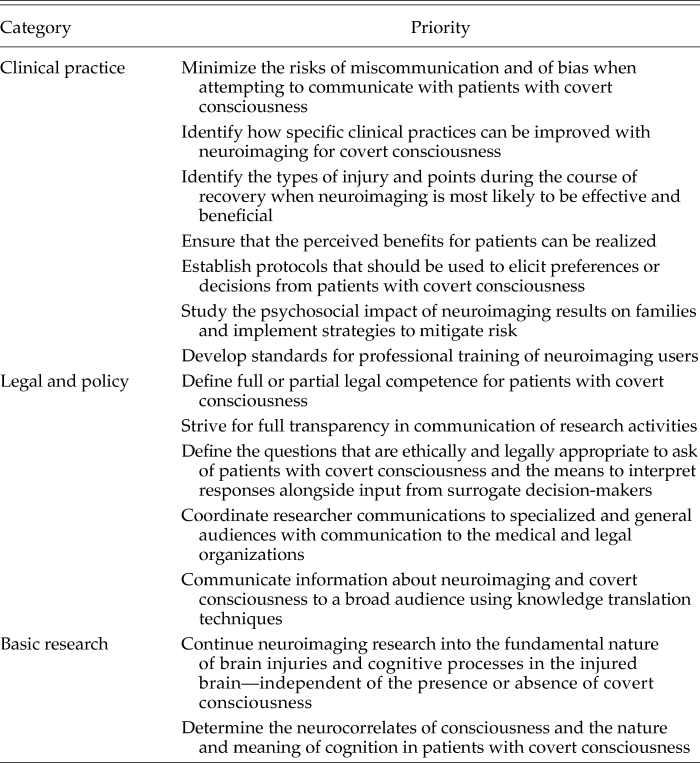
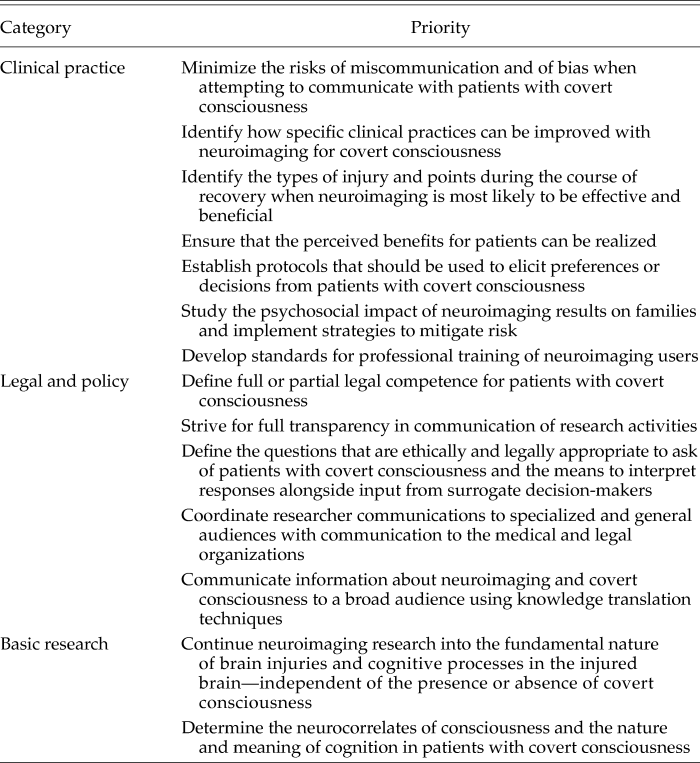
Thirty-six specific priorities emerged from qualitative analysis Footnote 45 of more than 25 hours of interviews. A Pareto principle threshold Footnote 46 was used to identify the most frequently cited priorities; 16 priorities were above this threshold. In addition to lying above the Pareto threshold, each of these priorities was also asserted by more than 30% (n ≥ 10) of the participants. The 16 priorities are listed in Table 1, organized into the following three major categories and, within each category, ordered by the frequency with which they were referenced:
-
• Clinical practice priorities: organizational and operational considerations for the clinical implementation of neuroimaging for DoC
-
• Legal and policy priorities: changes to the legal and healthcare systems to accommodate patients with covert consciousness
-
• Basic research priorities: continued discovery
Priorities Identified for Translating the Neuroimaging of Covert Consciousness
Clinical Practice Priorities
The most prominent priority for responsible clinical implementation of neuroimaging for covert consciousness is mitigation of the risks of misunderstanding or miscommunication when interpreting patients’ decisions or expressed preferences. Many participants felt that this process is a “restrictive kind of communication” (Ethicist ETH21) and implied that surrogate decision makers will continue to be essential.
[You] want to be fairly confident that you understood what meant yes and what meant no . . . that’s a pretty significant risk . . . of a fairly serious moral violation. (Ethicist ETH28)
The main risk would be that we misinterpret their response . . . there might be a risk that if we misinterpret we would be providing needless treatments. (Law Professional LL22)
One patient advocate, a brain injury survivor, expressed the need for cross-checks to ensure that patients’ expressed preferences are credible and consistent with preferences expressed prior to their injury:
I don’t think I was competent for like the first 18 months . . . I would say things to my mother that she honestly believed were true, because in my mind it was true, I wasn’t lying. But it really wasn’t true . . . that’s a danger . . . unless you have some other measure of judging credibility. (Advocacy Leader AD22, a DoC survivor)
As communication is constrained by the choice of questions established by a researcher or medical professional, the envelope of inquiry limits the interpretation of results. Participants point to the responsibility of researchers to acknowledge this limitation:
The preferences of the patients are to some extent constrained by the questions . . . [the communication is] structured in a way that reflects the options and the positions of those other than the patient. . . . [O]ne of the greatest risks would be to lose sight of how limited that communication paradigm is in comparison to natural communication. (Researcher RE25)
Participants identified the potential for improved patient care as a critical benefit of clinical translation:
It will be very helpful to understand what people actually want and whether they actually change their mind . . . compared to what they were before. (Practitioner PR24)
It would allow us to stratify those individuals . . . to employ a rehabilitation approach or intervention. (Researcher RE24)
The importance of generating a positive outcome for DoC patients is ingrained in participants’ criteria for responsible translation:
It’s in those cases where there’s debate as to whether or not to continue providing . . . intensive life support for a patient, and to be able to bring their voice directly into the discussion. (Ethicist ETH24)
Although participants were interested in patient-centered improvements in clinical outcomes, they felt that involving patients in decision-making may not reduce the burden on families or substitute decision makers. They emphasized a priority for elucidating the impact on patients and families:
Bringing in that extra dimension to the decision-making would likely in some circumstances relieve some of that emotional burden I think from the loved ones. (Advocacy Leader AD21)
Some families will be relieved if there are signs of consciousness, others will be horrified . . . they’ll still be left with difficult questions about quality of life and whether life support should be removed. (Law Professional LL22)
It’s going to give us more information as to what the patient wants and perceives . . . information which is sorely lacking in terms of if we want to support autonomous decision-making, which is what our healthcare system is based on. (Ethicist ETH23)
Legal and Policy Priorities
Many participants expressed that the dominant priority for clinical translation should be the extension of legal and clinical concepts of competence and consent for communication via neuroimaging:
You’ll need to devise some tests that are reasonably convincing in displays of both consciousness and competence here. And maybe even starting with matters that . . . have to do with patient comfort and various other kinds of things, and then extending to more difficult kinds of questions. (Ethicist ETH22)
Participants explained that legal disputes regarding treatment decisions are currently rare, and that families and members of a patient’s medical care team are on the frontline of the decision-making process. Therefore, there is an urgency to address the sense that communication mediated by neuroimaging may aid surrogate decision makers to make the best decisions they can in the interests of the patient:
Legal reasons are a very small part of what we deal with, with patients in vegetative states. It’s not often that courts are getting called, and so on. Usually it’s healthcare teams and families who are struggling to make the right decisions. (Ethicist ETH23)
One physician voiced the opinion that policies should address the skepticism that communication mediated by neuroimaging could ever reach the threshold necessary for legal consent:
Capacity or competence as a legal term is something that will continue to be used. It has completely different ramifications . . . knowing that the person actually legally can be completely incapable to make a decision, but they are capable to assent to certain things and that’s a general agreement . . . that they should be involved in their own care to the maximum of their ability. (Practitioner PR23)
Many participants hoped that, in addition to improving patient-centered care, future advances would acknowledge members of the public as important stakeholders reflecting the visibility of neuroimaging research in the public sphere. This desire was evident in the expressed ethical priority to improve transparency in communications to the public about the research:
It’s better to take this on directly and make sure the communication to the public is clear and accurate and unlikely to generate misunderstandings. (Law Professor LL22)
It’s really our responsibility, especially since we’re using taxpayers’ dollars primarily for this kind of research. (Researcher RE23)
Participants generally urged that researchers continue to maintain responsibility for public communication but suggested greater cooperation with federal or provincial healthcare authorities and funding agencies to guard against unrealistic expectations being established:
Those people who are calling for the research to be done, the funders and governments, and the medical field and the scientific field together have a responsibility to inform the public in a responsible way. (Practitioner PR25)
Basic Research Priorities
Participants recognized the opportunity for basic research in neuroimaging to contribute to greater understanding of brain injury and the phenomenon of consciousness and urged that this work should continue:
The reason the research program goes on is because the point is broader than documenting awareness. The point is about mapping residual cognitive function broadly and exploring the connection between that and diagnosis and prognosis. And I think it’s also important clinically, but also I’d say morally, to explore how far can we go with communication with these patients. (Ethicist ETH21)
We’re using this tool, these imaging tools, in ways that we didn’t before and that can have . . . widespread effects that we can’t even foresee at this point. (Researcher RE24)
When discussing continued progress in neuroimaging research, participants’ concerns centered on a need for scientific validity and a quality control process that maximizes confidence in the contextual relevance and temporal stability of patients’ responses:
This is where the reproducibility comes in . . . ensuring that the information that we think we’re getting is actually the information that we’re getting. (Ethicist ETH24)
If it’s accurate and it’s reliable, then it has the potential to decrease the emotional burden to families by allowing us to speak directly to the patients. But again, if . . . there’s a high false positive rate or we get ambiguous readings a significant number of times, then it may actually increase anxiety of families because they’re not sure of what to do with that information. (Ethicist ETH31)
Participants reflected on the lack of understanding of consciousness and advocated for broader basic and clinical research on the correlates and meaning of consciousness and cognition in these patients:
Does cognition [in a vegetative patient] exist in the way that here terrestrially we understand it? (Advocacy Leader AD21)
A need for an interdisciplinary exploration of the meaning—what we all think is required by way of conscious awareness for capacity in patients of this type. (Law Professor LL22)
Perspectives on Priorities and Implications for Clinical Neuroethics
For a landscape where ethics, law, society, and brain injury interact in ways rarely seen, experts identified priorities for the translation of neuroimaging of covert consciousness from the research laboratory to clinical care. Although they were optimistic that some patients with disorders of consciousness might be able to participate in decision-making about their own care, they were unequivocal about the complexities of the contextual environment surrounding this potential.
The concept of informed consent contains both an individual component arising from the patient’s autonomy and a social, legal, and institutional component dependent on rules, policies, and standard practices. Footnote 47 Previous work has recognized the difficulties in obtaining informed consent from cognitively impaired individuals. Footnote 48,Footnote 49 The priorities we identified concern both components of informed consent: determining whether DoC patients have sufficient autonomy to provide consent and modifying the laws and policies that govern informed consent to accommodate patients with impaired cognition. For example, with supported decision-making, a process that is consistent with the CRPD, individuals whose preferences cannot be adequately ascertained can still exercise their legal capacity through other people who “can reasonably ascribe to the individual’s actions, personal will and/or intentions consistent with the person’s identity.” Footnote 50 For patients with covert consciousness, these actions would be expressed through a neuroimaging protocol.
Miscommunication or misinterpretation of brain signals will jeopardize even the best protocol, however, especially if legal capacity is at stake. The legal system has little experience with highly technical modes of communication with cognitively impaired individuals. The Frye test has long been the standard for introduction of novel scientific evidence into legal proceedings. Footnote 51 Interestingly, the case that established the Frye test also concerned a type of covert communication—namely, evidence obtained from a polygraph that the court ultimately disallowed. Later, DNA evidence was received into the legal system with enthusiasm, although controversy arose amid charges of a rushed introduction. Footnote 52 From these and other precedents, the evidentiary bar for neuroimaging of covert consciousness will be high.
Notwithstanding the formidable difficulties in clinical implementation, neuroimaging could improve clinical outcomes for patients with DoC, not least by encouraging physicians and allied health workers to recognize that DoC patients may be highly aware of what is said in their presence and how they are treated. Improved public communication, coordinated with healthcare and legal authorities so expectations are aligned with reality, will further lead to desired positive outcomes for these severely affected patients. In this regard, better correlation of neuroimaging results and prognosis is also an inescapable priority and one that has also been previously reported. Footnote 53,Footnote 54
As neuroscience research gains traction for translation, professional guidelines and health laws are needed for training expert users and to provide legal standards that will touch all stakeholders in the world of people with disorders of consciousness and others with intact cognition but restricted communication such as patients with amyotrophic lateral sclerosis or brain stem strokes. The clinical, legal, and research priorities identified here provide the cornerstones for moving neuroimaging from bench to bedside in the foundation of actionable research and healthcare.