Introduction
The collared peccary (Pecari tajacu Linnaeus, 1758) is the only member of the family Tayassuidae classified by the IUCN as ‘least concern’, whereas the two other members, the Chacoan peccary (Catagonus wagneri) and the white-lipped peccary (Tayassu pecari), are considered endangered and vulnerable, respectively (IUCN, 2017). Therefore, studies regarding the development of assisted reproductive techniques for collared peccaries would not only serve to improve their reproductive management and conservation, but could also serve as a model for other Tayassuidae species.
Currently, studies on peccaries’ germplasm conservation have been mainly focused on the use of ejaculated sperm (Castelo et al., Reference Castelo, Bezerra, Lima, Alves, Oliveira, Santos, Peixoto and Silva2010a; Silva et al., Reference Silva, Peixoto, Lima, Bezerra, Campos, Paiva, Paula and Silva2012; Souza et al., Reference Souza, Lima, Peixoto, Silva, Oliveira and Silva2016; Campos et al., Reference Campos, Peixoto, Silva, Souza, Castelo, Maia, Pereira and Silva2017) and there has been only one study concerning the recovery and characterization of their epididymal sperm (Bezerra et al., Reference Bezerra, Silva, Peixoto, Silva, Oliveira and Silva2014). The use of epididymal sperm represents an important tool for their conservation because it allows the preservation of genetic material from valuable wild and captive individuals, even in the event of an unexpected death (Vilela et al., Reference Vilela, Marquez, Graham and Barfield2017).
In biobank formation, various sperm samples are damaged during cryopreservation, leading to a decrease in sample viability (Watson, Reference Watson2000). To reduce these problems, several factors, including the choice of an adequate semen extender, are critical for the effectiveness of sperm preservation during the freezing process. For peccaries’ ejaculated sperm, various studies have shown the effectiveness of a Tris-based extender for sperm freezing (Castelo et al., Reference Castelo, Bezerra, Lima, Alves, Oliveira, Santos, Peixoto and Silva2010a; Silva et al., Reference Silva, Peixoto, Lima, Bezerra, Campos, Paiva, Paula and Silva2012; Alves et al., Reference Alves, Oliveira, Castelo, Lima, Souza, Moreira, Paula and Silva2013). Other studies, however, have demonstrated that a coconut water-based extender, ACP-116c, better preserved ejaculated sperm of peccaries than did Tris (Silva et al., Reference Silva, Peixoto, Lima, Bezerra, Campos, Paiva, Paula and Silva2012). Given that a semen extender can produce variable results when used for sperm obtained from different sources, such as cauda epididymis, ejaculation, and electroejaculation (Álvarez et al., Reference Álvarez, Tamayo-Canul, Martínez-Rodríguez, López-Urueña, Gomes-Alves, Anel, Martínez-Pastor and Paz2012), the efficacy of Tris and ACP-116c for the freezing peccaries’ epididymal sperm requires further investigation.
Thawing rate is another important factor that can affect sperm quality (Andrabi, Reference Andrabi2009). Currently, peccaries’ ejaculated sperm samples have been thawed at temperatures varying from 37°C for 1 min (Castelo et al., Reference Castelo, Bezerra, Souza, Moreira, Paula, Oliveira and Silva2010b) to 70°C for 8 s (Silva et al., Reference Silva, Peixoto, Castelo, Lima, Silva, Oliveira and Silva2013), but no information is available on thawing their epididymal sperm. Given the need to better understand appropriate conditions for sperm preservation and thawing, we aimed to establish a protocol for freezing and thawing epididymal sperm of collared peccaries by comparing the effectiveness of Tris-based and ACP-116c extenders on post-thaw sperm quality.
Materials and methods
All reagents were obtained from Sigma Aldrich (St. Louis, MO, USA).
Animals
Twelve sexually mature male collared peccaries with an average age of 2.7 ± 0.3 years were used. These animals belonged to the Centre of Multiplication of Wild Animals (CEMAS) from UFERSA (Mossoró, RN, Brazil, 5°100´S, 37°100´W) and were culled for population control as part of an annual management plan that is conducted in compliance with ethical and animal welfare standards. The climate is semiarid, with an average annual temperature of 27°C. The animals were kept under a 12 h natural photoperiod and in sexual abstinence. They were fed a balanced swine ration plus vegetables. Fresh water was available ad libitum.
Epididymal sperm recovery
After slaughtering, the testis–epididymis complexes (CTEs) were removed, covered with gauze humidified with sterile salt solution (NaCl 0.9%), and immediately transported to the laboratory at room temperature. The CTEs were dissected and cauda epididymis, including 4 to 5 cm of the proximal vas deferens, were isolated and washed with salt solution to remove blood and cell debris (Bezerra et al., Reference Bezerra, Silva, Peixoto, Silva, Oliveira and Silva2014).
For each individual, the cauda epididymis plus vas deferens were submitted to retrograde flushing method for sperm recovery (Bezerra et al., Reference Bezerra, Silva, Peixoto, Silva, Oliveira and Silva2014) using different extenders at room temperature (~27°C), as follows. One epididymis was flushed with 5 ml of a Tris-based extender [3.028 g Tris-hydroxymethyl-aminomethane, 1.78 g monohydrated citric acid, and 1.25 g d-fructose dissolved in 100 ml of ultrapure water (Tris; 295 mOsm/l)] (Castelo et al., Reference Castelo, Bezerra, Lima, Alves, Oliveira, Santos, Peixoto and Silva2010a). The other epididymis was flushed using 5 ml ACP-116c (ACP®, ACP Biotecnologia, Fortaleza, Brazil; 307 mOsm/l) (Silva et al., Reference Silva, Peixoto, Castelo, Lima, Silva, Oliveira and Silva2013). This product is composed of dehydrated coconut water and pH regulators.
Sperm evaluation
After recovery, samples were immediately evaluated. The volume recovered from each epididymis was measured with a micropipette. The sperm concentration (×106 sperm/ml) for each sample was determined using a Neubauer counting chamber, and the number of recovered sperm was calculated. Sperm motility and vigour (strength of sperm flagellum beating on a 0–5 scale) were assessed using light microscopy at ×100 and ×400 magnifications (Eclipse E200, Nikon, Melville, NY, USA).
For morphological analysis, sperm (10 µl) smears stained with Bengal Rose (150 µl) were used. Two hundred cells per slide were counted, under light microscopy (×1000 magnification) (Sousa et al., Reference Sousa, Santos, Souza, Lima, Barros, Oliveira and Silva2013). Functional membrane integrity was evaluated as the sperm osmotic response to a hypoosmotic swelling (HOS) test, using distilled water (0mOsm/l). Two hundred sperm were examined and those with a swollen, coiled tail were considered to have a functional membrane (Santos et al., Reference Santos, Sousa, Peixoto, Simão, Oliveira and Silva2013). Sperm viability was determined by bromophenol blue stained smears, using light microscopy (×400 magnification), based on analyses of 200 cells per slide (Sousa et al., Reference Sousa, Santos, Souza, Lima, Barros, Oliveira and Silva2013).
Cryopreservation procedure
After initial evaluation, samples were centrifuged at 3000 rpm/min (Bezerra et al., Reference Bezerra, Silva, Peixoto, Silva, Oliveira and Silva2014). The supernatant was removed and the samples were resuspended in the same extender used for sperm recovery, plus the addition of 20% egg yolk. This dilution was made in order to reach a concentration of 200 × 106 sperm/ml
The cryopreservation procedure was conducted following a method previously described for ejaculated sperm of peccaries (Castelo et al., Reference Castelo, Bezerra, Lima, Alves, Oliveira, Santos, Peixoto and Silva2010a). After the dilution, samples were stored in a water jacket (30 ml) at 27°C and equilibrated for 4 h at 5°C in a refrigerator. After cooling, the samples were added to Tris-egg yolk or ACP-egg yolk plus 12% glycerol (also at 5°C), resulting in a final concentration of 6% glycerol in the extender. The final dilution resulted in a sperm concentration of 100 × 106 sperm/ml The sperm motility and vigour were evaluated after the addition of glycerol. The samples from each treatment were packed into six 0.25 ml plastic straws and placed horizontally in an insulated box for 20 min, 3 cm above the liquid nitrogen (N2) level. Finally, the straws were plunged into liquid N2 for storage.
After 2 weeks, samples derived from both treatments were thawed by immersing the straws in a water bath at 37°C for 1 min. Then, they were immediately evaluated as reported for fresh samples. Moreover, samples were evaluated through computer-assisted semen analysis (CASA; IVOS 7.4G; Hamilton-Thorne Research, Beverly, MA, USA), following equipment configurations established for the species (Souza et al., Reference Souza, Lima, Peixoto, Silva, Oliveira and Silva2016). The evaluation of sperm plasma membrane integrity was conducted with a fluorescent solution containing fluorophores 6-carboxyfluorescein diacetate (0.46 mg C-FDA:1 ml dimethylsulfoxide) and propidium iodide (0.5 mg PI:1 ml 0.9% saline solution) (Souza et al., Reference Souza, Lima, Peixoto, Castelo, Oliveira, Paula and Silva2015). In addition, to evaluate frozen–thawed sperm survival, a thermal resistance test (TRT) was conducted by evaluating subjective sperm motility, vigour, viability, and osmotic response after 60 min and 120 min at 37°C (Campos et al., Reference Campos, Silva, Bezerra, Castelo, Peixoto and Silva2014).
Comparison of different thawing rates
After selecting the best extender, other straws derived from each individual were thawed in a water bath to assess different thawing rates: 37°C/60 s; 55°C/7 s, followed by another 30 s at 37°C (Castelo et al., Reference Castelo, Bezerra, Souza, Moreira, Paula, Oliveira and Silva2010b); and 70°C/8 s, and another 30 s at 37°C (Silva et al., Reference Silva, Peixoto, Castelo, Lima, Silva, Oliveira and Silva2013). The samples were immediately evaluated as reported for fresh samples. Moreover, kinematic parameters were analyzed by CASA and plasma membrane integrity at using fluorescent probes.
Statistical analysis
Statistical analysis was performed using Stat view software for Windows (SAS Institute Inc. Copyright 1992–1998, version 5.0, Cary, NC, USA). The results were expressed as mean ± standard error (SE). Data for sperm motility, viability, osmotic response, plasma membrane integrity, morphology, total motility, progressive motility, STR, and LIN were arcsine-transformed. To assess the effect of the extender and thawing rate on sperm characteristics, an analysis of variance (ANOVA) was performed followed by Fisher’s protected least significance difference (PLSD) test (α<0.05). Evaluation of the same effect on the vigour and number of recovered sperm was performed by the Mann–Whitney U-test (α<0.05).
Results
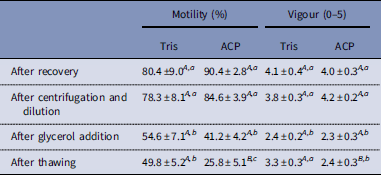
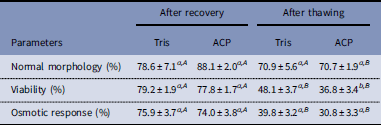
Samples had a whitish colour, highlighting the absence of or little contamination by red blood cells. Using Tris, an average of 1.0 (± 0.2) × 109 sperms were recovered, whereas 1.2 (± 0.4) × 109 sperms were recovered when ACP was used (P>0.05). Immediately after recovery, samples extended in both Tris and ACP had similar values for the parameters assessed (P>0.05) (Table 1 and 2).
Mean values (± standard error of the mean) for sperm motility and vigour of collared peccary (Pecari tajacu; n=12) epididymal sperm extended in Tris or powdered coconut water (ACP-116c), during sperm processing and after cryopreservation

a,b,c Within a column, means without a common superscript differed.
A,B Within a row, means without a common superscript differed (P<0.05).
Morphology, viability and osmotic response of collared peccary (Pecari tajacu; n=12) epididymal sperm extended in Tris or powdered coconut water (ACP-116c) after recovery and thawing

a,b Lowercase letters indicate comparison between treatments at the same moment.
A,B Uppercase letters indicate comparison for the same extender in different moments (P<0.05).
During epididymal sperm cryopreservation, centrifugation and extension in both extenders plus 20% egg yolk did not impair sperm motility or vigour (P>0.05). However, glycerol addition significantly decreased (P<0.05) these parameters for both extenders (Table 1).
The freezing and thawing procedures provoked a decrease (P<0.05) in the values of all parameters assessed, except for vigour in Tris samples (P>0.05). The Tris-based extender provided a more efficient preservation of sperm motility, vigour (Table 1), viability, and osmotic response (Table 2) than ACP (P<0.05), but the preservation of sperm morphology (Table 2) was not affected by the extender (P>0.05).
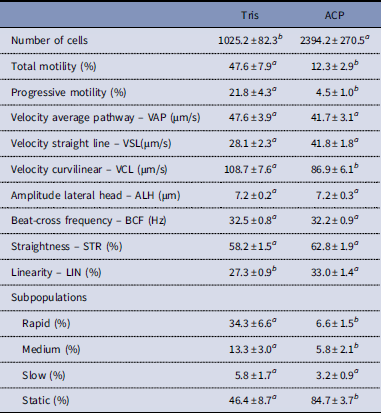
CASA (Table 3) identified and counted a higher number of cells in the use of ACP compared with Tris (P<0.05). We determined that the Tris extender, however, better preserved total motility, progressive motility, curvilinear velocity (VCL), rapid, and medium sperm when compared with ACP (P<0.05). Higher values for linearity (LIN) and static sperm, however, were documented with the use of ACP (P<0.05). Regarding plasma membrane integrity, no difference (P>0.05) between extenders was detected and values of 40.6 ± 3.8% and 37.7 ± 6.3 % were found for Tris and ACP, respectively.
Sperm motility endpoints measured by computer-assisted semen analysis in frozen–thawed epididymal sperm from collared peccaries (Pecari tajacu; n=12), extended in Tris or powdered coconut water (ACP-116c)

a,b Within a row, means without a common superscript differed (P<0.05).
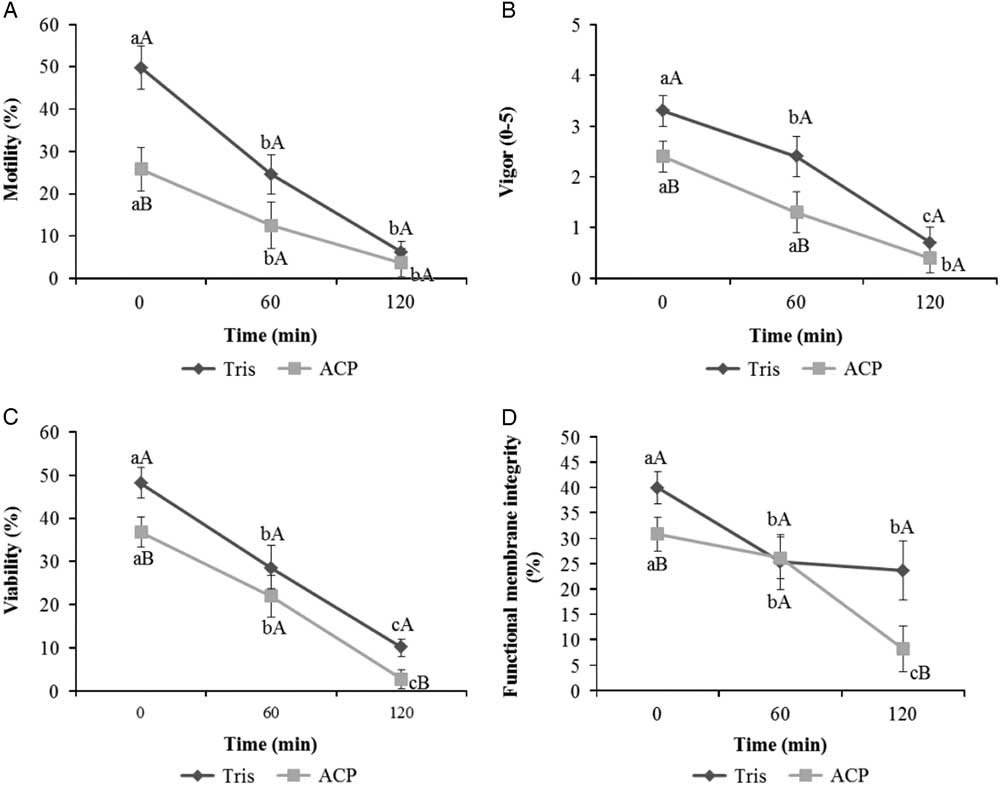
A gradual loss of sperm quality was noted for all parameters assessed during the post-thawing TRT (Fig. 1). At 120 min, Tris showed the best results for viability and osmotic response, which did not decrease in comparison with the evaluation at 60 min. Sperm motility for both treatments, however, was less than 10% after 120 min.
Sperm motility (A), vigour (B), viability (C) and osmotic response (D) of frozen–thawed collared peccary epididymal sperm using Tris and ACP extenders during a thermal resistance test at 37°C for 120 min. a,b,cLowercase letters indicate difference into the use of same extender along the time; A,BUppercase letters indicate differences between extenders at each time.

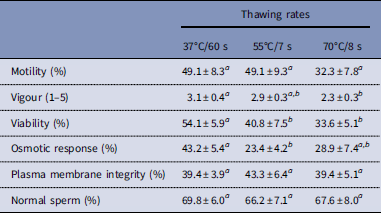
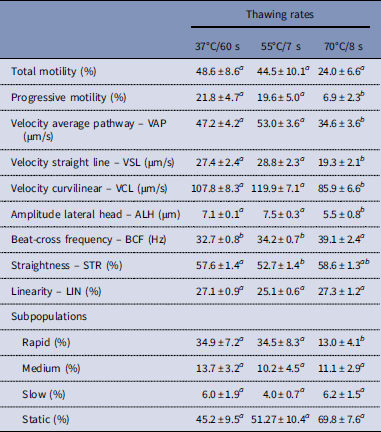
In general, the best post-thawing results were achieved with the use of the Tris-based extender. Therefore, samples derived from this treatment were subjected to different thawing rates and those thawed at 37°C/60 s were the best preserved (P<0.05) in terms of sperm viability and osmotic response (Table 4). Through CASA (Table 5), higher values for total and progressive motility, velocity average pathway – VAP, velocity straight line – VSL, velocity curvilinear – VCL, and amplitude lateral head –ALH were found in samples thawed at 37°C/60 s and 55°C/7 s, but those thawed at 70°C/8 s showed higher values for beat-cross frequency – BCF (P<0.05).
Characteristics of the collared peccaries (Pecari tajacu – n=12) epididymal sperm after cryopreservation using a Tris-based extender and thawing at 37°C/60 s, 55°C/7 s or 70°C/8 s

a.b.cWithin a row, means without a common superscript differed significantly (P<0.05).
Motility endpoints (mean ± standard error of the mean) measured by computer-assisted semen analysis of frozen–thawed epididymal sperm from collared peccaries (Pecari tajacu – n=12), thawed at 37°C/60 s, 55°C/7 s or 70°C/8 s

a,b,c Within a row, means without a common superscript differed (P<0.05).
Discussion
In recent decades, various efforts have been made to establish protocols to safeguard germplasm derived from valuable wild individuals that suddenly die, such as the Cantabrian brown bear (Anel et al., Reference Anel, Álvarez, Anel, Martínez-Pastor, Martínez, Chamorro and Paz2011), the agouti (Castelo et al., Reference Castelo, Silva, Bezerra, Costa, Lago, Bezerra, Campos, Praxedes and Silva2015), the red deer (García-Álvarez et al., Reference García-Álvarez, Soler, Maulen, Maroto-Morales, Iniesta-Cuerda, Martín-Maestro, Fernández-Santos and Garde2016), and the dromedary camel (Scholkamy et al., Reference Scholkamy, El-Badry and Mahmoud2016). To the best of our knowledge, this is the first report on the cryopreservation of epididymal sperm of collared peccaries. Contrary to observations for their sperm ejaculates (Silva et al., Reference Silva, Peixoto, Lima, Bezerra, Campos, Paiva, Paula and Silva2012), we found that a Tris-based extender provided better cryoprotective effects than an ACP extender for sperm recovered from the epididymis of peccaries.
The retrograde flushing method provided the recovery of adequate amounts of epididymal sperm from peccaries, with minimal contamination by red blood cells, as reported for other species (Martínez-Pastor et al., Reference Martínez-Pastor, García-Macias, Álvarez, Chamorro, Herraez, Paz and Anel2006; Silva et al., Reference Silva, Bezerra, Campos, Praxedes, Lima and Silva2017). Using both extenders, peccaries’ epididymal sperm showed characteristics similar to those found for fresh semen obtained by electroejaculation (Souza et al., Reference Souza, Lima, Peixoto, Castelo, Oliveira, Paula and Silva2015; Souza et al., Reference Souza, Lima, Peixoto, Silva, Oliveira and Silva2016; Campos et al., Reference Campos, Peixoto, Silva, Souza, Castelo, Maia, Pereira and Silva2017). This observation was also reported for species such as donkeys (Gloria et al., Reference Gloria, Contri, Amicis, Robbe and Carluccio2011), stallions (Monteiro et al., Reference Monteiro, Papa, Zahn, Dellaqua, Melo, Maziero, Avanzi, Alvarenga and Guasti2011), and rams (Álvarez et al., Reference Álvarez, Tamayo-Canul, Martínez-Rodríguez, López-Urueña, Gomes-Alves, Anel, Martínez-Pastor and Paz2012), in which the quality of fresh epididymal and ejaculated sperm were equivalent.
As expected, the freezing–thawing processes impaired the quality of peccaries’ epididymal sperm, except for vigour in samples diluted in Tris. In fact, this quality loss is somewhat expected because of the biochemical, functional, and ultrastructural damages that are induced by cryopreservation (Hamilton et al., Reference Hamilton, Castro, Delgado, Assis, Siqueira, Mendes, Goissis, Muiño-Blanco, Cebrián-Pérez, Nichi, Visintin, D’Ávila. and Assumpção2016). Comparing our post-thawing results to those previously reported for ejaculates (Silva et al., Reference Silva, Peixoto, Lima, Bezerra, Campos, Paiva, Paula and Silva2012; Alves et al., Reference Alves, Oliveira, Castelo, Lima, Souza, Moreira, Paula and Silva2013; Silva et al., Reference Silva, Peixoto, Castelo, Lima, Silva, Oliveira and Silva2013), peccaries’ sperm derived from both cauda epididymis and ejaculation apparently can be efficiently preserved using the same freezing–thawing procedures.
When glycerol is added to the diluents, there is an alteration on the osmolarity of the solution (García et al., Reference García, Ferrusola, Aparicio, Miró-Morán, Rodriguez, Bolaños, Fernández, Silva, Martínez, Tapia and Peña2012). The sperm need to adapt to this new osmotic condition by shrinking due to a loss of water (Ball & Anthony, Reference Ball and Anthony2001). The mitochondria present greater resistance to glycerol than other organelles (García et al., Reference García, Ferrusola, Aparicio, Miró-Morán, Rodriguez, Bolaños, Fernández, Silva, Martínez, Tapia and Peña2012), therefore it sometimes presents a slow adaptation to new conditions. In this context, depending on the composition of the media that sperm are exposed, different adaptive responses could be verified. Probably, this is the reason why addition of glycerol provoked an immediate reduction on peccaries’ sperm vigour in samples using Tris extender but, after thawing, sperm was more adapted to the new conditions and showed an increasing vigour. Using ACP, however, this adaptation seemed not to be possible, and the vigour was similar immediately after glycerol addition and thawing.
In general, Tris was a more efficient extender than ACP for peccaries’ epididymal sperm cryopreservation because it provided higher values for sperm motility, vigour, viability, osmotic response, and various CASA parameters. Such results are opposite from those found for peccaries’ ejaculated sperm (Silva et al., Reference Silva, Peixoto, Lima, Bezerra, Campos, Paiva, Paula and Silva2012), in which the authors found 48.3% and 30.4% motile sperm for samples diluted in ACP and Tris, respectively, after thawing.
Contact between spermatozoa and seminal plasma components is known to result in biochemical changes and plasmatic membrane damages, compromising the quality of frozen–thawed sperm (Monteiro et al., Reference Monteiro, Guasti, Hartwig, Dellaqua, Alvarenga and Papa2013). In fact, it is known that peccaries’ seminal plasma contains proteins involved in spermatic protection, such as clusterin and T-complex protein 1, and proteins with antioxidant activities, like glutathione peroxidase (GPx-5), ceruloplasmin, albumin, and transferrin (Santos et al., Reference Santos, Sousa, Martins, Moreira, Monteiro-Moreira, Moreno, Oliveira, Moura and Silva2014). Moreover, superoxide dismutase was recently reported as an antioxidant enzyme present on the peccaries’ seminal plasma (Santos et al., Reference Santos, Sousa, Silva, Paiva, Lago, Paula, Pereira, Moura and Silva2018). In this context, the absence of seminal plasma on epididymal samples could have exerted an unknown effect on the interactions between the sperm and extender, leading to a greater efficiency of Tris rather than ACP. Tris-based extenders have been used for sperm cryopreservation in several species for many decades. In addition to acting as a buffer, this extender is known for reducing the fructolysis index by the sperm, thus contributing to their energy preservation (Silva et al., Reference Silva, Cardoso and Silva2002).
Studies using ACP extenders are relatively new. Currently, ACP extenders have been tested on only a small number of species and the results are still controversial. In fact, various reports have shown different activity between Tris and ACP extenders, not only for peccaries (Silva et al., Reference Silva, Peixoto, Lima, Bezerra, Campos, Paiva, Paula and Silva2012; Campos et al., Reference Campos, Silva, Bezerra, Castelo, Peixoto and Silva2014), but for various species. For canine ejaculate (Cardoso et al., Reference Cardoso, Silva and Silva2005) and epididymal (Mota-Filho et al., Reference Mota-Filho, Silva, Nunes, Souza, Freitas, Araújo and Silva2014) sperm cryopreservation, both extenders provided a similar post-thawing effect on sperm parameters and were equally indicated for that taxa. For agoutis (Dasyprocta agouti), however, ACP was more efficient than Tris for the cryopreservation of epididymal sperm, providing significantly higher values for post-thawing sperm motility and vigour (Silva et al., Reference Silva, Peixoto, Santos, Castelo, Oliveira and Silva2011). Tris and ACP had a similar effect on the caprine semen cryopreservation immediately after thawing. However, during a TRT for up to 120 min, authors verified that Tris was more efficient in preserving sperm quality compared with an ACP extender. Oliveira and colleagues hypothesized that better results obtained using Tris are due to the higher quantity of egg yolk in it (20%) when compared with ACP (2.5%) (Oliveira et al., Reference Oliveira, Nunes, Salgueiro, Cavalcante, Brasil and Moura2011).
Regarding the TRT, the longevity of peccaries’ epididymal sperm was significantly greater in Tris than ACP, with similar amount of egg yolk (20%) for both extenders. Values of 24% motile sperm were found after 60 min when Tris was used. This is an interesting finding, as Campos et al. (Reference Campos, Silva, Bezerra, Castelo, Peixoto and Silva2014) previously demonstrated that peccaries’ ejaculated sperm had a reduced longevity after thawing, with values of <10% motile sperm at 60 min, after dilution in Tris or ACP (Campos et al., Reference Campos, Silva, Bezerra, Castelo, Peixoto and Silva2014). According to Álvarez et al. (Reference Álvarez, Tamayo-Canul, Martínez-Rodríguez, López-Urueña, Gomes-Alves, Anel, Martínez-Pastor and Paz2012), the ideal composition of the extender for cryopreservation depends on the source in which the sperm in which recovered: after natural ejaculation, collected by electroejaculation, or recovered from the epididymis (Álvarez et al., Reference Álvarez, Tamayo-Canul, Martínez-Rodríguez, López-Urueña, Gomes-Alves, Anel, Martínez-Pastor and Paz2012). In fact, epididymal sperm seems to be more resilient against toxic effects derived from different concentrations of glycerol due to their osmotic resistance being greater than in the ejaculated sperm (Monteiro et al., Reference Monteiro, Papa, Zahn, Dellaqua, Melo, Maziero, Avanzi, Alvarenga and Guasti2011), which probably contributes to their longer survival after thawing.
Additionally, we showed that the ACP extender with egg yolk added, even after using a software for image cleaning, presented a significant amount of debris that could interfere with sperm evaluations through CASA. Some debris could sometimes present as the same size as the sperm head, justifying the significantly higher number of sperm counted by CASA when ACP was used in comparison with the samples diluted in Tris. In fact, this finding was previously reported when ACP was used for semen preservation in dogs (Cardoso et al., Reference Cardoso, Silva and Silva2005) and collared peccaries (Silva et al., Reference Silva, Peixoto, Lima, Bezerra, Campos, Paiva, Paula and Silva2012). To solve this problem, further studies focused on peccaries’ epididymal sperm conservation should be conducted using a previous centrifugation of the ACP extender (Silva et al., Reference Silva, Peixoto, Lima, Bezerra, Campos, Paiva, Paula and Silva2012) or the replacement of egg yolk by its active fraction, the low-density lipoprotein (Souza et al., Reference Souza, Lima, Peixoto, Castelo, Oliveira, Paula and Silva2015).
Although Tris samples were demonstrated to have better results for many of the parameters assessed, sperm cryopreserved with ACP demonstrated a lower value for VCL and a higher value for LIN, which indicated a linear sperm track (Verstegen et al., Reference Verstegen, Iguer-Ouada and Onclin2002). The biochemical characteristics of this extender are very similar to those of fresh coconut water, in terms of vitamins, minerals, amino acids, carbohydrates, growth factors, phytohormones, and saturated fatty acids in its composition (Viveiros et al., Reference Viveiros, Nascimento, Orfão and Isaú2010). Phytohormones, such as indole-3-acetic acid (IAA), a substance associated with enhancement of swine sperm conservation, are also present in ACP (Toniolli et al., Reference Toniolli, Bussière, Courot, Magistrini and Combarnous1996). Because of these characteristics, ACP appeared to be a promising extender, requiring the development of further studies focusing on its interactions with different concentrations of different supplements used in sperm cryopreservation, such as egg yolk and glycerol.
Rapid thawing rates using high temperatures are usually reported for improving the post-thaw sperm quality in some ungulate species (Athurupana et al., Reference Athurupana, Ioki and Funahashi2015; Shah et al., Reference Shah, Andrabi and Qureshi2016). However, the thawing rate at 70°C/8 s seems to be as harmful for epididymal cells as previously reported for semen obtained by electroejaculation in peccaries (Silva et al., Reference Silva, Peixoto, Castelo, Lima, Silva, Oliveira and Silva2013). Conversely, Castelo et al. (Reference Castelo, Bezerra, Souza, Moreira, Paula, Oliveira and Silva2010b) observed that peccaries’ ejaculated sperm could be efficiently thawed at both 37°C/60 s and 55°C/7 s (Castelo et al., Reference Castelo, Bezerra, Souza, Moreira, Paula, Oliveira and Silva2010b). The same statement seems to be invalid for their epididymal sperm, as higher values of viability and osmotic response were achieved when samples were thawed at 37°C/60 s instead of 55°C/60 s.
In conclusion, we suggest the use of a Tris-based extender with added egg yolk and glycerol for the cryopreservation of epididymal sperm obtained from collared peccaries. In order to achieve a better post-thawing sperm quality, we suggest that samples should be thawed at 37°C/60 s. This information will be useful for the formation of germplasm banks derived from individuals that die unexpectedly.
Acknowledgements
The authors would like to thank Dr M.F. Oliveira from the CEMAS/UFERSA for providing the animals used in the experiments.
Financial support
CNPq (Process No. 507533/2010–0) supported this research.
Conflicts of Interest
There are no conflicts of interest.
Ethical standards
The ethics committee of the UFERSA approved the experimental protocols and animal care procedures used in this study (Process no. 23091.000254/11-88).