Introduction
The classification of Cytisus L. within the tribe Genisteae (Fabaceae) has been the subject of many taxonomic studies over the last 250 years. The first subdivision of the tribe Genisteae was made in 1753 by Linnaeus, who created three main genera: Cytisus, Genista L. and Spartium L. However, the taxonomic concepts adopted by Linnaeus, and later by Lamarck (Reference Lamarck1778) and De Jussieu (Reference De Jussieu1789), began to be challenged in the late 18th century. Moench (Reference Moench1797), judging Cytisus too heterogeneous, was the first to distinguish an additional genus, Laburnum Fabr. Over the next 150 years a profusion of small genera were described within the Genisteae (see for example Grisebach, Reference Grisebach1843; Spach, Reference Spach1844; Holubova-Klaskova, Reference Holubova-Klaskova1964; Skalicka, Reference Skalicka1968). The latest system within the tribe is closer to the Linnean classification, with two main complexes of genera: the Cytisus-group and the Genista-group (Lewis et al., Reference Lewis, Schrire, Mackinder and Lock2005).
The limits within the genus Cytisus have also undergone a few changes. De Candolle (Reference De Candolle1825) was the first to recognise sections within Cytisus. He distinguished six sections based on floral and seed characters. In the late 19th and 20th centuries the number of sections varied between two (Willkomm & Lange, Reference Willkomm and Lange1880), four (Koch, Reference Koch1873; Rouy, Reference Rouy1897; Frodin & Heywood, Reference Frodin, Heywood, Tutin, Heywood, Burges, Moore, Valentine, Walters and Webb1968), six (Rehder, Reference Rehder1949; Holubova-Klaskova, Reference Holubova-Klaskova1964) and seven (Briquet, Reference Briquet1894; Rothmaler, Reference Rothmaler1944; Maire, Reference Maire1987). The most recent classification, based on a consensus of several morphological and molecular studies, increased the number of sections within Cytisus to 13 (Cristofolini & Troia, Reference Cristofolini and Troia2006). This last work eradicated minor genera such as Lembotropis Griseb. and Calicotome Link and returned them to a more heterogeneous Cytisus.
Cytisus sections Alburnoides DC., Spartopsis Dumort. and Verzinum (Raf.) Talavera have always been thought to be related. Sections Spartopsis and Verzinum have often been grouped as a unique section either called Laburnum (De Candolle, Reference De Candolle1825) or Sarothamnus (Pellegrin, Reference Pellegrin1908; Rothmaler, Reference Rothmaler1944; Frodin & Heywood, Reference Frodin, Heywood, Tutin, Heywood, Burges, Moore, Valentine, Walters and Webb1968). Cytisus scoparius (L.) Link from Cytisus sect. Spartopsis and Cytisus multiflorus (Aiton) Sweet from Cytisus sect. Alburnoides are the prospective parents of an interspecific hybrid (Cytisus × dallimorei Rolfe; Rolfe, Reference Rolfe1910), indicating a close relationship between those two sections as well. Recent phylogenetic studies of the genus Cytisus also recognised close relationships between these three sections. Based on the most comprehensive molecular work of the genus (Cubas et al., Reference Cubas, Pardo and Tahiri2002), they are part of a monophyletic group along with Cytisus sect. Corothamnus (W.D.J.Koch) Nyman. A more recent study focusing on Cytisus purgans Boiss. revealed Cytisus sect. Spartopsis to be the sister-group to Cytisus sect. Alburnoides (Cytisus sect. Verzinum was not included in the analyses; Cubas et al., Reference Cubas, Pardo and Tahiri2006). A cladistic study based on 68 morphological characters placed the three sections in a clade along with Cytisus sect. Corothamnus (Cristofolini & Conte, Reference Cristofolini and Conte2002). Cytological data indicate that taxa from the three sections have chromosome counts of 2n = 46, 48 or 50 (Forissier, Reference Forissier1973; Horjales, Reference Horjales1974; Sanudo, Reference Sanudo1979; Cubas et al., Reference Cubas, Tahiri and Pardo2001). This variation is probably only due to the presence of accessory chromosomes known as B chromosomes. It has been suggested that these are due to the fragmentation of A chromosomes as a result of the method used to prepare material for the study of meiosis (Cubas et al., Reference Cubas, Tahiri and Pardo2001). We here consider sections Alburnoides, Spartopsis and Verzinum as components of a larger monophyletic group.
Maire (Reference Maire1987) was the first to give sections Alburnoides, Sarothamnus (Wimm.) Benth. (now a synonym of Spartopsis) and Verzinum their current delimitation. He based his classification on the shape of the keel, the position of the ovary inside the corolla, and the shape of the style and its hairiness. This classification was followed by Talavera & Salgueiro (Reference Talavera and Salgueiro1999) in their treatment of the genus for Flora Iberica but they recognised Sarothamnus as a synonym of Spartopsis. However, both of these taxonomic studies were done for Floras and were restricted to either the African species (Maire, Reference Maire1987; Tahiri & Ouyahya, Reference Tahiri, Ouyahya, Fennane, Ibn Tattou, Ouyahya and El Oualidi2007) or to the species from the Iberian Peninsula (Talavera et al., Reference Talavera, Aedo, Castroviejo, Romero Zarco, Saez, Salgueiro and Velayos1999). The recent reassessment by Cristofolini & Troia (Reference Cristofolini and Troia2006) did involve all known taxa from the three sections but it was more of a literature study that lacked morphological comparisons of specimens. We present here a taxonomic revision of Cytisus sections Alburnoides, Spartopsis and Verzinum.
Materials and Methods
The present revision is based on a study of more than 2000 dried herbarium specimens from ANG, B, BBF, BC, BM, BP, BR, C, E, FI, G, K, L, LINN, LISU, LY, MA, MAF, MANCH, MPU, P, SALA, SEV, TLF and VAL (herbarium abbreviations according to Holmgren et al., Reference Holmgren, Holmgren and Barnett1990). The measurements in the descriptions are taken from dried herbarium sheets. All specimens have been seen unless otherwise indicated. Type specimens seen are marked with an exclamation mark (!).
The specimens examined for each taxon are listed in alphabetical order of country, region and then localities. In the case of unknown localities, first the date of collection and then the name of the collector are taken into account.
Cytisus commutatus (Willk.) Briq. was placed in Cytisus sect. Sarothamnus, together with C. arboreus (Desf.) DC., C. baeticus (Webb) Steud., C. cantabricus (Willk.) Reichb.f. & Beck, C. grandiflorus (Brot.) DC., C. malacitanus Boiss., C. scoparius and C. striatus (Hill.) Rothm., by Pellegrin (Reference Pellegrin1908) and Frodin & Heywood (Reference Frodin, Heywood, Tutin, Heywood, Burges, Moore, Valentine, Walters and Webb1968). More recently Maire (Reference Maire1987) and Talavera et al. (Reference Talavera, Aedo, Castroviejo, Romero Zarco, Saez, Salgueiro and Velayos1999) placed Cytisus arboreus, C. baeticus and C. malacitanus in Cytisus sect. Verzinum and C. cantabricus, C. grandiflorus, C. scoparius and C. striatus in Cytisus sect. Spartopsis. In recent molecular studies Cytisus commutatus is in a clade with C. scoparius (trn L-F sequences, Cubas et al., Reference Cubas, Pardo and Tahiri2002; trn L-F, ITS and ETS sequences, Cubas et al., Reference Cubas, Pardo and Tahiri2006), which is the type species of Cytisus sect. Spartopsis (Dumortier, Reference Dumortier1827; Talavera & Salgueiro, Reference Talavera and Salgueiro1999). However, Cytisus commutatus can be distinguished from all other taxa of Cytisus sections Alburnoides, Spartopsis and Verzinum by its longer leaves, obovate leaflets with an acuminate apex, and a calyx entirely pilose and more deeply divided into two lips. The shape of the calyx is a highly diagnostic character within the whole tribe Genisteae (Zielinski, Reference Zielinski1975; Bisby, Reference Bisby, Polhill and Raven1981) and particularly within Cytisus (Cristofolini & Troia, Reference Cristofolini and Troia2006). Based on these morphological criteria we exclude Cytisus commutatus from the three sections studied here.
Diagnostic Characters
Habit. Taxa from Cytisus sections Alburnoides, Spartopsis and Verzinum are mostly erect shrubs about 1 to 3 m high. Although still considered an erect shrub, Cytisus striatus has more supple twigs. Cytisus malacitanus has an ascending habit with upright but curved twigs. Some species such as Cytisus oromediterraneus Rivas Mart. et al. and C. balansae (Boiss.) Ball are smaller in stature with short internodes. Cytisus ardoinoi E.Fourn. and C. scoparius subsp. maritimus (C.Bailey) Tutin are prostrate shrubs.
Twigs. Most taxa have unarmed twigs. The apex of the twigs can sometimes end in a soft spike in the case of Cytisus malacitanus or in a sharp spike in the case of C. balansae. The hairiness of the twigs changes with age. Young twigs usually bear short erect or adpressed hairs, giving a slightly hairy to villous appearance, while older twigs tend to be glabrescent or glabrous. The number of ribs on the twigs and the shape of the ribs are important diagnostic characters. Most taxa have T-shaped ribs except for Cytisus scoparius and C. ardoinoi subsp. sauzeanus (Burn & Briq.) Auvray that have V-shaped ribs. These taxa are also the only representatives of the three sections where the number of ribs is as low as five. For all other taxa the number of ribs is mostly 8 or 10 and sometimes up to 13, as in Cytisus balansae. Ribs are smoother for the taxa from section Alburnoides, with ribs larger than striae.
Leaves. Leaves are deciduous and tend to fall off at the onset of fruiting. Taxa from section Alburnoides only have a few leaves, which are often reduced. Leaves are either unifoliolate or trifoliolate. The number of leaflets is highly dependent on the age of the twigs for some species. Leaves are usually trifoliolate in section Verzinum and usually unifoliolate in section Alburnoides with the exception of Cytisus ardoinoi which has trifoliolate leaves. The number of leaflets is more variable within section Spartopsis. The number of ribs on the stipule is two for most taxa but up to three in the case of Cytisus balansae and C. malacitanus. Both species of section Verzinum share characteristic obovate leaflets whose apices are truncate. Species from section Alburnoides usually have linear to elliptic leaflets with the exception of the obovate leaves of Cytisus ardoinoi subsp. sauzeanus. Leaflets have more variable shapes in section Spartopsis, ranging from elliptic to lanceolate, obovate or linear.
Flowers. Taxa from the three sections are mainly yellow-flowered. However, two taxa are white-flowered, i.e. Cytisus multiflorus and C. scoparius f. albus (G.Don) Schneider, and forms andreanus (Puiss.) Zabel and bicolor (Massé) Auvray of C. scoparius bear variegated flowers that are either white and yellow or red and yellow. Flowers are solitary or paired in axillary clusters. The clusters tend to be located near the twig apices in section Alburnoides. Flowers from section Alburnoides are the smallest of the sections and are about 10 mm long, while those of species of sections Spartopsis and Verzinum often reach 20 mm. The calyx is either ciliate on the margins or glabrous as for species Cytisus scoparius and C. grandiflorus. The shape of the standard petal can vary within a taxon although they are often orbicular. However, its apex has a characteristic recurved shape within section Spartopsis apart from Cytisus striatus. Cytisus striatus shares an emarginate apex of the standard with C. balansae and C. oromediterraneus from section Alburnoides, as well as taxa from section Verzinum. The keel petals are either falcate to sub-falcate (sections Alburnoides and Spartopsis) or obovate (section Verzinum).
Style. The shape of the style distinguishes section Spartopsis (where the style forms a loop on itself when mature) from sections Alburnoides and Verzinum, where the style is curved at the top of the keel. The vestiture of the style is highly diagnostic for section Spartopsis.
Fruit. While the shape of the fruit is only slightly variable within the three sections, its vestiture is a highly diagnostic character at species and subspecies level, especially within Cytisus sect. Spartopsis. Most subspecies of Cytisus scoparius have legumes with ciliate margins. The legumes of Cytisus grandiflorus subsp. grandiflorus are sericeous on both the surface and margins while C. grandiflorus subsp. maurus (Humbert & Maire) Auvray has completely glabrous legumes. The legumes of Cytisus striatus have a highly recognisable white surface due to hundreds of long and adpressed hairs covering the whole fruit.
Systematic Treatment
Cytisus Desf., Fl. Atl. 2: 139 (1798), nom. cons. – Type: Cytisus villosus Pourret (designated by Polhill et al., Reference Polhill, Bisby, Cristofolini, Frodin and Meikle1978).
Cytisus L., Sp. Pl. 739 (1753), nom. rejic. – Type: Cytisus sessilifolius L.
Mostly low shrubs, rarely small trees or herbs woody at the base, unarmed. Twigs alternate, with no or 5–14 ribs, pubescent, sericeous or villous; ribs V-shaped or T-shaped. Leaves alternate, stipulate or estipulate, petiolate or sessile, unifoliolate or trifoliolate, deciduous or persistent; stipule with 2 or 3 ribs. Inflorescence in axillary or terminal capitules with few flowers or solitary flowers; flowers pedunculate, usually without nectar, ebracteate, with (0)1–3 bracteoles. Calyx campanulate or cylindrical, with two lips divided up to a third or a half of its length, glabrous or pilose; upper lip bidentate; lower lip tridentate; lobules triangular, symmetric. Corolla deciduous, mostly yellow, rarely white; petals fused to the floral receptacle or to the base of the staminal tube; standard about the same length as the wings and keel petals, rhombic, spathulate, orbicular or elliptic, emarginate or apiculate, glabrous or glabrescent; wings oblong, glabrous or glabrescent; keel petals sub-elliptic, glabrous or glabrescent. Androecium monadelphous; anthers basifixed and dorsifixed; tube oblique or rarely inversely oblique, truncate, membranous, glabrous; staminal filaments cylindrical; anthers ovoid or sub-cylindrical, glabrous. Ovary sessile or stipitate, with 5–18 seminal rudiments, pilose or glabrous, style cylindrical or plane, curved or arcuate; stigmata capitate or elliptic, introrse or extrorse. Fruit sessile or stipitate, elliptic, dehiscent, 1- to 13-seeded, glabrous or pilose. Seeds ovoid or ellipsoid, yellow, greenish, brown or black, with strophioles (Talavera et al., Reference Talavera, Aedo, Castroviejo, Romero Zarco, Saez, Salgueiro and Velayos1999; Cristofolini & Troia, Reference Cristofolini and Troia2006).
Distribution. About 60 species in Southern, Western and Central Europe, the Canary Islands, North Africa and West Asia. The highest species diversity is seen around the Mediterranean area.
Key to the sections
1a. Unarmed shrubs; twigs ribbed; ribs 5–10(13), T-shaped or V-shaped; flowers 1–2 in axillary clusters; calyx campanulate, divided into 2 lips to 1/3–1/2 of its length; legume oblong (Cytisus sects. Alburnoides, Spartopsis and Verzinum) 2
1b. Without the combination of characters above All other sections of Cytisus
2a. Leaves usually trifoliolate; leaflets obovate and truncate; keel petals obovate iii. Cytisus sect.Verzinum
2b. Leaves unifoliolate or trifoliolate; leaflets linear, elliptic or obovate and acuminate; keel falcate or sub-elliptic 3
3a. Twigs generally with 8–13 ribs, T-shaped; leaves often absent to few or reduced; flowers in axillary clusters near the apices of the twigs; calyx ciliate; petals about 10 mm long; standard sometimes emarginate but never recurvate; wings and keel petals always as long as the standard; style curved inside the keel i. Cytisus sect.Alburnoides
3b. Twigs with 5 V-shaped ribs or 8 T-shaped ribs; leaves well-developed; flowers in axillary clusters along the twigs; calyx generally glabrous; petals about 20 mm long; standard recurvate; wings and keel petals sometimes longer than the standard; style revolute inside the keel when mature ii. Cytisus sect.Spartopsis
i. Cytisus sect. Alburnoides DC., Prodr. 2: 153 (1825). – Type: Cytisus multiflorus (L’Hér.) Sweet, designated by Talavera & Salgueiro (Reference Talavera and Salgueiro1999).
Spartocytisus sect. Spartothamnus Webb & Berthel., Phyt. Canar. 2, 3: 52 (1836). – Spartothamnus (Webb & Berthel.) C.Presl, Bot. Bemerk. 138 (1844). – Cytisus (sect. Alburnoides) subsect. Spartothamnus (Webb & Berthel.) Briq., Etud. Cytis. Alp. Marit. 153 (1894). – Genista sect. Spartothamnus (Webb & Berthel.) Rouy, Fl. France 4: 205 (1897). – Cytisus sect. Spartocytisus Benth., Gen. Pl. 1: 484 (1867), pro parte. – Type: Spartocytisus albus Webb & Berthel., designated by Cristofolini & Troia (Reference Cristofolini and Troia2006).
Prostrate, low or erect shrubs. Twigs alternate, with 8–13 ribs T-shaped in transverse section, rarely with 5 ribs V-shaped in transverse section, sericeous to densely sericeous when young, glabrous to pubescent when older; ribs larger than striae. Leaves absent to few, often reduced, stipulate, petiolate or sessile, unifoliolate or trifoliolate; stipule with 2 or 3 ribs; leaflets linear, elliptic, obovate or oblanceolate, generally sericeous. Flowers 1–2 in axillary clusters, located near apices. Calyx campanulate, divided into two lips, ciliate. Corolla yellow or white; petals about 10 mm long; standard orbicular, sometimes emarginate, glabrous; wings as long as the standard, glabrous; keel petals as long as the standard, falcate or sub-elliptic, generally glabrous, rarely pubescent on the lower margin. Stamens 10. Style curved inside the keel, pilose or sericeous. Fruit plane, oblong, usually villous. Seeds ovoid, with large strophiole.
Key to the species
1a. Erect shrub up to 2 m high; striae on twigs superficial; flowers numerous; corolla white or pink 3. Cytisus multiflorus
1b. Ascending, low or prostrate shrub; striae on twigs well-developed; flowers few; corolla yellow 2
2a. Prostrate shrub; longer internodes; leaves trifoliolate 1. Cytisus ardoinoi
2b. Ascending or low shrub; short internodes; leaves unifoliolate 3
3a. Ascending shrub; twigs unarmed; stipule with 2 ribs 4. Cytisus oromediterraneus
3b. Low shrub; apex of the twigs transformed into sharp spikes; stipule with 3 ribs 2. Cytisus balansae
1. Cytisus ardoinoi E.Fourn., Bull. Soc. Bot. France 13: 89 (1866) [‘ardoini’]. – Genista ardoinoi (E.Fourn.) Rouy, Fl. France 4: 209 (1897) [‘ardoini’]. – Type: [France] ix 1869, Ardoino s.n. (Fournier’s collection) (holo FI!). Figs 1,2.
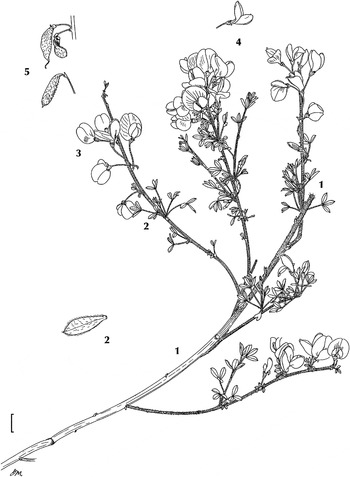
Fig. 1.Cytisus ardoinoi E.Fourn. subsp. ardoinoi. 1, stem; 2, leaves; 3, inflorescence; 4, flowers; 5, fruits. Drawn by Dominique Mansion and reproduced with permission (see Acknowledgements). Scale bar = 1 cm.
 Fig. 2.
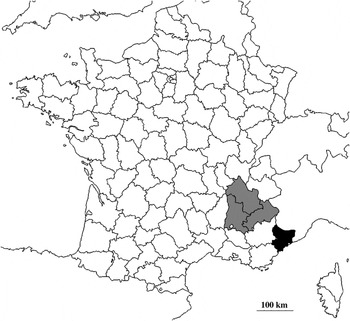
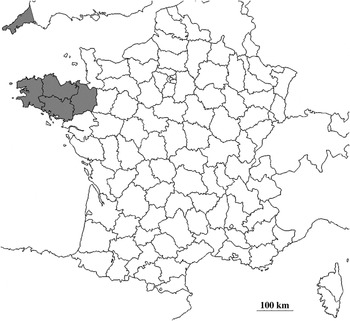
Distribution of Cytisus ardoinoi E.Fourn. subsp. ardoinoi (area in black) and Cytisus ardoinoi E.Fourn. subsp. sauzeanus (Burnat & Briq.) Auvray (area in grey).


Proposed IUCN conservation assessment. Near Threatened (NT), as for Cytisus ardoinoi subsp. sauzeanus, the most widespread subspecies.
Key to the subspecies of Cytisus ardoinoi
1a. Twigs with 8 T-shaped ribs; fruits densely villous 1a. Cytisus ardoinoi subsp.ardoinoi
1b. Twigs with 5 V-shaped ribs; fruits with surface glabrous but ciliate on margins 1b. Cytisus ardoinoi subsp.sauzeanus
1a. Cytisus ardoinoi E.Fourn. subsp.ardoinoi
Prostrate creeping shrub, 0.2–0.7 m high. Twigs with long internodes, unarmed, with 8 ribs T-shaped in transverse section, pubescent with erect hairs up to 1 mm long; striae well-developed. Leaves petiolate, trifoliolate; stipule with 2 ribs; petiole 3–6 mm long; leaflets 4–7 × 1–2 mm, linear to elliptic, sericeous. Flowers few; pedicel 3–10 mm long. Upper lip of the calyx 2–3 mm long; lower lip 2–4 mm long; teeth 0.5–1 mm deep. Corolla yellow; standard 9–13 mm long, 9–10.5 mm wide, orbicular, glabrous; wings 9.5–13 mm long, as long as the standard and the keel petals, 3–4 mm wide, shape variable, with apex curved, glabrous; keel 9.5–12 mm long, as long as the standard, 3–4 mm wide, falcate or sub-falcate, glabrous or pubescent on the lower margin. Style pilose. Fruit 10–20 mm long, plane, oblong or elliptic, densely villous.
Distribution. France (Alpes-Maritimes).
Flowering time. April–June.
Proposed IUCN conservation assessment. Vulnerable (VU D2). This assessment is based on criterion D2 from the IUCN red list categories (IUCN, 2001) as the area of occupancy of Cytisus ardoinoi subsp. ardoinoi is less than 20 km2 (G. Giggot & J. Olivier, Fédération Française des Conservatoires Botaniques Nationaux, pers. comm.). Individuals of Cytisus ardoinoi subsp. ardoinoi are eaten by sheep and goats and are self-incompatible, which adds to their vulnerability. The subspecies is protected in France (Anonymous, 1982).
Additional specimens examined. France. Alpes Maritimes: Anonymous (E); 23 iv 1896, Anonymous (E); Au-dessus de Menton, 20 v 1895, C. Bicknell (L); Bézaudun, iv 1870, Consolat (MPU); Bézaudun, v/vi 1870, J. Moggridge (E); Bézaudun, iv/vi 1873, Consolat 35 (E, G, K, L, MPU); Bézaudun, 26 v 1875, Barlet (LY); Bézaudun, Mont Chier, v/vi 1876, Huet (E, K, MPU); Caussols, 30 iv 1872, E. Burnat (G, MP); Caussols, 6 v 1905, I. Verguin (E, MPU); Caussols, 16 v 1917, P. Le Brun (MPU); Caussols, 20 iv 1966, G. Gavelle (MA); Caussols, 29 v 1971, C. Simon (K); Cime d’Ours, 25 iv 1869, J. Moggridge (G, K); Cime d’Ours, iv 1871, J. Moggridge (G); Cime d’Ours, 9 v 1889, W. Bernoulli (G, MA); Cime d’Ours, 8 iv 1893, J. Moggridge (G); Cime d’Ours, Menton, 20 iv 1872, J. Moggridge (K); Cipières, 27 v 1990, F. Hepper 8963 (K); Cipières, 3 v 1991, F. Hepper 9377 (K); Entre Caussols et Gourdon, 6 v 1963, G. Gavelle 4346 (L, MA); Entre Caussols et Gourdon, 26 v 1975, A. Charpin 11480 (G); L’Audibergue, 12 v 1908, J. Rodié (G); Le Chier près Bézaudun, 10 v 1872, E. Burnat (L); Mayres, 1893, abbé Sauze (G); Mont Aiguille, 7 iv 1877, W. Barbey (G); Mont Baudon, 15 v 1904, G. Vialon 2203 (G, MPU); Mont Baudon, près Menton, 23 v 1904, J. Arbost (MPU); Mont Cheiron, 7 v 1870, J. Moggridge (E); Mont Cheiron, 28 v 1875, E. Burnat (G); Mont Chier, iv/vi 1870/1872, Burnat & Consolat (MPU); Mont Chier, iv 1870, Hasskarl (L); Mont Chier, 10 v 1872, E. Burnat 149 (G); Mont Méras, 16 iv 1869, J. Moggridge (K); Mont Siricocca, v 1895, C. Bicknell 3820 (E, G); Thiey, près St Vallier, 23 v 1896, E. Burnat et al. (G).
1b. Cytisus ardoinoi subsp. sauzeanus (Burnat & Briq.) Auvray, comb. et stat. nov. – Cytisus sauzeanus Burnat & Briq., Etud. Cytis. Alp. Marit. 27, 157 (1894). – Genista ardoinoi subsp. sauzeana (Burnat & Briq.) Rouy, Fl. France 4: 209 (1897). – Genista sauzeana (Burnat & Briq.) Hill, Index Kewensis Suppl. 6: 90 (1926). – Cytisus ardoinoi var. sauzeanus (Burnat & Briq.) Chatenier, Bull. Soc. Bot. France 57: 122 (1910) [ardoinianus var. sauzianus]. – Type: [France] Isère, Mayres, près la Mure, 20 iv 1882/29 v 1882, Société dauphinoise d’échanges, Abbé Sauze 68 bis (holo G!; iso G!, MPU!). Figs 2,3.
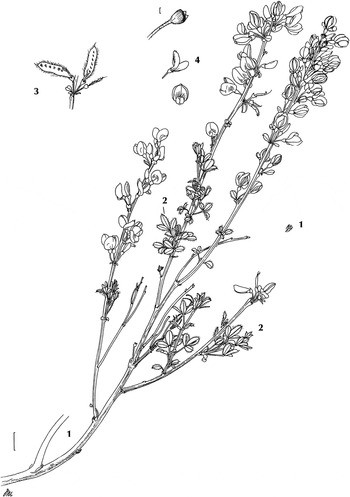
Fig. 3.Cytisus ardoinoi E.Fourn. subsp. sauzeanus (Burnat & Briq.) Auvray. 1, stem; 2, leaves; 3, fruits; 4, flowers. Drawn by Dominique Mansion and reproduced with permission. Lower scale bar = 1 cm. Upper scale bar = 1 mm.

Shrub 0.2–0.6 m high. Twigs with 5 ribs, V-shaped. Petiole 5–10 mm long; leaflets 7–12 × 3–6 mm, elliptic to obovate. Style glabrous. Fruit 20–40 mm long, glabrescent with occasional, short hairs on margins.
Distribution. France (Drôme, Hautes-Alpes, Isère).
Flowering time. May–June.
Proposed IUCN conservation assessment. Near Threatened (NT). Cytisus ardoinoi subsp. sauzeanus has an area of occupancy of less than 2000 km2 and has been found in a few (but more than 10) scattered locations. The subspecies is also undergoing a continuing decline in both the area of occupancy and the number of mature individuals due to the absence of fructification caused by self-incompatibility (G. Giggot & J. Olivier, Fédération Française des Conservatoires Botaniques Nationaux, pers. comm.).
Taxonomic notes. Cytisus ardoinoi subsp. sauzeanus is distinguishable by the number of ribs on the twigs as well as their shape. Both subspecies have a low prostrate habit as well as well-developed trifoliolate leaves which are unique features within Cytisus sect. Alburnoides. Both taxa have a well-delimited and allopatric distribution.
Additional specimens examined. France. Drôme: Gorges de Rioufroid, 29 v/19 viii 1896, C. Chatenier 3899 (LY). Hautes Alpes: Mont Aurore, 2 viii 1898, Rouy (LY); Montmaur, 3 viii 1898, H. Coste (MPU); St Julien en Beauchêne, 3 vii 1902, A. Faure (L, MPU); St Julien en Beauchêne, 7 vii 1902, L. Girod 106 (E); St Julien en Beauchêne, 10 vi 1931, R. de Litardière 6329 (MPU); St Julien en Beauchêne, 18 v 1948, J. Rodié (MPU). Isère: Marcieu, iv 1894, Bernard (LY); Marcieu, 1900/1904, Berruard (MPU); Mayres, 1893, abbé Sauze (G); Mont Séneppe, près de Marcieu, 25 vi 1889, abbé Sauze 6a (G).
2. Cytisus balansae (Boiss.) Ball, J. Bot. 11: 303 (1873). – Sarothamnus balansae Boiss., Diagn. Pl. Orient. ser. 2, 2: 7 (1856). – Cytisus purgans var. balansae (Boiss.) Briq., Etud. Cytis. Alp. Marit. 155 (1894). – Genista purgans subsp. balansae (Boiss.) Rouy, Fl. France 4: 206 (1897). – Genista purgans var. hermini Welw. in Rouy, Fl. France 4: 206 (1897), nom. nud. – Cytisus purgans subsp. balansae (Boiss.) Maire, Mém. Soc. Sci. Nat. Maroc. 7: 172 (1924). – Corothamnus balansae (Boiss.) Ponert, Feddes Repert. 83: 619 (1973). – Type: [Algeria] Fr. bois de Lambèse, 10 vii 1853, Balansa 918 (lecto G!, designated here; isolecto K! (left-hand specimen), P!).Fig. 4.
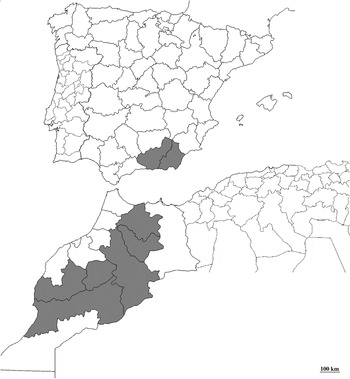
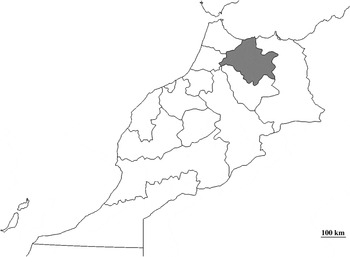
Fig. 4.Distribution of Cytisus balansae (Boiss.) Ball (area in grey). Cytisus balansae is present in Algeria but no locality is mentioned on specimen sheets (see list of specimens).
Cytisus balansae var. atlanticus Ball, J. Bot. 11: 303 (1873). – Cytisus balansae subsp. atlanticus Ball ex Canto & Rivas Mart., Lazaroa 23: 6 (2003 [‘2002’]), comb. inval. – Type: [Morocco] Ex regione superiori Atlantis Majoris in cacumine Djebel Tezah, 22 v 1871, Ball s.n. (lecto G!, designated by Talavera & Gibbs, Reference Talavera and Gibbs1997; isolecto K!).
Cytisus galianoi Talavera & P.E.Gibbs, Bot. J. Linn. Soc. 125: 338 (1997). – Cytisus balansae var. galianoi (Talavera & P.E.Gibbs) G.Lopez, Anales Jard. Bot. Madrid 57: 450 (2000). – Cytisus balansae subsp. nevadensis Canto & Rivas Mart., Lazaroa 23: 6 (2003 [‘2002’]). – Type: [Spain] Almeria, Sierra Nevada, between El Chullo and Cerro del Amirez, 6 vi 1988, Talavera & Valdes s.n. (holo SEV 136210; iso SEV 136211!).
Cytisus valdesii Talavera & P.E.Gibbs, Bot. J. Linn. Soc. 125: 340 (1997). – Type: [Morocco] Above village of Arround, Aït Mesan valley, 13 v 1871, Hooker s.n. (lecto K!, designated by Talavera & Gibbs, Reference Talavera and Gibbs1997).
Cytisus oromediterraneus subsp. nevadensis Rivas Mart., nom. inval. pro. syn., in Canto & Rivas Mart., Lazaroa 23: 6 (2003 [‘2002’]). – Based on: Spain, Granada, Puerto del Lobo de Sierra Nevada, 17 vii 1973, Ladero & Valdes Bermejo s.n. (MAF 94727 ×2).

Low ascending shrub, 0.2–0.6 m high. Twigs with short internodes, with 10–13 ribs T-shaped in transverse section, sericeous when young, glabrous when older; striae well-developed; twig apex ending in a sharp spike. Leaves mostly on young twigs, petiolate, unifoliolate; stipule with 3 ribs; petiole up to 1 mm long; leaflets 4–15 × 1–4 mm, linear, glabrescent to sericeous. Flowers few; pedicel 4–9 mm long. Upper lip of the calyx 2–4 mm long; lower lip 2–5 mm long; teeth 0.5–1 mm deep. Corolla yellow; standard 8–13 mm long, 6–12 mm wide, orbicular, more rarely elliptic, generally emarginate, glabrous; wings 8–13 mm long, as long as the standard and the keel petals, 2–4 mm wide, elliptic or oblong, with apex curved, glabrous; keel 8–12 mm long, as long as the standard, 2–4 mm wide, falcate or sub-falcate, generally glabrous, rarely pubescent on the lower margin. Anthers 0.5–1.6 mm long. Style pilose on the lower half. Fruit 13–26 × 5.5–8.5 mm, plane, elliptic, sericeous to villous, 1- to 2-seeded. Seeds 3–4.5 × 2.5–3.5 mm.
Distribution. Algeria, Morocco (Chaouia-Ouardigha, Fès-Boulemane, Sous-Massa-Drâa, Marrakech-Tensift-Al Haouz, Meknès-Tafilatet, Tadla-Azilal, Taza-Al Hoceima-Taounate), Spain (Almeria, Granada).
Flowering time. May–June.
Proposed IUCN conservation assessment. Least Concern (LC). This taxon is known from many localities across a wide area and there are no significant threats.
Taxonomic notes. Talavera & Gibbs (Reference Talavera and Gibbs1997) were the first to subdivide Cytisus purgans auct. into four species, named C. oromediterraneus Rivas Mart., C. balansae (Boiss.) Ball, C. galianoi Talavera & Gibbs and C. valdesii Talavera & Gibbs. The delimitation of the four species was mainly based on the presence or absence of spines, the number of ribs on the stems, the hairiness of the stems, the size of the calyx and the standard petal. Canto & Rivas-Martinez (2003) considered the levels of variation between Cytisus balansae, C. galianoi and C. valdesii too low to distinguish taxa at species rank. They therefore recognised three subspecies of Cytisus balansae: C. balansae subsp. balansae, C. balansae subsp. atlanticus Canto & Rivas Mart. and C. balansae subsp. nevadensis Canto & Rivas Mart. The distinction was based on characters such as the degree of spinyness, the hairiness of juvenile stems, the number of ribs on the twigs and the shape of the hairs on the calyx. However, we found that these characters are not diagnostic in herbarium material, with intermediate states frequent and no marked geographic isolation. No other morphological characters distinguish subspecies within Cytisus balansae.
Nomenclatural notes. Lectotypification of Sarothamnus balansae Boiss.: the specimens labelled Balansa 918 contain two collections, one in flower made on 8 June 1853 and one in fruit made on 10 July 1853. The fruiting specimen from G is designated as lectotype as this was where Boissier worked and fruits are taxonomically important in the group.
Additional specimens examined. Algeria. s. l. v/vi 1883, J. Battandier & L. Trabut (P); 15 v 1971, Davis 52364 (E, RNG); 19 v 1971, Davis 52501 (RNG); 8 vi 1984, D. Podlech 38832 (G); 10 vii 1988, A. Chabert (G, P); 24 vi 1984, A. Chabert (LY).
Morocco. s. l. v 1871, Dr Hooker (P); 31 v 1913, H. Powell (MPU); 3 vii 1920, R. Maire (MPU); 13 iv 1924, 15 x 1927, Weiller 605 (P); R. Maire (MPU); 20 iv 1933, R. Maire (MPU); 20 vi 1927, R. Maire (MPU); 17 vii 1989, M. Ait Lafkih et al. 513 (RNG); 27 vi 1997, C. Aedo et al. 4399 (RNG, VAL); Aït Messan, 15 vi 1921, E. Jahandiez 772 (E, MPU); Aït Messan, 17 vi 1921, Ch. D’Alleizette (P); Aït Messan, 10 iv 1926, H. Lindberg 3749 (K); Bekrut, 3 vi 1924, E. Jahandiez 528 (MPU); Tamelmelt, P. Crane (RNG). Chaouia-Ouardigha: Aïn Kahla, 15 v 1924, E. Jahandiez 301 (E, MA). Fès-Boulemane: Daïet Achlef, 1 vi 1923, E. Jahandiez 388 (G, P); Salida Lucia Boulemane, 22 iv 1984, Aparicio, Rowe & Silvestre (RNG). Marrakech-Tensift-Al Haouz: 17 v 1981, J. Fernandez Casas et al. 4694 (RNG); Adrar-n-Oukaïmeden, 29 vi 2006, A. Herrero et al. 2968 (MA, RNG); Djebel Toubkal, viii/ix 1970, Clayton & Brinklow 26 (E); Djebel Toubkal, 24 vii 1973, Davis 55526 (E); Oukaïmeden, 11 vii 1984, G. Lopez & F. Munoz Garmendia 8957 (MA, RNG); Oukaïmeden, 25 vii 1997, S.L. Jury et al. 18121 (MA); Tanzat, 14 ix 1941, C. Sauvage 1505 (MPU); Tizi-n-Aït-Hamed, 3 vii 1997, J. Güemes et al. 1548 (VAL); Zaouiat Ahansal, 5 ix 2004, P. Blanco 5 ix 2004 (MAF). Meknès-Tafilatet: Djebel Ayachi, 10 vi 1992, Optima Iter V 417 (RNG); road to Midelt, 12 vi 1992, Optima Iter V 726 (RNG); Tizi-n-Tretten, 16 vi 1936, R. Maire (G); Tizi-n-Tretten, 18 vi 1938, L. Faurel (MPU). Sous-Massa-Drâa: Djebel Siroua, 18 v 1981, S. Castroviejo et al. 4756 (MA, RNG); Gorges du Dades, 20 vi 1974, Reading Univ./B. M. Exped. 868 (RNG); Ourika, 9 vii 1921, R. Maire s.n. (MPU); Tizi-n-Test, 30 v 1980, A. Charpin et al. 289 (G); Tizi-n-Test, 30 v 1980, J. Fernandez Casas 3255 (G, MA); Tizi-n-Test, 12 i 1982, J. Fernandez Casas 4689 (G, MA, RNG). Tadla-Azilal: Azilal, 21 vii 1984, G. Lopez & F. Munoz Garmendia 9263 (MA); El-Ksiba to Tinghir, 9 vii 1997, A. Abaouz, M. Ait Lafkuh & A.J.K. Griffiths 17708 (RNG). Taza-Al Hoceima-Taounate: Djebel Bou Ibane, 24 vi 1997, C. Aedo et al. 4190 (MA, RNG, VAL).
Spain. Almeria: 19 vi 1988, B. Valdès, M.F. Watson et al. 896 (RNG); Abrucena, 17 vi 1988, B. Valdes, M.F. Watson et al. 621/88 (G, RNG); Calar alto, 3 vii 2004, Ciruelos & Pardo s.n. (MAF). Granada: 23 iv 1996, S.L. Jury 17128 (RNG); Hueneja, Sierra Nevada, 19 vi 1992, C. Aedo et al. 388 (MA); Puerto de la Ragua, Sierra Nevada, 22 vii 1973, B. Valdes s.n. (MA); Puerto de la Ragua, Sierra Nevada, 19 vi 1988, B. Valdes et al. 951/88 (G, RNG); Sierra Nevada, vi 1902, C. Pau 60573 (MA); Sierra Nevada, v 1951, C. Torres s.n. (MA); Sierra Nevada, 6 vi 1963, C.M. Stocken 219.63 (E); Sierra Nevada, 5 vi 1970, Archibald 3489 (E); Sierra Nevada, 6 vi 1995, S. Rivas-Martinez s.n. (MAF).
3. Cytisus multiflorus (L’Hér. ex Aiton) Sweet, Hort. Brit. 112 (1826). – Spartium multiflorum L’Hér. ex Aiton, Hort. Kew. 3: 11 (1789). – Genista multiflora (L’Hér. ex Aiton) Spach, Ann. Sci. Nat., Bot. sér. 3, 3: 155 (1845), nom. illeg. – Sarothamnus multiflorus (L’Hér. ex Aiton) Samp., Anais Fac. Sci. Porto 19: 87 (1934). – Type: Stirp. Nov. tab. LXXXVII (1805), iconotype, see nomenclatural notes.Fig. 5.
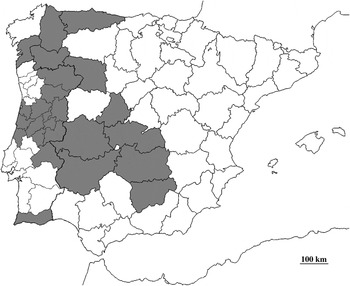
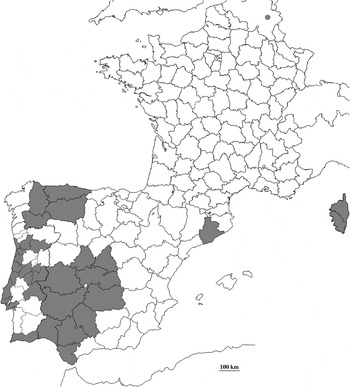
Fig. 5.Distribution of Cytisus multiflorus (L’Hér. ex Aiton) Sweet (area in grey).
Genista alba Lam., Encycl. 2: 623 (1788). – Spartium album (Lam.) Desf., Fl. Atlant. 2: 132 (1798). – Cytisus albus (Lam.) Link, Enum. Hort. Berol. Alt. 2: 241 (1822), non Cytisus albus Jacq. (1790). – Spartothamnus albus (Lam.) C.Presl, Abh. Königl. Böhm. Ges. Wiss. ser. 5, 3: 568 (1845). – Spartocytisus albus (Lam.) K.Koch, Dendrologie 1: 31 (1869). – Cytisus linkii Janka, Termesztr. Füzet. 8: 70 (1884). – Cytisus lusitanicus Willk., Prodr. Fl. Hispan., Suppl. 256 (1893). – Sarothamnus lusitanicus (Willk.) Pau, Trab. Mus. Nac. Ci. Nat., Sér. Bot. 1: 34 (1922). – Sarothamnus albus (Lam.) Lainz, Bol. Inst. Estud. Asturianos, Supl. Ci. 15: 23 (1970). – Type: [Portugal] Lamarck s.n. (holo P-LA!).
Spartium dispermum Willk., Bot. Mag. (Roëmer & Usteri) 4 (11): 19 ‘35’ (1790). – Type: Bot. Mag. (Roëmer & Usteri) 4 (11): tab. 2, lectotype designated here.
Sarothamnus parviflorus Willk. & Cutand. ex Willk., Linnaea 30: 95 (1859). – Type: Spain, Avila, Sierra de Gredos, vii 1855, Isern s.n. (Willkomm’s collection) (holo COI?, photograph of the type seen at MA).

Erect shrub, 1–2 m high. Twigs unarmed, with 8 ribs T-shaped in transverse section, densely sericeous when young, glabrescent when older; striae superficial. Leaves petiolate, usually unifoliolate; petiole 1.5–8 mm long; short stipule with 2 ribs; leaflets 4–8 × 1–4 mm, generally linear, sometimes elliptic or obovate, sericeous. Flowers numerous; pedicel 2–5 mm long. Upper lip of the calyx 2–3 mm long; lower lip 2–3 mm long; teeth 0.5–1 mm deep. Corolla white; standard 9–11 mm long, 6.5–10 mm wide, orbicular, glabrous; wings 9–11 mm long, as long as the standard and the keel petals, 2–4 mm wide, generally sub-elliptic, sometimes oblong, with apex curved or pointed, glabrous; keel 9–11 mm long, as long as the standard, 2–4 mm wide, sub-elliptic or falcate, generally glabrous. Anthers 0.7–0.8 mm long. Style sericeous. Fruit 15–31 × 5–6.5 mm, plane, oblong, villous, 1- to 7-seeded. Seeds 2.5–3 × 2–3 mm.
Illustrations in Genisteas espanolas, Lam. XLVII: 195 (Vicioso, Reference Vicioso1955) and in Flora Iberica 47: 174 (Talavera et al., Reference Talavera, Aedo, Castroviejo, Romero Zarco, Saez, Salgueiro and Velayos1999).
Distribution. Portugal (Castelo Branco, Coimbra, Faro, Guarda, Portalegre, Porto, Viseu), Spain (Asturias, Avila, Badajoz, Caceres, Ciudad Real, Jaen, Leon, Lugo, Orense, Pontevedra, Toledo, Zamora). Cultivated in Algeria, Belgium, Italy, the Netherlands, Switzerland, the United Kingdom and the United States.
Flowering time. April–May.
Proposed IUCN conservation assessment. Least Concern (LC). This taxon is known from many localities across a wide area and there are no significant threats.
Nomenclatural notes. Original material for Spartium multiflorum: L’Héritier’s Stirpes Novae was published in nine volumes. Plate 86, mentioned by Aiton as the type specimen for Spartium multiflorum in 1789, appears in the seventh volume. That volume was issued together with the eighth and ninth volumes in August 1805. However, a conspectus of the seventh volume was published at the same time as the sixth volume in September 1791. Letters from L’Héritier to Dryander, who made a few descriptions in Aiton’s Hortus Kewensis, referred to the position of the future plates of the seventh volume in 1788 (Buchheim, Reference Buchheim1965). We can therefore assume that the plates were already drawn in 1789 when Aiton published his book. Note 2 of Article 9.2 of the ICBN (McNeill et al., Reference McNeill, Barrie, Burdet, Demoulin, Hawksworth and Marhold2006) stipulates that original material comprises specimens or illustrations ‘both unpublished and published either prior to or together with the protologue’. Therefore, plate 86 belongs to the original material. Other possible material would be specimens from L’Héritier, whose collection was sold to A.-P. de Candolle. However, no specimen from L’Héritier has been found in the G-DC collection. We suggest, therefore, that the name was based only on the plate, and there is no need for lectotypification.
Additional specimens examined. Unknown country. 1787, Cambessedes (MPU); 25 iv 1933, E. Guinea (RNG); Hasskarl 1579 (L).
Portugal. s. l. vi 1916, G. Sampaio 2930 (L, MA). Castelo Branco: Serra da Gardunha, 2 v 2009, C. Aedo et al. 16379 (MA). Coimbra: iv 1881, A. Moller 1039 (P), iv 1881, A. Moller 1059 (G, MPU); iii 1890, J. Daveau (LY); 1935, Scarlett 118 (K); 29 iv 1936, Kostermans & Kruyt 757 (L); 23 iii 1939, W. Rothmaler 14672 (G); Pinhal de Marrocos, iv 1898, M. Ferreira 1579 (G, MA, MPU); Vila Franca, iv 1886, A. Moller 2152 (G, K, MPU, P); Vila Franca, vi 1887, D’Araujo E Castro vi 1887 (MPU); Vila Franca, 10 iii 1949, J. Matos 4244 (K, MA); Vila Franca, 1 iv 1955, Matos & Marques (L). Faro: Serra de Mandique, 22 iv 1968, Malato-Beliz et al. 5971 (MA). Guarda: Sabugal, 13 v 1970, Malato-Beliz et al. 8205 (MA); Serra da Estrella, 29 iv 1936, Souza 757 (L); Serra da Estrella, 29 iv 1994, E. Rico et al. 1123 (MA); Serra da Estrella, 23 vi 1987, W.O. van der Knaap & J.F.N. van Leeuwen 87-136 (L); Serra da Estrella, 14 vii 1987, W.O. van der Knaap & J.F.N. van Leeuwen 87-235 (L); Serra da Estrella, 18 v 1988, W.O. van der Knaap & J.F.N. van Leeuwen 88-27 (L); Serra da Estrella, Valesim, viii 1881, J. Daveau (LY). Portalegre: Campo Major, 27 ii 1980, J. Guerra & Monjardino 16284 (MA); Castelo de Vide, 8 iii 1977, Malato-Beliz et al. 13080 (MA). Porto: Amarante, v 1908, G. Sampaio (MPU). Viseu: Caramulinho, 30 v 1972, Malato-Beliz et al. 11721 (MA).
Spain. s. l. vi 1860, Anonymous (K). Asturias: Brana de Arriba, 9 v 1835, Dureau 349 (P); Brana de Arriba, 9 vii 1835, Hooker 349 (K); Brana de Arriba, 12 vi 1864, E. Bourgeau (MPU); Brana de Arriba, 12 vi 1864, G. Joad (K); Brana de Arriba, 1864, E. Bourgeau 2635 (G, K, LY, P); Moal, 2 v 1982, C. Aedo (MA); Pesoz, 22 iii 1959, S. Lainz (E); Puerto de Leitariegos, 8 iv 1962, S. Lainz (E). Avila: Cuevas del Valle, 12 v 1995, D. Sanchez-Mata et al. PC9528 (MAF); Hoyocasero, 11 v 1985, M. Luceno & P. Vargas (MA); La Huguijuela, 21 v 1982, D. Sanchez-Mata et al. (MA); Mijares, 19 iv 1982, D. Sanchez-Mata & Belmonte (MAF); Mijares, 6 v 1989, P. Canto 28 (G, K, MAF, MPU); Mijares, 6 v 1989, P. Canto 18061 (G, MA); Mijares, 11 v 1995, D. Sanchez-Mata et al. PC9519 (MAF); Mijares, 10 v 1999, P. Cubas & C. Pardo PC9906 (MAF); Poyatos, 12 vii 1995, P. Cubas & C. Pardo 95119 (MAF); Puerto de Casillas, 11 v 1995, D. Sanchez-Mata et al. PC9514 (MAF); Puerto de Menga, 13 vi 1974, G. Lopez & E. Valdes-Bermejo 18062 (G, MA); Puerto del Pico, 31 iii 1994, O. Lozoya 31 iii 1994 (MA); Puerto del Pico, 10 v 1999, P. Cubas & C. Pardo PC9909 (MAF); Ramacastanas, 13 iv 1987, P. Vargas 1944 (MA); Ramacastanas, 31 iii 1994, C. Sanz 31 iii 1994 (MA); Serranillos, 16 vi 1979, B. de Retz 79305 (G); Sierra de Gredos, 29 vi 1972, P. Gibbs & E. Dominguez 12 (E); Sierra de Gredos, 23 vi 1974, E.A. Leadlay & B. Petty 44 (RNG). Badajoz: Albuquerque, 24 ii 1994, A. Ortega & T. Rodriguez 12/94 (MA); Albuquerque, 31 iii 1995, A. Ortega & T. Rodriguez 5/95 (G); Albuquerque, 15 iii 1996, A. Ortega & T. Rodriguez 48/96 (MA); La Codosera, 16 iii 1989, J. Carrasco 116/89 (MA). Caceres: Garrovillas, 24 ii 1994, A. Ortega & T. Rodriguez 16/94 (MA); Grimaldo, 27 iii 1953, F. Bellot & B. Casaseca (G); Hoyos, 30 iii 1977, Moreno & Cubas (MAF); Jaraicejo, 7 iii 1980, D. Belmonte (MA); Los Catorros, 29 iii 1945, S. Rivas Goday 29 iii 1945 (MA); Mesilla, 5 iii 1978, S. Rivas-Martinez 9346 (G, MA, MAF); Peraleda de la Mata, 3 iii 1994, P. Navarro (MA); Pueblonuevo de Miramontes, 19 iv 1991, R. Gavilan 16148 (G, MA, RNG); Puerto de Honduras, 4 vi 1976, S. Rivas-Goday & Izco 4 vi 1976 (MAF); Puerto de Perales, 30 iii 1977, P. Cubas et al. (MA); Sierra de Miravete, 9 iv 1969, J. Fernandez Casas 526 (MA); Sierra de Montanchez, 24 iv 1994, Conti et al. 628 (RNG); Sierra de Montanchez, 24 iv 1994, Conti et al. 655 (RNG); Trujillo, 19 iii 1968, J. Borja (MA); Trujillo, 2 iii 1985, S. Silvestre (MA); Trujillo, 25 ii 1989, J. Perez Chiscano (MA). Catalonia: La Corona, Santixo, 24 iv 1991, A. Charpin et al. 22560 (G). Ciudad Real: Retuerta del Bullaque, 1 iv 1980, A. Barra et al. 2312 (MA, RNG); Retuerta del Bullaque, 1988, A. Barra et al. 13220 (G, MA, MAF, MPU); Retuerta del Bullaque, 20 iii 1999, V.J. Aran & M.J. Toha 20 iii 1999 (MA). Jaen: Sierra Magima, between Cambil and Huelma, 30 v 1970, Archibald 3413 (E). Leon: 20 km SW of La Baneza, 18 v 1972, R.K. Brummitt & A.O. Chater 172 (K); Combarros, iv 1965, C. Siphes (L); Cubillos, 2 vii 1851, Lange (P); El Bierzo, 16 iv 1933, W. & M. Rothmaler 98 (MA, MAF); Ponferrada, 19 vi 1991, G. Nieto Feliner 75 (MA). Lugo: Antes de Arzogon, R. Alvarez 17526 (MA); Sierra del Caurel, vi 1990, E. Blanco 372 (MA); Villaframil, 28 iv 1955, E. Carreira (G, MA). Orense: 17 v 1972, J. Fernandez Casas (MA); Boboras, 5 iv 1986, F. Silva-Pando 166 (G); Bovoras, 5 iv 1986, F. Silva-Pando 3611 (MA); El Barco, 17 v 1972, S. Lainz (G); Santa do Invernadeiro, 18 iv 1973, S. Castroviejo (G, MA). Pontevedra: Golada, 17 iv 1958, F. Bellot & B. Casaseca (MA); O Rosal, 6 iv 1995, J. Amigo (MA). Salamanca: 23 iv 1967, Brummitt & Ernst 5809 (K). Toledo: 4 iv 1921, D. Joaquin (MAF); Calzada de Cropesa, 2 iii 1985, S. Silvestre (MA); Las Navillas, 9 v 2003, M. Carrasco 731 (MA); Mola de Toledo, 20 iv 1974, A. Segura Zubizarreta 7514 (MA); San Pablo de los Montes, 14 vi 1864, E. Bourgeau (K, P); Talavera La Reina, 16 iv 1863, E. Bourgeau 2415 (G, K, P); Talavera La Reina, S. Albaille 1461 (MPU). Valencia: Pinar de Antequera, 8 v 2004, J. Lazaro Bello (MA). Zamora: Villardeciervos, 12 v 1974, E. Fuentes (MA).
4. Cytisus oromediterraneus Rivas Mart. et al., Veg. Alta Mont. Cantabrica 264 (1984). – Cytisus balansae var. europaeus G.Lopez & C.E.Jarvis, Anales Jard. Bot. Madrid 40: 342 (1984). – Cytisus balansae subsp. europaeus (G.Lopez & C.E.Jarvis) Muñoz Garm., Anales Jard. Bot. Madrid 41: 477 (1985). – Type: [Spain] Sierra de Guadarrama, Lugares rupestres del Alto del Leon, en el grado subalpino (de Lüdi), sobre granito, 6 v 1945, Rivas Goday 1407 (holo MA 60554!; iso G!, K!).Fig. 6.
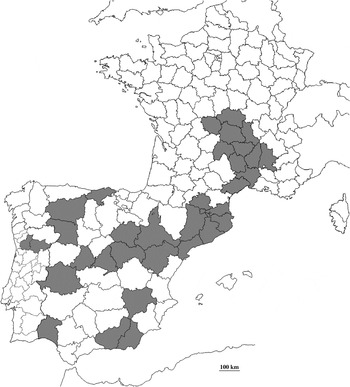
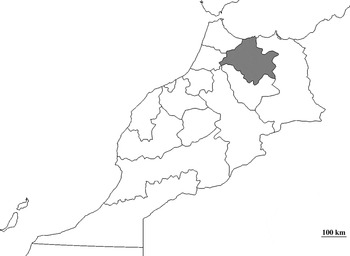
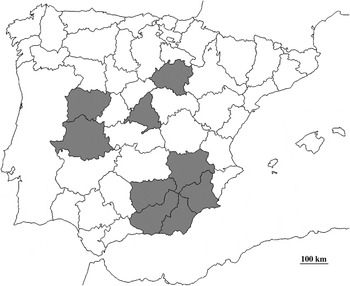
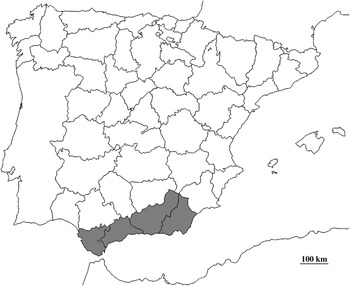
Fig. 6.Distribution of Cytisus oromediterraneus Rivas Mart. et al. (area in grey).
Cytisus purgans var. grandiflorus Deb. & E.Rev., Pl. Espagne (Teruel) 1895: 1079 (1895), nom. in sched. – Based on: Spain, Sierra de Guadalaviar, lieux arides, sur le calcaire, vi 1895, Debeaux & Reverchon 1079 (G!, L!, LY!, P!).
Genista purgans var. brachycarpa Rouy, Fl. France 4: 206 (1897). – Type: unknown (no material at LY under that name and no specimen associated with that name in the protologue).
Genista purgans auct. non L.: Gouan, Fl. Monsp. 474 (1764); De Candolle, Fl. Franç. 3, 4: 494 (1805) & Prodr. 2: 149 (1825); Duby, Bot. Gall. 1: 117 (1828); Rouy, Fl. France 4: 206 (1897); Coste, Fl. Descr. France 1: 300 (1901).
Spartium purgans auct. non L.: Amo, Fl. Fan. Penins. Iber. 5: 406 (1873).
Cytisus purgans auct. non (L.) Boiss.: Willkomm, Prodr. Fl. Hisp. 3: 456 (1877); Nyman, Consp. Fl. Eur. 157 (1878); Laguna, Fl. Forest. Espan. 2: 344 (1890); Vicioso, Bol. Inst. Forest. Invest. Exp. Madrid 72: 190 (1955); Frodin & Heywood, in Tutin et al., Fl. Eur. 2: 87 (1968); Quezel, in Maire, Fl. Afrique N. 16: 280 (1987).
Sarothamnus purgans auct. non (L.) Gren. & Godr.: Cadevall, Fl. Catalunya 2: 37 (1915).

Ascending shrub, 0.4–1 m high. Twigs with short internodes, unarmed, with 8 ribs T-shaped in transverse section, densely sericeous when young, glabrous when older; striae well-developed. Leaves rare, especially on young twigs, sessile or sub-sessile, unifoliolate; stipule with 2 ribs; leaflets 4–8 × 1–3 mm, generally linear, sometimes oblanceolate, sericeous. Flowers few; pedicel 2–10 mm long. Upper lip of the calyx 2–4 mm long; lower lip 2–4 mm long; teeth 0.5–1 mm deep. Corolla yellow; standard 9–13 mm long, 7–12 mm wide, orbicular, emarginate, glabrous; wings 9–13 mm long, as long as the standard and as long as or longer than the keel petals, 3–4 mm wide, elliptic or sub-elliptic, with apex curved, glabrous; keel 9–13 mm long, as long as the standard, 3–4 mm wide, falcate or sub-falcate, glabrous. Anthers 0.7–0.8 mm long. Style pilose on the lower half. Fruit 15–33 × 6–9 mm, plane, slightly curved, villous, 3- to 6-seeded. Seeds 3–4 × 2.5–3.5 mm.
Illustrations in Genisteas espanolas, Lam. XLVI: 191 (Vicioso, Reference Vicioso1955) and in Flora Iberica 48: 176 (Talavera et al., Reference Talavera, Aedo, Castroviejo, Romero Zarco, Saez, Salgueiro and Velayos1999).
Distribution. Andorra, France (Ardèche, Ariège, Auvergne, Cantal, Cévennes, Creuse, Drôme, Gard, Hérault, Loire, Puy-de-Dôme, Pyrénées-Orientales), Portugal (Guarda), Spain (Albacete, Almeria, Avila, Caceres, Cantabria, Catalonia, Gerona, Granada, Guadalajara, Huelva, Leon, Lerida, Lleida, Madrid, Soria, Teruel, Zamora, Zaragoza). Cultivated in the Netherlands and the United Kingdom.
Flowering time. April–May.
Proposed IUCN conservation assessment. Least Concern (LC). This taxon is known from many localities across a wide area and there are no significant threats.
Nomenclatural notes. Genista purgans, and combinations based on it, have been used by several authors to name the taxon which should rather be called Cytisus oromediterraneus. This confusion was due to an initial misnaming and subsequent attempt to designate the specimen Löfling 231b, Herb. Linn. No. 892.20 as a new type of Genista purgans (Lopez Gonzalez & Jarvis, Reference Lopez Gonzalez and Jarvis1984; Lopez Gonzalez, Reference Lopez Gonzalez1996). This proposition was rejected by the committee for Spermatophyta (Brummitt, Reference Brummitt1999). Löfling 231b is a specimen of Genista scorpius (L.) DC.
Additional specimens examined. Andorra. Vall d’Incles, 21 vi 2003, A. Lluent (MAF).
France. Ardèche: 13 vi 1938, H. Croockewit (L); Saint Agrève, 30 vi 1896, E. Reverchon (K); St Georges les Bains, 8 viii 1928, Kruseman (L). Ariège: Gèdre, iv/vi 1882, C. Baenitz (K, P). Auvergne: Gorge de Chasserae, vii 1961, Andr. & Belotam 1645 (L); Mont Dore, 19 vii 1980, K. Kramer 7374 (L); Mont Dore, 19 viii 2003, Oyarzun & Cubas (MAF); Mont Dore, Besse, 25 viii 1955, A. Touw 606 (L); Mont Dore, lac de Guéry, viii 1902, C.-J. Pitard (G); Puy de Sarrey, 25 viii 1955, J. Barhman 4913 (L). Cantal: 15 km from Massiac, 26 v 1962, R.K. Brummitt, P.E. Gibbs & J.A. Ratter 65 (E); Garabit, 29 v 1970, S. Barrier & P. Boivin (G); Le Falgoux, 27 vii 1950, Drummond & Sandwith 407 (K). Cévennes: Nord de Béziers, 11/12 vi 1870, A. Leresche (L); Près de Brusque, v/vii 1889, H. Coste (MPU); St Jean du Bruel, 15 vii 1966, P. Florschütz (L). Creuse: Crozant, 12 v 1885, C. Legendre 1234 (LY, P). Drôme: St Vallier, 26 iv 1865, Chabert (MPU); St Vallier, v/vii 1877, Chabert 1571 (P); Tain, 22 iv 1886, C. Chatenier (LY). Gard: Col de l’Asclié, 12 vi 1991, Snoek 24915 (L). Haute-Vienne: Rancon, 13 vi 1968, E. Contré 5530 (L). Hérault: Combes, 4 viii 1948, G. Blanchet (MPU); Pardaillon, 10 vi 1889, E. Neyraut (MPU); St Gervais, vii 1867, E. Cosson (P). Loire: Près de St Julien, Chapteuil, 24 v 1926, G. Kohler (G); St Chamond, C. Billot (LY); St Chamond, 1867, Jordan (K); St Chamond, Mont Pilat, 24 v 1858, Maille 981 bis (P); St Chamond, Mont Pilat, 24 v/28 vi 1858, C. Ozanon 2437 (G, LY, MPU, P); St Chamond, Mont Pilat, v/vi 1894, C. Ozanon (P); St Etienne, v 1874, Glastien (L); St Etienne, v 1881, E. René (L); St Etienne, v/vii 1883, J. Hervier v/vii 1883 (LY); St Etienne, v/vii 1884, J. Hervier (MPU); St Georges, 1868, A. Le Grand 1034 (L, MPU); St Just sur Loire, v/vi 1873, A. Le Grand (E); St Just sur Loire, vi 1906, Legay (MPU). Lozère: 1840, Jordan (P); Perjuret, 22 v 1954, S. Vautier (G). Puy de Dôme: Bourboule, 27 v/28 vi 1881, P. Billiet 38 (G, LY, MPU, P); Puy de Sancy, 10 viii 2002, C. Aedo 8389 (MA). Pyrénées-Orientales: 14 vi 1935, van Soest (L); 1944, Rechinger & Sleumer 803 (L); Canigou, J. Ball (K); Canigou, 16 vii 1872, A. Guillon (MPU); Courtal, 1 iv 1897, Frère Sennen (MPU); Le Veruet, v 1928, A. Meebold (K); Mont Canigou, Reuter (L); Mont Canigou, vi 1829, Richard (P); Mont Canigou, vi 1830, H. van Heurck (P); Mont Canigou, 23 vi 1966, De Wilde 11190 (K, L); Canigou, J. Ball (K); St Martin de Canigou, 8 vii 1872, A. Guillon (MPU); Vallée de Salse, 22 vi 1979, F.M. Muller 15099 (L); Vernet, 3 vi 1925, Ellman & Sandwith 1 (K); Vernet les Bains, x 1880, J. Ball (E); Vernet les Bains, 4 vi 1925, Ellman & Sandwith 36 (K).
Portugal. Guarda: Mantegas, 29 iv 1994, Conti et al. 1075 (RNG); Mantegas, 2 v 1994, Conti et al. 1490 (RNG); Serra da Estrella, 18 vi 1938, W. Rothmaler 13699 (G); Serra da Estrella, 5 v 1951, A. Fernandes et al. 6090 (L, MA); Serra da Estrella, 28 v 1972, F. Bellot & B. Casaseca (MA); Serra da Estrella, 14 vi 1988, N. Marcos & C. Gomez (MA); Serra da Estrella, 2 v 1994, E. Rico et al. 1490 (MA); Serra da Estrella, Castelo Branco, 18 vi 1987, W.O. van der Knaap & J.F.N. van Leeuwen 87-88 (L); Serra da Estrella, Covao da Metade, J. Daveau 49 (G, MPU, P); Serra da Estrella, Guarda, 19 vi 1987, W.O. van der Knaap & J.F.N. van Leeuwen 87-102 (L); Serra da Estrella, SW of Guarda, 28 v 1972, I.B.K. Richardson, V.H. Heywood & D.M. Moore 31 (RNG).
Spain. Albacete: Sierra de Alcaraz, 4 km S of Vianos, 24 vi 1979, R. U. Botany Dept. Exped. 320 (VAL). Almeria: Abrucena, 17 vi 1988, B. Valdes et al. 621/88 (G); Sierra Nevada, 6 vi 1963, C. Stocken 219.63 (E); Sierra Nevada, 19 vi 1988, B. Valdes et al. 896/88 (G). Avila: 21 v 1997, Crespo et al. (RNG); Circo de Gredos, 15 vii 1983, Gardner 2049 (E, RNG); La Horeajada, 18 viii 1992, S. Sardinero 8 (MAF); La Serrota, 22 viii 1995, D. Sanchez-Mata et al. 95146 (MAF); Mijares, 6 v 1989, P. Canto 29 (G, VAL); Mijares, 11 v 1995, D. Sanchez-Mata et al. PC9517 (MAF); Mijares, 10 v 1999, Cubas & Pardo PC9902 (MAF); Navalguijo, 29 vi 1986, M. Luceno & P. Vargas 1330 (MA); Puerto Castilla, 21 vi 1991, S. Sardinero (MAF); Valle de Ambles, 12 vii 1979, M. Ladero (MA). Caceres: Casares de Las Hurdes, 4 v 1994, Conti et al. 1670 (RNG). Cantabria: Alto Campoo, 6 viii 2008, C. Aedo 15848 (MA). Catalonia: Boven Unare, 9 vi 1936, P. Buwalda 2376 (L); Camprodon, Setcasas, Morens, vi 1847, E. Bourgeau 237 (G, P); Salardu, 8 vi 1936, Bloembergen 1849 (L); Setcasas, Morens, vi 1847, E. Bourgeau (LY). Gerona: 1 v 1963, Kramer & Westra 3580 (L); 19 vii 1983, Bolos et al. (VAL); Caralps, 19 vii 1993, E. Monasterio et al. 1096 (MA); Collada de Tosas, 23 vii 1967, J. Fernandez Casas 372 (MA); Puerto de Tossas, 10 vii 1988, R. Morales et al. 343 (MA). Granada: Puerto de la Ragua, 19 vi 1988, B. Valdes et al. 951/88 (G). Guadalajara: Checa, 28 v 1994, J. Mateo (VAL); Orea, 29 v 1994, J. Mateo (VAL); Orea, Pena de la Gallina, 24 iv 2004, O. Mayoral & M.A. Gomez-Serrano (VAL). Huelva: Los Paules, 18 viii 1984, I. Aizpuru & P. Catalan 1334.84 (MA). Leon: Arroyo de Valmorantin, 4 vi 2004, E. Alonso & E. de Paz (MAF, VAL); Between Potes and Rians, 8 vii 1978, P. Harold & R. McBeath 196 (E); Boca de Huergano, 13 vii 2006, V. Aran 6355 (MAF, VAL); De Geras a Collado de Aralla, 11 vi 2003, P. Cubas & C. Pardo (MAF); La Puebla de Lillo, 16 vii 1978, J. Losa Quintana 9349 (MA, RNG); Montes Agrilianos, 9 viii 1983, G. Nieto Feliner 962 (MA); Portilla de la Reina, 16 vi 2001, R. Alonso & E. de Paz (MAF, VAL); San Isidro, 28 ix 1973, G. Lopez & E. Valdes-Bermejo (MA); Sierra de Béjar, 14 vii 1991, S. Sardinero 24 (MAF); Truchas, 9 vii 1981, G. Nieto Feliner 207 (MA). Lerida: 20 km E of Adrall, 8 vii 1984, C.J. Miles 136 (RNG); Carratera Adrall-Sort, 6 viii 1987, J. & C. Pedrol 2281 (MA). Lleida: Aransa, Estany de la Pera, 30 vi 2004, J. Riera et al. 4818 (VAL); Puerto de la Bonaigua, 6 vii 1992, C. Aedo et al. 2107 (MA); Viliella, 15 vi 1950, P. Montserrat BCF40214 (VAL). Madrid: Alto del Leon, 6 v 1945, S. Rivas Goday (L); Braojos, 31 v 1918, C. Vicioso (MA); Cercedilla, 24 v 1934, P. Capell (VAL); Cotos, 14 ix 1989, C. Martin 219 (MA); De Miraflores al Puerto de la Morrueva, 15 vii 1970, Costa (VAL); Escorial, vii 1843, J. Rodriguez (MA); Escorial, iii/vi 1876, A. Winkler (P); Escorial, 2 vi 1924, E. Ellman & C. Hubbard 994 (K); Guadarrama, 1876, E. Hackel (MPU); Guadarrama, v 1935, S. Atchley 365 (K); Guadarrama, vii 1980, Monsonet & Mateo (VAL); Guadarrama, Altos de los Leones de Castilla, 21 vi 1968, Demetrio Jimenez (VAL); Gudillos, 16 v 1965, F. Bellot (MA); Leones de Castilla, 9 vi 1973, S. Rivas-Martinez & M. Costa 6661 (G, L, MA); Manzanares, vi 1854, Isern (MA); Navarredonda, v/vii 1863, E. Bourgeau 2413 (MA, MPU); Puerto de Caneneia, 1 v 1993, L. Ciudad Real de la Plaza (VAL); Puerto de Cotos, 19 vi 2002, D. Sanchez Mata (MAF); Puerto de Guadarrama, 27 v 1996, P. Cubas & C. Pardo PC9603 (MAF); Puerto de la Morcuera, 19 vi 1993, Sobrados & Risco (MAF); Puerto de la Morcuera, 1 vi 1997, P. Canto (MA, MAF); Robregordo, vi 1918, C. Vicioso (MA); Santa Maria de la Almeda, 18 v 1993, J. Izco (MA, VAL); Sierra de Guadarrama, 22 vi 1834, E. Bourgeau 2156 (K); Sierra de Guadarrama, 22 v 1973, S.L. Jury & G. Nieto Feliner 11177 (RNG); Sierra de Guadarrama, 30 vi 1978, S. Rivas-Martinez 16149 (MA, MAF, VAL); Sierra de Guadarrama, 16 v 1982, A. Aguilella (VAL); Sierra de Guadarrama, 1 iv 1990, S. Rivas-Martinez (MAF); Sierra de Guadarrama, 27 vi 1992, Isern 2490 (MA); Sierra de Guadarrama, 22 vi 1999, C. Navarro 2465 (MAF); Sierra de Guadarrama, Montes de Abantos, 22 vi 1999, Pizarro & Navarro 19104 (RNG, VAL); Somosierra, 28 v 1992, A. Izuzquiza 2423 (MA); Somosierra, 8 v 1994, P. Garin 17069 (MAF, RNG, VAL); Valle de Paular, 15 v 1982, A. Aguilella (VAL). Murcia: Cerdagne, Val de la Molina, 12 vii 1935, Frère Sennen (RNG). Palencia: Velilla del Rio Carrion, 17 vii 1992, J. Aparicio, Tx. Perez & P. Urrutia 10044 (VAL). Salamanca: Candelario, 30 v 1981, E. Rico 130 (G, MA, VAL); Candelario, 25 vii 1989, S. Sardinero (MAF); Pena de Francia, 4 vii 1946, A. Caballero (MA); Pena de Francia, 24 viii 1984, J. Guiemes & P. Garcia-Fayos (VAL); Plataforma del Calvitero, 30 vi 1985, P. Galan et al. (MA); San Lorenzo, 15 vi 1963, Andreas & Schotsman 1641 (L); Sierra de Béjar, 15 vi 2002, D. Sanchez-Mata et al. (MAF). Segovia: San Rafael, 16 v 1965, F. Bellot (MA). Soria: Alto de Piqueras, 8 vi 1967, Bellot & Monasterio 26295 (MA); La Poveda de Soria, 20 vi 1986, J. Alejandre 881.86 (MA); Montenegro de Cameros, 29 vi 1991, A. Segura Zubizarreta 40.104 (VAL); Puerto de Piqueras, 14 v 1973, S. Castroviejo (MA); Villartoso, 27 iii 1994, A. Segura Zubizarreta 43.495 (MA, VAL). Teruel: Between Bronchales and Noguera, 6 vi 1962, R.K. Brummitt, P.E. Gibbs & J.A. Ratter 877 (E, RNG); Bronchales, 9 viii 1982, Mateo & Aguilella 82838 (VAL); Fuente del Puerto, 13 vi 1988, G. Mateo 566 (VAL); Orihuela del Tremedal y Bronchales, D. Almagro (VAL); Sierra de Guadalaviar, vi 1895, E. Reverchon 10492 (L). Zamora: Laguna de los Peces, 18 vii 2001, Cubas & Oyarzun 8 (MAF). Zaragoza: Moncayo, 11 vi 1983, A. Aguilella (VAL); Moncayo, 12 vi 1983, Burgaz et al. (MA); Purujusco, 30 vi 2005, J.M. Pisco 1101 (VAL).
Cultivated F1 hybrids of section Alburnoides
5. Cytisus × beanii Dallimore, Garden 67: 371 (1905). – Type: [United Kingdom] 24 v 1917, Dallimore s.n. (neo K!, designated here).
Cytisus beanii Nichols., Kew Hand-List Trees and Shrubs, ed. 2: 173 (1902) [Beanii], nom. inval.
Origin: Cytisus ardoinoi × Cytisus oromediterraneus (Steffen, Reference Steffen1929; Malécot et al., 2009). Cytisus × beanii differs from C. ardoinoi in its less creeping habit and its unifoliolate leaves.
6. Cytisus × kewensis Bean, Gard. Chron. ser. 3, 19: 698 (1896). – Type: [United Kingdom] Arboretum Royal Gardens, Kew, 18 v 1896, Anonymous s.n. (lecto K!, designated here).
Origin: Cytisus multiflorus × Cytisus ardoinoi (Steffen, Reference Steffen1929; Malécot et al., 2009). Cytisus × kewensis differs from C. ardoinoi in its taller habit, longer leaflets, pale yellow flowers and oblong keel.
7. Cytisus × praecox (Rob.) Hort, Bull. Misc. Inform. Kew 1892: 22 (1892). – Genista praecox Rob., Garden 21: 283 (1882). – Type: [United Kingdom] Royal Botanic Gardens, Kew, 3 v 1905, Bean s.n. (neo K!, designated here).
Origin: Cytisus multiflorus × Cytisus oromediterraneus (Steffen, Reference Steffen1929; Malécot et al., 2009). Cytisus × praecox differs from C. multiflorus in its pale yellow flowers and its glabrescent fruits.
ii. Cytisus sect. Spartopsis Dumort., Fl. Belg. (Dumortier) 991 (1827). – Sarothamnus Wimm., Fl. Schles. 278 (1832). – Cytisus sect. Sarothamnus (Wimm.) Benth., Gen. Pl. 1: 484 (1865). – Type: Cytisus scoparius (L.) Link, designated by Talavera & Salgueiro (Reference Talavera and Salgueiro1999).
Cytisogenista Duhamel, Traité Arbr. Arbust. 1: 203 (1755), nom. rejic.
Cytisus (sect. Sarothamnus) subsect. Grypotropis Briq., Etud. Cytis. Alp. Marit. 146 (1894). – Sarothamnus sect. Grypotropis (Briq.) Asch. & Graebn., Syn. Mitteleur. Fl. 6, 2: 289 (1907). – Type: Cytisus scoparius (L.) Link, lectotype designated here.
Erect or prostrate shrubs. Twigs alternate, unarmed, with 5 ribs V-shaped in transverse section or 8 ribs T-shaped in transverse section, pubescent to sericeous when young, glabrescent or glabrous when older. Leaves well-developed, stipulate, petiolate or sessile, unifoliolate or trifoliolate; stipule with 2 ribs; leaflets linear, elliptic or obovate, pubescent with adpressed hairs. Flowers 1–2 in axillary clusters located along the twigs. Calyx campanulate, divided into two lips, generally glabrous, sometimes ciliate. Corolla yellow; petals about 20 mm long, sub-circular; standard orbicular, generally recurvate, glabrous; wings longer than or as long as the standard, elliptic, oblong or obovate, glabrous; keel petals longer than or as long as the standard; falcate, ciliate on the lower margin. Stamens 10. Style revolute inside the keel, glabrous or pilose. Fruits plane, oblong, ovoid or elliptic, 2- to 13-seeded. Seeds ovoid or elliptic, with large strophiole.
Key to the species
1a. Twigs pubescent when young; leaves sessile or sub-sessile, all unifoliolate 8. Cytisus cantabricus
1b. Twigs densely sericeous when young; leaves petiolate, unifoliolate and trifoliolate on the same plant 2
2a. Twigs with 8 T-shaped ribs; leaflets linear to elliptic; calyx ciliate; fruits densely villous with long white hairs covering their whole surface 11. Cytisus striatus
2b. Twigs with 5 V-shaped ribs; leaflets elliptic, obovate or lanceolate; calyx glabrous; fruits glabrous, ciliate on margins, pilose or villous 3
3a. Deep ribs; fruits generally ciliate on margins, rarely villous 10. Cytisus scoparius
3b. Attenuate ribs; fruits entirely glabrous or pilose 9. Cytisus grandiflorus
8. Cytisus cantabricus (Willk.) Reichb.f. & Beck, Icon. Fl. Germ. Helv. 22: 15 (1869). – Sarothamnus cantabricus Willk., Flora 34: 616 (1851). – Genista scoparia subsp. richteri Rouy, Fl. France 4: 205 (1897). – Sarothamnus scoparius subsp. cantabricus (Willk.) M.Lainz, Bol. Inst. Est. Asturianos 10: 195 (1964), nom. illeg. – Cytisus scoparius subsp. cantabricus (Willk.) M.Lainz ex Rivas Mart. et al., Trab. Dept. Bot. Fisiol. Veg. Madrid 3: 94 (1971), nom. illeg. – Type: [Spain] In dumetis montium prope Yrun et alibi in Guipuzcoa et Vizcaya, iv 1850/v 1850, Collection plantes exotiques 17 (lecto P!, designated here; isolecto G!).Fig. 7.
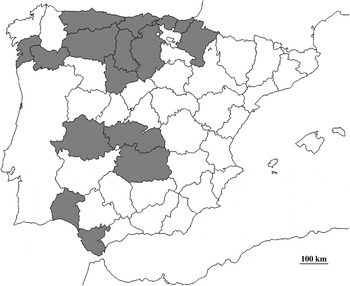
Fig. 7.Distribution of Cytisus cantabricus (Willk.) Reichb.f. & Beck (area in grey).
Sarothamnus cantabricus var. dieckii Lange, Diagn. Pl. Iber. 3: 14 (1893). – Type: [Spain] Reynosa, Cantabria, Dr Dieck 749 (holo C!).
Sarothamnus losae Pau, nom. in sched. – Based on: Santander: Espinosa de los Monteros, vi 1928, Plantes d’Espagne, Dr M. Losa 6692 (MA!).

Erect shrub, 1–2 m high. Twigs unarmed, with 8 ribs T-shaped in transverse section, pubescent when young, glabrous when older; ribs larger than striae. Leaves sessile or sub-sessile, unifoliolate; short stipule with 2 ribs; leaflets 5–10 × 1–5.5 mm, elliptic or obovate, pubescent with very short adpressed hairs. Pedicel 8–11 mm long. Calyx glabrous; upper lip 5–7 mm long; lower lip 5.5–8 mm long; teeth 0.5–1 mm deep. Corolla yellow; standard 19–24 mm long, 15–25 mm wide, orbicular, recurvate, glabrous; wings 18–24 mm long, longer or as long as the standard, as long as the keel petals, 6.5–9.5 mm wide, generally elliptic, sometimes oblong, glabrous; keel 19–25 mm long, longer or as long as the standard, 6.5–9.5 mm wide, falcate, pubescent on the lower margin. Anthers 1.8–2.5 mm long. Style pilose. Fruit 20–45 × 10–11 mm, plane, elliptic, villous, tangled hairs up to 5 mm long, 3- to 10-seeded. Seeds 2.5–3.5 × 2–3 mm, ovoid.
Illustrations in Genisteas espanolas, Lam. LI: 211 (Vicioso, Reference Vicioso1955) and in Flora Iberica 44: 167 (Talavera et al., Reference Talavera, Aedo, Castroviejo, Romero Zarco, Saez, Salgueiro and Velayos1999).
Distribution. Spain (Asturias, Burgos, Caceres, Cadiz, Cantabria, Ciudad Real, Huelva, Leon, Navarra, Orense, Palencia, Pontevedra, Santander, Toledo, Valladolid, Vizcaya).
Flowering time. April–June.
Proposed IUCN conservation assessment. Least Concern (LC). This taxon is known from many localities across a wide area and there are no significant threats.
Nomenclatural notes. Lectotypification of Sarothamnus cantabricus: the specimen of Collection plantes exotiques 17 seen at Kew is not a specimen of Cytisus cantabricus but of C. scoparius (described below). We choose the specimen from P as the lectotype as it bears the author’s handwriting.
Additional specimens examined. Spain. Asturias: Bajada del Puerto Ventana, 9 vii 1974, S. Castroviejo (MA); Oviedo, 18 vi 1979, Amich, Rico & Sanchez (MA, SALA); San Martin de Argolibio, Amieva, 2 v 1962, J. Fernandez Casas (MA); San Martin de Argolibio, Amieva, 2 v 1962, S. Lainz (RNG); Trescares, 13 v 1991, C. Aedo (MA). Burgos: Puerto de Piedrasluengas, 28 vi 1982, Aguilella et al. (VAL). Caceres: Parque National Monfragüe, 23 iii 1984, M.B. Crespuo (VAL). Cadiz: Facinas, 31 iii 1975, J. Harris 1425 (RNG). Cantabria: Cabezon de Liebana, 1 iv 1999, J. Pizarro (MAF); De Valdeprado a Pesaguero, 30 iv 1990, M. Herrera Gallastegui 15199 (SALA); Enmedio, 13 vi 1991, C.J. Valle et al. (SALA); Laredo, 25 v 1985, H. Herrera (MA); Monte Gulatrapa, 20 vii 1983, C. Aedo (MA); Pesagüero, 4 iv 1998, M. Pardo de Santayana 417 (MA); South of Pido, D.W. Dresser 426 (E); Valdeolea, 22 v 1999, M. Pardo de Santayana 787 (MA). Ciudad Real: Santa Elena to Despenaperros, 15 iv 1973, F.A. Bisby, K.W. Nicholls & R.M. Polhill 87 (RNG). Guipuzcoa: Entre Arechavalet y el Puerto de Arlaban, 11 v 1977, M. Costa, E. Fuentes & M. Horjales (SALA). Huelva: Matalascanas, 14 iii 1983, I. Mateu et al. (VAL); Matalascanas, 15 iii 1983, I. Mateu et al. (VAL). Leon: Branillin, 11 ix 1983, C. Perez Morales (VAL); Picos de Europa, 10 vii 1879, E. Levier (E, LY); Picos de Europa, 5 viii 1969, J. Grimes 283 (RNG); Picos de Europa, 6 viii 1969, J. Grimes 332 (RNG); Picos de Europa, 6 vii 1978, P. Harrold & R.J.D. McBeath 156 (E); Picos de Europa, supra Potes, 10/14 vii 1879, E. Levier (K); Picos de Europa supra Potes, ix 1880, J. Ball (K); Puerto de Ponton, 1 viii 1960, D.W. Dresser 1174 (E); Puerto de San Glorio, 1 vii 1982, F. Llamas (MA, VAL); Puerto de San Glorio, 1 vii 1982, F. Llamas 7456 (SALA); Puerto de San Glorio, 1 vii 1982, F. Llamas 82837 (VAL); Puerto de San Glorio, 3 vii 1987, M. Ladero et al. 3 vii 1987 (SALA). Navarra: Carretera entre el Collado de Aritxulegi y Lesaka, 26 v 1997, Loidi et al. 18059 (VAL). Orense: Sierra del Suido, 18 viii 1985, X. Giraldez (SALA). Palencia: Col de Piedras Luengas, 10 vii 1978, A. Charpin 14916 (G); Piedrasluengas, 14 vii 1974, S. Rivas-Goday & E. Valdes-Bermejo 14 vii 1974 (MA); Puerto de Piedrasluengas, 23 vii 1975, A. Segura Zubizarreta 8269 (VAL); Puerto de Piedrasluengas, 28 vi 1982, G. Mateo 82836 (VAL). Pontevedra: Cangas del Morrazo, 18 v 2009, E. Rico et al. (SALA). Santander: 6 km from Potes, 15 v 1972, R.K. Brummitt & A.O. Chater 97 (K); El Collado, 6 vii 1978, S. Castroviejo et al. 4117 (MA); Espinama, 7 ix 1944, M. Martin & C. Vicioso (MA); La Hoz de Abiada, 6 vi 1985, Anonymous 10266 (SALA); Puerto de Palombera, 25 iv 1982, A. Barra 9574 (MA). Toledo: Ventas de Pena Aguilera, Puerto del Milagro, 20 iv 1992, G. Mateo 6050 (VAL). Valladolid: Between Viana and Cabezon, v 1981, Vermeulen-Fernandez 125 (L). Vizcaya: Subida a los Tornos, 18 vii 1968, H. Sanudo (MA); Enecuri, Carretera de Bilbao a Algorta, 8 v 1976, M. Horjales (SALA).
9. Cytisus grandiflorus (Brot.) DC., Prodr. 2: 154 (1825). – Spartium grandiflorum Brot., Fl. Lusit. 2: 80 (1804). – Genista grandiflora (Brot.) Spach, Ann. Sci. Nat., Bot. sér. 3, 3: 155 (1845). – Sarothamnus grandiflorus (Brot.) Webb, Otia Hispan. ed. 2: 45 (1853). – Type: [Portugal] Tournefort 6312 with the mention ‘Cytiso-genista lusitanica, foliis myrti, siliquis tomentosis’ (lecto P!, designated here).Fig. 8.
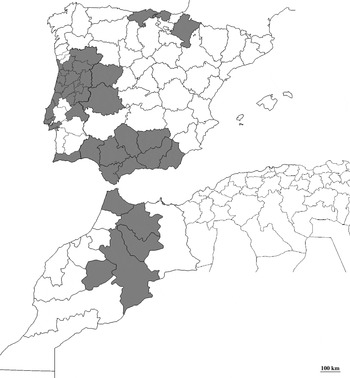
Fig. 8.Distribution of Cytisus grandiflorus (Brot.) DC. subsp. grandiflorus (area in grey).
Cytisus affinis Boiss., Elench. Pl. Nov. 31 (1838). – Sarothamnus affinis (Boiss.) Boiss., Voy. Bot. Espagne 2: 134 (1845). – Type: [Spain] In collibus circa Estepona, Ronda, v 1837/vi 1837, Boissier 51 (lecto G!, designated here; isolecto E!, K!, MPU!, P!).
Sarothamnus virgatus Webb, Iter Hispan. 52 (1838). – Locus typicus: In collibus Baeticis. Ex herbariis Ramburiano, not located.
Sarothamnus arboreus var. barbarus Jahand. & Maire, Bull. Soc. Hist. Nat. Afrique N. 14: 67 (1923). – Cytisus barbarus (Jahand. & Maire) Maire, Mém. Soc. Sci. Nat. Maroc 17: 30 (1926). – Cytisus grandiflorus subsp. barbarus (Jahand. & Maire) Maire, Cat. Pl. Maroc 2: 365 (1932). – Type: [Morocco] Grand Atlas, Reraya, Tansrart, bords de l’Acif Reraya, 16 vi 1921, Jahandiez 734 (lecto MPU!, designated here).
Cytisus barbarus var. haplophyllus Maire & Sennen, Bull. Soc. Hist. Nat. Afrique N. 23: 175 (1932). – Cytisus grandiflorus subsp. haplophyllus (Maire & Sennen) Maire, Cat. Pl. Maroc 2: 365 (1932). – Type: [Morocco] Gurugu, vers Taquigriat, 16 vi 1931, Plantes d’Espagne, Sennen & Mauricio 7818 (lecto MPU!, designated here; isolecto G!, VAL!).
Cytisus grandiflorus subsp. cabezudoi Talavera, Anales Jard. Bot. Madrid 57: 213 (1999). – Type: [Spain] Huelva, Hinojos, Pasada de la Zorra, 7 iv 1997, Gibbs & Talavera s.n. (holo SEV 141267!).

Nomenclatural notes. Typification of Spartium grandiflorum: three synonyms of Spartium grandiflorum are mentioned in the protologue:
‘Cytiso-Genista Lusitanica, foliis Myrti, siliquis tomentosis. Tourn. I. R. H. pag. 649’
‘Cytiso-Genista Lusitanica, magno flore, Idem. Ibid.’
‘Genista sylvestris repens, amplo flore, Lusitana. Grisl. Virid. Lusit. n.541.’
‘I. R. H.’ refers to ‘Institutiones Rei Herbariae’ written by Tournefort in 1719. ‘Virid. Lusit.’ refers to ‘Viridarium Lusitanium’ written by Grisley in 1749. No relevant drawing was associated with those names. Only the specimen Tournefort 6312 was found at P bearing the relevant phrase names ‘Genista lusitanica magno flore aureo foliis myrti’ and ‘Cytiso genista lusitanica foliis myrti siliquis tomentosis’. These annotations unambiguously link this specimen to Tournefort. In the absence of Brotero’s material at LISU and MO, we consider it likely that Brotero consulted Tournefort herbarium during his stay in Paris between 1778 and 1790. Thus the Tournefort material is part of the original material.
Lectotypification of Cytisus affinis: as most of Boissier’s original material is preserved in G, the specimen from G was chosen as the lectotype for Cytisus affinis.
Lectotypification of Sarothamnus arboreus var. barbarus: Jahandiez and Maire based their description on two specimens. Even though the authors indicated ‘Typus in Herbario Universitatis Algeriensis’ in the protologue the lectotype we designate is the only specimen in Maire’s collection that we could identify as a syntype.
Lectotypification of Cytisus barbarus subsp. haplophyllus: Maire’s original material is preserved at MPU so the specimen from MPU is chosen as lectotype. That specimen also has a large number of leaves, all unifoliolate, a character which is highly diagnostic for Cytisus barbarus subsp. haplophyllus.
Proposed IUCN conservation assessment. Least Concern (LC), as for the most widespread subspecies Cytisus grandiflorus subsp. grandiflorus.
Key to the subspecies of Cytisus grandiflorus
1a. Leaflets usually glabrous or glabrescent; fruits pilose 9a. Cytisus grandiflorus subsp.grandiflorus
1b. Leaflets sericeous or pilose; fruits glabrous 9b. Cytisus grandiflorus subsp.maurus
9a. Cytisus grandiflorus (Brot.) DC. subsp.grandiflorus
Erect shrub, 1–3 m high. Twigs unarmed, with 5 ribs V-shaped in transverse section, attenuate, densely sericeous when young, glabrescent to pilose when older; ribs attenuate. Leaves petiolate, usually unifoliolate, rarely trifoliolate on young twigs; petiole 1–5 mm long; leaflets 9–20 × 4–9 mm, elliptic or lanceolate, generally glabrous or glabrescent. Pedicel 6–15 mm long. Calyx glabrous; upper lip 4.5–6 mm long; lower lip 5–6.5 mm long; teeth 0.5–1 mm deep. Corolla yellow; standard 15–24 mm long, 13–20 mm wide, orbicular, recurvate, glabrous; wings 15–24 mm long, longer than the standard, as long as or shorter than the keel petals, 6–8 mm wide, elliptic or sub-elliptic, glabrous; keel 15–24 mm long, longer than the standard, 6–8 mm wide, falcate, pubescent on the external margin. Anthers 1.4–2.7 mm long. Fruit 25–45 × 7–10 mm, plane, oblong, pilose, sometimes ciliate on margins; hairs 2–5 mm long, tangled, up to 12-seeded. Seeds 2–4.5 mm, ovoid.
Illustration in Flora Iberica 42: 161 (Talavera et al., Reference Talavera, Aedo, Castroviejo, Romero Zarco, Saez, Salgueiro and Velayos1999).
Distribution. Morocco (Marrakech-Tensift-Al Haouz, Tanger-Tétouan, Taza-Al Hoceima-Taounate), Portugal (Castelo Branco, Coimbra, Evora, Faro, Guarda, Leiria, Lisboa, Portalegre, Porto, Viano do Castelo), Spain (Almeria, Andalusia, Caceres, Cadiz, Cantabria, Granada, Huelva, Malaga, Melilla, Navarra, Salamanca, Vizcaya).
Flowering time. March–June.
Proposed IUCN conservation assessment. Least Concern (LC). This taxon is known from many localities across a wide area and there are no significant threats.
Additional specimens examined. Morocco. s. l. Harcha, 11 iv 1937, R. Maire (MPU). Marrakech-Tensift-Al Haouz: 1 km below Oukaïmeden on road to Vallée de l’Ourika, 18 vii 1989, M. Ait Lafkih et al. 604 (RNG); 72 km from Marrakech, below Oukaïmeden, 16 vi 2001, S.L. Jury 18988 (RNG); Marrakech, 13 vii 1989, D. Podlech 47970 (G); Marrakech, de Oukaïmeden à Aït Lekak, 13 vii 1984, G. Lopez & F. Munoz Garmendia 9127 (MA, RNG); Oukaïmeden, 6 vii 1997, Sequeira et al. 3323 (VAL); Oukaïmeden, 14 vi 2001, M. Rejdali, M. Ait, Lafkih & S.M. Young 18905 (RNG); Oukaïmeden, c.75 km from Marrakech, 5 vi 2002, S.L. Jury et al. 19589 (RNG); Oukaïmeden to Ourika, 18 vii 1973, Davis 55305 (E); South from Marrakech, c.1 km below ski resort of Oukaïmeden, on road to Vallée de l’Ourika, 26 vii 1997, S.L. Jury 18216 (RNG). Tanger-Tétouan: 10 iv 1995, A.J. Caruz, M.A. Mateos & F.J. Pina 5512/95 (RNG); Bab Taza, 19 vi 1993, J.M. Montserrat 4130/5 (RNG); Bab Taza, 23 km from Chefchaouen, 18 iv 1974, F.A. Bisby, K.W. Nicholls & J. Grainger 1351 (RNG); Bab Taza, 23 km from Chefchaouen, 18 iv 1974, F.A. Bisby, K.W. Nicholls & J. Grainger 1352 (RNG); Oued Laou, 27 ii 1994, S.L. Jury 13467 (RNG); Track to Bou Ahmed, 22 iv 1995, S.L. Jury 16653 (RNG). Taza-Al Hoceima-Taounate: Beni-Seddat, 22 vi 1933, Sennen & Mauricio 8736 (MA, MPU); Beni-Seddat, Uarej, 22 vi 1933, Frère Sennen 8736 (VAL); Djebel Arekdi, 26 v 1981, J. Fernandez Casas 5135 (RNG); Djebel Outka, 16 v 1929, E. Jahandiez 231 (G); Ikaouen, 19 vi 1992, Optima Iter V 1428 (RNG); Taounate, Ikauene, 27 vi 1994, M.J. Diez Dapena et al. 3644/94 (RNG); Targuist, 23 v 1927, Font i Quer 287 (MPU); Taza, Bab Azhar, 3 vi 1929, E. Jahandiez 382 (E); Taza, Djebel Arekdi, 26 v 1981, S. Castroviejo et al. 5135 (MA).
Portugal. s. l. iv 1886, J. Daveau (LISU); Prope Olisiponam, Marti (BR). Castelo Branco: Marvao, 25 v 1983, R. Deschamps 7199 (BR). Coimbra: Arredores de Coimbra, penedo da Meditaçao, v 1879, A. Moller 400 (LISU); Arredores de Coimbra, penedo da Meditaçao, 1882, J. d’A. Guimaraes (LISU); Coimbra, 1876, Henrique (P); Coimbra, v 1886, A. Moller 2151 (BR); Coimbra, 4 v 1936, W. & M. Rothmaler 17070 (BR, MAF, VAL); Coimbra, 9 iv 1936, Kostermans & Kruyt 46 (L); Coimbra, pr. Santo Antonio dos Alivares, 4 v 1936, W. & M. Rothmaler (VAL); Penedo de Meditaçao, 22 iv 1948, J. Matos (K). Evora: Serra de S. Mamede, 28 iv 1994, E. Rico et al. 1026 (MA); Troia, 29 iii 1996, S. Rivas-Martinez et al. (MA). Faro: Faro, route de S. Brag, iv 1881, J. Daveau iv 1881 (LISU); Monte Gardo, 5 iv 1985, J. Bouharmont 17171 (BR); Portimao, 30 iii 1985, J. Bouharmont 17063 (BR); Près de Faro, 23 iii 1853, E. Bourgeau 1814 (K); Quarteira, 28 iii 1980, M. Ladero et al. (MAF). Guarda: Castelo Mendo, vii 1884, A.R. da Cunha (LISU); Serra da Estrela, 18 vi 1987, W.O. van der Knaap & J.F.N. van Leeuwen 87-89 (L); Serra da Estrela, viii 1881, J. Daveau (LISU); Serra da Estrela, 18 vi 1987, W.O. van der Knaap & J.F.N. van Leeuwen 87-92 (L); Souto do Bispo, 29 v 1972, R. Brummitt 12783 (K). Leiria: Caldas de Reinha, v 1882, J. Daveau 95 (MPU); Marinha Grande, 1880, H. de Mendea 1546 (LISU); Monte Sao Bartolommen, 16 v 1984, F.A. Bisby 1840 (K); Nazaré, 10 v 1994, F. Sales & S. Neves 134 (E). Lisboa: Malveira, 29 iv 1946, B. Rainha 21766 (G). Portalegre: Senhora de Pena, vi 1882, A.R. da Cunha (LISU). Porto: Gaia, Pedroso, v 1907, G. Sampaio (G); Porto, v 1918, Frère Sennen 4310 (MPU); Porto, v 1918, G. Sampaio 4310 (L); Porto, vii 1939, J. Castro (MAF); Porto, vii 1939, J. Castro 157/36 (VAL). Viano do Castelo: Val de Rosal, iv/v 1878, J. Daveau (K).
Spain. s. l. Pinal de la Plata, 7 iii/11 iv 1849, E. Bourgeau 120 (K). Almeria: Finana, Cerrom de la Cruz, 17 vi 1988, B. Valdes et al. 630 (RNG). Andalusia: Grazelama, 19 v/24 vi 1890, Willkomm 10 (BR); Sierra de Ronda, 1889, Lange 469 (BR). Caceres: Hervas, 18 iv 2009, F. Cabezas & A. Quintanar 1175 (MA). Cadiz: Sanlucan de Barrameda, iv 1965, J. Borja (RNG); Zahara, Subida al Puerto de las Palomas, 23 iv 1992, J. Güemes (VAL). Cantabria: De Valdeprado a Pesaguero, 30 iv 1990, M. Herrera Gallastegui 15199 (VAL). Granada: Las Alpujarras, 1 v 1990, S.L. Jury et al. 116 (RNG); Portugos, 6 iv 2001, D. Sanchez-Mata et al. (MAF). Huelva: Almonte, 12 iii 1978, S. Castroviejo et al. (K, L, MAF); Almonte, Parque Nacional de Donana, 12 iii 1978, S. Castroviejo et al. 9345 (BR, RNG); Between Hinojos and Almonte, 1 iv 1969, V.H. Heywood, D.M. Moore et al. 475 (RNG); Camping Dariana, 17 iii 1983, A. Aguilella & P. Garcia-Fayon (VAL). Malaga: Between Torrox and Cortijo de Benamay, 12 iv 1973, Bisby, Nicholls & Polhill 68 (RNG); El Madronal, mountains behind San Pedro on road to Ronda, 8 iv 1973, Bisby, Nicholls & Polhill 63 (RNG); Entre Monda y Ojen, 7 v 1973, G. Lopez & E. Valdes-Bermejo (VAL); Marbella to Ojen, 10 iv 1973, Bisby, Nicholls & Polhill 58 (RNG); Ojen, 18 iv 2003, V.J. Aran & M.J. Toha 5446 (VAL); Ronda, 1975, J.W. Carr (RNG); Ronda district, 8 v 1924, E. Ellman & C. Hubbard 263 (K); Serrania de Ronda, 30 v 1895, Porta & Rigo 111 (G); Serrania de Ronda, 9 iv 1973, Bisby, Nicholls & Polhill 50 (RNG); Sierra de Ronda, 28 vi/30 vii 1889, E. Reverchon 469 (K); Sierra Ojen, 9 iv 1973, Bisby, Nicholls & Polhill 61 (RNG); Sierra de Ojen, 29 iv 1977, M. Ladero et al. (VAL). Melilla: Gurugu, Sennen & Mauricio (MA); Gurugu, 10 iv 1929, Font i Quer 245 (G); Gurugu, 22 iii 1956, Ruiz de la Torre (MA); Gurugu, Taquigriat, 16 vi 1931, Sennen & Mauricio 7818 (G). Navarra: Artikutza, 5 vii 1983, I. Aizpuru & P. Catalan 83890 (VAL); Basaburua, 14 viii 2002, J. Peralta & U. Donezar 691 (SALA); Carretera entre el Collado de Aritxulegi y Lesaka, Loidi et al. 18059 (RNG); Ezkurra, 10 vii 1989, I. Aizpuru & P. Catalan 14162 (RNG, SALA, VAL). Salamanca: Pr. Carpio de Azaba, 27 v 1957, S. Lainz (K). Vizcaya: Miravalles, 12 iii 1913, Hno. Elias 1634 (LY).
9b. Cytisus grandiflorus subsp. maurus (Humbert & Maire) Auvray, comb. nov. – Cytisus maurus Humbert & Maire, Mém. Soc. Sci. Nat. Maroc 15: 21 (1926). – Sarothamnus maurus (Humbert & Maire) Raynaud, Bull. Soc. Bot. 121: 360 (1975). – Cytisus scoparius subsp. maurus (Humbert & Maire) Talavera, Anales Jard. Bot. Madrid 57: 212 (1999). – Type: [Morocco] In Atlantis Medii montibus supra urbem Taza: Daya Chiker, 17 vi 1925, Maire s.n. (holo MPU!).Fig. 9.
Fig. 9.Distribution of Cytisus grandiflorus (Brot.) DC. subsp. maurus (Humbert & Maire) Auvray (area in grey).

Short adpressed hairs on young twigs, older twigs glabrous. Leaves petiolate when trifoliolate, usually trifoliolate on young twigs, unifoliolate on older twigs; petiole up to 10 mm long; on young twigs, leaflets 6–10 × 3–5 mm, elliptic and more rarely obovate, sericeous; on older twigs, leaflets 6–10 × 3–5 mm, obovate, with fewer hairs. Standard 18–22 mm long, 16–22 mm wide. Wings as long as the keel petals. Fruit 25–40 × 7–10 mm, completely glabrous.
Distribution. Morocco (Taza-Al Hoceima-Taounate).
Proposed IUCN conservation assessment. Endangered (EN B2ab(v)). Cytisus grandiflorus subsp. maurus has been listed in only five different localities (Fougrach et al., Reference Fougrach, Badri and Malki2007). It is heavily grazed by wild animals (especially goats) which eat new shoots and fruits, causing a continuing decline in the number of mature individuals.
Additional specimens examined. Morocco. Taza-Al Hoceima-Taounate, Djebel Tazzeka: 2 vii 1938, L. Faurel (MPU); 9 vi 1961, De Wilde & Dorgelo 2915 (L); 14 vi 1980, A. Charpin et al. 963 (G); 24 v 1981, J. Fernandez Casas et al. 5020 (RNG); 16 v 1989, B. Valdes et al. (E); 16 vi 1992, Optima Iter V 1289 (RNG); 14 vi 1993, J.M. Montserrat 3695/5 (RNG); 1 xi 1993, P. Gareia et al. (E); 24 iv 1995, S.L. Jury et al. 16836 (RNG); 9 vii 2007, S. Jury & R. Shkwa 21006 (MA); Bou Guerba, 31 v 1929, E. Jahandiez 349 (E); Entre Daya Chiken et Bab-bou-Idir, 18 v 1974, J. Mathez 7124 (MPU).
10. Cytisus scoparius (L.) Link, Enum. Hort. Berol. Alt. 2: 241 (1822). – Spartium scoparium L., Sp. Pl. 2: 709 (1753). – Genista scoparia (L.) Lam., Fl. Franç. 3: 619 (1779). – Genista vulgaris Gray, Nat. Arr. Brit. Pl. 2: 595 (1821), nom. illeg. – Corema scoparium (L.) Bercht. & J.Presl., Prir. Rostlin Aneb. Rostl. 3, 9: 88 (1830–1835). – Sarothamnus vulgaris Wimm., Fl. Schles. 278 (1832), nom. illeg. – Sarothamnus scoparius (L.) W.D.J.Koch, Syn. Fl. Germ. Helv. 152 (1835). – Sarothamnus vulgaris var. scoparius (L.) Timbal-Lagrave, Bull. Soc. Sci. Phys. Nat. Toulouse 2: 485 (1874). – Genista scoparia var. vulgaris Rouy, Fl. France 4: 204 (1897), nom. illeg. – Cytisogenista scoparia (L.) Rothm., Repert. Spec. Nov. Regni Veg. 49: 55 (1940). – Type: [Italy] Burser XXII: 33 (lecto UPS!, designated by Auvray & Malécot, 2011).
Genista hirsuta Moench, Methodus 144 (1794), non Genista hirsuta Vahl (1790). – Type: Tab. CCCXIII, Flora Danica 2, 7, Oederi (1767), iconotype.
Spartium angulatum Raf., Précis Decouv. Somiol. 31 (1814). – Genista angulata (Raf.) Poir., Encycl. (Lamarck), Suppl. 5: 688 (1817). – Type: [USA] En Maryland, près Annapolis, dans les bois, Rafinesque (not seen).
Cytisus glabratus Link, Phys. Beschr. Canar. Ins. 156 (1825). – Sarothamnus scoparius var. glabratus (Link) Webb & Berthel., Hist., Nat. Iles Canaries (Phytogr.) 3, 2: 59 (1835–1842). – Type: A. Courant s.n. Locus typicus: Loco angusto circumsribitur ad aquarum canalem supper oppidum Orotavense, nec alibi occurit. Type not seen.
Sarothamnus bourgaei Boiss., Diagn. Pl. Orient. ser. 2, 2: 6 (1856). – Sarothamnus scoparius var. leiostylos Willk. in Willk. & Lange, Prodr. Fl. Hispan. 3: 458 (1877). – Cytisus scoparius var. bourgaei (Boiss.) Briq., Etud. Cytis. Alp. Marit. 146 (1894), nom. illeg. – Cytisogenista scoparia var. leiostylos (Willk.) Rothm., Repert. Spec. Nov. Regni Veg. 49: 55 (1940). – Sarothamnus vulgaris var. leiostylos (Willk.) C.Vicioso, Bol. Inst. Forest. Invest. Exp. Madrid 72: 206 (1955). – Cytisus scoparius subsp. bourgaei (Boiss.) Rivas Mart. et al., Opusc. Pharm. Complut. 2: 107 (1986). – Type: [Portugal] Algarve, Bois à Monchique, 6 vi 1853, Plantes d’Espagne, Bourgeau 1812 (lecto G!, designated here; isolecto C!, E!, K!, P!).
Sarothamnus oxyphyllus Boiss., Diagn. Pl. Orient. ser. 2, 2: 7 (1856). – Cytisus scoparius var. oxyphyllus (Boiss.) Briq., Etud. Cytis. Alp. Marit. 147 (1894). – Cytisogenista scoparia var. oxyphylla (Boiss.) Rothm., Repert. Spec. Nov. Regni Veg. 49: 55 (1940). – Type: [Portugal] Algarve, Bois à Monchique, 9 vi 1853, Plantes d’Espagne, Bourgeau 1813 (lecto G!, designated here; isolecto E!, K!, P!).
Sarothamnus vulgaris var. foliosus Timbal-Lagrave, Bull. Soc. Sci. Phys. Nat. Toulouse 2: 485 (1874). – Type: [France] environs de Gadillac (TLF?, not located).
Sarothamnus vulgaris var. sericeus Timbal-Lagrave, Bull. Soc. Sci. Phys. Nat. Toulouse 2: 485 (1874). – Type: [France] bois situés entre Langon et Pujols (TLF?, not located).
Sarothamnus burgalensis Sennen & Elias, Bol. Soc. Iber. Ci. Nat. 26: 85 (1927). – Type: [Spain] Burgos, Sierra Obarenes, montagnes escarpées de Besantes, 23 v 1915, Plantes d’Espagne, Elias 4331 (holo BC [not seen]; iso JE!, MA!).
Sarothamnus eliasii Sennen, Bol. Soc. Iber. Ci. Nat. 26: 86 (1927). – Type: [Spain] Burgos: Viloria de Rioja, 14 vii 1921, Plantes d’Espagne, Elias 4332 (holo BC [not seen]; iso G!, JE!, MA!, MPU!, RNG!).
Genista vulgaris Garsault, Desc. Pl. Anim. 180 (1767), nom. inval., opus utique oppressum.
Spartium angulosum Gilib., Fl. Lit. Inch. 2: 79 (1782), nom. inval., opus utique oppressum.
Proposed IUCN conservation assessment. Least Concern (LC), as for most subspecies especially Cytisus scoparius subsp. scoparius, the most widespread and invasive subspecies.
Key to the subspecies of Cytisus scoparius
1a. Prostrate shrub 10c. Cytisus scoparius subsp.maritimus
1b. Erect shrub 2
2a. Twigs all sub-parallel; keel glabrous 10d. Cytisus scoparius subsp.reverchonii
2b. Twigs not all sub-parallel; keel ciliate on the lower margin 3
3a. Fruit villous 10b. Cytisus scoparius subsp.insularis
3b. Fruit ciliate on margin 10a. Cytisus scoparius subsp.scoparius
Taxonomic notes. The infraspecific taxa within Cytisus scoparius all have well-delimitated, restricted distributions which rarely overlap with the distribution of the type subspecies. Therefore, we consider the taxa should be considered subspecies and not varieties.
Nomenclatural notes. Wimmer’s names: Wimmer always followed the same logical order to describe genera in his Flora von Schlesien (Wimmer, Reference Wimmer1832). After the name of the genus is its description, followed by the name of each species recognised within the genus. For each species, the name recognised by Wimmer is followed by a synonym or a pre-Linnean name and then its description. For Sarothamnus vulgaris, Wimmer cites Spartium scoparium as a synonym. The name Sarothamnus vulgaris is, therefore, superfluous.
Typification of Spartium scoparium: problems over the typification of Spartium scoparium have been discussed by Auvray & Malécot (2011). The former lectotype has been superseded in favour of the specimen Burser XXII: 33 from the Linnean collection on the grounds of conflict with the protologue (Auvray & Malécot, 2011).
Original material for Cytisus glabratus: the protologue mentions A. Courant as the collector of the potential type specimen. A. Courant spent some time in Orotava and gave his plant collection to De Candolle. However, no specimen has been found in De Candolle’s collection (G-DC) or in Link’s collection (B).
Typification of Sarothamnus bourgaei: Boissier’s original herbarium is located in Geneva. We therefore designate the specimen from G as the lectotype as it is the most likely to have been used by Boissier when he described Sarothamnus bourgaei.
10a. Cytisus scoparius (L.) Link subsp.scoparius
Erect shrub, 1–2 m high. Twigs unarmed, with 5 ribs V-shaped in transverse section, well-marked, densely sericeous when young, glabrous or glabrescent when older; ribs deep. Leaves petiolate, usually unifoliolate on young twigs, trifoliolate or unifoliolate on older twigs; stipule flat, with 2 ribs; petiole 2–5 mm long; leaflets 3–10 × 2–5 mm, central leaflet generally larger than the others, elliptic to obovate, pubescent with short adpressed hairs. Pedicel 6–10 mm long. Calyx glabrous; upper lip 4–5.5 mm long; lower lip 5–6.5 mm long; teeth 0.5–1 mm deep. Corolla yellow; standard 18–24 mm long, 14.5–20 mm wide, orbicular, recurvate, glabrous; wings 18–24 mm long, longer than the standard, as long as or shorter than the keel petals, 5–9 mm wide, generally elliptic, sometimes oblong, with curved apex, glabrous; keel 18–24 mm long, longer than the standard, 6–9 mm wide, falcate, ciliate on the external margin. Anthers 1.4–2.7 mm long. Style glabrous or slightly hairy. Fruit 20–50 × 7–12 mm, plane, oblong, ciliate on margins, up to 13-seeded. Seeds 2–4 × 2–3 mm, ovoid or elliptic.
Illustration in Genisteas espanolas, Lam. XLIX: 204 (Vicioso, Reference Vicioso1955).
Distribution. Austria, Belgium, Canada (Vancouver Island), Canary Islands, France, Germany, India, Ireland, Italy, Luxembourg, the Netherlands, Poland, Portugal, Sark island, Slovenia, Spain, Switzerland, Ukraine, the United Kingdom, the United States of America. Cytisus scoparius subsp. scoparius is invasive in North America, Australia, Japan and New Zealand (Williams, Reference Williams1981; Waterhouse, Reference Waterhouse1988; Bossard, Reference Bossard1991).
Flowering time. March–May.
Proposed IUCN conservation assessment. Least Concern (LC). This taxon is known from many localities across a wide area and there are no significant threats.
Additional specimens examined. Unknown country. v/vi 1857, Hasskarl (L); K. Subramanian 345 (L); Lejeune 732 (P).
Austria. Rothgraben, vi 1957, A. Patzak (E); Vienne, iv/viii 1893, O. Krebs (E).
Belgium. 5 vi 1969, H. Schoenmakers 233 (L).
Canada. Vancouver Island, 8 v 1875, Macoun (K).
Canary Islands. Ténérife, De la Péraudière (P); Ténérife, Cumbre de l’Orotava, iv 1906, C.-J. Pitard 522 (L).
France. Aisne: Berlise, 15 v/vi 1889, B. Riomet 2828 (MPU). Alsace: 1865, C. Meissner 1865 (L); Haguenau, 28 v/2 vii 1850, C. Billot 529 (MPU). Bretagne: Pointe du Raz, 10 viii 1962, F. Hekker (L). Cévennes: B. Smythies 128 (E). Eure-et-Loir: Nogent-la-Motron, 29 vii 1884, A. André (MPU). Finisterre: Gorges du Trevezel, 4 vi 1996, Santa (MPU). Gard: Piécourt, 15 v 1894, Aubouy (MPU). Gironde: Cestas, 26 v 1961, J. Wiebes 1 (L). Haute-Vienne: 26 km from Limoges, 1 vii 1980, Verdcourt & Vilmot-Dear 5348 (K). Hérault: Coulouma, 24 vi 1915, S. Albaille (MPU); Gorges d’Héric, 26 v 1965, A. Charpin (G); Le Carous, 11 vii 1926, S. Albaille 872 (MPU). Ile-de-France: Bois de Boulogne, près de Paris, v 1879, E. Ayasse (G). Indre et Loire: Savonnières, 13 vi 1935, E. Neyraut (MPU). Isère: Jura de Crémieu, 29 v 1915, J. Briquet 1290 (G); Jura de Crémieu, 31 v 1915, J. Briquet (G); Ratz, 26 v 1902, J. Briquet 3391 (G); Ratz, 9 vi 1920, J. Briquet 6094 (G); Ratz, 8 vi 1922, J. Briquet 7066 (G); Ratz, 16 vi 1922, J. Briquet 7177 (G); Ratz, 17 vi 1922, J. Briquet 7227 (G); Uriage, 11 vii 1897, E. Peyron (G); Tullins, 25 v 1902, J. Briquet 3217 (G); Tullins, 2 vi 1925, J. Briquet 10371 (G). Jura: Chaîne du Bourget, 1 viii 1922, J. Briquet 8062 (G). Lozère: 4 vi 1978, Symoens 2141 (L). Pyrénées: Col de Pau, 25 vi 1966, O. De Wilde 11464 (L); Espinal, 18 vi 1964, N. Sandwith 6385 (K). Pyrénées-Orientales: 25 vii 1934, D. Wyatt 226 (K); Canigou, 11 vii 1851, J. Ball (E); Environs de Molitz, 28 vii 1876, A. Guillon (MPU); Vallée du Toch, Massot (MPU). Saône et Loire: La Mère Boitier, 1847, J. Parseval (P); Motte St Jean, 21 iv 1961, A. Charpin (G). Savoie: Bourget, 3 vii 1901, J. Briquet 1728 (G); Bourget, 4 vii 1901, J. Briquet 1843 (G). Seine-et-Oise: Maisse, 2 vi 1878, E. Gaudefroy 2009 (K, LY, MPU).
Germany. Liebenstein, 12 vi 1908, H. Rottenbach (L); Reichardtsdorf, vii 1899, J. Brand (L).
India. South India: Nilgiri forest, 8 ii 1963, K. Subramanian 32 (L).
Ireland. Kerry, Gearhaneen river, 17 vi 1938, Burtt 684 (K).
Italy. Domo d’Ossola, vi/viii 1872, E. Ayasse (G); Elba, Monte Capanne, 20 v 1962, Kramer & Westra 3514 (L); Lac de Côme, 9 vi 1952, S. Vautier (G); Valle d’Aosta, Etroubles, 28 vii 1966, R. Brummitt 5537 (K).
Japan. Kyushu Island: Hazozaki, 10 v 1928, K. Ichikawa 54 (L).
Luxembourg. Bavigne, 15 vi 1954, E. Mennega (L).
Netherlands. 17 vi 1859, Hasskarl (L); Leiden, Hortus botanicus, 18 v 1946, Van Ooststroom 8344 (L); Posbank, vi 1970, Lieftink & Uyterwaal (L); Vola di Lugo, 9 viii 1958, B.K. Boom 35995 (L); Wageningen, 20 v 1925, B.K. Boom 818 (L); Zundert, 15 vi 1955, B.K. Boom 29732 (L).
Poland. Stolp, 1906, A. Lüderwaldt 1282 (L); Brzesko, 15 iv 1967, Frey 33 (L).
Portugal. Terceira, v 1838, C. Hochst (G).
Sark island. Between Seigneurie and Port à la Jument, 24 vii 1930, Ballard 522A (K).
Slovenia. Tisnov, 6 vi 1925, J. Suza 333 (K).
Spain. s. l. 4 vii 1953, C. Regel (G). Asturias: La Bobia, 17 vii 1956, E. Carreira (MA); Somiedo, 20 vii 1958, E. Guinea (MA). Avila: Casillas, 11 v 1995, D. Sanchez-Mata et al. PC9515 (MAF); Hoyos del Espino, 29 vi 1927, Lacaita 404/27 (G); La Lastra, 12 vii 2000, P. Rodriguez-Rojo (MAF); Navarrevisca-Burgohondo, 31 v 2004, Sanchez-Mata & Enrique E14 (MAF); Puerto de Casillas, 12 vii 1995, P. Cubas & C. Pardo 95115 (MAF); San martin del Pimpoller, 17 vii 1983, Gardner 2092 (RNG); Sierra de Gredos, P. Vargas 173PV99 (MA). Badajoz: Cabeza del Buey, 23 v 1971, J. Fernandez Casas (MA); Merida, 16 iv 1994, E. Rico et al. 93 (MA); Merida, Proserpina pond, 19 iv 1993, Conti et al. 93 (RNG). Burgos: Covarrubias, 24 v 1998, M. Rodrigo (MA); Montorio, 30 vi 1988, P. Galan & G. Lopez 3236 (MA). Caceres: Aliseda, 29 iii 1997, B. Rocher & J. Soler 6653 (MA); Banos de Montemayor, 14 v 1994, A. Caballero (MA); Cuacos de Yuste, 21 iv 2003, M. Carrasco (MAF); Guadalupe, 21 vi 1948, A. Caballero (MA); Merina, Proserpina pond, 19 iv 1994, Conti et al. 632 (RNG); Toril, 3 vi 1993, G. Aragon & J. Castillo 447 (MA); Villareal de San Carlos, 6 iii 1985, C. Fabregat (VAL). Cantabria: Monte Tolono, 21 vii 1987, P. Urrutia & J. Alejandre 1546.86 (MA). Catalonia: Sierra de Montseny, 16 iv 1977, Adema & Aleva 731 (L); Santa Fe, 8 iv 1934, Kruseman (L); Val de la Molina, 12 vii 1935, Frère Sennen (RNG). Ciudad Real: Valdepenas, 27 v 1989, M. Carrasco et al. (MAF). Cordoba: Valle del Guadalmellato, 4 iv 1980, M. Arenas (RNG). Coruna: Porto do Son, 20 iv 1992, J. Amigo & M. Romero (MA). Gerona: vi 1932, Frère Sennen (RNG); 17 iv 1977, Adema & Aleva 740 (L); 27 iv 1977, Adema & Aleva 851 (L); 16 v 1986, E. Castells & J. Pedrol 1229 (MA); 16 v 1986, E. Castells & J. Pedrol 1240 (MA); Ribes de Freser, 8 vi 1969, J. Fernandez Casas 974 (MA). Granada: Jerez del Marquesado, Arroyo de Alcazar, 16 vi 1988, B. Valdes et al. 413 (RNG); Sierra Nevada above Pinos Genil, 13 iv 1973, Bisby, Nicholls & Polhill 78 (RNG). Guadalajara: La Huerce, 7 vii 1987, F. Lamata (MA). Leon: Candin, Rio de la Vega, 27 vi 1994, Crespo et al. (RNG); El Bierzo, 8 v 1933, W. Rothmaler 159 (MA); Embalse del Rio Luna, 1 vii 1983, E. Bayon et al. 8655 (MA); Los Barrios de Luna, vi 1964, H. Sleumer 4830 (L); San Emiliano, 14 vi 1970, S. Rivas-Goday et al. (MAF). Lugo: Cervantes, 26 viii 1992, C. Navarro & E. Monasterio 982 (MA); Piedrafita de Cebreros, 3 viii 1990, E. Carreira (MA); Santa de Avicares, v 1986, F. Puche & A. Carain (VAL); Villardiaz-Fonsagrada, vii 1955, E. Carreira (MA). Madrid: Aldeo del Fresno, 4 v 1983, Martinez et al. (MA); Aldea del Fresno, 18 vi 2007, J. Calvo 767 (MA); Barranco Redubia, 2 v 1916, C. Vicioso (MA); Between Villalbia and Collado Mediano, 16 iv 1973, Bisby, Nicholls & Polhill 88 (RNG); Buitrago, 4 vi 1918, C. Vicioso (MA); Casillas, 15 vi 1984, Sanchez-Mata & Molina (MAF); Cercedilla, 8 vii 1992, Sobrados & Risco (MAF); Manzanares El Real, 9 vi 1988, A. Izuzquiza et al. 1518 (MA); Montejo de la Sierra, vii 1954, A. Rodriguez (MA); Navacerrada, vii 1911, Beltran (MA); Pinède de Chamartin de la Rosa, Hno. Jeronimo 3343 (MPU, RNG); Rascafria, Los Batanes, 2 v 1998, P. Canto (MAF); Sierra de Guadarrama, vi/vii 1914, C. Vicioso (MA); Sierra de Guadarrama, 17 vii 1978, S. Rivas-Martinez 14165 (G, MA, MAF, RNG); Sierra de Guadarrama, 22 vi 1999, Pizarro & Navarro 2455 (MAF); Sierra de Guadarrama, El Ventorrilo, 17 vii 1978, S. Rivas-Martinez (RNG); Sierra de Guadarrama, montes de Abantos, 22 vi 1999, Pizarro & Navarro 19105 (RNG). Navarra: 26 v 1997, J. Loidi et al. 18059 (G); Basaburua, 14 viii 2002, J. Peralta & U. Donezar 691 (VAL); Bigüezal, versant nord de la Sierra de Leyre, 9 vi 1985, L. Villar 202385 (RNG); Goiqueta, borde de Aliseda, 22 iv 1991, A. Boccilla Martinez (VAL). Palerma: Ficurra, iii/iv 1902, Ross 320 (L). Salamanca: Carretera de Montforte, 28 vi 1946, A. Caballero (MA). Segovia: Pradena, 14 vii 1985, T. Romero (MA). Soria: Baja del Moncayo, 1 vi 1993, L. Ceballos (MA); Puerto de Piqueras, 26 viii 1968, J. Fernandez Casas 583 (MA). Toledo: Castillo de Bayuela, 3 vi 1996, S. Rivas-Martinez & P. Canto (MAF); Navalcon, 30 v 2001, D. Sanchez-Mata & Enrique E4 (MAF). Valladolid: Between Viana and Cabezon, v 1981, Vermeulen-Fernandez 125 (L); Entre Olmedo y Medina del Campo, 30 vi 1978, S. Rivas Goday (MAF); Olmedo, v 1903, D. Gutierrez (MA). Vizcaya: Bilbao, 1 v 1947, E. Guinea 1179 (RNG); Bilbao, v 1947, E. Guinea (MA); Biscayes, Miravalles, Hno. Elias 1634 (RNG); Laguardia, 22 vi 1985, J. Alejandre 1407.85 (MA); Ondarroa, 13 iv 1984, Loidi (MAF); Villareal de Alava, 9 vi 1981, J. Alejandre 1371.81 (MA). Zamora: Sanabria, 19 vi 1995, Sanchez-Mata & Pardo 9573 (MAF); Sierra Culebra, 19 vi 1995, Sanchez-Mata & Pardo 95165 (MAF).
Switzerland. s. l. Bois de Fermens, 5 v 1859, Schleicher (G); Bois de Fermens, vi/viii 1888, P. Paiche (G); Bois de Ferney, 12 vi 1878, C.-L. Naville (G); Hottingen, 7 vii 1887, G. Kohler (G). Lausanne: Gärten von Ouchy, 14 v 1904, C. Baenitz (MPU). Tessin: Locarno, 22 v 1946, J. Simonet (G); Morcote, v 1858, Mercier (G); Rovio, 19 vi 1979, L. Favrot (G). Vaud: Bûchillon, 6 vi 1928, O. Meylan 292 (G); Bûchillon, 15 vii 1928, O. Meylan 601 (G); Buschillon, 17 vi 1915, G. Kohler (G).
Ukraine. 1868, A. Andrezejowski 60 (P).
United Kingdom. s. l. vi 1929, S. Pearce vi 1929 (K). East Suffolk: Covehittre, 5 vi 1977, G. Lewis 67 (K). Greater London: Teddington Lock, 20 vi 1932, A. Bullock (MAF). Surrey: 13 viii 1882, Buysman 652 (L); v 1887, J. Gamble 18791 (K); v 1887, J. Gamble 30459 (K); Barnes Common, 26 iv 1928, C. Hubbard (K); Claygate, 1837, H. Watson (L); Pirbright, 1 vi 1958, H.M. Burkill 1502 (L); Richmond Park, 13 vii 1927, W. Turrill (K); Weycombe, 10 v 1959, Hutchinson 170 (L).
United States. California: Mendocino County, Noyo, 12 vii 1998, D. Sanchez Mata (MAF). Delaware: St Georges, 19 v 1930, H. Moldenke 1259 (K). New Jersey: Union County, 10 vii 1952, H. Moldenke 21314 (L). Oregon: Portland, 25 vi 1920, G. Fischer (L); Taft, vii 1931, H.R. Bennett 1669 (L). Washington: v 1928, Grant (L).
Cytisus scoparius subsp. scoparius f. albus (G.Don) Schneider, Ill. Handb. Laubholzk. 2: 42 (1907). – Cytisus scoparius var. albus G.Don, Gen. Hist. 2: 155 (1832). – Type: France, Auvergne, entre Clermont et Volvic, Unknown s.n. (neo ANG!, designated here).
Genista scoparia var. albiflora Tinant, Fl. Luxemb. 358 (1836). – Spartium scoparium var. albiflorum (Tinant) N.H.F.Desp., Fl. Sarthe 47 (1838). – Sarothamnus scoparius [subsp. vulgaris] f. albiflorus (Tinant) Ulbrich, Natürschätze der Heimat 1: 8 (1920). – Sarothamnus scoparius var. albiflora (Tinant) A.Chev., Bull. Bot. France 67: 319 (1920). – Type: France, Auvergne, entre Clermont et Volvic, Unknown s.n. (neo ANG!, designated here).
Corolla white.
Nomenclatural notes. Typification of Cytisus scoparius var. albus: in the absence of material attributable to G. Don at BM, or in any other herbaria, we neotypify his name using a specimen with the same phenotype. The neotype bears the word ‘alba’ and has paler flowers than the type of Cytisus scoparius.
Typification of Genista scoparia var. albiflora: we were unable to locate Tinant’s material with that name. We neotypify the name with the same specimen as for Cytisus scoparius var. albus to fix the application of the name.
Cytisus scoparius subsp. scoparius f. andreanus (Puiss.) Zabel, Handb. Laubholzk.-Ben. 263 (1903). – Genista andreana Puiss., Rev. Hort. [Paris] 43: 372 (1886). – Sarothamnus scoparius var. andreana (Puiss.) André, Rev. Hort. [Paris] 43: 373 (1886). – Spartium scoparium var. andreanus (Puiss.) Düesberg, Gartenflora 40: 9 (1891). – Cytisus scoparius var. andreanus (Puiss.) L.Dippel, Handb. Laubholzk. 3: 680 (1893). – Genista scoparia [var.] andreana (Puiss.) Burvenich, Bull. Arboric. Culture Potag. Floric. 1903: 242 (1903). – Sarothamnus scoparius subvar. andreanus (Puiss.) Asch. & Graebn., Syn. Mitteleur. Fl. 6: 291 (1907). – Sarothamnus andreanus (Puiss.) Chevalier, Bull. Soc. Bot. France 67: 318 (1921). – Sarothamnus scoparius subsp. andreanus (Puiss.) P.Fourn., Quatre Fl. France (ed. 1): 537 (1936). – Type: Plate named Genista andreana, Revue horticole, 43: 372 (1886), lectotype designated here.
Wing petals reddish.
Nomenclatural notes. An isonym of Sarothamnus andreanus (Puiss.) Chevalier is reported in the literature: Sarothamnus andreanus (Puiss.) Bergmans, Vaste Pl. Rotsheesters 487 (1924).
Typification of the name Genista andreana: in the absence of herbarium material the plate published with the protologue is the only original material available.
Additional specimens examined. Netherlands. Boskoop, 14 v 1934, B.K. Boom 8068 (L); Boskoop, 21 v 1934, B.K. Boom 8145 (L); Den Haag, 10 v 1938, W. Marquardt 418 (L).
Cytisus scoparius subsp. scoparius f. bicolor (Massé) Auvray, comb. et stat. nov. – Genista scoparia var. bicolor Massé, Revue Hort. 275 (1850). – Sarothamnus scoparius var. bicolor (Massé) Stubbe, Plötzlich entstehende Variationen an Tieren und Pflanzen 153 (1963). – Type: France, Ernée, 7, rue Kennedy, Jardin, 13 v 2008, A. Le Gloanic et al. 1 (neo INH!, designated here).
Standard white. Rest of the corolla yellow.
Nomenclatural notes. The neotype is the only specimen of Cytisus scoparius seen with variegated white and yellow flowers. The specimen was collected in Ernée in 2008, the locus typicus of the form andreanus.
Cytisus scoparius subsp. scoparius f. sulphureus (Goldring) Rehder, Bibliogr. Cult. Trees 361 (1949). – Cytisus scoparius var. sulphureus Nicholson, Kew Hand-List Trees and Shrubs 1: 117 (1894), nom. nud. – Cytisus scoparius var. sulphureus Goldring, Gard. Mag. (London) 44: 580 (1901). – Cytisus scoparius var. pallidus Goldring, Garden 61: 299 (1902), nom. illeg. – Type: [France] Baugé, 1810, Augustin Nicaise Desvaux s.n. (neo ANG!, designated here).
Genista scoparia var. pallescens Tinant, Fl. Luxemb. 358 (1836). – Cytisus scoparius var. pallescens (Tinant) Magnel, Bull. Soc. Roy. Bot. Belg. 57: 67 (1924). – Type: [France] Baugé, 1810, Augustin Nicaise Desvaux s.n. (neo ANG, designated here).
Spartium scoparium f. ochroleucum Dippel, Handb. Laubholzk. 3: 680 (1893), nom. nud. – Cytisus scoparius f. ochroleucus hort. ex Zabel in Beissner et al., Handb. Laubholzk.-Ben. 263 (1903), nom. nud.
Cytisus scoparius var. sulfureus A.F.Schwarz, Abh. Naturh. Ges. Nürn. 18, 2: 160 (1912), nom. illeg., non Cytisus scoparius var. sulphureus Goldring (1901). – Type: [Germany] Nürnberg, 2 vi 1887, Schwarz s.n. (holo NHG!).
Sarothamnus scoparius f. sulfureus Ulbrich, Natürschätze der Heimat 1: 8 (1920). – Type: [France] Baugé, 1810, Augustin Nicaise Desvaux s.n. (neo ANG!, designated here).
Sarothamnus scoparius var. sulphureus A.Chev., Bull. Bot. France 67: 319 (1920). – Cytisus scoparius var. sulphureus vel ochroleucus M.Vilmorin & Bois, Frutic. Vilmor. 50 (1904), nom. inval. – Type: [France] Baugé, 1810, Augustin Nicaise Desvaux s.n. (neo ANG!, designated here).
Corolla pale yellow.
Nomenclatural notes. No original herbarium specimen has been seen for the epithets sulphureus Goldring, sulphureus A.Chev., sulfureus Ulbrich, and pallescens Tinant, and no suitable illustration has been found in the protologues. We therefore designate neotypes here. To fix the application of all these names, we choose to use the same neotype for all of them. The neotype bears the description ‘Floribus subalbis’, the Latin for ‘flowers nearly white’, the best match for ‘pale yellow’ found in the literature.
10b. Cytisus scoparius subsp. insularis (S.Ortiz & I.Pulgar) Auvray, comb. et stat. nov. – Cytisus insularis S.Ortiz & I.Pulgar, Bot. J. Linn. Soc. 136: 340 (2001). – Type: [Spain] Pontevedra, Ria de Pontevedra, Illa de Ons, 25 v 1998, Ortiz & Pulgar 785 (holo SANT; iso BM, K!, MA!, SANT).
Twigs more robust, with 5 ribs V-shaped in transverse section, deeper than in subspecies scoparius, short adpressed hairs on young twigs, older twigs glabrous. Leaves sessile or with short petiole, unifoliolate; leaflets 6–10 × 2–4 mm, elliptic. Lips of the calyx up to 8 mm long. Standard ovate; wings 7–9 mm wide; keel 7–9 mm wide, pubescent on the external margin. Fruit 30–45 × 10–12 mm, plane, linear-elliptic, ciliate on margins, with short hairs up to 1 mm long, villose on the surface, with tangled hairs up to 3 mm long, 10- to 16-seeded. Seeds 3–4 × 2–2.5 mm, ovoid.
Illustration in Ortiz et al. (Reference Ortiz, Pulgar and Iglesias2001: 342).
Distribution. Spain (Pontevedra: Ons Island).
IUCN conservation assessment. Endangered (EN) (Ortiz et al., Reference Ortiz, Pulgar, Iglesias, Banares, Blanca, Guëmes, Moreno and Ortiz2004).
Taxonomic notes. Cytisus scoparius subsp. insularis was recently discovered on Ons Island by Ortiz et al. (Reference Ortiz, Pulgar and Iglesias2001). This taxon has 5 V-ribbed twigs and fruits with ciliate margins, two characters that are highly specific to Cytisus scoparius within section Spartopsis.
Additional specimens examined. Spain. Pontevedra: Illa de Ons, 8 viii 1998, I. Pulgar 49417 (MA); Illa de Ons, 14 viii 1998, I. Pulgar 49419 (MA); Illa de Ons, 16 v 2002, I. Pulgar (MA, MAF).
10c. Cytisus scoparius subsp. maritimus (Rouy) Heywood, Bot. Soc. Brit. Isles Proc. 3: 176 (1959). – Genista scoparia var. maritimus Rouy, Fl. France 4: 204 (1897). – Sarothamnus scoparius subsp. maritimus (Rouy) Ulbrich, Mitt. Deutsch. Dendrol. Ges. 135 (1921). – Type: [France] Sables maritimes ou sur les côteaux du littoral, en France on en Corse (LY?, not located).Fig. 10.
Fig. 10.Distribution of Cytisus scoparius (L.) Link subsp. maritimus (Rouy) Heywood (area in grey).
Sarothamnus scoparius var. prostratus C.Bailey, Proc. Manchester Lit. Soc. 6: 49 (1866). – Cytisus scoparius var. prostratus (C.Bailey) F.Hand. ex A.B.Jacks., Gard. Chron. ser. 3, 105: 387 (1939). – Cytisus scoparius subsp. prostratus (C.Bailey) Tutin, Fl. Brit. Isles 416 (1952). – Type: [United Kingdom] Cornwall, The Lizard, 13 vii 1866, C. Bailey s.n. (lecto MANCH!, designated by Earl & Rich, Reference Earl and Rich2001).

Prostrate shrub. Short adpressed hairs on young twigs, older twigs glabrous. Leaves usually unifoliolate.
Distribution. France (Bretagne), United Kingdom (Cornwall).
Proposed IUCN conservation assessment. Least Concern (LC). This taxon has a reduced range of distribution but there are no significant threats to its survival.
Nomenclatural note. Typification of Genista scoparia var. maritima: Rouy’s original material is mostly preserved in LY. However, we could not find original material in Rouy’s collection there. In spite of the absence of a type, Sarothamnus scoparius var. prostratus is included as a synonym of Cytisus scoparius subsp. maritimus based on the description of the latter, being the only subspecies of Cytisus scoparius with a prostrate habit.
Additional specimens examined. United Kingdom. Cornwall: Cunnack 306 (MANCH); Cunnack (MANCH); Lizard, vi 1873, E.A. Lomax (MANCH).
10d. Cytisus scoparius subsp. reverchonii (Degen & Hervier) Rivas Goday & Rivas Mart., Trab. Dept. Bot. Fisiol. Veg. Madrid 3: 94 (1971). – Sarothamnus reverchonii Degen & Hervier, Magyar Bot. Lapok. 5: 6 (1906). – Sarothamnus scoparius var. reverchonii (Degen & Hervier) Cuatrecasas, Estudio sobra la Flora y la Vegetación del Macizo de Mágina 324 (1929). – Cytisus reverchonii (Degen & Hervier) Bean, Bull. Misc. Inform. Kew 1934: 224 (1934). – Sarothamnus vulgaris var. reverchonii (Degen & Hervier) C.Vicioso, Bol. Inst. Forest. Invest. Exp. Madrid 72: 206 (1955). – Sarothamnus scoparius subsp. reverchonii (Degen & Hervier) Rivas Goday & Rivas Mart., Anales Inst. Bot. Cavanilles 25: 170 (1969). – Type: [Spain] Jaen, in aridis prope ‘Pozo’, vi 1905/vii 1905, Reverchon 4620 (lecto BP!, designated here; isolecto E!, G!, LY!, MA!, MPU!, P!).Fig. 11.
Fig. 11.Distribution of Cytisus scoparius (L.) Link subsp. reverchonii (Degen & Hervier) Rivas Goday & Rivas Mart. (area in grey).

Erect shrub, 0.5–1 m high. Twigs all sub-parallel to the main one and more robust. Leaves rare, all unifoliolate; petiole short or non-existent, 0–1 mm long; leaflets 7–15 × 3–5 mm, elliptic, glabrous. Standard 18–22 mm long, 13–18 mm wide, sometimes recurvate; wings 5–7 mm wide, oblong or sub-elliptic; keel 5–7 mm wide, glabrous. Fruit usually larger than for the type subspecies, 10–12 mm wide, with long hairs on the margins. Seeds 3–4 mm long, elliptic.
Distribution. Spain (Albacete, Almeria, Caceres, Granada, Jaen, Madrid, Murcia, Salamanca, Soria).
Proposed IUCN conservation assessment. Least Concern (LC). This taxon is known from many localities across a wide area and there are no significant threats.
Nomenclatural note. Most type specimens from Degen are located in BP and B. Most type specimens from Hervier are located in C, CGE, F and L. No specimen from B, CGE and no specimen of Reverchon 4620 from C, F or L was seen. We therefore choose the specimen from BP as the lectotype for Sarothamnus reverchonii.
Additional specimens examined. Spain. Albacete: Alcaraz, 24 v 1993, S. Castroviejo et al. 12664 (MA); Casas de Carrasco, 7 vi 1995, D. Sanchez-Mata et al. 95166 (MAF); Las Crucetillas, 17 vi 1982, D. Belmonte et al. 17 vi 1982 (MAF); Puerto de Crucetillas, 6 vi 1995, P. Cubas et al. 9547 (MAF); Vallée de Ripoar, v/vi 1850, E. Bourgeau 613 (K); Yeste, 12 iv 1981, C. Soriano 956 (MA). Almeria: Santa de Maria, 29 iv 1995, J. Soler et al. 2253 (MA); Sierra de Maria, 18 vi 1934, Hno. Jeronimo 9110 (MAF, RNG); Sierra de Maria, v/vii 1899, E. Reverchon 1065 (LY); Velez Rubio, 16 v 1991, F. Garcia & S. Silvestre (G). Caceres: El Camocho de Herva, 20 vii 1946, S. Rivas Goday (MAF). Granada: Casillas de Rio Segura, 14 vii 1971; J. Molero & J. Fernandez Casas (MA); Castril, 21 v 1978, A. Charpin et al. 2435 (MA); El Gallardo, 28 v 1970, J. Fernandez Casas (MA); Puebla de Don Fabrique, 16 v 1988, M.L. Manso et al. 15204 (MA, MAF, RNG); Sierra de Guillimona, 14 vi 1986, Bayon et al. 1364 (MA); Sierra de Guillimona, Barranco de Torilla, 23 vi 1988, B. Valdes et al. 1732 (G, RNG); Sierra de Harana, 4 v 1973, O. Socorro & J. Hurtado (MA); Sierra Maria, 13 vi 1960, S. Rivas Goday (MAF). Jaen: Above Rio Segura, near La Toba, 27 vi 1955, V.H. Heywood 2989 (RNG); Alcaudete, 26 iv 1986, C. Fernandez & E. Gutierrez Urena JAEN 860309 (G); Calar de Siles, 10 vii 1971, S. Rivas-Goday et al. (MAF); De Siles a Orcera, 5 vi 1995, P. Cubas et al. 9555 (MAF); Hornos, 4 v 1985, C. Soriano 943 (MA); Pontones, 18 iv 1975, Gonzales Rebollar & Soriano 2933 (MA); Pontones, 6 v 1985, C. Soriano 944 (MA); Pontones, 5 vii 1985, C. Soriano 945 (MA); Quesada, 16 vii 1975, C. Soriano 2930 (MA); Santiago de la Espada, 6 vii 1985, C. Soriano 947 (MA); Sierra de Cazorla, 30 vi 1948, V.H. Heywood & P.H. Davis 405 (E, RNG); Sierra de Cazorla, vii 1951, V.H. Heywood 1512 (RNG); Sierra de Cazorla, 2 viii 1951, V.H. Heywood 1865 (RNG); Sierra de Cazorla, 25 vii 1971, J. Fernandez Casas 25 vii 1971 (MA); Sierra de Cazorla, 14 viii 1976, C. Campo & M. Tortosa 4236 (MA); Sierra de Cazorla, Barranco de los Valdeazorillos, 26 vii 1951, V.H. Heywood 1706 (RNG); Sierra de Segura, vii 1890, Porta & Rigo 448 (E, K); Siles, 1 v 1985, C. Soriano 951 (MA); Siles, 15 v 1986, C. Soriano 954 (MA); Subida a Santa de Magina, 15 vi 1982, Molero Masa et al. (MA); Torres de Albanchez, 29 iii 1986, C. Soriano 946 (MA). Madrid: Pedrezuela, 24 v 1985, E. Monasterio-Huelin & A. Galan (G). Murcia: El Gigante, 10 v 1970, J. Fernandez Casas (MA); Moratella, 24 iv 1997, C. Aedo et al. 1048 (MA); Sierra de Moratella, 15 vii 1974, A. Charpin & J. Fernandez Casas 10450 (G). Salamanca: La Fuente del Lobo de Bejar, 19 viii 1941, S. Rivas Goday (MAF). Soria: Alto de Piqueras, 22 viii 1998, Ciruelos & Pardo 9643 (MAF).
11. Cytisus striatus (Hill) Rothm., Feddes Repert. Spec. Nov. Regni Veg. 53: 149 (1944). – Genista striata Hill, Veg. Syst. 13: 63, t. 13 App. (1768). – Cytisus pendulinus L.f., Suppl. Pl. 328 (1782), nom. illeg. – Genista pendulina (L.f.) Lam., Encycl. 2(2): 623 (1788), nom. illeg. – Cytisus pendulinus var. genuinus Cout., Fl. Portugal 326 (1913), nom. illeg. – Spartium striatum (Hill) Samp., Herb. Port. 145 (1913). – Sarothamnus striatus (Hill) Samp., Bol. Soc. Brot. Ser. 2: 226 (1935). – Type: Plate 13, Hill, Veg. Syst. 13: 63 (1768), lectotype designated here.Fig. 12.
Fig. 12.Distribution of Cytisus striatus (Hill) Rothm. subsp. striatus (area in grey).
Spartium lusitanicum Mill., Gard. Dict., ed. 8: n°57 (1768). – Genista lusitanica (Mill.) Spach, Ann. Sci. Nat., Bot. sér. 3, 3: 155 (1845), nom. illeg., non Genista lusitanica L. (1753). – Sarothamnus lusitanicus (Mill.) Pau, Mém. Mus. Ci. Nat. Barcelona, sér. Bot. 1: 34 (1922). – Cytisus lusitanicus (Mill.) Maire, Bull. Soc. Hist. Nat. Afrique N. 22: 286 (1931), non Cytisus lusitanicus Willk. (1893). – Type: [Portugal] Plant on the left-hand side on Tournefort 6313 with the mention ‘Cytisus lusitanicus, foliis exiguis, magno flore, siliqua tomentosa’ (lecto P!, designated here).
Cytisus patens L. (in Murr.), Syst. Veg., ed. 13: 555 (1774). – Sarothamnus patens (L.) Webb, Iter Hispan. 51 (1838). – Cytisogenista patens (L.) Rothm., Repert. Spec. Nov. Regni Veg. 49: 55 (1940). – Type: [Sweden] Herb. Linn. n. 912.8 (lecto LINN!, designated by Cristofolini in Turland & Jarvis, Reference Turland and Jarvis1997).
Spartium procerum Willd., Enum. Pl. 2: 743 (1809). – Cytisus procerus (Willd.) Link, Enum. Hort. Berol. Alt. 2: 241 (1822). – Spartium patens ‘raça’ procerum (Willd.) Samp., Herb. Port. 63 (1913). – Spartium striatum ‘raça’ procerum (Willd.) Samp., Herb. Port. 145 (1913). – Sarothamnus striatus var. procerus (Willd.) C.Vicioso, Anales Jard. Bot. Madrid 6(2): 45 (1946). – Sarothamnus patens var. procerus (Willd.) C.Vicioso, Bol. Inst. Forest. Invest. Exp. Madrid 72: 215 (1955). – Type: [Portugal] In Lusitania, Willdenow s.n. (holo B!).
Sarothamnus eriocarpus Boiss. & Reut., Diagn. Pl. Nov. Hisp. 10 (1842). – Cytisus boissieri Briq., Etud. Cytis. Alp. Marit. 148 (1894). – Cytisus eriocarpus (Boiss & Reut.) Rchb. & Beck in Rchb., Icon. Fl. Germ. Helv. 22: 15 (1900–1903), non Cytisus eriocarpus Boiss. (1843). – Cytisus pendulinus var. eriocarpus Cout., Fl. Portugal 326 (1913). – Cytisogenista eriocarpa (Boiss. & Reut.) Rothm., Repert. Spec. Nov. Regni Veg. 49: 56 (1940). – Cytisus striatus var. eriocarpus (Boiss. & Reut.) Heywood, Agron. Lusit. 18: 87 (1956). – Sarothamnus striatus subsp. eriocarpus (Boiss. & Reut.) Lainz, Aport. Conocim. Fl. Gallega 6: 29 (1968). – Cytisus striatus subsp. eriocarpus (Boiss. & Reut.) Rivas Mart., Anales Inst. Bot. Cavanilles 34: 540 (1974). – Type: [Spain] Sierra de Toledo supra San Pablo de los montes, vii 1841, Reuter s.n. (lecto G!, designated here; isolecto G!, K!).
Sarothamnus welwitschii Boiss. & Reut., Pugill. Pl. Afr. Bor. Hispan. 28 (1852). – Cytisus welwitschii (Boiss. & Reut.) Rchb. & Beck in Rchb., Icon. Fl. Germ. Helv. 22: 15 (1900–1903). – Cytisus pendulinus var. welwitschii (Boiss. & Reut.) Cout., Fl. Portugal 326 (1913). – Cytisogenista welwitschii (Boiss. & Reut.) Rothm., Repert. Spec. Nov. Regni Veg. 49: 55 (1940). – Sarothamnus striatus var. welwitschii (Boiss. & Reut.) C.Vicioso, Anales Jard. Bot. Madrid 6(2): 45 (1946). – Sarothamnus patens subvar. welwitschii (Boiss. & Reut.) C.Vicioso, Bol. Inst. Forest. Invest. Exp. Madrid 72: 216 (1955). – Cytisus striatus var. welwitschii (Boiss. & Reut.) Heywood, Agron. Lusit. 18: 88 (1956). – Cytisus striatus subsp. welwitschii (Boiss. & Reut.) Rivas Mart., Lagascalia 15: 116 (1988). – Type: [Spain] in sylvis montosis inter Algesiras et Alcala de los Gazules, vi 1849, Boissier & Reuter s.n. (lecto G!, designated here; isolecto K!).
Sarothamnus welwitschii var. gallecicus Willk. in Willk. & Lange, Prodr. Fl. Hispan. 3: 459 (1877). – Cytisus welwitschii var. gallecicus (Willk.) Briq., Etud. Cytis. Alp. Marit. 149 (1894). – Sarothamnus striatus f. gallecicus (Willk.) C.Vicioso, Anales Jard. Bot. Madrid 6(2): 45 (1946) [gallaecicus]. – Sarothamnus patens f. gallecicus (Willk.) C.Vicioso, Bol. Inst. Forest. Invest. Exp. Madrid 72: 217 (1955). – Type: [Spain] Puerto de Piedrafita, Gallecio, 23 vii 1852, Lange s.n. (lecto C!, designated here).
Cytisus × canescens A.Terrisse, Monde Pl. 436: 3 (1989) [pro hybr.: Cytisus oromediterraneus × scoparius]. – Type: [France] In ora silvae “des Ares”, prope Quérigut (09); UFM : 31 T DH 2824; altitudo supra mare: ca 1420m; 26 août 1988 (BBF-BOSC, not located).

Nomenclatural notes. Typification of Spartium lusitanicum: Miller cites ‘Cytiso-Genista Lusitanica, magno flore’, a name provided by Tournefort in ‘Institutiones Rei Herbariae’. No original herbarium material from Miller himself has been found. We therefore choose a specimen from Tournefort’s collection. Specimen Tournefort 6313, matching both the description and the name given in ‘Institutiones Rei Herbariae’, is the most suitable.
Typification of Sarothamnus eriocarpus and Sarothamnus welwitschii: most type specimens from Boissier and Reuter are located in G. We therefore choose the best preserved specimen from G as the lectotype for Sarothamnus eriocarpus and for Sarothamnus welwitschii.
Typification of Sarothamnus welwitschii var. gallecicus: a few syntypes are cited in the protologue from amongst which the lectotype chosen here is the only specimen of the original material we could locate.
Taxonomic notes. Sampaio (Reference Sampaio1913) mentions ‘raças’ as a rank between ‘especies’ and ‘variedades’. This rank is not recognised by the ICBN (McNeill et al., Reference McNeill, Barrie, Burdet, Demoulin, Hawksworth and Marhold2006) but is validly published under Articles 4.3 and 35.3 of the ICBN.
Proposed IUCN conservation assessment. Least Concern (LC), as for both subspecies.
Key to the subspecies of Cytisus striatus
1a. Twigs supple; standard not emarginate 11a. Cytisus striatus subsp.striatus
1b. Twigs robust; standard emarginate 11b. Cytisus striatus subsp.megalanthus
11a. Cytisus striatus (Hill) Rothm. subsp.striatus
Erect shrub, 1–3 m high. Twigs supple, unarmed, with 8 ribs T-shaped in transverse section, densely sericeous when young, glabrescent when older. Leaves petiolate, unifoliolate on the upper part of young twigs, trifoliolate at the base of young twigs and on older twigs; stipule with 2 ribs; petiole 2–10 mm long; leaflets 2–10 × 1–5 mm, linear to elliptic, with pointed apex, pubescent with short adpressed hairs. Pedicel 5–10 mm long. Calyx ciliate; upper lip 3.5–6 mm long; lower lip 4.5–6 mm long; teeth 0.5–2 mm deep. Corolla yellow; standard 18–23 mm long, 15–22 mm wide, orbicular, recurvate, glabrous; wings 18–24 mm long, longer than or as long as the standard, as long as the keel petals, 7–9 mm wide, elliptic, oblong or obovate, rarely falcate, glabrous; keel 18–24 mm long, longer or as long as the standard, 7–9 mm wide, falcate, glabrous or pubescent on the lower margin. Anthers 1.2–1.7 mm long. Style pilose. Fruit 15–30 × 7–12 mm, plane, oblong or ovoid, densely villous, adpressed hairs up to 4.5 mm long covering the whole pod, leaving its shape undistinguishable, 2- to 8-seeded. Seeds 3–4 × 2–3 mm, ovoid.
Illustration in Flora Iberica 43: 164 (Talavera et al., Reference Talavera, Aedo, Castroviejo, Romero Zarco, Saez, Salgueiro and Velayos1999).
Distribution. Belgium (Liège), France (Corse), Portugal (Braga, Castelo Branco, Coimbra, Faro, Guarda, Leiria, Lisboa, Madeira, Portalegre, Porto, Viano do Castelo), Spain (Algeciras, Asturias, Avila, Badajoz, Barcelona, Caceres, Cadiz, Ciudad Real, Cordoba, Huelva, Leon, Lugo, Madrid, Orense, Sevilla, Toledo). Cytisus striatus subsp. striatus is invasive in North America (Zouhar, Reference Zouhar2005).
Flowering time. March–May.
Proposed IUCN conservation assessment. Least Concern (LC). This taxon is known from many localities across a wide area and there are no significant threats.
Additional specimens examined. Belgium. Liège: Embourg, 20 vi 1998, J. Lambinon 19106 (MAF); Embourg, 20 vi 1998, J. Lambinon 98/654 (MA).
France. Corse: Lama, 13 vii 1991, J. Lambinon 91/Co/240 (MA); Smapolo, 16 vii 1999, J. Lambinon 99/Co/353 (G).
Portugal. s.l. Above Grey, 11 vii 1947, J. Sinclair (E); 20 vii 1953, M. da Silva 1923 (G). Braga: Serra do Gerez, Albergaria, vi 1890, A. Moller 969 (MPU). Castelo Branco: Covilha, 17 vi 1933, W. Rothmaler 13673 (G); Penhas de Saude, 10 vii 1974, E. Leadlay & B. Petty 347 (E); Serra de Gois, 17 vii 1973, P. Litzler 77/1172 (MPU); Serra entre Gois et Pampilhosa, 17 vii 1973, P. Litzler 73/1170 (MPU). Coimbra: Arganil, 24 vii 1982, A. Marques 2277 (MA); Coimbra, 13 v 1982, A. Marques 1904 (MA); Choupal, v 1884, A. Moller 1746 (G, MPU); Vilafranca, vi 1883, A. Moller (LY); Vilafranca, vi 1889, A. Moller (G); Vilafranca, 18 v 1949, J. Matos (K). Faro: 26 iv 1983, P. Leenhouts 1676 (L); Monchique, 24 v 1938, W. Rothmaler 13340 (G); Sierra de Monchique, 4 viii 1876, C. Campo & M. Tortosa 4226 (MA). Guarda: Entre Guarda et Valhelhas, 16 vii 1983, E. Bayon et al. 8674 (MA); Entre Manteigas y Seia, 28 vii 1995, Ciruelos & Pardo 95139 (MAF); Serra da Estrela, 20 vii 1945, Fontez et al. 1186 (BR); Serra da Estrela, 14 vii 1973, M. Ladero et al. (MA, MAF); Serra da Estrela, Castelo Branco, 18 vi 1987, W.O. van der Knaap & J.F.N. van Leeuwen 87-78 (L); Serra da Estrela, Guarda, 18 vi 1987, W.O. van der Knaap & J.F.N. van Leeuwen 87-90 (L). Leiria: Pinhal de Leiria, 15 vii 1973, P. Litzler 73/1171 (MPU). Lisboa: Cintra, vii 1850, J. Gay (K); Cintra, 13 v 1938, W. Rothmaler 13149 (G); Entre Cascaes et Cabo de Roca, v 1890, J. Daveau (MPU); Serra de Cintra, v 1840, Anonymous (E). Madeira: Gully, 9 ix 1984, Davis 70371 (E). Portalegre: Monte Paleiros, 28 iv 1994, E. Rico et al. 955 (MA). Porto: 27 v 1918, G. Sampaio 4311 (G, L). Viano do Castelo: Val de Rosal, 1878, J. Daveau (P); Val de Rosal, iv/v 1878, J. Daveau 268 (G).
Spain. s. l. 6 vii 1932, C. Pau (MA); 1974/1977, J.W. Carr (RNG); Matapuerpen, 13 vi 1954, E. Guinea 1534 (RNG). Algeciras: 1849, Boissier & Reuter (E); 21 iv 1926, H. Lindberg 704 (B); Sierra de Palma, 26 iv 1873, R. Fritze (G); Sierra de Palma, 19 v 1876, Winkler (K); Sierra de Palma, 1887, E. Reverchon (L); Sierra de Palma, 1887, Rouy 71 (E); Sierra de Palma, 17 vii 1887, E. Reverchon 71 (E, G, LY, MA, MPU); Sierra de Palma, 20 iv/27 vii 1887, E. Reverchon (LY); Sierra de Palma, 22 iv/15 v 1895, Porta & Rigo 112 (B, E, K). Asturias: Sala, vi/vii 1862, E. Bourgeau 2632 (E, G). Avila: Candeleda, 22 v 1991, A. Herrero (MA); Candeleda, 23 iv 2004, F. Cabezas et al. 2726 (MA); El Arenal, 12 viii 1986, M. Luceno & P. Vargas (MA); Gredos, 7 vi 1980, C. Aedo (MA); Mijares, 19 iv 1982, Sanchez-Mata & Belmonte (MAF); Puerto del Pico, viii 1852, Isern (MA); Puerto del Pico, 27 vii 1856, M. Graells (K); Sierra de Gredos, v/vii 1863, E. Bourgeau 2414 (K, MPU); Sierra de Gredos, Puerto del Pico, 6 ix 1975, H. Ern 207 (B); Subida a la Sierra de Gredos, 12 vii 1968, A. Sanudo (MA). Badajoz: Apiorno, 24 v 1994, C. Cuadrado & E. Blanco 598 (MA). Barcelona: Massif de Tibidabo, 6 iv 1926, Frère Sennen (L). Caceres: Banos de Montemayo, 23 v 1944, A. Caballero (MA); El Cano de Canaveral, 13 v 1943, S. Rivas Goday (MAF); Garganta de Bejar, 30 vi 1973, S. Rivas-Goday et al. (MAF); Guadalupe, 19 vi 1946, C. Vicioso (MA); Guadalupe, 17 vi 1948, A. Caballero (MA); Guadalupe, 20 v 1949, A. Caballero (MA); Guadalupe, 23 v 1949, A. Caballero (MA); Guadalupe, 9 iv 1993, S. Castroviejo 12642 (MA); Las Hurdes, 4 v 1994, Conti et al. 1671 (RNG); Navatrasierra, 12 viii 1965, M. Ladero (MAF); Près de Guadalupe, 26 vii 1977, P. Litzler 77/250 (MPU); Salorino, 25 iv 1994, E. Rico et al. 674 (MA); Salorino, Sierra de san Pedro, Puerto de Elice, 25 iv 1994, Conti et al. 674 (RNG); Sierra Hervas, 6 vii 1973, P. Litzler 73/1168 (MPU); Subida al Puerto de Perales, 18 vi 1961, S. Rivas Goday (MAF); Südrand der Sierra de Gata, 1 v 1967, H. Scholz & P. Hiepko 821 (B). Caceres/Salamanca: Puerto de Perales, 12 vii 1973, P. Litzler 73/1229 (MPU). Cadiz: 200 m uphill from Facinas, 7 iv 1973, Bisby, Nicholls & Polhill 27 (RNG); 1 km E of Facinas, 9 iii 1977, Adey, Bisby & Polhill 45b (RNG); Above Facinas, 15 iii 1977, Adey 178 (RNG); Betin, 17 v 1925, P. Font i Quer & E. Gros 256/21 (B, RNG); Facinas, 7 iv 1974, F.A. Bisby, K.W. Nicholls & J. Grainger 1314 (RNG); Los Barrios, 8 v 1922, E. Gros 200/30 (B, MAF, RNG). Ciudad Real: Chorreras, 4 v 1998, R. Garcia Rio (MA); Puebla de Don Rodrigo, 30 vi 1991, F. Castilla & C. Martin-Blanco 662 (MA). Cordoba: 1 vi 1979, M. Diaz et al. 5040/79 (MA); San Calixto, 19 v 1979, L. Corral & P. Fernandez 4578/79 (MA). Huelva: Castano del Robledo, 21 v 1982, A. Charpin et al. 17053 (G); Costegone, 10 vi 1921, C. Pau (MA); Hinojales, 20 v 1943, C. Vicioso (MA); Linares de la Sierra, Sierra de Aracena, 20 iv 1994, Conti et al. 201 (RNG); Riotinto, 16 viii 2007, J. Calvo 1417 (MA); Santa Ana la real, 16 v 2001, C. Evrard 12735 (BR); Sierra de San Gines, 20 vi 1942, C. Vicioso (MA). Leon: Finolledo, 13 vi 1991, A. Penas et al. (MA, MAF). Lugo: vii 1964, Lugo, Bellot & Borja (RNG); 11 vii 1971, A. Sanudo (MA); 14 vii 1986, E. Carreira (MA); Cervantes, 26 viii 1992, C. Navarro & E. Monasterio 983 (MA); Louteiro, vii 1957, E. Carreira (MA); Ludro, 13 viii 1929, Kruseman (L); Riberas de Lea, 25 vii 1956, E. Carreira (MA); Villardiaz-Fonsagrada, 14 vii 1955, E. Carreira (G). Madrid: Isern (MA); Ponton de Oliva, 20 vii 1858, Isern (MA); Presa de El Villar, 26 vi 2002, P. Rodriguez-Rojo (MAF). Malaga: Palmitera, 23 vi 1972, J. Fernandez Casas (RNG). Orense: Pereiro de Aguiar, 31 viii 1994, V. Gracia (MA). Pontevedra: 9 viii 1975, S. Rivas-Goday & B. Valdes (MAF). Salamanca: Entre Cristobal et Colzada de Bejar, 26 vii 1983, S. Rivas-Martinez et al. (G, MAF); Sierra de Gata, 1 iv 1984, D. Sanchez Mata 33 (K). Sevilla: Constantina, Arroyo del Gualbarcar, 5 vi 1984, I. Lopez, J.A. Serveto & C. Vazquez (RNG). Toledo: Hontannar, 26 v 2003, V. Aran 5492 (MAF); Montes de Toledo, vii 1841, Reuter (MA); Montes de Toledo, vi 1963, J. Borja (MAF); Pantana de Cijara, 25 v 1968, E. Galiano et al. (G); San Pablo de los Montes, 13 vi 1924, P. Font i Quer & E. Gros 208/30 (B, G, MA, MAF, RNG); Sierra del Castanar, 4 vii 1979, A. Molina & A. Velasco (G, MAF); Sierra de Toledo, San Pablo de los Montes, 14 vi 1854, E. Bourgeau 2202 (E, G, K, MPU).
11b. Cytisus striatus subsp. megalanthus (Pau & Font Quer) Rivas Mart. & Belmonte, Opusc. Bot. Pharm. Complut. 5: 73 (1989). – Sarothamnus megalanthus Pau & Font Quer in Font Quer, Iter Marocc. 1927: 289 (1928). – Cytisus megalanthus (Pau & Font Quer) Font Quer, Cavanillesia 1: 73 (1928). – Type: [Morocco] Atlante Rhiphaeo, in quercetis juxta Bu-Meziat, 16 vi 1927, Iter Maroccanum, Font Quer 288 (lecto MPU!, designated here; isolecto BC!, G!, MA!).Fig. 13.
Fig. 13.Distribution of Cytisus striatus (Hill) Rothm. subsp. megalanthus (Pau & Font Quer) Rivas Mart. & Belmonte (area in grey).

Twigs robust, with 8 ribs T-shaped in transverse section, more marked and deeper than the type subspecies. Standard emarginate; wings as long as or shorter than the keel petals, generally falcate; keel glabrous.
Distribution. Morocco (Taza-Al Hoceima-Taounate).
Flowering time. May–June.
Proposed IUCN conservation assessment. Least Concern (LC). This taxon is abundant in spite of a reduced range of distribution and there are no significant threats to the survival of this subspecies.
Nomenclatural note. The specimen from MPU is chosen as lectotype due to the presence of both flowers and fruits and its availability online.
Additional specimens examined. Morocco. Taza-Al Hoceima-Taounate: 15 km SW of Ketama, 19 vi 1992, Optima Iter V 1481 (RNG); 28.1 km before Issaguen on road from Ketama, 8 vi 2007, S.L. Jury & R. Shkwa 20985 (RNG); Al Hoceima, Azila, Koudinat Tighighine, 30 vi 1993, J.A. Mejias & S. Silvestre (E, RNG); Al Hoceima, cerca de Tleta Ketama, 28 v 1981, J. Fernandez Casas 5270 (RNG); Azib de Ketama, 22 vi 1934, Sennen & Mauricio 9322 (G, MA, MAF, MPU, VAL); Bab Amegas, 17 vi 1928, R. Maire (MPU); Bab Berred, 15 iv 1992, A. Galan et al. (MAF); Bab Tasiat, 6 vi 1956, Ruiz de la Torre (MA); Djebel Tidiquin, 18 viii 1870, Davis 50716 (RNG); Est de Lliano-Amarillo, 6 vi 1955, Jovet-Ast et al. 13294 (MPU); Ikauene, entre Taounate et Ketama, 27 v 1994, M.J. Diez Dapena et al. 3637/94 (RNG); Imasinen, 13 vi 1929, R. Maire (MPU); Ketama et Beni Seddat, 6 vii 1932, Sennen & Mauricio 8382 (G, MA, MAF, MPU, VAL); Salida de Ketama, 10 vi 1996, M.A. Mateos & J.M. Montserrat 5776/3 (RNG); Tidighin, 14 vi 1929, R. Maire (MPU).
Cultivated F1 hybrid of section Spartopsis
12. Cytisus × dallimorei Rolfe, Gard. Chron. ser. 3, 47: 397 (1910). – Type: [United Kingdom] Royal Botanic Gardens, Kew, 14 v 1912, Bean s.n. (neo K!, designated here).
Origin: Cytisus scoparius f. andreanus × Cytisus multiflorus (Steffen, Reference Steffen1929; Malécot et al., 2009). Cytisus × dallimorei differs from C. scoparius f. andreanus by smaller, pink and purple flowers with obovate standard petals and sub-elliptic wings.
iii. Cytisus sect. Verzinum (Raf.) Talavera, Anales Jard. Bot. Madrid 57: 214 (1999). – Verzinum Raf., Sylva Tellur. 23 (1838). – Cytisus [sect. Sarothamnus] subsect. Verzinum (Raf.) Briq., Etud. Cytis. Alp. Marit. 149 (1894). – Sarothamnus sect. Verzinum (Raf.) Asch. & Graebn., Syn. Mitteleur. Fl. 6, 2: 289 (1907). – Type: Cytisus arboreus (Desf.) DC., designated by Talavera & Salgueiro (Reference Talavera and Salgueiro1999).
Erect or ascending shrubs. Twigs alternate, with 8–13 ribs T-shaped in transverse section, pubescent or sericeous when young, glabrescent when older. Leaves stipulate, petiolate or sessile, generally trifoliolate; stipules with 2 or 3 ribs; leaflets obovate with apex usually truncate and principal venation deeply sunken. Flowers 1–2 in axillary clusters. Calyx campanulate, divided into two lips, ciliate. Corolla yellow; standard orbicular, emarginate, glabrous; wings longer than or as long as the standard, elliptic, oblong or obovate, with curved apex, glabrous; keel petals longer than or as long as the standard, obovate, glabrous or pubescent on the lower margin. Stamens 10. Style curved inside the keel, glabrous or pubescent. Fruit plane, oblong to curved, 1- to 9-seeded. Seeds ovoid, with large strophiole.
Key to the species
1a. Twigs unarmed, with 8 ribs; leaves petiolate; stipule with 2 ribs 13. Cytisus arboreus
1b. Apex of the twigs slightly spiky, twigs with 10–13 ribs; leaves sessile or sub-sessile; stipule with 3 ribs 14. Cytisus malacitanus
13. Cytisus arboreus (Desf.) DC., Prodr. 2: 154 (1825). – Spartium arboreum Desf., Fl. Atlant. 2: 131, t. 177 (1798). – Genista arborea (Desf.) Poir. in Lamarck, Encycl. Suppl. 2: 719 (1812). – Verzinum arboreum (Desf.) Raf., Sylva Tellur. 23 (1838). – Sarothamnus arboreus (Desf.) Boiss., Voy. Bot. Espagne 2: 137 (1845). – Sarothamnus arboreus var. normalis Maire, Fl. Afrique N. 17: 296 (1941), nom. inval. – Cytisus arboreus subsp. eu-arboreus Maire, Catal. Pl. Maroc. 2: 364 (1932), nom. inval. – Type: [Algeria] Schaw 91 (René L. Desfontaines’ collection) (holo P!).Fig. 14.
Fig. 14.Distribution of Cytisus arboreus (Desf.) DC. (area in grey).
Sarothamnus baeticus Webb, Iter Hisp. 52 (1838). – Cytisus baeticus (Webb) Steud., Nomencl. Bot. ed. 2, 1: 477 (1840). – Cytisus arboreus subsp. baeticus (Webb) Maire, Mém. Soc. Sci. Nat. Maroc 7: 171 (1924). – Sarothamnus arboreus subsp. baeticus (Webb) C.Vicioso, Bol. Inst. Forest. Invest. Exp. Madrid 72: 222 (1955). – Type: [Spain] In montosis prope Alcala, Webb s.n. (holo FI!).
Sarothamnus gaditanus Boiss. & Reut., Diagn. Pl. Nov. Hisp. 10 (1842). – Type: [Spain] Cadix, Monnard 957 (lecto G!, designated here).
Sarothamnus catalaunicus Webb, Ann. Sci. Nat. Bot. ser. 3, 9: 63 (1848). – Cytisus catalaunicus (Webb) Briq., Etud. Cytis. Alp. Marit. 149 (1894). – Genista catalaunica (Webb) Rouy, Fl. France 4: 205 (1897). – Cytisus malacitanus subsp. catalaunicus (Webb) Heywood, Feddes Repert. 79: 22 (1968). – Cytisus arboreus subsp. catalaunicus (Webb) Maire, Pl. Marocc. Nov. 2: 2 (1929). – Cytisus arboreus [subsp. catalaunicus Maire] var. catalaunicus, Cat. Pl. Maroc 2: 365 (1932). – Cytisogenista catalaunica (Webb) Rothm., Repert. Spec. Nov. Regni Veg. 49: 56 (1940). – Sarothamnus arboreus subsp. catalaunicus (Webb) C.Vicioso, Bol. Inst. Forest. Invest. Exp. Madrid 72: 218 (1955). – Type: [Spain] Forêt de Racasens, près St Clément, 28 v 1847, Bourgeau, Pyrénées Espagnoles 743 (lecto K!, designated here; isolecto G!).
Sarothamnus carlierus Companyo, Hist. Nat. Dep. Pyr. Règn. Vég. 2: 165 (1864). – Type: [France] Pyrénées-Orientales, Banyuls-sur-Mer, le long de la rivière, 1 iii 1852/1 v 1852, Penchinat 1432 (holo BC [not seen]; iso L!, MPU!).
Cytisus baeticus var. macranthus Ball, Spicil. Fl. Marocc. 402 (1878). – Cytisus arboreus subsp. macranthus (Ball) Maire, Fl. Afrique N. 17: 298 (1941). – Type: [Morocco] in clivo septentrionali montis Djebel Kebir legi florentem mense Aprili (holo K?, not seen; iso MPU).
Cytisus arboreus var. transiens Maire, Bull. Soc. Hist. Nat. Afrique N. 19: 82 (1928). – Cytisus arboreus subsp. transiens (Maire) Maire, Fl. Afrique N. 17: 297 (1987). – Cytisus transiens (Maire) Talavera, Anales Jard. Bot. Madrid 57(1): 215 (1999). – Type: [Morocco] Christian, iv 1927, Jahandiez & Weiller 38.27 (lecto MPU!, designated here).
Cytisus arboreus var. leiocladus Maire, Bull. Hist. Nat. Afrique N. 19: 38 (1928). – Type: [Morocco] Moyen Atlas, Djebel Taralft à Mrirt, 25 iii 1915, Dr Nain s.n. (lecto MPU!, designated here).
Cytisus arboreus var. africanus Pau & Font Quer, Iter Marocc. 286 (1928). – Type: [Morocco] In quercetis, versus collem Ferrah dictum, prope Targuist, 29 vi 1927, Iter maroccanum, Font Quer 286 (lecto BC!, designated here; isolecto G!, MA!, MPU!).
Cytisus arboreus var. tetuanensis Pau, Iter Marocc. 180 (1928). – Type: [Morocco] In quercetis suberis vallis Lau, 12 v 1928, Iter maroccanum, Font Quer 180 (lecto MA!, designated here; isolecto BC!, MPU!).
Cytisus baeticus f. emarginatus Font Quer, Iter Marocc. 310 (1930), nom. in sched. – Based on: In declivibus, umbrosis montis Beni Hasmar, 14 iii 1930, Iter maroccanum, Font Quer 310 (BC!, MA!, MPU!).
Cytisus arboreus [subsp. catalaunicus] var. intermedius Maire in Emb. & Maire, Pl. Marocc. Nov. 2: 2 (1929). – Sarothamnus arboreus var. intermedius (Maire) C.Vicioso, Bol. Inst. Forest. Invest. Exp. Madrid 72: 222 (1955). – Type: [Morocco] In Atlantis Medii montibus: in valle amnis Zloul prope Ahermoumou, 17 vi 1927, Maire s.n. (holo MPU!).
Cytisus arboreus var. haplotrichus Maire, Bull. Hist. Nat. Afrique N. 22: 39 (1931). – Type: [Morocco] Grand Atlas, Ourika, broussailles sur les grès et les schistes entre Asguine et Arbalou, 8 vii 1921, Maire s.n. (lecto MPU!, designated here).
Cytisus arboreus [subsp. catalaunicus] var. genuinus Emb. & Maire, Pl. Marocc. Nov. 2: 2 (1929), nom. illeg. – Cytisus arboreus [subsp. catalaunicus] var. eu-catalaunicus Maire, Cat. Pl. Maroc 2: 365 (1932), nom. illeg. – Based on: Montagnes de Taza, gorges de l’Oued taza, 22 iii 1923, Maire s.n. (MPU!).
Cytisus baeticus f. melillensis Sennen, Diagn. Nouv. 154 (1936). – Type: [Spain] Melilla, Gurugu, 19 v 1932, Sennen & Mauricio 8403 (lecto G!, designated here; isolecto MA!, MAF!, MPU!).
Cytisus arboreus var. extravagans Font Quer, Mem. Acad. Cienc. Barcelona 25: 14 (1936). – Type: [Morocco] In declivibus dumosis Dj. Sidi Tual, 16 iv 1935, Font Quer s.n. (holo BC!).
Cytisus arboreus var. leiocarpus Maire, Bull. Hist. Nat. Afrique N. 32: 208 (1941). – Type: [Morocco] Moyen Atlas, Aït Issehaq, terrains argileux des montagnes, ii 1941, Ollivier 538 (lecto MPU!, designated here).

Erect shrub, 1–3 m high. Twigs unarmed, with (7–)8 ribs T-shaped in transverse section, densely sericeous when young, glabrescent when older. Leaves petiolate, trifoliolate; stipule with 2 ribs; petiole 5–10 mm long; leaflets 4–20 × 4–10 mm, generally obovate, rarely elliptic, with apex usually truncate, glabrous to sericeous. Pedicel 5–10 mm long. Calyx ciliate; upper lip 3–4.5 mm long; lower lip 3–5.5 mm long; teeth 0.5–2 mm deep. Corolla yellow; standard 14–20 mm long, 5–12 mm wide, orbicular, emarginate, glabrous; wings 14–21 mm long, longer or as long as the standard, as long as the keel petals, 5–9 mm wide, elliptic, oblong or obovate, with curved apex, glabrous; keel 14–21 mm long, longer or as long as the standard, 7–10 mm wide, obovate, mostly glabrous but pubescent on the lower margin. Anthers 1.2–1.7 mm long. Style glabrous or slightly hairy. Fruit 22–50 × 4–10 mm, plane, oblong to curved, glabrous to sericeous, 3- to 9-seeded. Seeds 3–4 × 2–3 mm.
Illustrations in Genisteas espanolas, Lam. LIII: 220 (Vicioso, Reference Vicioso1955) and in Flora Iberica 45: 169 (Talavera et al., Reference Talavera, Aedo, Castroviejo, Romero Zarco, Saez, Salgueiro and Velayos1999).
Distribution. Algeria (Alger, Oran), France (Pyrénées-Orientales, Roussillon, Var), Morocco (Grand Casablanca, Marrakech-Tensift-Al Haouz, Meknès-Tafilatet, Rabat-Salé-Zemmour-Zaer, Sous-Massa-Drâa, Tadla-Azilal, Tanger-Tétouan, Taza-Al Hoceima-Taounate), Portugal (Beja, Evora, Lisboa, Setubal), Spain (Almeria, Andalusia, Avila, Barcelona, Cadiz, Catalonia, Cordoba, Gaditana, Gerona, Malacitana, Malaga, Melilla, Sevilla).
Flowering time. March–May.
Proposed IUCN conservation assessment. Least Concern (LC). This taxon is known from many localities across a wide area and there are no significant threats.
Taxonomic notes. Cytisus arboreus has previously been subdivided into many subspecies and varieties which are here considered synonyms. Recent work has based the division of Cytisus arboreus on the length and shape of the hairs on the fruits and the hairiness of the twigs (Maire, Reference Maire1987; Talavera et al., Reference Talavera, Aedo, Castroviejo, Romero Zarco, Saez, Salgueiro and Velayos1999; Tahiri & Ouyahya, Reference Tahiri, Ouyahya, Fennane, Ibn Tattou, Ouyahya and El Oualidi2007). However, based on herbarium studies, it would appear that those characters are highly dependent on the climate and the maturity of the plant. Fruits tend to lose their hairs at maturity. Twigs also seem to be more pubescent when they are juvenile. These impressions have been confirmed by studies in the field (Joël Mathez, Alain Dobignard, pers. comm.). No other morphological characters distinguish taxa within Cytisus arboreus.
Nomenclatural notes. Typification of Sarothamnus gaditanus: the protologue cites specimens collected by Monnard and Picard in ‘Baetica, provincia Gaditana prope Chiclana’. The specimen Monnard 957 from Boissier’s collection bears the annotation ‘Sarothamnus gaditanus Boiss et Reut.’ written by Boissier.
Typification of Cytisus catalaunicus: in the absence of material at FI-WEBB, a specimen from K was chosen as lectotype as it bears some handwritten information on the locality and ecology of the plant collected by Bourgeau.
Original material for Cytisus baeticus var. macranthus: the specimen from MPU comprises just one flower and one fruit.
Typification of Cytisus arboreus var. transiens: the lectotype chosen best matches the protologue collection location.
Typification of Cytisus arboreus var. leiocladus: the lectotype chosen perfectly matches the information in the protologue for the collector, place and date of collection (‘Hab. In quercetis Atlantis medii: in monte Taralft supra Mrirt, Dr Nain, 1915’).
Typification of Cytisus arboreus var. africanus: the specimen from BC is chosen as most of Pau’s type specimens are housed there.
Typification of Cytisus arboreus var. tetuanensis: the specimen from MA is chosen as lectotype as this is a particularly good specimen.
Typification of Cytisus arboreus var. haplotrichus: the specimen chosen as lectotype bears Maire’s annotation ‘v. haplotrichus’.
Typification of Cytisus arboreus f. mellilensis: the specimen from G is chosen as lectotype due to the quality and quantity of plant material.
Typification of Cytisus arboreus var. leiocarpus: the material chosen as lectotype matches perfectly the locality and collector mentioned in the protologue and bears Maire’s annotation ‘v. leiocarpus’.
Additional specimens examined. Unknown country. 29 vi 1895, Cornu & Franchet (P); iv 1886, H. Duterte (MPU); Chiclana et al. 543 (P).
Algeria. s. l. 1850, de Marsilly (P); 30 km from Tizi-Ouzou, 29 iv 1976, D.A. & S.J. Sutton 100 (RNG); Bou Zarea, 9 iii 1867, J. Moggridge 231 (K); Le Ghar-Rouban, 3 iii 1935, A. Faure (MPU); Sidi-Aïssa, 1 v 1916, R. Maire (MPU); Sidi Djilali, 5 v 1916, R. Maire (MPU); Sidi Djilali, 24 v 1933, R. Maire (MPU). Alger: iii 1837, N. Bové (G, K); 1841, G. Munby (K); ii 1856, T. Birch Wolfe (K, P); 1938, A.W. Trethewy 50 (K); Chiffah, 20 ii 1881, Chabert (LY); Convalle Chifa prope Blidah, 26 i 1856, J. Ball (K); Forêt de Baïnem, ii 1912, J. Battandier (MPU); Forêt de St Ferdinand, iii/v 1947, A. Dupuis & L. Faurel 140 (G); Gorges de la Chiffah, 20 ii 1872, A. Chabert (G); Gorges de la Chiffah, v 1880, J. Battandier (MPU); Gorge de la Chiffa, près Blidah, 16 vii 1854, Cosson (MPU); Near Zeralda, iii/v 1947, Dubuis & Faurel 440 (K); Près Alger, 1871, Hasskarl (L); St Eugène, 17 ii/3 v 1863, Durando 510 (MPU, P); St Eugène, i/iv 1884, J. Battandier & L. Trabut 195 (G, L); St Eugène, BouZarea, 9 iii 1867, E. Paris 231 (MPU); Vallon des Consuls, ii 1881, C. Allard 3238 (G, LY, MPU, P). Oran: J. Battandier (MPU); ii 1859, T. Birch Wolfe (K); Bossuet, 17 vi 1930, A. Faure (E); Bou Elélis, 24 ii 1907, A. Faure (MA); Cassaigne, iv 1887, J. Battandier & L. Trabut 241 (L, MPU); Forêt de M’Sila, 1937/1939, A. Faure (MPU); Forêt de M’Sila, 15 iii 1980, M. Misset (G); Forêt de M’Sila, près El Ançor, 11 vii 1930, A. Faure (E, VAL); Gharrouban, 23 v 1856, E. Bourgeau (G); Les Andalouses, 23 iii 1911, A. Faure (E, L, MPU); Les Trembles, iv/v 1931, A. Faure (MAF); Les Trembles, 3 v 1931, A. Faure (K); M’Sila, 18 iv 1922, Ch. D’Alleizette 4094 (G, MPU); M’Sila, iii/vii 1930, A. Faure (G, K); Miserghin, 19 xii 1852, B. Balansa 379 (E, G, K, MPU, P); Misserghin, ii 1920, Ch. D’Alleizette (MA); Misserghin, 15 ii 1922, Ch. D’Alleizette (BR); Montagnes de Lion, 7 iv/8 v 1890, Doumergue (MPU); Near Zeralda, 28 v 1939, R. Maire (K); Ravin du Lion, 3 v 1927, Weiller (MPU); Santa Cruz, 8 iii 1904, A. Faure (LY); Zéralda, 1 iii 1925, R. Maire 4921 (G, MA, MPU).
France. Pyrénées Orientales: 15 iv 1898, Frère Sennen (MPU); Banyuls, 19 iv 1968, Andr. et al. 1645 (L); Banyuls, 20 iv 1969, P. Heukels 72 (L, P); Banyuls-sur-Mer, iii/v 1850, Boutigny & Penchinat 530 (G, LY, MPU, P); Banyuls-sur-Mer, 1852, Dr Penchinat 1431 (L, MPU); Banyuls-sur-Mer, 5 iv 1882, Boutigny 1570 bis (G, LY, MPU); Banyuls-sur-Mer, 27 ii 1883, Boutigny 1570 ter (G, LY, MPU); Collioure, 23 iv 1886, H. Duterte 1396 (G, LY, MPU); Collioure, 13 iv 1887, C. Flahaut (MPU); Coteaux de Régleille, 19 vi 1871, A. Guillon (MPU); Forêt de Racasens, 24 v 1849, E. Bourgeau (LY); Ille, 15 iii 1891, Pons-Simon 607 (G); Molitg, 25 vii 1876, A. Guillon 1570 (G, LY, MPU); Molitg, 1897, Frère Sennen (MPU); Port Vendre, 1855, Dr Penchinat 242 (G, K, L, LY, MA, MPU); Près d’Ille, iv 1891, Pons-Simon 3047 (G, LY, MPU); Près d’Ille, iv 1891, S. Pons 1396 bis (LY, MPU); Ravin de Banyuls, 15 iv 1949, J. Terré 933 (G, K); Réglisse, 18 iv 1871, A. Guillon (L); Vallon de Banyuls, 3 iv 1871, A. Guillon (MPU). Roussillon: Illa de Tet, 30 v 2009, T. Buira & J. Calvo JC3738 (MA). Var: Ile de Porquerolles, 26 v 1890, L. Legré (LY).
Morocco. s. l. v 1871, Dr Hooker (K, P); Aït-Smala, 10 iv 1937, R. Maire (MPU); Beni-Bu-Yahi, Djebel Kerker, 14 vi 1933, Sennen & Mauricio 8734 (G, VAL); Chaouia, 9 iii 1936, J. Gattefossé 472b (G, K); Col de Jerada, iv 1992, J. Martin 6061 (K); Djebel el Kalaa, 11 v 1928, Font i Quer 810871 (RNG); Djebel el Kalaa, 4 vi 1928, Font i Quer 810872 (RNG); Djebel Kerker, 22 iv 1934, Sennen & Mauricio 9321 (MAF); Djebel Zerhoun, 13 iv 1971, Davis 51235 (E, RNG); Ezzhilige, 24 iii 1976, J. Lewalle 8231 (BR); Gaba-el-Araix, 5 iv 1929, Font i Quer 309 (G, MA); Ioundra, 3 iv 1958, Whiting & Richmond 231 (K); Khatouat, 8 iv 1937, R. Maire (MPU); Oulad-Hammou, 28 iii 1974, Sutton, Miller & Russell 56 (RNG); Tala Mzalla, 12 v 1929, Font i Quer 243 (G, MA, MPU); Tesacut, 5 iv 1929, Font i Quer 244 (G, MA); Tid-Kid, 21 i 1921, Font i Quer 242 (G); Toufliat, 9 iv 1952, A. Easton 22 (K); Zaer, sud de Ezzhiligia, 27 i 1967, Mathez & Veilex (MPU). Grand Casablanca: Aït Issehaq, Ollivier 538 (MPU). Marrakech-Tensift-Al Haouz: 2 iv 1921, H. Romieux 1257 (G); Aït Ourin, 6 iv 1972, Davis 54067 (E, RNG); Forêt de Ghoujdama, 5 v 1979, Achal 79/99 (MA); Forêt de Ghoujdama, 5 v 1979, F. Damblon 79/99 (RNG); Near Asni, 14 iv 1969, Davis 49389 (E). Meknès-Tafilatet: Daïet Achlef, 8 vi 1923, E. Jahandiez 475 (G); Kerrouchen, 11 v 1925, E. Jahandiez 228 (K). Rabat-Salé-Zemmour-Zaer: Mamora, Aïn Jorra, 30 iv 1924, E. Jahandiez 242 (E); Oued Kharifla, 20 ii 1977, J. Lewalle 8620 (BR); Temara, 12/13 iii 1887, Grant (BR, MPU). Sous-Massa-Drâa: Djebel Amisten, Cosson (MPU); Tiz-n-Test, 31 iii 1972, D. Bramwell et al. 516 (K, RNG). Tadla-Azilal: Azilal, 21 iii 1923, E. Jahandiez 6 (E, MPU); Azilal, 22 iii 1923, E. Jahandiez 21 (MA); Azilal, 7 iv 1923, E. Jahandiez 105 bis (G, MPU); Beni Mellal, 23 iv 1986, D. Podlech 41620 (G); Beni Mellal, 5 iv 1985, J. Fernandez Casas et al. 8934 (MA); Ksiba, 9 iv 1937, R. Maire (G, MPU); Rif Azila, 27 v 1994, J. Lambinon & G. Van Den Sande (MA). Tanger-Tétouan: Salzmann (MPU); v 1849, Boissier & Reuter (G); iv 1871, Dr Hooker (K); iii 1911, C.-J. Pitard 655 (G); iv 1911, C.-J. Pitard 654 (G); iv 1911, C.-J. Pitard 656 (K); 1938, A.W. Trethewy 5 (K); Assifane, Taria, 3 v 1995, M.A. Mateos, E. Ramos & J. Villareal 6149/95 (RNG); E from Charafat, 24 ii 1995, S.L. Jury et al. 16113 (RNG); Entre Bab Taza y Bab Berred, 23 vi 1994, S. Talavera et al. 4104/94 (RNG); Djebel Kebir, iii 1911, C.-J. Pitard 653 (G); Le Ras Foughal, 4 v 1933, A. Faure (L, MA, MPU); Metalza, Djebel Tendri, 27 v 1933, Sennen & Mauricio 8735 (MPU, VAL); Subida al Jebel Tassaot, 21 vi 1994, S. Talavera et al. 3878/94 (RNG); Talembote, Subida al Djebel Tassaot, 16 iii 1995, M.A. Mateos et al. 4756/95 (RNG). Taza-Al-Hoceima-Taounate: 28 i 1964, J. Mathez 1229 (MPU); 18 km NW of Targuist, 27 ii 1994, S.L. Jury et al. 13514 (RNG); Aknoul, 1 iii 1994, S.L. Jury et al. 13694 (RNG); Bab Taza, 15 vi 1928, R. Maire (MPU); Bab Taza, 18 iv 1974, F.A. Bisby, K.W. Nicholls & J. Grainger 1353 (RNG); Bab Taza, 7 vi 1996, M.A. Mateos & J.M. Montserrat 5601/4 (RNG); Between Targuist and Beni Hadifa, 30 vi 1993, M.J. Diaz, M. Etlaftski & B. Valdes 1153/93 (RNG); Bou Cider, 27 vi 1938, L. Faurel (MPU); El Mancha, 4 iii 1964, J. Mathez 1315 (MPU); Entre Ketama y El-Jebha, 9 iv 1994, J.M. Montserrat & B. Valdès 2861/94 (RNG); Lau, 12 v 1928, Font i Quer 180 (G); Oued Laou, 8 vi 1995, A. Borattynski & A. Romo 8439/5 (RNG); Rabat, 6 iv 1933, R. Maire (MPU); Taza, 22 iii 1923, R. Maire (MPU); Tissouka, 14 vi 1928, R. Maire (MPU).
Portugal. Beja: Odemira, iii 1899, G. Sampaio 1580 (G, MA, MPU, P); Odemira, 7 ii 1939, W. Rothmaler 14462 (G). Evora: Entre Ourique et Garvao, vi/vii 1885, J. Daveau 1195 (G, MPU, P); Evora, v 1882, J. Daveau 62 (LY, MPU, P); Reguengos, 6 iv 1996, Sales & Hedge 96/21 (E); Santiago do Cacem, 25 iii 1981, L. Grandvaux Barbosa 13518 (MA); Vendas Novas in Transtagana, 10 iv 1949, Fernandes & Sousa 2978 (L). Lisboa: Serra da Cintra, v 1840, Anonymous (E); Serra da Cintra, vi 1882, J. Daveau (LY). Setubal: Serra de Grandola, 31 iii 1971, Davis 50886 (E).
Spain. Algeciras: 10 iii 1841, Anonymous (K); 1849, Reuter (K); vi 1849, Boissier & Reuter (G); Sierra de Palma, 2 v/17 vii 1887, Rouy 10 (BR); Tarifa, 12 v 1873, Dr C. Bamps (BR); Tarifa, 12 v 1914, Dr C. Bamps 756-14 (BR). Almeria: Sierra de Bacares, Isern (MA). Andalusia: Grazalema, 10 v/24 vi 1890, E. Reverchon 10 (E, LY, MPU, P); Zahara, 31 iii 1975, J. Harris 1430 (MA, RNG). Avila: Puerto del Pico, 6 v/20 vii 1863, E. Bourgeau 2414 (LY); Puerto del Pico, 19 viii 1889, Rouy (LY). Barcelona: 1910, Frère Sennen (L); Est de la Roca, 2 iv 1977, P. Litzler 77/181 (MPU); Massif du Tibidabo, 8 vi 1910, Frère Sennen (L); Massif du Tibidabo, xii 1910, Frère Sennen (L); Massif du Tibidabo, 21 iv 1912, Frère Sennen 1380 (E, MA); Massif du Tibidabo, 6 iv 1926, Frère Sennen (L); Massif du Tibidabo, 24 v 1926, Frère Sennen (L); Massif du Tibidabo, 21 iii 1928, Frère Sennen 6550 (MA); Massif du Tibidabo, viii 1930, Frère Sennen (RNG); Montealegre, Isern (MA); San Feliu de Lobregat, iii 1945, P. Capell (VAL); San Pol de Mal, Maresme, 2 iv 1984, X. Font (VAL); Serra de Collserola, 29 iii 1975, A. Hernandez (MA); St Vincent de Montalt, 14 iii 1989, J. Llistosella (VAL); Tiana, 25 iii 1990, X. Giraldez (MA); Vers Horta, iv 1916, Frère Sennen (MA). Cadiz: 1 km NW of Bolonia, 20 iv 1994, J. Heald 9 (RNG); 5 km E of Zahara, 6 iv 1974, F.A. Bisby, K.W. Nicholls & J. Grainger 1306 (RNG); Alcala de los Gazules, 3 vi 1849, E. Bourgeau 119 (E, G, K, LY, MPU); Alcala de los Gazules, 6 vi 1925, P. Font i Quer & E. Gros 28/10 (G); Alcala de los Gazules, 3 iv 1986, G. Mateo (VAL); Alcornocal del Barranco de Ojen, 23 iv 1976, M. Ladero et al. (MA, MAF); Benacoaz, 13 iv 1983, Aparicio et al. 7968 (MA); Benalup de Sidonia, 17 iii 1974, A. Gonzalez & G. Lopez (MAF, VAL); Bornos, 13 iv 1976, Borja et al. (MAF); Cerca de Medinasidonia, 18 xi 1972, J. Fernandez Casas (MA); El Bosque, 21 vi 1972, J. Fernandez Casas (MA); El Chaparral, San Roque, 26 iv 1922, E. Gros 200/30 (MA, MAF, RNG, VAL); Grazalema, vii 1884, Rouy (MPU); Los Barrios, 30 iv 1972, J. Hartado (MA); Los Barrios, ii 1980, J. Fernandez Casas 10335 (G); Los Barrios, 1 xi 1980, J. Fernandez Casas 2942 (BR, MA, MAF, RNG); Meala de los Gazules, E. Bourgeau (K); Pinal de Puerto Real, 4 iv 1850, E. Bourgeau (G); Puerto Real, Chiclana (MA); Rio Guadarranque, 22 iv 1967, H. Merxmüller & F. Oberwinkler 22737 (G); Sierra del Nino, 23 iv 1976, S. Castroviejo & E. Valdes-Bermejo 99 (MA); Ubrique, 30 iv 1983, Aparicio & Silvestre (MA); Tarifa, 5 iv 1985, M. Luceno & P. Vargas (MA); Vejer de la Frontera, 9 iii 1984, F. Fernandez Gonzalez et al. 1141 (MA, VAL). Catalonia: Espolla, 1908, Frère Sennen 539 (LY, MA, MPU, RNG). Ceuta: Sierra de Benzu, 29 v 1957, Ruiz de la Torre (MA). Cordoba: Hornachuelos, 13 iii 1981, P. Fernandez & I. Porras 492/81 (MA); Hornachuelos, 1 vi 1981, P. Fernandez & I. Porras 4684/81 (MA). Gaditana: 19 iii 1845, Willkomm 513 (K); Jimera, 29 v 1985, Porta & Rigo 113 (G, K, MA, MPU, P). Gerona: Llagostera, 27 iii 1997, F. Gomez Manzaneque et al. (MA); Serra de Clara, 29 v 1967, Colaris 1746 (L); Tossa, 9 iv 1934, M. Kruseman (L); Tossa, 15 vi 1936, P. Buwalda 2653 (L). Granada: Forrox, J. Domingo (G). Malaga: 4 km S of Ronda, 3 iv 1978, Davis 61512 (E); Around Ronda and Atajate, v 1837, E. Boissier (K, L); D’Estepona a Igualija, vi 1896, Rouy (LY); Farajan, 8 iv 1931, L. Ceballos 60424 (MA); Malaga road, iii 1957, J. Brinton-Lee 15 (K); Ronda, 29 iv 1936, B.K. Boom 11909 (L); Ronda, near Costes de la Fratera, 9 v 1924, E. Ellman & C. Hubbard 319 (K); Sauceda, 4 iii 1973, B. Casaseca (MAF); Serrania de Ronda, vi 1851, J. Ball (E); Sierra Bermeja, 22 iv 1976, S. Castroviejo & E. Valdes-Bermejo 69 (MA); Sierra de Nueva, 10 v 1924, E. Ellman & C. Hubbard 343 (K); Sierra de Ronda, 10 iv 1959, D. Brinton-Lee (E). Melilla: Gurugu, Font i Quer 809155 (RNG); Gurugu, 10 iv 1932, H. Mauricio 8377 (G, MA, MAF, MPU); Gurugu, 19 v 1932, Sennen & Mauricio 8403 (G, VAL); Gurugu, vers Basbel, 16 vi 1931, Sennen & Mauricio 7817 (G, MA, MAF, MPU, VAL); Nador, Gurugu, 2 vii 1993, M.J. Diaz, M. Etlaftski & B. Valdes 1422/93 (RNG). Sevilla: 23 iv 1969, P. Gibbs et al. 1223.69 (E); Algamitas, 19 iv 1975, E. Ramos (MAF).
14. Cytisus malacitanus Boiss., Elench. Pl. Nov. 32 (1838). – Sarothamnus malacitanus (Boiss.) Boiss., Voy. Bot. Espagne 2: 137 (1840). – Sarothamnus catalaunicus var. malacitanus (Boiss.) Pau, Nueva Contrib. Fl. Gran. 34 (1922). – Cytisus arboreus [subsp. catalaunicus] var. malacitanus Maire, Cat. Pl. Maroc 2: 365 (1932). – Sarothamnus arboreus var. malacitanus (Boiss.) C.Vicioso, Bol. Inst. Forest. Invest. Exp. Madrid 72: 221 (1955). – Cytisus arboreus subsp. malacitanus (Boiss.) Malag., Sin. Fl. Ibér. 36: 571 (1976). – Type: [Spain] San Anton prope Malaga, 1833, Boissier s.n. (lecto G!, designated by Burdet et al., Reference Burdet, Charpin and Jacquemoud1988; isolecto E!, G!, K!).Fig. 15.
Fig. 15.Distribution of Cytisus malacitanus Boiss. (area in grey).
Sarothamnus rotundatus Pau, Mém. Mus. Ci. Nat. Barcelona, sér. Bot. 1: 34 (1922). – Sarothamnus arboreus var. rotundatus (Pau) C.Vicioso, Bol. Inst. Forest. Invest. Exp. Madrid 72: 222 (1955). – Type: [Spain] Sierra Bermeja, Barranco del Madronal y las Minas, 18 v 1919, E. Goss s.n. (holo MA!).
Cytisus moleroi Fern.Casas, Exsicc. Nobis 3: 4 (1980). – Cytisus malacitanus subsp. moleroi (Fern.Casas) A.Lora et al., Acta Bot. Malac. 23: 235 (1998). – Type: [Spain] Malaga, prope oppidulum Canete la Real, 3 ii 1980, Fernandez Casas 2954 (holo MA!; iso BC!, G!, L!, MAF!, RNG!).

Ascending shrub, 0.2–1 m high. Twigs with 10–13 ribs T-shaped in transverse section, pubescent when young, with short erect hairs, glabrous when older; apex somewhat spiky. Leaves rare, sessile or sub-sessile, unifoliolate on young twigs, trifoliolate on older twigs; stipule with 3 ribs; leaflets 3–8 × 1–4 mm, obovate, pubescent and ciliate on margins. Pedicel 5–10 mm long. Calyx ciliate; upper lip 2.5–4 mm long; lower lip 3.5–5 mm long; teeth 0.5–1 mm deep. Corolla yellow; standard 13–17 mm long, 11–15 mm wide, orbicular, emarginate, glabrous; wings 13–17 mm long, as long as or shorter than the keel petals, 4–7 mm wide, generally elliptic, sometimes oblong, with curved apex, glabrous; keel 13–18 mm long, longer or as long as the other petals, 7–8 mm wide, obovate, generally glabrous. Anthers 0.7–1.1 mm long. Style glabrous. Fruit 20–47 × 7–9 mm, plane, oblong, sericeous or villous, adpressed hairs up to 3 mm long on the surface, 1- to 9-seeded. Seeds 2.5–4 × 2–3.5 mm.
Illustration in Flora Iberica 46: 171 (Talavera et al., Reference Talavera, Aedo, Castroviejo, Romero Zarco, Saez, Salgueiro and Velayos1999).
Distribution. Spain (Almeria, Cadiz, Granada, Malaga).
Flowering time. March–May.
IUCN conservation assessment. Near Threatened (NT) (Moreno, Reference Moreno2008).
Additional specimens examined. Spain. Almeria: Berja a Adra, 18 iii 1984, G. Mateo & R. Lazaro 84.1829 (VAL). Cadiz: Marbella, Sierra Bermeja, 9 iii 1984, F. Fernandez Gonzalez et al. 1142 (MA, VAL). Granada: Almunecar, 11 iii 1974, J. Fernandez Casas (MA); Orgiva-Albunol, 18 i 1979, Molero Masa (MA); Restabal, 23 iv 1972, J. Fernandez Casas (MA); Restabal, 4 iii 1980, M. Ladero et al. (MA); Salobrena, 26 ii 1972, J. Fernandez Casas (MA). Malaga: 1889, Lange 466 (K); 19 ii/29 iv 1889, E. Reverchon 466 (E, G, K, LY, MPU); 5 v 1957, D.B.L. 33 (K); Alhaurin de la Torre, 19 iii 1979, Leidse Bot. Excursie 98 (L); Alhaurin de la Torre et Alhaurin el Grande, 25 v 1976, G. Lopez 1964 (MA); Estepona, 25 iii 2004, V.J. Aran & M.J. Toha 5075 (VAL); Ronda, 7 v 1964, C. Stocken 352.64 (E); Ronda/San Pedro road, 9 iv 1973, F.A. Bisby, K.W. Nicholls & R.M. Polhill 53 (K, RNG); Sierra Bermeja, 27 iv 1931, I. Ceballos & C. Vicioso (MA); Sierra Bermeja, above Estepona, 13 iv 1978, Davis 61704 (E).
Insufficiently Known
Cytisus multiflorus (L’Hér. ex Aiton) Sweet f. incarnatus (Lodd. et al.) Rehder, Bibliogr. Cult. Trees 362 (1949). – Spartium multiflorum var. incarnatum Lodd. et al., Bot. Cab. 11: t. 1052 (1825). – Cytisus albus var. incarnatus (Lodd. et al.) Sweet, Hort. Brit. [Sweet], ed. 3: 156 (1839). – Cytisus incarnatus (Lodd. et al.) K.Koch, Dendrologie 1: 32 (1869). – Type: Bot. Cab. 11: t. 1052 (1825), iconotype.
Cytisus albus var. rosea Stapf, J. Roy. Hort. Soc. 52: 257 (1927). – Type: Bot. Mag. 143: t. 8693 (1916), iconotype.
Those two names refer to a taxon distinguished from Cytisus multiflorus by the colour of the corolla, pale pink instead of white. Based on their descriptions, these names might be synonyms. However, no specimens have been seen for either of them.
Acknowledgements
We would like to thank the curators of ANG, B, BBF, BC, BM, BP, BR, C, E, FI, G, K, L, LINN, LISU, LY, MA, MAF, MANCH, MPU, P, SALA, SEV, TLF and VAL for allowing us to consult their herbarium specimens and for their help in finding types. Our thanks also go to Joël Mathez and Alain Dobignard who shared valuable information on the morphology of Cytisus arboreus in the field. The exact reference for the protologue of Genista sauzeana would not have been found without the help of Jacques Florence in the library of Phanérogamie, MNHN, Paris. Special thanks to David Middleton, the Editor of Edinburgh Journal of Botany, for his valuable comments. We are very grateful to Guillaume Giggot and Jean Olivier from the Fédération des Conservatoires Botaniques who determined the IUCN status of Cytisus ardoinoi subsp. ardoinoi and C. ardoinoi subsp. sauzeanus. Special thanks to Dominique Mansion for the drawings and the publishers of Flore Forestière Française who authorised their reproduction. This work was supported by the Conseil Général de Maine et Loire as well as by the AAP ‘Dynamique de Filière’ entitled Genêt and the MODEMAVE research project from the Région Pays de la Loire.
Figures 1 and 3 are reproduced with permission from the editors of Flore Forestière Française, guide écologique illustré tome 3 « Région Méditerranéenne » (Rameau et al., Reference Rameau, Mansion, Dume and Gauberville2008), published by the Institut pour le Développement Forestier, 23 avenue Bosquet, 75007 Paris.
The base maps for the distribution maps are available free for use from www.d-maps.com (D. Dalet, 2007–2012).